International Research Journal of Engineering and Technology (IRJET) e-ISSN: 2395-0056
Volume: 09 Issue: 11 | Nov 2022 www.irjet.net p-ISSN: 2395-0072
© 2022, IRJET | Impact Factor value: 7.529 | ISO 9001:2008 Certified Journal | Page 639
Digital Certificate Verification using Blockchain
Prof. Priyanka Abhale1, Anjali Chikate2, Shubhada Jadhav3, Irshad Shaikh4,
Rutuja Bhole5
ALARD COLLEGE OF ENGINEERING & MANAGEMENT (ALARD Knowledge Park, Survey No. 50, Marunji, Near
Rajiv
Gandhi IT Park, Hinjewadi, Pune-411057) Approved by AICTE. Recognized by DTE. NAAC Accredited. Affiliated to
SPPU (Pune University).
----------------------------------------------------------------------***--------------------------------------------------------------------
Abstract -This article describes a blockchain technology
algorithm for validating digital certificates. As the number
of university and higher education students and graduates
continues to grow each year, there is a need to easily
validate graduation certificates. In this paper, we project
two financial models in which the price of services is
balanced between graduates and employers as the main
actors of services. Students demand cheap and easily
verifiable certificates, and employers demand fast and
reliable proof of their degrees. The issue of fake
credentials is a big one. Getting a fake education certificate
in India is not that difficult. Companies that hire thousands
of freshmen spend a lot of money verifying applicants'
educational credentials and qualifications. A blockchain is
a distributed digital ledger collectively managed by a
network of computers called nodes. Data on the blockchain
cannot be changed by one person without the consent of
everyone else holding the record. This keeps your data
safe.
Key Words: (Blockchain, Document Verification,
Digital Certificate, distributed, Pre-processing)
1. INTRODUCTION
During the training students will get many certificates.
Students produce these certificates when applying for
public or private sector jobs. All of these certificates must
be manually verified. Sometimes students present fake
certificates and are difficult to identify. The issue of fake
academic credentials has long been a problem in academia.
This is because such certificates are cheap to produce and
require manual validation, which greatly complicates the
validation process. This problem can be solved by storing
digital certificates on the blockchain.
1.1 Problem Definition
In existing systems, the problem of fake certificates is a big
one. Companies that hire thousands of freshers spend a lot
of money verifying applicants' educational credentials and
qualifications. To address this issue, we are implementing
an electronic certificate system for validating educational
certificates using blockchain technology.
1.2 Model Architecture
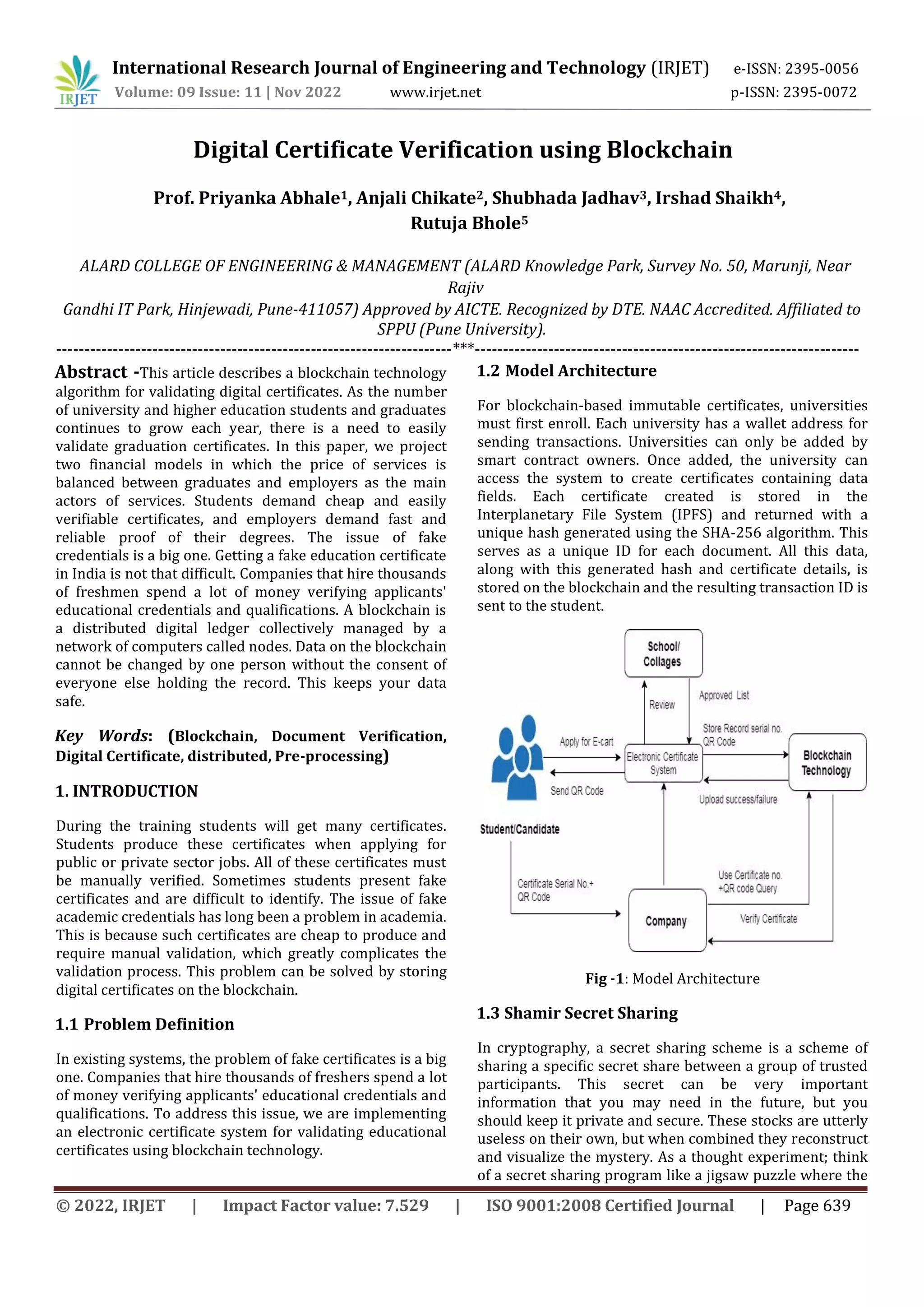
For blockchain-based immutable certificates, universities
must first enroll. Each university has a wallet address for
sending transactions. Universities can only be added by
smart contract owners. Once added, the university can
access the system to create certificates containing data
fields. Each certificate created is stored in the
Interplanetary File System (IPFS) and returned with a
unique hash generated using the SHA-256 algorithm. This
serves as a unique ID for each document. All this data,
along with this generated hash and certificate details, is
stored on the blockchain and the resulting transaction ID is
sent to the student.
Fig -1: Model Architecture
1.3 Shamir Secret Sharing
In cryptography, a secret sharing scheme is a scheme of
sharing a specific secret share between a group of trusted
participants. This secret can be very important
information that you may need in the future, but you
should keep it private and secure. These stocks are utterly
useless on their own, but when combined they reconstruct
and visualize the mystery. As a thought experiment; think
of a secret sharing program like a jigsaw puzzle where the
International Research Journal of Engineering and Technology (IRJET) e-ISSN: 2395-0056
Volume: 09 Issue: 11 | Nov 2022 www.irjet.net p-ISSN: 2395-0072
© 2022, IRJET | Impact Factor value: 7.529 | ISO 9001:2008 Certified Journal | Page 640
pieces of the puzzle are divided among her ten players but
completely blank. The image created by the puzzle is
visible only when all the pieces are put together. The goal
is to distribute keys from one geographic location to
multiple locations in order to compromise the system.
1.4 SHA-1(Hash)
SHA-1, or Secure Hash Algorithm 1, is a cryptographic hash
function that takes an input and produces a 160-bit (20-
byte) hash value. This hash value is called the message
digest. This message digest is typically displayed as a 40-
digit hexadecimal number. It is a US federal information
processing standard and was developed by the US National
Security Agency. SHA-1 has been considered insecure since
2005. Browsers from major technology companies such as
Microsoft, Google, Apple, and Mozilla stopped accepting
SHA-1 SSL certificates in 2017.
2. Objectives
The system saves paper, reduces administrative costs,
prevents document counterfeiting, and provides accurate
and reliable digital certificate information. This system
ensures the accuracy, security and immutability of
information. Implement a validation algorithm that can
validate each peer for each access request.
3. Scope of Study
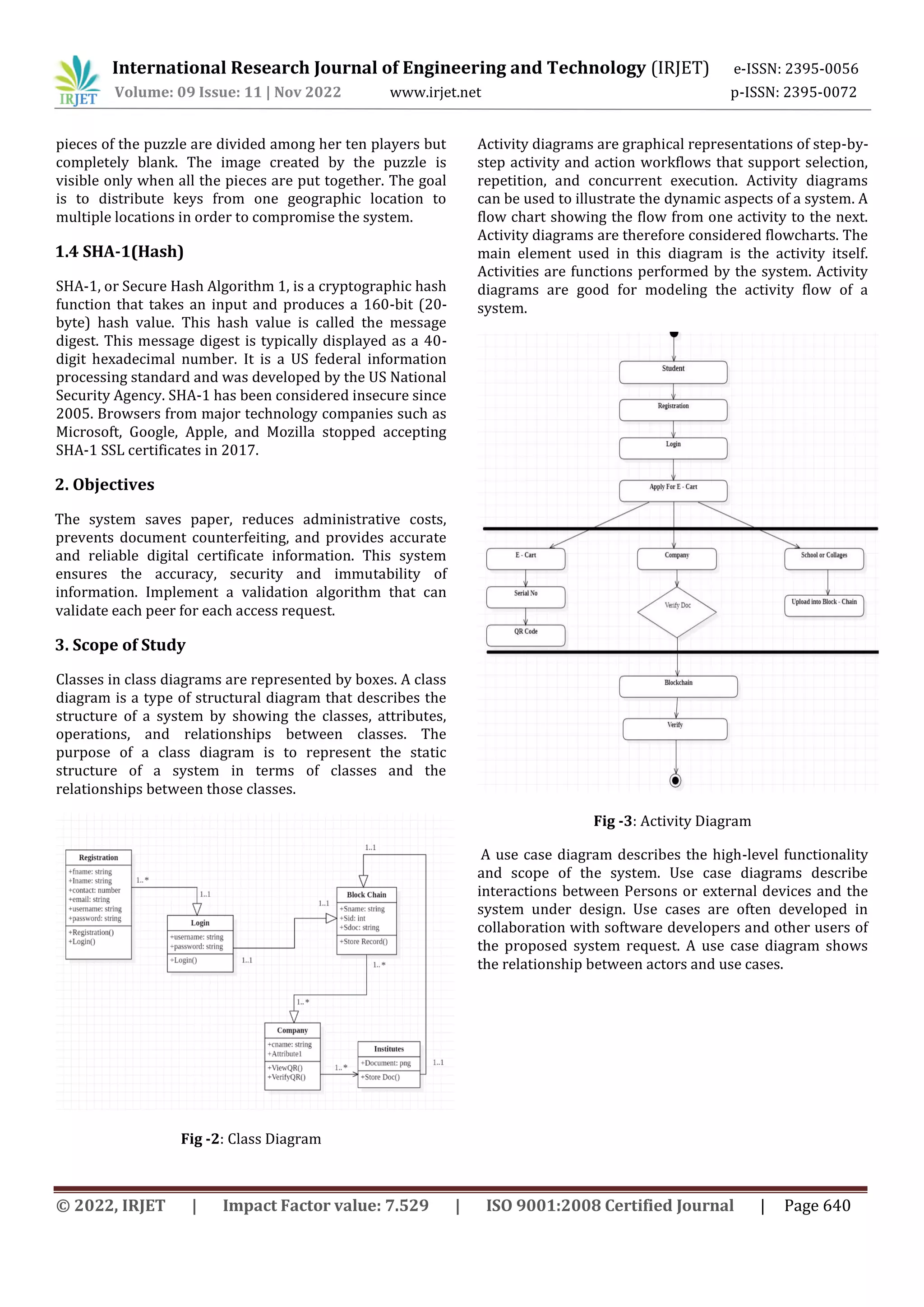
Classes in class diagrams are represented by boxes. A class
diagram is a type of structural diagram that describes the
structure of a system by showing the classes, attributes,
operations, and relationships between classes. The
purpose of a class diagram is to represent the static
structure of a system in terms of classes and the
relationships between those classes.
Fig -2: Class Diagram
Activity diagrams are graphical representations of step-by-
step activity and action workflows that support selection,
repetition, and concurrent execution. Activity diagrams
can be used to illustrate the dynamic aspects of a system. A
flow chart showing the flow from one activity to the next.
Activity diagrams are therefore considered flowcharts. The
main element used in this diagram is the activity itself.
Activities are functions performed by the system. Activity
diagrams are good for modeling the activity flow of a
system.
Fig -3: Activity Diagram
A use case diagram describes the high-level functionality
and scope of the system. Use case diagrams describe
interactions between Persons or external devices and the
system under design. Use cases are often developed in
collaboration with software developers and other users of
the proposed system request. A use case diagram shows
the relationship between actors and use cases.
International Research Journal of Engineering and Technology (IRJET) e-ISSN: 2395-0056
Volume: 09 Issue: 11 | Nov 2022 www.irjet.net p-ISSN: 2395-0072
© 2022, IRJET | Impact Factor value: 7.529 | ISO 9001:2008 Certified Journal | Page 641
Fig -4: Use Case Diagram
4. CONCLUSIONS
In this research, we have successfully investigated how
digital certificate validation works. This model can be used
in enterprise implementations of candidate validation
where candidate certificates are legally validated. The
automatic certificate issuance is open and transparent
within the system. Therefore, a company or organization
can request information about certificates from the
system. The proposed system saves administrative costs,
prevents document forgery, and provides accurate and
reliable digital certificate information.
ACKNOWLEDGEMENT
This document was supported by Alard College of
Engineering & Management, Pune 411057. We would like
to express our sincere gratitude to everyone who gave us
valuable opinions toward the completion of the seminar
report of "Digital Qualification Examination by
Blockchain", which is part of the curriculum of this
seminar. We thank the cooperating departments for
providing valuable support and prerequisites for system
development. We are very grateful to Professor Priyanka
Abhale for guiding us in the right way, giving her time
whenever needed, giving her knowledge and sharing their
experience in carrying out this project. We would like to
thank you for correcting our doubts by providing them.
REFERENCES
[1] Jiin-Chiou Chen, Narn-Yih Lee, Chien Chi, and Yi-Hua
Chen “Blockchain and Smart Contract for Digital
Certificate” Proceedings of IEEE International Conference
on Applied System Innovation 2018 IEEE ICASI 2018-
Meen, Prior & Lam (Eds)
[2] Austin Draper, Aryan Familrouhani, Devin Cao,
Tevisophea Heng, Wenlin Han “Security Applications and
Challenges in Blockchain” Published in IEEE International
Conference on Consumer Electronics (ICCE) 2019
[3] Marco Baldi, Franco Chiaraluce, Emanuele Frontoni,
Giuseppe Gottardi, Daniele Sciarroni and Luca Spalazzi
Certificate “Validation through Public Ledgers and
Blockchains” In Proceedings of the First Italian Conference
on Cybersecurity (ITASEC17) 2017
[4] Neethu Gopal, Vani V Prakash “Survey on Blockchain
Based Digital Certificate System” International Research
Journal of Engineering and Technology (IRJET) Nov 2018
SIGIR Conference on Research and Development in
Information Retrieval, Santiago, Chile ,2015: 959-962.
[5] Glaser, F., & Bezzenberger, L. (2015). Beyond
Cryptocurrencies - A Taxonomy of Decentralized
Consensus Systems. In European Conference on
Information Systems
[6] Pazaitis, A., De Filippi, P. and Kostakis, V. (2017).
Blockchain and Value Systems in the Sharing Economy:
TheIllustrative Case of Back feed. Working Papers in
Technology Governance and Economic Dynamics

Digital Certificate Verification using Blockchain

  • 1.
    International Research Journalof Engineering and Technology (IRJET) e-ISSN: 2395-0056 Volume: 09 Issue: 11 | Nov 2022 www.irjet.net p-ISSN: 2395-0072 © 2022, IRJET | Impact Factor value: 7.529 | ISO 9001:2008 Certified Journal | Page 639 Digital Certificate Verification using Blockchain Prof. Priyanka Abhale1, Anjali Chikate2, Shubhada Jadhav3, Irshad Shaikh4, Rutuja Bhole5 ALARD COLLEGE OF ENGINEERING & MANAGEMENT (ALARD Knowledge Park, Survey No. 50, Marunji, Near Rajiv Gandhi IT Park, Hinjewadi, Pune-411057) Approved by AICTE. Recognized by DTE. NAAC Accredited. Affiliated to SPPU (Pune University). ----------------------------------------------------------------------***-------------------------------------------------------------------- Abstract -This article describes a blockchain technology algorithm for validating digital certificates. As the number of university and higher education students and graduates continues to grow each year, there is a need to easily validate graduation certificates. In this paper, we project two financial models in which the price of services is balanced between graduates and employers as the main actors of services. Students demand cheap and easily verifiable certificates, and employers demand fast and reliable proof of their degrees. The issue of fake credentials is a big one. Getting a fake education certificate in India is not that difficult. Companies that hire thousands of freshmen spend a lot of money verifying applicants' educational credentials and qualifications. A blockchain is a distributed digital ledger collectively managed by a network of computers called nodes. Data on the blockchain cannot be changed by one person without the consent of everyone else holding the record. This keeps your data safe. Key Words: (Blockchain, Document Verification, Digital Certificate, distributed, Pre-processing) 1. INTRODUCTION During the training students will get many certificates. Students produce these certificates when applying for public or private sector jobs. All of these certificates must be manually verified. Sometimes students present fake certificates and are difficult to identify. The issue of fake academic credentials has long been a problem in academia. This is because such certificates are cheap to produce and require manual validation, which greatly complicates the validation process. This problem can be solved by storing digital certificates on the blockchain. 1.1 Problem Definition In existing systems, the problem of fake certificates is a big one. Companies that hire thousands of freshers spend a lot of money verifying applicants' educational credentials and qualifications. To address this issue, we are implementing an electronic certificate system for validating educational certificates using blockchain technology. 1.2 Model Architecture For blockchain-based immutable certificates, universities must first enroll. Each university has a wallet address for sending transactions. Universities can only be added by smart contract owners. Once added, the university can access the system to create certificates containing data fields. Each certificate created is stored in the Interplanetary File System (IPFS) and returned with a unique hash generated using the SHA-256 algorithm. This serves as a unique ID for each document. All this data, along with this generated hash and certificate details, is stored on the blockchain and the resulting transaction ID is sent to the student. Fig -1: Model Architecture 1.3 Shamir Secret Sharing In cryptography, a secret sharing scheme is a scheme of sharing a specific secret share between a group of trusted participants. This secret can be very important information that you may need in the future, but you should keep it private and secure. These stocks are utterly useless on their own, but when combined they reconstruct and visualize the mystery. As a thought experiment; think of a secret sharing program like a jigsaw puzzle where the
  • 2.
    International Research Journalof Engineering and Technology (IRJET) e-ISSN: 2395-0056 Volume: 09 Issue: 11 | Nov 2022 www.irjet.net p-ISSN: 2395-0072 © 2022, IRJET | Impact Factor value: 7.529 | ISO 9001:2008 Certified Journal | Page 640 pieces of the puzzle are divided among her ten players but completely blank. The image created by the puzzle is visible only when all the pieces are put together. The goal is to distribute keys from one geographic location to multiple locations in order to compromise the system. 1.4 SHA-1(Hash) SHA-1, or Secure Hash Algorithm 1, is a cryptographic hash function that takes an input and produces a 160-bit (20- byte) hash value. This hash value is called the message digest. This message digest is typically displayed as a 40- digit hexadecimal number. It is a US federal information processing standard and was developed by the US National Security Agency. SHA-1 has been considered insecure since 2005. Browsers from major technology companies such as Microsoft, Google, Apple, and Mozilla stopped accepting SHA-1 SSL certificates in 2017. 2. Objectives The system saves paper, reduces administrative costs, prevents document counterfeiting, and provides accurate and reliable digital certificate information. This system ensures the accuracy, security and immutability of information. Implement a validation algorithm that can validate each peer for each access request. 3. Scope of Study Classes in class diagrams are represented by boxes. A class diagram is a type of structural diagram that describes the structure of a system by showing the classes, attributes, operations, and relationships between classes. The purpose of a class diagram is to represent the static structure of a system in terms of classes and the relationships between those classes. Fig -2: Class Diagram Activity diagrams are graphical representations of step-by- step activity and action workflows that support selection, repetition, and concurrent execution. Activity diagrams can be used to illustrate the dynamic aspects of a system. A flow chart showing the flow from one activity to the next. Activity diagrams are therefore considered flowcharts. The main element used in this diagram is the activity itself. Activities are functions performed by the system. Activity diagrams are good for modeling the activity flow of a system. Fig -3: Activity Diagram A use case diagram describes the high-level functionality and scope of the system. Use case diagrams describe interactions between Persons or external devices and the system under design. Use cases are often developed in collaboration with software developers and other users of the proposed system request. A use case diagram shows the relationship between actors and use cases.
  • 3.
    International Research Journalof Engineering and Technology (IRJET) e-ISSN: 2395-0056 Volume: 09 Issue: 11 | Nov 2022 www.irjet.net p-ISSN: 2395-0072 © 2022, IRJET | Impact Factor value: 7.529 | ISO 9001:2008 Certified Journal | Page 641 Fig -4: Use Case Diagram 4. CONCLUSIONS In this research, we have successfully investigated how digital certificate validation works. This model can be used in enterprise implementations of candidate validation where candidate certificates are legally validated. The automatic certificate issuance is open and transparent within the system. Therefore, a company or organization can request information about certificates from the system. The proposed system saves administrative costs, prevents document forgery, and provides accurate and reliable digital certificate information. ACKNOWLEDGEMENT This document was supported by Alard College of Engineering & Management, Pune 411057. We would like to express our sincere gratitude to everyone who gave us valuable opinions toward the completion of the seminar report of "Digital Qualification Examination by Blockchain", which is part of the curriculum of this seminar. We thank the cooperating departments for providing valuable support and prerequisites for system development. We are very grateful to Professor Priyanka Abhale for guiding us in the right way, giving her time whenever needed, giving her knowledge and sharing their experience in carrying out this project. We would like to thank you for correcting our doubts by providing them. REFERENCES [1] Jiin-Chiou Chen, Narn-Yih Lee, Chien Chi, and Yi-Hua Chen “Blockchain and Smart Contract for Digital Certificate” Proceedings of IEEE International Conference on Applied System Innovation 2018 IEEE ICASI 2018- Meen, Prior & Lam (Eds) [2] Austin Draper, Aryan Familrouhani, Devin Cao, Tevisophea Heng, Wenlin Han “Security Applications and Challenges in Blockchain” Published in IEEE International Conference on Consumer Electronics (ICCE) 2019 [3] Marco Baldi, Franco Chiaraluce, Emanuele Frontoni, Giuseppe Gottardi, Daniele Sciarroni and Luca Spalazzi Certificate “Validation through Public Ledgers and Blockchains” In Proceedings of the First Italian Conference on Cybersecurity (ITASEC17) 2017 [4] Neethu Gopal, Vani V Prakash “Survey on Blockchain Based Digital Certificate System” International Research Journal of Engineering and Technology (IRJET) Nov 2018 SIGIR Conference on Research and Development in Information Retrieval, Santiago, Chile ,2015: 959-962. [5] Glaser, F., & Bezzenberger, L. (2015). Beyond Cryptocurrencies - A Taxonomy of Decentralized Consensus Systems. In European Conference on Information Systems [6] Pazaitis, A., De Filippi, P. and Kostakis, V. (2017). Blockchain and Value Systems in the Sharing Economy: TheIllustrative Case of Back feed. Working Papers in Technology Governance and Economic Dynamics