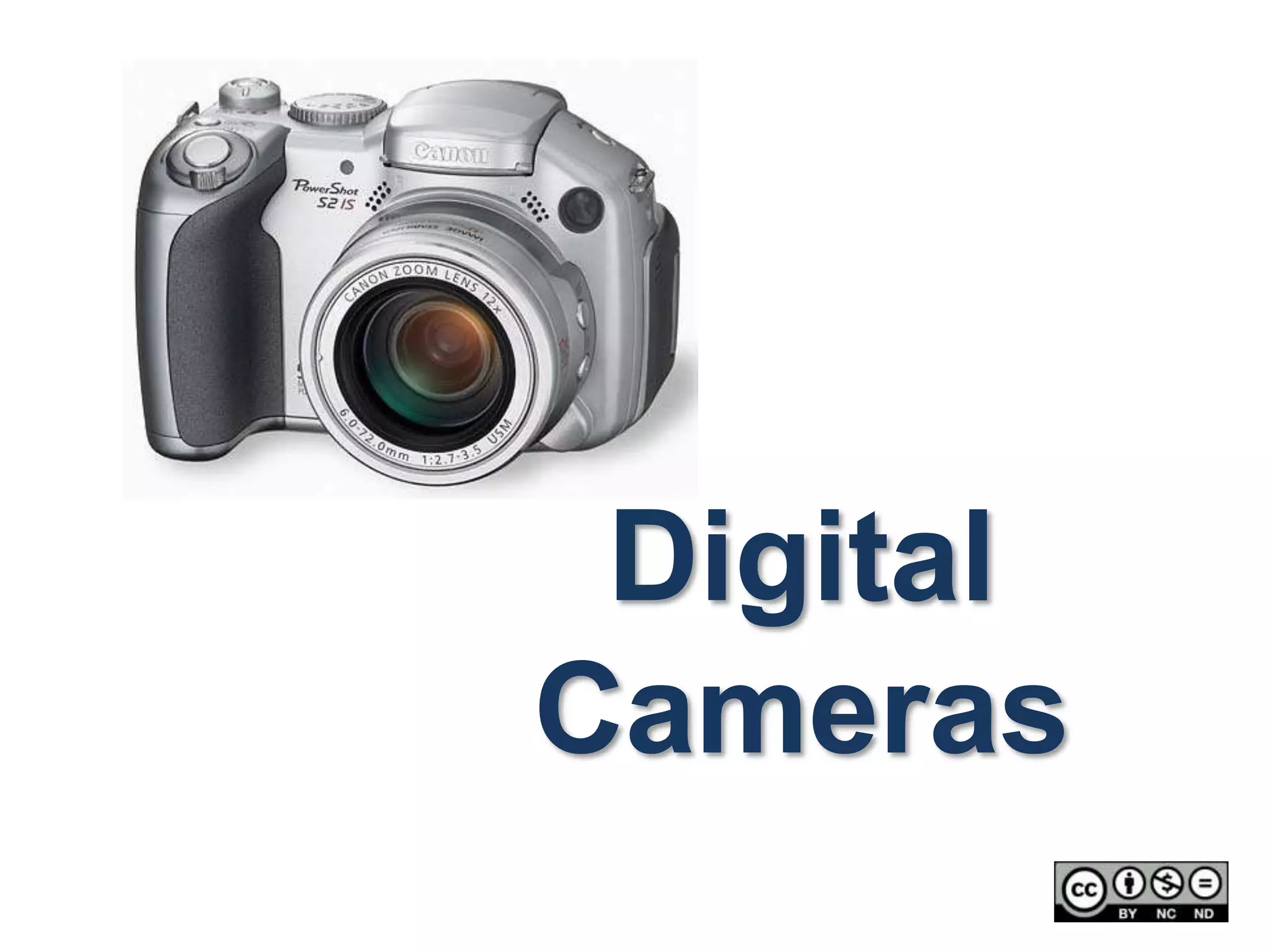
DigitalCameras
Sponsored by 2
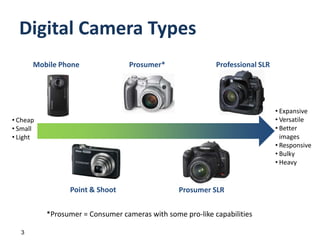
Digital Camera Types3Prosumer*Mobile Phone Professional SLRExpansive
Versatile
Better images
Responsive
Bulky
Heavy
Cheap
Small
LightPoint & ShootProsumer SLR*Prosumer = Consumer cameras with some pro-like capabilities
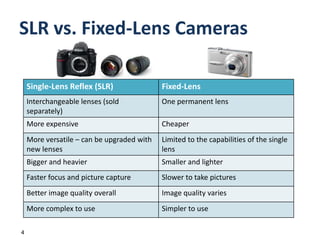
SLR vs. Fixed-Lens Cameras4
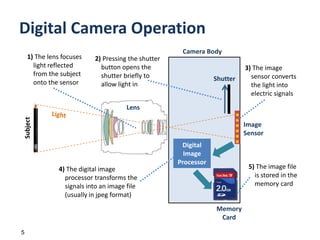
Digital Camera Operation5Camera Body1) The lens focuses light reflected from the subject onto the sensor2) Pressing the shutter button opens the shutter briefly to allow light in3) The image sensor converts the light into electric signalsShutterLensLightImageSensorSubjectDigitalImageProcessor5) The image file is stored in the memory card4) The digital image processor transforms the signals into an image file (usually in jpeg format)MemoryCard
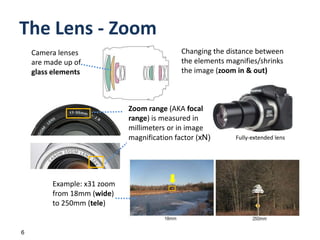
The Lens - Zoom6Changing the distance between the elements magnifies/shrinks the image (zoom in & out) Camera lenses are made up of glass elementsZoom range (AKA focal range) is measured in millimeters or in image magnification factor (xN)Fully-extended lensExample: x31 zoom from 18mm (wide) to 250mm (tele)
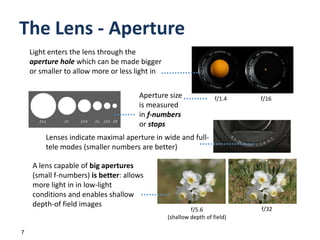
The Lens - Aperture7Light enters the lens through the aperture hole which can be made bigger or smaller to allow more or less light in  Aperture size  is measured in f-numbers or stopsf/1.4f/16Lenses indicate maximal aperture in wide and full-tele modes (smaller numbers are better)A lens capable of big apertures (small f-numbers) isbetter: allows more light in in low-light conditions and enables shallow depth-of field imagesf/32f/5.6 (shallow depth of field)
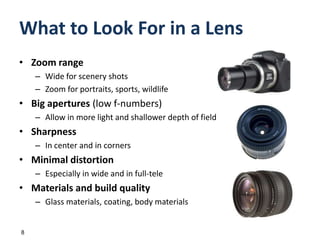
What to Look For in a LensZoom rangeWide for scenery shotsZoom for portraits, sports, wildlife Big apertures (low f-numbers)Allow in more light and shallower depth of fieldSharpnessIn center and in cornersMinimal distortionEspecially in wide and in full-teleMaterials and build qualityGlass materials, coating, body materials8
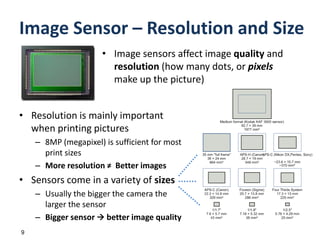
Image Sensor – Resolution and SizeImage sensors affect image quality and resolution (how many dots, or pixels make up the picture) Resolution is mainly important when printing pictures 8MP (megapixel) is sufficient for most print sizes  More resolution ≠  Better imagesSensors come in a variety of sizesUsually the bigger the camera the larger the sensor Bigger sensor  better image quality9
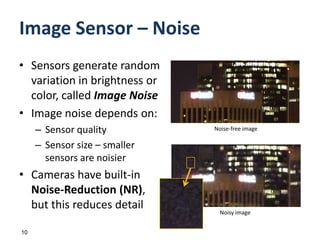
Image Sensor – NoiseSensors generate random variation in brightness or color, called Image NoiseImage noise depends on:Sensor qualitySensor size – smaller sensors are noisier Cameras have built-in Noise-Reduction (NR),but this reduces detail10Noise-free imageNoisy image

Digital Cameras Sponsored

  • 1.
  • 2.
  • 3.
    Digital Camera Types3Prosumer*MobilePhone Professional SLRExpansive
  • 4.
  • 5.
  • 6.
  • 7.
  • 8.
  • 9.
  • 10.
  • 11.
    LightPoint & ShootProsumerSLR*Prosumer = Consumer cameras with some pro-like capabilities
  • 12.
  • 13.
    Digital Camera Operation5CameraBody1) The lens focuses light reflected from the subject onto the sensor2) Pressing the shutter button opens the shutter briefly to allow light in3) The image sensor converts the light into electric signalsShutterLensLightImageSensorSubjectDigitalImageProcessor5) The image file is stored in the memory card4) The digital image processor transforms the signals into an image file (usually in jpeg format)MemoryCard
  • 14.
    The Lens -Zoom6Changing the distance between the elements magnifies/shrinks the image (zoom in & out) Camera lenses are made up of glass elementsZoom range (AKA focal range) is measured in millimeters or in image magnification factor (xN)Fully-extended lensExample: x31 zoom from 18mm (wide) to 250mm (tele)
  • 15.
    The Lens -Aperture7Light enters the lens through the aperture hole which can be made bigger or smaller to allow more or less light in Aperture size is measured in f-numbers or stopsf/1.4f/16Lenses indicate maximal aperture in wide and full-tele modes (smaller numbers are better)A lens capable of big apertures (small f-numbers) isbetter: allows more light in in low-light conditions and enables shallow depth-of field imagesf/32f/5.6 (shallow depth of field)
  • 16.
    What to LookFor in a LensZoom rangeWide for scenery shotsZoom for portraits, sports, wildlife Big apertures (low f-numbers)Allow in more light and shallower depth of fieldSharpnessIn center and in cornersMinimal distortionEspecially in wide and in full-teleMaterials and build qualityGlass materials, coating, body materials8
  • 17.
    Image Sensor –Resolution and SizeImage sensors affect image quality and resolution (how many dots, or pixels make up the picture) Resolution is mainly important when printing pictures 8MP (megapixel) is sufficient for most print sizes More resolution ≠ Better imagesSensors come in a variety of sizesUsually the bigger the camera the larger the sensor Bigger sensor  better image quality9
  • 18.
    Image Sensor –NoiseSensors generate random variation in brightness or color, called Image NoiseImage noise depends on:Sensor qualitySensor size – smaller sensors are noisier Cameras have built-in Noise-Reduction (NR),but this reduces detail10Noise-free imageNoisy image
  • 19.
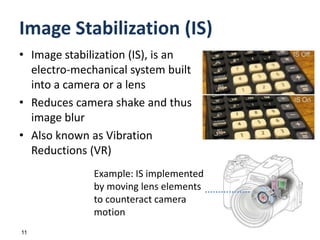
    Image Stabilization (IS)Imagestabilization (IS), is an electro-mechanical system built into a camera or a lens Reduces camera shake and thus image blurAlso known as Vibration Reductions (VR) 11Example: IS implemented by moving lens elements to counteract camera motion
  • 20.
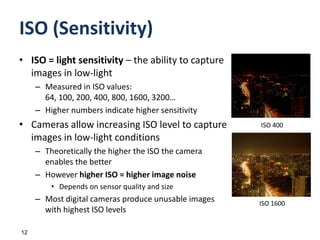
    ISO (Sensitivity)ISO= lightsensitivity – the ability to capture images in low-lightMeasured in ISO values: 64, 100, 200, 400, 800, 1600, 3200…Higher numbers indicate higher sensitivity Cameras allow increasing ISO level to capture images in low-light conditionsTheoretically the higher the ISO the camera enables the betterHowever higher ISO = higher image noiseDepends on sensor quality and sizeMost digital cameras produce unusable images with highest ISO levels12ISO 400ISO 1600
  • 21.
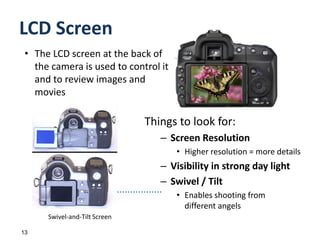
    LCD ScreenThings tolook for:Screen ResolutionHigher resolution = more details Visibility in strong day light Swivel / TiltEnables shooting from different angels13The LCD screen at the back of the camera is used to control it and to review images and moviesSwivel-and-Tilt Screen
  • 22.
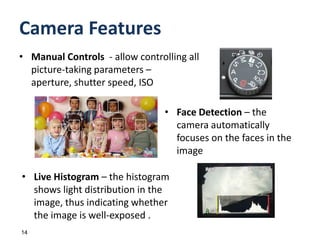
    Camera FeaturesManual Controls - allow controlling all picture-taking parameters – aperture, shutter speed, ISO14Face Detection – the camera automatically focuses on the faces in the image
  • 23.
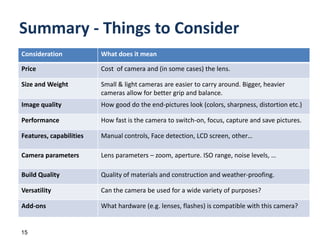
    Live Histogram –the histogram shows light distribution in the image, thus indicating whether the image is well-exposed . Summary - Things to Consider15
  • 24.
  • 25.
    Photo CreditsNight Timeis the Right Time / Jakob Montrasio, http://www.flickr.com/photos/yakobusan/280627593/17
  • 26.
    Legal NoteThis presentationis provided for use under the terms of Creative Commons Attribution-Noncommercial-No Derivative Works 3.0 license.(You may use, distribute, embed and make copies. You may not make commercial use or change. Attribution to the creators is required)18