MUHAMAD QHAIRUL AQMAL BIN ROSMIN 
AND 
JOSHUA FERNANDEZ 
PRESENTING :
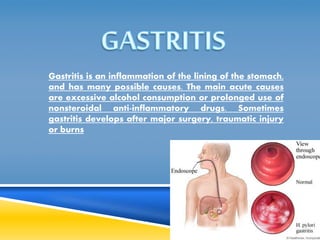
Gastritis is an inflammation of the lining of the stomach, 
and has many possible causes. The main acute causes 
are excessive alcohol consumption or prolonged use of 
nonsteroidal anti-inflammatory drugs. Sometimes 
gastritis develops after major surgery, traumatic injury 
or burns
SIGNS AND SYMPTOMS 
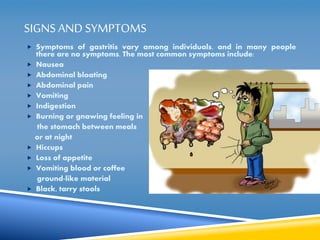
 Symptoms of gastritis vary among individuals, and in many people 
there are no symptoms. The most common symptoms include: 
 Nausea 
 Abdominal bloating 
 Abdominal pain 
 Vomiting 
 Indigestion 
 Burning or gnawing feeling in 
the stomach between meals 
or at night 
 Hiccups 
 Loss of appetite 
 Vomiting blood or coffee 
ground-like material 
 Black, tarry stools
PREVENTION 
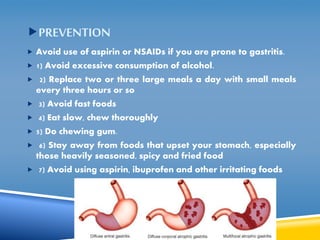
 Avoid use of aspirin or NSAIDs if you are prone to gastritis. 
 1) Avoid excessive consumption of alcohol. 
 2) Replace two or three large meals a day with small meals 
every three hours or so 
 3) Avoid fast foods 
 4) Eat slow, chew thoroughly 
 5) Do chewing gum. 
 6) Stay away from foods that upset your stomach, especially 
those heavily seasoned, spicy and fried food 
 7) Avoid using aspirin, ibuprofen and other irritating foods
TREATMENT 
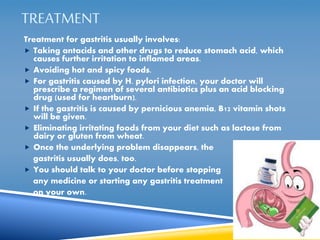
Treatment for gastritis usually involves: 
 Taking antacids and other drugs to reduce stomach acid, which 
causes further irritation to inflamed areas. 
 Avoiding hot and spicy foods. 
 For gastritis caused by H. pylori infection, your doctor will 
prescribe a regimen of several antibiotics plus an acid blocking 
drug (used for heartburn). 
 If the gastritis is caused by pernicious anemia, B12 vitamin shots 
will be given. 
 Eliminating irritating foods from your diet such as lactose from 
dairy or gluten from wheat. 
 Once the underlying problem disappears, the 
gastritis usually does, too. 
 You should talk to your doctor before stopping 
any medicine or starting any gastritis treatment 
on your own.
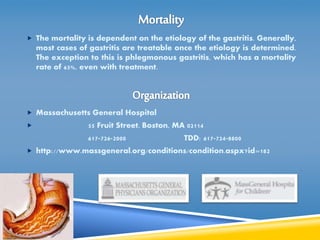
 The mortality is dependent on the etiology of the gastritis. Generally, 
most cases of gastritis are treatable once the etiology is determined. 
The exception to this is phlegmonous gastritis, which has a mortality 
rate of 65%, even with treatment. 
 Massachusetts General Hospital 
 55 Fruit Street, Boston, MA 02114 
617-726-2000 TDD: 617-724-8800 
 http://www.massgeneral.org/conditions/condition.aspx?id=182
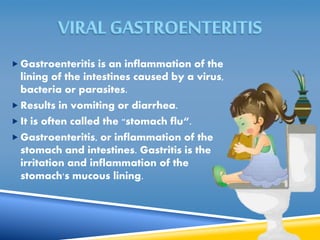
 Gastroenteritis is an inflammation of the 
lining of the intestines caused by a virus, 
bacteria or parasites. 
Results in vomiting or diarrhea. 
 It is often called the "stomach flu“. 
 Gastroenteritis, or inflammation of the 
stomach and intestines. Gastritis is the 
irritation and inflammation of the 
stomach's mucous lining.
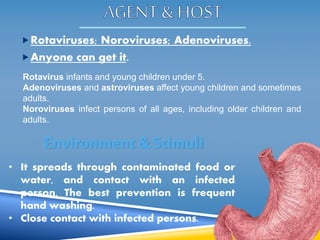
Rotaviruses; Noroviruses; Adenoviruses. 
Anyone can get it. 
Rotavirus infants and young children under 5. 
Adenoviruses and astroviruses affect young children and sometimes 
adults. 
Noroviruses infect persons of all ages, including older children and 
adults. 
• It spreads through contaminated food or 
water, and contact with an infected 
person. The best prevention is frequent 
hand washing. 
• Close contact with infected persons.
• Frequent hand washing and disinfection. Rotavirus gastroenteritis 
can also be prevented by vaccines. 
• Watery diarrhea and vomiting. 
• Headache, fever, and stomach ache. 
• Symptoms begin 1 to 2 days following infection, and may last for 1 
to 10 days, depending on the virus. 
By a physician on the 
basis of the symptoms 
and medical 
examination. 
Rotavirus infection can 
be diagnosed by 
laboratory testing of a 
stool specimen. 
Prevent severe loss of 
fluids (dehydration) by 
taking fluids. 
Medications should be 
avoided unless 
recommended by a 
physician.
People who died from gastroenteritis has more than 
doubled from 1999 to 2007. The death rate from almost 
7,000 to over 17,000 per year. Viral gastroenteritis is the 
second most common illness in the U.S. (Centers for Disease 
Control and Prevention) 
NIDDK 
National institute of diabetes and digestive and kidney diseases (also 
information in Spanish) 
http://www2.niddk.nih.gov/
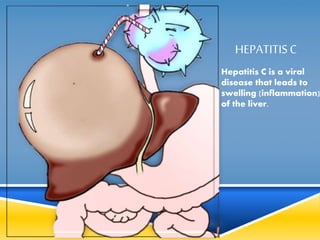
HEPATITIS C 
Hepatitis C is a viral 
disease that leads to 
swelling (inflammation) 
of the liver.
CAUSES 
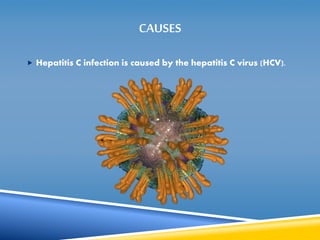
 Hepatitis C infection is caused by the hepatitis C virus (HCV).
SIGNS AND SYMPTOMS 
Hepatitis C infection usually produces no signs or symptoms during 
its earliest stages. When signs and symptoms do occur, they're 
generally mild and flu-like and may include: 
• Fatigue 
• Fever 
• Nausea or poor appetite 
• Muscle and joint pains 
• Tenderness in the area of your liver 
• Individuals at high risk for 
infection. 
• Children born to chronically 
infected mothers 
• People who received blood, blood 
products, or transplanted organs 
prior to 1992 
• Persons with abnormal levels of 
liver enzymes in the blood 
• Testing is recommended when 
exposure to the virus is 
suspected.
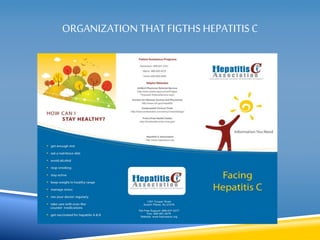
ORGANIZATION THAT FIGTHS HEPATITIS C
WILSON’S DISEASE 
Wilson's disease is named after Samuel 
Alexander Kinnier Wilson (1878–1937), the 
British neurologist who first described 
the condition in 1912
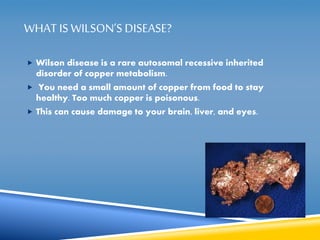
WHAT IS WILSON’S DISEASE? 
 Wilson disease is a rare autosomal recessive inherited 
disorder of copper metabolism. 
 You need a small amount of copper from food to stay 
healthy. Too much copper is poisonous. 
 This can cause damage to your brain, liver, and eyes.
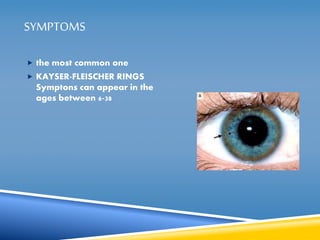
SYMPTOMS 
 the most common one 
 KAYSER-FLEISCHER RINGS 
Symptons can appear in the 
ages between 6-38
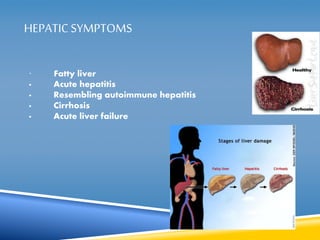
HEPATIC SYMPTOMS 
· Fatty liver 
· Acute hepatitis 
· Resembling autoimmune hepatitis 
· Cirrhosis 
· Acute liver failure
NEUROLOGICAL AND PSYCHIATRIC 
SYMPTOMS 
 Movement disorders (tremor, involuntary movements 
 Dysautonomia 
 Migraine headaches 
 Insomnia 
 Seizures 
 Depresion 
 Psychosis 
 Personality changes 
 Neurotic behaviours
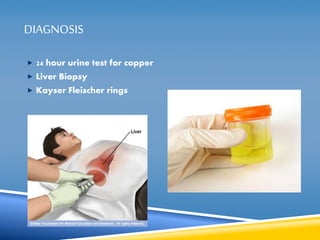
DIAGNOSIS 
 24 hour urine test for copper 
 Liver Biopsy 
 Kayser Fleischer rings
TREATMENT 
 Wilson disease is a very treatable condition. With proper 
therapy, disease progress can be halted and oftentimes 
symptoms can be improved. Treatment is aimed at removing 
excess accumulated copper and preventing its accumulation. 
Treatment for Wilson disease is a lifelong process. Patients may 
become progressively sicker from day to day, so immediate 
treatment can be critical. Treatment delays may cause 
irreversible damage.
REFERENCES 
• Ghany MG, Strader DB, Thomas DL, Seeff LB. American Association 
for the Study of Liver Diseases. Diagnosis, management, and 
treatment of hepatitis C: an update. Hepatology. 2009;49:1335-1374. 
• Jou JH, Muir AJ. In the clinic. Hepatitis C. Ann Intern Med. 
2008;148:ITC6-1-ITC6-16. 
• O'Leary JG, Davis GL. Hepatitis C. In: Feldman M, Friedman LS, 
Brandt LJ, eds. Sleisenger and Fordtran's Gastrointestinal and Liver 
Disease. 9th ed. Philadelphia, Pa: Saunders Elsevier; 2010:chap 79. 
• Rosen HR. Clinical practice. Chronic hepatitis C infection.N Engl J Med. 
2011 Jun 23;364(25):2429-38. 
• http://articles.latimes.com/2012/feb/21/news/la-heb-hepatitis-c-hiv-deaths- 
20120221 
• http://www.cdc.gov/ncidod/dvrd/revb/gastro/faq.htm 
• http://www.medicalnewstoday.com/articles/243036.php 
• http://www.nlm.nih.gov/medlineplus/gastroenteritis.html

Digestive system disease

  • 1.
    MUHAMAD QHAIRUL AQMALBIN ROSMIN AND JOSHUA FERNANDEZ PRESENTING :
  • 3.
    Gastritis is aninflammation of the lining of the stomach, and has many possible causes. The main acute causes are excessive alcohol consumption or prolonged use of nonsteroidal anti-inflammatory drugs. Sometimes gastritis develops after major surgery, traumatic injury or burns
  • 4.
    SIGNS AND SYMPTOMS  Symptoms of gastritis vary among individuals, and in many people there are no symptoms. The most common symptoms include:  Nausea  Abdominal bloating  Abdominal pain  Vomiting  Indigestion  Burning or gnawing feeling in the stomach between meals or at night  Hiccups  Loss of appetite  Vomiting blood or coffee ground-like material  Black, tarry stools
  • 5.
    PREVENTION  Avoiduse of aspirin or NSAIDs if you are prone to gastritis.  1) Avoid excessive consumption of alcohol.  2) Replace two or three large meals a day with small meals every three hours or so  3) Avoid fast foods  4) Eat slow, chew thoroughly  5) Do chewing gum.  6) Stay away from foods that upset your stomach, especially those heavily seasoned, spicy and fried food  7) Avoid using aspirin, ibuprofen and other irritating foods
  • 6.
    TREATMENT Treatment forgastritis usually involves:  Taking antacids and other drugs to reduce stomach acid, which causes further irritation to inflamed areas.  Avoiding hot and spicy foods.  For gastritis caused by H. pylori infection, your doctor will prescribe a regimen of several antibiotics plus an acid blocking drug (used for heartburn).  If the gastritis is caused by pernicious anemia, B12 vitamin shots will be given.  Eliminating irritating foods from your diet such as lactose from dairy or gluten from wheat.  Once the underlying problem disappears, the gastritis usually does, too.  You should talk to your doctor before stopping any medicine or starting any gastritis treatment on your own.
  • 7.
     The mortalityis dependent on the etiology of the gastritis. Generally, most cases of gastritis are treatable once the etiology is determined. The exception to this is phlegmonous gastritis, which has a mortality rate of 65%, even with treatment.  Massachusetts General Hospital  55 Fruit Street, Boston, MA 02114 617-726-2000 TDD: 617-724-8800  http://www.massgeneral.org/conditions/condition.aspx?id=182
  • 8.
     Gastroenteritis isan inflammation of the lining of the intestines caused by a virus, bacteria or parasites. Results in vomiting or diarrhea.  It is often called the "stomach flu“.  Gastroenteritis, or inflammation of the stomach and intestines. Gastritis is the irritation and inflammation of the stomach's mucous lining.
  • 9.
    Rotaviruses; Noroviruses; Adenoviruses. Anyone can get it. Rotavirus infants and young children under 5. Adenoviruses and astroviruses affect young children and sometimes adults. Noroviruses infect persons of all ages, including older children and adults. • It spreads through contaminated food or water, and contact with an infected person. The best prevention is frequent hand washing. • Close contact with infected persons.
  • 10.
    • Frequent handwashing and disinfection. Rotavirus gastroenteritis can also be prevented by vaccines. • Watery diarrhea and vomiting. • Headache, fever, and stomach ache. • Symptoms begin 1 to 2 days following infection, and may last for 1 to 10 days, depending on the virus. By a physician on the basis of the symptoms and medical examination. Rotavirus infection can be diagnosed by laboratory testing of a stool specimen. Prevent severe loss of fluids (dehydration) by taking fluids. Medications should be avoided unless recommended by a physician.
  • 11.
    People who diedfrom gastroenteritis has more than doubled from 1999 to 2007. The death rate from almost 7,000 to over 17,000 per year. Viral gastroenteritis is the second most common illness in the U.S. (Centers for Disease Control and Prevention) NIDDK National institute of diabetes and digestive and kidney diseases (also information in Spanish) http://www2.niddk.nih.gov/
  • 12.
    HEPATITIS C HepatitisC is a viral disease that leads to swelling (inflammation) of the liver.
  • 13.
    CAUSES  HepatitisC infection is caused by the hepatitis C virus (HCV).
  • 14.
    SIGNS AND SYMPTOMS Hepatitis C infection usually produces no signs or symptoms during its earliest stages. When signs and symptoms do occur, they're generally mild and flu-like and may include: • Fatigue • Fever • Nausea or poor appetite • Muscle and joint pains • Tenderness in the area of your liver • Individuals at high risk for infection. • Children born to chronically infected mothers • People who received blood, blood products, or transplanted organs prior to 1992 • Persons with abnormal levels of liver enzymes in the blood • Testing is recommended when exposure to the virus is suspected.
  • 17.
  • 18.
    WILSON’S DISEASE Wilson'sdisease is named after Samuel Alexander Kinnier Wilson (1878–1937), the British neurologist who first described the condition in 1912
  • 19.
    WHAT IS WILSON’SDISEASE?  Wilson disease is a rare autosomal recessive inherited disorder of copper metabolism.  You need a small amount of copper from food to stay healthy. Too much copper is poisonous.  This can cause damage to your brain, liver, and eyes.
  • 20.
    SYMPTOMS  themost common one  KAYSER-FLEISCHER RINGS Symptons can appear in the ages between 6-38
  • 21.
    HEPATIC SYMPTOMS ·Fatty liver · Acute hepatitis · Resembling autoimmune hepatitis · Cirrhosis · Acute liver failure
  • 22.
    NEUROLOGICAL AND PSYCHIATRIC SYMPTOMS  Movement disorders (tremor, involuntary movements  Dysautonomia  Migraine headaches  Insomnia  Seizures  Depresion  Psychosis  Personality changes  Neurotic behaviours
  • 23.
    DIAGNOSIS  24hour urine test for copper  Liver Biopsy  Kayser Fleischer rings
  • 24.
    TREATMENT  Wilsondisease is a very treatable condition. With proper therapy, disease progress can be halted and oftentimes symptoms can be improved. Treatment is aimed at removing excess accumulated copper and preventing its accumulation. Treatment for Wilson disease is a lifelong process. Patients may become progressively sicker from day to day, so immediate treatment can be critical. Treatment delays may cause irreversible damage.
  • 25.
    REFERENCES • GhanyMG, Strader DB, Thomas DL, Seeff LB. American Association for the Study of Liver Diseases. Diagnosis, management, and treatment of hepatitis C: an update. Hepatology. 2009;49:1335-1374. • Jou JH, Muir AJ. In the clinic. Hepatitis C. Ann Intern Med. 2008;148:ITC6-1-ITC6-16. • O'Leary JG, Davis GL. Hepatitis C. In: Feldman M, Friedman LS, Brandt LJ, eds. Sleisenger and Fordtran's Gastrointestinal and Liver Disease. 9th ed. Philadelphia, Pa: Saunders Elsevier; 2010:chap 79. • Rosen HR. Clinical practice. Chronic hepatitis C infection.N Engl J Med. 2011 Jun 23;364(25):2429-38. • http://articles.latimes.com/2012/feb/21/news/la-heb-hepatitis-c-hiv-deaths- 20120221 • http://www.cdc.gov/ncidod/dvrd/revb/gastro/faq.htm • http://www.medicalnewstoday.com/articles/243036.php • http://www.nlm.nih.gov/medlineplus/gastroenteritis.html