XII – Maths 90
CHAPTER 9
DIFFERENTIAL EQUATIONS
POINTS TO REMEMBER
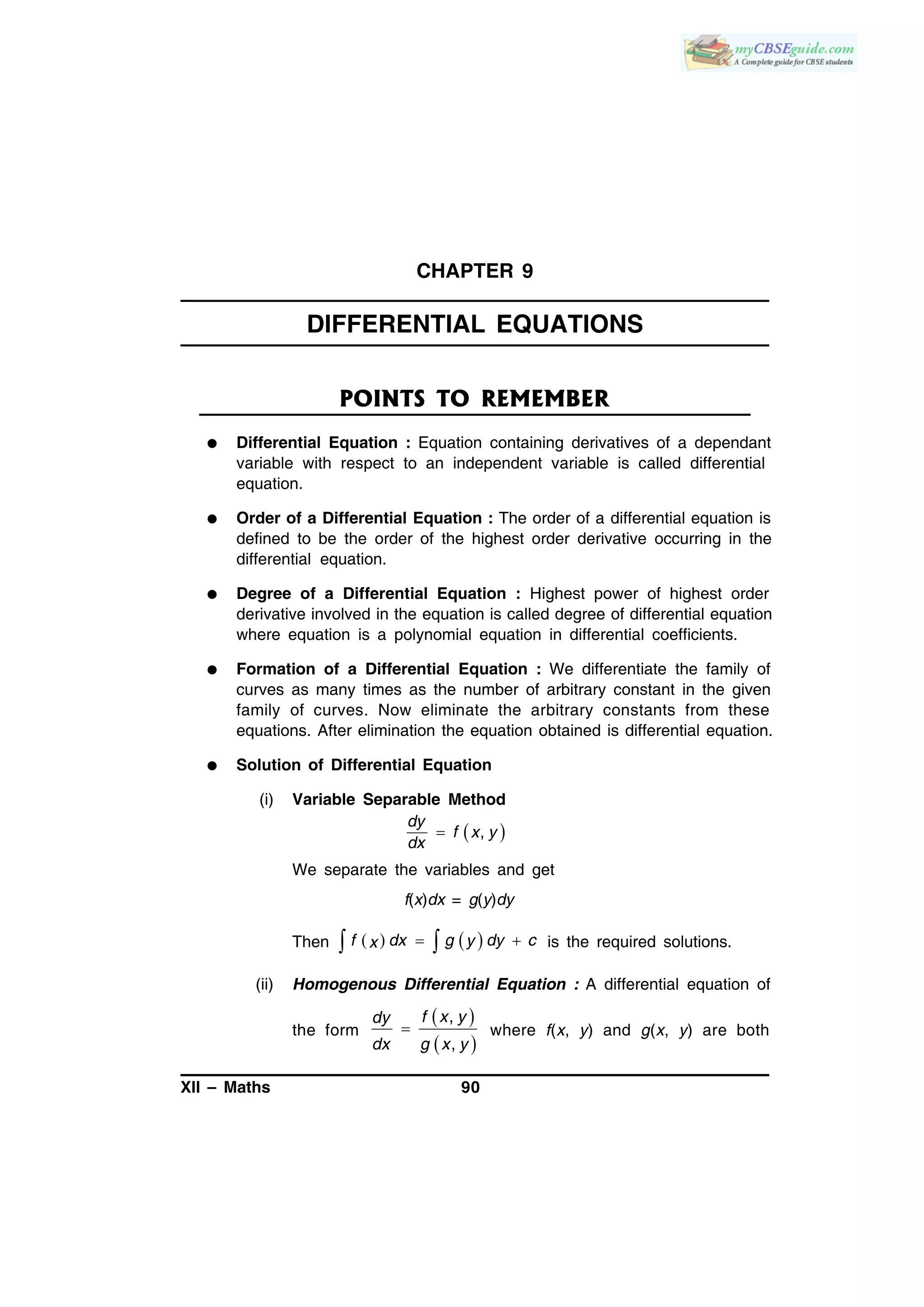
 Differential Equation : Equation containing derivatives of a dependant
variable with respect to an independent variable is called differential
equation.
 Order of a Differential Equation : The order of a differential equation is
defined to be the order of the highest order derivative occurring in the
differential equation.
 Degree of a Differential Equation : Highest power of highest order
derivative involved in the equation is called degree of differential equation
where equation is a polynomial equation in differential coefficients.
 Formation of a Differential Equation : We differentiate the family of
curves as many times as the number of arbitrary constant in the given
family of curves. Now eliminate the arbitrary constants from these
equations. After elimination the equation obtained is differential equation.
 Solution of Differential Equation
(i) Variable Separable Method
 ,
dy
f x y
dx
We separate the variables and get
f(x)dx = g(y)dy
Then    f dx g dy cyx    is the required solutions.
(ii) Homogenous Differential Equation : A differential equation of
the form
 
 
,
,
f x ydy
dx g x y
 where f(x, y) and g(x, y) are both
91 XII – Maths
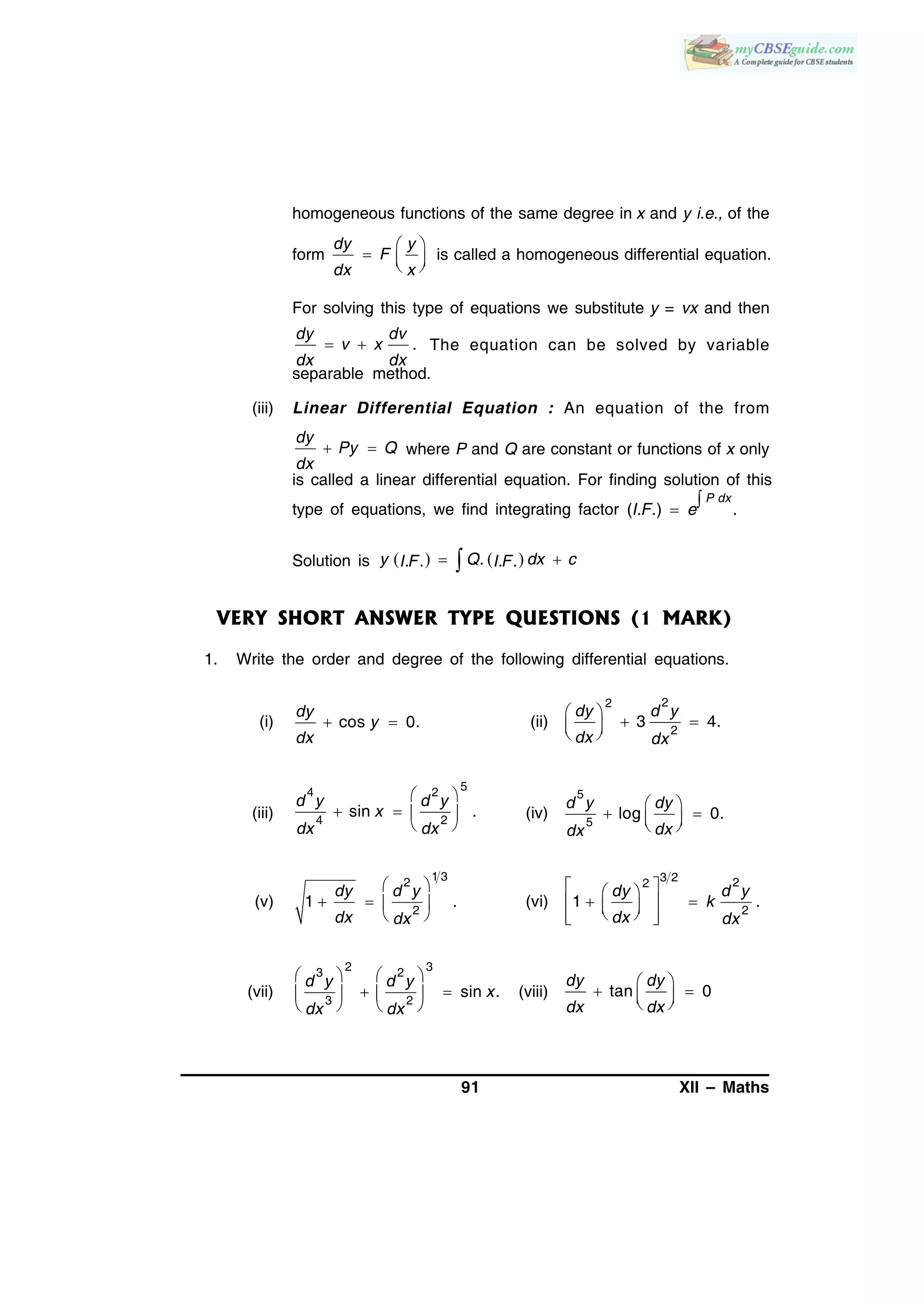
homogeneous functions of the same degree in x and y i.e., of the
form
dy y
F
dx x
 
   
is called a homogeneous differential equation.
For solving this type of equations we substitute y = vx and then
. 
dy dv
v x
dx dx
The equation can be solved by variable
separable method.
(iii) Linear Differential Equation : An equation of the from
dy
Py Q
dx
  where P and Q are constant or functions of x only
is called a linear differential equation. For finding solution of this
type of equations, we find integrating factor ( . .) .
P dx
I F e

Solution is    .. . . . y Q dx cI F I F
VERY SHORT ANSWER TYPE QUESTIONS (1 MARK)
1. Write the order and degree of the following differential equations.
(i) cos 0.
dy
y
dx
  (ii)
22
2
3 4.
dy d y
dx dx
 
   
(iii)
54 2
4 2
sin .
d y d y
x
dx dx
 
   
 
(iv)
5
5
log 0.
d y dy
dxdx
 
   
(v)
1 32
2
1 .
dy d y
dx dx
 
   
 
(vi)
  
      
3 2 22
2
1 .
dy d y
k
dx dx
(vii)
2 33 2
3 2
sin .
d y d y
x
dx dx
   
    
   
(viii) tan 0
 
   
dy dy
dx dx
XII – Maths 92
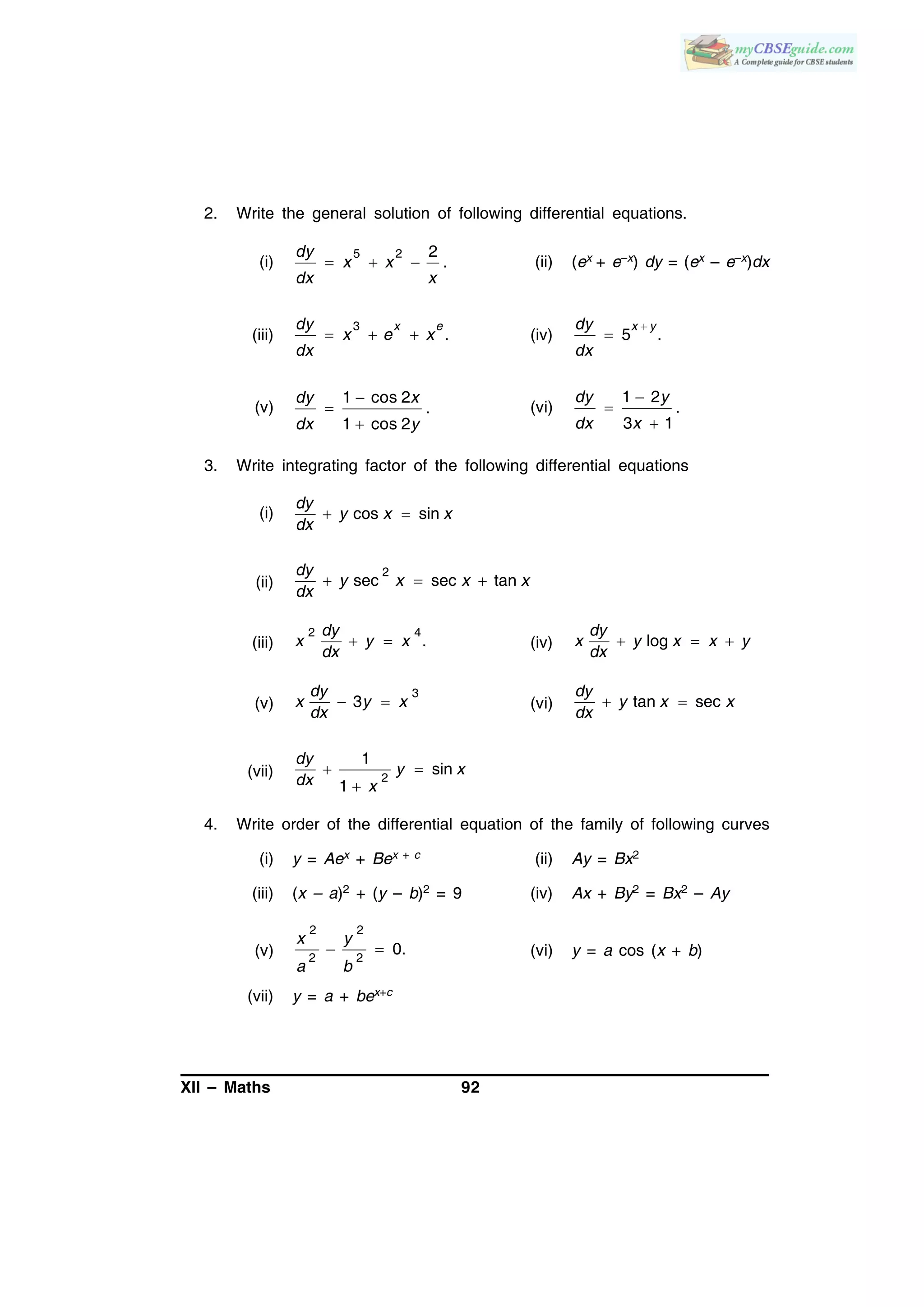
2. Write the general solution of following differential equations.
(i)
5 2 2
.
dy
x x
dx x
   (ii) (ex + e–x) dy = (ex – e–x)dx
(iii)
3
.
x edy
x e x
dx
   (iv) 5 .
x ydy
dx


(v)
1 cos 2
.
1 cos 2
dy x
dx y



(vi)
1 2
.
3 1
dy y
dx x



3. Write integrating factor of the following differential equations
(i) cos sin
dy
y x x
dx
 
(ii)
2
sec sec tan
dy
y x x x
dx
  
(iii)
2 4
.
dy
x y x
dx
  (iv) log
dy
x y x x y
dx
  
(v)
3
3
dy
x y x
dx
  (vi) tan sec
dy
y x x
dx
 
(vii) 2
1
sin
1
 

dy
y x
dx x
4. Write order of the differential equation of the family of following curves
(i) y = Aex + Bex + c (ii) Ay = Bx2
(iii) (x – a)2 + (y – b)2 = 9 (iv) Ax + By2 = Bx2 – Ay
(v)
2 2
2 2
0. 
x y
a b
(vi) y = a cos (x + b)
(vii) y = a + bex+c
93 XII – Maths
SHORT ANSWER TYPE QUESTIONS (4 MARKS)
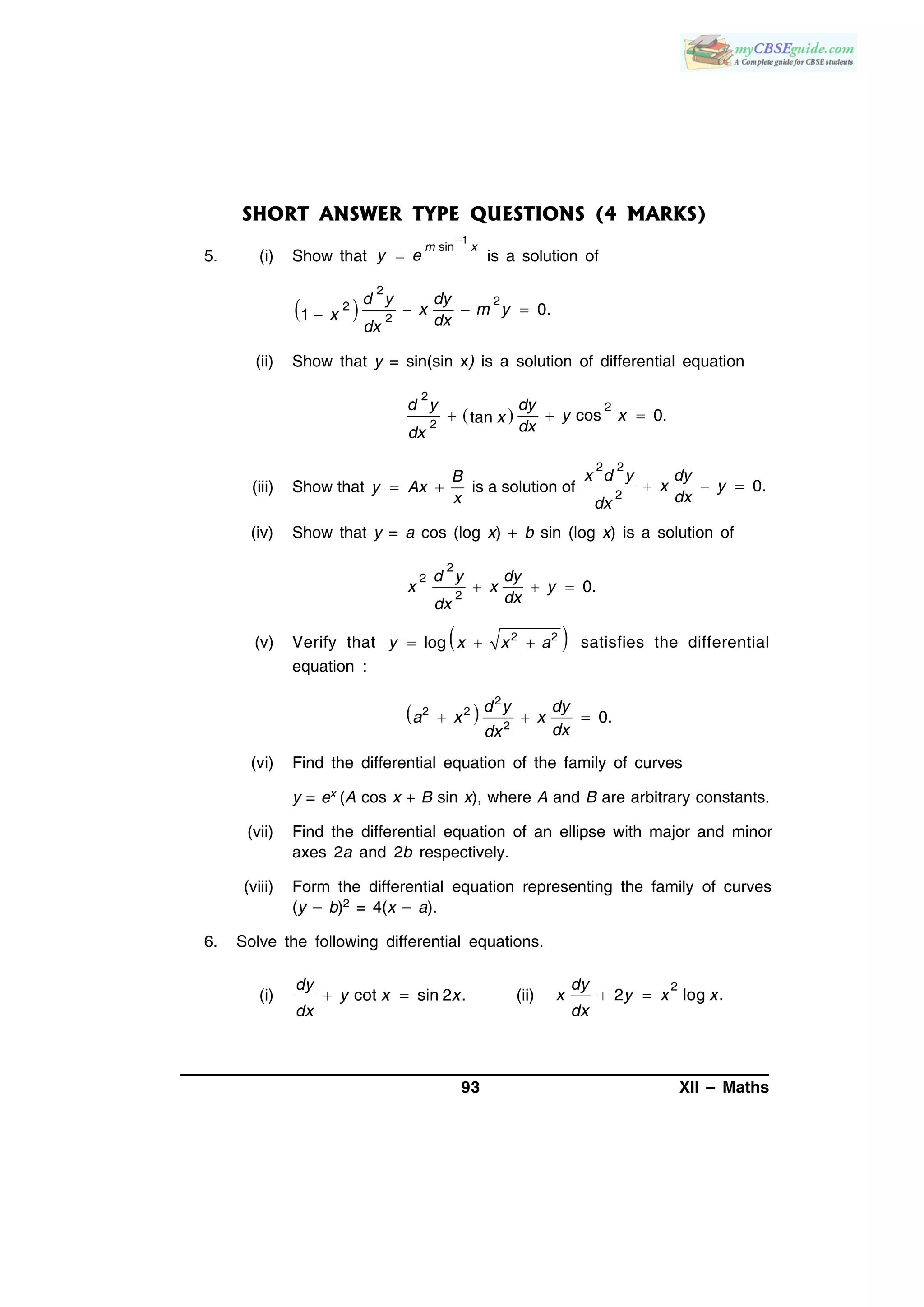
5. (i) Show that
1
sinm x
y e

 is a solution of
 
2
22
2
0.1
d y dy
x m yx dxdx
  
(ii) Show that y = sin(sin x) is a solution of differential equation
 
2
2
2
cos 0.tan  
d y dy
y xx
dxdx
(iii) Show that  
B
y Ax
x
is a solution of
2 2
2
0.
x d y dy
x y
dxdx
  
(iv) Show that y = a cos (log x) + b sin (log x) is a solution of
2
2
2
0.
d y dy
x x y
dxdx
  
(v) Verify that  2 2
logy x x a   satisfies the differential
equation :
 
2
2 2
2
0.
d y dy
a x x
dxdx
  
(vi) Find the differential equation of the family of curves
y = ex (A cos x + B sin x), where A and B are arbitrary constants.
(vii) Find the differential equation of an ellipse with major and minor
axes 2a and 2b respectively.
(viii) Form the differential equation representing the family of curves
(y – b)2 = 4(x – a).
6. Solve the following differential equations.
(i) cot sin 2 .
dy
y x x
dx
  (ii)
2
2 log .
dy
x y x x
dx
 
XII – Maths 94
(iii)
1 sin
. cos , 0.
dx x
y x x
dy x x
   
(iv)
3
cos cos sin .
dy
x x x
dx
 
(v)  3
0  ydx x y dy
(vi)  3
2 
y y
ye dx y xe dy
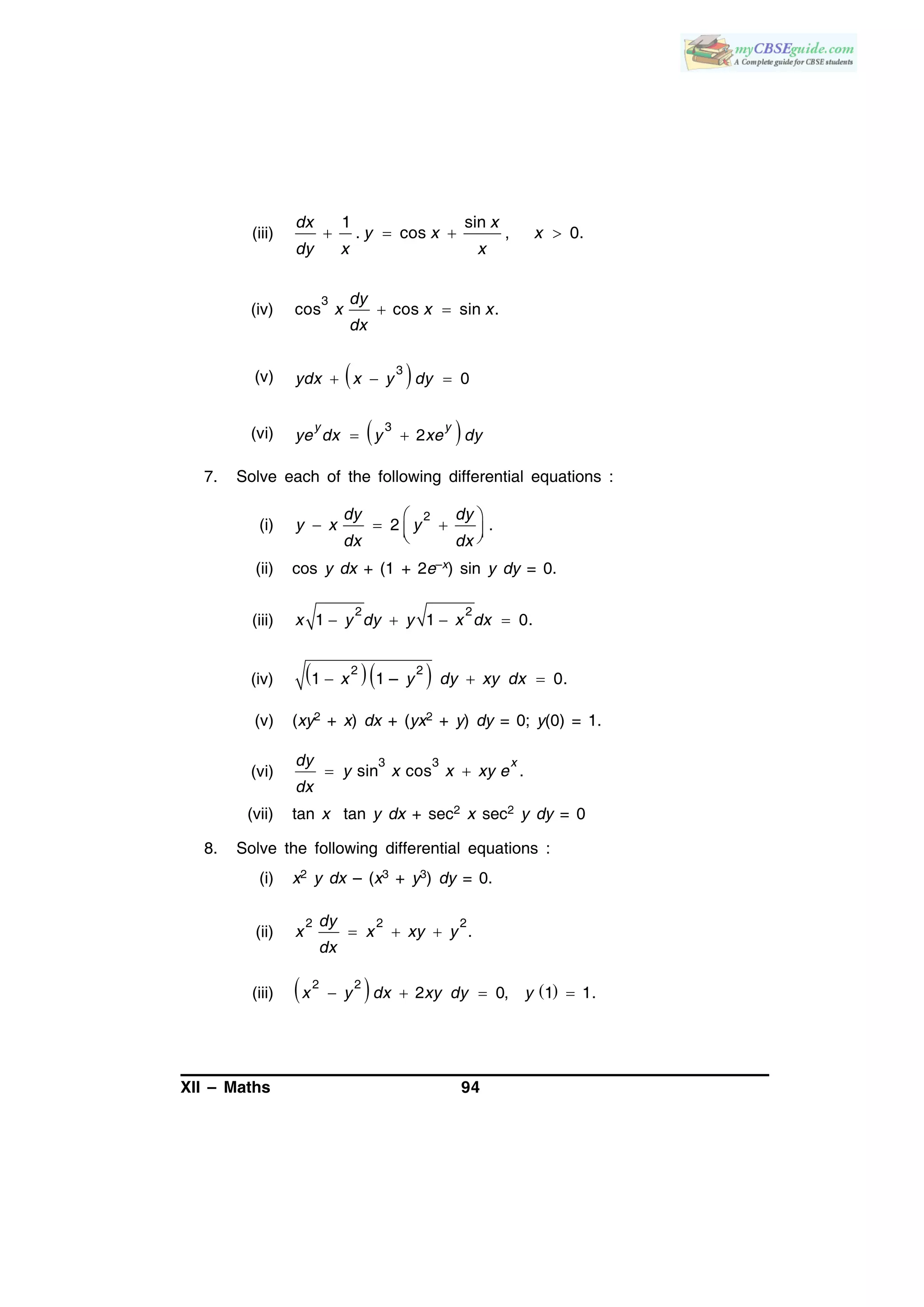
7. Solve each of the following differential equations :
(i)
2
2 .
dy dy
y x y
dx dx
 
    
(ii) cos y dx + (1 + 2e–x) sin y dy = 0.
(iii)
2 2
1 1 0.x y dy y x dx   
(iv)   2 2
1 1 – 0.x y dy xy dx  
(v) (xy2 + x) dx + (yx2 + y) dy = 0; y(0) = 1.
(vi)
3 3
sin cos .
xdy
y x x xy e
dx
 
(vii) tan x tan y dx + sec2 x sec2 y dy = 0
8. Solve the following differential equations :
(i) x2 y dx – (x3 + y3) dy = 0.
(ii)
2 2 2
.
dy
x x xy y
dx
  
(iii)    2 2
2 0, 1 1.x y dx xy dy y   
95 XII – Maths
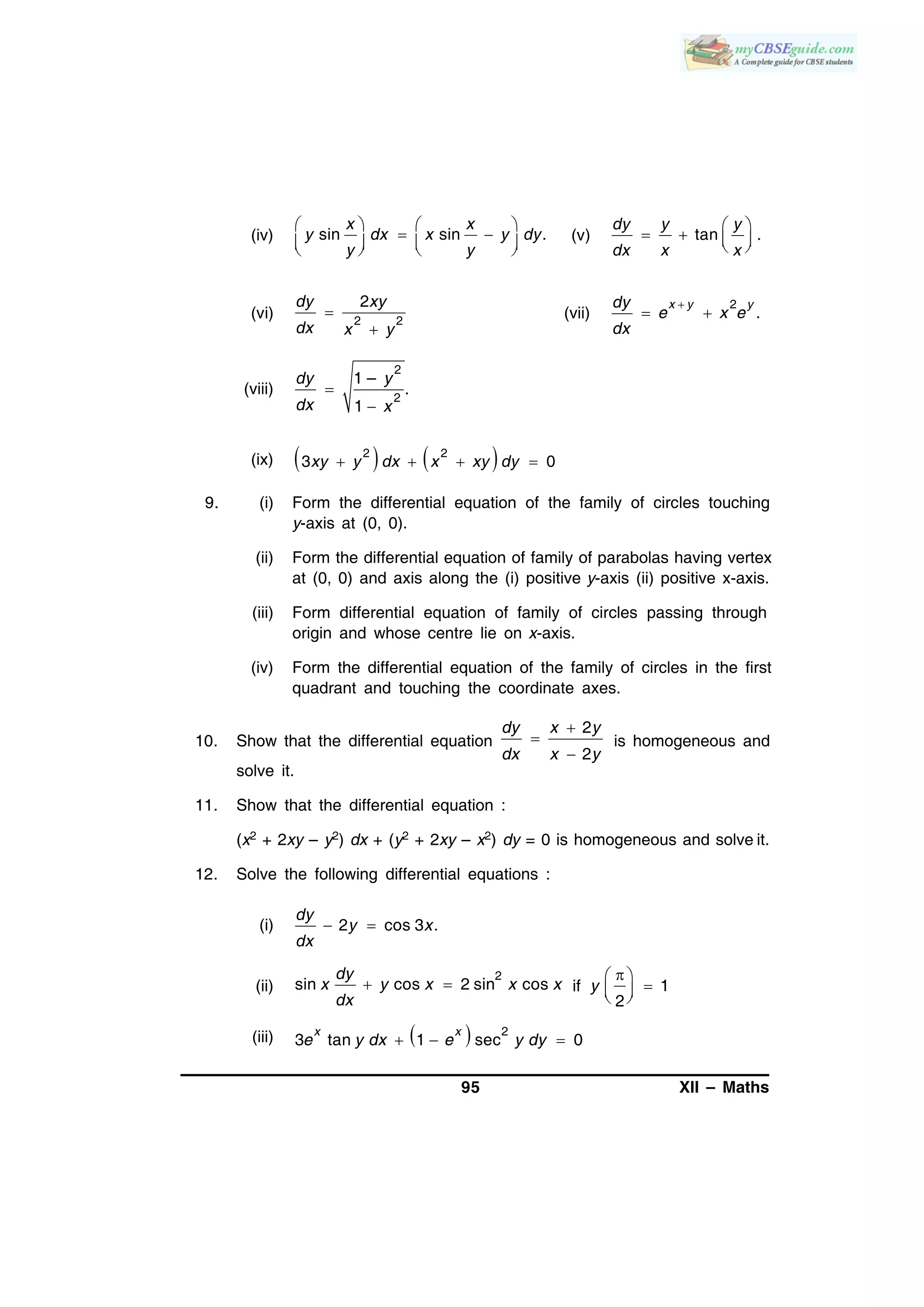
(iv) sin sin .
x x
y dx x y dy
y y
   
 
      
(v) tan .
dy y y
dx x x
 
    
(vi) 2 2
2dy xy
dx x y


(vii)
2
.
x y ydy
e x e
dx

 
(viii)
2
2
1 –
.
1
dy y
dx x


(ix)    2 2
3 0   xy y dx x xy dy
9. (i) Form the differential equation of the family of circles touching
y-axis at (0, 0).
(ii) Form the differential equation of family of parabolas having vertex
at (0, 0) and axis along the (i) positive y-axis (ii) positive x-axis.
(iii) Form differential equation of family of circles passing through
origin and whose centre lie on x-axis.
(iv) Form the differential equation of the family of circles in the first
quadrant and touching the coordinate axes.
10. Show that the differential equation
2
2
dy x y
dx x y



is homogeneous and
solve it.
11. Show that the differential equation :
(x2 + 2xy – y2) dx + (y2 + 2xy – x2) dy = 0 is homogeneous and solve it.
12. Solve the following differential equations :
(i) 2 cos 3 .
dy
y x
dx
 
(ii)
2
sin cos 2 sin cos
dy
x y x x x
dx
  if 1
2
y
 
  
(iii)   2
3 tan 1 sec 0  
x x
e y dx e y dy
XII – Maths 96
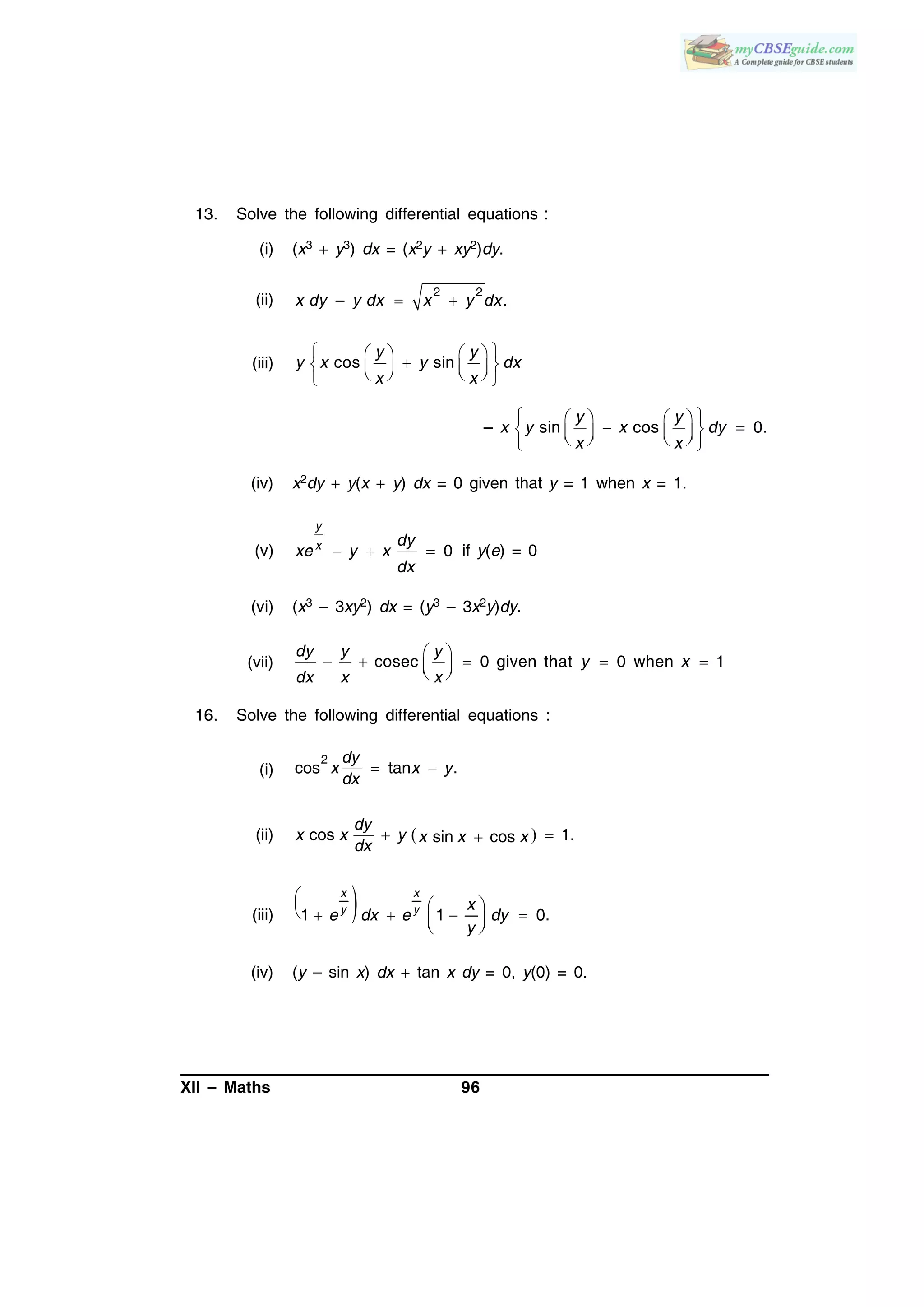
13. Solve the following differential equations :
(i) (x3 + y3) dx = (x2y + xy2)dy.
(ii)
2 2
– .x dy y dx x y dx 
(iii) cos sin
y y
y x y dx
x x
    
        
– sin cos 0.
y y
x y x dy
x x
    
         
(iv) x2dy + y(x + y) dx = 0 given that y = 1 when x = 1.
(v) 0
y
x dy
xe y x
dx
   if y(e) = 0
(vi) (x3 – 3xy2) dx = (y3 – 3x2y)dy.
(vii) cosec 0 given that 0 when 1
 
      
dy y y
y x
dx x x
16. Solve the following differential equations :
(i)
2
cos tan .
dy
x x y
dx
 
(ii)  cos 1.sin cos
dy
x x y x x x
dx
 
(iii) 1 1 0.
x x
y y x
e dx e dy
y

       
(iv) (y – sin x) dx + tan x dy = 0, y(0) = 0.
97 XII – Maths
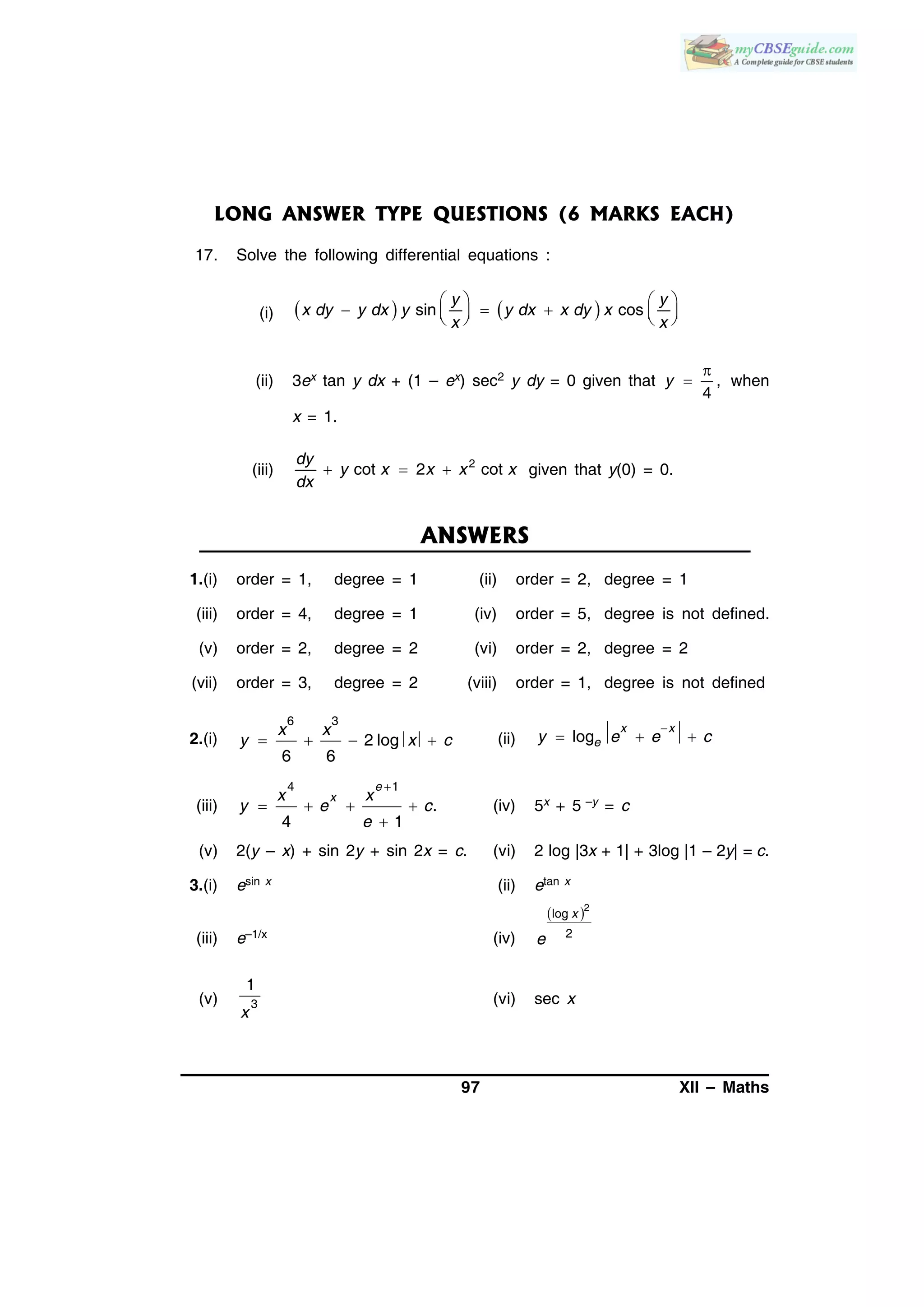
LONG ANSWER TYPE QUESTIONS (6 MARKS EACH)
17. Solve the following differential equations :
(i)    sin cos
y y
x dy y dx y y dx x dy x
x x
   
        
(ii) 3ex tan y dx + (1 – ex) sec2 y dy = 0 given that ,
4
y

 when
x = 1.
(iii) 2
cot 2 cot
dy
y x x x x
dx
   given that y(0) = 0.
ANSWERS
1.(i) order = 1, degree = 1 (ii) order = 2, degree = 1
(iii) order = 4, degree = 1 (iv) order = 5, degree is not defined.
(v) order = 2, degree = 2 (vi) order = 2, degree = 2
(vii) order = 3, degree = 2 (viii) order = 1, degree is not defined
2.(i)    
6 3
2 log
6 6
x x
y x c (ii)

  log
x x
ey e e c
(iii)

   

4 1
.
4 1
e
xx x
y e c
e
(iv) 5x + 5 –y = c
(v) 2(y – x) + sin 2y + sin 2x = c. (vi) 2 log |3x + 1| + 3log |1 – 2y| = c.
3.(i) esin x (ii) etan x
(iii) e–1/x (iv)
 2
log
2
x
e
(v) 3
1
x
(vi) sec x
XII – Maths 98
(vii)
1
tan

x
e
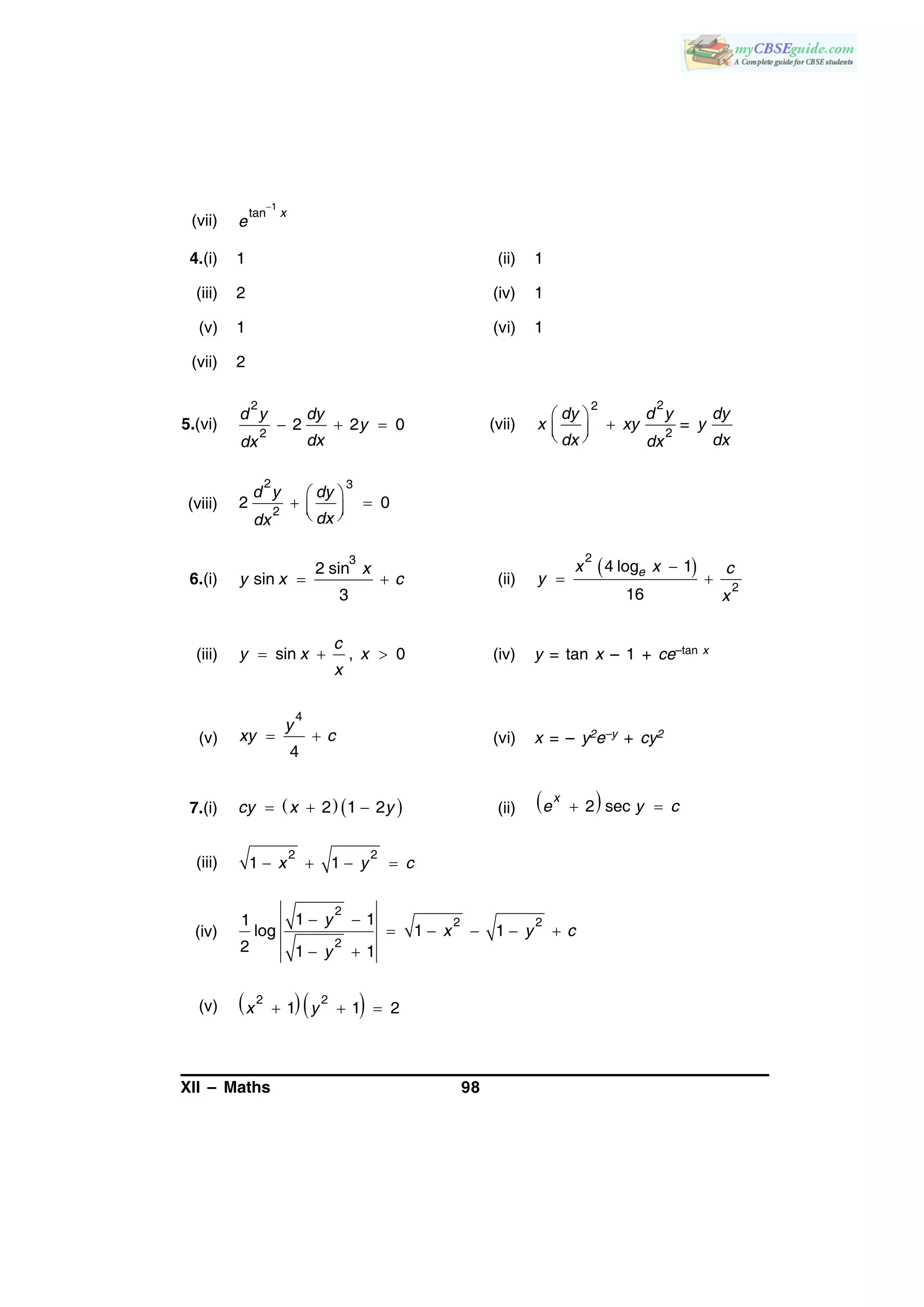
4.(i) 1 (ii) 1
(iii) 2 (iv) 1
(v) 1 (vi) 1
(vii) 2
5.(vi)   
2
2
2 2 0
d y dy
y
dxdx
(vii)
 
  
22
2
=
dy d y dy
x xy y
dx dxdx
(viii)
 
   
2 3
2
2 0
d y dy
dxdx
6.(i)  
3
2 sin
sin
3
x
y x c (ii)
 
 
2
2
4 log 1
16
ex x c
y
x
(iii)   sin , 0
c
y x x
x
(iv) y = tan x – 1 + ce–tan x
(v)
4
4
 
y
xy c (vi) x = – y2e–y + cy2
7.(i)      2 1 2cy x y (ii)   2 sec
x
e y c
(iii)    
2 2
1 1x y c
(iv)
 
    
 
2
2 2
2
1 11
log 1 1
2 1 1
y
x y c
y
(v)     
2 2
1 1 2x y
99 XII – Maths
(vi)
4 61 1
log cos cos
4 6
x x
y x x xe e c     
 
3
1 cos 2
– cos 2 1
16 3
xx
x x e c
 
    
  
(vii)  
cos 2
log tan
x
y c
y
8.(i)

 
3
3
log
3
x
y c
y
(ii)
  
   
1
tan log
y
x c
x
(iii) x2 + y2 = 2x
(iv)
 

cos x y
y ce [Hint :
1
Put v
x
 ]
(v) sin
y
cx
x
  
 
(vi)   
2 2
c x y y
(vii)

   
3
3
y x x
e e c (viii)  
 
1 1
sin siny x c
(ix)  3
log  x x y y cx
9.(i)   
2 2
2 0
dy
x y xy
dx
(ii)  2 , 2
dy dy
y x y x
dx dx
(iii)   
2 2
2 0
dy
x y xy
dx
(iv)      2 2 2
1 ' '   x y y x yy
10.
  
     
2 2 1 2
log 2 3 tan
3
x y
x xy y c
x
11.   

3
2 2
x c
x y
xx y
XII – Maths 100
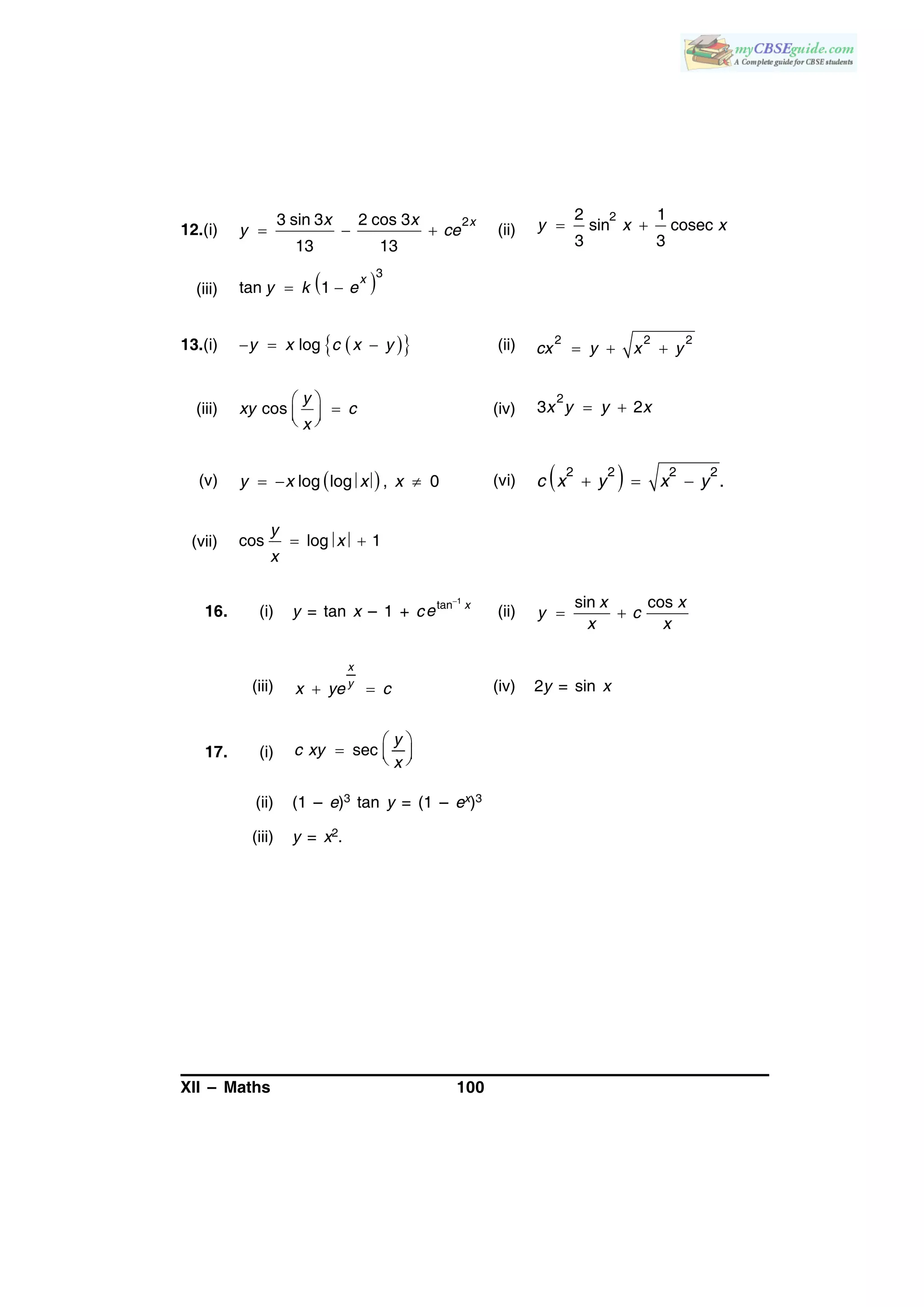
12.(i)   
23 sin 3 2 cos 3
13 13
xx x
y ce (ii)  
22 1
sin cosec
3 3
y x x
(iii)  3
tan 1 
x
y k e
13.(i)     logy x c x y (ii)   
2 2 2
cx y x y
(iii)
 
  
cos
y
xy c
x
(iv)  
2
3 2x y y x
(v)    log log , 0y x x x (vi)    
2 2 2 2
.c x y x y
(vii) cos log 1 
y
x
x
16. (i) y = tan x – 1 + c
1
tan
x
e (ii)
sin cosx x
y c
x x
 
(iii)
x
y
x ye c  (iv) 2y = sin x
17. (i) sec
 
   
y
c xy
x
(ii) (1 – e)3 tan y = (1 – ex)3
(iii) y = x2.

Differntials equatoin

  • 1.
    XII – Maths90 CHAPTER 9 DIFFERENTIAL EQUATIONS POINTS TO REMEMBER  Differential Equation : Equation containing derivatives of a dependant variable with respect to an independent variable is called differential equation.  Order of a Differential Equation : The order of a differential equation is defined to be the order of the highest order derivative occurring in the differential equation.  Degree of a Differential Equation : Highest power of highest order derivative involved in the equation is called degree of differential equation where equation is a polynomial equation in differential coefficients.  Formation of a Differential Equation : We differentiate the family of curves as many times as the number of arbitrary constant in the given family of curves. Now eliminate the arbitrary constants from these equations. After elimination the equation obtained is differential equation.  Solution of Differential Equation (i) Variable Separable Method  , dy f x y dx We separate the variables and get f(x)dx = g(y)dy Then    f dx g dy cyx    is the required solutions. (ii) Homogenous Differential Equation : A differential equation of the form     , , f x ydy dx g x y  where f(x, y) and g(x, y) are both
  • 2.
    91 XII –Maths homogeneous functions of the same degree in x and y i.e., of the form dy y F dx x       is called a homogeneous differential equation. For solving this type of equations we substitute y = vx and then .  dy dv v x dx dx The equation can be solved by variable separable method. (iii) Linear Differential Equation : An equation of the from dy Py Q dx   where P and Q are constant or functions of x only is called a linear differential equation. For finding solution of this type of equations, we find integrating factor ( . .) . P dx I F e  Solution is    .. . . . y Q dx cI F I F VERY SHORT ANSWER TYPE QUESTIONS (1 MARK) 1. Write the order and degree of the following differential equations. (i) cos 0. dy y dx   (ii) 22 2 3 4. dy d y dx dx       (iii) 54 2 4 2 sin . d y d y x dx dx         (iv) 5 5 log 0. d y dy dxdx       (v) 1 32 2 1 . dy d y dx dx         (vi)           3 2 22 2 1 . dy d y k dx dx (vii) 2 33 2 3 2 sin . d y d y x dx dx              (viii) tan 0       dy dy dx dx
  • 3.
    XII – Maths92 2. Write the general solution of following differential equations. (i) 5 2 2 . dy x x dx x    (ii) (ex + e–x) dy = (ex – e–x)dx (iii) 3 . x edy x e x dx    (iv) 5 . x ydy dx   (v) 1 cos 2 . 1 cos 2 dy x dx y    (vi) 1 2 . 3 1 dy y dx x    3. Write integrating factor of the following differential equations (i) cos sin dy y x x dx   (ii) 2 sec sec tan dy y x x x dx    (iii) 2 4 . dy x y x dx   (iv) log dy x y x x y dx    (v) 3 3 dy x y x dx   (vi) tan sec dy y x x dx   (vii) 2 1 sin 1    dy y x dx x 4. Write order of the differential equation of the family of following curves (i) y = Aex + Bex + c (ii) Ay = Bx2 (iii) (x – a)2 + (y – b)2 = 9 (iv) Ax + By2 = Bx2 – Ay (v) 2 2 2 2 0.  x y a b (vi) y = a cos (x + b) (vii) y = a + bex+c
  • 4.
    93 XII –Maths SHORT ANSWER TYPE QUESTIONS (4 MARKS) 5. (i) Show that 1 sinm x y e   is a solution of   2 22 2 0.1 d y dy x m yx dxdx    (ii) Show that y = sin(sin x) is a solution of differential equation   2 2 2 cos 0.tan   d y dy y xx dxdx (iii) Show that   B y Ax x is a solution of 2 2 2 0. x d y dy x y dxdx    (iv) Show that y = a cos (log x) + b sin (log x) is a solution of 2 2 2 0. d y dy x x y dxdx    (v) Verify that  2 2 logy x x a   satisfies the differential equation :   2 2 2 2 0. d y dy a x x dxdx    (vi) Find the differential equation of the family of curves y = ex (A cos x + B sin x), where A and B are arbitrary constants. (vii) Find the differential equation of an ellipse with major and minor axes 2a and 2b respectively. (viii) Form the differential equation representing the family of curves (y – b)2 = 4(x – a). 6. Solve the following differential equations. (i) cot sin 2 . dy y x x dx   (ii) 2 2 log . dy x y x x dx  
  • 5.
    XII – Maths94 (iii) 1 sin . cos , 0. dx x y x x dy x x     (iv) 3 cos cos sin . dy x x x dx   (v)  3 0  ydx x y dy (vi)  3 2  y y ye dx y xe dy 7. Solve each of the following differential equations : (i) 2 2 . dy dy y x y dx dx        (ii) cos y dx + (1 + 2e–x) sin y dy = 0. (iii) 2 2 1 1 0.x y dy y x dx    (iv)   2 2 1 1 – 0.x y dy xy dx   (v) (xy2 + x) dx + (yx2 + y) dy = 0; y(0) = 1. (vi) 3 3 sin cos . xdy y x x xy e dx   (vii) tan x tan y dx + sec2 x sec2 y dy = 0 8. Solve the following differential equations : (i) x2 y dx – (x3 + y3) dy = 0. (ii) 2 2 2 . dy x x xy y dx    (iii)    2 2 2 0, 1 1.x y dx xy dy y   
  • 6.
    95 XII –Maths (iv) sin sin . x x y dx x y dy y y              (v) tan . dy y y dx x x        (vi) 2 2 2dy xy dx x y   (vii) 2 . x y ydy e x e dx    (viii) 2 2 1 – . 1 dy y dx x   (ix)    2 2 3 0   xy y dx x xy dy 9. (i) Form the differential equation of the family of circles touching y-axis at (0, 0). (ii) Form the differential equation of family of parabolas having vertex at (0, 0) and axis along the (i) positive y-axis (ii) positive x-axis. (iii) Form differential equation of family of circles passing through origin and whose centre lie on x-axis. (iv) Form the differential equation of the family of circles in the first quadrant and touching the coordinate axes. 10. Show that the differential equation 2 2 dy x y dx x y    is homogeneous and solve it. 11. Show that the differential equation : (x2 + 2xy – y2) dx + (y2 + 2xy – x2) dy = 0 is homogeneous and solve it. 12. Solve the following differential equations : (i) 2 cos 3 . dy y x dx   (ii) 2 sin cos 2 sin cos dy x y x x x dx   if 1 2 y      (iii)   2 3 tan 1 sec 0   x x e y dx e y dy
  • 7.
    XII – Maths96 13. Solve the following differential equations : (i) (x3 + y3) dx = (x2y + xy2)dy. (ii) 2 2 – .x dy y dx x y dx  (iii) cos sin y y y x y dx x x               – sin cos 0. y y x y x dy x x                (iv) x2dy + y(x + y) dx = 0 given that y = 1 when x = 1. (v) 0 y x dy xe y x dx    if y(e) = 0 (vi) (x3 – 3xy2) dx = (y3 – 3x2y)dy. (vii) cosec 0 given that 0 when 1          dy y y y x dx x x 16. Solve the following differential equations : (i) 2 cos tan . dy x x y dx   (ii)  cos 1.sin cos dy x x y x x x dx   (iii) 1 1 0. x x y y x e dx e dy y          (iv) (y – sin x) dx + tan x dy = 0, y(0) = 0.
  • 8.
    97 XII –Maths LONG ANSWER TYPE QUESTIONS (6 MARKS EACH) 17. Solve the following differential equations : (i)    sin cos y y x dy y dx y y dx x dy x x x              (ii) 3ex tan y dx + (1 – ex) sec2 y dy = 0 given that , 4 y   when x = 1. (iii) 2 cot 2 cot dy y x x x x dx    given that y(0) = 0. ANSWERS 1.(i) order = 1, degree = 1 (ii) order = 2, degree = 1 (iii) order = 4, degree = 1 (iv) order = 5, degree is not defined. (v) order = 2, degree = 2 (vi) order = 2, degree = 2 (vii) order = 3, degree = 2 (viii) order = 1, degree is not defined 2.(i)     6 3 2 log 6 6 x x y x c (ii)    log x x ey e e c (iii)       4 1 . 4 1 e xx x y e c e (iv) 5x + 5 –y = c (v) 2(y – x) + sin 2y + sin 2x = c. (vi) 2 log |3x + 1| + 3log |1 – 2y| = c. 3.(i) esin x (ii) etan x (iii) e–1/x (iv)  2 log 2 x e (v) 3 1 x (vi) sec x
  • 9.
    XII – Maths98 (vii) 1 tan  x e 4.(i) 1 (ii) 1 (iii) 2 (iv) 1 (v) 1 (vi) 1 (vii) 2 5.(vi)    2 2 2 2 0 d y dy y dxdx (vii)      22 2 = dy d y dy x xy y dx dxdx (viii)       2 3 2 2 0 d y dy dxdx 6.(i)   3 2 sin sin 3 x y x c (ii)     2 2 4 log 1 16 ex x c y x (iii)   sin , 0 c y x x x (iv) y = tan x – 1 + ce–tan x (v) 4 4   y xy c (vi) x = – y2e–y + cy2 7.(i)      2 1 2cy x y (ii)   2 sec x e y c (iii)     2 2 1 1x y c (iv)          2 2 2 2 1 11 log 1 1 2 1 1 y x y c y (v)      2 2 1 1 2x y
  • 10.
    99 XII –Maths (vi) 4 61 1 log cos cos 4 6 x x y x x xe e c        3 1 cos 2 – cos 2 1 16 3 xx x x e c           (vii)   cos 2 log tan x y c y 8.(i)    3 3 log 3 x y c y (ii)        1 tan log y x c x (iii) x2 + y2 = 2x (iv)    cos x y y ce [Hint : 1 Put v x  ] (v) sin y cx x      (vi)    2 2 c x y y (vii)      3 3 y x x e e c (viii)     1 1 sin siny x c (ix)  3 log  x x y y cx 9.(i)    2 2 2 0 dy x y xy dx (ii)  2 , 2 dy dy y x y x dx dx (iii)    2 2 2 0 dy x y xy dx (iv)      2 2 2 1 ' '   x y y x yy 10.          2 2 1 2 log 2 3 tan 3 x y x xy y c x 11.     3 2 2 x c x y xx y
  • 11.
    XII – Maths100 12.(i)    23 sin 3 2 cos 3 13 13 xx x y ce (ii)   22 1 sin cosec 3 3 y x x (iii)  3 tan 1  x y k e 13.(i)     logy x c x y (ii)    2 2 2 cx y x y (iii)      cos y xy c x (iv)   2 3 2x y y x (v)    log log , 0y x x x (vi)     2 2 2 2 .c x y x y (vii) cos log 1  y x x 16. (i) y = tan x – 1 + c 1 tan x e (ii) sin cosx x y c x x   (iii) x y x ye c  (iv) 2y = sin x 17. (i) sec       y c xy x (ii) (1 – e)3 tan y = (1 – ex)3 (iii) y = x2.