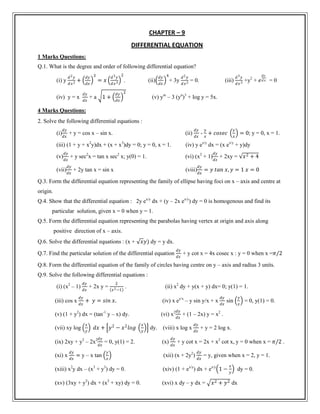
CHAPTER – 9
DIFFERENTIAL EQUATION
1 Marks Questions:
Q.1. What is the degree and order of following differential equation?
(i) y
𝑑2 𝑦
𝑑𝑥2 +
𝑑𝑦
𝑑𝑥
3
= 𝑥
𝑑3 𝑦
𝑑𝑥3
2
. (ii)
𝑑𝑦
𝑑𝑥
4
+ 3y
𝑑2 𝑦
𝑑𝑥2 = 0. (iii)
𝑑3 𝑦
𝑑𝑥3 +y2
+ 𝑒
𝑑𝑦
𝑑 𝑥 = 0
(iv) y = x
𝑑𝑦
𝑑𝑥
+ a 1 +
𝑑𝑦
𝑑𝑥
2
(v) ym
– 3 (yn
)3
+ log y = 5x.
4 Marks Questions:
2. Solve the following differential equations :
(i)
𝑑𝑦
𝑑𝑥
+ y = cos x – sin x. (ii)
𝑑𝑦
𝑑𝑥
-
𝑦
𝑥
+ 𝑐𝑜𝑠𝑒𝑐
𝑦
𝑥
= 0; y = 0, x = 1.
(iii) (1 + y + x2
y)dx + (x + x3
)dy = 0; y = 0, x = 1. (iv) y ex/y
dx = (x ex/y
+ y)dy
(v)
𝑑𝑦
𝑑𝑥
+ y sec2
x = tan x sec2
x; y(0) = 1. (vi) (x2
+ 1)
𝑑𝑦
𝑑𝑥
+ 2xy = 𝑥2 + 4
(vii)
𝑑𝑦
𝑑𝑥
+ 2y tan x = sin x (viii)
𝑑𝑦
𝑑𝑥
= 𝑦 𝑡𝑎𝑛 𝑥, 𝑦 = 1 𝑥 = 0
Q.3. Form the differential equation representing the family of ellipse having foci on x – axis and centre at
origin.
Q.4. Show that the differential equation : 2y ex/y
dx + (y – 2x ex/y
) dy = 0 is homogenous and find its
particular solution, given x = 0 when y = 1.
Q.5. Form the differential equation representing the parabolas having vertex at origin and axis along
positive direction of x – axis.
Q.6. Solve the differential equations : (x + 𝑥𝑦) dy = y dx.
Q.7. Find the particular solution of the differential equation
𝑑𝑦
𝑑𝑥
+ y cot x = 4x cosec x : y = 0 when x =𝜋/2
Q.8. Form the differential equation of the family of circles having centre on y – axis and radius 3 units.
Q.9. Solve the following differential equations :
(i) (x2
– 1)
𝑑𝑦
𝑑𝑥
+ 2x y =
2
𝑥2−1
. (ii) x2
dy + y(x + y) dx= 0; y(1) = 1.
(iii) cos x
𝑑𝑦
𝑑𝑥
+ 𝑦 = 𝑠𝑖𝑛 𝑥. (iv) x ey/x
– y sin y/x + x
𝑑𝑦
𝑑𝑥
sin
𝑦
𝑥
= 0, y(1) = 0.
(v) (1 + y2
) dx = (tan-1
y – x) dy. (vi) x2 𝑑𝑦
𝑑𝑥
+ (1 – 2x) y = x2
.
(vii) xy log
𝑥
𝑦
𝑑𝑥 + 𝑦2
− 𝑥2
𝑙𝑜𝑔
𝑥
𝑦
dy. (viii) x log x
𝑑𝑦
𝑑𝑥
+ y = 2 log x.
(ix) 2xy + y2
– 2x2 𝑑𝑦
𝑑𝑥
= 0, y(1) = 2. (x)
𝑑𝑦
𝑑𝑥
+ y cot x = 2x + x2
cot x, y = 0 when x = 𝜋/2 .
(xi) x
𝑑𝑦
𝑑𝑥
= y – x tan
𝑦
𝑥
(xii) (x + 2y2
)
𝑑𝑦
𝑑𝑥
= y, given when x = 2, y = 1.
(xiii) x2
y dx – (x3
+ y3
) dy = 0. (xiv) (1 + ex/y
) dx + ex/y
1 −
𝑥
𝑦
dy = 0.
(xv) (3xy + y2
) dx + (x2
+ xy) dy = 0. (xvi) x dy – y dx = 𝑥2 + 𝑦2 dx
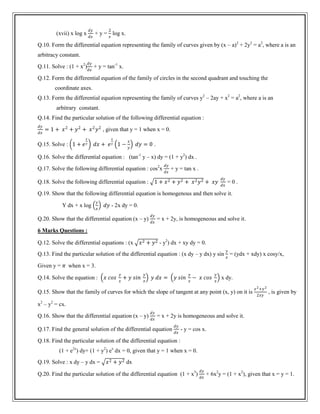
(xvii) x log x
𝑑𝑦
𝑑𝑥
+ y =
2
𝑥
log x.
Q.10. Form the differential equation representing the family of curves given by (x – a)2
+ 2y2
= a2
, where a is an
arbitracy constant.
Q.11. Solve : (1 + x2
)
𝑑𝑦
𝑑𝑥
+ y = tan-1
x.
Q.12. Form the differential equation of the family of circles in the second quadrant and touching the
coordinate axes.
Q.13. Form the differential equation representing the family of curves y2
– 2ay + x2
= a2
, where a is an
arbitrary constant.
Q.14. Find the particular solution of the following differential equation :
𝑑𝑦
𝑑𝑥
= 1 + 𝑥2
+ 𝑦2
+ 𝑥2
𝑦2
, given that y = 1 when x = 0.
Q.15. Solve : 1 + 𝑒
𝑥
𝑦 𝑑𝑥 + 𝑒
𝑥
𝑦 1 −
𝑥
𝑦
𝑑𝑦 = 0 .
Q.16. Solve the differential equation : (tan-1
y – x) dy = (1 + y2
) dx .
Q.17. Solve the following differential equation : cos2
x
𝑑𝑦
𝑑𝑥
+ y = tan x .
Q.18. Solve the following differential equation : 1 + 𝑥2 + 𝑦2 + 𝑥2 𝑦2 + 𝑥𝑦
𝑑𝑦
𝑑𝑥
= 0 .
Q.19. Show that the following differential equation is homogenous and then solve it.
Y dx + x log
𝑦
𝑥
𝑑𝑦 - 2x dy = 0.
Q.20. Show that the differential equation (x – y)
𝑑𝑦
𝑑𝑥
= x + 2y, is homogeneous and solve it.
6 Marks Questions :
Q.12. Solve the differential equations : (x 𝑥2 + 𝑦2 - y2
) dx + xy dy = 0.
Q.13. Find the particular solution of the differential equation : (x dy – y dx) y sin
𝑦
𝑥
= (ydx + xdy) x cosy/x,
Given y = 𝜋 when x = 3.
Q.14. Solve the equation : 𝑥 𝑐𝑜𝑠
𝑦
𝑥
+ 𝑦 𝑠𝑖𝑛
𝑦
𝑥
𝑦 𝑑𝑥 = 𝑦 𝑠𝑖𝑛
𝑦
𝑥
− 𝑥 𝑐𝑜𝑠
𝑦
𝑥
x dy.
Q.15. Show that the family of curves for which the slope of tangent at any point (x, y) on it is
𝑥2+𝑦2
2𝑥𝑦
, is given by
x2
– y2
= cx.
Q.16. Show that the differential equation (x – y)
𝑑𝑦
𝑑𝑥
= x + 2y is homogeneous and solve it.
Q.17. Find the general solution of the differential equation
𝑑𝑦
𝑑𝑥
- y = cos x.
Q.18. Find the particular solution of the differential equation :
(1 + e2x
) dy+ (1 + y2
) ex
dx = 0, given that y = 1 when x = 0.
Q.19. Solve : x dy – y dx = 𝑥2 + 𝑦2 dx
Q.20. Find the particular solution of the differential equation (1 + x3
)
𝑑𝑦
𝑑𝑥
+ 6x2
y = (1 + x2
), given that x = y = 1.

Chapter 9 differential equation

  • 1.
    CHAPTER – 9 DIFFERENTIALEQUATION 1 Marks Questions: Q.1. What is the degree and order of following differential equation? (i) y 𝑑2 𝑦 𝑑𝑥2 + 𝑑𝑦 𝑑𝑥 3 = 𝑥 𝑑3 𝑦 𝑑𝑥3 2 . (ii) 𝑑𝑦 𝑑𝑥 4 + 3y 𝑑2 𝑦 𝑑𝑥2 = 0. (iii) 𝑑3 𝑦 𝑑𝑥3 +y2 + 𝑒 𝑑𝑦 𝑑 𝑥 = 0 (iv) y = x 𝑑𝑦 𝑑𝑥 + a 1 + 𝑑𝑦 𝑑𝑥 2 (v) ym – 3 (yn )3 + log y = 5x. 4 Marks Questions: 2. Solve the following differential equations : (i) 𝑑𝑦 𝑑𝑥 + y = cos x – sin x. (ii) 𝑑𝑦 𝑑𝑥 - 𝑦 𝑥 + 𝑐𝑜𝑠𝑒𝑐 𝑦 𝑥 = 0; y = 0, x = 1. (iii) (1 + y + x2 y)dx + (x + x3 )dy = 0; y = 0, x = 1. (iv) y ex/y dx = (x ex/y + y)dy (v) 𝑑𝑦 𝑑𝑥 + y sec2 x = tan x sec2 x; y(0) = 1. (vi) (x2 + 1) 𝑑𝑦 𝑑𝑥 + 2xy = 𝑥2 + 4 (vii) 𝑑𝑦 𝑑𝑥 + 2y tan x = sin x (viii) 𝑑𝑦 𝑑𝑥 = 𝑦 𝑡𝑎𝑛 𝑥, 𝑦 = 1 𝑥 = 0 Q.3. Form the differential equation representing the family of ellipse having foci on x – axis and centre at origin. Q.4. Show that the differential equation : 2y ex/y dx + (y – 2x ex/y ) dy = 0 is homogenous and find its particular solution, given x = 0 when y = 1. Q.5. Form the differential equation representing the parabolas having vertex at origin and axis along positive direction of x – axis. Q.6. Solve the differential equations : (x + 𝑥𝑦) dy = y dx. Q.7. Find the particular solution of the differential equation 𝑑𝑦 𝑑𝑥 + y cot x = 4x cosec x : y = 0 when x =𝜋/2 Q.8. Form the differential equation of the family of circles having centre on y – axis and radius 3 units. Q.9. Solve the following differential equations : (i) (x2 – 1) 𝑑𝑦 𝑑𝑥 + 2x y = 2 𝑥2−1 . (ii) x2 dy + y(x + y) dx= 0; y(1) = 1. (iii) cos x 𝑑𝑦 𝑑𝑥 + 𝑦 = 𝑠𝑖𝑛 𝑥. (iv) x ey/x – y sin y/x + x 𝑑𝑦 𝑑𝑥 sin 𝑦 𝑥 = 0, y(1) = 0. (v) (1 + y2 ) dx = (tan-1 y – x) dy. (vi) x2 𝑑𝑦 𝑑𝑥 + (1 – 2x) y = x2 . (vii) xy log 𝑥 𝑦 𝑑𝑥 + 𝑦2 − 𝑥2 𝑙𝑜𝑔 𝑥 𝑦 dy. (viii) x log x 𝑑𝑦 𝑑𝑥 + y = 2 log x. (ix) 2xy + y2 – 2x2 𝑑𝑦 𝑑𝑥 = 0, y(1) = 2. (x) 𝑑𝑦 𝑑𝑥 + y cot x = 2x + x2 cot x, y = 0 when x = 𝜋/2 . (xi) x 𝑑𝑦 𝑑𝑥 = y – x tan 𝑦 𝑥 (xii) (x + 2y2 ) 𝑑𝑦 𝑑𝑥 = y, given when x = 2, y = 1. (xiii) x2 y dx – (x3 + y3 ) dy = 0. (xiv) (1 + ex/y ) dx + ex/y 1 − 𝑥 𝑦 dy = 0. (xv) (3xy + y2 ) dx + (x2 + xy) dy = 0. (xvi) x dy – y dx = 𝑥2 + 𝑦2 dx
  • 2.
    (xvii) x logx 𝑑𝑦 𝑑𝑥 + y = 2 𝑥 log x. Q.10. Form the differential equation representing the family of curves given by (x – a)2 + 2y2 = a2 , where a is an arbitracy constant. Q.11. Solve : (1 + x2 ) 𝑑𝑦 𝑑𝑥 + y = tan-1 x. Q.12. Form the differential equation of the family of circles in the second quadrant and touching the coordinate axes. Q.13. Form the differential equation representing the family of curves y2 – 2ay + x2 = a2 , where a is an arbitrary constant. Q.14. Find the particular solution of the following differential equation : 𝑑𝑦 𝑑𝑥 = 1 + 𝑥2 + 𝑦2 + 𝑥2 𝑦2 , given that y = 1 when x = 0. Q.15. Solve : 1 + 𝑒 𝑥 𝑦 𝑑𝑥 + 𝑒 𝑥 𝑦 1 − 𝑥 𝑦 𝑑𝑦 = 0 . Q.16. Solve the differential equation : (tan-1 y – x) dy = (1 + y2 ) dx . Q.17. Solve the following differential equation : cos2 x 𝑑𝑦 𝑑𝑥 + y = tan x . Q.18. Solve the following differential equation : 1 + 𝑥2 + 𝑦2 + 𝑥2 𝑦2 + 𝑥𝑦 𝑑𝑦 𝑑𝑥 = 0 . Q.19. Show that the following differential equation is homogenous and then solve it. Y dx + x log 𝑦 𝑥 𝑑𝑦 - 2x dy = 0. Q.20. Show that the differential equation (x – y) 𝑑𝑦 𝑑𝑥 = x + 2y, is homogeneous and solve it. 6 Marks Questions : Q.12. Solve the differential equations : (x 𝑥2 + 𝑦2 - y2 ) dx + xy dy = 0. Q.13. Find the particular solution of the differential equation : (x dy – y dx) y sin 𝑦 𝑥 = (ydx + xdy) x cosy/x, Given y = 𝜋 when x = 3. Q.14. Solve the equation : 𝑥 𝑐𝑜𝑠 𝑦 𝑥 + 𝑦 𝑠𝑖𝑛 𝑦 𝑥 𝑦 𝑑𝑥 = 𝑦 𝑠𝑖𝑛 𝑦 𝑥 − 𝑥 𝑐𝑜𝑠 𝑦 𝑥 x dy. Q.15. Show that the family of curves for which the slope of tangent at any point (x, y) on it is 𝑥2+𝑦2 2𝑥𝑦 , is given by x2 – y2 = cx. Q.16. Show that the differential equation (x – y) 𝑑𝑦 𝑑𝑥 = x + 2y is homogeneous and solve it. Q.17. Find the general solution of the differential equation 𝑑𝑦 𝑑𝑥 - y = cos x. Q.18. Find the particular solution of the differential equation : (1 + e2x ) dy+ (1 + y2 ) ex dx = 0, given that y = 1 when x = 0. Q.19. Solve : x dy – y dx = 𝑥2 + 𝑦2 dx Q.20. Find the particular solution of the differential equation (1 + x3 ) 𝑑𝑦 𝑑𝑥 + 6x2 y = (1 + x2 ), given that x = y = 1.