CÁLCULO DE DERIVADAS
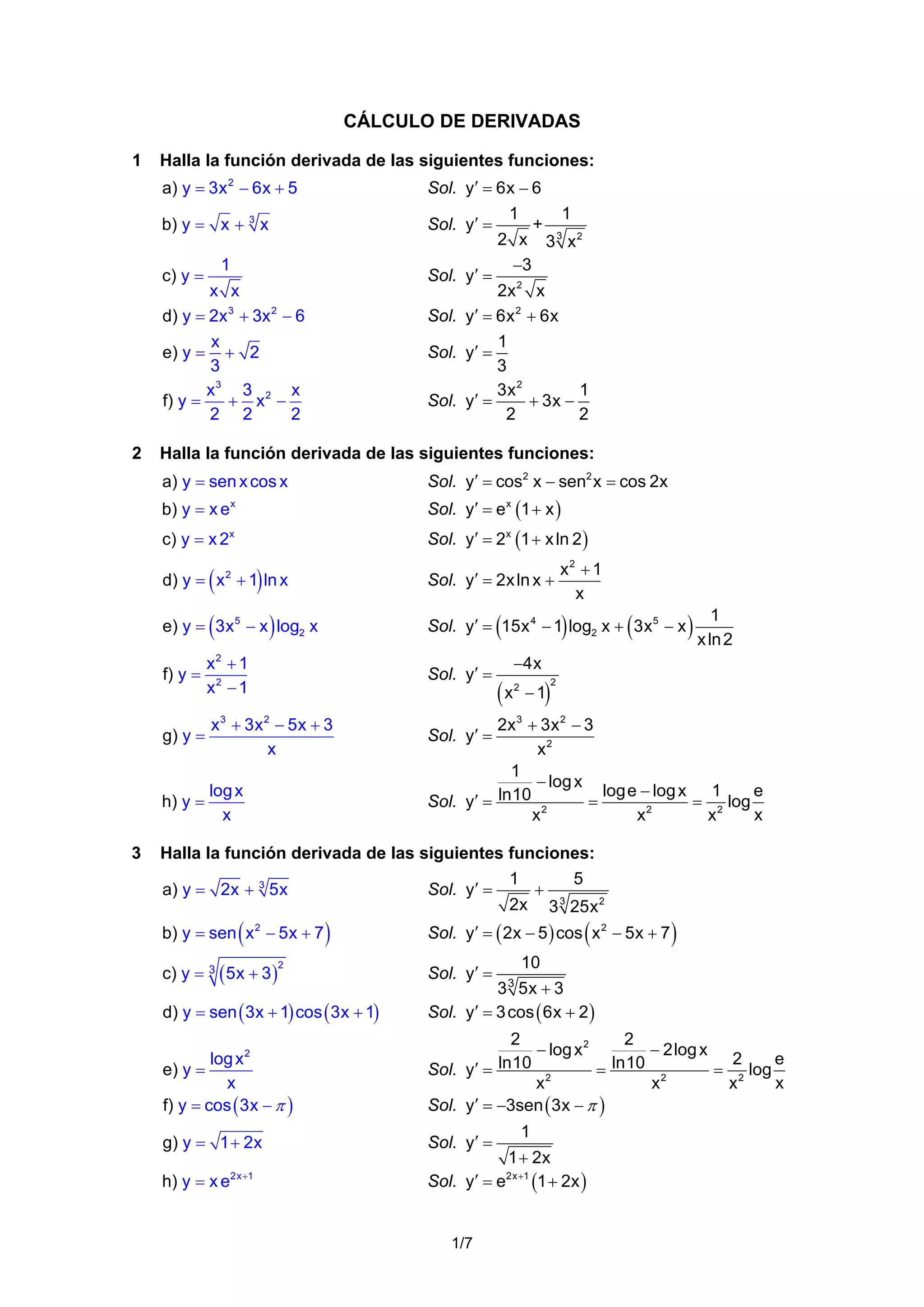
1

Halla la función derivada de las siguientes funciones:

Sol. y′ = 6x − 6
1
1
Sol. y′ =
+
3 2
2 x 3 x
−3
Sol. y′ = 2
2x x
Sol. y′ = 6x 2 + 6x
1
Sol. y′ =
3
3x 2
1
Sol. y′ =
+ 3x −
2
2

a) y = 3x 2 − 6 x + 5
b) y = x + 3 x
1

c) y =

x x
d) y = 2x 3 + 3x 2 − 6
x
e) y = + 2
3
x3 3 2 x
+ x −
f) y =
2 2
2

2

Halla la función derivada de las siguientes funciones:

a) y = sen x cos x

Sol. y′ = cos2 x − sen2 x = cos 2x

b) y = x e x

Sol. y′ = e x (1 + x )

c) y = x 2x

Sol. y′ = 2x (1 + x ln 2 )

(

)

Sol. y′ = 2x ln x +

d) y = x 2 + 1 ln x

(

)

(

)

(

Sol. y′ = 15x 4 − 1 log2 x + 3x 5 − x

e) y = 3x 5 − x log2 x
x2 + 1
x2 − 1

Sol. y′ =

g) y =

x 3 + 3x 2 − 5x + 3
x

h) y =

log x
x

1
) x ln 2

Sol. y′ =

f) y =

3

x2 + 1
x

−4x

(x

2

)

−1

2

2x 3 + 3x 2 − 3
x2
1
− log x
loge − log x 1
e
ln10
Sol. y′ =
=
= 2 log
2
2
x
x
x
x

Halla la función derivada de las siguientes funciones:
1
5
a) y = 2x + 3 5x
Sol. y′ =
+
3
2x 3 25x 2
b) y = sen x 2 − 5x + 7
Sol. y′ = ( 2x − 5 ) cos x 2 − 5x + 7

(

c) y = 3 ( 5 x + 3 )

)

2

(

Sol. y′ =

)

10

d) y = sen ( 3x + 1) cos ( 3x + 1)

3 5x + 3
Sol. y′ = 3 cos ( 6x + 2 )

log x 2
e) y =
x
f) y = cos ( 3x − π )

2
2
− log x 2
− 2log x
2
e
ln10
′ = ln10 2
Sol. y
=
= 2 log
2
x
x
x
x
Sol. y′ = −3sen ( 3x − π )

g) y = 1 + 2x

Sol. y′ =

h) y = x e

2x +1

3

1

1 + 2x
′ = e2 x +1 (1 + 2x )
Sol. y

1/7
i) y =

(

)

sen x 2 + 1

Sol. y′ =

1 − x2

j) y = x sen (π − x )
k) y =

Sol. y′ =

⎛ 3x
⎞
− 5⎟
l) y = ⎜
⎝ 2
⎠
3x − 7
m) y =
x+2

)

(

)

(

)

(

1 − x2 1 − x2

)

Sol. y′ = sen (π − x ) − x cos (π − x )

1
x2

3

(

2x 1 − x 2 cos x 2 + 1 + xsen x 2 + 1

4

−2
3x 3 x 2

⎛ 3x
⎞
Sol. y′ = 6 ⎜
− 5⎟
⎝ 2
⎠
13
Sol. y′ =
2
( x + 2)

3

n) y = e − x ln ( cos x )

Sol. y′ = −e − x ⎡ln ( cos x ) + tg x ⎤
⎣
⎦

ñ) y = tg x

Sol. y′ =

⎛ x + 1⎞
o) y = ln ⎜
⎟
⎝ x ⎠

Sol. y′ =

⎛ x ⎞
p) y = ⎜
⎟
⎝ x + 1⎠

1
2

2 cos x tg x
−1
x +x
2

5

Sol. y′ =

5x 4

( x + 1)

6

2

⎛ 1 − x ⎞3
q) y = ⎜
⎟
⎝ 1+ x ⎠

Sol. y′ =

x2 − 4
x

r) y =

Sol. y′ =

2

4
x

x +1

(

3 (1 + x ) 3 (1 − x )(1 + x )

Sol. y′ =

x −1

s) y =

−4

2

x2 − 4
1

( x + 1)
7
( 2 x − 3)
x
2

x

t) y = 2 x − 3

)

7

Sol. y′ =

6

4

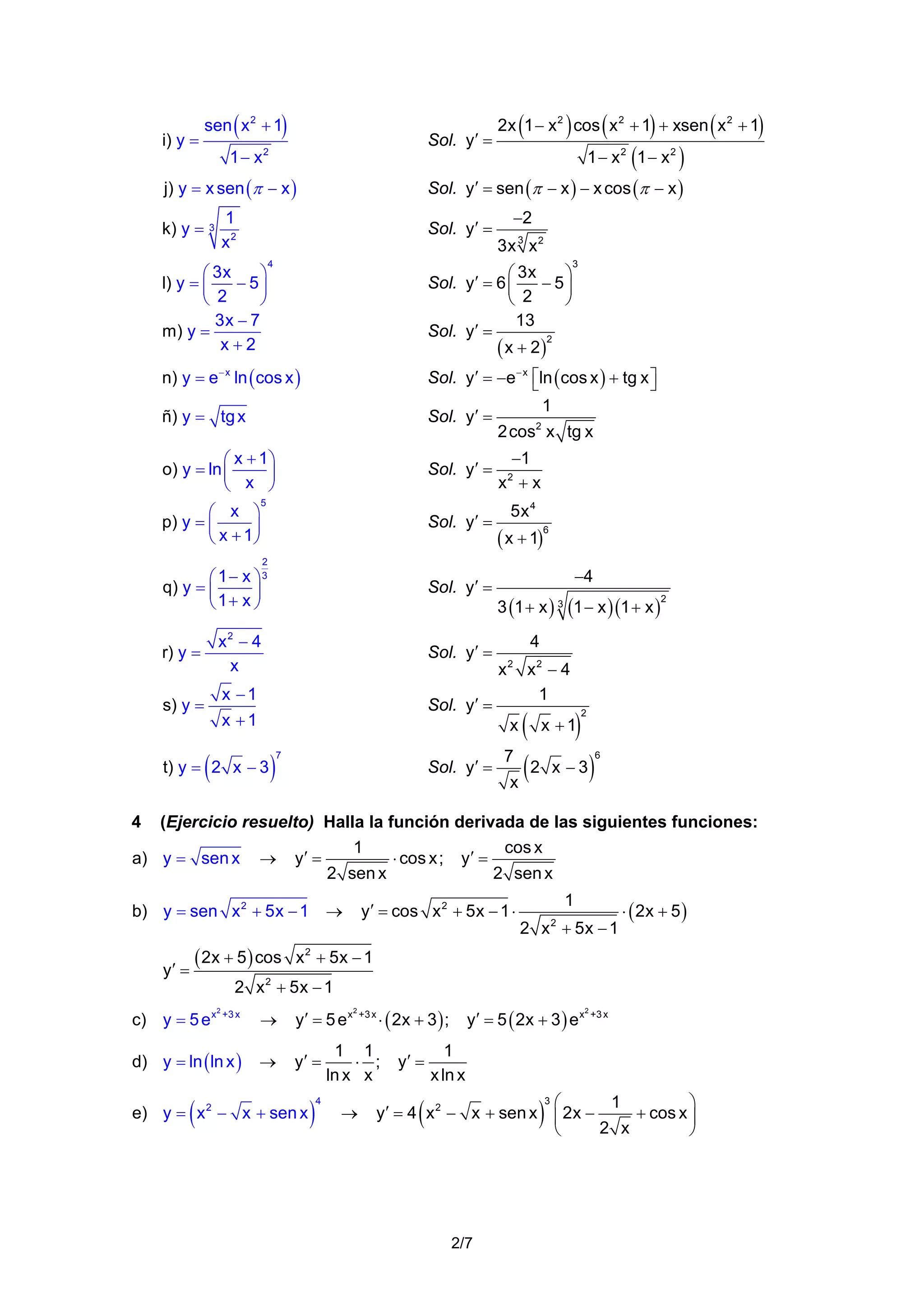
(Ejercicio resuelto) Halla la función derivada de las siguientes funciones:
1
cos x
⋅ cos x; y′ =
a) y = sen x → y′ =
2 sen x
2 sen x

y′ = cos x 2 + 5x − 1 ⋅

b) y = sen x 2 + 5x − 1 →

y′ =

( 2x + 5 ) cos

1
2 x 2 + 5x − 1

⋅ ( 2x + 5 )

x 2 + 5x − 1

2 x 2 + 5x − 1
⋅ ( 2x + 3 ) ;

+3 x

→

y′ = 5 e x

d) y = ln ( ln x )

→

y′ =

1 1
⋅ ;
ln x x

)

→

c) y = 5 e x

(

2

e) y = x 2 − x + sen x

4

2

+3 x

y′ =

y′ = 5 ( 2x + 3 ) e x

2

+3 x

1
x ln x

(

)

3 ⎛
1
⎞
y′ = 4 x 2 − x + sen x ⎜ 2x −
+ cos x ⎟
2 x
⎝
⎠

2/7
f)

y = x x +1

⎛ 2 ( x + 1) + x ⎞
⋅⎜
⎜ 2 x + 1 ⎟;
⎟
3
2
⎠
x +x ⎝

2

g) y =

4 4 x 2 ( x + 1)

1− x
1+ x

⋅

3x + 2

2 4 x3 + x 2 2 x + 1

=

1

⋅

3x + 2

2 4 x 2 ( x + 1) 2 4 ( x + 1)2

1− x
1+ x

3

y′ =

→

−1 ⋅ (1 + x ) − (1 − x ) ⋅ 1

(1 + x )

y′ =

→
−1

y′ ==

(1 + x )

i)

1

y′ =

3x + 2

h) y =

y′ =

1 ⎞
⎛
⋅ ⎜ 1⋅ x + 1 + x ⋅
⎟
2 x +1⎠
2 x x +1 ⎝
1

1

y′ =
y′ =

y′ =

→

2

1− x
2
1+ x

−1

=

1− x
1+ x

⋅

1

(1 + x ) (1 − x )

y′ =

→

−1 − x − 1 + x
2

;

y′ =
1

1− x
2
1+ x

−2

(1 + x )
⋅

2

−2

(1 + x )

2

−1

(1 + x ) (1 − x )
3

1+ x

(1 + x ) (1 + x )(1 − x )
1− x
1+ x

=

4

−1

y = ln

=

(1 + x )
−1⋅ (1 + x ) − (1 − x ) ⋅ 1
⋅
=
2
(1 + x )
2

;

y′ =

−1

(1 + x )

1 − x2

−2
−2
1
−2
;
⋅
=
=
1 − x (1 + x )2 (1 − x )(1 + x ) 2 (1 − x )(1 + x )
1+ x
1+ x

y′ =

−2
1 − x2

De otra forma: Desarrollando el logaritmo previamente:
1
1
−1
1
y = ln (1 − x ) − ln (1 + x ) → y′ =
.1 =
⋅ ( −1) −
−
1− x
1+ x
1− x 1+ x
−1 − x − (1 − x ) −1 − x − 1 + x
−2
y′ =
; y′ =
=
1 − x2
(1 − x )(1 + x ) (1 − x )(1 + x )

j)

y=
y′ =

k) y =

1 − tg x
1 + tg x

−1 − tg x − 1 + tg x
−1
1
⋅ (1 + tg x ) − (1 − tg x ) ⋅
2
2
cos x =
cos2 x
y′ = cos x
2
2
(1 + tg x )
(1 + tg x )

→
−2

cos x (1 + tg x )
2

1 − tg x
1 + tg x

→

2

y′ =

⎛ 1 − tg x ⎞
⋅D⎜
⎟
1 − tg x
⎝ 1 + tg x ⎠
2
1 + tg x
1

⎛ 1 − tg x ⎞
−2
En el ejercicio anterior se calculó: D ⎜
⎟=
2
2
⎝ 1 + tg x ⎠ cos x (1 + tg x )
1

y′ =
2

⋅

−2

1 − tg x cos x (1 + tg x )
1 + tg x
2

2

−1

=

(1 + tg x ) (1 − tg x )
4

2

cos x

3/7

1 + tg x
−1

y′ ==
cos2 x
y′ =

l)

=

−1
cos x (1 + tg x )
2

(1 + tg x )(1 − tg x )

−1
cos2 x (1 + tg x ) 1 − tg2 x
→

y′ =

+
ln 3 x2 1
⋅3 ;
2

y′ =

y = 3 x +1
y′ =

(1 + tg x ) (1 − tg x )
3

1
2 3 x +1

⋅ 3 x +1 ⋅ ln3 =

+
1 3 x +1
ln 3 3 x +1 ln 3 ( x +1) − x2 1
⋅
⋅ ln 3 =
⋅ x +1 =
⋅3
2 3 x +1
2
2
32

ln 3 x +1
3
2

m) y = log ( sen x ⋅ cos x ) ;

y = 2 ⋅ log ( sen x ⋅ cos x )

2

1
1
⋅
⋅ ( cos x ⋅ cos x + sen x ( - sen x ) )
sen x ⋅ cos x ln10
2 cos2 x − sen2 x
2
y′ =
⋅ cos2 x − sen2 x =
ln10 ⋅ sen x ⋅ cos x
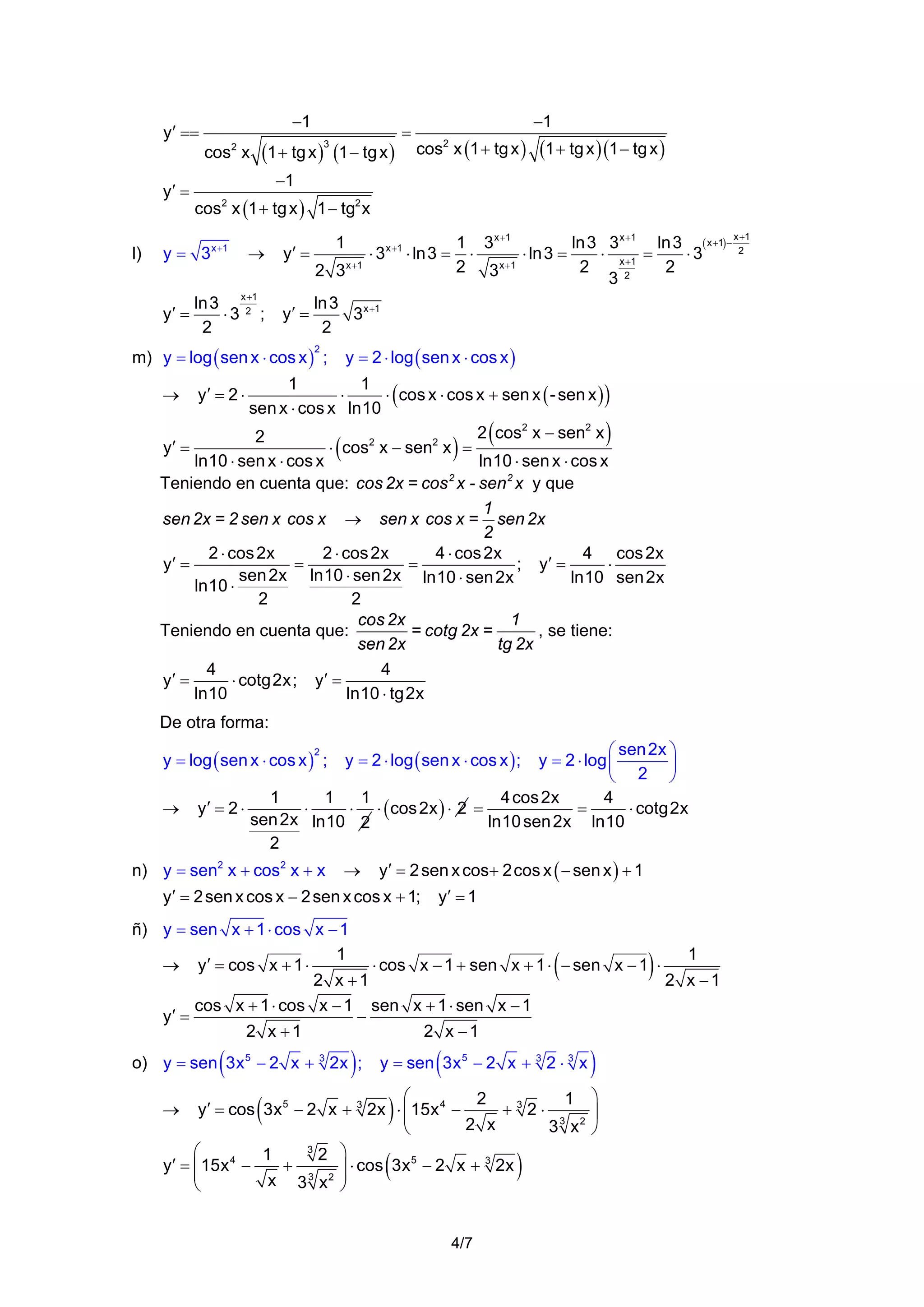
Teniendo en cuenta que: cos 2x = cos 2 x - sen 2 x y que
1
sen 2x = 2 sen x cos x → sen x cos x = sen 2x
2
2 ⋅ cos 2x
2 ⋅ cos 2x
4 ⋅ cos 2x
4 cos 2x
=
=
⋅
y′ =
; y′ =
sen 2x ln10 ⋅ sen 2x ln10 ⋅ sen 2x
ln10 sen 2x
ln10 ⋅
2
2
cos 2x
1
Teniendo en cuenta que:
= cotg 2x =
, se tiene:
sen 2x
tg 2x
4
4
y′ =
⋅ cotg2x; y′ =
ln10
ln10 ⋅ tg2x
→

y′ = 2 ⋅

(

)

(

)

De otra forma:
⎛ sen 2x ⎞
y = 2 ⋅ log ⎜
⎟
⎝ 2 ⎠
1
1
1
4 cos 2x
4
y′ = 2 ⋅
=
⋅ cotg2x
⋅
⋅ ⋅ ( cos 2x ) ⋅ 2 =
sen 2x ln10 2
ln10 sen 2x ln10
2

y = log ( sen x ⋅ cos x ) ;
2

→

y = 2 ⋅ log ( sen x ⋅ cos x ) ;

n) y = sen2 x + cos2 x + x → y′ = 2 sen x cos+ 2cos x ( − sen x ) + 1
y′ = 2 sen x cos x − 2 sen x cos x + 1; y′ = 1
ñ) y = sen x + 1 ⋅ cos x − 1
1
1
→ y′ = cos x + 1 ⋅
⋅ cos x − 1 + sen x + 1 ⋅ − sen x − 1 ⋅
2 x +1
2 x −1
cos x + 1 ⋅ cos x − 1 sen x + 1 ⋅ sen x − 1
y′ =
−
2 x +1
2 x −1

(

(

)

o) y = sen 3x 5 − 2 x + 3 2x ;

(

y = sen 3x 5 − 2 x + 3 2 ⋅ 3 x

)

)

⎛
2
1 ⎞
y′ = cos 3x 5 − 2 x + 3 2x ⋅ ⎜ 15x 4 −
+32⋅
⎟
2 x
3 3 x2 ⎠
⎝
3
⎛
1
2 ⎞
5
3
y′ = ⎜ 15x 4 −
+
⎟ ⋅ cos 3x − 2 x + 2x
⎜
3 2 ⎟
x 3 x ⎠
⎝

→

(

)

(

)

4/7
y′ =

p) y = sen x + x 2 + 1 →
2

y′ =

2 sen x + x + 1
2

)

y = cos2 3 x + 9 − 6x + x 2 ;

)

(

3

3

(

2 sen x + x 2 + 1

y = cos2 3 x 2 − 5x + 9

(x

(

)

2

− 5x + 9

)

2

⋅ ( 2x − 5 )

2

− ( 2x − 5 ) ⋅ 2 ⋅ sen 3 x 2 − 5x + 9 ⋅ cos 3 x 2 − 5x + 9

(

y′ =

sen2a = 2 sena cosa →

)

(

− ( 2x − 5 ) ⋅ sen 2 3 x 2 − 5x + 9

(

( 5 − 2x ) ⋅ sen ( 2 3 x 2 − 5x + 9 )

(

3 3 x 2 − 5x + 9

y = arc sen x

→

)

→

1

y′ =

y′ =

( x)

2

−1

y′ =
1−

2

( x)

1

⋅

1
2 x
1
2 x

1

;

y′ =

;

y′ =

y′ =

1

⋅

1

⋅

1

1− x 2 x
−1

;

1− x 2 x

1
1
⋅
;
1+ x 2 x

y = arc tg x

5

y′ =

y′ =

y′ =

b) y =

( x)

5

Sol. y′ =

x2 − 4
x2

Sol. y′ =

d) y = x 2 sen x + 2x cos x − 2 sen x
e) y = tg2 e3x

2
x
2
y′ = 2x arc cos + x 2
x

5x 4

( x + 1)

6

−x2 + 8

Sol. y′ = x 2 cos x
Sol. y′ = 6 e3 x tg e3 x sec 2 e3 x

y = x 2 arc cos

−1

−2
;
2
2
⎛2⎞ x
1− ⎜ ⎟
⎝x⎠

5/7

2 x − x2
−1

2 x − x2

2 x (1 + x )

x3 x2 − 4
Sol. y′ = sec x

c) y = ln ( sec x + tg x )

f)

2 x

;

1

1

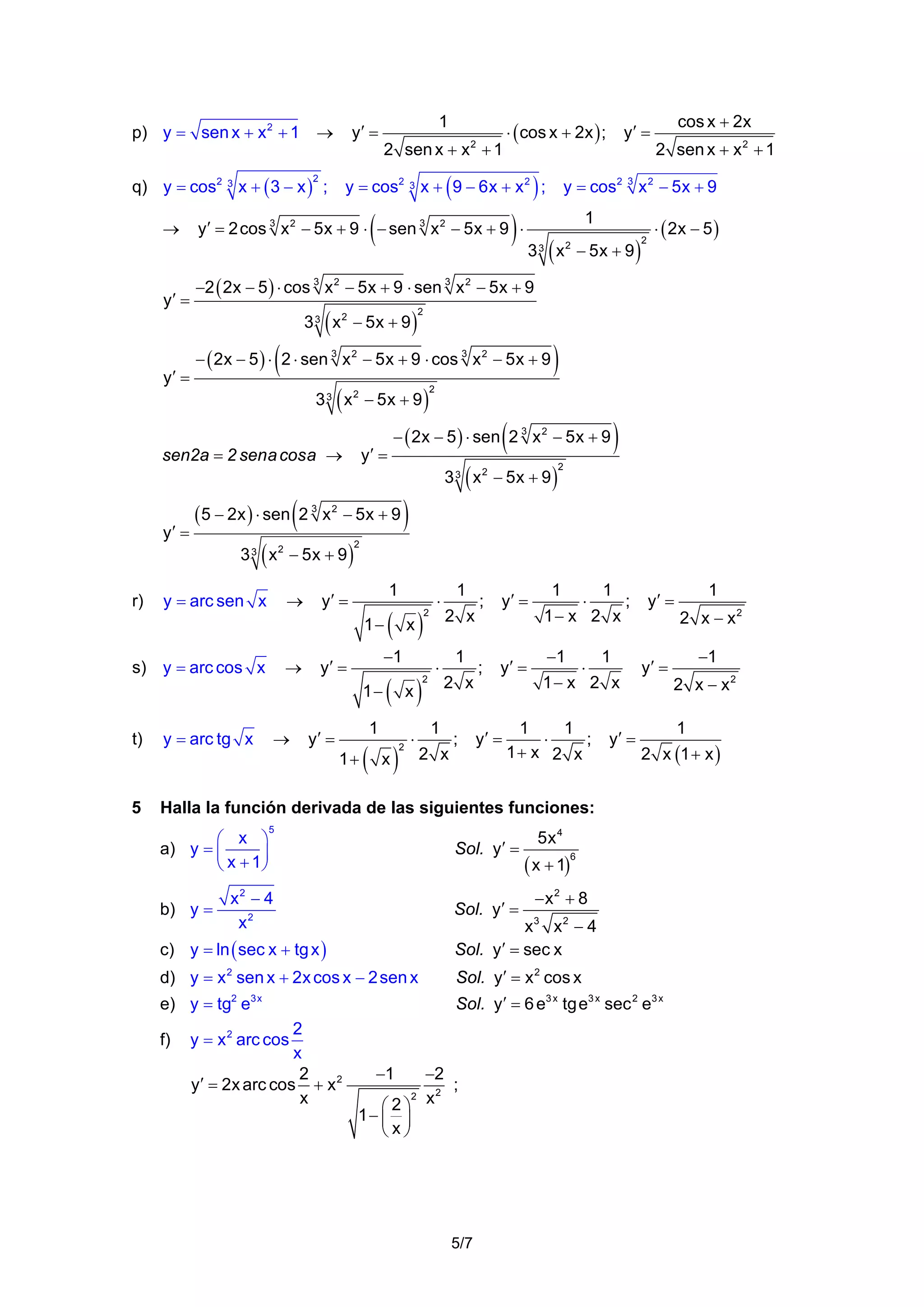
Halla la función derivada de las siguientes funciones:

1+

2

⋅

2

⋅

t)

⎛ x ⎞
a) y = ⎜
⎟
⎝ x + 1⎠

→

)

)

2

1−
s) y = arc cos x

)

2

3 3 x 2 − 5x + 9

r)

cos x + 2x

−2 ( 2x − 5 ) ⋅ cos 3 x 2 − 5x + 9 ⋅ sen 3 x 2 − 5x + 9

3 3 x 2 − 5x + 9

y′ =

y′ =

1

y′ = 2 cos 3 x 2 − 5x + 9 ⋅ − sen 3 x 2 − 5x + 9 ⋅

3 3 x 2 − 5x + 9
y′ =

⋅ ( cos x + 2x ) ;

(

q) y = cos2 3 x + ( 3 − x ) ;
→

1
y′ = 2x arc cos

2
+
x

2
4
1− 2
x

⎛
2
y′ = 2x ⎜ arc cos +
x
⎝

y′ = 2x arc cos

;

2
+
x

2x
x2 − 4

;

⎞
⎟
x −4⎠
1

2

g) y = ( x − 1) 2x − x 2 + arcsen ( x − 1)
2 − 2x

y′ = 1⋅ 2x − x 2 + ( x − 1) ⋅

y′ = 2x − x 2 + ( x − 1)
y′ = 2x − x 2 +
y′ =
y′ =

2 2x − x

2 (1 − x )
2 2x − x

x − x2 − 1 + x
2x − x

2

2x − x 2

(

2 2x − x 2

(

)

2x − x 2

2x − x

2

)

2

=

1 − ( x − 1)

1 − x + 2x − 1

2x − x 2

2 2x − x

2

)

;

;

4x − 2x 2

(

;

2

2x − x 2
=

2

1

+
1

+

2x − x 2 + x − x 2 − 1 + x + 1

2

1

+

2

=

(

2 2x − x 2
2x − x

2x − x

2

);

2

;

2x − x 2

y′ = 2 2x − x 2

(

)

x
− 2x
2
1
+x⋅
⋅ 2x +
4 + x2

h) y = x ln 4 + x 2 + 4 arc tg

(

y′ = ln 4 + x 2

(

)

(

)

y′ = ln 4 + x 2

(
)
y′ = ln ( 4 + x )
y′ = ln 4 + x 2

)

4
1
⋅ − 2;
2
x 2
1+
4
2x 2
16
1
+
+
⋅ − 2;
4 + x2 4 + x2 2
2x 2
8
+
+
− 2;
2
4+x
4 + x2
2x 2 + 8 − 8 − 2x 2
0
;
+
= ln 4 + x 2 +
2
4+x
4 + x2

y′ = 1⋅ ln 4 + x 2

(

)

2

6

Aplica la derivación logarítmica para derivar:

a) y = x 3x
Se toma logaritmo neperiano en cada miembro:
ln y = ln x 3x ; ln y = 3x ln x
Se deriva en cada miembro:
1
1
y′
⋅ y′ = 3 ⋅ ln x + 3 x ⋅ ;
= 3 ⋅ ln x + 3
D ( ln y ) = D ( 3x ln x ) ;
y
y
x
Se despeja la función derivada de y: y′ = ( 3ln x + 3 ) y
Se sustituye la función y por su expresión:
y′ = ( 3 ln x + 3 ) x 3x ;

y′ = 3x 3 x ( ln x + 1)

6/7
x + 1 ⎞ x +1
⎛
x
Sol. y′ = ⎜ ln x +
x ⎟
⎝
⎠

b) y = x x +1
1⎞
⎛
c) y = ⎜ 1 + ⎟
x⎠
⎝

d) y = ( ln x )

x

x +1

⎛ sen x ⎞
e) y = ⎜
⎟
⎝ x ⎠

f)

y = x tg x

⎡ ⎛
1⎞
1 ⎤⎛
1⎞
Sol. y′ = ⎢ln ⎜ 1 + ⎟ −
⎥ ⎜1 + x ⎟
x ⎠ 1+ x ⎦ ⎝
⎠
⎣ ⎝
x + 1⎤
x +1
⎡
ln x )
Sol. y′ = ⎢ln ( ln x ) +
x ⎥(
ln x ⎦
⎣
x

x

⎡ ⎛ sen x ⎞
⎤ ⎛ sen x ⎞
Sol. y′ = ⎢ln ⎜
⎟ + x cotg x − 1⎥ ⎜ x ⎟
⎠
⎣ ⎝ x ⎠
⎦⎝
tg x ⎞ tg x
⎛ ln x
Sol. y′ = ⎜
+
x
2
x ⎟
⎝ cos x
⎠

7/7

x

Ejerciciosderivadasresueltos

  • 1.
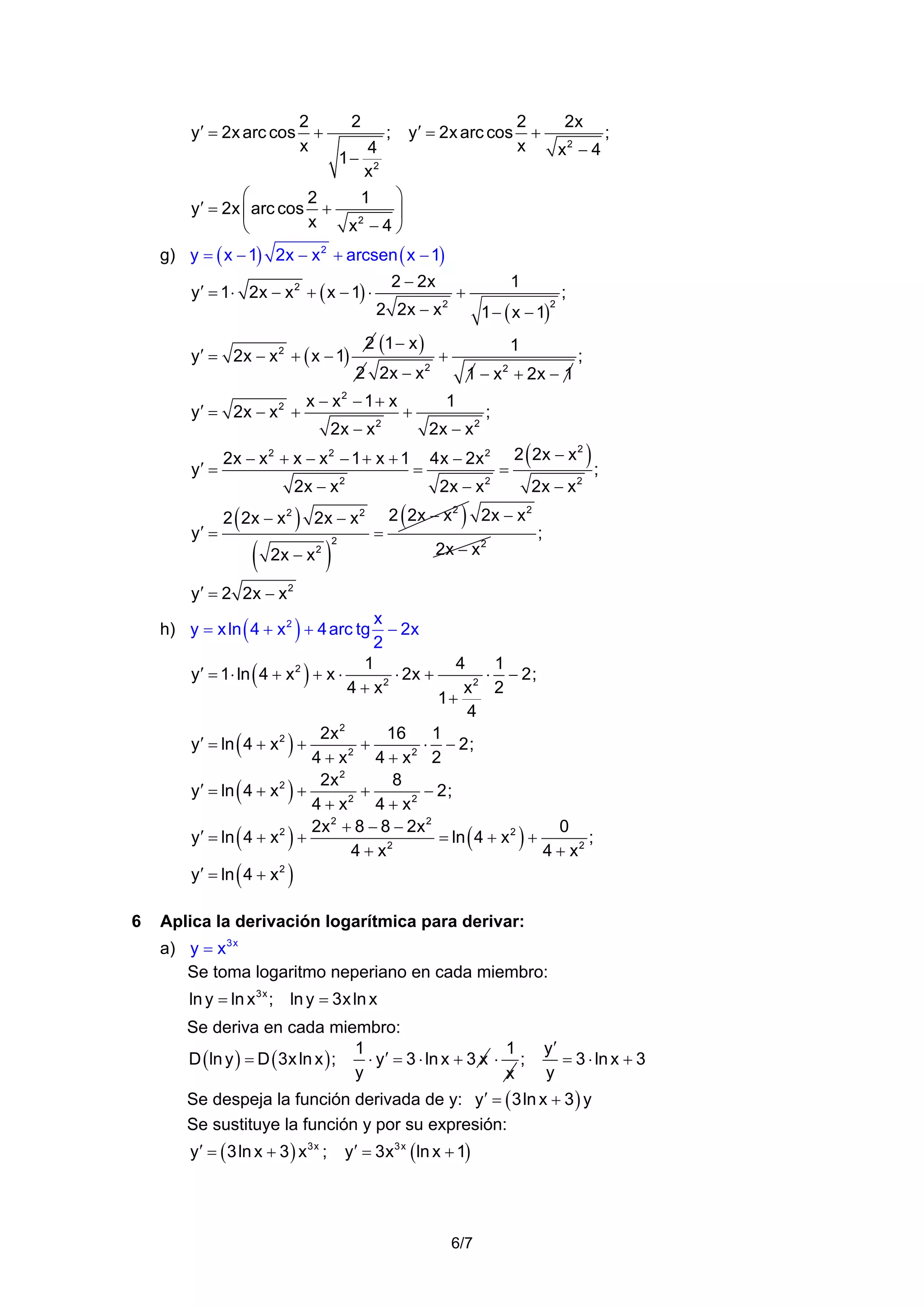
    CÁLCULO DE DERIVADAS 1 Hallala función derivada de las siguientes funciones: Sol. y′ = 6x − 6 1 1 Sol. y′ = + 3 2 2 x 3 x −3 Sol. y′ = 2 2x x Sol. y′ = 6x 2 + 6x 1 Sol. y′ = 3 3x 2 1 Sol. y′ = + 3x − 2 2 a) y = 3x 2 − 6 x + 5 b) y = x + 3 x 1 c) y = x x d) y = 2x 3 + 3x 2 − 6 x e) y = + 2 3 x3 3 2 x + x − f) y = 2 2 2 2 Halla la función derivada de las siguientes funciones: a) y = sen x cos x Sol. y′ = cos2 x − sen2 x = cos 2x b) y = x e x Sol. y′ = e x (1 + x ) c) y = x 2x Sol. y′ = 2x (1 + x ln 2 ) ( ) Sol. y′ = 2x ln x + d) y = x 2 + 1 ln x ( ) ( ) ( Sol. y′ = 15x 4 − 1 log2 x + 3x 5 − x e) y = 3x 5 − x log2 x x2 + 1 x2 − 1 Sol. y′ = g) y = x 3 + 3x 2 − 5x + 3 x h) y = log x x 1 ) x ln 2 Sol. y′ = f) y = 3 x2 + 1 x −4x (x 2 ) −1 2 2x 3 + 3x 2 − 3 x2 1 − log x loge − log x 1 e ln10 Sol. y′ = = = 2 log 2 2 x x x x Halla la función derivada de las siguientes funciones: 1 5 a) y = 2x + 3 5x Sol. y′ = + 3 2x 3 25x 2 b) y = sen x 2 − 5x + 7 Sol. y′ = ( 2x − 5 ) cos x 2 − 5x + 7 ( c) y = 3 ( 5 x + 3 ) ) 2 ( Sol. y′ = ) 10 d) y = sen ( 3x + 1) cos ( 3x + 1) 3 5x + 3 Sol. y′ = 3 cos ( 6x + 2 ) log x 2 e) y = x f) y = cos ( 3x − π ) 2 2 − log x 2 − 2log x 2 e ln10 ′ = ln10 2 Sol. y = = 2 log 2 x x x x Sol. y′ = −3sen ( 3x − π ) g) y = 1 + 2x Sol. y′ = h) y = x e 2x +1 3 1 1 + 2x ′ = e2 x +1 (1 + 2x ) Sol. y 1/7
  • 2.
    i) y = ( ) senx 2 + 1 Sol. y′ = 1 − x2 j) y = x sen (π − x ) k) y = Sol. y′ = ⎛ 3x ⎞ − 5⎟ l) y = ⎜ ⎝ 2 ⎠ 3x − 7 m) y = x+2 ) ( ) ( ) ( 1 − x2 1 − x2 ) Sol. y′ = sen (π − x ) − x cos (π − x ) 1 x2 3 ( 2x 1 − x 2 cos x 2 + 1 + xsen x 2 + 1 4 −2 3x 3 x 2 ⎛ 3x ⎞ Sol. y′ = 6 ⎜ − 5⎟ ⎝ 2 ⎠ 13 Sol. y′ = 2 ( x + 2) 3 n) y = e − x ln ( cos x ) Sol. y′ = −e − x ⎡ln ( cos x ) + tg x ⎤ ⎣ ⎦ ñ) y = tg x Sol. y′ = ⎛ x + 1⎞ o) y = ln ⎜ ⎟ ⎝ x ⎠ Sol. y′ = ⎛ x ⎞ p) y = ⎜ ⎟ ⎝ x + 1⎠ 1 2 2 cos x tg x −1 x +x 2 5 Sol. y′ = 5x 4 ( x + 1) 6 2 ⎛ 1 − x ⎞3 q) y = ⎜ ⎟ ⎝ 1+ x ⎠ Sol. y′ = x2 − 4 x r) y = Sol. y′ = 2 4 x x +1 ( 3 (1 + x ) 3 (1 − x )(1 + x ) Sol. y′ = x −1 s) y = −4 2 x2 − 4 1 ( x + 1) 7 ( 2 x − 3) x 2 x t) y = 2 x − 3 ) 7 Sol. y′ = 6 4 (Ejercicio resuelto) Halla la función derivada de las siguientes funciones: 1 cos x ⋅ cos x; y′ = a) y = sen x → y′ = 2 sen x 2 sen x y′ = cos x 2 + 5x − 1 ⋅ b) y = sen x 2 + 5x − 1 → y′ = ( 2x + 5 ) cos 1 2 x 2 + 5x − 1 ⋅ ( 2x + 5 ) x 2 + 5x − 1 2 x 2 + 5x − 1 ⋅ ( 2x + 3 ) ; +3 x → y′ = 5 e x d) y = ln ( ln x ) → y′ = 1 1 ⋅ ; ln x x ) → c) y = 5 e x ( 2 e) y = x 2 − x + sen x 4 2 +3 x y′ = y′ = 5 ( 2x + 3 ) e x 2 +3 x 1 x ln x ( ) 3 ⎛ 1 ⎞ y′ = 4 x 2 − x + sen x ⎜ 2x − + cos x ⎟ 2 x ⎝ ⎠ 2/7
  • 3.
    f) y = xx +1 ⎛ 2 ( x + 1) + x ⎞ ⋅⎜ ⎜ 2 x + 1 ⎟; ⎟ 3 2 ⎠ x +x ⎝ 2 g) y = 4 4 x 2 ( x + 1) 1− x 1+ x ⋅ 3x + 2 2 4 x3 + x 2 2 x + 1 = 1 ⋅ 3x + 2 2 4 x 2 ( x + 1) 2 4 ( x + 1)2 1− x 1+ x 3 y′ = → −1 ⋅ (1 + x ) − (1 − x ) ⋅ 1 (1 + x ) y′ = → −1 y′ == (1 + x ) i) 1 y′ = 3x + 2 h) y = y′ = 1 ⎞ ⎛ ⋅ ⎜ 1⋅ x + 1 + x ⋅ ⎟ 2 x +1⎠ 2 x x +1 ⎝ 1 1 y′ = y′ = y′ = → 2 1− x 2 1+ x −1 = 1− x 1+ x ⋅ 1 (1 + x ) (1 − x ) y′ = → −1 − x − 1 + x 2 ; y′ = 1 1− x 2 1+ x −2 (1 + x ) ⋅ 2 −2 (1 + x ) 2 −1 (1 + x ) (1 − x ) 3 1+ x (1 + x ) (1 + x )(1 − x ) 1− x 1+ x = 4 −1 y = ln = (1 + x ) −1⋅ (1 + x ) − (1 − x ) ⋅ 1 ⋅ = 2 (1 + x ) 2 ; y′ = −1 (1 + x ) 1 − x2 −2 −2 1 −2 ; ⋅ = = 1 − x (1 + x )2 (1 − x )(1 + x ) 2 (1 − x )(1 + x ) 1+ x 1+ x y′ = −2 1 − x2 De otra forma: Desarrollando el logaritmo previamente: 1 1 −1 1 y = ln (1 − x ) − ln (1 + x ) → y′ = .1 = ⋅ ( −1) − − 1− x 1+ x 1− x 1+ x −1 − x − (1 − x ) −1 − x − 1 + x −2 y′ = ; y′ = = 1 − x2 (1 − x )(1 + x ) (1 − x )(1 + x ) j) y= y′ = k) y = 1 − tg x 1 + tg x −1 − tg x − 1 + tg x −1 1 ⋅ (1 + tg x ) − (1 − tg x ) ⋅ 2 2 cos x = cos2 x y′ = cos x 2 2 (1 + tg x ) (1 + tg x ) → −2 cos x (1 + tg x ) 2 1 − tg x 1 + tg x → 2 y′ = ⎛ 1 − tg x ⎞ ⋅D⎜ ⎟ 1 − tg x ⎝ 1 + tg x ⎠ 2 1 + tg x 1 ⎛ 1 − tg x ⎞ −2 En el ejercicio anterior se calculó: D ⎜ ⎟= 2 2 ⎝ 1 + tg x ⎠ cos x (1 + tg x ) 1 y′ = 2 ⋅ −2 1 − tg x cos x (1 + tg x ) 1 + tg x 2 2 −1 = (1 + tg x ) (1 − tg x ) 4 2 cos x 3/7 1 + tg x
  • 4.
    −1 y′ == cos2 x y′= l) = −1 cos x (1 + tg x ) 2 (1 + tg x )(1 − tg x ) −1 cos2 x (1 + tg x ) 1 − tg2 x → y′ = + ln 3 x2 1 ⋅3 ; 2 y′ = y = 3 x +1 y′ = (1 + tg x ) (1 − tg x ) 3 1 2 3 x +1 ⋅ 3 x +1 ⋅ ln3 = + 1 3 x +1 ln 3 3 x +1 ln 3 ( x +1) − x2 1 ⋅ ⋅ ln 3 = ⋅ x +1 = ⋅3 2 3 x +1 2 2 32 ln 3 x +1 3 2 m) y = log ( sen x ⋅ cos x ) ; y = 2 ⋅ log ( sen x ⋅ cos x ) 2 1 1 ⋅ ⋅ ( cos x ⋅ cos x + sen x ( - sen x ) ) sen x ⋅ cos x ln10 2 cos2 x − sen2 x 2 y′ = ⋅ cos2 x − sen2 x = ln10 ⋅ sen x ⋅ cos x ln10 ⋅ sen x ⋅ cos x Teniendo en cuenta que: cos 2x = cos 2 x - sen 2 x y que 1 sen 2x = 2 sen x cos x → sen x cos x = sen 2x 2 2 ⋅ cos 2x 2 ⋅ cos 2x 4 ⋅ cos 2x 4 cos 2x = = ⋅ y′ = ; y′ = sen 2x ln10 ⋅ sen 2x ln10 ⋅ sen 2x ln10 sen 2x ln10 ⋅ 2 2 cos 2x 1 Teniendo en cuenta que: = cotg 2x = , se tiene: sen 2x tg 2x 4 4 y′ = ⋅ cotg2x; y′ = ln10 ln10 ⋅ tg2x → y′ = 2 ⋅ ( ) ( ) De otra forma: ⎛ sen 2x ⎞ y = 2 ⋅ log ⎜ ⎟ ⎝ 2 ⎠ 1 1 1 4 cos 2x 4 y′ = 2 ⋅ = ⋅ cotg2x ⋅ ⋅ ⋅ ( cos 2x ) ⋅ 2 = sen 2x ln10 2 ln10 sen 2x ln10 2 y = log ( sen x ⋅ cos x ) ; 2 → y = 2 ⋅ log ( sen x ⋅ cos x ) ; n) y = sen2 x + cos2 x + x → y′ = 2 sen x cos+ 2cos x ( − sen x ) + 1 y′ = 2 sen x cos x − 2 sen x cos x + 1; y′ = 1 ñ) y = sen x + 1 ⋅ cos x − 1 1 1 → y′ = cos x + 1 ⋅ ⋅ cos x − 1 + sen x + 1 ⋅ − sen x − 1 ⋅ 2 x +1 2 x −1 cos x + 1 ⋅ cos x − 1 sen x + 1 ⋅ sen x − 1 y′ = − 2 x +1 2 x −1 ( ( ) o) y = sen 3x 5 − 2 x + 3 2x ; ( y = sen 3x 5 − 2 x + 3 2 ⋅ 3 x ) ) ⎛ 2 1 ⎞ y′ = cos 3x 5 − 2 x + 3 2x ⋅ ⎜ 15x 4 − +32⋅ ⎟ 2 x 3 3 x2 ⎠ ⎝ 3 ⎛ 1 2 ⎞ 5 3 y′ = ⎜ 15x 4 − + ⎟ ⋅ cos 3x − 2 x + 2x ⎜ 3 2 ⎟ x 3 x ⎠ ⎝ → ( ) ( ) 4/7
  • 5.
    y′ = p) y= sen x + x 2 + 1 → 2 y′ = 2 sen x + x + 1 2 ) y = cos2 3 x + 9 − 6x + x 2 ; ) ( 3 3 ( 2 sen x + x 2 + 1 y = cos2 3 x 2 − 5x + 9 (x ( ) 2 − 5x + 9 ) 2 ⋅ ( 2x − 5 ) 2 − ( 2x − 5 ) ⋅ 2 ⋅ sen 3 x 2 − 5x + 9 ⋅ cos 3 x 2 − 5x + 9 ( y′ = sen2a = 2 sena cosa → ) ( − ( 2x − 5 ) ⋅ sen 2 3 x 2 − 5x + 9 ( ( 5 − 2x ) ⋅ sen ( 2 3 x 2 − 5x + 9 ) ( 3 3 x 2 − 5x + 9 y = arc sen x → ) → 1 y′ = y′ = ( x) 2 −1 y′ = 1− 2 ( x) 1 ⋅ 1 2 x 1 2 x 1 ; y′ = ; y′ = y′ = 1 ⋅ 1 ⋅ 1 1− x 2 x −1 ; 1− x 2 x 1 1 ⋅ ; 1+ x 2 x y = arc tg x 5 y′ = y′ = y′ = b) y = ( x) 5 Sol. y′ = x2 − 4 x2 Sol. y′ = d) y = x 2 sen x + 2x cos x − 2 sen x e) y = tg2 e3x 2 x 2 y′ = 2x arc cos + x 2 x 5x 4 ( x + 1) 6 −x2 + 8 Sol. y′ = x 2 cos x Sol. y′ = 6 e3 x tg e3 x sec 2 e3 x y = x 2 arc cos −1 −2 ; 2 2 ⎛2⎞ x 1− ⎜ ⎟ ⎝x⎠ 5/7 2 x − x2 −1 2 x − x2 2 x (1 + x ) x3 x2 − 4 Sol. y′ = sec x c) y = ln ( sec x + tg x ) f) 2 x ; 1 1 Halla la función derivada de las siguientes funciones: 1+ 2 ⋅ 2 ⋅ t) ⎛ x ⎞ a) y = ⎜ ⎟ ⎝ x + 1⎠ → ) ) 2 1− s) y = arc cos x ) 2 3 3 x 2 − 5x + 9 r) cos x + 2x −2 ( 2x − 5 ) ⋅ cos 3 x 2 − 5x + 9 ⋅ sen 3 x 2 − 5x + 9 3 3 x 2 − 5x + 9 y′ = y′ = 1 y′ = 2 cos 3 x 2 − 5x + 9 ⋅ − sen 3 x 2 − 5x + 9 ⋅ 3 3 x 2 − 5x + 9 y′ = ⋅ ( cos x + 2x ) ; ( q) y = cos2 3 x + ( 3 − x ) ; → 1
  • 6.
    y′ = 2xarc cos 2 + x 2 4 1− 2 x ⎛ 2 y′ = 2x ⎜ arc cos + x ⎝ y′ = 2x arc cos ; 2 + x 2x x2 − 4 ; ⎞ ⎟ x −4⎠ 1 2 g) y = ( x − 1) 2x − x 2 + arcsen ( x − 1) 2 − 2x y′ = 1⋅ 2x − x 2 + ( x − 1) ⋅ y′ = 2x − x 2 + ( x − 1) y′ = 2x − x 2 + y′ = y′ = 2 2x − x 2 (1 − x ) 2 2x − x x − x2 − 1 + x 2x − x 2 2x − x 2 ( 2 2x − x 2 ( ) 2x − x 2 2x − x 2 ) 2 = 1 − ( x − 1) 1 − x + 2x − 1 2x − x 2 2 2x − x 2 ) ; ; 4x − 2x 2 ( ; 2 2x − x 2 = 2 1 + 1 + 2x − x 2 + x − x 2 − 1 + x + 1 2 1 + 2 = ( 2 2x − x 2 2x − x 2x − x 2 ); 2 ; 2x − x 2 y′ = 2 2x − x 2 ( ) x − 2x 2 1 +x⋅ ⋅ 2x + 4 + x2 h) y = x ln 4 + x 2 + 4 arc tg ( y′ = ln 4 + x 2 ( ) ( ) y′ = ln 4 + x 2 ( ) y′ = ln ( 4 + x ) y′ = ln 4 + x 2 ) 4 1 ⋅ − 2; 2 x 2 1+ 4 2x 2 16 1 + + ⋅ − 2; 4 + x2 4 + x2 2 2x 2 8 + + − 2; 2 4+x 4 + x2 2x 2 + 8 − 8 − 2x 2 0 ; + = ln 4 + x 2 + 2 4+x 4 + x2 y′ = 1⋅ ln 4 + x 2 ( ) 2 6 Aplica la derivación logarítmica para derivar: a) y = x 3x Se toma logaritmo neperiano en cada miembro: ln y = ln x 3x ; ln y = 3x ln x Se deriva en cada miembro: 1 1 y′ ⋅ y′ = 3 ⋅ ln x + 3 x ⋅ ; = 3 ⋅ ln x + 3 D ( ln y ) = D ( 3x ln x ) ; y y x Se despeja la función derivada de y: y′ = ( 3ln x + 3 ) y Se sustituye la función y por su expresión: y′ = ( 3 ln x + 3 ) x 3x ; y′ = 3x 3 x ( ln x + 1) 6/7
  • 7.
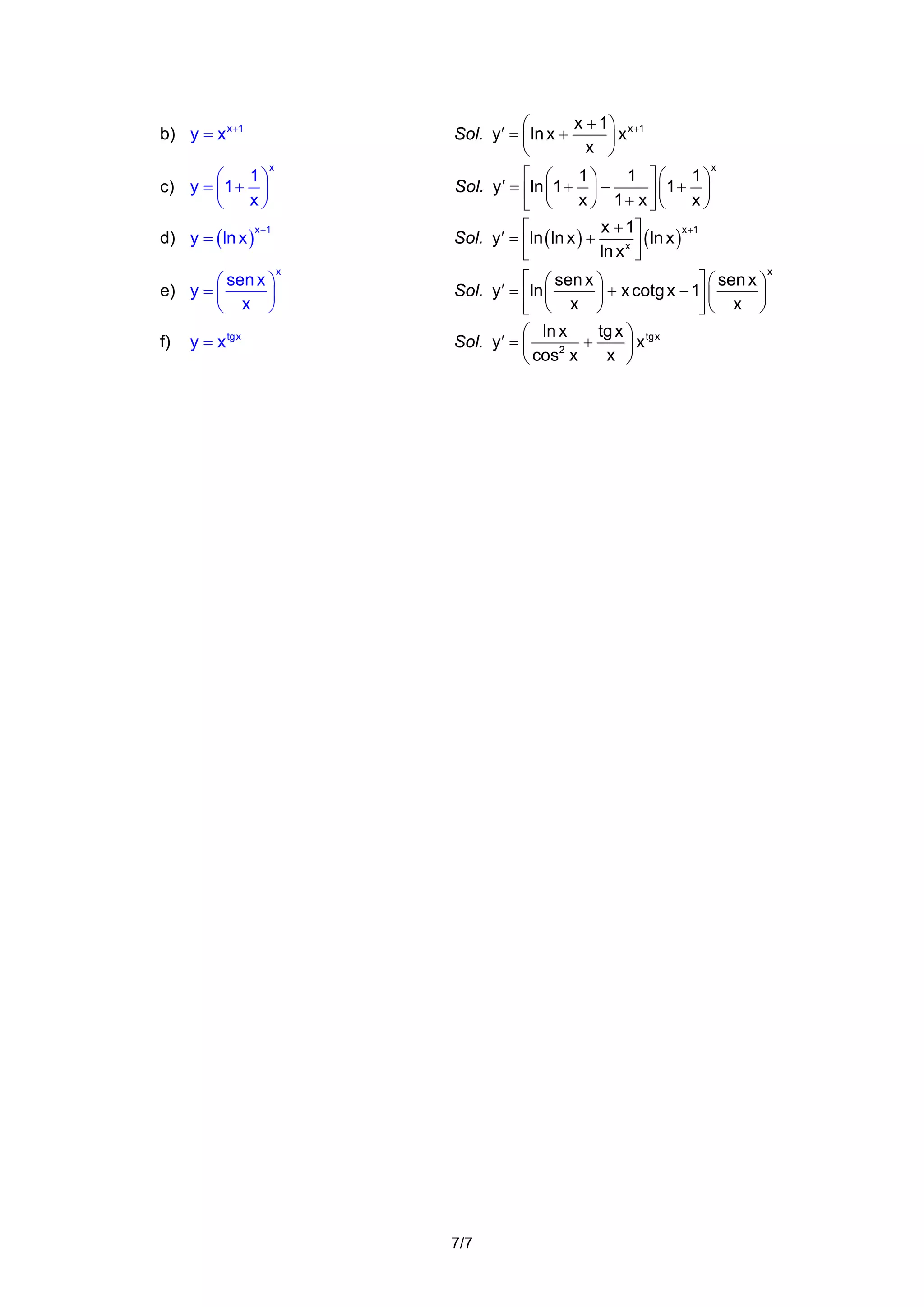
    x + 1⎞ x +1 ⎛ x Sol. y′ = ⎜ ln x + x ⎟ ⎝ ⎠ b) y = x x +1 1⎞ ⎛ c) y = ⎜ 1 + ⎟ x⎠ ⎝ d) y = ( ln x ) x x +1 ⎛ sen x ⎞ e) y = ⎜ ⎟ ⎝ x ⎠ f) y = x tg x ⎡ ⎛ 1⎞ 1 ⎤⎛ 1⎞ Sol. y′ = ⎢ln ⎜ 1 + ⎟ − ⎥ ⎜1 + x ⎟ x ⎠ 1+ x ⎦ ⎝ ⎠ ⎣ ⎝ x + 1⎤ x +1 ⎡ ln x ) Sol. y′ = ⎢ln ( ln x ) + x ⎥( ln x ⎦ ⎣ x x ⎡ ⎛ sen x ⎞ ⎤ ⎛ sen x ⎞ Sol. y′ = ⎢ln ⎜ ⎟ + x cotg x − 1⎥ ⎜ x ⎟ ⎠ ⎣ ⎝ x ⎠ ⎦⎝ tg x ⎞ tg x ⎛ ln x Sol. y′ = ⎜ + x 2 x ⎟ ⎝ cos x ⎠ 7/7 x