BY- ARYAN SAXENA 
CLASS- 8 A
 A network consists of two or more computers 
that are linked in order to share resources, 
exchange files, or allow electronic 
communications. 
 The computers on a network may be linked 
through cables, telephone lines, radio waves, 
satellites, or infrared light beams 
2
 File sharing 
 Resource sharing 
 Communication and collaboration 
 Remote access 
 Data protection 
3
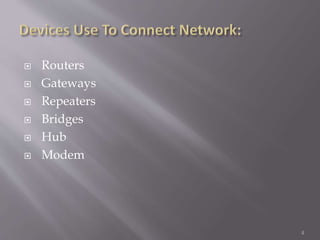
 Routers 
 Gateways 
 Repeaters 
 Bridges 
 Hub 
 Modem 
4
Abbreviations Network 
PAN Personal Area Network 
LAN Local Area Network 
CAN Campus Area Network 
MAN Metropolitan Area Network 
WAN Wide Area Network 
5
6 
Topology Advantages Disadvantage S 
BUS Takes less cable Break in the Bus, 
network is down 
Ring Easy to install Expensive parts 
Star Easy to install; most 
common; break in 
workstation cable, 
network still works 
More expensive than Bus
Topologies Description 
Linear Bus All nodes and peripheral devices are 
attached to a common backbone cable. 
Ring All nodes are connected in a circular 
chain. 
Star All nodes are connected to a central 
hub.
 A local area network (LAN) is a group of 
computers and associated devices that share a 
common communications line or wireless link. 
 Typically, connected devices share the 
resources of a single processor or server within 
a small geographic area . 
 . A local area network may serve as few as two 
or three users or as many as thousands of 
users. 
9

Different types of network

  • 1.
    BY- ARYAN SAXENA CLASS- 8 A
  • 2.
     A networkconsists of two or more computers that are linked in order to share resources, exchange files, or allow electronic communications.  The computers on a network may be linked through cables, telephone lines, radio waves, satellites, or infrared light beams 2
  • 3.
     File sharing  Resource sharing  Communication and collaboration  Remote access  Data protection 3
  • 4.
     Routers Gateways  Repeaters  Bridges  Hub  Modem 4
  • 5.
    Abbreviations Network PANPersonal Area Network LAN Local Area Network CAN Campus Area Network MAN Metropolitan Area Network WAN Wide Area Network 5
  • 6.
    6 Topology AdvantagesDisadvantage S BUS Takes less cable Break in the Bus, network is down Ring Easy to install Expensive parts Star Easy to install; most common; break in workstation cable, network still works More expensive than Bus
  • 7.
    Topologies Description LinearBus All nodes and peripheral devices are attached to a common backbone cable. Ring All nodes are connected in a circular chain. Star All nodes are connected to a central hub.
  • 9.
     A localarea network (LAN) is a group of computers and associated devices that share a common communications line or wireless link.  Typically, connected devices share the resources of a single processor or server within a small geographic area .  . A local area network may serve as few as two or three users or as many as thousands of users. 9