SUB TITLE: VERMITECHNOLOGY
SUBCODE: VMBSE21
• TITLE: METHODS OF VERMICOMPOSTING
SUBMITTED BY:
JULIET PRINCY BAI. A
I M.Sc., MICROBIOLOGY
PG AND RESEARCH DEPT OF MICROBIOLOGY
SRI PARAMAKALYANI COLLEGE
ALWARKURICHI - 627412
SUBMITTED TO:
Dr. S. VISWANATHAN, M.Sc., Ph.D.,
HEAD AND ASSOCIATE PROFESSOR,
PG AND RESEARCH DEPT OF MICROBIOLOGY
SRI PARAMAKALYANI COLLEGE
ALWARKURICHI – 627412
2.
Introduction
A)Windrows system
B) Wedgesystem
C)Container system –
a)Pits, tanks and cement rings
b)Commercial model
c)Beds or bins
1.Top fed type
2.Stacked type
D) Continuous flow system
Conclusion
CONTENT
3.
• Vermicomposting isthe process of using earthworms to
transform organic waste into nutrient-rich compost,
enhancing soil fertility.
• This method effectively reduces waste volume, making it an
environmentally friendly solution for managing organic materials.
• The resulting vermicompost improves soil structure, retains moisture, and
increases microbial activity, which benefits plant growth.
Introduction
4.
A. Windrow system
•This system deals with construction of windrows under shade to avoid direct sunlight.
• This method involves spreading out a layer of worms and bedding on the floor or ground to start.
• The first layer of a new windrow should be 10 to 15cm high.
• Earthworms can be reared at a production nursery or rectangular boxes prior to their inoculation in the
windrows.
• The worms feed from the bottom till the top of the bed.
• The windrow has to be monitored daily and when signs of surface feeding are noticed, another 7 to 10
cm layer of feedstock can be added.
5.
• Thick layersof feedstock are avoided because they impede oxygen penetration into the
windrow.
• This can cause the worms to migrate to the upper surface before lower layers are
thoroughly digested, creating anaerobic fermentation.
• The windrows are irrigated with center post sprinkler up to twice daily to maintain
optimum moisture content of 80% throughout the windrow.
• Now the material on top is removed to start a new row, and the material on the bottom is
vermicompost. The new row can be started in a new location or it can be moved
longitudinally by about 20' by dumping the worm inhabited material past the end of the
row, digging out some vermicompost, and then shuffling some more worms over.
6.
Setup of Windrow
System
Maintenanceand Advantages
The windrow system involves constructing rows of
organic waste in shaded areas to prevent
overheating, with layers of worms and bedding
added. The ideal initial height is 10 to 15 cm, and
moisture must be kept at 80%.
Daily monitoring for surface feeding is essential,
with irrigation to maintain moisture. Advantages
include effective waste processing, cost reduction,
and suitability for various climates.
WINDROW SYSTEM
7.
B. Wedge System
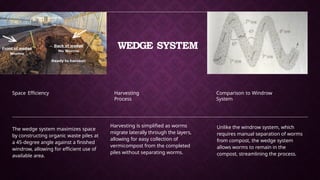
●The arrangement of the row of vermibed is V-shaped in the wedge system.
• This is a modified windrow system and it maximizes space and simplifies harvesting because there
is no need to separate worms from vermicompost.
• Organic wastes are applied in layers against a finished windrow at a 45 ֯ angle.
• The piles can be constructed inside a structure or outdoors if they are covered with a tarpaulin or
compost cover to prevent leaching of nutrients.
• A frontend loader is used to establish a windrow 1.2 to 3 m wide by whatever length is appropriate.
• Spreading a 30 to 45 cm layer of organic materials the length of one end of available space starts
the windrow.
• Up to 0.45 kg of worms is added per square meter of windrow surface area.
• Subsequent layers of 5 to 7.5 cm of organics are added weekly and preferably more addition in
colder seasons.
8.
• After thewindrow reaches two to three feet deep, worms in the first windrow will eventually migrate
toward the fresh feed.
• Worms will continue to move laterally through the windrows.
• After two to six months, the first windrow and each subsequent pile can be harvested.
• A variation of this method uses a migrating windrow. Here a row can be started as a windrow or as a
layer and then grown into a windrow.
• A loader is used to feed one side of the row, keeping it the same height and length, but making it
wider.
• After a while, a loader is used to remove vermicompost from the side opposite the one being fed.
• Later, the finished compost is removed from that same side again.
• The row migrates laterally as it is being fed along one side and harvested along the other.
• At any time, the feeding and harvesting sides can be switched to change the migration.
9.
WEDGE SYSTEM
Space EfficiencyHarvesting
Process
Comparison to Windrow
System
The wedge system maximizes space
by constructing organic waste piles at
a 45-degree angle against a finished
windrow, allowing for efficient use of
available area.
Harvesting is simplified as worms
migrate laterally through the layers,
allowing for easy collection of
vermicompost from the completed
piles without separating worms.
Unlike the windrow system, which
requires manual separation of worms
from compost, the wedge system
allows worms to remain in the
compost, streamlining the process.
10.
C. Container system
Acontainer system is a type of vermicomposting setup that uses a controlled environment to house
red wiggler worms and organic waste. The system is designed to optimize worm growth, waste
decomposition, and vermicompost production.
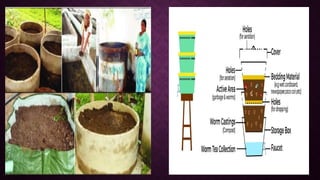
a. PITS, TANKS AND CEMENT RINGS
• Pits made for vermicomposting are 1 m deep and 1.5 m wide.
• The length varies as required.
• Tanks made up of different materials such as normal bricks, hollow bricks, asbestos sheets and
locally available rocks were evaluated for vermicompost preparation.
• Tanks can be constructed with the dimensions suitable for operations.
• Scientists at ICRISAT have evaluated tanks with dimensions of 1.5 m (5 feet) width, 4.5 m (15 feet)
length and 0.9 m (3 feet) height.
• The commercial biodigester contains a partition wall with small holes to facilitate easy movement of
earthworms from one tank to the other (Nagavallemma, et al, 2004)
• Vermicompost can also be prepared above the ground by using cement rings.
• The size of the cement ring should be 90 cm in diameter and 30 cm in height
12.
b. COMMERCIAL MODEL
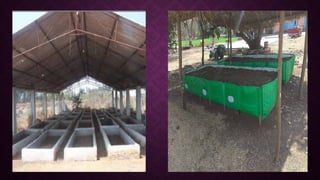
•The commercial model for vermicomposting consists of four chambers enclosed
by a wall (1.5 m width, 4.5 m length and 0.9 m height).
• The walls are made up of different materials such as normal bricks, hollow bricks,
asbestos sheets and locally available rocks.
• This model contains partition walls with small holes to facilitate easy movement of
earthworms from one chamber to another.
• Providing an outlet at one corner of each chamber with as light slope facilitates
collection of excess water, which is reused later or used as earthworm leachate
on crop.
13.
• The fourcomponents of a tank are filled with plant residues one after another.
• The first chamber is filled layer by layer along with cow dung and then earthworms
are released. Then the second chamber is filled layer by layer.
• Once the contents in the first chamber are processed the earthworms move to
chamber 2, which is already filled and ready for earthworms.
• This facilitates harvesting of decomposed material from the first chamber and also
saves labor for harvesting and introducing earthworms.
• This technology reduces labour cost and saves water as well as time.
15.
c. BEDS ORBINS
1. Top-fed type
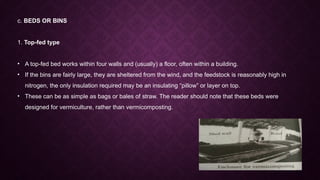
• A top-fed bed works within four walls and (usually) a floor, often within a building.
• If the bins are fairly large, they are sheltered from the wind, and the feedstock is reasonably high in
nitrogen, the only insulation required may be an insulating “pillow” or layer on top.
• These can be as simple as bags or bales of straw. The reader should note that these beds were
designed for vermiculture, rather than vermicomposting.
16.
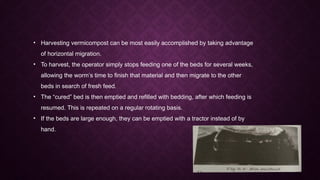
• Harvesting vermicompostcan be most easily accomplished by taking advantage
of horizontal migration.
• To harvest, the operator simply stops feeding one of the beds for several weeks,
allowing the worm’s time to finish that material and then migrate to the other
beds in search of fresh feed.
• The “cured” bed is then emptied and refilled with bedding, after which feeding is
resumed. This is repeated on a regular rotating basis.
• If the beds are large enough, they can be emptied with a tractor instead of by
hand.
17.
2. Stacked type
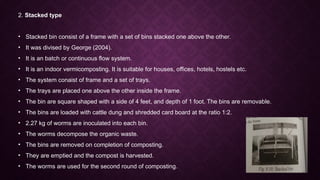
•Stacked bin consist of a frame with a set of bins stacked one above the other.
• It was divised by George (2004).
• It is an batch or continuous flow system.
• It is an indoor vermicomposting. It is suitable for houses, offices, hotels, hostels etc.
• The system conaist of frame and a set of trays.
• The trays are placed one above the other inside the frame.
• The bin are square shaped with a side of 4 feet, and depth of 1 foot. The bins are removable.
• The bins are loaded with cattle dung and shredded card board at the ratio 1:2.
• 2.27 kg of worms are inoculated into each bin.
• The worms decompose the organic waste.
• The bins are removed on completion of composting.
• They are emptied and the compost is harvested.
• The worms are used for the second round of composting.
18.
D. Continuous FlowSystems
• This system originally developed by Dr. Clive Edwards of the Rothamstead Agricultural Research
Station is gaining popularity and has been adopted by many midscale operations.
• The efficiency savings offered by their continuous flow design increases with the amount of material
processed.
• This system design is now almost ubiquitous in commercial mid to large-scale vermicomposting
systems.
• Each of these systems uses a relatively deep top-fed container, in which the composting mass sits
upon a raised floor made from a widely spaced wire mesh.
19.
• Worms areadded to the system and food waste is added gradually, layered with bedding
material. The system is continually fed until the bin is nearly full.
• The worms generally move upward through the feedstock/bedding layers and
vermicompost is harvested from below by scraping or cutting a thin layer of finished
material from just above the grill using a rake or a manually or hydraulically operated
blade.
• Continuous flow systems offer several advantages to medium to large scale composting
operations.
• They are relatively straightforward to construct and operate.
20.
• They arelabour-efficient in terms of operation and harvesting finished material.
• They avoid the need for expensive equipment associated with technical ‘invessel’ systems and the
turning and screening of windrowed material.
• It should be noted that, despite the recent and increasing interest in this design, windrows are still the
most common largescale vermicomposting system in use.
• Continuous flow vermicomposting designs are arguably the most efficient systems available, in terms of
time and labour savings.
• However, regardless of efficiency or ease of operation, there is no design that eliminates the need for
careful monitoring and good system management, which may require considerable initial
experimentation and familiarization.
22.
MAINTAINING CONTINUOUS FLOW
•Continuous flow vermicomposting systems provide an ongoing flow of vermicompost that
is easily removed from the system without disrupting the worm activity or requiring
complex or time-consuming harvesting methods.
• Because of their operating efficiency, these system designs are becoming almost as
popular as windrows for large-scale applications.
• However, like all vermicomposting systems, the continuous flow model poses several
challenges. In order to simplify some of the technical terminology, the worms most often
used in vermicomposting are usually referred to as "surface feeders.”
23.
• They aregenerally presumed to only be active at or just below the surface. However, this
is not always the case.
• Earthworms are oxygen breathing, moisture-loving animals that require organic material
to be bacterially active before they eat it. In their natural environment, this is usually top
few inches of soil or surface organic litter, such as leaves.
• In any system with a free flow of oxygen, monitored moisture level and abundant supply
of decomposing organic material, earthworms may spread throughout the material unless
the system is carefully managed.
24.
• Earthworms maytherefore be found anywhere within the continuous flow systems which
meets their requirements.
• One of the advantages to the continuous flow design is in the ease with which a continuous
supply of vermicompost can be removed from the system. However, harvesting of the
finished material should not begin until the system is nearly full of material.
• Many operators have found that, along with appropriate loading rates, a minimum depth of
material in the system of between 12"-18" will help to ensure that few, if any, worms will be
low in the bed and drop through, or fall out with the harvested vermicompost.
• Once fully charged, vermicompost then needs to be removed at a rate that maintains a
relatively constant level of material in the system.
25.
MANAGING
FEEDING RATES
Proper feedingrates are essential for
maintaining the health of earthworms and
the efficiency of vermicomposting systems.
Feeding rates directly influence worm
activity; optimal rates encourage surface
feeding and migration, while excessive
feeding can lead to anaerobic conditions.
Regular observation helps determine the
right time to add new feedstock, ensuring
that worms have sufficient time to process
existing material.
Significance of Feeding Rates Impact on Worm Behavior
Monitoring Feedstock Decomposition
Applying thin layers of feedstock (1-2
inches) improves aeration and reduces the
risk of overheating, promoting a healthy
composting environment.
Layering Techniques
Balanced feeding rates ensure that
organic material is processed efficiently,
preventing the build-up of unprocessed
waste and maintaining system aeration.
System Performance
26.
Vermicomposting systemssuch as windrow, wedge, container, and continuous flow each
serve unique purposes in organic waste management.
Effective moisture management is crucial across all systems, maintaining approximately
80% moisture content to support worm activity.
Regular monitoring of feeding rates ensures worms can efficiently process material
without causing overheating or anaerobic conditions.
Using appropriate bedding materials and bulking agents can enhance worm health and
compost quality, improving overall system efficiency.
Implementing a rotation schedule for feeding and harvesting can optimize space
utilization and increase productivity in commercial operations.
CONCLUSION