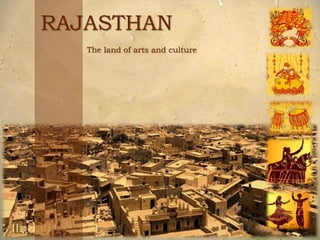
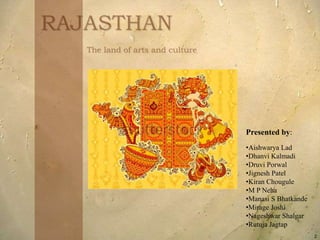
RAJASTHAN
The land of arts and culture
2
Presented by:
•Aishwarya Lad
•Dhanvi Kalmadi
•Druvi Porwal
•Jignesh Patel
•Kiran Chougule
•M P Neha
•Manasi S Bhatkande
•Mirage Joshi
•Nageshwar Shalgar
•Rutuja Jagtap
3
INTRODUCTION
4
HISTORY
•Rajasthan manifests itself in its unique art and
culture.
•The latticed havelis, ornate palaces and
intricately carved temples reflects the ancient
Indian way of life.
• the architectural beauty of forts and palaces
symbolize the skills of its artists.
•It’s art forms has got intricate carvings and
bright colors.
•Natural resources of the region are used
innovatively to bring life to vivid images and
historic scenes.
• Use of textiles and even household walls as
base for art works.
•Depiction of historic legends and battling
scenes.
•Powdered gem stones captures royal scenes of
eternity.
•The wall paintings immortalize a domestic
occasion.
•The miniatures are a collectors favorite.
•Major export of handicrafts.
•An important income source of the people.
THEMES USED
•Gods and goddess,
•Religious motifs
•Natural phenomenon such as the sun,
moon, stars
•Animals in the region.
5
ART FORMS
6
Thapa:
• It is more basic form of hand prints.
•Representations of various gods and goddesses and religious
ceremonies
•Thapas are drawn mainly by women with the help of
kumkum, sindoor, henna, ghee and cow-dung.
•The main colors used for making Thapas of different kinds
are red, yellow, green, blue, black and yellow.
•Kumkum is the main ingredient used in this form of drawing.
Mandanas:
•They are drawn both in Rajasthan and in Madhya Pradesh.
•Mandana derives from the word Mandan which means
ornamentation or decoration.
•They are drawn on the walls and floors of the houses, which are
first plastered with clay and cow-dung mixture.
•Mandanas are drawn on the occasion of religious festivals, fasts,
auspicious ceremony, marriage or a specially organized religious
worship.
TYPES OF ART FORMS PRACTICED IN RAJASTHAN
7
Rajput Paintings:
•Rajput painting originated in the royal states of Rajasthan,
around the late 16th and early 17th century.
•One can also observe the dominance of Chaurapanchasika
group style in Indian Rajasthani Paintings.
•Gond paintings:
•These can be found in inner and outer walls of the houses,
windows and niches.
•The main colors used are: red, yellow, blue, black and
white.
•These paintings are based on motifs taken from the oral
narratives of Gonds.
• Local deities, cock fight, scenes connected with forest,
agriculture, marriage and other rituals find place in these
paintings.
•These Paintings revolved around the Great epics of Ramayana and the Mahabharata, the
life of Lord Krishna, landscapes and humans.
•Colors used for the painting were derived from minerals, plant sources, conch shells,
precious stones, gold and silver, etc.
8
Gudna motif:
•Gudna refers to that style of painting, which is made by piercing the
body with the help of a needle and injecting it with black colour
obtained from lamp soot.
•Use of kumkum, milk of aak, leaves of bilva plant and juice of
harsingar flower are also used at times.
•Images of birds, animals, gods and goddesses, vertical, horizontal
and diagonal lines, dots, flowers, swastika, sun and moon are some of
the popular motifs used in Gudna.
•These designs have ritual and symbolic meanings.
Shekhawati:
•Shekhawati are murals consisting mainly of only floral and abstract designs.
•Wall painting in Shekhawati boomed only after Mughal power was declined.
•The artists depended heavily on traditional Indian subjects.
•This consisted of scenes from mythology, especially of Lord Krishna, local legends,
animals and plants, daily lives of men and women, towns and the Shekhawat Rajas.
9
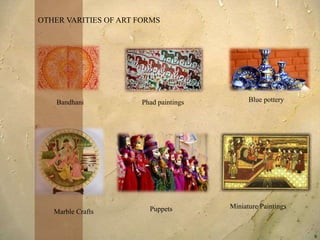
Blue pottery
OTHER VARITIES OF ART FORMS
Marble Crafts
Miniature Paintings
Bandhani
Puppets
Phad paintings
10
SANJHI ART
11
SANJHI ART
•Sanjhi’ is a word derived from words like ‘Sajja’, ‘Shringar’ and ‘Sajavat’ which all means
‘decoration’.
•Sanjhi art is rooted in the folk culture of Uttar Pradesh (Mathura).
It was taken to its glory by the Vaishnava temples in the 15th and 16th century.
•Sanjhi came to be regarded as a highly refined art form practiced by the Brahmin priests.
•The term Sanjhi is derived from the Hindi word Sandhya, the period of dusk with which the art
form is typically art form is associated.
12
•Sanjhi art is the traditional art of stenciling from Mathura, Krishna's home town.
•Known for its inherent spiritual implications that reach beyond immediate aesthetic appeal,
• it is considered to be one of the finest arts of spiritual expression.
• The art grew in the 16th and the 17th centuries, when the walls and floors of temples were
decorated with Sanjhi motifs.
• The art depicts Indian mythological stories in numerous forms with predominant focus on
Krishna’s Leela.
•Folklore tells us that the origins of this art form lie with Radhe who made Sanjhi Rangoli
using natural colors, along with flowers, leaves and colored stones to woo Krishna.
•The other Gopis soon followed suit, also making intricate designs to impress Krishna.
THEMES AND MOTIFS
13
•To create a Sanjhi design, stencils are made on paper using specially designed scissors.
•These stencils are placed on flat surfaces or water, where the rangoli has to be drawn.
•Dry colors are then shifted on to the surface. Filling the colors and lifting the stencils are
as critical as cutting the design.
•Peacocks, bullock carts, horses, cows and trees are some of the common motifs used.
•Sanjhi paper art, a traditional art form of stenciled paper cutting, serves as a conduit of
expression for artist’s devotion to Krishna.
TECHNIQUE
14
CONTEMPORARY USES
•The number of artisans practicing Sanjhi making are limited. The demand for their work
in its traditional form has been declining over the years. In a search for an alternative
employment for their skills, they have turned their hand to making Sanjhi for
contemporary use.
•Sanjhi templates are now used as stencils made of plastic sheets for decorative bindis ,
henna patterns and sari borders.
• As a form of art work Sanjhi are also used in greeting cards, cutout partitions, coasters,
trays and other decorative items.
•When used in Lampshades and in window partitions, the Sanjhi comes to life when lit up
and the design depicted glows with light.
• Here the intricate and delicate cuts of the Sanjhi itself and not the Rangoli is the
centerpiece of creation.
•The Delhi Crafts Council has been doing extensive work in reviving and popularizing
the languishing craft of Sanjhi in the past of few years and given a much-needed boost to
the craft and the artisans.

Rajasthan folk arts

  • 1.
    RAJASTHAN The land ofarts and culture
  • 2.
    2 Presented by: •Aishwarya Lad •DhanviKalmadi •Druvi Porwal •Jignesh Patel •Kiran Chougule •M P Neha •Manasi S Bhatkande •Mirage Joshi •Nageshwar Shalgar •Rutuja Jagtap
  • 3.
  • 4.
    4 HISTORY •Rajasthan manifests itselfin its unique art and culture. •The latticed havelis, ornate palaces and intricately carved temples reflects the ancient Indian way of life. • the architectural beauty of forts and palaces symbolize the skills of its artists. •It’s art forms has got intricate carvings and bright colors. •Natural resources of the region are used innovatively to bring life to vivid images and historic scenes. • Use of textiles and even household walls as base for art works. •Depiction of historic legends and battling scenes. •Powdered gem stones captures royal scenes of eternity. •The wall paintings immortalize a domestic occasion. •The miniatures are a collectors favorite. •Major export of handicrafts. •An important income source of the people. THEMES USED •Gods and goddess, •Religious motifs •Natural phenomenon such as the sun, moon, stars •Animals in the region.
  • 5.
  • 6.
    6 Thapa: • It ismore basic form of hand prints. •Representations of various gods and goddesses and religious ceremonies •Thapas are drawn mainly by women with the help of kumkum, sindoor, henna, ghee and cow-dung. •The main colors used for making Thapas of different kinds are red, yellow, green, blue, black and yellow. •Kumkum is the main ingredient used in this form of drawing. Mandanas: •They are drawn both in Rajasthan and in Madhya Pradesh. •Mandana derives from the word Mandan which means ornamentation or decoration. •They are drawn on the walls and floors of the houses, which are first plastered with clay and cow-dung mixture. •Mandanas are drawn on the occasion of religious festivals, fasts, auspicious ceremony, marriage or a specially organized religious worship. TYPES OF ART FORMS PRACTICED IN RAJASTHAN
  • 7.
    7 Rajput Paintings: •Rajput paintingoriginated in the royal states of Rajasthan, around the late 16th and early 17th century. •One can also observe the dominance of Chaurapanchasika group style in Indian Rajasthani Paintings. •Gond paintings: •These can be found in inner and outer walls of the houses, windows and niches. •The main colors used are: red, yellow, blue, black and white. •These paintings are based on motifs taken from the oral narratives of Gonds. • Local deities, cock fight, scenes connected with forest, agriculture, marriage and other rituals find place in these paintings. •These Paintings revolved around the Great epics of Ramayana and the Mahabharata, the life of Lord Krishna, landscapes and humans. •Colors used for the painting were derived from minerals, plant sources, conch shells, precious stones, gold and silver, etc.
  • 8.
    8 Gudna motif: •Gudna refersto that style of painting, which is made by piercing the body with the help of a needle and injecting it with black colour obtained from lamp soot. •Use of kumkum, milk of aak, leaves of bilva plant and juice of harsingar flower are also used at times. •Images of birds, animals, gods and goddesses, vertical, horizontal and diagonal lines, dots, flowers, swastika, sun and moon are some of the popular motifs used in Gudna. •These designs have ritual and symbolic meanings. Shekhawati: •Shekhawati are murals consisting mainly of only floral and abstract designs. •Wall painting in Shekhawati boomed only after Mughal power was declined. •The artists depended heavily on traditional Indian subjects. •This consisted of scenes from mythology, especially of Lord Krishna, local legends, animals and plants, daily lives of men and women, towns and the Shekhawat Rajas.
  • 9.
    9 Blue pottery OTHER VARITIESOF ART FORMS Marble Crafts Miniature Paintings Bandhani Puppets Phad paintings
  • 10.
  • 11.
    11 SANJHI ART •Sanjhi’ isa word derived from words like ‘Sajja’, ‘Shringar’ and ‘Sajavat’ which all means ‘decoration’. •Sanjhi art is rooted in the folk culture of Uttar Pradesh (Mathura). It was taken to its glory by the Vaishnava temples in the 15th and 16th century. •Sanjhi came to be regarded as a highly refined art form practiced by the Brahmin priests. •The term Sanjhi is derived from the Hindi word Sandhya, the period of dusk with which the art form is typically art form is associated.
  • 12.
    12 •Sanjhi art isthe traditional art of stenciling from Mathura, Krishna's home town. •Known for its inherent spiritual implications that reach beyond immediate aesthetic appeal, • it is considered to be one of the finest arts of spiritual expression. • The art grew in the 16th and the 17th centuries, when the walls and floors of temples were decorated with Sanjhi motifs. • The art depicts Indian mythological stories in numerous forms with predominant focus on Krishna’s Leela. •Folklore tells us that the origins of this art form lie with Radhe who made Sanjhi Rangoli using natural colors, along with flowers, leaves and colored stones to woo Krishna. •The other Gopis soon followed suit, also making intricate designs to impress Krishna. THEMES AND MOTIFS
  • 13.
    13 •To create aSanjhi design, stencils are made on paper using specially designed scissors. •These stencils are placed on flat surfaces or water, where the rangoli has to be drawn. •Dry colors are then shifted on to the surface. Filling the colors and lifting the stencils are as critical as cutting the design. •Peacocks, bullock carts, horses, cows and trees are some of the common motifs used. •Sanjhi paper art, a traditional art form of stenciled paper cutting, serves as a conduit of expression for artist’s devotion to Krishna. TECHNIQUE
  • 14.
    14 CONTEMPORARY USES •The numberof artisans practicing Sanjhi making are limited. The demand for their work in its traditional form has been declining over the years. In a search for an alternative employment for their skills, they have turned their hand to making Sanjhi for contemporary use. •Sanjhi templates are now used as stencils made of plastic sheets for decorative bindis , henna patterns and sari borders. • As a form of art work Sanjhi are also used in greeting cards, cutout partitions, coasters, trays and other decorative items. •When used in Lampshades and in window partitions, the Sanjhi comes to life when lit up and the design depicted glows with light. • Here the intricate and delicate cuts of the Sanjhi itself and not the Rangoli is the centerpiece of creation. •The Delhi Crafts Council has been doing extensive work in reviving and popularizing the languishing craft of Sanjhi in the past of few years and given a much-needed boost to the craft and the artisans.