PRESENTATION ON MADHUBANI
PAINTING
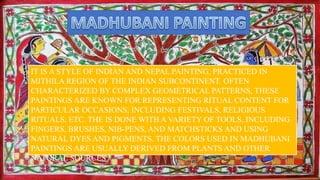
IT IS A STYLE OF INDIAN AND NEPAL PAINTING, PRACTICED IN
MITHILA REGION OF THE INDIAN SUBCONTINENT. OFTEN
CHARACTERIZED BY COMPLEX GEOMETRICAL PATTERNS, THESE
PAINTINGS ARE KNOWN FOR REPRESENTING RITUAL CONTENT FOR
PARTICULAR OCCASIONS, INCLUDING FESTIVALS, RELIGIOUS
RITUALS, ETC. THE IS DONE WITH A VARIETY OF TOOLS, INCLUDING
FINGERS, BRUSHES, NIB-PENS, AND MATCHSTICKS AND USING
NATURAL DYES AND PIGMENTS. THE COLORS USED IN MADHUBANI
PAINTINGS ARE USUALLY DERIVED FROM PLANTS AND OTHER
NATURAL SOURCES
Origin
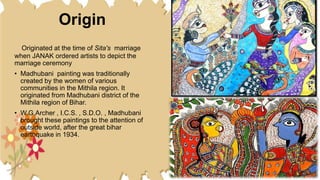
Originated at the time of Sita's marriage
when JANAK ordered artists to depict the
marriage ceremony
• Madhubani painting was traditionally
created by the women of various
communities in the Mithila region. It
originated from Madhubani district of the
Mithila region of Bihar.
• W.G.Archer , I.C.S. , S.D.O. , Madhubani
brought these paintings to the attention of
outside world, after the great bihar
earthquake in 1934.
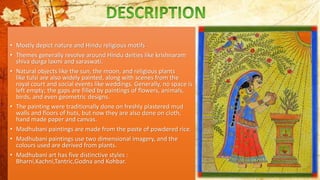
• Mostly depict nature and Hindu religious motifs
• Themes generally revolve around Hindu deities like krishnaram
shiva durga laxmi and saraswati.
• Natural objects like the sun, the moon, and religious plants
like tulsi are also widely painted, along with scenes from the
royal court and social events like weddings. Generally, no space is
left empty; the gaps are filled by paintings of flowers, animals,
birds, and even geometric designs.
• The painting were traditionally done on freshly plastered mud
walls and floors of huts, but now they are also done on cloth,
hand made paper and canvas.
• Madhubani paintings are made from the paste of powdered rice.
• Madhubani paintings use two dimensional imagery, and the
colours used are derived from plants.
• Madhubani art has five distinctive styles :
Bharni,Kachni,Tantric,Godna and Kohbar.
• Earlier only natural colours were used.
• These days poster and acrylic colours are used.
• The colours are applied flat with no shading.
• Black- By blending soot and cow dung.
• Yellow- From turmeric, pollen, lime, milk of banyan leaves
• Blue- Indigo
• Red- Kusam flower juice or red sandalwood
• Green- wood of apple tree leaves
• White- Rice powder
• Orange- Palasha flowers
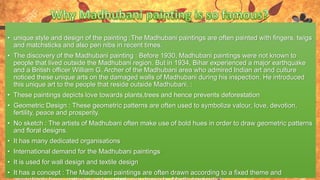
• unique style and design of the painting :The Madhubani paintings are often painted with fingers, twigs
and matchsticks and also pen nibs in recent times.
• The discovery of the Madhubani painting : Before 1930, Madhubani paintings were not known to
people that lived outside the Madhubani region. But in 1934, Bihar experienced a major earthquake
and a British officer William G. Archer of the Madhubani area who admired Indian art and culture
noticed these unique arts on the damaged walls of Madhubani during his inspection. He introduced
this unique art to the people that reside outside Madhubani. :
• These paintings depicts love towards plants,trees and hence prevents deforestation
• Geometric Design : These geometric patterns are often used to symbolize valour, love, devotion,
fertility, peace and prosperity.
• No sketch : The artists of Madhubani often make use of bold hues in order to draw geometric patterns
and floral designs.
• It has many dedicated organisations
• International demand for the Madhubani paintings
• It is used for wall design and textile design
• It has a concept : The Madhubani paintings are often drawn according to a fixed theme and
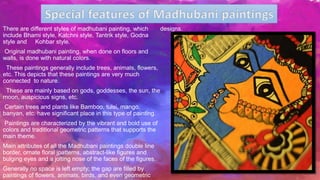
There are different styles of madhubani painting, which
include Bharni style, Katchni style, Tantrik style, Godna
style and Kohbar style.
Original madhubani painting, when done on floors and
walls, is done with natural colors.
These paintings generally include trees, animals, flowers,
etc. This depicts that these paintings are very much
connected to nature.
These are mainly based on gods, goddesses, the sun, the
moon, auspicious signs, etc.
Certain trees and plants like Bamboo, tulsi, mango,
banyan, etc. have significant place in this type of painting.
Paintings are characterized by the vibrant and bold use of
colors and traditional geometric patterns that supports the
main theme.
Main attributes of all the Madhubani paintings double line
border, ornate floral jpatterns, abstract-like figures and
bulging eyes and a jolting nose of the faces of the figures.
Generally no space is left empty; the gap are filled by
paintings of flowers, animals, birds, and even geometric
designs.
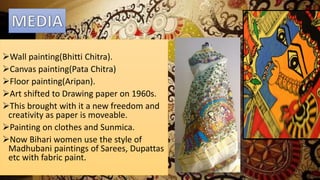
Wall painting(Bhitti Chitra).
Canvas painting(Pata Chitra)
Floor painting(Aripan).
Art shifted to Drawing paper on 1960s.
This brought with it a new freedom and
creativity as paper is moveable.
Painting on clothes and Sunmica.
Now Bihari women use the style of
Madhubani paintings of Sarees, Dupattas
etc with fabric paint.
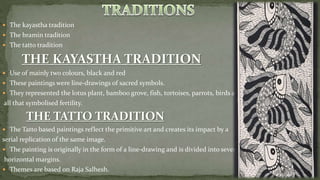
 The kayastha tradition
 The bramin tradition
 The tatto tradition
 Use of mainly two colours, black and red
 These paintings were line-drawings of sacred symbols.
 They represented the lotus plant, bamboo grove, fish, tortoises, parrots, birds and
all that symbolised fertility.
 The Tatto based paintings reflect the primitive art and creates its impact by a
serial replication of the same image.
 The painting is originally in the form of a line-drawing and is divided into several
horizontal margins.
 Themes are based on Raja Salhesh.
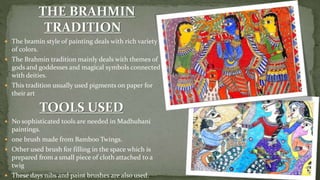
 The bramin style of painting deals with rich variety
of colors.
 The Brahmin tradition mainly deals with themes of
gods and goddesses and magical symbols connected
with deities.
 This tradition usually used pigments on paper for
their art
 No sophisticated tools are needed in Madhubani
paintings.
 one brush made from Bamboo Twings.
 Other used brush for filling in the space which is
prepared from a small piece of cloth attached to a
twig
 These days nibs and paint brushes are also used.
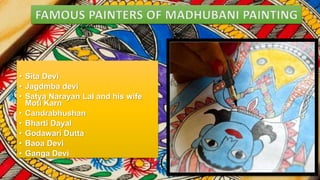
• Sita Devi
• Jagdmba devi
• Satya Narayan Lal and his wife
Moti Karn
• Candrabhushan
• Bharti Dayal
• Godawari Dutta
• Baoa Devi
• Ganga Devi
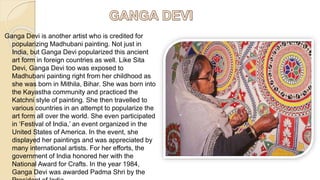
Ganga Devi is another artist who is credited for
popularizing Madhubani painting. Not just in
India, but Ganga Devi popularized this ancient
art form in foreign countries as well. Like Sita
Devi, Ganga Devi too was exposed to
Madhubani painting right from her childhood as
she was born in Mithila, Bihar. She was born into
the Kayastha community and practiced the
Katchni style of painting. She then travelled to
various countries in an attempt to popularize the
art form all over the world. She even participated
in ‘Festival of India,’ an event organized in the
United States of America. In the event, she
displayed her paintings and was appreciated by
many international artists. For her efforts, the
government of India honored her with the
National Award for Crafts. In the year 1984,
Ganga Devi was awarded Padma Shri by the
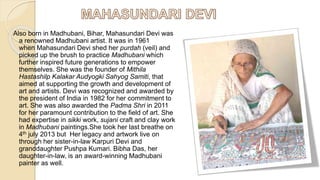
Also born in Madhubani, Bihar, Mahasundari Devi was
a renowned Madhubani artist. It was in 1961
when Mahasundari Devi shed her purdah (veil) and
picked up the brush to practice Madhubani which
further inspired future generations to empower
themselves. She was the founder of Mithila
Hastashilp Kalakar Audyogki Sahyog Samiti, that
aimed at supporting the growth and development of
art and artists. Devi was recognized and awarded by
the president of India in 1982 for her commitment to
art. She was also awarded the Padma Shri in 2011
for her paramount contribution to the field of art. She
had expertise in sikki work, sujani craft and clay work
in Madhubani paintings.She took her last breathe on
4th july 2013 but Her legacy and artwork live on
through her sister-in-law Karpuri Devi and
granddaughter Pushpa Kumari. Bibha Das, her
daughter-in-law, is an award-winning Madhubani
painter as well.
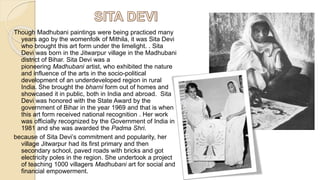
Though Madhubani paintings were being practiced many
years ago by the womenfolk of Mithila, it was Sita Devi
who brought this art form under the limelight. . Sita
Devi was born in the Jitwarpur village in the Madhubani
district of Bihar. Sita Devi was a
pioneering Madhubani artist, who exhibited the nature
and influence of the arts in the socio-political
development of an underdeveloped region in rural
India. She brought the bharni form out of homes and
showcased it in public, both in India and abroad. Sita
Devi was honored with the State Award by the
government of Bihar in the year 1969 and that is when
this art form received national recognition . Her work
was officially recognized by the Government of India in
1981 and she was awarded the Padma Shri.
because of Sita Devi’s commitment and popularity, her
village Jitwarpur had its first primary and then
secondary school, paved roads with bricks and got
electricity poles in the region. She undertook a project
of teaching 1000 villagers Madhubani art for social and
financial empowerment.
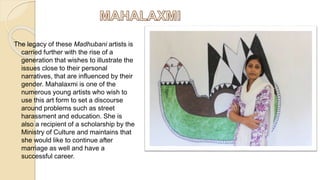
The legacy of these Madhubani artists is
carried further with the rise of a
generation that wishes to illustrate the
issues close to their personal
narratives, that are influenced by their
gender. Mahalaxmi is one of the
numerous young artists who wish to
use this art form to set a discourse
around problems such as street
harassment and education. She is
also a recipient of a scholarship by the
Ministry of Culture and maintains that
she would like to continue after
marriage as well and have a
successful career.
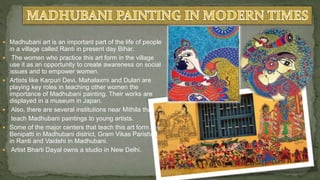
 Madhubani art is an important part of the life of people
in a village called Ranti in present day Bihar.
 The women who practice this art form in the village
use it as an opportunity to create awareness on social
issues and to empower women.
 Artists like Karpuri Devi, Mahalaxmi and Dulari are
playing key roles in teaching other women the
importance of Madhubani painting. Their works are
displayed in a museum in Japan.
 Also, there are several institutions near Mithila that
teach Madhubani paintings to young artists.
 Some of the major centers that teach this art form are
Benipatti in Madhubani district, Gram Vikas Parishad
in Ranti and Vaidehi in Madhubani.
 Artist Bharti Dayal owns a studio in New Delhi.
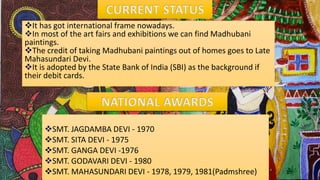
SMT. JAGDAMBA DEVI - 1970
SMT. SITA DEVI - 1975
SMT. GANGA DEVI -1976
SMT. GODAVARI DEVI - 1980
SMT. MAHASUNDARI DEVI - 1978, 1979, 1981(Padmshree)
It has got international frame nowadays.
In most of the art fairs and exhibitions we can find Madhubani
paintings.
The credit of taking Madhubani paintings out of homes goes to Late
Mahasundari Devi.
It is adopted by the State Bank of India (SBI) as the background if
their debit cards.

Madhubani painting(new)

  • 1.
  • 2.
    IT IS ASTYLE OF INDIAN AND NEPAL PAINTING, PRACTICED IN MITHILA REGION OF THE INDIAN SUBCONTINENT. OFTEN CHARACTERIZED BY COMPLEX GEOMETRICAL PATTERNS, THESE PAINTINGS ARE KNOWN FOR REPRESENTING RITUAL CONTENT FOR PARTICULAR OCCASIONS, INCLUDING FESTIVALS, RELIGIOUS RITUALS, ETC. THE IS DONE WITH A VARIETY OF TOOLS, INCLUDING FINGERS, BRUSHES, NIB-PENS, AND MATCHSTICKS AND USING NATURAL DYES AND PIGMENTS. THE COLORS USED IN MADHUBANI PAINTINGS ARE USUALLY DERIVED FROM PLANTS AND OTHER NATURAL SOURCES
  • 3.
    Origin Originated at thetime of Sita's marriage when JANAK ordered artists to depict the marriage ceremony • Madhubani painting was traditionally created by the women of various communities in the Mithila region. It originated from Madhubani district of the Mithila region of Bihar. • W.G.Archer , I.C.S. , S.D.O. , Madhubani brought these paintings to the attention of outside world, after the great bihar earthquake in 1934.
  • 4.
    • Mostly depictnature and Hindu religious motifs • Themes generally revolve around Hindu deities like krishnaram shiva durga laxmi and saraswati. • Natural objects like the sun, the moon, and religious plants like tulsi are also widely painted, along with scenes from the royal court and social events like weddings. Generally, no space is left empty; the gaps are filled by paintings of flowers, animals, birds, and even geometric designs. • The painting were traditionally done on freshly plastered mud walls and floors of huts, but now they are also done on cloth, hand made paper and canvas. • Madhubani paintings are made from the paste of powdered rice. • Madhubani paintings use two dimensional imagery, and the colours used are derived from plants. • Madhubani art has five distinctive styles : Bharni,Kachni,Tantric,Godna and Kohbar.
  • 5.
    • Earlier onlynatural colours were used. • These days poster and acrylic colours are used. • The colours are applied flat with no shading. • Black- By blending soot and cow dung. • Yellow- From turmeric, pollen, lime, milk of banyan leaves • Blue- Indigo • Red- Kusam flower juice or red sandalwood • Green- wood of apple tree leaves • White- Rice powder • Orange- Palasha flowers
  • 6.
    • unique styleand design of the painting :The Madhubani paintings are often painted with fingers, twigs and matchsticks and also pen nibs in recent times. • The discovery of the Madhubani painting : Before 1930, Madhubani paintings were not known to people that lived outside the Madhubani region. But in 1934, Bihar experienced a major earthquake and a British officer William G. Archer of the Madhubani area who admired Indian art and culture noticed these unique arts on the damaged walls of Madhubani during his inspection. He introduced this unique art to the people that reside outside Madhubani. : • These paintings depicts love towards plants,trees and hence prevents deforestation • Geometric Design : These geometric patterns are often used to symbolize valour, love, devotion, fertility, peace and prosperity. • No sketch : The artists of Madhubani often make use of bold hues in order to draw geometric patterns and floral designs. • It has many dedicated organisations • International demand for the Madhubani paintings • It is used for wall design and textile design • It has a concept : The Madhubani paintings are often drawn according to a fixed theme and
  • 7.
    There are differentstyles of madhubani painting, which include Bharni style, Katchni style, Tantrik style, Godna style and Kohbar style. Original madhubani painting, when done on floors and walls, is done with natural colors. These paintings generally include trees, animals, flowers, etc. This depicts that these paintings are very much connected to nature. These are mainly based on gods, goddesses, the sun, the moon, auspicious signs, etc. Certain trees and plants like Bamboo, tulsi, mango, banyan, etc. have significant place in this type of painting. Paintings are characterized by the vibrant and bold use of colors and traditional geometric patterns that supports the main theme. Main attributes of all the Madhubani paintings double line border, ornate floral jpatterns, abstract-like figures and bulging eyes and a jolting nose of the faces of the figures. Generally no space is left empty; the gap are filled by paintings of flowers, animals, birds, and even geometric designs.
  • 8.
    Wall painting(Bhitti Chitra). Canvaspainting(Pata Chitra) Floor painting(Aripan). Art shifted to Drawing paper on 1960s. This brought with it a new freedom and creativity as paper is moveable. Painting on clothes and Sunmica. Now Bihari women use the style of Madhubani paintings of Sarees, Dupattas etc with fabric paint.
  • 9.
     The kayasthatradition  The bramin tradition  The tatto tradition  Use of mainly two colours, black and red  These paintings were line-drawings of sacred symbols.  They represented the lotus plant, bamboo grove, fish, tortoises, parrots, birds and all that symbolised fertility.  The Tatto based paintings reflect the primitive art and creates its impact by a serial replication of the same image.  The painting is originally in the form of a line-drawing and is divided into several horizontal margins.  Themes are based on Raja Salhesh.
  • 10.
     The braminstyle of painting deals with rich variety of colors.  The Brahmin tradition mainly deals with themes of gods and goddesses and magical symbols connected with deities.  This tradition usually used pigments on paper for their art  No sophisticated tools are needed in Madhubani paintings.  one brush made from Bamboo Twings.  Other used brush for filling in the space which is prepared from a small piece of cloth attached to a twig  These days nibs and paint brushes are also used.
  • 11.
    • Sita Devi •Jagdmba devi • Satya Narayan Lal and his wife Moti Karn • Candrabhushan • Bharti Dayal • Godawari Dutta • Baoa Devi • Ganga Devi
  • 12.
    Ganga Devi isanother artist who is credited for popularizing Madhubani painting. Not just in India, but Ganga Devi popularized this ancient art form in foreign countries as well. Like Sita Devi, Ganga Devi too was exposed to Madhubani painting right from her childhood as she was born in Mithila, Bihar. She was born into the Kayastha community and practiced the Katchni style of painting. She then travelled to various countries in an attempt to popularize the art form all over the world. She even participated in ‘Festival of India,’ an event organized in the United States of America. In the event, she displayed her paintings and was appreciated by many international artists. For her efforts, the government of India honored her with the National Award for Crafts. In the year 1984, Ganga Devi was awarded Padma Shri by the
  • 13.
    Also born inMadhubani, Bihar, Mahasundari Devi was a renowned Madhubani artist. It was in 1961 when Mahasundari Devi shed her purdah (veil) and picked up the brush to practice Madhubani which further inspired future generations to empower themselves. She was the founder of Mithila Hastashilp Kalakar Audyogki Sahyog Samiti, that aimed at supporting the growth and development of art and artists. Devi was recognized and awarded by the president of India in 1982 for her commitment to art. She was also awarded the Padma Shri in 2011 for her paramount contribution to the field of art. She had expertise in sikki work, sujani craft and clay work in Madhubani paintings.She took her last breathe on 4th july 2013 but Her legacy and artwork live on through her sister-in-law Karpuri Devi and granddaughter Pushpa Kumari. Bibha Das, her daughter-in-law, is an award-winning Madhubani painter as well.
  • 14.
    Though Madhubani paintingswere being practiced many years ago by the womenfolk of Mithila, it was Sita Devi who brought this art form under the limelight. . Sita Devi was born in the Jitwarpur village in the Madhubani district of Bihar. Sita Devi was a pioneering Madhubani artist, who exhibited the nature and influence of the arts in the socio-political development of an underdeveloped region in rural India. She brought the bharni form out of homes and showcased it in public, both in India and abroad. Sita Devi was honored with the State Award by the government of Bihar in the year 1969 and that is when this art form received national recognition . Her work was officially recognized by the Government of India in 1981 and she was awarded the Padma Shri. because of Sita Devi’s commitment and popularity, her village Jitwarpur had its first primary and then secondary school, paved roads with bricks and got electricity poles in the region. She undertook a project of teaching 1000 villagers Madhubani art for social and financial empowerment.
  • 15.
    The legacy ofthese Madhubani artists is carried further with the rise of a generation that wishes to illustrate the issues close to their personal narratives, that are influenced by their gender. Mahalaxmi is one of the numerous young artists who wish to use this art form to set a discourse around problems such as street harassment and education. She is also a recipient of a scholarship by the Ministry of Culture and maintains that she would like to continue after marriage as well and have a successful career.
  • 16.
     Madhubani artis an important part of the life of people in a village called Ranti in present day Bihar.  The women who practice this art form in the village use it as an opportunity to create awareness on social issues and to empower women.  Artists like Karpuri Devi, Mahalaxmi and Dulari are playing key roles in teaching other women the importance of Madhubani painting. Their works are displayed in a museum in Japan.  Also, there are several institutions near Mithila that teach Madhubani paintings to young artists.  Some of the major centers that teach this art form are Benipatti in Madhubani district, Gram Vikas Parishad in Ranti and Vaidehi in Madhubani.  Artist Bharti Dayal owns a studio in New Delhi.
  • 17.
    SMT. JAGDAMBA DEVI- 1970 SMT. SITA DEVI - 1975 SMT. GANGA DEVI -1976 SMT. GODAVARI DEVI - 1980 SMT. MAHASUNDARI DEVI - 1978, 1979, 1981(Padmshree) It has got international frame nowadays. In most of the art fairs and exhibitions we can find Madhubani paintings. The credit of taking Madhubani paintings out of homes goes to Late Mahasundari Devi. It is adopted by the State Bank of India (SBI) as the background if their debit cards.