Download to read offline
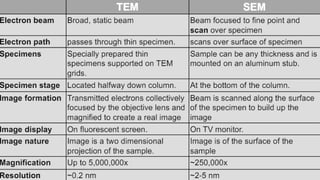
Scanning Electron Microscopy (SEM) and Transmission Electron Microscopy (TEM) are both powerful techniques used for imaging and analyzing the microstructure of materials, but they have key differences in terms of their working principles, applications, and the type of information they provide. Here's a comparison: Scanning Electron Microscopy (SEM) Working Principle: SEM uses a focused beam of high-energy electrons that scan across the surface of a specimen. The interaction of the electrons with the atoms in the sample generates various signals (secondary electrons, backscattered electrons, X-rays) that are collected to form an image. Sample Preparation: Generally simpler and less time-consuming than TEM. Samples need to be conductive or coated with a conductive material (like gold or carbon) if they are non-conductive. Can accommodate bulk samples. Imaging: Provides detailed three-dimensional images of the sample surface. Depth of field is high, which gives a better sense of surface topography. Resolution is typically in the nanometer range (about 1-20 nm), though not as high as TEM. Applications: Used for studying surface morphology and topography. Widely used in materials science, biology, and for quality control in various industries. Transmission Electron Microscopy (TEM) Working Principle: TEM uses a high-energy electron beam that is transmitted through an ultra-thin specimen. The electrons interact with the sample and are scattered; these interactions are used to form an image. Sample Preparation: More complex and time-consuming, requiring the sample to be very thin (typically less than 100 nm). Samples often need to be specially prepared using techniques like ultramicrotomy or ion milling. Imaging: Provides detailed two-dimensional images with atomic or near-atomic resolution. Can provide information about the internal structure, crystallography, and morphology of the sample. Resolution is extremely high, often less than 1 nm. Applications: Used for detailed internal structural analysis, crystallography, and nanomaterial research. Essential in fields like materials science, nanotechnology, and biology for observing fine cellular structures, viruses, and macromolecules. Summary of Differences


