Did the War on Terror Deter
Ungoverned Spaces? Not in Africa
Mitch Downey∗
November 22, 2019
Abstract
Many of the world’s poorest citizens live in peripheral spaces their states have chosen
not to control. Leaving these spaces ungoverned poses challenges for development, global
terrorism, and conflict. Can the international community induce countries to invest in
controlling their territory? I consider the Bush Administration’s foreign policy, which,
following the September 11th attacks, demanded countries take active steps to reduce
terrorist safe havens or risk a US invasion. Drawing upon recent work on the determinants
of government control, I develop a difference-in-difference strategy to test for evidence
of government expansions and implement this test using subnational conflict data from
Africa. Across a wide range of specifications and measures, I consistently find precise
estimates suggesting African states did not engage in these expansions. The results suggest
that broad-based deterrence is an ineffective policy strategy to reduce ungoverned spaces.
Keywords: National Security; Ungoverned spaces; State capacity; Conflict; Deterrence;
Africa; Foreign policy
JEL Classification Numbers: F51, F52, O19, O55
∗
Assistant Professor, Institute for International Economic Studies (IIES), Stockholm University. Email:
mitch.downey@iies.su.se. I thank Eli Berman, Nancy Qian, Jeremy Caddel, Justin Fox, Mauricio Romero,
Brenton Kenkel and participants at PacDev and NBER ENS Summer Institute for helpful comments. All errors
are my own.
1
“Terrorist groups like al Qaeda depend upon the aid or indifference of governments... Some
governments still turn a blind eye to the terrorists, hoping the threat will pass them by.
They are mistaken... We’re asking for a comprehensive commitment to this fight. We must
unite in opposing all terrorists... Any government that rejects this principle... will know the
consequences.”
– President George W. Bush (November 10, 2001)
1 Introduction
Academics and policymakers are increasingly concerned with “ungoverned spaces,” swaths
of territory where formal governments have little influence or presence. This broad concern is
usually founded on two specific worries. First, ungoverned (or, perhaps more accurately, min-
imally governed) spaces have powerful negative impacts on the rest of the world by providing
safe havens for terrorists and violent groups to operate. Recent history in Syria shows these
safe havens can facilitate devastating attacks throughout the world. The second issue is that
some degree of governance appears to be essential for development and improving citizen wel-
fare. Much of development, from broad institutions like schools and credit markets to specific
interventions like cash transfers and distribution of bed nets, requires some degree of stability
and government authority. Even private market trading requires security and the protection of
property rights.
Though formal governance is important, what can be done? Often, ungoverned spaces are
peripheral, low-income, resource-poor territories. States have little incentive to control these
areas. A growing literature shows that investment in state capacity is a rational choice gov-
ernments make based on the calculated costs and benefits of controlling in a region. Clear
incentives like agricultural productivity (Callen et al., 2015), potential mining revenues (Van-
den Eynde, 2015), and risks of interstate conflict (Lee, 2018) drive states’ decision to invest in
building authority. However, these responses offer little policy guidance. What can Western
states do to encourage the extension of governance?
This paper evaluates one of the most significant Western initiatives meant to incentivize
governments to expand their authority: The global war on terror beginning with the 2001 inva-
sion of Afghanistan. After the September 11th
attacks, US focus shifted dramatically towards
ungoverned spaces.
In the next section, I use a range of quotes from the Bush Administration to illustrate four
key themes. First, all governments must take some action, and inactivity will be punished.
Second, the problem of terrorism was fundamentally connected to weak states, and the expec-
tations placed on governments required them to be strong, effective, and high capacity states.
2
Third, the US war on terror was inherently global, and finally, the US would not wait for an
actual attack in order to justify military intervention. These elements of foreign policy pose
a significant threat to governments who leave territory uncontrolled. Given the US’ swift and
powerful removal of the Afghan and Iraqi governments, this threat was as credible as such
threats can be.
I ask whether this “treatment” effectively led sub-Saharan governments to push their au-
thority into previously ungoverned spaces. Specifically, after 2001, is there evidence of increased
government engagement in less-governed provinces, relative to those that were more extensively
governed pre-2001?1
In answering this, there are two major challenges. First, one must deter-
mine which provinces were more or less extensively governed before 2001. Second, one must
observe increased government engagement.
To determine which provinces were more or less likely to be extensively governed before 2001,
I build on a large literature studying determinants of and correlates with government presence.
For instance, as discussed above, agricultural productivity (Callen et al., 2015) and mining
revenue (Vanden Eynde, 2015) both increase incentives for government engagement. Thus, I
treat provinces with low pre-2001 agricultural productivity and without mines as those which
were less likely to be directly governed (compared with provinces in the same country with
greater agricultural productivity or with mines). I then ask whether evidence of government
engagement increased in these provinces, relative to others in the same country. In total, I
use eight such proxies drawn from the empirical ungoverned spaces literature, and Section 3
discusses these extensively.
The second challenge is observing the expansion of government presence. To do this, I build
on theoretical (Hirshleifer, 1989; Skaperdas, 1996) and empirical (Berman, Downey, and Felter,
2016; Crost and Felter, 2016; Kalyvas, 2006) evidence that violence rises when entities contest
one another for control of territory. This notion is central in the contest functions standard
in the theoretical literature and has empirical support from many contexts. Territory which
is unambiguously controlled by either rebels or the government tends to be peaceful. Instead,
violence rises when one group tries to take control from another. Thus, to determine whether
governments try to expand authority into minimally governed territories following the 2001
invasion, I ask whether government-initiated violence rises disproportionately in previously less
governed regions.2
With this strategy for measuring the extent of pre-2001 government presence and for ob-
serving expansions of authority, I use a difference-in-difference strategy (with and without
propensity scores), multiple proxies for pre-2001 control, and a range of violence measures and
1
Throughout, I use “province” to refer to the first subnational administrative unit within each country.
2
The results are nearly identical when considering total violence.
3
sub-samples. Across a rich set of specifications, I consistently find no evidence that African
governments expanded authority in response to the invasion (and likewise no evidence for
key sub-samples of countries). Parallel pre-trends support the identification strategy and are
matched by equally parallel post-trends. My estimates are fairly precise (I interpret magnitudes
below). Given the variety of empirical specifications, they tell a consistent story that there was
no effect. I conclude that the Bush administration’s foreign policy did not deter ungoverned
spaces, and discuss several potential explanations for why.
These results have important policy implications. The idea of using military force to deter
undesirable behavior is among the oldest ideas in foreign policy, captured by the Romans’
phrase Si vis pacem, para bellum (“If you wish for peace, prepare for war”). This mantra
remains central to modern debates, particularly but not exclusively in the United States. For
instance, the 2018 National Defense Strategy shows the remarkable persistence of the Romans’
views: “Achieving peace through strength requires the Joint Force to deter conflict through
preparedness for war” (Department of Defense, 2018). Traditional perspectives on deterrence
were formed during the Cold War and thereby focused on nuclear deterrence among equally
powerful states. However, academics and policymakers have recently devoted great attention
to adapting these insights to modern contexts, particularly concerns about weak states and
terrorism (see Morgan (2012) and R¨uhle (2015) for reviews).
Importantly, this was a dramatic example of intended deterrence. In 2001, the Taliban
(which ruled Afghanistan at the time) was removed from power with overwhelming force within
weeks of the start of a US invasion. Worldwide attention focused extensively on the invasion
and its aftermath, and the Bush administration’s emphasis on deterring other states from
becoming terrorist “safe havens” was always central to the conversation (as the next section
demonstrates). If this sort of intervention did not deter ungoverned spaces, then it is unlikely
that any military action could. The strategy appears fundamentally flawed.
The rest of the paper is organized as follows. Section 2 gives background on US foreign policy
specifically as it relates to deterrence and ungoverned spaces. Section 3 summarizes evidence
important for predicting and identifying ungoverned spaces. Section 4 summarizes the data and
methods. Section 5 presents results, including a range of specifications and robustness checks.
Section 6 discusses potential explanations before Section 7 concludes.
2 Deterrence as Theme Following the Invasion
Here, I use statements by senior Bush administration officials to illustrate key themes im-
portant for understanding why deterrence might have led governments to expand governance.
Throughout, the key idea is that the administration was always consciously focused on raising
4
states’ perceptions of the costs of leaving space ungoverned.
The importance of taking action. The first important theme, ubiquitous during the
administration, was the importance of taking action. In November 2001, President Bush said
“All nations, if they want to fight terror, must do something. Over time it’s going to be
important for nations to know they will be held accountable for inactivity. You’re either with
us or against us in the fight against terror.” Speaking at the UN days later he announced that
“In this war of terror, each of us must answer for what we have done or what we have left
undone... The memorials and vigils around the world will not be forgotten, but the time for
sympathy has now passed. The time for action has now arrived.”
As the US invasion of Afghanistan began (in response to the Taliban’s refusal to turn over
al-Qaeda leaders), Bush argued that “Every nation has a choice to make. In this conflict, there
is no neutral ground. If any government sponsors the outlaws and killers of innocence, they
have become outlaws and murderers themselves. And they will take that lonely path at their
own peril.”
Vice President Dick Cheney was clear that the administration would treat governments
allowing terrorism top operate the same as terrorists (what he called “The Bush Doctrine”),
and that this came from the September 11th
attacks. “Before 9-11, all too many nations tended
to draw a distinction between the terrorist groups and the states that provided these groups
with support... The distinction between the terrorists and their sponsors should no longer
stand.”
State capacity. Thus, the Bush administration focused on increasing states’ action. What
sort of action? To understand why the invasion of Afghanistan might have induced government
expansions one must recognize that the emphasis was always on state capacity and territo-
rial control. In June 2002, President Bush stated that “America is now threatened less by
conquering states than we are by failing ones.”
Consider Bush’s November 2001 summary of the UN resolution that the US championed:
Every United Nations member has a responsibility to crack down on terrorist
financing... We have a responsibility to deny any sanctuary, safe haven or tran-
sit to terrorists. Every known terrorist camp must be shut down, its operators
apprehended and evidence of their arrest presented to the United Nations. We
have a responsibility to deny weapons to terrorists and to actively prevent private
citizens from providing them. These obligations are urgent, and they are binding
on every nation with a place in this chamber.
To see the role of state capacity, consider a weak state like the Central African Republic
(CAR). At the time (and for at least a decade), the government had little power outside of
Bangui, several armed groups (including those with extremist Islamist leanings) held unchecked
5
territory away from the capital, and religious and ethnic tensions divided both cities and rural
areas. It is almost impossible to imagine the government of the CAR halting these groups’
financing (which was largely from looting), blocking their transit (given how many areas were
controlled by the groups), or stopping the flow of weapons to them (fluid within the country
and across international borders). In other words, a weak state cannot possibly meet the
expectations of the Bush administration. Combined with the emphasis on taking action, this
is a major challenge for these states.
Three themes turned this challenge into a threat: the global scope of terrorism, the openness
to preventative attacks, and the credibility of the use of force.
The global scope of the war on terror. From its earliest days, the administration’s
war on terror was explicitly global. As early as September 2001, President Bush said that “[al-
Qaeda] and its leader - a person named Osama bin Laden - are linked to many other organiza-
tions in different countries, including the Egyptian Islamic Jihad and the Islamic Movement of
Uzbekistan. There are thousands of these terrorists in more than 60 countries.” A month later
he underscored this point, emphasizing “We are at the beginning of our efforts in Afghanistan,
but Afghanistan is only the beginning of our efforts in the world. This war will not end until
terrorists with global reach have been found and stopped and defeated.” (emphasis added)
Elsewhere in the administration, Secretary of Defense Donald Rumsfeld said “All one has
to do is read the intelligence information to know that there are a good number of people who
have been well trained. They are well financed. They are located in 40 or 50 countries. And
they are determined to attack the values and the interests and the peace and the way of life
of the [NATO] people.” Speaking before Congress in early 2003, CIA Director George Tenet
emphasized 50 lawless zones becoming hotbeds for international terrorism. The administration
was always mindful of the global nature of terrorism, and made sure its focus extended broadly.
Perspectives on Africa. Where did Africa fit into the administration’s focus? In October
2001, Condoleezza Rice (then National Security Advisor; Secretary of State during Bush’s
second term) was explicit: “Africa’s history and geography give it a pivotal role in the war on
terrorism... Africa is critical.”
As early as November 15, 2001, the House Subcommittee on Africa held a hearing on “Africa
and the War on Global Terrorism.” In his opening statement alone (less than 600 words), Chair
Ed Royce (R-CA) discussed terrorism threats emanating from eight different countries (and all
regions of Africa), including cooperation with al-Qaeda in Sierra Leone and Liberia, concerns
that Somalia and Sudan (“among other countries”) will harbor terrorists fleeing Afghanistan,
and anti-American protests in Nigeria, South Africa, Kenya, and Tanzania (“and elsewhere”)
some worried would enable recruitment of future extremists.
Preventative strikes. Afghanistan was invaded and the Taliban removed from power only
6
after the September 11th
attacks. If African governments suspected they would not be called
to task unless an attack emanated from their country and they continued non-cooperation with
the US (as the Taliban did in Afghanistan), then they may not have had any incentive to
expand governance prior to such an attack. That was not the case.
The doctrine of “preemptive warfare” was a central element of Bush foreign policy. On its
basis, Congress granted the administration the authority to use military force against Iraq in
October 2002. Rumsfeld summarized the administration’s rationale in June 2002:
If a terrorist can attack at any time, in any place, and using any technique, and
it’s physically impossible to defend in every place, at every time against every
technique, then one needs to calibrate the definition of “defensive.” ...The only
defense is to take the effort to find those global networks and to deal with them
as the United States did in Afghanistan. Now is that defensive or is it offensive?
I personally think of it as defensive... Clearly, every nation has the right of self-
defense and this is the only, only conceivable way for us to defend ourselves against
those kinds of threats.
Thus, there was no reason to expect that US military action would wait until an actual
terrorist attack occurred, or that African governments would have a “second chance” to prevent
US invasion by appropriately responding to such an attack.
The credibility of the threat. Finally, a pivotal theme uniting the others is that these
threats of force were extremely credible. Within 1 month of the September 11th
attack the
US began Operation Enduring Freedom in Afghanistan, and within 2 months, the Taliban had
been forced from Kabul and all remaining strongholds, dispersed and defeated. Less than 1
year later, in October 2002, Congress authorized the use of military force in Iraq. Operation
Iraqi Freedom began in March 2003, and it too concluded within 2 months with the removal of
Saddam Hussein and his government.
On May 1, 2003, President Bush declared an end to major combat operations in Iraq and
was already focusing on the next conflict:
America and our coalition will finish what we have begun. From Pakistan to the
Philippines to the Horn of Africa, we are hunting down Al Qaida killers... Any
person, organization or government that supports, protects or harbors terrorists
is complicit in the murder of the innocent and equally guilty of terrorist crimes.
Shortly thereafter, Vice President Cheney, summarized: “If there is anyone in the world
today who doubts the seriousness of the Bush Doctrine, I would urge that person to consider
the fate of the Taliban in Afghanistan, and of Saddam Hussein’s regime in Iraq.”
Summary. In summary, the Bush administration explicitly demanded states control their
7
peripheries out of concern for terrorist safe havens. Their focus was global, with Africa playing
an important role, and they went to great lengths to ensure that threats of force were credible
and plausible even without attack (through reference to preemptive warfare). In light of this, I
believe it is directly policy relevant to test whether African governments expanded their control
in response to these threats, or whether the “Bush doctrine” was ultimately unsuccessful.
3 Measuring the Extent of Government Influence
In this section, I discuss the observable characteristics that help determine which provinces
were more (and less) likely to be governed prior to 2001. As discussed in the methods sec-
tion (Section 4), this facilitates a difference-in-difference design comparing subsequent violence
between these two types of regions.
For simplicity, the proxies for government presence discussed here are divided into two
sections. First, I discuss factors that reduce the costs or increase the benefits of establishing
government presence. These, in large part, are drawn from the literature estimating the causal
effects of these factors on the rational decision of states as to where to govern. Second, I discuss
factors shown to be correlated with government presence (without causal claims or, in some
cases, because they are affected by government presence). Here, I discuss only the evidence
behind the proxies. Data sources and measurement strategies are discussed in Section 4.
3.1 Determinants of the Decision to Govern
Terrain ruggedness. Rugged terrain both increases the costs of governing territory, and
reduces the benefits of doing so. With respect to costs, these areas are simply difficult to
travel and establish an influence. Gooch (2017) shows that rugged areas were shielded from
Mao Zedong’s attempt to implement his Great Leap Forward program. These challenges are
exacerbated in unstable states. For instance, Fearon and Laitin (2003) use a panel of 161
countries and show robust evidence that rugged terrain increases the risk of civil war by affording
insurgents a place to hide.
At the same time, in addition to raising the costs of governance, rugged terrain lowers the
benefits. Nunn and Puga (2012) summarize agronomic evidence that terrain ruggedness reduces
agricultural productivity. Callen et al. (2015) shows that agricultural productivity creates a
strong incentive to govern. Using the Pakistan government’s explicit demarcation of spaces to be
left ungoverned (the Frontier Crimes Regulation) and increased agricultural productivity from
the Green Revolution, they show evidence that agricultural productivity causes the government
to establish formal institutions. Given evidence on both costs and benefits, one would expect
8
more rugged terrain to be less likely to be governed, prior to the 2001 invasion.
Mineral resources. Mineral resources provide a source of wealth and, involving fairly
centralized production, are relatively easy to tax. Thus, there is a strong incentive for govern-
ments to control mining regions. How do governments respond to the presence of minerals?
Vanden Eynde (2015) uses a unique reform in India which increased state governments’ legal
ability to tax mineral revenue (differentially for different minerals). He finds that state gov-
ernments, which are responsible for the majority of counterinsurgency activity in India, are
more likely to invest in controlling areas where mining revenues rise. This suggests that min-
ing revenues are an effective incentive for government control. Interestingly, a larger literature
has shown that large resource discoveries (especially oil) often induce conflict, particularly in
the presence of weak institutions (e.g., Lei and Michaels (2014)).3
This is consistent with an
interpretation where the government and rebels both try to control these valuable spaces.
Border provinces. States have an obvious incentive to avoid conflict, which is both costly
and risky. Recently, Lee (2018) shows that this incentive manifests in states’ decision about
whether to govern their border provinces, particularly those that border hostile neighboring
states. She develops and validates a novel measure of state capacity based on implausible
statistical anomalies in government-collected Census data, and shows within-country evidence
of lower capacity in provinces bordering hostile neighbors. The mechanism appears to be the
desire to avoid confusion over fluid national boundaries, the risk that the neighboring state will
undermine government activities, and the challenge of battling insurgent groups when they can
draw support from a hostile neighbor.
3.2 Correlates of Government Presence
Remoteness. Broadly speaking, “remoteness” is a feature of geography that implies
sparsely populated areas far from the national capital or other major cities. Condra (2015)
shows that ethnic groups native to remote regions are more likely to fight for autonomy. Asher,
Nagpal, and Novosad (2017) shows that providing public goods is more difficult in more re-
mote districts, and, as a result, there is less government activity there. Generally, Tollefsen
and Buhaug (2015) show that geographic variables like these are the most robust predictors of
insurgency and civil war and they review several potential explanations.
Infant mortality. Most causes of infant mortality are preventable through state provision
of public goods like health services (Rutstein, 2000). For this reason, infant mortality is a
widely used and recommended measure of state capacity, as it correlates with other forms of
state failure (Gurr et al., 1999; Lee, 2018).
3
See Cotet and Tsui (2013) for a critical review.
9
Child malnutrition. Berman et al. (2016) study the Philippines government’s attempt
to expand governance through a targeted counterinsurgency program. They find that this
expansion of governance reduced child malnutrition, and provide evidence that this is due to
the security and institutions that come with government control. (For instance, when the
program displaced rebels to neighboring municipalities, malnutrition rises there.) Thus, there
is evidence that child malnutrition is lower where the government is better established. This is
unsurprising, in light of the large range of health services that governments provide.
World bank projects. One reason why ungoverned spaces are concerning is because they
are often too dangerous for the state or international organizations to provide services to their
overwhelmingly poor populations. Crost, Felter, and Johnston (2014) use a discontinuity in
the rule the World Bank used to award a community development block grant, and show that
awarding these grants and initiating projects in poorly governed spaces induces an increase in
violence. This violence response often leads the projects to be canceled. Thus, active World
Bank projects are an indicator of some degree of government control.
4 Data and Methods
4.1 Sample
The main sample is based on a set of 50 African countries. For each, I use the Global
Administrative Areas (GADM) database of administrative boundaries (Hijmans et al., 2015)
for a time-invariant set of geographic boundaries. I focus on the first subnational administrative
unit (e.g., “state” in the United States, “province” in Canada), which I refer to as provinces.
Population data is from the Oak Ridge National Library’s LandScan dataset, which esti-
mates population at roughly a 1km resolution. From this, I calculate population of provinces
using the shapefiles from GADM. The remainder of data sources are discussed below.
4.2 Violence data
My primary specification relies on violence data from the Armed Conflict Location and
Event Data (ACLED) Project (Raleigh et al., 2010). ACLED seeks to create a comprehensive
dataset of political violence in Africa and elsewhere. Information is drawn from news reports,
and coders identify a range of event details, including the actors involved and the location (as
precisely as possible), which I use to place events within provinces. ACLED data is available
for all African countries from 1997 onward.
My primary specification uses the number of events, as is standard in the subnational conflict
literature (Berman, Downey, and Felter, 2016; Berman, Shapiro, and Felter, 2011; Crost and
10
Felter, 2016; Crost, Felter, and Johnston, 2014). For interpretability, I standardize this measure
to have standard deviation 1. However, in robustness checks in Section 5.2, I consider other
measures (an indicator for any event, a count of deaths, and a per capitized count of events),
none of which change the conclusions.
Because my interest is in government expansions of control, I focus on events involving the
government. Specifically, my primary specification uses events in which the military engaged
rebels, militias, or civilians.4
However, in Section 5.2 I show that using all events has no effect
on the conclusions.
I also use data from the Uppsala Conflict Data Program (UCDP), one of the most his-
toric collectors of conflcit data. Specifically, I use the UCDP’s Georeferenced Event Dataset
(Sundberg and Melander, 2013), which codes conflict events in a similar manner to ACLED
and similarly makes it possible to include government-involved activity5
and calculate subna-
tional conflict. The main differences are that the UCDP only codes events 1) in which at least
one death occurred, and 2) involving a dyad that was engaged in substantial conflict during
the given year or an adjacent year.6
This means that a large amount of government activity
attempting to expand the state will go unmeasured. Thus, my preferred specification uses
ACLED data, but Section 5.2 shows that the results are robust to UCDP data.7
4.3 Measures of “ungoverned”
I develop a total of eight measures to represent the proxies for “ungoverned” (or, more
accurately, less governed) spaces that are described in Section 3.
Sparseness. I use the log of the inverse population density (area per population), which
captures one dimension of remoteness. I use the year 2000 population.
Distance to the capital. Another dimension of remoteness is distance to the capital, and
I use the log distance between the national capital city and the province’s centroid.
Terrain Ruggedness Index. I use the Terrain Ruggedness Index (TRI) introduced by
Riley, Degloria, and Elliot (1999) to study wildlife habits, and popularized in social science
by Nunn and Puga (2012). The TRI essentially measures high-frequency changes in elevation
(suggesting rocky, mountainous terrain). On his website, Diego Puga provides elevation data
for a grid of 30 arc-second cells, and I use this data to create average TRI within each province.
4
ACLED Interaction codes 12-17. While the conceptual distinction between these groups is clear, in a given
event, it can be difficult to precisely discern them.
5
Specifically, I use events between the government (SideA includes government) and non-state actors (Type-
OfViolence equal one, SideB does not include government) or civilians (TypeOfViolence equal 3).
6
Specifically, if a dyad (pair of actors) engage in conflict causing 25 or more battle-deaths in a year, then
the UCDP data includes all events between those two actors during that year, the prior year, and the next year.
7
For a debate about the merits of the two datasets see Eck (2012) or Kishi (2016).
11
Malnutrition. I use the World Bank’s Subnational Malnutrition Database to estimate
province-level malnutrition for the latest availabile pre-2001 year (which is overwhelmingly
2000). My primary specification uses the fraction of children who are underweight.
Infant Mortality. I use the subnational infant mortality data from Storeygard et al.
(2008), which primarily pertains to the year 2000.
No minerals. I use an indicator for provinces which lack mines or oil or gas fields. For
oil and gas fields, I use the American Association of Petroleum Geologists’ Giant Oil and Gas
Fields of the World data.8
For mines, I use the US Geologiacal Survey’s Mineral Resource Data
System (MRDS). Both provide longitudes and latitudes that allow me to place mines and fields
within provinces.
Border province. Using GADM shapefiles, I code provinces as border provinces if they
share a border with another country.
No World Bank Projects. Researchers at AidData at the College of William and Mary
have geocoded every project approved by the World Bank’s IBRD and IDA programs from
1995 on. I map these projects to provinces, and use an indicator for whether any project began
prior to September, 2001.
For all continuous measures (the first five of eight), I standardize the variable to have
standard deviation of one, which facilitates interpretation and comparisons across different
measures.
4.4 Methods
I am interested in whether African governments expanded their control after the Octo-
ber, 2001, invasion of Afghanistan. If violence rises when governments seek to control previ-
ously rebel-controlled space then one can equivalently ask whether violence disproportionately
increased in ungoverned territory following the invasion. For this question, a difference-in-
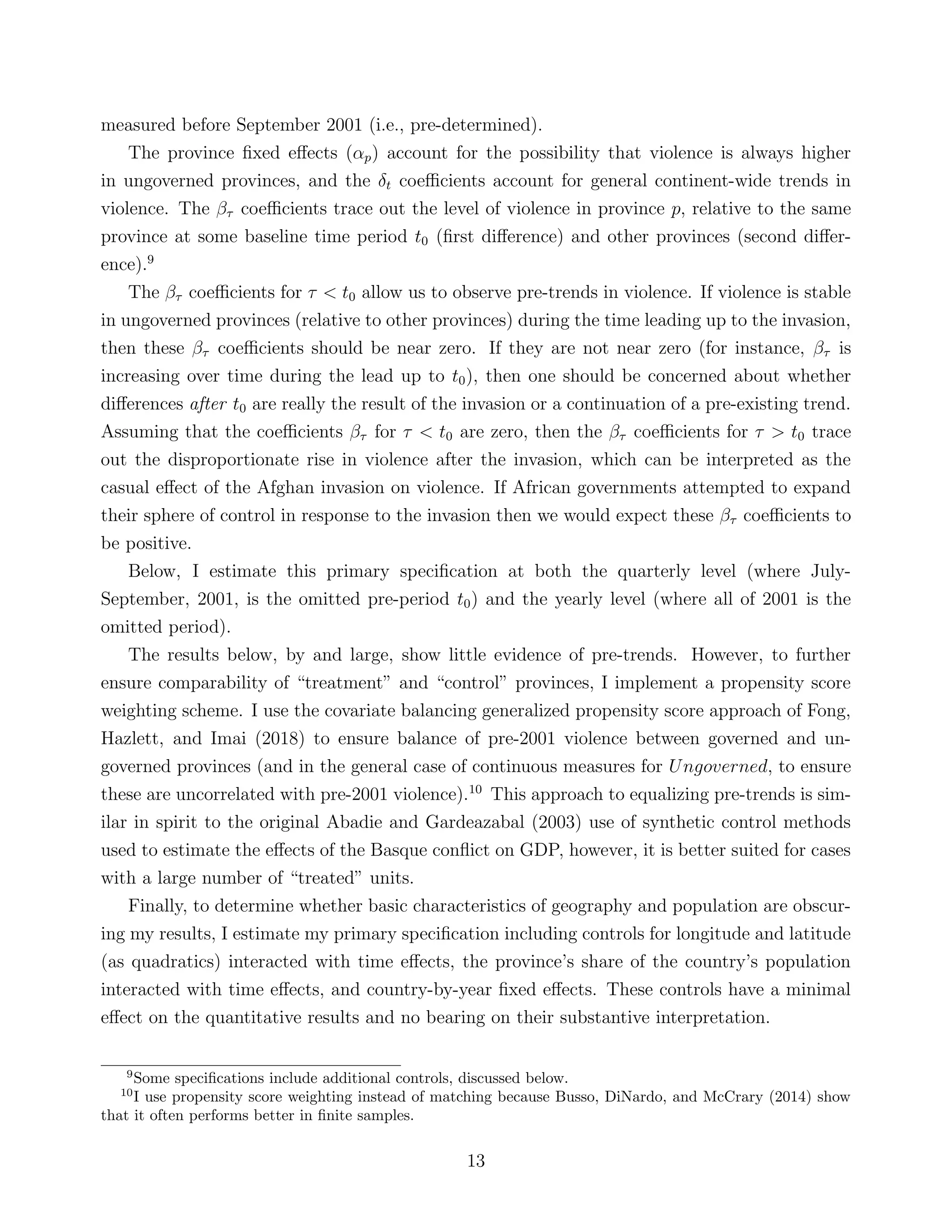
difference approach is ideal. Specifically, my primary specification is:
GovV iop,t = αp + δt +
τ=t0
βτ Ungovernedp × 1{t = τ} + εp,t (1)
where p indexes provinces, t indexes time (I estimate both quarterly and yearly effects), and
1{·} is the indicator function. GovV iop,t is one of the measures of government-involved violence
described in 4.2 and Ungovernedp is one of the proxies for ungoverned (or less likely to be
governed) space described above in Section 4.3, all of which are either time invariant or are
8
This data is created by former AAPG president Mike Horn and used in Arezki, Ramey, and Sheng (2017)
and Lei and Michaels (2014).
12
measured before September 2001 (i.e., pre-determined).
The province fixed effects (αp) account for the possibility that violence is always higher
in ungoverned provinces, and the δt coefficients account for general continent-wide trends in
violence. The βτ coefficients trace out the level of violence in province p, relative to the same
province at some baseline time period t0 (first difference) and other provinces (second differ-
ence).9
The βτ coefficients for τ < t0 allow us to observe pre-trends in violence. If violence is stable
in ungoverned provinces (relative to other provinces) during the time leading up to the invasion,
then these βτ coefficients should be near zero. If they are not near zero (for instance, βτ is
increasing over time during the lead up to t0), then one should be concerned about whether
differences after t0 are really the result of the invasion or a continuation of a pre-existing trend.
Assuming that the coefficients βτ for τ < t0 are zero, then the βτ coefficients for τ > t0 trace
out the disproportionate rise in violence after the invasion, which can be interpreted as the
casual effect of the Afghan invasion on violence. If African governments attempted to expand
their sphere of control in response to the invasion then we would expect these βτ coefficients to
be positive.
Below, I estimate this primary specification at both the quarterly level (where July-
September, 2001, is the omitted pre-period t0) and the yearly level (where all of 2001 is the
omitted period).
The results below, by and large, show little evidence of pre-trends. However, to further
ensure comparability of “treatment” and “control” provinces, I implement a propensity score
weighting scheme. I use the covariate balancing generalized propensity score approach of Fong,
Hazlett, and Imai (2018) to ensure balance of pre-2001 violence between governed and un-
governed provinces (and in the general case of continuous measures for Ungoverned, to ensure
these are uncorrelated with pre-2001 violence).10
This approach to equalizing pre-trends is sim-
ilar in spirit to the original Abadie and Gardeazabal (2003) use of synthetic control methods
used to estimate the effects of the Basque conflict on GDP, however, it is better suited for cases
with a large number of “treated” units.
Finally, to determine whether basic characteristics of geography and population are obscur-
ing my results, I estimate my primary specification including controls for longitude and latitude
(as quadratics) interacted with time effects, the province’s share of the country’s population
interacted with time effects, and country-by-year fixed effects. These controls have a minimal
effect on the quantitative results and no bearing on their substantive interpretation.
9
Some specifications include additional controls, discussed below.
10
I use propensity score weighting instead of matching because Busso, DiNardo, and McCrary (2014) show
that it often performs better in finite samples.
13
5 Results
5.1 Main results
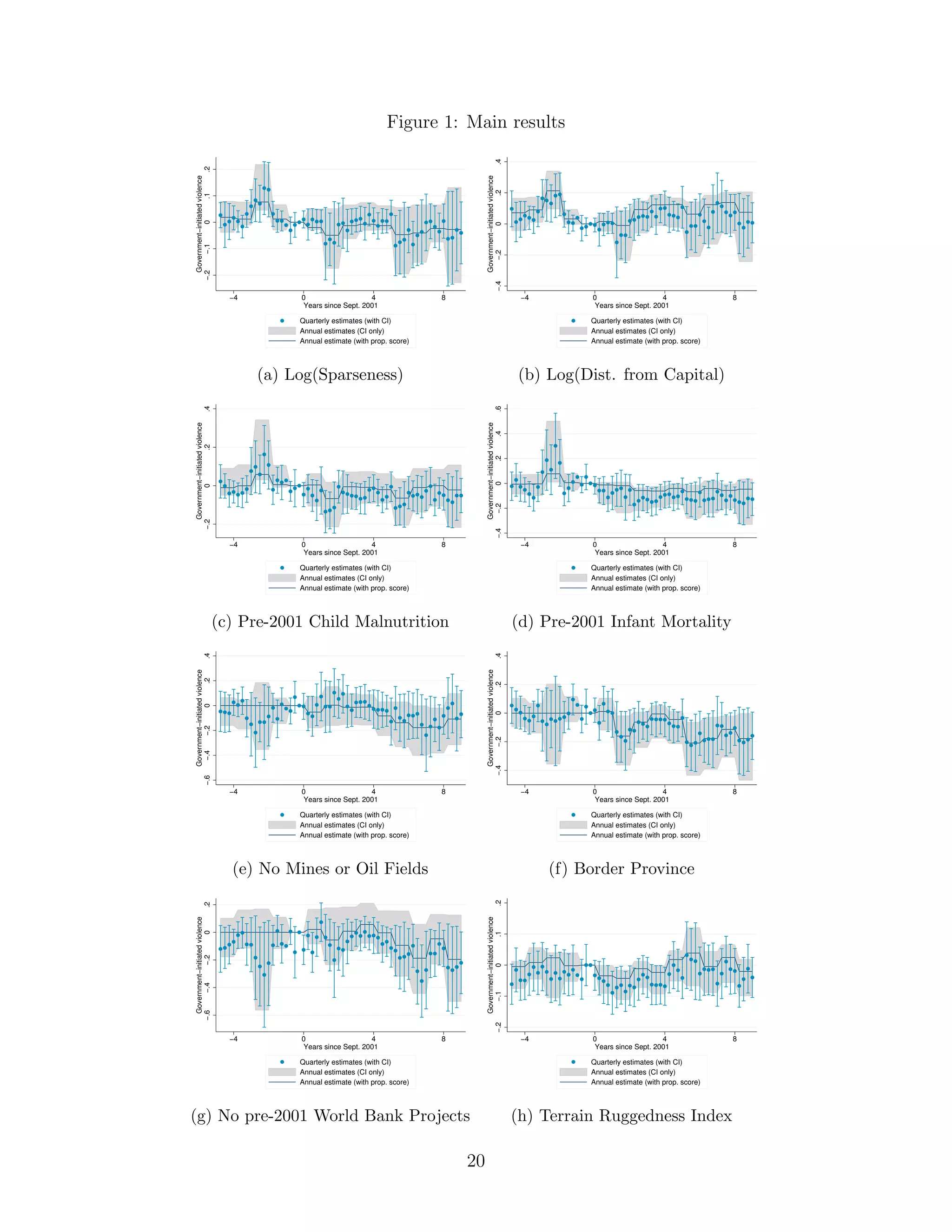
The main results are best seen in Figure 1, which plots estimated coefficients from the
quarterly and annual regressions, as well as results using the propensity scores to balance the
pre-trends. (For visual simplicity, confidence intervals are presented only for the unweighted
regressions, but the standard errors are similar for the propensity weighted regressions.) Because
violence has been scaled to have standard deviation of one, the coefficients can be interpreted
as the differential violence increase (in units of standard deviations) resulting from a 1-unit
increase in the given “ungoverned” proxy. Because the continuous proxies panels (a)-(e) have
also been scaled, 1-unit means a 1 standard deviation increase in those proxies.
The pre-trends are generally flat and not statistically significantly different from zero. De-
viations are often small and substantially mitigated by the propensity scores.11
Regardless of
the method, the estimated post-invasion coefficients are generally near zero. Particularly in
the years immediately following 2001, non-zero estimates are typically negative, suggesting, if
anything, less government involvement in ungoverned spaces. When the propensity weights
improve the pre-trends, they usually bring the estimated effects closer to zero.
The standard errors rarely reject zero, and are often fairly precise. For instance, the speci-
fications estimated with yearly data (and no weights) can often rule out effects larger than .1
standard deviations in the years immediately following, and can almost always rule out effects
larger than .2 standard deviations.
[Figure 1 about here.]
The pattern of results given by Figure 1 shows there is little evidence to suggest an expansion
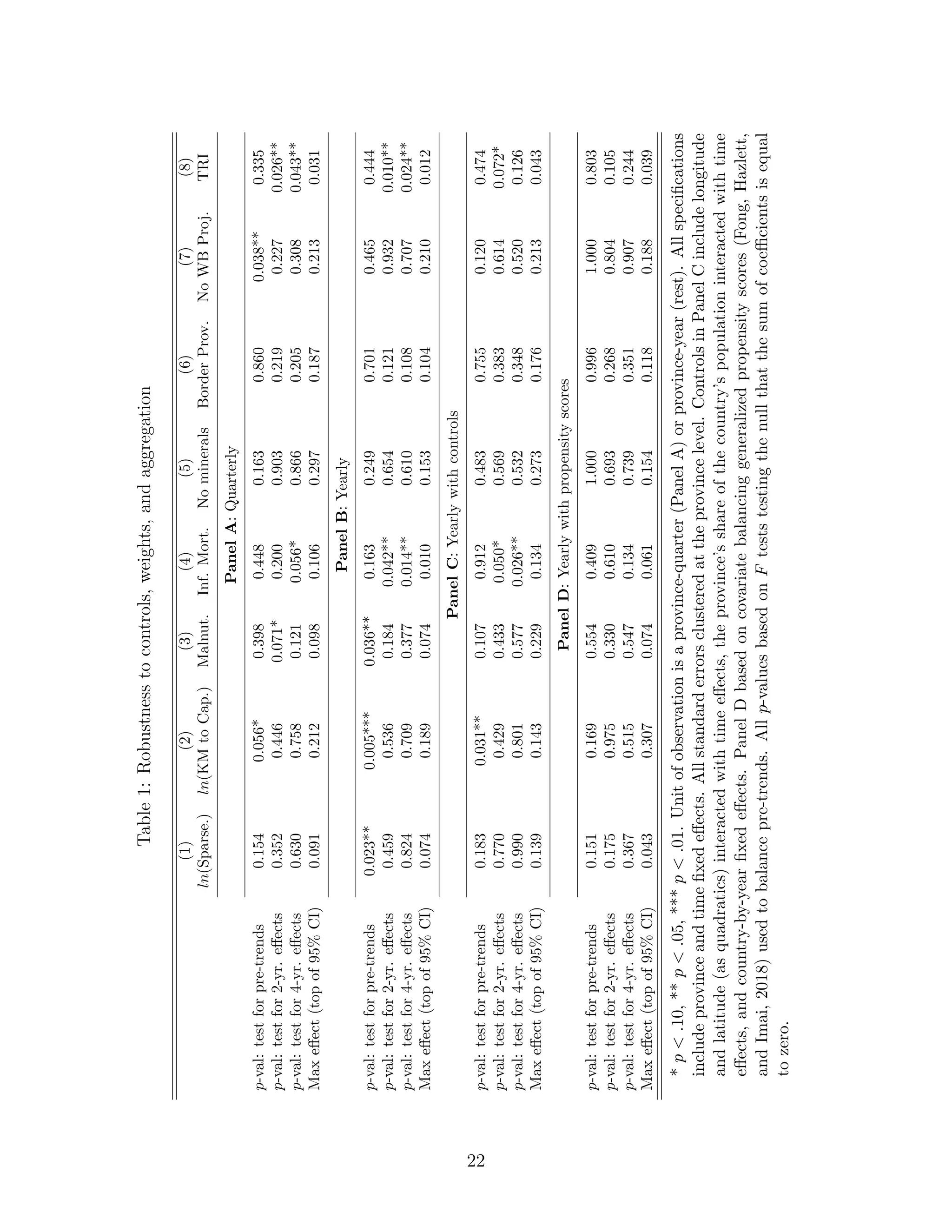
of governance following the invasion of Afghanistan. Table 1 collects the various statistical
results that support this conclusion.
The Table shows four panels, corresponding to the regression results with annual and quar-
terly data, and annual results with controls and propensity scores. For each specification,
the table presents the p-values corresponding to an F test for the joint significance of the
pre-treatment coefficients (i.e., a test for pre-trends), the joint significance of post-treatment
coefficients from the first two years after 2001 and the first four years after 2001 (i.e., 2-year
and 4-year treatment effects), and the top of the highest confidence interval on any coefficient
from the first four years after treatment (i.e., the largest possible increase that is consistent
with the results, or the smallest treatment effect that the results rule out).
11
Often, malnutrition and infant mortality are measured in 1999, and there is a corresponding spike during
that year because shocks in violence affect these child and infant health outcomes (Akresh, Lucchetti, and
Thirumurthy, 2012; Mansour and Rees, 2012; Molina, 2018).
14
[Table 1 about here.]
The table suggests two important conclusions. First, the confidence intervals are generally
very tight. I can often rule out an increase in violence of .10 standard deviations, and I can
almost always rule out an increase of .20 standard deviations. For reference, .10 standard
deviations of the violence distribution is equal to .33 incidents of government-initiated violence
in a year, which is a reasonably small effect.
Second, it is important to notice that some of the estimated effects are statistically significant
(though when they are, they suggest decreasing violence after 2001) and some of the pre-
trends are significant. Including controls usually pushes both the pre-trends and the estimated
effects towards statistical non-significance. Mechanically, the propensity scores eliminate any
statistical evidence of pre-trends. When they do, they also eliminate any evidence of most-2001
effects (which is not mechanical). This is not because the weighting increases the standard
errors. The results in Panel D remain precisely estimated, and I can again often rule out effects
of .10 in half of the cases, and effects of .20 in seven of the eight cases.
5.2 Robustness
I claim that states did not attempt to capture their ungoverned territories following the
2001 Afghan invasion. I base this conclusion on a set of eight proxies drawn from the relevant
literature. My primary results flexibly and transparently present evidence from four different
specifications, for a total of 32 regressions. Of course, there are many other regressions that
could have been run, and in attempting to establish a null finding the burden is on the author
to be exhaustive.
Table 2 presents a variety of additional robustness checks. For simplicity, I present only
coefficients from yearly, unweighted regressions where I estimate a joint effect for the two
immediately following years (2002 and 2003). In other words, I present only the single coefficient
on the differential increase in violence during those two years. The full results are available
upon request.
First, I consider different measures of government-involved violence using the ACLED data.
Row 1 presents my baseline specification (the total count of events). In rows 2-4, I use a binary
indicator for whether there was any event, the number of deaths, and the number of events per
capita. In row 5, I use all ACLED events, rather than only those involving the government, in
case government involvement is not accurately recorded. None of these change the conclusions.
In row 6, I relax the assumption that “ungoverned” is linear in the proxy, and present results
using a dichotomous measure (for above vs. below average). In rows 7-11, I present parallel
15
results using the UCDP data, and again find no effect. With the UCDP data it is also possible
to include a longer time-frame, and so in row 12 I extend the sample back to 1992.
Finally, I consider specific sub-samples. In row 13, I use the ACLED data and consider only
conflict-prone countries (defined as those experiencing a conflict with 25+ battle deaths during
at least one year in the 1990’s). Even in this sub-sample (where instability is high and rebels
are almost surely in control of the ungoverned spaces), there is no effect.
Next, I acknowledge that much of the War on Terror rhetoric centered on religion and
radical Islam. For instance, in the November 15, 2001, House Subcommittee on Africa hearing
on Africa and Global Terrorism, Chair Ed Royce (R-CA) said, “Some believe that segments
of Africa’s large Muslim population will make it difficult for certain African governments to
provide continued support to the United States and may even prove to be a recruiting base for
international terrorist organizations.” Thus, in rows 14 and 15 I consider the set of countries
with large Muslim populations (40% or more of the population, roughly the mean) and growing
Muslim populations, and again find no results. There is a marginally significant (p <.10)
increase in conflict in sparse provinces of countries with growing Muslim populations, but
the magnitude is small (.046 standard deviations, and the 95% confidence interval rules out
increases bigger than .097 standard deviations). In row 16, I focus on the eight countries Royce
specifically mentioned in his opening statement, again finding no effects.
[Table 2 about here.]
Additional results are presented in the appendix. Table A1 presents population-weighted
results. The point estimates are very similar, but population weights make the standard errors
larger. This is potentially because provinces experiencing the most violence and those which
are least likely to be governed (i.e., the provinces driving identification) tend to have relatively
small populations. Thus, it becomes even harder to reject the null that there was no expansion
in governance.
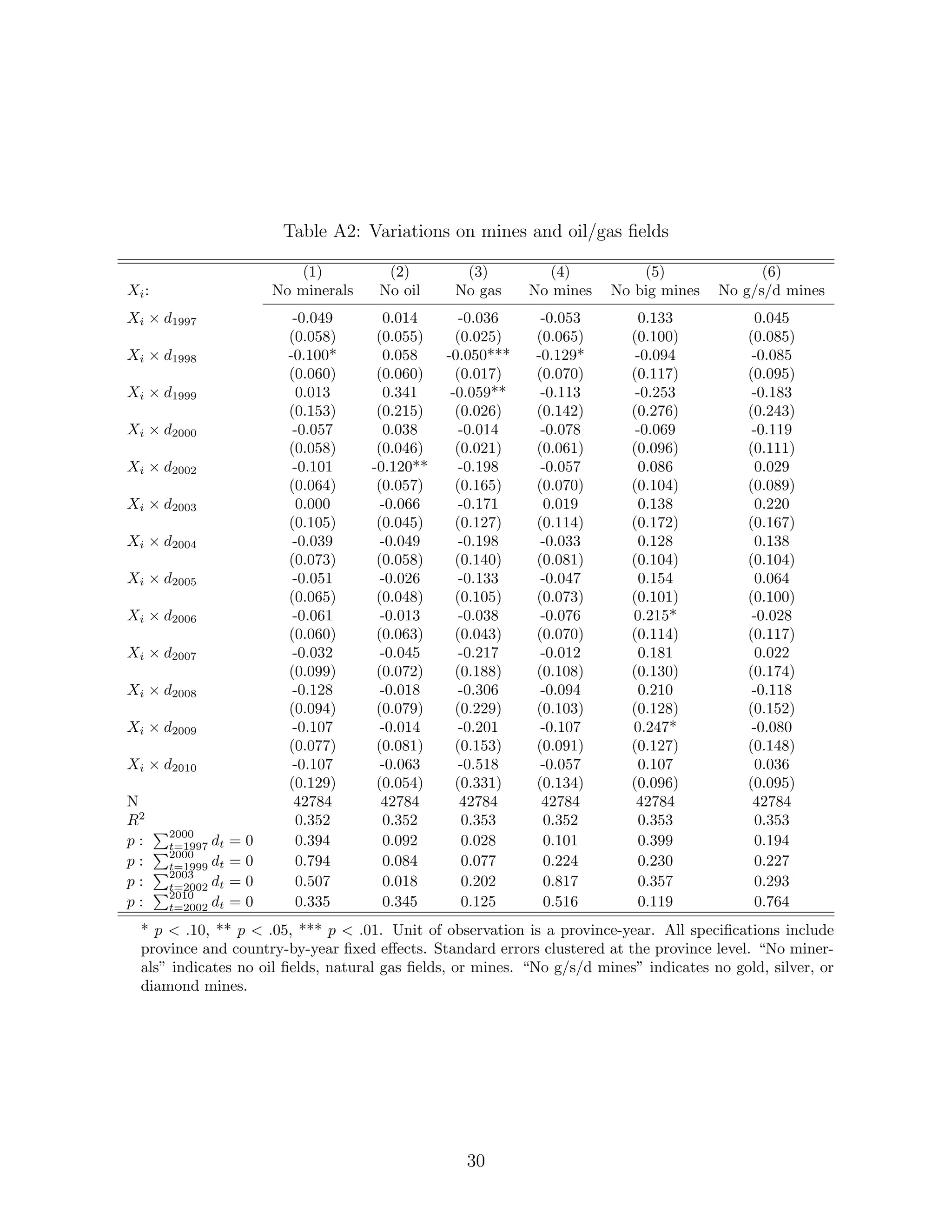
The main mineral resource specification is based on whether the provinces has any mines,
oil fields, or natural gas fields. Table A2 separately break apart mines, oil, and gas. None
show any meaningful evidence of increased conflict. I also look separately at the presence of
especially valuable minerals (gold, silver, and diamonds), which bears the same conclusion.
Finally, I consider especially large mines (those reported in the MRDS as having large or
medium production size, just under a third of mines). These show modestly sized positive
post-2001 coefficients (point estimates from .14 to .22 standard deviations during the first 5
years), one of which is statistically significant (p < .10), though the F-test fails to reject the
null that all post coefficients are jointly zero (p = .119). This is modest evidence of government
expansions, but does not seem particularly compelling.
16
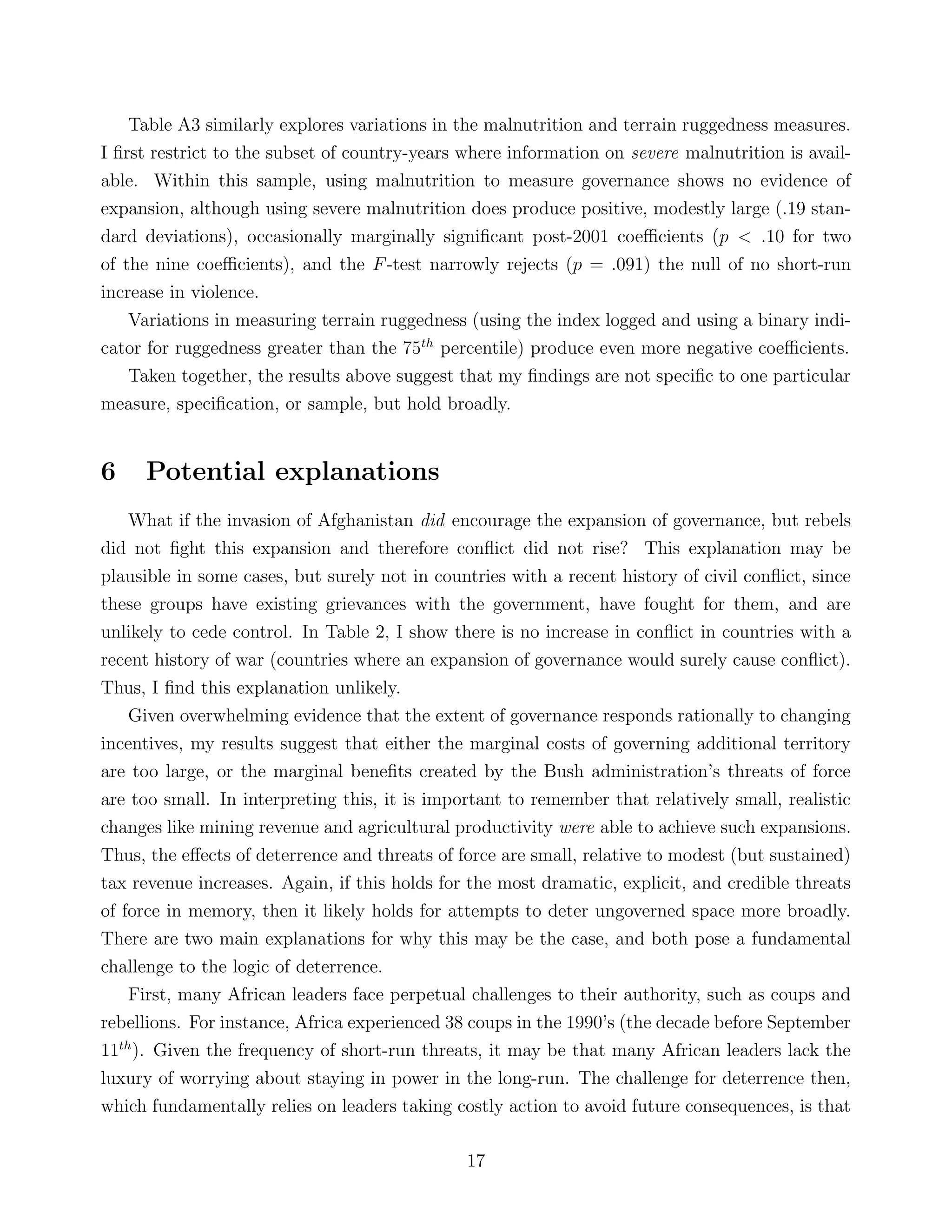
Table A3 similarly explores variations in the malnutrition and terrain ruggedness measures.
I first restrict to the subset of country-years where information on severe malnutrition is avail-
able. Within this sample, using malnutrition to measure governance shows no evidence of
expansion, although using severe malnutrition does produce positive, modestly large (.19 stan-
dard deviations), occasionally marginally significant post-2001 coefficients (p < .10 for two
of the nine coefficients), and the F-test narrowly rejects (p = .091) the null of no short-run
increase in violence.
Variations in measuring terrain ruggedness (using the index logged and using a binary indi-
cator for ruggedness greater than the 75th
percentile) produce even more negative coefficients.
Taken together, the results above suggest that my findings are not specific to one particular
measure, specification, or sample, but hold broadly.
6 Potential explanations
What if the invasion of Afghanistan did encourage the expansion of governance, but rebels
did not fight this expansion and therefore conflict did not rise? This explanation may be
plausible in some cases, but surely not in countries with a recent history of civil conflict, since
these groups have existing grievances with the government, have fought for them, and are
unlikely to cede control. In Table 2, I show there is no increase in conflict in countries with a
recent history of war (countries where an expansion of governance would surely cause conflict).
Thus, I find this explanation unlikely.
Given overwhelming evidence that the extent of governance responds rationally to changing
incentives, my results suggest that either the marginal costs of governing additional territory
are too large, or the marginal benefits created by the Bush administration’s threats of force
are too small. In interpreting this, it is important to remember that relatively small, realistic
changes like mining revenue and agricultural productivity were able to achieve such expansions.
Thus, the effects of deterrence and threats of force are small, relative to modest (but sustained)
tax revenue increases. Again, if this holds for the most dramatic, explicit, and credible threats
of force in memory, then it likely holds for attempts to deter ungoverned space more broadly.
There are two main explanations for why this may be the case, and both pose a fundamental
challenge to the logic of deterrence.
First, many African leaders face perpetual challenges to their authority, such as coups and
rebellions. For instance, Africa experienced 38 coups in the 1990’s (the decade before September
11th
). Given the frequency of short-run threats, it may be that many African leaders lack the
luxury of worrying about staying in power in the long-run. The challenge for deterrence then,
which fundamentally relies on leaders taking costly action to avoid future consequences, is that
17
it may be least effective in unstable environments with short-sighted leaders.12
Unfortunately,
these are exactly the types of environments where ungoverned spaces are most concerning.
Second, governments may have perceived the US military as spread too thin for its threats
of force to be credible, given wars in Afghanistan and Iraq. States may have thought the US
could not possibly sustain a third armed conflict. This, too, is a deep challenge to deterrence.
Credibility is central to effective deterrence. Without acting on past threats and warnings,
it is difficult to maintain credibility. Upon acting, however, resources become committed and
it is difficult to make additional threats credible. This tension is a fundamental challenge for
advocates of deterrence and may explain why African governments did not respond.
Whatever the cause, the conclusion remains consistent that Western governments would
have a difficult time using threats of force to adequately incentivize governments to expand
their territory.
7 Conclusions
Deterrence remains one of the most hotly contested issues in international policy. Here, I
consider whether deterrence was effective in incentivizing African governments to expand their
states’ control following the 2001 invasion of Afghanistan. Given the critical role of ungoverned
spaces in both the development and international security landscapes today, I believe this is an
important question.
I find no evidence that African governments pushed into their countries peripheries following
the invasion. This result is robust to a host of different empirical specifications. This finding is
not merely of academic interest, but given the role of deterrence in the Bush Administration’s
rhetoric and policy calculus, it has direct applications for future foreign policy.
12
Recently, Di Lonardo and Tyson (2019) have made this argument theoretically.
18
19
Figure 1: Main results
−.2−.10.1.2
Government−initiatedviolence
−4 0 4 8
Years since Sept. 2001
Quarterly estimates (with CI)
Annual estimates (CI only)
Annual estimate (with prop. score)
(a) Log(Sparseness)
−.4−.20.2.4
Government−initiatedviolence
−4 0 4 8
Years since Sept. 2001
Quarterly estimates (with CI)
Annual estimates (CI only)
Annual estimate (with prop. score)
(b) Log(Dist. from Capital)
−.20.2.4
Government−initiatedviolence
−4 0 4 8
Years since Sept. 2001
Quarterly estimates (with CI)
Annual estimates (CI only)
Annual estimate (with prop. score)
(c) Pre-2001 Child Malnutrition
−.4−.20.2.4.6
Government−initiatedviolence
−4 0 4 8
Years since Sept. 2001
Quarterly estimates (with CI)
Annual estimates (CI only)
Annual estimate (with prop. score)
(d) Pre-2001 Infant Mortality
−.6−.4−.20.2.4
Government−initiatedviolence
−4 0 4 8
Years since Sept. 2001
Quarterly estimates (with CI)
Annual estimates (CI only)
Annual estimate (with prop. score)
(e) No Mines or Oil Fields
−.4−.20.2.4
Government−initiatedviolence
−4 0 4 8
Years since Sept. 2001
Quarterly estimates (with CI)
Annual estimates (CI only)
Annual estimate (with prop. score)
(f) Border Province
−.6−.4−.20.2
Government−initiatedviolence
−4 0 4 8
Years since Sept. 2001
Quarterly estimates (with CI)
Annual estimates (CI only)
Annual estimate (with prop. score)
(g) No pre-2001 World Bank Projects
−.2−.10.1.2
Government−initiatedviolence
−4 0 4 8
Years since Sept. 2001
Quarterly estimates (with CI)
Annual estimates (CI only)
Annual estimate (with prop. score)
(h) Terrain Ruggedness Index
20
21
Table1:Robustnesstocontrols,weights,andaggregation
(1)(2)(3)(4)(5)(6)(7)(8)
ln(Sparse.)ln(KMtoCap.)Malnut.Inf.Mort.NomineralsBorderProv.NoWBProj.TRI
PanelA:Quarterly
p-val:testforpre-trends0.1540.056*0.3980.4480.1630.8600.038**0.335
p-val:testfor2-yr.effects0.3520.4460.071*0.2000.9030.2190.2270.026**
p-val:testfor4-yr.effects0.6300.7580.1210.056*0.8660.2050.3080.043**
Maxeffect(topof95%CI)0.0910.2120.0980.1060.2970.1870.2130.031
PanelB:Yearly
p-val:testforpre-trends0.023**0.005***0.036**0.1630.2490.7010.4650.444
p-val:testfor2-yr.effects0.4590.5360.1840.042**0.6540.1210.9320.010**
p-val:testfor4-yr.effects0.8240.7090.3770.014**0.6100.1080.7070.024**
Maxeffect(topof95%CI)0.0740.1890.0740.0100.1530.1040.2100.012
PanelC:Yearlywithcontrols
p-val:testforpre-trends0.1830.031**0.1070.9120.4830.7550.1200.474
p-val:testfor2-yr.effects0.7700.4290.4330.050*0.5690.3830.6140.072*
p-val:testfor4-yr.effects0.9900.8010.5770.026**0.5320.3480.5200.126
Maxeffect(topof95%CI)0.1390.1430.2290.1340.2730.1760.2130.043
PanelD:Yearlywithpropensityscores
p-val:testforpre-trends0.1510.1690.5540.4091.0000.9961.0000.803
p-val:testfor2-yr.effects0.1750.9750.3300.6100.6930.2680.8040.105
p-val:testfor4-yr.effects0.3670.5150.5470.1340.7390.3510.9070.244
Maxeffect(topof95%CI)0.0430.3070.0740.0610.1540.1180.1880.039
*p<.10,**p<.05,***p<.01.Unitofobservationisaprovince-quarter(PanelA)orprovince-year(rest).Allspecifications
includeprovinceandtimefixedeffects.Allstandarderrorsclusteredattheprovincelevel.ControlsinPanelCincludelongitude
andlatitude(asquadratics)interactedwithtimeeffects,theprovince’sshareofthecountry’spopulationinteractedwithtime
effects,andcountry-by-yearfixedeffects.PanelDbasedoncovariatebalancinggeneralizedpropensityscores(Fong,Hazlett,
andImai,2018)usedtobalancepre-trends.Allp-valuesbasedonFteststestingthenullthatthesumofcoefficientsisequal
tozero.
22
Table 2: Robustness to changes in sample and outcome variable
Change (1) (2) (3) (4) (5) (6) (7) (8)
ln(Sparse.) ln(KM to Cap.) TRI Malnut. Inf. Mort. No minerals Border Prov. No WB Proj.
Baseline -0.022 -0.045 -0.072** -0.086 -0.300** -0.051 -0.065 0.023
(0.042) (0.045) (0.035) (0.113) (0.152) (0.076) (0.064) (0.050)
Any event 0.011 0.004 -0.038*** 0.029* 0.007 -0.023 -0.010 -0.000
(0.007) (0.007) (0.013) (0.017) (0.020) (0.016) (0.016) (0.029)
Deaths -0.005 -0.004 -0.002 0.016 -0.009 -0.029 -0.009 -0.037
(0.008) (0.007) (0.006) (0.011) (0.013) (0.020) (0.015) (0.032)
Per capita 0.037 0.005 0.000 -0.020 -0.096* 0.004 -0.038 -0.075
(0.037) (0.018) (0.024) (0.044) (0.055) (0.039) (0.037) (0.099)
All vio. -0.034 -0.049 -0.033 -0.137 -0.343* -0.065 -0.076 0.019
(0.048) (0.049) (0.030) (0.129) (0.190) (0.065) (0.063) (0.056)
Binary indep. var. -0.085 -0.017 -0.133* -0.081 -0.159 -0.051 -0.065 0.023
(0.083) (0.062) (0.074) (0.092) (0.115) (0.076) (0.064) (0.050)
N 42784 42784 42784 42728 42728 42784 42784 42784
Baseline (UCDP) -0.002 -0.017 0.028 -0.093 -0.111 -0.090 -0.007 0.038
(0.025) (0.030) (0.037) (0.064) (0.070) (0.063) (0.042) (0.047)
Any event (UCDP) -0.006 0.006 0.021 0.016 -0.003 -0.002 -0.015 0.008
(0.010) (0.011) (0.015) (0.021) (0.025) (0.026) (0.019) (0.024)
Deaths (UCDP) 0.000 -0.014 0.003 -0.017 -0.069* 0.032 -0.007 -0.013
(0.027) (0.029) (0.017) (0.032) (0.039) (0.069) (0.041) (0.037)
Per capita (UCDP) -0.013 -0.011 -0.011 -0.064** -0.052 -0.029 0.003 0.059
(0.027) (0.015) (0.017) (0.031) (0.033) (0.038) (0.028) (0.060)
All vio. (UCDP) 0.001 -0.010 0.018 -0.102 -0.116 -0.104* -0.006 0.003
(0.022) (0.028) (0.033) (0.063) (0.072) (0.063) (0.043) (0.068)
N 21300 21300 21300 21300 21300 21300 21300 21300
1992-2010 -0.001 -0.016 0.029 -0.098 -0.121 -0.094 -0.005 0.042
(0.026) (0.032) (0.039) (0.068) (0.074) (0.067) (0.045) (0.050)
N 28844 28844 28844 28844 28844 28844 28844 28844
War in 1990s -0.024 -0.054 -0.081** -0.095 -0.345** -0.054 -0.076 0.024
(0.046) (0.053) (0.039) (0.118) (0.170) (0.085) (0.073) (0.055)
N 36456 36456 36456 36456 36456 36456 36456 36456
Muslim countries -0.034 -0.039 -0.032 -0.151 -0.459 0.030 -0.049 -0.026
(0.060) (0.069) (0.023) (0.207) (0.316) (0.052) (0.056) (0.032)
N 18200 18200 18200 18200 18200 18200 18200 18200
Islam growing 0.046* 0.033 -0.111* -0.023 -0.212 -0.083 0.019 0.046
(0.026) (0.026) (0.060) (0.121) (0.148) (0.074) (0.062) (0.069)
N 27160 27160 27160 27104 27104 27160 27160 27160
Royce countries -0.273 -0.277* -0.023 -0.196 -0.439 -0.144 -0.234* 0.044
(0.175) (0.160) (0.047) (0.195) (0.300) (0.164) (0.133) (0.034)
N 10528 10528 10528 10528 10528 10528 10528 10528
* p < .10, ** p < .05, *** p < .01. Unit of observation is a province-year. All specifications
include province and country-by-year fixed effects. Standard errors clustered at the province
level.
23
References
Abadie, A. and J. Gardeazabal (2003). The economic costs of conflict: A case study of the
basque country. The American Economic Review 93(1), 113–132.
Akresh, R., L. Lucchetti, and H. Thirumurthy (2012). Wars and child health: Evidence from
the eritrean–ethiopian conflict. Journal of development economics 99(2), 330–340.
Arezki, R., V. A. Ramey, and L. Sheng (2017). News shocks in open economies: Evidence from
giant oil discoveries. The Quarterly Journal of Economics 132(1), 103–155.
Asher, S., K. Nagpal, and P. Novosad (2017). The cost of distance: Geography and governance
in rural india. 2018 PacDev Paper.
Berman, E., M. Downey, and J. Felter (2016). Expanding governance as development: Evidence
on child nutrition in the philippines. NBER Working Paper 21849.
Berman, E., J. N. Shapiro, and J. H. Felter (2011). Can hearts and minds be bought? the
economics of counterinsurgency in iraq. Journal of Political Economy 119(4), 766–819.
Busso, M., J. DiNardo, and J. McCrary (2014). New evidence on the finite sample properties
of propensity score reweighting and matching estimators. Review of Economics and Statis-
tics 96(5), 885–897.
Callen, M., S. Gulzar, A. Rezaee, and J. N. Shapiro (2015). Choosing Ungoverned Space:
Pakistan’s Frontier Crimes Regulation. UCSD mimeo.
Condra, L. N. (2015). The perils of the periphery: Explaining african ethnic group rebellion,
1980-2006. Working Paper.
Cotet, A. M. and K. K. Tsui (2013). Oil and conflict: What does the cross country evidence
really show? American Economic Journal: Macroeconomics 5(1), 49–80.
Crost, B., J. Felter, and P. Johnston (2014). Aid Under Fire: Development Projects and Civil
Conflict. The American Economic Review.
Crost, B. and J. H. Felter (2016). Export crops and civil conflict. Empirical Studies of Conflict
Working Paper No. 4.
Department of Defense (2018). Summary of the 2018 National Defense Strategy of the United
States: Sharpening the American Military’s Competitive Edge.
24
Di Lonardo, L. and S. Tyson (2019). Political instability and the failure of deterrence. Working
Paper.
Eck, K. (2012). In data we trust? a comparison of ucdp ged and acled conflict events datasets.
Cooperation and Conflict 47(1), 124–141.
Fearon, J. D. and D. D. Laitin (2003). Ethnicity, insurgency, and civil war. American political
science review 97(01), 75–90.
Fong, C., C. Hazlett, and K. Imai (2018). Covariate balancing propensity score for a continuous
treatment: application to the efficacy of political advertisements. The Annals of Applied
Statistics 12(1), 156–177.
Gooch, E. (2017). Resistence is futile? institutional and geographic factors in china’s great
famine. Working Paper.
Gurr, T. R., B. Harff, M. Levy, G. D. Dabelko, P. T. Surko, and A. N. Unger (1999). State failure
task force report: Phase ii findings. Environmental Change & Security Project Report (5),
50.
Hijmans, R., J. Kapoor, J. Wieczorek, N. Garcia, A. Maunahan, A. Rala, and A. Mandel
(2015). Global administrative areas (v. 2.8).
Hirshleifer, J. (1989). Conflict and rent-seeking success functions: Ratio vs. difference models
of relative success. Public Choice 63(2), 101–112.
Kalyvas, S. N. (2006). The logic of violence in civil war.
Kishi, R. (2016). ACLED, in light of the Journal of Peace Research’s exploration of the state
of conflict data. Comment.
Lee, M. M. (2018). The international politics of incomplete sovereignty: How hostile neighbors
weaken the state. International Organization 72(2).
Lei, Y.-H. and G. Michaels (2014). Do giant oilfield discoveries fuel internal armed conflicts?
Journal of Development Economics 110, 139–157.
Mansour, H. and D. I. Rees (2012). Armed conflict and birth weight: Evidence from the al-aqsa
intifada. Journal of development Economics 99(1), 190–199.
Molina, T. (2018). Health-seeking amidst conflict: Evidence from the philippines.
25
Morgan, P. M. (2012). The state of deterrence in international politics today. Contemporary
Security Policy 33(1), 85–107.
Nunn, N. and D. Puga (2012). Ruggedness: The blessing of bad geography in africa. Review
of Economics and Statistics 94(1), 20–36.
Raleigh, C., A. Linke, H. Hegre, and J. Karlsen (2010). Introducing ACLED: An armed conflict
location and event dataset: Special data feature. Journal of peace research 47(5), 651–660.
Riley, S. J., S. D. Degloria, and S. Elliot (1999). Index that quantifies topographic heterogeneity.
intermountain Journal of sciences 5(1-4), 23–27.
R¨uhle, M. (2015). Deterrence: What it can (and cannot) do. NATO Review.
Rutstein, S. O. (2000). Factors associated with trends in infant and child mortality in developing
countries during the 1990s. Bulletin of the World Health Organization 78(10), 1256–1270.
Skaperdas, S. (1996). Contest success functions. Economic Theory 7(2), 283–290.
Storeygard, A., D. Balk, M. Levy, and G. Deane (2008). The global distribution of infant
mortality: a subnational spatial view. Population, space and place 14(3), 209–229.
Sundberg, R. and E. Melander (2013). Introducing the ucdp georeferenced event dataset.
Journal of Peace Research 50(4), 523–532.
Tollefsen, A. F. and H. Buhaug (2015). Insurgency and inaccessibility. International Studies
Review 17(1), 6–25.
Vanden Eynde, O. (2015). Mining Royalties and Incentives for Security Operations: Evidence
from India’s Red Corridor. Paris School of Economics mimeo.
26
A Additional results
[Table A1 about here.]
[Table A2 about here.]
[Table A3 about here.]
27
28
TableA1:Mainresultswithpopulationweights
(1)(2)(3)(4)(5)(6)(7)(8)
X:ln(Sparse.)ln(KMtoCap.)TRIMalnut.Inf.Mort.NomineralsBorderProv.NoWBProj.
Xi×d19970.0060.0630.0780.0680.0500.0370.051-0.011
(0.041)(0.039)(0.058)(0.056)(0.045)(0.102)(0.050)(0.174)
Xi×d1998-0.0020.082**0.0790.104*0.008-0.0110.0420.151
(0.036)(0.035)(0.056)(0.055)(0.048)(0.103)(0.045)(0.180)
Xi×d19990.0920.148*-0.0300.1680.1190.1540.028-0.472
(0.115)(0.075)(0.103)(0.106)(0.082)(0.272)(0.133)(0.517)
Xi×d20000.0180.0180.0880.0260.066-0.1040.059-0.204
(0.086)(0.051)(0.138)(0.126)(0.053)(0.176)(0.074)(0.207)
Xi×d20020.0610.005-0.207**-0.071-0.084-0.239**0.0550.072
(0.085)(0.051)(0.105)(0.098)(0.086)(0.115)(0.076)(0.100)
Xi×d2003-0.088-0.096-0.118-0.102-0.339*0.093-0.127-0.168
(0.120)(0.085)(0.077)(0.097)(0.198)(0.124)(0.091)(0.113)
Xi×d20040.0510.021-0.099-0.054-0.215**-0.153-0.0180.016
(0.080)(0.057)(0.077)(0.080)(0.093)(0.115)(0.070)(0.188)
Xi×d20050.0430.063-0.111-0.061-0.146**-0.178-0.0170.036
(0.072)(0.064)(0.068)(0.075)(0.061)(0.122)(0.066)(0.307)
Xi×d2006-0.0060.0870.1010.018-0.140**-0.139-0.064-0.064
(0.074)(0.085)(0.094)(0.118)(0.069)(0.214)(0.095)(0.570)
Xi×d2007-0.182-0.0650.110-0.018-0.424*-0.075-0.195*0.422
(0.123)(0.106)(0.112)(0.132)(0.222)(0.200)(0.111)(0.477)
Xi×d2008-0.0750.0570.034-0.108-0.326*-0.350-0.149-0.251
(0.130)(0.124)(0.110)(0.172)(0.197)(0.267)(0.135)(0.748)
Xi×d2009-0.0090.1040.0160.049-0.330**-0.351-0.0700.295
(0.105)(0.125)(0.113)(0.148)(0.137)(0.277)(0.122)(0.826)
Xi×d2010-0.024-0.066-0.206-0.228-0.502-0.303*-0.161*-0.088
(0.178)(0.103)(0.154)(0.166)(0.357)(0.166)(0.089)(0.218)
N4278442784427844272842728427844278442784
R20.4580.4590.4590.4580.4600.4590.4580.459
p:2000
t=1997dt=00.5580.0110.2280.0330.1000.8230.3430.391
p:2000
t=1999dt=00.5160.1060.7380.2860.0860.8960.5960.304
p:2003
t=2002dt=00.8760.4390.0380.2570.0570.4520.5960.576
p:2010
t=2002dt=00.7680.8600.4970.4690.0270.1630.2530.931
*p<.10,**p<.05,***p<.01.Unitofobservationisaprovince-year.Dependentvariableisaveragequarterlygovernment-
initiatedcombatevents.Allspecificationsincludeprovinceandcountry-by-yearfixedeffects.Standarderrorsclusteredatthe
provincelevel.Sampleincludes48countries.Allregressionsweightbyprovinces’2000population.
29
Table A2: Variations on mines and oil/gas fields
(1) (2) (3) (4) (5) (6)
Xi: No minerals No oil No gas No mines No big mines No g/s/d mines
Xi × d1997 -0.049 0.014 -0.036 -0.053 0.133 0.045
(0.058) (0.055) (0.025) (0.065) (0.100) (0.085)
Xi × d1998 -0.100* 0.058 -0.050*** -0.129* -0.094 -0.085
(0.060) (0.060) (0.017) (0.070) (0.117) (0.095)
Xi × d1999 0.013 0.341 -0.059** -0.113 -0.253 -0.183
(0.153) (0.215) (0.026) (0.142) (0.276) (0.243)
Xi × d2000 -0.057 0.038 -0.014 -0.078 -0.069 -0.119
(0.058) (0.046) (0.021) (0.061) (0.096) (0.111)
Xi × d2002 -0.101 -0.120** -0.198 -0.057 0.086 0.029
(0.064) (0.057) (0.165) (0.070) (0.104) (0.089)
Xi × d2003 0.000 -0.066 -0.171 0.019 0.138 0.220
(0.105) (0.045) (0.127) (0.114) (0.172) (0.167)
Xi × d2004 -0.039 -0.049 -0.198 -0.033 0.128 0.138
(0.073) (0.058) (0.140) (0.081) (0.104) (0.104)
Xi × d2005 -0.051 -0.026 -0.133 -0.047 0.154 0.064
(0.065) (0.048) (0.105) (0.073) (0.101) (0.100)
Xi × d2006 -0.061 -0.013 -0.038 -0.076 0.215* -0.028
(0.060) (0.063) (0.043) (0.070) (0.114) (0.117)
Xi × d2007 -0.032 -0.045 -0.217 -0.012 0.181 0.022
(0.099) (0.072) (0.188) (0.108) (0.130) (0.174)
Xi × d2008 -0.128 -0.018 -0.306 -0.094 0.210 -0.118
(0.094) (0.079) (0.229) (0.103) (0.128) (0.152)
Xi × d2009 -0.107 -0.014 -0.201 -0.107 0.247* -0.080
(0.077) (0.081) (0.153) (0.091) (0.127) (0.148)
Xi × d2010 -0.107 -0.063 -0.518 -0.057 0.107 0.036
(0.129) (0.054) (0.331) (0.134) (0.096) (0.095)
N 42784 42784 42784 42784 42784 42784
R2
0.352 0.352 0.353 0.352 0.353 0.353
p :
2000
t=1997 dt = 0 0.394 0.092 0.028 0.101 0.399 0.194
p :
2000
t=1999 dt = 0 0.794 0.084 0.077 0.224 0.230 0.227
p :
2003
t=2002 dt = 0 0.507 0.018 0.202 0.817 0.357 0.293
p :
2010
t=2002 dt = 0 0.335 0.345 0.125 0.516 0.119 0.764
* p < .10, ** p < .05, *** p < .01. Unit of observation is a province-year. All specifications include
province and country-by-year fixed effects. Standard errors clustered at the province level. “No miner-
als” indicates no oil fields, natural gas fields, or mines. “No g/s/d mines” indicates no gold, silver, or
diamond mines.
30
Table A3: Variations on malnutrition and terrain ruggedness
(1) (2) (3) (4) (5) (6)
Xi: Malnut. Malnut. Sev. maln. TRI ln(TRI) High TRI
Xi × d1997 0.073 -0.025 -0.012 0.007 0.027 -0.015
(0.058) (0.067) (0.031) (0.029) (0.028) (0.061)
Xi × d1998 0.058 0.134 -0.010 0.021 0.033 0.047
(0.072) (0.095) (0.044) (0.030) (0.022) (0.072)
Xi × d1999 0.259** 0.693* 0.189 0.042 0.040 0.214
(0.110) (0.354) (0.293) (0.066) (0.068) (0.210)
Xi × d2000 0.025 -0.011 -0.045 -0.016 -0.018 -0.067
(0.055) (0.072) (0.041) (0.037) (0.026) (0.062)
Xi × d2002 -0.025 -0.046 0.133 -0.065 -0.030 -0.177**
(0.104) (0.083) (0.097) (0.042) (0.028) (0.086)
Xi × d2003 -0.147 -0.139 0.190* -0.078** -0.029 -0.257**
(0.167) (0.125) (0.101) (0.035) (0.031) (0.104)
Xi × d2004 -0.039 -0.083 0.187* -0.031 -0.015 -0.171**
(0.106) (0.097) (0.102) (0.031) (0.023) (0.083)
Xi × d2005 0.013 -0.094 0.122 -0.050 -0.035 -0.133*
(0.085) (0.081) (0.076) (0.032) (0.023) (0.078)
Xi × d2006 0.045 -0.077 0.042 0.036 0.017 -0.027
(0.057) (0.068) (0.038) (0.029) (0.026) (0.060)
Xi × d2007 -0.103 -0.162 0.120 0.078 0.044 -0.099
(0.178) (0.100) (0.074) (0.068) (0.042) (0.098)
Xi × d2008 -0.070 -0.054 0.073 0.025 0.011 -0.110
(0.160) (0.075) (0.073) (0.043) (0.044) (0.082)
Xi × d2009 0.068 -0.031 0.132 0.034 0.015 -0.048
(0.098) (0.073) (0.084) (0.043) (0.036) (0.082)
Xi × d2010 -0.162 -0.076 0.222 -0.038 -0.003 -0.178
(0.278) (0.088) (0.168) (0.056) (0.052) (0.135)
N 42728 10640 10696 42784 42728 42784
R2
0.354 0.357 0.353 0.353 0.352 0.353
p :
2000
t=1997 dt = 0 0.065 0.037 0.703 0.655 0.414 0.511
p :
2000
t=1999 dt = 0 0.032 0.040 0.629 0.753 0.784 0.487
p :
2003
t=2002 dt = 0 0.446 0.330 0.091 0.041 0.249 0.013
p :
2010
t=2002 dt = 0 0.671 0.280 0.109 0.769 0.919 0.086
* p < .10, ** p < .05, *** p < .01. Unit of observation is a province-year. All speci-
fications include province and country-by-year fixed effects. Standard errors clustered
at the province level. Column 2 restricts to the sample for which severe malnutrition is
available, but uses malnutrition. “High TRI” refers to TRI above the 75th
percentile.
Columns 1 and 4 mimic Table 1.
31

Did the War on Terror Deter Ungoverned Spaces? Not in Africa

  • 1.
    Did the Waron Terror Deter Ungoverned Spaces? Not in Africa Mitch Downey∗ November 22, 2019 Abstract Many of the world’s poorest citizens live in peripheral spaces their states have chosen not to control. Leaving these spaces ungoverned poses challenges for development, global terrorism, and conflict. Can the international community induce countries to invest in controlling their territory? I consider the Bush Administration’s foreign policy, which, following the September 11th attacks, demanded countries take active steps to reduce terrorist safe havens or risk a US invasion. Drawing upon recent work on the determinants of government control, I develop a difference-in-difference strategy to test for evidence of government expansions and implement this test using subnational conflict data from Africa. Across a wide range of specifications and measures, I consistently find precise estimates suggesting African states did not engage in these expansions. The results suggest that broad-based deterrence is an ineffective policy strategy to reduce ungoverned spaces. Keywords: National Security; Ungoverned spaces; State capacity; Conflict; Deterrence; Africa; Foreign policy JEL Classification Numbers: F51, F52, O19, O55 ∗ Assistant Professor, Institute for International Economic Studies (IIES), Stockholm University. Email: mitch.downey@iies.su.se. I thank Eli Berman, Nancy Qian, Jeremy Caddel, Justin Fox, Mauricio Romero, Brenton Kenkel and participants at PacDev and NBER ENS Summer Institute for helpful comments. All errors are my own. 1
  • 2.
    “Terrorist groups likeal Qaeda depend upon the aid or indifference of governments... Some governments still turn a blind eye to the terrorists, hoping the threat will pass them by. They are mistaken... We’re asking for a comprehensive commitment to this fight. We must unite in opposing all terrorists... Any government that rejects this principle... will know the consequences.” – President George W. Bush (November 10, 2001) 1 Introduction Academics and policymakers are increasingly concerned with “ungoverned spaces,” swaths of territory where formal governments have little influence or presence. This broad concern is usually founded on two specific worries. First, ungoverned (or, perhaps more accurately, min- imally governed) spaces have powerful negative impacts on the rest of the world by providing safe havens for terrorists and violent groups to operate. Recent history in Syria shows these safe havens can facilitate devastating attacks throughout the world. The second issue is that some degree of governance appears to be essential for development and improving citizen wel- fare. Much of development, from broad institutions like schools and credit markets to specific interventions like cash transfers and distribution of bed nets, requires some degree of stability and government authority. Even private market trading requires security and the protection of property rights. Though formal governance is important, what can be done? Often, ungoverned spaces are peripheral, low-income, resource-poor territories. States have little incentive to control these areas. A growing literature shows that investment in state capacity is a rational choice gov- ernments make based on the calculated costs and benefits of controlling in a region. Clear incentives like agricultural productivity (Callen et al., 2015), potential mining revenues (Van- den Eynde, 2015), and risks of interstate conflict (Lee, 2018) drive states’ decision to invest in building authority. However, these responses offer little policy guidance. What can Western states do to encourage the extension of governance? This paper evaluates one of the most significant Western initiatives meant to incentivize governments to expand their authority: The global war on terror beginning with the 2001 inva- sion of Afghanistan. After the September 11th attacks, US focus shifted dramatically towards ungoverned spaces. In the next section, I use a range of quotes from the Bush Administration to illustrate four key themes. First, all governments must take some action, and inactivity will be punished. Second, the problem of terrorism was fundamentally connected to weak states, and the expec- tations placed on governments required them to be strong, effective, and high capacity states. 2
  • 3.
    Third, the USwar on terror was inherently global, and finally, the US would not wait for an actual attack in order to justify military intervention. These elements of foreign policy pose a significant threat to governments who leave territory uncontrolled. Given the US’ swift and powerful removal of the Afghan and Iraqi governments, this threat was as credible as such threats can be. I ask whether this “treatment” effectively led sub-Saharan governments to push their au- thority into previously ungoverned spaces. Specifically, after 2001, is there evidence of increased government engagement in less-governed provinces, relative to those that were more extensively governed pre-2001?1 In answering this, there are two major challenges. First, one must deter- mine which provinces were more or less extensively governed before 2001. Second, one must observe increased government engagement. To determine which provinces were more or less likely to be extensively governed before 2001, I build on a large literature studying determinants of and correlates with government presence. For instance, as discussed above, agricultural productivity (Callen et al., 2015) and mining revenue (Vanden Eynde, 2015) both increase incentives for government engagement. Thus, I treat provinces with low pre-2001 agricultural productivity and without mines as those which were less likely to be directly governed (compared with provinces in the same country with greater agricultural productivity or with mines). I then ask whether evidence of government engagement increased in these provinces, relative to others in the same country. In total, I use eight such proxies drawn from the empirical ungoverned spaces literature, and Section 3 discusses these extensively. The second challenge is observing the expansion of government presence. To do this, I build on theoretical (Hirshleifer, 1989; Skaperdas, 1996) and empirical (Berman, Downey, and Felter, 2016; Crost and Felter, 2016; Kalyvas, 2006) evidence that violence rises when entities contest one another for control of territory. This notion is central in the contest functions standard in the theoretical literature and has empirical support from many contexts. Territory which is unambiguously controlled by either rebels or the government tends to be peaceful. Instead, violence rises when one group tries to take control from another. Thus, to determine whether governments try to expand authority into minimally governed territories following the 2001 invasion, I ask whether government-initiated violence rises disproportionately in previously less governed regions.2 With this strategy for measuring the extent of pre-2001 government presence and for ob- serving expansions of authority, I use a difference-in-difference strategy (with and without propensity scores), multiple proxies for pre-2001 control, and a range of violence measures and 1 Throughout, I use “province” to refer to the first subnational administrative unit within each country. 2 The results are nearly identical when considering total violence. 3
  • 4.
    sub-samples. Across arich set of specifications, I consistently find no evidence that African governments expanded authority in response to the invasion (and likewise no evidence for key sub-samples of countries). Parallel pre-trends support the identification strategy and are matched by equally parallel post-trends. My estimates are fairly precise (I interpret magnitudes below). Given the variety of empirical specifications, they tell a consistent story that there was no effect. I conclude that the Bush administration’s foreign policy did not deter ungoverned spaces, and discuss several potential explanations for why. These results have important policy implications. The idea of using military force to deter undesirable behavior is among the oldest ideas in foreign policy, captured by the Romans’ phrase Si vis pacem, para bellum (“If you wish for peace, prepare for war”). This mantra remains central to modern debates, particularly but not exclusively in the United States. For instance, the 2018 National Defense Strategy shows the remarkable persistence of the Romans’ views: “Achieving peace through strength requires the Joint Force to deter conflict through preparedness for war” (Department of Defense, 2018). Traditional perspectives on deterrence were formed during the Cold War and thereby focused on nuclear deterrence among equally powerful states. However, academics and policymakers have recently devoted great attention to adapting these insights to modern contexts, particularly concerns about weak states and terrorism (see Morgan (2012) and R¨uhle (2015) for reviews). Importantly, this was a dramatic example of intended deterrence. In 2001, the Taliban (which ruled Afghanistan at the time) was removed from power with overwhelming force within weeks of the start of a US invasion. Worldwide attention focused extensively on the invasion and its aftermath, and the Bush administration’s emphasis on deterring other states from becoming terrorist “safe havens” was always central to the conversation (as the next section demonstrates). If this sort of intervention did not deter ungoverned spaces, then it is unlikely that any military action could. The strategy appears fundamentally flawed. The rest of the paper is organized as follows. Section 2 gives background on US foreign policy specifically as it relates to deterrence and ungoverned spaces. Section 3 summarizes evidence important for predicting and identifying ungoverned spaces. Section 4 summarizes the data and methods. Section 5 presents results, including a range of specifications and robustness checks. Section 6 discusses potential explanations before Section 7 concludes. 2 Deterrence as Theme Following the Invasion Here, I use statements by senior Bush administration officials to illustrate key themes im- portant for understanding why deterrence might have led governments to expand governance. Throughout, the key idea is that the administration was always consciously focused on raising 4
  • 5.
    states’ perceptions ofthe costs of leaving space ungoverned. The importance of taking action. The first important theme, ubiquitous during the administration, was the importance of taking action. In November 2001, President Bush said “All nations, if they want to fight terror, must do something. Over time it’s going to be important for nations to know they will be held accountable for inactivity. You’re either with us or against us in the fight against terror.” Speaking at the UN days later he announced that “In this war of terror, each of us must answer for what we have done or what we have left undone... The memorials and vigils around the world will not be forgotten, but the time for sympathy has now passed. The time for action has now arrived.” As the US invasion of Afghanistan began (in response to the Taliban’s refusal to turn over al-Qaeda leaders), Bush argued that “Every nation has a choice to make. In this conflict, there is no neutral ground. If any government sponsors the outlaws and killers of innocence, they have become outlaws and murderers themselves. And they will take that lonely path at their own peril.” Vice President Dick Cheney was clear that the administration would treat governments allowing terrorism top operate the same as terrorists (what he called “The Bush Doctrine”), and that this came from the September 11th attacks. “Before 9-11, all too many nations tended to draw a distinction between the terrorist groups and the states that provided these groups with support... The distinction between the terrorists and their sponsors should no longer stand.” State capacity. Thus, the Bush administration focused on increasing states’ action. What sort of action? To understand why the invasion of Afghanistan might have induced government expansions one must recognize that the emphasis was always on state capacity and territo- rial control. In June 2002, President Bush stated that “America is now threatened less by conquering states than we are by failing ones.” Consider Bush’s November 2001 summary of the UN resolution that the US championed: Every United Nations member has a responsibility to crack down on terrorist financing... We have a responsibility to deny any sanctuary, safe haven or tran- sit to terrorists. Every known terrorist camp must be shut down, its operators apprehended and evidence of their arrest presented to the United Nations. We have a responsibility to deny weapons to terrorists and to actively prevent private citizens from providing them. These obligations are urgent, and they are binding on every nation with a place in this chamber. To see the role of state capacity, consider a weak state like the Central African Republic (CAR). At the time (and for at least a decade), the government had little power outside of Bangui, several armed groups (including those with extremist Islamist leanings) held unchecked 5
  • 6.
    territory away fromthe capital, and religious and ethnic tensions divided both cities and rural areas. It is almost impossible to imagine the government of the CAR halting these groups’ financing (which was largely from looting), blocking their transit (given how many areas were controlled by the groups), or stopping the flow of weapons to them (fluid within the country and across international borders). In other words, a weak state cannot possibly meet the expectations of the Bush administration. Combined with the emphasis on taking action, this is a major challenge for these states. Three themes turned this challenge into a threat: the global scope of terrorism, the openness to preventative attacks, and the credibility of the use of force. The global scope of the war on terror. From its earliest days, the administration’s war on terror was explicitly global. As early as September 2001, President Bush said that “[al- Qaeda] and its leader - a person named Osama bin Laden - are linked to many other organiza- tions in different countries, including the Egyptian Islamic Jihad and the Islamic Movement of Uzbekistan. There are thousands of these terrorists in more than 60 countries.” A month later he underscored this point, emphasizing “We are at the beginning of our efforts in Afghanistan, but Afghanistan is only the beginning of our efforts in the world. This war will not end until terrorists with global reach have been found and stopped and defeated.” (emphasis added) Elsewhere in the administration, Secretary of Defense Donald Rumsfeld said “All one has to do is read the intelligence information to know that there are a good number of people who have been well trained. They are well financed. They are located in 40 or 50 countries. And they are determined to attack the values and the interests and the peace and the way of life of the [NATO] people.” Speaking before Congress in early 2003, CIA Director George Tenet emphasized 50 lawless zones becoming hotbeds for international terrorism. The administration was always mindful of the global nature of terrorism, and made sure its focus extended broadly. Perspectives on Africa. Where did Africa fit into the administration’s focus? In October 2001, Condoleezza Rice (then National Security Advisor; Secretary of State during Bush’s second term) was explicit: “Africa’s history and geography give it a pivotal role in the war on terrorism... Africa is critical.” As early as November 15, 2001, the House Subcommittee on Africa held a hearing on “Africa and the War on Global Terrorism.” In his opening statement alone (less than 600 words), Chair Ed Royce (R-CA) discussed terrorism threats emanating from eight different countries (and all regions of Africa), including cooperation with al-Qaeda in Sierra Leone and Liberia, concerns that Somalia and Sudan (“among other countries”) will harbor terrorists fleeing Afghanistan, and anti-American protests in Nigeria, South Africa, Kenya, and Tanzania (“and elsewhere”) some worried would enable recruitment of future extremists. Preventative strikes. Afghanistan was invaded and the Taliban removed from power only 6
  • 7.
    after the September11th attacks. If African governments suspected they would not be called to task unless an attack emanated from their country and they continued non-cooperation with the US (as the Taliban did in Afghanistan), then they may not have had any incentive to expand governance prior to such an attack. That was not the case. The doctrine of “preemptive warfare” was a central element of Bush foreign policy. On its basis, Congress granted the administration the authority to use military force against Iraq in October 2002. Rumsfeld summarized the administration’s rationale in June 2002: If a terrorist can attack at any time, in any place, and using any technique, and it’s physically impossible to defend in every place, at every time against every technique, then one needs to calibrate the definition of “defensive.” ...The only defense is to take the effort to find those global networks and to deal with them as the United States did in Afghanistan. Now is that defensive or is it offensive? I personally think of it as defensive... Clearly, every nation has the right of self- defense and this is the only, only conceivable way for us to defend ourselves against those kinds of threats. Thus, there was no reason to expect that US military action would wait until an actual terrorist attack occurred, or that African governments would have a “second chance” to prevent US invasion by appropriately responding to such an attack. The credibility of the threat. Finally, a pivotal theme uniting the others is that these threats of force were extremely credible. Within 1 month of the September 11th attack the US began Operation Enduring Freedom in Afghanistan, and within 2 months, the Taliban had been forced from Kabul and all remaining strongholds, dispersed and defeated. Less than 1 year later, in October 2002, Congress authorized the use of military force in Iraq. Operation Iraqi Freedom began in March 2003, and it too concluded within 2 months with the removal of Saddam Hussein and his government. On May 1, 2003, President Bush declared an end to major combat operations in Iraq and was already focusing on the next conflict: America and our coalition will finish what we have begun. From Pakistan to the Philippines to the Horn of Africa, we are hunting down Al Qaida killers... Any person, organization or government that supports, protects or harbors terrorists is complicit in the murder of the innocent and equally guilty of terrorist crimes. Shortly thereafter, Vice President Cheney, summarized: “If there is anyone in the world today who doubts the seriousness of the Bush Doctrine, I would urge that person to consider the fate of the Taliban in Afghanistan, and of Saddam Hussein’s regime in Iraq.” Summary. In summary, the Bush administration explicitly demanded states control their 7
  • 8.
    peripheries out ofconcern for terrorist safe havens. Their focus was global, with Africa playing an important role, and they went to great lengths to ensure that threats of force were credible and plausible even without attack (through reference to preemptive warfare). In light of this, I believe it is directly policy relevant to test whether African governments expanded their control in response to these threats, or whether the “Bush doctrine” was ultimately unsuccessful. 3 Measuring the Extent of Government Influence In this section, I discuss the observable characteristics that help determine which provinces were more (and less) likely to be governed prior to 2001. As discussed in the methods sec- tion (Section 4), this facilitates a difference-in-difference design comparing subsequent violence between these two types of regions. For simplicity, the proxies for government presence discussed here are divided into two sections. First, I discuss factors that reduce the costs or increase the benefits of establishing government presence. These, in large part, are drawn from the literature estimating the causal effects of these factors on the rational decision of states as to where to govern. Second, I discuss factors shown to be correlated with government presence (without causal claims or, in some cases, because they are affected by government presence). Here, I discuss only the evidence behind the proxies. Data sources and measurement strategies are discussed in Section 4. 3.1 Determinants of the Decision to Govern Terrain ruggedness. Rugged terrain both increases the costs of governing territory, and reduces the benefits of doing so. With respect to costs, these areas are simply difficult to travel and establish an influence. Gooch (2017) shows that rugged areas were shielded from Mao Zedong’s attempt to implement his Great Leap Forward program. These challenges are exacerbated in unstable states. For instance, Fearon and Laitin (2003) use a panel of 161 countries and show robust evidence that rugged terrain increases the risk of civil war by affording insurgents a place to hide. At the same time, in addition to raising the costs of governance, rugged terrain lowers the benefits. Nunn and Puga (2012) summarize agronomic evidence that terrain ruggedness reduces agricultural productivity. Callen et al. (2015) shows that agricultural productivity creates a strong incentive to govern. Using the Pakistan government’s explicit demarcation of spaces to be left ungoverned (the Frontier Crimes Regulation) and increased agricultural productivity from the Green Revolution, they show evidence that agricultural productivity causes the government to establish formal institutions. Given evidence on both costs and benefits, one would expect 8
  • 9.
    more rugged terrainto be less likely to be governed, prior to the 2001 invasion. Mineral resources. Mineral resources provide a source of wealth and, involving fairly centralized production, are relatively easy to tax. Thus, there is a strong incentive for govern- ments to control mining regions. How do governments respond to the presence of minerals? Vanden Eynde (2015) uses a unique reform in India which increased state governments’ legal ability to tax mineral revenue (differentially for different minerals). He finds that state gov- ernments, which are responsible for the majority of counterinsurgency activity in India, are more likely to invest in controlling areas where mining revenues rise. This suggests that min- ing revenues are an effective incentive for government control. Interestingly, a larger literature has shown that large resource discoveries (especially oil) often induce conflict, particularly in the presence of weak institutions (e.g., Lei and Michaels (2014)).3 This is consistent with an interpretation where the government and rebels both try to control these valuable spaces. Border provinces. States have an obvious incentive to avoid conflict, which is both costly and risky. Recently, Lee (2018) shows that this incentive manifests in states’ decision about whether to govern their border provinces, particularly those that border hostile neighboring states. She develops and validates a novel measure of state capacity based on implausible statistical anomalies in government-collected Census data, and shows within-country evidence of lower capacity in provinces bordering hostile neighbors. The mechanism appears to be the desire to avoid confusion over fluid national boundaries, the risk that the neighboring state will undermine government activities, and the challenge of battling insurgent groups when they can draw support from a hostile neighbor. 3.2 Correlates of Government Presence Remoteness. Broadly speaking, “remoteness” is a feature of geography that implies sparsely populated areas far from the national capital or other major cities. Condra (2015) shows that ethnic groups native to remote regions are more likely to fight for autonomy. Asher, Nagpal, and Novosad (2017) shows that providing public goods is more difficult in more re- mote districts, and, as a result, there is less government activity there. Generally, Tollefsen and Buhaug (2015) show that geographic variables like these are the most robust predictors of insurgency and civil war and they review several potential explanations. Infant mortality. Most causes of infant mortality are preventable through state provision of public goods like health services (Rutstein, 2000). For this reason, infant mortality is a widely used and recommended measure of state capacity, as it correlates with other forms of state failure (Gurr et al., 1999; Lee, 2018). 3 See Cotet and Tsui (2013) for a critical review. 9
  • 10.
    Child malnutrition. Bermanet al. (2016) study the Philippines government’s attempt to expand governance through a targeted counterinsurgency program. They find that this expansion of governance reduced child malnutrition, and provide evidence that this is due to the security and institutions that come with government control. (For instance, when the program displaced rebels to neighboring municipalities, malnutrition rises there.) Thus, there is evidence that child malnutrition is lower where the government is better established. This is unsurprising, in light of the large range of health services that governments provide. World bank projects. One reason why ungoverned spaces are concerning is because they are often too dangerous for the state or international organizations to provide services to their overwhelmingly poor populations. Crost, Felter, and Johnston (2014) use a discontinuity in the rule the World Bank used to award a community development block grant, and show that awarding these grants and initiating projects in poorly governed spaces induces an increase in violence. This violence response often leads the projects to be canceled. Thus, active World Bank projects are an indicator of some degree of government control. 4 Data and Methods 4.1 Sample The main sample is based on a set of 50 African countries. For each, I use the Global Administrative Areas (GADM) database of administrative boundaries (Hijmans et al., 2015) for a time-invariant set of geographic boundaries. I focus on the first subnational administrative unit (e.g., “state” in the United States, “province” in Canada), which I refer to as provinces. Population data is from the Oak Ridge National Library’s LandScan dataset, which esti- mates population at roughly a 1km resolution. From this, I calculate population of provinces using the shapefiles from GADM. The remainder of data sources are discussed below. 4.2 Violence data My primary specification relies on violence data from the Armed Conflict Location and Event Data (ACLED) Project (Raleigh et al., 2010). ACLED seeks to create a comprehensive dataset of political violence in Africa and elsewhere. Information is drawn from news reports, and coders identify a range of event details, including the actors involved and the location (as precisely as possible), which I use to place events within provinces. ACLED data is available for all African countries from 1997 onward. My primary specification uses the number of events, as is standard in the subnational conflict literature (Berman, Downey, and Felter, 2016; Berman, Shapiro, and Felter, 2011; Crost and 10
  • 11.
    Felter, 2016; Crost,Felter, and Johnston, 2014). For interpretability, I standardize this measure to have standard deviation 1. However, in robustness checks in Section 5.2, I consider other measures (an indicator for any event, a count of deaths, and a per capitized count of events), none of which change the conclusions. Because my interest is in government expansions of control, I focus on events involving the government. Specifically, my primary specification uses events in which the military engaged rebels, militias, or civilians.4 However, in Section 5.2 I show that using all events has no effect on the conclusions. I also use data from the Uppsala Conflict Data Program (UCDP), one of the most his- toric collectors of conflcit data. Specifically, I use the UCDP’s Georeferenced Event Dataset (Sundberg and Melander, 2013), which codes conflict events in a similar manner to ACLED and similarly makes it possible to include government-involved activity5 and calculate subna- tional conflict. The main differences are that the UCDP only codes events 1) in which at least one death occurred, and 2) involving a dyad that was engaged in substantial conflict during the given year or an adjacent year.6 This means that a large amount of government activity attempting to expand the state will go unmeasured. Thus, my preferred specification uses ACLED data, but Section 5.2 shows that the results are robust to UCDP data.7 4.3 Measures of “ungoverned” I develop a total of eight measures to represent the proxies for “ungoverned” (or, more accurately, less governed) spaces that are described in Section 3. Sparseness. I use the log of the inverse population density (area per population), which captures one dimension of remoteness. I use the year 2000 population. Distance to the capital. Another dimension of remoteness is distance to the capital, and I use the log distance between the national capital city and the province’s centroid. Terrain Ruggedness Index. I use the Terrain Ruggedness Index (TRI) introduced by Riley, Degloria, and Elliot (1999) to study wildlife habits, and popularized in social science by Nunn and Puga (2012). The TRI essentially measures high-frequency changes in elevation (suggesting rocky, mountainous terrain). On his website, Diego Puga provides elevation data for a grid of 30 arc-second cells, and I use this data to create average TRI within each province. 4 ACLED Interaction codes 12-17. While the conceptual distinction between these groups is clear, in a given event, it can be difficult to precisely discern them. 5 Specifically, I use events between the government (SideA includes government) and non-state actors (Type- OfViolence equal one, SideB does not include government) or civilians (TypeOfViolence equal 3). 6 Specifically, if a dyad (pair of actors) engage in conflict causing 25 or more battle-deaths in a year, then the UCDP data includes all events between those two actors during that year, the prior year, and the next year. 7 For a debate about the merits of the two datasets see Eck (2012) or Kishi (2016). 11
  • 12.
    Malnutrition. I usethe World Bank’s Subnational Malnutrition Database to estimate province-level malnutrition for the latest availabile pre-2001 year (which is overwhelmingly 2000). My primary specification uses the fraction of children who are underweight. Infant Mortality. I use the subnational infant mortality data from Storeygard et al. (2008), which primarily pertains to the year 2000. No minerals. I use an indicator for provinces which lack mines or oil or gas fields. For oil and gas fields, I use the American Association of Petroleum Geologists’ Giant Oil and Gas Fields of the World data.8 For mines, I use the US Geologiacal Survey’s Mineral Resource Data System (MRDS). Both provide longitudes and latitudes that allow me to place mines and fields within provinces. Border province. Using GADM shapefiles, I code provinces as border provinces if they share a border with another country. No World Bank Projects. Researchers at AidData at the College of William and Mary have geocoded every project approved by the World Bank’s IBRD and IDA programs from 1995 on. I map these projects to provinces, and use an indicator for whether any project began prior to September, 2001. For all continuous measures (the first five of eight), I standardize the variable to have standard deviation of one, which facilitates interpretation and comparisons across different measures. 4.4 Methods I am interested in whether African governments expanded their control after the Octo- ber, 2001, invasion of Afghanistan. If violence rises when governments seek to control previ- ously rebel-controlled space then one can equivalently ask whether violence disproportionately increased in ungoverned territory following the invasion. For this question, a difference-in- difference approach is ideal. Specifically, my primary specification is: GovV iop,t = αp + δt + τ=t0 βτ Ungovernedp × 1{t = τ} + εp,t (1) where p indexes provinces, t indexes time (I estimate both quarterly and yearly effects), and 1{·} is the indicator function. GovV iop,t is one of the measures of government-involved violence described in 4.2 and Ungovernedp is one of the proxies for ungoverned (or less likely to be governed) space described above in Section 4.3, all of which are either time invariant or are 8 This data is created by former AAPG president Mike Horn and used in Arezki, Ramey, and Sheng (2017) and Lei and Michaels (2014). 12
  • 13.
    measured before September2001 (i.e., pre-determined). The province fixed effects (αp) account for the possibility that violence is always higher in ungoverned provinces, and the δt coefficients account for general continent-wide trends in violence. The βτ coefficients trace out the level of violence in province p, relative to the same province at some baseline time period t0 (first difference) and other provinces (second differ- ence).9 The βτ coefficients for τ < t0 allow us to observe pre-trends in violence. If violence is stable in ungoverned provinces (relative to other provinces) during the time leading up to the invasion, then these βτ coefficients should be near zero. If they are not near zero (for instance, βτ is increasing over time during the lead up to t0), then one should be concerned about whether differences after t0 are really the result of the invasion or a continuation of a pre-existing trend. Assuming that the coefficients βτ for τ < t0 are zero, then the βτ coefficients for τ > t0 trace out the disproportionate rise in violence after the invasion, which can be interpreted as the casual effect of the Afghan invasion on violence. If African governments attempted to expand their sphere of control in response to the invasion then we would expect these βτ coefficients to be positive. Below, I estimate this primary specification at both the quarterly level (where July- September, 2001, is the omitted pre-period t0) and the yearly level (where all of 2001 is the omitted period). The results below, by and large, show little evidence of pre-trends. However, to further ensure comparability of “treatment” and “control” provinces, I implement a propensity score weighting scheme. I use the covariate balancing generalized propensity score approach of Fong, Hazlett, and Imai (2018) to ensure balance of pre-2001 violence between governed and un- governed provinces (and in the general case of continuous measures for Ungoverned, to ensure these are uncorrelated with pre-2001 violence).10 This approach to equalizing pre-trends is sim- ilar in spirit to the original Abadie and Gardeazabal (2003) use of synthetic control methods used to estimate the effects of the Basque conflict on GDP, however, it is better suited for cases with a large number of “treated” units. Finally, to determine whether basic characteristics of geography and population are obscur- ing my results, I estimate my primary specification including controls for longitude and latitude (as quadratics) interacted with time effects, the province’s share of the country’s population interacted with time effects, and country-by-year fixed effects. These controls have a minimal effect on the quantitative results and no bearing on their substantive interpretation. 9 Some specifications include additional controls, discussed below. 10 I use propensity score weighting instead of matching because Busso, DiNardo, and McCrary (2014) show that it often performs better in finite samples. 13
  • 14.
    5 Results 5.1 Mainresults The main results are best seen in Figure 1, which plots estimated coefficients from the quarterly and annual regressions, as well as results using the propensity scores to balance the pre-trends. (For visual simplicity, confidence intervals are presented only for the unweighted regressions, but the standard errors are similar for the propensity weighted regressions.) Because violence has been scaled to have standard deviation of one, the coefficients can be interpreted as the differential violence increase (in units of standard deviations) resulting from a 1-unit increase in the given “ungoverned” proxy. Because the continuous proxies panels (a)-(e) have also been scaled, 1-unit means a 1 standard deviation increase in those proxies. The pre-trends are generally flat and not statistically significantly different from zero. De- viations are often small and substantially mitigated by the propensity scores.11 Regardless of the method, the estimated post-invasion coefficients are generally near zero. Particularly in the years immediately following 2001, non-zero estimates are typically negative, suggesting, if anything, less government involvement in ungoverned spaces. When the propensity weights improve the pre-trends, they usually bring the estimated effects closer to zero. The standard errors rarely reject zero, and are often fairly precise. For instance, the speci- fications estimated with yearly data (and no weights) can often rule out effects larger than .1 standard deviations in the years immediately following, and can almost always rule out effects larger than .2 standard deviations. [Figure 1 about here.] The pattern of results given by Figure 1 shows there is little evidence to suggest an expansion of governance following the invasion of Afghanistan. Table 1 collects the various statistical results that support this conclusion. The Table shows four panels, corresponding to the regression results with annual and quar- terly data, and annual results with controls and propensity scores. For each specification, the table presents the p-values corresponding to an F test for the joint significance of the pre-treatment coefficients (i.e., a test for pre-trends), the joint significance of post-treatment coefficients from the first two years after 2001 and the first four years after 2001 (i.e., 2-year and 4-year treatment effects), and the top of the highest confidence interval on any coefficient from the first four years after treatment (i.e., the largest possible increase that is consistent with the results, or the smallest treatment effect that the results rule out). 11 Often, malnutrition and infant mortality are measured in 1999, and there is a corresponding spike during that year because shocks in violence affect these child and infant health outcomes (Akresh, Lucchetti, and Thirumurthy, 2012; Mansour and Rees, 2012; Molina, 2018). 14
  • 15.
    [Table 1 abouthere.] The table suggests two important conclusions. First, the confidence intervals are generally very tight. I can often rule out an increase in violence of .10 standard deviations, and I can almost always rule out an increase of .20 standard deviations. For reference, .10 standard deviations of the violence distribution is equal to .33 incidents of government-initiated violence in a year, which is a reasonably small effect. Second, it is important to notice that some of the estimated effects are statistically significant (though when they are, they suggest decreasing violence after 2001) and some of the pre- trends are significant. Including controls usually pushes both the pre-trends and the estimated effects towards statistical non-significance. Mechanically, the propensity scores eliminate any statistical evidence of pre-trends. When they do, they also eliminate any evidence of most-2001 effects (which is not mechanical). This is not because the weighting increases the standard errors. The results in Panel D remain precisely estimated, and I can again often rule out effects of .10 in half of the cases, and effects of .20 in seven of the eight cases. 5.2 Robustness I claim that states did not attempt to capture their ungoverned territories following the 2001 Afghan invasion. I base this conclusion on a set of eight proxies drawn from the relevant literature. My primary results flexibly and transparently present evidence from four different specifications, for a total of 32 regressions. Of course, there are many other regressions that could have been run, and in attempting to establish a null finding the burden is on the author to be exhaustive. Table 2 presents a variety of additional robustness checks. For simplicity, I present only coefficients from yearly, unweighted regressions where I estimate a joint effect for the two immediately following years (2002 and 2003). In other words, I present only the single coefficient on the differential increase in violence during those two years. The full results are available upon request. First, I consider different measures of government-involved violence using the ACLED data. Row 1 presents my baseline specification (the total count of events). In rows 2-4, I use a binary indicator for whether there was any event, the number of deaths, and the number of events per capita. In row 5, I use all ACLED events, rather than only those involving the government, in case government involvement is not accurately recorded. None of these change the conclusions. In row 6, I relax the assumption that “ungoverned” is linear in the proxy, and present results using a dichotomous measure (for above vs. below average). In rows 7-11, I present parallel 15
  • 16.
    results using theUCDP data, and again find no effect. With the UCDP data it is also possible to include a longer time-frame, and so in row 12 I extend the sample back to 1992. Finally, I consider specific sub-samples. In row 13, I use the ACLED data and consider only conflict-prone countries (defined as those experiencing a conflict with 25+ battle deaths during at least one year in the 1990’s). Even in this sub-sample (where instability is high and rebels are almost surely in control of the ungoverned spaces), there is no effect. Next, I acknowledge that much of the War on Terror rhetoric centered on religion and radical Islam. For instance, in the November 15, 2001, House Subcommittee on Africa hearing on Africa and Global Terrorism, Chair Ed Royce (R-CA) said, “Some believe that segments of Africa’s large Muslim population will make it difficult for certain African governments to provide continued support to the United States and may even prove to be a recruiting base for international terrorist organizations.” Thus, in rows 14 and 15 I consider the set of countries with large Muslim populations (40% or more of the population, roughly the mean) and growing Muslim populations, and again find no results. There is a marginally significant (p <.10) increase in conflict in sparse provinces of countries with growing Muslim populations, but the magnitude is small (.046 standard deviations, and the 95% confidence interval rules out increases bigger than .097 standard deviations). In row 16, I focus on the eight countries Royce specifically mentioned in his opening statement, again finding no effects. [Table 2 about here.] Additional results are presented in the appendix. Table A1 presents population-weighted results. The point estimates are very similar, but population weights make the standard errors larger. This is potentially because provinces experiencing the most violence and those which are least likely to be governed (i.e., the provinces driving identification) tend to have relatively small populations. Thus, it becomes even harder to reject the null that there was no expansion in governance. The main mineral resource specification is based on whether the provinces has any mines, oil fields, or natural gas fields. Table A2 separately break apart mines, oil, and gas. None show any meaningful evidence of increased conflict. I also look separately at the presence of especially valuable minerals (gold, silver, and diamonds), which bears the same conclusion. Finally, I consider especially large mines (those reported in the MRDS as having large or medium production size, just under a third of mines). These show modestly sized positive post-2001 coefficients (point estimates from .14 to .22 standard deviations during the first 5 years), one of which is statistically significant (p < .10), though the F-test fails to reject the null that all post coefficients are jointly zero (p = .119). This is modest evidence of government expansions, but does not seem particularly compelling. 16
  • 17.
    Table A3 similarlyexplores variations in the malnutrition and terrain ruggedness measures. I first restrict to the subset of country-years where information on severe malnutrition is avail- able. Within this sample, using malnutrition to measure governance shows no evidence of expansion, although using severe malnutrition does produce positive, modestly large (.19 stan- dard deviations), occasionally marginally significant post-2001 coefficients (p < .10 for two of the nine coefficients), and the F-test narrowly rejects (p = .091) the null of no short-run increase in violence. Variations in measuring terrain ruggedness (using the index logged and using a binary indi- cator for ruggedness greater than the 75th percentile) produce even more negative coefficients. Taken together, the results above suggest that my findings are not specific to one particular measure, specification, or sample, but hold broadly. 6 Potential explanations What if the invasion of Afghanistan did encourage the expansion of governance, but rebels did not fight this expansion and therefore conflict did not rise? This explanation may be plausible in some cases, but surely not in countries with a recent history of civil conflict, since these groups have existing grievances with the government, have fought for them, and are unlikely to cede control. In Table 2, I show there is no increase in conflict in countries with a recent history of war (countries where an expansion of governance would surely cause conflict). Thus, I find this explanation unlikely. Given overwhelming evidence that the extent of governance responds rationally to changing incentives, my results suggest that either the marginal costs of governing additional territory are too large, or the marginal benefits created by the Bush administration’s threats of force are too small. In interpreting this, it is important to remember that relatively small, realistic changes like mining revenue and agricultural productivity were able to achieve such expansions. Thus, the effects of deterrence and threats of force are small, relative to modest (but sustained) tax revenue increases. Again, if this holds for the most dramatic, explicit, and credible threats of force in memory, then it likely holds for attempts to deter ungoverned space more broadly. There are two main explanations for why this may be the case, and both pose a fundamental challenge to the logic of deterrence. First, many African leaders face perpetual challenges to their authority, such as coups and rebellions. For instance, Africa experienced 38 coups in the 1990’s (the decade before September 11th ). Given the frequency of short-run threats, it may be that many African leaders lack the luxury of worrying about staying in power in the long-run. The challenge for deterrence then, which fundamentally relies on leaders taking costly action to avoid future consequences, is that 17
  • 18.
    it may beleast effective in unstable environments with short-sighted leaders.12 Unfortunately, these are exactly the types of environments where ungoverned spaces are most concerning. Second, governments may have perceived the US military as spread too thin for its threats of force to be credible, given wars in Afghanistan and Iraq. States may have thought the US could not possibly sustain a third armed conflict. This, too, is a deep challenge to deterrence. Credibility is central to effective deterrence. Without acting on past threats and warnings, it is difficult to maintain credibility. Upon acting, however, resources become committed and it is difficult to make additional threats credible. This tension is a fundamental challenge for advocates of deterrence and may explain why African governments did not respond. Whatever the cause, the conclusion remains consistent that Western governments would have a difficult time using threats of force to adequately incentivize governments to expand their territory. 7 Conclusions Deterrence remains one of the most hotly contested issues in international policy. Here, I consider whether deterrence was effective in incentivizing African governments to expand their states’ control following the 2001 invasion of Afghanistan. Given the critical role of ungoverned spaces in both the development and international security landscapes today, I believe this is an important question. I find no evidence that African governments pushed into their countries peripheries following the invasion. This result is robust to a host of different empirical specifications. This finding is not merely of academic interest, but given the role of deterrence in the Bush Administration’s rhetoric and policy calculus, it has direct applications for future foreign policy. 12 Recently, Di Lonardo and Tyson (2019) have made this argument theoretically. 18
  • 19.
  • 20.
    Figure 1: Mainresults −.2−.10.1.2 Government−initiatedviolence −4 0 4 8 Years since Sept. 2001 Quarterly estimates (with CI) Annual estimates (CI only) Annual estimate (with prop. score) (a) Log(Sparseness) −.4−.20.2.4 Government−initiatedviolence −4 0 4 8 Years since Sept. 2001 Quarterly estimates (with CI) Annual estimates (CI only) Annual estimate (with prop. score) (b) Log(Dist. from Capital) −.20.2.4 Government−initiatedviolence −4 0 4 8 Years since Sept. 2001 Quarterly estimates (with CI) Annual estimates (CI only) Annual estimate (with prop. score) (c) Pre-2001 Child Malnutrition −.4−.20.2.4.6 Government−initiatedviolence −4 0 4 8 Years since Sept. 2001 Quarterly estimates (with CI) Annual estimates (CI only) Annual estimate (with prop. score) (d) Pre-2001 Infant Mortality −.6−.4−.20.2.4 Government−initiatedviolence −4 0 4 8 Years since Sept. 2001 Quarterly estimates (with CI) Annual estimates (CI only) Annual estimate (with prop. score) (e) No Mines or Oil Fields −.4−.20.2.4 Government−initiatedviolence −4 0 4 8 Years since Sept. 2001 Quarterly estimates (with CI) Annual estimates (CI only) Annual estimate (with prop. score) (f) Border Province −.6−.4−.20.2 Government−initiatedviolence −4 0 4 8 Years since Sept. 2001 Quarterly estimates (with CI) Annual estimates (CI only) Annual estimate (with prop. score) (g) No pre-2001 World Bank Projects −.2−.10.1.2 Government−initiatedviolence −4 0 4 8 Years since Sept. 2001 Quarterly estimates (with CI) Annual estimates (CI only) Annual estimate (with prop. score) (h) Terrain Ruggedness Index 20
  • 21.
  • 22.
    Table1:Robustnesstocontrols,weights,andaggregation (1)(2)(3)(4)(5)(6)(7)(8) ln(Sparse.)ln(KMtoCap.)Malnut.Inf.Mort.NomineralsBorderProv.NoWBProj.TRI PanelA:Quarterly p-val:testforpre-trends0.1540.056*0.3980.4480.1630.8600.038**0.335 p-val:testfor2-yr.effects0.3520.4460.071*0.2000.9030.2190.2270.026** p-val:testfor4-yr.effects0.6300.7580.1210.056*0.8660.2050.3080.043** Maxeffect(topof95%CI)0.0910.2120.0980.1060.2970.1870.2130.031 PanelB:Yearly p-val:testforpre-trends0.023**0.005***0.036**0.1630.2490.7010.4650.444 p-val:testfor2-yr.effects0.4590.5360.1840.042**0.6540.1210.9320.010** p-val:testfor4-yr.effects0.8240.7090.3770.014**0.6100.1080.7070.024** Maxeffect(topof95%CI)0.0740.1890.0740.0100.1530.1040.2100.012 PanelC:Yearlywithcontrols p-val:testforpre-trends0.1830.031**0.1070.9120.4830.7550.1200.474 p-val:testfor2-yr.effects0.7700.4290.4330.050*0.5690.3830.6140.072* p-val:testfor4-yr.effects0.9900.8010.5770.026**0.5320.3480.5200.126 Maxeffect(topof95%CI)0.1390.1430.2290.1340.2730.1760.2130.043 PanelD:Yearlywithpropensityscores p-val:testforpre-trends0.1510.1690.5540.4091.0000.9961.0000.803 p-val:testfor2-yr.effects0.1750.9750.3300.6100.6930.2680.8040.105 p-val:testfor4-yr.effects0.3670.5150.5470.1340.7390.3510.9070.244 Maxeffect(topof95%CI)0.0430.3070.0740.0610.1540.1180.1880.039 *p<.10,**p<.05,***p<.01.Unitofobservationisaprovince-quarter(PanelA)orprovince-year(rest).Allspecifications includeprovinceandtimefixedeffects.Allstandarderrorsclusteredattheprovincelevel.ControlsinPanelCincludelongitude andlatitude(asquadratics)interactedwithtimeeffects,theprovince’sshareofthecountry’spopulationinteractedwithtime effects,andcountry-by-yearfixedeffects.PanelDbasedoncovariatebalancinggeneralizedpropensityscores(Fong,Hazlett, andImai,2018)usedtobalancepre-trends.Allp-valuesbasedonFteststestingthenullthatthesumofcoefficientsisequal tozero. 22
  • 23.
    Table 2: Robustnessto changes in sample and outcome variable Change (1) (2) (3) (4) (5) (6) (7) (8) ln(Sparse.) ln(KM to Cap.) TRI Malnut. Inf. Mort. No minerals Border Prov. No WB Proj. Baseline -0.022 -0.045 -0.072** -0.086 -0.300** -0.051 -0.065 0.023 (0.042) (0.045) (0.035) (0.113) (0.152) (0.076) (0.064) (0.050) Any event 0.011 0.004 -0.038*** 0.029* 0.007 -0.023 -0.010 -0.000 (0.007) (0.007) (0.013) (0.017) (0.020) (0.016) (0.016) (0.029) Deaths -0.005 -0.004 -0.002 0.016 -0.009 -0.029 -0.009 -0.037 (0.008) (0.007) (0.006) (0.011) (0.013) (0.020) (0.015) (0.032) Per capita 0.037 0.005 0.000 -0.020 -0.096* 0.004 -0.038 -0.075 (0.037) (0.018) (0.024) (0.044) (0.055) (0.039) (0.037) (0.099) All vio. -0.034 -0.049 -0.033 -0.137 -0.343* -0.065 -0.076 0.019 (0.048) (0.049) (0.030) (0.129) (0.190) (0.065) (0.063) (0.056) Binary indep. var. -0.085 -0.017 -0.133* -0.081 -0.159 -0.051 -0.065 0.023 (0.083) (0.062) (0.074) (0.092) (0.115) (0.076) (0.064) (0.050) N 42784 42784 42784 42728 42728 42784 42784 42784 Baseline (UCDP) -0.002 -0.017 0.028 -0.093 -0.111 -0.090 -0.007 0.038 (0.025) (0.030) (0.037) (0.064) (0.070) (0.063) (0.042) (0.047) Any event (UCDP) -0.006 0.006 0.021 0.016 -0.003 -0.002 -0.015 0.008 (0.010) (0.011) (0.015) (0.021) (0.025) (0.026) (0.019) (0.024) Deaths (UCDP) 0.000 -0.014 0.003 -0.017 -0.069* 0.032 -0.007 -0.013 (0.027) (0.029) (0.017) (0.032) (0.039) (0.069) (0.041) (0.037) Per capita (UCDP) -0.013 -0.011 -0.011 -0.064** -0.052 -0.029 0.003 0.059 (0.027) (0.015) (0.017) (0.031) (0.033) (0.038) (0.028) (0.060) All vio. (UCDP) 0.001 -0.010 0.018 -0.102 -0.116 -0.104* -0.006 0.003 (0.022) (0.028) (0.033) (0.063) (0.072) (0.063) (0.043) (0.068) N 21300 21300 21300 21300 21300 21300 21300 21300 1992-2010 -0.001 -0.016 0.029 -0.098 -0.121 -0.094 -0.005 0.042 (0.026) (0.032) (0.039) (0.068) (0.074) (0.067) (0.045) (0.050) N 28844 28844 28844 28844 28844 28844 28844 28844 War in 1990s -0.024 -0.054 -0.081** -0.095 -0.345** -0.054 -0.076 0.024 (0.046) (0.053) (0.039) (0.118) (0.170) (0.085) (0.073) (0.055) N 36456 36456 36456 36456 36456 36456 36456 36456 Muslim countries -0.034 -0.039 -0.032 -0.151 -0.459 0.030 -0.049 -0.026 (0.060) (0.069) (0.023) (0.207) (0.316) (0.052) (0.056) (0.032) N 18200 18200 18200 18200 18200 18200 18200 18200 Islam growing 0.046* 0.033 -0.111* -0.023 -0.212 -0.083 0.019 0.046 (0.026) (0.026) (0.060) (0.121) (0.148) (0.074) (0.062) (0.069) N 27160 27160 27160 27104 27104 27160 27160 27160 Royce countries -0.273 -0.277* -0.023 -0.196 -0.439 -0.144 -0.234* 0.044 (0.175) (0.160) (0.047) (0.195) (0.300) (0.164) (0.133) (0.034) N 10528 10528 10528 10528 10528 10528 10528 10528 * p < .10, ** p < .05, *** p < .01. Unit of observation is a province-year. All specifications include province and country-by-year fixed effects. Standard errors clustered at the province level. 23
  • 24.
    References Abadie, A. andJ. Gardeazabal (2003). The economic costs of conflict: A case study of the basque country. The American Economic Review 93(1), 113–132. Akresh, R., L. Lucchetti, and H. Thirumurthy (2012). Wars and child health: Evidence from the eritrean–ethiopian conflict. Journal of development economics 99(2), 330–340. Arezki, R., V. A. Ramey, and L. Sheng (2017). News shocks in open economies: Evidence from giant oil discoveries. The Quarterly Journal of Economics 132(1), 103–155. Asher, S., K. Nagpal, and P. Novosad (2017). The cost of distance: Geography and governance in rural india. 2018 PacDev Paper. Berman, E., M. Downey, and J. Felter (2016). Expanding governance as development: Evidence on child nutrition in the philippines. NBER Working Paper 21849. Berman, E., J. N. Shapiro, and J. H. Felter (2011). Can hearts and minds be bought? the economics of counterinsurgency in iraq. Journal of Political Economy 119(4), 766–819. Busso, M., J. DiNardo, and J. McCrary (2014). New evidence on the finite sample properties of propensity score reweighting and matching estimators. Review of Economics and Statis- tics 96(5), 885–897. Callen, M., S. Gulzar, A. Rezaee, and J. N. Shapiro (2015). Choosing Ungoverned Space: Pakistan’s Frontier Crimes Regulation. UCSD mimeo. Condra, L. N. (2015). The perils of the periphery: Explaining african ethnic group rebellion, 1980-2006. Working Paper. Cotet, A. M. and K. K. Tsui (2013). Oil and conflict: What does the cross country evidence really show? American Economic Journal: Macroeconomics 5(1), 49–80. Crost, B., J. Felter, and P. Johnston (2014). Aid Under Fire: Development Projects and Civil Conflict. The American Economic Review. Crost, B. and J. H. Felter (2016). Export crops and civil conflict. Empirical Studies of Conflict Working Paper No. 4. Department of Defense (2018). Summary of the 2018 National Defense Strategy of the United States: Sharpening the American Military’s Competitive Edge. 24
  • 25.
    Di Lonardo, L.and S. Tyson (2019). Political instability and the failure of deterrence. Working Paper. Eck, K. (2012). In data we trust? a comparison of ucdp ged and acled conflict events datasets. Cooperation and Conflict 47(1), 124–141. Fearon, J. D. and D. D. Laitin (2003). Ethnicity, insurgency, and civil war. American political science review 97(01), 75–90. Fong, C., C. Hazlett, and K. Imai (2018). Covariate balancing propensity score for a continuous treatment: application to the efficacy of political advertisements. The Annals of Applied Statistics 12(1), 156–177. Gooch, E. (2017). Resistence is futile? institutional and geographic factors in china’s great famine. Working Paper. Gurr, T. R., B. Harff, M. Levy, G. D. Dabelko, P. T. Surko, and A. N. Unger (1999). State failure task force report: Phase ii findings. Environmental Change & Security Project Report (5), 50. Hijmans, R., J. Kapoor, J. Wieczorek, N. Garcia, A. Maunahan, A. Rala, and A. Mandel (2015). Global administrative areas (v. 2.8). Hirshleifer, J. (1989). Conflict and rent-seeking success functions: Ratio vs. difference models of relative success. Public Choice 63(2), 101–112. Kalyvas, S. N. (2006). The logic of violence in civil war. Kishi, R. (2016). ACLED, in light of the Journal of Peace Research’s exploration of the state of conflict data. Comment. Lee, M. M. (2018). The international politics of incomplete sovereignty: How hostile neighbors weaken the state. International Organization 72(2). Lei, Y.-H. and G. Michaels (2014). Do giant oilfield discoveries fuel internal armed conflicts? Journal of Development Economics 110, 139–157. Mansour, H. and D. I. Rees (2012). Armed conflict and birth weight: Evidence from the al-aqsa intifada. Journal of development Economics 99(1), 190–199. Molina, T. (2018). Health-seeking amidst conflict: Evidence from the philippines. 25
  • 26.
    Morgan, P. M.(2012). The state of deterrence in international politics today. Contemporary Security Policy 33(1), 85–107. Nunn, N. and D. Puga (2012). Ruggedness: The blessing of bad geography in africa. Review of Economics and Statistics 94(1), 20–36. Raleigh, C., A. Linke, H. Hegre, and J. Karlsen (2010). Introducing ACLED: An armed conflict location and event dataset: Special data feature. Journal of peace research 47(5), 651–660. Riley, S. J., S. D. Degloria, and S. Elliot (1999). Index that quantifies topographic heterogeneity. intermountain Journal of sciences 5(1-4), 23–27. R¨uhle, M. (2015). Deterrence: What it can (and cannot) do. NATO Review. Rutstein, S. O. (2000). Factors associated with trends in infant and child mortality in developing countries during the 1990s. Bulletin of the World Health Organization 78(10), 1256–1270. Skaperdas, S. (1996). Contest success functions. Economic Theory 7(2), 283–290. Storeygard, A., D. Balk, M. Levy, and G. Deane (2008). The global distribution of infant mortality: a subnational spatial view. Population, space and place 14(3), 209–229. Sundberg, R. and E. Melander (2013). Introducing the ucdp georeferenced event dataset. Journal of Peace Research 50(4), 523–532. Tollefsen, A. F. and H. Buhaug (2015). Insurgency and inaccessibility. International Studies Review 17(1), 6–25. Vanden Eynde, O. (2015). Mining Royalties and Incentives for Security Operations: Evidence from India’s Red Corridor. Paris School of Economics mimeo. 26
  • 27.
    A Additional results [TableA1 about here.] [Table A2 about here.] [Table A3 about here.] 27
  • 28.
  • 29.
    TableA1:Mainresultswithpopulationweights (1)(2)(3)(4)(5)(6)(7)(8) X:ln(Sparse.)ln(KMtoCap.)TRIMalnut.Inf.Mort.NomineralsBorderProv.NoWBProj. Xi×d19970.0060.0630.0780.0680.0500.0370.051-0.011 (0.041)(0.039)(0.058)(0.056)(0.045)(0.102)(0.050)(0.174) Xi×d1998-0.0020.082**0.0790.104*0.008-0.0110.0420.151 (0.036)(0.035)(0.056)(0.055)(0.048)(0.103)(0.045)(0.180) Xi×d19990.0920.148*-0.0300.1680.1190.1540.028-0.472 (0.115)(0.075)(0.103)(0.106)(0.082)(0.272)(0.133)(0.517) Xi×d20000.0180.0180.0880.0260.066-0.1040.059-0.204 (0.086)(0.051)(0.138)(0.126)(0.053)(0.176)(0.074)(0.207) Xi×d20020.0610.005-0.207**-0.071-0.084-0.239**0.0550.072 (0.085)(0.051)(0.105)(0.098)(0.086)(0.115)(0.076)(0.100) Xi×d2003-0.088-0.096-0.118-0.102-0.339*0.093-0.127-0.168 (0.120)(0.085)(0.077)(0.097)(0.198)(0.124)(0.091)(0.113) Xi×d20040.0510.021-0.099-0.054-0.215**-0.153-0.0180.016 (0.080)(0.057)(0.077)(0.080)(0.093)(0.115)(0.070)(0.188) Xi×d20050.0430.063-0.111-0.061-0.146**-0.178-0.0170.036 (0.072)(0.064)(0.068)(0.075)(0.061)(0.122)(0.066)(0.307) Xi×d2006-0.0060.0870.1010.018-0.140**-0.139-0.064-0.064 (0.074)(0.085)(0.094)(0.118)(0.069)(0.214)(0.095)(0.570) Xi×d2007-0.182-0.0650.110-0.018-0.424*-0.075-0.195*0.422 (0.123)(0.106)(0.112)(0.132)(0.222)(0.200)(0.111)(0.477) Xi×d2008-0.0750.0570.034-0.108-0.326*-0.350-0.149-0.251 (0.130)(0.124)(0.110)(0.172)(0.197)(0.267)(0.135)(0.748) Xi×d2009-0.0090.1040.0160.049-0.330**-0.351-0.0700.295 (0.105)(0.125)(0.113)(0.148)(0.137)(0.277)(0.122)(0.826) Xi×d2010-0.024-0.066-0.206-0.228-0.502-0.303*-0.161*-0.088 (0.178)(0.103)(0.154)(0.166)(0.357)(0.166)(0.089)(0.218) N4278442784427844272842728427844278442784 R20.4580.4590.4590.4580.4600.4590.4580.459 p:2000 t=1997dt=00.5580.0110.2280.0330.1000.8230.3430.391 p:2000 t=1999dt=00.5160.1060.7380.2860.0860.8960.5960.304 p:2003 t=2002dt=00.8760.4390.0380.2570.0570.4520.5960.576 p:2010 t=2002dt=00.7680.8600.4970.4690.0270.1630.2530.931 *p<.10,**p<.05,***p<.01.Unitofobservationisaprovince-year.Dependentvariableisaveragequarterlygovernment- initiatedcombatevents.Allspecificationsincludeprovinceandcountry-by-yearfixedeffects.Standarderrorsclusteredatthe provincelevel.Sampleincludes48countries.Allregressionsweightbyprovinces’2000population. 29
  • 30.
    Table A2: Variationson mines and oil/gas fields (1) (2) (3) (4) (5) (6) Xi: No minerals No oil No gas No mines No big mines No g/s/d mines Xi × d1997 -0.049 0.014 -0.036 -0.053 0.133 0.045 (0.058) (0.055) (0.025) (0.065) (0.100) (0.085) Xi × d1998 -0.100* 0.058 -0.050*** -0.129* -0.094 -0.085 (0.060) (0.060) (0.017) (0.070) (0.117) (0.095) Xi × d1999 0.013 0.341 -0.059** -0.113 -0.253 -0.183 (0.153) (0.215) (0.026) (0.142) (0.276) (0.243) Xi × d2000 -0.057 0.038 -0.014 -0.078 -0.069 -0.119 (0.058) (0.046) (0.021) (0.061) (0.096) (0.111) Xi × d2002 -0.101 -0.120** -0.198 -0.057 0.086 0.029 (0.064) (0.057) (0.165) (0.070) (0.104) (0.089) Xi × d2003 0.000 -0.066 -0.171 0.019 0.138 0.220 (0.105) (0.045) (0.127) (0.114) (0.172) (0.167) Xi × d2004 -0.039 -0.049 -0.198 -0.033 0.128 0.138 (0.073) (0.058) (0.140) (0.081) (0.104) (0.104) Xi × d2005 -0.051 -0.026 -0.133 -0.047 0.154 0.064 (0.065) (0.048) (0.105) (0.073) (0.101) (0.100) Xi × d2006 -0.061 -0.013 -0.038 -0.076 0.215* -0.028 (0.060) (0.063) (0.043) (0.070) (0.114) (0.117) Xi × d2007 -0.032 -0.045 -0.217 -0.012 0.181 0.022 (0.099) (0.072) (0.188) (0.108) (0.130) (0.174) Xi × d2008 -0.128 -0.018 -0.306 -0.094 0.210 -0.118 (0.094) (0.079) (0.229) (0.103) (0.128) (0.152) Xi × d2009 -0.107 -0.014 -0.201 -0.107 0.247* -0.080 (0.077) (0.081) (0.153) (0.091) (0.127) (0.148) Xi × d2010 -0.107 -0.063 -0.518 -0.057 0.107 0.036 (0.129) (0.054) (0.331) (0.134) (0.096) (0.095) N 42784 42784 42784 42784 42784 42784 R2 0.352 0.352 0.353 0.352 0.353 0.353 p : 2000 t=1997 dt = 0 0.394 0.092 0.028 0.101 0.399 0.194 p : 2000 t=1999 dt = 0 0.794 0.084 0.077 0.224 0.230 0.227 p : 2003 t=2002 dt = 0 0.507 0.018 0.202 0.817 0.357 0.293 p : 2010 t=2002 dt = 0 0.335 0.345 0.125 0.516 0.119 0.764 * p < .10, ** p < .05, *** p < .01. Unit of observation is a province-year. All specifications include province and country-by-year fixed effects. Standard errors clustered at the province level. “No miner- als” indicates no oil fields, natural gas fields, or mines. “No g/s/d mines” indicates no gold, silver, or diamond mines. 30
  • 31.
    Table A3: Variationson malnutrition and terrain ruggedness (1) (2) (3) (4) (5) (6) Xi: Malnut. Malnut. Sev. maln. TRI ln(TRI) High TRI Xi × d1997 0.073 -0.025 -0.012 0.007 0.027 -0.015 (0.058) (0.067) (0.031) (0.029) (0.028) (0.061) Xi × d1998 0.058 0.134 -0.010 0.021 0.033 0.047 (0.072) (0.095) (0.044) (0.030) (0.022) (0.072) Xi × d1999 0.259** 0.693* 0.189 0.042 0.040 0.214 (0.110) (0.354) (0.293) (0.066) (0.068) (0.210) Xi × d2000 0.025 -0.011 -0.045 -0.016 -0.018 -0.067 (0.055) (0.072) (0.041) (0.037) (0.026) (0.062) Xi × d2002 -0.025 -0.046 0.133 -0.065 -0.030 -0.177** (0.104) (0.083) (0.097) (0.042) (0.028) (0.086) Xi × d2003 -0.147 -0.139 0.190* -0.078** -0.029 -0.257** (0.167) (0.125) (0.101) (0.035) (0.031) (0.104) Xi × d2004 -0.039 -0.083 0.187* -0.031 -0.015 -0.171** (0.106) (0.097) (0.102) (0.031) (0.023) (0.083) Xi × d2005 0.013 -0.094 0.122 -0.050 -0.035 -0.133* (0.085) (0.081) (0.076) (0.032) (0.023) (0.078) Xi × d2006 0.045 -0.077 0.042 0.036 0.017 -0.027 (0.057) (0.068) (0.038) (0.029) (0.026) (0.060) Xi × d2007 -0.103 -0.162 0.120 0.078 0.044 -0.099 (0.178) (0.100) (0.074) (0.068) (0.042) (0.098) Xi × d2008 -0.070 -0.054 0.073 0.025 0.011 -0.110 (0.160) (0.075) (0.073) (0.043) (0.044) (0.082) Xi × d2009 0.068 -0.031 0.132 0.034 0.015 -0.048 (0.098) (0.073) (0.084) (0.043) (0.036) (0.082) Xi × d2010 -0.162 -0.076 0.222 -0.038 -0.003 -0.178 (0.278) (0.088) (0.168) (0.056) (0.052) (0.135) N 42728 10640 10696 42784 42728 42784 R2 0.354 0.357 0.353 0.353 0.352 0.353 p : 2000 t=1997 dt = 0 0.065 0.037 0.703 0.655 0.414 0.511 p : 2000 t=1999 dt = 0 0.032 0.040 0.629 0.753 0.784 0.487 p : 2003 t=2002 dt = 0 0.446 0.330 0.091 0.041 0.249 0.013 p : 2010 t=2002 dt = 0 0.671 0.280 0.109 0.769 0.919 0.086 * p < .10, ** p < .05, *** p < .01. Unit of observation is a province-year. All speci- fications include province and country-by-year fixed effects. Standard errors clustered at the province level. Column 2 restricts to the sample for which severe malnutrition is available, but uses malnutrition. “High TRI” refers to TRI above the 75th percentile. Columns 1 and 4 mimic Table 1. 31