1
Leverage on Counter Improvised Explosives Device (C-IED) information to achieve
Battlefield Effects for Targeting Operations and Information Operations (IO)
“Information and Intelligence” is the “Fire and Maneuver” of the 21st Century.
- Major General Michael T Flynn, March 2011.
Introduction
Military strategy in Afghanistan continues to place emphasis on targeting operations designed to
crumble insurgent (INS) networks as part of the population centric counterinsurgency (COIN)
operations. In COIN, “traditional” and “irregular” warfare require a mix of lethal and non-lethal
actions. These actions complement each other and create dilemmas for opponents in COIN
operations. Thus, planning of lethal and non-lethal actions is inseparable. The last 10 years of
Afghanistan operations have highlighted the need for non-lethal actions in the conduct of
“irregular warfare” environment. Non-lethal activities such as inform and influence activities,
civil military operations (CMO), and reconstruction are being integrated early on during design
and planning stage to achieve desired outcomes or effects as part of the targeting and
synchronisation processes.
Campaign Design, Planning and Targeting Process
“…complexity is often rooted in patterns of interaction among agents.”1
Axelrod and Cohen
1
Axelrod, Robert and Cohen, Michael D. Harnessing Complexity: Organisational Implications of a Scientific
Frontier. New York: Basic Books, 2000. pp. 26.
2
In RC(S), it is imperative to understand the relationship between the campaign design, planning,
and targeting process so as to gain understanding of the challenges and to ensure relevant
military solution to the situation. Design focuses on understanding the operational environment,
the problem setting and development of an operational approach tofacilitate subsequent planning
to solve the problem. Planning focuses on solving the problem through development of concepts
of operation, detailed plans and allocation of resources to achieve the mission. Targeting
operations enable the selection, prioritising targets and matching the appropriate lethal and non-
lethal response to them.
When operating in such complex realms, commanders must define the contemporary operating
environment with sufficient clout to understand the challenges and opportunities. This is
achieved through the application of the Integrated Planning Process (IPB2
), Political, Military,
Economic, Social, Information, and Infrastructure– Physical Environment and Time (PMESII-
PT3
); and Area, Structure, Capabilities, Organisations, People and Events (ASCOPE4
) process or
methodology. In RC(s), the staff officers and commander often leverage PMESII-PT to gain that
understanding of the issues posed.
2
IPB identifies unique and significant characteristics within and throughout the Operating Environment (OE). It
evaluates terrain, weather and the infrastructure and their effects on coalition and threat forces (FM 2-0, Intelligence
in the Operational Environment. May 2004).
3
PMESII stands for Political, Military, Economic, Social, Information, and Infrastructure. Later, the U.S. military
doctrine writers added Physical Environment and Time as additional factors to consider in defining an operational
environment. U.S. Army Field Manuals 5-0, 3-0, and even 5-2 Design advocate PMESII, PMESII-PT, ASCOPE, or
METT-TC as methodologies to ascertain a better understanding of an environment. Furthermore, these methods are
generally categorized as sub steps to a larger process. For example, according to FM 5-0, one can use METT-TC (or
PMESII) during the Intelligence Preparation of the Battlefield process which consists of four additional steps and is
a part of the larger Military Decision Making Process.
4
ASCOPE stands for Area, Structure, Capabilities, Organisations, People and Events.
3
During campaign design and planning, the staff officers and commander analyse civil
considerations from several perspectives – the population, the insurgents, and coalition forces –
to determine the effects on friendly and enemy courses of action. By analysing the six categories
of civil considerations of PMESII from multiple perspectives aids the understanding of the
operating environment and helps to isolate the insurgents from the population5
. This will enable
the staff officers to focus their targeting operations by informing and influencing population
using lethal and non-lethal actions against the insurgent.
The understanding of these variables of the processes by all staff officers and commander is
critical to enhance the situation awareness of the operating environment and to develop a plan to
defeat the insurgents. Every echelon must use these operational variables as a way to define their
operational environment, which often corresponds to developing plans for their Area of
Operations (AO).
Targeting Process
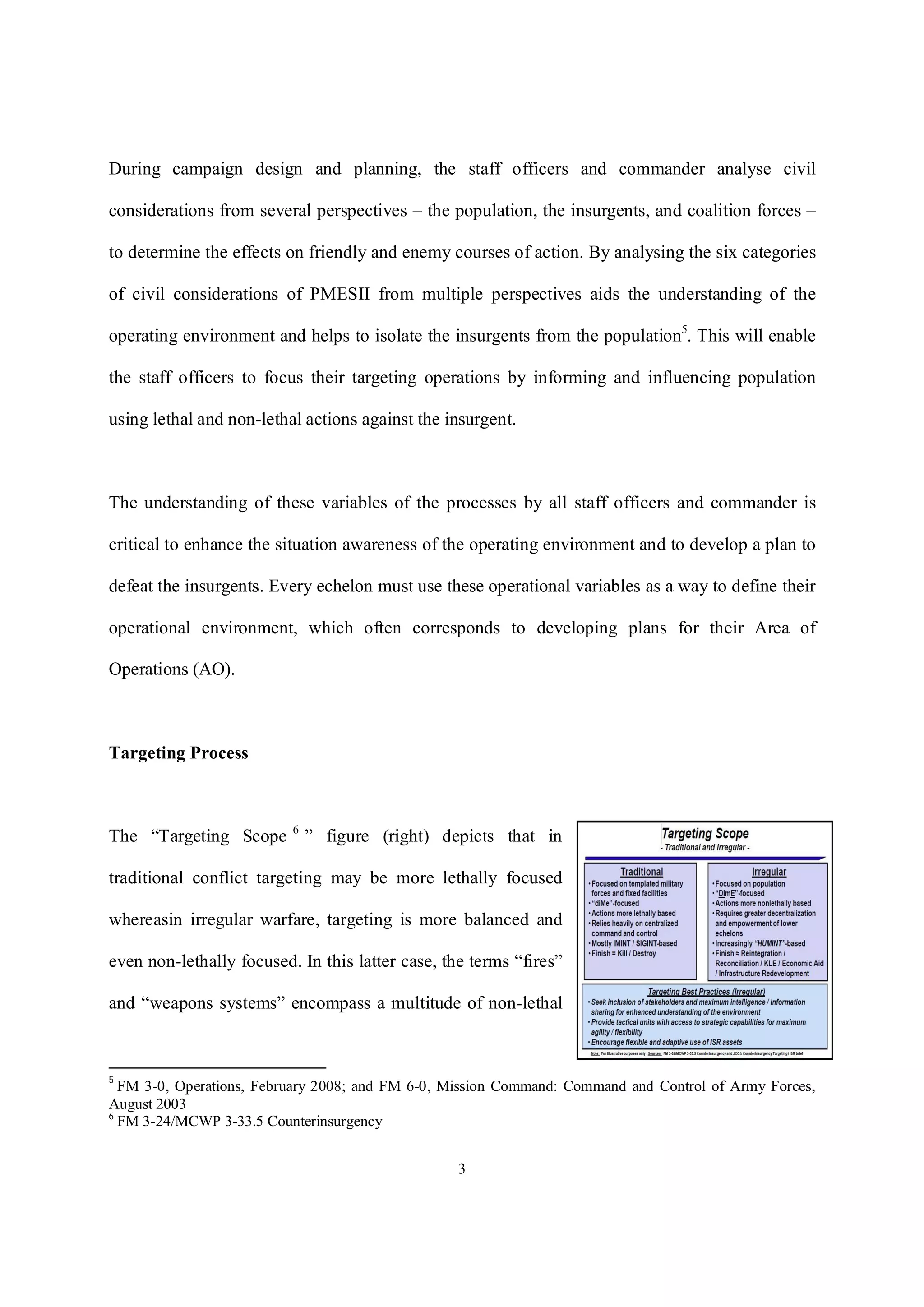
The “Targeting Scope 6
” figure (right) depicts that in
traditional conflict targeting may be more lethally focused
whereasin irregular warfare, targeting is more balanced and
even non-lethally focused. In this latter case, the terms “fires”
and “weapons systems” encompass a multitude of non-lethal
5
FM 3-0, Operations, February 2008; and FM 6-0, Mission Command: Command and Control of Army Forces,
August 2003
6
FM 3-24/MCWP 3-33.5 Counterinsurgency
4
activities including Key Leadership Engagement (KLE), Provincial Reconstruction Team (PRT)
and Military Information Support to Operations (MISO). These non-lethal activities in the
irregular warfare box of the figure seek to address the much greater non-lethal aspect of
informing and influencing people. The focus is on informing and influencing numerous friendly
and neutral audiences which may include local host nation leaders and population.
Unlike conventional wars, where one military aims to defeat another on the battlefield, the centre
of gravity (CoG) in insurgency is the population. In other words, the battle between insurgent
and the state is a tug-of-war for the loyalty and support of the population. David Galula7
contends:
“If the insurgent manages to dissociate the population from the counterinsurgent [the
government], to control it physically, to get its active support, he will win the war
because, in the final analysis, the exercise of political power depends on the tacit or
explicit agreement of the population or, at worst, on its submissiveness.”
Separate the insurgent, Attack the network
Improvised explosive devices (IEDs) are often used by the insurgent due to their unwillingness
to engage in direct action and vastly limited resources in comparison to a military superior
coalition forces (CF). This is coupled with the fact that IEDs had been proven successful as a
‘poor man’s tool’ that can achieve strategic impact in the irregular warfare. Through the wanton
7
David Galula, “Counterinsurgency Warfare: Theory and Practice”, New York: Frederick A. Praeger, Publishers,
1964
5
use of IEDs, the aim are to discredit the International Security Assistance Force (ISAF) and the
Government of the Islamic Republic of Afghanistan (GIRoA), and show their ineptness in
securing the general population’s well-being; thus ensuring that the insurgent continues to gain
support of the population for their causes.
Hence, it is imperative to secure the population that will then lead to the separation of the
insurgent; as the insurgency requires the support of the people to survive. This can be achieved
via effective Information Operations (IO) to broadcast the ill-doings of the INS during an IED
event as well as to leverage on Biometric Enabled Intelligence (BEI) to prosecute these insurgent
to undermine their efforts to gain populace support. One of the key advances in modern
counterinsurgency has been the application of biometric and forensic intelligence to catch the
elusive enemy capable of blending in with the population. Biometric enrolments have become
part of campaign plans, and the addition of trained explosive ordnance disposal (EOD)
technicians has provided units with increasingly more information about the construction and
origins of IEDs through their detailed post-blast analysis or information from weapon cache
finds and captured materials being exploited. This information is used for force protection,
targeting and staying ahead in the fight against the insurgents by understanding the indicators.
Without the population’s support, insurgents cannot survive. Likewise, without the population’s
support, a state’s government lacks legitimacy and is unlikely to survive. A successful
counterinsurgency strategy requires winning the population away from insurgents by drawing on
a mixture of lethal and non-lethal actions by promoting the credibility of the Afghan government
and security forces. Finding the balance between lethal and non-lethal operations is perhaps the
6
greatest challenge in the counterinsurgency. If the goal is to build rapport with the population
and win their trust, then lethal operations alone are unlikely to achieve this end.
Insurgent IO efforts – Why are they better at it?
"Mullah Omar said the first power in Afghanistan is information," said a Western
military official in Kabul, the Afghan capital, who is familiar with intelligence matters, citing
former Taliban officials who knew the movement's long-time leader. "He who controls the
information controls the will of the people."
Like ISAF and their Afghan allies, the INS / Taliban conduct their own extensive information
operations too. This is sometimes aided by international media. The insurgent exploitation of the
Quran Burning incident on 22 Feb 12 at Bagram Airfield and the Kandahar massacre by US
soldier killing of 17 civilians on 11 Mar 12 epitomised the effectiveness of the insurgent to
exploit the media for their advantage in the information operations arena. Their speed-to-market
by which the insurgent exploits such incidents, from the start of the incident to gaining the
international media attention is phenomenon.
Even though the insurgent’s IO campaign in the war of narrative and allegations can be
absolutely fallacious and fraudulently misleading; however, it has proven to be successful. The
insurgent’s success in information arena can be attributed to (1) non-hierarchical clearance of
printed or broadcast material, (2) non attributable to the INS organisation, (3) materials based on
7
INS message and may not be factually true and (4) anecdotal evidence, hardly indicative of
accepted research or reporting standards.
The INS uses the information it gathers to probe for vulnerability and opportunity for suicide
bombers, to monitor the movements of coalition forces and Afghan forces and to stymie efforts
by GIRoA to improve public services that help the government build credibility with civilians.
They influence, coerce, threaten the Afghan population through face-to-face communication, use
Short Messaging System (SMS) for propaganda, threatens Afghanistan National Security Forces
(ANSF) through physical and verbal intimidation and exploit the wedge between ISAF / GIRoA
and Afghan people.
Exploitation of CIED information for Targeting and Information Operations
When insurgent mounts an attack, it usually will have an IED-related or associated action which
in turn may activate an EOD response or generate tactical action i.e. targeting operations, quick
response force. The tactical units then utilises and direct resources to assess the threat such as
through focused enrolment, on-site exploitation, and intelligence assessment of the insurgent
network based on C-IED information.
This C-IED information will then yield information of the insurgent’s network in the Area of
Interest (AOI) and recommend lethal and non-lethal targets. This will then assist the operational
and tactical units in mission planning and highlight any C-IED information or IED hazards in
their areas so that they can shape their counterinsurgency fight.
8
In RC(S), IED incidents and bomb makers or facilitators are shown to operate in a relatively
small geographical (<5km) area and therefore known by the local community. This offers an
opportunity for the security forces (ANSF and Coalition Forces - CF) to engage the local
informal and formal leaders in an attempt to generate localised responsibility and communal
security. This effect is achieved through focused engagements with the local populace and
leaders through multiple mediums such as through non-lethal activities like Shura, KLE, Female
Engagement Teams (FET), and reconstruction projects. It is important to elicit the information
and provide solutions that foster the cooperation of local populace who are better at spotting
insurgents, their bombs and providing indications or warnings “left of boom” (before IEDs blow
up)8
.
The end-state is to secure the key and critical terrain leveraging on CIED information to identify
the INS network and separate them from the community.
The insurgents have built vast quantities of improvised explosive device (IED) to hinder freedom
of movement and action of the Afghan security and Coalition Forces (CF). In addition, they
have developed large scale homemade explosive (HME) factories and IED processing plants
amongst the population centres. Exploiting IEDs or captured enemy personnel and materiel for
force protection aim to prevent insurgent attacks on friendly forces and installations. Targeting
8
Fixing Intel: A Blueprint for Making Intelligence Relevant in Afghanistan by MG Michael T Flynn :
http://www.cnas.org/files/documents/publications/AfghanIntel_Flynn_Jan2010_code507_voices.pdf
9
allows coalition forces or ANSF to engage insurgents in order to achieve lethal or non-lethal
effects. IED component and captured materiel exploitation allows intelligence personnel to trace
the sources of insurgent network and origins, thus enabling coalition forces and ANSF to cripple
the insurgents’ network. Finally, exploitation enables prosecution of insurgent after their
captured materials have been fully exploited for intelligence purposes. As a result of such
actionable intelligence, coalition forces can conduct precision airstrikes, drones or Unmanned
Aerial Vehicles (UAV) to eliminate these insurgent networks and IEDs that threaten civilians,
Afghan security forces and coalition troops. Great care is taken to reduce minimise any
collateral damage to religious areas i.e. mosque and reduce loss of life. When possible, local
officials are consulted to gain their approval prior to any release of munitions, the area is
cordoned, and announcements are made through local media or loud speakers.
In addition, leveraging on the C-IED’s Biometric Enabled Intelligence (BEI) and Evidence-based
operations (EvBO9
) contributes to the building of GIRoA’s credibility and cooperation amongst
the ANSF, investigators, prosecutors, judges and prison officials. To enrol biometric at focussed
threat or target areas to increase the insurgents’ database so as to reduce the IED incidents to
protect the Afghan people, ANSF and GIRoA. Getting biometric associated bomb-makers or
facilitators will have significant impact on decreasing casualties. For example, in winter season,
insurgents’ IED activities tend to assume a low. Therefore, it is important to keep the insurgents
“pinned down” operationally and discredited through continuous non-lethal actions and
9
EvBO are operations where Afghan law enforcement authorities, supported by ISAF, effectively investigate,
apprehend, search or seize criminal suspects and affiliated property in accordance with Afghan law. ISAF, in
cooperation with International Community (IC)’s Rule of Law (RoL) personnel and GIRoA, will focus on
supporting EvBO in the designated Provincial Justice Centres (PJC) by providing training, mentoring and
partnership.
10
information operations. This is to reduce and disrupt the influence in the known and emerging
insurgent areas.
Coupled with success stories such as when the ANSF interdict IED facilitation route, attack
supply chain will have tremendous effect on the Afghan people. In the long run, the population
will then increase their trust in GIRoA and ANSF.
Conclusion
Targeting operations will continue to focus against insurgents’ networks, building a credible
governance system and re-construction effort. It is important for the commanders and their
planners to leverage on the C-IED information and Biometric Enabled Intelligence (BEI) for
targeting operations utilising lethal and non-lethal actions in the planning process and conduct of
operations. With clear understanding of the commander’s intent, these serve to provide the
necessary up-front direction for the coherent integration of lethal and non-lethal actions.
The end-state is to promote and provide a secured environment to the Afghan people through
successful non-lethal activities and IO initiatives by curbing or limiting the insurgent’s ability to
conduct complex attacks, employing IEDs, intimidation against the Afghan populace, GIRoA
and ANSF. This is achieved through leveraging on the C-IED’s BEI and EvBO as they
contribute to the building of Afghan capacity; develop a credible, accountable and sustainable
GIRoA and ANSF.
11
In conclusion, the tools needed to effectively neutralise IEDs as a battlefield threat will not be
found in technological systems or equipment, nor in killing insurgent leaders, but rather in
building relationships with the people who have become the battleground for all modern military
conflicts. Winning the information arena leveraging on the CIED information, addresses the
concerns of the people and this will in turn wins the will of the people. The population’s silence
speaks as loudly as the next explosion in many ways.
“Know your patch. Know the people, the topography, economy, history, and culture. Know every
village, road, field, population group, tribal leader, and ancient grievance. Your task is to
become the world expert in your particular district…. Neglect this knowledge, and it will kill
you.”
- Dr. David Kilcullen, Department of State, Chief Strategist, Office of the Coordinator for
Terrorism, June 2006

CIED information for IO & Targeting

  • 1.
    1 Leverage on CounterImprovised Explosives Device (C-IED) information to achieve Battlefield Effects for Targeting Operations and Information Operations (IO) “Information and Intelligence” is the “Fire and Maneuver” of the 21st Century. - Major General Michael T Flynn, March 2011. Introduction Military strategy in Afghanistan continues to place emphasis on targeting operations designed to crumble insurgent (INS) networks as part of the population centric counterinsurgency (COIN) operations. In COIN, “traditional” and “irregular” warfare require a mix of lethal and non-lethal actions. These actions complement each other and create dilemmas for opponents in COIN operations. Thus, planning of lethal and non-lethal actions is inseparable. The last 10 years of Afghanistan operations have highlighted the need for non-lethal actions in the conduct of “irregular warfare” environment. Non-lethal activities such as inform and influence activities, civil military operations (CMO), and reconstruction are being integrated early on during design and planning stage to achieve desired outcomes or effects as part of the targeting and synchronisation processes. Campaign Design, Planning and Targeting Process “…complexity is often rooted in patterns of interaction among agents.”1 Axelrod and Cohen 1 Axelrod, Robert and Cohen, Michael D. Harnessing Complexity: Organisational Implications of a Scientific Frontier. New York: Basic Books, 2000. pp. 26.
  • 2.
    2 In RC(S), itis imperative to understand the relationship between the campaign design, planning, and targeting process so as to gain understanding of the challenges and to ensure relevant military solution to the situation. Design focuses on understanding the operational environment, the problem setting and development of an operational approach tofacilitate subsequent planning to solve the problem. Planning focuses on solving the problem through development of concepts of operation, detailed plans and allocation of resources to achieve the mission. Targeting operations enable the selection, prioritising targets and matching the appropriate lethal and non- lethal response to them. When operating in such complex realms, commanders must define the contemporary operating environment with sufficient clout to understand the challenges and opportunities. This is achieved through the application of the Integrated Planning Process (IPB2 ), Political, Military, Economic, Social, Information, and Infrastructure– Physical Environment and Time (PMESII- PT3 ); and Area, Structure, Capabilities, Organisations, People and Events (ASCOPE4 ) process or methodology. In RC(s), the staff officers and commander often leverage PMESII-PT to gain that understanding of the issues posed. 2 IPB identifies unique and significant characteristics within and throughout the Operating Environment (OE). It evaluates terrain, weather and the infrastructure and their effects on coalition and threat forces (FM 2-0, Intelligence in the Operational Environment. May 2004). 3 PMESII stands for Political, Military, Economic, Social, Information, and Infrastructure. Later, the U.S. military doctrine writers added Physical Environment and Time as additional factors to consider in defining an operational environment. U.S. Army Field Manuals 5-0, 3-0, and even 5-2 Design advocate PMESII, PMESII-PT, ASCOPE, or METT-TC as methodologies to ascertain a better understanding of an environment. Furthermore, these methods are generally categorized as sub steps to a larger process. For example, according to FM 5-0, one can use METT-TC (or PMESII) during the Intelligence Preparation of the Battlefield process which consists of four additional steps and is a part of the larger Military Decision Making Process. 4 ASCOPE stands for Area, Structure, Capabilities, Organisations, People and Events.
  • 3.
    3 During campaign designand planning, the staff officers and commander analyse civil considerations from several perspectives – the population, the insurgents, and coalition forces – to determine the effects on friendly and enemy courses of action. By analysing the six categories of civil considerations of PMESII from multiple perspectives aids the understanding of the operating environment and helps to isolate the insurgents from the population5 . This will enable the staff officers to focus their targeting operations by informing and influencing population using lethal and non-lethal actions against the insurgent. The understanding of these variables of the processes by all staff officers and commander is critical to enhance the situation awareness of the operating environment and to develop a plan to defeat the insurgents. Every echelon must use these operational variables as a way to define their operational environment, which often corresponds to developing plans for their Area of Operations (AO). Targeting Process The “Targeting Scope 6 ” figure (right) depicts that in traditional conflict targeting may be more lethally focused whereasin irregular warfare, targeting is more balanced and even non-lethally focused. In this latter case, the terms “fires” and “weapons systems” encompass a multitude of non-lethal 5 FM 3-0, Operations, February 2008; and FM 6-0, Mission Command: Command and Control of Army Forces, August 2003 6 FM 3-24/MCWP 3-33.5 Counterinsurgency
  • 4.
    4 activities including KeyLeadership Engagement (KLE), Provincial Reconstruction Team (PRT) and Military Information Support to Operations (MISO). These non-lethal activities in the irregular warfare box of the figure seek to address the much greater non-lethal aspect of informing and influencing people. The focus is on informing and influencing numerous friendly and neutral audiences which may include local host nation leaders and population. Unlike conventional wars, where one military aims to defeat another on the battlefield, the centre of gravity (CoG) in insurgency is the population. In other words, the battle between insurgent and the state is a tug-of-war for the loyalty and support of the population. David Galula7 contends: “If the insurgent manages to dissociate the population from the counterinsurgent [the government], to control it physically, to get its active support, he will win the war because, in the final analysis, the exercise of political power depends on the tacit or explicit agreement of the population or, at worst, on its submissiveness.” Separate the insurgent, Attack the network Improvised explosive devices (IEDs) are often used by the insurgent due to their unwillingness to engage in direct action and vastly limited resources in comparison to a military superior coalition forces (CF). This is coupled with the fact that IEDs had been proven successful as a ‘poor man’s tool’ that can achieve strategic impact in the irregular warfare. Through the wanton 7 David Galula, “Counterinsurgency Warfare: Theory and Practice”, New York: Frederick A. Praeger, Publishers, 1964
  • 5.
    5 use of IEDs,the aim are to discredit the International Security Assistance Force (ISAF) and the Government of the Islamic Republic of Afghanistan (GIRoA), and show their ineptness in securing the general population’s well-being; thus ensuring that the insurgent continues to gain support of the population for their causes. Hence, it is imperative to secure the population that will then lead to the separation of the insurgent; as the insurgency requires the support of the people to survive. This can be achieved via effective Information Operations (IO) to broadcast the ill-doings of the INS during an IED event as well as to leverage on Biometric Enabled Intelligence (BEI) to prosecute these insurgent to undermine their efforts to gain populace support. One of the key advances in modern counterinsurgency has been the application of biometric and forensic intelligence to catch the elusive enemy capable of blending in with the population. Biometric enrolments have become part of campaign plans, and the addition of trained explosive ordnance disposal (EOD) technicians has provided units with increasingly more information about the construction and origins of IEDs through their detailed post-blast analysis or information from weapon cache finds and captured materials being exploited. This information is used for force protection, targeting and staying ahead in the fight against the insurgents by understanding the indicators. Without the population’s support, insurgents cannot survive. Likewise, without the population’s support, a state’s government lacks legitimacy and is unlikely to survive. A successful counterinsurgency strategy requires winning the population away from insurgents by drawing on a mixture of lethal and non-lethal actions by promoting the credibility of the Afghan government and security forces. Finding the balance between lethal and non-lethal operations is perhaps the
  • 6.
    6 greatest challenge inthe counterinsurgency. If the goal is to build rapport with the population and win their trust, then lethal operations alone are unlikely to achieve this end. Insurgent IO efforts – Why are they better at it? "Mullah Omar said the first power in Afghanistan is information," said a Western military official in Kabul, the Afghan capital, who is familiar with intelligence matters, citing former Taliban officials who knew the movement's long-time leader. "He who controls the information controls the will of the people." Like ISAF and their Afghan allies, the INS / Taliban conduct their own extensive information operations too. This is sometimes aided by international media. The insurgent exploitation of the Quran Burning incident on 22 Feb 12 at Bagram Airfield and the Kandahar massacre by US soldier killing of 17 civilians on 11 Mar 12 epitomised the effectiveness of the insurgent to exploit the media for their advantage in the information operations arena. Their speed-to-market by which the insurgent exploits such incidents, from the start of the incident to gaining the international media attention is phenomenon. Even though the insurgent’s IO campaign in the war of narrative and allegations can be absolutely fallacious and fraudulently misleading; however, it has proven to be successful. The insurgent’s success in information arena can be attributed to (1) non-hierarchical clearance of printed or broadcast material, (2) non attributable to the INS organisation, (3) materials based on
  • 7.
    7 INS message andmay not be factually true and (4) anecdotal evidence, hardly indicative of accepted research or reporting standards. The INS uses the information it gathers to probe for vulnerability and opportunity for suicide bombers, to monitor the movements of coalition forces and Afghan forces and to stymie efforts by GIRoA to improve public services that help the government build credibility with civilians. They influence, coerce, threaten the Afghan population through face-to-face communication, use Short Messaging System (SMS) for propaganda, threatens Afghanistan National Security Forces (ANSF) through physical and verbal intimidation and exploit the wedge between ISAF / GIRoA and Afghan people. Exploitation of CIED information for Targeting and Information Operations When insurgent mounts an attack, it usually will have an IED-related or associated action which in turn may activate an EOD response or generate tactical action i.e. targeting operations, quick response force. The tactical units then utilises and direct resources to assess the threat such as through focused enrolment, on-site exploitation, and intelligence assessment of the insurgent network based on C-IED information. This C-IED information will then yield information of the insurgent’s network in the Area of Interest (AOI) and recommend lethal and non-lethal targets. This will then assist the operational and tactical units in mission planning and highlight any C-IED information or IED hazards in their areas so that they can shape their counterinsurgency fight.
  • 8.
    8 In RC(S), IEDincidents and bomb makers or facilitators are shown to operate in a relatively small geographical (<5km) area and therefore known by the local community. This offers an opportunity for the security forces (ANSF and Coalition Forces - CF) to engage the local informal and formal leaders in an attempt to generate localised responsibility and communal security. This effect is achieved through focused engagements with the local populace and leaders through multiple mediums such as through non-lethal activities like Shura, KLE, Female Engagement Teams (FET), and reconstruction projects. It is important to elicit the information and provide solutions that foster the cooperation of local populace who are better at spotting insurgents, their bombs and providing indications or warnings “left of boom” (before IEDs blow up)8 . The end-state is to secure the key and critical terrain leveraging on CIED information to identify the INS network and separate them from the community. The insurgents have built vast quantities of improvised explosive device (IED) to hinder freedom of movement and action of the Afghan security and Coalition Forces (CF). In addition, they have developed large scale homemade explosive (HME) factories and IED processing plants amongst the population centres. Exploiting IEDs or captured enemy personnel and materiel for force protection aim to prevent insurgent attacks on friendly forces and installations. Targeting 8 Fixing Intel: A Blueprint for Making Intelligence Relevant in Afghanistan by MG Michael T Flynn : http://www.cnas.org/files/documents/publications/AfghanIntel_Flynn_Jan2010_code507_voices.pdf
  • 9.
    9 allows coalition forcesor ANSF to engage insurgents in order to achieve lethal or non-lethal effects. IED component and captured materiel exploitation allows intelligence personnel to trace the sources of insurgent network and origins, thus enabling coalition forces and ANSF to cripple the insurgents’ network. Finally, exploitation enables prosecution of insurgent after their captured materials have been fully exploited for intelligence purposes. As a result of such actionable intelligence, coalition forces can conduct precision airstrikes, drones or Unmanned Aerial Vehicles (UAV) to eliminate these insurgent networks and IEDs that threaten civilians, Afghan security forces and coalition troops. Great care is taken to reduce minimise any collateral damage to religious areas i.e. mosque and reduce loss of life. When possible, local officials are consulted to gain their approval prior to any release of munitions, the area is cordoned, and announcements are made through local media or loud speakers. In addition, leveraging on the C-IED’s Biometric Enabled Intelligence (BEI) and Evidence-based operations (EvBO9 ) contributes to the building of GIRoA’s credibility and cooperation amongst the ANSF, investigators, prosecutors, judges and prison officials. To enrol biometric at focussed threat or target areas to increase the insurgents’ database so as to reduce the IED incidents to protect the Afghan people, ANSF and GIRoA. Getting biometric associated bomb-makers or facilitators will have significant impact on decreasing casualties. For example, in winter season, insurgents’ IED activities tend to assume a low. Therefore, it is important to keep the insurgents “pinned down” operationally and discredited through continuous non-lethal actions and 9 EvBO are operations where Afghan law enforcement authorities, supported by ISAF, effectively investigate, apprehend, search or seize criminal suspects and affiliated property in accordance with Afghan law. ISAF, in cooperation with International Community (IC)’s Rule of Law (RoL) personnel and GIRoA, will focus on supporting EvBO in the designated Provincial Justice Centres (PJC) by providing training, mentoring and partnership.
  • 10.
    10 information operations. Thisis to reduce and disrupt the influence in the known and emerging insurgent areas. Coupled with success stories such as when the ANSF interdict IED facilitation route, attack supply chain will have tremendous effect on the Afghan people. In the long run, the population will then increase their trust in GIRoA and ANSF. Conclusion Targeting operations will continue to focus against insurgents’ networks, building a credible governance system and re-construction effort. It is important for the commanders and their planners to leverage on the C-IED information and Biometric Enabled Intelligence (BEI) for targeting operations utilising lethal and non-lethal actions in the planning process and conduct of operations. With clear understanding of the commander’s intent, these serve to provide the necessary up-front direction for the coherent integration of lethal and non-lethal actions. The end-state is to promote and provide a secured environment to the Afghan people through successful non-lethal activities and IO initiatives by curbing or limiting the insurgent’s ability to conduct complex attacks, employing IEDs, intimidation against the Afghan populace, GIRoA and ANSF. This is achieved through leveraging on the C-IED’s BEI and EvBO as they contribute to the building of Afghan capacity; develop a credible, accountable and sustainable GIRoA and ANSF.
  • 11.
    11 In conclusion, thetools needed to effectively neutralise IEDs as a battlefield threat will not be found in technological systems or equipment, nor in killing insurgent leaders, but rather in building relationships with the people who have become the battleground for all modern military conflicts. Winning the information arena leveraging on the CIED information, addresses the concerns of the people and this will in turn wins the will of the people. The population’s silence speaks as loudly as the next explosion in many ways. “Know your patch. Know the people, the topography, economy, history, and culture. Know every village, road, field, population group, tribal leader, and ancient grievance. Your task is to become the world expert in your particular district…. Neglect this knowledge, and it will kill you.” - Dr. David Kilcullen, Department of State, Chief Strategist, Office of the Coordinator for Terrorism, June 2006