Video Coding Standards
• H.120
• H.261
• MPEG-1 and MPEG-2/H.262
• H.263
• MPEG-4


Thomas Wiegand: Digital Image Communication   Video Coding Standards 1
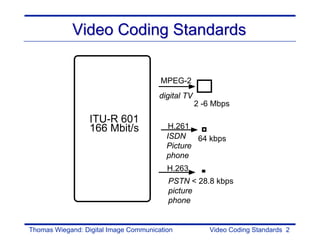
Video Coding Standards


                                       MPEG-2
                                      digital TV
                                                   2 -6 Mbps

                  ITU-R 601
                  166 Mbit/s              H.261
                                         ISDN    64 kbps
                                         Picture
                                         phone
                                         H.263
                                         PSTN < 28.8 kbps
                                         picture
                                         phone


Thomas Wiegand: Digital Image Communication           Video Coding Standards 2
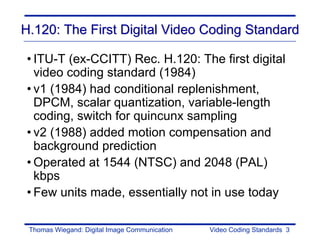
H.120: The First Digital Video Coding Standard

• ITU-T (ex-CCITT) Rec. H.120: The first digital
  video coding standard (1984)
• v1 (1984) had conditional replenishment,
  DPCM, scalar quantization, variable-length
  coding, switch for quincunx sampling
• v2 (1988) added motion compensation and
  background prediction
• Operated at 1544 (NTSC) and 2048 (PAL)
  kbps
• Few units made, essentially not in use today

 Thomas Wiegand: Digital Image Communication   Video Coding Standards 3
H.261: The Basis of Modern Video Compression

• ITU-T (ex-CCITT) Rec. H.261: The first widespread
  practical success
• First design (late ’80s) embodying typical structure
  that dominates today: 16x16 macroblock motion
  compensation, 8x8 DCT, scalar quantization, and
  variable-length coding
• Other key aspects: loop filter, integer-pel motion
  compensation accuracy, 2-D VLC for coefficients
• Operated at 64-2048 kbps
• Still in use, although mostly as a backward-
  compatibility feature – overtaken by H.263


 Thomas Wiegand: Digital Image Communication   Video Coding Standards 4
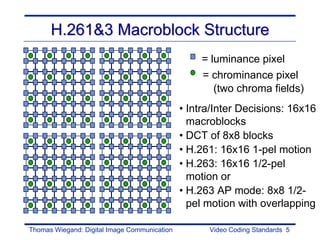
H.261&3 Macroblock Structure
                                                  = luminance pixel
                                                  = chrominance pixel
                                                     (two chroma fields)
                                              • Intra/Inter Decisions: 16x16
                                                macroblocks
                                              • DCT of 8x8 blocks
                                              • H.261: 16x16 1-pel motion
                                              • H.263: 16x16 1/2-pel
                                                motion or
                                              • H.263 AP mode: 8x8 1/2-
                                                pel motion with overlapping

Thomas Wiegand: Digital Image Communication         Video Coding Standards 5
MPEG-1
• Formally ISO/IEC 11172-2 (‘93), developed by
  ISO/IEC JTC1 SC29 WG11 (MPEG) – use is
  fairly widespread, but mostly overtaken by
  MPEG-2
• Superior quality to H.261 when operated at
  higher bit rates (≥ 1 Mbps for CIF 352x288
  resolution)
• Can provide approximately VHS quality
  between 1-2 Mbps using SIF 352x240/288
  resolution
• Technical features: Adds bi-directional motion
  prediction and half-pixel motion to H.261 design
Thomas Wiegand: Digital Image Communication   Video Coding Standards 6
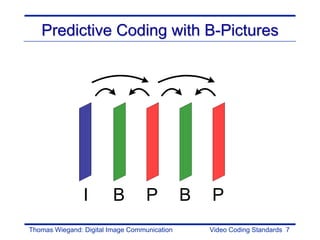
Predictive Coding with B-Pictures


                I        B         P          B   P
Thomas Wiegand: Digital Image Communication       Video Coding Standards 7
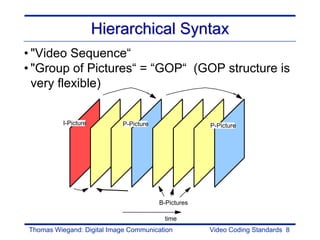
Hierarchical Syntax
• "Video Sequence“
• "Group of Pictures“ = “GOP“ (GOP structure is
  very flexible)


          I-Picture         P-Picture                P-Picture


                                        B-Pictures

                                          time
Thomas Wiegand: Digital Image Communication          Video Coding Standards 8
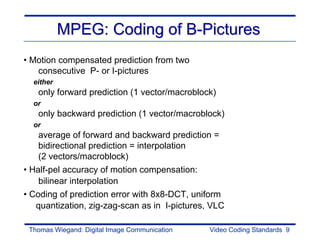
MPEG: Coding of B-Pictures
• Motion compensated prediction from two
   consecutive P- or I-pictures
  either
   only forward prediction (1 vector/macroblock)
  or
   only backward prediction (1 vector/macroblock)
  or
    average of forward and backward prediction =
    bidirectional prediction = interpolation
    (2 vectors/macroblock)
• Half-pel accuracy of motion compensation:
    bilinear interpolation
• Coding of prediction error with 8x8-DCT, uniform
   quantization, zig-zag-scan as in I-pictures, VLC

 Thomas Wiegand: Digital Image Communication   Video Coding Standards 9
MPEG-2/H.262
• Formally ISO/IEC 13818-2 & ITU-T H.262, developed
  (‘94) jointly by ISO/IEC SC29 WG11 (MPEG) and
  ITU-T
• Now in wide use for DVD standard and DTV
  (the most commonly used video coding standard)
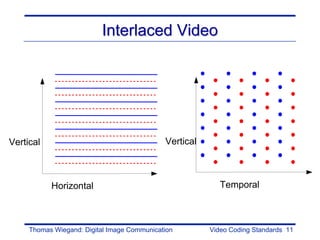
• Primary new technical features: support for interlaced-
  scan pictures and scalability
• Essentially the same as MPEG-1 for progressive-scan
  pictures, and MPEG-1 forward compatibility required
• Not especially useful below 2 Mbps (range of use
  normally 2-20 Mbps)


Thomas Wiegand: Digital Image Communication   Video Coding Standards 10
Interlaced Video


Vertical                                     Vertical


           Horizontal                                      Temporal


     Thomas Wiegand: Digital Image Communication        Video Coding Standards 11
H.263: The Next Generation
• ITU-T Rec. H.263 (v1: 1995): The next
  generation of video coding performance,
  developed by ITU-T
• Has overtaken H.261 as dominant
  videoconferencing codec
• Superior to H.261 at all bit rates
• Wins by a factor of two at very low rates
• Versions 2: H.263+ (late ’97/early ’98) and 3
  (about now) later developed


Thomas Wiegand: Digital Image Communication   Video Coding Standards 12
Technical Features of H.263
• “Baseline” Algorithm Features beat H.261
   – Half-pel motion compensation
   – 3-D variable length coding of DCT coefficients
   – Median motion vector prediction
   – More efficient coding pattern signaling
   – Deletable GOB header overhead
• Optional Enhanced Modes
   – Increased motion vector range with picture
     extrapolation
   – Advanced prediction mode (AP mode): Variable-
     size and overlapped block motion compensation
     (OBMC) with picture extrapolation
   – PB-frames (bi-directional prediction)
   – Arithmetic entropy coding
   – Continuous-presence multipoint / video mux
Thomas Wiegand: Digital Image Communication   Video Coding Standards 13
Motion Compensation H.261 vs. H.263
• H.261 (1990): integer-pel accuracy, loop filter,
  1 motion vector per MB

• H.263 (1995): half-pel accuracy, no loop filter,
  1 motion vector per MB (already in MPEG-1,2)

• H.263 option „Advanced Prediction Mode“
  - overlapped block motion compensation (OBMC),
  - switch between 1 or 4 motion vectors per MB

• H.263 option „PB frames“
 Thomas Wiegand: Digital Image Communication   Video Coding Standards 14
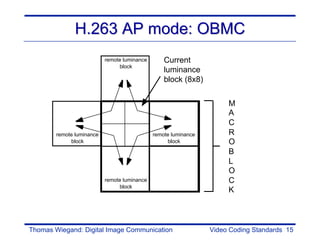
H.263 AP mode: OBMC
                           remote luminance       Current
                                block
                                                  luminance
                                                  block (8x8)


                                                                      M
                                                                      A
                                                                      C
        remote luminance                      remote luminance        R
             block                                 block              O
                                                                      B
                                                                      L
                                                                      O
                           remote luminance                           C
                                block
                                                                      K


Thomas Wiegand: Digital Image Communication                      Video Coding Standards 15
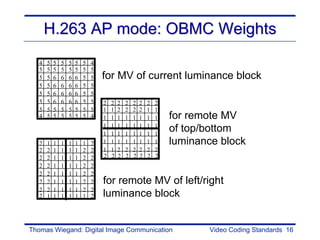
H.263 AP mode: OBMC Weights
   4   5   5   5   5   5   5   4
   5   5   5   5   5   5   5   5
   5   5   6   6   6   6   5   5   for MV of current luminance block
   5   5   6   6   6   6   5   5
   5   5   6   6   6   6   5   5
   5   5   6   6   6   6   5   5   2   2   2   2   2   2   2   2
   5   5   5   5   5   5   5   5   1   1   2   2   2   2   1   1
   4   5   5   5   5   5   5   4   1   1   1   1   1   1   1   1   for remote MV
                                   1   1   1   1   1   1   1   1
                                   1   1   1   1   1   1   1   1
                                                                   of top/bottom
   2   1   1   1   1   1   1   2   1   1   1   1   1   1   1   1   luminance block
   2   2   1   1   1   1   2   2   1   1   2   2   2   2   2   2
   2   2   1   1   1   1   2   2   2   2   2   2   2   2   2   2
   2   2   1   1   1   1   2   2
   2   2   1   1   1   1   2   2
   2   2   1   1   1   1   2   2   for remote MV of left/right
   2   2   1   1   1   1   2   2
   2   1   1   1   1   1   1   2   luminance block


Thomas Wiegand: Digital Image Communication                               Video Coding Standards 16
Performance of H.263 AP Mode
               36
               35                                       1)
                                                                 2)
               34
               33
  PSNR [dB]


               32
               31
               30
               29                             1) H.263 TMN-9 AP-mode
                                              2) H.263 TMN-9 w/o options
               28
               27
               26
                    0    32           64                      128
                              rate [kbps]

Thomas Wiegand: Digital Image Communication          Video Coding Standards 17
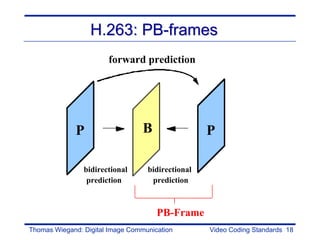
H.263: PB-frames
                       forward prediction


             P                    B                P

                bidirectional      bidirectional
                 prediction         prediction


                                      PB-Frame
Thomas Wiegand: Digital Image Communication        Video Coding Standards 18
Performance of H.263 PB-Mode
36
                                     1)       3a)
35                                                          2)
34
33                                             3b)
32
31                                     1) H.263 TMN-9 w/o options (6.25 fps)
30                                     2) H.263 TMN-9 w/o options (12.5 fps)
                                       3) H.263 TMN-9 PB-mode (12.5 fps)
29                                        a) P-frames
28                                        b) B-frames
27
26
     0          32           64                       128
                  rate [kbps]
Thomas Wiegand: Digital Image Communication          Video Coding Standards 19
Performance of H.263 and H.261

                                    1)         2)           3)
 34
                                                       4)
                                                                 5)
 32

 30

 28                            1)   H.263 v1 TMN-9, all options
                               2)   H.263 TMN-9 w/o options
 26                            3)   H.261 PVRG codec
                               4)   H.263 TMN-9 w/o options, integer-pel ME
 24                            5)   H.261 PVRG codec w/o loop filter

               32        64                   128
                           rate [kbps]
Thomas Wiegand: Digital Image Communication         Video Coding Standards 20
H.263+ Feature Categories
• Improved compression efficiency (e.g.,
  15-25% overall improvement over
  H.263v1)
• Error resilience (1st resilient video
  standard)
• Custom and Flexible Video Formats
• Scalability for resilience and multipoint
• Supplemental enhancement information


Thomas Wiegand: Digital Image Communication   Video Coding Standards 21
H.263+: Better Ways of Coding
• Efficiency & Perceptual Enhancement
   – Advanced intra-coding
   – Deblocking filter (in the loop)
   – Alternate inter VLC for heavy motion
   – Modified quantization/coefficient range
   – Improved PB-frames (and B frames too)
   – Tweaks of prior features (RC, UMV, AP, CPM)
• Dynamic Resolution Features
   – Reference-picture resampling (also global motion)
   – Reduced-resolution update


Thomas Wiegand: Digital Image Communication   Video Coding Standards 22
H.263+: Improved Error Resilience
• Slice-structured coding (packetization, low
  delay, object-oriented coding)
• Independent segment decoding
  (packetization, encoder parallelization)
• Reference picture selection (with optional
  back-channel)
• Scalability Features (see part 3)


Thomas Wiegand: Digital Image Communication   Video Coding Standards 23
H.263+: New Kinds of Pictures
• Custom Video Source Formats
  – Custom picture resolutions
  – Custom pixel/picture aspect ratios
  – Custom picture clock rates
• Scalability Pictures
  – SNR scalability (fidelity enhancement layer)
    – Temporal scalability (B pictures)
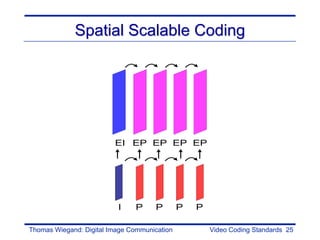
    – Spatial scalability (resolution enhancement
      layer)

Thomas Wiegand: Digital Image Communication   Video Coding Standards 24
Spatial Scalable Coding


                         EI EP EP EP EP


                          I    P     P        P   P

Thomas Wiegand: Digital Image Communication           Video Coding Standards 25
What New Applications Does H.263+ Enable?
 •     Error/packet-loss resilient video
 •     Scalable multiple bit rate video at low bit rates
 •     Flexible-format low bit rate video
 •     High frame rate video (e.g., 72 frames / sec)
 •     Progressive picture quality refinement
 •     Dynamic video picture resolution
 •     Graphics/still-picture snapshot coding
 •     Object-layered video using chroma key
 •     Special effects / global motion


     Thomas Wiegand: Digital Image Communication   Video Coding Standards 26
MPEG-4: H.263 + Additions + Variable Shape Coding

  • MPEG-4 (v1: early 1999), formally ISO/IEC
    14496-2: Roughly follows H.263 design and
    adds all prior features and various “trick
    modes” and (most important) shape coding
  • Includes zero-tree wavelet coding of still
    pictures, segmented coding of shapes,
    coding of synthetic content
  • v2 (early 2000) developed, v3 and v4 in
    progress


  Thomas Wiegand: Digital Image Communication   Video Coding Standards 27
MPEG-4 v1: Simple Profile
• H.263v1 Baseline (exact compatibility to H.263, plus
  custom picture format with a different picture header)
• Variable block-size and picture-extrapolating MC
  (parts of H.263v1 Annexes D & F & H.263+ Annex J)
• Spatial-Predictive Intra Coding (similar to H.263
  Annex I)
• Altered step size for DC coefficients
• Relative placement of rectangular pictures (sort of
  H.263+ Annex R)
• Slice-structured coding (like H.263+ Annex K)
• Data partitioning and reversible VLC (not in H.263
  until v3)
Thomas Wiegand: Digital Image Communication   Video Coding Standards 28
MPEG-4 v1: Core Profile
• Binary shape coding (shape coding is the
  most unique new feature of MPEG-4 –
  different than H.263+ Annex L chroma
  keying)
• B-picture temporal scalability (a subset of
  H.263+ Annex O)
• P-picture temporal scalability (a subset of
  H.263+ Annex N)
• MPEG-2-style inverse quantization (not in
  H.263)

Thomas Wiegand: Digital Image Communication   Video Coding Standards 29
MPEG-4 v1: Main Profile
• Grey-scale shape coding (soft representation
  of shapes)
• Interlace (backward compatibility for 1940’s-
  era analog compression technique)
• Static sprite coding (warpable pictures,
  different than H.263+ Annex P)
• Scalable still pictures


Thomas Wiegand: Digital Image Communication   Video Coding Standards 30
MPEG-4 v1: Other Technical Features
• Temporal & spatial scalability (a subset of
  H.263+ Annex O)
• Overlapped block motion compensation (part
  of H.263v1 Annex F)
• 12-bit video
• Dynamic 2D mesh coding
• Face animation modeling


Thomas Wiegand: Digital Image Communication   Video Coding Standards 31
MPEG-4 v2
• Fidelity
   – Quarter-pel Motion Compensation
   – Global MC (somewhat different than
     H.263+ Annex P)
   – Shape-Adaptive DCT (for shape-based
     coding)
   – Reduced-Resolution Update (H.263+
     Annex Q)
• Error Resilience
   – Reference Picture Selection (H.263+
     Annex N)
Thomas Wiegand: Digital Image Communication   Video Coding Standards 32
MPEG-4 v2
• Object based spatial scalability (spatial scalability for
  arbitrary shaped coding)
• Multiple auxiliary components (specialized apps)
• Mesh coding for Body Mesh and 3-D Mesh (synthetic
  and semi-synthetic content)
• Still-Picture Coding
   – Wavelet tiling for still picture (random access
      within a still picture)
   – Error resilience for still pictures (recovery from
      errors)
   – Scalable arbitrary shape for still picture coding
      (scalability with shape coding for still pictures)

 Thomas Wiegand: Digital Image Communication   Video Coding Standards 33
H.263++ New Version 3 Features, I
• Annex U: Fidelity enhancement by
  macroblock and block-level reference picture
  selection
  - Improved compression performance
  - Improved error resilience
• Annex V: Packet Loss & Error Resilience
  using data partitioning with reversible VLCs
  (roughly similar to MPEG-4 data partitioning,
  but improved by using reversible coding of
  motion vectors rather than coefficients)


Thomas Wiegand: Digital Image Communication   Video Coding Standards 34
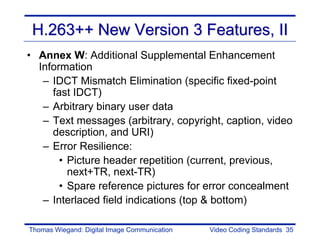
H.263++ New Version 3 Features, II
• Annex W: Additional Supplemental Enhancement
  Information
   – IDCT Mismatch Elimination (specific fixed-point
     fast IDCT)
   – Arbitrary binary user data
   – Text messages (arbitrary, copyright, caption, video
     description, and URI)
   – Error Resilience:
       • Picture header repetition (current, previous,
         next+TR, next-TR)
       • Spare reference pictures for error concealment
   – Interlaced field indications (top & bottom)

Thomas Wiegand: Digital Image Communication   Video Coding Standards 35

DIC_video_coding_standards_07

  • 1.
    Video Coding Standards •H.120 • H.261 • MPEG-1 and MPEG-2/H.262 • H.263 • MPEG-4 Thomas Wiegand: Digital Image Communication Video Coding Standards 1
  • 2.
    Video Coding Standards MPEG-2 digital TV 2 -6 Mbps ITU-R 601 166 Mbit/s H.261 ISDN 64 kbps Picture phone H.263 PSTN < 28.8 kbps picture phone Thomas Wiegand: Digital Image Communication Video Coding Standards 2
  • 3.
    H.120: The FirstDigital Video Coding Standard • ITU-T (ex-CCITT) Rec. H.120: The first digital video coding standard (1984) • v1 (1984) had conditional replenishment, DPCM, scalar quantization, variable-length coding, switch for quincunx sampling • v2 (1988) added motion compensation and background prediction • Operated at 1544 (NTSC) and 2048 (PAL) kbps • Few units made, essentially not in use today Thomas Wiegand: Digital Image Communication Video Coding Standards 3
  • 4.
    H.261: The Basisof Modern Video Compression • ITU-T (ex-CCITT) Rec. H.261: The first widespread practical success • First design (late ’80s) embodying typical structure that dominates today: 16x16 macroblock motion compensation, 8x8 DCT, scalar quantization, and variable-length coding • Other key aspects: loop filter, integer-pel motion compensation accuracy, 2-D VLC for coefficients • Operated at 64-2048 kbps • Still in use, although mostly as a backward- compatibility feature – overtaken by H.263 Thomas Wiegand: Digital Image Communication Video Coding Standards 4
  • 5.
    H.261&3 Macroblock Structure = luminance pixel = chrominance pixel (two chroma fields) • Intra/Inter Decisions: 16x16 macroblocks • DCT of 8x8 blocks • H.261: 16x16 1-pel motion • H.263: 16x16 1/2-pel motion or • H.263 AP mode: 8x8 1/2- pel motion with overlapping Thomas Wiegand: Digital Image Communication Video Coding Standards 5
  • 6.
    MPEG-1 • Formally ISO/IEC11172-2 (‘93), developed by ISO/IEC JTC1 SC29 WG11 (MPEG) – use is fairly widespread, but mostly overtaken by MPEG-2 • Superior quality to H.261 when operated at higher bit rates (≥ 1 Mbps for CIF 352x288 resolution) • Can provide approximately VHS quality between 1-2 Mbps using SIF 352x240/288 resolution • Technical features: Adds bi-directional motion prediction and half-pixel motion to H.261 design Thomas Wiegand: Digital Image Communication Video Coding Standards 6
  • 7.
    Predictive Coding withB-Pictures I B P B P Thomas Wiegand: Digital Image Communication Video Coding Standards 7
  • 8.
    Hierarchical Syntax • "VideoSequence“ • "Group of Pictures“ = “GOP“ (GOP structure is very flexible) I-Picture P-Picture P-Picture B-Pictures time Thomas Wiegand: Digital Image Communication Video Coding Standards 8
  • 9.
    MPEG: Coding ofB-Pictures • Motion compensated prediction from two consecutive P- or I-pictures either only forward prediction (1 vector/macroblock) or only backward prediction (1 vector/macroblock) or average of forward and backward prediction = bidirectional prediction = interpolation (2 vectors/macroblock) • Half-pel accuracy of motion compensation: bilinear interpolation • Coding of prediction error with 8x8-DCT, uniform quantization, zig-zag-scan as in I-pictures, VLC Thomas Wiegand: Digital Image Communication Video Coding Standards 9
  • 10.
    MPEG-2/H.262 • Formally ISO/IEC13818-2 & ITU-T H.262, developed (‘94) jointly by ISO/IEC SC29 WG11 (MPEG) and ITU-T • Now in wide use for DVD standard and DTV (the most commonly used video coding standard) • Primary new technical features: support for interlaced- scan pictures and scalability • Essentially the same as MPEG-1 for progressive-scan pictures, and MPEG-1 forward compatibility required • Not especially useful below 2 Mbps (range of use normally 2-20 Mbps) Thomas Wiegand: Digital Image Communication Video Coding Standards 10
  • 11.
    Interlaced Video Vertical Vertical Horizontal Temporal Thomas Wiegand: Digital Image Communication Video Coding Standards 11
  • 12.
    H.263: The NextGeneration • ITU-T Rec. H.263 (v1: 1995): The next generation of video coding performance, developed by ITU-T • Has overtaken H.261 as dominant videoconferencing codec • Superior to H.261 at all bit rates • Wins by a factor of two at very low rates • Versions 2: H.263+ (late ’97/early ’98) and 3 (about now) later developed Thomas Wiegand: Digital Image Communication Video Coding Standards 12
  • 13.
    Technical Features ofH.263 • “Baseline” Algorithm Features beat H.261 – Half-pel motion compensation – 3-D variable length coding of DCT coefficients – Median motion vector prediction – More efficient coding pattern signaling – Deletable GOB header overhead • Optional Enhanced Modes – Increased motion vector range with picture extrapolation – Advanced prediction mode (AP mode): Variable- size and overlapped block motion compensation (OBMC) with picture extrapolation – PB-frames (bi-directional prediction) – Arithmetic entropy coding – Continuous-presence multipoint / video mux Thomas Wiegand: Digital Image Communication Video Coding Standards 13
  • 14.
    Motion Compensation H.261vs. H.263 • H.261 (1990): integer-pel accuracy, loop filter, 1 motion vector per MB • H.263 (1995): half-pel accuracy, no loop filter, 1 motion vector per MB (already in MPEG-1,2) • H.263 option „Advanced Prediction Mode“ - overlapped block motion compensation (OBMC), - switch between 1 or 4 motion vectors per MB • H.263 option „PB frames“ Thomas Wiegand: Digital Image Communication Video Coding Standards 14
  • 15.
    H.263 AP mode:OBMC remote luminance Current block luminance block (8x8) M A C remote luminance remote luminance R block block O B L O remote luminance C block K Thomas Wiegand: Digital Image Communication Video Coding Standards 15
  • 16.
    H.263 AP mode:OBMC Weights 4 5 5 5 5 5 5 4 5 5 5 5 5 5 5 5 5 5 6 6 6 6 5 5 for MV of current luminance block 5 5 6 6 6 6 5 5 5 5 6 6 6 6 5 5 5 5 6 6 6 6 5 5 2 2 2 2 2 2 2 2 5 5 5 5 5 5 5 5 1 1 2 2 2 2 1 1 4 5 5 5 5 5 5 4 1 1 1 1 1 1 1 1 for remote MV 1 1 1 1 1 1 1 1 1 1 1 1 1 1 1 1 of top/bottom 2 1 1 1 1 1 1 2 1 1 1 1 1 1 1 1 luminance block 2 2 1 1 1 1 2 2 1 1 2 2 2 2 2 2 2 2 1 1 1 1 2 2 2 2 2 2 2 2 2 2 2 2 1 1 1 1 2 2 2 2 1 1 1 1 2 2 2 2 1 1 1 1 2 2 for remote MV of left/right 2 2 1 1 1 1 2 2 2 1 1 1 1 1 1 2 luminance block Thomas Wiegand: Digital Image Communication Video Coding Standards 16
  • 17.
    Performance of H.263AP Mode 36 35 1) 2) 34 33 PSNR [dB] 32 31 30 29 1) H.263 TMN-9 AP-mode 2) H.263 TMN-9 w/o options 28 27 26 0 32 64 128 rate [kbps] Thomas Wiegand: Digital Image Communication Video Coding Standards 17
  • 18.
    H.263: PB-frames forward prediction P B P bidirectional bidirectional prediction prediction PB-Frame Thomas Wiegand: Digital Image Communication Video Coding Standards 18
  • 19.
    Performance of H.263PB-Mode 36 1) 3a) 35 2) 34 33 3b) 32 31 1) H.263 TMN-9 w/o options (6.25 fps) 30 2) H.263 TMN-9 w/o options (12.5 fps) 3) H.263 TMN-9 PB-mode (12.5 fps) 29 a) P-frames 28 b) B-frames 27 26 0 32 64 128 rate [kbps] Thomas Wiegand: Digital Image Communication Video Coding Standards 19
  • 20.
    Performance of H.263and H.261 1) 2) 3) 34 4) 5) 32 30 28 1) H.263 v1 TMN-9, all options 2) H.263 TMN-9 w/o options 26 3) H.261 PVRG codec 4) H.263 TMN-9 w/o options, integer-pel ME 24 5) H.261 PVRG codec w/o loop filter 32 64 128 rate [kbps] Thomas Wiegand: Digital Image Communication Video Coding Standards 20
  • 21.
    H.263+ Feature Categories •Improved compression efficiency (e.g., 15-25% overall improvement over H.263v1) • Error resilience (1st resilient video standard) • Custom and Flexible Video Formats • Scalability for resilience and multipoint • Supplemental enhancement information Thomas Wiegand: Digital Image Communication Video Coding Standards 21
  • 22.
    H.263+: Better Waysof Coding • Efficiency & Perceptual Enhancement – Advanced intra-coding – Deblocking filter (in the loop) – Alternate inter VLC for heavy motion – Modified quantization/coefficient range – Improved PB-frames (and B frames too) – Tweaks of prior features (RC, UMV, AP, CPM) • Dynamic Resolution Features – Reference-picture resampling (also global motion) – Reduced-resolution update Thomas Wiegand: Digital Image Communication Video Coding Standards 22
  • 23.
    H.263+: Improved ErrorResilience • Slice-structured coding (packetization, low delay, object-oriented coding) • Independent segment decoding (packetization, encoder parallelization) • Reference picture selection (with optional back-channel) • Scalability Features (see part 3) Thomas Wiegand: Digital Image Communication Video Coding Standards 23
  • 24.
    H.263+: New Kindsof Pictures • Custom Video Source Formats – Custom picture resolutions – Custom pixel/picture aspect ratios – Custom picture clock rates • Scalability Pictures – SNR scalability (fidelity enhancement layer) – Temporal scalability (B pictures) – Spatial scalability (resolution enhancement layer) Thomas Wiegand: Digital Image Communication Video Coding Standards 24
  • 25.
    Spatial Scalable Coding EI EP EP EP EP I P P P P Thomas Wiegand: Digital Image Communication Video Coding Standards 25
  • 26.
    What New ApplicationsDoes H.263+ Enable? • Error/packet-loss resilient video • Scalable multiple bit rate video at low bit rates • Flexible-format low bit rate video • High frame rate video (e.g., 72 frames / sec) • Progressive picture quality refinement • Dynamic video picture resolution • Graphics/still-picture snapshot coding • Object-layered video using chroma key • Special effects / global motion Thomas Wiegand: Digital Image Communication Video Coding Standards 26
  • 27.
    MPEG-4: H.263 +Additions + Variable Shape Coding • MPEG-4 (v1: early 1999), formally ISO/IEC 14496-2: Roughly follows H.263 design and adds all prior features and various “trick modes” and (most important) shape coding • Includes zero-tree wavelet coding of still pictures, segmented coding of shapes, coding of synthetic content • v2 (early 2000) developed, v3 and v4 in progress Thomas Wiegand: Digital Image Communication Video Coding Standards 27
  • 28.
    MPEG-4 v1: SimpleProfile • H.263v1 Baseline (exact compatibility to H.263, plus custom picture format with a different picture header) • Variable block-size and picture-extrapolating MC (parts of H.263v1 Annexes D & F & H.263+ Annex J) • Spatial-Predictive Intra Coding (similar to H.263 Annex I) • Altered step size for DC coefficients • Relative placement of rectangular pictures (sort of H.263+ Annex R) • Slice-structured coding (like H.263+ Annex K) • Data partitioning and reversible VLC (not in H.263 until v3) Thomas Wiegand: Digital Image Communication Video Coding Standards 28
  • 29.
    MPEG-4 v1: CoreProfile • Binary shape coding (shape coding is the most unique new feature of MPEG-4 – different than H.263+ Annex L chroma keying) • B-picture temporal scalability (a subset of H.263+ Annex O) • P-picture temporal scalability (a subset of H.263+ Annex N) • MPEG-2-style inverse quantization (not in H.263) Thomas Wiegand: Digital Image Communication Video Coding Standards 29
  • 30.
    MPEG-4 v1: MainProfile • Grey-scale shape coding (soft representation of shapes) • Interlace (backward compatibility for 1940’s- era analog compression technique) • Static sprite coding (warpable pictures, different than H.263+ Annex P) • Scalable still pictures Thomas Wiegand: Digital Image Communication Video Coding Standards 30
  • 31.
    MPEG-4 v1: OtherTechnical Features • Temporal & spatial scalability (a subset of H.263+ Annex O) • Overlapped block motion compensation (part of H.263v1 Annex F) • 12-bit video • Dynamic 2D mesh coding • Face animation modeling Thomas Wiegand: Digital Image Communication Video Coding Standards 31
  • 32.
    MPEG-4 v2 • Fidelity – Quarter-pel Motion Compensation – Global MC (somewhat different than H.263+ Annex P) – Shape-Adaptive DCT (for shape-based coding) – Reduced-Resolution Update (H.263+ Annex Q) • Error Resilience – Reference Picture Selection (H.263+ Annex N) Thomas Wiegand: Digital Image Communication Video Coding Standards 32
  • 33.
    MPEG-4 v2 • Objectbased spatial scalability (spatial scalability for arbitrary shaped coding) • Multiple auxiliary components (specialized apps) • Mesh coding for Body Mesh and 3-D Mesh (synthetic and semi-synthetic content) • Still-Picture Coding – Wavelet tiling for still picture (random access within a still picture) – Error resilience for still pictures (recovery from errors) – Scalable arbitrary shape for still picture coding (scalability with shape coding for still pictures) Thomas Wiegand: Digital Image Communication Video Coding Standards 33
  • 34.
    H.263++ New Version3 Features, I • Annex U: Fidelity enhancement by macroblock and block-level reference picture selection - Improved compression performance - Improved error resilience • Annex V: Packet Loss & Error Resilience using data partitioning with reversible VLCs (roughly similar to MPEG-4 data partitioning, but improved by using reversible coding of motion vectors rather than coefficients) Thomas Wiegand: Digital Image Communication Video Coding Standards 34
  • 35.
    H.263++ New Version3 Features, II • Annex W: Additional Supplemental Enhancement Information – IDCT Mismatch Elimination (specific fixed-point fast IDCT) – Arbitrary binary user data – Text messages (arbitrary, copyright, caption, video description, and URI) – Error Resilience: • Picture header repetition (current, previous, next+TR, next-TR) • Spare reference pictures for error concealment – Interlaced field indications (top & bottom) Thomas Wiegand: Digital Image Communication Video Coding Standards 35