Outline
I. Definition ofa Dictionary
II. Two Types of Dictionaries
III. Special Dictionaries
IV. Kinds of Information a
Dictionary Provides
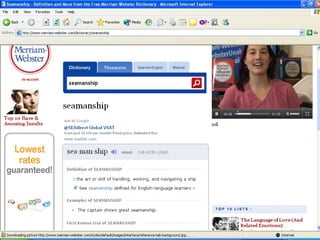
V. How to Use a Dictionary
VI. Tips in Using a Dictionary
3.
I. Definition
A dictionary,also referred to as a
lexicon, wordbook, or
vocabulary, is a collection of
words in one or more specific
languages, often listed
alphabetically, with usage
information, definitions,
etymologies, phonetics,
pronunciations, and other
information; or a book of words in
one language with their
equivalents in another, also
known as a lexicon. [Wikipedia]
4.
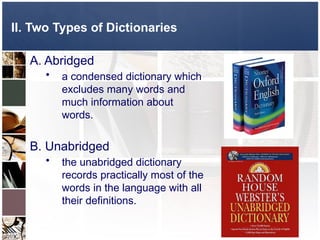
A. Abridged
• acondensed dictionary which
excludes many words and
much information about
words.
B. Unabridged
• the unabridged dictionary
records practically most of the
words in the language with all
their definitions.
II. Two Types of Dictionaries
5.
There are specialdictionaries confined to particular problems
of meaning and usage, and to other fields such as
science, music, literature, etc. Your acquaintance with
them will depend on your individual needs. Some
dictionaries of this type are:
a. Advanced Learner’s Dictionary of Management
b. Computer Dictionary
c. Blackwell's Dictionary of Nursing
d. Dictionary of Economic Terms
e. Management Dictionary
f. Marketing Dictionary
g. The Mariner’s Dictionary
III. Special Dictionaries
6.
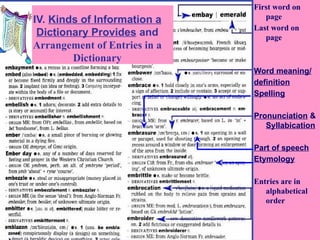
First word on
page
Lastword on
page
Word meaning/
definition
Spelling
Pronunciation &
Syllabication
Part of speech
Etymology
Entries are in
alphabetical
order
IV. Kinds of Information a
Dictionary Provides and
Arrangement of Entries in a
Dictionary
V. How toUse a Dictionary
1. Familiarize yourself with the
dictionary.
Dictionaries vary in approach. The
best way to learn how to use your particular
dictionary effectively is to read its
introductory section where you'll find out
how the entries are arranged.
Introductory section - explains important
information such as:
- the abbreviations
- pronunciation symbols used
throughout the entries.
9.
V. How toUse a Dictionary
2. Know how to look up a word.
When you come across a
word you don't recognize or know
the meaning of, keep a note of it.
When you get around to looking it
up, here is the sequence to follow:
10.
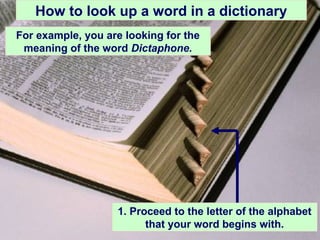
1. Proceed tothe letter of the alphabet
that your word begins with.
How to look up a word in a dictionary
For example, you are looking for the
meaning of the word Dictaphone.
11.
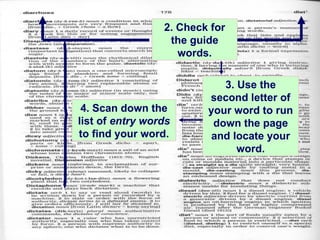
2. Check for
theguide
words.
3. Use the
second letter of
your word to run
down the page
and locate your
word.
4. Scan down the
list of entry words
to find your word.
12.
V. How toUse a Dictionary
4. Think about how the information you've found
relates to the word as you encountered it.
If there are multiple definitions, decide which one
matches your source or context for the word and notice how the
different definitions are related to one another.
13.
V. How toUse a Dictionary
5. Use your dictionary for other purposes than looking
up a word.
Many dictionaries come with an array of other useful
information. Some of the information that you might find in your
dictionary includes:
• Standard letters for jobs, RSVPs, filing complaints, official
writing, etc.
• Maps and geographical information.
• Statistics on population.
• Weights, volume and measurements.
• Lists of countries, cities, capitals, etc.
• Flags of countries, states, provinces, regions, etc.
• Lists of famous or historical people.
• Lists of facts.
14.
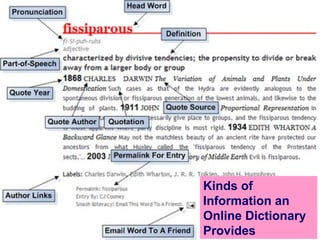
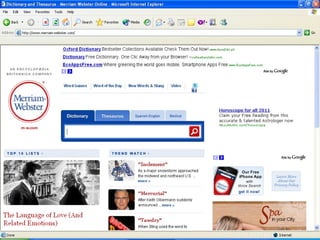
6. Learn howto use an online dictionary.
Choose a suitable free online dictionary, or a
subscription one if your place of work or study subscribes, and
simply type in the word you're looking for. The search engine will
return the word to you and the definition section should contain
most of the elements discussed above.
Note that free services may not be as comprehensive as a
subscription or book dictionary, so keep this in mind when you're
not sure that you've found the right answer.
• Make use of the audio content provided with online
dictionaries. This can help considerably when you're
unsure how to pronounce the word.
• To use Google to find online definitions, type: "define:
futile". The search engine will only look for definitions.
V. How to Use a Dictionary
19.
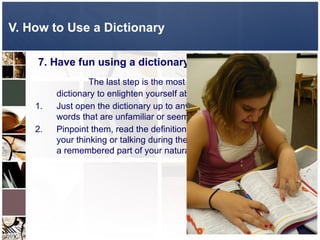
7. Have funusing a dictionary.
The last step is the most fun – simply browse a
dictionary to enlighten yourself about new words now and then.
1. Just open the dictionary up to any page and scan the page for
words that are unfamiliar or seem interesting.
2. Pinpoint them, read the definition and try to add the new word to
your thinking or talking during the next few days until it becomes
a remembered part of your natural vocabulary.
V. How to Use a Dictionary
20.
1. If youcan't seem to locate your word, make sure you're
spelling the word correctly.
For example, you won't find "isotope" if you're
looking in the A section, which you might be
tempted to do if, for example, your chemistry
teacher speaks with a bit of a southern accent!
2. If you're having trouble spelling a word, try the spell-
checker in a word processor and see what it
suggests.
3. Old dictionaries make excellent door stops or hollow
books.
VI. Tips in Using a Dictionary
21.
VI. Tips inUsing a Dictionary
4. Even though it's easy to check words using an online
dictionary, the free ones don't always provide enough
information, so it pays to always have a hard copy
dictionary on your bookshelf to call upon whenever
needed.
5. Don't be afraid to study the etymology of a word. Since
much of our language is derived from Greek or Latin,
you'll often find yourself learning root words from
them, but after you have, you'll find that it can be
easier to understand words that are new to you
simply by looking at the structure of the word.
22.
VI. Tips inUsing a Dictionary
6. Language is defined to a large degree by usage. You
can help keep a language alive by using more of it.
Try to occasionally use words that are "getting dusty"
either in written or verbal communication. English is
the closest thing to a universal language on Earth,
and it deserves a chance to thrive.
23.
VI. Tips inUsing a Dictionary
Warnings
• Printed dictionaries may go out of date as the
language changes, so check the copyright date of
yours.
• Dictionaries vary in content, and some are very
specific. Look at the title to find out what you have.
24.
References
• Book
Fernando, JovitaN., Pacita I. Habana, Alicia L. Cinco (1988).
College English for Today, Book 1. Mandaluyong City: National
Book Store.
• Electronic sources
How to Use a Dictionary. Retrieved February 1, 2011, from
http://www.wikihow.com/Use-a-Dictionary
Paul Shoebottom (1996-2011). How to Use a Dictionary
Effectively. Retrieved February 1, 2011, from
http://esl.fis.edu/learners/advice/dic.htm

![I. Definition
A dictionary, also referred to as a
lexicon, wordbook, or
vocabulary, is a collection of
words in one or more specific
languages, often listed
alphabetically, with usage
information, definitions,
etymologies, phonetics,
pronunciations, and other
information; or a book of words in
one language with their
equivalents in another, also
known as a lexicon. [Wikipedia]](https://image.slidesharecdn.com/english5pptq4-usingadictionary-250217065909-51f7412d/85/ENGLISH-5-PPT-Q4-Using-a-Dictionary-pptx-3-320.jpg)