Lorem ipsum dolor
• Subtítulo subtítulo
INTRODUCTION
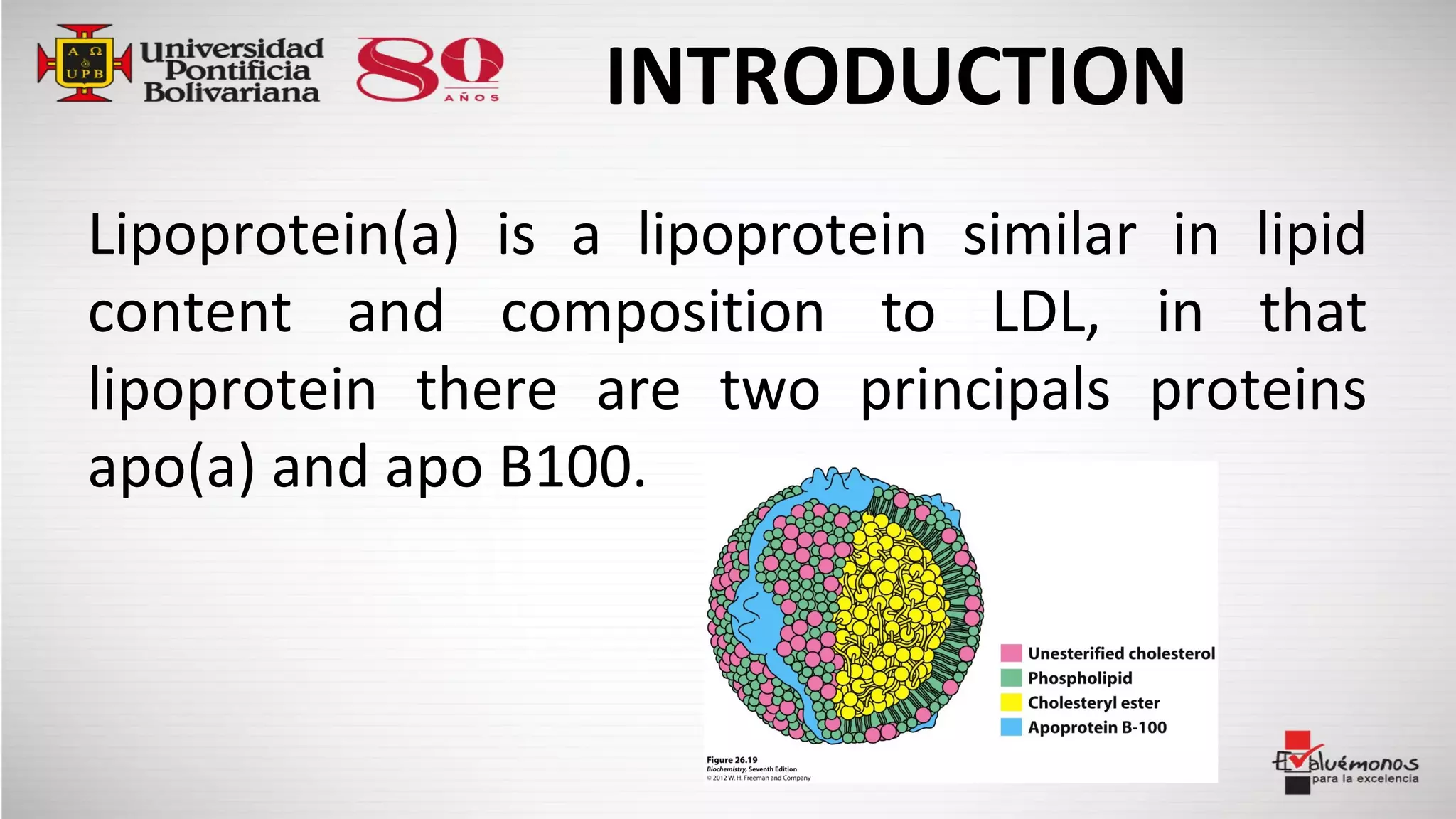
Lipoprotein(a) is a lipoprotein similar in lipid
content and composition to LDL, in that
lipoprotein there are two principals proteins
apo(a) and apo B100.
INTRODUCTION
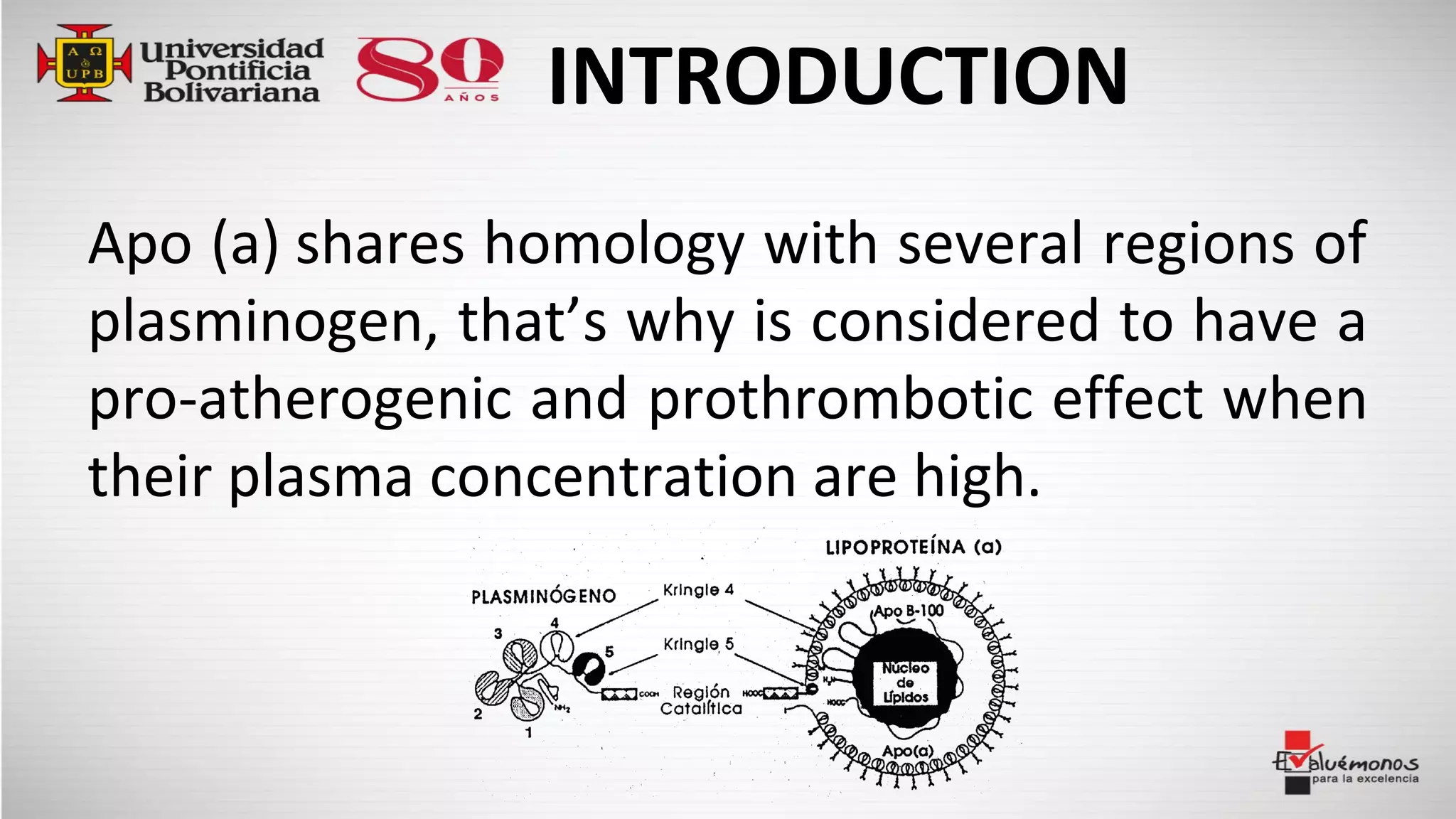
Apo (a) shares homology with several regions of
plasminogen, that’s why is considered to have a
pro-atherogenic and prothrombotic effect when
their plasma concentration are high.
INTRODUCTION
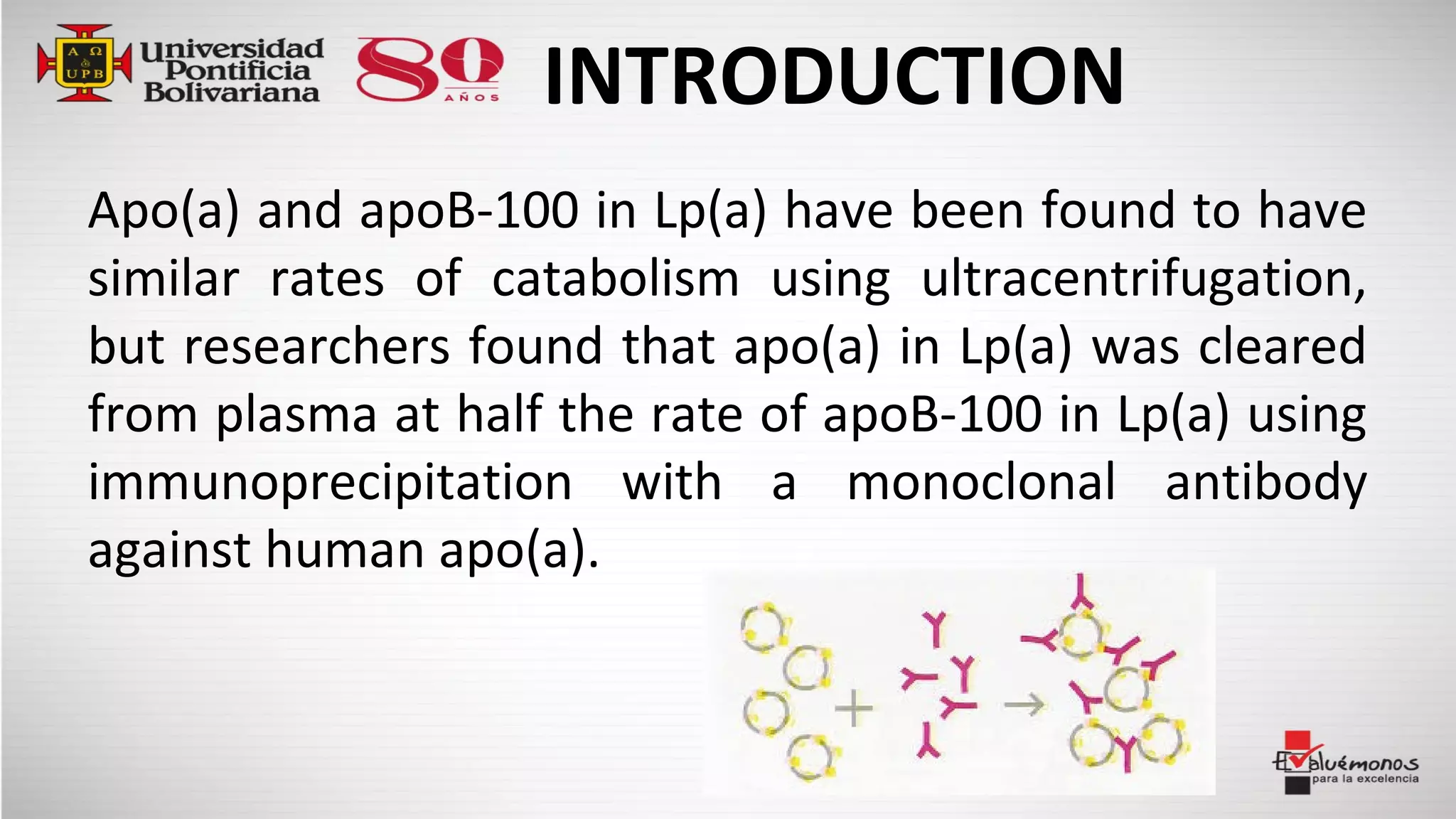
Apo(a) and apoB-100 in Lp(a) have been found to have
similar rates of catabolism using ultracentrifugation,
but researchers found that apo(a) in Lp(a) was cleared
from plasma at half the rate of apoB-100 in Lp(a) using
immunoprecipitation with a monoclonal antibody
against human apo(a).
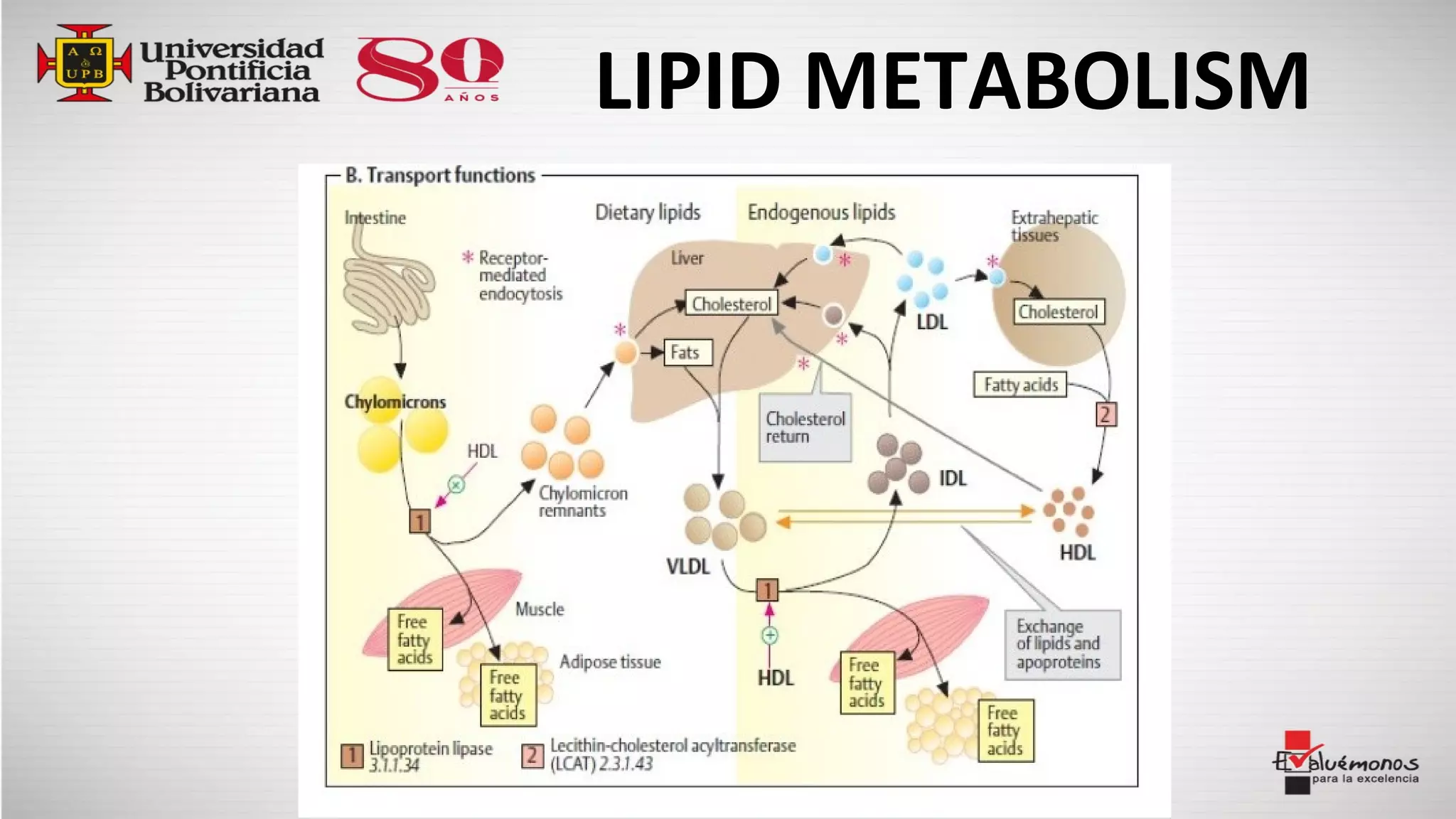
LIPID METABOLISM
LIPID METABOLISM
apoB-100 FUNCTION
Is the main structural
surface protein found
on all beta-lipoproteins
(Chylomicrons, VLDLs,
IDLs and LDLs)
apoB-100 FUNCTION
Responsible for carrying fat molecules
(lipids), including cholesterol, around the
body to all cells within all tissues.
LIPOPROTEIN(a)
FUNCTION
• Particles which contain triglycerides, cholesterol,
phospholipids and proteins, they are specialized in
lipid transport.
• Similar lipid content and composition of LDL but
different in having apolipoprotein (apo) (a)
covalently linked to apoB-100 by a disulfide bond
LIPOPROTEIN(a)
FUNCTION
Pro-atherogenic effect since the particle
preferentially accepts oxidized phospholipids from
LDL, leading to lipid deposition in the arterial intima
and, thereby, promoting multiple oxidative and
inflammatory actions
PLASMATIC LIPOPROTEIN
METABOLISM
PLASMATIC LIPOPROTEIN
METABOLISM
GENERAL OBJECTIVE
Examine the individual metabolism of apo(a)
and apoB-100 within plasma Lp(a).
MATERIALES
Y
MÉTODOS
Participantes 5(4)
Género Masculino (M)
Edad 52.8 ± 4.9
Índice de Masa
Corporal (IMC)
30.1 ± 1.7 kg/m2
CRITERIOS DE INCLUSIÒN
Lípidos plasmáticos
[ TG] ≥ 150 mg / dl
[Colesterol LDL] ≥ 130 mg / dl
[ Colesterol HDL ] <40 mg / dl
CRITERIOS DE EXCLUSIÒN
Edad < 40
Infarto de miocardio en los últimos
6 meses
Tabaquismo
Disfunción tiroides
Enfermedades del hígado y riñón
Cáncer de hígado
Diabetes Mellitus
Accidentes cerebrovasculares
Uso actual de medicamentos que afecta el
metabolismo de los lípidos
2500 rpm
4 ° C
30 min
0.15%
Antes de la infusion(0 h)
30, 35, 45 min 1, 1.5, 2, 3,
4, 6, 9, 12, 14,15 h
-80C
20 HORAS
Dieta especial
< 30% de calorías en forma de grasa total
< 7% de grasa saturada
< 200 mg/día de colesterol
Infusión constante de leucina deuterada 10 μmol/kg por hora
Dieta Especial
ELISA
Utilizada para identificar un
anticuerpo o un antígeno,
utilizando uno de estos dos, el cual,
es absorbido en una superficie
sólida. Se utiliza un conjugado anti-
gamaglobulina humana al que se le
une una fosfatasa o peroxidasa
para revelar al acción ag-ac.
ELISA
La enzima actúa y produce una solución
coloreada, la intensidad del color se determina
por espectofotometría y es DP a la cantidad de
anticuerpos o antígenos presentes.
ELISA
Se utilizó para:
•Determinar el contenido de Lp(a) y el tamaño
de la isoforma de apo(a)
•Determinar la concentración de apoB en el
plasma, VLDL y de IDL
SDS-PAGE
SDS-PAGE
Técnica que se utiliza para separar proteínas, en
esta técnica las proteínas se encuentran en una
solución disueltas con el detergente SDS
( cargado negativamente) y con la influencia de
un campo eléctrico migran según su tamaño
SDS-PAGE
El SDS transforma la estructura de la proteína,
pasándola a una cadena lineal y les transmite
una carga negativa, así la distribución es
uniforme de acuerdo a la carga, asegurando el
fraccionamiento por el tamaño
SDS-PAGE
En el estudio se hizo uso de está técnica para la
separación de la Apo (a) y apoB-100. Ya que los
investigadores querían comparar el
metabolismo individual de estas dos proteínas
presentes en la Lp (a).
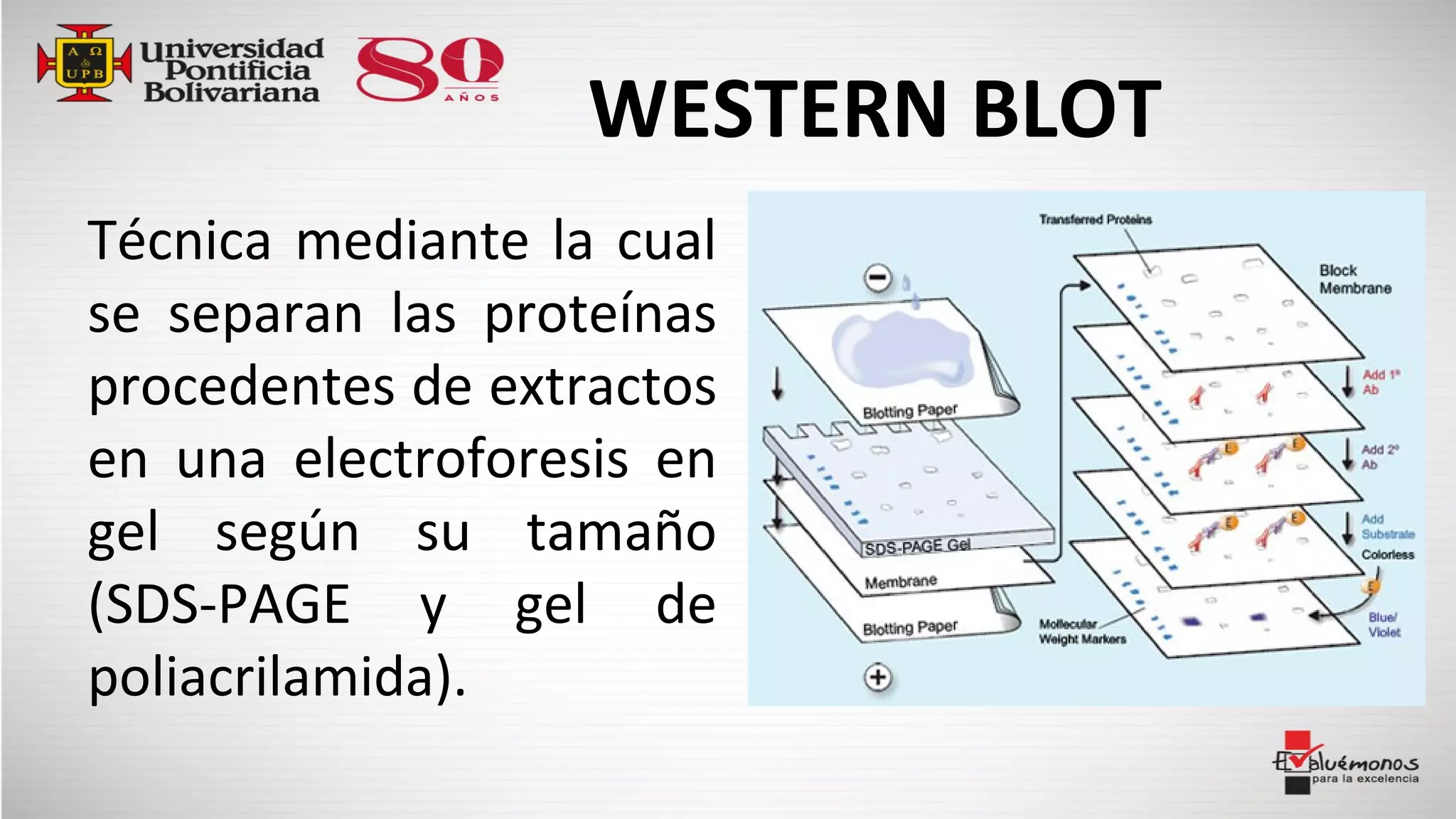
WESTERN BLOT
Técnica mediante la cual
se separan las proteínas
procedentes de extractos
en una electroforesis en
gel según su tamaño
(SDS-PAGE y gel de
poliacrilamida).
WESTERN BLOT
Las proteínas se disuelven en SDS (detergente
cargado negativamente), luego de la
electroforesis las proteínas se transfieren a un
filtro y se incuban con anticuerpos que
reaccionan con la la proteína de interés.
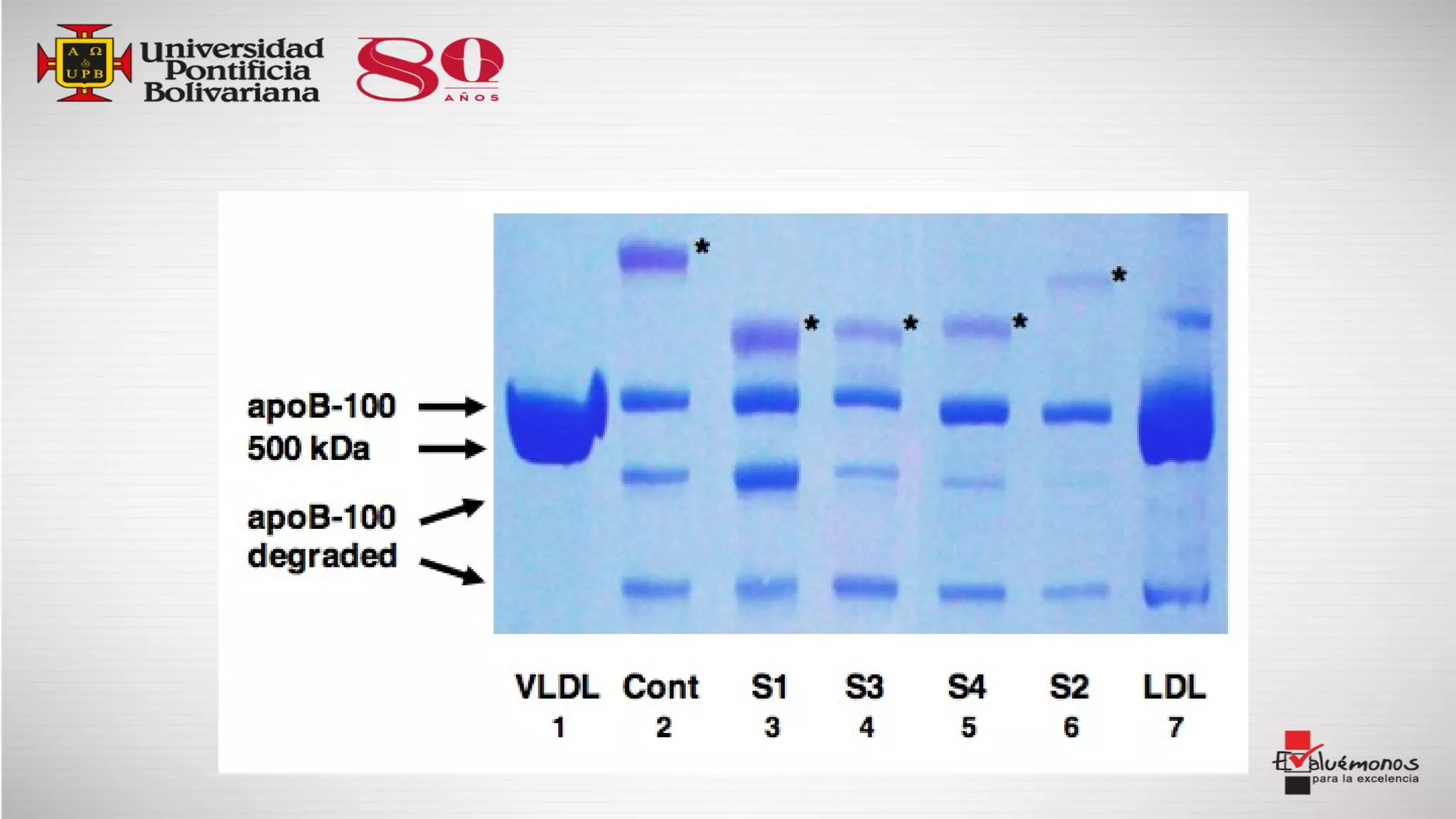
WESTERN BLOT
En el estudio se
utilizó para
confirmar la
ubicación de la
apoB-100
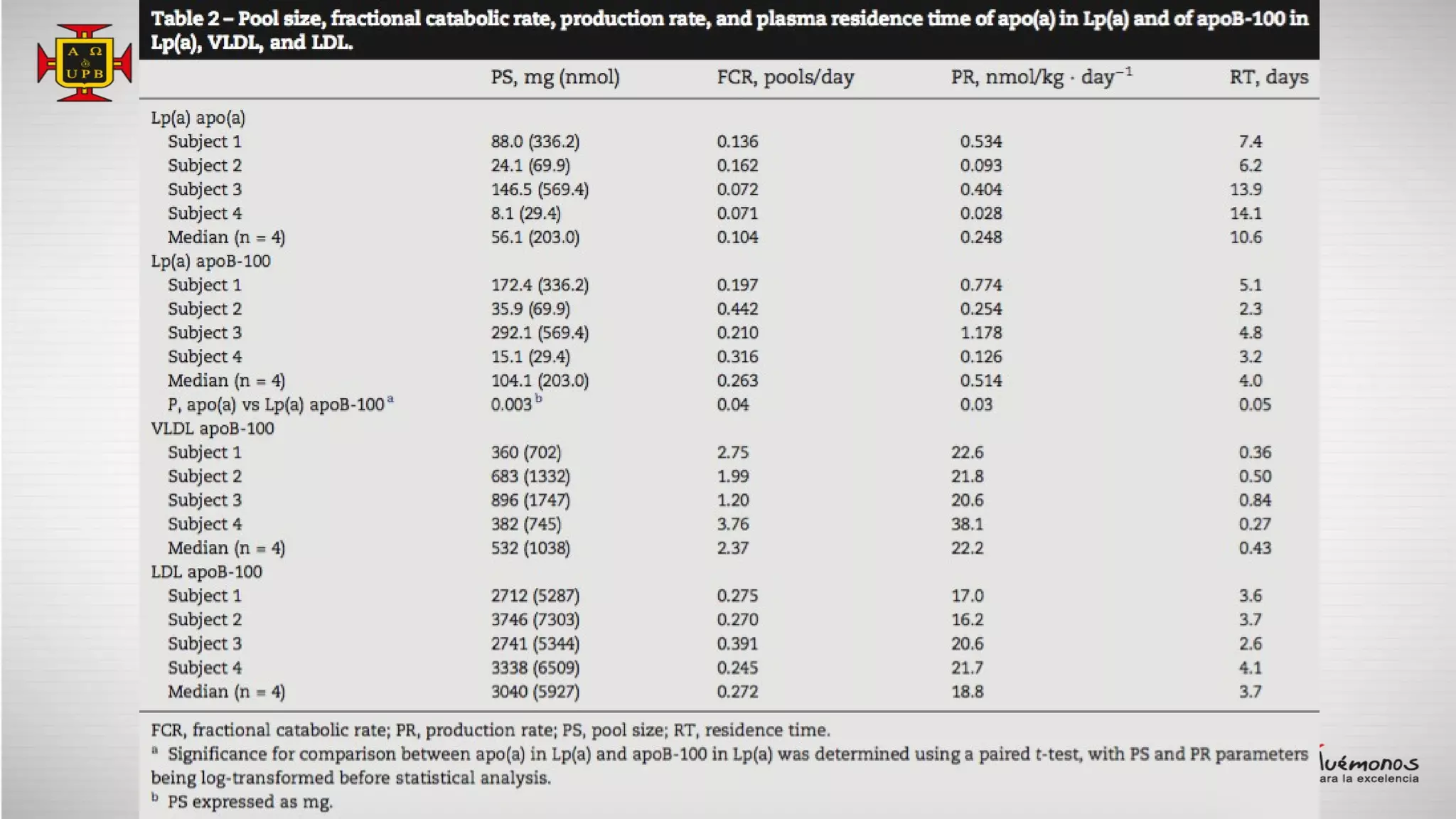
RESULTADOS
DISCUSION
AUTOR POSTULATE AGREE/DIS
AGREE
JL Jenner, LJ
Seman, JS Millar,
S. Lamon-Fava,
FK Welty, GG
Dolnikowski
S.Lamon-Fave,
MR Differenderfer
PHR Barrett, A.
Buchsbaum, NR
Matàn, AH
Lichtenstein
“In our earlier study, Lp(a) was isolated
from whole plasma, using lectin-
mediated affinity chromatography
without any ultracentrifugation”
“In the fed state, a substantial portion
of VLDL apoB-100 is not converted to
LDL apoB-100 but, rather, is removed
from circulation by the liver, especially
in hypertriglyceridemic subjects”
AGREE
AGREE
DISCUSION
AUTOR POSTULATE AGREE/DISAGREE
JDMorrisett, JW
Gaubatz,MN Nava, JR
Guyton, AS Hoffman, AR
Opekun
Rader DL, Cain W, Ikewaki
K, Talley G, Zech LA, Usher
D.
Krempler F, Kostner GM,
Bolzano K, Sandhofer F,
Roscher A, Haslauer F,
Brewer Jr HB.
“Our observation provides evidence that apo(a)
and apoB-100 within plasma Lp(a) are not
catabolized from the bloodstream as a unit in the
non-fasting state is inconsistent with other human
Lp(a) studies which reported similar rates of
catabolism for Lp(a) apo(a) and Lp(a) apoB-100”
“Early radioiodinated studies of human Lp(a)
production is the major determinant of Lp(a) levels
in fasting plasma, with the apo(a) PR being
inversely related to apo(a) isoform size“
AGREE
AGREE
CONCLUSIONS
The amount of people that researchers used was not enough,
they couldn't establish an association between plasma levels
and PR because it did not reach statistical significance. They
should have used a larger group of people.
CONCLUSIONS
They found that depending on the method that you use to
separate apo(a) and apoB-100 from Lp(a) there is going to
exist a substantial difference in the clearance, apo(a) was
cleared at half the rate of apoB-100. future researchers
should take this in consideration before choosing one or the
other in their articles
CONCLUSIONS
These studies allow us to recognize
the differences in blood lipids
metabolism in people with
dyslipidemia, leaving foundation
for future therapeutic studies.
CONCLUSIONS
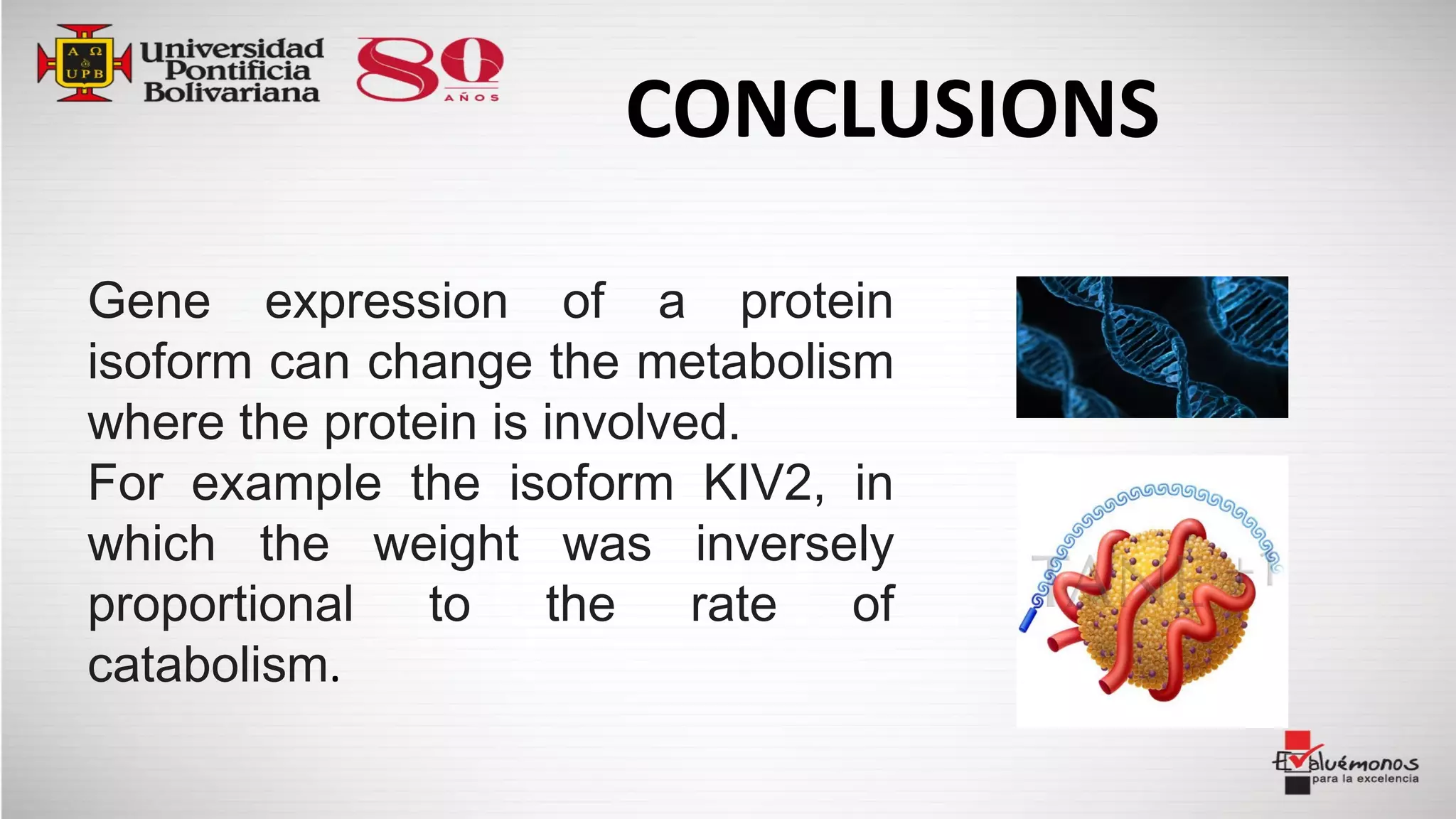
Gene expression of a protein
isoform can change the metabolism
where the protein is involved.
For example the isoform KIV2, in
which the weight was inversely
proportional to the rate of
catabolism.
MAPA CONCEPTUAL
¨
MAPA CONCEPTUAL
GRACIAS

Diapositivas seminario

  • 2.
    Lorem ipsum dolor •Subtítulo subtítulo
  • 3.
    INTRODUCTION Lipoprotein(a) is alipoprotein similar in lipid content and composition to LDL, in that lipoprotein there are two principals proteins apo(a) and apo B100.
  • 4.
    INTRODUCTION Apo (a) shareshomology with several regions of plasminogen, that’s why is considered to have a pro-atherogenic and prothrombotic effect when their plasma concentration are high.
  • 5.
    INTRODUCTION Apo(a) and apoB-100in Lp(a) have been found to have similar rates of catabolism using ultracentrifugation, but researchers found that apo(a) in Lp(a) was cleared from plasma at half the rate of apoB-100 in Lp(a) using immunoprecipitation with a monoclonal antibody against human apo(a).
  • 6.
  • 7.
  • 8.
    apoB-100 FUNCTION Is themain structural surface protein found on all beta-lipoproteins (Chylomicrons, VLDLs, IDLs and LDLs)
  • 9.
    apoB-100 FUNCTION Responsible forcarrying fat molecules (lipids), including cholesterol, around the body to all cells within all tissues.
  • 10.
    LIPOPROTEIN(a) FUNCTION • Particles whichcontain triglycerides, cholesterol, phospholipids and proteins, they are specialized in lipid transport. • Similar lipid content and composition of LDL but different in having apolipoprotein (apo) (a) covalently linked to apoB-100 by a disulfide bond
  • 11.
    LIPOPROTEIN(a) FUNCTION Pro-atherogenic effect sincethe particle preferentially accepts oxidized phospholipids from LDL, leading to lipid deposition in the arterial intima and, thereby, promoting multiple oxidative and inflammatory actions
  • 12.
  • 13.
  • 14.
    GENERAL OBJECTIVE Examine theindividual metabolism of apo(a) and apoB-100 within plasma Lp(a).
  • 15.
  • 16.
    Participantes 5(4) Género Masculino(M) Edad 52.8 ± 4.9 Índice de Masa Corporal (IMC) 30.1 ± 1.7 kg/m2 CRITERIOS DE INCLUSIÒN Lípidos plasmáticos [ TG] ≥ 150 mg / dl [Colesterol LDL] ≥ 130 mg / dl [ Colesterol HDL ] <40 mg / dl CRITERIOS DE EXCLUSIÒN Edad < 40 Infarto de miocardio en los últimos 6 meses Tabaquismo Disfunción tiroides Enfermedades del hígado y riñón Cáncer de hígado Diabetes Mellitus Accidentes cerebrovasculares Uso actual de medicamentos que afecta el metabolismo de los lípidos
  • 17.
    2500 rpm 4 °C 30 min 0.15% Antes de la infusion(0 h) 30, 35, 45 min 1, 1.5, 2, 3, 4, 6, 9, 12, 14,15 h -80C 20 HORAS Dieta especial < 30% de calorías en forma de grasa total < 7% de grasa saturada < 200 mg/día de colesterol Infusión constante de leucina deuterada 10 μmol/kg por hora Dieta Especial
  • 18.
    ELISA Utilizada para identificarun anticuerpo o un antígeno, utilizando uno de estos dos, el cual, es absorbido en una superficie sólida. Se utiliza un conjugado anti- gamaglobulina humana al que se le une una fosfatasa o peroxidasa para revelar al acción ag-ac.
  • 19.
    ELISA La enzima actúay produce una solución coloreada, la intensidad del color se determina por espectofotometría y es DP a la cantidad de anticuerpos o antígenos presentes.
  • 20.
    ELISA Se utilizó para: •Determinarel contenido de Lp(a) y el tamaño de la isoforma de apo(a) •Determinar la concentración de apoB en el plasma, VLDL y de IDL
  • 21.
  • 22.
    SDS-PAGE Técnica que seutiliza para separar proteínas, en esta técnica las proteínas se encuentran en una solución disueltas con el detergente SDS ( cargado negativamente) y con la influencia de un campo eléctrico migran según su tamaño
  • 23.
    SDS-PAGE El SDS transformala estructura de la proteína, pasándola a una cadena lineal y les transmite una carga negativa, así la distribución es uniforme de acuerdo a la carga, asegurando el fraccionamiento por el tamaño
  • 24.
    SDS-PAGE En el estudiose hizo uso de está técnica para la separación de la Apo (a) y apoB-100. Ya que los investigadores querían comparar el metabolismo individual de estas dos proteínas presentes en la Lp (a).
  • 25.
    WESTERN BLOT Técnica mediantela cual se separan las proteínas procedentes de extractos en una electroforesis en gel según su tamaño (SDS-PAGE y gel de poliacrilamida).
  • 26.
    WESTERN BLOT Las proteínasse disuelven en SDS (detergente cargado negativamente), luego de la electroforesis las proteínas se transfieren a un filtro y se incuban con anticuerpos que reaccionan con la la proteína de interés.
  • 27.
    WESTERN BLOT En elestudio se utilizó para confirmar la ubicación de la apoB-100
  • 28.
  • 32.
    DISCUSION AUTOR POSTULATE AGREE/DIS AGREE JLJenner, LJ Seman, JS Millar, S. Lamon-Fava, FK Welty, GG Dolnikowski S.Lamon-Fave, MR Differenderfer PHR Barrett, A. Buchsbaum, NR Matàn, AH Lichtenstein “In our earlier study, Lp(a) was isolated from whole plasma, using lectin- mediated affinity chromatography without any ultracentrifugation” “In the fed state, a substantial portion of VLDL apoB-100 is not converted to LDL apoB-100 but, rather, is removed from circulation by the liver, especially in hypertriglyceridemic subjects” AGREE AGREE
  • 33.
    DISCUSION AUTOR POSTULATE AGREE/DISAGREE JDMorrisett,JW Gaubatz,MN Nava, JR Guyton, AS Hoffman, AR Opekun Rader DL, Cain W, Ikewaki K, Talley G, Zech LA, Usher D. Krempler F, Kostner GM, Bolzano K, Sandhofer F, Roscher A, Haslauer F, Brewer Jr HB. “Our observation provides evidence that apo(a) and apoB-100 within plasma Lp(a) are not catabolized from the bloodstream as a unit in the non-fasting state is inconsistent with other human Lp(a) studies which reported similar rates of catabolism for Lp(a) apo(a) and Lp(a) apoB-100” “Early radioiodinated studies of human Lp(a) production is the major determinant of Lp(a) levels in fasting plasma, with the apo(a) PR being inversely related to apo(a) isoform size“ AGREE AGREE
  • 34.
    CONCLUSIONS The amount ofpeople that researchers used was not enough, they couldn't establish an association between plasma levels and PR because it did not reach statistical significance. They should have used a larger group of people.
  • 35.
    CONCLUSIONS They found thatdepending on the method that you use to separate apo(a) and apoB-100 from Lp(a) there is going to exist a substantial difference in the clearance, apo(a) was cleared at half the rate of apoB-100. future researchers should take this in consideration before choosing one or the other in their articles
  • 36.
    CONCLUSIONS These studies allowus to recognize the differences in blood lipids metabolism in people with dyslipidemia, leaving foundation for future therapeutic studies.
  • 37.
    CONCLUSIONS Gene expression ofa protein isoform can change the metabolism where the protein is involved. For example the isoform KIV2, in which the weight was inversely proportional to the rate of catabolism.
  • 38.
  • 39.
  • 40.