Dial Calipers
(Vernier)
Dial Calipers
General Information
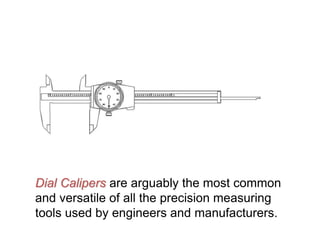
Dial Calipers are arguably the most common
and versatile of all the precision measuring
tools used by engineers and manufacturers.
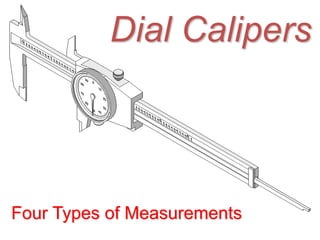
Four Types of Measurements
Dial Calipers
Dial calipers are used to perform four common
measurements on parts…
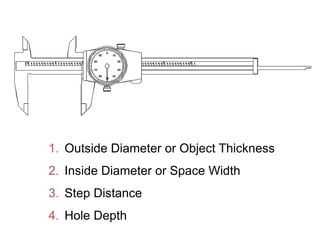
1. Outside Diameter or Object Thickness
2. Inside Diameter or Space Width
3. Step Distance
4. Hole Depth
Outside Measuring Faces
These are the faces between which outside
length or diameter is measured.
Example: Outside Diameter of object
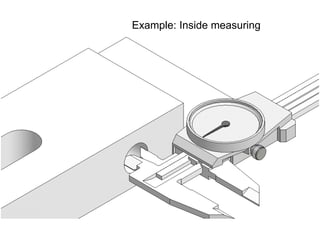
Inside Measuring Faces
These are the faces between which inside
diameter or space width (i.e., slot width) is
measured.
Example: Inside measuring
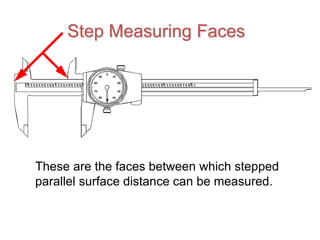
Step Measuring Faces
These are the faces between which stepped
parallel surface distance can be measured.
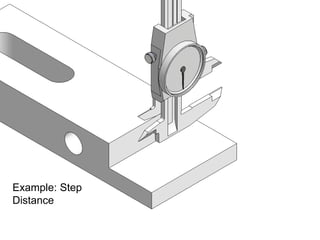
Example: Step
Distance
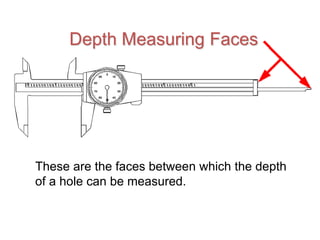
Depth Measuring Faces
These are the faces between which the depth
of a hole can be measured.
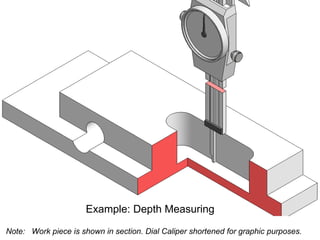
Note: Work piece is shown in section. Dial Caliper shortened for graphic purposes.
Example: Depth Measuring
Nomenclature
Dial Calipers
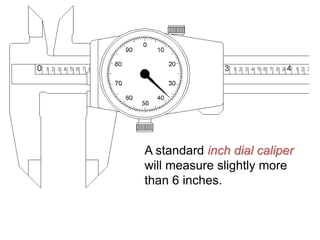
A standard inch dial caliper
will measure slightly more
than 6 inches.
The blade scale shows each inch divided into
10 increments. Each increment equals one
hundred thousandths (0.100”).
Blade
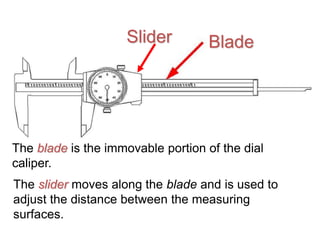
The blade is the immovable portion of the dial
caliper.
The slider moves along the blade and is used to
adjust the distance between the measuring
surfaces.
Slider
Pointer
The pointer rotates within the
dial as the slider moves back-
and-forth along the blade.
Reference Edge
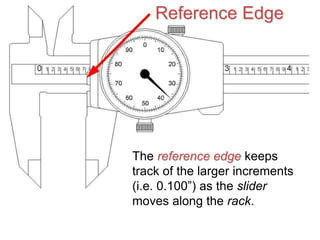
The reference edge keeps
track of the larger increments
(i.e. 0.100”) as the slider
moves along the rack.
Rack
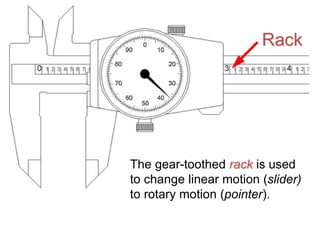
The gear-toothed rack is used
to change linear motion (slider)
to rotary motion (pointer).
Reading the Inch Dial Caliper
Dial Calipers
The dial is divided 100 times, with each graduation
equaling one thousandth of an inch (0.001”).
Every time the pointer completes one rotation, the
reference edge on the slider will have moved the
distance of one blade scale increment (0.100”).
To determine the outside diameter of this pipe section,
the user must first identify how many inches are being
shown on the blade scale.
The reference edge is located between the 1 and 2 inch marks.
So, the user makes a mental note…1 inch.
1.000”
0.400”
The user then identifies how many 0.1” increment marks are
showing to the right of the last inch mark.
In this case, there are 4…or 0.400”.
Next, the user looks at the pointer on the dial to see
how many thousandths it is pointing to.
In this case, it is pointing to 37…or 0.037”.
1.000”
0.400”
0.037”
The user then adds the three
values together…
+
1.437”
How wide is the block?
1.000”
0.400”
0.002”
+
1.402”
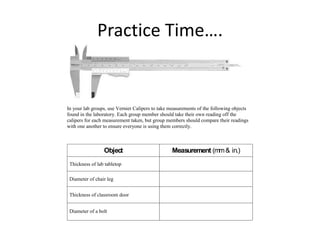
Practice Time….
In your lab groups, use Vernier Calipers to take measurements of the following objects
found in the laboratory. Each group member should take their own reading off the
calipers for each measurement taken, but group members should compare their readings
with one another to ensure everyone is using them correctly.
Object Measurement (mm& in.)
Thickness of lab tabletop
Diameter of chair leg
Thickness of classroom door
Diameter of a bolt

dial caliper.pptx

  • 1.
  • 2.
  • 3.
    Dial Calipers arearguably the most common and versatile of all the precision measuring tools used by engineers and manufacturers.
  • 4.
    Four Types ofMeasurements Dial Calipers
  • 5.
    Dial calipers areused to perform four common measurements on parts…
  • 6.
    1. Outside Diameteror Object Thickness 2. Inside Diameter or Space Width 3. Step Distance 4. Hole Depth
  • 7.
    Outside Measuring Faces Theseare the faces between which outside length or diameter is measured.
  • 8.
  • 9.
    Inside Measuring Faces Theseare the faces between which inside diameter or space width (i.e., slot width) is measured.
  • 10.
  • 11.
    Step Measuring Faces Theseare the faces between which stepped parallel surface distance can be measured.
  • 12.
  • 13.
    Depth Measuring Faces Theseare the faces between which the depth of a hole can be measured.
  • 14.
    Note: Work pieceis shown in section. Dial Caliper shortened for graphic purposes. Example: Depth Measuring
  • 15.
  • 16.
    A standard inchdial caliper will measure slightly more than 6 inches.
  • 17.
    The blade scaleshows each inch divided into 10 increments. Each increment equals one hundred thousandths (0.100”).
  • 18.
    Blade The blade isthe immovable portion of the dial caliper. The slider moves along the blade and is used to adjust the distance between the measuring surfaces. Slider
  • 19.
    Pointer The pointer rotateswithin the dial as the slider moves back- and-forth along the blade.
  • 20.
    Reference Edge The referenceedge keeps track of the larger increments (i.e. 0.100”) as the slider moves along the rack.
  • 21.
    Rack The gear-toothed rackis used to change linear motion (slider) to rotary motion (pointer).
  • 22.
    Reading the InchDial Caliper Dial Calipers
  • 23.
    The dial isdivided 100 times, with each graduation equaling one thousandth of an inch (0.001”).
  • 24.
    Every time thepointer completes one rotation, the reference edge on the slider will have moved the distance of one blade scale increment (0.100”).
  • 25.
    To determine theoutside diameter of this pipe section, the user must first identify how many inches are being shown on the blade scale.
  • 26.
    The reference edgeis located between the 1 and 2 inch marks. So, the user makes a mental note…1 inch. 1.000” 0.400” The user then identifies how many 0.1” increment marks are showing to the right of the last inch mark. In this case, there are 4…or 0.400”.
  • 27.
    Next, the userlooks at the pointer on the dial to see how many thousandths it is pointing to. In this case, it is pointing to 37…or 0.037”. 1.000” 0.400” 0.037” The user then adds the three values together… + 1.437”
  • 28.
    How wide isthe block? 1.000” 0.400” 0.002” + 1.402”
  • 29.
    Practice Time…. In yourlab groups, use Vernier Calipers to take measurements of the following objects found in the laboratory. Each group member should take their own reading off the calipers for each measurement taken, but group members should compare their readings with one another to ensure everyone is using them correctly. Object Measurement (mm& in.) Thickness of lab tabletop Diameter of chair leg Thickness of classroom door Diameter of a bolt

Editor's Notes

  • #4 Regardless of what type of caliper you use, be sure to take the following precautions to avoid damaging the caliper: 1. Wash your hands before you handle the dial caliper to remove dirt and oils that might damage the caliper. 2. Wipe the caliper components clean both before and after you use the caliper. 3. Do NOT drop or otherwise mishandle the caliper. Doing so may damage or destroy the caliper.
  • #5 At the conclusion of this presentation, you will be able to… identify four types of measurements that dial calipers can perform. identify the different parts of a dial caliper. accurately read an inch dial caliper.
  • #14 Project Lead The Way, Inc. Copyright 2007
  • #30 Correct dimensions: Overall outside dimension: 4.724 in. Thickness: 0.047 in. Spindle hole diameter: 0.590 in