DIABETIC PERIPHERAL
NEUROPATHY
Dr N.PRABAKARAN
Objectives
• Definition
• Risk factors
• Pathogenesis
• Classification
• Test
• Management
• Conclusion
55 year old gentleman who is a known patient with type 2 diabetes for 15
years presented with a history of inability to sleep at night due to persistent
pricking sensation of both his feet which was worrying for 6 months. On
examination , his feet were normal , monofilament recorded 10g in both
feet and biothesiometer read 40 volts bilaterally. Both fundi showed severe
non proliferative diabetic retinopathy. Systemic examination was normal .
He has been on glibenclamide 10mg twice daily and metformin 1g thrice
daily . His HbA1C was more than 12%.All of the following are true except:
• A . Peripheral neuropathy is an indication to start him on insulin.
• B. Best option is to add another oral hypoglycemic agent for better control
of his sugars.
• C. Microcellular rubber footwear should be ideally prescribed for his
neuropathy.
• D.He might require long term insulin therapy.
• E. Severe NPDR is an indication for insulin therapy.
DEFINITION
• Peripheral neuropathy is defined as presence of symptoms and /or
signs of peripheral nerve dysfunction in people with diabetes.
• Most common symptomatic complication of diabetes.
• It is characterized by a decline and damage of nerve function leading
to loss of sensation,ulceration and subsequent amputation.
Risk factors
• Poor glucose control
• Long duration of diabetes
• Damage to blood vessels
• Autoimmune factors
• Genetic susceptibility
• Lifestyle factors:
Alcohol , smoking , low HDL , cardiovascular disease.
Pathogenesis
Metabolic hypothesis:
Persistant hyperglycemia and insulin deficiency  alteration in
sorbitol pathway  increased advanced glycosylated end product
formation  increased oxidative stress  nerve dysfunction.
Immune hypothesis:
Autoantigen that induce immune response APLA,antibodies to
gangliosides
Microvascular hypothesis:
Impaired vasoconstriction and vasodilatation absolute/relative
ischemia in nerve
Neurotrophic hypothesis:
NFG,neurotrophin 3,4/5,IFG-1 are necessary for survival of neuron are
deficient in hyperglycemic individuals
Oxidative stress hypothesis:
Hyperglyemia increased free radical formationendothelial cell
dysfunction and neurotoxic effectnerve damage.
Classification
Symmetric polyneuropathies
-Sensory or sensorimotor polyneuropathy
-Selective small fiber polyneuropathy
-Autonomic neuropathy
Focal and multifocal neuropathies
-Cranial neuropathy
-Limb mononeuropathy
-Trunk mononeuropathy
-Mononeuropathy multiplex
-Asymmetric lower limb motor neuropathy
Distal symmetric polyneuropathy
Cranial neuropathies
• EOM- diabetic>non diabetic
• >50yrs,abrupt,painless a/w headache
• 3rd
cranial nerve(sparing pupil) –mc
• 4th
cranial nerve –least common
• 6th
cranial nerve-may be involved with other CN.
• Facial palsy in diabetes-relationship uncertain
• No specific treatment, gradual recovery typically occurs.
Limb Mononeuropathies
Compression and entrapment neuropathy
• Slowly developing lesion---pain+weakness
• Incidence diabetic=nondiabetic
• Median nerve (carpal tunnel syndrome)-mc
• Symptomatic carpal tunnel 11%in T1DM,6%T2DM
• Asymptomatic carpal tunnel much more common
• Ulnar neuropathy at elbow occurs as well.
• Treatment empirical,conservative or surgical
Nerve infarctions
• Abrupt and painful
• Radial nerve result in wrist drop
• Peroneal nerve-foot drop
• Femoral nerve-quadriceps weakness
• Lateral femoral cutaneous nerve-meralgia paresthetica
• Electrodiagnostic test reveals axon loss
• Recovery takes month to years depend on the extent of axon loss and
site(proximal vs distal)
• Distal muscle recovery is often incompletely
• No specific treatment for limb mononeuropathy
• If multiple nerves are affected it result in mononeuropathy multiplex
• Immunomodulating therapy advocated for mononeuropathy multiplex
Truncal Mononeuropathy
• Pain around abdomen or lower chest
• Cutaneous hyperesthesia
• Restricted form of diabetic radiculopathy
• Paraspinal muscle denervation on EMG
• Once structural abnormalities are ruled out
• Treatment –pain management
• Gradual improvement generally occurs.
Asymmetric lower limb motor neuropathy
• Type 2DM,male >50 yrs,weight loss
• Pain in lower thoracic and upper lumbar nerve roots.
• Pain worst at onset and gradually subsides.
• Paresthesia and hyperesthesia are common
• Painweakness in upper leg
• o/e L2-L4 distribution weakness seen
• Weakness involves iliopsoas,quadriceps,adductor
sparing hip extensors and hamstrings.
• Weakness usually unilateral or bilateral,when bilateral it is frequently
asymmetric
• Sensory loss is mild mainly in distal
• Knee/ankle jerks are absent in most patients
• Progression of sign and symptom varies it can be as short as 1-2 weeks or
as long as year or more
• Most patient –improvement of pain or dysesthesia
• Recovery of motor function is often incomplete ,slower,takes up to 18
months
• Etiology is microscopic vasculitis producing nerve ischemia,with multifocal
involvement of lumbosacral roots,plexus and peripheral nerve ,hence it is
termed as diabetic lumbosacral radiculoplexus neuropathy.
• Treatment – controlling diabetes.
Chronic inflammatory demyelinating
polyneuropathy
• It is acquired immune mediated inflammatory disorder of PNS
• It is chronically progressive or relapsing symmetric sensorimotor
disorder with cytoalbuminologic dissociation and interstitial and
perivascular endoneurial infiltration by lymphocytes and
macrophages.
• It is considered to be chronic variant of AIDP ,the most common form
of guillian barre syndrome.
• These patient present with limb weakness(proximal and distal) which
is often proceded by infective illness.
• A proportion of patient also have sensory and autonomic dysfunction
• CIDP must be treated to prevent accumulating disability that
nescessitates physical and occupational therapy,orthotic devices and
long term treatment
• Main stay of treatment is immunosuppressive or immunomodulatory
intervention.
Treatment induced neuropathy in diabetes
• Acute onset of neuropathic pain and/or autonomic dysfunction within 8 weeks
of large improvement in glycemic control specified as decrease in more than 2%
HbA1C over 3 months.
• Poor glucose control and rapid treatment of hyperglycemia can be associated
with increased risk of neuropathy
• Insulin neuritis was considered rare cause for acute neuropathy
• It is most common in T1DM treated with insulin,but it can occur in any type
where there is rapid correction either with insulin or OHAs.
• Hemodynamic changes (AV shunting) resulting in endoneurial hypoxia of small
fibers.
• Symptoms are less responsive to opioids.
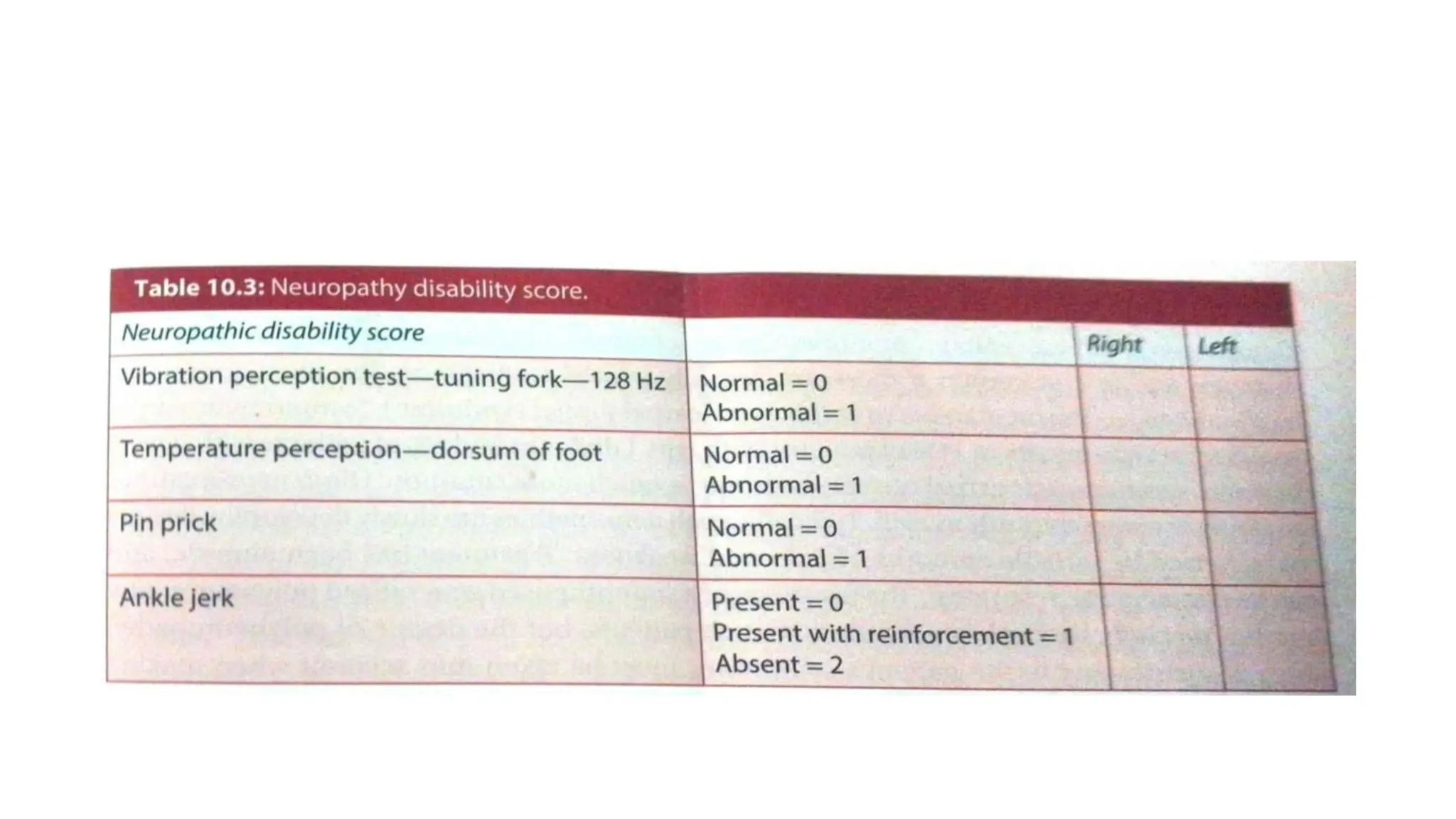
Assessment
Management
Small fiber neuropathy
Daily foot inspection
Microcellular rubber footwear
Shoe should fit well
Avoid exposure to heat
Creams for skin drying and cracking
After bathing feet should be dried
Nails should be cut transversely
Large fiber neuropathy
• Gait and strength training-
Diabetic patient with large fiber neuropathy have increased
predisposition to falls due to ataxia,incoordination,weakness and
muscle wasting.Improving muscle strength by high intensity strength
training,coordination and balance
• Microcellular rubber foorwear
Management aimed at symptoms
Superficial pain
• Tricyclic antidepressant-C/I CVD,BPH,Narrow angle glaucoma
s/e anticholinergic effect,orthostatic hypotension,ED limit it usage.
• Anticonvulsants-except phenytoin
• Carbamazepine,gabapentin,pregabalin
• Topiramate –shows promising results causes growth of intraepidermal
nerve fiber used at dose of 25-50mg/day
• SSRI and SNRI –Fluoxetine<Duloxetine
• Deep seated pain
• Opioid derivatives-tramadol+paracetamol
• Transcutaneous electrical nerve stimulation
• Local application of capsaicin oinment
Nonpharmacological treatment
• TENS
• Electrical spinal cord stimulation
• Percutaneous electrical nerve stimulation
• Magnetic field therapy
• Low intensity laser therapy
• Monochromatic near infrared treatment
• Electroacupuncture
• Exercise
• Psychological therapy
Conclusion
• Important complication of uncontrolled hyperglycemia
• DPN is common and costly disease
• Weight loss and exercise are helpful in both diabetic and prediabetic
• Prevention of ulcers and falls
• Educating patient about MCR footwear,periodic foot examinations
and intensive podiatric care
• Primary prevention start with fall risk assessment,education,referral
to physical therapy
Reference
• Harrison's Principles of Internal Medicine, 21e
• A Practical guide to diabetes mellitus
• www.uptodate.com/diabetic-neuropathy

DIABETIS MELLITUS PERIPHERAL NEUROPATHY.pptx

  • 1.
  • 2.
    Objectives • Definition • Riskfactors • Pathogenesis • Classification • Test • Management • Conclusion
  • 3.
    55 year oldgentleman who is a known patient with type 2 diabetes for 15 years presented with a history of inability to sleep at night due to persistent pricking sensation of both his feet which was worrying for 6 months. On examination , his feet were normal , monofilament recorded 10g in both feet and biothesiometer read 40 volts bilaterally. Both fundi showed severe non proliferative diabetic retinopathy. Systemic examination was normal . He has been on glibenclamide 10mg twice daily and metformin 1g thrice daily . His HbA1C was more than 12%.All of the following are true except: • A . Peripheral neuropathy is an indication to start him on insulin. • B. Best option is to add another oral hypoglycemic agent for better control of his sugars. • C. Microcellular rubber footwear should be ideally prescribed for his neuropathy. • D.He might require long term insulin therapy. • E. Severe NPDR is an indication for insulin therapy.
  • 4.
    DEFINITION • Peripheral neuropathyis defined as presence of symptoms and /or signs of peripheral nerve dysfunction in people with diabetes. • Most common symptomatic complication of diabetes. • It is characterized by a decline and damage of nerve function leading to loss of sensation,ulceration and subsequent amputation.
  • 5.
    Risk factors • Poorglucose control • Long duration of diabetes • Damage to blood vessels • Autoimmune factors • Genetic susceptibility • Lifestyle factors: Alcohol , smoking , low HDL , cardiovascular disease.
  • 6.
    Pathogenesis Metabolic hypothesis: Persistant hyperglycemiaand insulin deficiency  alteration in sorbitol pathway  increased advanced glycosylated end product formation  increased oxidative stress  nerve dysfunction. Immune hypothesis: Autoantigen that induce immune response APLA,antibodies to gangliosides
  • 7.
    Microvascular hypothesis: Impaired vasoconstrictionand vasodilatation absolute/relative ischemia in nerve Neurotrophic hypothesis: NFG,neurotrophin 3,4/5,IFG-1 are necessary for survival of neuron are deficient in hyperglycemic individuals Oxidative stress hypothesis: Hyperglyemia increased free radical formationendothelial cell dysfunction and neurotoxic effectnerve damage.
  • 8.
    Classification Symmetric polyneuropathies -Sensory orsensorimotor polyneuropathy -Selective small fiber polyneuropathy -Autonomic neuropathy Focal and multifocal neuropathies -Cranial neuropathy -Limb mononeuropathy -Trunk mononeuropathy -Mononeuropathy multiplex -Asymmetric lower limb motor neuropathy
  • 9.
  • 10.
    Cranial neuropathies • EOM-diabetic>non diabetic • >50yrs,abrupt,painless a/w headache • 3rd cranial nerve(sparing pupil) –mc • 4th cranial nerve –least common • 6th cranial nerve-may be involved with other CN. • Facial palsy in diabetes-relationship uncertain • No specific treatment, gradual recovery typically occurs.
  • 11.
    Limb Mononeuropathies Compression andentrapment neuropathy • Slowly developing lesion---pain+weakness • Incidence diabetic=nondiabetic • Median nerve (carpal tunnel syndrome)-mc • Symptomatic carpal tunnel 11%in T1DM,6%T2DM • Asymptomatic carpal tunnel much more common • Ulnar neuropathy at elbow occurs as well. • Treatment empirical,conservative or surgical
  • 12.
    Nerve infarctions • Abruptand painful • Radial nerve result in wrist drop • Peroneal nerve-foot drop • Femoral nerve-quadriceps weakness • Lateral femoral cutaneous nerve-meralgia paresthetica • Electrodiagnostic test reveals axon loss • Recovery takes month to years depend on the extent of axon loss and site(proximal vs distal) • Distal muscle recovery is often incompletely • No specific treatment for limb mononeuropathy • If multiple nerves are affected it result in mononeuropathy multiplex • Immunomodulating therapy advocated for mononeuropathy multiplex
  • 13.
    Truncal Mononeuropathy • Painaround abdomen or lower chest • Cutaneous hyperesthesia • Restricted form of diabetic radiculopathy • Paraspinal muscle denervation on EMG • Once structural abnormalities are ruled out • Treatment –pain management • Gradual improvement generally occurs.
  • 14.
    Asymmetric lower limbmotor neuropathy • Type 2DM,male >50 yrs,weight loss • Pain in lower thoracic and upper lumbar nerve roots. • Pain worst at onset and gradually subsides. • Paresthesia and hyperesthesia are common • Painweakness in upper leg • o/e L2-L4 distribution weakness seen • Weakness involves iliopsoas,quadriceps,adductor sparing hip extensors and hamstrings.
  • 15.
    • Weakness usuallyunilateral or bilateral,when bilateral it is frequently asymmetric • Sensory loss is mild mainly in distal • Knee/ankle jerks are absent in most patients • Progression of sign and symptom varies it can be as short as 1-2 weeks or as long as year or more • Most patient –improvement of pain or dysesthesia • Recovery of motor function is often incomplete ,slower,takes up to 18 months • Etiology is microscopic vasculitis producing nerve ischemia,with multifocal involvement of lumbosacral roots,plexus and peripheral nerve ,hence it is termed as diabetic lumbosacral radiculoplexus neuropathy. • Treatment – controlling diabetes.
  • 16.
    Chronic inflammatory demyelinating polyneuropathy •It is acquired immune mediated inflammatory disorder of PNS • It is chronically progressive or relapsing symmetric sensorimotor disorder with cytoalbuminologic dissociation and interstitial and perivascular endoneurial infiltration by lymphocytes and macrophages. • It is considered to be chronic variant of AIDP ,the most common form of guillian barre syndrome. • These patient present with limb weakness(proximal and distal) which is often proceded by infective illness.
  • 17.
    • A proportionof patient also have sensory and autonomic dysfunction • CIDP must be treated to prevent accumulating disability that nescessitates physical and occupational therapy,orthotic devices and long term treatment • Main stay of treatment is immunosuppressive or immunomodulatory intervention.
  • 18.
    Treatment induced neuropathyin diabetes • Acute onset of neuropathic pain and/or autonomic dysfunction within 8 weeks of large improvement in glycemic control specified as decrease in more than 2% HbA1C over 3 months. • Poor glucose control and rapid treatment of hyperglycemia can be associated with increased risk of neuropathy • Insulin neuritis was considered rare cause for acute neuropathy • It is most common in T1DM treated with insulin,but it can occur in any type where there is rapid correction either with insulin or OHAs. • Hemodynamic changes (AV shunting) resulting in endoneurial hypoxia of small fibers. • Symptoms are less responsive to opioids.
  • 19.
  • 21.
    Management Small fiber neuropathy Dailyfoot inspection Microcellular rubber footwear Shoe should fit well Avoid exposure to heat Creams for skin drying and cracking After bathing feet should be dried Nails should be cut transversely
  • 22.
    Large fiber neuropathy •Gait and strength training- Diabetic patient with large fiber neuropathy have increased predisposition to falls due to ataxia,incoordination,weakness and muscle wasting.Improving muscle strength by high intensity strength training,coordination and balance • Microcellular rubber foorwear
  • 23.
    Management aimed atsymptoms Superficial pain • Tricyclic antidepressant-C/I CVD,BPH,Narrow angle glaucoma s/e anticholinergic effect,orthostatic hypotension,ED limit it usage. • Anticonvulsants-except phenytoin • Carbamazepine,gabapentin,pregabalin • Topiramate –shows promising results causes growth of intraepidermal nerve fiber used at dose of 25-50mg/day • SSRI and SNRI –Fluoxetine<Duloxetine
  • 24.
    • Deep seatedpain • Opioid derivatives-tramadol+paracetamol • Transcutaneous electrical nerve stimulation • Local application of capsaicin oinment
  • 25.
    Nonpharmacological treatment • TENS •Electrical spinal cord stimulation • Percutaneous electrical nerve stimulation • Magnetic field therapy • Low intensity laser therapy • Monochromatic near infrared treatment • Electroacupuncture • Exercise • Psychological therapy
  • 26.
    Conclusion • Important complicationof uncontrolled hyperglycemia • DPN is common and costly disease • Weight loss and exercise are helpful in both diabetic and prediabetic • Prevention of ulcers and falls • Educating patient about MCR footwear,periodic foot examinations and intensive podiatric care • Primary prevention start with fall risk assessment,education,referral to physical therapy
  • 27.
    Reference • Harrison's Principlesof Internal Medicine, 21e • A Practical guide to diabetes mellitus • www.uptodate.com/diabetic-neuropathy