Diabetes Mellitus
Type 2
K. P. Adewole
UJ/2017/MD/0210
OUTLINE
INTRODUCTION
CLASSIFICATION
TYPE 2 DIABETES MELLITUS
PATHOGENESIS
METABOLIC DEFECTS
INSULIN RESISTANCE
β-CELL DYSFUNCTION
MORPHOLOGY
CLINICAL FEATURES
LABORATORY FEATURES
TREATMENT
COMPLICATIONS
DIFFERENCE BETWEEN T1D AND T2D
CONCLUSION
REFERENCES
INTRODUCTION
Diabetes mellitus is a group of metabolic disorders
having features of hyperglycemia.
The prevalence of diabetes is increasing sharply in
the developing countries because of more sedentary
lifestyles.
India and China have the largest prevalence of
diabetics.
CLASSIFICATION OF DIABETES
MELLITUS
1. Type 1 diabetes
2. Type 2 diabetes
3. Genetic defects of β-cell function
4. Genetic defects in insulin action
5. Exocrine pancreatic defects
6. Endocrinopathies,
7. Infections
9. Genetic syndromes associatedwith diabetes
10. Gestational diabetes mellitus
TYPE 2 DIABETES MELLITUS
• Accounts for ~ 90–95% of diabetic patients.
• Majority of patients are overweight.
• Though known as “adult-onset,” it is now found in
children and adolescents.
PATHOGENESIS
Type 2 diabetes is a multifactorial disease.
• Environmental factors play a role and includes:
– Sedentary lifestyle
– Dietary habits and associated obesity.
• Genetic factors:
– Type 2 diabetes has a concordance rate of 35% to
60% in monozygotic twins compared with 17% to
30% in dizygotic twins.
– Lifetime risk for type 2 diabetes in an offspring is
more than double if both parents are affected.
– Diabetogenic genes: They have been found.
– There is no evidence of an autoimmune basis.
METABOLIC DEFECTS IN TYPE 2
DIABETES
Two important metabolic defects are:
Insulin Resistance
β-Cell Dysfunction
INSULIN RESISTANCE
Insulin resistance is the decrease/failure of target
(peripheral) tissues to insulin action.
Main factors in the development of insulin resistance
is obesity.
Obesity and Insulin Resistance
Obesity is associated with type 2 diabetes and the
visceral obesity is found in more than 80% of
patients.
– Amount of fat
– Distribution of body fat
Causes of Insulin Resistance in
Obesity
1. Increasing FFAs
2. Reducing antihyperglycemic adipokines
3. Secreting proinflammatory cytokines which
increase cell stress
4. Inactivation of PPAR.
Consequences of Insulin
Resistance
i. Decreased uptake of glucose in muscle.
ii. Reduced glycolysis and fatty acid oxidation in the
liver.
iii. Inability to suppress hepatic gluconeogenesis.
β-CELL DYSFUNCTION
In type 2 diabetes, β-cell dysfunction manifests as
inadequate insulin secretion by the pancreatic β cells
(relative insulin deficiency) in association with insulin
resistance and hyperglycemia.
β-cell dysfunction is multifactorial in origin
Obesity and β-cell dysfunction
– Compensatory β-cell hyperplasia
– β-cell failure (early stage)
– β-cell failure (late stage)
Molecular Mechanisms of β-Cell
Dysfunction
– Excess FFAs and decreased insulin signaling
(lipotoxicity)
– Direct toxicity by amyloid deposits
MORPHOLOGY
Pancreas
Lesions of pancreas are not diagnostic and are more common
with type 1 than with type 2 diabetes.
The morphological changes include:
• Reduced number and size of islets: It is seen in type 1 diabetes
which is mild in type 2 diabetes.
• Infiltration of islets (insulitis): Mainly by T lymphocytes
predominantly in type 1 diabetes.
• Amyloid deposition within islets: It is observed in and around
capillaries and between cells in type 2 diabetes. In advanced
stages, the islets may be virtually obliterated and may show
fibrosis.
• Increase in the number and size of islets: It may be seen in
nondiabetic newborns of diabetic mothers as a hyperplastic in
response to the maternal hyperglycemia.
MORPHOLOGY
Blood Vessels
• Hyaline arteriolosclerosis: It can be found in hypertension, elderly
nondiabeticswithout hypertension and more severe degree in
diabetics also.
• In diabetics, it is related to the duration of diabetes and the level of
blood pressure.
• It is characterized by amorphous, hyaline thickening of the wall of the
arterioles, which may narrow the lumen of the vessel
• Diabetic microangiopathy: It is characterized by diffuse thickening of
basement membranes, which is mostly seen in the capillaries of the
skin, skeletal muscle, retina, renal glomeruli, and renal medulla.
• Though capillaries show basement membrane thickening, they are
leakier to plasma proteins than normal.
• The microangiopathy results in diabetic nephropathy, retinopathy,
and some forms of neuropathy.
CLINICAL FEATURES OF T2D
• Age: Usually occurs in older above the age of 40
years and frequently in obese individuals.
Due to increase in obesity and sedentary lifestyle, it
is now detected also in children and adolescents.
• Presentation: Polyuria, polydipsia, unexplained
weakness or weight loss. Ketoacidosis is infrequent
and presentation is usually mild.
• In asymptomatic individuals, the diagnosis is made
after routine blood or urine testing.
LABORATORY
FEATURES
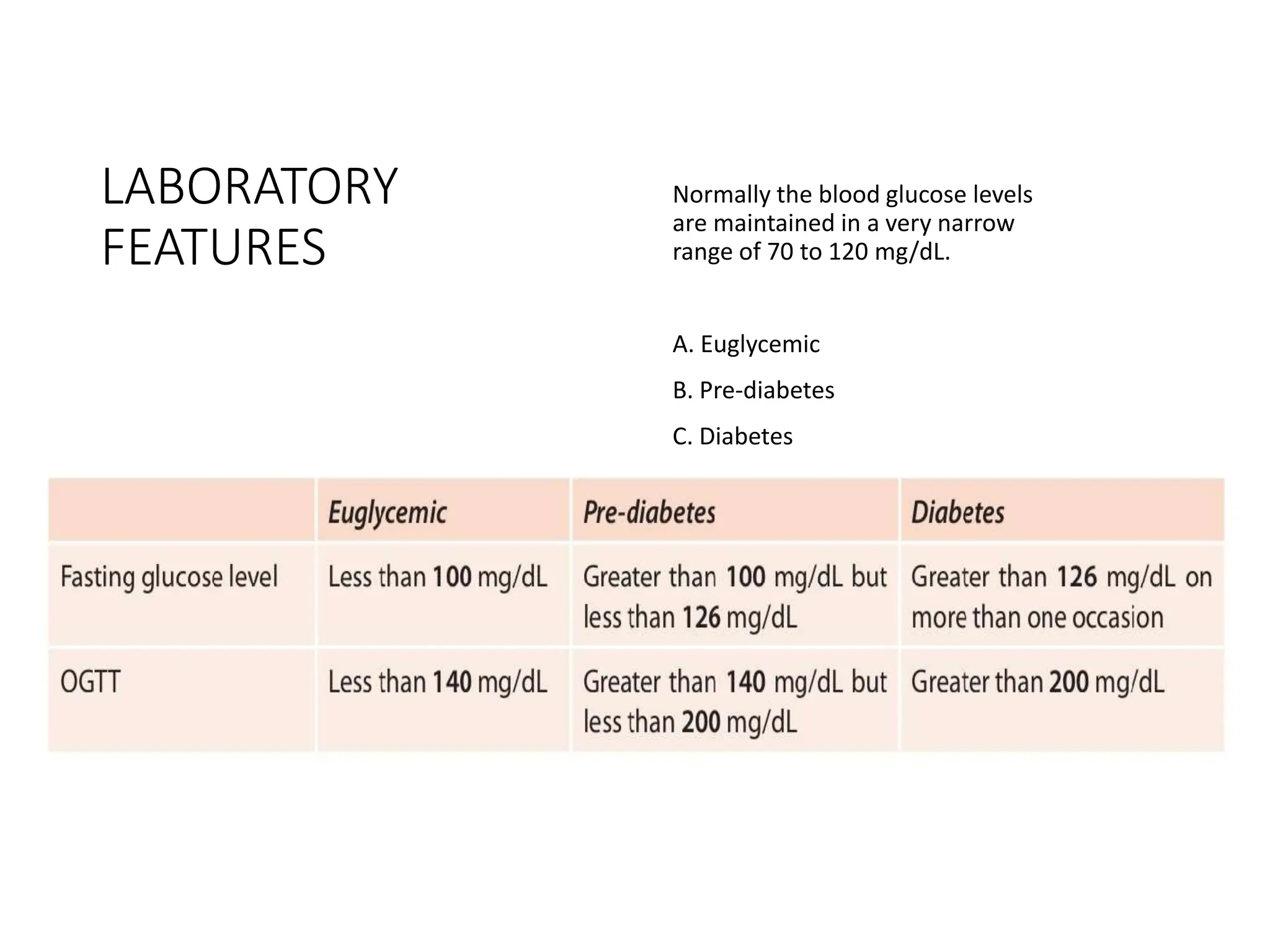
Normally the blood glucose levels
are maintained in a very narrow
range of 70 to 120 mg/dL.
A. Euglycemic
B. Pre-diabetes
C. Diabetes
Euglycemic
Individuals are considered to be euglycemic when
• 1. Fasting glucose level is less than 100 mg/dL, or
• 2. Glucose level less than 140 mg/dL following an
OGTT.
Pre-diabetes
It is defined as condition in which there is impaired
glucose tolerance, but elevated blood sugar does not
reach the criterion accepted for an outright diagnosis
of diabetes.
The criteria for diagnosis are:
• Fasting glucose level is greater than 100 mg/dL but
less than 126 mg/dL.
• GTT values greater than 140 mg/dL but less than
200 mg/dL.
Risks in pre-diabetes:
1) Progression to frank diabetes over time and
Diabetes
Any one of three criteria can be used for the
diagnosis of diabetes:
1. A random glucose level greater than 200 mg/dL,
with classical signs and symptoms.
2. A fasting glucose level greater than 126 mg/dL on
more than one occasion.
3. An abnormal oral glucose tolerance test (OGTT), in
which the glucose level is greater than 200 mg/dL, 2
hours after a standard carbohydrate load.
TREATMENT
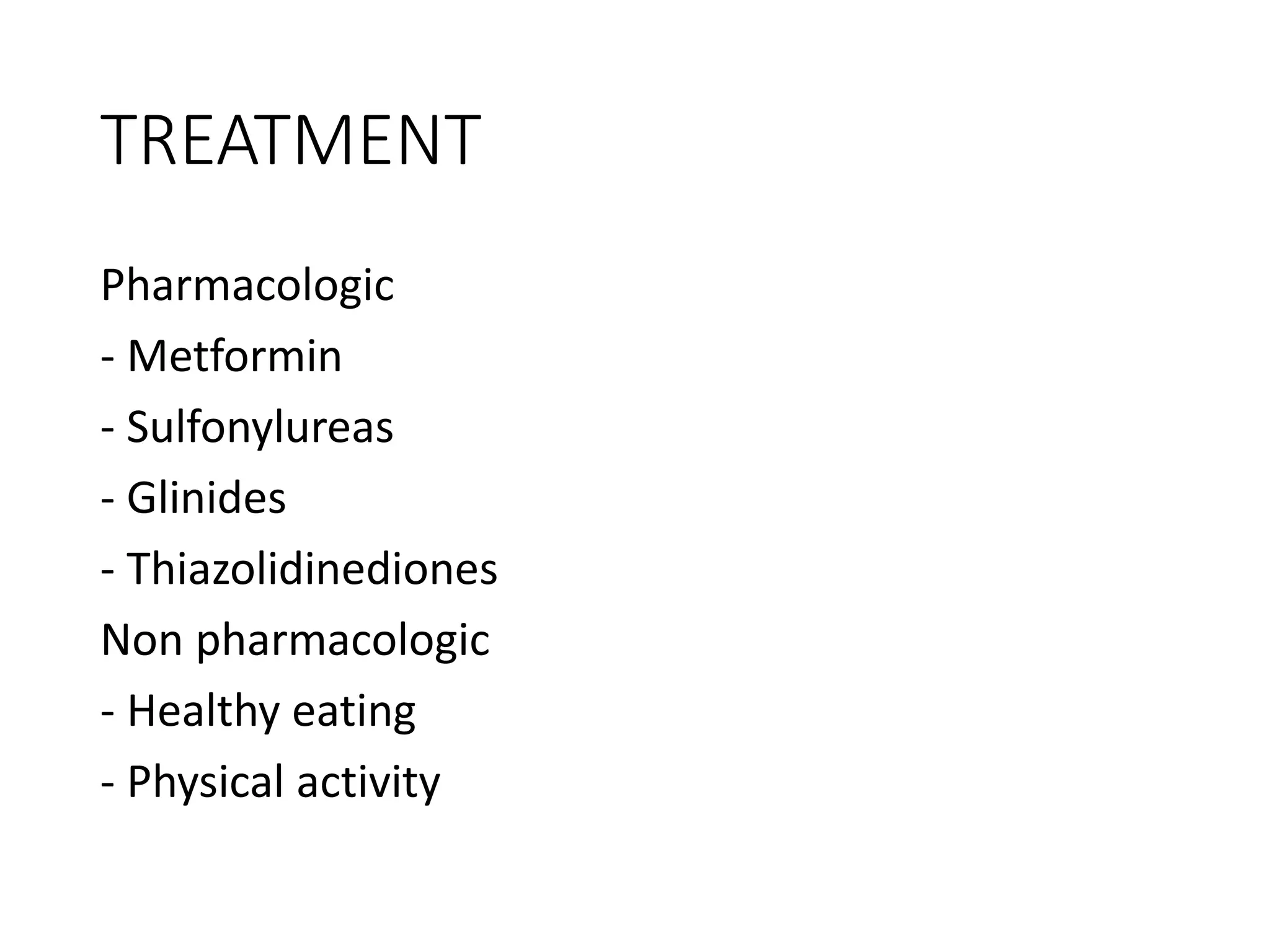
Pharmacologic
- Metformin
- Sulfonylureas
- Glinides
- Thiazolidinediones
Non pharmacologic
- Healthy eating
- Physical activity
COMPLICATIONS
Complications are similar in both
type 1 and type 2 diabetes.
DIFFERENCE BETWEEN T1D AND T2D
CONCLUSION
Type 2 diabetes mellitus is a chronic condition
characterized by insulin resistance and impaired
insulin secretion, leading to elevated blood glucose
levels.
It often develops in adulthood and is associated with
lifestyle factors like sedentary behavior and poor
diet.
Management involves lifestyle changes, medication,
and sometimes insulin therapy.
Regular monitoring of blood sugar levels is crucial for
effective control.
REFERENCES
Inzucchi, S. E., Bergenstal, R. M., Buse, J. B., Diamant,
M., Ferrannini, E., Nauck, M., ... & Matthews, D. R.
(2015). Management of hyperglycemia in type 2
diabetes, 2015: a patient-centered approach: update
to a position statement of the American Diabetes
Association and the European Association for the
Study of Diabetes. Diabetes Care, 38(1), 140-149.
Kahn, S. E., Cooper, M. E., & Del Prato, S. (2014).
Pathophysiology and treatment of type 2 diabetes:
perspectives on the past, present, and future. The
Lancet, 383(9922), 1068-1083.

Diabetes Mellitus Type 2 - Pathology.pptx

  • 1.
    Diabetes Mellitus Type 2 K.P. Adewole UJ/2017/MD/0210
  • 2.
    OUTLINE INTRODUCTION CLASSIFICATION TYPE 2 DIABETESMELLITUS PATHOGENESIS METABOLIC DEFECTS INSULIN RESISTANCE β-CELL DYSFUNCTION MORPHOLOGY CLINICAL FEATURES LABORATORY FEATURES TREATMENT COMPLICATIONS DIFFERENCE BETWEEN T1D AND T2D CONCLUSION REFERENCES
  • 3.
    INTRODUCTION Diabetes mellitus isa group of metabolic disorders having features of hyperglycemia. The prevalence of diabetes is increasing sharply in the developing countries because of more sedentary lifestyles. India and China have the largest prevalence of diabetics.
  • 4.
    CLASSIFICATION OF DIABETES MELLITUS 1.Type 1 diabetes 2. Type 2 diabetes 3. Genetic defects of β-cell function 4. Genetic defects in insulin action 5. Exocrine pancreatic defects 6. Endocrinopathies, 7. Infections 9. Genetic syndromes associatedwith diabetes 10. Gestational diabetes mellitus
  • 5.
    TYPE 2 DIABETESMELLITUS • Accounts for ~ 90–95% of diabetic patients. • Majority of patients are overweight. • Though known as “adult-onset,” it is now found in children and adolescents.
  • 6.
    PATHOGENESIS Type 2 diabetesis a multifactorial disease. • Environmental factors play a role and includes: – Sedentary lifestyle – Dietary habits and associated obesity. • Genetic factors: – Type 2 diabetes has a concordance rate of 35% to 60% in monozygotic twins compared with 17% to 30% in dizygotic twins. – Lifetime risk for type 2 diabetes in an offspring is more than double if both parents are affected. – Diabetogenic genes: They have been found. – There is no evidence of an autoimmune basis.
  • 7.
    METABOLIC DEFECTS INTYPE 2 DIABETES Two important metabolic defects are: Insulin Resistance β-Cell Dysfunction
  • 8.
    INSULIN RESISTANCE Insulin resistanceis the decrease/failure of target (peripheral) tissues to insulin action. Main factors in the development of insulin resistance is obesity.
  • 9.
    Obesity and InsulinResistance Obesity is associated with type 2 diabetes and the visceral obesity is found in more than 80% of patients. – Amount of fat – Distribution of body fat
  • 10.
    Causes of InsulinResistance in Obesity 1. Increasing FFAs 2. Reducing antihyperglycemic adipokines 3. Secreting proinflammatory cytokines which increase cell stress 4. Inactivation of PPAR.
  • 11.
    Consequences of Insulin Resistance i.Decreased uptake of glucose in muscle. ii. Reduced glycolysis and fatty acid oxidation in the liver. iii. Inability to suppress hepatic gluconeogenesis.
  • 12.
    β-CELL DYSFUNCTION In type2 diabetes, β-cell dysfunction manifests as inadequate insulin secretion by the pancreatic β cells (relative insulin deficiency) in association with insulin resistance and hyperglycemia. β-cell dysfunction is multifactorial in origin
  • 13.
    Obesity and β-celldysfunction – Compensatory β-cell hyperplasia – β-cell failure (early stage) – β-cell failure (late stage)
  • 14.
    Molecular Mechanisms ofβ-Cell Dysfunction – Excess FFAs and decreased insulin signaling (lipotoxicity) – Direct toxicity by amyloid deposits
  • 15.
    MORPHOLOGY Pancreas Lesions of pancreasare not diagnostic and are more common with type 1 than with type 2 diabetes. The morphological changes include: • Reduced number and size of islets: It is seen in type 1 diabetes which is mild in type 2 diabetes. • Infiltration of islets (insulitis): Mainly by T lymphocytes predominantly in type 1 diabetes. • Amyloid deposition within islets: It is observed in and around capillaries and between cells in type 2 diabetes. In advanced stages, the islets may be virtually obliterated and may show fibrosis. • Increase in the number and size of islets: It may be seen in nondiabetic newborns of diabetic mothers as a hyperplastic in response to the maternal hyperglycemia.
  • 16.
    MORPHOLOGY Blood Vessels • Hyalinearteriolosclerosis: It can be found in hypertension, elderly nondiabeticswithout hypertension and more severe degree in diabetics also. • In diabetics, it is related to the duration of diabetes and the level of blood pressure. • It is characterized by amorphous, hyaline thickening of the wall of the arterioles, which may narrow the lumen of the vessel • Diabetic microangiopathy: It is characterized by diffuse thickening of basement membranes, which is mostly seen in the capillaries of the skin, skeletal muscle, retina, renal glomeruli, and renal medulla. • Though capillaries show basement membrane thickening, they are leakier to plasma proteins than normal. • The microangiopathy results in diabetic nephropathy, retinopathy, and some forms of neuropathy.
  • 17.
    CLINICAL FEATURES OFT2D • Age: Usually occurs in older above the age of 40 years and frequently in obese individuals. Due to increase in obesity and sedentary lifestyle, it is now detected also in children and adolescents. • Presentation: Polyuria, polydipsia, unexplained weakness or weight loss. Ketoacidosis is infrequent and presentation is usually mild. • In asymptomatic individuals, the diagnosis is made after routine blood or urine testing.
  • 18.
    LABORATORY FEATURES Normally the bloodglucose levels are maintained in a very narrow range of 70 to 120 mg/dL. A. Euglycemic B. Pre-diabetes C. Diabetes
  • 19.
    Euglycemic Individuals are consideredto be euglycemic when • 1. Fasting glucose level is less than 100 mg/dL, or • 2. Glucose level less than 140 mg/dL following an OGTT.
  • 20.
    Pre-diabetes It is definedas condition in which there is impaired glucose tolerance, but elevated blood sugar does not reach the criterion accepted for an outright diagnosis of diabetes. The criteria for diagnosis are: • Fasting glucose level is greater than 100 mg/dL but less than 126 mg/dL. • GTT values greater than 140 mg/dL but less than 200 mg/dL. Risks in pre-diabetes: 1) Progression to frank diabetes over time and
  • 21.
    Diabetes Any one ofthree criteria can be used for the diagnosis of diabetes: 1. A random glucose level greater than 200 mg/dL, with classical signs and symptoms. 2. A fasting glucose level greater than 126 mg/dL on more than one occasion. 3. An abnormal oral glucose tolerance test (OGTT), in which the glucose level is greater than 200 mg/dL, 2 hours after a standard carbohydrate load.
  • 22.
    TREATMENT Pharmacologic - Metformin - Sulfonylureas -Glinides - Thiazolidinediones Non pharmacologic - Healthy eating - Physical activity
  • 23.
    COMPLICATIONS Complications are similarin both type 1 and type 2 diabetes.
  • 24.
  • 25.
    CONCLUSION Type 2 diabetesmellitus is a chronic condition characterized by insulin resistance and impaired insulin secretion, leading to elevated blood glucose levels. It often develops in adulthood and is associated with lifestyle factors like sedentary behavior and poor diet. Management involves lifestyle changes, medication, and sometimes insulin therapy. Regular monitoring of blood sugar levels is crucial for effective control.
  • 26.
    REFERENCES Inzucchi, S. E.,Bergenstal, R. M., Buse, J. B., Diamant, M., Ferrannini, E., Nauck, M., ... & Matthews, D. R. (2015). Management of hyperglycemia in type 2 diabetes, 2015: a patient-centered approach: update to a position statement of the American Diabetes Association and the European Association for the Study of Diabetes. Diabetes Care, 38(1), 140-149. Kahn, S. E., Cooper, M. E., & Del Prato, S. (2014). Pathophysiology and treatment of type 2 diabetes: perspectives on the past, present, and future. The Lancet, 383(9922), 1068-1083.