Diabetes and Periodontitis
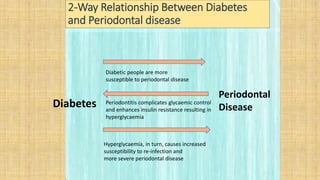
2-Way Relationship Between Diabetes
and Periodontal disease
Diabetic people are more
susceptible to periodontal disease
Periodontitis complicates glycaemic control
and enhances insulin resistance resulting in
hyperglycaemia
Hyperglycaemia, in turn, causes increased
susceptibility to re-infection and
more severe periodontal disease
Diabetes
Periodontal
Disease
Effect of Diabetes on
Periodontitis
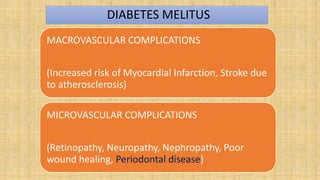
DIABETES MELITUS
MACROVASCULAR COMPLICATIONS
(Increased risk of Myocardial Infarction, Stroke due
to atherosclerosis)
MICROVASCULAR COMPLICATIONS
(Retinopathy, Neuropathy, Nephropathy, Poor
wound healing, Periodontal disease)
Thus, Periodontitis is a
complication of Diabetes
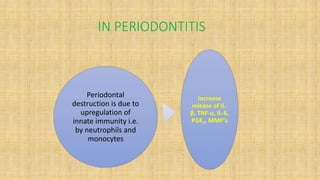
IN PERIODONTITIS
Periodontal
destruction is due to
upregulation of
innate immunity i.e.
by neutrophils and
monocytes
Increase
release of IL-
β, TNF-⍺, IL-6,
PGE2, MMP’s
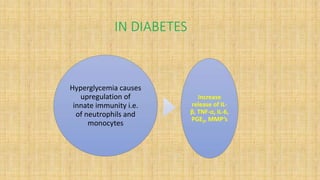
IN DIABETES
Hyperglycemia causes
upregulation of
innate immunity i.e.
of neutrophils and
monocytes
Increase
release of IL-
β, TNF-⍺, IL-6,
PGE2, MMP’s
Thus the mechanism of
destruction is same in both
the diseases
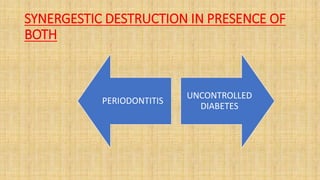
SYNERGESTIC DESTRUCTION IN PRESENCE OF
BOTH
PERIODONTITIS
UNCONTROLLED
DIABETES
CLINICAL FEATURES IN
DIABETIC PATIENTS
The most striking changes in
uncontrolled diabetic patients are
diminished defense mechanisms with
increased susceptibility of infections,
causing destructive periodontitis
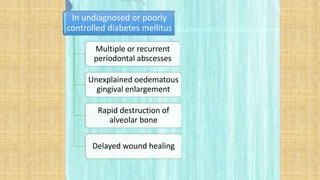
In undiagnosed or poorly
controlled diabetes mellitus
Multiple or recurrent
periodontal abscesses
Unexplained oedematous
gingival enlargement
Rapid destruction of
alveolar bone
Delayed wound healing
Other features include
Cheilosis, drying and cracking
of mucosa
Decreased salivary flow
Burning mouth
Opportunistic fungal infections
by Candida albicans
PATHOGENESIS
MICROBIOLOGY
• Capnocytophaga species
and anaerobic Vibrios
with few pigmented
Bacteroids,
Actinobacillus
actinomycetemcomitans
INCREASE
IN
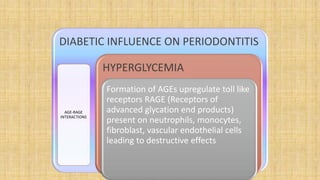
DIABETIC INFLUENCE ON PERIODONTITIS
AGE-RAGE
INTERACTIONS
HYPERGLYCEMIA LEADS TO
Nonenzymatic glycosylation
of proteins and lipids
carbohydrates resulting in
formation of advanced
glycation end products
(AGEs)
DIABETIC INFLUENCE ON PERIODONTITIS
AGE-RAGE
INTERACTIONS
HYPERGLYCEMIA
Formation of AGEs upregulate toll like
receptors RAGE (Receptors of
advanced glycation end products)
present on neutrophils, monocytes,
fibroblast, vascular endothelial cells
leading to destructive effects
• AGEs forms at normal
glucose levels, but its
formation increases many
folds in hyperglycemic
stage leading to
destructive effects
AGEs
AGE-RAGE INTERACTIONS
CAUSE DESTRUCTIVE EFFECTS
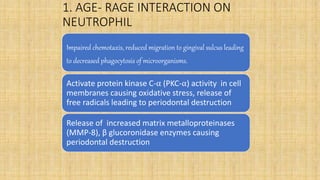
1. AGE- RAGE INTERACTION ON
NEUTROPHIL
Impaired chemotaxis, reduced migration to gingival sulcus leading
to decreased phagocytosis of microorganisms.
Activate protein kinase C-⍺ (PKC-⍺) activity in cell
membranes causing oxidative stress, release of
free radicals leading to periodontal destruction
Release of increased matrix metalloproteinases
(MMP-8), β glucoronidase enzymes causing
periodontal destruction
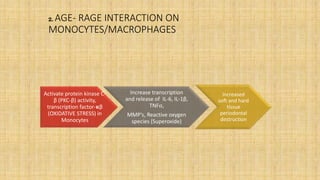
2. AGE- RAGE INTERACTION ON
MONOCYTES/MACROPHAGES
Activate protein kinase C-
β (PKC-β) activity,
transcription factor-𝛋β
(OXIDATIVE STRESS) in
Monocytes
Increase transcription
and release of IL-6, IL-1β,
TNF⍺,
MMP’s, Reactive oxygen
species (Superoxide)
Increased
soft and hard
tissue
periodontal
destruction
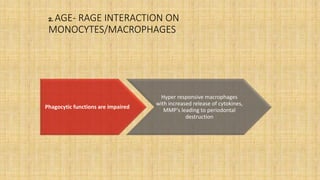
2. AGE- RAGE INTERACTION ON
MONOCYTES/MACROPHAGES
Phagocytic functions are impaired
Hyper responsive macrophages
with increased release of cytokines,
MMP’s leading to periodontal
destruction
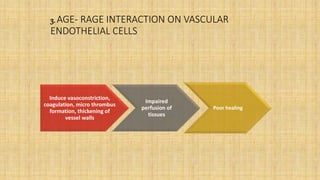
3. AGE- RAGE INTERACTION ON VASCULAR
ENDOTHELIAL CELLS
Induce vasoconstriction,
coagulation, micro thrombus
formation, thickening of
vessel walls
Impaired
perfusion of
tissues
Poor healing
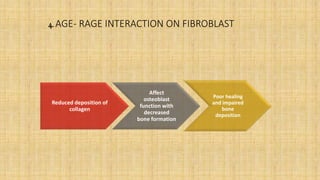
4. AGE- RAGE INTERACTION ON FIBROBLAST
Reduced deposition of
collagen
Affect
osteoblast
function with
decreased
bone formation
Poor healing
and impaired
bone
deposition
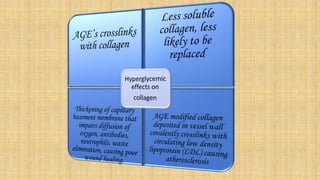
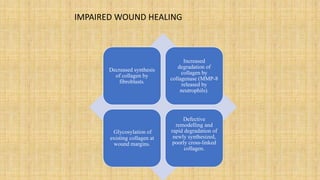
Decreased synthesis
of collagen by
fibroblasts.
Increased
degradation of
collagen by
collagenase (MMP-8
released by
neutrophils).
Glycosylation of
existing collagen at
wound margins.
Defective
remodelling and
rapid degradation of
newly synthesized,
poorly cross-linked
collagen.
IMPAIRED WOUND HEALING
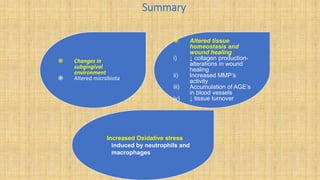
Summary
 Changes in
subgingival
environment
 Altered microbiota
 Altered tissue
homeostasis and
wound healing
i) ↓ collagen production-
alterations in wound
healing
ii) Increased MMP’s
activity
iii) Accumulation of AGE’s
in blood vessels
iv) ↓ tissue turnover
Increased Oxidative stress
induced by neutrophils and
macrophages
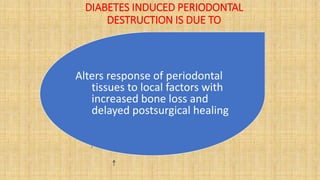
DIABETES INDUCED PERIODONTAL
DESTRUCTION IS DUE TO
Alters response of periodontal
tissues to local factors with
increased bone loss and
delayed postsurgical healing
TREATMENT
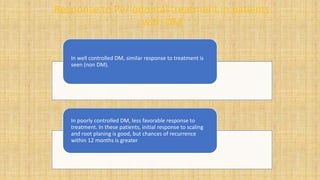
Response to Periodontal treatment in patients
with DM
In well controlled DM, similar response to treatment is
seen (non DM).
In poorly controlled DM, less favorable response to
treatment. In these patients, initial response to scaling
and root planing is good, but chances of recurrence
within 12 months is greater
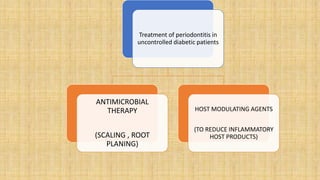
Treatment of periodontitis in
uncontrolled diabetic patients
ANTIMICROBIAL
THERAPY
(SCALING , ROOT
PLANING)
HOST MODULATING AGENTS
(TO REDUCE INFLAMMATORY
HOST PRODUCTS)
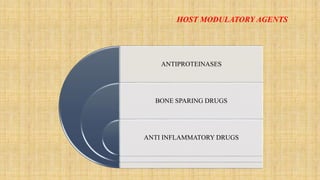
ANTIPROTEINASES
BONE SPARING DRUGS
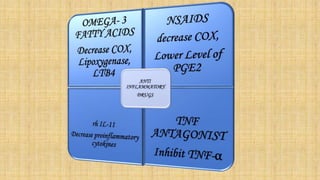
ANTI INFLAMMATORY DRUGS
HOST MODULATORY AGENTS
ANTIPROTEINASES
SUBANTIMICROBIAL
DOSE OF
DOXYCYCLINE
ONLY DRUG
APPROVED BY
FDA TO BE
USED AS HOST
MODULATORY
AGENT
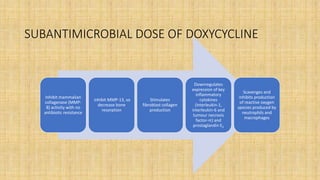
SUBANTIMICROBIAL DOSE OF DOXYCYCLINE
Inhibit mammalian
collagenase (MMP-
8) activity with no
antibiotic resistance
inhibit MMP-13, so
decrease bone
resorption
Stimulates
fibroblast collagen
production
Downregulates
expression of key
inflammatory
cytokines
(interleukin-1,
interleukin-6 and
tumour necrosis
factor-∝) and
prostaglandin E2
Scavenges and
inhibits production
of reactive oxygen
species produced by
neutrophils and
macrophages
Periostat
(20-mg doxycycline
hyclate, twice daily
for periods of 3–9
months as an
adjunct to scaling
and root planing)
BONE SPARING
DRUGS
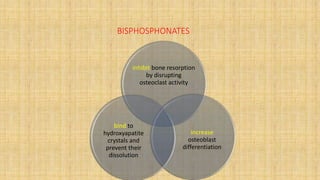
BISPHOSPHONATES
inhibit bone resorption
by disrupting
osteoclast activity
increase
osteoblast
differentiation
bind to
hydroxyapatite
crystals and
prevent their
dissolution
BISPHOSPHONATES
Long term
therapy leads to
“bisphosphonate-
associated
osteonecrosis’’
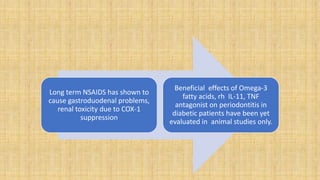
Long term NSAIDS has shown to
cause gastroduodenal problems,
renal toxicity due to COX-1
suppression
Beneficial effects of Omega-3
fatty acids, rh IL-11, TNF
antagonist on periodontitis in
diabetic patients have been yet
evaluated in animal studies only.
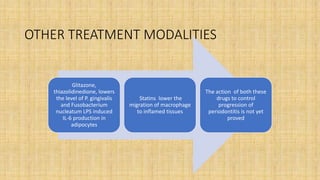
OTHER TREATMENT MODALITIES
Glitazone,
thiazolidinedione, lowers
the level of P. gingivalis
and Fusobacterium
nucleatum LPS induced
IL-6 production in
adipocytes
Statins lower the
migration of macrophage
to inflamed tissues
The action of both these
drugs to control
progression of
periodontitis is not yet
proved
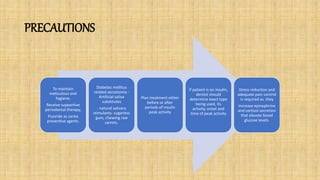
PRECAUTIONS
To maintain
meticulous oral
hygiene,
Receive supportive
periodontal therapy,
Fluoride as caries
preventive agents.
Diabetes mellitus
related xerostomia -
Artificial saliva
substitutes
- natural salivary
stimulants- sugarless
gum, chewing raw
carrots.
Plan treatment either
before or after
periods of insulin
peak activity
If patient is on insulin,
dentist should
determine exact type
being used, its
activity, onset and
time of peak activity
Stress reduction and
adequate pain control
is required as they
increase epinephrine
and cortisol secretion
that elevate blood
glucose levels.
Effect of Periodontitis on
Diabetes
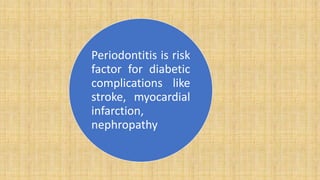
Periodontitis is risk
factor for diabetic
complications like
stroke, myocardial
infarction,
nephropathy
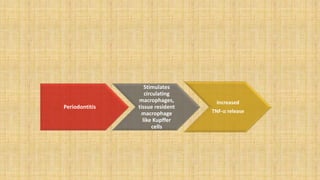
Periodontitis
Stimulates
circulating
macrophages,
tissue resident
macrophage
like Kupffer
cells
Increased
TNF-⍺ release
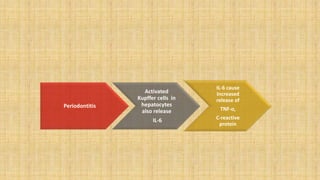
Periodontitis
Activated
Kupffer cells in
hepatocytes
also release
IL-6
IL-6 cause
Increased
release of
TNF-⍺,
C-reactive
protein
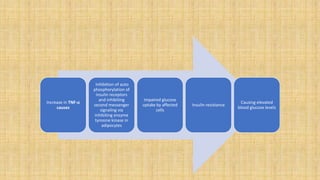
Increase in TNF-⍺
causes
Inhibition of auto
phosphorylation of
insulin receptors
and inhibiting
second messenger
signaling via
inhibiting enzyme
tyrosine kinase in
adipocytes
Impaired glucose
uptake by affected
cells
Insulin resistance
Causing elevated
blood glucose levels
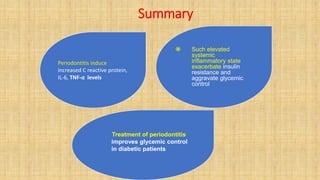
Summary
Periodontitis induce
increased C reactive protein,
IL-6, TNF-⍺ levels
 Such elevated
systemic
inflammatory state
exacerbate insulin
resistance and
aggravate glycemic
control
Treatment of periodontitis
improves glycemic control
in diabetic patients
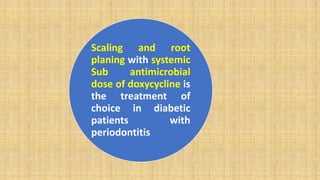
Scaling and root
planing with systemic
Sub antimicrobial
dose of doxycycline is
the treatment of
choice in diabetic
patients with
periodontitis
Thank u !!!

Diabetes and Periodontitis PPT

  • 2.
  • 3.
    2-Way Relationship BetweenDiabetes and Periodontal disease Diabetic people are more susceptible to periodontal disease Periodontitis complicates glycaemic control and enhances insulin resistance resulting in hyperglycaemia Hyperglycaemia, in turn, causes increased susceptibility to re-infection and more severe periodontal disease Diabetes Periodontal Disease
  • 4.
    Effect of Diabeteson Periodontitis
  • 5.
    DIABETES MELITUS MACROVASCULAR COMPLICATIONS (Increasedrisk of Myocardial Infarction, Stroke due to atherosclerosis) MICROVASCULAR COMPLICATIONS (Retinopathy, Neuropathy, Nephropathy, Poor wound healing, Periodontal disease)
  • 6.
    Thus, Periodontitis isa complication of Diabetes
  • 7.
    IN PERIODONTITIS Periodontal destruction isdue to upregulation of innate immunity i.e. by neutrophils and monocytes Increase release of IL- β, TNF-⍺, IL-6, PGE2, MMP’s
  • 8.
    IN DIABETES Hyperglycemia causes upregulationof innate immunity i.e. of neutrophils and monocytes Increase release of IL- β, TNF-⍺, IL-6, PGE2, MMP’s
  • 9.
    Thus the mechanismof destruction is same in both the diseases
  • 10.
    SYNERGESTIC DESTRUCTION INPRESENCE OF BOTH PERIODONTITIS UNCONTROLLED DIABETES
  • 11.
  • 12.
    The most strikingchanges in uncontrolled diabetic patients are diminished defense mechanisms with increased susceptibility of infections, causing destructive periodontitis
  • 13.
    In undiagnosed orpoorly controlled diabetes mellitus Multiple or recurrent periodontal abscesses Unexplained oedematous gingival enlargement Rapid destruction of alveolar bone Delayed wound healing
  • 14.
    Other features include Cheilosis,drying and cracking of mucosa Decreased salivary flow Burning mouth Opportunistic fungal infections by Candida albicans
  • 15.
  • 16.
    MICROBIOLOGY • Capnocytophaga species andanaerobic Vibrios with few pigmented Bacteroids, Actinobacillus actinomycetemcomitans INCREASE IN
  • 17.
    DIABETIC INFLUENCE ONPERIODONTITIS AGE-RAGE INTERACTIONS HYPERGLYCEMIA LEADS TO Nonenzymatic glycosylation of proteins and lipids carbohydrates resulting in formation of advanced glycation end products (AGEs)
  • 18.
    DIABETIC INFLUENCE ONPERIODONTITIS AGE-RAGE INTERACTIONS HYPERGLYCEMIA Formation of AGEs upregulate toll like receptors RAGE (Receptors of advanced glycation end products) present on neutrophils, monocytes, fibroblast, vascular endothelial cells leading to destructive effects
  • 19.
    • AGEs formsat normal glucose levels, but its formation increases many folds in hyperglycemic stage leading to destructive effects AGEs
  • 20.
  • 21.
    1. AGE- RAGEINTERACTION ON NEUTROPHIL Impaired chemotaxis, reduced migration to gingival sulcus leading to decreased phagocytosis of microorganisms. Activate protein kinase C-⍺ (PKC-⍺) activity in cell membranes causing oxidative stress, release of free radicals leading to periodontal destruction Release of increased matrix metalloproteinases (MMP-8), β glucoronidase enzymes causing periodontal destruction
  • 22.
    2. AGE- RAGEINTERACTION ON MONOCYTES/MACROPHAGES Activate protein kinase C- β (PKC-β) activity, transcription factor-𝛋β (OXIDATIVE STRESS) in Monocytes Increase transcription and release of IL-6, IL-1β, TNF⍺, MMP’s, Reactive oxygen species (Superoxide) Increased soft and hard tissue periodontal destruction
  • 23.
    2. AGE- RAGEINTERACTION ON MONOCYTES/MACROPHAGES Phagocytic functions are impaired Hyper responsive macrophages with increased release of cytokines, MMP’s leading to periodontal destruction
  • 24.
    3. AGE- RAGEINTERACTION ON VASCULAR ENDOTHELIAL CELLS Induce vasoconstriction, coagulation, micro thrombus formation, thickening of vessel walls Impaired perfusion of tissues Poor healing
  • 25.
    4. AGE- RAGEINTERACTION ON FIBROBLAST Reduced deposition of collagen Affect osteoblast function with decreased bone formation Poor healing and impaired bone deposition
  • 27.
    Decreased synthesis of collagenby fibroblasts. Increased degradation of collagen by collagenase (MMP-8 released by neutrophils). Glycosylation of existing collagen at wound margins. Defective remodelling and rapid degradation of newly synthesized, poorly cross-linked collagen. IMPAIRED WOUND HEALING
  • 28.
    Summary  Changes in subgingival environment Altered microbiota  Altered tissue homeostasis and wound healing i) ↓ collagen production- alterations in wound healing ii) Increased MMP’s activity iii) Accumulation of AGE’s in blood vessels iv) ↓ tissue turnover Increased Oxidative stress induced by neutrophils and macrophages
  • 29.
    DIABETES INDUCED PERIODONTAL DESTRUCTIONIS DUE TO Alters response of periodontal tissues to local factors with increased bone loss and delayed postsurgical healing
  • 30.
  • 31.
    Response to Periodontaltreatment in patients with DM In well controlled DM, similar response to treatment is seen (non DM). In poorly controlled DM, less favorable response to treatment. In these patients, initial response to scaling and root planing is good, but chances of recurrence within 12 months is greater
  • 32.
    Treatment of periodontitisin uncontrolled diabetic patients ANTIMICROBIAL THERAPY (SCALING , ROOT PLANING) HOST MODULATING AGENTS (TO REDUCE INFLAMMATORY HOST PRODUCTS)
  • 33.
    ANTIPROTEINASES BONE SPARING DRUGS ANTIINFLAMMATORY DRUGS HOST MODULATORY AGENTS
  • 34.
  • 35.
    ONLY DRUG APPROVED BY FDATO BE USED AS HOST MODULATORY AGENT
  • 36.
    SUBANTIMICROBIAL DOSE OFDOXYCYCLINE Inhibit mammalian collagenase (MMP- 8) activity with no antibiotic resistance inhibit MMP-13, so decrease bone resorption Stimulates fibroblast collagen production Downregulates expression of key inflammatory cytokines (interleukin-1, interleukin-6 and tumour necrosis factor-∝) and prostaglandin E2 Scavenges and inhibits production of reactive oxygen species produced by neutrophils and macrophages
  • 37.
    Periostat (20-mg doxycycline hyclate, twicedaily for periods of 3–9 months as an adjunct to scaling and root planing)
  • 38.
  • 39.
    inhibit bone resorption bydisrupting osteoclast activity increase osteoblast differentiation bind to hydroxyapatite crystals and prevent their dissolution BISPHOSPHONATES
  • 40.
    Long term therapy leadsto “bisphosphonate- associated osteonecrosis’’
  • 42.
    Long term NSAIDShas shown to cause gastroduodenal problems, renal toxicity due to COX-1 suppression Beneficial effects of Omega-3 fatty acids, rh IL-11, TNF antagonist on periodontitis in diabetic patients have been yet evaluated in animal studies only.
  • 43.
    OTHER TREATMENT MODALITIES Glitazone, thiazolidinedione,lowers the level of P. gingivalis and Fusobacterium nucleatum LPS induced IL-6 production in adipocytes Statins lower the migration of macrophage to inflamed tissues The action of both these drugs to control progression of periodontitis is not yet proved
  • 44.
    PRECAUTIONS To maintain meticulous oral hygiene, Receivesupportive periodontal therapy, Fluoride as caries preventive agents. Diabetes mellitus related xerostomia - Artificial saliva substitutes - natural salivary stimulants- sugarless gum, chewing raw carrots. Plan treatment either before or after periods of insulin peak activity If patient is on insulin, dentist should determine exact type being used, its activity, onset and time of peak activity Stress reduction and adequate pain control is required as they increase epinephrine and cortisol secretion that elevate blood glucose levels.
  • 45.
  • 46.
    Periodontitis is risk factorfor diabetic complications like stroke, myocardial infarction, nephropathy
  • 47.
  • 48.
    Periodontitis Activated Kupffer cells in hepatocytes alsorelease IL-6 IL-6 cause Increased release of TNF-⍺, C-reactive protein
  • 49.
    Increase in TNF-⍺ causes Inhibitionof auto phosphorylation of insulin receptors and inhibiting second messenger signaling via inhibiting enzyme tyrosine kinase in adipocytes Impaired glucose uptake by affected cells Insulin resistance Causing elevated blood glucose levels
  • 50.
    Summary Periodontitis induce increased Creactive protein, IL-6, TNF-⍺ levels  Such elevated systemic inflammatory state exacerbate insulin resistance and aggravate glycemic control Treatment of periodontitis improves glycemic control in diabetic patients
  • 51.
    Scaling and root planingwith systemic Sub antimicrobial dose of doxycycline is the treatment of choice in diabetic patients with periodontitis
  • 52.