Models & Frameworks (2000-2015)
Costas Katsavounidis
Katsavounidis C. 2
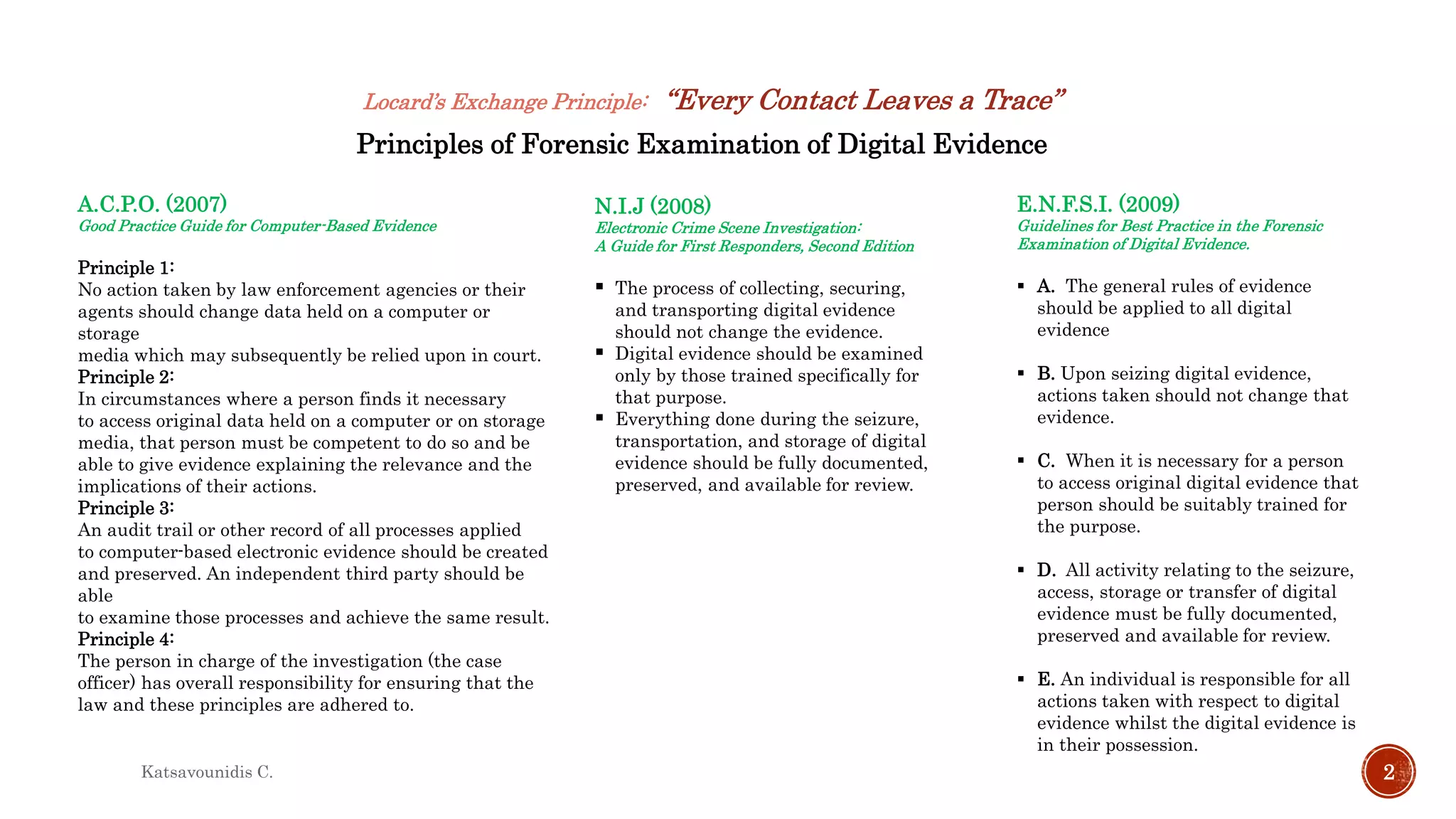
Locard’s Exchange Principle: “Every Contact Leaves a Trace”
Principles of Forensic Examination of Digital Evidence
A.C.P.O. (2007)
Good Practice Guide for Computer-Based Evidence
Principle 1:
No action taken by law enforcement agencies or their
agents should change data held on a computer or
storage
media which may subsequently be relied upon in court.
Principle 2:
In circumstances where a person finds it necessary
to access original data held on a computer or on storage
media, that person must be competent to do so and be
able to give evidence explaining the relevance and the
implications of their actions.
Principle 3:
An audit trail or other record of all processes applied
to computer-based electronic evidence should be created
and preserved. An independent third party should be
able
to examine those processes and achieve the same result.
Principle 4:
The person in charge of the investigation (the case
officer) has overall responsibility for ensuring that the
law and these principles are adhered to.
N.I.J (2008)
Electronic Crime Scene Investigation:
A Guide for First Responders, Second Edition
 The process of collecting, securing,
and transporting digital evidence
should not change the evidence.
 Digital evidence should be examined
only by those trained specifically for
that purpose.
 Everything done during the seizure,
transportation, and storage of digital
evidence should be fully documented,
preserved, and available for review.
E.N.F.S.I. (2009)
Guidelines for Best Practice in the Forensic
Examination of Digital Evidence.
 A. The general rules of evidence
should be applied to all digital
evidence
 B. Upon seizing digital evidence,
actions taken should not change that
evidence.
 C. When it is necessary for a person
to access original digital evidence that
person should be suitably trained for
the purpose.
 D. All activity relating to the seizure,
access, storage or transfer of digital
evidence must be fully documented,
preserved and available for review.
 E. An individual is responsible for all
actions taken with respect to digital
evidence whilst the digital evidence is
in their possession.
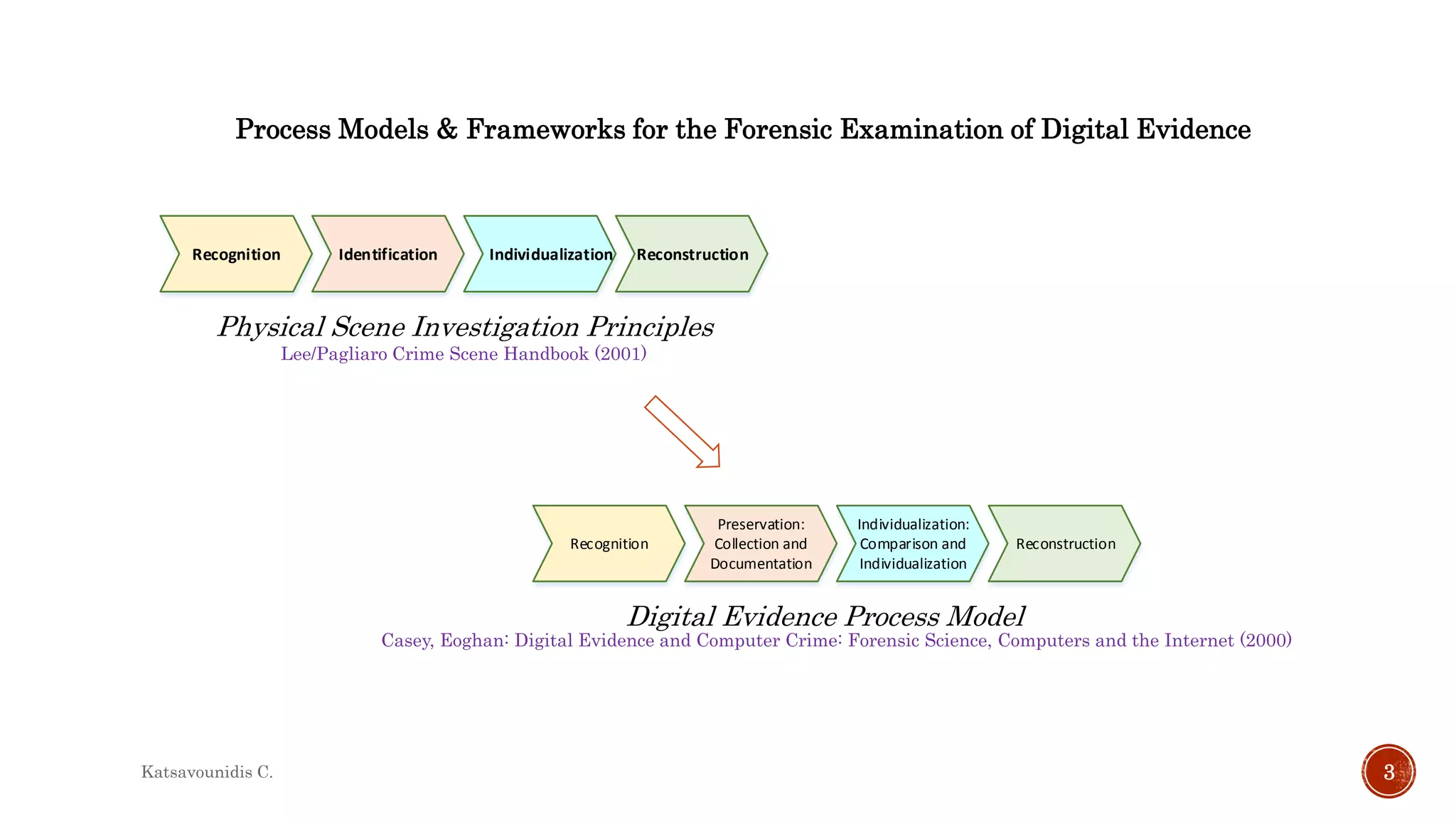
Recognition Identification Individualization Reconstruction
Lee/Pagliaro Crime Scene Handbook (2001)
Physical Scene Investigation Principles
Recognition
Preservation:
Collection and
Documentation
Individualization:
Comparison and
Individualization
Reconstruction
Casey, Eoghan: Digital Evidence and Computer Crime: Forensic Science, Computers and the Internet (2000)
Digital Evidence Process Model
Katsavounidis C. 3
Process Models & Frameworks for the Forensic Examination of Digital Evidence
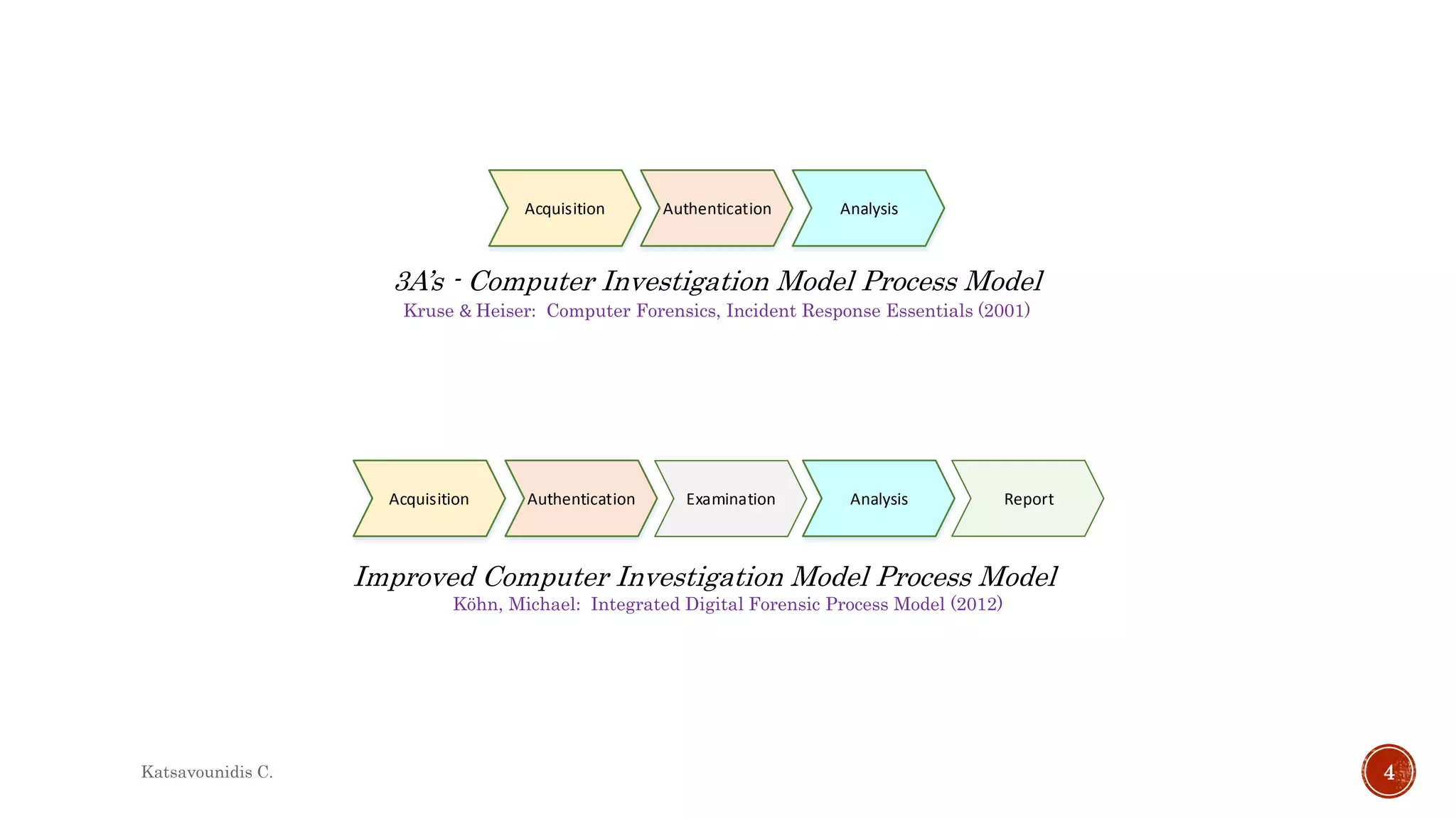
Acquisition Authentication Analysis
3A’s - Computer Investigation Model Process Model
Kruse & Heiser: Computer Forensics, Incident Response Essentials (2001)
Acquisition Authentication Analysis ReportExamination
Improved Computer Investigation Model Process Model
Köhn, Michael: Integrated Digital Forensic Process Model (2012)
Katsavounidis C. 4
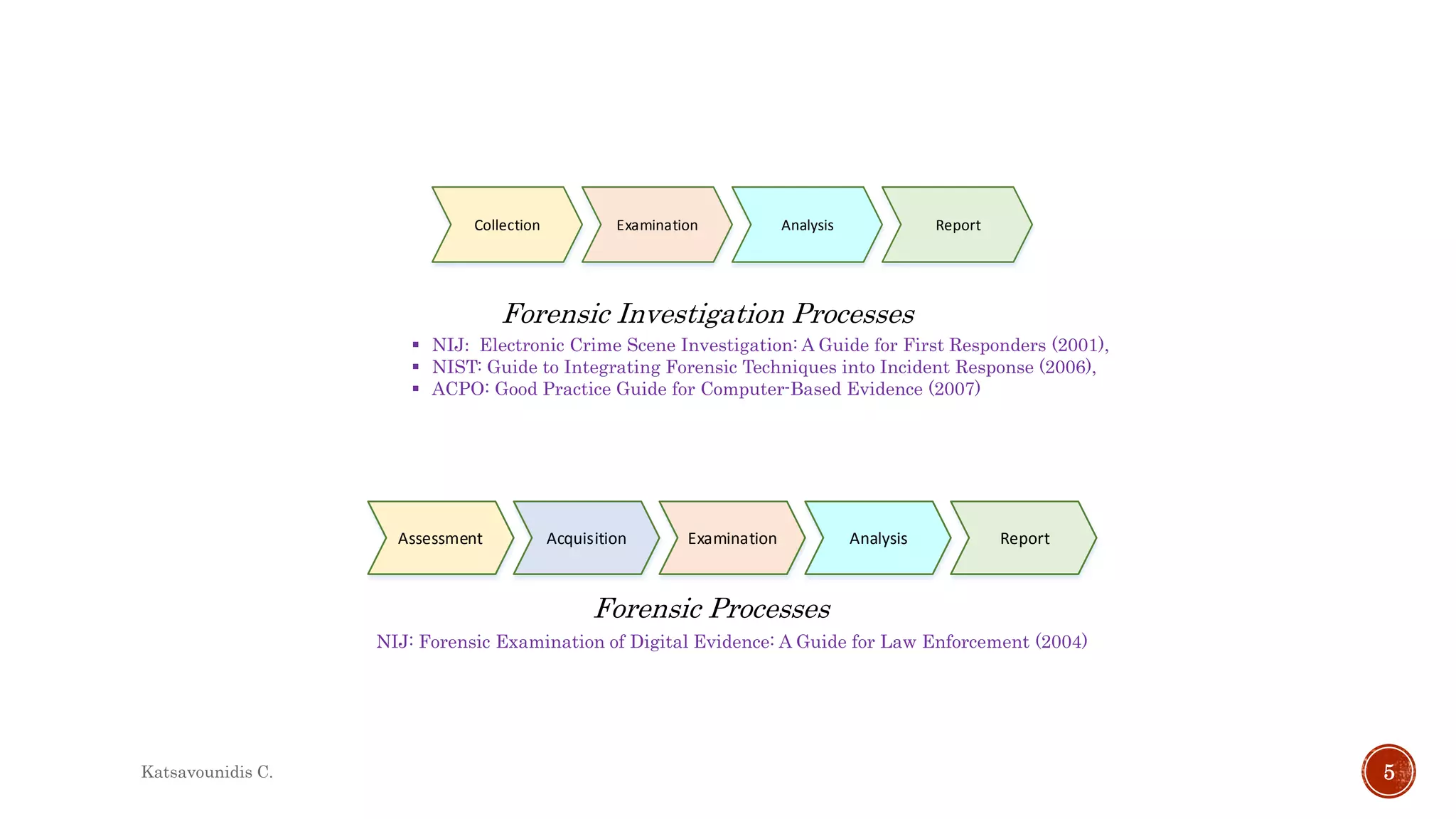
Forensic Investigation Processes
 NIJ: Electronic Crime Scene Investigation: A Guide for First Responders (2001),
 NIST: Guide to Integrating Forensic Techniques into Incident Response (2006),
 ACPO: Good Practice Guide for Computer-Based Evidence (2007)
Forensic Processes
NIJ: Forensic Examination of Digital Evidence: A Guide for Law Enforcement (2004)
Collection Examination Analysis Report
Acquisition Examination Analysis ReportAssessment
Katsavounidis C. 5
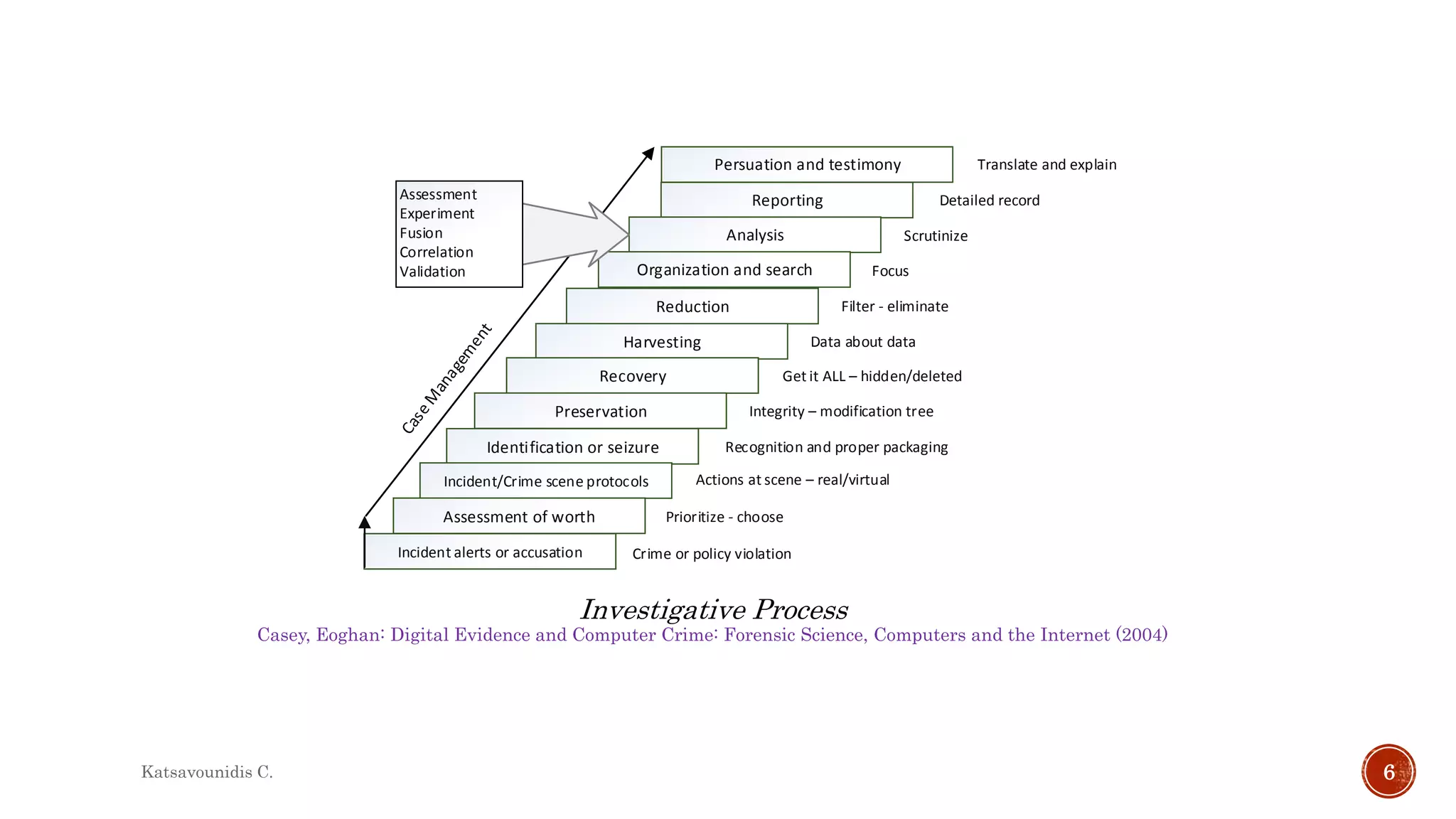
Casey, Eoghan: Digital Evidence and Computer Crime: Forensic Science, Computers and the Internet (2004)
Investigative Process
Persuation and testimony
Reporting
Analysis
Organization and search
Reduction
Harvesting
Recovery
Preservation
Identification or seizure
Incident/Crime scene protocols
Assessment of worth
Incident alerts or accusation
Assessment
Experiment
Fusion
Correlation
Validation
Crime or policy violation
Prioritize - choose
Actions at scene – real/virtual
Recognition and proper packaging
Get it ALL – hidden/deleted
Data about data
Integrity – modification tree
Filter - eliminate
Focus
Scrutinize
Detailed record
Translate and explain
Katsavounidis C. 6
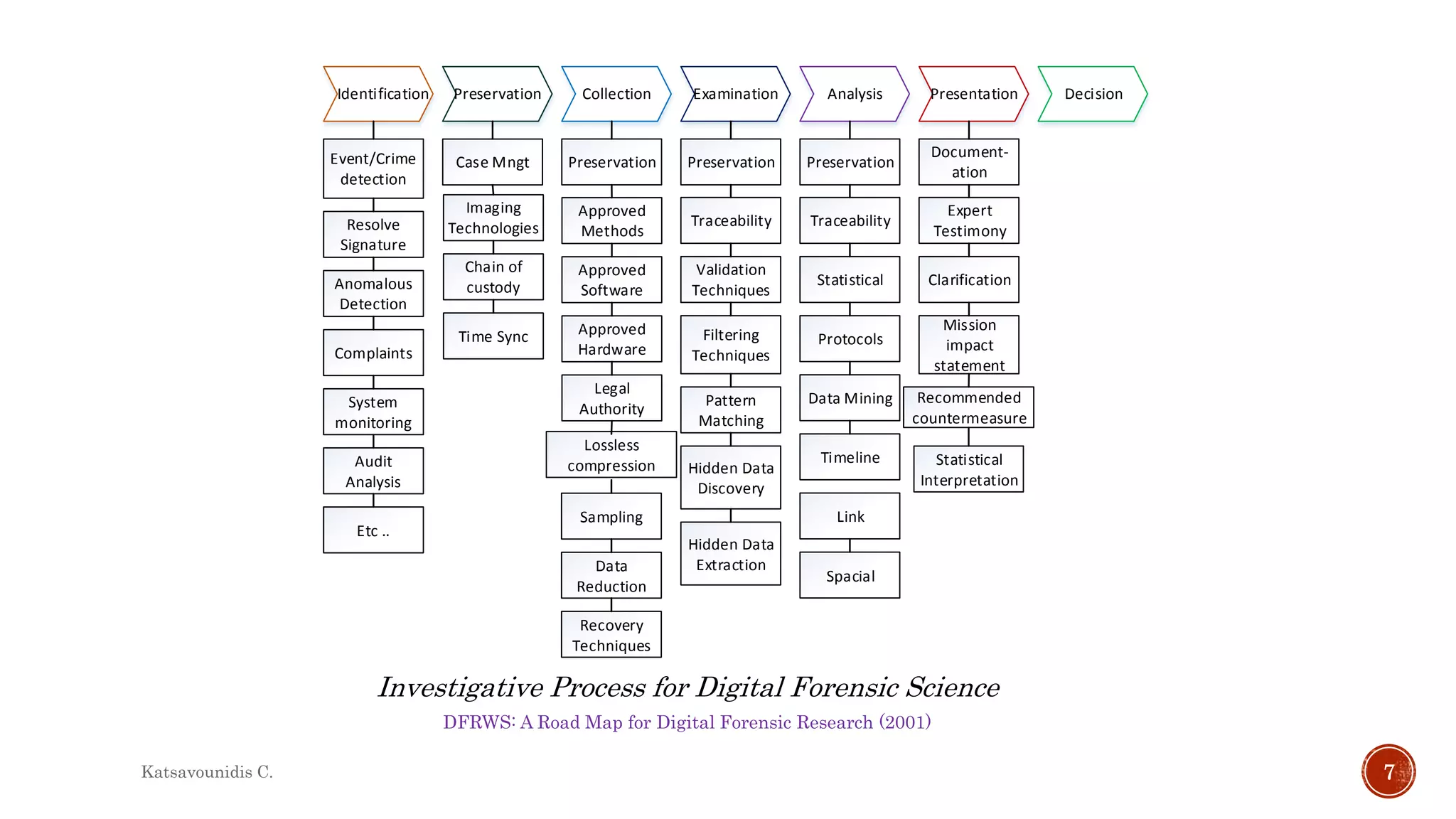
DFRWS: A Road Map for Digital Forensic Research (2001)
Investigative Process for Digital Forensic Science
Identification Preservation Collection Examination Analysis Presentation Decision
Event/Crime
detection
Resolve
Signature
Anomalous
Detection
Complaints
System
monitoring
Audit
Analysis
Etc ..
Case Mngt
Imaging
Technologies
Chain of
custody
Time Sync
Preservation
Approved
Methods
Approved
Software
Approved
Hardware
Legal
Authority
Lossless
compression
Sampling
Data
Reduction
Recovery
Techniques
Preservation Preservation
Document-
ation
Traceability Traceability
Validation
Techniques
Statistical
Protocols
Data Mining
Timeline
Link
Spacial
Filtering
Techniques
Pattern
Matching
Hidden Data
Discovery
Hidden Data
Extraction
Expert
Testimony
Clarification
Mission
impact
statement
Recommended
countermeasure
Statistical
Interpretation
Katsavounidis C. 7
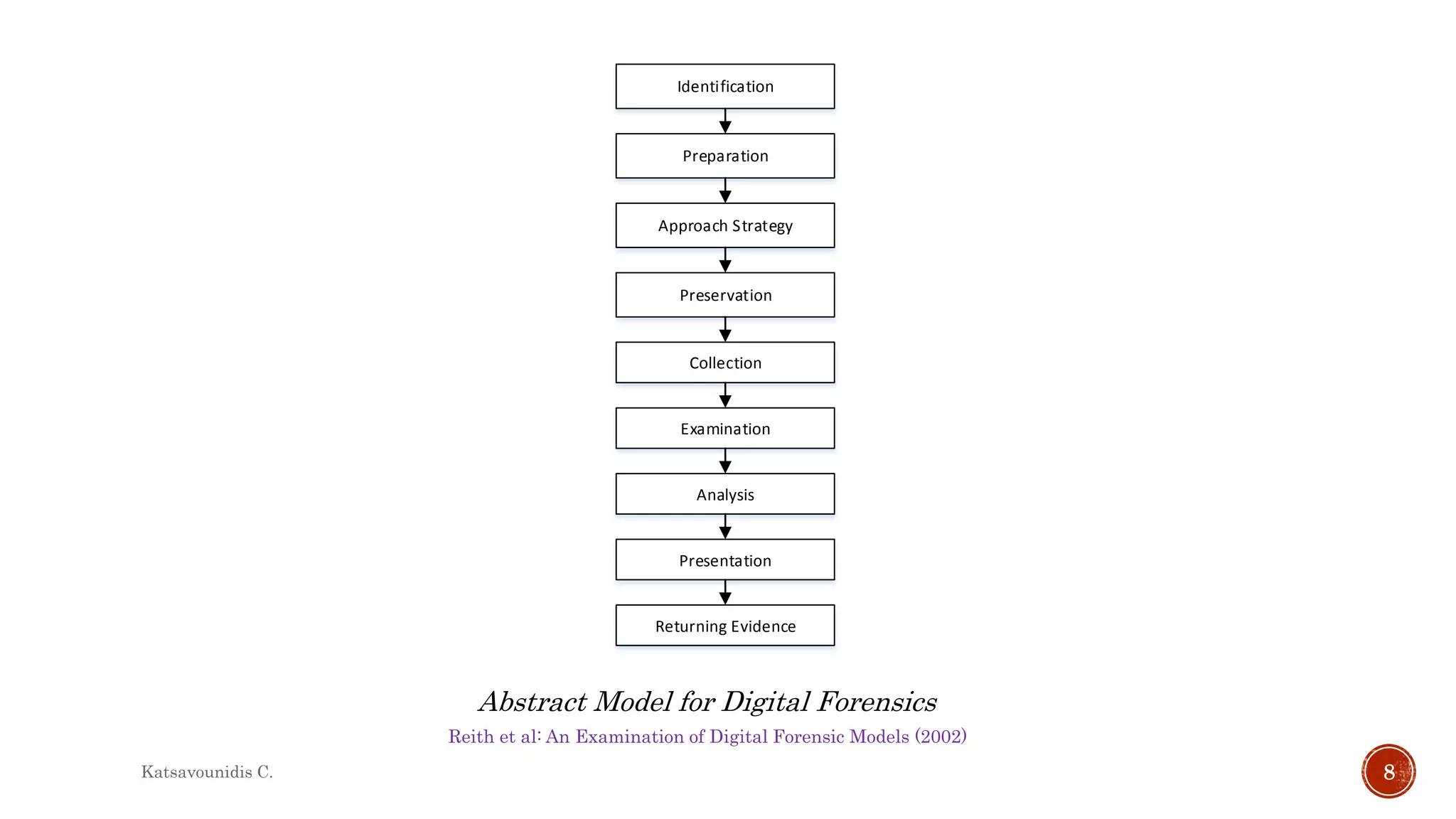
Reith et al: An Examination of Digital Forensic Models (2002)
Abstract Model for Digital Forensics
Identification
Preparation
Approach Strategy
Preservation
Collection
Examination
Analysis
Presentation
Returning Evidence
Katsavounidis C. 8
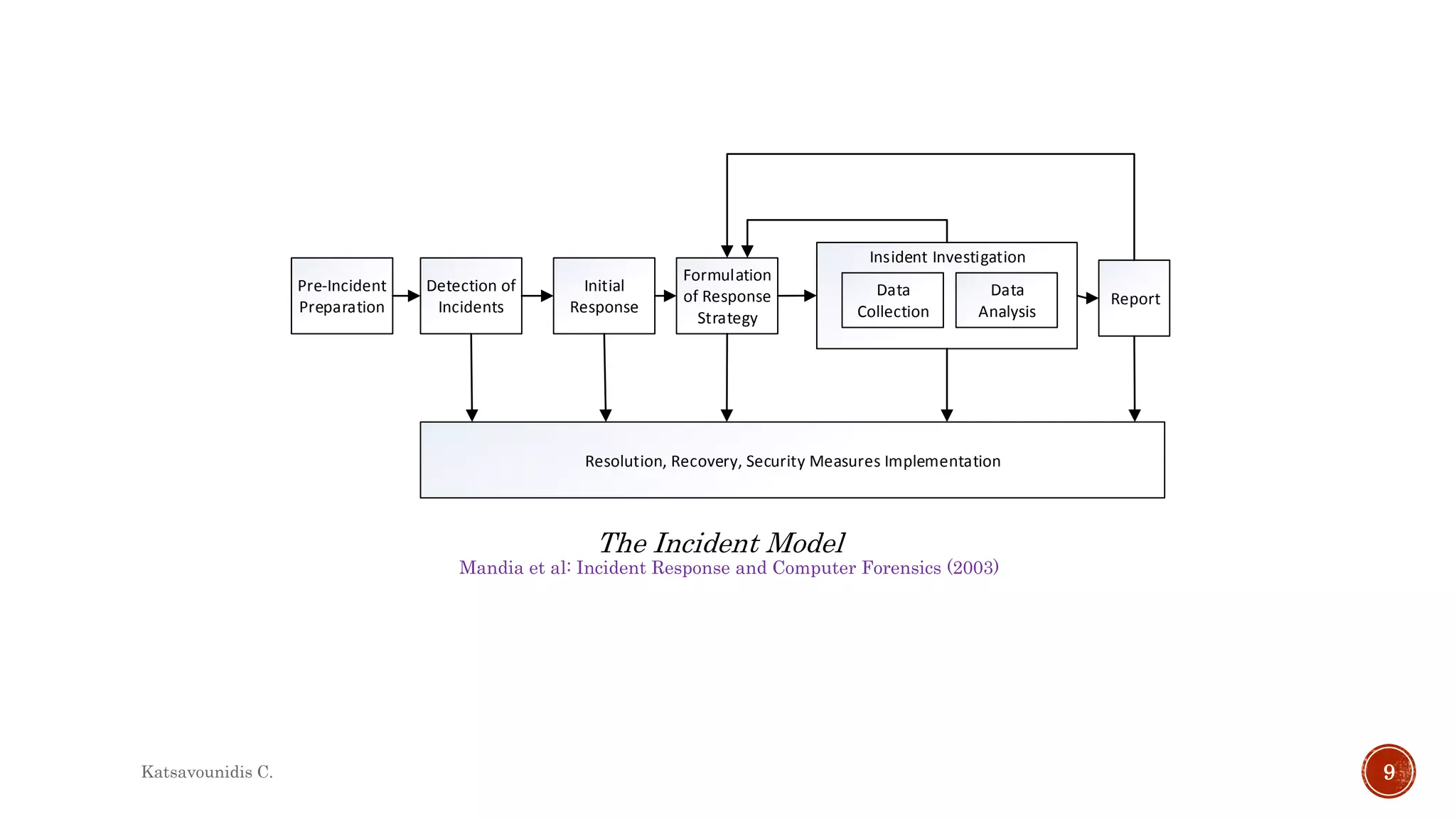
Mandia et al: Incident Response and Computer Forensics (2003)
The Incident Model
Pre-Incident
Preparation
Detection of
Incidents
Initial
Response
Formulation
of Response
Strategy
Report
Insident Investigation
Data
Collection
Data
Analysis
Resolution, Recovery, Security Measures Implementation
Katsavounidis C. 9
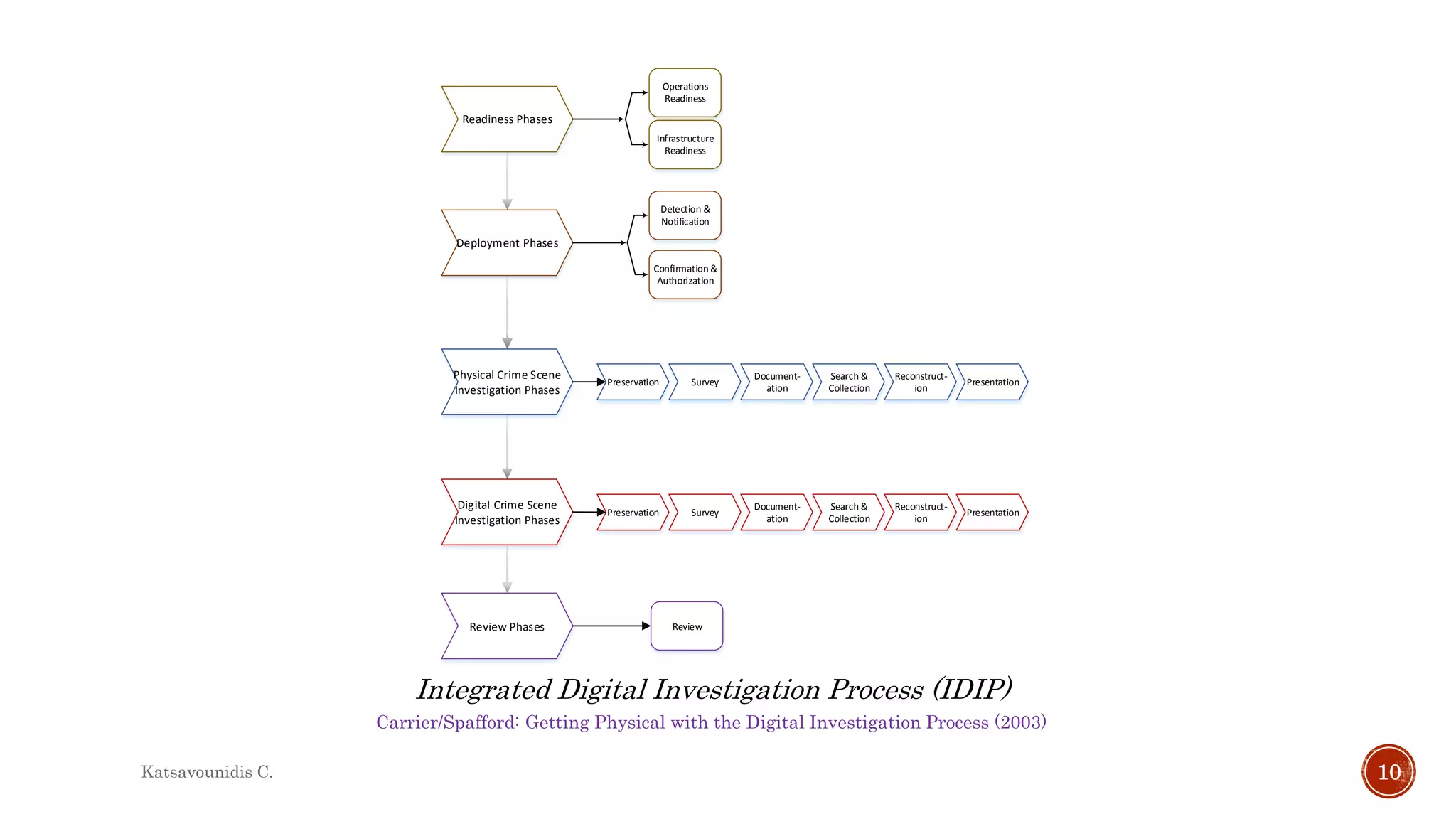
Carrier/Spafford: Getting Physical with the Digital Investigation Process (2003)
Integrated Digital Investigation Process (IDIP)
Readiness Phases
Deployment Phases
Physical Crime Scene
Investigation Phases
Digital Crime Scene
Investigation Phases
Review Phases
Operations
Readiness
Infrastructure
Readiness
Detection &
Notification
Confirmation &
Authorization
Preservation Survey
Document-
ation
Search &
Collection
Reconstruct-
ion
Presentation
Preservation Survey
Document-
ation
Search &
Collection
Reconstruct-
ion
Presentation
Review
Katsavounidis C. 10
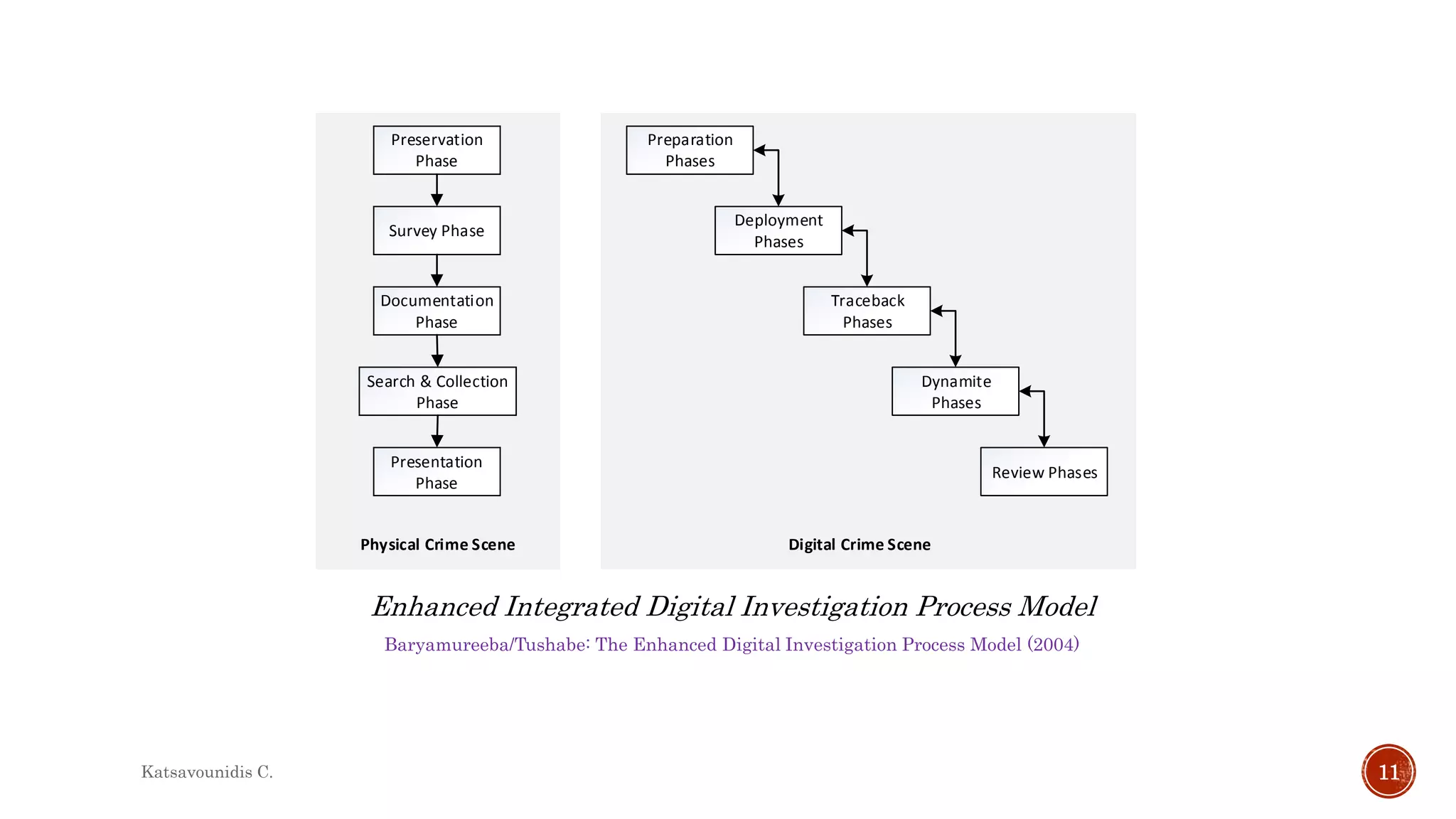
Baryamureeba/Tushabe: The Enhanced Digital Investigation Process Model (2004)
Enhanced Integrated Digital Investigation Process Model
Preparation
Phases
Deployment
Phases
Traceback
Phases
Dynamite
Phases
Review Phases
Digital Crime Scene
Preservation
Phase
Survey Phase
Documentation
Phase
Search & Collection
Phase
Presentation
Phase
Physical Crime Scene
Katsavounidis C. 11
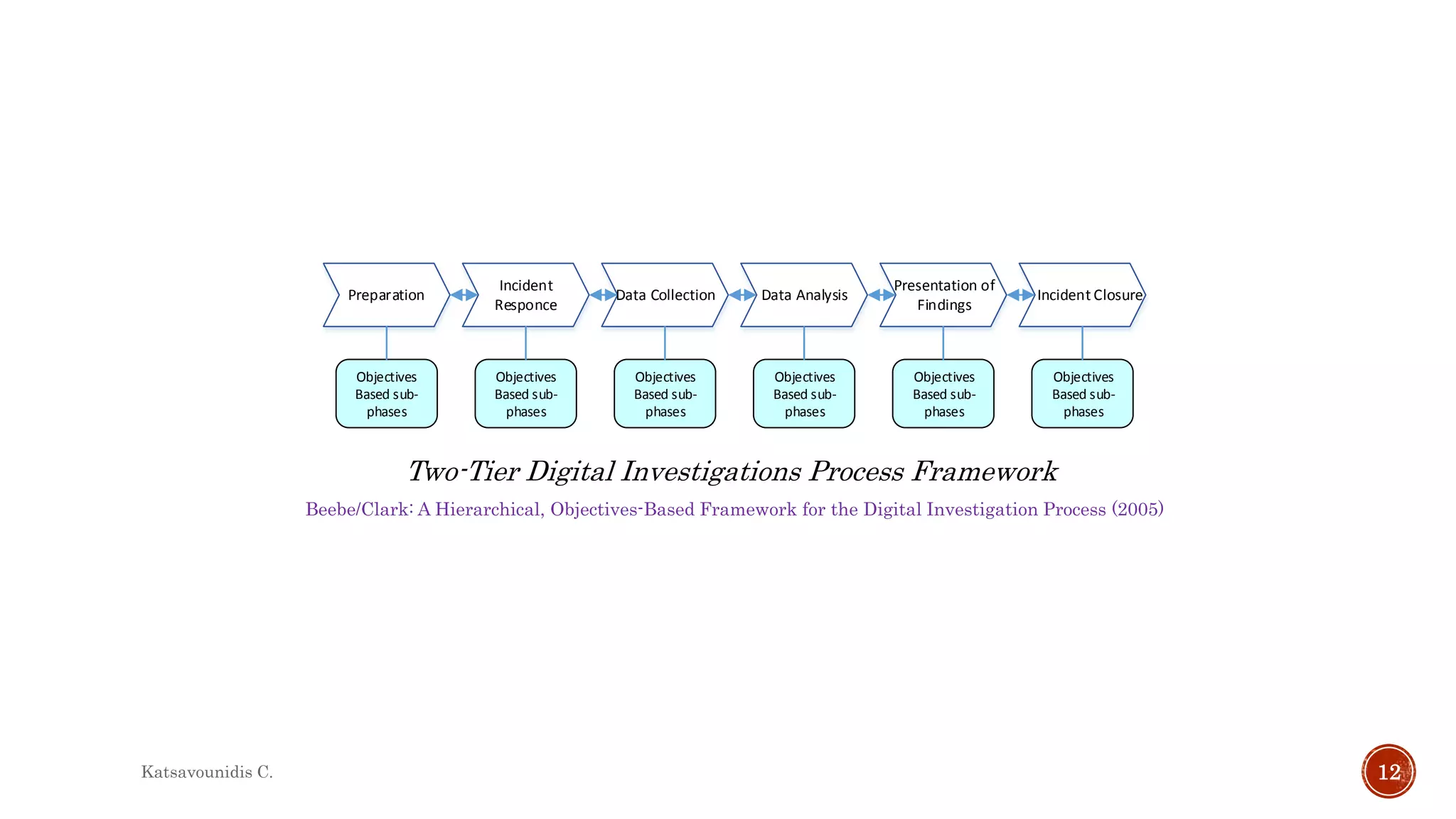
Beebe/Clark: A Hierarchical, Objectives-Based Framework for the Digital Investigation Process (2005)
Two-Tier Digital Investigations Process Framework
Preparation
Incident
Responce
Data Collection Data Analysis
Presentation of
Findings
Incident Closure
Objectives
Based sub-
phases
Objectives
Based sub-
phases
Objectives
Based sub-
phases
Objectives
Based sub-
phases
Objectives
Based sub-
phases
Objectives
Based sub-
phases
Katsavounidis C. 12
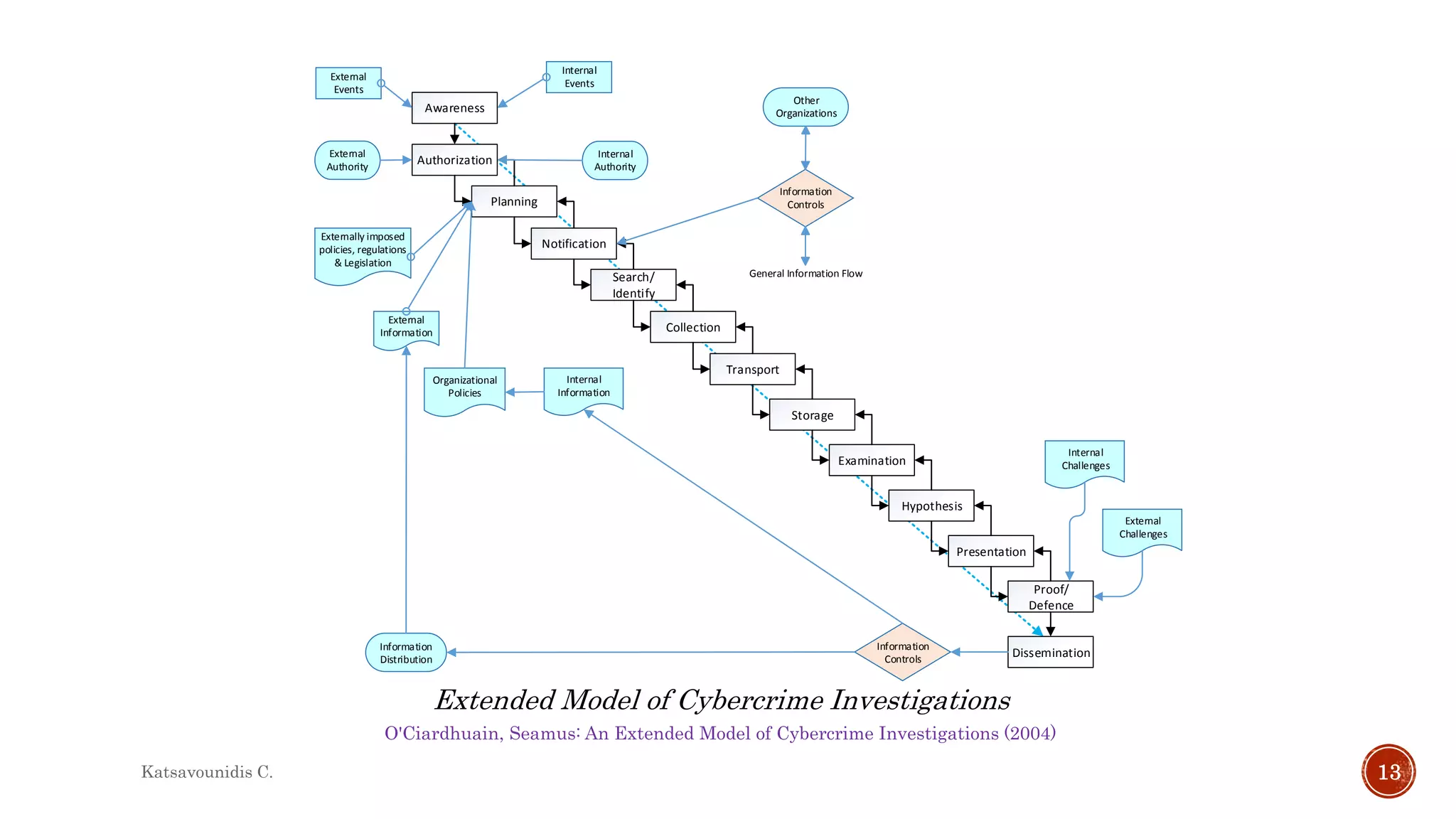
O'Ciardhuain, Seamus: An Extended Model of Cybercrime Investigations (2004)
Extended Model of Cybercrime Investigations
Awareness
Authorization
Planning
Notification
Search/
Identify
Collection
Transport
Storage
Examination
Hypothesis
Presentation
Proof/
Defence
Dissemination
External
Events
External
Authority
Externally imposed
policies, regulations
& Legislation
External
Information
Information
Distribution
Organizational
Policies
Internal
Information
Information
Controls
Internal
Authority
Internal
Events
Information
Controls
General Information Flow
Other
Organizations
Internal
Challenges
External
Challenges
Katsavounidis C. 13
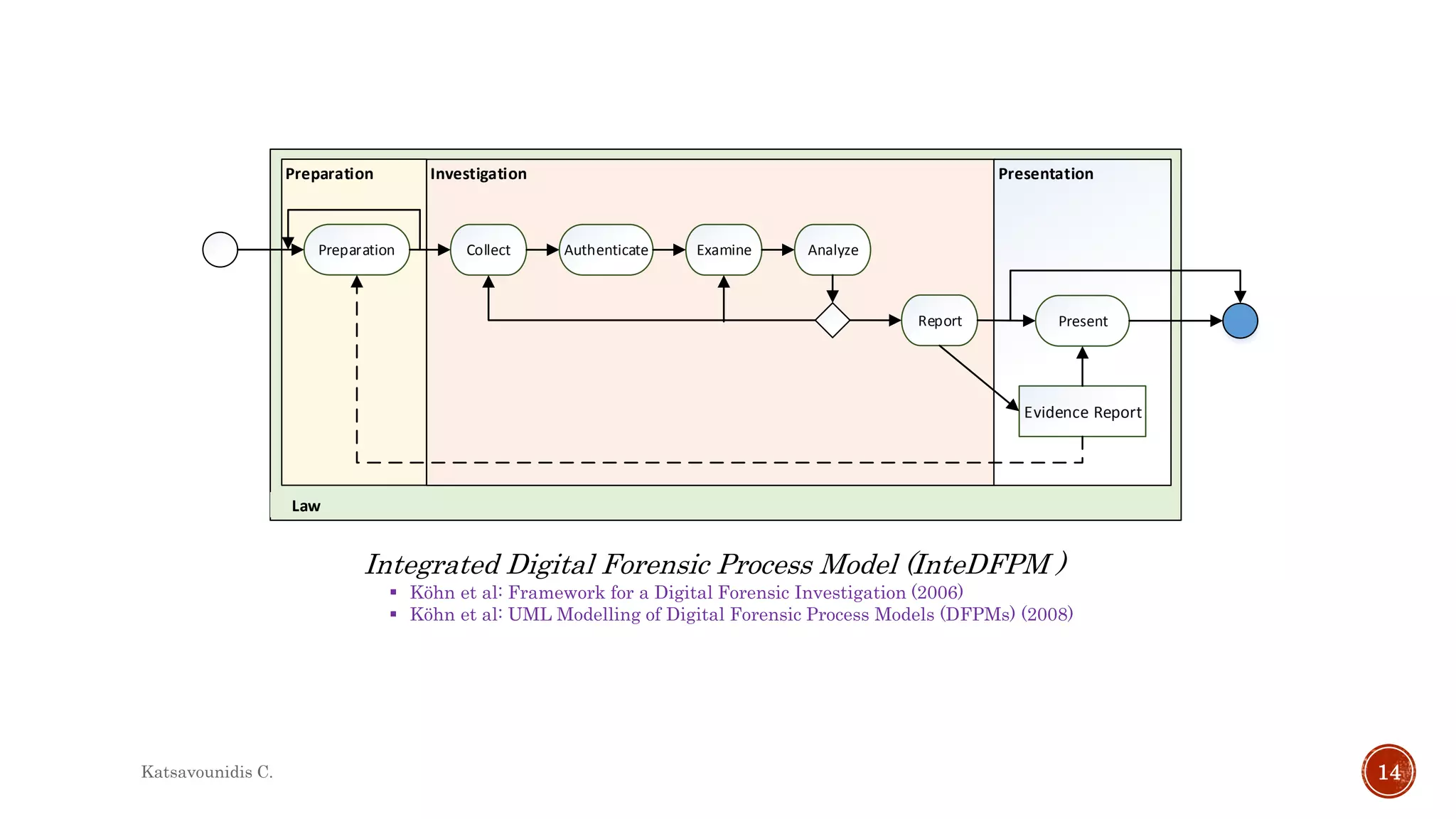
 Köhn et al: Framework for a Digital Forensic Investigation (2006)
 Köhn et al: UML Modelling of Digital Forensic Process Models (DFPMs) (2008)
Integrated Digital Forensic Process Model (InteDFPM )
Preparation Investigation Presentation
Law
Preparation Collect Authenticate Examine Analyze
Report Present
Evidence Report
Katsavounidis C. 14
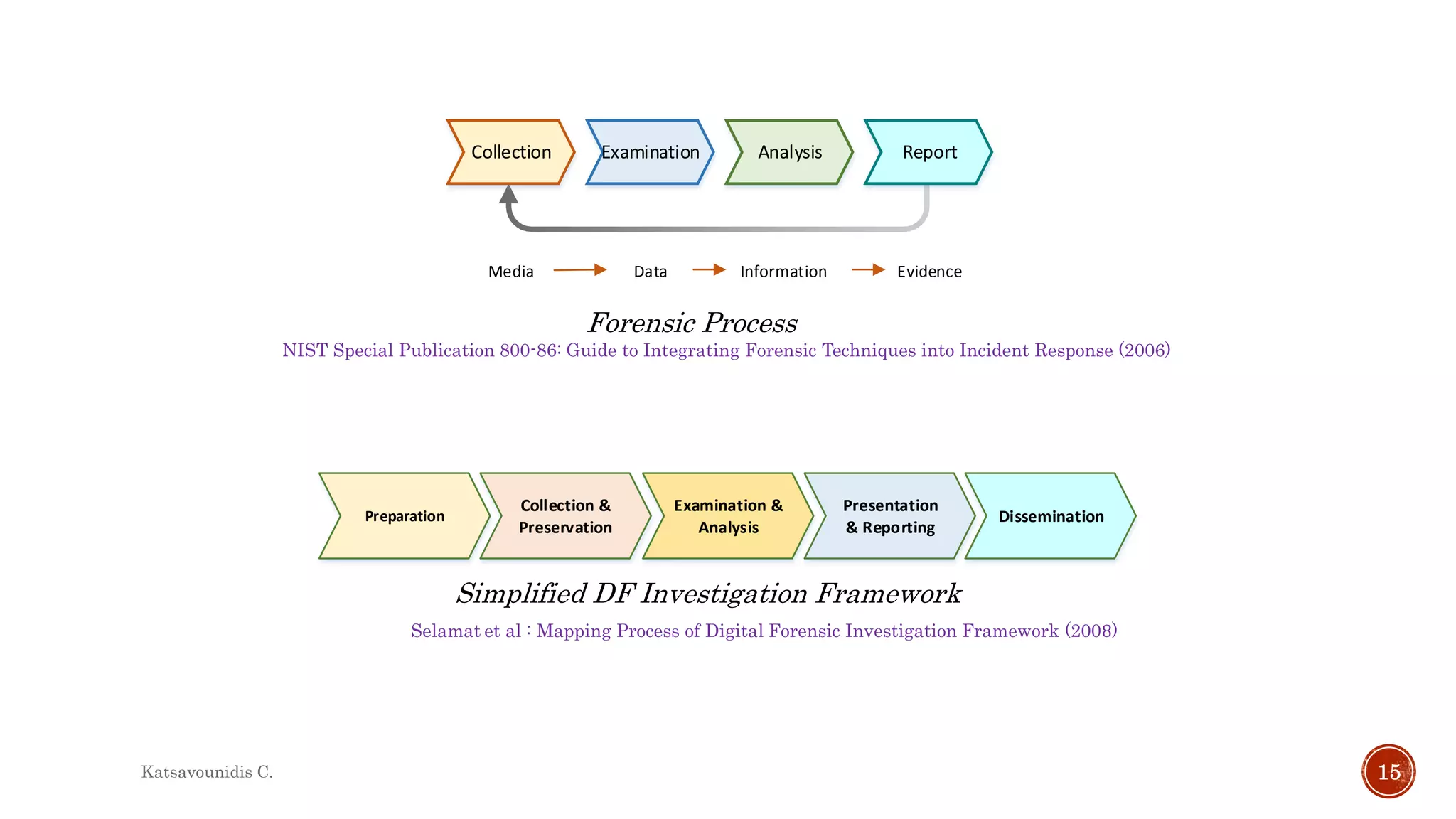
NIST Special Publication 800-86: Guide to Integrating Forensic Techniques into Incident Response (2006)
Forensic Process
Collection Examination Analysis Report
Media Data Information Evidence
Selamat et al : Mapping Process of Digital Forensic Investigation Framework (2008)
Simplified DF Investigation Framework
Preparation
Presentation
& Reporting
Collection &
Preservation
Dissemination
Examination &
Analysis
Katsavounidis C. 15
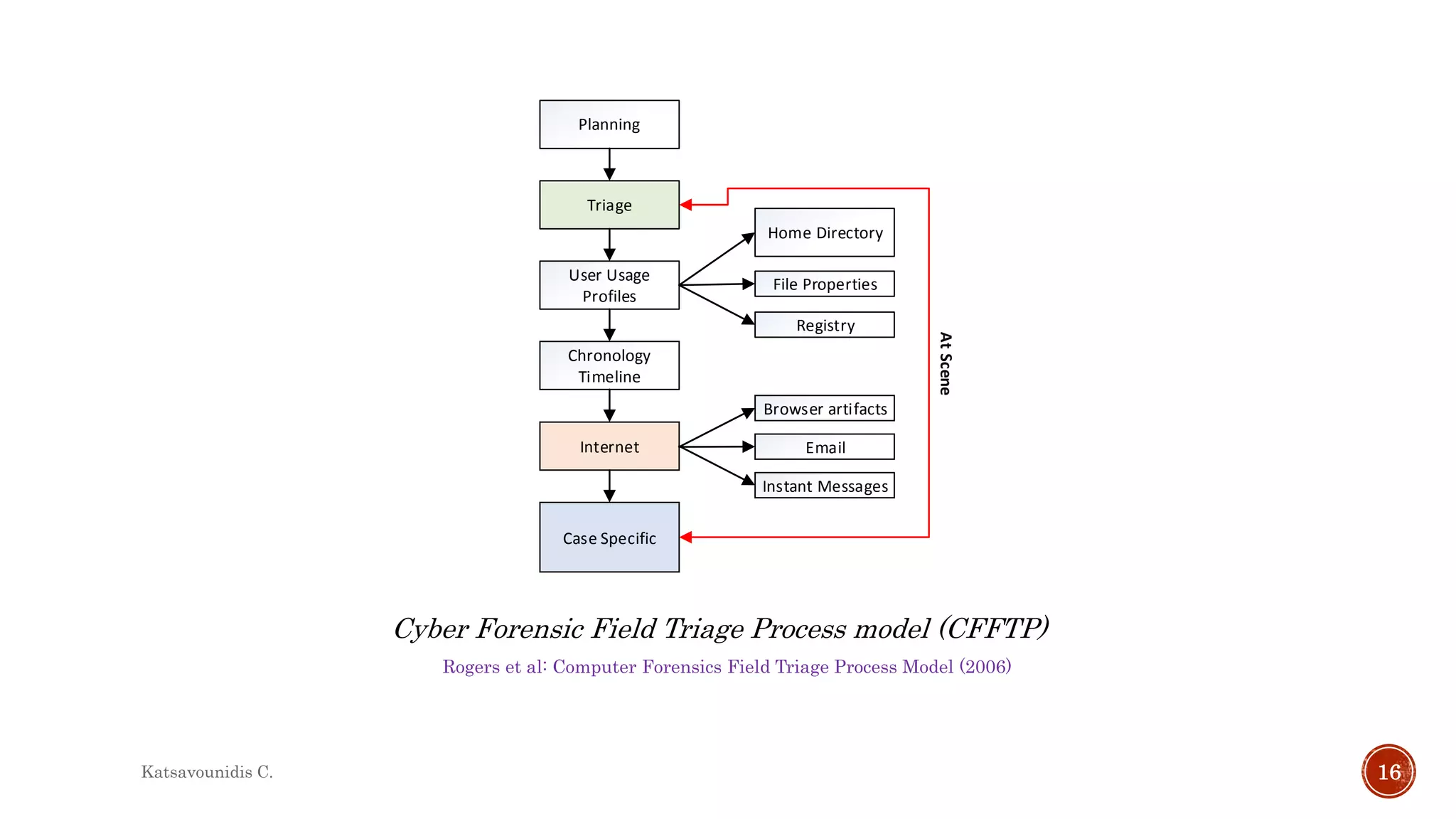
Rogers et al: Computer Forensics Field Triage Process Model (2006)
Cyber Forensic Field Triage Process model (CFFTP)
Planning
Triage
User Usage
Profiles
Home Directory
File Properties
Registry
Chronology
Timeline
Internet
Case Specific
Email
Browser artifacts
Instant Messages
AtScene
Katsavounidis C. 16
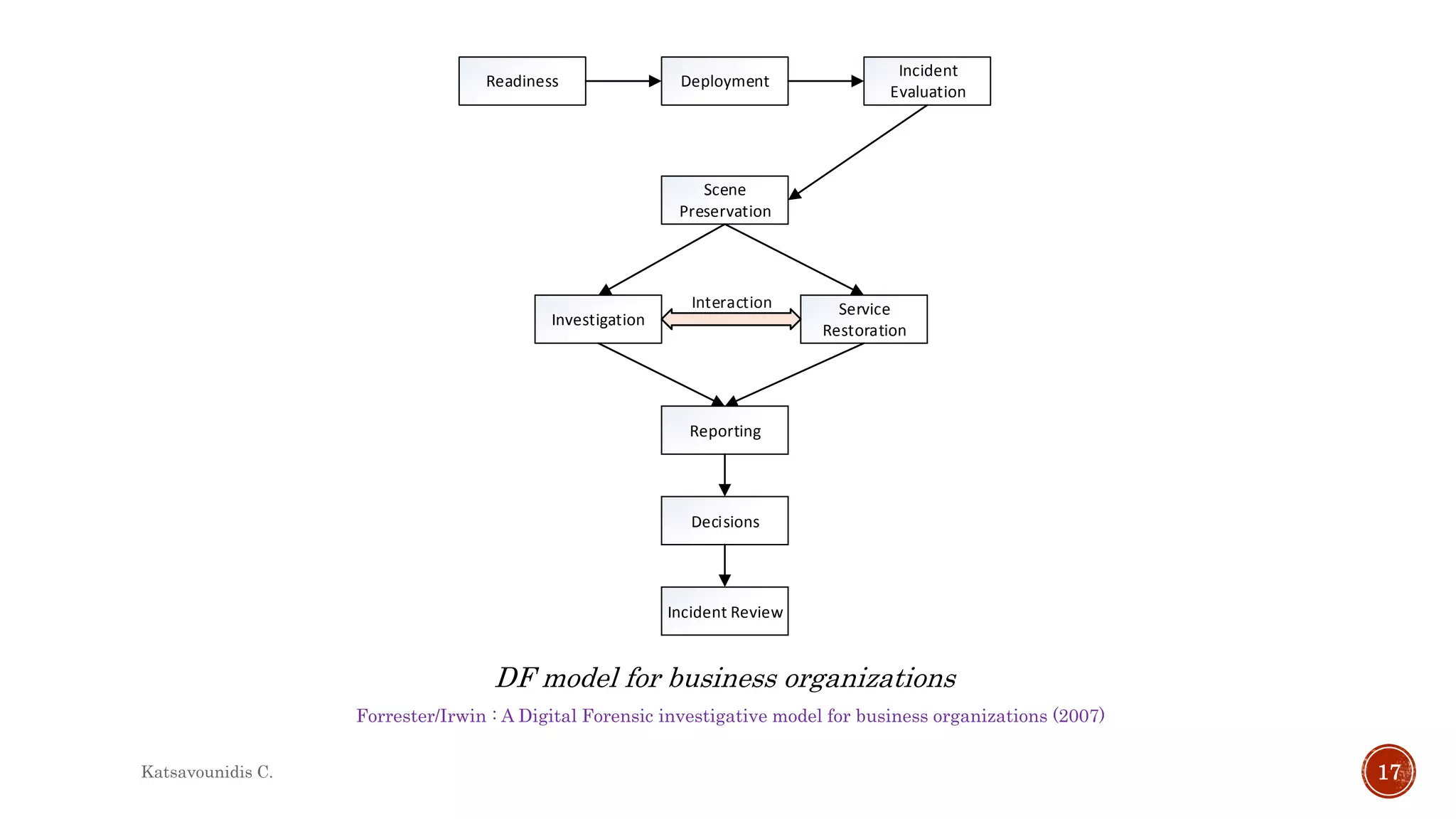
Forrester/Irwin : A Digital Forensic investigative model for business organizations (2007)
DF model for business organizations
Readiness Deployment
Incident
Evaluation
Scene
Preservation
Investigation
Service
Restoration
Reporting
Decisions
Incident Review
Interaction
Katsavounidis C. 17
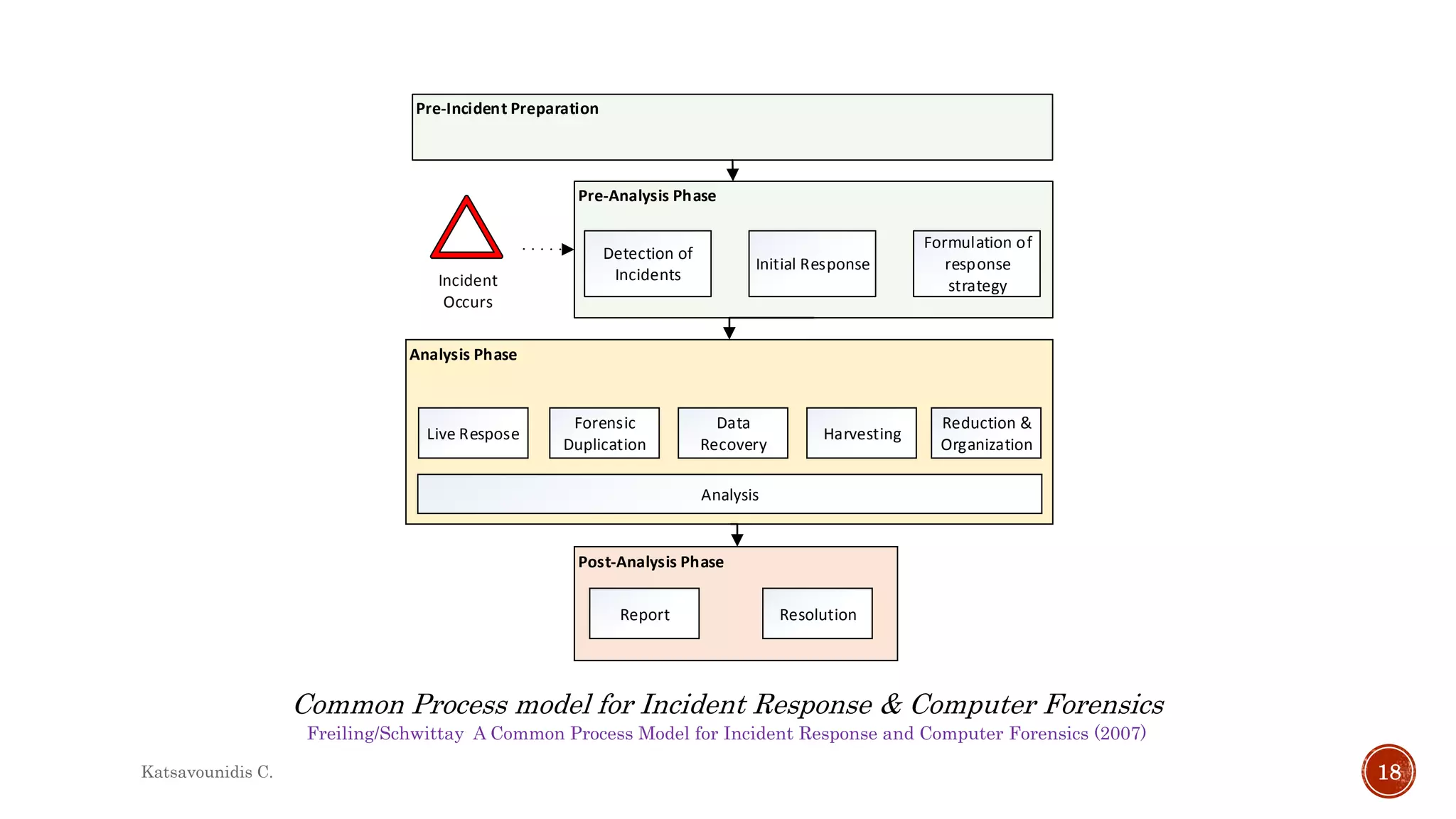
Freiling/Schwittay A Common Process Model for Incident Response and Computer Forensics (2007)
Common Process model for Incident Response & Computer Forensics
Pre-Analysis Phase
Detection of
Incidents
Initial Response
Formulation of
response
strategy
Pre-Incident Preparation
Incident
Occurs
Analysis Phase
Live Respose
Forensic
Duplication
Data
Recovery
Harvesting
Reduction &
Organization
Analysis
Post-Analysis Phase
Report Resolution
Katsavounidis C. 18
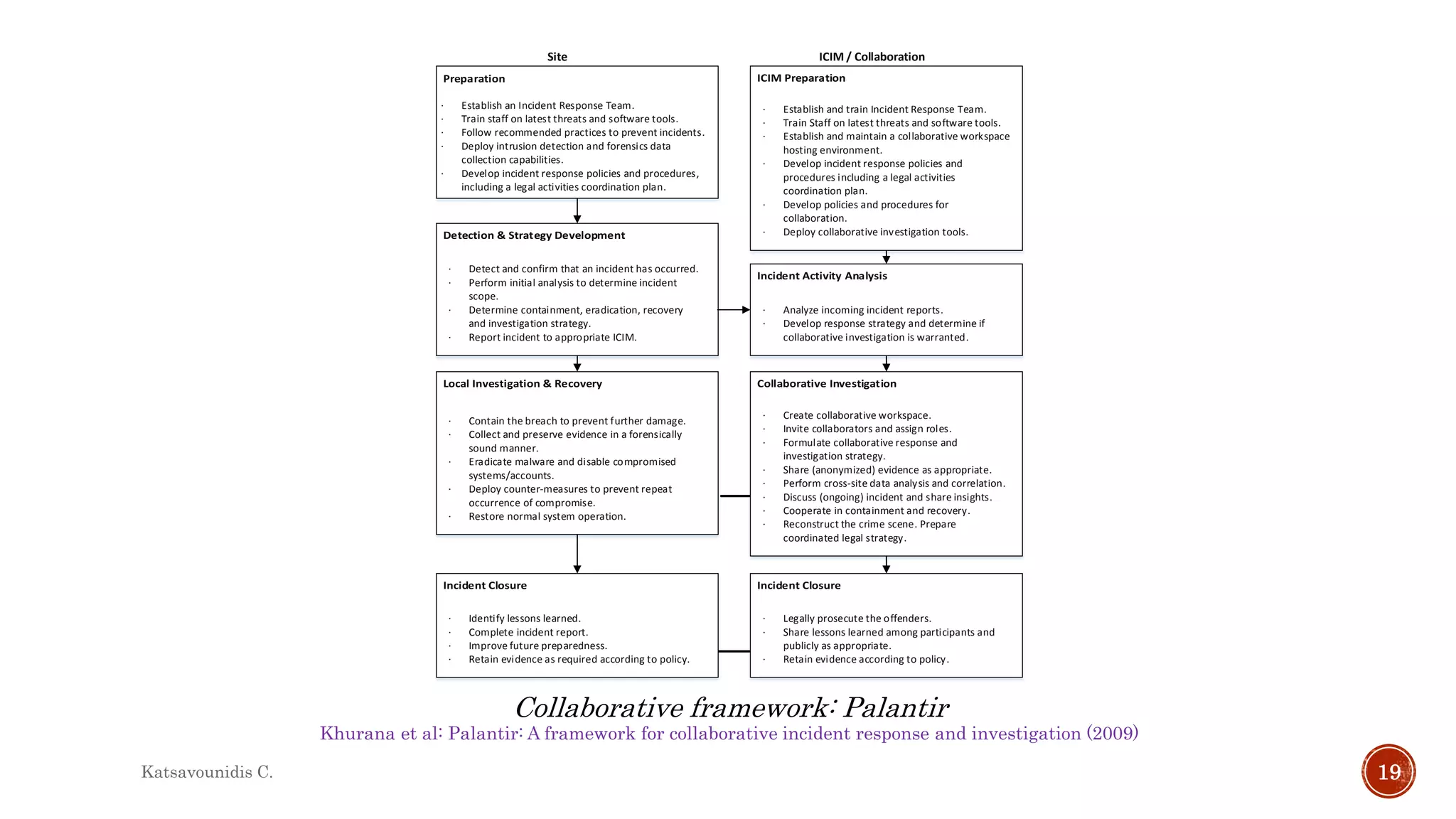
Khurana et al: Palantir: A framework for collaborative incident response and investigation (2009)
Collaborative framework: Palantir
· Establish an Incident Response Team.
· Train staff on latest threats and software tools.
· Follow recommended practices to prevent incidents.
· Deploy intrusion detection and forensics data
collection capabilities.
· Develop incident response policies and procedures,
including a legal activities coordination plan.
· Detect and confirm that an incident has occurred.
· Perform initial analysis to determine incident
scope.
· Determine containment, eradication, recovery
and investigation strategy.
· Report incident to appropriate ICIM.
· Identify lessons learned.
· Complete incident report.
· Improve future preparedness.
· Retain evidence as required according to policy.
· Establish and train Incident Response Team.
· Train Staff on latest threats and software tools.
· Establish and maintain a collaborative workspace
hosting environment.
· Develop incident response policies and
procedures including a legal activities
coordination plan.
· Develop policies and procedures for
collaboration.
· Deploy collaborative investigation tools.
· Analyze incoming incident reports.
· Develop response strategy and determine if
collaborative investigation is warranted.
· Create collaborative workspace.
· Invite collaborators and assign roles.
· Formulate collaborative response and
investigation strategy.
· Share (anonymized) evidence as appropriate.
· Perform cross-site data analysis and correlation.
· Discuss (ongoing) incident and share insights.
· Cooperate in containment and recovery.
· Reconstruct the crime scene. Prepare
coordinated legal strategy.
· Legally prosecute the offenders.
· Share lessons learned among participants and
publicly as appropriate.
· Retain evidence according to policy.
· Contain the breach to prevent further damage.
· Collect and preserve evidence in a forensically
sound manner.
· Eradicate malware and disable compromised
systems/accounts.
· Deploy counter-measures to prevent repeat
occurrence of compromise.
· Restore normal system operation.
Site ICIM / Collaboration
Katsavounidis C. 19
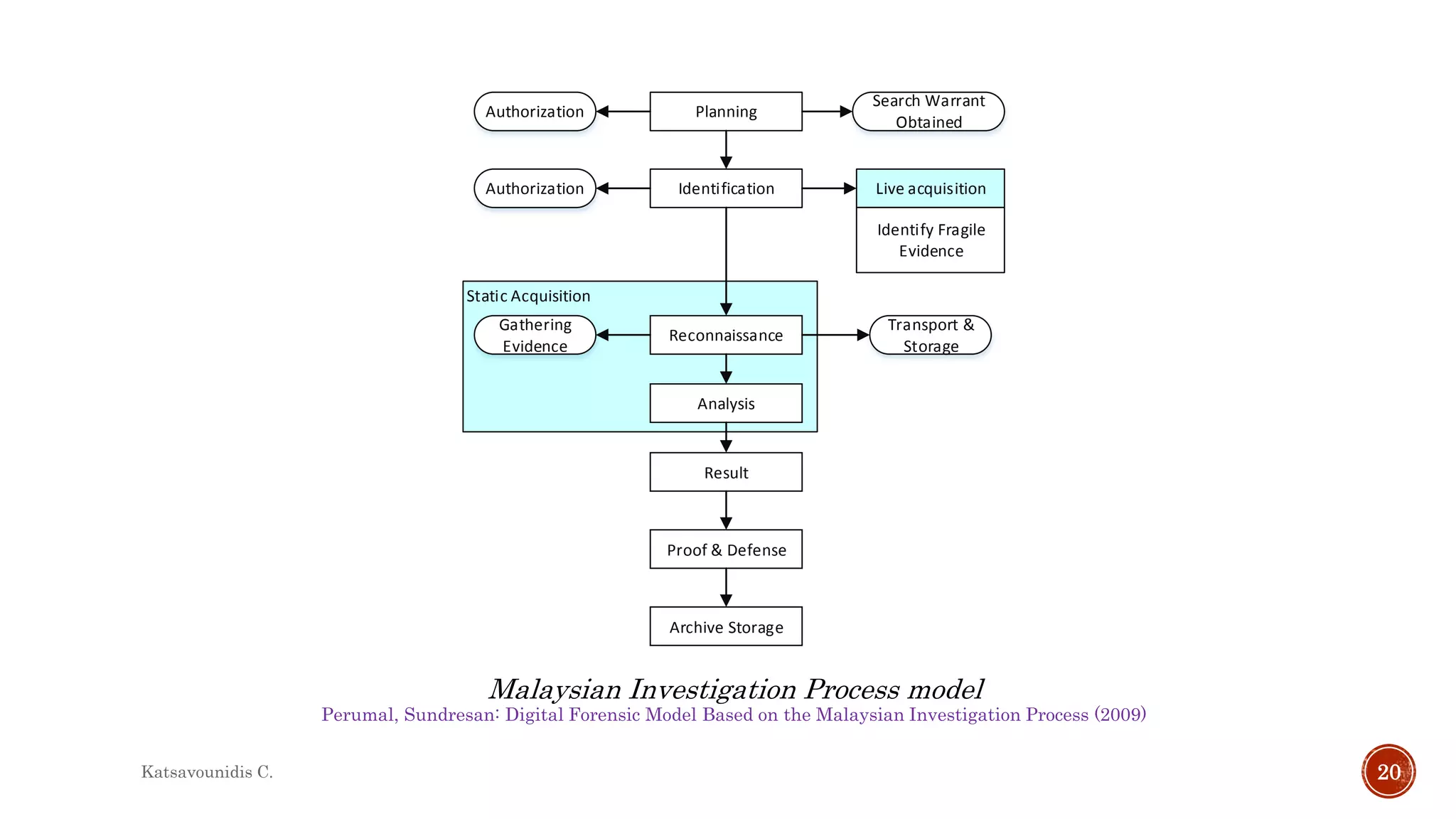
Perumal, Sundresan: Digital Forensic Model Based on the Malaysian Investigation Process (2009)
Malaysian Investigation Process model
Static Acquisition
Authorization
Search Warrant
Obtained
Planning
IdentificationAuthorization Live acquisition
Identify Fragile
Evidence
Reconnaissance
Gathering
Evidence
Transport &
Storage
Analysis
Result
Proof & Defense
Archive Storage
Katsavounidis C. 20
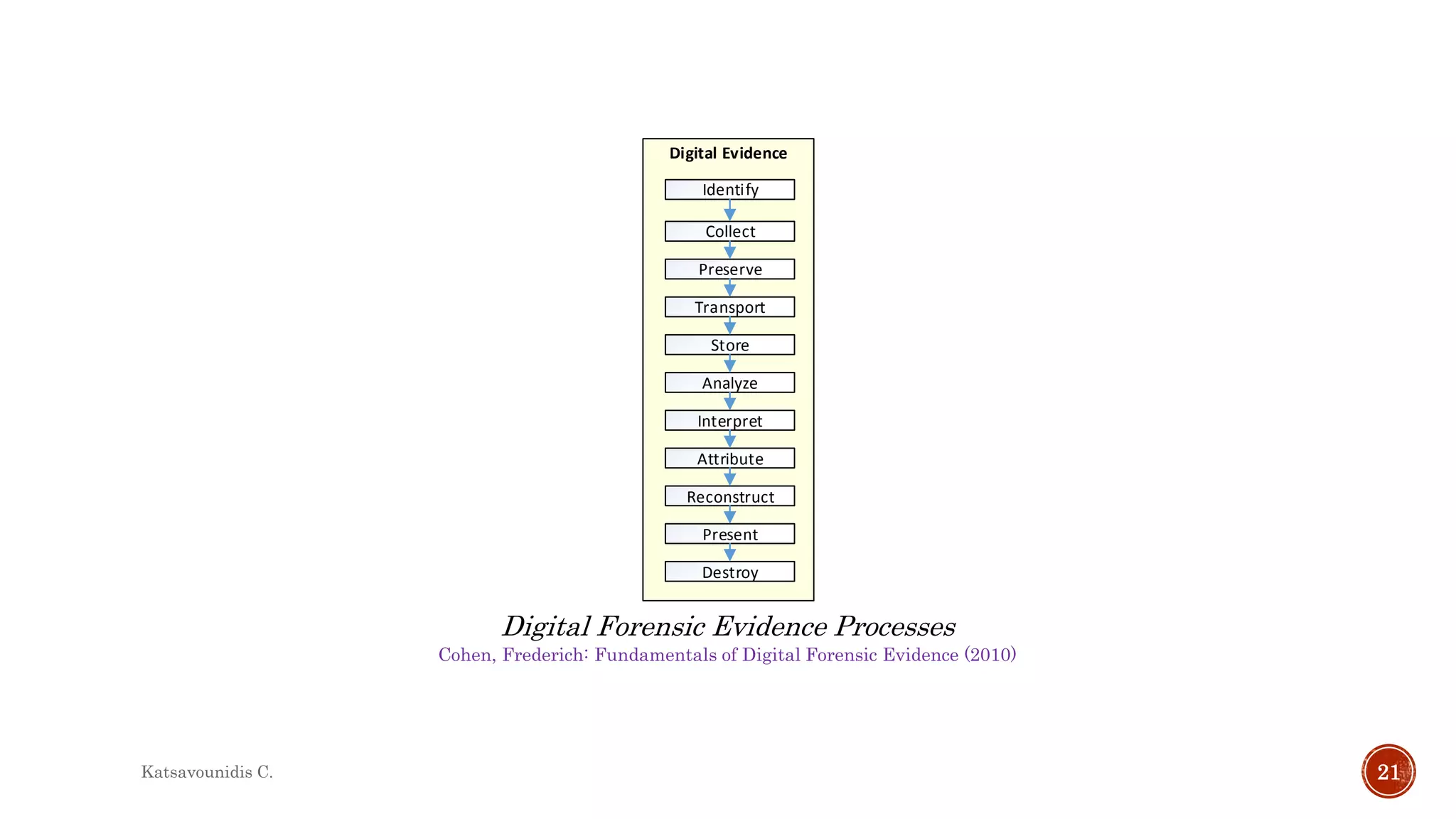
Cohen, Frederich: Fundamentals of Digital Forensic Evidence (2010)
Digital Forensic Evidence Processes
Digital Evidence
Identify
Collect
Preserve
Transport
Store
Analyze
Interpret
Attribute
Reconstruct
Present
Destroy
Katsavounidis C. 21
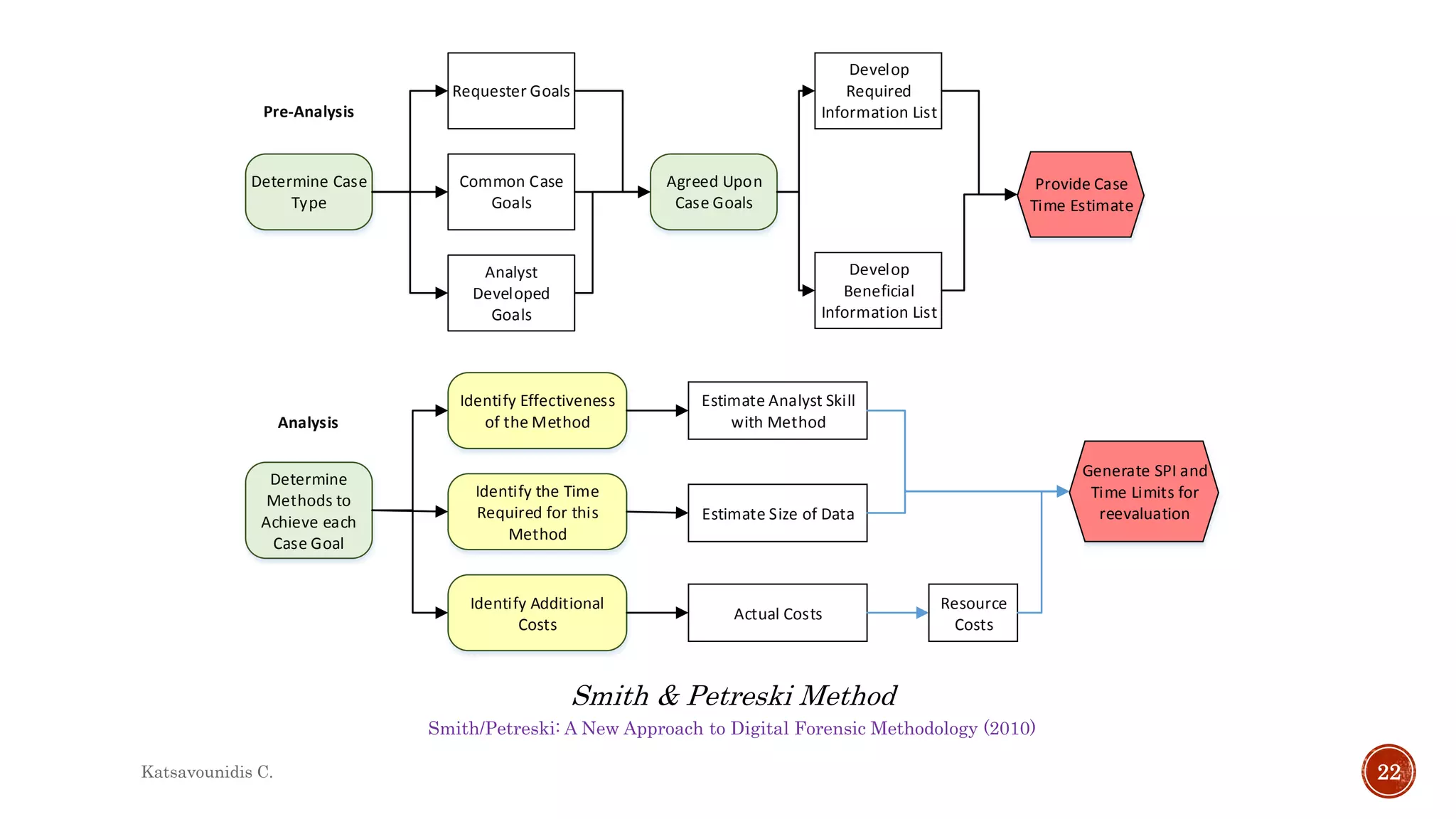
Smith/Petreski: A New Approach to Digital Forensic Methodology (2010)
Smith & Petreski Method
Determine Case
Type
Requester Goals
Common Case
Goals
Analyst
Developed
Goals
Agreed Upon
Case Goals
Develop
Required
Information List
Develop
Beneficial
Information List
Provide Case
Time Estimate
Determine
Methods to
Achieve each
Case Goal
Pre-Analysis
Analysis
Identify Effectiveness
of the Method
Identify the Time
Required for this
Method
Identify Additional
Costs
Estimate Analyst Skill
with Method
Estimate Size of Data
Actual Costs
Resource
Costs
Generate SPI and
Time Limits for
reevaluation
Katsavounidis C. 22
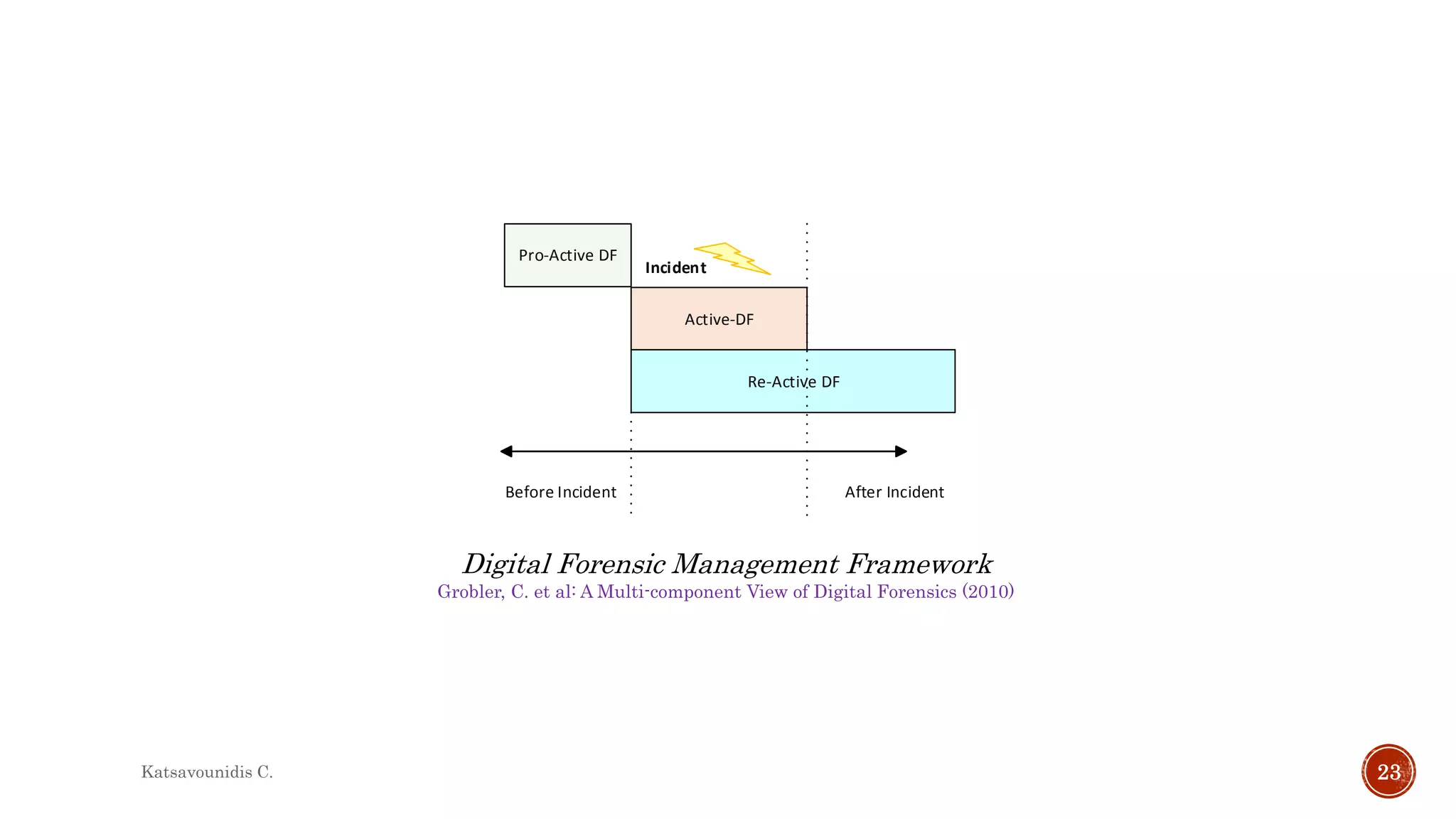
Grobler, C. et al: A Multi-component View of Digital Forensics (2010)
Digital Forensic Management Framework
Pro-Active DF
Active-DF
Re-Active DF
Incident
Before Incident After Incident
Katsavounidis C. 23
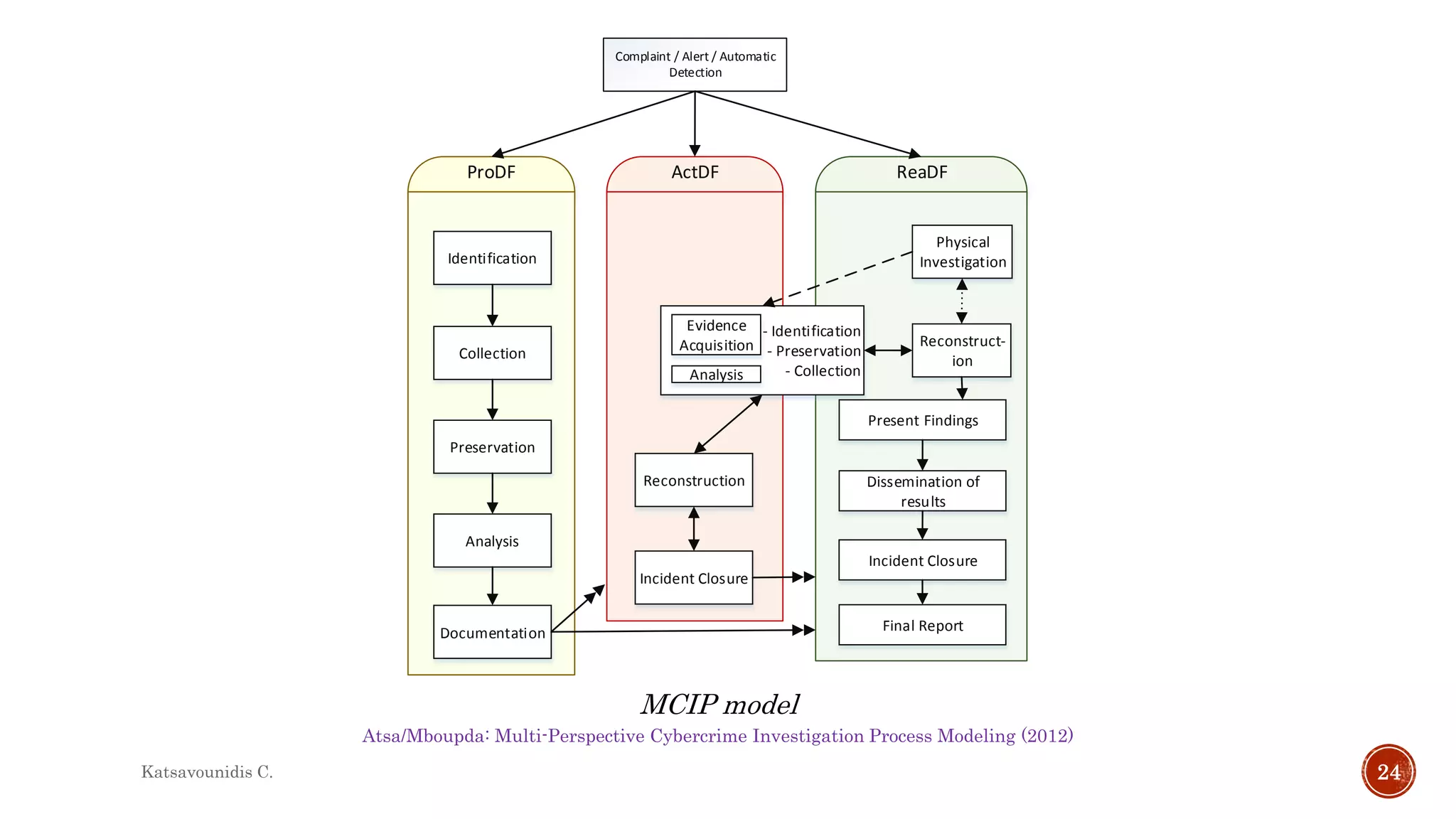
Atsa/Mboupda: Multi-Perspective Cybercrime Investigation Process Modeling (2012)
MCIP model
ReaDFProDF ActDF
Complaint / Alert / Automatic
Detection
Identification
Collection
Preservation
Analysis
Documentation
Incident Closure
Reconstruction
- Identification
- Preservation
- Collection
Evidence
Acquisition
Analysis
Physical
Investigation
Reconstruct-
ion
Present Findings
Dissemination of
results
Incident Closure
Final Report
Katsavounidis C. 24
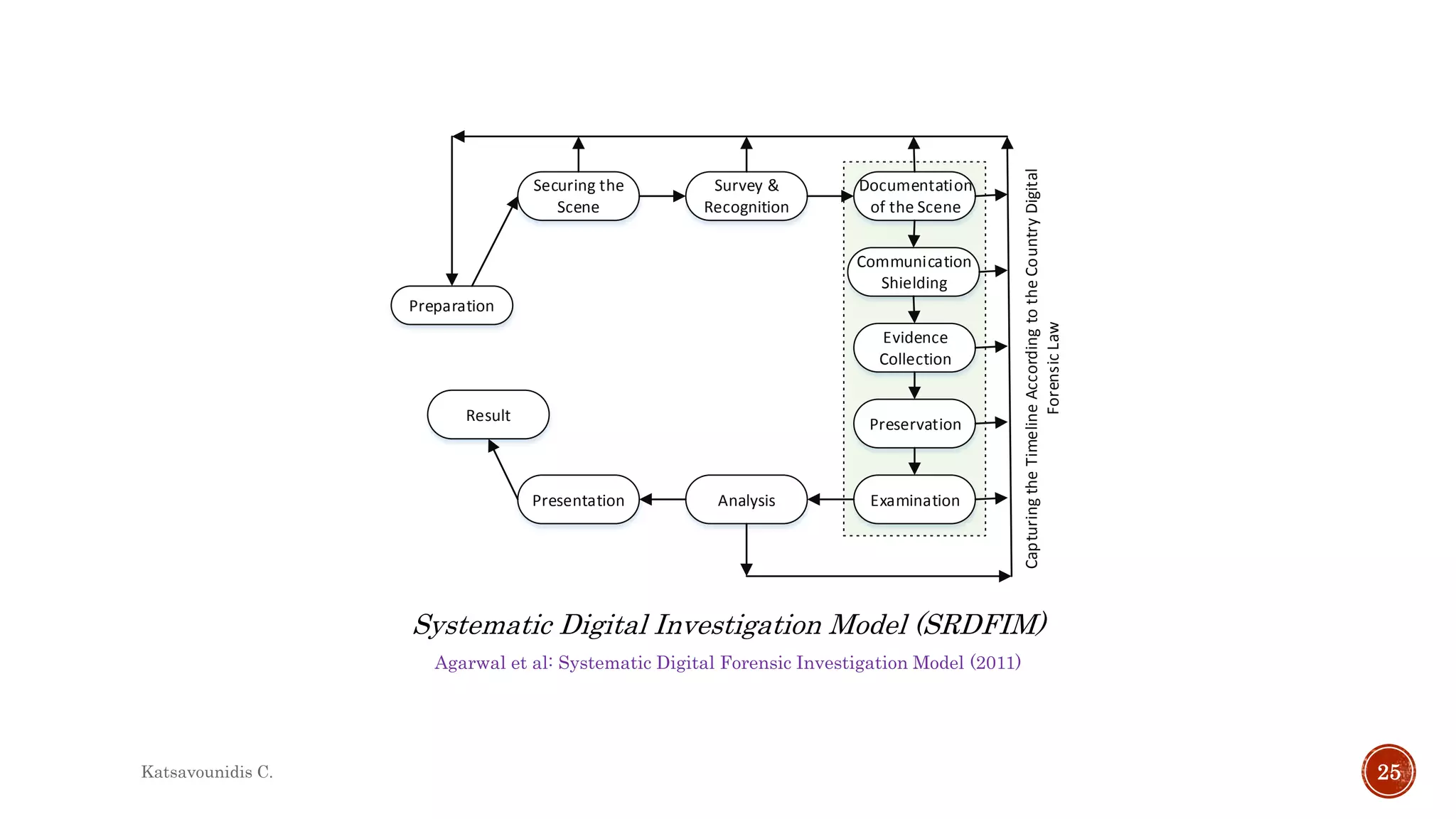
Agarwal et al: Systematic Digital Forensic Investigation Model (2011)
Systematic Digital Investigation Model (SRDFIM)
Preparation
Securing the
Scene
Survey &
Recognition
Documentation
of the Scene
Communication
Shielding
Evidence
Collection
Preservation
ExaminationAnalysisPresentation
Result
CapturingtheTimelineAccordingtotheCountryDigital
ForensicLaw
Katsavounidis C. 25
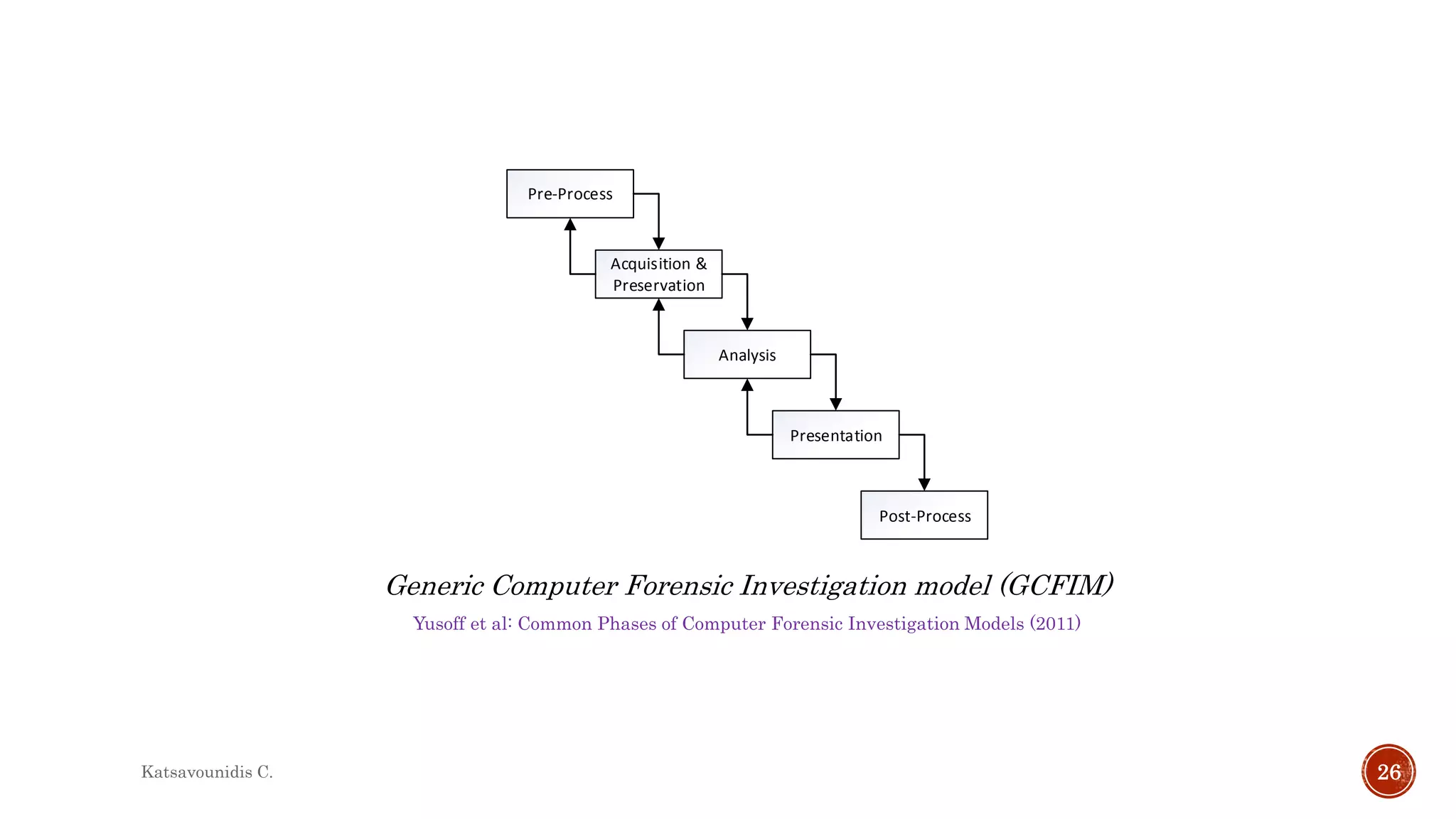
Yusoff et al: Common Phases of Computer Forensic Investigation Models (2011)
Generic Computer Forensic Investigation model (GCFIM)
Pre-Process
Acquisition &
Preservation
Analysis
Presentation
Post-Process
Katsavounidis C. 26
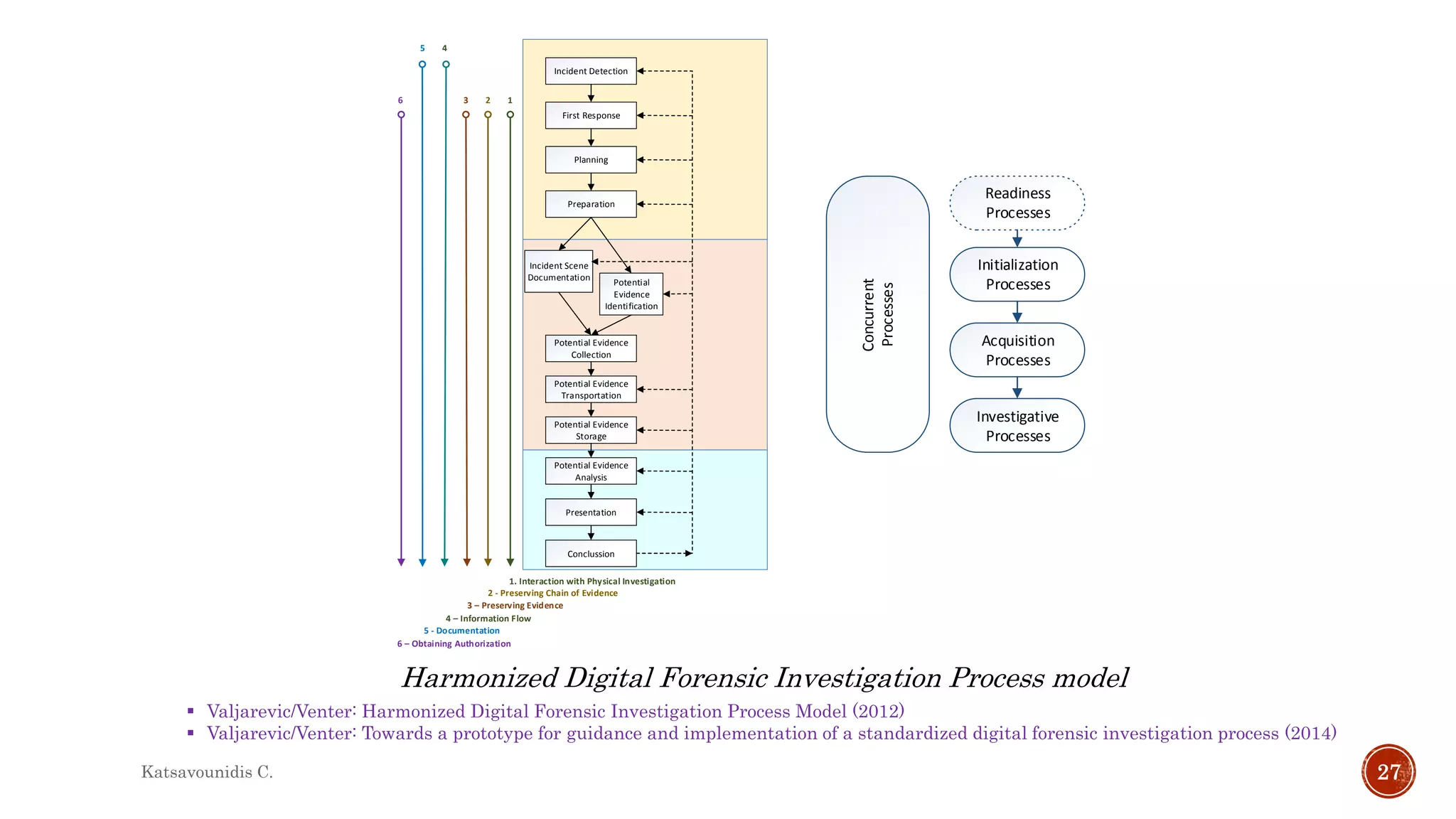
 Valjarevic/Venter: Harmonized Digital Forensic Investigation Process Model (2012)
 Valjarevic/Venter: Towards a prototype for guidance and implementation of a standardized digital forensic investigation process (2014)
Harmonized Digital Forensic Investigation Process model
Incident Detection
First Response
Planning
Preparation
Incident Scene
Documentation
Potential Evidence
Transportation
Potential Evidence
Storage
Potential Evidence
Analysis
Presentation
Conclussion
Potential
Evidence
Identification
Potential Evidence
Collection
123
45
1. Interaction with Physical Investigation
2 - Preserving Chain of Evidence
3 – Preserving Evidence
4 – Information Flow
5 - Documentation
6
6 – Obtaining Authorization
Readiness
Processes
Initialization
Processes
Acquisition
Processes
Investigative
Processes
Concurrent
Processes
Katsavounidis C. 27
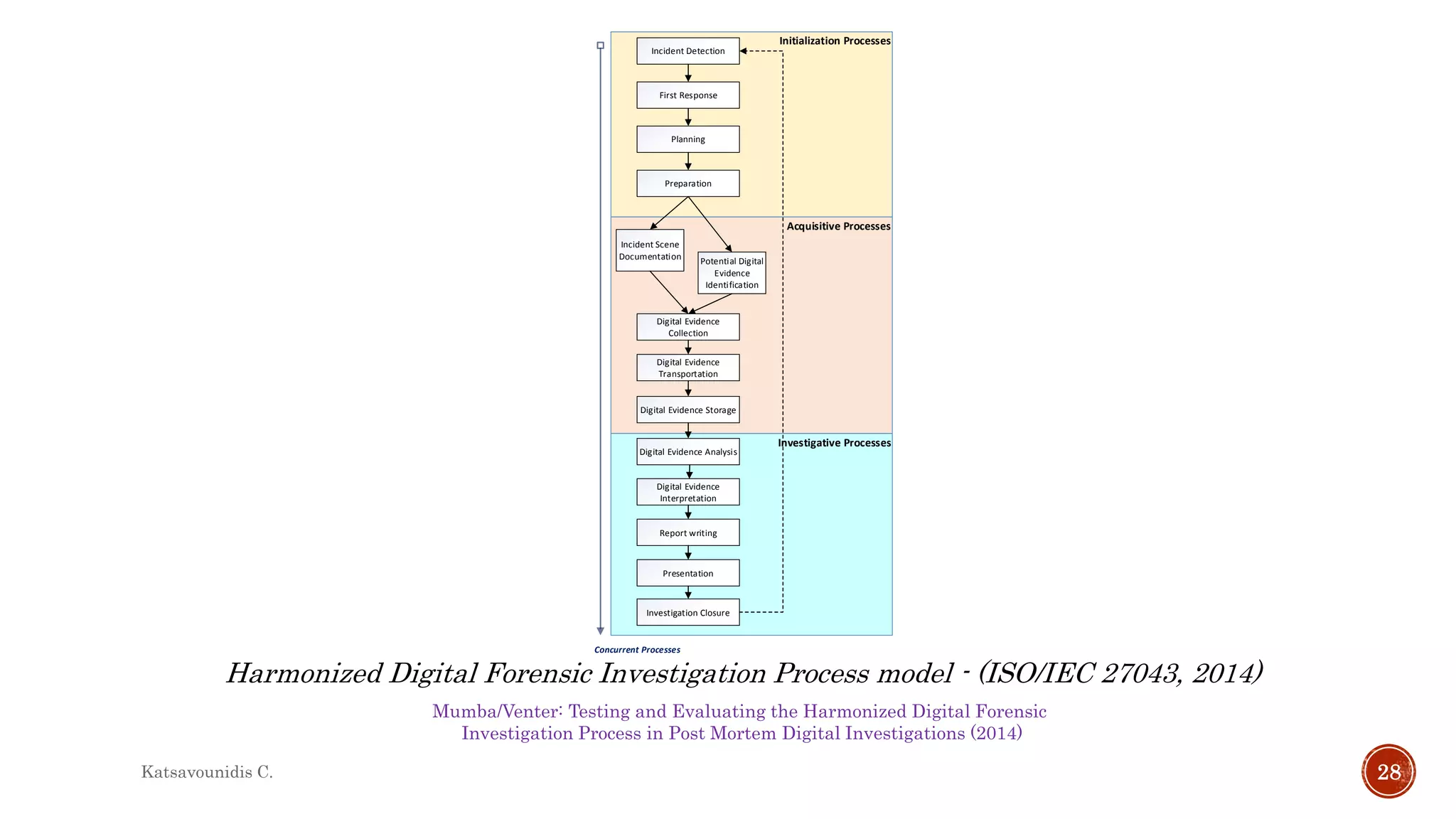
Mumba/Venter: Testing and Evaluating the Harmonized Digital Forensic
Investigation Process in Post Mortem Digital Investigations (2014)
Harmonized Digital Forensic Investigation Process model - (ISO/IEC 27043, 2014)
Investigative Processes
Acquisitive Processes
Initialization Processes
Incident Detection
First Response
Planning
Preparation
Incident Scene
Documentation
Digital Evidence
Transportation
Digital Evidence Storage
Digital Evidence Analysis
Presentation
Investigation Closure
Potential Digital
Evidence
Identification
Digital Evidence
Collection
Concurrent Processes
Digital Evidence
Interpretation
Report writing
Katsavounidis C. 28
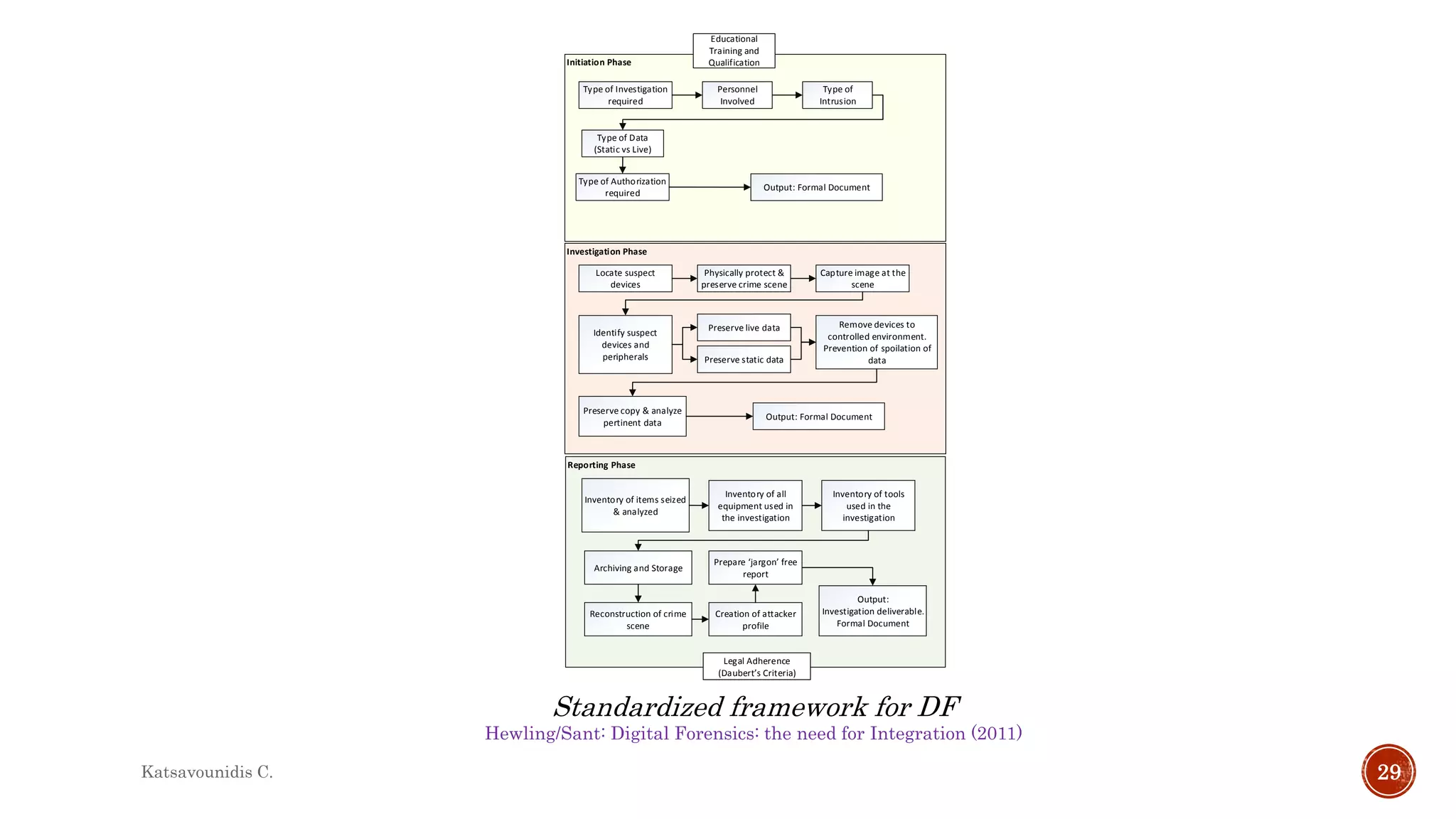
Hewling/Sant: Digital Forensics: the need for Integration (2011)
Standardized framework for DF
Initiation Phase
Type of Investigation
required
Educational
Training and
Qualification
Personnel
Involved
Type of
Intrusion
Type of Data
(Static vs Live)
Type of Authorization
required
Output: Formal Document
Investigation Phase
Locate suspect
devices
Physically protect &
preserve crime scene
Capture image at the
scene
Identify suspect
devices and
peripherals
Preserve live data
Preserve static data
Remove devices to
controlled environment.
Prevention of spoilation of
data
Preserve copy & analyze
pertinent data
Output: Formal Document
Reporting Phase
Inventory of items seized
& analyzed
Prepare jargon free
report
Inventory of all
equipment used in
the investigation
Inventory of tools
used in the
investigation
Archiving and Storage
Reconstruction of crime
scene
Creation of attacker
profile
Output:
Investigation deliverable.
Formal Document
Legal Adherence
(Daubert s Criteria)
Katsavounidis C. 29
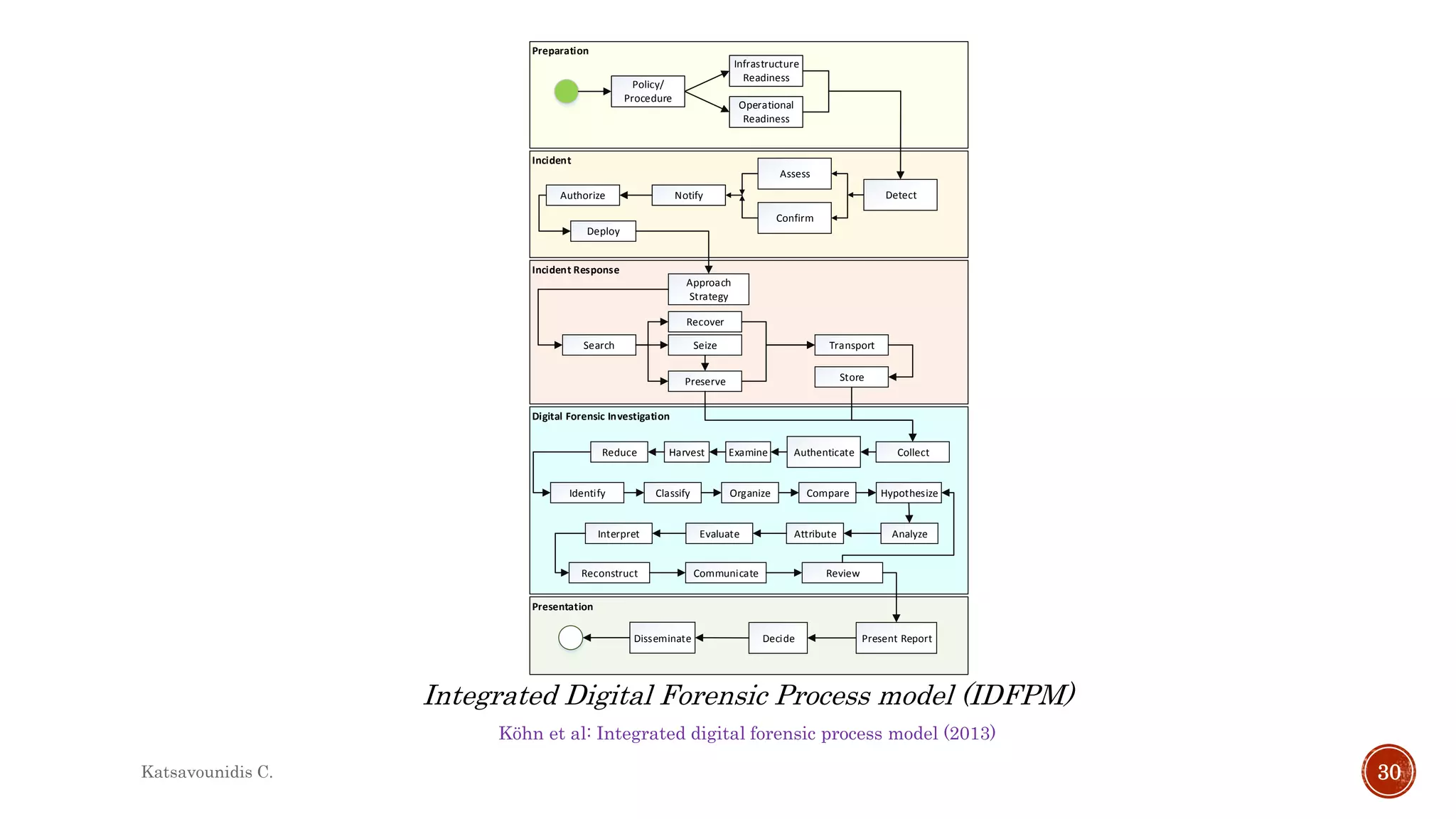
Köhn et al: Integrated digital forensic process model (2013)
Integrated Digital Forensic Process model (IDFPM)
Presentation
Preparation
Policy/
Procedure
Infrastructure
Readiness
Operational
Readiness
Incident
Incident Response
DetectNotifyAuthorize
Deploy
Confirm
Assess
Approach
Strategy
Search
Recover
Seize
Preserve
Transport
Store
Digital Forensic Investigation
CollectAuthenticateExamineHarvestReduce
Identify Classify Organize Compare Hypothesize
AnalyzeAttributeEvaluateInterpret
Reconstruct Communicate Review
Present ReportDecideDisseminate
Katsavounidis C. 30
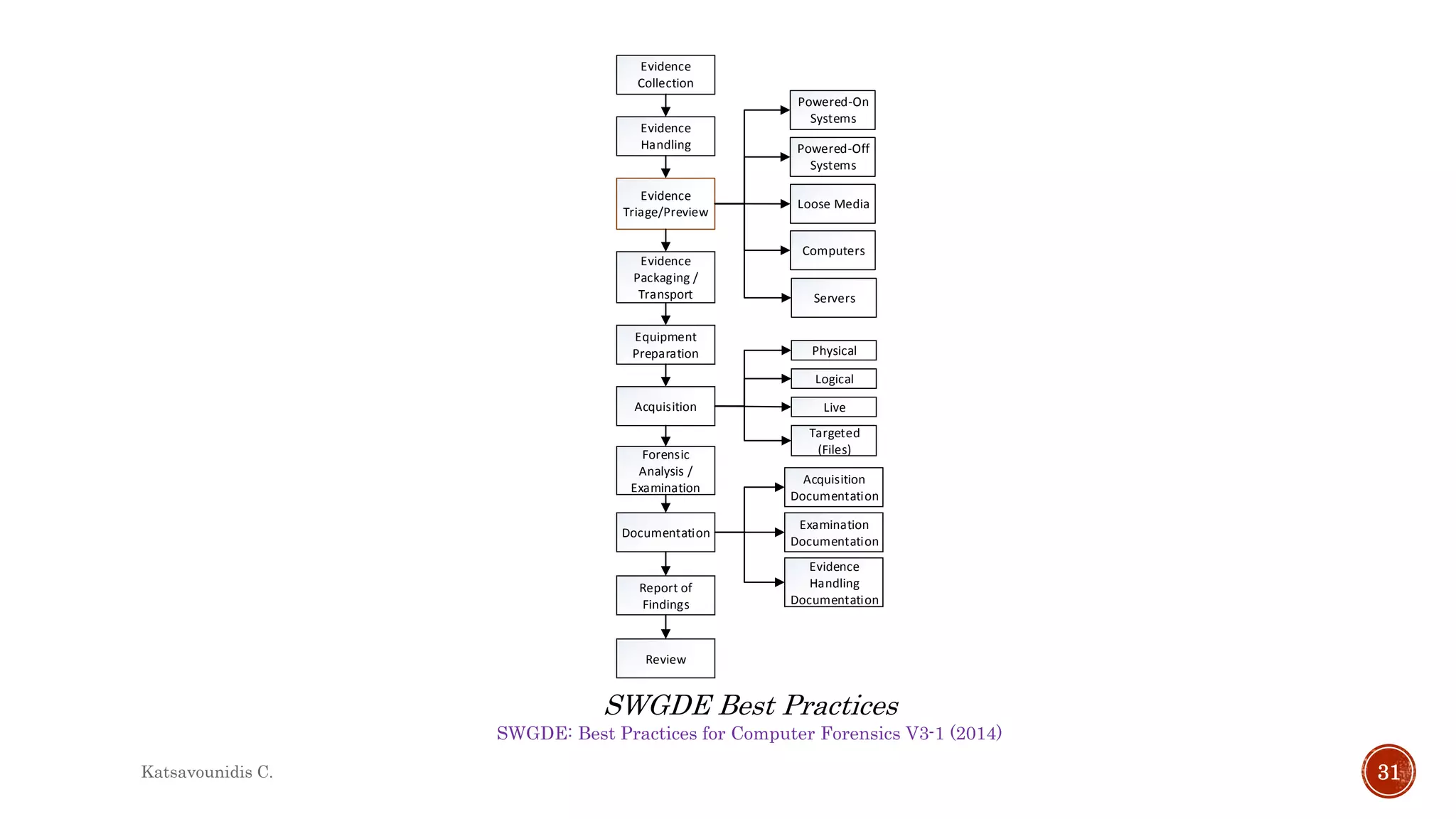
SWGDE: Best Practices for Computer Forensics V3-1 (2014)
SWGDE Best Practices
Evidence
Collection
Evidence
Handling
Evidence
Triage/Preview
Powered-On
Systems
Powered-Off
Systems
Loose Media
Computers
Servers
Evidence
Packaging /
Transport
Equipment
Preparation
Acquisition
Physical
Forensic
Analysis /
Examination
Documentation
Acquisition
Documentation
Examination
Documentation
Evidence
Handling
Documentation
Report of
Findings
Review
Logical
Live
Targeted
(Files)
Katsavounidis C. 31
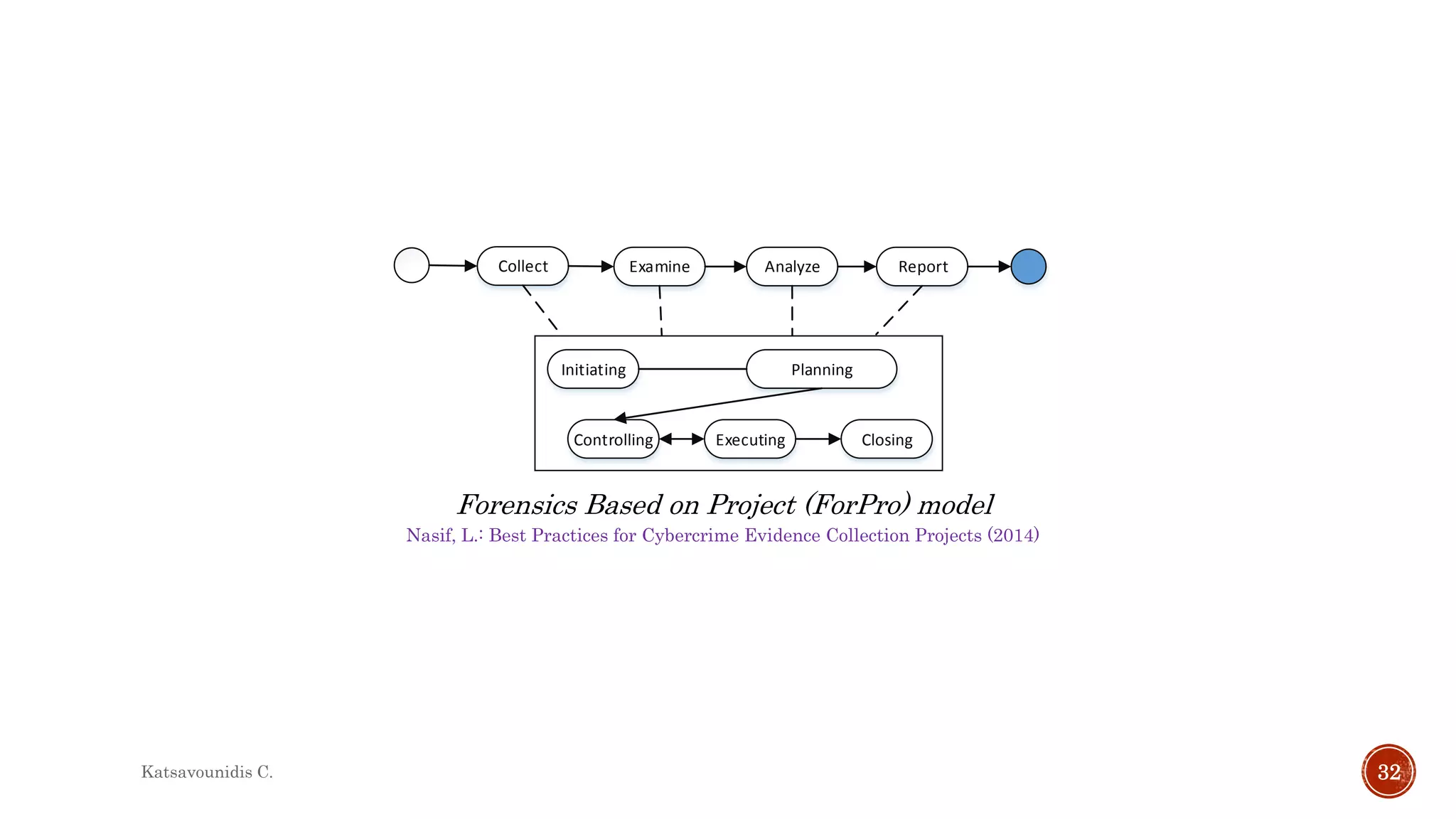
Nasif, L.: Best Practices for Cybercrime Evidence Collection Projects (2014)
Forensics Based on Project (ForPro) model
Collect Examine Analyze Report
Initiating Planning
Controlling Executing Closing
Katsavounidis C. 32
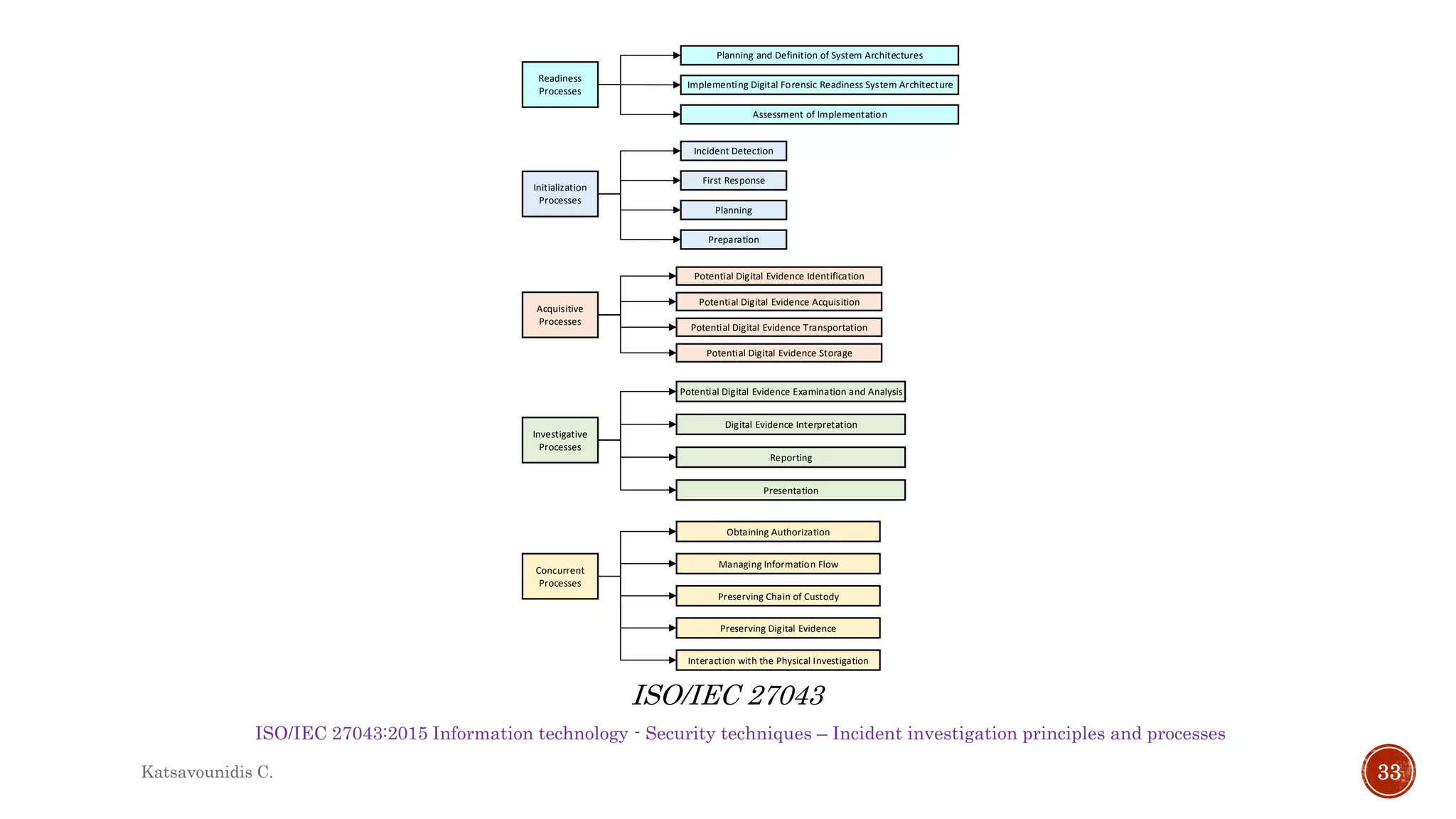
ISO/IEC 27043:2015 Information technology - Security techniques – Incident investigation principles and processes
ISO/IEC 27043
Initialization
Processes
Acquisitive
Processes
Investigative
Processes
Concurrent
Processes
Incident Detection
First Response
Planning
Preparation
Potential Digital Evidence Identification
Potential Digital Evidence Acquisition
Potential Digital Evidence Transportation
Potential Digital Evidence Storage
Potential Digital Evidence Examination and Analysis
Digital Evidence Interpretation
Reporting
Presentation
Obtaining Authorization
Managing Information Flow
Preserving Chain of Custody
Preserving Digital Evidence
Interaction with the Physical Investigation
Readiness
Processes
Planning and Definition of System Architectures
Implementing Digital Forensic Readiness System Architecture
Assessment of Implementation
Katsavounidis C. 33
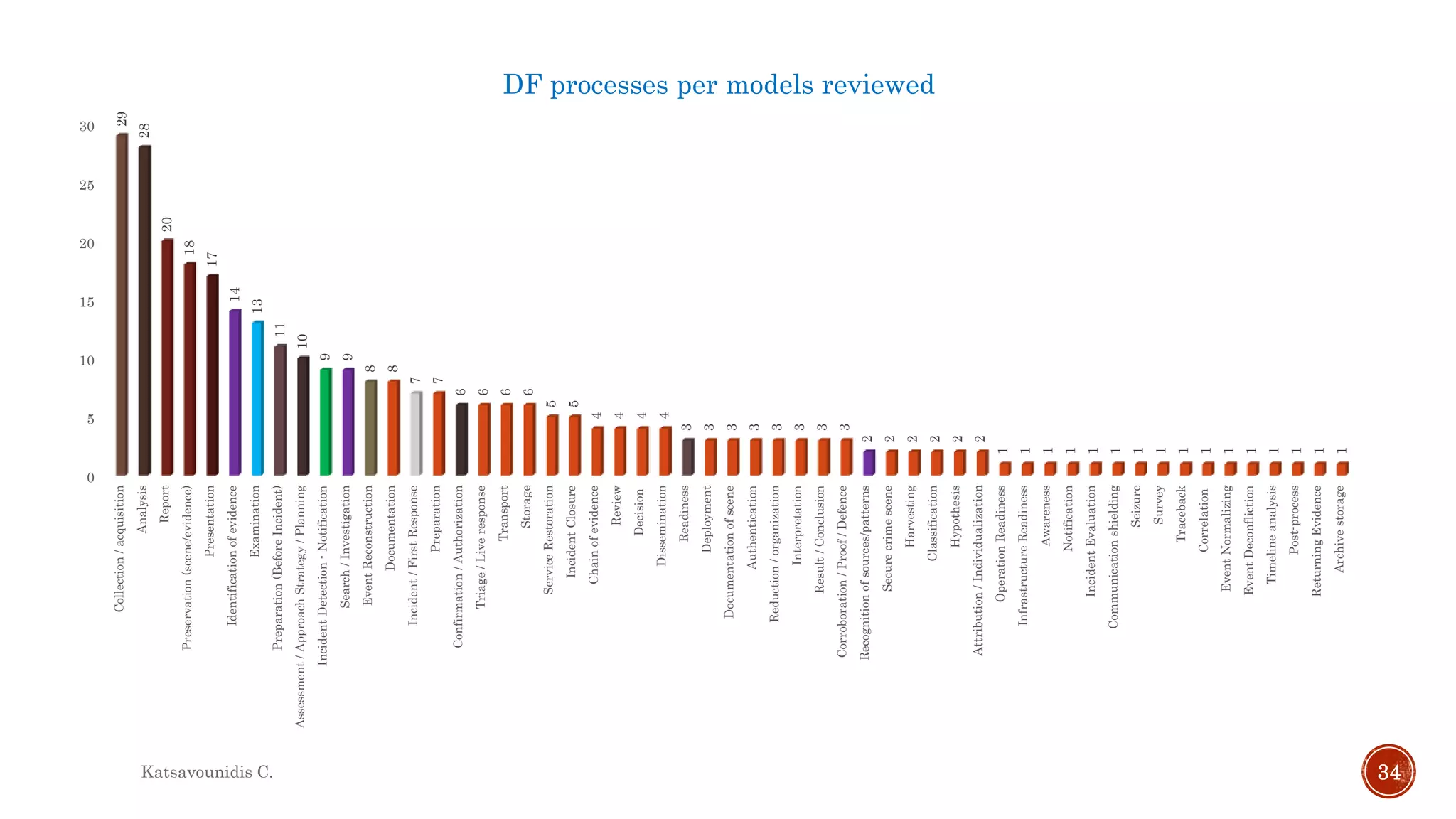
DF processes per models reviewed
0
5
10
15
20
25
30
Collection/acquisition
Analysis
Report
Preservation(scene/evidence)
Presentation
Identificationofevidence
Examination
Preparation(BeforeIncident)
Assessment/ApproachStrategy/Planning
IncidentDetection-Notification
Search/Investigation
EventReconstruction
Documentation
Incident/FirstResponse
Preparation
Confirmation/Authorization
Triage/Liveresponse
Transport
Storage
ServiceRestoration
IncidentClosure
Chainofevidence
Review
Decision
Dissemination
Readiness
Deployment
Documentationofscene
Authentication
Reduction/organization
Interpretation
Result/Conclusion
Corroboration/Proof/Defence
Recognitionofsources/patterns
Securecrimescene
Harvesting
Classification
Hypothesis
Attribution/Individualization
OperationReadiness
InfrastructureReadiness
Awareness
Notification
IncidentEvaluation
Communicationshielding
Seizure
Survey
Traceback
Correlation
EventNormalizing
EventDeconfliction
Timelineanalysis
Post-process
ReturningEvidence
Archivestorage
29
28
20
18
17
14
13
11
10
9
9
8
8
7
7
6
6
6
6
5
5
4
4
4
4
3
3
3
3
3
3
3
3
2
2
2
2
2
2
1
1
1
1
1
1
1
1
1
1
1
1
1
1
1
1
Katsavounidis C. 34
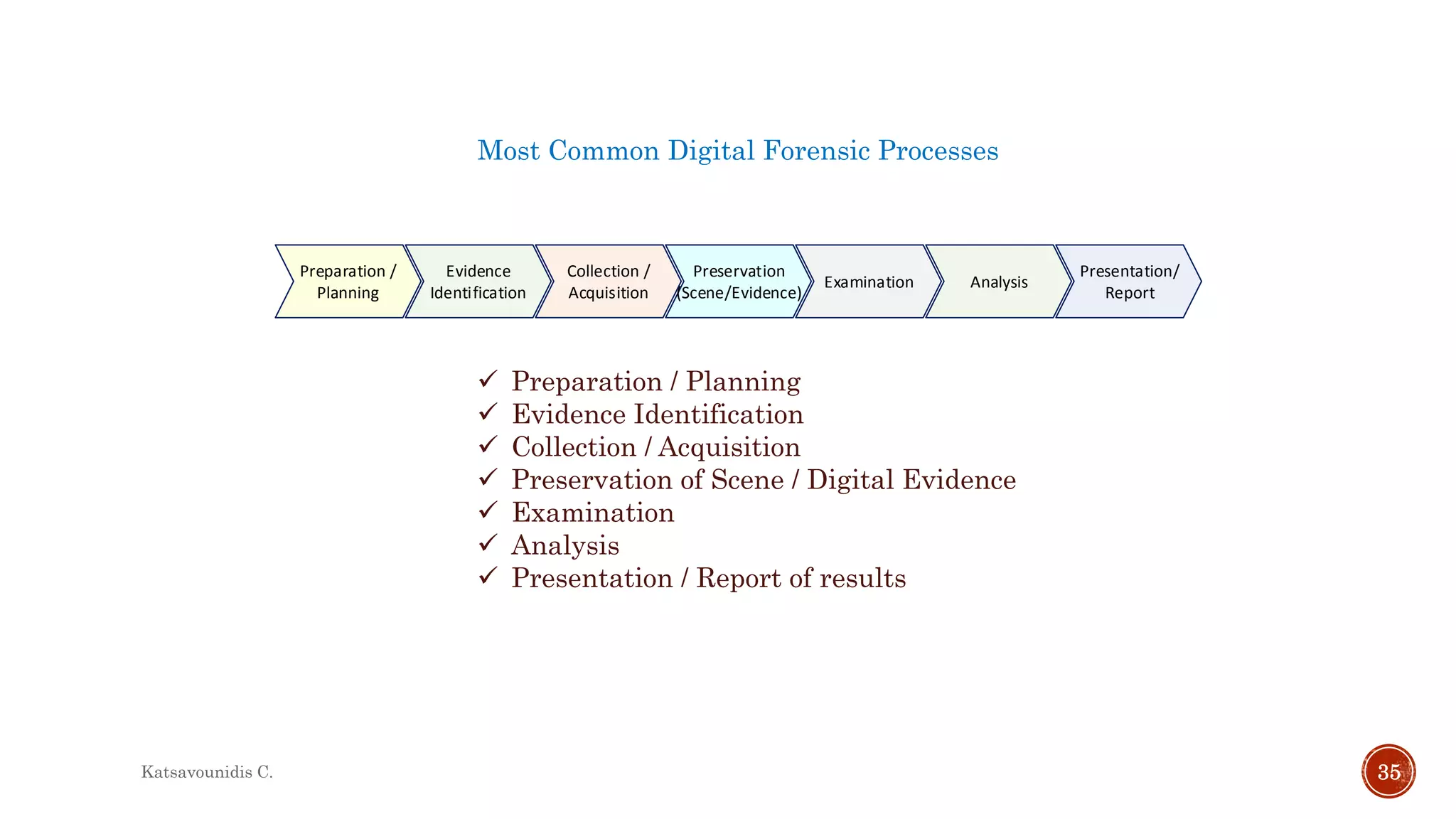
Most Common Digital Forensic Processes
Katsavounidis C. 35
Preparation /
Planning
Evidence
Identification
Collection /
Acquisition
Preservation
(Scene/Evidence)
Examination Analysis
Presentation/
Report
 Preparation / Planning
 Evidence Identification
 Collection / Acquisition
 Preservation of Scene / Digital Evidence
 Examination
 Analysis
 Presentation / Report of results
Katsavounidis C. 36
“We can all see, but can you observe?”

DF Process Models

  • 1.
    Models & Frameworks(2000-2015) Costas Katsavounidis
  • 2.
    Katsavounidis C. 2 Locard’sExchange Principle: “Every Contact Leaves a Trace” Principles of Forensic Examination of Digital Evidence A.C.P.O. (2007) Good Practice Guide for Computer-Based Evidence Principle 1: No action taken by law enforcement agencies or their agents should change data held on a computer or storage media which may subsequently be relied upon in court. Principle 2: In circumstances where a person finds it necessary to access original data held on a computer or on storage media, that person must be competent to do so and be able to give evidence explaining the relevance and the implications of their actions. Principle 3: An audit trail or other record of all processes applied to computer-based electronic evidence should be created and preserved. An independent third party should be able to examine those processes and achieve the same result. Principle 4: The person in charge of the investigation (the case officer) has overall responsibility for ensuring that the law and these principles are adhered to. N.I.J (2008) Electronic Crime Scene Investigation: A Guide for First Responders, Second Edition  The process of collecting, securing, and transporting digital evidence should not change the evidence.  Digital evidence should be examined only by those trained specifically for that purpose.  Everything done during the seizure, transportation, and storage of digital evidence should be fully documented, preserved, and available for review. E.N.F.S.I. (2009) Guidelines for Best Practice in the Forensic Examination of Digital Evidence.  A. The general rules of evidence should be applied to all digital evidence  B. Upon seizing digital evidence, actions taken should not change that evidence.  C. When it is necessary for a person to access original digital evidence that person should be suitably trained for the purpose.  D. All activity relating to the seizure, access, storage or transfer of digital evidence must be fully documented, preserved and available for review.  E. An individual is responsible for all actions taken with respect to digital evidence whilst the digital evidence is in their possession.
  • 3.
    Recognition Identification IndividualizationReconstruction Lee/Pagliaro Crime Scene Handbook (2001) Physical Scene Investigation Principles Recognition Preservation: Collection and Documentation Individualization: Comparison and Individualization Reconstruction Casey, Eoghan: Digital Evidence and Computer Crime: Forensic Science, Computers and the Internet (2000) Digital Evidence Process Model Katsavounidis C. 3 Process Models & Frameworks for the Forensic Examination of Digital Evidence
  • 4.
    Acquisition Authentication Analysis 3A’s- Computer Investigation Model Process Model Kruse & Heiser: Computer Forensics, Incident Response Essentials (2001) Acquisition Authentication Analysis ReportExamination Improved Computer Investigation Model Process Model Köhn, Michael: Integrated Digital Forensic Process Model (2012) Katsavounidis C. 4
  • 5.
    Forensic Investigation Processes NIJ: Electronic Crime Scene Investigation: A Guide for First Responders (2001),  NIST: Guide to Integrating Forensic Techniques into Incident Response (2006),  ACPO: Good Practice Guide for Computer-Based Evidence (2007) Forensic Processes NIJ: Forensic Examination of Digital Evidence: A Guide for Law Enforcement (2004) Collection Examination Analysis Report Acquisition Examination Analysis ReportAssessment Katsavounidis C. 5
  • 6.
    Casey, Eoghan: DigitalEvidence and Computer Crime: Forensic Science, Computers and the Internet (2004) Investigative Process Persuation and testimony Reporting Analysis Organization and search Reduction Harvesting Recovery Preservation Identification or seizure Incident/Crime scene protocols Assessment of worth Incident alerts or accusation Assessment Experiment Fusion Correlation Validation Crime or policy violation Prioritize - choose Actions at scene – real/virtual Recognition and proper packaging Get it ALL – hidden/deleted Data about data Integrity – modification tree Filter - eliminate Focus Scrutinize Detailed record Translate and explain Katsavounidis C. 6
  • 7.
    DFRWS: A RoadMap for Digital Forensic Research (2001) Investigative Process for Digital Forensic Science Identification Preservation Collection Examination Analysis Presentation Decision Event/Crime detection Resolve Signature Anomalous Detection Complaints System monitoring Audit Analysis Etc .. Case Mngt Imaging Technologies Chain of custody Time Sync Preservation Approved Methods Approved Software Approved Hardware Legal Authority Lossless compression Sampling Data Reduction Recovery Techniques Preservation Preservation Document- ation Traceability Traceability Validation Techniques Statistical Protocols Data Mining Timeline Link Spacial Filtering Techniques Pattern Matching Hidden Data Discovery Hidden Data Extraction Expert Testimony Clarification Mission impact statement Recommended countermeasure Statistical Interpretation Katsavounidis C. 7
  • 8.
    Reith et al:An Examination of Digital Forensic Models (2002) Abstract Model for Digital Forensics Identification Preparation Approach Strategy Preservation Collection Examination Analysis Presentation Returning Evidence Katsavounidis C. 8
  • 9.
    Mandia et al:Incident Response and Computer Forensics (2003) The Incident Model Pre-Incident Preparation Detection of Incidents Initial Response Formulation of Response Strategy Report Insident Investigation Data Collection Data Analysis Resolution, Recovery, Security Measures Implementation Katsavounidis C. 9
  • 10.
    Carrier/Spafford: Getting Physicalwith the Digital Investigation Process (2003) Integrated Digital Investigation Process (IDIP) Readiness Phases Deployment Phases Physical Crime Scene Investigation Phases Digital Crime Scene Investigation Phases Review Phases Operations Readiness Infrastructure Readiness Detection & Notification Confirmation & Authorization Preservation Survey Document- ation Search & Collection Reconstruct- ion Presentation Preservation Survey Document- ation Search & Collection Reconstruct- ion Presentation Review Katsavounidis C. 10
  • 11.
    Baryamureeba/Tushabe: The EnhancedDigital Investigation Process Model (2004) Enhanced Integrated Digital Investigation Process Model Preparation Phases Deployment Phases Traceback Phases Dynamite Phases Review Phases Digital Crime Scene Preservation Phase Survey Phase Documentation Phase Search & Collection Phase Presentation Phase Physical Crime Scene Katsavounidis C. 11
  • 12.
    Beebe/Clark: A Hierarchical,Objectives-Based Framework for the Digital Investigation Process (2005) Two-Tier Digital Investigations Process Framework Preparation Incident Responce Data Collection Data Analysis Presentation of Findings Incident Closure Objectives Based sub- phases Objectives Based sub- phases Objectives Based sub- phases Objectives Based sub- phases Objectives Based sub- phases Objectives Based sub- phases Katsavounidis C. 12
  • 13.
    O'Ciardhuain, Seamus: AnExtended Model of Cybercrime Investigations (2004) Extended Model of Cybercrime Investigations Awareness Authorization Planning Notification Search/ Identify Collection Transport Storage Examination Hypothesis Presentation Proof/ Defence Dissemination External Events External Authority Externally imposed policies, regulations & Legislation External Information Information Distribution Organizational Policies Internal Information Information Controls Internal Authority Internal Events Information Controls General Information Flow Other Organizations Internal Challenges External Challenges Katsavounidis C. 13
  • 14.
     Köhn etal: Framework for a Digital Forensic Investigation (2006)  Köhn et al: UML Modelling of Digital Forensic Process Models (DFPMs) (2008) Integrated Digital Forensic Process Model (InteDFPM ) Preparation Investigation Presentation Law Preparation Collect Authenticate Examine Analyze Report Present Evidence Report Katsavounidis C. 14
  • 15.
    NIST Special Publication800-86: Guide to Integrating Forensic Techniques into Incident Response (2006) Forensic Process Collection Examination Analysis Report Media Data Information Evidence Selamat et al : Mapping Process of Digital Forensic Investigation Framework (2008) Simplified DF Investigation Framework Preparation Presentation & Reporting Collection & Preservation Dissemination Examination & Analysis Katsavounidis C. 15
  • 16.
    Rogers et al:Computer Forensics Field Triage Process Model (2006) Cyber Forensic Field Triage Process model (CFFTP) Planning Triage User Usage Profiles Home Directory File Properties Registry Chronology Timeline Internet Case Specific Email Browser artifacts Instant Messages AtScene Katsavounidis C. 16
  • 17.
    Forrester/Irwin : ADigital Forensic investigative model for business organizations (2007) DF model for business organizations Readiness Deployment Incident Evaluation Scene Preservation Investigation Service Restoration Reporting Decisions Incident Review Interaction Katsavounidis C. 17
  • 18.
    Freiling/Schwittay A CommonProcess Model for Incident Response and Computer Forensics (2007) Common Process model for Incident Response & Computer Forensics Pre-Analysis Phase Detection of Incidents Initial Response Formulation of response strategy Pre-Incident Preparation Incident Occurs Analysis Phase Live Respose Forensic Duplication Data Recovery Harvesting Reduction & Organization Analysis Post-Analysis Phase Report Resolution Katsavounidis C. 18
  • 19.
    Khurana et al:Palantir: A framework for collaborative incident response and investigation (2009) Collaborative framework: Palantir · Establish an Incident Response Team. · Train staff on latest threats and software tools. · Follow recommended practices to prevent incidents. · Deploy intrusion detection and forensics data collection capabilities. · Develop incident response policies and procedures, including a legal activities coordination plan. · Detect and confirm that an incident has occurred. · Perform initial analysis to determine incident scope. · Determine containment, eradication, recovery and investigation strategy. · Report incident to appropriate ICIM. · Identify lessons learned. · Complete incident report. · Improve future preparedness. · Retain evidence as required according to policy. · Establish and train Incident Response Team. · Train Staff on latest threats and software tools. · Establish and maintain a collaborative workspace hosting environment. · Develop incident response policies and procedures including a legal activities coordination plan. · Develop policies and procedures for collaboration. · Deploy collaborative investigation tools. · Analyze incoming incident reports. · Develop response strategy and determine if collaborative investigation is warranted. · Create collaborative workspace. · Invite collaborators and assign roles. · Formulate collaborative response and investigation strategy. · Share (anonymized) evidence as appropriate. · Perform cross-site data analysis and correlation. · Discuss (ongoing) incident and share insights. · Cooperate in containment and recovery. · Reconstruct the crime scene. Prepare coordinated legal strategy. · Legally prosecute the offenders. · Share lessons learned among participants and publicly as appropriate. · Retain evidence according to policy. · Contain the breach to prevent further damage. · Collect and preserve evidence in a forensically sound manner. · Eradicate malware and disable compromised systems/accounts. · Deploy counter-measures to prevent repeat occurrence of compromise. · Restore normal system operation. Site ICIM / Collaboration Katsavounidis C. 19
  • 20.
    Perumal, Sundresan: DigitalForensic Model Based on the Malaysian Investigation Process (2009) Malaysian Investigation Process model Static Acquisition Authorization Search Warrant Obtained Planning IdentificationAuthorization Live acquisition Identify Fragile Evidence Reconnaissance Gathering Evidence Transport & Storage Analysis Result Proof & Defense Archive Storage Katsavounidis C. 20
  • 21.
    Cohen, Frederich: Fundamentalsof Digital Forensic Evidence (2010) Digital Forensic Evidence Processes Digital Evidence Identify Collect Preserve Transport Store Analyze Interpret Attribute Reconstruct Present Destroy Katsavounidis C. 21
  • 22.
    Smith/Petreski: A NewApproach to Digital Forensic Methodology (2010) Smith & Petreski Method Determine Case Type Requester Goals Common Case Goals Analyst Developed Goals Agreed Upon Case Goals Develop Required Information List Develop Beneficial Information List Provide Case Time Estimate Determine Methods to Achieve each Case Goal Pre-Analysis Analysis Identify Effectiveness of the Method Identify the Time Required for this Method Identify Additional Costs Estimate Analyst Skill with Method Estimate Size of Data Actual Costs Resource Costs Generate SPI and Time Limits for reevaluation Katsavounidis C. 22
  • 23.
    Grobler, C. etal: A Multi-component View of Digital Forensics (2010) Digital Forensic Management Framework Pro-Active DF Active-DF Re-Active DF Incident Before Incident After Incident Katsavounidis C. 23
  • 24.
    Atsa/Mboupda: Multi-Perspective CybercrimeInvestigation Process Modeling (2012) MCIP model ReaDFProDF ActDF Complaint / Alert / Automatic Detection Identification Collection Preservation Analysis Documentation Incident Closure Reconstruction - Identification - Preservation - Collection Evidence Acquisition Analysis Physical Investigation Reconstruct- ion Present Findings Dissemination of results Incident Closure Final Report Katsavounidis C. 24
  • 25.
    Agarwal et al:Systematic Digital Forensic Investigation Model (2011) Systematic Digital Investigation Model (SRDFIM) Preparation Securing the Scene Survey & Recognition Documentation of the Scene Communication Shielding Evidence Collection Preservation ExaminationAnalysisPresentation Result CapturingtheTimelineAccordingtotheCountryDigital ForensicLaw Katsavounidis C. 25
  • 26.
    Yusoff et al:Common Phases of Computer Forensic Investigation Models (2011) Generic Computer Forensic Investigation model (GCFIM) Pre-Process Acquisition & Preservation Analysis Presentation Post-Process Katsavounidis C. 26
  • 27.
     Valjarevic/Venter: HarmonizedDigital Forensic Investigation Process Model (2012)  Valjarevic/Venter: Towards a prototype for guidance and implementation of a standardized digital forensic investigation process (2014) Harmonized Digital Forensic Investigation Process model Incident Detection First Response Planning Preparation Incident Scene Documentation Potential Evidence Transportation Potential Evidence Storage Potential Evidence Analysis Presentation Conclussion Potential Evidence Identification Potential Evidence Collection 123 45 1. Interaction with Physical Investigation 2 - Preserving Chain of Evidence 3 – Preserving Evidence 4 – Information Flow 5 - Documentation 6 6 – Obtaining Authorization Readiness Processes Initialization Processes Acquisition Processes Investigative Processes Concurrent Processes Katsavounidis C. 27
  • 28.
    Mumba/Venter: Testing andEvaluating the Harmonized Digital Forensic Investigation Process in Post Mortem Digital Investigations (2014) Harmonized Digital Forensic Investigation Process model - (ISO/IEC 27043, 2014) Investigative Processes Acquisitive Processes Initialization Processes Incident Detection First Response Planning Preparation Incident Scene Documentation Digital Evidence Transportation Digital Evidence Storage Digital Evidence Analysis Presentation Investigation Closure Potential Digital Evidence Identification Digital Evidence Collection Concurrent Processes Digital Evidence Interpretation Report writing Katsavounidis C. 28
  • 29.
    Hewling/Sant: Digital Forensics:the need for Integration (2011) Standardized framework for DF Initiation Phase Type of Investigation required Educational Training and Qualification Personnel Involved Type of Intrusion Type of Data (Static vs Live) Type of Authorization required Output: Formal Document Investigation Phase Locate suspect devices Physically protect & preserve crime scene Capture image at the scene Identify suspect devices and peripherals Preserve live data Preserve static data Remove devices to controlled environment. Prevention of spoilation of data Preserve copy & analyze pertinent data Output: Formal Document Reporting Phase Inventory of items seized & analyzed Prepare jargon free report Inventory of all equipment used in the investigation Inventory of tools used in the investigation Archiving and Storage Reconstruction of crime scene Creation of attacker profile Output: Investigation deliverable. Formal Document Legal Adherence (Daubert s Criteria) Katsavounidis C. 29
  • 30.
    Köhn et al:Integrated digital forensic process model (2013) Integrated Digital Forensic Process model (IDFPM) Presentation Preparation Policy/ Procedure Infrastructure Readiness Operational Readiness Incident Incident Response DetectNotifyAuthorize Deploy Confirm Assess Approach Strategy Search Recover Seize Preserve Transport Store Digital Forensic Investigation CollectAuthenticateExamineHarvestReduce Identify Classify Organize Compare Hypothesize AnalyzeAttributeEvaluateInterpret Reconstruct Communicate Review Present ReportDecideDisseminate Katsavounidis C. 30
  • 31.
    SWGDE: Best Practicesfor Computer Forensics V3-1 (2014) SWGDE Best Practices Evidence Collection Evidence Handling Evidence Triage/Preview Powered-On Systems Powered-Off Systems Loose Media Computers Servers Evidence Packaging / Transport Equipment Preparation Acquisition Physical Forensic Analysis / Examination Documentation Acquisition Documentation Examination Documentation Evidence Handling Documentation Report of Findings Review Logical Live Targeted (Files) Katsavounidis C. 31
  • 32.
    Nasif, L.: BestPractices for Cybercrime Evidence Collection Projects (2014) Forensics Based on Project (ForPro) model Collect Examine Analyze Report Initiating Planning Controlling Executing Closing Katsavounidis C. 32
  • 33.
    ISO/IEC 27043:2015 Informationtechnology - Security techniques – Incident investigation principles and processes ISO/IEC 27043 Initialization Processes Acquisitive Processes Investigative Processes Concurrent Processes Incident Detection First Response Planning Preparation Potential Digital Evidence Identification Potential Digital Evidence Acquisition Potential Digital Evidence Transportation Potential Digital Evidence Storage Potential Digital Evidence Examination and Analysis Digital Evidence Interpretation Reporting Presentation Obtaining Authorization Managing Information Flow Preserving Chain of Custody Preserving Digital Evidence Interaction with the Physical Investigation Readiness Processes Planning and Definition of System Architectures Implementing Digital Forensic Readiness System Architecture Assessment of Implementation Katsavounidis C. 33
  • 34.
    DF processes permodels reviewed 0 5 10 15 20 25 30 Collection/acquisition Analysis Report Preservation(scene/evidence) Presentation Identificationofevidence Examination Preparation(BeforeIncident) Assessment/ApproachStrategy/Planning IncidentDetection-Notification Search/Investigation EventReconstruction Documentation Incident/FirstResponse Preparation Confirmation/Authorization Triage/Liveresponse Transport Storage ServiceRestoration IncidentClosure Chainofevidence Review Decision Dissemination Readiness Deployment Documentationofscene Authentication Reduction/organization Interpretation Result/Conclusion Corroboration/Proof/Defence Recognitionofsources/patterns Securecrimescene Harvesting Classification Hypothesis Attribution/Individualization OperationReadiness InfrastructureReadiness Awareness Notification IncidentEvaluation Communicationshielding Seizure Survey Traceback Correlation EventNormalizing EventDeconfliction Timelineanalysis Post-process ReturningEvidence Archivestorage 29 28 20 18 17 14 13 11 10 9 9 8 8 7 7 6 6 6 6 5 5 4 4 4 4 3 3 3 3 3 3 3 3 2 2 2 2 2 2 1 1 1 1 1 1 1 1 1 1 1 1 1 1 1 1 Katsavounidis C. 34
  • 35.
    Most Common DigitalForensic Processes Katsavounidis C. 35 Preparation / Planning Evidence Identification Collection / Acquisition Preservation (Scene/Evidence) Examination Analysis Presentation/ Report  Preparation / Planning  Evidence Identification  Collection / Acquisition  Preservation of Scene / Digital Evidence  Examination  Analysis  Presentation / Report of results
  • 36.
    Katsavounidis C. 36 “Wecan all see, but can you observe?”