Introduction: Cyberforensics
• Providesdigital evidence of a specific or general activity
• Key role in investigation of cybercrime
• “Evidence” in the case of “cyberoffenses”
• Handling of the digital forensics evidence
• Computer is either the subject or the object of cybercrimes or is used as a tool to
commit a cybercrime
Historical Background of Cyberforensics:
• The earliest recorded computer crimes occurred in1969 and 1970 when student
protestors burned computers at various universities.
• Computer intrusion and fraud committed with the help of computers were the first
crimes to be widely recognized as a new type of crime.
• The application of computer for investigating computer based crime has led to
development of a new field called as computer forensics. Sometimes also referred as
Digital forensics.
3.
Digital Forensics Science
•Defn: Application of analyses techniques to the reliable and unbiased collection,
analysis, interpretation and presentation of digital evidence.
The following are two more definitions worth considering:
• Digital forensics: The use of scientifically derived and proven methods toward the
preservation, collection, validation, identification, analysis, interpretation, documentation
and presentation of digital evidence derived from digital sources for the purpose of
facilitation or furthering the reconstruction of events found to be criminal, or helping to
anticipate unauthorized actions shown to be disruptive to planned operations.
• Computer Forensics: The lawful and ethical seizure, acquisition, analysis, reporting
and safeguarding of data and metadata derived from digital devices which may contain
information that is notable and perhaps of evidentiary value to the trier of fact in
managerial, administrative, civil and criminal investigations. In other words, it is the
collection of techniques and tools used to find evidence in a computer.
4.
The Role ofDigital Forensics is to:
• Uncover and Document evidence and leads.
• Corroborate evidence discovered in other ways(E-Discovery)
• Assist in showing a pattern of events(data mining has a application
here).
• Connect attack and victim computers(Locard's Exchange principle).
• Reveal an end-to-end path of the events leading to a compromise
attempt, successful or not.
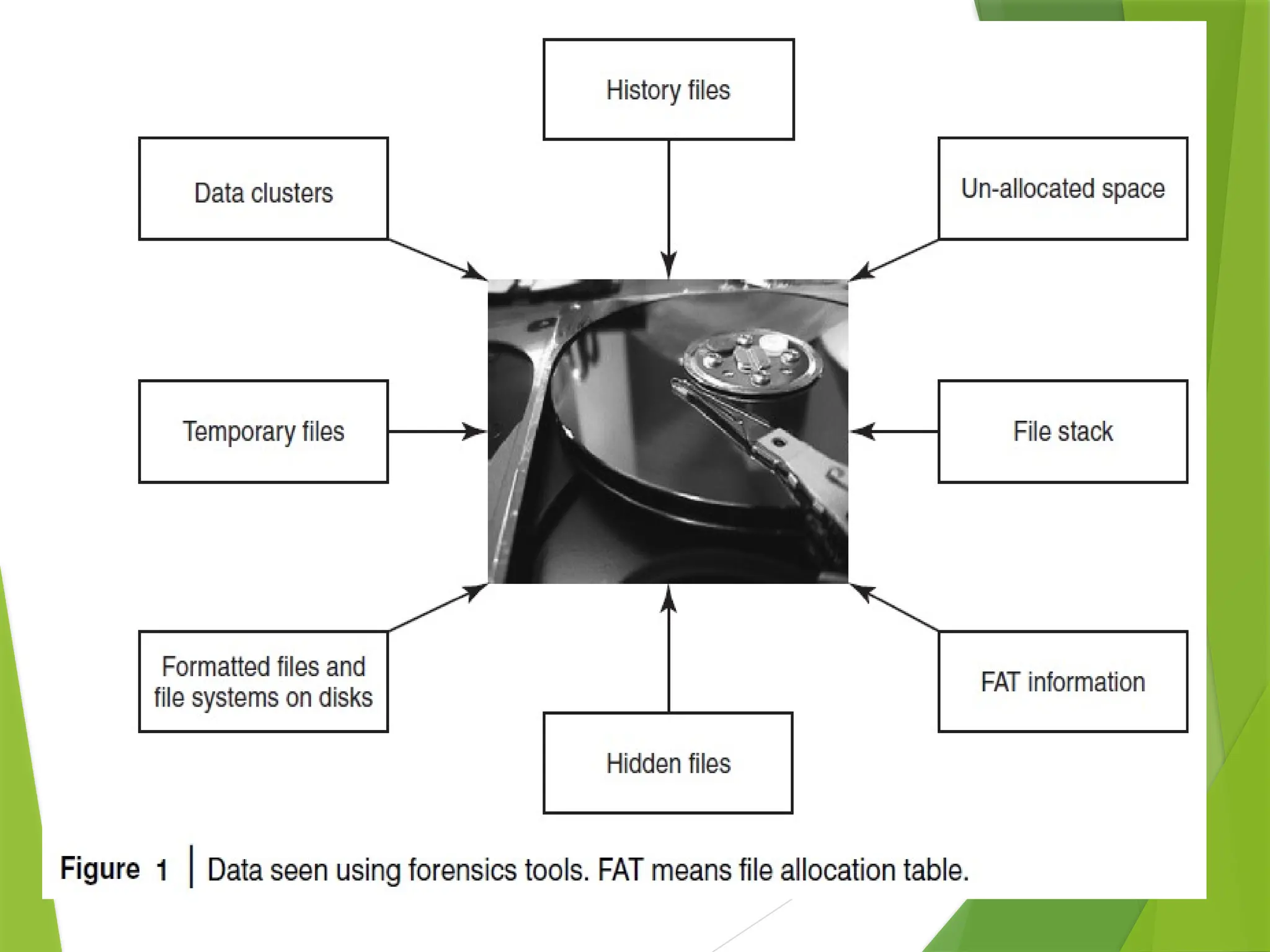
• Extract data that may be hidden, deleted or otherwise not directly
available.
6.
Need for ComputerForensics
• Convergence of ICT advances and the pervasive use of computers worldwide
• High technical capacity of modern computers/computing devices
• New risks for computer users
Widespread use of computer forensics is the result of:
• Increasing dependence of law enforcement on digital evidence
• Ubiquity of computers that followed from the microcomputer revolution
Evidence
• Everything that is used to determine or demonstrate the truth of an assertion.
• Can be used in court to convict people who are believed to have committed crimes.
• Handle carefully.
7.
Cyberforensics and DigitalEvidence
1. Computer forensics
2. Network forensics
Computer forensics experts know the techniques to retrieve the data from files listed in
standard directory search, hidden files, deleted files, deleted E-Mail and passwords,
login IDs, encrypted files, hidden partitions, etc. Typically, the evidences reside on
computer systems, user created files, user protected files, computer created files and on
computer networks.
The Rules of Evidence
According to the “Indian Evidence Act 1872,” “Evidence” means and includes:
3. All statements which the court permits or requires to be made before it by witnesses,
in relation to matters of fact under inquiry, are called oral evidence.
4. All documents that are produced for the inspection of the court are called
documentary evidence.
8.
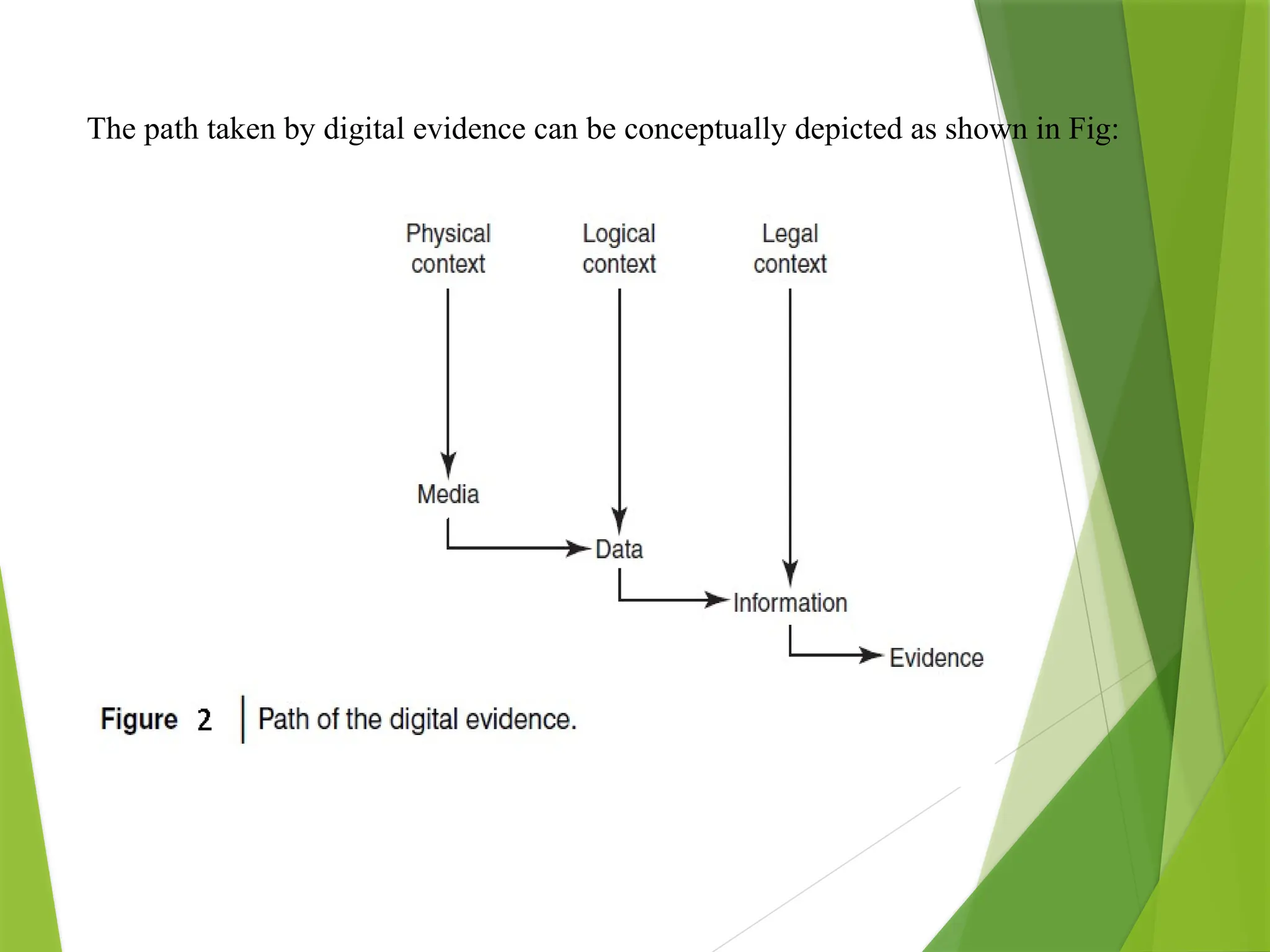
There are numberof contexts involved in actually identifying a piece of digital evidence:
1.Physical context: it must be definable in its physical form, that is , it should reside on
a specific piece.
2. Logical context: it must be identifiable as to its logical position, that is where does it
reside relative to the file system.
3. Legal context: we must place the evidence in the correct context to read its meaning,
This may require looking at the evidence as machine learning, for example , American
standard code for Information Interchange (ASCII).
9.
The path takenby digital evidence can be conceptually depicted as shown in Fig:
10.
Digital Forensics LifeCycle
As per FBI’s (Federal Bureau of Investigation) view, digital evidence is present in
nearly every crime scene. That is why law enforcement must know how to recognize,
seize, transport and store original digital evidence to preserve it for forensics
examination. The cardinal roles to remember are that evidence is:
1. Admissible.
2. Authentic.
3. Complete.
4. Reliable.
5. Understandable and believable.
11.
Digital Forensics Process:
•Digital forensics evidence consists of exhibits.
• The exhibits are introduced as evidence by either side.
• Testimony is presented to establish the process.
• The party must show the evidence.
• Digital forensics evidence can be challenged.
• Forensics experts formulate a cost proposal.
• Proposed timeline of activities, lists of anticipated deliverables and a plan for
production and turnover of evidence.
• Submission of a preliminary risk analysis for the forensics service being
proposed.
12.
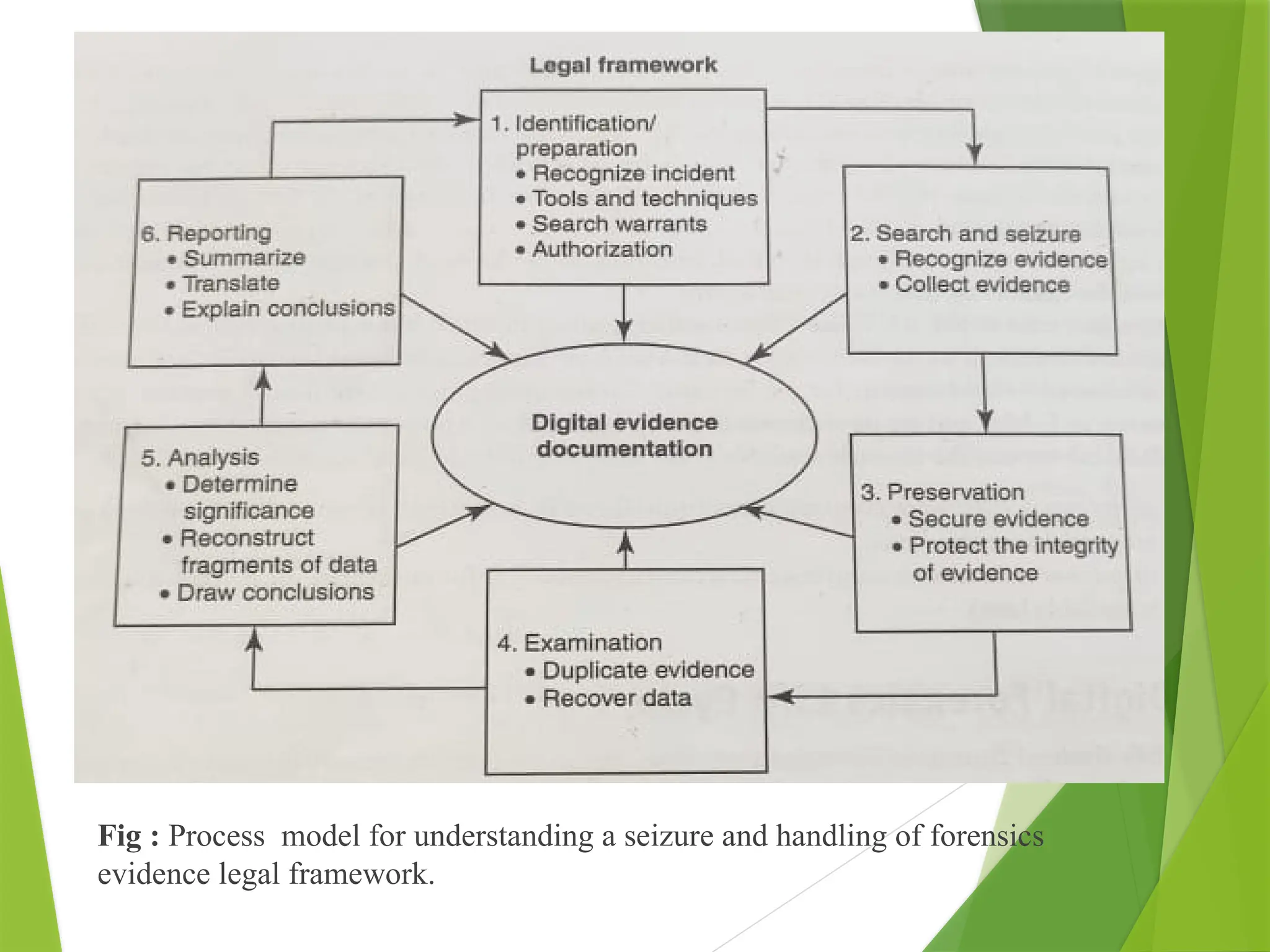
Fig : Processmodel for understanding a seizure and handling of forensics
evidence legal framework.
13.
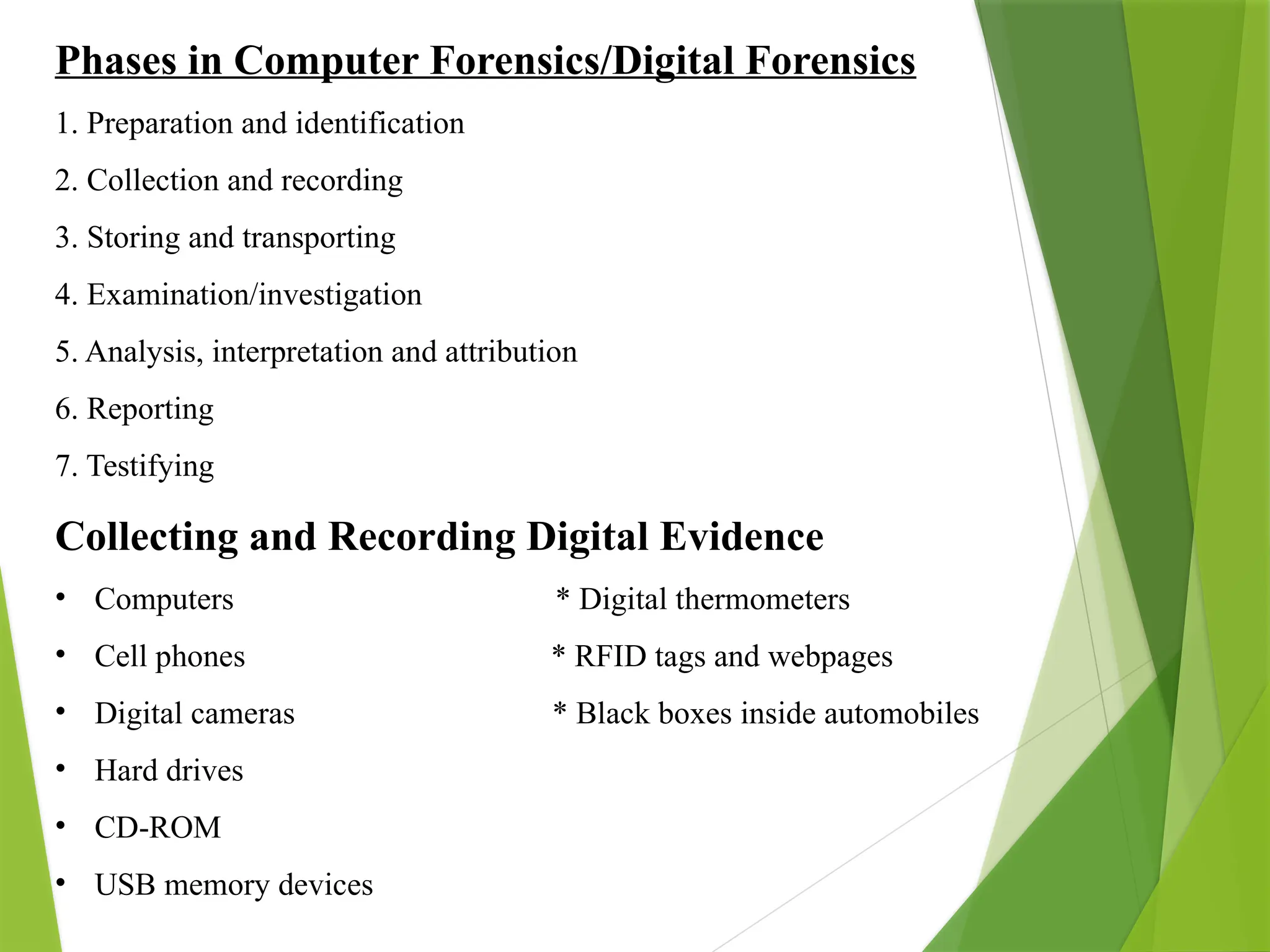
Phases in ComputerForensics/Digital Forensics
1. Preparation and identification
2. Collection and recording
3. Storing and transporting
4. Examination/investigation
5. Analysis, interpretation and attribution
6. Reporting
7. Testifying
Collecting and Recording Digital Evidence
• Computers * Digital thermometers
• Cell phones * RFID tags and webpages
• Digital cameras * Black boxes inside automobiles
• Hard drives
• CD-ROM
• USB memory devices
14.
Collecting and RecordingDigital Evidence:
Sources
1. Computers
2. Cell phones
3. Digital cameras
4. Hard drives
5. CD-ROM
6. USB memory devices
7. Digital thermometers
8. Black boxes inside automobiles
9. RFID tags and webpages
15.
Storing and TransportingDigital Evidence:
1. Image computer media using a write-blocking tool to ensure that no data is added
to the suspect device
2. Establish and maintain the chain of custody
3. Document everything that has been done
4. Only use tools and methods that have been tested and evaluated to validate their
accuracy and reliability.
5. Care must be taken in transportation to prevent spoliation (in a hot car, digital
media tends to lose bits).
6. Care must be taken to preserve chain of custody and assure that a witness can
testify accurately about what took place.
16.
Examining/Investigating Digital Evidence:
•Special care must be taken to ensure that the forensics specialist has the legal authority to
seize, copy and examine the data.
• Sometimes authority stems from a search warrant.
• As a general rule, one should not examine digital information unless one has the legal
authority to do so.
• Amateur forensics examiners should keep this in mind before starting any unauthorized
investigation.
Analysis, Interpretation and Attribution:
• Analysis, interpretation and attribution of evidence are the most difficult aspects
encountered by most forensics analysts.
• Analysis, interpretation and attribution of digital forensics evidence can be reconciled with
non-digital evidence.
• Digital forensics evidence can be externally stipulated.
• Open-source tools are available to conduct analysis of open ports, mapped drives on the
live computer system.
17.
Reporting:
• A reportis generated.
• The report may be in a written form or an oral testimony (or combination of the two).
• Evidence, analysis, interpretation and attribution to be presented in the form of expert reports,
depositions and testimony.
• Presentation of the report (a complex and tricky process)
Broad-Level Elements of the Report
1. Identity of the reporting agency
2. Case identifier or submission number
3. Case investigator
4. Identity of the submitter
5. Date of receipt
6. Date of report
7. Serial number, make and model
8. Identity and signature of the examiner
9. Steps taken during examination
10. Results/conclusions
18.
Principles to maintainthe integrity of digital evidence
Principle 1: No action taken by law enforcement agencies or their agents should change data
held on a computer or storage media, which may subsequently be relied upon in court.
Principle 2: In exceptional circumstances, where a person finds it necessary to access original
data held on a computer or on storage media that person must be competent to do so and be
able to give evidence explaining the relevance and the implications of his/her actions.
Principle 3: An audit trail or other record of all processes applied to computer-based
electronic evidence should be created and preserved. An independent third party should be
able to examine those processes and achieve the same result.
Principle 4: The person in-charge of the investigation (the case officer) has overall
responsibility for ensuring that the law and these principles are adhered to.
19.
Chain of CustodyConcept
• It is the central concept in cyber forensics/digital forensics investigation.
• It is the process of validating how many kinds of evidences have been gathered, tracked
and protected on the way to a court of law.
• It is essential to get in the habit of protecting all evidences equally so that they will
hold up in court.
• The purpose is that the proponent of a piece of evidence must demonstrate that it is
what it purports to be.
• The chain of custody is a chronological written record of those individuals who have
had custody of the evidence from its initial acquisition until its final disposition.
• A chain of custody begins when an item of relevant evidence is collected, and the chain
is maintained until the evidence is disposed off.
• The chain of custody assumes continuous accountability.