
Developments in European Statistics Challenges in Official Statistics Walter Radermacher, Chief Statistician of the European Union, Director General Eurostat
Robert M. Pirsig: Zen or the art of motorcycle maintenance
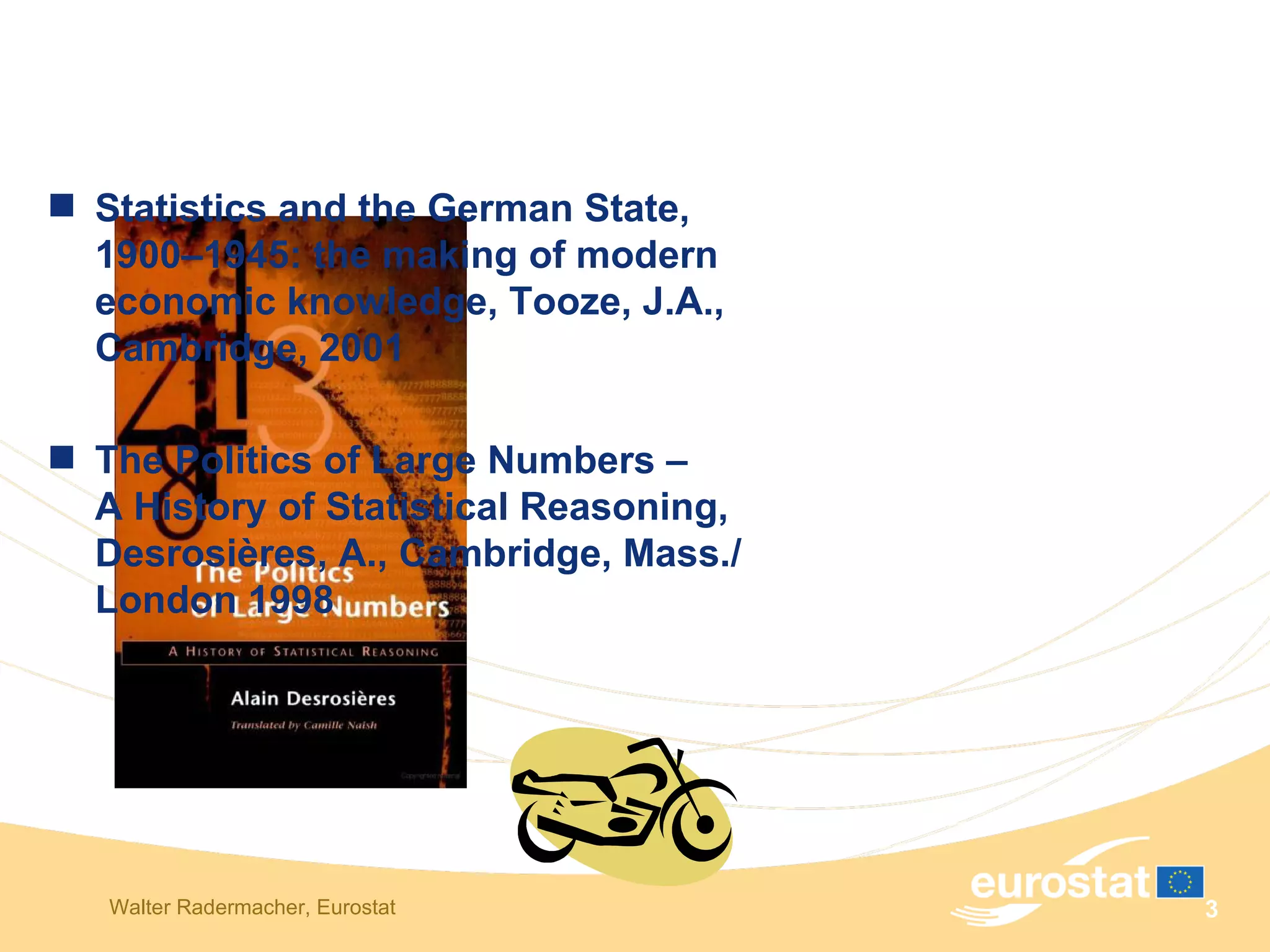
Statistics and the German State, 1900–1945: the making of modern economic knowledge, Tooze, J.A., Cambridge, 2001 The Politics of Large Numbers   –  A History of Statistical Reasoning, Desrosières, A., Cambridge, Mass./ London 1998
Statistics: a short history in 4 political steps „ Statistics“ is the empirical branch of the science of state (German: Statistik – >  Staatswissenschaften) Official statistics (political/administrative position, working methods) reflect the development of societies in particular the specific relationship between state and citizens  Some factors create different political settings: Constitution (democratic, authoritative) Institutional set-up of economy (market, planification) Society (closed/national, globalised) Main sectors of economic production Dynamics of structural change (slow, fast)
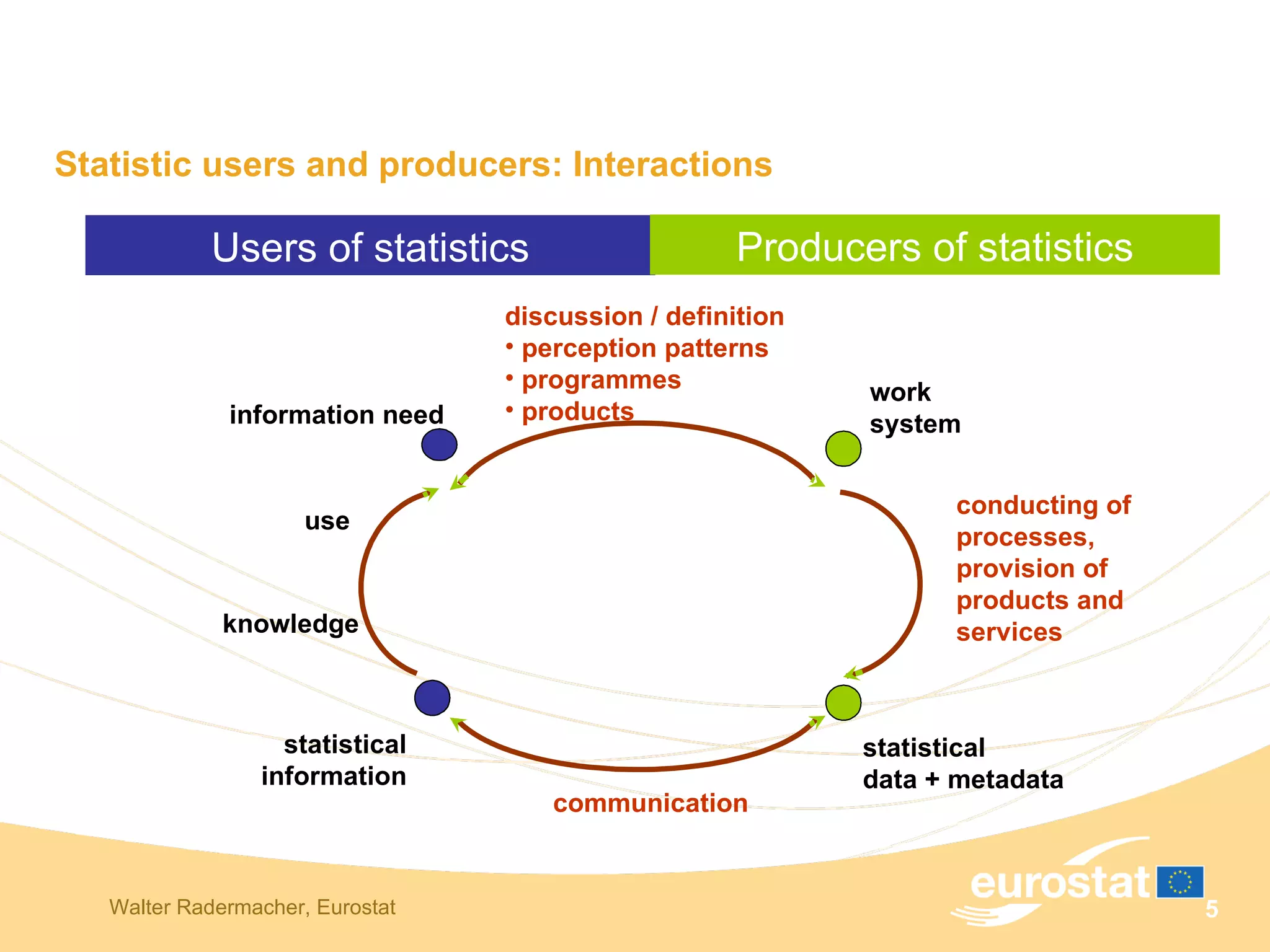
Statistic users and producers: Interactions Users of statistics Producers of statistics information need use knowledge statistical information statistical data + metadata work system conducting of processes, provision of products and services discussion / definition perception patterns programmes products communication
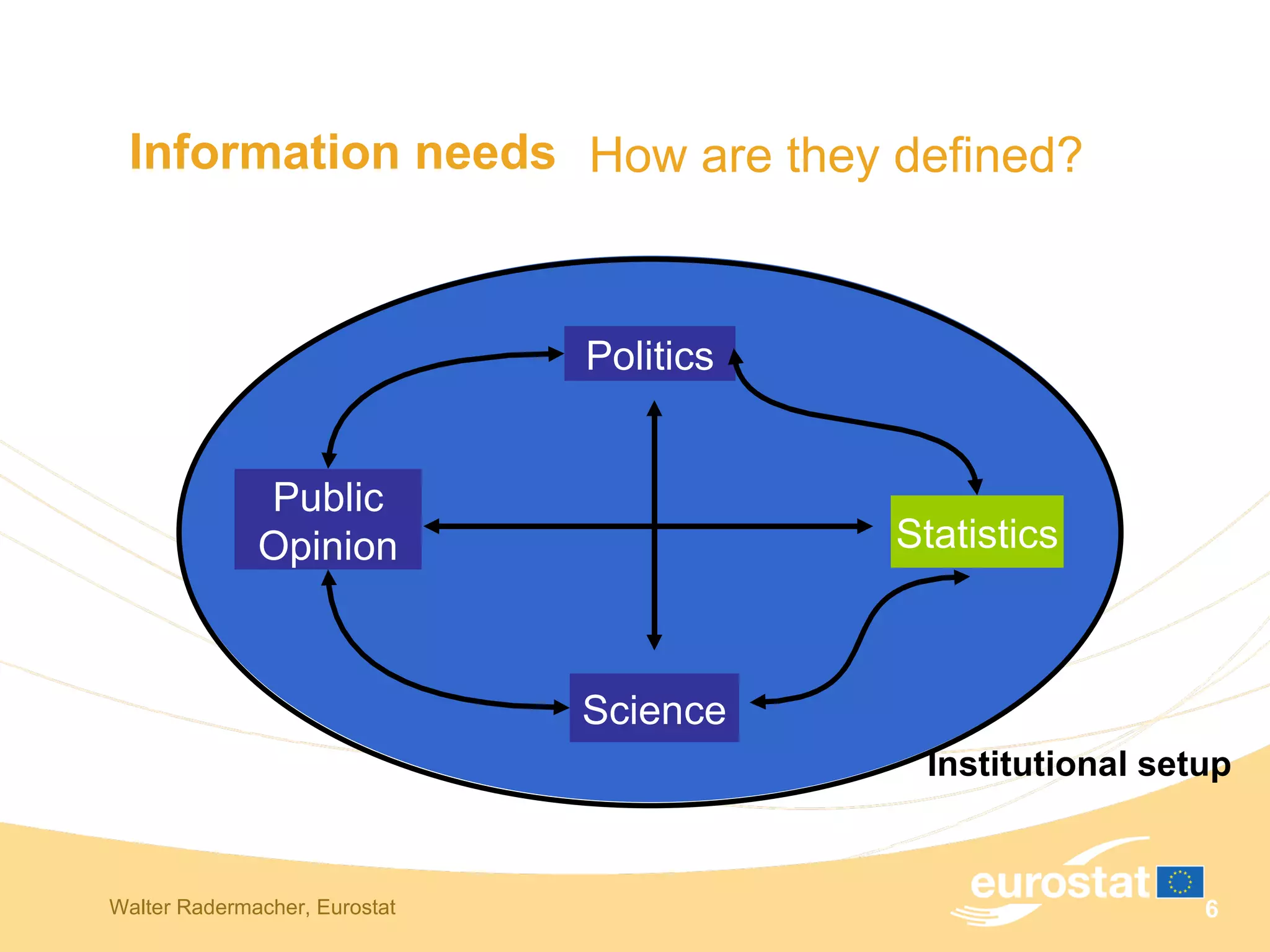
Information needs Statistics Public Opinion Science Politics Institutional   setup How are they defined?
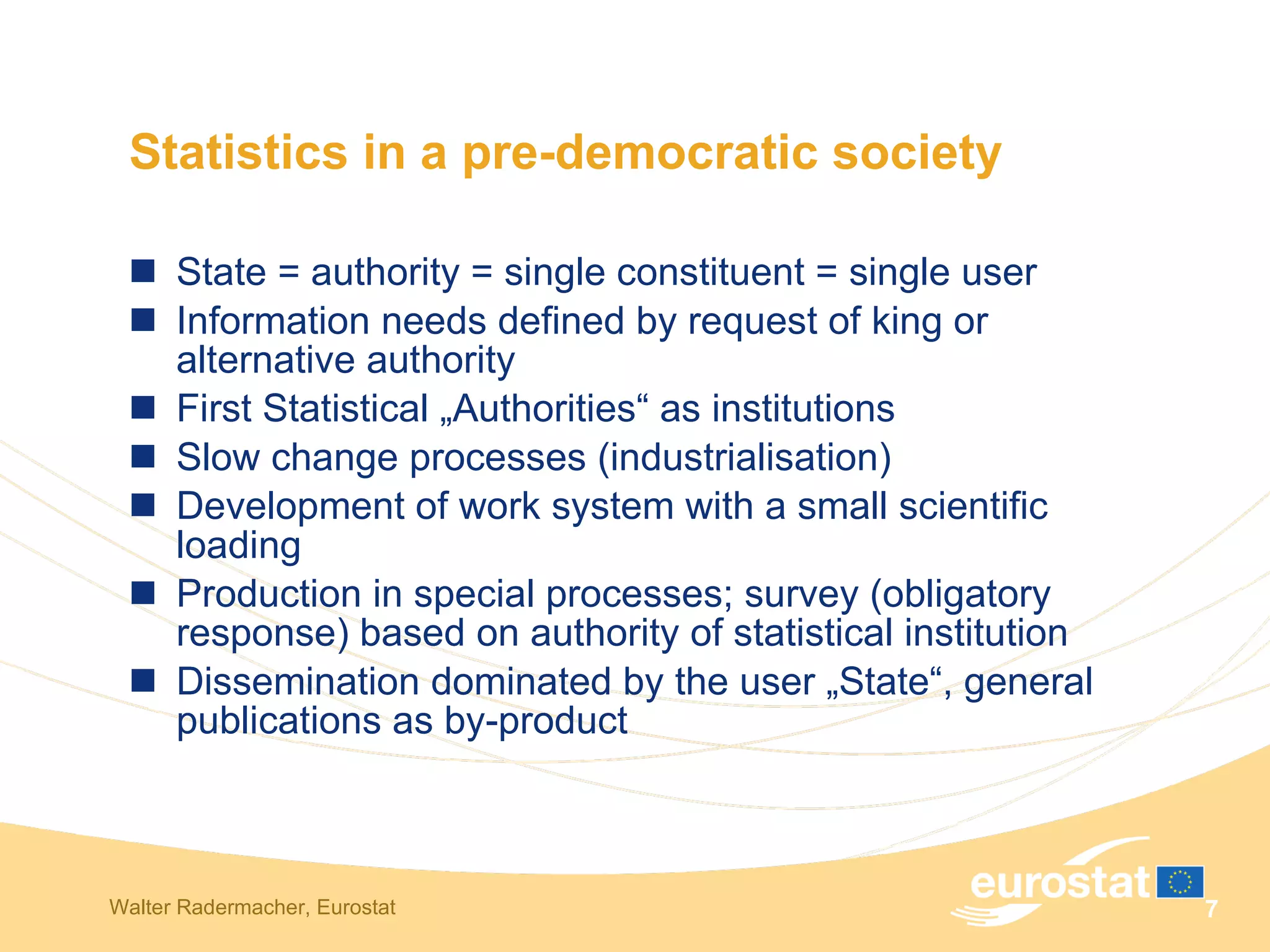
Statistics in a pre-democratic society State = authority = single constituent = single user Information needs defined by request of king or alternative authority First Statistical „Authorities“ as institutions Slow change processes (industrialisation) Development of work system with a small scientific loading Production in special processes; survey (obligatory response) based on authority of statistical institution Dissemination dominated by the user „State“, general publications as by-product
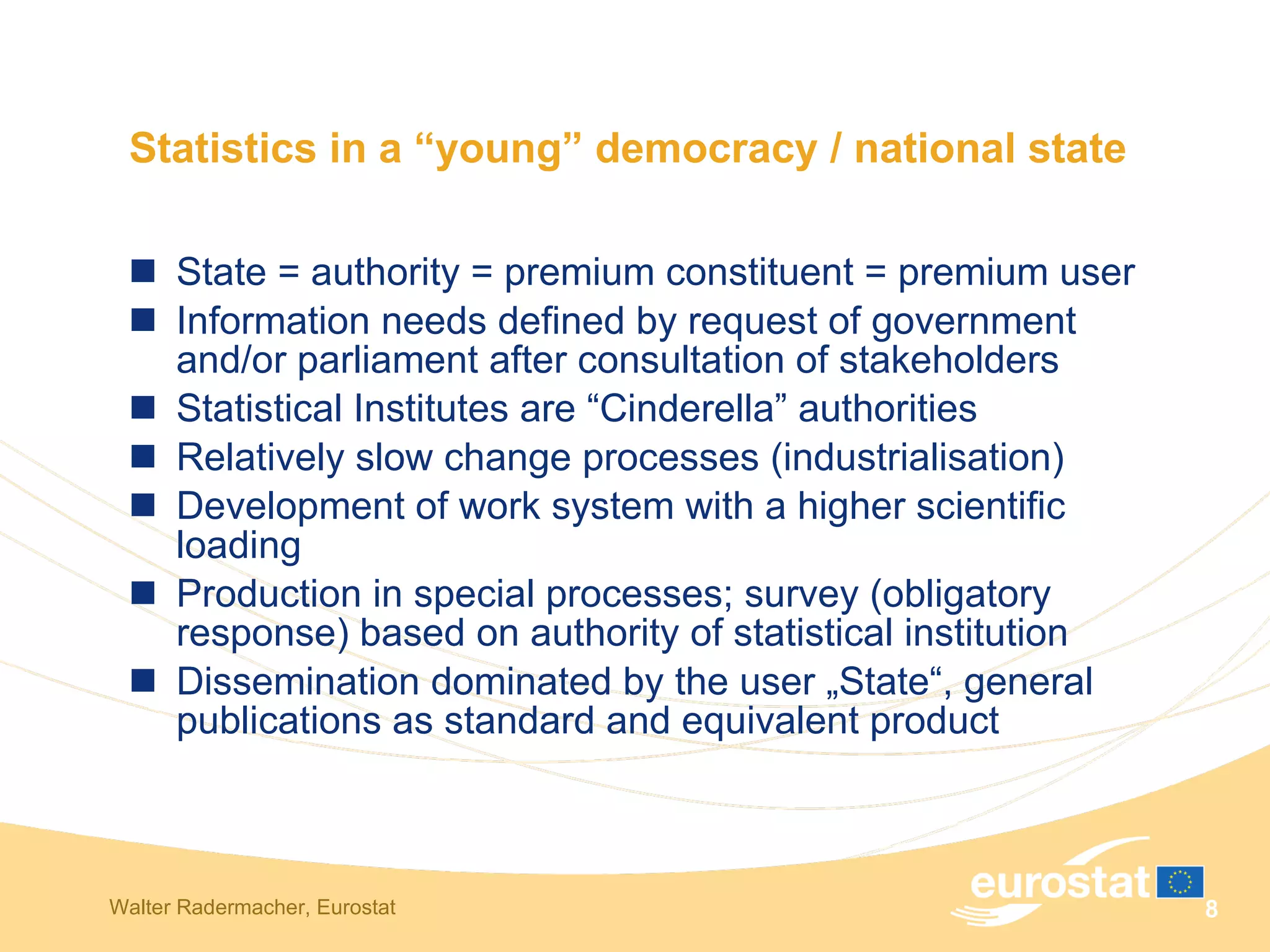
Statistics in a “young” democracy / national state State = authority = premium constituent = premium user Information needs defined by request of government and/or parliament after consultation of stakeholders Statistical Institutes are “Cinderella” authorities Relatively slow change processes (industrialisation) Development of work system with a higher scientific loading Production in special processes; survey (obligatory response) based on authority of statistical institution Dissemination dominated by the user „State“, general publications as standard and equivalent product
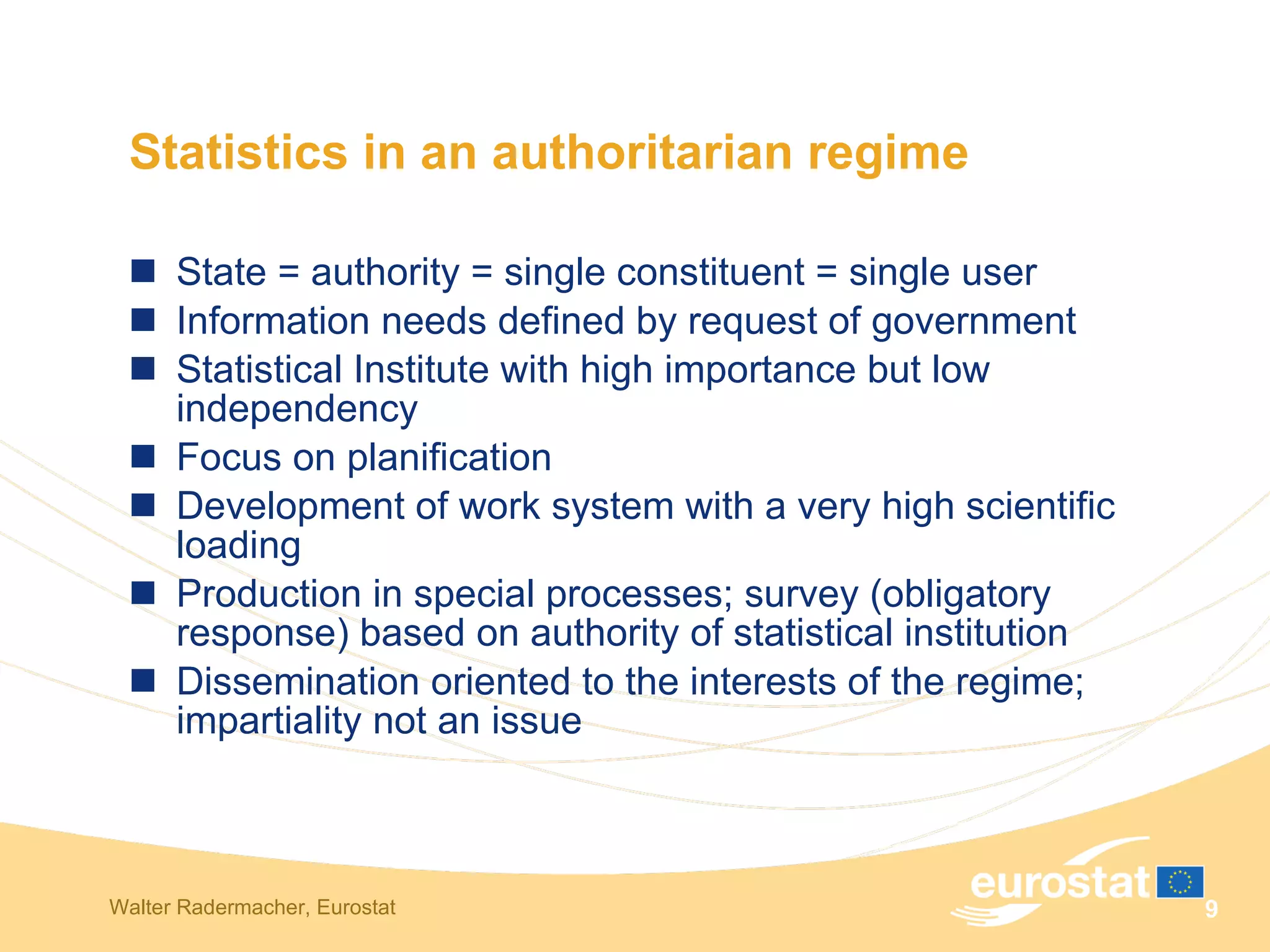
Statistics in an authoritarian regime State = authority = single constituent = single user Information needs defined by request of government Statistical Institute with high importance but low independency Focus on planification Development of work system with a very high scientific loading Production in special processes; survey (obligatory response) based on authority of statistical institution Dissemination oriented to the interests of the regime; impartiality not an issue
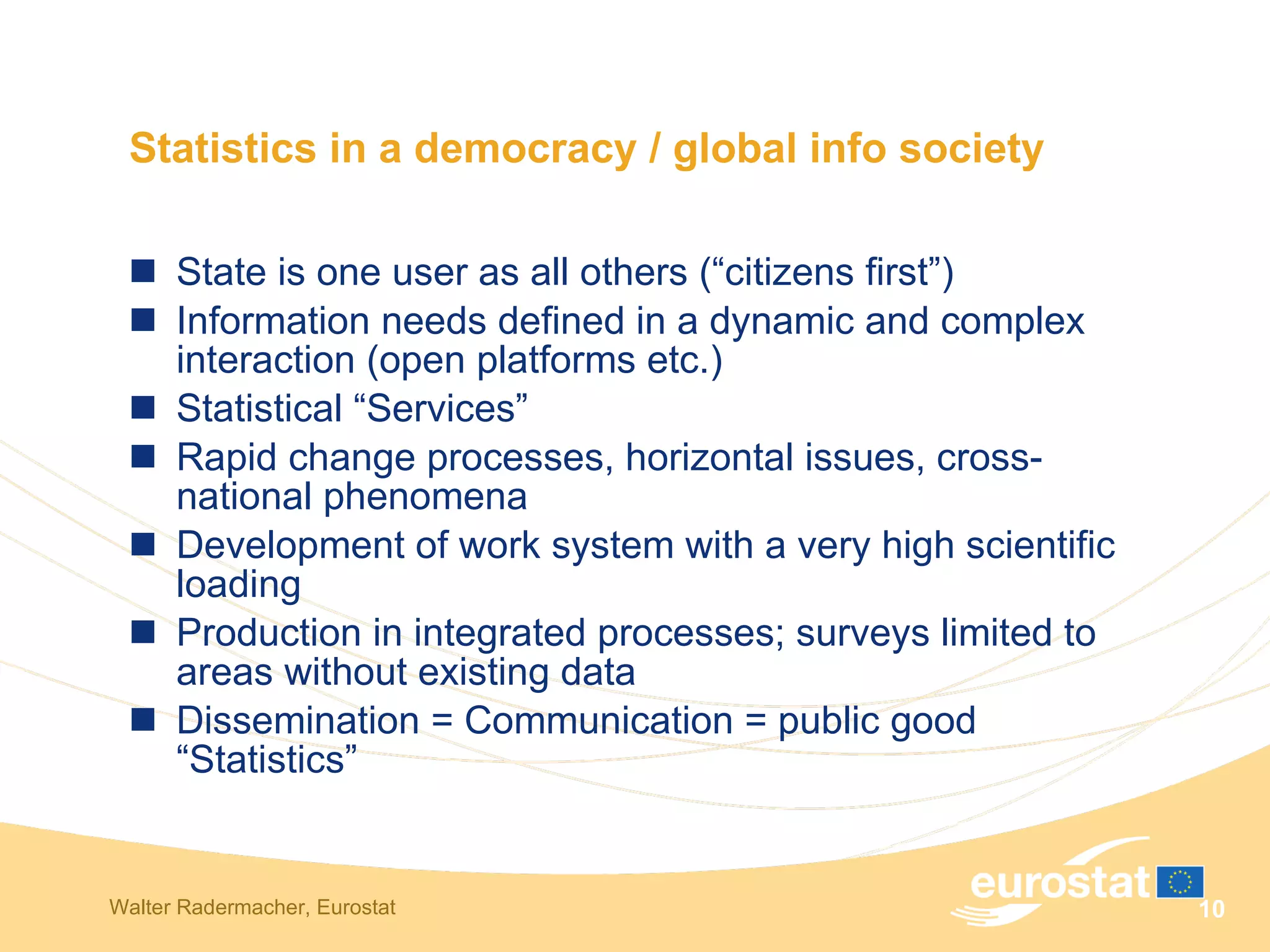
Statistics in a democracy / global info society State is one user as all others (“citizens first”) Information needs defined in a dynamic and complex interaction (open platforms etc.) Statistical “Services” Rapid change processes, horizontal issues, cross-national phenomena Development of work system with a very high scientific loading Production in integrated processes; surveys limited to areas without existing data Dissemination = Communication = public good “Statistics”
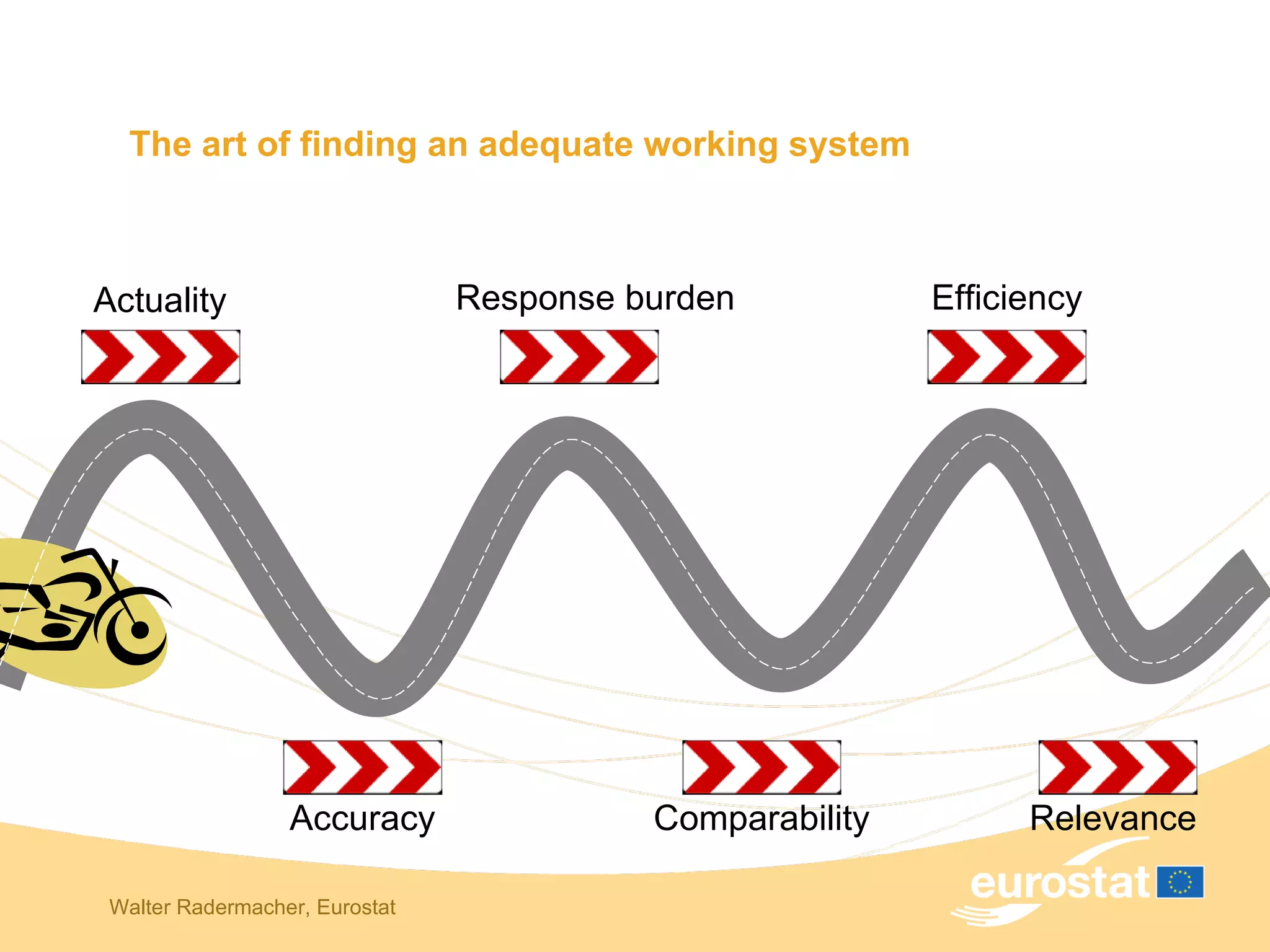
The art of finding an adequate working system Actuality Comparability Response burden Accuracy Efficiency Relevance
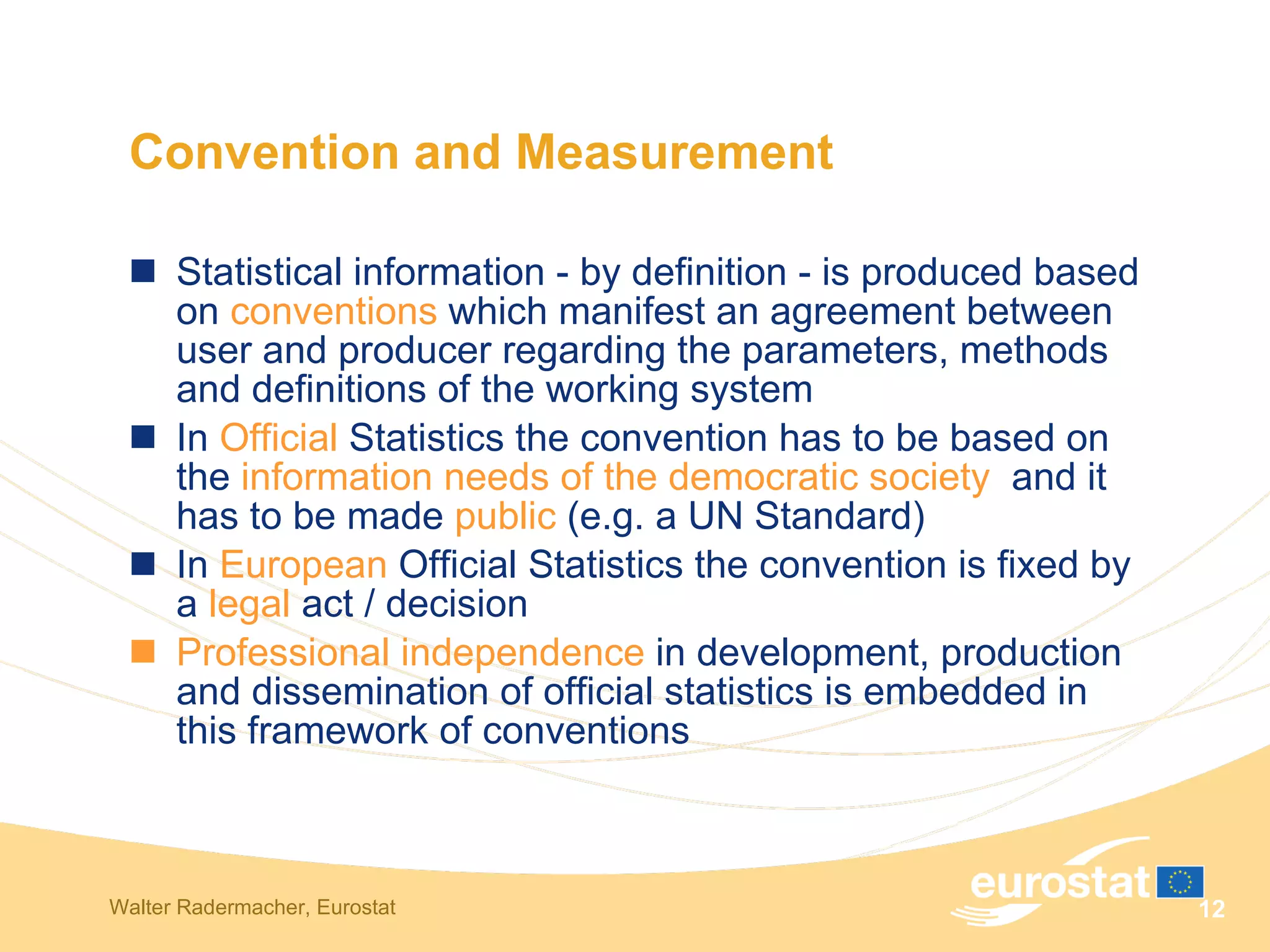
Convention and Measurement Statistical information - by definition - is produced based on  conventions  which manifest an agreement between user and producer regarding the parameters, methods and definitions of the working system In  Official  Statistics the convention has to be based on the  information needs of the democratic society   and it has to be made  public  (e.g. a UN Standard) In  European  Official Statistics the convention is fixed by a  legal  act / decision Professional independence  in development, production and dissemination of official statistics is embedded in this framework of conventions
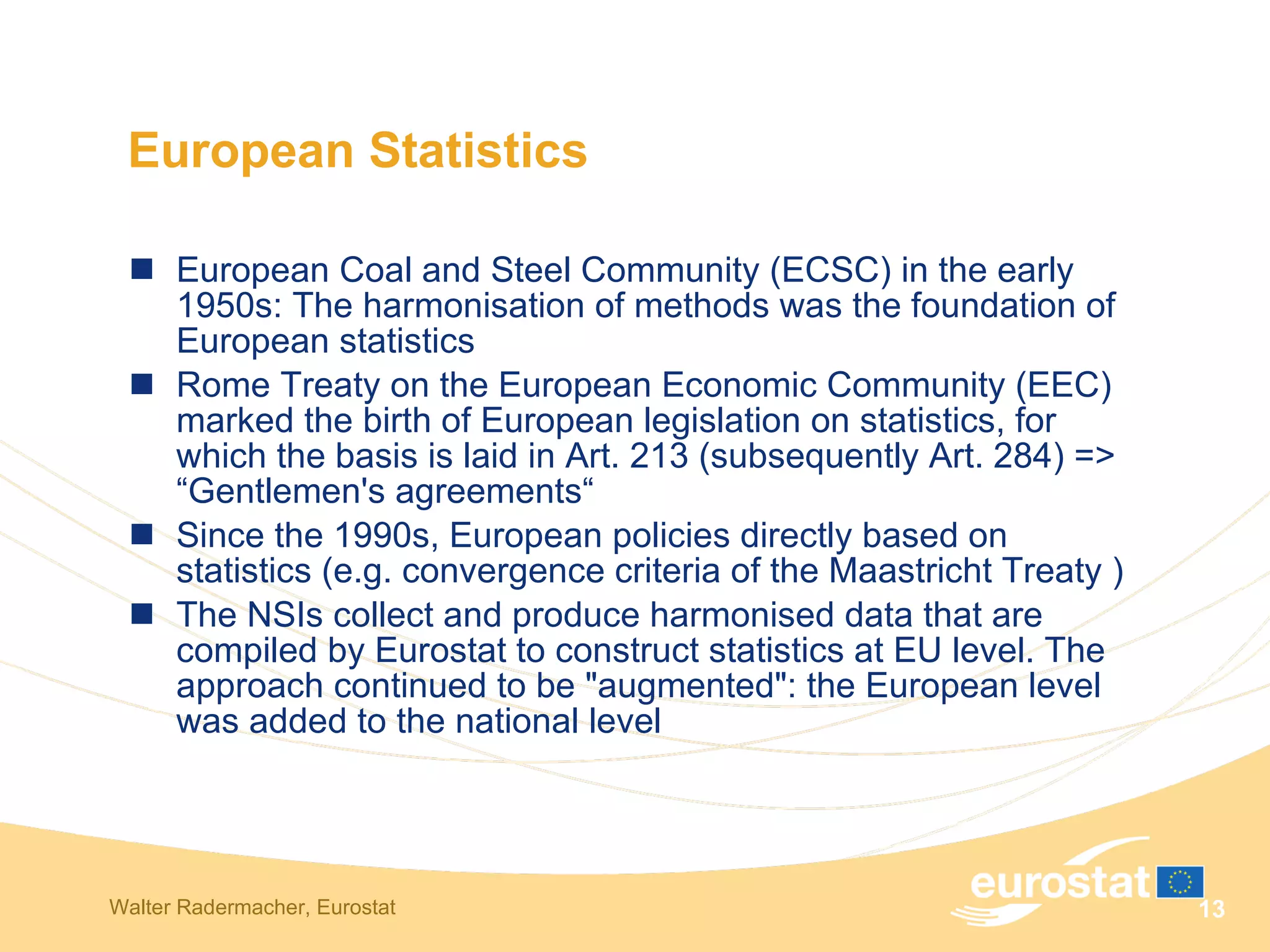
European Coal and Steel Community (ECSC) in the early 1950s: The harmonisation of methods was the foundation of European statistics  Rome Treaty on the European Economic Community (EEC) marked the birth of European legislation on statistics, for which the basis is laid in Art. 213 (subsequently Art. 284)  =>  “Gentlemen's agreements“ Since the 1990s, European policies directly based on statistics (e.g. convergence criteria of the Maastricht Treaty ) The NSIs collect and produce harmonised data that are compiled by Eurostat to construct statistics at EU level. The approach continued to be "augmented": the European level was added to the national level  European Statistics
European Statistical System ESS Regulation (EC) No 223/2009 of the European Parliament and of the Council of 11 March 2009 on European Statistics  Strengthens the cooperation in the ESS, in particular  cost-effectiveness-principle (Art. 2 (f)),  the European Statistical System Committee (Art. 7), collaborative networks (Art. 15.), and a  European approach to statistics (Art. 16).  Generally, a next phase for official statistics in Europe has been initiated, in which the intentions of the law, namely to put in place a real "system" that makes use of cooperation and standardisation as far as possible while respecting the subsidiarity principle have to be realised.
Elements of the ESS ESS Committee (ESSC) European Statistical Advisory Committee (ESAC) European Statistical Governance Advisory Board (ESGAB) Partnership Group Directors Groups Comitolgy and advisory committees ESSnets Sponsorships DGINS and other conferences
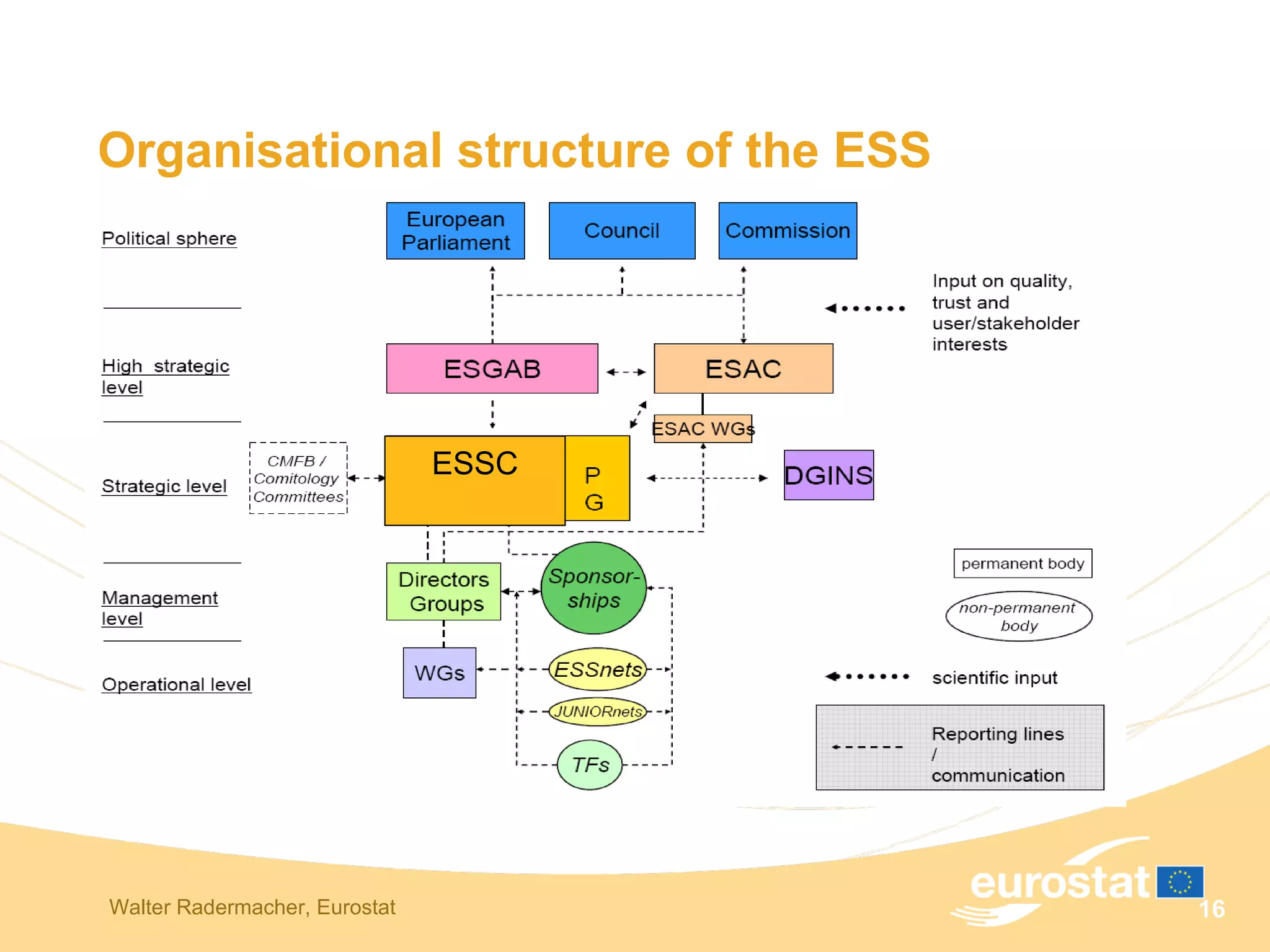
Organisational structure of the ESS ESSC
Situation of Statistical Offices Need to reduce costs and increase efficiency Increasing demands for statistical products and reduction of respondent’s burden Improvements in quality are needed Emerging user needs Progress in information technology
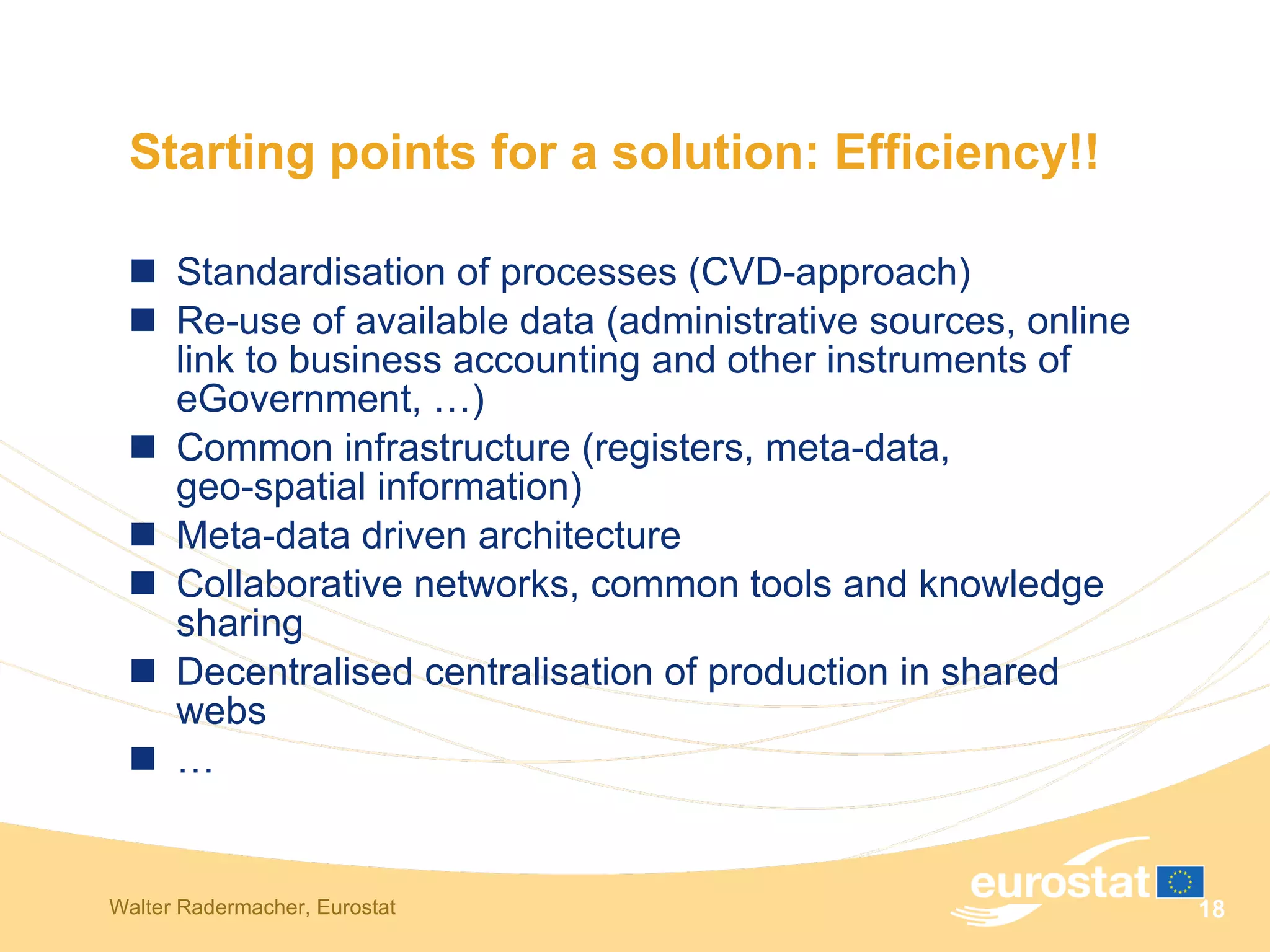
Starting points for a solution: Efficiency!!  Standardisation of processes (CVD-approach) Re-use of available data (administrative sources, online link to business accounting and other instruments of eGovernment, …) Common infrastructure (registers, meta-data,  geo-spatial information) Meta-data driven architecture Collaborative networks, common tools and knowledge sharing  Decentralised centralisation of production in shared webs …
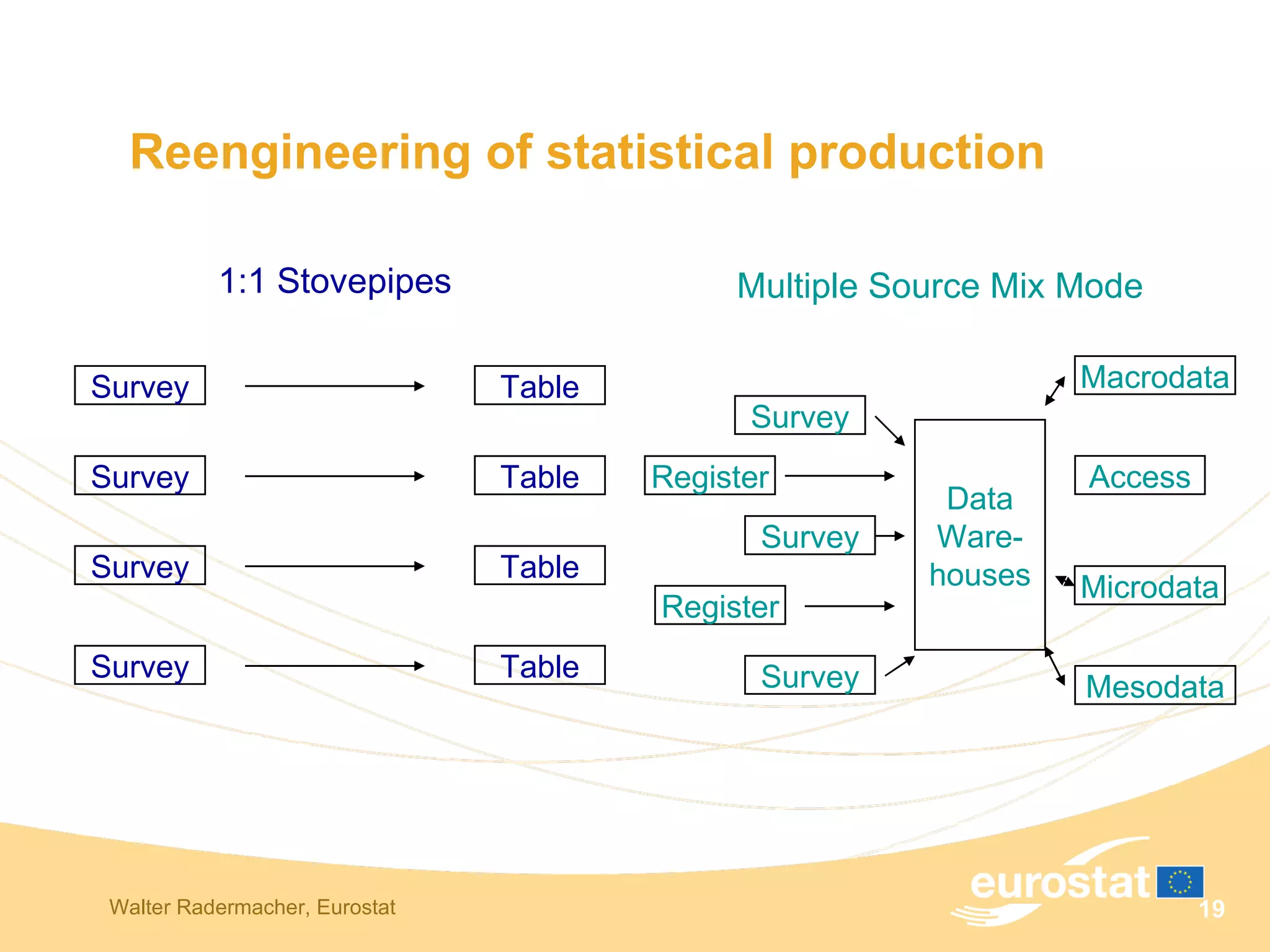
Reengineering of statistical production 1:1 Stovepipes Multiple Source Mix Mode Survey Table Survey Table Survey Table Survey Table Survey Survey Register Register Survey Data Ware- houses Macrodata Access Microdata Mesodata
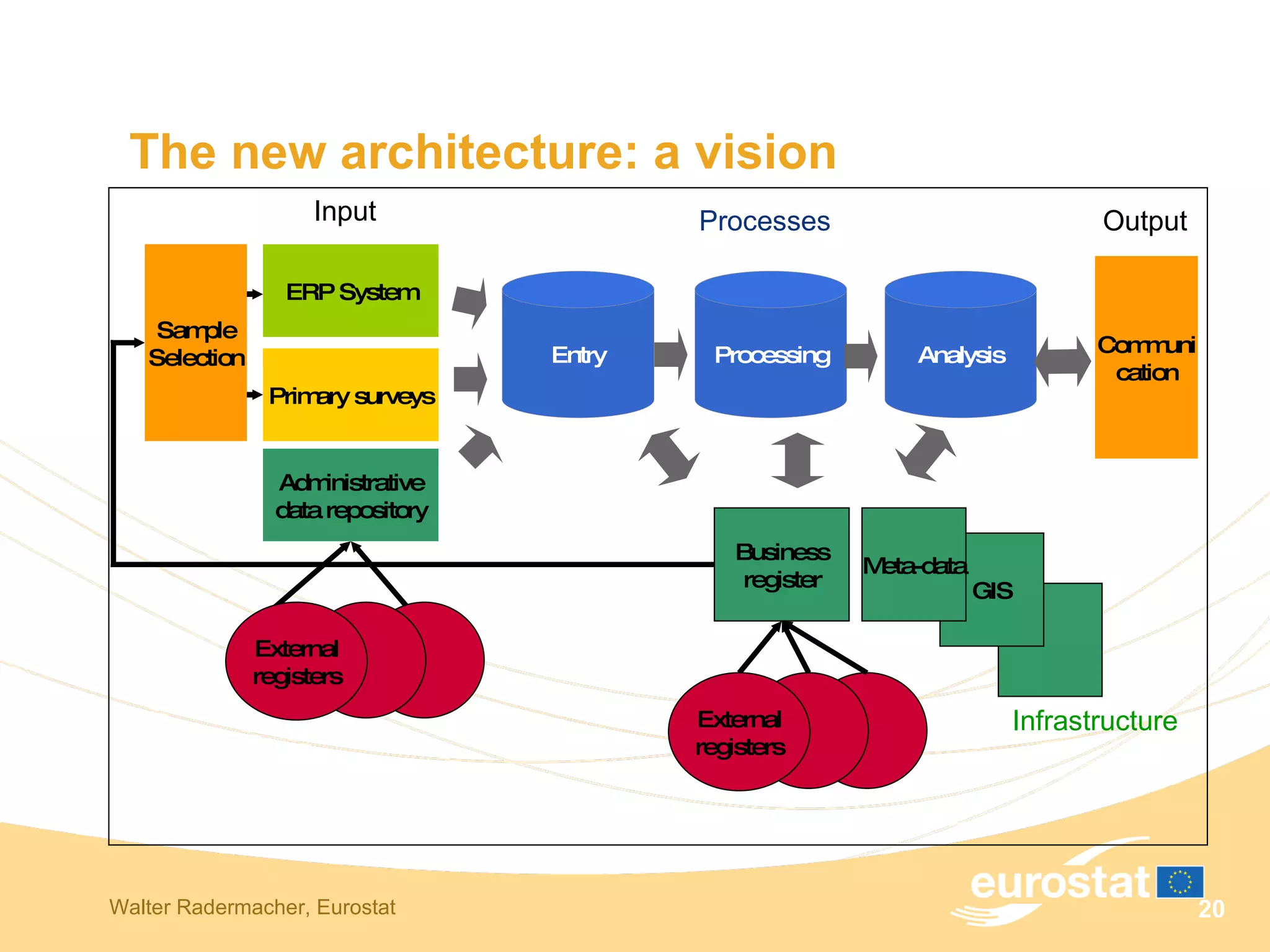
The new architecture: a vision GIS Business register Meta-data Entry Processing Analysis Primary surveys Administrative data repository ERP System Sample Selection External registers External registers Communication Processes Infrastructure Input Output
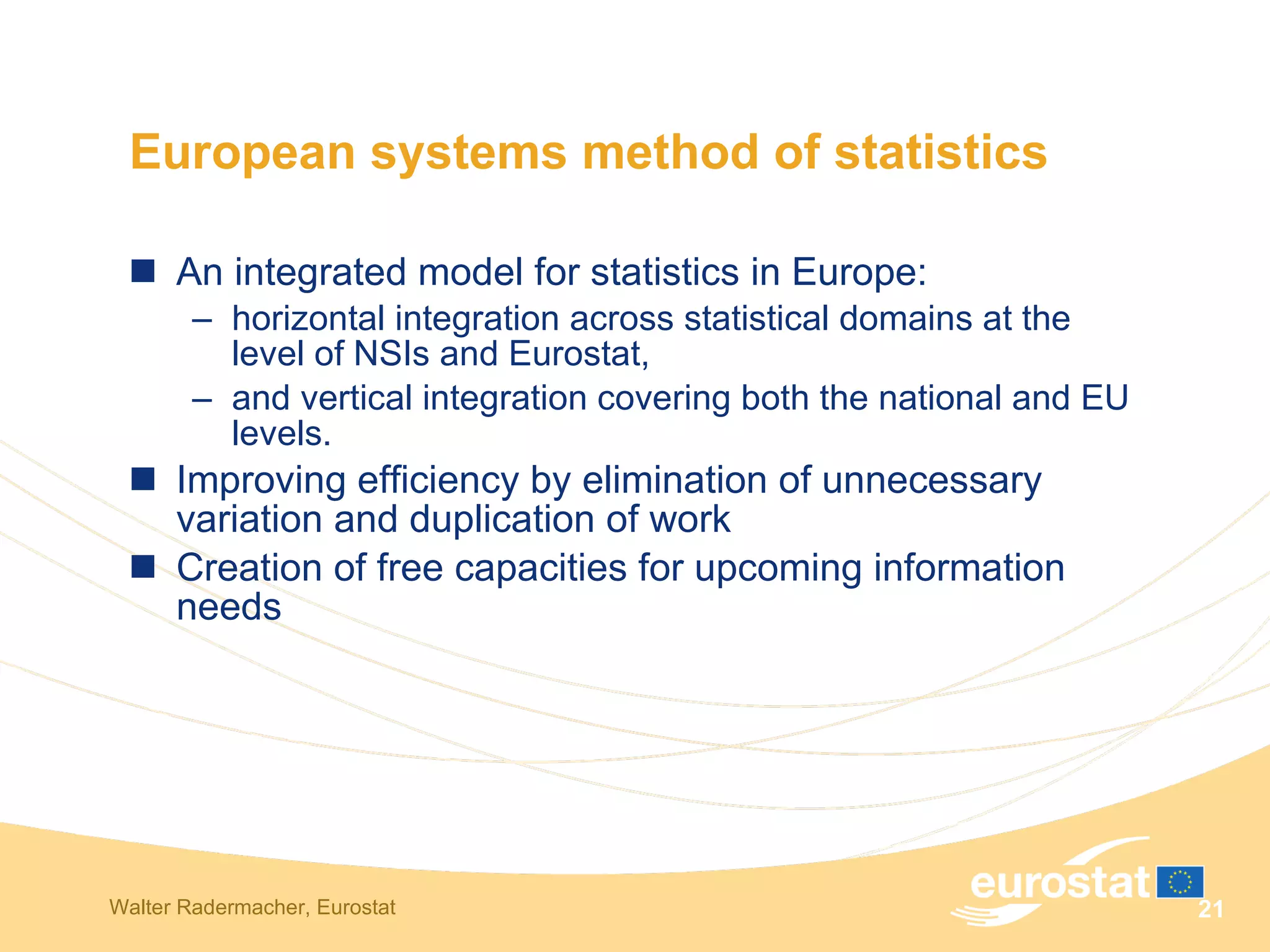
European systems method of statistics An integrated model for statistics in Europe:  horizontal integration across statistical domains at the level of NSIs and Eurostat,  and vertical integration covering both the national and EU levels.  Improving efficiency by elimination of unnecessary variation and duplication of work Creation of free capacities for upcoming information needs
Change in the professional paradigm  From "data-collectors" to "re-users of data"  Risks  concepts and definitions may be changed by the owners of the data  data collections could be discontinued or altered  a loss of control (at least in the perception of statisticians) higher complexity  Reallocation of R&D in statistics needed
Technical and methodological challenges Standardisation and integration of formerly separated production processes will demand great efforts and an effective change management.  Stepwise approach and with intensive collaboration  Quality assessment + assurance of statistics will become much more complex  The legitimate interest of statistics, i.e. the position vis-à-vis the owners of re-used data (administrators, regulators or others) has to be reconsidered and strengthened
New ways of communicating with users  The more statistical production is based on complex methodology the more it is necessary to explain the results.  Trust in the statistical system and the perception of the quality of statistical information are closely related. „ Official“ has to become a quality stamp that users can assess against predefined quality guidelines A basic education in simple statistical elements could help to mitigate a tendency of misunderstanding with the general public (“innumeracy”).  As a consequence, user orientation has to be the guiding principle in communication.
Thank you for your attention! [email_address] http://epp.eurostat.ec.europa.eu/

Developments in European Statistics

  • 1.
    Developments in EuropeanStatistics Challenges in Official Statistics Walter Radermacher, Chief Statistician of the European Union, Director General Eurostat
  • 2.
    Robert M. Pirsig:Zen or the art of motorcycle maintenance
  • 3.
    Statistics and theGerman State, 1900–1945: the making of modern economic knowledge, Tooze, J.A., Cambridge, 2001 The Politics of Large Numbers – A History of Statistical Reasoning, Desrosières, A., Cambridge, Mass./ London 1998
  • 4.
    Statistics: a shorthistory in 4 political steps „ Statistics“ is the empirical branch of the science of state (German: Statistik – > Staatswissenschaften) Official statistics (political/administrative position, working methods) reflect the development of societies in particular the specific relationship between state and citizens Some factors create different political settings: Constitution (democratic, authoritative) Institutional set-up of economy (market, planification) Society (closed/national, globalised) Main sectors of economic production Dynamics of structural change (slow, fast)
  • 5.
    Statistic users andproducers: Interactions Users of statistics Producers of statistics information need use knowledge statistical information statistical data + metadata work system conducting of processes, provision of products and services discussion / definition perception patterns programmes products communication
  • 6.
    Information needs StatisticsPublic Opinion Science Politics Institutional setup How are they defined?
  • 7.
    Statistics in apre-democratic society State = authority = single constituent = single user Information needs defined by request of king or alternative authority First Statistical „Authorities“ as institutions Slow change processes (industrialisation) Development of work system with a small scientific loading Production in special processes; survey (obligatory response) based on authority of statistical institution Dissemination dominated by the user „State“, general publications as by-product
  • 8.
    Statistics in a“young” democracy / national state State = authority = premium constituent = premium user Information needs defined by request of government and/or parliament after consultation of stakeholders Statistical Institutes are “Cinderella” authorities Relatively slow change processes (industrialisation) Development of work system with a higher scientific loading Production in special processes; survey (obligatory response) based on authority of statistical institution Dissemination dominated by the user „State“, general publications as standard and equivalent product
  • 9.
    Statistics in anauthoritarian regime State = authority = single constituent = single user Information needs defined by request of government Statistical Institute with high importance but low independency Focus on planification Development of work system with a very high scientific loading Production in special processes; survey (obligatory response) based on authority of statistical institution Dissemination oriented to the interests of the regime; impartiality not an issue
  • 10.
    Statistics in ademocracy / global info society State is one user as all others (“citizens first”) Information needs defined in a dynamic and complex interaction (open platforms etc.) Statistical “Services” Rapid change processes, horizontal issues, cross-national phenomena Development of work system with a very high scientific loading Production in integrated processes; surveys limited to areas without existing data Dissemination = Communication = public good “Statistics”
  • 11.
    The art offinding an adequate working system Actuality Comparability Response burden Accuracy Efficiency Relevance
  • 12.
    Convention and MeasurementStatistical information - by definition - is produced based on conventions which manifest an agreement between user and producer regarding the parameters, methods and definitions of the working system In Official Statistics the convention has to be based on the information needs of the democratic society and it has to be made public (e.g. a UN Standard) In European Official Statistics the convention is fixed by a legal act / decision Professional independence in development, production and dissemination of official statistics is embedded in this framework of conventions
  • 13.
    European Coal andSteel Community (ECSC) in the early 1950s: The harmonisation of methods was the foundation of European statistics Rome Treaty on the European Economic Community (EEC) marked the birth of European legislation on statistics, for which the basis is laid in Art. 213 (subsequently Art. 284) => “Gentlemen's agreements“ Since the 1990s, European policies directly based on statistics (e.g. convergence criteria of the Maastricht Treaty ) The NSIs collect and produce harmonised data that are compiled by Eurostat to construct statistics at EU level. The approach continued to be "augmented": the European level was added to the national level European Statistics
  • 14.
    European Statistical SystemESS Regulation (EC) No 223/2009 of the European Parliament and of the Council of 11 March 2009 on European Statistics Strengthens the cooperation in the ESS, in particular cost-effectiveness-principle (Art. 2 (f)), the European Statistical System Committee (Art. 7), collaborative networks (Art. 15.), and a European approach to statistics (Art. 16). Generally, a next phase for official statistics in Europe has been initiated, in which the intentions of the law, namely to put in place a real "system" that makes use of cooperation and standardisation as far as possible while respecting the subsidiarity principle have to be realised.
  • 15.
    Elements of theESS ESS Committee (ESSC) European Statistical Advisory Committee (ESAC) European Statistical Governance Advisory Board (ESGAB) Partnership Group Directors Groups Comitolgy and advisory committees ESSnets Sponsorships DGINS and other conferences
  • 16.
  • 17.
    Situation of StatisticalOffices Need to reduce costs and increase efficiency Increasing demands for statistical products and reduction of respondent’s burden Improvements in quality are needed Emerging user needs Progress in information technology
  • 18.
    Starting points fora solution: Efficiency!! Standardisation of processes (CVD-approach) Re-use of available data (administrative sources, online link to business accounting and other instruments of eGovernment, …) Common infrastructure (registers, meta-data, geo-spatial information) Meta-data driven architecture Collaborative networks, common tools and knowledge sharing Decentralised centralisation of production in shared webs …
  • 19.
    Reengineering of statisticalproduction 1:1 Stovepipes Multiple Source Mix Mode Survey Table Survey Table Survey Table Survey Table Survey Survey Register Register Survey Data Ware- houses Macrodata Access Microdata Mesodata
  • 20.
    The new architecture:a vision GIS Business register Meta-data Entry Processing Analysis Primary surveys Administrative data repository ERP System Sample Selection External registers External registers Communication Processes Infrastructure Input Output
  • 21.
    European systems methodof statistics An integrated model for statistics in Europe: horizontal integration across statistical domains at the level of NSIs and Eurostat, and vertical integration covering both the national and EU levels. Improving efficiency by elimination of unnecessary variation and duplication of work Creation of free capacities for upcoming information needs
  • 22.
    Change in theprofessional paradigm From "data-collectors" to "re-users of data" Risks concepts and definitions may be changed by the owners of the data data collections could be discontinued or altered a loss of control (at least in the perception of statisticians) higher complexity Reallocation of R&D in statistics needed
  • 23.
    Technical and methodologicalchallenges Standardisation and integration of formerly separated production processes will demand great efforts and an effective change management. Stepwise approach and with intensive collaboration Quality assessment + assurance of statistics will become much more complex The legitimate interest of statistics, i.e. the position vis-à-vis the owners of re-used data (administrators, regulators or others) has to be reconsidered and strengthened
  • 24.
    New ways ofcommunicating with users The more statistical production is based on complex methodology the more it is necessary to explain the results. Trust in the statistical system and the perception of the quality of statistical information are closely related. „ Official“ has to become a quality stamp that users can assess against predefined quality guidelines A basic education in simple statistical elements could help to mitigate a tendency of misunderstanding with the general public (“innumeracy”). As a consequence, user orientation has to be the guiding principle in communication.
  • 25.
    Thank you foryour attention! [email_address] http://epp.eurostat.ec.europa.eu/

Editor's Notes

  • #6 Bild bekommt durch den Text Bezug zur Statistik.