A Framework for Understanding
Statistical Performance
Paul Askew

CONFERENCE
2-5 SEPTEMBER 2013
NEWCASTLE
Outline
1. Introduction
2. Framework – the “Why”


Operational Drivers



Current Strategic Drivers

3. Framework – the “How”


Macro level



Analytical level
1. Introduction
1. Scope….A framework for


Managing Statistics about performance
(rather than performance of statistical techniques)

2. Operational Origins
•

More about practical drivers and process

•

Utility….target setting, performance improvement

3. Distilling application and development across sectors….
•

Criminal justice, regulation, education, health

•

It really matters….safety, housing, education….
1. Introduction

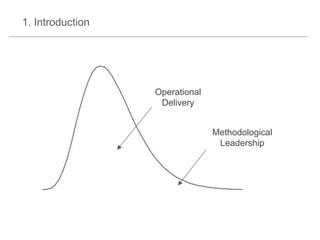
Operational
Delivery
Methodological
Leadership
1. Introduction
1. Scope….A framework for


Managing Statistics about performance
(rather than performance of statistical techniques)

2. Operational Origins
•

More about practical drivers and process

•

Utility….target setting, performance improvement

3. Distilling application and development across sectors….
•

Criminal justice, regulation, education, health

•

It really matters….safety, housing, education….
Outline
1. Introduction
2. Framework – the “Why”


Operational Drivers



Current Strategic Drivers

3. Framework – the “How”


Macro level



Analytical level
2. Why - Operational Drivers

1. It actually matters to people – safety, home, education
2. Performance Regime – broad scope, high profile, deep drill down
3. “Multi-multi” dimensional – both of measures and assessments
4. Statistics meaning – datum, summary, technique
5. Targets - legal, audited, collaborative!
6. Performance Pantomime
7. Less about techniques, more about process
8. Operational Delivery – police, health, regulation…
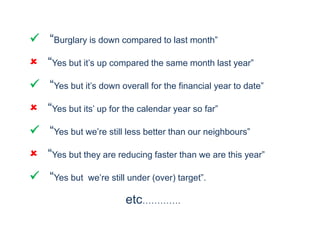
 “Burglary is down compared to last month”
 “Yes but it’s up compared the same month last year”
 “Yes but it’s down overall for the financial year to date”
 “Yes but its’ up for the calendar year so far”

 “Yes but we’re still less better than our neighbours”
 “Yes but they are reducing faster than we are this year”
 “Yes but

we’re still under (over) target”.

etc………….
2. Why - Operational Drivers

1. It actually matters to people – safety, home, education
2. Performance Regime – broad scope, high profile, deep drill down
3. “Multi-multi” dimensional – both of measures and assessments
4. Statistics meaning – datum, summary, technique,
5. Targets - legal, audited, collaborative!
6. Performance Pantomime
7. Less about techniques, more about process
8. Operational Delivery – police, health, regulation…
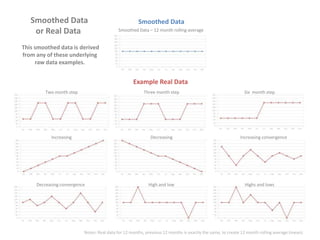
Smoothed Data
or Real Data

Smoothed Data
Smoothed Data – 12 month rolling average

This smoothed data is derived
from any of these underlying
raw data examples.

Example Real Data
Two month step

Three month step

Increasing

Decreasing

Decreasing convergence

High and low

Six month step

Increasing convergence

Highs and lows

Notes: Real data for 12 months, previous 12 months is exactly the same, to create 12 month rolling average (mean).
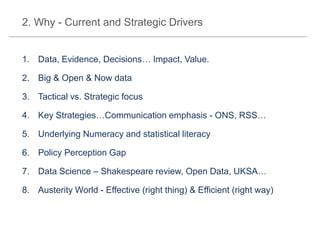
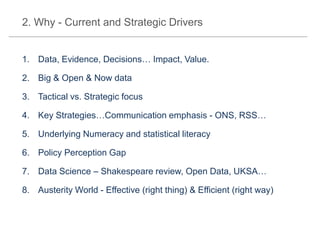
2. Why - Current and Strategic Drivers
1. Data, Evidence, Decisions… Impact, Value.
2. Big & Open & Now data
3. Tactical vs. Strategic focus

4. Key Strategies…Communication emphasis - ONS, RSS…
5. Underlying Numeracy and statistical literacy
6. Policy Perception Gap

7. Data Science – Shakespeare review, Open Data, UKSA…
8. Austerity World - Effective (right thing) & Efficient (right way)
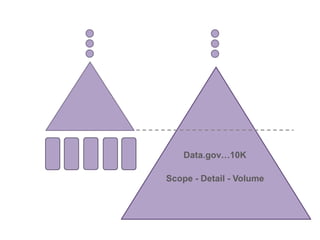
Data.gov…10K
Scope - Detail - Volume
2. Why - Current and Strategic Drivers
1. Data, Evidence, Decisions… Impact, Value.
2. Big & Open & Now data
3. Tactical vs. Strategic focus

4. Key Strategies…Communication emphasis - ONS, RSS…
5. Underlying numeracy and statistical literacy
6. Policy Perception Gap

7. Data Science – Shakespeare review, Open Data, UKSA…
8. Austerity World - Effective (right thing) & Efficient (right way)
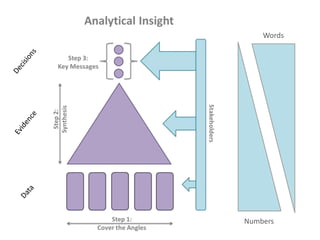
Words

Numbers
2. Why - Current and Strategic Drivers
1. Data, Evidence, Decisions… Impact, Value.
2. Big & Open & Now data
3. Tactical vs. Strategic focus

4. Key Strategies…Communication emphasis - ONS, RSS…
5. Underlying Numeracy and statistical literacy
6. Policy Perception Gap

7. Data Science – Shakespeare review, Open Data, UKSA…
8. Austerity World - Effective (right thing) & Efficient (right way)
% Adults at GCSE+ Levels

The numeracy challenge is big and getting bigger…
• Literacy Improving
while Numeracy
declining

Numeracy
• 26% to 22% (7.5m
adults) with GCSE+
• 17m adults at
primary school level

Skills for Life Survey 2011 (England)
Department for Business Innovation and Skills
A Framework for Understanding
Statistical Performance

Paul Askew
2. Why - Current and Strategic Drivers
1. Data, Evidence, Decisions… Impact, Value.
2. Big & Open & Now data
3. Tactical vs. Strategic focus

4. Key Strategies…Communication emphasis - ONS, RSS…
5. Underlying Numeracy and statistical literacy
6. Policy Perception Gap

7. Data Science – Shakespeare review, Open Data, UKSA…
8. Austerity World - Effective (right thing) & Efficient (right way)
Outline
1. Introduction
2. Framework – the “Why”


Operational Drivers



Current Strategic Drivers

3. Framework – the “How”


Macro level



Analytical level
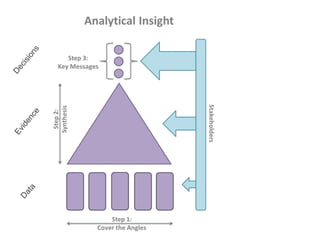
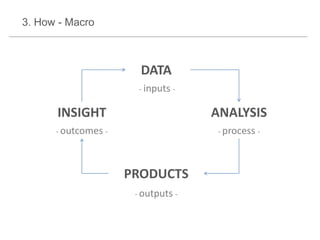
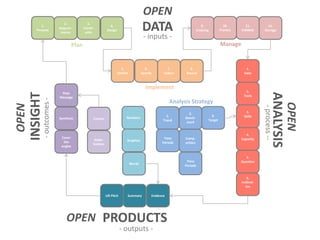
3. How - Macro

DATA
- inputs -

INSIGHT

ANALYSIS

- outcomes -

- process -

PRODUCTS
- outputs -
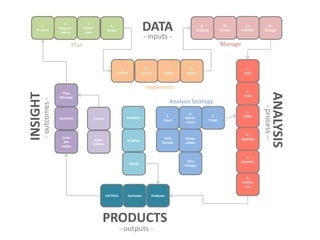
1.
Purpose

2.
Requirements

3.
Constraints

DATA

4.
Design

9.
Entering

12.
Storage

Manage

5.
Defiine

6.
Specify

7.
Collect

8.
Record

1.
Data

Implement

2.
Tools

Analysis Strategy

Synthesis

Comms

Cover
the
angles

Stakeholders

1.
Trend

Graphics

2.
Benchmark

Time
Periods

Numbers

Comparitors

Time
Periods

Words

3.
Target

3.
Skills

4.
Capacity

5.
Question

6.
Inclination
Lift Pitch

Summary

Evidence

PRODUCTS
- outputs -

ANALYSIS

Keys
Message

- process --

- outcomes -

11.
Validate

- inputs -

Plan

INSIGHT

10.
Process
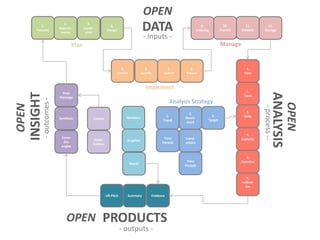
OPEN
1.
Purpose

2.
Requirements

3.
Constraints

DATA

4.
Design

9.
Entering

6.
Specify

7.
Collect

8.
Record

1.
Data

Implement

2.
Tools

Synthesis

Comms

Cover
the
angles

Stakeholders

1.
Trend

Graphics

2.
Benchmark

Time
Periods

Numbers

Comparitors

Time
Periods

Words

3.
Target

3.
Skills

4.
Capacity

5.
Question

6.
Inclination
Lift Pitch

Summary

Evidence

OPEN PRODUCTS
- outputs -

OPEN

Analysis Strategy

ANALYSIS

Keys
Message

- process --

- outcomes -

12.
Storage

Manage

5.
Defiine

INSIGHT

11.
Validate

- inputs -

Plan

OPEN

10.
Process
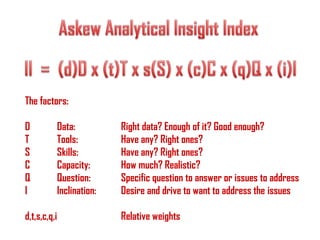
The factors:
D
T
S
C
Q
I
d,t,s,c,q,i

Data:
Tools:
Skills:
Capacity:
Question:
Inclination:

Right data? Enough of it? Good enough?
Have any? Right ones?
How much? Realistic?
Specific question to answer or issues to address
Desire and drive to want to address the issues
Relative weights
OPEN
1.
Purpose

2.
Requirements

3.
Constraints

DATA

4.
Design

9.
Entering

6.
Specify

7.
Collect

8.
Record

1.
Data

Implement

2.
Tools

Synthesis

Comms

Cover
the
angles

Stakeholders

1.
Trend

Graphics

2.
Benchmark

Time
Periods

Numbers

Comparitors

Time
Periods

Words

3.
Target

3.
Skills

4.
Capacity

5.
Question

6.
Inclination
Lift Pitch

Summary

Evidence

OPEN PRODUCTS
- outputs -

OPEN

Analysis Strategy

ANALYSIS

Keys
Message

- process --

- outcomes -

12.
Storage

Manage

5.
Defiine

INSIGHT

11.
Validate

- inputs -

Plan

OPEN

10.
Process
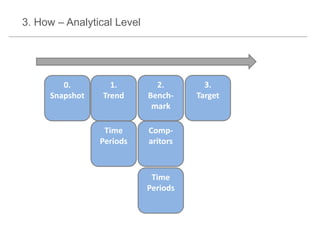
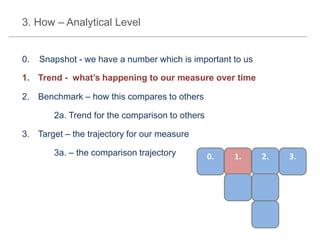
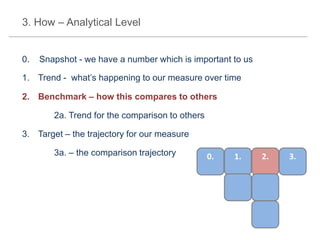
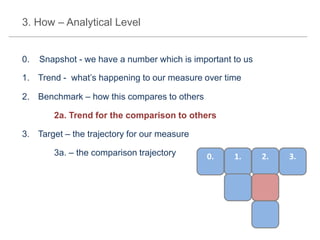
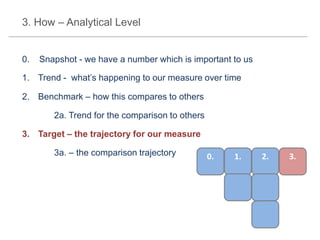
3. How – Analytical Level

0.
Snapshot

1.
Trend

2.
Benchmark

Time
Periods

Comparitors

Time
Periods

3.
Target
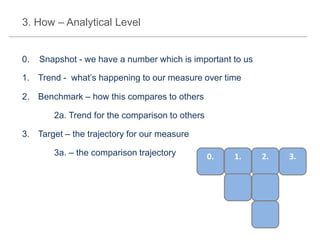
3. How – Analytical Level

0.

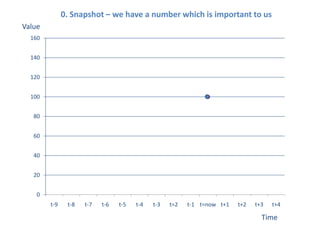
Snapshot - we have a number which is important to us

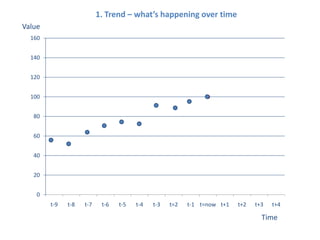
1. Trend - what’s happening to our measure over time
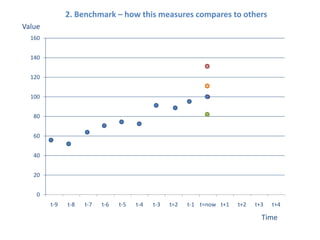
2. Benchmark – how this compares to others

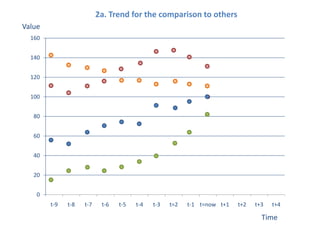
2a. Trend for the comparison to others
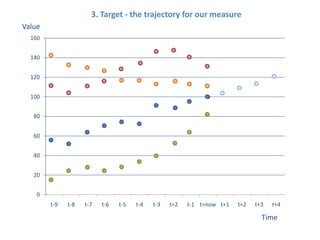
3. Target – the trajectory for our measure
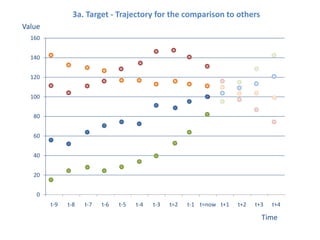
3a. – the comparison trajectory

0.

1.

2.

3.
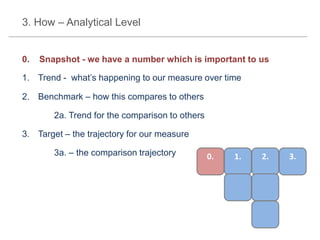
3. How – Analytical Level

0.

Snapshot - we have a number which is important to us

1. Trend - what’s happening to our measure over time
2. Benchmark – how this compares to others

2a. Trend for the comparison to others
3. Target – the trajectory for our measure
3a. – the comparison trajectory

0.

1.

2.

3.
3. How – Analytical Level

0.

Snapshot - we have a number which is important to us

1. Trend - what’s happening to our measure over time
2. Benchmark – how this compares to others

2a. Trend for the comparison to others
3. Target – the trajectory for our measure
3a. – the comparison trajectory

0.

1.

2.

3.
3. How – Analytical Level

0.

Snapshot - we have a number which is important to us

1. Trend - what’s happening to our measure over time
2. Benchmark – how this compares to others

2a. Trend for the comparison to others
3. Target – the trajectory for our measure
3a. – the comparison trajectory

0.

1.

2.

3.
3. How – Analytical Level

0.

Snapshot - we have a number which is important to us

1. Trend - what’s happening to our measure over time
2. Benchmark – how this compares to others

2a. Trend for the comparison to others
3. Target – the trajectory for our measure
3a. – the comparison trajectory

0.

1.

2.

3.
3. How – Analytical Level

0.

Snapshot - we have a number which is important to us

1. Trend - what’s happening to our measure over time
2. Benchmark – how this compares to others

2a. Trend for the comparison to others
3. Target – the trajectory for our measure
3a. – the comparison trajectory

0.

1.

2.

3.
0. Snapshot – we have a number which is important to us
Value
160
140
120
100
80

60
40
20
0
t-9

t-8

t-7

t-6

t-5

t-4

t-3

t=2

t-1 t=now t+1

t+2

t+3

t+4

Time
1. Trend – what’s happening over time
Value
160
140
120
100
80

60
40
20
0
t-9

t-8

t-7

t-6

t-5

t-4

t-3

t=2

t-1 t=now t+1

t+2

t+3

t+4

Time
2. Benchmark – how this measures compares to others
Value
160
140
120
100
80

60
40
20
0
t-9

t-8

t-7

t-6

t-5

t-4

t-3

t=2

t-1 t=now t+1

t+2

t+3

t+4

Time
2a. Trend for the comparison to others
Value
160
140
120
100
80

60
40
20
0
t-9

t-8

t-7

t-6

t-5

t-4

t-3

t=2

t-1 t=now t+1

t+2

t+3

t+4

Time
3. Target - the trajectory for our measure
Value
160
140
120
100
80

60
40
20
0
t-9

t-8

t-7

t-6

t-5

t-4

t-3

t=2

t-1 t=now t+1

t+2

t+3

t+4

Time
3a. Target - Trajectory for the comparison to others
Value
160
140
120
100
80

60
40
20
0
t-9

t-8

t-7

t-6

t-5

t-4

t-3

t=2

t-1 t=now t+1

t+2

t+3

t+4

Time
Outline
1. Introduction
2. Framework – the “Why”


Operational Drivers



Current Strategic Drivers

3. Framework – the “How”


Macro



Analytical
A Framework for Understanding
Statistical Performance
Paul Askew

Thank You
CONFERENCE
2-5 SEPTEMBER 2013
NEWCASTLE

A Framework for Statistical Performance

  • 1.
    A Framework forUnderstanding Statistical Performance Paul Askew CONFERENCE 2-5 SEPTEMBER 2013 NEWCASTLE
  • 2.
    Outline 1. Introduction 2. Framework– the “Why”  Operational Drivers  Current Strategic Drivers 3. Framework – the “How”  Macro level  Analytical level
  • 3.
    1. Introduction 1. Scope….Aframework for  Managing Statistics about performance (rather than performance of statistical techniques) 2. Operational Origins • More about practical drivers and process • Utility….target setting, performance improvement 3. Distilling application and development across sectors…. • Criminal justice, regulation, education, health • It really matters….safety, housing, education….
  • 4.
  • 5.
    1. Introduction 1. Scope….Aframework for  Managing Statistics about performance (rather than performance of statistical techniques) 2. Operational Origins • More about practical drivers and process • Utility….target setting, performance improvement 3. Distilling application and development across sectors…. • Criminal justice, regulation, education, health • It really matters….safety, housing, education….
  • 7.
    Outline 1. Introduction 2. Framework– the “Why”  Operational Drivers  Current Strategic Drivers 3. Framework – the “How”  Macro level  Analytical level
  • 9.
    2. Why -Operational Drivers 1. It actually matters to people – safety, home, education 2. Performance Regime – broad scope, high profile, deep drill down 3. “Multi-multi” dimensional – both of measures and assessments 4. Statistics meaning – datum, summary, technique 5. Targets - legal, audited, collaborative! 6. Performance Pantomime 7. Less about techniques, more about process 8. Operational Delivery – police, health, regulation…
  • 10.
     “Burglary isdown compared to last month”  “Yes but it’s up compared the same month last year”  “Yes but it’s down overall for the financial year to date”  “Yes but its’ up for the calendar year so far”  “Yes but we’re still less better than our neighbours”  “Yes but they are reducing faster than we are this year”  “Yes but we’re still under (over) target”. etc………….
  • 11.
    2. Why -Operational Drivers 1. It actually matters to people – safety, home, education 2. Performance Regime – broad scope, high profile, deep drill down 3. “Multi-multi” dimensional – both of measures and assessments 4. Statistics meaning – datum, summary, technique, 5. Targets - legal, audited, collaborative! 6. Performance Pantomime 7. Less about techniques, more about process 8. Operational Delivery – police, health, regulation…
  • 12.
    Smoothed Data or RealData Smoothed Data Smoothed Data – 12 month rolling average This smoothed data is derived from any of these underlying raw data examples. Example Real Data Two month step Three month step Increasing Decreasing Decreasing convergence High and low Six month step Increasing convergence Highs and lows Notes: Real data for 12 months, previous 12 months is exactly the same, to create 12 month rolling average (mean).
  • 13.
    2. Why -Current and Strategic Drivers 1. Data, Evidence, Decisions… Impact, Value. 2. Big & Open & Now data 3. Tactical vs. Strategic focus 4. Key Strategies…Communication emphasis - ONS, RSS… 5. Underlying Numeracy and statistical literacy 6. Policy Perception Gap 7. Data Science – Shakespeare review, Open Data, UKSA… 8. Austerity World - Effective (right thing) & Efficient (right way)
  • 14.
  • 15.
    2. Why -Current and Strategic Drivers 1. Data, Evidence, Decisions… Impact, Value. 2. Big & Open & Now data 3. Tactical vs. Strategic focus 4. Key Strategies…Communication emphasis - ONS, RSS… 5. Underlying numeracy and statistical literacy 6. Policy Perception Gap 7. Data Science – Shakespeare review, Open Data, UKSA… 8. Austerity World - Effective (right thing) & Efficient (right way)
  • 16.
  • 17.
    2. Why -Current and Strategic Drivers 1. Data, Evidence, Decisions… Impact, Value. 2. Big & Open & Now data 3. Tactical vs. Strategic focus 4. Key Strategies…Communication emphasis - ONS, RSS… 5. Underlying Numeracy and statistical literacy 6. Policy Perception Gap 7. Data Science – Shakespeare review, Open Data, UKSA… 8. Austerity World - Effective (right thing) & Efficient (right way)
  • 18.
    % Adults atGCSE+ Levels The numeracy challenge is big and getting bigger… • Literacy Improving while Numeracy declining Numeracy • 26% to 22% (7.5m adults) with GCSE+ • 17m adults at primary school level Skills for Life Survey 2011 (England) Department for Business Innovation and Skills
  • 19.
    A Framework forUnderstanding Statistical Performance Paul Askew
  • 20.
    2. Why -Current and Strategic Drivers 1. Data, Evidence, Decisions… Impact, Value. 2. Big & Open & Now data 3. Tactical vs. Strategic focus 4. Key Strategies…Communication emphasis - ONS, RSS… 5. Underlying Numeracy and statistical literacy 6. Policy Perception Gap 7. Data Science – Shakespeare review, Open Data, UKSA… 8. Austerity World - Effective (right thing) & Efficient (right way)
  • 21.
    Outline 1. Introduction 2. Framework– the “Why”  Operational Drivers  Current Strategic Drivers 3. Framework – the “How”  Macro level  Analytical level
  • 22.
    3. How -Macro DATA - inputs - INSIGHT ANALYSIS - outcomes - - process - PRODUCTS - outputs -
  • 23.
  • 24.
  • 25.
    The factors: D T S C Q I d,t,s,c,q,i Data: Tools: Skills: Capacity: Question: Inclination: Right data?Enough of it? Good enough? Have any? Right ones? Have any? Right ones? How much? Realistic? Specific question to answer or issues to address Desire and drive to want to address the issues Relative weights
  • 26.
  • 27.
    3. How –Analytical Level 0. Snapshot 1. Trend 2. Benchmark Time Periods Comparitors Time Periods 3. Target
  • 28.
    3. How –Analytical Level 0. Snapshot - we have a number which is important to us 1. Trend - what’s happening to our measure over time 2. Benchmark – how this compares to others 2a. Trend for the comparison to others 3. Target – the trajectory for our measure 3a. – the comparison trajectory 0. 1. 2. 3.
  • 29.
    3. How –Analytical Level 0. Snapshot - we have a number which is important to us 1. Trend - what’s happening to our measure over time 2. Benchmark – how this compares to others 2a. Trend for the comparison to others 3. Target – the trajectory for our measure 3a. – the comparison trajectory 0. 1. 2. 3.
  • 30.
    3. How –Analytical Level 0. Snapshot - we have a number which is important to us 1. Trend - what’s happening to our measure over time 2. Benchmark – how this compares to others 2a. Trend for the comparison to others 3. Target – the trajectory for our measure 3a. – the comparison trajectory 0. 1. 2. 3.
  • 31.
    3. How –Analytical Level 0. Snapshot - we have a number which is important to us 1. Trend - what’s happening to our measure over time 2. Benchmark – how this compares to others 2a. Trend for the comparison to others 3. Target – the trajectory for our measure 3a. – the comparison trajectory 0. 1. 2. 3.
  • 32.
    3. How –Analytical Level 0. Snapshot - we have a number which is important to us 1. Trend - what’s happening to our measure over time 2. Benchmark – how this compares to others 2a. Trend for the comparison to others 3. Target – the trajectory for our measure 3a. – the comparison trajectory 0. 1. 2. 3.
  • 33.
    3. How –Analytical Level 0. Snapshot - we have a number which is important to us 1. Trend - what’s happening to our measure over time 2. Benchmark – how this compares to others 2a. Trend for the comparison to others 3. Target – the trajectory for our measure 3a. – the comparison trajectory 0. 1. 2. 3.
  • 34.
    0. Snapshot –we have a number which is important to us Value 160 140 120 100 80 60 40 20 0 t-9 t-8 t-7 t-6 t-5 t-4 t-3 t=2 t-1 t=now t+1 t+2 t+3 t+4 Time
  • 35.
    1. Trend –what’s happening over time Value 160 140 120 100 80 60 40 20 0 t-9 t-8 t-7 t-6 t-5 t-4 t-3 t=2 t-1 t=now t+1 t+2 t+3 t+4 Time
  • 36.
    2. Benchmark –how this measures compares to others Value 160 140 120 100 80 60 40 20 0 t-9 t-8 t-7 t-6 t-5 t-4 t-3 t=2 t-1 t=now t+1 t+2 t+3 t+4 Time
  • 37.
    2a. Trend forthe comparison to others Value 160 140 120 100 80 60 40 20 0 t-9 t-8 t-7 t-6 t-5 t-4 t-3 t=2 t-1 t=now t+1 t+2 t+3 t+4 Time
  • 38.
    3. Target -the trajectory for our measure Value 160 140 120 100 80 60 40 20 0 t-9 t-8 t-7 t-6 t-5 t-4 t-3 t=2 t-1 t=now t+1 t+2 t+3 t+4 Time
  • 39.
    3a. Target -Trajectory for the comparison to others Value 160 140 120 100 80 60 40 20 0 t-9 t-8 t-7 t-6 t-5 t-4 t-3 t=2 t-1 t=now t+1 t+2 t+3 t+4 Time
  • 40.
    Outline 1. Introduction 2. Framework– the “Why”  Operational Drivers  Current Strategic Drivers 3. Framework – the “How”  Macro  Analytical
  • 41.
    A Framework forUnderstanding Statistical Performance Paul Askew Thank You CONFERENCE 2-5 SEPTEMBER 2013 NEWCASTLE