Economic Commissionfor Europe
Conference of European Statisticians
Sixty-fifth plenary session
Geneva, 19-21 June 2017
Item 7 (d) of the provisional agenda
Value of official statistics
Value of officialstatistics: Recommendations onpromoting,
measuring and communicating the value of officialstatistics
Prepared by the Task Force on the Value of Official Statistics
United Nations ECE/CES/2017/4
Economicand Social Council Distr.: General
2 March 2017
English only
(A summary document will be
translated to Russian and French)
Summary
The document presents for your comments the Recommendations on Promoting,
Measuring and Communicating the Value of Official Statistics, including a measurement
framework.
The Recommendations have been prepared by the UNECE Task Force on the Value of
Official Statistics consisting of the United Kingdom (chair), Australia, Canada, Ireland,
Mexico, New Zealand, Switzerland, Turkey, Eurostat, OECD, PARIS21 and UNECE.
The deadline for the reply is 24 March 2017. Please send your comments using the
attached feedback questionnaire to anu.peltola@unece.org.
Subject to the positive outcome of the consultation, the Recommendations will be
submitted to the 2017 plenary session of the Conference of European Statisticians for
discussion and endorsement on 19-21 June 2017.
Contents
1. Introduction...................................................................................................................... 3
A. Why these recommendations?............................................................................................3
B. Work process .....................................................................................................................3
C. The recommendations in brief............................................................................................4
D. Blueprint for the way forward............................................................................................6
E. Structure of the report........................................................................................................7
2. The current position.......................................................................................................... 8
A. What is value? ....................................................................................................................8
B. Who are the users of official statistics?...............................................................................8
C. What surveys show about users’ views? ...........................................................................10
D. Official statistics and decision making ..............................................................................12
3. Existing practices to generate, promote and measure value............................................. 13
A. Current practices in statistical offices...............................................................................13
B. Practices in other industries .............................................................................................16
C. Comparison of statisticians’ and other industries’ approaches .........................................22
4. Building value through partnerships............................................................................... 24
A. Partnerships with stakeholders........................................................................................24
B. Partnerships through engagement activities.....................................................................25
C. Partnerships to leverage Big Data.....................................................................................26
D. Crowdsourcing.................................................................................................................26
E. An assessment and going forward ....................................................................................26
5. Measuring the value of official statistics .......................................................................... 28
A. Towards a framework with a set of indicators..................................................................28
B. Objective indicators..........................................................................................................29
C. Subjective indicators – a generic user survey....................................................................31
D. Monetizing the value added of official statistics................................................................32
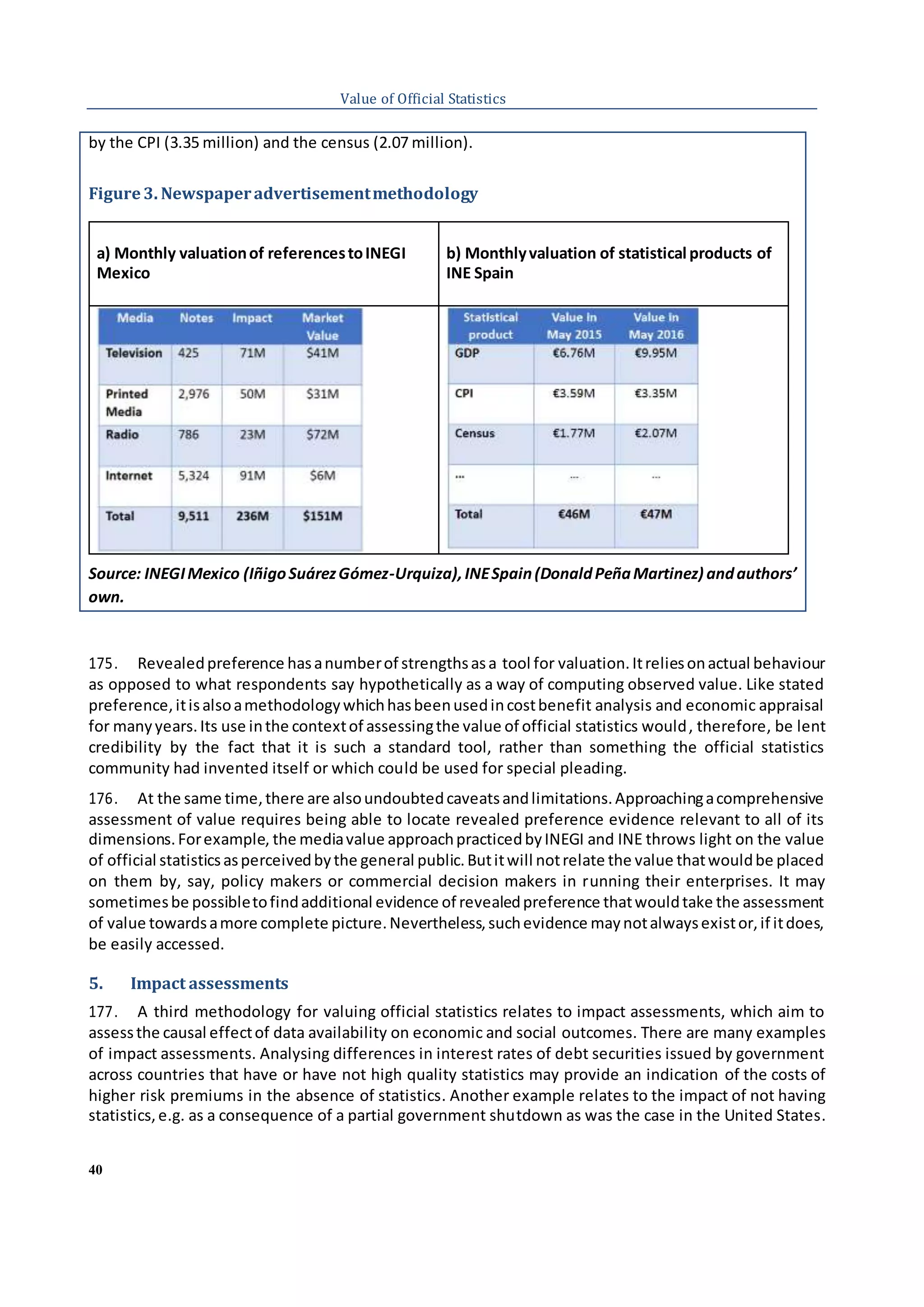
E. Conclusions on measuring the value added of official statistics ........................................44
6. Recommendations ........................................................................................................... 45
7. Conclusions and nextsteps.............................................................................................. 52
Annex 1 The value of official statistics in a page .........................................................................54
Annex 2 Why official statistics are valuable? ..............................................................................55
Annex 3 Generic user survey questions for statistical offices......................................................63
Annex 4 Case studies of other industries’ approach to generation and promotion of value.........70
Annex 5 Studies that use statistics to achieve development impacts..........................................84
1. Introduction
A. Why these recommendations?
1. Official statistics have had an enviable track record over the last few decades.
Furthermore, in an information age, the provision of reliable and high quality data and
information by national statistical offices (NSOs) around the world is increasingly important to
our economies and societies. But this is absolutely not a license to rest on our laurels. In
particular, we need to recognise the implications of technological and other developments, which
represent both opportunities and threats:
• NSOs are by no means the sole supplier of information. Indeed, the world is awash with
data. This may be confusing and give more weight to opinions and impressions. Official
statistics need to stand out as a trustworthy source of information.
• Tightening budgets and proper public accountability have increased the pressure on NSOs
to demonstrate how effectively they use public funds to meet the needs for statistical
information.
• Technological advances have powered the Digital and Data Revolutions. These raise
legitimate questions about how effectively NSOs are using these new possibilities to
expand the benefits they provide to our societies.
• The challenge presented by Big Data. Every day, 2.5 quintillion bytes of data are created –
so much that 90 per cent of the data in the world today have been created in the last two
years.1
Proper exploitation and correct analysis of the data is the key success factor in being
able to make better decisions.2
• Demand for statistics is rapidly increasing. An increasingly globalized and interconnected
world creates new needs for accurate information about economies and societies. As just
one example, reporting on progress towards the 2030 Agenda on Sustainable Development
will require hundreds of indicators to be produced in many new partnerships.
• Users’ needs are becoming more complex and individualized, and more detailed
information is needed for instance on small population groups and geographic localities.
Just as in other areas, the public legitimately demands that their needs for information can
be met conveniently and easily, and asks for more tailored products that are easy to use.
2. It is not over-dramatic to conclude that official statistics are at cross roads. There are
opportunitiespresentedbythese developments,whichif theyare wise, official statisticians will take in
orderto buildonprevioussuccesses.Butthere are alsothreats.Failure torecognise these or to react to
themwithcomplacencycouldhave the mostseriousconsequences.Atworst,official statisticscouldfind
itself partly or largely replaced by other information and data providers.
B. Workprocess
3. In April 2014, the Conference of European Statisticians (CES) held a seminar “What is the
value of official statistics and how do we communicate that value?”. The Conference stated that
1
“Applynewanalytics tools to reveal newopportunities,” IBM SmarterPlanet website, Business Analytics page
www.ibm.com/smarterpl/us/en/business_analytics/article/it_businees_intelligence.html
2
“Performance andCapacity Implications for BigData”, IBM Redpaper, International Technical Support Organization, ibm.com/redbooks
4
Value of Official Statistics
the value of official statistics should be promoted as a global asset. The Conference called for
joint actions at the international level to develop a common language and terminology related to
the value of official statistics and to measure the economic value of official statistics through the
collection of case studies.
4. To advance this agenda, the CES Bureau asked a group of interested countries and
organizations to develop a road map to explore the key aspects to be covered in further work on
the value of official statistics. Such a road map was prepared by a group composed of the United
Kingdom (chair), Austria, Canada, Mexico, OECD and UNECE.
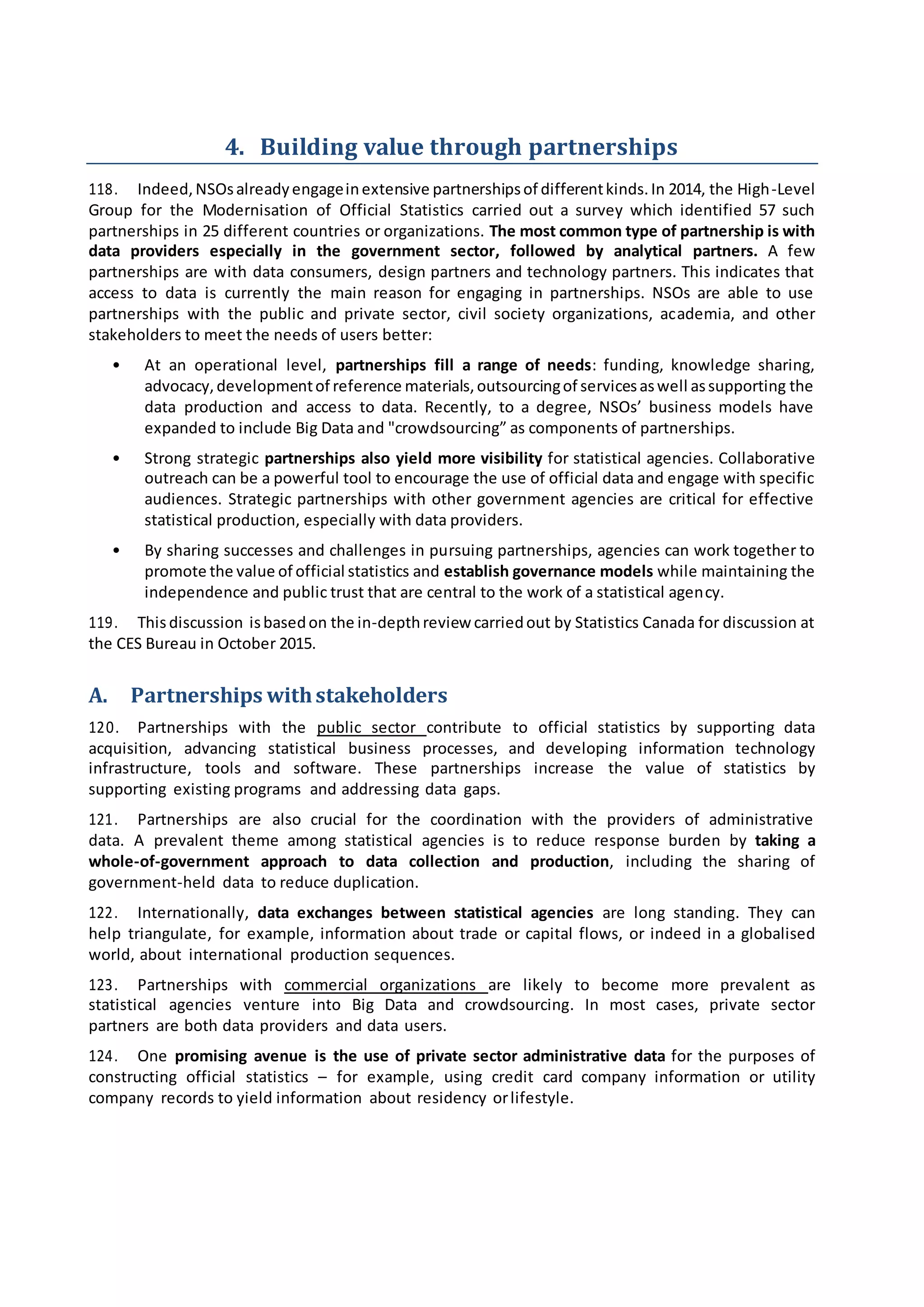
5. In consequence, the CES Bureau established a Task Force on the Value of Official Statistics
in March 2015 composed of experts from the United Kingdom (chair), Mexico (vice chair),
Canada, Ireland, New Zealand, Turkey, Eurostat and OECD. UNECE acts as the secretariat. By
virtue of its terms of reference, the Task Force’s objective was to define what users, stakeholders
and society value in official statistics, and develop ways to measure this value for better
understanding and communication to society.
6. In October 2015, the Task Force carried out a survey of NSOs, jointly with the UNECE High-
Level Group (HLG) Modernisation Committee on Products and Sources, to collate good and
innovative practices which improved the relevance of official statistics, measured their value or
persuasively advocated the value of investing in official statistics. Where respondents were
happy to have such information shared, this Report mentions some examples. More examples
are presented in the wiki on best practices in the value of official statistics.
7. The InterimRecommendationsonthe value of official statisticswere discussedbythe CESBureau
in February 2016 and by the CES plenary session in April 2016. The Interim Recommendations were
circulatedforelectronicconsultationto all CESmembers,andthisfinal Reporttakes into account all the
feedback received.
8. The Recommendations will be submitted to the Bureau of the Conference of European
Statisticians for a review in February 2017, and subsequently for all CES members for a final
electronic consultation. Subject to positive outcome of the consultation, the full Report will be
submitted to the 2017 plenary session of the Conference of European Statisticians for
endorsement.
C. The recommendations inbrief
9. Based on its work over the last two years, looking at what has worked in other industries and
sectors as well as in official statistics, the Task Force has made a number of recommendations
appropriate to these circumstances. These are set out in full in Chapter 6. In summary, they are as
follows:
1) We should exploit the comparative advantage of official statistics (the cornerstone of
statistical work): Official statistics are produced in professional independence based on
scientific methods, rigorous quality criteria and the Fundamental Principles of Official
Statistics. This has numerous ramifications but we should exploit the “unique selling point”
for official statistics.
2) We can improve the value of statistics by putting users of statistics truly at the centre:
However expertly and professionally produced, official statistical products are of no use
unless they meet someone’s needs. That requires understanding users (and non-users who
5
1. Introduction
are potential users) and their information needs. It also means recognizing that these needs
will not stand still and will change over time.
3) Statistics need to be designed for everyday life: Design is crucial for official statistics, no less
than for other sectors. This is not just about logos or graphics but fundamentally about
providing products and services that meet the needs of our users. Different users have
different needs and statistical production should recognize this. A recurrent theme is that
often users no longer want just the numbers but also the story that goes with them and
their implications.
4) Statisticians need to innovate to remain valuable. The world is not standing still – anything
but. Requirements made of NSOs are changing and growing. Technologically, so too are the
means to satisfy these needs. Investment in innovation is therefore indispensable.
5) We can go further with the right strategic partners. NSOs are experienced in working in
partnershipwithothers.Buthistorically,ourrange of partnershassometimesbeen limited. We
should seek out new partnerships whenever these can offer strategic value. New forms of
partnershipinternationallyandwiththe private sector involving new technologies and design,
new products and new dissemination channels all offer ways of tapping hitherto unexploited
potential.
6) Building the official statistics brand and gaining visibility would take us further. Excessive
modesty about official statistics is dangerous. We can realize the potential value of what we
produce only if users recognize what we have to offer and turn to us to meet their needs.
Official statistics have a strong comparative advantage, its unique selling point noted above.
Explicit brand recognition and promotion strategies for each NSO would advertise our
strengths.
7) By measuringoutcomes,the resultsof usingofficial statistics, we can achieve a greater impact.
The judge and jury on the value of official statistics is whether our outputs lead to better
outcomes for our economies and societies – that they lead to decisions by governments,
companies or people which are better informed and well based. All of the previous
recommendations are designed to help achieve this end. But, to date, statisticians have not
been good at assessing and measuring such impact. This has hampered our ability to promote
the value of official statistics. This includes the need to:
• Take steps to improve our knowledge of what our statistics are used for, and the
impact that they can have. Share good examples of uses of statistics and the
positive outcomes to the public.
• Measure the value of official statistics with a dashboard of indicators and a regular
user survey.
• Develop approaches to calculate monetary values of official statistics. This report
describes the most frequently applied methodologies to monetize the value added
of official statistics. By gaining more experience, these methodologies can be
refined, and more examples and evidence of the value of official statistics can be
collected. Monetary measures of the value of certain statistic or statistics in general
can provide a convincing case for defending official statistics.
8) We needtoshare and learnand stayabreast of best practices across the statistical community.
The threats and opportunities facing official statistics are constantly changing. However
6
Value of Official Statistics
successful we have been in the past, the future can be assured only by actively responding to
these changingcircumstances.The TaskForce was struckin the course of its work by how many
existing good practices could be identified in individual NSOs or in other industries but which
were not widely known. It, therefore, oversaw the construction of a wiki on best practices of
statistical officesinvalue creation, measurement and promotion. The Task Force recommends
the wiki should be maintained and actively used.
D. Blueprint for the way forward
10. These Recommendations can be only the start of ongoing action. As an aid to helping take
forwardthat ongoingaction,and in the light of the CES’s reaction to the Interim Recommendations on
the value of official statisticslast year,the TaskForce has producedseveral “co-products”to go with the
final report. These are:
• A wiki for the sharing of best practices among statistical offices in value creation,
measurement and promotion: www1.unece.org/stat/platform/x/FQRXBw
(See recommendation 8).
• A generic user survey with potential questions for reviewing the subjective value of official
statistics as perceived by users of statistics (See recommendation 7 and Annex 3).
• A note setting out various useful information and arguments to act as a quarry from which
to construct presentations for particular uses and stakeholders, as required, to
demonstrate the value of official statistics and to argue for increased investment. (See
Annex 2).
• A shorter version – not much than a page – derived from this material, representing “killer
facts” to persuade interlocutors of the value of investing in official statistics. (See Annex 1).
11. More specifically,the TaskForce makesthe following proposalsto take the agenda forward with
the impetus it warrants:
• All NSOs should take forward the agenda defined by the recommendations. NSOs will, of
course, be at different points on the various dimensions of the recommendations.
• UNECE should host and maintain the best practices wiki that the Task Force has created.
NSOs should supply their own relevant material to the wiki updated in the light of
experience in taking the work programme forward.
• The updating of the wiki should be accompanied by a UNECE meeting of relevant experts.
The meeting would review progress with the overall agenda and consider whether the
recommendations needed amending or updating in the light of experience. This could be
linked to the work of existing expert groups under the Conference of European Statisticians.
• The work to generate better information on measurement of the value of official statistics
is both urgent and where the statistics community generally starts from a low base.
“Pathfinder” NSOs should, therefore, be invited to undertake work in line with the
proposals in Chapter 5 to share their experiences with the rest of the statistical community.
• In part, the UNECE wiki could provide the means of sharing. But this mechanism could be
enhanced by organizing meetings to discuss and share experiences. NSOs could also be
encouraged to host or co-host these events to help overall progress.
7
1. Introduction
E. Structure ofthe report
12. Chapter 2 of the Recommendations discusses the nature of the value added that NSOs are
seeking to generate. It notes that genuine value implies products being of use to those that
consume them, in particular for purposes of informing evidence based decision making – not only
in the public sector but across user segments also for informing commercial and household
decisions, as well as the academia and social sector. It also notes that changing circumstances
means that what is of value also changes. So, NSOs need constantly to review and renew what
they offer to ensure the added value is maintained.
13. Chapter 3 portraits the current practices of NSOs and other industries in generating, promoting
and measuring the value. It identifies the United Nations Fundamental Principles of Official
Statistics as the cornerstone of what we do. Adherence to these, if properly implemented and
supported by statistical legislation, should guarantee the quality and reliability of our outputs
and independence of any policy or other interests, in distinction to most other information
providers. This is a strong comparative advantage which should be promoted more assertively.
The Chapter usesthe results of the UNECE survey carried out in October 2015 to portray NSOs’ current
practices. The Chapter also looks at the practices of a selection of other organizations and industries,
whichalsohave the potential foradoptionbyNSOs. The analysis of practices in other industries turned
out to be very useful for cross-fertilizing with the practices of NSOs.
14. Chapter 4 surveys and discusses partnerships that NSOs have set up or are engaged in.
Some 57 such partnerships are analysed in 25 different countries. There is plenty of scope for
mutual learning. There appear to be areas where the potential for gain has not yet been fully
exploited: (1) building of shared production systems and frameworks between NSOs; (2) greater
attention in assistance to developing countries to support the value of official statistics; (3)
stronger partnerships to maximise the gains from administrative and other new data sources; and
(4) the largely untapped potential for collaboration with the private and commercial sectors, not
least in creating new products.
15. Statisticians measure almost every aspect of society, but not their own value added. Chapter 5
considers how to measure the value of official statistics and identifies three parts of a
measurement framework with indicators on the value of official statistics consisting of: (1)
observable indicators, (2) subjective indicators from surveys and (3) experiments to monetize the
value of official statistics. The Chapter makes recommendations on how to get started with the
measurement task.
16. Chapter 6 sets out some recommended actions for promoting and increasing the value of
official statistics for NSOs. It recognises, however, that in a changing world, a single snapshot
would quickly lose relevance. The Task Force has, therefore, established a wiki platform to give
NSOs the ability to share their good practices and experiences for mutual learning. The wiki
provides concrete examples of each recommendation to showcase how to increase, promote and
measure the value of official statistics.
17. Chapter 7 draws some conclusions, and makes proposals for next steps.
2. The current position
A. What is value?
18. Value is a central but sometimes slippery concept for any business or service. The Oxford
English Dictionary defines value as “the importance, worth, or usefulness of something”. It may
have a material or monetary dimension: how much could be charged for the particular output or
service. But, for a public organisation in particular, it is also likely to have a wider component –
the value that the organisation contributes to society, regardless of whether all of its contribution
could or should have a price tag.
19. There is also a dynamic element insofar as an output or service is rarely timelessly of
intrinsic value. Value often depends on changing circumstances and needs. Oil lamps lost value
after the advent of gas and then electric lighting, as did steam power when more efficient means
of propulsion became available. Putting this in another way, and in the context of official
statistics, value has to be assessed and re-built continuously.
20. Quality of statistics is one of the key features of data that influences the value that users
experience. Quality could be seen as “fitness for use” which includes many dimensions, such as
relevance, accuracy, timeliness, accessibility, comparability and coherence. Quality is by no means a
monopoly of official statistics. Private data providers may even be able to provide users with some
betterqualityfeatures,forinstance bettertimeliness. But it is undoubtedly true that the value offered
by official statisticsis supportedby theirlegalandinstitutionalframeworkthat ensures the compilation
of objective and independent statistics that are not subject to inappropriate influence.
21. In less abstract terms, one of the strongest motivations for producing data and information
is its usefulness in evidence based decision making. Relevant statistics fulfil one or several of the
following characteristics: they have many users, are essential to the fulfilment of the mandates of
several organizations,facilitatetrade ordevelopment,theirreleasecausesreactions at the markets and
their unavailability creates inequities or asymmetric information.
22. When resources are limited and choices need to be made as to how they should best be
deployed to maximum effect, reliable evidence is at a premium. This applies whether it is a
governmental decision at local, national or international level, a business decision or a personal
decision that is at stake. Conversely, official statistics are arguably of little value in themselves
unless they help the making of well-based decisions. Or, in convenient summary:
23. Data are the lifeblood of decision-making and the raw material for accountability.
Without high-quality data providing the right information on the right things at the right time;
designing, monitoring and evaluating effective policies becomes almost impossible.3
So, too,
does the ability of businesses and people to make well-based decisions. As the volumes of
available data increase, quality should become the decisive factor when choosing a data source.
B. Who are the users of official statistics?
24. Statistics are produced to be used and to make an impact on society through a higher
degree of openness and transparency, avoiding misuse of data, ensuring confidentiality and equal
access to information as part of human rights. The result of using official statistics should be a
3
A Worldthat Counts: www.undatarevolution.org/report/
9
2. The current position
society with more empowered people, better policies, more effective and accountable decision
making, greater participation and stronger democratic mechanisms.
25. Statistics need to be developed with users in mind. User needs differ de pending on
circumstances. It may be useful to identify user segments so that it becomes possible to develop
products and services that meet specific user needs better. Users may be classified into different
groups. Some NSOs have established user segments or personas to improve customer service.
26. Similarly, the European Statistical Advisory Committee (ESAC) has noted the importance of
identifying different types of users of statistics, understanding their needs and creating a strong
communication strategy. ESAC classifies users into institutional users, such as international
organizations,agreementsorinitiatives,andnon-institutional users. Non-institutional users are further
divided into subgroups according to their interest in statistics.
27. Basedon thiswork,the Task Force suggestedthe following segmentation of users (see figure 1)
as a basis for constructing well-based production and communication of statistics to meet different
groups’ needs:
1) Users with a general interest (e.g. economic growth)
• Citizens
• Media and journalists
• Students and teachers
2) Users with a pre-defined/structured interest (e.g. certain set of indicators)
• International policies and monitoring frameworks
• International organizations
3) Users with a specific subject/domain interest (e.g. health)
• Decision makers
• Policy makers and analysts
• Marketing analysts
• Experts in a specific field
• Private businesses
• NGOs and associations
4) Users with a reuse and reproduction interest (e.g. other statistics or products)
• Other producers of official statistics
• Private or government organizations providing information services/products
• Other providers of information services (e.g. App builders)
5) Users with a research interest (e.g. innovation in enterprises)
• Scientific community – academics and researchers
• Consultants and researchers in the government or private sector
10
Value of Official Statistics
Figure1. Usersof official statisticsandtheirdata needs
28. Users can be also classified into heavy users, light or occasional users and non-users. Non-
users merit explicit attention. Non-users of official statistics may not have any needs that official
statistics could meet. But it is equally possible that the situation arises from lack of available
statistics which would meet legitimate needs and requirements or from user ignorance as to
statistics that are available and would have value for non-users. Either way, NSOs would be well
advised to develop an understanding about non-use and to act accordingly.
29. It is also of interest as to how different user segments value statistics, and what possibly
influences their views. Some statistical offices have collected examples of the uses of statistics by
different user groups and showcase them on the NSO’s website. The next two sections will look at
these issues.
C. What surveys show about users’views?
30. Overall, official statistics currently retain pleasingly high appreciation. The Task Force
received 49 replies4
to its survey in October 2015. Two thirds of NSOs who responded reported
that the citations of their statistics have been increasing, and only 3 offices record a decreasing
trend. While user confidence is often already at a high level, more than half of NSOs
nevertheless reported that the trend is rising further (the rest do not have the information
available). Two thirds reported that the importance of their statistics among users is increasing,
while the other third does not have information on this parameter.
31. This is, though, a story at aggregate level. Getting below the surface points to further
issues: some positive, some neutral and some more doubtful.
32. Based on individual countries’ user surveys, on the credit side of the balance sheet:
4
The followingcountries andorganizations responded: Armenia, Azerbaijan, Belarus, Bosnia andHerzegovina, Bulgaria, Canada, Chile,
Colombia, Croatia, Estonia, Finland, Georgia, Greece, Hungary, Iceland, Ireland, Israel, Italy, Japan, Kazakhstan, Kyrgyzstan,Latvia, Lithuania,
Luxembourg, Mexico, Moldova, Netherlands, NewZealand, Norway, Poland, Portugal, Romania, Russian Federation, Serbia, Slovakia,
Slovenia, Spain, Sweden, Switzerland, Tajikistan, Turkey,Ukraine, UnitedKingdom,UnitedStates Energy InformationAdministration,United
States Social Security Administration, UnitedStates Bureauof LaborStatistics andCIS-STAT, Eurostat andESCAP.
11
2. The current position
• More frequent users seem to value statistics more highly. A gradual trend of an increasing
proportion of less frequent and first time users can be seen.
 Users who trust official statistics most also seem to value them most highly. For example,
in New Zealand 92 per cent of those who completely trust official statistics are satisfied,
and 85 per cent of those who feel statistics are completely free of political interference
are satisfied with official statistics. In Mexico, 90 per cent of the population that have
used official statistics in their activities, believe it to be essential for sound decision
making.
33. At the same time, less positively, user surveys show that:
• Users who were not satisfied with timeliness were less satisfied with the overall quality
of statistics.
• Users see increasing data sharing as an opportunity to create value, but an opportunity
that is not always taken.
• The number of users who are looking for simple and quick answers is growing. These
users tend to apply the logic of web search instead of being prepared to spend more time
to browse through large data tables or to look in traditionally printed publications. On
average, 50 per cent of users report that it is not easy to find statistics.
• Users of international databases emphasize the importance of international
comparability, often wishing that this wasimproved.
• Business users and decision makers tend to value and trust official statistics less than
government users.
• Users are asking more frequently about the status of statistics provided. They do not
exactly know what “official statistics” entails in terms of sources, methods, reliability,
comparability, etc., and often do not know how to obtain this information.
• Users are increasingly looking for stories and context to the figures, whereas often they
are just presented with statistics in vacuum.
34. Some of these points are illustrated by various quotes within the feedback received.
12
Value of Official Statistics
35. All in all, the conclusion is that official statistics start from a good base and that the
overall trends are still favourable. Nevertheless, there are warning signs that we would ignore
at our peril.
D. Official statistics anddecisionmaking
36. The UNECE survey collected cases on the value of official statistics for decision making
from NSOs. The responses showed a remarkably wide range of decisions that were assisted by
official statistics. Some of the uses of official statistics for decision making included: calculations
of minimum wage, fuel surcharges, policies and strategies to reduce poverty and unemployment,
population and labour force forecasts, property prices and the rental market analysis, regional
development and city planning, union negotiations, transport infrastructure, education
infrastructure, subsidies, quotas, government representation and electoral boundaries, health
services, immigration, trade, quality of life comparisons, interest rates, budgets and finance,
local, national and international strategic planning and development, crisis management and
investment.
37. Furthermore, the survey suggested that where NSOs monitored the use and value placed
on their statistics, there were positive trends. There were improving trends both in media
citations and also in feedback about the trust and usefulness of official statistics.
38. There were also plenty of concrete examples as to where official statistics were supporting
and enabling good decision making throughout societies. Case study material from Ireland,
Finland and the United Kingdom, and from many other countries, have been collected into a
wiki of best practices.
39. At the same time, there was considerable evidence of misuse, lack of use or
misunderstanding of official statistics. The harmonized index of consumer prices (HICP) was
misunderstood adjusting rent on property (Hungary), immigration statistics were misused in an
election campaign (Switzerland), the public perception of immigration did not match with the
information available (Italy) and the purported “vanishing advantage of a university degree”
(Canada). All of these examples point to a lack of statistical literacy or at least a lack of knowledge
as to what relevant and potentially useful statistics were available.5
40. At the least, this suggests that NSOs would be unwise to rest on their laurels. There is
clearly more to do to improve public debate and decision making and the contribution of data
and official statistics to supporting them. One lesson seems to be that NSOs need to move
increasingly beyond just producing statistics but also to set those statistics in context and to bring
out the implications and the story that those statistics tell.
41. While we live in an information age where provision of information is at a premium, there
is no pre-ordained reason why NSOs alone can provide that information. Potential users will take
the information from any provider if it is perceived to have value in the terms described in
previous sections. Certainly, official statisticians have considerable comparative advantage but
competing information providers have advantages, too. Sometimes, they will have resources
available to them that dwarf those available to most NSOs.
5
Janssen andForbes (2014)further illustrate this point in their paperon“TheUse of Official Statistics in Evidence BasedPolicyMakingin New
Zealand”
3. Existing practices to generate, promote and measure value
42. As discussed earlier, official statisticians should be able to learn not only from good and
productive practices in other NSOs but also from other industries. While it is true NSOs generally
have no “bottom line” to guide and motivate their approach, commercial concerns can generally
also expect to make sustained profits only if they are perceived to add value. Generating value is
therefore a common objective.
A. Current practices in statistical offices
1. Generatingvalue
43. The previoussectionlookedatwhatvalue meanstousersof statistics,sothatNSOscan generate
value. NSOsneedtoconsiderthe capabilitiestheyhave,suchasthe organization,people,processes and
technology,toimprove the value of statistics.Oftenwe talkabouttechnology, and also more and more
often about standardization of processes, but less often about the role of staff. Yet, human resources
are the key to generating value in statistical offices. Now NSOs are increasingly considering how to
develop their staff, the necessary skills and capabilities to generate more value to society.
44. The exact ways in which official statistics are provided and their scope differs from country
to country. But the Fundamental Principles of Official Statistics apply to everything statisticians
do. The principles were developed over 20 years ago by the CES to help define what constitutes a
good system of official statistics and what role the statistical system should play in countries.
Their message6
in simple terms is:
• We are impartial: we publish relevant findings without fear or favour.
• We are professional: we have rigorous quality assurance practices.
• We are scientific: we facilitate a correct interpretation of data by using scientific
standards.
• We are vocal: we provide information on the use of our statistics and interpretation of our
statistics.
• We are flexible: we draw information from many sources.
• We protect confidentiality: we operate in secure physical and digital environments.
• We are transparent: we fully disclose our methods and standards.
• We collaborate: we work with statistical agencies within our country to uphold a
consistent and efficient statistical system.
• We promote efficiency: we continually review and update our methods, processes and
systems.
• We are global: we cooperate with international partners to ensure best methods.
6
Modernstats-HLGvideo on theFundamental Principles: www.youtube.com/watch?v=uxb3iOnVr1Y. This generalizedvideo was produced
based on Statistics Canada’s promotional video, publishedin 2013
14
Value of Official Statistics
45. Adherence to these principles has given official statistics a number of major advantages:
a) Official statistics have solid institutional and legal basis. Combined with competent,
impartial and professionally independent production standards, NSOs generally have
strong and respected reputations and images.
b) NSOs usually have respected mandates to collect data, which might be more difficult for
agencies which might be seen as having ulterior motives.
c) By the same token, due to the strong data confidentiality protection by NSOs,
respondents are more likely to provide accurate information without fear of any
consequences.
d) Furthermore, the mandate given to NSOs ensures that data are collected and published
consistently over long periods which allows for comparison of social, environmental and
economic phenomena overtime.
e) More generally, official statistics are seen as being produced with the sole aim of
generating truthful and accurate information. NSOs have no additional special interests
to forward, as might be perceived to be the case with some other information providers.
2. Promotingvalue
46. Most NSOs - 94 per cent in our survey - took some action to explain and promote the
value of the statistics to their stakeholders. In many cases, this was helped by the repeated use
of key messages or phrases to embed the value of the official statistics in the public perception.
Some NSOs also used a single phrase or slogan with most or all of their releases to emphasize
their purpose and what they stood for.
47. NSOs are increasingly using new ways of presenting statistics, in order to reveal more
clearly their value. Visualisations and infographics are increasingly used as experience of their use
increases.
48. Ireland provides an interesting Educational Outreach Programme aimed at promoting
awareness of statistical products and services, and their value to society as a whole. They offer
training towards an Institute of Public Administration (IPA) Diploma in Official Statistics for Policy
Evaluation to educate policy makers and evaluators in the use of official statistics. The Office visits
schools, colleges and government departments to showcase their website and Statbank and
explain how their statistics can be accessed and used.
49. In Romania, specific attention is paid to convincing respondents about the importance to
respond to statistical surveys. Those who participate in the field work explain that “the
calculation of the Consumer Price Index is very important for measuring inflation, determining the
purchasing power of incomes, wages and pensions; negotiating wages and indexing pensions and
allowances, supporting decision making in the social field; calculation of real interest; deflating
value indicators in retail trade and services for international comparisons”.
50. In 2014, Mexico’s National Institute of Statistics and Geography (INEGI) developed an ad
hoc training program for strategic users to facilitate the understanding of statistical concepts,
data analysis and communication. As a result, INEGI signed more than 290 cooperation
agreements and trained 19,785 users.
15
3. Existing practices to generate, promote and measure value
3. Assessing value
51. NSOs generally take steps to assess the perceived value of their outputs. Measuring and
monitoring citations is a particularly widespread practice. Almost 90 per cent of responding NSOs
monitor citations in the media to their office and to their statistics and services. Only 5 NSOs
reported not doing this. Many offices have outsourced media monitoring to commercial entities.
Two out of three offices report an increasing trend in citations, and only three offices report a
decreasing trend.
52. Citations are used to review how statistics are used, perceived and that they are correctly
interpreted. Some offices classify the citations into those that have either a positive, negative or
neutral impact on the value and image of official statistics. Some offices reported peaks in
citations around releases of statistics that are high on current political agenda of the country.
53. Since 2013, Statistics Lithuania has calculated a composite indicator, an index of public
interest in official statistics and services. It covers changes in the number of unique visits on the
Official Statistics Portal, the website of Statistics Lithuania and in the e-Statistics system,
registered by hit counters, newly registered Portal users, individual enquiries, and cases of
quotation in the monitored media, with the year 2013 taken as the base year.
54. In Mexico a report "INEGI in the Media” reflects the monthly institutional positioning of
INEGI in the media, its impact and an estimated market value.
55. A further widespread practice (78 per cent of responding NSOs) is the monitoring of user
confidence (or trust) in the NSO and/or its outputs. More than 50 per cent of offices reported an
increasing trend of trust in official statistics, while most of the others report a stable position.
Only one office reported a decreasing trend.
56. The questions in the user surveys measure confidence in the NSOs, whether users find the
statistics objective or politically neutral, whether users trust official statistics, whether statistics
are considered accurate or reliable and how users evaluate the image of the office. Some offices
ask questions that relate directly to certain statistics such as “Do you have trust in statistics like
unemployment, population, national accounts, foreign trade, industrial production which are
produced by our Institution?” These surveys are typically carried out annually, or every second
year or every third year.
57. The U.S. Bureau of Labor Statistics (BLS) and the U.S. Census Bureau have a daily trust
survey that enables interesting analysis of the impact of different events or comments concerning
official statistics on users’ trust instatistics7
.
58. More than 80 per cent of NSOs measure the usefulness or importance of their statistical
products and services to the users. Two offices out of three reported an increasing trend of
perceived usefulness of official statistics, while the rest do not have information about the trend.
59. The United States Energy Information Administration reports as useful simple questions
on why users came to the website. This provides interesting information on the use of statistics,
such as for writing a report, making an investment, teaching a class, educating themselves or
briefing a decision maker.
7
“MaintainingCredibilityin an Increasingly Skeptical World”, Michael Levi, MorganEarp, Daniel Toth (Bureauof LaborStatistics,United
States) at the UNECEWorksession onthe communicationofstatistics:
www.unece.org/fileadmin/DAM/stats/documents/ece/ces/ge.45/2015/BC53_Maintaining_Credibility_in_an_Incr
easingly_Skeptical_World_edited-_Levi.pdf
16
Value of Official Statistics
60. Statistics Canada and Spain mention that they monitor media coverage of statistics by
statistical themes, including census, business, demography and labour, among others. The
purpose is to collect information on the use of different statistics. For instance, Spain reported
over 14 million accesses to the INE database in 2014, and more than 22,000 followers of their
twitter account (@es_INE).
61. The Italian National Institute for Statistics (Istat) provides a possibility for user feedback on
each page of the website. They ask users whether the content is useful and enable them to write
comments.
62. Statistics Estonia uses a recommendation index as an indicator of user satisfaction. On the
rating scale 0-10, those who give 9-10 points are considered recommenders and those who give
0-6 points are considered non-recommenders. The recommendation index is calculated as the
share of non-recommenders subtracted from the share of recommenders.
63. Much less common have been attempts to quantify the monetary value of statistical
products. In principle, cost-benefit analysis would be a powerful means of measuring and
promoting value of statistics. In practice, the difficulties of realising such an approach have been
substantial. Nevertheless, both the New Zealand and Spanish NSOs have carried out pioneering
work.
64. Statistics New Zealand assesses the economic value of some of itsstatistics:
 PopulationCensus8
:Despitedifficultquantification,censusdeliversbenefitswell inexcessof its
directcosts (anet presentvalue of close to$1 billionoverthe next25 years).Everydollar
investedinthe censusgeneratesanetbenefitof five dollarsinthe economy.The economic
value wascalculatedbasedona thoroughreview of the mainusesof censusdatain health,
education,social development,resource allocation,policymakingandresearchbycentral and
local government,the private sectorandtheacademia.
 Experimentalwork hasbeenundertaken onmeasuringthe economicvalue of the Consumer
Price Index (CPI) andtertiaryeducationdatainthe IntegratedDataInfrastructure (IDI) to
developamethodologyandcapabilityformeasuringthe economicvalue of statistics.
 CustomerMeasurementFramework:aprojecttodevelopaframeworkandindicatorsto
measure users’awareness,access,use andsatisfactionwithstatistical products andservices.
65. Since 2012, the Spanish Statistical Office (Instituto Nacional de Estadistica, INE) has been
measuring the economic impact of statistical information in the media to have a more accurate
perception of how the public values official statistics and to know about their interests. INE
evaluates news regarding their office and its statistical activities in 1,327 written publications
(newspapers, magazines and supplements), 18 radio stations, 28 television channels and 6,410
online platforms. Based on this, the value of INE operations in the media is estimated to have
increased to €372 million in 2014.
B. Practices inother industries
66. The previous sections make clear that NSOs can learn about good practices from each
other. But the fundamental issue of generating value is no different from that faced by other
8
“Valuingthe Census”, Statistics NewZealand, July 2014: www.stats.govt.nz/methods/research-papers/topss/valuing-census.aspx
17
3. Existing practices to generate, promote and measure value
industries, especially by other government agencies but also businesses. It is therefore important
to consider what we can learn from practices in other industries.
67. Cross-industry benchmarking has been successfully used across business sectors but also
between government and private sectors, such as across healthcare and car industry.
Furthermore, many budgeting and quality management practices developed for businesses have
been adapted to the public sector. Innovations from altogether different industries may bring
inspiring ideas that can be well implemented in our own sector.
68. The findings presented in this section are based on case studies of a selection of
companies and industries. These were chosen to include a mix of different types of
company/industry, and include both well-established, and newer and more innovative
enterprises. The case studies include organizations specialized in software, information industry,
electronic trade, pharmaceuticals, meteorological services, cars and chocolate. The compilation
of the case studies was based solely on internet research.
69. The following companies/industries were selected and case studies prepared:
• Apple Inc – designs, develops and sells electronics, computer software, on-line services, and
personal computers.
• Amazon – electronic commerce and cloud computing.
• BMW – luxury car producer.
• Google – technology company specializing in internet-related services and products.
• Meteorological organizations – responsible for the provision of weather information and
forecasts.
• The UK pharmaceutical industry – develops, produces and markets therapeutic drugs.
• JH Whittaker and Sons (Whittaker’s) – a New Zealand confectionery company specializing in
chocolate.
70. The full case studies are included in Annex 4. The following discussion is based on an
analysis of the case studies to draw out key themes relating to the delivery and communication of
value across the selected companies/industries.
1. Generatingvalue
71. Analysis of the case studies reveals several key themes in the way these businesses
generate and promote value:
(i) Customerfocus
72. Staying relevant to the user is crucial to all of the businesses considered. Put simply, if a
business does not produce products that provide value to its customers, then it will cease to
exist. Understanding what customers do and do not value allows businesses to innovate
products, services and capabilities to fit these needs, to the business’s advantage.
73. At Apple, the culture is fundamentally designed to put the customer at the centre of
everything it does, from the design of its products through to the design of its retail stores. ‘We
put ourselves in the customer’s shoes’. Apple is constantly working, as it says, to delight
customers with the release of new products, as well as in evolving its products and in its store
design.
18
Value of Official Statistics
74. Amazon also has strong customer focus. ‘Our vision is to be earth’s most customer-centric
company’. The philosophy is that what is best for the customer ultimately turns out best for the
business. Developers focus first on what value is to be delivered to the customer, and only then
how to do so, instead of building technology first and only then thinking about how to use it.
75. Google has the same approach. ‘Worry about the money later, when you focus on the user
all else will follow’. Early in Google’s history, it released some of its products as ‘beta launches’
and then made iterations as customers fed back what they wanted more and less of. Google
continues to listen carefully to user feedback after each launch and revise products based on
what it hears.
76. The Meteorology offices considered have also learned that simply providing the best
weather forecast or climate outlook is no longer sufficient. ‘A weather forecast only has value if it
can be used to make decisions that yield attractive benefits to users’. Increasingly,
meteorological offices are seeking to build relationships with customers to ensure that they are
providing the information needed to reduce uncertainty and improve decision-making.
(ii) Good design
77. Design is also a recurring feature and aligns naturally with customer focus. Having
identified what it is potential users want, the natural next step is to design products and services
that fit the need.
78. The effective use of design is a valuable source of differentiation, and gives customers a
reason for buying from a firm and not its competitors. Design also adds value to products and
services and improves their accessibility to users. Customers are often willing to pay more for
well-designed products that can offer benefits such as greater usability, improved functionality
and improved aesthetics.
79. Apple is one exemplar. Its design philosophy is to make complex things simple, and
produce products that are intuitive and easy to use. Apple products are designed to work
together and use the same basic architecture. In addition to using design to make its offerings
more valuable, Apple has also used design in the location and layout of its retail stores. The stores
are strategically located in high traffic urban shopping districts to attract customers.
80. Google has also made design a priority to ensure its competitive edge. ‘Our goal is to
design everything so that it is beautifully simple. Each product should have an intuitive, simple
and beautiful design that delights users every time they visit’. Unveiled last year, Material
Design, Google’s evolving language for mobiles, tablets and desktops, offers consistency in
interactions, invisible rules that govern everything, so that every app feels familiar, and provides
‘beauty in service and function’.
(iii) Determined innovation
81. Design may be critically important but it needs to have something to work on. For this
reason, concentration on innovation is a further recurrent feature of the case studies in how the
businesses generate value. Creativity and innovation can lead to new and more attractive
products, more efficient and effective work processes and, in consequence, to increased sales
and customer satisfaction.
82. Each year, Google invests billions of dollars in technology and research and development
projects. It encourages blue sky thinking by giving employees 20 percent of their work time to
19
3. Existing practices to generate, promote and measure value
pursue projects that they are passionate about. Many wind up as new products or product
improvements.
83. Apple has also invested heavily in research to underpin good design. The company believes
that focused investments in research and development are critical to its future growth and
competitive position in the marketplace and are directly related to new and enhanced products.
It also fosters innovation through its HR practices. Apple rewards and recognises employees for
energy and enthusiasm in innovation.
84. Innovation is also an integral part of BMWs product development. It spends around 25
percent of its profits on research and development, which it believes have led to products that
continue to attract the public’s approval
85. At Amazon, experimentation and willingness to invent is a strong part of the culture. ‘If you
double the number of experiments you do per year, you’re going to double your inventiveness’.
Amazon has created its own internal experimentation platform called ‘Weblab’ that it uses to
evaluate improvements to its website and products.
86. In the pharmaceutical industry, research and development is critical to the development
of new and effective medicines for patients, across a huge range of diseases and conditions.
Without research and innovation being at its core, the industry would have stagnated.
(iv) Productivepartnerships
87. The fourth recurrent theme from the case studies is the importance attached to formation
of well-considered partnerships. ‘For generations companies built moats between themselves
and their competitors. Today, the most successful companies build bridges’. Firms taking
advantage of strategic partnerships can utilise the counterparty’s strengths to make both firms
stronger in the long run. Teaming up with others enables businesses to generate value and gain
competitive advantage through access to a partner’s resources, including markets, technologies,
capital and people.
88. Weather offices are increasingly forming partnerships with academic institutions and
software companies to improve their efficiency and impact. For example, in the UK, the Met
Office has established a Met Office Academic Partnership to bring together the Met Office and
leading universities in weather research (Universities of Exeter, Oxford, Leeds and Reading).
89. Amazon has been able to consolidate its strength in different sectors through its
partnership arrangements and through using technology to facilitate product promotion and
distribution via these partnerships. The Amazon retail platform enables other retailers to sell
products online using the Amazon interface and infrastructure through their ‘Syndicated Stores’
programme. For example, in the UK, Waterstones, a large traditional bookstore, entered into a
partnership arrangement where Amazon markets and distributes its books online in return for a
commission. Such partnerships help Amazon to extend its reach into the customer base of other
suppliers, and customers who buy in one category, such as books, can be encouraged to purchase
in other areas such as clothes and electronics. So both sides benefit.
90. Whittakers has also collaborated with other companies where there is a link to chocolate.
For example, it produced a co-branded product ‘Lewis Road Creamery Chocolate Milk Drink’
that has attracted a huge consumer following. It has also entered into partnerships with
commercially successful brands such as L&P and Jelly Tip.
20
Value of Official Statistics
91. BMW recognises that future generation cars cannot be built without more input from
telecoms and software companies, so is exploring deeper relationships with companies such as
Apple.
2. Promotingvalue
(i) Brand managementand recognition
92. All of the businesses in the case studies place great weight on brand recognition as a
means of delivering and communicating value. They see this as no less important than the goods
and services they produce. Successful pursuit of brand recognition can generate major value for
a company.
93. It is probably best taken, however, as being not an independent ingredient of success but
rather something that builds on the potential value from customer focus, good design,
innovation and from focused partnership working. A branding exercise based on purported
reliability or user friendliness would be unlikely to be successful if the underlying product or
service did not have such attributes. Brand promotion is, rather, about communicating and
promoting these underlying ingredients of value. Different businesses have adopted varying
approaches to this.
94. Both Apple and Google have achieved brand success by courting media coverage. Being
aggressively global has also been important to the success of these brands.
95. Some companies strive for recognition of their brand by using external evaluations and
taking part in award competitions, to achieve third party endorsement. Apple, for example, has
been the recipient of repeated awards from the US National Academy of Television Arts - “Tech
Emmys” - that it believes have helped its branding. A study by Hendricks & Singhal of the
University of Western Ontario and Georgia Institute of Technology confirmed the validity of such
an approach. Award winners outperformed the control group on profitability, return on sales,
growth in employees and growth in assets.
96. BMW has used external evaluation to increase the performance and value of the
company.
97. ‘Through the EFQM assessment we receive objective, valuable and helpful suggestions
about our strengths and - even more important - potentials. We use it in the strategy and target
process to decide about ‘doing the right things’.
98. This assessment has been confirmed in objective measures of increased value.
99. In New Zealand, Whittakers’ has been listed the most trusted brand in the Readers Digest
Survey of Most Trusted Brands for four consecutive years. The company has increased its market
share in each of those years. Whittaker’s marketing head says that the award helps with the
company’s marketing strategy.
100. ‘Each year many brands use these little winner badges on their packaging. As a consumer
facing a shelf full of items, it’s human nature to make comparisons and look for signals, so why
not use the one with a little medal on it’.
21
3. Existing practices to generate, promote and measure value
(ii) Impactand outcomes
101. Ultimately, as discussed earlier in this report, organizations in both the public and private
sectors generate value via their impact on social and economic outcomes. Whereas previously,
most companies focused on assessing value in terms of the bottom line, there is now, for good
commercial reasons, a stronger focus on demonstrating value in terms of impacts on society.
102. Meteorological offices, for example, promote the role they play in reducing loss of life and
economic damages. Many businesses - construction, agriculture, retail and manufacturing, and
leisure and tourism, for example - rely on weather reports that directly affect their profitability and
contribution to the economy.
103. The pharmaceutical industry also underlines the contribution it makes to the health and
wellbeing of the population, and to the economy. In the UK, the pharmaceutical sector’s
contribution to the balance of trade was the third greatest of nine major industrial sectors. On
the social side, medicines developed by the pharmaceutical industry have helped the prevention
or cure of previously life threatening diseases. In other cases, they have changed acute ‘death
sentence’ illnesses to manageable chronic conditions. The industry also points to its impact in
reducing the burden on national health systems.
3. Assessing value
104. Information on how industries and companies measure value is often not freely available
because they see this as commercially sensitive information. However, from publicly available
information, measurement is focused on the following dimensions:
(i) Financialmetrics
105. Most of the industries and firms included in this study use a range of conventional
financial measures to monitor their progress. These include metrics such as revenue,
profitability, sales growth, return on invested capital, market share and shareholder value.
106. Companies such as Apple, Google and Amazon publish most of these metrics regularly in
annual reports.
(ii) Customersatisfaction
107. A range of customer satisfaction measures are also used to help track how companies are
performing.
108. Apple, Amazon and Google all use the American Customer Satisfaction Index (ACSI)
customer rating to compare themselves to their competitors. The ACSI is a cause and effect
model with indices for drivers of satisfaction (customer expectations, perceived quality and
perceived value), satisfaction (ACSI) and outcomes for satisfaction (customer complaints and
customer loyalty, including customer retention and price tolerance). Company, industry, sector
and brand provide benchmarks. ACSI clients gain access to in-depth perspectives for their own
company as well as for industry peers and competitors, which gives them strategic insights into
their organizations’ customer relationships and its competitive stance in the marketplace
109. Apple also uses the Net Promoter Score (NPS) to track customer satisfaction and loyalty.
This is based on asking customers a simple question: ‘How likely are you to recommend our
company, products or services to a friend or colleague’? Those who respond with a score of 9 or
10 are called promoters and are considered likely to exhibit value creating behaviours, such as
22
Value of Official Statistics
buying more, remaining customers longer, and making referrals that are more positive to other
potential customers. Those who respond with a score of 0 to 6 are labelled detractors, and are
believed to be less likely to exhibit the value creating behaviours. Responses of 7 and 8 are
labelled passives and their behaviour falls in the middle of promoters and detractors. The NPS is
calculated by subtracting the percentage of customers who are detractors from the percentage
who are promoters.
110. Amazon tracks its performance against about 500 measurable goals, nearly 80 per cent of
which relate to customer objectives. Details of the full suite of customer-based measures are not
readily available but include metrics such as percentage of orders from repeat customers and
growth in the number of customer accounts.
111. BMW constantly measures product-based satisfaction and satisfaction with sales and
services. A sample of services or new vehicle users is surveyed for satisfaction with the dealer’s
performance after every visit to the dealership. In addition, the company runs regular market
research studies to track customer satisfaction.
(iii) Innovation
112. Apple, Google and Amazon all track the value generated by innovation, because of its
importance to them. Measures used include percentage of revenue spent on research and
development (R&D), percentage of revenue coming from new products, and R&D expenditure as
a percentage of net sales.
(iv) Economicimpact
113. With increasing pressure for accountability for use of public funds, meteorological offices
are increasingly seeking to quantify the impact of weather variability on the economy or
different sectors of the economy, such as agriculture, retail sales, and aviation. For example, it
has been estimated that weather variability accounts for as much as 3.4 per cent of GDP in the
US, and that a third of economic activity is impacted in some way. The extent to which accurate
forecasting can mitigate these effects is therefore an important measure of success.
114. The pharmaceutical industry has also sought to demonstrate its value by using measures
that quantify the industry’s contribution to the economy. Measures used include the
contribution of the industry to GDP and national income, and its impact on the country’s trade
balance and employment.
C. Comparisonofstatisticians’and other industries’approaches
115. NSOs use a range of approaches, both to measuring the value and impact of their outputs
and to promoting that value. We can all learn from other NSOs good ideas and practices. Other
industries have similar concerns about value and how to promote generation of it. A significant
difference in emphasis, however, is the extent to which the other industries described above have
embedded value generation and promotion into their overall business model. Customer focus
and brand recognition, being supported by emphasis on cultures and modes of operation, are
likely to feed value generation and promotion and appear much more central to other industries’
operations.
23
3. Existing practices to generate, promote and measure value
116. Exactly how large such differences are, is a question which can be reasonably debated. But
what is undoubtedly true is that these other industry approaches are a fertile ground for NSOs’
attention. We can learn from them, just as we can from each other.
117. As a high level summary, one might think of a paradigm for the generation and promotion
of value in the following terms:
• Begin with a firm focus on the customer/user and his/herneeds.
• Place stress on design of products and services to meet those needs, based on continuing
innovation and on the fruits of well-chosen strategic partners.
• Investin brand recognitionand promotion so thatthose well designed and innovative services
are well known and trusted.
• In this way, generate beneficial outcomes and impacts on society…
… whichin turnare widely recognized as having added value. The unique quality in the case of official
statisticsisthe cornerstone andan outcome of applyingthe Fundamental Principlesof Official Statistics.
Or, in terms of a diagrammatic representation of concentric circles:
4. Building value through partnerships
118. Indeed,NSOsalreadyengageinextensive partnershipsof differentkinds.In 2014, the High-Level
Group for the Modernisation of Official Statistics carried out a survey which identified 57 such
partnerships in 25 different countries or organizations. The most common type of partnership is with
data providers especially in the government sector, followed by analytical partners. A few
partnerships are with data consumers, design partners and technology partners. This indicates that
access to data is currently the main reason for engaging in partnerships. NSOs are able to use
partnerships with the public and private sector, civil society organizations, academia, and other
stakeholders to meet the needs of users better:
• At an operational level, partnerships fill a range of needs: funding, knowledge sharing,
advocacy,developmentof reference materials,outsourcingof servicesaswell assupporting the
data production and access to data. Recently, to a degree, NSOs’ business models have
expanded to include Big Data and "crowdsourcing” as components of partnerships.
• Strong strategic partnerships also yield more visibility for statistical agencies. Collaborative
outreach can be a powerful tool to encourage the use of official data and engage with specific
audiences. Strategic partnerships with other government agencies are critical for effective
statistical production, especially with data providers.
• By sharing successes and challenges in pursuing partnerships, agencies can work together to
promote the value of official statistics and establish governance models while maintaining the
independence and public trust that are central to the work of a statistical agency.
119. Thisdiscussion isbasedon the in-depthreview carriedout by Statistics Canada for discussion at
the CES Bureau in October 2015.
A. Partnerships withstakeholders
120. Partnerships with the public sector contribute to official statistics by supporting data
acquisition, advancing statistical business processes, and developing information technology
infrastructure, tools and software. These partnerships increase the value of statistics by
supporting existing programs and addressing data gaps.
121. Partnerships are also crucial for the coordination with the providers of administrative
data. A prevalent theme among statistical agencies is to reduce response burden by taking a
whole-of-government approach to data collection and production, including the sharing of
government-held data to reduce duplication.
122. Internationally, data exchanges between statistical agencies are long standing. They can
help triangulate, for example, information about trade or capital flows, or indeed in a globalised
world, about international production sequences.
123. Partnerships with commercial organizations are likely to become more prevalent as
statistical agencies venture into Big Data and crowdsourcing. In most cases, private sector
partners are both data providers and data users.
124. One promising avenue is the use of private sector administrative data for the purposes of
constructing official statistics – for example, using credit card company information or utility
company records to yield information about residency orlifestyle.
25
4. Building value through partnerships
125. A number of NSOs have agreements with software or wider IT companies to provide
information technology services. Such service agreements can have both reactive and proactive
dimensions. Reactive services ensure addressing critical issues that could affect the business
systems with high priority. Proactive services ensure that systems are in place that move to, or
towards, industry standards and best practices.
126. Other partnerships take the form of structured relationships with users. The NSO might
offer advice and training in the use of its products. Conversely, users have the opportunity to
provide feedback or, more actively, to help shape the development of existing or new products. A
number of NSOs have agreements with software companies to provide information technology
services.
127. Partnerships with civil society foster better response rates from the business sector, which
will translate into better quality data, thus increasing the value of official statistics. Moreover, the
use of official data among key decision makers adds credibility and augments the public trust
necessary for statistical agencies to function.
128. Existing partnerships of this kind embody collaboration on statistical business processes
and for data acquisition, as well as for funding purposes, knowledge sharing and mutual
exploration of strategic issues.
129. NSOs often engage in partnerships with the media. This can take different forms, from
occasional press conferences to daily services to media to facilitate news drafting based on
statistical releases. For instance, Statistics Netherlands provides a modern media centre to
support effective dissemination of statistics by the media.
130. Partnerships with the scientific academic and research communities are carried out to
support fundamental and applied research, facilitate microdata access, promote the use of
analytical tools, influence academic curricula, establish joint professorships and share knowledge.
They contribute, among others, to substantially increase the availability of public-use data files
and improve access to official statistics.
131. Several national statistical agencies have partnered with universities to extend their
capabilities and improve their data-gathering practices. Other initiatives have aimed at
partnership with secondary schools to increase statistical awareness and literacy amongst the
pupils. It shows also in user surveys, carried out by many NSOs, that those users that are
experienced in using statistics appreciate them most highly. Therefore, it is of strategic
importance for NSOs to work for better statistical literacy and sufficient education on the use of
statistics.
B. Partnerships throughengagement activities
132. Engagement activities help to accomplish various goals, such as encouraging respondent
participation, gaining support from influential bodies, showcasing the value of official statistics
and promoting their use by giving access to data and tools, and offering training and support.
133. Engagement is generally an ongoing relationship which can be more or less strong and
more or less structured. It might, for example, embody ongoing partnership between an NSO and
its respondents, aimed at securing required information in the least burdensome way. Also
common are engagement mechanisms with users incorporating briefings, presentations and
workshops aimed at ensuring maximum understanding and exploitation of the value of official
26
Value of Official Statistics
statistics. An extension involving one particular class of users is joint events with outside
experts, with the goal of improving public debate and decision making regarding key issues.
C. Partnerships to leverage Big Data
134. The advent of Big Data, with its potential impact on the core business of statistical
organizations, points up the potential of partnership arrangements to drive this agenda forward.
Due to the uncertainty, complexity, velocity and size of Big Data, many NSOs may not have
internal expertise in design, analysis, and technology that would be needed to exploit the
opportunities in full. Partnership working to assemble the full portfolio of skills and experience
that will be needed for using Big Data seems an obvious option. Candidates for such partners could
be found amongst the academic sector research institutes, technology providers, data consumers,
data privacy protectors and businesses.
135. Apart from other advantages, such partnership can also pay dividends in more intangible
ways. These derive from the coming together of different backgrounds, cultures and skills of the
various parties.
D. Crowdsourcing
136. While historical examples can be cited of crowdsourcing over several centuries, its modern
use for assembling statistical information from a disseminated group of active participants is still
in its infancy. In principle, however, it is a technique that could locate and assemble information,
analyse existing information, seek help to find an empirical solution, and evaluate public taste or
public support.
137. Its potential is as a low-cost partnership that produces timely and relevant data. It also
potentially unites diverse resources and people, helping organizations to innovate and achieve
better results.
138. There are currently only limited examples of such partnerships involving NSOs. But it is an
avenue that should be kept in mind.
E. An assessment andgoing forward
139. NSOs currently engage in many partnerships, in diverse ways and with diverse
counterparties. There is a rich palette available for mutual learning amongst NSOs.
140. There is clearly a need to further develop NSOs’ engagement in partnerships that help to
increase the value of official statistics. However, it will be important for NSOs to ensure their
professional independence when engaging in close strategic partnerships with other organizations.
It is possible to discern areas where the potential for gainful partnerships has not yet been fully
exploited:
• One relates to the building of shared systems and frameworks in collaborative development
among NSOs and other stakeholders.The Australian Bureau of Statistics and the Dutch Central
Bureauof Statisticshave highlighted the efficiency that can be achieved through international
collaboration in business architecture development. This would benefit technical assistance
programmes fordevelopingcountries. For example, Statistics Canada is sharing common tools
withitsInternational Statistical FellowshipProgramincountriesinAfrica,Latin America and the
27
4. Building value through partnerships
Caribbean,and Mexico´sINEGIis developingspatial datainmembercountries of the Association
of Caribbean States.
• In some countries stronger partnerships with data providers from the government and
businesssectorsand non-governmentorganizations will be needed to gain access to new data
sources and to possibly adapt them to the needs of official statistics.
• Collaboration with the scientific community can be beneficial for methodology development
and to increase the use of NSOs’ rich datasets and thus increase the value for society.
• There wouldseem to be substantial untapped potential for collaboration with the private and
commercial sectors: (a) in developing and sourcing new types of information; (b) developing
technologiesfordatacollection,measurementanddissemination;and(c) creatingnew products
based on statistical data.
5. Measuring the value of official statistics
A. Towards a frameworkwitha set of indicators
141. Official statisticians are undoubtedly at a disadvantage in defending and promoting our
industry with the lack of a recognised and persuasive means of computing the value on the
outputs that we produce. At the very least, it leaves us open to the taunt that while we seek to
measure all kinds of other outputs, we do not measure the value of what we ourselves produce.
Furthermore, it weakens our ability to promote official statistics and argue for further investment
in them since we are not able to show conclusively how their value exceeds the cost.
142. At the same time, measuring the value of official statistics needs to be done rigorousl y
within a disciplined and principled framework. Ad hoc indicators, based on individual “bright ideas”
could give misleading results and, in the process, undermine the credibility of the overall
endeavour. Accordingly, this section discusses and sets out a proposed framework within which
NSOs might work to measure the value of their outputs. In doing so, it takes into account the
conclusions of previous sections, and in particular: (1) the dimensions of the value of official
statistics, as summarised in the diagram at the end of Chapter 3; and (2) how other industries
approach this issue.
143. The proposal is that the framework should contain three elements:
• Observable “objective” indicators: indicators like the number of downloads, the number of
citations by type of media, etc. that can be collected from existing sources are relevant for
analysing the value of official statistics. Each of these indicators will provide information on a
specific aspect of the value of official statistics, thus not being representative of the full value.
Further, subjective choices in the selection of the vast array of possible indicators, need to be
made in order not to drown in a plethora of them. As such, the representativeness of the
indicators and the need to make an appropriate selection of a limited set of indicators are in
tension.
• “Subjective” indicatorsderivedfromusersatisfactionsurveys: indispensable to assess the value
of statistics in terms of the user confidence and trust in official statistics, the usefulness and
accessibilityof official statistics.Dedicatedsurveyscouldbe done onaperiodic,say annual, basis,
or could be addressed to a sample of visitors of the website on a more continuous basis.
• Methodologies trying to value/monetize the value of statistics: being able to put a monetary
value toofficial statisticswouldprovideaverypowerful andconvincingtool fordemonstrating its
value. Some attempts have been made to apply such a monetary valuation but so far not with
great success. A key issue to be addressed, in the absence of observable prices, is finding
convincingwaysof determiningappropriate shadow pricestounderpinthe calculationof value.A
further issue is to avoid missing part of the output or double-counting some output elements.
144. The rest of this section discusses and develops each of these elements in turn. In respect to all
of them, while the diagram on dimensions of value is a good starting point, we recommend that the
approach should be informed by a number of other precepts and principles:
• For the reasonsdiscussedearlierinthisreport,it isimportantthatthe brand of official statisticsis
recognized. But the value of official statistics may go beyond the value of the brand, and it is
important that the measurement should encompass this wider field rather than just the value
of the brand itself. People mayknow the name of the statistical office and its logo, but they still
29
5. Measuring the value of official statistics
often do a Google search, if they need statistics on a certain phenomenon. In an event at a
universityinIreland,whenaskedhow manyknew the statistical office, almost everyone did. But
whenaskedhowmanyhad visited the websiteof the statistical office, only two hands out of 200
came up.
• Furthermore, howeverinnovative andwelldesignedthe statistical outputs we produce are, self-
evidently if they are not recognized and used by the public, they have no value added.
• The ultimate focus should be on users’ experiences and perceptions: are the data they are
looking for available, are they available at the right level of detail, sufficient quality and in the
right format? How many users do we have? How do they use our statistics? How useful are our
statistics for them? In this respect, design, innovation, partnerships and brand recognition are
important intermediate stages in generating value from official statistics. But the value to be
measuredmustbe basedonthe actual use made of official statistics, their accessibility and their
perceivedqualityand usefulness. One wayof encapsulatingthese thoughts is to ponder whether
users perceive we are providing them with a valuable service, over and above the value of the
statistical products we publish.
• Having indicators on the inputs (e.g. hours spent on development work) may be useful as a
management tool but these do not tell us anything about the impact of statistics.
• Furthermore, the measurability of the indicator is an important criterion. For the subjective
indicators,thisimplieshavingavailable meanstosurveyusersatisfaction onaregularandreliable
basis. It would also be desirable to arrive at a set of indicators that allow for international
comparison. Although difference in the outcomes across countries may (heavily) depend on
cultural differences, international comparison may provide useful information for mutual
exchanges of experiences and best practice.
• Finally, it is important to know more about potential users who presently are not using
statistics.We shouldbe interestednotonlyinthe actual value of official statistics, butthe greater
potential value if nonuserswhowouldderive benefitfromofficialstatistics were in fact to do so.
Thisraisesobviousquestions. Whyare theynotusingofficial statistics?Are theynot aware of the
statisticswe offer?Are ourstatisticsnotuseful tothem? Are the statistics not in the right format
or timely enough? The same holds for the need to improve our knowledge on what kind of
statistics people are lookingfor,to have more knowledgeof whatitisthat our usersactuallyneed
and value.
B. Objective indicators
145. When looking at possible objective indicators, one would typically look for indicators that
reflect the actual use of official statistics in the various domains (policy, research, media, general
public, etc.). In addition, one could include indicators which reflect the adherence to the
Fundamental Principles of Official Statistics.
• Use of statistics: These include indicators such as the number of visits to the website and data
downloads, by topic. These indicators and their developments over time would provide a fair
reflection of (the changes in) the actual use of official statistics. They can also reflect the
acquaintance of users with the statistical office. Obviously, one would like to have more
informationonthe type of users,andwhetherornot the userscould(easily) retrieve the relevant
data, andwhetherornot theyare satisfiedwiththe results. Such information could be collected
via the surveying of visitors on a sample basis (see subjective indicators) or using a Customer
30
Value of Official Statistics
Relationship Management System (CRM).
• Relevance of statistics: The number of citations in the main newspapers/news-websites, radio
and television channels is an important indicator, for example related to press conferences,
releases,andother specific communication channels. This indicator including the development
over time provides a good indicator of the impact of statistical “news”, its relevance for public
debate,the brandingof andthe trust inofficial statistics.The numberof citations in research and
policywouldprovide adifferentcuton the degree of relevance and trust in official statistics, but
now for more specific groups. An analysis of the alternative data sources used may provide
additional information on what reasons users have not to use official statistics.
• Transparency of statistics: One indicationof transparencywouldbe the publicationof anadvance
release calendar, and the publication of an indicator reflecting the adherence to this calendar
wouldbe a possible indicator of the quality of statistics in terms of punctuality. In addition, one
couldcollectinformationonthe availabilityof metadataandothermaterialsandresources about
statistics.
• Quality of statistics:The mostobvioussummarywouldbe the magnitude anddirectionof regular
revisions in economic growth or a continually updated list of international best practices
implemented by the NSO. As economic growth is based on a whole array of underlying data
sources, it may also provide an indication of reliability beyond the remits of national accounts.
Such indicators would have to be used with care, however, given for example differences in
revision policies between countries.
146. The key indicators that are available in each office could be grouped into a dashboard of
indicators on quality, transparency, use and relevance. The exact indicators to use depend on each
country. Examples of possible indicators are given in the following dashboard.
Table1. Dashboardwithpossible objectiveindicatorsonthevalueofofficial statistics
Quality Transparency
punctualityof statistical releases(share of
punctual/late /cancelledreleases)
timelinessof metadata(average“age”of
metadataon the website)
share of errorfree statistical releases share of statisticsreleasedwith metadata
quickcorrectionof errors (average delayof
correctionsindays)
numberof blogpostsby official statisticians
accuracy of statistics(average revisions) numberof users/journaliststrained
timelinessof statistical releases(weeksfrom
the reference period)
numberof articlesexplainingstatistics
numberof newvisualizationtools introduced numberof open data solutionsfeaturingstatistics
innovationorqualityawardsreceived numberof partnershipagreements
availabilityof qualitydescriptions(shareof
statisticsreleased)
numberof data cellsinonline statistical databases
31
5. Measuring the value of official statistics
Use Relevance
numberof website visits numberof citationsbymedia
downloads of statistical databydomain numberof citationsinresearch/policywork
visitstothe digital library/websiteof
publications
mostcitedstatistics
numberof followersinsocial media mostused/downloadedstatistics
numberof newsfeedsubscribers numberof retweets
numberof stats appsdownloads numberof tailoredservicesbyusergroups
numberof chat contacts numberof new end-products/services
numberof agreementstouse microdata for
research
workingtime usedfordevelopment
numberof agreementsforchargeable
services /salesof products/services
numberof papers/presentations/inputsthat
contribute tointernational statisticalwork
sales/numberof publications requested numberof international studyvisitshosted
numberof responsestointernational requests numberof membershipsininternational expert
groups
C. Subjectiveindicators – a generic user survey
147. It was earlier suggested that indicators should not be chosen on an ad hoc basis but as part
of a disciplined framework. In the case of subjective indicators, the obvious source of information
is a survey of users. This section, therefore, proposes the form and coverage that such a survey
might take. Indicators on more subjective perceptions could relate to the following topics. Some of
the questions are more generic in nature, and thus intended for all users. Other questions, such as
the ones on innovation, may need to be more targeted at specific, better informed, user groups. In
parallel with obtaining information of these issues, it would be desirable to establish ways of
generating more information on the users of official statistics (age, gender, level of education, etc.)
and the use of official statistics (how often do they use official statistics; for what purpose do they
use the statistics; and from where do they typically get data?)
• Satisfaction with products and services. First, one would want to know whether the user did
manage to find an answer to his/her question(s), whether or not the relevant information was
easyto find(e.g.accessibilityof statistical databases), and to what extent the information needs
were met. This analysis could be further deepened by asking questions on what the user
considersthe mostimportantcharacteristicsof officialstatistics or statistics more generally (e.g.
timeliness,accuracy,trustworthiness,(inter)national comparability, etc.), and how he/she rates
official statistics on each of these characteristics. Questions on preferences for type of access
(online,phone,inperson),device type(s) usedandpreferredmedia further inform the picture of
our customers.
• UserSupport: Under thisheading,questionscouldbe askedinrelationto the general perception
of user on whether or not we are doing well, and what the user thinks we could do better in
servingusers.
32
Value of Official Statistics
• Design, communication and metadata: Here, questions could be raised on the design of the
official statistics website ingeneral,andthe statistical warehouseinparticular:how easy/difficult
it isto navigate andfindthe relevantinformation, how satisfiedthe userisaboutthe visualization
of official statistics (videos, infographics, maps, graphs, indicator sets), etc.
• Relevance,responsivenessandinnovation: How effectivelydoesthe statistical office inform the
public debate on current issues affecting our country, to what extent do you think that we are
innovative in the way we work (e.g. using new technologies, methods and data sources), how
important are official statistics in helping to understand societal developments.
• Awareness of brand and message: Under this heading, questions could be raised on the trust in
official statistics,the perceivedlackof political interference, and the overall satisfaction with the
statistical office and the understanding of its remit.
• Specific products and services: Have you heard of a particular statistical product; how satisfied
are youwiththe quality of the product or service; have you used public use files or anonymized
microdata and for whichdomainswouldyouneedthem mostly; do you think there are benefits
for you or your organization from increased sharing of anonymized data, etc.
148. The above represents a generic skeleton that individual NSOs could use to develop their own
surveys, with survey questions tailored to their own specific circumstances. A more detailed generic
user survey is provided in Annex 3 of this report.
149. In addition, NSOs are recommended to conduct or participate in occasional targeted surveys
in addition to the main user survey. Targeted surveys could include, for instance:
• Government-wide surveys on how well people recognize different agencies, their logos and
mandates, including the NSO.
• Online surveys that appear on the NSOs’ website with a couple of targeted questions on the
usefulness of the website and itsfunctions.
• Key stakeholder surveys to find out about their specific needs. This would be a useful tool for
developing effective partnerships and reinforcing the communication strategy.
D. Monetizing the value added ofofficial statistics
150. Output indicators such as the number of downloads from the official databases, the number of
references in the media, and the number of quotations in policy and research papers can provide very
valuable insightsintothe use of officialstatistics,especially when monitoring developments over longer
periodsof time.Comparingaweightedindexof these use indicatorswitha volume index of the resource
inputsmayalsoprovide anindication,albeitanimperfectone,of the developmentsinthe productivity or
efficiency of producing official statistics. However, as noted at the beginning of this section, a more
powerful and convincing story on the value added of official statistics can be generated by putting a
monetary value on (the impact of) statistics. This section discusses a variety of possible valuation
methods. Subsequently, the following approaches will be covered:
• cost-based approaches
• market (equivalent) pricing
• stated preference methods
• revealed preference methods
33
5. Measuring the value of official statistics
• impact assessments
151. Each of the following sections will provide a short description of one of the above approaches.
Alsothe mainpros andcons of eachmethodologywill be discussed. In the final section of this Chapter, a
summaryof mainconclusionsandrecommendations will be provided. Before starting the discussion on
the monetization methods, it is worth noting that the availability of high quality input and output
indicators could support this process to a significant degree.
152. The approach outlined in the first section is somewhat different from the later ones in that it
considers the costs of producing official statistics and then assumes that the value is equal to the cost.
This differs from the other approaches which seek to value official statistics from direct evidence.
1. Calculatingthecost-base
153. One approach to put a monetary value on official statistics would be to calculate the total costs
spent on the production of these statistics. In the area of national accounts, this is a commonly applied
methodology for measuring the output of services (in current prices) for which market prices are not
available. Inthisrespect,one could alsolookuponthe total costsforthe productionof official statisticsas
being equivalent to the value that a society is willing to pay for these services, as implicitly agreed via
democratic procedures.
154. But there are obvious drawbacks to this approach. By definition, such a cost-based method does
not take into account differences in quality and productivity, when comparing data over time or across
countries. Similarly,since the costandvalue are deemedbydefinition to be equal, this can give no guide
as to whetherandto whatextentinvestmentinofficialstatisticswasworthwhile. By the same token, the
methodology can say nothing about productivity movements since, by definition, this would be always
unchanged. Inthe fieldof national accounting, whenmeasuringdevelopmentsovertime, recent Systems
of National Accounts(SNAs) have beenadvocatingmovingawayfrom“output equals inputs” approaches
wherever possible. It is, therefore, not advocated that this approach should be used to monitor
developments over time of the value of official statistics.
155. At the same time, there are a number of good reasons why NSOs should assemble reliable and
comprehensive data on their costs:
• Costsdata enable the relativelylow costsof official statistics tobe demonstrated, certainly when
expressed in per capita terms. One could argue that, for example, €15 per person per year is a
true bargain for compiling a wealth of high quality information to support evidence based
research and policy making.
• An analysisof the costs over time, either or not adjusted for price changes, would also allow for
showingthe oftendecreasing patterns in the budgets spent on official statistics. Combining the
volume-index of these costs with the development of a genuine measure of the constant price
value of statistics makes it possible to assess productivity or efficiency gains over time.
• The data wouldalsoallowfora comparisonacross countries,forexample by analysing either the
costs percapita or the costs as a percentage of GDP. That said, in international comparisons, it is
obviously importantto compare like with like. As discussed below, that may be easier said than
done. Nevertheless, with care, such exercises are not impossible.
• Last but not least, comparing the cost base with the results of output-based valuation methods
can produce interesting insights both between countries and over time.
34
Value of Official Statistics
156. In calculatingthe costbase, one can distinguish two basic methods. The first one is the pure cash
recording,inwhichthe relevantcashpaymentsin a year are used for costing official statistics. The other
methodisthe full accrualsmethod.In this method, one tries to allocate the costs as much as possible to
the years in which they add to the production of official statistics in that year. This methodology is
especiallyrelevantincaseswhere the budgetsallocatedtoofficial statisticsvary to a considerable extent
overthe years,an example incase beingsignificantspecial budget lines for conducting a national census
in certain benchmark years. New Zealand has applied this method in valuing the annual costs for their
census.Indoingso,StatisticsNewZealandhasmade assumptionsonthe service life andthe depreciation
pattern of the census results9
. It is clear that these assumptions are not always that straightforward. It
may therefore be more convenient to simply allocate the average costs to the years from the relevant
census to the next census, either or not adjusting them for price changes. The same method could be
applied for other one-off budget lines, although here too one needs to make assumptions on the
allocationof these coststofuture years,which may be less trivial than in the case of a census. Whatever
the chosen solution, such an accruals method is clearly preferable in principle to applying a pure cash
recording.
157. A final issue relates to which costs one should include in the estimates. As in calculating the cost
base for otherindustries,itisproposedtotake the followingexpenditures for the compilation of official
statistics into consideration: compensation of employees, purchases of goods and services, and
depreciationcosts(forexample, related to ICT-equipment and office buildings owned)10
. Secondly, it is
importantto be clearabout the delineationof official statistics. In most countries, this is not confined to
the national statistical institute,asthere maybe otherstatistical authoritiesinvolvedinthe production of
official statistics, such as the statistical department of the national central bank. More generally, one
would like to include all national institutes that in some way or another are involved in conducting
statistical surveys,processingdataanddisseminatingstatistics,all preferablyconfinedtowhatgenerallyis
consideredpartof “official statistics”.Thisapproachwouldalsoprovide betterinternationally comparable
costingdata, as organisational arrangementsof official statisticscandiffer substantially across countries.
158. Note that in the first instance, in the interests of practicability and simplicity, it is proposed to
include neither the costs of respondents to complete statistical surveys nor the costs of producing
administrative registers or private databases used in the compilation of official statistics11
. It is also
proposed to exclude costs for users to access the information. However, in a more advanced
methodology,one wouldwantata laterstage to include these lattercategories,thusenablingto monitor
the possible impactsof,for example, shifts from surveys to administrative data, or the enhancement of
dissemination systems.
159. Some countries, such as Estonia and Ireland, are using the Generic Statistical Business Process
Model (GSBPM)12
as a tool to estimate the costof producingofficial statistics.Anextensionto the GSBPM
to cover the non-data activities of statistical organisations, namely the Generic Activity Model for a
Statistical Organization(GAMSO)13
,nowprovidesacomprehensivetool forcostestimationwithnon-data
activitiesalsoincluded.One advantage of thisapproachis an increasedinternational comparabilityof cost
break-downs.
9
For this and other methods for valuing the census statistics, see Statistics New Zealand (July 2014), Valuing the Census. Available at:
www.stats.govt.nz/methods/research-papers/topss/valuing-census.aspx
10
One couldadd interest payments, but here it is proposednot toexclude them. Inaddition to thedirect interest payments beingnegligible in most
cases, it may also dependon national arrangements for debt financingof government units. Furthermore, the proposed method nicely aligns with
the method for the measurement of government services in the system of national accounts.
11
It may also be quite problematic to make an estimate of the extra costs to make these data available for statistics.
12
For more informationabout GSBPM: www1.unece.org/stat/platform/display/GSBPM
13
For more informationabout GAMSO: www1.unece.org/stat/platform/display/GAMSO
35
5. Measuring the value of official statistics
2. Valuationbymarket(equivalent)pricing
160. In national accounting,marketpricesare the basicreference formonetaryvaluation. However, as
inthe case of manypublicservices,marketpricesare notdirectlyobservable forstatistical outputs.In the
absence of market transactions, the main reference for valuation of such outputs should, as a general
rule, be the market price that would have been received, if the statistical outputs had been sold in a
marketenvironment. One waytoimplement thisapproach istoapproximate the market price by looking
at the marketpricesof similarservicesorproductswhichare actually transacted in a competitive market
environment. If relevant data are available, such a market equivalent pricing method seems to be
attractive for the monetization of the value of official statistics.
161. As a first step, the application of the market-equivalent pricing method would require the
collection of extensive information on how private companies sell statistical information on the
information market. The following examples of statistical products developed by private operators in
various statistical areas can serve as an illustration of this methodology:
• Consumer price indices:
 Premise commercializes data on food inflation for a number of developing countries. Its
business case is based on the fact that a large amount of economic data for developing
countriesis out of date for institutions to base their decisions upon. Premise publishes for
example foodstapleindexesfor Argentina, Brazil, China, India and the US. According to the
company,foodstaple indexescanpredictfoodtrendsupto25 days inadvance of the official
monthlyreleases.Price dataare trackedand collectedthrougha network of contributors on
the basis of observations made directly on the ground, notably through photographs14
.
 Pricestatsis another example of a company providing updates on inflation for a number of
countriesona daily basis using web scraping technologies collecting online prices15
. It also
publishes purchasing power parities for a number of targeted economies.
• Business data
 Bureauvan Dijkprovidesawide range of company information and business intelligence at
national,regional andglobal level.Italso offers data on mergers and acquisitions and other
economicinformation.One of itsflagship products is Orbis, a database providing extensive
information on private companies around the world. Its databases contain data for
approximately 200 million companies based on more than 140 different sources16
.
• Macro-economic statistics
 The Global Database provided by CEIC contains over 2.5 million time series covering
countriesfrom all over the world (G7 countries, Europe, Latin America, Middle East, Africa,
Asia),offeringquickcountryreferencesonkeyindicatorssuchasGDP, CPI andForeignDirect
Investment (FDI), as well as more detailed information on key economic sectors.
 Another example of a private information broker providing macro-economic statistics is
Haver Analytics, which commercial offer covers more than 200 databases with long-time
series,fromover1,350 governmentandprivate sources, ranging from Balance of Payments
(BoP) statistics to labour force survey data.
14
See the article “Photos are creatinga real-time food-price index”, published in Wired, April 2016, at
http://www.wired.co.uk/article/premise-app-food-tracking-brazil-philippines.
15
For an example of theuse of Pricestats data,see thearticle “Strawin the wind”, publishedin The Economist, July 2016, at
http://www.economist.com/news/britain/21702225-forget-financial-markets-evidence-mounting-real-economy-suffering.
16
See http://www.bvdinfo.com/en-gb/our-products/company-information/international-products/orbis.
36
Value of Official Statistics
• Statistical information of a more general nature
 Statista.com presentsitself asone of the world'sleadingonline statistics portal, claiming to
have 3 million users every month. It provides market data, surveys and statistics of all
kinds, allegedly on more than 80,000 topics from more than 18,000 sources, covering 170
industries and 1,000,000 statistics, 20,000 studies, etc. They focus on visualization tools,
notably attractive infographics.
162. All these examplesshow anactive anddynamicinformation market where private companies not
onlyprovide theircustomerswith traditional statistical products (which is greatly facilitated by the free
disseminationof official statisticsandpoliciesencouragingthe reuseof publicinformationforcommercial
purposes), but also develop increasingly innovative statistical products with, apparently, commercial
success.
163. The above examplesof private databrokersmaybe useful inprovidingmarketprice informationto
monetize the value addedof officialstatistics.On the other hand, the limits of such an approach are also
clear, as itsvalidityreliesonthe similaritybetweenthe outputsproducedbyofficial statistical authorities
and the products sold on the information market. In most cases, this is not that straightforward. The
relevant private companies typically create competitive advantages by exploiting commercial niches
where official statistics are not adequate or not timely enough17
. These niches can be quite specialised
and of interestforan extremelylimitednumberof potential clients.Furthermore, the relevant statistical
products are often marketed together with additional services such as instruments for data analytics,
visualisation tools, and dedicated customer support services. Only in some cases it may be possible to
observe equivalentproducts(e.g.EU-aggregate Balance of Payments). Another problem may be related
to the fact that the relevantmarketservices are often limited to some specific areas, thus not providing
pricesforthe whole scope of officialstatistics.Itisalso limited, by its nature, to the price that customers
are willing to pay on the market, thus underemphasising the value added from the (free) use of official
statistics for research and public policy purposes. Finally, in applying this approach, one may be
confronted with some practical problems, mainly due to the difficulty of getting access to the pricing
policy followed by the private information providers.
164. While attractive in its principle, the approach of market equivalent pricing for establishing a
monetary value of official statistics clearly has its limitations, both from a conceptual and a practical
point of view. It is, therefore, recommended to work towards applying this methodology where this is
practicable butrecognisingthatthisislikelytobe foronly a limitednumberof clearlyidentifiedstatistical
outputs(e.g.well established macro-economic statistics or key indicators with similar geographical and
time coverage). That said, practical experience gained on a case by case basis may lead to greater scope
for such methodology than is apparent as of now. It is, therefore, important that NSOs share their
experiences of this approach.
3. Valuingwithstated preferencemethods
165. There may be more scope for computingthe value of official statistics from the stated preference
method,sometimesreferredtoas the contingentvaluationmethod.Itrelatestoasurvey-basedapproach
used for the valuation of non-market goods and services, asking people directly about the values they
attach to statistics.(Itthusdiffersfromthe “revealedpreference method” discussed in the next section,
where valuesare inferredfromthe choicespeoplemake.).The contingentvalue of a non-market good or
service isthe amountthat usersare “willingtopay”for it,or “willingtoaccept”inreturn for not having it.
17
In some cases, their business model is basedon the absenceof trust in official statistics, as a consequence of whichthe applicationof the market
equivalent pricing methodology seems to be at odds with the reality of the (perceived) quality of official statistics.
37
5. Measuring the value of official statistics
The keydifference betweenwillingnesstopayand willingness to accept is that the former is constrained
by a person’s ability to pay (i.e., typically a person’s disposable income) and the latter is not.
166. In stated preference studies, randomly selected samples or stratified samples of individuals are
selected from the general population and given information about a particular problem. They are then
presentedwitha hypothetical occurrence, such as the provision of a specific good or service, and asked
how much they would be willing to pay for the relevant product or the amount of compensation they
wouldbe willingtoacceptto give upthe goodor service.The actual format may take the form of a direct
question (“how much”) or it may be a bidding procedure (ranking alternatives) or a referendum vote
(yes/no).The studiescanbe undertakenasface-to-face interviews,telephone,ormail orinternetsurveys.
167. The statedpreference methodwasone of several methodsusedtoexplore the economic value of
the UK Economic and Social Data Service (ESDS)18
. The ESDS is a distributed service which aims to
promote widerandmore informeduse of datafor research and teaching in social sciences. It has around
23,000 active users and an operating budget of £3.3 million. In the ESDS study, a user survey was
undertaken in which respondents were asked to express their willingness to pay in terms of an annual
(subscription) fee andona pay-per-access basis. Responses were weighted by type of use, and the use-
weighted means multiplied by the three year annual average number of active registered users.
168. Thisresultedinanestimatedwillingnesstopayof around £25 millionperannumamongthe survey
population.The same survey also asked respondents what they would be willing to accept in return for
givingupall access to the ESDS forone year. Some respondents were willing to accept nothing, because
they believed that data should be free. Including these responses, the use-weighted mean of the
individual willingness to accept was £5,333, and excluding them it was £6,154. When the data were
multiplied by the three year average number of active users, the responses suggested a willingness to
accept of around £111 millionperannumamongthe surveyuser community. The results from this study
illustrate the typicallylower contingent values obtained when based on willingness to pay compared to
willingness to accept, reflecting the budgetary constraints associated with the former.
169. Like all valuationmethods,the statedpreference method has advantages and disadvantages. The
mainadvantage isthat it isextremelyflexible, as a consequence of which it can be used to estimate the
economicvalue of virtuallyanything, albeit that it is best able to estimate values for goods and services
that are easily identified and understood by users and that are consumed in discrete amounts. It is also
the most widelyacceptedmethodforestimatingtotal economicvalue,includingall types of non-use and
“passive use” values. Furthermore, the results are relatively straightforward to analyse and describe.
Monetary values can be presented in terms of a mean or median value per capita, or as an aggregate
value for the affected population. It is therefore not surprising that the method has been used
successfullyina variety of situations and that the methodology is being constantly improved to make it
more reliable.
170. On the otherhand,the estimatesof non-use valuesare difficulttovalidateexternally.The method
alsoassumesthatpeople understandthe product inquestion andstate theirpreference inthe contingent
market just as they would in the real market. However, some respondents may be unfamiliar with the
product being valued and may not have an adequate basis for articulating its true value. Furthermore,
respondentsmayfail totake the questionsseriouslybecausethe financial implicationsof their responses
are notbinding.The expressedanswerstoa willingnessto pay question in a contingent valuation format
may also be biased, because the respondent is expressing views about the desirability of the scenario,
18
For more information, see Charles Beagrie LtdandThe Centre forStrategic Economic Studies (CSES), University of Victoria (March 2012),
“Economic Impact Evaluationof theEconomicandSocial Data Service”. Available at: http://www.esrc.ac.uk/files/research/research-and-impact-
evaluation/economic-impact-evaluation-of-the-economic-and-social-data-service/.
38
Value of Official Statistics
rather than answering the question as intended. Finally, the method can be expensive and time
consuming,because of the extensive pre-testing and survey work needed to arrive at adequate results.
4. Valuingwithrevealedpreferencemethods
171. The revealedpreferencetheory,pioneered by Paul Samuelson19
, aims to understand consumers’
preferences for attributes when choosing among a bundle of goods or services when their choices are
constrainedbytheiravailablebudget.Inthissense,the methodissimilartostatedpreference methodsin
that it exploits the trade-off between attributes. An example for this trade-off is the choice of schools
basedon available statisticsonschool qualityand on commuting distance. The method is different from
the stated preference method in that it does not use specifically designed and controlled surveys (or
choice experiments), but attempts statistical inference based on observed real-world behaviour.
172. By wayof illustration, the followingtextdescribesbriefly twoexamplesof the revealedpreference
methodology, the important ones.
173. The first relates to school choice. In this context, revealed preference methods are used to
evaluate the trade-offbetweenchoosing a school based on academic performance (published in annual
school league tables),geographicproximity(in termsof commutingtime) andotherattributes.Infigure 2,
the trade-off between geographic proximity (on the vertical y-axis) and academic performance (on the
horizontal x-axis) isillustratedinthe formof the average parents’indifference curve that connects all x-y
combinations of schools that yield the same utility to the parents. In this example, the parents’
indifferencebetweenschoolsA and B allows us to infer that they are “willing to pay” the higher price of
commuting to the more distant school B, because they expect a better education for their child. If the
commuting cost is monetized in the form of fuel prices or parents’ wage-equivalent time then this
method gives the monetary value of the educational statistics. Burgess et al.20
, for example, show that
mostEnglishfamilieshave strongpreferencesforsecondaryschools'academicperformance published in
annual school performance tables.Parentsalsovalue schools'socio-economic composition and distance,
whichmay limitthe potential of school choice to improve academic standards. Less advantaged parents
have weaker preferences for academic performance. Jensen21
finds that the perceived returns to
secondaryschool inthe DominicanRepublicare extremelylow,despite high measured returns. Students
at randomly selected schools given information on the higher measured returns completed on average
0.20-0.35 more years of school over the next four years than those who were not.
19
Samuelson, P. (1938),“ANote onthe Pure Theory ofConsumers' Behaviour”,Economica, 5 (17): 61-71.
20
Burgess, S., Greaves, E., Vignoles, A. andWilson, D. (2015), “What parents want: school preferences and school choice”. The Economic
Journal, 125(587): 1262-1289.
21
Jensen, R. (2010), “Impact of Informationon theReturns toEducationon the Demand for Schooling in the Dominican Republic”, Quarterly
Journal of Economics, 125(2): 515-548.
39
5. Measuring the value of official statistics
Figure2. Preferencetrade-offsinrevealedpreferencemethods
174. The second example infers the value added of official statistics from the media coverage of
statistics. It aims to evaluate the trade-off faced by a publisher who decides between two sources of
revenue: placing advertisements (that have zero or even negative value for readers) and placing
substantive content (to attract a wide readership and increase sales). It can then be assumed that, if a
publisherplacescontentinsteadof anadvertisement,the value this content has to readers (in attracting
additional readers)mustatleastbe equivalenttothe revenue thatwould have been generated from the
advertisement. The value of statistics content to the readers can thus be approximated by the cost of
placing an advertisement of the same size as the content. Good examples of this method have been
elaboratedbythe Mexican and the Spanish statistical office (INEGI and INE). Both institutes publish the
impact of official statistics in the media as part of their monthly communications reports. In the case of
INE, the analysis is undertaken by the media company Kantar Media. INEGI produces the statistics in-
house forsome mediatypesandoutsourcesthe remainingtaskstoanexternal consultancy.See box 1 for
further details.
Box1: Use caseofthe valuationofofficial statisticsinthemedia
To estimate the value of statisticsinthe media,INESpaincurrentlysearchesforthree keywordsinthe
variousmediatypes(printedmedia,radio,television,internet).Basedonthese searches,theypublish
three statistics:
1. number of references;
2. impact:number of references times the audience (i.e. circulation of the newspaper, number of
viewers);
3. market value: cost of placing an advertisement of the same size (for print and internet) as the
article that contains the reference (at the same time and section). For radio and television
content INE and INEGI use the rate per second.
INEGI Mexico obtains the total market of references to statistics as the sum over all media types.
The estimate by INEGI amounted to US$ 151 million in an average month in 2015 (see figure 3a). For
INE, the total value increased from EUR 46 million in May 2015 to EUR 47 million in May 2016 (see
figure 3b). This value can be broken down by statistical product. For INE, for example, the GDP
statisticsinMay 2016 were estimatedtohave apublicvalue of EUR 9.95 millionper month, followed
40
Value of Official Statistics
175. Revealedpreference hasanumberof strengthsasa tool for valuation.Itreliesonactual behaviour
as opposed to what respondents say hypothetically as a way of computing observed value. Like stated
preference,itisalsoamethodologywhichhasbeenusedincostbenefit analysis and economic appraisal
for manyyears.Its use inthe contextof assessingthe value of official statistics would, therefore, be lent
credibility by the fact that it is such a standard tool, rather than something the official statistics
community had invented itself or which could be used for special pleading.
176. At the same time,there are alsoundoubtedcaveatsandlimitations.Approachingacomprehensive
assessment of value requires being able to locate revealed preference evidence relevant to all of its
dimensions.Forexample, the mediavalue approachpracticedbyINEGI and INE throws light on the value
of official statisticsasperceivedbythe general public.Butitwill notrelate the value thatwouldbe placed
on them by, say, policy makers or commercial decision makers in running their enterprises. It may
sometimesbe possibletofindadditional evidence of revealedpreference thatwouldtake the assessment
of value towardsamore complete picture.Nevertheless,suchevidence maynotalwaysexistor,if itdoes,
be easily accessed.
5. Impact assessments
177. A third methodology for valuing official statistics relates to impact assessments, which aim to
assessthe causal effectof data availability on economic and social outcomes. There are many examples
of impact assessments. Analysing differences in interest rates of debt securities issued by government
across countries that have or have not high quality statistics may provide an indication of the costs of
higher risk premiums in the absence of statistics. Another example relates to the impact of not having
statistics,e.g. as a consequence of a partial government shutdown as was the case in the United States.
by the CPI (3.35 million) and the census (2.07 million).
Figure3. Newspaperadvertisementmethodology
a) Monthly valuationof referencestoINEGI
Mexico
b) Monthlyvaluation of statistical products of
INE Spain
Source: INEGIMexico (IñigoSuárezGómez-Urquiza),INESpain(DonaldPeñaMartinez) andauthors’
own.
41
5. Measuring the value of official statistics
More generally, it is possible to contemplate exercises to assess the costs of having no or unreliable
statistics, by analysing the costs of wrong policy decisions, or by estimating the impact of lost trust in
statisticsongovernmentdecisionmaking,international relationsandthe business environment. While it
isnot alwaysstraightforwardtoisolate the impactof the statisticsalone,neverthelesscareful analysiswill
often be capable of yielding useful information.
178. In thissection,aconcrete example of impactassessmentsispresented for school statistics, based
on the work of Burgess and his colleagues. Annex 5 to this report lists a number of references to other
available case studies measuringthe value of dataor statistics. Public school choice is a well-established
instrumenttoallowparentstochoose the right school for their child. It has the potential to increase the
accountabilityof schools,rewardthemforgoodperformance andthus improve educational outcomes22
.
Building on a unique policy experiment in England and Wales23
, two exercises, as set out in Box 2, are
summarised here thatquantifythe return-on-investment of official school statistics. The first estimates
the effect on economic growth. The second quantifies the cost-savings from avoiding more costly
investments in other areas, such as cutting class-sizes by hiring more teachers.
179. The publication of school league tables in England come at a cost of approximately £150 million
per cohort. Burgess et al conclude, however, that this cost is more than offset, by a positive school
accountabilityeffectonstudentachievementthatis equivalent to (i) an estimated increase in economic
growth of £2.4 billion per year; and (ii) a class-size reduction worth £2.9 billion per cohort. Every £1
investedinprovidingschool statistics thus results in a £16 to £18 return, depending on which of the two
methodsisused. Thus,thisexampledemonstratesthatsubstantial gainscanbe derivedfrom investing in
and publishing school performance information.
180. It is clear that impact assessments can allow calculation of the wide value of providing statistics,
often on a monetized basis. As such, they can provide very strong evidence for the value added of
(official) statistics. On the other hand, impact assessments can only be conducted where circumstances
imply an event which can be evaluated. So, their application will be restricted to such circumstances.
Nevertheless, where such exercises are possible, they allow thorough assessment of the value of the
statistics concerned, often providing a very compelling case.
22
See e.g. Hatfield, J. W., Kojima,F. andNarita, Y. (2012), “Promotingschool competitionthrough school choice: A market design approach”,
Workingpaper, Department of Economics, Stanford University; and OECD (2008), “Measuring Improvements in Learning Outcomes: Best
Practices to Assess the Value-Added of Schools”, OECD Publishing, Paris.
23
See footnote20.
42
Value of Official Statistics
24
See footnote20.
25
See e.g. CopenhagenConsensus Centre (2015),Online supplement to“The economics of optimism: The debate heats up about what goals the
world should set itself for 2030”, The Economist. Available at www.copenhagenconsensus.com/post-2015-consensus/economist
26
The baseline year is 2003 as separate PISA results for 2000 for England and Wales are not available.
Box2: England/Walesexperimentontheimpact ofeducational statistics
Exploitingarare,exogenouspolicychange thatresults in the provision of official school statistics in
England but not in Wales, Burgess et al.24
find a significant and sizeable negative effect on pupil
progressinWales,as illustratedinnational exams(see figure 4) andPISA scores.Basedonthe results
of thisresearch,itisestimatedthat every£1 investedinthe examinationsystemandthe subsequent
productionanddisseminationof school league tablesresultsin academic improvements equivalent
to an £16 increase in GDP or, alternatively, cost savings of £19 compared to cutting class sizes to
achieve equivalent improvements. These results are on a par with even the most optimistic “value
for money” investments for the targets of the Sustainable Development Goals25
.
Figure 4. National Exam Performance in England and Wales
Source: Burgess et al., 2013
Impact on economic growth
Following a policy change in 2001, as a consequence of which Wales stopped publishing school
league tables while England continued the publication, it is possible to compare a composite
measure of cognitive skills (the aggregated PISA scores of Mathematics, Science and Reading) for
England and Wales in 2003 (baseline26
) and 2009 (end line). The difference-in-difference of 10 test
404550556065
1995 1996 1997 1998 1999 2000 2001 2002 2003 2004 2005 2006 2007 2008
Year
England Wales
School Percent 5 A*-C : All Obs
43
5. Measuring the value of official statistics
6. Summaryand conclusions onmonetizingthevalueofstatistics
181. The preceding sections have discussed a number of approaches to placing a monetary value of
official statistics.One of these –calculatingthe cost of the statistics – cannot really be regarded as giving
evidence of the value of statistics, certainly not when monitoring the evolution over time, and suffers
froma numberof drawbacksinthisguise.Nevertheless,there are good reasonswhyNSOs would be well
advised toconstructcomprehensiveinformationabouttheircostbase.Suchinformationisusefulin itself
and can also be used in conjunction with genuine information about value to assess efficiency and
productivity, either on a comparative basis at a point of time or their evolution over time.
182. But, as discussed, there are a number of other methods – market equivalent pricing, stated
preference, revealed preference, impact assessment – which can be used to generate well-based and
convincinginformationaboutvalue.Eachof these hasstrengthsandweaknesses.None can be employed
universallybutonlyinparticularcircumstances.Nevertheless,togethertheyhave been used successfully
to produce good information about the value of outputs other than official statistics, in appraisal
exercisesovermanydecades.There seemsnoreason, therefore, why NSOs should hold back from using
the same techniquesinourownfield. Furthermore,experience of using such techniques will itself show
how they can be used to increased effect.
27
Source: OECD PISA databases for 2003and2009,available at www.oecd.org/pisa/pisaproducts/
28
See Hanushek. E. andL. Woessmann (2012),“Dobetter schools leadto more growth? Cognitive skills, economic outcomes, and causation”,
Journal of Economic Growth, 17, 267-321; andOECD (2010), “The High Cost ofLowEducational Performance: The long-run economicimpact of
improving PISA outcomes”, OECD, Paris. Available at www.oecd.org/pisa/44417824.pdf
29
In the UK, GCSE exams are organisedby competing providers that charge a minimum of $250 per candidate. The examination syste m in
England(of which the publication ofschool league tables is onlya small part)is thereforeestimatedtocome at a cost of 500,000 pupils x £300 =
£150 million per cohort.
30
See footnote20.
31
For state-fundedsecondary schools in the UK, the class size over the period1978-2011oscillates around21 andtheaverage student-teacher-ratio
around16. The difference betweenboth statistics remains constant at 5 over theentireperiodandit is therefore a conservative assumptiontoequate
a 30% reduction in class size with a 30% reduction in student-teacher ratio. See Department for Education (2011), Class Size and education in
Englandevidence report, Figure 1-6. Available at: www.gov.uk/government/uploads/system/uploads/attachment_data/file/183364/DFE-RR169.pdf
32
Department for Education (2011), School workforce in England: November 2011, Tables 1d and 9a. Available at
www.gov.uk/government/uploads/system/uploads/attachment_data/file/219297/sfr06-2012v6.pdf
scores corresponds to a standard deviation of 0.1 on the PISA scale. Hanushek and Woessmann27
,
and OECD28
estimate that an increase in PISA scores by a standard deviation of 0.1 yields a 0.174
percentage point increase in GDP. Given England’s GDP of £1.38 trillion in 2015, this results in an
estimated improvement in economic production of £2.4 billion (= 0.00174 x £1.38 trillion) per year.
In relationtothe cost of the examination system at about £300 per student (i.e. £300x500,000=£150
million29
), this results in an estimated "return on investment" of 1500% (=(£2,400-£150)/£150
million) from producing the league tables.
Cost-savings potential
Burgessetal.30
findthe effectsize of publishingschool league tablesonnational examresults to be equivalent
to a 30% reductioninclasssize (basedonpreviousresults in Angrist and Lavy, 1999). This effect is comparable
to a 30% reduction of the current UK student-teacher-ratio from 16 down to 11.231
. Holding the number of
students fixed at 500,000 per cohort, this reduction would require hiring 13,390 (=44,640-31,250) additional
secondary school teachers at the average annual salary of £36,20032
. Putting the overall cost saving of not
hiring these additional teachers at £484 million per year (13,390x£36,200) in relation to the cost of the
examination system results in an estimated "return on investment" for six years of secondary schooling of
1800% (=(6x£484-£150)/£150 million) from producing the league tables.
44
Value of Official Statistics
183. All in all, if one would like to arrive at a relatively complete coverage of official statistics when
tryingto monetize theirvalue added,the statedpreference methodandthe revealedpreference method
(advertisementmethod),inadditiontohavingdataon the cost of producing official statistics seem to be
the most promising. However, it is also clear that the more compelling results can be derived from the
otherrevealedpreference method(the exampleof school choice) andthe impactassessments.Whatever
one’s preference, it would be good to gain more experience in the practical application of the various
methods for monetizing the value added of official statistics. Countries are therefore encouraged to
compile (experimental) estimatesandshare themwithothercountries.Forthe purpose of the latter, it is
proposed to set up a repository as part of the best practices wiki.
E. Conclusions onmeasuring the value added of official statistics
184. In the above sections, various approaches to generating information about the value added of
official statistics have been described. Three sets of actions by NSOs are recommended:
• Setting up a standard set of directly observable, “objective” indicators on the use of statistics.
Such a dashboardof indicatorscould include,forexample,standardizedindicatorsonthe number
of downloads, the number of quotation in the news, etc.
• Having a regular user survey, from which can be derived the perception of users about the
compilationanddisseminationof official statistics. The collection of such “subjective” indicators
will provide good feedback about the current perception of official statistics. But it will also
provide informationastohowthe perceivedvalue andusefulnesscanbe improved in the future.
• Working to compute a monetized value of official statistics. In other fields, the available
methodologiesformonetizingvalueare becomingmore and more developed, and are deployed
to goodeffect.Officialstatisticiansshouldnotbaulkata similar endeavour.Thisislikelytoinvolve
use of a combinationof techniques.Theirpractical usefulnessislikelytoincrease withexperience
of their use. It is therefore important that such experiences are systematically shared between
NSOs.
6. Recommendations
185. NSOs start from a position where usage of their outputs is generally increasing and where
user confidence and trust is rising, often from already high levels. However, the official statistical
community would be unwise in the extreme to regard this as a prescription for resting on its
laurels. Changing needs and circumstances present numerous challenges. The world is not short
of information: on the contrary, it is awash with it. Many bodies would claim to generate useful
information and official statisticians have no monopoly on that. Developments in technology are
likely to underline rather than detract from this conclusion. The challenge for official statistics is
to demonstrate that they nevertheless continue to add, and indeed add growing, unique value.
186. This leads to a number of more specific recommendations for the way forward. The first
recommendation relates especially to the comparative advantage of official statistics, discussed
in Chapter 3.
Recommendation1– Exploit the comparativeadvantage of official
statistics (the cornerstone)
187. Official statistics are produced in professional independence based on scientific methods,
rigorous quality criteria and the Fundamental Principles of Official Statistics. Statistical legislation
supportingthe applicationof FundamentalPrinciplesisanimportantelementinensuringthe positionof
NSOsas a trustedinformationsource thatisindependentfromany policy or other interests. It could be
said that the value of official statistics, as compared to any other statistics or data, is “the difference
induced by the Fundamental Principles”, therefore:
• Data security and confidentiality protection become increasingly important to ensure as the
workof statistical offices is changing, especially through increased data integration, exchange
and reuse of data betweenproducersof officialstatistics nationally and internationally and the
use of various new data sources.
• Trustworthiness represents perhaps the highest value of official statistics compared to other
data sources. The Fundamental Principles emphasize that official statistics are impartial and
scientifically compiled based on professional considerations only. Quality assurance is
essential for building the value of official statistics, as well as a key element to increasing the
users’confidence.Qualityisbynomeansa monopolyof official statistics.However,NSOshavea
unique legal and institutional framework that ensures the compilation of objective and
independent statistics that are not influenced by any interests. We publish relevant findings
without fear or favour, and we fully disclose our methods.
• All NSOsshould have aQuality Assurance Framework,available tousers,in order to ensure the
quality of the statistics they produce and disseminate. NSOs should make a clear and concise
qualitystatementthatsummarizes howtheyimplementthe Fundamental Principles of Official
Statistics, thus guaranteeing the reliability, objectivity and high quality of the products they
produce, indistinctionfromotherdataproviders that do not apply the Fundamental Principles
rigorously.
• To fullybenefitfromtheircomparativeadvantage,NSOs need to consider the capabilities they
have,suchas the organization,people,processesandtechnology. The statistical infrastructure
that NSOs create and maintain, including statistical frameworks and classifications, provide
46
Value of Official Statistics
coherence and enable users to obtain meaning from data. Human resources are the key to
generatingvalue in statistical offices. NSOsneedtodevelop theirstaff, their skills and capacity
to be able to respond to new challenges and to generate more value to society. At the end of
the day, staff is the key resource that will make the recommendations happen.
188. Further recommendations relate to the generation and promotion of value, discussed in
Chapters 3 and 4:
• Begin with a firm focus on the customer/user and his/her needs
• Place stress on design of products and services to meet those needs, based on continuing
innovation
• Investinbrandrecognitionandpromotionso that those well designed and innovative services
are well known and trusted
• In this way, generate beneficial outcomes and impacts on society…
… whichinturn are widelyrecognizedashavingaddedvalue.
Recommendation2– Put users of statistics truly at the centre
189. We produce data and statistics as a service to users. We need to listen deeply to users and
be user-centred in everything we do to unlock the benefits of our vast datasets and ensure our
relevance. NSOs should reduce users’ burden by providing products and services that meet their
needs better at reasonable costs, are easily available and effectively communicated. We need to
understand and respond to the different needs of our users. Users should be segmented to meet
user needs better (see Chapter 2 b) - some users just want access to datasets, some want tailored
analysis and some want tools to make the underlying data easier to understand, for instance:
• Data is not the whole story. We are bestplacedto provide the context to data by analysing our
vast datasets to describe what is actually happening in the dataset behind the statistical
aggregates.Accordingto their role, NSOs would produce objective analysis based on data, not
any subjectiveanalysis,viewsorspeculation. We have whatittakestofindfreshinsights to data
and reuse existing data sources in new ways.
47
6. Recommendations
• We need to redefine our products and services to move away from bulk data provision
towardshighervalue outputsthatcorrespondwithwhatuserstrulyneed.Businessesare among
the leastsatisfiedusersof statistics. We need to find out what kind of statistical services users
reallyneed.Decisionmakersuse dashboardswithheadline indicators on a daily basis to review
progress towards their policy goals. They should have our apps providing the latest “headline
statistics” ready foruse and up to date with the freshest statistics. Some NSOs have organized
eventswhere datausersdemonstrate benefitsfromusing official statistics and practical uses of
data. This has proven useful for developing more user oriented services.
• We cannot simply say “no” to new trends and demands. Ten years ago statisticians debated
whether measuring sustainable development was part of our tasks or not. Now the SDGs are
here and we needtomeasure them and help others to do so. We need to look at how our data
can be used for analysing climate change, reducing vulnerabilities and building resilience.
Recommendation3– Designstatistics for everyday life
190. Many statistical offices already use distinctive design to give official statistics a look and
feel of a branded product. Design is much more than logos, typography and graphics – it is
about keeping users of statistics engaged with our statistics and improving their usability. NSOs
should improve ease of use and ease of access to statistics, for instance:
• Data are everywhere, statistics are not. We should encourage a more open access to non-
confidential statistics so that they can be used in various devices, apps and analytical tools by
the private sector. Thisdoesnotmean thateverythingshouldbe available free of charge. NSOs’
resourcesare limitedandthey cannot pre-compute all possible data combinations. Therefore,
chargeable statistical servicescouldbe providedwhere the service is tailored to individual data
needs. This also promotes wide use of existing datasets. NSOs also need to translate raw data
into information and develop new kinds of products that people may use in their daily lives.
Greater emphasis needs to be put on digital communication, such as user-centred design and
userfriendlyinterfaces,andincreasingthe use of infographics, data visualization tools, stream
of articles, social media posts and tweets. These services should be interactive to encourage
feedback and development ideas from users.
• Encourage design innovation and engage users in developing new products and services. Use
grants andcompetitionstocreate incentivesfor staff to come up with ideas for new designs to
unlock the value of statistics. Set up catalyst projects to experiment with new thinking. Send
your designinnovationstoopencompetitionstowinawardsfromthe media,the academia, the
private sector or other stakeholders. Announce an award competition in statistics: statistical
Olympics or “Hackathons” to invite programmers, software developers, graphic and interface
designersandprojectmanagerstocollaborate intensively on productdevelopment. NSOs have
alsodone beta launches of new products so that customers can provide feedback which feeds
into new iterations of the product.
• Userslook for data pointsto answertheir specificquestions.Toooftenstatisticsare presented
in ways that are not easy to understand. Users no longer have the time to browse through
massive data tables or printed publications. They are becoming impatient and are looking for
quick answers. We need to re-engineer access to statistical information, and consider, for
example, creating “Stats engine” services to provide statistical figures as answers to users’
questions and develop the use of geospatial tools. Statistics should be repackaged and
disseminated by topic, population group or geographic area rather than by data source or
collection.
48
Value of Official Statistics
Recommendation4– Innovate to remainvaluable
191. Finding the best ways to measure the changing reality requires constantly innovating - to
power and underpin the well-designed products by which we stand or fall. While we want to
maintain our traditions, long time series and quality standards, we have to be flexible and
adaptable - innovate at a faster pace than ever before to maintain and increase our value to
society, for instance:
• Take the time to stop and think what we are really aiming at. Statisticians are too busy with
ongoing producing: collecting data, editing and compiling aggregates, creating tables and
disseminatingthe results. Innovation is not only about technology, it is also about what we do
and howwe do it.Standard-basedmodernization of statistical production could free resources
for innovation from statistical production.
• Make the best use of technological opportunities for data extraction and integration, and
exchange between producers of official statistics, stemming from the Data Revolution and Big
Data. On one hand,we needtofullyutilizethe goodmethodsandabilitiesthatwe alreadyhave,
e.g. to improve timelinessusing nowcasting,assessingthe accuracy,consistencyand usefulness
of the results produced from Big Data and incorporating the relevant digital data sources in
statistical production to meet user demand, including the growing demand for real-time data.
Timeliness continues to be a central consideration since in NSOs’ surveys users that were not
satisfiedwithtimelinesswere also less convinced of the value of statistics. On the other hand,
we should recruit and train staff for data analytics and data science and in using new data
sources, technologies and applications. We can offer challenging work to analyse the widest
range of datasets together with digitaldata.
• Invest at least 10 per cent of working time in innovation and research. We can no longer just
maintainthe statusquo;we needto searchfor new solutions, ask questions, collect ideas, test
them and evaluate them. We should not settle for trite answers. While we safeguard our
traditional values and image, we should be curious about how to unleash the potential of
statistics to improve lives. This could entail hosting “stats hack” sessions that bring together a
diverse range of staff and other experts to create ideas for new products or improvements to
existing products. Having an innovation website to host new experimental statistics and
products may be a good way to seek feedback from users.
• Considerand explore the evolving roles that NSOs should expect to fill. It will increasingly not
be enough for NSOs just to produce statistics. They will need, for example, to move towards
become “knowledge hubs”, if they are to be able to produce the information that decision
makersneed, combining statistics and other data sources and drawing out the implications. In
another dimension, the reporting on SDGs, for one thing, will call for a strong coordinator of
work,with NSOsreachingoutto data producerstheyhave notworkedwithbefore, and not just
producing outputs on their own. In this sense, NSOs’ role in quality control, accreditation,
standardsettingandmethodological guidance will become more prominent than before. Some
statistical offices have already gone further and started the transformation into a “statistical
data hub” that will offer a data management platform with access to all open data in the
country.
49
6. Recommendations
Recommendation5– Go further with strategic partners
192. We work in strong partnerships in the statistical community and engage with data
providers. Strategic partnerships with other government agencies are critical for the efficient
production of official statistics. In engaging in strategic partnerships, be it with public or private
organizations,NSOsneedto considerpossible risksto theirprofessional independence to avoid any loss
of trust.Partnershipswe engage inshouldbe of mutual benefitandaddto the value of official statistics
to society. The combination of tight budgets and rapidly increasing data needs, especially for the
reporting on SDGs, calls for seeking new partners to leverage expertise and add value. If we fail
to team up with the right partners, somebody else will step in to deliver on our behalf, therefore:
• Partnerships with the private sector still represent a largely untapped source of innovation.
They could open access to source data that may replace or complement traditional surveys.
Partnerships may enable access to new tools and technologies, design knowledge, product
ideas,disseminationchannelsandnetworks.We shouldmake our data available for use in new
products of private companies, thus, increasing the reach of statistics. Effective partnerships
with the media could also help to communicate and reach the users of statistics better.
• Experimentwith“Statslabs” and newmodelsof international partnerships within and outside
the statistical community.Forexample,setup“Statslabs”withexpertsfromstatistical andother
offices to work in product and design development. This would help address resource
constraints and spread new innovations by “copying and pasting”, thus, increasing our
capabilities.
• Look for, and make the most of, opportunities to influence stakeholders’ work. For example,
some statistical offices have worked with administrative data providers to adjust their data
collectionslightlytoreduce direct business surveying or to modify their work in a manner that
would allow the use of administrative data in a virtual population register to complement or
replace the current head countcensus.
• Get at the centre of decision making, making a reality of strategic partnerships with such
users, whether in the public sector with policy making or resource allocation, or in private
sector decisionmaking.We can do our jobswell onlyif we understandthe issuesfacingdecision
makersand whichthe informationwe provide isintended to inform. Such involvement is in no
wayinconsistentwithour professional integrity – to the contrary, it is an important part of our
professionalism.
Recommendation6– Build the official statistics brandand gain visibility
193. Excessive modesty about official statistics is dangerous. Like other industries, we need not
only to generate value but to demonstrate and publicise that we are doing so. One element of
this is relentless promotion of the comparative advantages of our adherence to the
Fundamental Principles of Official Statistics characterized by high quality standards,
professionalism, globally agreed methods, unwavering impartiality and credibility. More
generally, brand recognition should be an explicit objective, based on the usefulness and quality
of what we do and bolstered by concrete examples of the value of official statistics, therefore:
• Be more assertive about out adherence to the Fundamental Principlesof Official Statistics and
the value that thisgenerates. This together with the reliability and quality that this endows in
our products is a genuine comparative advantage that official statistics enjoys and we should
exploititas such. Official statistics have intrinsic value for democratic societies and for human
50
Value of Official Statistics
rightsinterms of the equal right to information and accountability of decision making through
the measurement of economic, social and environmental development.
• Promote and publicize how official statistics around the world have added value. As previous
sectionsillustrate,thereare manyexamplesof where official statistics have generated value to
societiesandeconomies.Again,“hidingour light under a bushel” is not a virtue in this domain.
Official statisticiansshouldfindmeanstopublicizesuchsuccesses, not least as a way of helping
identifyfurtherinstances of where officialstatistics couldaddvalue. We should share examples
which showcase the value of statistics in decision making and how they help people decide
where to locate a business, what products to sell, where to build roads, schools and hospitals,
and to knowhowfamilies,women,menandchildrenare doing,whatisourqualityof life,status
of environment,economicconditionsandperformance.Whynotwrite aseriesof articlesonthe
uses of statistics, innovation, design and product development?
• All NSOs should formulate and implement explicit brand recognition and promotion
strategies.While the general precepts apply across all official statistics, the circumstances and
conditionsfacingindividual NSOswill differ. There are many but varying means by which NSOs
can achieve greaterbrandrecognitionandvisibilityandindividual NSOstrategies could draw on
these, as appropriate to their particularcontext.
• Take steps to cater for a wider and probably less informed range of users. The range of users
of official statisticsisexpanding,notjusttoinclude professional analysts,researchersandpublic
officials but to embrace a wider range of citizens looking for data to inform their decisions. In
itself,thisiswelcome butitalsomeansthe average user is liable to be less well informed. One
consequence is that NSOs need to consider how to make their outputs and their implications
more accessible – what was appropriate for expert users will not be so for less expert but
nevertheless fully legitimate ones. Furthermore, NSOs should consider practicable steps,
perhapsworkingwithotheragencies,toeducate users in numeracy and statistical literacy. This
isof strategicimportance for increasing the appreciation of official statistics and their value in
society.
194. A further recommendation relates to the measurement of the value of official statistics,
coming from the discussion in Chapter 5.
Recommendation7– Measure outcomes to achieve greater impact
195. Statisticians measure almost everything except themselves. To have a greater impact on
society and decision making, actions need to be taken along the lines of previous
recommendations, but we will also need to measure our results and impact. Furthermore, this
would itself help drive forward the agenda. If we measure ourselves, we will be better able to
prove our worth, communicate with stakeholders and clarify ourstrategy, therefore:
• Take steps to improve our knowledge of what our statistics are used for, and the impact that
they can have. Statisticsshouldnotjustbe producedforself-service.Withthe increasingsupply
of statistics available online, our users risk becoming less well known to us. If we do not know
what we are needed for, we will fail in communicating our value. Statisticians are at the
crossroads also with the “do more with less” approach and the need to invest in reliable,
impartial andhigh-qualitystatisticsneedstobe recognizedif the increasingdataneedsare tobe
met.NSOshave little freedomtorethinktheirproductsas the majorityof resources are needed
for producingstatisticsrequiredbyinternationalornational legislation. Measuring the value of
51
6. Recommendations
our workcan helpjustifywhy investmentinofficial statisticsis important,andwhatthe benefits
of those investments will be.
• Measuring the value of official statistics with a dashboard of indicators and a regular user
survey (see Chapter5) wouldhelpusgaininsightsintowhere toinvesttogenerate highervalue.
The metricscouldinclude amixture of measuresof the economic value of official statistics and
operational measures relating to user awareness, satisfaction, access to and use of official
statistics.Stakeholderandpartnersurveyswouldbe useful for identifying our weaknesses and
strengths, and they could guide us towards partnerships that are more effective.
• Develop approaches to calculate monetary values of official statistics, based on existing
techniques applied in other fields. This report describes the most frequently applied
methodologies to monetize the value added of official statistics. By gaining more experience
these methodologies can be refined, and more examples and evidence of the value of official
statistics can be collected. Monetary measures of the value of certain statistic or statistics in
general can provide a convincing case for defending official statistics.
Recommendation8– Share and learn to stay abreast of best practices
196. The world does not stand still. The phenomena that compete with official statistics are
active and constantly changing. The challenges that a statistical office faces in one country will
not necessarily be the same as the challenges faced by another statistical office in another
country. Analogously, strategies to address these challenges that are successfully implemented
may not necessarily apply, or be successful, in another statistical office.
197. One final recommendation on international work stems from discussion in many parts of
previous sections. There is great value in NSOs learning and applying best practices, both from
other NSOs but also from other organizations. Indeed, part of the purpose of this report is to
assemble such examples of good practice, therefore:
• The official statistics´ community needs an interactive and dynamic model to implement the
practical applicationsof the recommendationslistedinthe previoussections. The Task Force on
the Value of Official Statistics has developed a wiki on best practices of statistical offices in
value creation, measurement and promotion. The wiki provides a catalog of best practices for
the above recommendations to be used for ideas by all statistical offices. NSOs could select
interestingpractices from the wiki that are relevant to their circumstances and they could also
add theirparticulargoodpracticesandsharetheir experiences for general use through the wiki.
• The Task Force recommends that the wiki be hosted by the UNECE Statistics Division. NSOs
wouldbe invitedto update the practices annually in connection with a relevant UNECE expert
meeting, such as to the network of experts on communication and dissemination that often
discussvalue propositionandvalue creation. Inthe longer term, the wiki could be extended to
include a library of recent studiesand research on the value of data and statistics. It could also
be extended to cover some selected best practices of other industries, besides statistical
offices, that provide ideas on successful strategies that address similar challenges from which
we can all learn.
7. Conclusions and next steps
198. The recommendations set out in the preceding Chapter are all based on the Task Force’s
view that official statistics stand at a cross roads. The Task Force believes that action is necessary
now to ensure the continuation of previous success to take advantage of the unique
opportunities that present themselves, and to deal decisively with the threats that are also
evident.
199. That NSOs should give themselves better information about the value generated by official
statistics is a particularly pressing part of the recommendations. The lack of such information
presents a particular risk at a time when public expenditure on all activities, including official
statistics, is under intense scrutiny. Recommendation seven proposes various measurement
approaches to address this issue.
200. The Task Force urges NSOsto take forwardthe recommendations andtoshare the experience of
so doing. Active sharingof experiencesin practical implementationof the recommendations will greatly
speed up the progress.
201. In February2015, whenthe Task Force was setup, the CES Bureau identified the following work
strands related to the value of official statistics:
• Making strategic recommendations on how to promote and communicate the value of official
statistics and measure their impact, to be led by this Task Force.
• Promotingandmarketing the value of officialstatisticstobe ledbythe High-LevelGroup for the
Modernisationof Official Statistics (HLG-MOS) andbe discussedatthe regularWork Sessions on
Dissemination and Communication of Statistics.
• Valuing the costs of producing official statistics to be led by the HLG-MOS, especially to share
current experience and practices in using the HLG standards as a basis for cost estimation.
202. In this light, the Task Force proposes the following:
• All NSOs are invited to implement the Recommendations, and make use of the related tools,
includingthe practical examplesprovided in the wiki, the generic user survey and the annexes
withpersuasive talkingpoints.NSOswill, of course, be at different points of development and
will neednationalactionsplansto implementthe strategyhighlightedinthe Recommendations.
• The Task Force has created the best practices wiki noted in Chapter 6. UNECE should host and
maintainthis wiki andinvite NSOsonce ayearto supplytheir own relevant material to the wiki
and update itinthe lightof experience. Such updates could also be made whenever there was
new information to share. The annual updating could be accompanied by a UNECE meeting of
relevant experts for which the wiki could serve as a repository of interesting practices for
discussion.
• Overthe years,the UNECE Work Sessionson the Communication andDissemination of Statistics
have discussedmany issuesrelatedtothese recommendations,suchas customer focus, design,
innovationandbrandrecognitionaswell asthe value propositionof official statisticsin general.
This or another dedicated meeting of experts could be asked to promote and review progress
withthe recommendations andconsiderwithin 4-5 years’ time whether the recommendations
needed amending or updating in the light of experience.
• The work to generate better information on measurement of the value of official statistics is
53
6. Recommendations
bothurgentand an area where the statistical community generally starts from a low base. We,
therefore, propose the following to kick-start this agenda: “pathfinder” NSOs are invited to
undertake work in line with the proposals in Chapter 5. At least four or five such pathfinders
shouldbe sought though there should be no upper limit. They would undertake to share their
experiences with the rest of the statistical community within 2-3 years.
• In part, this sharing could be done by the means of the UNECE wiki. This mechanism could be
enhanced by asking the HLG-MOS to promote and support the use of GAMSO and other HLG
standardsas a basisfor comparable costestimation. For instance, analyzing the cost-efficiency
of NSOs’ statistical production versus other producers in the public and private sectors could
provide convincing evidence.
• In addition, UNECE and other international bodies, such as Eurostat, OECD, PARIS21 and the
World Bank, are encouraged to advance specific areas of these Recommendations.
54
Value of Official Statistics
Annex 1 The value of official statistics ina page
Official statistics help us understand who we are, have been and are becoming
Official statisticstell the storiesof ourcountries –on population,health,crime andthe economy.Over
time,theyweave acompellingnarrative thatchartsthe pace andnature of change in society.
Better official statistics make for better decisions, and thus better outcomes
Statistics constitute the indispensableevidence base forhighqualitydecisions –for publicpolicy, service
delivery, forcompaniestakingcommercial decisionsandforpeople decidingabouttheireverydaylives.
Good official data supports trust in government and other institutions
The evidence isthatwhengovernmentdecisionsare made transparentlyandonthe basisof sound
official statistics,citizensare more likelytotrustthe political process.Official statisticsgive the basisfor
holdingpublicandcorporate bodiestoaccount.
Official statistics help promote equality
Accessto informationisademocraticandconstitutional right.Anopenandtransparentsystemof public
data can helpempowercitizensacrossall of society.
Official statisticsare notthe onlysource of information.Onthe contrary,the dangerisof drowningin
data. But official statistics have a number of key and sometimes unique advantages, based on the
United Nations Fundamental Principles of Official Statistics, which makes them indispensable:
1) Official statistics are trusted because theyare impartial: Good official dataare producedfree
frompolitical orcommercial influence.Those whocompilethe statisticshave novestedinterests
and are boundbya strict professionaldutyof impartiality.
2) Official statistics are producedto recognizedstandards: Official statisticsare basedonopen
methodologiesandproducedtointernationally recognizedstandards,andare thusinternationally
comparable.Theyare producedtransparently sothatuserscan assess theiraccuracy andreliability.
3) Official Statistics are firmlybased on evidence:Theyare generallybasedinsurveyand/or
administrativedatasourceswhichare largerinscale than mostnon-officialstatistics.Theyare
conductedandresourcedaccordingto national needratherthancommercial expediency.
A global network of experts develops official statistics
Statisticianshave astrongnetworkto share and developmethodsand practicesinternationally.We
profitfromcountries’bestexperts comingtogethertoprovide fasterandbetterstatistics ontraditional
as well as newareas – humancapital, householdservices,climatechange,globalizationandmanymore.
The benefits of official statistics vastly outweigh their production costs
1) Official statistics are cheap: In the UnitedStates,the productionof governmentdatais estimated
to cost three centsperpersonperday. InAustralia,the costsrepresentaround0.03 per centof the
overall size of the economy.Suchcostsare typical.
2) They are an efficientuse ofresources:Official statisticsrepresentareusable publicgoodand
theiruse doesnotreduce the amountof informationavailabletoothers.Onthe contrary,the
“networkeffect”of theirbeingavailabletoall potential usersincreasestheirvalueandbenefit.
3) Benefitsof official statisticsare of an order of magnitude higher than theircost: The time and
attentiongivenbyfiscal andmonetaryauthoritiesaroundthe worldatteststothe importance of the
informationofficial statisticsconvey. A studyin New Zealand estimatesthateverydollarinvestedin
the censusgeneratesanetbenefitof five dollars.Benefitsof asimilarmultiple weredemonstrated
for the 2011 Censusof Population inthe UnitedKingdom.
55
Annexes
Annex 2 Why official statistics are valuable?
As set out in the main report, in a competitive world, it would be foolhardy to assume that official
statistics will continue to be valued and funded as a matter of course. Official statistics offer many
benefits that can be adduced to demonstrate their value. Nevertheless, a proactive approach is
needed to conveying these points, not least to make the case for continued and increased
investment in them.
This annex is intended as a repository of helpful material for use in this regard, based on the Task
Force’s deliberations and case studies identified in the course of the work. The annex is not intended
as a document to be used directly but rather one which can feed into presentations made in a
variety of contexts for different audiences.
A. General value of official statistics
Official statistics are inherently about providing information and become ever more important in the
information age. Official statistics provide an indispensable element in the information system of a
democratic society, serving the government, the economy and the public with data about the
economic, demographic, social and environmental situation:
• Theyenable decision makers to function on the basis of high quality information – whether in
the public sector for policy making or service delivery, in the commercial sector or people
making decision in their everyday lives – thus leading to better outcomes.
• They allow citizens to hold public and other bodies to account.
• Theyfacilitate researchandanalysistoproceed onthe basisof a comprehensive evidence base
leadingtoinnovationandimprovedeconomicandsocial outcomes.Itisa Fundamental Principle
of Official Statisticstohonor people’s right to information and secure equal access to statistics
for everyone.
“Imagine the world without statistics. Governments would fumble in the dark, investors would waste
money and electorates would struggle to hold their political leaders to account. This is why The
Economist publishes more than 1,000 figures each week, on matters such as output, prices and jobs,
from a host of countries”33
.
Official statisticians have by no means a monopoly on producing statistics, let alone the wider
information base. Nevertheless, they do have numerous comparative advantages and unique selling
points, as compared with other statistics and information:
1. Official statistics are impartial and free from political or commercial influence. Statistical
legislation gives official statisticians guaranteed professional independence, thus ensuring
objective and unbiased information. Methods and procedures for collection, compilation and
dissemination of statistical data are based solely on professional considerations, ethics and
scientific principles, as well as internationally agreed concepts and methods. This is a unique
feature of official statistics.
2. They are of best professional quality. These same arrangements ensure that official statistics
are of high quality. Professional peer pressure and review acts as a strong mechanism to
maintain and improve the quality of official statistics, so they come with this assurance.
33
The Economist (2012): Don’t lie to me,Argentina,available at: www.economist.com/node/21548242
56
Value of Official Statistics
3. Provision of uniquely comprehensive information that is consistent over time. Non-official
producersof statisticsgenerallyactinaccordance withtheirownneedsand circumstances. This
means they often have little or no incentive to maintain statistics which are produced and
consistent over long periods of time. Furthermore, official statistics generally cover topics,
regions,typesof activitiesandother groupings that are essential to our societies but for which
non-official producersof statisticsmayhave noincentive tooperate.Examplesinclude statistics
on economic development, construction, (un)employment, prices, human capital, housing,
health,wellbeing, agricultural supply and demand, business performance, international trade,
and many similar. Statistics needed for public policy and service delivery, measuring national
progress,legislative requirementsandinternational reporting obligations are among priorities.
Without official statistics these needs would be largely unmet.
4. Assured equal access to official statistics. It is a Fundamental Principle of Official Statistics to
honour people’s right to information and secure equal access to statistics for everyone. By
contrast, non-official providers of statistics and information may often have a commercial or
other incentive structure which means they will not want to share all statistics which they
compile.Inthe absence of official statistics, this would lead to seriously suboptimal economic
and social outcomes.
5. Official statisticians are trusted guardians of data and confidentiality. Statistical offices have a
uniquely strong legal setting for ensuring strict confidentiality of individual data, as well as a
reputation built up over many decades of the same. Individual data are not given to any other
authorities and cannot be used for any other purposes than statistics and selected scientific
researchprojects.Consequently,businessandhouseholdsare prepared to provide information
to official statisticians that they would not be prepared to give to other statistical providers.
Benefits of official statistics greatly outweigh their costs.
• Official statistics are cheap. In the United States, the production of government data is
estimatedtocostthree centsper person per day34
, and the costs of producing official statistics
represent around 0.03 per cent of the overall size of the Australian economy35
. Such costs are
typical.
• Theyare an efficient use of resources. Official statistics represents a reusable public good and
their use by one user does not reduce the amount of information available to others. On the
contrary,the “networkeffect”of theirbeingavailable toall potentialusersincreasestheir value
and benefit.
• Benefits of official statistics are of an order of magnitude higher than their cost. The time and
attentiongivenbyfiscal andmonetaryauthoritiesaroundthe worldatteststothe importance of
the informationofficial statisticsconvey.(Seethe Economistquotation above.) But the effect is
much wider,aftertakinginto account the additional benefits to commercial and other parts of
society.
• A studycarriedout inNewZealandsuggeststhateverydollarinvestedinthe population
and housingcensusgeneratesanetbenefitof five dollarsinthe economy. Benefits of a
similar multiple were demonstrated for the 2011 Census of Population in the United
Kingdom.
34
Fostering Innovation, Creating Jobs, DrivingBetter Decisions: The Value of Government Data, available at:
www.esa.doc.gov/reports/fostering-innovation-creating-jobs-driving-better-decisions-value-government-data
35
www.abs.gov.au/websitedbs/d3310114.nsf/home/Australian+Statistician+-+Speeches+-+ABS+Delivering+Public+Value
57
Annexes
• A studycomparingdevelopmentsinWalesandEngland,afterWales stoppedpublishing
school performance statistics in 2001 while England continued, noted that publishing
performance statistics byschoolscontribute to better learning outcomes, as measured
by the PISA test. Implicitly, every British pound invested in producing school statistics
resulted in 16 pounds’ increase in GDP.36
B. The value of official statistics to different stakeholders
1. Valueto the general public
Official statistics help us understand who we are, have been and are becoming. Official statistics
describe ourlivesandthe circumstancessurroundingus.Theygive abasisfor thinkingabout the future,
grounded in good information about the present and the past.
High quality information,available easily and free of charge, underpins well based public debate. The
use of official statisticsisdemonstrated every day in the newspapers, social media and websites, radio
and TV. Without official statistics public debate would be markedly poorer. NSOs are increasingly
exploringwaysof providingeasieraccessthroughclosercollaboration with the media, development of
data finders,betterlayouts,easiernavigation,interactive graphsandmaps,more insightful analysis and
thematic releases looking at official statistics in a new light.
Evidence leads to sustained improvement in people’s lives. Statistics provide a story that describes
howwe make our living,whatkindof productswe consume,how much money we spend, what are the
priceswe pay,where dowe live and work, what kind of enterprises produce the services and products
we buy, are they multinational or local, how many people do they employ, how many people are
unemployed,whatisthe qualityof housing,how muchmortgage dowe have, what is our income level,
howhealthyare we, howlongdo we live,whatkindof social servicesdowe use, how are we educated,
do we participate indecisionmakingorvoluntarywork,dowe live in one place or move to another city
or another country etc.:
• Such information means that people can make better decisions affecting their lives, everyday
ones as well as longer term ones regarding, for example, financial planning.
• It also means that needs and social pressures can be identified more accurately and quickly.
Good local data, for example, on population and housing makes it possible to plan and target
government services better, such as schools and health care facilities, and thus avoid
unnecessary spending of scarce public resources.
Official statistics raise community awareness. Statistics inform individuals about the communities in
which they live and thus empower them to participate in democratic processes. People may seek to
understandjobopportunitiesin a particular location, compare house prices and costs of living and see
how their country compares internationally. Having reliable official statistics has been compared to
having‘cleanwater’or‘soundmoney’ – thingswithoutwhichsocietystartstofall apart. Beinginformed
is critical to the freedom of speech.
Official statistics facilitate scrutinizing and holding government and commercial institutions to
account, and thereby add value.
• Studies have shown that increased public transparency and disclosure of data generate
confidence in the markets. Statistics can also enhance political accountability and reduce
36 See Chapter 5, section D of this report for more detail.
58
Value of Official Statistics
corruption. This was shown for instance by the audits of local government37
in Brazil.
• Official statisticsassistpeople inholding to account those elected to represent them. Statistics
help to monitor the effectiveness of decision making and shed light on the consequences of
such decisions.
Providing guidance on statistics and preventing their misuse and misinterpretation. By virtue of their
independenceandprofessional standing, it is becoming more common for NSOs to take part in topical
debatestohelpguide the correctuse and interpretationof statistics,orat least to avoid incorrect ones.
This is an important role in underpinning well-based public debate, which official statisticians are
uniquely well-placed to take.
2. Valueto international policyanddevelopment
Comparable and harmonizedofficial statisticsare a powerful tool. International policy frameworks are
increasinglyevidence basedandcome witha measurementframework.Thisistrue for the 2030 Agenda
for Sustainable Development,the ParisClimate Change Agreement,the Sendai Framework for Disaster
RiskReductionandmanyothers.Theyare all reachingouttowardsofficial statistics to provide the basis
for the reportingandmonitoring,impelledbythe strong international comparability offered by official
statistics. The international statistical system has effective mechanisms for agreeing on standard
definitions,classificationsandmethodstobe usedacrosscountries.Thismakesmeaningful comparisons
possible, and enables linking new data with the rich datasets of statistical offices.
Ask a statistician how to measure it. After the lessons learned from difficulties to measure the
MillenniumDevelopmentGoals,earlyengagementof the statistical community has become a common
practice.Statisticiansare askedhowtoformulate measurable targets,andespeciallywhichindicators to
select and what kind of methodologies, concepts and definitions to use. The purpose is to enable
meaningful monitoring of progress and reduce the need for costly additional investments.
The statistical network is effective in filling data gaps. The international statistical system works in
collaboration, thereby bringing the best experts together to develop new statistics and statistical
methods.Forinstance,statisticiansdeveloped guidance on measuring sustainable development years
before SDGs were chosen as the next global development benchmark. Where important gaps exist in
international reporting,statisticianscanefficientlyfillthembydevelopingpractical guidance thatcan be
shared with and used by many countries.
NSOs provide the pathway to national statistics. The pressure to increase coordination within the
national statistical system is coming from users, including the government and international
organizations, who are looking for compatibility, high quality and easier access to the required
information. NSOs increasingly engage with other data producers within the official statistical system
and inthe civil society, academiaandthe private sector,andare calledto provide advice onmethods to
ensure highqualityof statistics. NSOs have been asked to coordinate the data flows on SDG indicators
to provide easier access to data, but also to review the quality.
Official statistics as a reliable measure of progress. Official statistics provide an independent and
impartial meansforassessingprogress(orthe lackof it!).(1) They can provide the baseline: how many
people live below the poverty line; what are the social, economic and environmental conditions; and
whatkindof infrastructure,healthandeducationservices are lacking. (2) They can be used to measure
consequences and outcomes, for instance to evaluate whether maternal mortality has decreased
37
Ferraz, Claudio, andFredericoFinan(2011): Electoral accountability andcorruption:Evidence from theaudits of local governments. The
American Economic Review101(4), pp. 1274-1311
59
Annexes
through investment in health care or whether more children are attending school through better
planning of school facilities and increased training of teachers.
Building statistical capacity supports social, economic and environmental progress.
• Statisticssupportevidence basedpolicy and provide information for analysing civil, economic,
political and social rights38
. They also feed people’s right to information and thus support
participation in society.
• National statisticsare essential fordevelopingpublic-orientedpolicies. NSOs’ coordination role
helpstobringkeystakeholderstogethertodefinesharedneedsandidentifygaps.Availabilityof
robuststatisticsbyage, gender, income and geography inform aid donors and governments so
that resources are targeted more effectively.
3. Valueto decisionmakers
Official statistics provide the right information to inform decisions. Policy makers, businesses and
individuals all make decisions and are affected by decisions based on official statistics:
• Availabilityof trustworthyandtimelystatisticsiscrucial,forinstance foracorrect assessmentof
the monetary and economic situation of a country. Census data inform decisions to allocate
resourcesacrossprogrammesand plan public services, such as building new hospitals, schools
or roads. Statisticsinfluence the direction of fiscal, economic and trade policies, social welfare
and environmental policy decisions, and target efforts to improve efficiency and productivity,
and identify cost savings.
• Almost 90% of businesses39
say that access to data is critical to being competitive. Official
statistics underpin fundamental decisions, such as investment planning, risk assessment and
marketanalysis,andtoconsiderwhere tobase the businessandhow tomeetcustomers’needs.
Accordingto estimates,inthe UnitedStatesgovernmentdataguide trillionsof dollars’ worth of
investments each year40
.
Wrong decisions are costly. According to a British manager41
: “The investments involved in deciding
aboutthe locationof storesare justtoo large to rely on gut feeling only. The immediate financial costs
and long-term losses caused by poor location decision cannot be overestimated”. Inability to access
well-based statistics leads to increased costs in the public sector too. For instance, in New Zealand
reactions to short-term population change without full consideration of the ongoing demographic
transition resulted in a surplus of schools in some regions and a shortage in others. In one area,
underestimationof pre-school childrenledtoashortfall of approximately40million USDin government
funding during one year42
.
Official statisticshelpstowards an efficientandconsistentevidence base for decisions. In the absence
of official statisticsuniversallyavailable,commercialandotherdecisionmakerswouldneedtoassemble
their own statistical and information bases. This would result in duplication and inconsistency. User
38
UnitedNations Office ofthe High Commissioner onHumanRights: OfficialStatistics andHuman Rights, available at:
www.ohchr.org/Documents/Issues/HRIndicators/StatisticsAndHumanRights.pdf
39
A survey of 200 seniorexecutives of businesses in the UnitedStates, Europe andAsia, available at:
www.freshfields.com/uploadedFiles/Locations/Global/Data/content/dealingwithdata.pdf
40
Fostering Innovation, CreatingJobs, DrivingBetter Decisions: The Valueof Government Data, available at:
www.esa.doc.gov/reports/fostering-innovation-creating-jobs-driving-better-decisions-value-government-data
41
Alison Green, Sainsbury’s Strategic Development Manager in Location Planningin The 2001 Census andits Significance for the Commercial
World, BRC Solutions, 2004, p.57
42
http://icots.info/9/proceedings/pdfs/ICOTS9_5A1_FORBES.pdf
60
Value of Official Statistics
surveysshowthatdecisionmakers relyonthe fact that official statistics are produced impartially using
internationally agreed scientific methods.
Availability of official statistics relating to a wide range of domains and coverage means that
interactionscan be exploitedwithconsequenteconomic,environmental andsocial gain. NSOsprovide
uniquelyrichdatasetsthatintegrate datafromdirectstatistical surveys,governmentdatasetsand other
sources.NSOsworkactivelytoimprove timeliness and coverage, amongst others by increasing the use
of newdatasources:businessinformation,trade transactions,scannerdata,geodata,social media,web
scraping etc:
• Use of these official statisticsdatabaseshelps to save resources, reuse information and reduce
the burden on respondents.
• In addition, the ability to exploit these integrated datasets opens up valuable new insights at
modest additional cost, spanning key economic, environmental and social concerns.
Official statisticians can provide reliable guidance and analysis. Statisticians’ professional skills,
experience,andthe detailedknowledgetheyhave byvirtue of compilingtheiroutputs,meanstheyhave
the abilitytoappraise anddraw outthe implicationsof theirstatistics in ways which users and decision
makersfindincreasinglyvaluable. This is evidenced by the growing requests to official statisticians for
guidance in using their statistics and to confirm correct conclusions. Similarly, official statisticians are
increasingly asked to inform decision makers as to the story told by the statistics, not just to provide
some numbers.
4. Valueofofficial statisticsto the informationindustry
While official statisticians need to be aware that they are no more immune to competition than any
other sector, they should also be aware of the opportunities for partnership and collaboration. In
particular, official statistics are often the foundation stone for a vibrant and productive industry more
widely.
Official statistics are available for reuse as Open Data. A number of information producers, in the
publicandprivate sectors,use statistical dataasinputto theirownproductsand services.NSOs provide
their data free of charge and more so in easily reusable machine readable formats. Reuse of existing
data improvesthe efficiency of the whole informationindustry,andreducescostsandburden caused to
respondents as less direct data collection is needed. NSOs also source a large part of their data from
sources other than respondents, already providing integrated datasets for wider use. Governments
promote Open Data as a driver of economic growth and job creation. Studies show that fast-growing
economies often base their success on rich information, which translates into knowledge and more
complex and diverse products43
.
Use of official statistical data can trigger innovation. Official statistics lend validity to private data as a
reliable benchmark.Estimatesusingbigdataandothersourcesare comparedto official statistics to test
comparability and as a sense and reality check. Private companies, in search of data that deliver the
most relevant and pertinent insights and adds value to their products, increasingly access official
statistics for thispurpose.Examplesof innovative productsinclude,forexample applications facilitating
transport benefit from data on public transport schedules, population densities, traffic patterns,
locations of real estate and land use.
43
Hidalgo, Cesar (2015): Why InformationGrows. The Evolution of Order, from Atoms to Economies.
61
Annexes
Industrializationofofficial statistics has wide benefits. The information industry greatly benefits from
the commonstandards,definitions,classificationsandmethodsdevelopedbythe statistical community.
Statistical officesare creatingenvironmentsthatfacilitate reuse and sharing of components, processes
and data repositories. NSOs actively promote the wider acceptance and use of these standards to
enable newproductsandservicestobe created.The UNECE High-Level Group for the Modernisation of
Official Statisticsisdrivingsuchdevelopment internationally, in partnerships with other players in the
information industry, and recently finalized a project that developed machine readable common
metadata standards that facilitate data integration, linking and reuse.
Official statistics are commercially valuable. Official statistics are a key input to a wide variety of
commercial productsandservicesinthe economy. Private businessesvaluedataas a strategic asset and
invest important amounts in data to find their competitive advantage. In the United States, an
estimation based on a very short and incomplete list of firms that rely heavily on official statistics,
suggests that government data help private firms generate revenues of at least $24 billion annually,
many times greater than spending on official statistics. McKinsey Global Institute estimates44
the
potential global economic benefits of open government data as 3 trillion dollars annually.
Official statistics grow key data science skills. In order to be able to carry out what is required to
produce and disseminate modernofficial statistics,NSOsincreasingly invest in high level statistical and
data science skills.Theyprovidetraininganddevelopment to their staff and also encourage the supply
chainof newskilledrecruits.Suchskillsare oftencrucial forthe data science industryasa whole,aswell
as businessessuchas banks, insurance companies, ministries, research institutes and other sectors. In
the short term,there maybe competitionbetweenNSOsandthe restof the economyforsuchskills. But
in the wider picture, the investment NSOs make in these skills is in the general interest.
5. Valueto research
The research community is an essential adjunct to economic innovation and improved social and
environmental outcomes. Much of the sector’s work is possible, however, only because of its access to
wide-ranging official statistics. Testament to this fact is underlined by the pressure from research
institutes in many or most countries for availability of further statistical information.
Newresearch insightsfrom integrateddatasets. Statistical officesserve researchers by providing them
withwide,complexandeasilylinkable datasetsintechnicallyadvanced environments. Integrated large
unit-level datasets enable universities, policy analysis institutes, research institutions, ministries,
municipal agencies and individual researchers to do empirical analysis to inform future decisions. The
datasets assist in studying complex problems that have multiple causes and cut across many areas of
government, such as productivity, innovation, gender pay gap, income deprivation, climate change,
joblessness, homelessness etc.
Servicesto increase the efficiencyandproductivityof research. NSOstypicallyprovide researcherswith
data alreadycollected,classified,combined,editedandcorrectedinthe compilationof officialstatistics.
Data come frommultiple sources,suchascensuses,surveys and population and business registers, tax
registers, school systems, social protection and health systems, and as such enable a multitude of
longitudinal and cross-sectional analysis. Accessible metadata together with a suite of research tools,
applications and software are offered for processing and analysing data. These services enable
researcherstofocuson the keyissueswithwhichtheyare concerned,ratherthanon the preparation of
the data itself.
44
McKinsey Global Institute(2013): Opendata: Unlocking innovationand performance with liquidinformation
62
Value of Official Statistics
Usingofficial statistics’data adds credibility. Official statisticsare trusted because of the use of rigorous
scientificmethodsintreating,editing,combiningandcheckingdatacarefully.They are thus regarded as
a reliable basisforresearchfindings.Statistical datasets also offer more consistency of concepts across
sectorsand are available forsufficientlylongtime periodstomake more reliable conclusions.Itmayalso
be possible to compare the specific findings of a research project to related official numbers.
Stronger research capacity by working together with statisticians. Statistical offices, universities and
researchinstituteshave alongrecordof workingcloselytogethertodevelopstatistical methods on one
handand empirical researchonthe other.Anexample of jointinvestment in capability is the European
Master inOfficial Statistics,anetworkof Mastersprogrammesprovidingpost-graduate educationin the
area of official statistics.Additionally, many NSOs offer traineeships to students and carry out training
on surveytechniquesandstatistical methodologies,againaddingtothe overall endowment of research
capability.
NSOs work internationally to provide wider possibilities for researchers. NSOs have developed
common principles and tools for access to microdata for research purposes and are sharing best
practices across countries. Eurostat provides researchers with several public-use files containing data
fromEU countries,andotherinternational organizations have similar projects aimed at promoting this
type of exchange. The survey on income and living conditions (EU-SILC) is a good example where the
microdata is an end-product of its own and can be accessed by researchers globally. Such initiatives
increase the scope for productive research on international phenomena and allow for comparative
analysis across a range of subjects.
63
Annexes
Annex 3 Generic user survey questions for statistical offices
Introductionto respondents:
Welcome to the User Survey of the National Statistical Office (NSO) [replace with a name of the
office]. The NSO is committed to compiling quality, independent, objective and trustworthy
official statistics.
Satisfaction of users is a priority for the NSO and our goal is to provide our users with the best
service required to meet their needs.
In order to help us find out whether we are satisfying your needs and expectations, we would
appreciate your help by taking a few moments to complete this survey. Your comments are
appreciated and will help us to learn about what we are doing well and what we need to do
better. Please be assured that your responses will be completely anonymous.
We appreciate your taking the time to participate in this survey which should take about xx
minutes to complete [replace with an estimate that takes into account the duration of the
national survey including common questions and specific national questions].
Please respond to all questions in each section which are relevant to you as a user of statistics.
You can submit your survey by [indicate how].
Thank you.
Optional usersurvey questions:
Characteristics of data users
1. Please tell us about you.
(We will notpublishanypersonal information.)
Age group Dropdownlist
Gender Female /Male
Highestlevel of educationattained Dropdownlist
Sector/Industry Dropdownlist
Use of statistics
2. Whendidyou last contact the NSO or use its
statistics?
Dropdownlist
Academic or student
Central government
International organization
Local government
Media
Non-governmental organization
Political party or organization
Privatebusiness
Privateuser
Trade association
Other (pleasespecify)
[Replace dropdown lists with
nationally relevantversions.]
Primary school
High school
College
Master’s degree
Doctorate
Other (pleasespecify)
Earlier today
Yesterday
2-3 days ago
About a week ago
2-3 weeks ago
About a month ago
2-3 months ago
4 months or more
I have never been in touch with the
NSO
64
Value of Official Statistics
2b. [if anoption more than a monthago selected]
Whyhave you not contacted the NSO/usedthe
NSO statistics inthe past month?
Dropdownlist
3. How frequentlydoyou usually use NSO
statistics?
Dropdownlist
If Never,please specifywhy?______
4. For which purposesdo you use statistics?
Please selectall that apply.
Dropdownlist
4A. [Optional]Howimportant are the NSO’sstatistics for the purpose you mentioned?
[Displaysonlythose purposesthatwere selected]
Essential Important Background
information
Of minor
importance
Of no
use
Don’t
know
Work in general
Business or market analysis
Education
Legislativework
Media use
Modellingor forecasting
Negotiations
Personal interest
Policy formulation/monitoring/evaluation
Regional analysis
Reports or publications
Research
Reuse in other products
Service planning
Work in general
Business or market analysis
Education
Legislativework
Media use
Modellingor forecasting
Negotiations
Personal interest
Policy formulation/monitoring/evaluation
Regional analysis
Reports or publications
Research
Reuse in other products
Service planning
Other (pleasespecify)
Daily
Weekly
Monthly
Quarterly
Annually
Less often
Never
I have had no need for any statistical information
I have found another website/source to use that suits me better
I find itdifficultto navigatethe CSO’s website
I prefer the design of another website/source
I prefer the infographics/reports provided by another website/source
I had not known about the CSO before now
Other (pleasespecify)
65
Annexes
5. Whichstatistics do you use most often?
Please selectall that apply.
Dropdownlist
Accessing statistics
6. How do you usually accessNSO statistics and
information?(Select1-3 options)
Dropdownlist
7. How do you become alertedto the latest NSO
statistics?
Dropdownlist
8A. Whichdevice doyou use to access statistics?
8B. [Optional] If morethan one: Whatis your
preferred device to accessstatistics?
8C. [Optional] Whichdevice doyouuse most
oftento access statistics?
Dropdownlist
(selectall
devicesused)
Population (e.g. census,education,migration, gender)
Labour market (e.g. employment, productivity,earnings)
Health (e.g. lifeexpectancy)
Income and consumption
Education
Energy
Justiceand crime
Travel and tourism
National accounts (e.g. GDP)
Business (e.g. construction,industrial production, retail trade)
Globalization (e.g. trade, foreign affiliates,balanceof payments)
Prices and costs (e.g. consumer and producer prices,livingcosts)
Science, technology and innovation
Environment and climate
Sustainabledevelopment
Regional
Other (pleasespecify)
NSO website
StatBank
NSO Twitter
NSO Facebook
Contact NSO staff
Email NSO staff
Phone NSO staff
NSO Application ProgrammingInterface(API)
NSO Anonymised Microdata Files (AMFs)
NSO Research Microdata Files (RMFs)
Printed publications
Press
Radio
Social Media
Statistical releases
TV
Other (pleasespecify)
NSO Calendar
NSO website
NSO twitter
NSO Facebook
NSO email contact
Press / newspapers
Radio
TV
Other printed publications
Social Media
Other (pleasespecify)
Laptop
Desktop
Mobilephone
Tablet
Printed Media
Other (pleasespecify)
66
Value of Official Statistics
User satisfaction
9. How satisfiedare you with the extentto which the NSO statisticsyou use…
Very
satisfied
Satisfied Neither satisfied
nor dissatisfied
Dissatisfied Very
dissatisfied
Meetyour needs
Are accurate
Are trustworthy
Are free frompolitical interference
Are clearlypresented
Are easyto find
Are easilyunderstood
Are timely
Are detailedenough
Are clearlydocumented
Enable comparisons
Are up to date
Are frequentenough
Are visuallyappealing
[Optional forthe issueswithwhichthe respondentisnotsatisfied]
Please provide us with detailsofsuggested improvementsrelatingto NSO statistics(Q9) in…:
Relevance and innovation
10. To what extentdo you agree withthat the NSO…?
Strongly
agree
Agree Neither agree
nor disagree
Disagree Strongly
disagree
Is independent
Providesaquality customerservice
Has knowledgeableandcompetentstaff
Collectsanddisseminationuseful statistics
Protectsconfidentialityof individual data
Explainsdatasourcesandmethodsclearly
Supportsthe interpretationanduse of statistics
Visualizesinformationwell
Communicatesclearly
Meetsyour informationrequirements
Is active indevelopingnew services
Is activelypresentinSocial Media
Helpspeople understandourcountry
Effectivelyinformspublicdebate
Providesvaluable servicesandstatistics
Is trustworthy
67
Annexes
11. Please tell us:
What youthinkthe NSO is doingwell?
What youthinkthe NSO coulddobetter?
What the NSO shoulddo to informyourwork
that itdoesnot currentlydo?
What the NSO currentlydoesthatyou
considerobsoleteornotuseful?
What are the mostimportant outcomesor
benefits resultingfromusingourstatisticsor
services?
12. Please selectthe choice that applies:
NSOstatisticsandservicesare Dropdownlist for mywork or studies
13. Have NSO’s statisticsand serviceshelpedinformany decisionsorpoliciesmade by you (or by your
organization) over the last years?
Yes No Don’tknow/NA
[If yes] Please provide examples:
14. Do you thinkNSO statistics differfrom otherdata and statistics,and how?
Yes No
[If yes] Please explainbrieflythe difference:
15. The NSO as country X’s national statistical office isresponsible forcollectingdata and producing
official statisticsthat helppeople to understandbetter theircountry – its population,resources,
economy,society,environment,culture etc. The NSOconducts about X studieson all aspects ofour
lives.
15. Wouldyou say the NSO work
makes a
contributionto the wellbeingandlife of inour country?
Awareness and trust
16. How well informedare you about the work ofthe NSO? Dropdownlist
Essential
Important
Background information
Of minor importance
Of no use
Very well informed
Fairly well informed
Not very well informed
Not at all informed
Don’t know/not sure
major
moderate
little
no
68
Value of Official Statistics
17. To what extentdo you trust the NSO statistics? Dropdownlist
18. How wouldyou describe your overall viewof the NSO? Dropdownlist
19. How likelyisit that you would recommendthe NSOstatistics and
servicesto a friendor a colleague (usinga scale from 0 to 10)?
Selectavalue
Specific products and services
20. How satisfiedare you with the followingNSOproducts and services?
Very
satisfied
Satisfied Neither satisfied
nor dissatisfied
Dissatisfied Very
dissatisfied
n.a.
Articlesandstorieson statistics
Online statistical releases
Maps and infographics
Methodological descriptions
NSOTwitter
NSOFacebook
NSOnewsalerts
NSOwebsite
NSOdata explorer
Publicuse filesand microdata
Release calendar
etc.
[Optional] Pleaseprovide uswithdetailsof suggestedimprovementsrelatingto NSO products and
services(Q19)?
Additional comments:
21. What, if anything else,wouldyou like to say
about the NSO or its statistics?
_________________
Trust them greatly
Tend to trust them
Neither trust nor distrust
Tend not to trust them
Distrust them greatly
Don’t know/not sure
I would speak highly of NSO, without being asked
I would speak highly of NSO, if someone asked
I would be neutral about NSO; if someone asked
I would be critical of NSO; if someone asked
I would be critical of NSO; without being asked
69
Annexes
Additional considerations outside these survey questions:
Questions currently not included and often asked in user surveys:
- Have you everbeenaskedtoreplytoan NSOsurvey?Yes/No
- Qualityratingsof individual statistics
- How importantthe variousqualitydimensionsare (Question5)?
Not covered by this survey are surveys:
- For partnersand keystakeholders –see below some additionalquestions
- On website functionalities –couldbe a separate online surveyforpage visitors
- On NSO’simage comparedtootherorganizations –separate surveyonall government
- For customersonchargeable services –separate shortsurveysenttocustomerafterwards
A separate stakeholder survey could include some of the following questions:
- The NSO takesthe time to understandthe dataneedsof yourorganization
- The NSO givesyouthe opportunitytodiscussNSO’sprioritiesandplans
- The NSO workscollaborativelywithyou
- The NSO seeksyourfeedbackandrespondstoit
- The NSO keepsyou informedaboutitswork
A website functionality survey could include some of the following questions:
- How satisfiedare youthatthe NSO’swebsite is…(scale 1-5)?
User friendly/Easyto navigate /Clearlypresented/Sufficientlydetailed/Upto date
/Innovative /Interesting/Well visualized
- What informationare youtypicallylookingfor(open)?
- Do youusuallyobtainwhatyouare lookingfor?Yes/No
- How longdoesittake to findthe informationyouare lookingfor(dropdownlist)?
70
Value of Official Statistics
Annex 4 Case studies of other industries’approachto generationand
promotionofvalue
Casesstudieswere assembledonthe approachesusedbythe following7organizationsorindustries:
 Apple Inc– a companythat designs, develops and sells electronics, computer
software, on-line services, and personal computers.
 Amazon – an electronic commerce and cloud computing company.
 BMW – a luxury car producer.
 Google – a technology company specializing in internet-related services and
products,
 Meteorological services –responsibleforthe provisionof weatherinformation
andforecasts.
 UK Pharmaceuticals – develops, produces and markets drugs and
pharmaceuticals for use in medications.
 JH Whittakerand Sons (Whittaker’s) – a New Zealand confectionary company
specialising in chocolate.
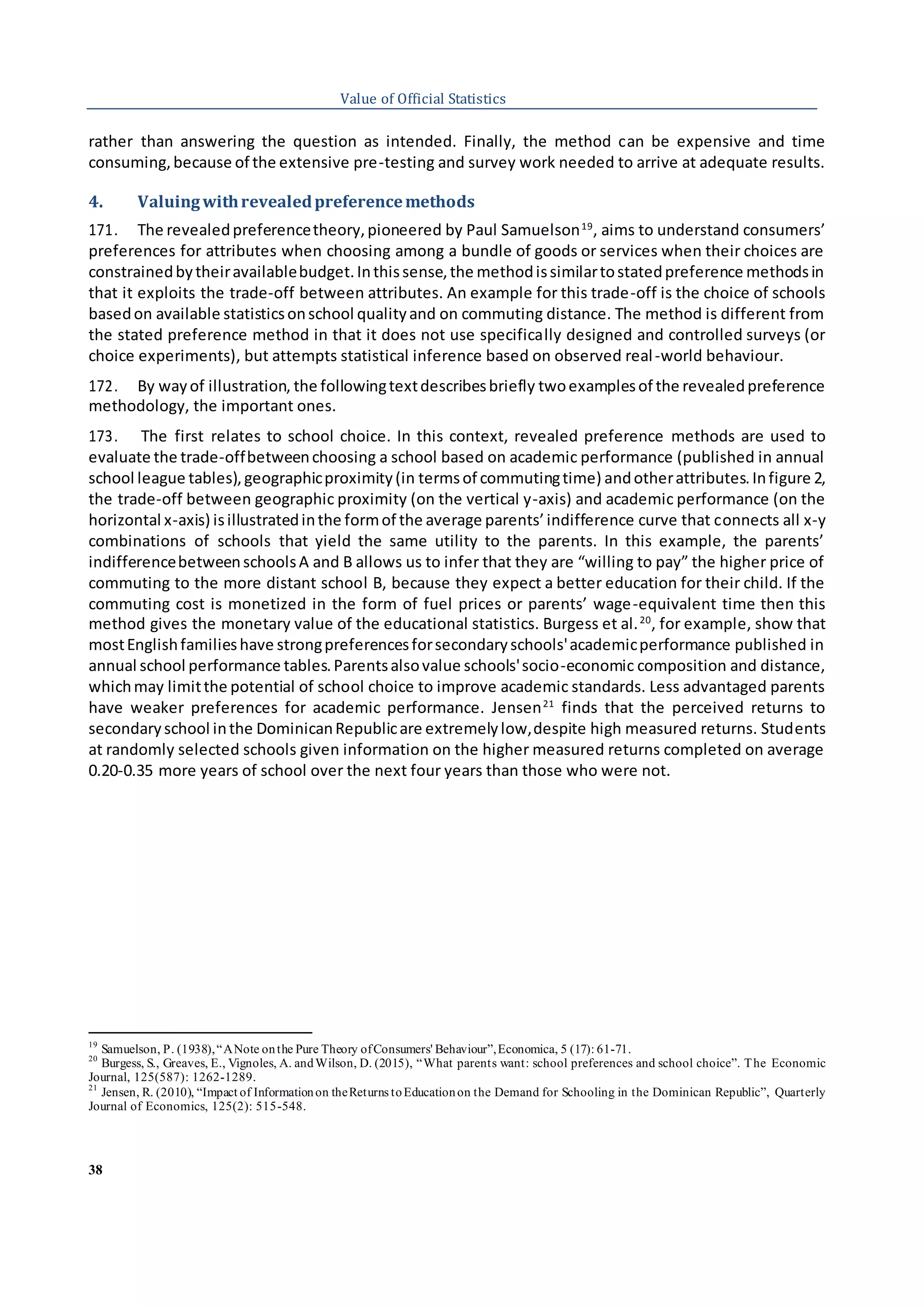
1. AppleInc
Apple Inc is a multinational technology company that designs, develops and sells electronics,
computersoftware,on-line services,andpersonal computers.Itsbestknownhardware products are
the Mac line of computers,the iPodmediaplayer,the iPhone smartphone,the iPadtabletcomputer,
and the Apple Watch smartwatch. Its online services include iCloud, the iTunes Store and the App
Store. Apple’s consumer software includes the OS X and iOS operating systems, the iTunes media
browser, the Safari web browser, and the iLife and iWork creativity and productivity suites.
Founded in 1976, Apple is today the world’s second largest information technology company by
revenue, the world’s largest technology company by Total Assets, and the world’s third largest
mobile phone maker. In 2014, Apple became the first US Company to be valued over $700 billion.
Today it employs 98,000 full-time employees, maintains over 450 retail stores in 16 countries, and
operates the on-line Apple store and iTunes store, the latter of which is the world’s largest music
retailer.
Apple enjoys a high level of brand loyalty. According to the 2014 edition of Interbrand Best Global
Brands report, Apple is the world’s most valuable brand with a valuation of $118.9 million.
Key features of how Apple delivers value are through its:
 Dedication to customer service
 Commitment to quality, innovation, design and simplicity
 People and culture
 Consistency and product integration
Customer service
Apple’swholeculture isdesigned around delivering a superior customer experience. The company
putsthe customerat the centre of everythingitdoes,fromthe design of its products through to the
71
Annexes
designof itsretail stores.Generatingcustomervalue meansbuilding a business model that ensures
that value is created repeatedly.
‘At Apple our goal is to delight customers when they purchase a product and keep them happy
through the life span’.
‘We put ourselves in the customer’s shoes’.
The company believes a high quality sales experience with knowledgeable salespersons who can
convey the value of the company’s products and services greatly enhances its ability to attract and
retaincustomers.Assuch,Apple’semployeesare notjust focused on designing and selling products
that will satisfy customers, but on providing a first class retail experience that delights shoppers.
They make visitors to their stores feel appreciated and customers connected to more than just a
transaction.Theyempowerthembyletting themplaywiththe productsandstayaslong as theylike.
They make them aware that they are always welcome to comeback for advice after their purchase.
Apple has invested in self-service tools that allow customers to schedule their own appointments
and shop on-line. It is constantly evolving its store design to make it easier for customers.
The company’s retail stores are typically located in high traffic locations in high quality shopping
mallsandurban shoppingdistricts.Byoperating its own stores and locating them in desirable high-
traffic locations, the company is better positioned to ensure a high quality buying experience and
attract new customers.
Commitment to quality, innovation, design and simplicity
Apple is committed to producing quality products that ‘change people’s lives’. It believes that
excellence comesfromdoingafewthingsanddoingthem well, rather than trying to be all things to
all people.
“We believe that we are on the earth to make great products in markets where we can make a
significant contribution’.
‘We don’t settle for anything less than excellence’.
Apple’sproductsare the result of extensive research and strong design. It carefully considers what
customers are looking for, including not only what they want now, but what they will need later.
Whenever it releases a new product, customers trust that it will be attractive and easy to use, and
will improve the way that they communicate, work and spend their leisure time.
The company believesinmakingcomplex things simple. The products have to be intuitive and easy
to use. Apple proved that consumers would pay for music that they would otherwise obtain free
from sites such as Napster, simply because the iTunes experience is that much simpler.
The principle of simplicity permeates Apple, from its products to the limited range on offer.
‘The popularityof Apple’sproductsislargelydue to their simplicity and intuitiveness, making them
accessible to tech-savvy consumers, but also to kids and seniors’.
Because the industries inwhichApple competes are characterised by rapid technological advances,
the company’sabilitytocompete successfullydependsheavilyonitsabilitytoensure acontinual and
timely flow of competitive products, services and technologies to the marketplace. The company
continuestodevelopnew technologiesto enhance existing products and to expand the range of its
product offerings through research and development.
72
Value of Official Statistics
People and culture
The people thatApple employsare verycarefullyselectedandtrained. The employees truly believe
inwhat Apple isdoing and are deeply entrenched in and committed to the customer’s experience.
‘Creating a successful business isn’t just about having a stand out product, true success ultimately
comes down to having a team of stellar people’.
Apple paysa lotof attentiontohowculture isinfusedinitsemployees. Culture is what knits people
togetherintoa societythatoperateswithasingularmissionandfocus.And,because Apple’s culture
isbasedon a passionate commitmenttodeliveringsuperior customer value, it has become not only
the glue, but the engine that drives the company to even greater value.
‘Apple Campus is an exceptionally tight ship, full of driven individuals who are held to very high
standards to make the next thing that everyone is going to be talking about’.
Consistency and product integration
All of Apple’sproductshave the same basicarchitecture.Because of thisconsistency,customerswho
already own Apple products know what they will be getting. Using the same architecture also
facilitates ease of use of the products.
Apple products are designed to work together. They are part of an ecosystem that makes offerings
more valuable.Forexample,the introductionof the iPhone was coupled with the opening of an on-
line applications store.
Value metrics
Customer satisfaction metrics are an important way in which Apple tracks its value. The Net
Promoter Score and American Customer Satisfaction Index are two key metrics that it uses.
The company alsousesconventionalfinancial metricstomonitorits performance. Examples include
net sales and profits, net income, share of world-wide market etc
Innovationismonitoredusingmeasuressuchaspercentage of revenue spent and R&D expenditure
as a percentage of net sales.
2. Amazon
Amazonisan Americanelectroniccommerce andcloudcomputingcompany.Itwas born in 1995 as a
place to buybooksbecause of the unique customerexperience the Webcouldofferbooklovers.The
name reflectedthe visionof Jeff Bezos,toproduce alarge scale phenomenonlikethe Amazon River.
Justeightyearslater,Amazonpassedthe $5 billion sales mark – it took Walmart 20 years to achieve
this. By 2008, Amazon was a global brand with over 76 million active customer accounts and order
fulfilment to more than 200 countries.
Amazon.com expanded to offer customers more types of products. It also offers platforms that
enable thirdpartiestosell productsoff itswebsites. Today, more than two million small businesses
reach new customers by leveraging the power of the Amazon e-commerce platform.
Launched in 2006, Amazon Web Services (AWS) began exposing key infrastructure services to
businesses in the form of web services – now widely known as cloud computing. Using AWS,
businesses can take advantage of Amazon’s expertise and economies of scale to access resources
when their business needs them, delivering results faster at lower cost.
In 2007, Amazon introduced the first kindle, the revolutionary portable e-reader that wirelessly
73
Annexes
downloads books, magazines, newspapers, blogs to a high-resolution electronic display that looks
and feels like real paper.
Customer focus
Amazonhas made goodcustomerservice acornerstone of the business.Jeff Bezos,the CEO,isa firm
believer that what is best for the customer ultimately turns out to be best for the business. He has
forceddeveloperstofocus on value delivered to the customer, instead of building technology first
and then think about how to use it.
‘Our vision is to be the world’s most customer-centric company’.
‘We are not competitorobsessed,we’re customerobsessed. We start with the customer needs and
we work backwards’
‘If we can arrange thingsinsuch a way thatour interestsare alignedwithour customers, then in the
long-termthatwill workoutreallywellforourcustomersandit will workoutreallywell forAmazon’
‘Focusing on the customer makes a company more resilient’.
Achievingcustomer loyalty and repeat purchases has been the key to Amazon’s success. This focus
on the customerhas translatedintoexcellence in service, with the American Customer Satisfaction
Index, giving Amazon a consistently high score.
Innovation
Amazonhas a culture thatencouragesinnovation.Itbelievesthatexperimentation is imperative for
inventiveness andinnovation.Experimentationandwillingnesstoinventistherefore a strong part of
the culture.
‘If you double the numberof experimentsyoudoperyearyou’re goingtodouble yourinventiveness’
Bezosisa strongbelieverthatinnovationcanonlycome fromthe bottom.He believesthateveryone
mustbe able toexperiment,learnanditerate.He valuesitinhisemployees.He looksforpeople that
like to invent and is always looking for ways to make products better.
‘Those closest to the problem are in the best position to solve it’.
‘The day we stop exploring is the day we commit ourselves to live in a stagnant world, devoid of
curiosity, empty of dreams’
Amazon has created its own internal experimentation platform called ‘Weblab’ that it uses to
evaluate improvements to its website and products.
Applying new technologies has been used to give Amazon a competitive edge.
‘All the effort we put into technology might not matter that much if we kept technology off to the
side insome sortof R&D department, butwe don’ttake that approach.Technologyinfuses all of our
teams, all of our processes, our decision-making, and our approach to innovation in each of our
businesses. It is deeply integrated in everything we do’.
Partnerships
As Amazon has grown, it has formed partnerships with a range of companies in different sectors.
Examples include Drugstore.com (pharmacy), Living.com (furniture), Pets.com (pet supplies),
Wineshopper.com (groceries), and Kozmo.com (urban home delivery). In most cases Amazon
purchasedan equitystake inthese partners,sothatitwouldshare intheirprosperity.Italsocharged
74
Value of Official Statistics
them fees for placements on the Amazon site to promote and drive traffic to their sites.
Amazon has been able to consolidate its strength in different sectors through its partnership
arrangements and through using technology to facilitate product promotion and distribution via
these partnerships.The Amazonretail platformenables other retailers to sell products online using
the Amazon user interface and infrastructure through their ‘Syndicated Stores’ programme. For
example, in the UK, Waterstones is one of the largest traditional bookstores. It found competition
withonline soexpensive,thateventually it entered into a partnership arrangement where Amazon
markets and distributes its books online in return for a commission online. Such partnerships help
Amazonto extenditsreachintothe customerbase of othersuppliers,andcustomerswhobuyinone
category such as books can be encouraged to purchase into other areas such as clothes and
electronics.
Anotherformof partnershipisthe AmazonMarketplace whichenablesAmazoncustomersandother
retailers to sell their new and used books and other goods alongside the regular retail listings. A
similar partnership approach is the Amazon Merchants@ program which enables third party
merchants to sell their products via Amazon. Amazon earns fees either through fixed fees or sales
commissions’per-unit.Thisarrangementcan benefit customers who get a wider choice of products
from a range of suppliers with the convenience of purchasing them through a single checkout
process.
Amazonhas alsofacilitatedformation of partnerships with smaller companies through its affiliates
programme.
Metrics
A commontheme inAmazon’sdevelopmentisthe drive touse a measuredapproachto all aspectsof
the business. The company has a culture of metrics. Each site is closely monitored with standard
service availabilitymonitoring,site availabilityanddownloadspeed.It also monitors per minute site
revenue upper/lower bounds.
At Amazon,‘automationreplaces intuitions’ and real time experimentation tests are always run to
answer questions since the actual consumer behaviour is considered the best way to decide upon
tactics.
Amazonusesaround500 metricstotrack its performance,around80 percentof whichare related to
customer objectives. They include measures such as percentage of orders from repeat growth,
growthin the numberof customeraccounts.Amazon also uses the ASCI to benchmark itself against
other companies.
3. BMW
BMW is a luxury car producer and is seen as one of the most prestigious, stable and admired
companies inthe world.Itcontinuestobe one of the bestplayersinthe luxuryautomobile industry.
It believesinexcellence in everything it does: service, product quality, customer relationships, and
product and brand recognition. BMWs goal is to be a leading provider of premium products and
premium services for individual mobility.
Long-term thinking, strong investment in research and development, ecological and social
responsibilityinthe value chain, and an effective speed and agility in responding to changes in the
market are some of the reasons for BMWs success.
75
Annexes
Brand recognition
Brand has had a strong impact on BMWs performance. Brands are characterised through consistent
quality, craftsmanship, recognisability, exclusivity, reputation, distinctive variation, timing, and
heritage.The keytoBMWs successisconsistencyandauthenticity of their marketing strategies and
policies.Withsuchastrong brand, the company has been able to earn some of the highest margins
in the industry.
Design and quality
Design and quality are strong points behind BMWs success. BMW achieves a higher quality of
engineeringthanisusual inproductioncars.While mostcar assemblyhasbeentaken over by robots
or workers from low wage economies, BMW maintains a skilled labour force, and employs double
the number of workers than any other company in the automobile industry. It puts the product
before anything else and is deeply committed to that principle.
The traditionof qualitypermeatesall workprocessesof the company.A comprehensive, multi-level
managementsystemensuresqualityinall workprocesses,as well ascomponentsandmaterials,and
ultimately its products. Above all, BMW orients its quality management system to the needs of its
customers.
‘Customer oriented thought and action is part of corporation philosophy and anchors our goal of
achievingperfectresultsinall manufacturingareas.Ouremployees’attitude toqualityfromthe very
beginning, continuing along the entire process chain, prevents mistakes and ensures continual
improvement’.
Innovation
Innovationisanintegral part of BMWs product development. It spends around 25% of its profits on
research and development. Innovation enables the company to keep at the forefront in a
competitive environment.
BMWs continuedsuccessisitsstrategicfocusondevelopingcustomerfriendly innovations, coupled
withan approachto innovationmanagementwhichisuniquewithinthe automobileindustry.One of
itskeysisa constantfocuson the culture of innovation –makingprofessionalinnovative processes a
strategic and cultural constituent of every area of the company.
This focus on culture is a guiding principle within BMW. It ensures that all departments in the
organizationare focusedoninnovation,includingsalesandmarketing,humanresourcesandproduct
development.
Everyone working for the company, from the factory floor to the design studios to the marketing
department, is encouraged to speak out.
‘Ideas bubble up freely, and there is never a penalty for proposing a new way of doing things, no
matter how outlandish’.
BMW’s management structure is flat, flexible and entrepreneurial. This helps innovations to be
developed quickly to improve internal processes and for the marketplace.
The company usescross-functional teams which are more effective at problem solving. This lateral
ability to communicate across divisions and silos, facilitate speedier innovation.
The German car maker has always been able to respond to the attacks of its competitors with an
increasingly level of technology and innovation that characterises its products.
76
Value of Official Statistics
Customer focus
BMW uses customer profiling to understand its customers. It goes beyond pure demographic
statistics andcarefullytracksthe personalities,lifestylesandtastesof itscustomers.The information
isusedacross all areas of the business,fromthe designand development of the cars, through to the
premiumpricingof all elements of the marketing mix. BMW is very clear about its targeting. It only
targets the premium priced cars and does not strive to compete with every segment of the auto
industry.Itavoidsthe highvolume marketof middle of the road vehicles and focuses strictly on the
luxurysector.BMW is an example of excellent consumer research, matched to segments that were
targeted by very suitable and successful cars.
‘That means having a clear understanding of customer behaviour and recognising trends’.
‘A company mustknowwhatthe publicwantsand maintain a keen interest in the relationship with
their customers and value their thoughts. That’s why BMW is where it is today, so far ahead of the
others.’
‘What it really needed
BMW understandsthe importance of makingthe purchase of one of its cars a special experience for
the customer. The sales associate spends as much time as it takes for the purchaser to understand
howto operate their new car. It’s all about the customer and the car and making the customer feel
special. The BMW staff are passionate about the brand and what it stands for.
Partnerships
BMW has used partnerships to help maintain a competitive edge in the market. For example, it
partneredwithClemsonUniversitytobuildamulti-milliondollarInternational CentreforAutomobile
Research in South Carolina, US.
‘What it really needed was a specialised talent funnel – students with graduate level training in
automotive engineeringwithan emphasisonintegratingthe smartsystemsemerginginthe industry’
Located on the Clemson University International Centre for Automobile Research campus, the
Information Technology Research Centre (ITRC) is an integral part of BMWs research and
developmentnetwork.Itprovidesanimportantplatformwithinthe BMWGroup for jointinnovation
projects with leading IT companies in the US. At the ITRC, mechanical, electrical and computer
engineers and students – from BMW, the IT industry and the university – work together in an open
innovation model on proof of concept and pilot projects where IT innovations push automotive
solutions forward.
BMW is exploring deeper partnerships with software computer companies, such as Apple. It
recognises that future generation cars cannot be built without more input from telecoms and
software companies and is aware that Apple has been studying how to make a self-driving electric
car. Both companies would need to profit from the cooperation or it will not last.
Metrics
BMW uses satisfaction measures to monitor performance.
The company undertakesregularassessmentsof customersatisfactionsfollowingsales and services.
It also commissions market research to gauge customer satisfaction.
BMW has also strived for recognition of its value by using external evaluations and taking part in
award competitions. The company has undertaken the EFQM assessment and won the EFQM
77
Annexes
Excellence awardin2013. The award isorganizedonce a year and is designed to recognise Europe’s
best-performingorganizations,whether private, public or non-profit. It recognises industry leaders
with an indisputable track record of success in turning strategy into action and continuously
improving their organization’s performance.
4. Google
Google isa multinational, publicly traded organization, built around the company’s hugely popular
searchengine.Google searchisthe mostusedsearchengine onthe world-wide web, handling more
than 3 billion searches each day. It was originally developed by Larry Page and Sergey Brin in 1997.
Its use is very simple and provides the best search results of all search engines.
Google is today one of the most valuable brands in the world. The success of Google is directly
connected to the efforts of the company to fulfil its mission statement and vision statement.
Its vision is to ‘provide access to the world’s information in one click’.
Its mission is to ‘organize the world’s information and make it universally accessible and useful’.
Ever since itsbeginningsthe companyhasfocusedondevelopingproprietaryalgorithmstomaximise
effectiveness. It continues to focus on ensuring that individuals can access the information they
need.
Brand recognition
The Google brand isvery simple and has resulted in a very large number of customers who interact
with the brand very often. Like Apple, Google has achieved brand success by getting huge splashy
presseveryday.Google continuestogetintothe newsbyhavinga large numberof consumer-facing
productsthat are constantlyupdated.Google hasasserteditsbranding images on its own websites,
on mobile,onTV and in movies.Beingaggressively global and appealing influential groups has also
been important to the success of the brand.
Customer experience
Product decisions at Google are driven by optimising for the user experience first and for revenue
second.The companyfirmlybelievesthatthe betterthe userexperience,the more easilythe money
will follow.
“Worry about the moneylater,whenyoufocus on the user, all else will follow’ ‘Create a great user
experience and the revenue will take care of itself’.
‘Since the beginning,we’ve focusedonprovidingthe bestuser experience possible. Whether we’re
designinganewinternetbrowserora new tweaktothe lookof the homepage,we take great care to
see that they will ultimately suit you, rather than our own internal goal or bottom line. Our
homepage interface is clear and simple, and pages loaded instantly.’
A huge part of Google’s success can be attributed to the push from ‘Marissa Mayer’ to implement
the user experience of Google, which can be summarised in one word – simplicity. The simple
homepage, common-sense research function and digestible search page layout made Google and
immediate go to for finding information fast and reliably.
At Google, software developers are taught that the best products ‘include only the features that
people need to accomplish their goals.’
‘Scores of design features in every Google product have been refined based on user logs’.
78
Value of Official Statistics
‘Expectanyproduct rollingoff the line tohave some association with bettering the user experience
behind their search algorithm. No matter if that’s building stronger ties through information
gatheredonGoogle Plus,productreceipts that hit Gmail, or even the hours of cat videos you watch
on YouTube, it all leads to a better graph connecting searchers to the results that matter most to
them’.
Design
Google made design a priority in 2011. To ensure that it could compete with Apple’s tech cachet,
Google’s products had to be well designed.
‘If designed poorly, new-fangled interactions can be jarring, unsettling, even scary.’
Today,Google producesbetterdesignedsoftware than any other tech company. Unveiled last year,
Material Design,Google’sevolvinglanguageformobiles, tabletsanddesktops –offersconsistency in
interactions, invisible rules that govern everything, so that every app feels familiar, and beauty in
service and function.
‘Our goal is to design everything so that it is beautifully simple’.
“Larry has raised the bar for everything that we do in design…Everything now has design as a fore
element’.
‘Each product should have an intuitive, simple and beautiful design that delights users each time
they visit.’
Innovation
Google hasusedinnovative strategiestomaintain its leadership in the industry. Each year it invests
hundredsof millionsof dollarsintechnologyand research and development projects. It is investing
more than its rivals and because of this, it provides more products to people than any other te ch
company. Examples of its products are Gmail, Google maps, Chromebook, Glass and Nexus.
At Google, employees are given 20 percent of their work time to pursue projects that they are
passionate about, even if they are outside of the core job or core mission of the company. Many
wind up as products or product improvements.
Eight principles have guided innovation by Google:
 Have a missionthatmatters:Google hasa simple missionthat is used to guide
all of itsdecisions.Itmakessure thatall itsemployeesfeel connected to it and
empowered to help achieve it.
 Thinkbigbut start small – ‘No matter how ambitious the plan you have to roll
up your sleeves and start somewhere’. ‘The notion of “10x thinking” is at the
heart of how we innovate at Google: true innovation starts when you try to
improve something by 10 times rather than by10%’.
 Strive for continual innovation, not instant perfection – ‘Early in Google’s
history we released some of our products as “beta launches” and then made
rapid iterations as users told us what they wanted more (and less) of. Today
we continue to listen carefully to user feedback after each launch and revise
products based on what we hear. The beauty of this approach is that you get
real world user feedback and never get too far from what the market wants.’
‘The firstversionof AdWordsreleasedin1999, wasn’tverysuccessful – almost
79
Annexes
no one clickedon the ads. Not many people remember that because we kept
iteratingandeventuallyreachedthe model thatwe have today.Andwe’re still
improving it; very year we run tens of thousands of search and ads quality
experiments, and over the past year we’ve launched over a dozen new
formats. Some products we update every day’.
 Look for ideas everywhere – ‘At Google we believe that collaboration is
essential to innovation and that it happens best when you share information
openly. ‘As leader of our Ads products, I want to hear ideas from everyone –
and that includesourpartners,advertisers, and all of the people in my team’.
 Share everything – ‘by sharing everything you encourage the discussion,
exchange and re-interpretation of ideas, which can lead to unexpected and
innovative outcomes’
 Spark withimagination,fuelwithdata – ‘We try to encourage blue skythinking
through 20% time – a full day per week during which engineers can work on
whatever they want. Looking back at our launch calendar over a recent 6
month period, we found that many products started life in employees’ 20
percent time’. ‘Data … can either back up your instincts or prove them totally
wrong’. ‘At Google data is a big part of every choice we make. We test and
measure almosteverythingwe dosothat we have a continuousdatastreamto
informdecisions’.
 Be a platform – ‘There is so much awe-inspiring innovation being driven by
people all over the globe. That’s why we believe so strongly in the power of
opentechnologies.Theyenable anyone,anywhere,toapplytheiruniqueskills,
perspectivesandpassionstothe creationof new productsand features on top
of our platforms’.
 Neverfail tofail – ‘People rememberyourhitsmore thanyourmisses.It’sokay
to fail as longas youlearnfromyour mistakesandcorrectthem fast. Trust me,
we’ve failed plenty of times. Knowing that it’s okay to fail can free you up to
take risks.Andthe tech industry is so dynamic that the moment that you stop
taking risks is the moment you get left behind’
Metrics
Google usesthe AmericanCustomerSatisfactionIndex (ACSI) to benchmark its performance against
other companies.
5. Meteorologicalservices
Meteorological officesprovidethe publicwiththe informationtheyneedtomake informeddecisions
to protect their health, safety and security in the face of changing weather and environmental
conditions.Accurate andtimelyforecasts and warnings are also critical to the optimum functioning
of the economy,where manyindustriesincludingagriculture,energyproduction,transportation and
forestry are directly affected by weather conditions.
Optimisingthe use of weatherandclimate information requires an active partnership between the
producer and consumer of meteorological services. It is clear that reliance on simply providing the
bestweatherforecastorclimate outlookisnotsufficient.Meteorological informationacquires value
through its influence on the decisions of the users of that information. It is used to reduce
80
Value of Official Statistics
uncertainty and improve economic and other decisions.
‘Information about the weather only has value insofar as it affects human behaviour’.
‘A weatherforecastonlyhasvalue if itcan be usedto make decisionsthatyieldattractive benefits to
users’
Meteorological officesdelivervalue include byenablingbetterinformeddecisionswhichreducerisks
and increase opportunities. They achieve this by:
 Tailoring products and services to customer needs – the need for different
types and levels of detail of weather information is dictated by how the
informationistobe applied.Meteorological officesare increasingly seeking to
build better partnerships with customers who utilise their products and
services, so that they can better understand the extent and shape of their
needsandtailorproductsand servicestomeetthose needs.The driverbehind
thisservice conceptisensuring that people and institutions are positioned to
act on the information provided and make ‘smart’ decisions and build
resilience in communities. Most meteorological offices do not have the
extensive capacities to meet all of their customer needs, and must therefore
be selective around where they will be able to deliver most value.
 Ensuring information is accessible – good communication and dissemination
of weatherand climate information is an intrinsic element in maximising the
overall benefit – or value – of weather information to society. The benefit of
weatherinformationtosocietyisonlymaximisedwhenthe greatestnumberof
people receive the information and act upon it when making decisions.
 Buildingawarenessof the valueof meteorological information – promoting a
betterunderstandingof the valued role of meteorological offices in reducing
loss of life and economic damages, and the benefits of improved use of
meteorological services. In this way it raises awareness of the opportunities
that weather and related information offer. A growing number of
meteorological offices are attempting to promote a better understanding of
the value of weather and climate information to society and the economy
through calculating a monetary estimate of the value of the information. For
example,ithas been estimated that weather variability accounts for as much
as 3.4% of GDP in the USA. Most studies tend to focus on a particular sector,
such as agriculture ortransport.
 Research and development– to understandmeteorological andclimatological
cycles and their impacts better, and develop new or improved products and
services.
 Partnerships – increasingly weather offices are forming partnerships with
academicinstitutionsandsoftware companiestoimprove their efficiency and
impact. For example, in the UK the Met Office has established a Met Office
Academic Partnership to bring together the Met Office and institutions that
are amongthe UK leadinguniversitiesinweatherandresearch(Universities of
Exeter, Oxford, Leeds and Reading) to tackle key challenges with weather
prediction. The aim of the collaboration is to draw together world class
expertisearoundafocusedprogramme of researchto tackle key challenges in
81
Annexes
weatherandclimate science prediction;andtomaximise the returnonthe UK’
investment in research and development in its leading research institutions.
In the UK, the Met office is also working in partnership with the oil and gas industry to enhance its
weatherforecasting.Weatherdatareportsobtainedfromover104 oil and gas platforms and mobile
installations across the North Sea in real time, enable forecasters to predict and analyse weather
patterns more accurately and provide bespoke forecasting advice. ‘Helimet is an internet-based
weather data network originally designed to share data between UK installations and helicopter
operators. Thiscollaborationisagreat example of how cutting edge data technology, driven by the
oil and gas industry can be of great value to other areas. Helimet uses a network of automated
weather stations located on offshore oil and gas platforms and mobile installations. They provide
detailedreportsof cloud,visibility,andweatherinsome instances,information on wave conditions.
These data are fedintoa networkallowingmore accurate definitionof the weatheracross the North
Sea,an area prone to adverse weather conditions. ‘Helimet makes a significant contribution to the
Met Officesabilitytoaccuratelymonitorandprovide weatheradvice.Accurate guidance is critical to
the safe and efficient operation of not only the oil and gas industry but also the wider offshore
renewables, shipping and aviation activity.’
In NZ, Metservice invested in MetOcean, a leading NZ oceanographic services company helping
maritime and offshore industry clients to improve decision making and improve operational
efficiencies.In NZ close commercial partnerships have been instrumental in bringing new weather
servicestothe public.Forexample,the Metservice Marineapphasbeendesignedinpartnershipwith
Maritime NZand the Metservice Snowweatherappwhichincludesvital information about road and
ski conditions was developed jointly with the Department of Conservation.
Metrics
Meteorological offices are increasingly seeking to quantify the value of weather information in
monetary terms. The main ways they use to estimate the value of forecasts are by:
 Modelling of decisions, with and without forecasts, and of the expected
consequences of these decisions (eg for agriculture, electricity generation,
fisheries etc)
 Using surveys to obtain value estimates
 Using data from actual events ie observed weather phenomena with and
without forecasts or warnings (eg use of observational data for valuing
hurricane and heat wave warnings)
6. TheUnited Kingdom’sPharmaceutical industry
The pharmaceutical industry develops, produces and markets drugs and pharmaceuticals for use in
medications. It is subject to a variety of laws and regulations that govern the patenting, testing,
safety, efficacy and marketing of drugs.
Pharmaceutical companies deliver value through:
 Undertaking research and development – this enables the development of
new and innovative medicines for patients, across a huge range of diseases
and conditions, which make an essential contribution to the health and
wellbeing of the population. Medicines developed by the pharmaceutical
industry have helped to change the healthcare landscape through the
82
Value of Official Statistics
prevention or cure of previously life-threatening diseases, such as HIV and
AIDS.
 Contributing to efficiencies and savings – many chronic conditions place a
huge economic burden on society through employee absenteeism and lost
productivity due to illness; the long-term medical, in-patient hospital and
surgical costs associated with late treatment and disease; the significant cost
to the National Health System through disability; and the societal costs
associated with illness. Appropriate use of medicines can deliver patient
benefits and consequent cost savings.
 Making a vital contribution to the economy – by most measures the
pharmaceutical sectorisBritain’smostsuccessful research-basedindustry. For
example,GrossValue Added(GVA) peremployee inthe industryissignificantly
higher than high and medium-tech sectors such as chemicals, motor vehicles
and computer products. Over the past decade the industry has consistently
generatedalarge trade surplus for the UK, and its contribution to the balance
of trade was the third greatest of nine major industrial sectors.
 Being a source of highly skilled jobs – the industry employs around 73,000
people directlyinthe UK,almosta thirdof which are in highly skilled research
and developmentroles.Inaddition, the industry generates thousands of jobs
in related industries, such as the biotechnology, medical technology and
diagnostics industries.
Metrics
The pharmaceutical industryinthe UKusesGross Value Added(GVA) tomeasure the contribution of
the industrytothe UKs national income. To measure the GVA the value of output generated by the
industryiscalculatedandfromthisthe cost of goodsand service involvedin production isdeducted.
The UK pharmaceutical industry also tracks the return from pharmaceutical innovation on a regular
basis. Two key measures are used: static internal rate of return (IRR), which provides a yearly
‘snapshot’of returnsperformance,anddynamicreturns,whichprovides a year-on-year assessment
of the key drivers of changes in IRR over time.
Other measures that are used to assess the value of the industry are:
 Sales of prescription medicines
 Retail and Producer price indices for pharmaceutical products
 Pharmaceutical industry’s contribution to the trade balance
 Employment in the pharmaceutical industry
 Pharmaceutical industry’s contribution to improving health outcomes
7. Whittaker’s
JH Whittaker’s & Sons Ltd (Whittakers) is a New Zealand confectionary company specialising in
chocolate. The company controls its entire manufacturing process, calling itself a ‘bean to bar’
manufacturer. It has been a family-owned business since 1896, with third-generation family
members still the sole shareholders in the company.
83
Annexes
Whittaker’shasbuiltastrong culture aroundthe brand. In 2011, itwas listed as New Zealand’s third
mosttrustedbrand bya ReadersDigestsurvey.Itimproveditsstandingto first in 2012, and retained
this standing in the next four consecutive years.
Key aspects of how Whittaker’s delivers value include:
 Brand recognition – the brand provides premium quality at an affordable
price. It is recognised as being trustworthy and reliable, and for consistently
delivering a strong experience in terms of product quality, variety, price and
availability. Whittaker’s have used the same label designer since 1984.
 Quality– the companyisdedicatedtoonlyusingethically-sourcedingredients
of the highest quality. It is committed to ensuring quality by undertaking the
whole productionprocessinthe manufacture of its products, and investing in
good quality equipment. “It’s a core company value that we will never
compromise on’.
 Innovation – Whittaker’s is constantly seeking to surprise and delight
customers by producing new flavours and products. For example, it recently
introduced a new artisan range of chocolate with ingredients sourced from
New Zealand artisan producers.
 Collaborating with other companies – the company has shown a keenness to
advance itself bycollaboratingwithothercompany’sproductswherethere isa
link to chocolate. For example, it produced a co-branded ice-cream product
‘Lewis Road Creamery Chocolate Milk Drink’ that has attracted a huge
consumer following. It has also entered into partnerships with commercially
successful brands like L&P and Jelly Tip. ‘The collaboration of two desirable
boutique brandsthathave a loyal following –soit appealedtothe fansof each
brand and it appealed to the kiwi origin.”
 Communications/marketing – Whittaker’s have made smart use of
communicationschannels,especiallysocial media,andhave investedheavilyin
paid media like television.
Metrics
Whittaker’s has been listed the most trusted brand in the Readers Digest Survey of most trusted
brands for the last four consecutive years. The company has increased its market share with every
year it has been voted the most trusted brand.
84
Value of Official Statistics
Annex 5 Studies that use statistics to achieve development impacts
1. Education
IMPACT OF INFORMATIONON THE RETURNS TO EDUCATION ON THE DEMAND FOR SCHOOLING IN
THE DOMINICANREPUBLIC
WEBSITE: JPAL
LOCATION: RepúblicaDominicana
SAMPLE: 2,250 eighthgrade boys
TIMELINE: 2001 - 2005
THEMES: Education
Labor Markets
POLICYISSUE: StudentParticipation
PAPERCITATIONS:Jensen,Robert.2010. "Impact of Informationonthe Returnsto Educationonthe
DemandforSchoolinginthe DominicanRepublic." QuarterlyJournal of Economics 125 (2010): 515-548.
EXAMINING THE EFFECT OF INFORMATIONABOUT FINANCIALAID FOR HIGHER EDUCATION ON
SCHOOLING OUTCOMES IN CHILE
WEBSITE: JPAL
LOCATION: Santiago,MetropolitanRegion,Chile
SAMPLE: 6,233 eighth-grade studentsin226 low-incomeschools
TIMELINE: 2009
THEMES: Education
POLICYISSUE: Post-PrimaryEducation;StudentLearning;StudentParticipation
PAPERCITATIONS:Dinkelman,Taryn,andClaudiaMartinez."InvestinginSchoolinginChile:The Role of
InformationAboutFinancialAidforHigherEducation."The Reviewof Economicsand Statistics,
Forthcoming.
THE ROLE OF INFORMATIONIN SCHOOL CHOICE: ANEXPERIMENTAL STUDY WITH LOW-INCOME
FAMILIES IN CHILE
WEBSITE: JPAL
LOCATION: Chile
THEMES: Education
2. Health
COMMUNITY-BASEDMONITORING OF PUBLICPRIMARY HEALTH CARE PROVIDERS
POLICYISSUE: Publichealthcare quality
INTERVENTION:Throughtworoundsof village meetings,localized nongovernmentalorganizations
encouragedcommunitiestobe more involvedwiththe state of healthservice provisionand
strengthenedtheircapacitytoholdtheirlocal healthproviderstoaccountfor performance.
RESULTS: A year afterthe intervention,treatmentcommunitiesare more involvedinmonitoringthe
provider,andthe healthworkersappeartoexerthigherefforttoserve the community.The study
documentslarge increasesinutilizationandimprovedhealthoutcomes—reducedchildmortalityand
increasedchildweight—thatcompare favorablytosome of the more successful community-based
85
Annexes
interventiontrialsreportedinthe medical literature.
PAPERCITATIONS:Björkman,M.and J. Svensson(2007).Powerto the People:Evidence froma
RandomizedFieldExperimentonCommunity-BasedMonitoringinUganda. QuarterlyJournal of
Economics,124(2): 735-769.
HIV/AIDS PREVENTION THROUGH RELATIVE RISK INFORMATIONFOR TEENAGE GIRLS IN KENYA
WEBSITE: JPAL
LOCATION: WesternKenya
SAMPLE: 328 PrimarySchoolsinKenya'sWesternProvince
TIMELINE: 2003 - 2005
THEMES: Education;Health
POLICYISSUE: Gender;HIV/AIDS
PAPERCITATIONS:Dupas,Pascaline.2011. "Do TeenagersRespondtoHIV RiskInformation?Evidence
froma FieldExperimentinKenya." AmericanEconomicJournal:AppliedEconomics3(1):1-34.
THE ROLE OF INFORMATIONAND SOCIAL LEARNING ON RISKY SEXUAL BEHAVIOR IN CAMEROON
WEBSITE: JPAL
LOCATION: Cameroon
SAMPLE: 4,200 13-year-oldgirls
TIMELINE: 2009 - 2012
THEMES: Health
POLICYISSUE: HIV/AIDS
INTEGRATED MEDICAL INFORMATIONAND DISEASE SURVEILLANCE INPRIMARY HEALTH CENTERS IN
INDIA
WEBSITE: JPAL
LOCATION: Karnataka,India
SAMPLE: 350 primaryhealthcentersinfive districts
TIMELINE: 2010 - 2011
THEMES: Health;Political Economy&Governance
POLICYISSUE: Healthcare ProviderAttendance
PAPERCITATIONS:Dhaliwal,Iqbal,andRemaHanna.“Deal withthe Devil:The SuccessesandLimitations
of BureaucraticReforminIndia.”NBERWorkingPaperNo.20482, September2014.
3. Targeting
EFFECTIVELY TARGETING ANTI-POVERTYPROGRAMS IN INDONESIA
WEBSITE: JPAL
LOCATION: NorthSumatra,SouthSulawesi,andCentral Javaprovinces,Indonesia
SAMPLE: 5,756 householdsin640 villages
TIMELINE: 2008 - 2009
THEMES: Political Economy&Governance
POLICYISSUE: Targetedcash transferprogramshave become an increasinglycommontool forpoverty
reduction,butidentifyingthe poorcanbe challengingasgovernmentsoftenlackreliable information
aboutincomes.CashTransfers;CommunityParticipation;Transparency&Accountability;Ultra-Poor
Programs
INTERVENTION:RCTevaluatingtargetingof poorhouseholdsusing(i) proxymeanstesting(PMT) based
86
Value of Official Statistics
on censusdataversus(ii) acommunitybasedand(iii) ahybridmethod.
RESULTS: The PMT incorrectlyclassified30percentof households,while the communityandhybrid
methodsclassifiedabout33percentof householdsincorrectly.
PAPERCITATIONS:Alatas,Vivi,AbhijitBanerjee,Remahanna,BenjaminA.Olken,andJuliaTobias.2012.
"Targetingthe Poor:Evidence froma FieldExperimentinIndonesia." AmericanEconomicReview
102(4): 1206-1240.
IMPROVING TARGETING OF A CONDITIONAL CASH TRANSFER PROGRAMIN INDONESIA
WEBSITE: JPAL
LOCATION: Lampung,SouthSumatra,and Central Javaprovinces,Indonesia
SAMPLE: 400 villages
TIMELINE: 2010 - 2012
THEMES: Political Economy&Governance
POLICYISSUE: Cash Transfers
PAPERCITATIONS:Alatas,Vivi,AbhijitBanerjee,RemaHanna,BenjaminOlken,RirinPurnamasari,and
MatthewWai-Poi.2014. "Self-Targeting:Evidence fromaFieldExperimentinIndonesia."Journal of
Political Economy,forthcoming.
SOUTH AFRICAN OLD AGE PENSION SCHEME
INTERVENTION:The SouthAfricanOldAge Pensionscheme isameanstested,unconditional cash
transferscheme forwomenabove 60 and menabove 65 yearsof age.
RESULTS: Edmonds(2006) findsthat these pensiontransfersare associatedwithadeclineinhours
workedperdayof a childlivingwithanelder.A complementaryrise inschool attendance ratesisalso
seenamongthese children.Duflo(2003) findsthatwomenreceivingpensionsinSouthAfrica
significantlyimprovesthe healthandnutritionalstatusof theirgranddaughters.Duflo’sestimates
suggestthatthe pensionsreceivedbywomenhelpstheirgranddaughterstobridge the entire gapin
heightforage scores withAmericanchildren.
PAPERCITATIONS:Duflo,E.(2003). Grandmothersand Granddaughters:Old‐Age Pensionsand
IntrahouseholdAllocationinSouthAfrica. WorldBankEconomic Review,17(1): 1-25. Edmonds,E.V.
(2006). ChildlaborandschoolingresponsestoanticipatedincomeinSouthAfrica. Journal of
DevelopmentEconomics,81(2): 386-414.
4. Governance
INFORMATIONDISSEMINATION CAMPAIGNANDVOTERS' BEHAVIOR IN THE 2009 MUNICIPAL
ELECTIONS IN MEXICO
WEBSITE: JPAL
LOCATION: Jalisco,Morelos,andTabasco,Mexico
SAMPLE: 2,360 votingprecincts
TIMELINE: 2009
THEMES: Political Economy&Governance
POLICYISSUE: Corruption;Transparency& Accountability
VOTER INFORMATIONCAMPAIGNSANDTHE DELHI MUNICIPALCOUNCILLORS 2011 ELECTION
WEBSITE: JPAL
LOCATION: Delhi,India
87
Annexes
SAMPLE: 240 municipal wards
TIMELINE: 2010 - 2012
THEMES: Political Economy&Governance
POLICYISSUE: CommunityParticipation;Corruption;UrbanServices
POLITICIANS,PUBLICLY-RELEASED AUDITS OF CORRUPTION,AND ELECTORAL OUTCOMES IN BRAZIL
WEBSITE:
LOCATION: Brazil
SAMPLE: 669 Municipalities
TIMELINE: 2005
THEMES: Political Economy&Governance
POLICYISSUE: CommunityParticipation;Corruption
PAPERCITATIONS:Ferraz,Claudio,andFredericoFinan.2008. "ExposingCorruptPoliticians:The Effects
of Brazil'sPubliclyReleasedAuditsof Electoral Outcomes."The QuarterlyJournal of Economics 123(2):
703-44.
5. Agriculture
FUTURES PRICES AND RISK HEDGING IN GUJARAT,INDIA
WEBSITE: JPAL
LOCATION: Rural Gujarat, India
SAMPLE: 108 villagesin4districtsof Gujarat
TIMELINE: 2007 -
THEMES: Agriculture;Finance &Microfinance
VALUING PUBLICINFORMATION IN AGRICULTURALCOMMODITY MARKETS: WASDE CORN REPORTS
WEBSITE: AgEcon
THEMES: Agriculture

Value of official statistics: Recommendations on promoting, measuring and communicating the value of official statistics

  • 1.
    Economic Commissionfor Europe Conferenceof European Statisticians Sixty-fifth plenary session Geneva, 19-21 June 2017 Item 7 (d) of the provisional agenda Value of official statistics Value of officialstatistics: Recommendations onpromoting, measuring and communicating the value of officialstatistics Prepared by the Task Force on the Value of Official Statistics United Nations ECE/CES/2017/4 Economicand Social Council Distr.: General 2 March 2017 English only (A summary document will be translated to Russian and French) Summary The document presents for your comments the Recommendations on Promoting, Measuring and Communicating the Value of Official Statistics, including a measurement framework. The Recommendations have been prepared by the UNECE Task Force on the Value of Official Statistics consisting of the United Kingdom (chair), Australia, Canada, Ireland, Mexico, New Zealand, Switzerland, Turkey, Eurostat, OECD, PARIS21 and UNECE. The deadline for the reply is 24 March 2017. Please send your comments using the attached feedback questionnaire to anu.peltola@unece.org. Subject to the positive outcome of the consultation, the Recommendations will be submitted to the 2017 plenary session of the Conference of European Statisticians for discussion and endorsement on 19-21 June 2017.
  • 2.
    Contents 1. Introduction...................................................................................................................... 3 A.Why these recommendations?............................................................................................3 B. Work process .....................................................................................................................3 C. The recommendations in brief............................................................................................4 D. Blueprint for the way forward............................................................................................6 E. Structure of the report........................................................................................................7 2. The current position.......................................................................................................... 8 A. What is value? ....................................................................................................................8 B. Who are the users of official statistics?...............................................................................8 C. What surveys show about users’ views? ...........................................................................10 D. Official statistics and decision making ..............................................................................12 3. Existing practices to generate, promote and measure value............................................. 13 A. Current practices in statistical offices...............................................................................13 B. Practices in other industries .............................................................................................16 C. Comparison of statisticians’ and other industries’ approaches .........................................22 4. Building value through partnerships............................................................................... 24 A. Partnerships with stakeholders........................................................................................24 B. Partnerships through engagement activities.....................................................................25 C. Partnerships to leverage Big Data.....................................................................................26 D. Crowdsourcing.................................................................................................................26 E. An assessment and going forward ....................................................................................26 5. Measuring the value of official statistics .......................................................................... 28 A. Towards a framework with a set of indicators..................................................................28 B. Objective indicators..........................................................................................................29 C. Subjective indicators – a generic user survey....................................................................31 D. Monetizing the value added of official statistics................................................................32 E. Conclusions on measuring the value added of official statistics ........................................44 6. Recommendations ........................................................................................................... 45 7. Conclusions and nextsteps.............................................................................................. 52 Annex 1 The value of official statistics in a page .........................................................................54 Annex 2 Why official statistics are valuable? ..............................................................................55 Annex 3 Generic user survey questions for statistical offices......................................................63 Annex 4 Case studies of other industries’ approach to generation and promotion of value.........70 Annex 5 Studies that use statistics to achieve development impacts..........................................84
  • 3.
    1. Introduction A. Whythese recommendations? 1. Official statistics have had an enviable track record over the last few decades. Furthermore, in an information age, the provision of reliable and high quality data and information by national statistical offices (NSOs) around the world is increasingly important to our economies and societies. But this is absolutely not a license to rest on our laurels. In particular, we need to recognise the implications of technological and other developments, which represent both opportunities and threats: • NSOs are by no means the sole supplier of information. Indeed, the world is awash with data. This may be confusing and give more weight to opinions and impressions. Official statistics need to stand out as a trustworthy source of information. • Tightening budgets and proper public accountability have increased the pressure on NSOs to demonstrate how effectively they use public funds to meet the needs for statistical information. • Technological advances have powered the Digital and Data Revolutions. These raise legitimate questions about how effectively NSOs are using these new possibilities to expand the benefits they provide to our societies. • The challenge presented by Big Data. Every day, 2.5 quintillion bytes of data are created – so much that 90 per cent of the data in the world today have been created in the last two years.1 Proper exploitation and correct analysis of the data is the key success factor in being able to make better decisions.2 • Demand for statistics is rapidly increasing. An increasingly globalized and interconnected world creates new needs for accurate information about economies and societies. As just one example, reporting on progress towards the 2030 Agenda on Sustainable Development will require hundreds of indicators to be produced in many new partnerships. • Users’ needs are becoming more complex and individualized, and more detailed information is needed for instance on small population groups and geographic localities. Just as in other areas, the public legitimately demands that their needs for information can be met conveniently and easily, and asks for more tailored products that are easy to use. 2. It is not over-dramatic to conclude that official statistics are at cross roads. There are opportunitiespresentedbythese developments,whichif theyare wise, official statisticians will take in orderto buildonprevioussuccesses.Butthere are alsothreats.Failure torecognise these or to react to themwithcomplacencycouldhave the mostseriousconsequences.Atworst,official statisticscouldfind itself partly or largely replaced by other information and data providers. B. Workprocess 3. In April 2014, the Conference of European Statisticians (CES) held a seminar “What is the value of official statistics and how do we communicate that value?”. The Conference stated that 1 “Applynewanalytics tools to reveal newopportunities,” IBM SmarterPlanet website, Business Analytics page www.ibm.com/smarterpl/us/en/business_analytics/article/it_businees_intelligence.html 2 “Performance andCapacity Implications for BigData”, IBM Redpaper, International Technical Support Organization, ibm.com/redbooks
  • 4.
    4 Value of OfficialStatistics the value of official statistics should be promoted as a global asset. The Conference called for joint actions at the international level to develop a common language and terminology related to the value of official statistics and to measure the economic value of official statistics through the collection of case studies. 4. To advance this agenda, the CES Bureau asked a group of interested countries and organizations to develop a road map to explore the key aspects to be covered in further work on the value of official statistics. Such a road map was prepared by a group composed of the United Kingdom (chair), Austria, Canada, Mexico, OECD and UNECE. 5. In consequence, the CES Bureau established a Task Force on the Value of Official Statistics in March 2015 composed of experts from the United Kingdom (chair), Mexico (vice chair), Canada, Ireland, New Zealand, Turkey, Eurostat and OECD. UNECE acts as the secretariat. By virtue of its terms of reference, the Task Force’s objective was to define what users, stakeholders and society value in official statistics, and develop ways to measure this value for better understanding and communication to society. 6. In October 2015, the Task Force carried out a survey of NSOs, jointly with the UNECE High- Level Group (HLG) Modernisation Committee on Products and Sources, to collate good and innovative practices which improved the relevance of official statistics, measured their value or persuasively advocated the value of investing in official statistics. Where respondents were happy to have such information shared, this Report mentions some examples. More examples are presented in the wiki on best practices in the value of official statistics. 7. The InterimRecommendationsonthe value of official statisticswere discussedbythe CESBureau in February 2016 and by the CES plenary session in April 2016. The Interim Recommendations were circulatedforelectronicconsultationto all CESmembers,andthisfinal Reporttakes into account all the feedback received. 8. The Recommendations will be submitted to the Bureau of the Conference of European Statisticians for a review in February 2017, and subsequently for all CES members for a final electronic consultation. Subject to positive outcome of the consultation, the full Report will be submitted to the 2017 plenary session of the Conference of European Statisticians for endorsement. C. The recommendations inbrief 9. Based on its work over the last two years, looking at what has worked in other industries and sectors as well as in official statistics, the Task Force has made a number of recommendations appropriate to these circumstances. These are set out in full in Chapter 6. In summary, they are as follows: 1) We should exploit the comparative advantage of official statistics (the cornerstone of statistical work): Official statistics are produced in professional independence based on scientific methods, rigorous quality criteria and the Fundamental Principles of Official Statistics. This has numerous ramifications but we should exploit the “unique selling point” for official statistics. 2) We can improve the value of statistics by putting users of statistics truly at the centre: However expertly and professionally produced, official statistical products are of no use unless they meet someone’s needs. That requires understanding users (and non-users who
  • 5.
    5 1. Introduction are potentialusers) and their information needs. It also means recognizing that these needs will not stand still and will change over time. 3) Statistics need to be designed for everyday life: Design is crucial for official statistics, no less than for other sectors. This is not just about logos or graphics but fundamentally about providing products and services that meet the needs of our users. Different users have different needs and statistical production should recognize this. A recurrent theme is that often users no longer want just the numbers but also the story that goes with them and their implications. 4) Statisticians need to innovate to remain valuable. The world is not standing still – anything but. Requirements made of NSOs are changing and growing. Technologically, so too are the means to satisfy these needs. Investment in innovation is therefore indispensable. 5) We can go further with the right strategic partners. NSOs are experienced in working in partnershipwithothers.Buthistorically,ourrange of partnershassometimesbeen limited. We should seek out new partnerships whenever these can offer strategic value. New forms of partnershipinternationallyandwiththe private sector involving new technologies and design, new products and new dissemination channels all offer ways of tapping hitherto unexploited potential. 6) Building the official statistics brand and gaining visibility would take us further. Excessive modesty about official statistics is dangerous. We can realize the potential value of what we produce only if users recognize what we have to offer and turn to us to meet their needs. Official statistics have a strong comparative advantage, its unique selling point noted above. Explicit brand recognition and promotion strategies for each NSO would advertise our strengths. 7) By measuringoutcomes,the resultsof usingofficial statistics, we can achieve a greater impact. The judge and jury on the value of official statistics is whether our outputs lead to better outcomes for our economies and societies – that they lead to decisions by governments, companies or people which are better informed and well based. All of the previous recommendations are designed to help achieve this end. But, to date, statisticians have not been good at assessing and measuring such impact. This has hampered our ability to promote the value of official statistics. This includes the need to: • Take steps to improve our knowledge of what our statistics are used for, and the impact that they can have. Share good examples of uses of statistics and the positive outcomes to the public. • Measure the value of official statistics with a dashboard of indicators and a regular user survey. • Develop approaches to calculate monetary values of official statistics. This report describes the most frequently applied methodologies to monetize the value added of official statistics. By gaining more experience, these methodologies can be refined, and more examples and evidence of the value of official statistics can be collected. Monetary measures of the value of certain statistic or statistics in general can provide a convincing case for defending official statistics. 8) We needtoshare and learnand stayabreast of best practices across the statistical community. The threats and opportunities facing official statistics are constantly changing. However
  • 6.
    6 Value of OfficialStatistics successful we have been in the past, the future can be assured only by actively responding to these changingcircumstances.The TaskForce was struckin the course of its work by how many existing good practices could be identified in individual NSOs or in other industries but which were not widely known. It, therefore, oversaw the construction of a wiki on best practices of statistical officesinvalue creation, measurement and promotion. The Task Force recommends the wiki should be maintained and actively used. D. Blueprint for the way forward 10. These Recommendations can be only the start of ongoing action. As an aid to helping take forwardthat ongoingaction,and in the light of the CES’s reaction to the Interim Recommendations on the value of official statisticslast year,the TaskForce has producedseveral “co-products”to go with the final report. These are: • A wiki for the sharing of best practices among statistical offices in value creation, measurement and promotion: www1.unece.org/stat/platform/x/FQRXBw (See recommendation 8). • A generic user survey with potential questions for reviewing the subjective value of official statistics as perceived by users of statistics (See recommendation 7 and Annex 3). • A note setting out various useful information and arguments to act as a quarry from which to construct presentations for particular uses and stakeholders, as required, to demonstrate the value of official statistics and to argue for increased investment. (See Annex 2). • A shorter version – not much than a page – derived from this material, representing “killer facts” to persuade interlocutors of the value of investing in official statistics. (See Annex 1). 11. More specifically,the TaskForce makesthe following proposalsto take the agenda forward with the impetus it warrants: • All NSOs should take forward the agenda defined by the recommendations. NSOs will, of course, be at different points on the various dimensions of the recommendations. • UNECE should host and maintain the best practices wiki that the Task Force has created. NSOs should supply their own relevant material to the wiki updated in the light of experience in taking the work programme forward. • The updating of the wiki should be accompanied by a UNECE meeting of relevant experts. The meeting would review progress with the overall agenda and consider whether the recommendations needed amending or updating in the light of experience. This could be linked to the work of existing expert groups under the Conference of European Statisticians. • The work to generate better information on measurement of the value of official statistics is both urgent and where the statistics community generally starts from a low base. “Pathfinder” NSOs should, therefore, be invited to undertake work in line with the proposals in Chapter 5 to share their experiences with the rest of the statistical community. • In part, the UNECE wiki could provide the means of sharing. But this mechanism could be enhanced by organizing meetings to discuss and share experiences. NSOs could also be encouraged to host or co-host these events to help overall progress.
  • 7.
    7 1. Introduction E. Structureofthe report 12. Chapter 2 of the Recommendations discusses the nature of the value added that NSOs are seeking to generate. It notes that genuine value implies products being of use to those that consume them, in particular for purposes of informing evidence based decision making – not only in the public sector but across user segments also for informing commercial and household decisions, as well as the academia and social sector. It also notes that changing circumstances means that what is of value also changes. So, NSOs need constantly to review and renew what they offer to ensure the added value is maintained. 13. Chapter 3 portraits the current practices of NSOs and other industries in generating, promoting and measuring the value. It identifies the United Nations Fundamental Principles of Official Statistics as the cornerstone of what we do. Adherence to these, if properly implemented and supported by statistical legislation, should guarantee the quality and reliability of our outputs and independence of any policy or other interests, in distinction to most other information providers. This is a strong comparative advantage which should be promoted more assertively. The Chapter usesthe results of the UNECE survey carried out in October 2015 to portray NSOs’ current practices. The Chapter also looks at the practices of a selection of other organizations and industries, whichalsohave the potential foradoptionbyNSOs. The analysis of practices in other industries turned out to be very useful for cross-fertilizing with the practices of NSOs. 14. Chapter 4 surveys and discusses partnerships that NSOs have set up or are engaged in. Some 57 such partnerships are analysed in 25 different countries. There is plenty of scope for mutual learning. There appear to be areas where the potential for gain has not yet been fully exploited: (1) building of shared production systems and frameworks between NSOs; (2) greater attention in assistance to developing countries to support the value of official statistics; (3) stronger partnerships to maximise the gains from administrative and other new data sources; and (4) the largely untapped potential for collaboration with the private and commercial sectors, not least in creating new products. 15. Statisticians measure almost every aspect of society, but not their own value added. Chapter 5 considers how to measure the value of official statistics and identifies three parts of a measurement framework with indicators on the value of official statistics consisting of: (1) observable indicators, (2) subjective indicators from surveys and (3) experiments to monetize the value of official statistics. The Chapter makes recommendations on how to get started with the measurement task. 16. Chapter 6 sets out some recommended actions for promoting and increasing the value of official statistics for NSOs. It recognises, however, that in a changing world, a single snapshot would quickly lose relevance. The Task Force has, therefore, established a wiki platform to give NSOs the ability to share their good practices and experiences for mutual learning. The wiki provides concrete examples of each recommendation to showcase how to increase, promote and measure the value of official statistics. 17. Chapter 7 draws some conclusions, and makes proposals for next steps.
  • 8.
    2. The currentposition A. What is value? 18. Value is a central but sometimes slippery concept for any business or service. The Oxford English Dictionary defines value as “the importance, worth, or usefulness of something”. It may have a material or monetary dimension: how much could be charged for the particular output or service. But, for a public organisation in particular, it is also likely to have a wider component – the value that the organisation contributes to society, regardless of whether all of its contribution could or should have a price tag. 19. There is also a dynamic element insofar as an output or service is rarely timelessly of intrinsic value. Value often depends on changing circumstances and needs. Oil lamps lost value after the advent of gas and then electric lighting, as did steam power when more efficient means of propulsion became available. Putting this in another way, and in the context of official statistics, value has to be assessed and re-built continuously. 20. Quality of statistics is one of the key features of data that influences the value that users experience. Quality could be seen as “fitness for use” which includes many dimensions, such as relevance, accuracy, timeliness, accessibility, comparability and coherence. Quality is by no means a monopoly of official statistics. Private data providers may even be able to provide users with some betterqualityfeatures,forinstance bettertimeliness. But it is undoubtedly true that the value offered by official statisticsis supportedby theirlegalandinstitutionalframeworkthat ensures the compilation of objective and independent statistics that are not subject to inappropriate influence. 21. In less abstract terms, one of the strongest motivations for producing data and information is its usefulness in evidence based decision making. Relevant statistics fulfil one or several of the following characteristics: they have many users, are essential to the fulfilment of the mandates of several organizations,facilitatetrade ordevelopment,theirreleasecausesreactions at the markets and their unavailability creates inequities or asymmetric information. 22. When resources are limited and choices need to be made as to how they should best be deployed to maximum effect, reliable evidence is at a premium. This applies whether it is a governmental decision at local, national or international level, a business decision or a personal decision that is at stake. Conversely, official statistics are arguably of little value in themselves unless they help the making of well-based decisions. Or, in convenient summary: 23. Data are the lifeblood of decision-making and the raw material for accountability. Without high-quality data providing the right information on the right things at the right time; designing, monitoring and evaluating effective policies becomes almost impossible.3 So, too, does the ability of businesses and people to make well-based decisions. As the volumes of available data increase, quality should become the decisive factor when choosing a data source. B. Who are the users of official statistics? 24. Statistics are produced to be used and to make an impact on society through a higher degree of openness and transparency, avoiding misuse of data, ensuring confidentiality and equal access to information as part of human rights. The result of using official statistics should be a 3 A Worldthat Counts: www.undatarevolution.org/report/
  • 9.
    9 2. The currentposition society with more empowered people, better policies, more effective and accountable decision making, greater participation and stronger democratic mechanisms. 25. Statistics need to be developed with users in mind. User needs differ de pending on circumstances. It may be useful to identify user segments so that it becomes possible to develop products and services that meet specific user needs better. Users may be classified into different groups. Some NSOs have established user segments or personas to improve customer service. 26. Similarly, the European Statistical Advisory Committee (ESAC) has noted the importance of identifying different types of users of statistics, understanding their needs and creating a strong communication strategy. ESAC classifies users into institutional users, such as international organizations,agreementsorinitiatives,andnon-institutional users. Non-institutional users are further divided into subgroups according to their interest in statistics. 27. Basedon thiswork,the Task Force suggestedthe following segmentation of users (see figure 1) as a basis for constructing well-based production and communication of statistics to meet different groups’ needs: 1) Users with a general interest (e.g. economic growth) • Citizens • Media and journalists • Students and teachers 2) Users with a pre-defined/structured interest (e.g. certain set of indicators) • International policies and monitoring frameworks • International organizations 3) Users with a specific subject/domain interest (e.g. health) • Decision makers • Policy makers and analysts • Marketing analysts • Experts in a specific field • Private businesses • NGOs and associations 4) Users with a reuse and reproduction interest (e.g. other statistics or products) • Other producers of official statistics • Private or government organizations providing information services/products • Other providers of information services (e.g. App builders) 5) Users with a research interest (e.g. innovation in enterprises) • Scientific community – academics and researchers • Consultants and researchers in the government or private sector
  • 10.
    10 Value of OfficialStatistics Figure1. Usersof official statisticsandtheirdata needs 28. Users can be also classified into heavy users, light or occasional users and non-users. Non- users merit explicit attention. Non-users of official statistics may not have any needs that official statistics could meet. But it is equally possible that the situation arises from lack of available statistics which would meet legitimate needs and requirements or from user ignorance as to statistics that are available and would have value for non-users. Either way, NSOs would be well advised to develop an understanding about non-use and to act accordingly. 29. It is also of interest as to how different user segments value statistics, and what possibly influences their views. Some statistical offices have collected examples of the uses of statistics by different user groups and showcase them on the NSO’s website. The next two sections will look at these issues. C. What surveys show about users’views? 30. Overall, official statistics currently retain pleasingly high appreciation. The Task Force received 49 replies4 to its survey in October 2015. Two thirds of NSOs who responded reported that the citations of their statistics have been increasing, and only 3 offices record a decreasing trend. While user confidence is often already at a high level, more than half of NSOs nevertheless reported that the trend is rising further (the rest do not have the information available). Two thirds reported that the importance of their statistics among users is increasing, while the other third does not have information on this parameter. 31. This is, though, a story at aggregate level. Getting below the surface points to further issues: some positive, some neutral and some more doubtful. 32. Based on individual countries’ user surveys, on the credit side of the balance sheet: 4 The followingcountries andorganizations responded: Armenia, Azerbaijan, Belarus, Bosnia andHerzegovina, Bulgaria, Canada, Chile, Colombia, Croatia, Estonia, Finland, Georgia, Greece, Hungary, Iceland, Ireland, Israel, Italy, Japan, Kazakhstan, Kyrgyzstan,Latvia, Lithuania, Luxembourg, Mexico, Moldova, Netherlands, NewZealand, Norway, Poland, Portugal, Romania, Russian Federation, Serbia, Slovakia, Slovenia, Spain, Sweden, Switzerland, Tajikistan, Turkey,Ukraine, UnitedKingdom,UnitedStates Energy InformationAdministration,United States Social Security Administration, UnitedStates Bureauof LaborStatistics andCIS-STAT, Eurostat andESCAP.
  • 11.
    11 2. The currentposition • More frequent users seem to value statistics more highly. A gradual trend of an increasing proportion of less frequent and first time users can be seen.  Users who trust official statistics most also seem to value them most highly. For example, in New Zealand 92 per cent of those who completely trust official statistics are satisfied, and 85 per cent of those who feel statistics are completely free of political interference are satisfied with official statistics. In Mexico, 90 per cent of the population that have used official statistics in their activities, believe it to be essential for sound decision making. 33. At the same time, less positively, user surveys show that: • Users who were not satisfied with timeliness were less satisfied with the overall quality of statistics. • Users see increasing data sharing as an opportunity to create value, but an opportunity that is not always taken. • The number of users who are looking for simple and quick answers is growing. These users tend to apply the logic of web search instead of being prepared to spend more time to browse through large data tables or to look in traditionally printed publications. On average, 50 per cent of users report that it is not easy to find statistics. • Users of international databases emphasize the importance of international comparability, often wishing that this wasimproved. • Business users and decision makers tend to value and trust official statistics less than government users. • Users are asking more frequently about the status of statistics provided. They do not exactly know what “official statistics” entails in terms of sources, methods, reliability, comparability, etc., and often do not know how to obtain this information. • Users are increasingly looking for stories and context to the figures, whereas often they are just presented with statistics in vacuum. 34. Some of these points are illustrated by various quotes within the feedback received.
  • 12.
    12 Value of OfficialStatistics 35. All in all, the conclusion is that official statistics start from a good base and that the overall trends are still favourable. Nevertheless, there are warning signs that we would ignore at our peril. D. Official statistics anddecisionmaking 36. The UNECE survey collected cases on the value of official statistics for decision making from NSOs. The responses showed a remarkably wide range of decisions that were assisted by official statistics. Some of the uses of official statistics for decision making included: calculations of minimum wage, fuel surcharges, policies and strategies to reduce poverty and unemployment, population and labour force forecasts, property prices and the rental market analysis, regional development and city planning, union negotiations, transport infrastructure, education infrastructure, subsidies, quotas, government representation and electoral boundaries, health services, immigration, trade, quality of life comparisons, interest rates, budgets and finance, local, national and international strategic planning and development, crisis management and investment. 37. Furthermore, the survey suggested that where NSOs monitored the use and value placed on their statistics, there were positive trends. There were improving trends both in media citations and also in feedback about the trust and usefulness of official statistics. 38. There were also plenty of concrete examples as to where official statistics were supporting and enabling good decision making throughout societies. Case study material from Ireland, Finland and the United Kingdom, and from many other countries, have been collected into a wiki of best practices. 39. At the same time, there was considerable evidence of misuse, lack of use or misunderstanding of official statistics. The harmonized index of consumer prices (HICP) was misunderstood adjusting rent on property (Hungary), immigration statistics were misused in an election campaign (Switzerland), the public perception of immigration did not match with the information available (Italy) and the purported “vanishing advantage of a university degree” (Canada). All of these examples point to a lack of statistical literacy or at least a lack of knowledge as to what relevant and potentially useful statistics were available.5 40. At the least, this suggests that NSOs would be unwise to rest on their laurels. There is clearly more to do to improve public debate and decision making and the contribution of data and official statistics to supporting them. One lesson seems to be that NSOs need to move increasingly beyond just producing statistics but also to set those statistics in context and to bring out the implications and the story that those statistics tell. 41. While we live in an information age where provision of information is at a premium, there is no pre-ordained reason why NSOs alone can provide that information. Potential users will take the information from any provider if it is perceived to have value in the terms described in previous sections. Certainly, official statisticians have considerable comparative advantage but competing information providers have advantages, too. Sometimes, they will have resources available to them that dwarf those available to most NSOs. 5 Janssen andForbes (2014)further illustrate this point in their paperon“TheUse of Official Statistics in Evidence BasedPolicyMakingin New Zealand”
  • 13.
    3. Existing practicesto generate, promote and measure value 42. As discussed earlier, official statisticians should be able to learn not only from good and productive practices in other NSOs but also from other industries. While it is true NSOs generally have no “bottom line” to guide and motivate their approach, commercial concerns can generally also expect to make sustained profits only if they are perceived to add value. Generating value is therefore a common objective. A. Current practices in statistical offices 1. Generatingvalue 43. The previoussectionlookedatwhatvalue meanstousersof statistics,sothatNSOscan generate value. NSOsneedtoconsiderthe capabilitiestheyhave,suchasthe organization,people,processes and technology,toimprove the value of statistics.Oftenwe talkabouttechnology, and also more and more often about standardization of processes, but less often about the role of staff. Yet, human resources are the key to generating value in statistical offices. Now NSOs are increasingly considering how to develop their staff, the necessary skills and capabilities to generate more value to society. 44. The exact ways in which official statistics are provided and their scope differs from country to country. But the Fundamental Principles of Official Statistics apply to everything statisticians do. The principles were developed over 20 years ago by the CES to help define what constitutes a good system of official statistics and what role the statistical system should play in countries. Their message6 in simple terms is: • We are impartial: we publish relevant findings without fear or favour. • We are professional: we have rigorous quality assurance practices. • We are scientific: we facilitate a correct interpretation of data by using scientific standards. • We are vocal: we provide information on the use of our statistics and interpretation of our statistics. • We are flexible: we draw information from many sources. • We protect confidentiality: we operate in secure physical and digital environments. • We are transparent: we fully disclose our methods and standards. • We collaborate: we work with statistical agencies within our country to uphold a consistent and efficient statistical system. • We promote efficiency: we continually review and update our methods, processes and systems. • We are global: we cooperate with international partners to ensure best methods. 6 Modernstats-HLGvideo on theFundamental Principles: www.youtube.com/watch?v=uxb3iOnVr1Y. This generalizedvideo was produced based on Statistics Canada’s promotional video, publishedin 2013
  • 14.
    14 Value of OfficialStatistics 45. Adherence to these principles has given official statistics a number of major advantages: a) Official statistics have solid institutional and legal basis. Combined with competent, impartial and professionally independent production standards, NSOs generally have strong and respected reputations and images. b) NSOs usually have respected mandates to collect data, which might be more difficult for agencies which might be seen as having ulterior motives. c) By the same token, due to the strong data confidentiality protection by NSOs, respondents are more likely to provide accurate information without fear of any consequences. d) Furthermore, the mandate given to NSOs ensures that data are collected and published consistently over long periods which allows for comparison of social, environmental and economic phenomena overtime. e) More generally, official statistics are seen as being produced with the sole aim of generating truthful and accurate information. NSOs have no additional special interests to forward, as might be perceived to be the case with some other information providers. 2. Promotingvalue 46. Most NSOs - 94 per cent in our survey - took some action to explain and promote the value of the statistics to their stakeholders. In many cases, this was helped by the repeated use of key messages or phrases to embed the value of the official statistics in the public perception. Some NSOs also used a single phrase or slogan with most or all of their releases to emphasize their purpose and what they stood for. 47. NSOs are increasingly using new ways of presenting statistics, in order to reveal more clearly their value. Visualisations and infographics are increasingly used as experience of their use increases. 48. Ireland provides an interesting Educational Outreach Programme aimed at promoting awareness of statistical products and services, and their value to society as a whole. They offer training towards an Institute of Public Administration (IPA) Diploma in Official Statistics for Policy Evaluation to educate policy makers and evaluators in the use of official statistics. The Office visits schools, colleges and government departments to showcase their website and Statbank and explain how their statistics can be accessed and used. 49. In Romania, specific attention is paid to convincing respondents about the importance to respond to statistical surveys. Those who participate in the field work explain that “the calculation of the Consumer Price Index is very important for measuring inflation, determining the purchasing power of incomes, wages and pensions; negotiating wages and indexing pensions and allowances, supporting decision making in the social field; calculation of real interest; deflating value indicators in retail trade and services for international comparisons”. 50. In 2014, Mexico’s National Institute of Statistics and Geography (INEGI) developed an ad hoc training program for strategic users to facilitate the understanding of statistical concepts, data analysis and communication. As a result, INEGI signed more than 290 cooperation agreements and trained 19,785 users.
  • 15.
    15 3. Existing practicesto generate, promote and measure value 3. Assessing value 51. NSOs generally take steps to assess the perceived value of their outputs. Measuring and monitoring citations is a particularly widespread practice. Almost 90 per cent of responding NSOs monitor citations in the media to their office and to their statistics and services. Only 5 NSOs reported not doing this. Many offices have outsourced media monitoring to commercial entities. Two out of three offices report an increasing trend in citations, and only three offices report a decreasing trend. 52. Citations are used to review how statistics are used, perceived and that they are correctly interpreted. Some offices classify the citations into those that have either a positive, negative or neutral impact on the value and image of official statistics. Some offices reported peaks in citations around releases of statistics that are high on current political agenda of the country. 53. Since 2013, Statistics Lithuania has calculated a composite indicator, an index of public interest in official statistics and services. It covers changes in the number of unique visits on the Official Statistics Portal, the website of Statistics Lithuania and in the e-Statistics system, registered by hit counters, newly registered Portal users, individual enquiries, and cases of quotation in the monitored media, with the year 2013 taken as the base year. 54. In Mexico a report "INEGI in the Media” reflects the monthly institutional positioning of INEGI in the media, its impact and an estimated market value. 55. A further widespread practice (78 per cent of responding NSOs) is the monitoring of user confidence (or trust) in the NSO and/or its outputs. More than 50 per cent of offices reported an increasing trend of trust in official statistics, while most of the others report a stable position. Only one office reported a decreasing trend. 56. The questions in the user surveys measure confidence in the NSOs, whether users find the statistics objective or politically neutral, whether users trust official statistics, whether statistics are considered accurate or reliable and how users evaluate the image of the office. Some offices ask questions that relate directly to certain statistics such as “Do you have trust in statistics like unemployment, population, national accounts, foreign trade, industrial production which are produced by our Institution?” These surveys are typically carried out annually, or every second year or every third year. 57. The U.S. Bureau of Labor Statistics (BLS) and the U.S. Census Bureau have a daily trust survey that enables interesting analysis of the impact of different events or comments concerning official statistics on users’ trust instatistics7 . 58. More than 80 per cent of NSOs measure the usefulness or importance of their statistical products and services to the users. Two offices out of three reported an increasing trend of perceived usefulness of official statistics, while the rest do not have information about the trend. 59. The United States Energy Information Administration reports as useful simple questions on why users came to the website. This provides interesting information on the use of statistics, such as for writing a report, making an investment, teaching a class, educating themselves or briefing a decision maker. 7 “MaintainingCredibilityin an Increasingly Skeptical World”, Michael Levi, MorganEarp, Daniel Toth (Bureauof LaborStatistics,United States) at the UNECEWorksession onthe communicationofstatistics: www.unece.org/fileadmin/DAM/stats/documents/ece/ces/ge.45/2015/BC53_Maintaining_Credibility_in_an_Incr easingly_Skeptical_World_edited-_Levi.pdf
  • 16.
    16 Value of OfficialStatistics 60. Statistics Canada and Spain mention that they monitor media coverage of statistics by statistical themes, including census, business, demography and labour, among others. The purpose is to collect information on the use of different statistics. For instance, Spain reported over 14 million accesses to the INE database in 2014, and more than 22,000 followers of their twitter account (@es_INE). 61. The Italian National Institute for Statistics (Istat) provides a possibility for user feedback on each page of the website. They ask users whether the content is useful and enable them to write comments. 62. Statistics Estonia uses a recommendation index as an indicator of user satisfaction. On the rating scale 0-10, those who give 9-10 points are considered recommenders and those who give 0-6 points are considered non-recommenders. The recommendation index is calculated as the share of non-recommenders subtracted from the share of recommenders. 63. Much less common have been attempts to quantify the monetary value of statistical products. In principle, cost-benefit analysis would be a powerful means of measuring and promoting value of statistics. In practice, the difficulties of realising such an approach have been substantial. Nevertheless, both the New Zealand and Spanish NSOs have carried out pioneering work. 64. Statistics New Zealand assesses the economic value of some of itsstatistics:  PopulationCensus8 :Despitedifficultquantification,censusdeliversbenefitswell inexcessof its directcosts (anet presentvalue of close to$1 billionoverthe next25 years).Everydollar investedinthe censusgeneratesanetbenefitof five dollarsinthe economy.The economic value wascalculatedbasedona thoroughreview of the mainusesof censusdatain health, education,social development,resource allocation,policymakingandresearchbycentral and local government,the private sectorandtheacademia.  Experimentalwork hasbeenundertaken onmeasuringthe economicvalue of the Consumer Price Index (CPI) andtertiaryeducationdatainthe IntegratedDataInfrastructure (IDI) to developamethodologyandcapabilityformeasuringthe economicvalue of statistics.  CustomerMeasurementFramework:aprojecttodevelopaframeworkandindicatorsto measure users’awareness,access,use andsatisfactionwithstatistical products andservices. 65. Since 2012, the Spanish Statistical Office (Instituto Nacional de Estadistica, INE) has been measuring the economic impact of statistical information in the media to have a more accurate perception of how the public values official statistics and to know about their interests. INE evaluates news regarding their office and its statistical activities in 1,327 written publications (newspapers, magazines and supplements), 18 radio stations, 28 television channels and 6,410 online platforms. Based on this, the value of INE operations in the media is estimated to have increased to €372 million in 2014. B. Practices inother industries 66. The previous sections make clear that NSOs can learn about good practices from each other. But the fundamental issue of generating value is no different from that faced by other 8 “Valuingthe Census”, Statistics NewZealand, July 2014: www.stats.govt.nz/methods/research-papers/topss/valuing-census.aspx
  • 17.
    17 3. Existing practicesto generate, promote and measure value industries, especially by other government agencies but also businesses. It is therefore important to consider what we can learn from practices in other industries. 67. Cross-industry benchmarking has been successfully used across business sectors but also between government and private sectors, such as across healthcare and car industry. Furthermore, many budgeting and quality management practices developed for businesses have been adapted to the public sector. Innovations from altogether different industries may bring inspiring ideas that can be well implemented in our own sector. 68. The findings presented in this section are based on case studies of a selection of companies and industries. These were chosen to include a mix of different types of company/industry, and include both well-established, and newer and more innovative enterprises. The case studies include organizations specialized in software, information industry, electronic trade, pharmaceuticals, meteorological services, cars and chocolate. The compilation of the case studies was based solely on internet research. 69. The following companies/industries were selected and case studies prepared: • Apple Inc – designs, develops and sells electronics, computer software, on-line services, and personal computers. • Amazon – electronic commerce and cloud computing. • BMW – luxury car producer. • Google – technology company specializing in internet-related services and products. • Meteorological organizations – responsible for the provision of weather information and forecasts. • The UK pharmaceutical industry – develops, produces and markets therapeutic drugs. • JH Whittaker and Sons (Whittaker’s) – a New Zealand confectionery company specializing in chocolate. 70. The full case studies are included in Annex 4. The following discussion is based on an analysis of the case studies to draw out key themes relating to the delivery and communication of value across the selected companies/industries. 1. Generatingvalue 71. Analysis of the case studies reveals several key themes in the way these businesses generate and promote value: (i) Customerfocus 72. Staying relevant to the user is crucial to all of the businesses considered. Put simply, if a business does not produce products that provide value to its customers, then it will cease to exist. Understanding what customers do and do not value allows businesses to innovate products, services and capabilities to fit these needs, to the business’s advantage. 73. At Apple, the culture is fundamentally designed to put the customer at the centre of everything it does, from the design of its products through to the design of its retail stores. ‘We put ourselves in the customer’s shoes’. Apple is constantly working, as it says, to delight customers with the release of new products, as well as in evolving its products and in its store design.
  • 18.
    18 Value of OfficialStatistics 74. Amazon also has strong customer focus. ‘Our vision is to be earth’s most customer-centric company’. The philosophy is that what is best for the customer ultimately turns out best for the business. Developers focus first on what value is to be delivered to the customer, and only then how to do so, instead of building technology first and only then thinking about how to use it. 75. Google has the same approach. ‘Worry about the money later, when you focus on the user all else will follow’. Early in Google’s history, it released some of its products as ‘beta launches’ and then made iterations as customers fed back what they wanted more and less of. Google continues to listen carefully to user feedback after each launch and revise products based on what it hears. 76. The Meteorology offices considered have also learned that simply providing the best weather forecast or climate outlook is no longer sufficient. ‘A weather forecast only has value if it can be used to make decisions that yield attractive benefits to users’. Increasingly, meteorological offices are seeking to build relationships with customers to ensure that they are providing the information needed to reduce uncertainty and improve decision-making. (ii) Good design 77. Design is also a recurring feature and aligns naturally with customer focus. Having identified what it is potential users want, the natural next step is to design products and services that fit the need. 78. The effective use of design is a valuable source of differentiation, and gives customers a reason for buying from a firm and not its competitors. Design also adds value to products and services and improves their accessibility to users. Customers are often willing to pay more for well-designed products that can offer benefits such as greater usability, improved functionality and improved aesthetics. 79. Apple is one exemplar. Its design philosophy is to make complex things simple, and produce products that are intuitive and easy to use. Apple products are designed to work together and use the same basic architecture. In addition to using design to make its offerings more valuable, Apple has also used design in the location and layout of its retail stores. The stores are strategically located in high traffic urban shopping districts to attract customers. 80. Google has also made design a priority to ensure its competitive edge. ‘Our goal is to design everything so that it is beautifully simple. Each product should have an intuitive, simple and beautiful design that delights users every time they visit’. Unveiled last year, Material Design, Google’s evolving language for mobiles, tablets and desktops, offers consistency in interactions, invisible rules that govern everything, so that every app feels familiar, and provides ‘beauty in service and function’. (iii) Determined innovation 81. Design may be critically important but it needs to have something to work on. For this reason, concentration on innovation is a further recurrent feature of the case studies in how the businesses generate value. Creativity and innovation can lead to new and more attractive products, more efficient and effective work processes and, in consequence, to increased sales and customer satisfaction. 82. Each year, Google invests billions of dollars in technology and research and development projects. It encourages blue sky thinking by giving employees 20 percent of their work time to
  • 19.
    19 3. Existing practicesto generate, promote and measure value pursue projects that they are passionate about. Many wind up as new products or product improvements. 83. Apple has also invested heavily in research to underpin good design. The company believes that focused investments in research and development are critical to its future growth and competitive position in the marketplace and are directly related to new and enhanced products. It also fosters innovation through its HR practices. Apple rewards and recognises employees for energy and enthusiasm in innovation. 84. Innovation is also an integral part of BMWs product development. It spends around 25 percent of its profits on research and development, which it believes have led to products that continue to attract the public’s approval 85. At Amazon, experimentation and willingness to invent is a strong part of the culture. ‘If you double the number of experiments you do per year, you’re going to double your inventiveness’. Amazon has created its own internal experimentation platform called ‘Weblab’ that it uses to evaluate improvements to its website and products. 86. In the pharmaceutical industry, research and development is critical to the development of new and effective medicines for patients, across a huge range of diseases and conditions. Without research and innovation being at its core, the industry would have stagnated. (iv) Productivepartnerships 87. The fourth recurrent theme from the case studies is the importance attached to formation of well-considered partnerships. ‘For generations companies built moats between themselves and their competitors. Today, the most successful companies build bridges’. Firms taking advantage of strategic partnerships can utilise the counterparty’s strengths to make both firms stronger in the long run. Teaming up with others enables businesses to generate value and gain competitive advantage through access to a partner’s resources, including markets, technologies, capital and people. 88. Weather offices are increasingly forming partnerships with academic institutions and software companies to improve their efficiency and impact. For example, in the UK, the Met Office has established a Met Office Academic Partnership to bring together the Met Office and leading universities in weather research (Universities of Exeter, Oxford, Leeds and Reading). 89. Amazon has been able to consolidate its strength in different sectors through its partnership arrangements and through using technology to facilitate product promotion and distribution via these partnerships. The Amazon retail platform enables other retailers to sell products online using the Amazon interface and infrastructure through their ‘Syndicated Stores’ programme. For example, in the UK, Waterstones, a large traditional bookstore, entered into a partnership arrangement where Amazon markets and distributes its books online in return for a commission. Such partnerships help Amazon to extend its reach into the customer base of other suppliers, and customers who buy in one category, such as books, can be encouraged to purchase in other areas such as clothes and electronics. So both sides benefit. 90. Whittakers has also collaborated with other companies where there is a link to chocolate. For example, it produced a co-branded product ‘Lewis Road Creamery Chocolate Milk Drink’ that has attracted a huge consumer following. It has also entered into partnerships with commercially successful brands such as L&P and Jelly Tip.
  • 20.
    20 Value of OfficialStatistics 91. BMW recognises that future generation cars cannot be built without more input from telecoms and software companies, so is exploring deeper relationships with companies such as Apple. 2. Promotingvalue (i) Brand managementand recognition 92. All of the businesses in the case studies place great weight on brand recognition as a means of delivering and communicating value. They see this as no less important than the goods and services they produce. Successful pursuit of brand recognition can generate major value for a company. 93. It is probably best taken, however, as being not an independent ingredient of success but rather something that builds on the potential value from customer focus, good design, innovation and from focused partnership working. A branding exercise based on purported reliability or user friendliness would be unlikely to be successful if the underlying product or service did not have such attributes. Brand promotion is, rather, about communicating and promoting these underlying ingredients of value. Different businesses have adopted varying approaches to this. 94. Both Apple and Google have achieved brand success by courting media coverage. Being aggressively global has also been important to the success of these brands. 95. Some companies strive for recognition of their brand by using external evaluations and taking part in award competitions, to achieve third party endorsement. Apple, for example, has been the recipient of repeated awards from the US National Academy of Television Arts - “Tech Emmys” - that it believes have helped its branding. A study by Hendricks & Singhal of the University of Western Ontario and Georgia Institute of Technology confirmed the validity of such an approach. Award winners outperformed the control group on profitability, return on sales, growth in employees and growth in assets. 96. BMW has used external evaluation to increase the performance and value of the company. 97. ‘Through the EFQM assessment we receive objective, valuable and helpful suggestions about our strengths and - even more important - potentials. We use it in the strategy and target process to decide about ‘doing the right things’. 98. This assessment has been confirmed in objective measures of increased value. 99. In New Zealand, Whittakers’ has been listed the most trusted brand in the Readers Digest Survey of Most Trusted Brands for four consecutive years. The company has increased its market share in each of those years. Whittaker’s marketing head says that the award helps with the company’s marketing strategy. 100. ‘Each year many brands use these little winner badges on their packaging. As a consumer facing a shelf full of items, it’s human nature to make comparisons and look for signals, so why not use the one with a little medal on it’.
  • 21.
    21 3. Existing practicesto generate, promote and measure value (ii) Impactand outcomes 101. Ultimately, as discussed earlier in this report, organizations in both the public and private sectors generate value via their impact on social and economic outcomes. Whereas previously, most companies focused on assessing value in terms of the bottom line, there is now, for good commercial reasons, a stronger focus on demonstrating value in terms of impacts on society. 102. Meteorological offices, for example, promote the role they play in reducing loss of life and economic damages. Many businesses - construction, agriculture, retail and manufacturing, and leisure and tourism, for example - rely on weather reports that directly affect their profitability and contribution to the economy. 103. The pharmaceutical industry also underlines the contribution it makes to the health and wellbeing of the population, and to the economy. In the UK, the pharmaceutical sector’s contribution to the balance of trade was the third greatest of nine major industrial sectors. On the social side, medicines developed by the pharmaceutical industry have helped the prevention or cure of previously life threatening diseases. In other cases, they have changed acute ‘death sentence’ illnesses to manageable chronic conditions. The industry also points to its impact in reducing the burden on national health systems. 3. Assessing value 104. Information on how industries and companies measure value is often not freely available because they see this as commercially sensitive information. However, from publicly available information, measurement is focused on the following dimensions: (i) Financialmetrics 105. Most of the industries and firms included in this study use a range of conventional financial measures to monitor their progress. These include metrics such as revenue, profitability, sales growth, return on invested capital, market share and shareholder value. 106. Companies such as Apple, Google and Amazon publish most of these metrics regularly in annual reports. (ii) Customersatisfaction 107. A range of customer satisfaction measures are also used to help track how companies are performing. 108. Apple, Amazon and Google all use the American Customer Satisfaction Index (ACSI) customer rating to compare themselves to their competitors. The ACSI is a cause and effect model with indices for drivers of satisfaction (customer expectations, perceived quality and perceived value), satisfaction (ACSI) and outcomes for satisfaction (customer complaints and customer loyalty, including customer retention and price tolerance). Company, industry, sector and brand provide benchmarks. ACSI clients gain access to in-depth perspectives for their own company as well as for industry peers and competitors, which gives them strategic insights into their organizations’ customer relationships and its competitive stance in the marketplace 109. Apple also uses the Net Promoter Score (NPS) to track customer satisfaction and loyalty. This is based on asking customers a simple question: ‘How likely are you to recommend our company, products or services to a friend or colleague’? Those who respond with a score of 9 or 10 are called promoters and are considered likely to exhibit value creating behaviours, such as
  • 22.
    22 Value of OfficialStatistics buying more, remaining customers longer, and making referrals that are more positive to other potential customers. Those who respond with a score of 0 to 6 are labelled detractors, and are believed to be less likely to exhibit the value creating behaviours. Responses of 7 and 8 are labelled passives and their behaviour falls in the middle of promoters and detractors. The NPS is calculated by subtracting the percentage of customers who are detractors from the percentage who are promoters. 110. Amazon tracks its performance against about 500 measurable goals, nearly 80 per cent of which relate to customer objectives. Details of the full suite of customer-based measures are not readily available but include metrics such as percentage of orders from repeat customers and growth in the number of customer accounts. 111. BMW constantly measures product-based satisfaction and satisfaction with sales and services. A sample of services or new vehicle users is surveyed for satisfaction with the dealer’s performance after every visit to the dealership. In addition, the company runs regular market research studies to track customer satisfaction. (iii) Innovation 112. Apple, Google and Amazon all track the value generated by innovation, because of its importance to them. Measures used include percentage of revenue spent on research and development (R&D), percentage of revenue coming from new products, and R&D expenditure as a percentage of net sales. (iv) Economicimpact 113. With increasing pressure for accountability for use of public funds, meteorological offices are increasingly seeking to quantify the impact of weather variability on the economy or different sectors of the economy, such as agriculture, retail sales, and aviation. For example, it has been estimated that weather variability accounts for as much as 3.4 per cent of GDP in the US, and that a third of economic activity is impacted in some way. The extent to which accurate forecasting can mitigate these effects is therefore an important measure of success. 114. The pharmaceutical industry has also sought to demonstrate its value by using measures that quantify the industry’s contribution to the economy. Measures used include the contribution of the industry to GDP and national income, and its impact on the country’s trade balance and employment. C. Comparisonofstatisticians’and other industries’approaches 115. NSOs use a range of approaches, both to measuring the value and impact of their outputs and to promoting that value. We can all learn from other NSOs good ideas and practices. Other industries have similar concerns about value and how to promote generation of it. A significant difference in emphasis, however, is the extent to which the other industries described above have embedded value generation and promotion into their overall business model. Customer focus and brand recognition, being supported by emphasis on cultures and modes of operation, are likely to feed value generation and promotion and appear much more central to other industries’ operations.
  • 23.
    23 3. Existing practicesto generate, promote and measure value 116. Exactly how large such differences are, is a question which can be reasonably debated. But what is undoubtedly true is that these other industry approaches are a fertile ground for NSOs’ attention. We can learn from them, just as we can from each other. 117. As a high level summary, one might think of a paradigm for the generation and promotion of value in the following terms: • Begin with a firm focus on the customer/user and his/herneeds. • Place stress on design of products and services to meet those needs, based on continuing innovation and on the fruits of well-chosen strategic partners. • Investin brand recognitionand promotion so thatthose well designed and innovative services are well known and trusted. • In this way, generate beneficial outcomes and impacts on society… … whichin turnare widely recognized as having added value. The unique quality in the case of official statisticsisthe cornerstone andan outcome of applyingthe Fundamental Principlesof Official Statistics. Or, in terms of a diagrammatic representation of concentric circles:
  • 24.
    4. Building valuethrough partnerships 118. Indeed,NSOsalreadyengageinextensive partnershipsof differentkinds.In 2014, the High-Level Group for the Modernisation of Official Statistics carried out a survey which identified 57 such partnerships in 25 different countries or organizations. The most common type of partnership is with data providers especially in the government sector, followed by analytical partners. A few partnerships are with data consumers, design partners and technology partners. This indicates that access to data is currently the main reason for engaging in partnerships. NSOs are able to use partnerships with the public and private sector, civil society organizations, academia, and other stakeholders to meet the needs of users better: • At an operational level, partnerships fill a range of needs: funding, knowledge sharing, advocacy,developmentof reference materials,outsourcingof servicesaswell assupporting the data production and access to data. Recently, to a degree, NSOs’ business models have expanded to include Big Data and "crowdsourcing” as components of partnerships. • Strong strategic partnerships also yield more visibility for statistical agencies. Collaborative outreach can be a powerful tool to encourage the use of official data and engage with specific audiences. Strategic partnerships with other government agencies are critical for effective statistical production, especially with data providers. • By sharing successes and challenges in pursuing partnerships, agencies can work together to promote the value of official statistics and establish governance models while maintaining the independence and public trust that are central to the work of a statistical agency. 119. Thisdiscussion isbasedon the in-depthreview carriedout by Statistics Canada for discussion at the CES Bureau in October 2015. A. Partnerships withstakeholders 120. Partnerships with the public sector contribute to official statistics by supporting data acquisition, advancing statistical business processes, and developing information technology infrastructure, tools and software. These partnerships increase the value of statistics by supporting existing programs and addressing data gaps. 121. Partnerships are also crucial for the coordination with the providers of administrative data. A prevalent theme among statistical agencies is to reduce response burden by taking a whole-of-government approach to data collection and production, including the sharing of government-held data to reduce duplication. 122. Internationally, data exchanges between statistical agencies are long standing. They can help triangulate, for example, information about trade or capital flows, or indeed in a globalised world, about international production sequences. 123. Partnerships with commercial organizations are likely to become more prevalent as statistical agencies venture into Big Data and crowdsourcing. In most cases, private sector partners are both data providers and data users. 124. One promising avenue is the use of private sector administrative data for the purposes of constructing official statistics – for example, using credit card company information or utility company records to yield information about residency orlifestyle.
  • 25.
    25 4. Building valuethrough partnerships 125. A number of NSOs have agreements with software or wider IT companies to provide information technology services. Such service agreements can have both reactive and proactive dimensions. Reactive services ensure addressing critical issues that could affect the business systems with high priority. Proactive services ensure that systems are in place that move to, or towards, industry standards and best practices. 126. Other partnerships take the form of structured relationships with users. The NSO might offer advice and training in the use of its products. Conversely, users have the opportunity to provide feedback or, more actively, to help shape the development of existing or new products. A number of NSOs have agreements with software companies to provide information technology services. 127. Partnerships with civil society foster better response rates from the business sector, which will translate into better quality data, thus increasing the value of official statistics. Moreover, the use of official data among key decision makers adds credibility and augments the public trust necessary for statistical agencies to function. 128. Existing partnerships of this kind embody collaboration on statistical business processes and for data acquisition, as well as for funding purposes, knowledge sharing and mutual exploration of strategic issues. 129. NSOs often engage in partnerships with the media. This can take different forms, from occasional press conferences to daily services to media to facilitate news drafting based on statistical releases. For instance, Statistics Netherlands provides a modern media centre to support effective dissemination of statistics by the media. 130. Partnerships with the scientific academic and research communities are carried out to support fundamental and applied research, facilitate microdata access, promote the use of analytical tools, influence academic curricula, establish joint professorships and share knowledge. They contribute, among others, to substantially increase the availability of public-use data files and improve access to official statistics. 131. Several national statistical agencies have partnered with universities to extend their capabilities and improve their data-gathering practices. Other initiatives have aimed at partnership with secondary schools to increase statistical awareness and literacy amongst the pupils. It shows also in user surveys, carried out by many NSOs, that those users that are experienced in using statistics appreciate them most highly. Therefore, it is of strategic importance for NSOs to work for better statistical literacy and sufficient education on the use of statistics. B. Partnerships throughengagement activities 132. Engagement activities help to accomplish various goals, such as encouraging respondent participation, gaining support from influential bodies, showcasing the value of official statistics and promoting their use by giving access to data and tools, and offering training and support. 133. Engagement is generally an ongoing relationship which can be more or less strong and more or less structured. It might, for example, embody ongoing partnership between an NSO and its respondents, aimed at securing required information in the least burdensome way. Also common are engagement mechanisms with users incorporating briefings, presentations and workshops aimed at ensuring maximum understanding and exploitation of the value of official
  • 26.
    26 Value of OfficialStatistics statistics. An extension involving one particular class of users is joint events with outside experts, with the goal of improving public debate and decision making regarding key issues. C. Partnerships to leverage Big Data 134. The advent of Big Data, with its potential impact on the core business of statistical organizations, points up the potential of partnership arrangements to drive this agenda forward. Due to the uncertainty, complexity, velocity and size of Big Data, many NSOs may not have internal expertise in design, analysis, and technology that would be needed to exploit the opportunities in full. Partnership working to assemble the full portfolio of skills and experience that will be needed for using Big Data seems an obvious option. Candidates for such partners could be found amongst the academic sector research institutes, technology providers, data consumers, data privacy protectors and businesses. 135. Apart from other advantages, such partnership can also pay dividends in more intangible ways. These derive from the coming together of different backgrounds, cultures and skills of the various parties. D. Crowdsourcing 136. While historical examples can be cited of crowdsourcing over several centuries, its modern use for assembling statistical information from a disseminated group of active participants is still in its infancy. In principle, however, it is a technique that could locate and assemble information, analyse existing information, seek help to find an empirical solution, and evaluate public taste or public support. 137. Its potential is as a low-cost partnership that produces timely and relevant data. It also potentially unites diverse resources and people, helping organizations to innovate and achieve better results. 138. There are currently only limited examples of such partnerships involving NSOs. But it is an avenue that should be kept in mind. E. An assessment andgoing forward 139. NSOs currently engage in many partnerships, in diverse ways and with diverse counterparties. There is a rich palette available for mutual learning amongst NSOs. 140. There is clearly a need to further develop NSOs’ engagement in partnerships that help to increase the value of official statistics. However, it will be important for NSOs to ensure their professional independence when engaging in close strategic partnerships with other organizations. It is possible to discern areas where the potential for gainful partnerships has not yet been fully exploited: • One relates to the building of shared systems and frameworks in collaborative development among NSOs and other stakeholders.The Australian Bureau of Statistics and the Dutch Central Bureauof Statisticshave highlighted the efficiency that can be achieved through international collaboration in business architecture development. This would benefit technical assistance programmes fordevelopingcountries. For example, Statistics Canada is sharing common tools withitsInternational Statistical FellowshipProgramincountriesinAfrica,Latin America and the
  • 27.
    27 4. Building valuethrough partnerships Caribbean,and Mexico´sINEGIis developingspatial datainmembercountries of the Association of Caribbean States. • In some countries stronger partnerships with data providers from the government and businesssectorsand non-governmentorganizations will be needed to gain access to new data sources and to possibly adapt them to the needs of official statistics. • Collaboration with the scientific community can be beneficial for methodology development and to increase the use of NSOs’ rich datasets and thus increase the value for society. • There wouldseem to be substantial untapped potential for collaboration with the private and commercial sectors: (a) in developing and sourcing new types of information; (b) developing technologiesfordatacollection,measurementanddissemination;and(c) creatingnew products based on statistical data.
  • 28.
    5. Measuring thevalue of official statistics A. Towards a frameworkwitha set of indicators 141. Official statisticians are undoubtedly at a disadvantage in defending and promoting our industry with the lack of a recognised and persuasive means of computing the value on the outputs that we produce. At the very least, it leaves us open to the taunt that while we seek to measure all kinds of other outputs, we do not measure the value of what we ourselves produce. Furthermore, it weakens our ability to promote official statistics and argue for further investment in them since we are not able to show conclusively how their value exceeds the cost. 142. At the same time, measuring the value of official statistics needs to be done rigorousl y within a disciplined and principled framework. Ad hoc indicators, based on individual “bright ideas” could give misleading results and, in the process, undermine the credibility of the overall endeavour. Accordingly, this section discusses and sets out a proposed framework within which NSOs might work to measure the value of their outputs. In doing so, it takes into account the conclusions of previous sections, and in particular: (1) the dimensions of the value of official statistics, as summarised in the diagram at the end of Chapter 3; and (2) how other industries approach this issue. 143. The proposal is that the framework should contain three elements: • Observable “objective” indicators: indicators like the number of downloads, the number of citations by type of media, etc. that can be collected from existing sources are relevant for analysing the value of official statistics. Each of these indicators will provide information on a specific aspect of the value of official statistics, thus not being representative of the full value. Further, subjective choices in the selection of the vast array of possible indicators, need to be made in order not to drown in a plethora of them. As such, the representativeness of the indicators and the need to make an appropriate selection of a limited set of indicators are in tension. • “Subjective” indicatorsderivedfromusersatisfactionsurveys: indispensable to assess the value of statistics in terms of the user confidence and trust in official statistics, the usefulness and accessibilityof official statistics.Dedicatedsurveyscouldbe done onaperiodic,say annual, basis, or could be addressed to a sample of visitors of the website on a more continuous basis. • Methodologies trying to value/monetize the value of statistics: being able to put a monetary value toofficial statisticswouldprovideaverypowerful andconvincingtool fordemonstrating its value. Some attempts have been made to apply such a monetary valuation but so far not with great success. A key issue to be addressed, in the absence of observable prices, is finding convincingwaysof determiningappropriate shadow pricestounderpinthe calculationof value.A further issue is to avoid missing part of the output or double-counting some output elements. 144. The rest of this section discusses and develops each of these elements in turn. In respect to all of them, while the diagram on dimensions of value is a good starting point, we recommend that the approach should be informed by a number of other precepts and principles: • For the reasonsdiscussedearlierinthisreport,it isimportantthatthe brand of official statisticsis recognized. But the value of official statistics may go beyond the value of the brand, and it is important that the measurement should encompass this wider field rather than just the value of the brand itself. People mayknow the name of the statistical office and its logo, but they still
  • 29.
    29 5. Measuring thevalue of official statistics often do a Google search, if they need statistics on a certain phenomenon. In an event at a universityinIreland,whenaskedhow manyknew the statistical office, almost everyone did. But whenaskedhowmanyhad visited the websiteof the statistical office, only two hands out of 200 came up. • Furthermore, howeverinnovative andwelldesignedthe statistical outputs we produce are, self- evidently if they are not recognized and used by the public, they have no value added. • The ultimate focus should be on users’ experiences and perceptions: are the data they are looking for available, are they available at the right level of detail, sufficient quality and in the right format? How many users do we have? How do they use our statistics? How useful are our statistics for them? In this respect, design, innovation, partnerships and brand recognition are important intermediate stages in generating value from official statistics. But the value to be measuredmustbe basedonthe actual use made of official statistics, their accessibility and their perceivedqualityand usefulness. One wayof encapsulatingthese thoughts is to ponder whether users perceive we are providing them with a valuable service, over and above the value of the statistical products we publish. • Having indicators on the inputs (e.g. hours spent on development work) may be useful as a management tool but these do not tell us anything about the impact of statistics. • Furthermore, the measurability of the indicator is an important criterion. For the subjective indicators,thisimplieshavingavailable meanstosurveyusersatisfaction onaregularandreliable basis. It would also be desirable to arrive at a set of indicators that allow for international comparison. Although difference in the outcomes across countries may (heavily) depend on cultural differences, international comparison may provide useful information for mutual exchanges of experiences and best practice. • Finally, it is important to know more about potential users who presently are not using statistics.We shouldbe interestednotonlyinthe actual value of official statistics, butthe greater potential value if nonuserswhowouldderive benefitfromofficialstatistics were in fact to do so. Thisraisesobviousquestions. Whyare theynotusingofficial statistics?Are theynot aware of the statisticswe offer?Are ourstatisticsnotuseful tothem? Are the statistics not in the right format or timely enough? The same holds for the need to improve our knowledge on what kind of statistics people are lookingfor,to have more knowledgeof whatitisthat our usersactuallyneed and value. B. Objective indicators 145. When looking at possible objective indicators, one would typically look for indicators that reflect the actual use of official statistics in the various domains (policy, research, media, general public, etc.). In addition, one could include indicators which reflect the adherence to the Fundamental Principles of Official Statistics. • Use of statistics: These include indicators such as the number of visits to the website and data downloads, by topic. These indicators and their developments over time would provide a fair reflection of (the changes in) the actual use of official statistics. They can also reflect the acquaintance of users with the statistical office. Obviously, one would like to have more informationonthe type of users,andwhetherornot the userscould(easily) retrieve the relevant data, andwhetherornot theyare satisfiedwiththe results. Such information could be collected via the surveying of visitors on a sample basis (see subjective indicators) or using a Customer
  • 30.
    30 Value of OfficialStatistics Relationship Management System (CRM). • Relevance of statistics: The number of citations in the main newspapers/news-websites, radio and television channels is an important indicator, for example related to press conferences, releases,andother specific communication channels. This indicator including the development over time provides a good indicator of the impact of statistical “news”, its relevance for public debate,the brandingof andthe trust inofficial statistics.The numberof citations in research and policywouldprovide adifferentcuton the degree of relevance and trust in official statistics, but now for more specific groups. An analysis of the alternative data sources used may provide additional information on what reasons users have not to use official statistics. • Transparency of statistics: One indicationof transparencywouldbe the publicationof anadvance release calendar, and the publication of an indicator reflecting the adherence to this calendar wouldbe a possible indicator of the quality of statistics in terms of punctuality. In addition, one couldcollectinformationonthe availabilityof metadataandothermaterialsandresources about statistics. • Quality of statistics:The mostobvioussummarywouldbe the magnitude anddirectionof regular revisions in economic growth or a continually updated list of international best practices implemented by the NSO. As economic growth is based on a whole array of underlying data sources, it may also provide an indication of reliability beyond the remits of national accounts. Such indicators would have to be used with care, however, given for example differences in revision policies between countries. 146. The key indicators that are available in each office could be grouped into a dashboard of indicators on quality, transparency, use and relevance. The exact indicators to use depend on each country. Examples of possible indicators are given in the following dashboard. Table1. Dashboardwithpossible objectiveindicatorsonthevalueofofficial statistics Quality Transparency punctualityof statistical releases(share of punctual/late /cancelledreleases) timelinessof metadata(average“age”of metadataon the website) share of errorfree statistical releases share of statisticsreleasedwith metadata quickcorrectionof errors (average delayof correctionsindays) numberof blogpostsby official statisticians accuracy of statistics(average revisions) numberof users/journaliststrained timelinessof statistical releases(weeksfrom the reference period) numberof articlesexplainingstatistics numberof newvisualizationtools introduced numberof open data solutionsfeaturingstatistics innovationorqualityawardsreceived numberof partnershipagreements availabilityof qualitydescriptions(shareof statisticsreleased) numberof data cellsinonline statistical databases
  • 31.
    31 5. Measuring thevalue of official statistics Use Relevance numberof website visits numberof citationsbymedia downloads of statistical databydomain numberof citationsinresearch/policywork visitstothe digital library/websiteof publications mostcitedstatistics numberof followersinsocial media mostused/downloadedstatistics numberof newsfeedsubscribers numberof retweets numberof stats appsdownloads numberof tailoredservicesbyusergroups numberof chat contacts numberof new end-products/services numberof agreementstouse microdata for research workingtime usedfordevelopment numberof agreementsforchargeable services /salesof products/services numberof papers/presentations/inputsthat contribute tointernational statisticalwork sales/numberof publications requested numberof international studyvisitshosted numberof responsestointernational requests numberof membershipsininternational expert groups C. Subjectiveindicators – a generic user survey 147. It was earlier suggested that indicators should not be chosen on an ad hoc basis but as part of a disciplined framework. In the case of subjective indicators, the obvious source of information is a survey of users. This section, therefore, proposes the form and coverage that such a survey might take. Indicators on more subjective perceptions could relate to the following topics. Some of the questions are more generic in nature, and thus intended for all users. Other questions, such as the ones on innovation, may need to be more targeted at specific, better informed, user groups. In parallel with obtaining information of these issues, it would be desirable to establish ways of generating more information on the users of official statistics (age, gender, level of education, etc.) and the use of official statistics (how often do they use official statistics; for what purpose do they use the statistics; and from where do they typically get data?) • Satisfaction with products and services. First, one would want to know whether the user did manage to find an answer to his/her question(s), whether or not the relevant information was easyto find(e.g.accessibilityof statistical databases), and to what extent the information needs were met. This analysis could be further deepened by asking questions on what the user considersthe mostimportantcharacteristicsof officialstatistics or statistics more generally (e.g. timeliness,accuracy,trustworthiness,(inter)national comparability, etc.), and how he/she rates official statistics on each of these characteristics. Questions on preferences for type of access (online,phone,inperson),device type(s) usedandpreferredmedia further inform the picture of our customers. • UserSupport: Under thisheading,questionscouldbe askedinrelationto the general perception of user on whether or not we are doing well, and what the user thinks we could do better in servingusers.
  • 32.
    32 Value of OfficialStatistics • Design, communication and metadata: Here, questions could be raised on the design of the official statistics website ingeneral,andthe statistical warehouseinparticular:how easy/difficult it isto navigate andfindthe relevantinformation, how satisfiedthe userisaboutthe visualization of official statistics (videos, infographics, maps, graphs, indicator sets), etc. • Relevance,responsivenessandinnovation: How effectivelydoesthe statistical office inform the public debate on current issues affecting our country, to what extent do you think that we are innovative in the way we work (e.g. using new technologies, methods and data sources), how important are official statistics in helping to understand societal developments. • Awareness of brand and message: Under this heading, questions could be raised on the trust in official statistics,the perceivedlackof political interference, and the overall satisfaction with the statistical office and the understanding of its remit. • Specific products and services: Have you heard of a particular statistical product; how satisfied are youwiththe quality of the product or service; have you used public use files or anonymized microdata and for whichdomainswouldyouneedthem mostly; do you think there are benefits for you or your organization from increased sharing of anonymized data, etc. 148. The above represents a generic skeleton that individual NSOs could use to develop their own surveys, with survey questions tailored to their own specific circumstances. A more detailed generic user survey is provided in Annex 3 of this report. 149. In addition, NSOs are recommended to conduct or participate in occasional targeted surveys in addition to the main user survey. Targeted surveys could include, for instance: • Government-wide surveys on how well people recognize different agencies, their logos and mandates, including the NSO. • Online surveys that appear on the NSOs’ website with a couple of targeted questions on the usefulness of the website and itsfunctions. • Key stakeholder surveys to find out about their specific needs. This would be a useful tool for developing effective partnerships and reinforcing the communication strategy. D. Monetizing the value added ofofficial statistics 150. Output indicators such as the number of downloads from the official databases, the number of references in the media, and the number of quotations in policy and research papers can provide very valuable insightsintothe use of officialstatistics,especially when monitoring developments over longer periodsof time.Comparingaweightedindexof these use indicatorswitha volume index of the resource inputsmayalsoprovide anindication,albeitanimperfectone,of the developmentsinthe productivity or efficiency of producing official statistics. However, as noted at the beginning of this section, a more powerful and convincing story on the value added of official statistics can be generated by putting a monetary value on (the impact of) statistics. This section discusses a variety of possible valuation methods. Subsequently, the following approaches will be covered: • cost-based approaches • market (equivalent) pricing • stated preference methods • revealed preference methods
  • 33.
    33 5. Measuring thevalue of official statistics • impact assessments 151. Each of the following sections will provide a short description of one of the above approaches. Alsothe mainpros andcons of eachmethodologywill be discussed. In the final section of this Chapter, a summaryof mainconclusionsandrecommendations will be provided. Before starting the discussion on the monetization methods, it is worth noting that the availability of high quality input and output indicators could support this process to a significant degree. 152. The approach outlined in the first section is somewhat different from the later ones in that it considers the costs of producing official statistics and then assumes that the value is equal to the cost. This differs from the other approaches which seek to value official statistics from direct evidence. 1. Calculatingthecost-base 153. One approach to put a monetary value on official statistics would be to calculate the total costs spent on the production of these statistics. In the area of national accounts, this is a commonly applied methodology for measuring the output of services (in current prices) for which market prices are not available. Inthisrespect,one could alsolookuponthe total costsforthe productionof official statisticsas being equivalent to the value that a society is willing to pay for these services, as implicitly agreed via democratic procedures. 154. But there are obvious drawbacks to this approach. By definition, such a cost-based method does not take into account differences in quality and productivity, when comparing data over time or across countries. Similarly,since the costandvalue are deemedbydefinition to be equal, this can give no guide as to whetherandto whatextentinvestmentinofficialstatisticswasworthwhile. By the same token, the methodology can say nothing about productivity movements since, by definition, this would be always unchanged. Inthe fieldof national accounting, whenmeasuringdevelopmentsovertime, recent Systems of National Accounts(SNAs) have beenadvocatingmovingawayfrom“output equals inputs” approaches wherever possible. It is, therefore, not advocated that this approach should be used to monitor developments over time of the value of official statistics. 155. At the same time, there are a number of good reasons why NSOs should assemble reliable and comprehensive data on their costs: • Costsdata enable the relativelylow costsof official statistics tobe demonstrated, certainly when expressed in per capita terms. One could argue that, for example, €15 per person per year is a true bargain for compiling a wealth of high quality information to support evidence based research and policy making. • An analysisof the costs over time, either or not adjusted for price changes, would also allow for showingthe oftendecreasing patterns in the budgets spent on official statistics. Combining the volume-index of these costs with the development of a genuine measure of the constant price value of statistics makes it possible to assess productivity or efficiency gains over time. • The data wouldalsoallowfora comparisonacross countries,forexample by analysing either the costs percapita or the costs as a percentage of GDP. That said, in international comparisons, it is obviously importantto compare like with like. As discussed below, that may be easier said than done. Nevertheless, with care, such exercises are not impossible. • Last but not least, comparing the cost base with the results of output-based valuation methods can produce interesting insights both between countries and over time.
  • 34.
    34 Value of OfficialStatistics 156. In calculatingthe costbase, one can distinguish two basic methods. The first one is the pure cash recording,inwhichthe relevantcashpaymentsin a year are used for costing official statistics. The other methodisthe full accrualsmethod.In this method, one tries to allocate the costs as much as possible to the years in which they add to the production of official statistics in that year. This methodology is especiallyrelevantincaseswhere the budgetsallocatedtoofficial statisticsvary to a considerable extent overthe years,an example incase beingsignificantspecial budget lines for conducting a national census in certain benchmark years. New Zealand has applied this method in valuing the annual costs for their census.Indoingso,StatisticsNewZealandhasmade assumptionsonthe service life andthe depreciation pattern of the census results9 . It is clear that these assumptions are not always that straightforward. It may therefore be more convenient to simply allocate the average costs to the years from the relevant census to the next census, either or not adjusting them for price changes. The same method could be applied for other one-off budget lines, although here too one needs to make assumptions on the allocationof these coststofuture years,which may be less trivial than in the case of a census. Whatever the chosen solution, such an accruals method is clearly preferable in principle to applying a pure cash recording. 157. A final issue relates to which costs one should include in the estimates. As in calculating the cost base for otherindustries,itisproposedtotake the followingexpenditures for the compilation of official statistics into consideration: compensation of employees, purchases of goods and services, and depreciationcosts(forexample, related to ICT-equipment and office buildings owned)10 . Secondly, it is importantto be clearabout the delineationof official statistics. In most countries, this is not confined to the national statistical institute,asthere maybe otherstatistical authoritiesinvolvedinthe production of official statistics, such as the statistical department of the national central bank. More generally, one would like to include all national institutes that in some way or another are involved in conducting statistical surveys,processingdataanddisseminatingstatistics,all preferablyconfinedtowhatgenerallyis consideredpartof “official statistics”.Thisapproachwouldalsoprovide betterinternationally comparable costingdata, as organisational arrangementsof official statisticscandiffer substantially across countries. 158. Note that in the first instance, in the interests of practicability and simplicity, it is proposed to include neither the costs of respondents to complete statistical surveys nor the costs of producing administrative registers or private databases used in the compilation of official statistics11 . It is also proposed to exclude costs for users to access the information. However, in a more advanced methodology,one wouldwantata laterstage to include these lattercategories,thusenablingto monitor the possible impactsof,for example, shifts from surveys to administrative data, or the enhancement of dissemination systems. 159. Some countries, such as Estonia and Ireland, are using the Generic Statistical Business Process Model (GSBPM)12 as a tool to estimate the costof producingofficial statistics.Anextensionto the GSBPM to cover the non-data activities of statistical organisations, namely the Generic Activity Model for a Statistical Organization(GAMSO)13 ,nowprovidesacomprehensivetool forcostestimationwithnon-data activitiesalsoincluded.One advantage of thisapproachis an increasedinternational comparabilityof cost break-downs. 9 For this and other methods for valuing the census statistics, see Statistics New Zealand (July 2014), Valuing the Census. Available at: www.stats.govt.nz/methods/research-papers/topss/valuing-census.aspx 10 One couldadd interest payments, but here it is proposednot toexclude them. Inaddition to thedirect interest payments beingnegligible in most cases, it may also dependon national arrangements for debt financingof government units. Furthermore, the proposed method nicely aligns with the method for the measurement of government services in the system of national accounts. 11 It may also be quite problematic to make an estimate of the extra costs to make these data available for statistics. 12 For more informationabout GSBPM: www1.unece.org/stat/platform/display/GSBPM 13 For more informationabout GAMSO: www1.unece.org/stat/platform/display/GAMSO
  • 35.
    35 5. Measuring thevalue of official statistics 2. Valuationbymarket(equivalent)pricing 160. In national accounting,marketpricesare the basicreference formonetaryvaluation. However, as inthe case of manypublicservices,marketpricesare notdirectlyobservable forstatistical outputs.In the absence of market transactions, the main reference for valuation of such outputs should, as a general rule, be the market price that would have been received, if the statistical outputs had been sold in a marketenvironment. One waytoimplement thisapproach istoapproximate the market price by looking at the marketpricesof similarservicesorproductswhichare actually transacted in a competitive market environment. If relevant data are available, such a market equivalent pricing method seems to be attractive for the monetization of the value of official statistics. 161. As a first step, the application of the market-equivalent pricing method would require the collection of extensive information on how private companies sell statistical information on the information market. The following examples of statistical products developed by private operators in various statistical areas can serve as an illustration of this methodology: • Consumer price indices:  Premise commercializes data on food inflation for a number of developing countries. Its business case is based on the fact that a large amount of economic data for developing countriesis out of date for institutions to base their decisions upon. Premise publishes for example foodstapleindexesfor Argentina, Brazil, China, India and the US. According to the company,foodstaple indexescanpredictfoodtrendsupto25 days inadvance of the official monthlyreleases.Price dataare trackedand collectedthrougha network of contributors on the basis of observations made directly on the ground, notably through photographs14 .  Pricestatsis another example of a company providing updates on inflation for a number of countriesona daily basis using web scraping technologies collecting online prices15 . It also publishes purchasing power parities for a number of targeted economies. • Business data  Bureauvan Dijkprovidesawide range of company information and business intelligence at national,regional andglobal level.Italso offers data on mergers and acquisitions and other economicinformation.One of itsflagship products is Orbis, a database providing extensive information on private companies around the world. Its databases contain data for approximately 200 million companies based on more than 140 different sources16 . • Macro-economic statistics  The Global Database provided by CEIC contains over 2.5 million time series covering countriesfrom all over the world (G7 countries, Europe, Latin America, Middle East, Africa, Asia),offeringquickcountryreferencesonkeyindicatorssuchasGDP, CPI andForeignDirect Investment (FDI), as well as more detailed information on key economic sectors.  Another example of a private information broker providing macro-economic statistics is Haver Analytics, which commercial offer covers more than 200 databases with long-time series,fromover1,350 governmentandprivate sources, ranging from Balance of Payments (BoP) statistics to labour force survey data. 14 See the article “Photos are creatinga real-time food-price index”, published in Wired, April 2016, at http://www.wired.co.uk/article/premise-app-food-tracking-brazil-philippines. 15 For an example of theuse of Pricestats data,see thearticle “Strawin the wind”, publishedin The Economist, July 2016, at http://www.economist.com/news/britain/21702225-forget-financial-markets-evidence-mounting-real-economy-suffering. 16 See http://www.bvdinfo.com/en-gb/our-products/company-information/international-products/orbis.
  • 36.
    36 Value of OfficialStatistics • Statistical information of a more general nature  Statista.com presentsitself asone of the world'sleadingonline statistics portal, claiming to have 3 million users every month. It provides market data, surveys and statistics of all kinds, allegedly on more than 80,000 topics from more than 18,000 sources, covering 170 industries and 1,000,000 statistics, 20,000 studies, etc. They focus on visualization tools, notably attractive infographics. 162. All these examplesshow anactive anddynamicinformation market where private companies not onlyprovide theircustomerswith traditional statistical products (which is greatly facilitated by the free disseminationof official statisticsandpoliciesencouragingthe reuseof publicinformationforcommercial purposes), but also develop increasingly innovative statistical products with, apparently, commercial success. 163. The above examplesof private databrokersmaybe useful inprovidingmarketprice informationto monetize the value addedof officialstatistics.On the other hand, the limits of such an approach are also clear, as itsvalidityreliesonthe similaritybetweenthe outputsproducedbyofficial statistical authorities and the products sold on the information market. In most cases, this is not that straightforward. The relevant private companies typically create competitive advantages by exploiting commercial niches where official statistics are not adequate or not timely enough17 . These niches can be quite specialised and of interestforan extremelylimitednumberof potential clients.Furthermore, the relevant statistical products are often marketed together with additional services such as instruments for data analytics, visualisation tools, and dedicated customer support services. Only in some cases it may be possible to observe equivalentproducts(e.g.EU-aggregate Balance of Payments). Another problem may be related to the fact that the relevantmarketservices are often limited to some specific areas, thus not providing pricesforthe whole scope of officialstatistics.Itisalso limited, by its nature, to the price that customers are willing to pay on the market, thus underemphasising the value added from the (free) use of official statistics for research and public policy purposes. Finally, in applying this approach, one may be confronted with some practical problems, mainly due to the difficulty of getting access to the pricing policy followed by the private information providers. 164. While attractive in its principle, the approach of market equivalent pricing for establishing a monetary value of official statistics clearly has its limitations, both from a conceptual and a practical point of view. It is, therefore, recommended to work towards applying this methodology where this is practicable butrecognisingthatthisislikelytobe foronly a limitednumberof clearlyidentifiedstatistical outputs(e.g.well established macro-economic statistics or key indicators with similar geographical and time coverage). That said, practical experience gained on a case by case basis may lead to greater scope for such methodology than is apparent as of now. It is, therefore, important that NSOs share their experiences of this approach. 3. Valuingwithstated preferencemethods 165. There may be more scope for computingthe value of official statistics from the stated preference method,sometimesreferredtoas the contingentvaluationmethod.Itrelatestoasurvey-basedapproach used for the valuation of non-market goods and services, asking people directly about the values they attach to statistics.(Itthusdiffersfromthe “revealedpreference method” discussed in the next section, where valuesare inferredfromthe choicespeoplemake.).The contingentvalue of a non-market good or service isthe amountthat usersare “willingtopay”for it,or “willingtoaccept”inreturn for not having it. 17 In some cases, their business model is basedon the absenceof trust in official statistics, as a consequence of whichthe applicationof the market equivalent pricing methodology seems to be at odds with the reality of the (perceived) quality of official statistics.
  • 37.
    37 5. Measuring thevalue of official statistics The keydifference betweenwillingnesstopayand willingness to accept is that the former is constrained by a person’s ability to pay (i.e., typically a person’s disposable income) and the latter is not. 166. In stated preference studies, randomly selected samples or stratified samples of individuals are selected from the general population and given information about a particular problem. They are then presentedwitha hypothetical occurrence, such as the provision of a specific good or service, and asked how much they would be willing to pay for the relevant product or the amount of compensation they wouldbe willingtoacceptto give upthe goodor service.The actual format may take the form of a direct question (“how much”) or it may be a bidding procedure (ranking alternatives) or a referendum vote (yes/no).The studiescanbe undertakenasface-to-face interviews,telephone,ormail orinternetsurveys. 167. The statedpreference methodwasone of several methodsusedtoexplore the economic value of the UK Economic and Social Data Service (ESDS)18 . The ESDS is a distributed service which aims to promote widerandmore informeduse of datafor research and teaching in social sciences. It has around 23,000 active users and an operating budget of £3.3 million. In the ESDS study, a user survey was undertaken in which respondents were asked to express their willingness to pay in terms of an annual (subscription) fee andona pay-per-access basis. Responses were weighted by type of use, and the use- weighted means multiplied by the three year annual average number of active registered users. 168. Thisresultedinanestimatedwillingnesstopayof around £25 millionperannumamongthe survey population.The same survey also asked respondents what they would be willing to accept in return for givingupall access to the ESDS forone year. Some respondents were willing to accept nothing, because they believed that data should be free. Including these responses, the use-weighted mean of the individual willingness to accept was £5,333, and excluding them it was £6,154. When the data were multiplied by the three year average number of active users, the responses suggested a willingness to accept of around £111 millionperannumamongthe surveyuser community. The results from this study illustrate the typicallylower contingent values obtained when based on willingness to pay compared to willingness to accept, reflecting the budgetary constraints associated with the former. 169. Like all valuationmethods,the statedpreference method has advantages and disadvantages. The mainadvantage isthat it isextremelyflexible, as a consequence of which it can be used to estimate the economicvalue of virtuallyanything, albeit that it is best able to estimate values for goods and services that are easily identified and understood by users and that are consumed in discrete amounts. It is also the most widelyacceptedmethodforestimatingtotal economicvalue,includingall types of non-use and “passive use” values. Furthermore, the results are relatively straightforward to analyse and describe. Monetary values can be presented in terms of a mean or median value per capita, or as an aggregate value for the affected population. It is therefore not surprising that the method has been used successfullyina variety of situations and that the methodology is being constantly improved to make it more reliable. 170. On the otherhand,the estimatesof non-use valuesare difficulttovalidateexternally.The method alsoassumesthatpeople understandthe product inquestion andstate theirpreference inthe contingent market just as they would in the real market. However, some respondents may be unfamiliar with the product being valued and may not have an adequate basis for articulating its true value. Furthermore, respondentsmayfail totake the questionsseriouslybecausethe financial implicationsof their responses are notbinding.The expressedanswerstoa willingnessto pay question in a contingent valuation format may also be biased, because the respondent is expressing views about the desirability of the scenario, 18 For more information, see Charles Beagrie LtdandThe Centre forStrategic Economic Studies (CSES), University of Victoria (March 2012), “Economic Impact Evaluationof theEconomicandSocial Data Service”. Available at: http://www.esrc.ac.uk/files/research/research-and-impact- evaluation/economic-impact-evaluation-of-the-economic-and-social-data-service/.
  • 38.
    38 Value of OfficialStatistics rather than answering the question as intended. Finally, the method can be expensive and time consuming,because of the extensive pre-testing and survey work needed to arrive at adequate results. 4. Valuingwithrevealedpreferencemethods 171. The revealedpreferencetheory,pioneered by Paul Samuelson19 , aims to understand consumers’ preferences for attributes when choosing among a bundle of goods or services when their choices are constrainedbytheiravailablebudget.Inthissense,the methodissimilartostatedpreference methodsin that it exploits the trade-off between attributes. An example for this trade-off is the choice of schools basedon available statisticsonschool qualityand on commuting distance. The method is different from the stated preference method in that it does not use specifically designed and controlled surveys (or choice experiments), but attempts statistical inference based on observed real-world behaviour. 172. By wayof illustration, the followingtextdescribesbriefly twoexamplesof the revealedpreference methodology, the important ones. 173. The first relates to school choice. In this context, revealed preference methods are used to evaluate the trade-offbetweenchoosing a school based on academic performance (published in annual school league tables),geographicproximity(in termsof commutingtime) andotherattributes.Infigure 2, the trade-off between geographic proximity (on the vertical y-axis) and academic performance (on the horizontal x-axis) isillustratedinthe formof the average parents’indifference curve that connects all x-y combinations of schools that yield the same utility to the parents. In this example, the parents’ indifferencebetweenschoolsA and B allows us to infer that they are “willing to pay” the higher price of commuting to the more distant school B, because they expect a better education for their child. If the commuting cost is monetized in the form of fuel prices or parents’ wage-equivalent time then this method gives the monetary value of the educational statistics. Burgess et al.20 , for example, show that mostEnglishfamilieshave strongpreferencesforsecondaryschools'academicperformance published in annual school performance tables.Parentsalsovalue schools'socio-economic composition and distance, whichmay limitthe potential of school choice to improve academic standards. Less advantaged parents have weaker preferences for academic performance. Jensen21 finds that the perceived returns to secondaryschool inthe DominicanRepublicare extremelylow,despite high measured returns. Students at randomly selected schools given information on the higher measured returns completed on average 0.20-0.35 more years of school over the next four years than those who were not. 19 Samuelson, P. (1938),“ANote onthe Pure Theory ofConsumers' Behaviour”,Economica, 5 (17): 61-71. 20 Burgess, S., Greaves, E., Vignoles, A. andWilson, D. (2015), “What parents want: school preferences and school choice”. The Economic Journal, 125(587): 1262-1289. 21 Jensen, R. (2010), “Impact of Informationon theReturns toEducationon the Demand for Schooling in the Dominican Republic”, Quarterly Journal of Economics, 125(2): 515-548.
  • 39.
    39 5. Measuring thevalue of official statistics Figure2. Preferencetrade-offsinrevealedpreferencemethods 174. The second example infers the value added of official statistics from the media coverage of statistics. It aims to evaluate the trade-off faced by a publisher who decides between two sources of revenue: placing advertisements (that have zero or even negative value for readers) and placing substantive content (to attract a wide readership and increase sales). It can then be assumed that, if a publisherplacescontentinsteadof anadvertisement,the value this content has to readers (in attracting additional readers)mustatleastbe equivalenttothe revenue thatwould have been generated from the advertisement. The value of statistics content to the readers can thus be approximated by the cost of placing an advertisement of the same size as the content. Good examples of this method have been elaboratedbythe Mexican and the Spanish statistical office (INEGI and INE). Both institutes publish the impact of official statistics in the media as part of their monthly communications reports. In the case of INE, the analysis is undertaken by the media company Kantar Media. INEGI produces the statistics in- house forsome mediatypesandoutsourcesthe remainingtaskstoanexternal consultancy.See box 1 for further details. Box1: Use caseofthe valuationofofficial statisticsinthemedia To estimate the value of statisticsinthe media,INESpaincurrentlysearchesforthree keywordsinthe variousmediatypes(printedmedia,radio,television,internet).Basedonthese searches,theypublish three statistics: 1. number of references; 2. impact:number of references times the audience (i.e. circulation of the newspaper, number of viewers); 3. market value: cost of placing an advertisement of the same size (for print and internet) as the article that contains the reference (at the same time and section). For radio and television content INE and INEGI use the rate per second. INEGI Mexico obtains the total market of references to statistics as the sum over all media types. The estimate by INEGI amounted to US$ 151 million in an average month in 2015 (see figure 3a). For INE, the total value increased from EUR 46 million in May 2015 to EUR 47 million in May 2016 (see figure 3b). This value can be broken down by statistical product. For INE, for example, the GDP statisticsinMay 2016 were estimatedtohave apublicvalue of EUR 9.95 millionper month, followed
  • 40.
    40 Value of OfficialStatistics 175. Revealedpreference hasanumberof strengthsasa tool for valuation.Itreliesonactual behaviour as opposed to what respondents say hypothetically as a way of computing observed value. Like stated preference,itisalsoamethodologywhichhasbeenusedincostbenefit analysis and economic appraisal for manyyears.Its use inthe contextof assessingthe value of official statistics would, therefore, be lent credibility by the fact that it is such a standard tool, rather than something the official statistics community had invented itself or which could be used for special pleading. 176. At the same time,there are alsoundoubtedcaveatsandlimitations.Approachingacomprehensive assessment of value requires being able to locate revealed preference evidence relevant to all of its dimensions.Forexample, the mediavalue approachpracticedbyINEGI and INE throws light on the value of official statisticsasperceivedbythe general public.Butitwill notrelate the value thatwouldbe placed on them by, say, policy makers or commercial decision makers in running their enterprises. It may sometimesbe possibletofindadditional evidence of revealedpreference thatwouldtake the assessment of value towardsamore complete picture.Nevertheless,suchevidence maynotalwaysexistor,if itdoes, be easily accessed. 5. Impact assessments 177. A third methodology for valuing official statistics relates to impact assessments, which aim to assessthe causal effectof data availability on economic and social outcomes. There are many examples of impact assessments. Analysing differences in interest rates of debt securities issued by government across countries that have or have not high quality statistics may provide an indication of the costs of higher risk premiums in the absence of statistics. Another example relates to the impact of not having statistics,e.g. as a consequence of a partial government shutdown as was the case in the United States. by the CPI (3.35 million) and the census (2.07 million). Figure3. Newspaperadvertisementmethodology a) Monthly valuationof referencestoINEGI Mexico b) Monthlyvaluation of statistical products of INE Spain Source: INEGIMexico (IñigoSuárezGómez-Urquiza),INESpain(DonaldPeñaMartinez) andauthors’ own.
  • 41.
    41 5. Measuring thevalue of official statistics More generally, it is possible to contemplate exercises to assess the costs of having no or unreliable statistics, by analysing the costs of wrong policy decisions, or by estimating the impact of lost trust in statisticsongovernmentdecisionmaking,international relationsandthe business environment. While it isnot alwaysstraightforwardtoisolate the impactof the statisticsalone,neverthelesscareful analysiswill often be capable of yielding useful information. 178. In thissection,aconcrete example of impactassessmentsispresented for school statistics, based on the work of Burgess and his colleagues. Annex 5 to this report lists a number of references to other available case studies measuringthe value of dataor statistics. Public school choice is a well-established instrumenttoallowparentstochoose the right school for their child. It has the potential to increase the accountabilityof schools,rewardthemforgoodperformance andthus improve educational outcomes22 . Building on a unique policy experiment in England and Wales23 , two exercises, as set out in Box 2, are summarised here thatquantifythe return-on-investment of official school statistics. The first estimates the effect on economic growth. The second quantifies the cost-savings from avoiding more costly investments in other areas, such as cutting class-sizes by hiring more teachers. 179. The publication of school league tables in England come at a cost of approximately £150 million per cohort. Burgess et al conclude, however, that this cost is more than offset, by a positive school accountabilityeffectonstudentachievementthatis equivalent to (i) an estimated increase in economic growth of £2.4 billion per year; and (ii) a class-size reduction worth £2.9 billion per cohort. Every £1 investedinprovidingschool statistics thus results in a £16 to £18 return, depending on which of the two methodsisused. Thus,thisexampledemonstratesthatsubstantial gainscanbe derivedfrom investing in and publishing school performance information. 180. It is clear that impact assessments can allow calculation of the wide value of providing statistics, often on a monetized basis. As such, they can provide very strong evidence for the value added of (official) statistics. On the other hand, impact assessments can only be conducted where circumstances imply an event which can be evaluated. So, their application will be restricted to such circumstances. Nevertheless, where such exercises are possible, they allow thorough assessment of the value of the statistics concerned, often providing a very compelling case. 22 See e.g. Hatfield, J. W., Kojima,F. andNarita, Y. (2012), “Promotingschool competitionthrough school choice: A market design approach”, Workingpaper, Department of Economics, Stanford University; and OECD (2008), “Measuring Improvements in Learning Outcomes: Best Practices to Assess the Value-Added of Schools”, OECD Publishing, Paris. 23 See footnote20.
  • 42.
    42 Value of OfficialStatistics 24 See footnote20. 25 See e.g. CopenhagenConsensus Centre (2015),Online supplement to“The economics of optimism: The debate heats up about what goals the world should set itself for 2030”, The Economist. Available at www.copenhagenconsensus.com/post-2015-consensus/economist 26 The baseline year is 2003 as separate PISA results for 2000 for England and Wales are not available. Box2: England/Walesexperimentontheimpact ofeducational statistics Exploitingarare,exogenouspolicychange thatresults in the provision of official school statistics in England but not in Wales, Burgess et al.24 find a significant and sizeable negative effect on pupil progressinWales,as illustratedinnational exams(see figure 4) andPISA scores.Basedonthe results of thisresearch,itisestimatedthat every£1 investedinthe examinationsystemandthe subsequent productionanddisseminationof school league tablesresultsin academic improvements equivalent to an £16 increase in GDP or, alternatively, cost savings of £19 compared to cutting class sizes to achieve equivalent improvements. These results are on a par with even the most optimistic “value for money” investments for the targets of the Sustainable Development Goals25 . Figure 4. National Exam Performance in England and Wales Source: Burgess et al., 2013 Impact on economic growth Following a policy change in 2001, as a consequence of which Wales stopped publishing school league tables while England continued the publication, it is possible to compare a composite measure of cognitive skills (the aggregated PISA scores of Mathematics, Science and Reading) for England and Wales in 2003 (baseline26 ) and 2009 (end line). The difference-in-difference of 10 test 404550556065 1995 1996 1997 1998 1999 2000 2001 2002 2003 2004 2005 2006 2007 2008 Year England Wales School Percent 5 A*-C : All Obs
  • 43.
    43 5. Measuring thevalue of official statistics 6. Summaryand conclusions onmonetizingthevalueofstatistics 181. The preceding sections have discussed a number of approaches to placing a monetary value of official statistics.One of these –calculatingthe cost of the statistics – cannot really be regarded as giving evidence of the value of statistics, certainly not when monitoring the evolution over time, and suffers froma numberof drawbacksinthisguise.Nevertheless,there are good reasonswhyNSOs would be well advised toconstructcomprehensiveinformationabouttheircostbase.Suchinformationisusefulin itself and can also be used in conjunction with genuine information about value to assess efficiency and productivity, either on a comparative basis at a point of time or their evolution over time. 182. But, as discussed, there are a number of other methods – market equivalent pricing, stated preference, revealed preference, impact assessment – which can be used to generate well-based and convincinginformationaboutvalue.Eachof these hasstrengthsandweaknesses.None can be employed universallybutonlyinparticularcircumstances.Nevertheless,togethertheyhave been used successfully to produce good information about the value of outputs other than official statistics, in appraisal exercisesovermanydecades.There seemsnoreason, therefore, why NSOs should hold back from using the same techniquesinourownfield. Furthermore,experience of using such techniques will itself show how they can be used to increased effect. 27 Source: OECD PISA databases for 2003and2009,available at www.oecd.org/pisa/pisaproducts/ 28 See Hanushek. E. andL. Woessmann (2012),“Dobetter schools leadto more growth? Cognitive skills, economic outcomes, and causation”, Journal of Economic Growth, 17, 267-321; andOECD (2010), “The High Cost ofLowEducational Performance: The long-run economicimpact of improving PISA outcomes”, OECD, Paris. Available at www.oecd.org/pisa/44417824.pdf 29 In the UK, GCSE exams are organisedby competing providers that charge a minimum of $250 per candidate. The examination syste m in England(of which the publication ofschool league tables is onlya small part)is thereforeestimatedtocome at a cost of 500,000 pupils x £300 = £150 million per cohort. 30 See footnote20. 31 For state-fundedsecondary schools in the UK, the class size over the period1978-2011oscillates around21 andtheaverage student-teacher-ratio around16. The difference betweenboth statistics remains constant at 5 over theentireperiodandit is therefore a conservative assumptiontoequate a 30% reduction in class size with a 30% reduction in student-teacher ratio. See Department for Education (2011), Class Size and education in Englandevidence report, Figure 1-6. Available at: www.gov.uk/government/uploads/system/uploads/attachment_data/file/183364/DFE-RR169.pdf 32 Department for Education (2011), School workforce in England: November 2011, Tables 1d and 9a. Available at www.gov.uk/government/uploads/system/uploads/attachment_data/file/219297/sfr06-2012v6.pdf scores corresponds to a standard deviation of 0.1 on the PISA scale. Hanushek and Woessmann27 , and OECD28 estimate that an increase in PISA scores by a standard deviation of 0.1 yields a 0.174 percentage point increase in GDP. Given England’s GDP of £1.38 trillion in 2015, this results in an estimated improvement in economic production of £2.4 billion (= 0.00174 x £1.38 trillion) per year. In relationtothe cost of the examination system at about £300 per student (i.e. £300x500,000=£150 million29 ), this results in an estimated "return on investment" of 1500% (=(£2,400-£150)/£150 million) from producing the league tables. Cost-savings potential Burgessetal.30 findthe effectsize of publishingschool league tablesonnational examresults to be equivalent to a 30% reductioninclasssize (basedonpreviousresults in Angrist and Lavy, 1999). This effect is comparable to a 30% reduction of the current UK student-teacher-ratio from 16 down to 11.231 . Holding the number of students fixed at 500,000 per cohort, this reduction would require hiring 13,390 (=44,640-31,250) additional secondary school teachers at the average annual salary of £36,20032 . Putting the overall cost saving of not hiring these additional teachers at £484 million per year (13,390x£36,200) in relation to the cost of the examination system results in an estimated "return on investment" for six years of secondary schooling of 1800% (=(6x£484-£150)/£150 million) from producing the league tables.
  • 44.
    44 Value of OfficialStatistics 183. All in all, if one would like to arrive at a relatively complete coverage of official statistics when tryingto monetize theirvalue added,the statedpreference methodandthe revealedpreference method (advertisementmethod),inadditiontohavingdataon the cost of producing official statistics seem to be the most promising. However, it is also clear that the more compelling results can be derived from the otherrevealedpreference method(the exampleof school choice) andthe impactassessments.Whatever one’s preference, it would be good to gain more experience in the practical application of the various methods for monetizing the value added of official statistics. Countries are therefore encouraged to compile (experimental) estimatesandshare themwithothercountries.Forthe purpose of the latter, it is proposed to set up a repository as part of the best practices wiki. E. Conclusions onmeasuring the value added of official statistics 184. In the above sections, various approaches to generating information about the value added of official statistics have been described. Three sets of actions by NSOs are recommended: • Setting up a standard set of directly observable, “objective” indicators on the use of statistics. Such a dashboardof indicatorscould include,forexample,standardizedindicatorsonthe number of downloads, the number of quotation in the news, etc. • Having a regular user survey, from which can be derived the perception of users about the compilationanddisseminationof official statistics. The collection of such “subjective” indicators will provide good feedback about the current perception of official statistics. But it will also provide informationastohowthe perceivedvalue andusefulnesscanbe improved in the future. • Working to compute a monetized value of official statistics. In other fields, the available methodologiesformonetizingvalueare becomingmore and more developed, and are deployed to goodeffect.Officialstatisticiansshouldnotbaulkata similar endeavour.Thisislikelytoinvolve use of a combinationof techniques.Theirpractical usefulnessislikelytoincrease withexperience of their use. It is therefore important that such experiences are systematically shared between NSOs.
  • 45.
    6. Recommendations 185. NSOsstart from a position where usage of their outputs is generally increasing and where user confidence and trust is rising, often from already high levels. However, the official statistical community would be unwise in the extreme to regard this as a prescription for resting on its laurels. Changing needs and circumstances present numerous challenges. The world is not short of information: on the contrary, it is awash with it. Many bodies would claim to generate useful information and official statisticians have no monopoly on that. Developments in technology are likely to underline rather than detract from this conclusion. The challenge for official statistics is to demonstrate that they nevertheless continue to add, and indeed add growing, unique value. 186. This leads to a number of more specific recommendations for the way forward. The first recommendation relates especially to the comparative advantage of official statistics, discussed in Chapter 3. Recommendation1– Exploit the comparativeadvantage of official statistics (the cornerstone) 187. Official statistics are produced in professional independence based on scientific methods, rigorous quality criteria and the Fundamental Principles of Official Statistics. Statistical legislation supportingthe applicationof FundamentalPrinciplesisanimportantelementinensuringthe positionof NSOsas a trustedinformationsource thatisindependentfromany policy or other interests. It could be said that the value of official statistics, as compared to any other statistics or data, is “the difference induced by the Fundamental Principles”, therefore: • Data security and confidentiality protection become increasingly important to ensure as the workof statistical offices is changing, especially through increased data integration, exchange and reuse of data betweenproducersof officialstatistics nationally and internationally and the use of various new data sources. • Trustworthiness represents perhaps the highest value of official statistics compared to other data sources. The Fundamental Principles emphasize that official statistics are impartial and scientifically compiled based on professional considerations only. Quality assurance is essential for building the value of official statistics, as well as a key element to increasing the users’confidence.Qualityisbynomeansa monopolyof official statistics.However,NSOshavea unique legal and institutional framework that ensures the compilation of objective and independent statistics that are not influenced by any interests. We publish relevant findings without fear or favour, and we fully disclose our methods. • All NSOsshould have aQuality Assurance Framework,available tousers,in order to ensure the quality of the statistics they produce and disseminate. NSOs should make a clear and concise qualitystatementthatsummarizes howtheyimplementthe Fundamental Principles of Official Statistics, thus guaranteeing the reliability, objectivity and high quality of the products they produce, indistinctionfromotherdataproviders that do not apply the Fundamental Principles rigorously. • To fullybenefitfromtheircomparativeadvantage,NSOs need to consider the capabilities they have,suchas the organization,people,processesandtechnology. The statistical infrastructure that NSOs create and maintain, including statistical frameworks and classifications, provide
  • 46.
    46 Value of OfficialStatistics coherence and enable users to obtain meaning from data. Human resources are the key to generatingvalue in statistical offices. NSOsneedtodevelop theirstaff, their skills and capacity to be able to respond to new challenges and to generate more value to society. At the end of the day, staff is the key resource that will make the recommendations happen. 188. Further recommendations relate to the generation and promotion of value, discussed in Chapters 3 and 4: • Begin with a firm focus on the customer/user and his/her needs • Place stress on design of products and services to meet those needs, based on continuing innovation • Investinbrandrecognitionandpromotionso that those well designed and innovative services are well known and trusted • In this way, generate beneficial outcomes and impacts on society… … whichinturn are widelyrecognizedashavingaddedvalue. Recommendation2– Put users of statistics truly at the centre 189. We produce data and statistics as a service to users. We need to listen deeply to users and be user-centred in everything we do to unlock the benefits of our vast datasets and ensure our relevance. NSOs should reduce users’ burden by providing products and services that meet their needs better at reasonable costs, are easily available and effectively communicated. We need to understand and respond to the different needs of our users. Users should be segmented to meet user needs better (see Chapter 2 b) - some users just want access to datasets, some want tailored analysis and some want tools to make the underlying data easier to understand, for instance: • Data is not the whole story. We are bestplacedto provide the context to data by analysing our vast datasets to describe what is actually happening in the dataset behind the statistical aggregates.Accordingto their role, NSOs would produce objective analysis based on data, not any subjectiveanalysis,viewsorspeculation. We have whatittakestofindfreshinsights to data and reuse existing data sources in new ways.
  • 47.
    47 6. Recommendations • Weneed to redefine our products and services to move away from bulk data provision towardshighervalue outputsthatcorrespondwithwhatuserstrulyneed.Businessesare among the leastsatisfiedusersof statistics. We need to find out what kind of statistical services users reallyneed.Decisionmakersuse dashboardswithheadline indicators on a daily basis to review progress towards their policy goals. They should have our apps providing the latest “headline statistics” ready foruse and up to date with the freshest statistics. Some NSOs have organized eventswhere datausersdemonstrate benefitsfromusing official statistics and practical uses of data. This has proven useful for developing more user oriented services. • We cannot simply say “no” to new trends and demands. Ten years ago statisticians debated whether measuring sustainable development was part of our tasks or not. Now the SDGs are here and we needtomeasure them and help others to do so. We need to look at how our data can be used for analysing climate change, reducing vulnerabilities and building resilience. Recommendation3– Designstatistics for everyday life 190. Many statistical offices already use distinctive design to give official statistics a look and feel of a branded product. Design is much more than logos, typography and graphics – it is about keeping users of statistics engaged with our statistics and improving their usability. NSOs should improve ease of use and ease of access to statistics, for instance: • Data are everywhere, statistics are not. We should encourage a more open access to non- confidential statistics so that they can be used in various devices, apps and analytical tools by the private sector. Thisdoesnotmean thateverythingshouldbe available free of charge. NSOs’ resourcesare limitedandthey cannot pre-compute all possible data combinations. Therefore, chargeable statistical servicescouldbe providedwhere the service is tailored to individual data needs. This also promotes wide use of existing datasets. NSOs also need to translate raw data into information and develop new kinds of products that people may use in their daily lives. Greater emphasis needs to be put on digital communication, such as user-centred design and userfriendlyinterfaces,andincreasingthe use of infographics, data visualization tools, stream of articles, social media posts and tweets. These services should be interactive to encourage feedback and development ideas from users. • Encourage design innovation and engage users in developing new products and services. Use grants andcompetitionstocreate incentivesfor staff to come up with ideas for new designs to unlock the value of statistics. Set up catalyst projects to experiment with new thinking. Send your designinnovationstoopencompetitionstowinawardsfromthe media,the academia, the private sector or other stakeholders. Announce an award competition in statistics: statistical Olympics or “Hackathons” to invite programmers, software developers, graphic and interface designersandprojectmanagerstocollaborate intensively on productdevelopment. NSOs have alsodone beta launches of new products so that customers can provide feedback which feeds into new iterations of the product. • Userslook for data pointsto answertheir specificquestions.Toooftenstatisticsare presented in ways that are not easy to understand. Users no longer have the time to browse through massive data tables or printed publications. They are becoming impatient and are looking for quick answers. We need to re-engineer access to statistical information, and consider, for example, creating “Stats engine” services to provide statistical figures as answers to users’ questions and develop the use of geospatial tools. Statistics should be repackaged and disseminated by topic, population group or geographic area rather than by data source or collection.
  • 48.
    48 Value of OfficialStatistics Recommendation4– Innovate to remainvaluable 191. Finding the best ways to measure the changing reality requires constantly innovating - to power and underpin the well-designed products by which we stand or fall. While we want to maintain our traditions, long time series and quality standards, we have to be flexible and adaptable - innovate at a faster pace than ever before to maintain and increase our value to society, for instance: • Take the time to stop and think what we are really aiming at. Statisticians are too busy with ongoing producing: collecting data, editing and compiling aggregates, creating tables and disseminatingthe results. Innovation is not only about technology, it is also about what we do and howwe do it.Standard-basedmodernization of statistical production could free resources for innovation from statistical production. • Make the best use of technological opportunities for data extraction and integration, and exchange between producers of official statistics, stemming from the Data Revolution and Big Data. On one hand,we needtofullyutilizethe goodmethodsandabilitiesthatwe alreadyhave, e.g. to improve timelinessusing nowcasting,assessingthe accuracy,consistencyand usefulness of the results produced from Big Data and incorporating the relevant digital data sources in statistical production to meet user demand, including the growing demand for real-time data. Timeliness continues to be a central consideration since in NSOs’ surveys users that were not satisfiedwithtimelinesswere also less convinced of the value of statistics. On the other hand, we should recruit and train staff for data analytics and data science and in using new data sources, technologies and applications. We can offer challenging work to analyse the widest range of datasets together with digitaldata. • Invest at least 10 per cent of working time in innovation and research. We can no longer just maintainthe statusquo;we needto searchfor new solutions, ask questions, collect ideas, test them and evaluate them. We should not settle for trite answers. While we safeguard our traditional values and image, we should be curious about how to unleash the potential of statistics to improve lives. This could entail hosting “stats hack” sessions that bring together a diverse range of staff and other experts to create ideas for new products or improvements to existing products. Having an innovation website to host new experimental statistics and products may be a good way to seek feedback from users. • Considerand explore the evolving roles that NSOs should expect to fill. It will increasingly not be enough for NSOs just to produce statistics. They will need, for example, to move towards become “knowledge hubs”, if they are to be able to produce the information that decision makersneed, combining statistics and other data sources and drawing out the implications. In another dimension, the reporting on SDGs, for one thing, will call for a strong coordinator of work,with NSOsreachingoutto data producerstheyhave notworkedwithbefore, and not just producing outputs on their own. In this sense, NSOs’ role in quality control, accreditation, standardsettingandmethodological guidance will become more prominent than before. Some statistical offices have already gone further and started the transformation into a “statistical data hub” that will offer a data management platform with access to all open data in the country.
  • 49.
    49 6. Recommendations Recommendation5– Gofurther with strategic partners 192. We work in strong partnerships in the statistical community and engage with data providers. Strategic partnerships with other government agencies are critical for the efficient production of official statistics. In engaging in strategic partnerships, be it with public or private organizations,NSOsneedto considerpossible risksto theirprofessional independence to avoid any loss of trust.Partnershipswe engage inshouldbe of mutual benefitandaddto the value of official statistics to society. The combination of tight budgets and rapidly increasing data needs, especially for the reporting on SDGs, calls for seeking new partners to leverage expertise and add value. If we fail to team up with the right partners, somebody else will step in to deliver on our behalf, therefore: • Partnerships with the private sector still represent a largely untapped source of innovation. They could open access to source data that may replace or complement traditional surveys. Partnerships may enable access to new tools and technologies, design knowledge, product ideas,disseminationchannelsandnetworks.We shouldmake our data available for use in new products of private companies, thus, increasing the reach of statistics. Effective partnerships with the media could also help to communicate and reach the users of statistics better. • Experimentwith“Statslabs” and newmodelsof international partnerships within and outside the statistical community.Forexample,setup“Statslabs”withexpertsfromstatistical andother offices to work in product and design development. This would help address resource constraints and spread new innovations by “copying and pasting”, thus, increasing our capabilities. • Look for, and make the most of, opportunities to influence stakeholders’ work. For example, some statistical offices have worked with administrative data providers to adjust their data collectionslightlytoreduce direct business surveying or to modify their work in a manner that would allow the use of administrative data in a virtual population register to complement or replace the current head countcensus. • Get at the centre of decision making, making a reality of strategic partnerships with such users, whether in the public sector with policy making or resource allocation, or in private sector decisionmaking.We can do our jobswell onlyif we understandthe issuesfacingdecision makersand whichthe informationwe provide isintended to inform. Such involvement is in no wayinconsistentwithour professional integrity – to the contrary, it is an important part of our professionalism. Recommendation6– Build the official statistics brandand gain visibility 193. Excessive modesty about official statistics is dangerous. Like other industries, we need not only to generate value but to demonstrate and publicise that we are doing so. One element of this is relentless promotion of the comparative advantages of our adherence to the Fundamental Principles of Official Statistics characterized by high quality standards, professionalism, globally agreed methods, unwavering impartiality and credibility. More generally, brand recognition should be an explicit objective, based on the usefulness and quality of what we do and bolstered by concrete examples of the value of official statistics, therefore: • Be more assertive about out adherence to the Fundamental Principlesof Official Statistics and the value that thisgenerates. This together with the reliability and quality that this endows in our products is a genuine comparative advantage that official statistics enjoys and we should exploititas such. Official statistics have intrinsic value for democratic societies and for human
  • 50.
    50 Value of OfficialStatistics rightsinterms of the equal right to information and accountability of decision making through the measurement of economic, social and environmental development. • Promote and publicize how official statistics around the world have added value. As previous sectionsillustrate,thereare manyexamplesof where official statistics have generated value to societiesandeconomies.Again,“hidingour light under a bushel” is not a virtue in this domain. Official statisticiansshouldfindmeanstopublicizesuchsuccesses, not least as a way of helping identifyfurtherinstances of where officialstatistics couldaddvalue. We should share examples which showcase the value of statistics in decision making and how they help people decide where to locate a business, what products to sell, where to build roads, schools and hospitals, and to knowhowfamilies,women,menandchildrenare doing,whatisourqualityof life,status of environment,economicconditionsandperformance.Whynotwrite aseriesof articlesonthe uses of statistics, innovation, design and product development? • All NSOs should formulate and implement explicit brand recognition and promotion strategies.While the general precepts apply across all official statistics, the circumstances and conditionsfacingindividual NSOswill differ. There are many but varying means by which NSOs can achieve greaterbrandrecognitionandvisibilityandindividual NSOstrategies could draw on these, as appropriate to their particularcontext. • Take steps to cater for a wider and probably less informed range of users. The range of users of official statisticsisexpanding,notjusttoinclude professional analysts,researchersandpublic officials but to embrace a wider range of citizens looking for data to inform their decisions. In itself,thisiswelcome butitalsomeansthe average user is liable to be less well informed. One consequence is that NSOs need to consider how to make their outputs and their implications more accessible – what was appropriate for expert users will not be so for less expert but nevertheless fully legitimate ones. Furthermore, NSOs should consider practicable steps, perhapsworkingwithotheragencies,toeducate users in numeracy and statistical literacy. This isof strategicimportance for increasing the appreciation of official statistics and their value in society. 194. A further recommendation relates to the measurement of the value of official statistics, coming from the discussion in Chapter 5. Recommendation7– Measure outcomes to achieve greater impact 195. Statisticians measure almost everything except themselves. To have a greater impact on society and decision making, actions need to be taken along the lines of previous recommendations, but we will also need to measure our results and impact. Furthermore, this would itself help drive forward the agenda. If we measure ourselves, we will be better able to prove our worth, communicate with stakeholders and clarify ourstrategy, therefore: • Take steps to improve our knowledge of what our statistics are used for, and the impact that they can have. Statisticsshouldnotjustbe producedforself-service.Withthe increasingsupply of statistics available online, our users risk becoming less well known to us. If we do not know what we are needed for, we will fail in communicating our value. Statisticians are at the crossroads also with the “do more with less” approach and the need to invest in reliable, impartial andhigh-qualitystatisticsneedstobe recognizedif the increasingdataneedsare tobe met.NSOshave little freedomtorethinktheirproductsas the majorityof resources are needed for producingstatisticsrequiredbyinternationalornational legislation. Measuring the value of
  • 51.
    51 6. Recommendations our workcanhelpjustifywhy investmentinofficial statisticsis important,andwhatthe benefits of those investments will be. • Measuring the value of official statistics with a dashboard of indicators and a regular user survey (see Chapter5) wouldhelpusgaininsightsintowhere toinvesttogenerate highervalue. The metricscouldinclude amixture of measuresof the economic value of official statistics and operational measures relating to user awareness, satisfaction, access to and use of official statistics.Stakeholderandpartnersurveyswouldbe useful for identifying our weaknesses and strengths, and they could guide us towards partnerships that are more effective. • Develop approaches to calculate monetary values of official statistics, based on existing techniques applied in other fields. This report describes the most frequently applied methodologies to monetize the value added of official statistics. By gaining more experience these methodologies can be refined, and more examples and evidence of the value of official statistics can be collected. Monetary measures of the value of certain statistic or statistics in general can provide a convincing case for defending official statistics. Recommendation8– Share and learn to stay abreast of best practices 196. The world does not stand still. The phenomena that compete with official statistics are active and constantly changing. The challenges that a statistical office faces in one country will not necessarily be the same as the challenges faced by another statistical office in another country. Analogously, strategies to address these challenges that are successfully implemented may not necessarily apply, or be successful, in another statistical office. 197. One final recommendation on international work stems from discussion in many parts of previous sections. There is great value in NSOs learning and applying best practices, both from other NSOs but also from other organizations. Indeed, part of the purpose of this report is to assemble such examples of good practice, therefore: • The official statistics´ community needs an interactive and dynamic model to implement the practical applicationsof the recommendationslistedinthe previoussections. The Task Force on the Value of Official Statistics has developed a wiki on best practices of statistical offices in value creation, measurement and promotion. The wiki provides a catalog of best practices for the above recommendations to be used for ideas by all statistical offices. NSOs could select interestingpractices from the wiki that are relevant to their circumstances and they could also add theirparticulargoodpracticesandsharetheir experiences for general use through the wiki. • The Task Force recommends that the wiki be hosted by the UNECE Statistics Division. NSOs wouldbe invitedto update the practices annually in connection with a relevant UNECE expert meeting, such as to the network of experts on communication and dissemination that often discussvalue propositionandvalue creation. Inthe longer term, the wiki could be extended to include a library of recent studiesand research on the value of data and statistics. It could also be extended to cover some selected best practices of other industries, besides statistical offices, that provide ideas on successful strategies that address similar challenges from which we can all learn.
  • 52.
    7. Conclusions andnext steps 198. The recommendations set out in the preceding Chapter are all based on the Task Force’s view that official statistics stand at a cross roads. The Task Force believes that action is necessary now to ensure the continuation of previous success to take advantage of the unique opportunities that present themselves, and to deal decisively with the threats that are also evident. 199. That NSOs should give themselves better information about the value generated by official statistics is a particularly pressing part of the recommendations. The lack of such information presents a particular risk at a time when public expenditure on all activities, including official statistics, is under intense scrutiny. Recommendation seven proposes various measurement approaches to address this issue. 200. The Task Force urges NSOsto take forwardthe recommendations andtoshare the experience of so doing. Active sharingof experiencesin practical implementationof the recommendations will greatly speed up the progress. 201. In February2015, whenthe Task Force was setup, the CES Bureau identified the following work strands related to the value of official statistics: • Making strategic recommendations on how to promote and communicate the value of official statistics and measure their impact, to be led by this Task Force. • Promotingandmarketing the value of officialstatisticstobe ledbythe High-LevelGroup for the Modernisationof Official Statistics (HLG-MOS) andbe discussedatthe regularWork Sessions on Dissemination and Communication of Statistics. • Valuing the costs of producing official statistics to be led by the HLG-MOS, especially to share current experience and practices in using the HLG standards as a basis for cost estimation. 202. In this light, the Task Force proposes the following: • All NSOs are invited to implement the Recommendations, and make use of the related tools, includingthe practical examplesprovided in the wiki, the generic user survey and the annexes withpersuasive talkingpoints.NSOswill, of course, be at different points of development and will neednationalactionsplansto implementthe strategyhighlightedinthe Recommendations. • The Task Force has created the best practices wiki noted in Chapter 6. UNECE should host and maintainthis wiki andinvite NSOsonce ayearto supplytheir own relevant material to the wiki and update itinthe lightof experience. Such updates could also be made whenever there was new information to share. The annual updating could be accompanied by a UNECE meeting of relevant experts for which the wiki could serve as a repository of interesting practices for discussion. • Overthe years,the UNECE Work Sessionson the Communication andDissemination of Statistics have discussedmany issuesrelatedtothese recommendations,suchas customer focus, design, innovationandbrandrecognitionaswell asthe value propositionof official statisticsin general. This or another dedicated meeting of experts could be asked to promote and review progress withthe recommendations andconsiderwithin 4-5 years’ time whether the recommendations needed amending or updating in the light of experience. • The work to generate better information on measurement of the value of official statistics is
  • 53.
    53 6. Recommendations bothurgentand anarea where the statistical community generally starts from a low base. We, therefore, propose the following to kick-start this agenda: “pathfinder” NSOs are invited to undertake work in line with the proposals in Chapter 5. At least four or five such pathfinders shouldbe sought though there should be no upper limit. They would undertake to share their experiences with the rest of the statistical community within 2-3 years. • In part, this sharing could be done by the means of the UNECE wiki. This mechanism could be enhanced by asking the HLG-MOS to promote and support the use of GAMSO and other HLG standardsas a basisfor comparable costestimation. For instance, analyzing the cost-efficiency of NSOs’ statistical production versus other producers in the public and private sectors could provide convincing evidence. • In addition, UNECE and other international bodies, such as Eurostat, OECD, PARIS21 and the World Bank, are encouraged to advance specific areas of these Recommendations.
  • 54.
    54 Value of OfficialStatistics Annex 1 The value of official statistics ina page Official statistics help us understand who we are, have been and are becoming Official statisticstell the storiesof ourcountries –on population,health,crime andthe economy.Over time,theyweave acompellingnarrative thatchartsthe pace andnature of change in society. Better official statistics make for better decisions, and thus better outcomes Statistics constitute the indispensableevidence base forhighqualitydecisions –for publicpolicy, service delivery, forcompaniestakingcommercial decisionsandforpeople decidingabouttheireverydaylives. Good official data supports trust in government and other institutions The evidence isthatwhengovernmentdecisionsare made transparentlyandonthe basisof sound official statistics,citizensare more likelytotrustthe political process.Official statisticsgive the basisfor holdingpublicandcorporate bodiestoaccount. Official statistics help promote equality Accessto informationisademocraticandconstitutional right.Anopenandtransparentsystemof public data can helpempowercitizensacrossall of society. Official statisticsare notthe onlysource of information.Onthe contrary,the dangerisof drowningin data. But official statistics have a number of key and sometimes unique advantages, based on the United Nations Fundamental Principles of Official Statistics, which makes them indispensable: 1) Official statistics are trusted because theyare impartial: Good official dataare producedfree frompolitical orcommercial influence.Those whocompilethe statisticshave novestedinterests and are boundbya strict professionaldutyof impartiality. 2) Official statistics are producedto recognizedstandards: Official statisticsare basedonopen methodologiesandproducedtointernationally recognizedstandards,andare thusinternationally comparable.Theyare producedtransparently sothatuserscan assess theiraccuracy andreliability. 3) Official Statistics are firmlybased on evidence:Theyare generallybasedinsurveyand/or administrativedatasourceswhichare largerinscale than mostnon-officialstatistics.Theyare conductedandresourcedaccordingto national needratherthancommercial expediency. A global network of experts develops official statistics Statisticianshave astrongnetworkto share and developmethodsand practicesinternationally.We profitfromcountries’bestexperts comingtogethertoprovide fasterandbetterstatistics ontraditional as well as newareas – humancapital, householdservices,climatechange,globalizationandmanymore. The benefits of official statistics vastly outweigh their production costs 1) Official statistics are cheap: In the UnitedStates,the productionof governmentdatais estimated to cost three centsperpersonperday. InAustralia,the costsrepresentaround0.03 per centof the overall size of the economy.Suchcostsare typical. 2) They are an efficientuse ofresources:Official statisticsrepresentareusable publicgoodand theiruse doesnotreduce the amountof informationavailabletoothers.Onthe contrary,the “networkeffect”of theirbeingavailabletoall potential usersincreasestheirvalueandbenefit. 3) Benefitsof official statisticsare of an order of magnitude higher than theircost: The time and attentiongivenbyfiscal andmonetaryauthoritiesaroundthe worldatteststothe importance of the informationofficial statisticsconvey. A studyin New Zealand estimatesthateverydollarinvestedin the censusgeneratesanetbenefitof five dollars.Benefitsof asimilarmultiple weredemonstrated for the 2011 Censusof Population inthe UnitedKingdom.
  • 55.
    55 Annexes Annex 2 Whyofficial statistics are valuable? As set out in the main report, in a competitive world, it would be foolhardy to assume that official statistics will continue to be valued and funded as a matter of course. Official statistics offer many benefits that can be adduced to demonstrate their value. Nevertheless, a proactive approach is needed to conveying these points, not least to make the case for continued and increased investment in them. This annex is intended as a repository of helpful material for use in this regard, based on the Task Force’s deliberations and case studies identified in the course of the work. The annex is not intended as a document to be used directly but rather one which can feed into presentations made in a variety of contexts for different audiences. A. General value of official statistics Official statistics are inherently about providing information and become ever more important in the information age. Official statistics provide an indispensable element in the information system of a democratic society, serving the government, the economy and the public with data about the economic, demographic, social and environmental situation: • Theyenable decision makers to function on the basis of high quality information – whether in the public sector for policy making or service delivery, in the commercial sector or people making decision in their everyday lives – thus leading to better outcomes. • They allow citizens to hold public and other bodies to account. • Theyfacilitate researchandanalysistoproceed onthe basisof a comprehensive evidence base leadingtoinnovationandimprovedeconomicandsocial outcomes.Itisa Fundamental Principle of Official Statisticstohonor people’s right to information and secure equal access to statistics for everyone. “Imagine the world without statistics. Governments would fumble in the dark, investors would waste money and electorates would struggle to hold their political leaders to account. This is why The Economist publishes more than 1,000 figures each week, on matters such as output, prices and jobs, from a host of countries”33 . Official statisticians have by no means a monopoly on producing statistics, let alone the wider information base. Nevertheless, they do have numerous comparative advantages and unique selling points, as compared with other statistics and information: 1. Official statistics are impartial and free from political or commercial influence. Statistical legislation gives official statisticians guaranteed professional independence, thus ensuring objective and unbiased information. Methods and procedures for collection, compilation and dissemination of statistical data are based solely on professional considerations, ethics and scientific principles, as well as internationally agreed concepts and methods. This is a unique feature of official statistics. 2. They are of best professional quality. These same arrangements ensure that official statistics are of high quality. Professional peer pressure and review acts as a strong mechanism to maintain and improve the quality of official statistics, so they come with this assurance. 33 The Economist (2012): Don’t lie to me,Argentina,available at: www.economist.com/node/21548242
  • 56.
    56 Value of OfficialStatistics 3. Provision of uniquely comprehensive information that is consistent over time. Non-official producersof statisticsgenerallyactinaccordance withtheirownneedsand circumstances. This means they often have little or no incentive to maintain statistics which are produced and consistent over long periods of time. Furthermore, official statistics generally cover topics, regions,typesof activitiesandother groupings that are essential to our societies but for which non-official producersof statisticsmayhave noincentive tooperate.Examplesinclude statistics on economic development, construction, (un)employment, prices, human capital, housing, health,wellbeing, agricultural supply and demand, business performance, international trade, and many similar. Statistics needed for public policy and service delivery, measuring national progress,legislative requirementsandinternational reporting obligations are among priorities. Without official statistics these needs would be largely unmet. 4. Assured equal access to official statistics. It is a Fundamental Principle of Official Statistics to honour people’s right to information and secure equal access to statistics for everyone. By contrast, non-official providers of statistics and information may often have a commercial or other incentive structure which means they will not want to share all statistics which they compile.Inthe absence of official statistics, this would lead to seriously suboptimal economic and social outcomes. 5. Official statisticians are trusted guardians of data and confidentiality. Statistical offices have a uniquely strong legal setting for ensuring strict confidentiality of individual data, as well as a reputation built up over many decades of the same. Individual data are not given to any other authorities and cannot be used for any other purposes than statistics and selected scientific researchprojects.Consequently,businessandhouseholdsare prepared to provide information to official statisticians that they would not be prepared to give to other statistical providers. Benefits of official statistics greatly outweigh their costs. • Official statistics are cheap. In the United States, the production of government data is estimatedtocostthree centsper person per day34 , and the costs of producing official statistics represent around 0.03 per cent of the overall size of the Australian economy35 . Such costs are typical. • Theyare an efficient use of resources. Official statistics represents a reusable public good and their use by one user does not reduce the amount of information available to others. On the contrary,the “networkeffect”of theirbeingavailable toall potentialusersincreasestheir value and benefit. • Benefits of official statistics are of an order of magnitude higher than their cost. The time and attentiongivenbyfiscal andmonetaryauthoritiesaroundthe worldatteststothe importance of the informationofficial statisticsconvey.(Seethe Economistquotation above.) But the effect is much wider,aftertakinginto account the additional benefits to commercial and other parts of society. • A studycarriedout inNewZealandsuggeststhateverydollarinvestedinthe population and housingcensusgeneratesanetbenefitof five dollarsinthe economy. Benefits of a similar multiple were demonstrated for the 2011 Census of Population in the United Kingdom. 34 Fostering Innovation, Creating Jobs, DrivingBetter Decisions: The Value of Government Data, available at: www.esa.doc.gov/reports/fostering-innovation-creating-jobs-driving-better-decisions-value-government-data 35 www.abs.gov.au/websitedbs/d3310114.nsf/home/Australian+Statistician+-+Speeches+-+ABS+Delivering+Public+Value
  • 57.
    57 Annexes • A studycomparingdevelopmentsinWalesandEngland,afterWalesstoppedpublishing school performance statistics in 2001 while England continued, noted that publishing performance statistics byschoolscontribute to better learning outcomes, as measured by the PISA test. Implicitly, every British pound invested in producing school statistics resulted in 16 pounds’ increase in GDP.36 B. The value of official statistics to different stakeholders 1. Valueto the general public Official statistics help us understand who we are, have been and are becoming. Official statistics describe ourlivesandthe circumstancessurroundingus.Theygive abasisfor thinkingabout the future, grounded in good information about the present and the past. High quality information,available easily and free of charge, underpins well based public debate. The use of official statisticsisdemonstrated every day in the newspapers, social media and websites, radio and TV. Without official statistics public debate would be markedly poorer. NSOs are increasingly exploringwaysof providingeasieraccessthroughclosercollaboration with the media, development of data finders,betterlayouts,easiernavigation,interactive graphsandmaps,more insightful analysis and thematic releases looking at official statistics in a new light. Evidence leads to sustained improvement in people’s lives. Statistics provide a story that describes howwe make our living,whatkindof productswe consume,how much money we spend, what are the priceswe pay,where dowe live and work, what kind of enterprises produce the services and products we buy, are they multinational or local, how many people do they employ, how many people are unemployed,whatisthe qualityof housing,how muchmortgage dowe have, what is our income level, howhealthyare we, howlongdo we live,whatkindof social servicesdowe use, how are we educated, do we participate indecisionmakingorvoluntarywork,dowe live in one place or move to another city or another country etc.: • Such information means that people can make better decisions affecting their lives, everyday ones as well as longer term ones regarding, for example, financial planning. • It also means that needs and social pressures can be identified more accurately and quickly. Good local data, for example, on population and housing makes it possible to plan and target government services better, such as schools and health care facilities, and thus avoid unnecessary spending of scarce public resources. Official statistics raise community awareness. Statistics inform individuals about the communities in which they live and thus empower them to participate in democratic processes. People may seek to understandjobopportunitiesin a particular location, compare house prices and costs of living and see how their country compares internationally. Having reliable official statistics has been compared to having‘cleanwater’or‘soundmoney’ – thingswithoutwhichsocietystartstofall apart. Beinginformed is critical to the freedom of speech. Official statistics facilitate scrutinizing and holding government and commercial institutions to account, and thereby add value. • Studies have shown that increased public transparency and disclosure of data generate confidence in the markets. Statistics can also enhance political accountability and reduce 36 See Chapter 5, section D of this report for more detail.
  • 58.
    58 Value of OfficialStatistics corruption. This was shown for instance by the audits of local government37 in Brazil. • Official statisticsassistpeople inholding to account those elected to represent them. Statistics help to monitor the effectiveness of decision making and shed light on the consequences of such decisions. Providing guidance on statistics and preventing their misuse and misinterpretation. By virtue of their independenceandprofessional standing, it is becoming more common for NSOs to take part in topical debatestohelpguide the correctuse and interpretationof statistics,orat least to avoid incorrect ones. This is an important role in underpinning well-based public debate, which official statisticians are uniquely well-placed to take. 2. Valueto international policyanddevelopment Comparable and harmonizedofficial statisticsare a powerful tool. International policy frameworks are increasinglyevidence basedandcome witha measurementframework.Thisistrue for the 2030 Agenda for Sustainable Development,the ParisClimate Change Agreement,the Sendai Framework for Disaster RiskReductionandmanyothers.Theyare all reachingouttowardsofficial statistics to provide the basis for the reportingandmonitoring,impelledbythe strong international comparability offered by official statistics. The international statistical system has effective mechanisms for agreeing on standard definitions,classificationsandmethodstobe usedacrosscountries.Thismakesmeaningful comparisons possible, and enables linking new data with the rich datasets of statistical offices. Ask a statistician how to measure it. After the lessons learned from difficulties to measure the MillenniumDevelopmentGoals,earlyengagementof the statistical community has become a common practice.Statisticiansare askedhowtoformulate measurable targets,andespeciallywhichindicators to select and what kind of methodologies, concepts and definitions to use. The purpose is to enable meaningful monitoring of progress and reduce the need for costly additional investments. The statistical network is effective in filling data gaps. The international statistical system works in collaboration, thereby bringing the best experts together to develop new statistics and statistical methods.Forinstance,statisticiansdeveloped guidance on measuring sustainable development years before SDGs were chosen as the next global development benchmark. Where important gaps exist in international reporting,statisticianscanefficientlyfillthembydevelopingpractical guidance thatcan be shared with and used by many countries. NSOs provide the pathway to national statistics. The pressure to increase coordination within the national statistical system is coming from users, including the government and international organizations, who are looking for compatibility, high quality and easier access to the required information. NSOs increasingly engage with other data producers within the official statistical system and inthe civil society, academiaandthe private sector,andare calledto provide advice onmethods to ensure highqualityof statistics. NSOs have been asked to coordinate the data flows on SDG indicators to provide easier access to data, but also to review the quality. Official statistics as a reliable measure of progress. Official statistics provide an independent and impartial meansforassessingprogress(orthe lackof it!).(1) They can provide the baseline: how many people live below the poverty line; what are the social, economic and environmental conditions; and whatkindof infrastructure,healthandeducationservices are lacking. (2) They can be used to measure consequences and outcomes, for instance to evaluate whether maternal mortality has decreased 37 Ferraz, Claudio, andFredericoFinan(2011): Electoral accountability andcorruption:Evidence from theaudits of local governments. The American Economic Review101(4), pp. 1274-1311
  • 59.
    59 Annexes through investment inhealth care or whether more children are attending school through better planning of school facilities and increased training of teachers. Building statistical capacity supports social, economic and environmental progress. • Statisticssupportevidence basedpolicy and provide information for analysing civil, economic, political and social rights38 . They also feed people’s right to information and thus support participation in society. • National statisticsare essential fordevelopingpublic-orientedpolicies. NSOs’ coordination role helpstobringkeystakeholderstogethertodefinesharedneedsandidentifygaps.Availabilityof robuststatisticsbyage, gender, income and geography inform aid donors and governments so that resources are targeted more effectively. 3. Valueto decisionmakers Official statistics provide the right information to inform decisions. Policy makers, businesses and individuals all make decisions and are affected by decisions based on official statistics: • Availabilityof trustworthyandtimelystatisticsiscrucial,forinstance foracorrect assessmentof the monetary and economic situation of a country. Census data inform decisions to allocate resourcesacrossprogrammesand plan public services, such as building new hospitals, schools or roads. Statisticsinfluence the direction of fiscal, economic and trade policies, social welfare and environmental policy decisions, and target efforts to improve efficiency and productivity, and identify cost savings. • Almost 90% of businesses39 say that access to data is critical to being competitive. Official statistics underpin fundamental decisions, such as investment planning, risk assessment and marketanalysis,andtoconsiderwhere tobase the businessandhow tomeetcustomers’needs. Accordingto estimates,inthe UnitedStatesgovernmentdataguide trillionsof dollars’ worth of investments each year40 . Wrong decisions are costly. According to a British manager41 : “The investments involved in deciding aboutthe locationof storesare justtoo large to rely on gut feeling only. The immediate financial costs and long-term losses caused by poor location decision cannot be overestimated”. Inability to access well-based statistics leads to increased costs in the public sector too. For instance, in New Zealand reactions to short-term population change without full consideration of the ongoing demographic transition resulted in a surplus of schools in some regions and a shortage in others. In one area, underestimationof pre-school childrenledtoashortfall of approximately40million USDin government funding during one year42 . Official statisticshelpstowards an efficientandconsistentevidence base for decisions. In the absence of official statisticsuniversallyavailable,commercialandotherdecisionmakerswouldneedtoassemble their own statistical and information bases. This would result in duplication and inconsistency. User 38 UnitedNations Office ofthe High Commissioner onHumanRights: OfficialStatistics andHuman Rights, available at: www.ohchr.org/Documents/Issues/HRIndicators/StatisticsAndHumanRights.pdf 39 A survey of 200 seniorexecutives of businesses in the UnitedStates, Europe andAsia, available at: www.freshfields.com/uploadedFiles/Locations/Global/Data/content/dealingwithdata.pdf 40 Fostering Innovation, CreatingJobs, DrivingBetter Decisions: The Valueof Government Data, available at: www.esa.doc.gov/reports/fostering-innovation-creating-jobs-driving-better-decisions-value-government-data 41 Alison Green, Sainsbury’s Strategic Development Manager in Location Planningin The 2001 Census andits Significance for the Commercial World, BRC Solutions, 2004, p.57 42 http://icots.info/9/proceedings/pdfs/ICOTS9_5A1_FORBES.pdf
  • 60.
    60 Value of OfficialStatistics surveysshowthatdecisionmakers relyonthe fact that official statistics are produced impartially using internationally agreed scientific methods. Availability of official statistics relating to a wide range of domains and coverage means that interactionscan be exploitedwithconsequenteconomic,environmental andsocial gain. NSOsprovide uniquelyrichdatasetsthatintegrate datafromdirectstatistical surveys,governmentdatasetsand other sources.NSOsworkactivelytoimprove timeliness and coverage, amongst others by increasing the use of newdatasources:businessinformation,trade transactions,scannerdata,geodata,social media,web scraping etc: • Use of these official statisticsdatabaseshelps to save resources, reuse information and reduce the burden on respondents. • In addition, the ability to exploit these integrated datasets opens up valuable new insights at modest additional cost, spanning key economic, environmental and social concerns. Official statisticians can provide reliable guidance and analysis. Statisticians’ professional skills, experience,andthe detailedknowledgetheyhave byvirtue of compilingtheiroutputs,meanstheyhave the abilitytoappraise anddraw outthe implicationsof theirstatistics in ways which users and decision makersfindincreasinglyvaluable. This is evidenced by the growing requests to official statisticians for guidance in using their statistics and to confirm correct conclusions. Similarly, official statisticians are increasingly asked to inform decision makers as to the story told by the statistics, not just to provide some numbers. 4. Valueofofficial statisticsto the informationindustry While official statisticians need to be aware that they are no more immune to competition than any other sector, they should also be aware of the opportunities for partnership and collaboration. In particular, official statistics are often the foundation stone for a vibrant and productive industry more widely. Official statistics are available for reuse as Open Data. A number of information producers, in the publicandprivate sectors,use statistical dataasinputto theirownproductsand services.NSOs provide their data free of charge and more so in easily reusable machine readable formats. Reuse of existing data improvesthe efficiency of the whole informationindustry,andreducescostsandburden caused to respondents as less direct data collection is needed. NSOs also source a large part of their data from sources other than respondents, already providing integrated datasets for wider use. Governments promote Open Data as a driver of economic growth and job creation. Studies show that fast-growing economies often base their success on rich information, which translates into knowledge and more complex and diverse products43 . Use of official statistical data can trigger innovation. Official statistics lend validity to private data as a reliable benchmark.Estimatesusingbigdataandothersourcesare comparedto official statistics to test comparability and as a sense and reality check. Private companies, in search of data that deliver the most relevant and pertinent insights and adds value to their products, increasingly access official statistics for thispurpose.Examplesof innovative productsinclude,forexample applications facilitating transport benefit from data on public transport schedules, population densities, traffic patterns, locations of real estate and land use. 43 Hidalgo, Cesar (2015): Why InformationGrows. The Evolution of Order, from Atoms to Economies.
  • 61.
    61 Annexes Industrializationofofficial statistics haswide benefits. The information industry greatly benefits from the commonstandards,definitions,classificationsandmethodsdevelopedbythe statistical community. Statistical officesare creatingenvironmentsthatfacilitate reuse and sharing of components, processes and data repositories. NSOs actively promote the wider acceptance and use of these standards to enable newproductsandservicestobe created.The UNECE High-Level Group for the Modernisation of Official Statisticsisdrivingsuchdevelopment internationally, in partnerships with other players in the information industry, and recently finalized a project that developed machine readable common metadata standards that facilitate data integration, linking and reuse. Official statistics are commercially valuable. Official statistics are a key input to a wide variety of commercial productsandservicesinthe economy. Private businessesvaluedataas a strategic asset and invest important amounts in data to find their competitive advantage. In the United States, an estimation based on a very short and incomplete list of firms that rely heavily on official statistics, suggests that government data help private firms generate revenues of at least $24 billion annually, many times greater than spending on official statistics. McKinsey Global Institute estimates44 the potential global economic benefits of open government data as 3 trillion dollars annually. Official statistics grow key data science skills. In order to be able to carry out what is required to produce and disseminate modernofficial statistics,NSOsincreasingly invest in high level statistical and data science skills.Theyprovidetraininganddevelopment to their staff and also encourage the supply chainof newskilledrecruits.Suchskillsare oftencrucial forthe data science industryasa whole,aswell as businessessuchas banks, insurance companies, ministries, research institutes and other sectors. In the short term,there maybe competitionbetweenNSOsandthe restof the economyforsuchskills. But in the wider picture, the investment NSOs make in these skills is in the general interest. 5. Valueto research The research community is an essential adjunct to economic innovation and improved social and environmental outcomes. Much of the sector’s work is possible, however, only because of its access to wide-ranging official statistics. Testament to this fact is underlined by the pressure from research institutes in many or most countries for availability of further statistical information. Newresearch insightsfrom integrateddatasets. Statistical officesserve researchers by providing them withwide,complexandeasilylinkable datasetsintechnicallyadvanced environments. Integrated large unit-level datasets enable universities, policy analysis institutes, research institutions, ministries, municipal agencies and individual researchers to do empirical analysis to inform future decisions. The datasets assist in studying complex problems that have multiple causes and cut across many areas of government, such as productivity, innovation, gender pay gap, income deprivation, climate change, joblessness, homelessness etc. Servicesto increase the efficiencyandproductivityof research. NSOstypicallyprovide researcherswith data alreadycollected,classified,combined,editedandcorrectedinthe compilationof officialstatistics. Data come frommultiple sources,suchascensuses,surveys and population and business registers, tax registers, school systems, social protection and health systems, and as such enable a multitude of longitudinal and cross-sectional analysis. Accessible metadata together with a suite of research tools, applications and software are offered for processing and analysing data. These services enable researcherstofocuson the keyissueswithwhichtheyare concerned,ratherthanon the preparation of the data itself. 44 McKinsey Global Institute(2013): Opendata: Unlocking innovationand performance with liquidinformation
  • 62.
    62 Value of OfficialStatistics Usingofficial statistics’data adds credibility. Official statisticsare trusted because of the use of rigorous scientificmethodsintreating,editing,combiningandcheckingdatacarefully.They are thus regarded as a reliable basisforresearchfindings.Statistical datasets also offer more consistency of concepts across sectorsand are available forsufficientlylongtime periodstomake more reliable conclusions.Itmayalso be possible to compare the specific findings of a research project to related official numbers. Stronger research capacity by working together with statisticians. Statistical offices, universities and researchinstituteshave alongrecordof workingcloselytogethertodevelopstatistical methods on one handand empirical researchonthe other.Anexample of jointinvestment in capability is the European Master inOfficial Statistics,anetworkof Mastersprogrammesprovidingpost-graduate educationin the area of official statistics.Additionally, many NSOs offer traineeships to students and carry out training on surveytechniquesandstatistical methodologies,againaddingtothe overall endowment of research capability. NSOs work internationally to provide wider possibilities for researchers. NSOs have developed common principles and tools for access to microdata for research purposes and are sharing best practices across countries. Eurostat provides researchers with several public-use files containing data fromEU countries,andotherinternational organizations have similar projects aimed at promoting this type of exchange. The survey on income and living conditions (EU-SILC) is a good example where the microdata is an end-product of its own and can be accessed by researchers globally. Such initiatives increase the scope for productive research on international phenomena and allow for comparative analysis across a range of subjects.
  • 63.
    63 Annexes Annex 3 Genericuser survey questions for statistical offices Introductionto respondents: Welcome to the User Survey of the National Statistical Office (NSO) [replace with a name of the office]. The NSO is committed to compiling quality, independent, objective and trustworthy official statistics. Satisfaction of users is a priority for the NSO and our goal is to provide our users with the best service required to meet their needs. In order to help us find out whether we are satisfying your needs and expectations, we would appreciate your help by taking a few moments to complete this survey. Your comments are appreciated and will help us to learn about what we are doing well and what we need to do better. Please be assured that your responses will be completely anonymous. We appreciate your taking the time to participate in this survey which should take about xx minutes to complete [replace with an estimate that takes into account the duration of the national survey including common questions and specific national questions]. Please respond to all questions in each section which are relevant to you as a user of statistics. You can submit your survey by [indicate how]. Thank you. Optional usersurvey questions: Characteristics of data users 1. Please tell us about you. (We will notpublishanypersonal information.) Age group Dropdownlist Gender Female /Male Highestlevel of educationattained Dropdownlist Sector/Industry Dropdownlist Use of statistics 2. Whendidyou last contact the NSO or use its statistics? Dropdownlist Academic or student Central government International organization Local government Media Non-governmental organization Political party or organization Privatebusiness Privateuser Trade association Other (pleasespecify) [Replace dropdown lists with nationally relevantversions.] Primary school High school College Master’s degree Doctorate Other (pleasespecify) Earlier today Yesterday 2-3 days ago About a week ago 2-3 weeks ago About a month ago 2-3 months ago 4 months or more I have never been in touch with the NSO
  • 64.
    64 Value of OfficialStatistics 2b. [if anoption more than a monthago selected] Whyhave you not contacted the NSO/usedthe NSO statistics inthe past month? Dropdownlist 3. How frequentlydoyou usually use NSO statistics? Dropdownlist If Never,please specifywhy?______ 4. For which purposesdo you use statistics? Please selectall that apply. Dropdownlist 4A. [Optional]Howimportant are the NSO’sstatistics for the purpose you mentioned? [Displaysonlythose purposesthatwere selected] Essential Important Background information Of minor importance Of no use Don’t know Work in general Business or market analysis Education Legislativework Media use Modellingor forecasting Negotiations Personal interest Policy formulation/monitoring/evaluation Regional analysis Reports or publications Research Reuse in other products Service planning Work in general Business or market analysis Education Legislativework Media use Modellingor forecasting Negotiations Personal interest Policy formulation/monitoring/evaluation Regional analysis Reports or publications Research Reuse in other products Service planning Other (pleasespecify) Daily Weekly Monthly Quarterly Annually Less often Never I have had no need for any statistical information I have found another website/source to use that suits me better I find itdifficultto navigatethe CSO’s website I prefer the design of another website/source I prefer the infographics/reports provided by another website/source I had not known about the CSO before now Other (pleasespecify)
  • 65.
    65 Annexes 5. Whichstatistics doyou use most often? Please selectall that apply. Dropdownlist Accessing statistics 6. How do you usually accessNSO statistics and information?(Select1-3 options) Dropdownlist 7. How do you become alertedto the latest NSO statistics? Dropdownlist 8A. Whichdevice doyou use to access statistics? 8B. [Optional] If morethan one: Whatis your preferred device to accessstatistics? 8C. [Optional] Whichdevice doyouuse most oftento access statistics? Dropdownlist (selectall devicesused) Population (e.g. census,education,migration, gender) Labour market (e.g. employment, productivity,earnings) Health (e.g. lifeexpectancy) Income and consumption Education Energy Justiceand crime Travel and tourism National accounts (e.g. GDP) Business (e.g. construction,industrial production, retail trade) Globalization (e.g. trade, foreign affiliates,balanceof payments) Prices and costs (e.g. consumer and producer prices,livingcosts) Science, technology and innovation Environment and climate Sustainabledevelopment Regional Other (pleasespecify) NSO website StatBank NSO Twitter NSO Facebook Contact NSO staff Email NSO staff Phone NSO staff NSO Application ProgrammingInterface(API) NSO Anonymised Microdata Files (AMFs) NSO Research Microdata Files (RMFs) Printed publications Press Radio Social Media Statistical releases TV Other (pleasespecify) NSO Calendar NSO website NSO twitter NSO Facebook NSO email contact Press / newspapers Radio TV Other printed publications Social Media Other (pleasespecify) Laptop Desktop Mobilephone Tablet Printed Media Other (pleasespecify)
  • 66.
    66 Value of OfficialStatistics User satisfaction 9. How satisfiedare you with the extentto which the NSO statisticsyou use… Very satisfied Satisfied Neither satisfied nor dissatisfied Dissatisfied Very dissatisfied Meetyour needs Are accurate Are trustworthy Are free frompolitical interference Are clearlypresented Are easyto find Are easilyunderstood Are timely Are detailedenough Are clearlydocumented Enable comparisons Are up to date Are frequentenough Are visuallyappealing [Optional forthe issueswithwhichthe respondentisnotsatisfied] Please provide us with detailsofsuggested improvementsrelatingto NSO statistics(Q9) in…: Relevance and innovation 10. To what extentdo you agree withthat the NSO…? Strongly agree Agree Neither agree nor disagree Disagree Strongly disagree Is independent Providesaquality customerservice Has knowledgeableandcompetentstaff Collectsanddisseminationuseful statistics Protectsconfidentialityof individual data Explainsdatasourcesandmethodsclearly Supportsthe interpretationanduse of statistics Visualizesinformationwell Communicatesclearly Meetsyour informationrequirements Is active indevelopingnew services Is activelypresentinSocial Media Helpspeople understandourcountry Effectivelyinformspublicdebate Providesvaluable servicesandstatistics Is trustworthy
  • 67.
    67 Annexes 11. Please tellus: What youthinkthe NSO is doingwell? What youthinkthe NSO coulddobetter? What the NSO shoulddo to informyourwork that itdoesnot currentlydo? What the NSO currentlydoesthatyou considerobsoleteornotuseful? What are the mostimportant outcomesor benefits resultingfromusingourstatisticsor services? 12. Please selectthe choice that applies: NSOstatisticsandservicesare Dropdownlist for mywork or studies 13. Have NSO’s statisticsand serviceshelpedinformany decisionsorpoliciesmade by you (or by your organization) over the last years? Yes No Don’tknow/NA [If yes] Please provide examples: 14. Do you thinkNSO statistics differfrom otherdata and statistics,and how? Yes No [If yes] Please explainbrieflythe difference: 15. The NSO as country X’s national statistical office isresponsible forcollectingdata and producing official statisticsthat helppeople to understandbetter theircountry – its population,resources, economy,society,environment,culture etc. The NSOconducts about X studieson all aspects ofour lives. 15. Wouldyou say the NSO work makes a contributionto the wellbeingandlife of inour country? Awareness and trust 16. How well informedare you about the work ofthe NSO? Dropdownlist Essential Important Background information Of minor importance Of no use Very well informed Fairly well informed Not very well informed Not at all informed Don’t know/not sure major moderate little no
  • 68.
    68 Value of OfficialStatistics 17. To what extentdo you trust the NSO statistics? Dropdownlist 18. How wouldyou describe your overall viewof the NSO? Dropdownlist 19. How likelyisit that you would recommendthe NSOstatistics and servicesto a friendor a colleague (usinga scale from 0 to 10)? Selectavalue Specific products and services 20. How satisfiedare you with the followingNSOproducts and services? Very satisfied Satisfied Neither satisfied nor dissatisfied Dissatisfied Very dissatisfied n.a. Articlesandstorieson statistics Online statistical releases Maps and infographics Methodological descriptions NSOTwitter NSOFacebook NSOnewsalerts NSOwebsite NSOdata explorer Publicuse filesand microdata Release calendar etc. [Optional] Pleaseprovide uswithdetailsof suggestedimprovementsrelatingto NSO products and services(Q19)? Additional comments: 21. What, if anything else,wouldyou like to say about the NSO or its statistics? _________________ Trust them greatly Tend to trust them Neither trust nor distrust Tend not to trust them Distrust them greatly Don’t know/not sure I would speak highly of NSO, without being asked I would speak highly of NSO, if someone asked I would be neutral about NSO; if someone asked I would be critical of NSO; if someone asked I would be critical of NSO; without being asked
  • 69.
    69 Annexes Additional considerations outsidethese survey questions: Questions currently not included and often asked in user surveys: - Have you everbeenaskedtoreplytoan NSOsurvey?Yes/No - Qualityratingsof individual statistics - How importantthe variousqualitydimensionsare (Question5)? Not covered by this survey are surveys: - For partnersand keystakeholders –see below some additionalquestions - On website functionalities –couldbe a separate online surveyforpage visitors - On NSO’simage comparedtootherorganizations –separate surveyonall government - For customersonchargeable services –separate shortsurveysenttocustomerafterwards A separate stakeholder survey could include some of the following questions: - The NSO takesthe time to understandthe dataneedsof yourorganization - The NSO givesyouthe opportunitytodiscussNSO’sprioritiesandplans - The NSO workscollaborativelywithyou - The NSO seeksyourfeedbackandrespondstoit - The NSO keepsyou informedaboutitswork A website functionality survey could include some of the following questions: - How satisfiedare youthatthe NSO’swebsite is…(scale 1-5)? User friendly/Easyto navigate /Clearlypresented/Sufficientlydetailed/Upto date /Innovative /Interesting/Well visualized - What informationare youtypicallylookingfor(open)? - Do youusuallyobtainwhatyouare lookingfor?Yes/No - How longdoesittake to findthe informationyouare lookingfor(dropdownlist)?
  • 70.
    70 Value of OfficialStatistics Annex 4 Case studies of other industries’approachto generationand promotionofvalue Casesstudieswere assembledonthe approachesusedbythe following7organizationsorindustries:  Apple Inc– a companythat designs, develops and sells electronics, computer software, on-line services, and personal computers.  Amazon – an electronic commerce and cloud computing company.  BMW – a luxury car producer.  Google – a technology company specializing in internet-related services and products,  Meteorological services –responsibleforthe provisionof weatherinformation andforecasts.  UK Pharmaceuticals – develops, produces and markets drugs and pharmaceuticals for use in medications.  JH Whittakerand Sons (Whittaker’s) – a New Zealand confectionary company specialising in chocolate. 1. AppleInc Apple Inc is a multinational technology company that designs, develops and sells electronics, computersoftware,on-line services,andpersonal computers.Itsbestknownhardware products are the Mac line of computers,the iPodmediaplayer,the iPhone smartphone,the iPadtabletcomputer, and the Apple Watch smartwatch. Its online services include iCloud, the iTunes Store and the App Store. Apple’s consumer software includes the OS X and iOS operating systems, the iTunes media browser, the Safari web browser, and the iLife and iWork creativity and productivity suites. Founded in 1976, Apple is today the world’s second largest information technology company by revenue, the world’s largest technology company by Total Assets, and the world’s third largest mobile phone maker. In 2014, Apple became the first US Company to be valued over $700 billion. Today it employs 98,000 full-time employees, maintains over 450 retail stores in 16 countries, and operates the on-line Apple store and iTunes store, the latter of which is the world’s largest music retailer. Apple enjoys a high level of brand loyalty. According to the 2014 edition of Interbrand Best Global Brands report, Apple is the world’s most valuable brand with a valuation of $118.9 million. Key features of how Apple delivers value are through its:  Dedication to customer service  Commitment to quality, innovation, design and simplicity  People and culture  Consistency and product integration Customer service Apple’swholeculture isdesigned around delivering a superior customer experience. The company putsthe customerat the centre of everythingitdoes,fromthe design of its products through to the
  • 71.
    71 Annexes designof itsretail stores.Generatingcustomervaluemeansbuilding a business model that ensures that value is created repeatedly. ‘At Apple our goal is to delight customers when they purchase a product and keep them happy through the life span’. ‘We put ourselves in the customer’s shoes’. The company believes a high quality sales experience with knowledgeable salespersons who can convey the value of the company’s products and services greatly enhances its ability to attract and retaincustomers.Assuch,Apple’semployeesare notjust focused on designing and selling products that will satisfy customers, but on providing a first class retail experience that delights shoppers. They make visitors to their stores feel appreciated and customers connected to more than just a transaction.Theyempowerthembyletting themplaywiththe productsandstayaslong as theylike. They make them aware that they are always welcome to comeback for advice after their purchase. Apple has invested in self-service tools that allow customers to schedule their own appointments and shop on-line. It is constantly evolving its store design to make it easier for customers. The company’s retail stores are typically located in high traffic locations in high quality shopping mallsandurban shoppingdistricts.Byoperating its own stores and locating them in desirable high- traffic locations, the company is better positioned to ensure a high quality buying experience and attract new customers. Commitment to quality, innovation, design and simplicity Apple is committed to producing quality products that ‘change people’s lives’. It believes that excellence comesfromdoingafewthingsanddoingthem well, rather than trying to be all things to all people. “We believe that we are on the earth to make great products in markets where we can make a significant contribution’. ‘We don’t settle for anything less than excellence’. Apple’sproductsare the result of extensive research and strong design. It carefully considers what customers are looking for, including not only what they want now, but what they will need later. Whenever it releases a new product, customers trust that it will be attractive and easy to use, and will improve the way that they communicate, work and spend their leisure time. The company believesinmakingcomplex things simple. The products have to be intuitive and easy to use. Apple proved that consumers would pay for music that they would otherwise obtain free from sites such as Napster, simply because the iTunes experience is that much simpler. The principle of simplicity permeates Apple, from its products to the limited range on offer. ‘The popularityof Apple’sproductsislargelydue to their simplicity and intuitiveness, making them accessible to tech-savvy consumers, but also to kids and seniors’. Because the industries inwhichApple competes are characterised by rapid technological advances, the company’sabilitytocompete successfullydependsheavilyonitsabilitytoensure acontinual and timely flow of competitive products, services and technologies to the marketplace. The company continuestodevelopnew technologiesto enhance existing products and to expand the range of its product offerings through research and development.
  • 72.
    72 Value of OfficialStatistics People and culture The people thatApple employsare verycarefullyselectedandtrained. The employees truly believe inwhat Apple isdoing and are deeply entrenched in and committed to the customer’s experience. ‘Creating a successful business isn’t just about having a stand out product, true success ultimately comes down to having a team of stellar people’. Apple paysa lotof attentiontohowculture isinfusedinitsemployees. Culture is what knits people togetherintoa societythatoperateswithasingularmissionandfocus.And,because Apple’s culture isbasedon a passionate commitmenttodeliveringsuperior customer value, it has become not only the glue, but the engine that drives the company to even greater value. ‘Apple Campus is an exceptionally tight ship, full of driven individuals who are held to very high standards to make the next thing that everyone is going to be talking about’. Consistency and product integration All of Apple’sproductshave the same basicarchitecture.Because of thisconsistency,customerswho already own Apple products know what they will be getting. Using the same architecture also facilitates ease of use of the products. Apple products are designed to work together. They are part of an ecosystem that makes offerings more valuable.Forexample,the introductionof the iPhone was coupled with the opening of an on- line applications store. Value metrics Customer satisfaction metrics are an important way in which Apple tracks its value. The Net Promoter Score and American Customer Satisfaction Index are two key metrics that it uses. The company alsousesconventionalfinancial metricstomonitorits performance. Examples include net sales and profits, net income, share of world-wide market etc Innovationismonitoredusingmeasuressuchaspercentage of revenue spent and R&D expenditure as a percentage of net sales. 2. Amazon Amazonisan Americanelectroniccommerce andcloudcomputingcompany.Itwas born in 1995 as a place to buybooksbecause of the unique customerexperience the Webcouldofferbooklovers.The name reflectedthe visionof Jeff Bezos,toproduce alarge scale phenomenonlikethe Amazon River. Justeightyearslater,Amazonpassedthe $5 billion sales mark – it took Walmart 20 years to achieve this. By 2008, Amazon was a global brand with over 76 million active customer accounts and order fulfilment to more than 200 countries. Amazon.com expanded to offer customers more types of products. It also offers platforms that enable thirdpartiestosell productsoff itswebsites. Today, more than two million small businesses reach new customers by leveraging the power of the Amazon e-commerce platform. Launched in 2006, Amazon Web Services (AWS) began exposing key infrastructure services to businesses in the form of web services – now widely known as cloud computing. Using AWS, businesses can take advantage of Amazon’s expertise and economies of scale to access resources when their business needs them, delivering results faster at lower cost. In 2007, Amazon introduced the first kindle, the revolutionary portable e-reader that wirelessly
  • 73.
    73 Annexes downloads books, magazines,newspapers, blogs to a high-resolution electronic display that looks and feels like real paper. Customer focus Amazonhas made goodcustomerservice acornerstone of the business.Jeff Bezos,the CEO,isa firm believer that what is best for the customer ultimately turns out to be best for the business. He has forceddeveloperstofocus on value delivered to the customer, instead of building technology first and then think about how to use it. ‘Our vision is to be the world’s most customer-centric company’. ‘We are not competitorobsessed,we’re customerobsessed. We start with the customer needs and we work backwards’ ‘If we can arrange thingsinsuch a way thatour interestsare alignedwithour customers, then in the long-termthatwill workoutreallywellforourcustomersandit will workoutreallywell forAmazon’ ‘Focusing on the customer makes a company more resilient’. Achievingcustomer loyalty and repeat purchases has been the key to Amazon’s success. This focus on the customerhas translatedintoexcellence in service, with the American Customer Satisfaction Index, giving Amazon a consistently high score. Innovation Amazonhas a culture thatencouragesinnovation.Itbelievesthatexperimentation is imperative for inventiveness andinnovation.Experimentationandwillingnesstoinventistherefore a strong part of the culture. ‘If you double the numberof experimentsyoudoperyearyou’re goingtodouble yourinventiveness’ Bezosisa strongbelieverthatinnovationcanonlycome fromthe bottom.He believesthateveryone mustbe able toexperiment,learnanditerate.He valuesitinhisemployees.He looksforpeople that like to invent and is always looking for ways to make products better. ‘Those closest to the problem are in the best position to solve it’. ‘The day we stop exploring is the day we commit ourselves to live in a stagnant world, devoid of curiosity, empty of dreams’ Amazon has created its own internal experimentation platform called ‘Weblab’ that it uses to evaluate improvements to its website and products. Applying new technologies has been used to give Amazon a competitive edge. ‘All the effort we put into technology might not matter that much if we kept technology off to the side insome sortof R&D department, butwe don’ttake that approach.Technologyinfuses all of our teams, all of our processes, our decision-making, and our approach to innovation in each of our businesses. It is deeply integrated in everything we do’. Partnerships As Amazon has grown, it has formed partnerships with a range of companies in different sectors. Examples include Drugstore.com (pharmacy), Living.com (furniture), Pets.com (pet supplies), Wineshopper.com (groceries), and Kozmo.com (urban home delivery). In most cases Amazon purchasedan equitystake inthese partners,sothatitwouldshare intheirprosperity.Italsocharged
  • 74.
    74 Value of OfficialStatistics them fees for placements on the Amazon site to promote and drive traffic to their sites. Amazon has been able to consolidate its strength in different sectors through its partnership arrangements and through using technology to facilitate product promotion and distribution via these partnerships.The Amazonretail platformenables other retailers to sell products online using the Amazon user interface and infrastructure through their ‘Syndicated Stores’ programme. For example, in the UK, Waterstones is one of the largest traditional bookstores. It found competition withonline soexpensive,thateventually it entered into a partnership arrangement where Amazon markets and distributes its books online in return for a commission online. Such partnerships help Amazonto extenditsreachintothe customerbase of othersuppliers,andcustomerswhobuyinone category such as books can be encouraged to purchase into other areas such as clothes and electronics. Anotherformof partnershipisthe AmazonMarketplace whichenablesAmazoncustomersandother retailers to sell their new and used books and other goods alongside the regular retail listings. A similar partnership approach is the Amazon Merchants@ program which enables third party merchants to sell their products via Amazon. Amazon earns fees either through fixed fees or sales commissions’per-unit.Thisarrangementcan benefit customers who get a wider choice of products from a range of suppliers with the convenience of purchasing them through a single checkout process. Amazonhas alsofacilitatedformation of partnerships with smaller companies through its affiliates programme. Metrics A commontheme inAmazon’sdevelopmentisthe drive touse a measuredapproachto all aspectsof the business. The company has a culture of metrics. Each site is closely monitored with standard service availabilitymonitoring,site availabilityanddownloadspeed.It also monitors per minute site revenue upper/lower bounds. At Amazon,‘automationreplaces intuitions’ and real time experimentation tests are always run to answer questions since the actual consumer behaviour is considered the best way to decide upon tactics. Amazonusesaround500 metricstotrack its performance,around80 percentof whichare related to customer objectives. They include measures such as percentage of orders from repeat growth, growthin the numberof customeraccounts.Amazon also uses the ASCI to benchmark itself against other companies. 3. BMW BMW is a luxury car producer and is seen as one of the most prestigious, stable and admired companies inthe world.Itcontinuestobe one of the bestplayersinthe luxuryautomobile industry. It believesinexcellence in everything it does: service, product quality, customer relationships, and product and brand recognition. BMWs goal is to be a leading provider of premium products and premium services for individual mobility. Long-term thinking, strong investment in research and development, ecological and social responsibilityinthe value chain, and an effective speed and agility in responding to changes in the market are some of the reasons for BMWs success.
  • 75.
    75 Annexes Brand recognition Brand hashad a strong impact on BMWs performance. Brands are characterised through consistent quality, craftsmanship, recognisability, exclusivity, reputation, distinctive variation, timing, and heritage.The keytoBMWs successisconsistencyandauthenticity of their marketing strategies and policies.Withsuchastrong brand, the company has been able to earn some of the highest margins in the industry. Design and quality Design and quality are strong points behind BMWs success. BMW achieves a higher quality of engineeringthanisusual inproductioncars.While mostcar assemblyhasbeentaken over by robots or workers from low wage economies, BMW maintains a skilled labour force, and employs double the number of workers than any other company in the automobile industry. It puts the product before anything else and is deeply committed to that principle. The traditionof qualitypermeatesall workprocessesof the company.A comprehensive, multi-level managementsystemensuresqualityinall workprocesses,as well ascomponentsandmaterials,and ultimately its products. Above all, BMW orients its quality management system to the needs of its customers. ‘Customer oriented thought and action is part of corporation philosophy and anchors our goal of achievingperfectresultsinall manufacturingareas.Ouremployees’attitude toqualityfromthe very beginning, continuing along the entire process chain, prevents mistakes and ensures continual improvement’. Innovation Innovationisanintegral part of BMWs product development. It spends around 25% of its profits on research and development. Innovation enables the company to keep at the forefront in a competitive environment. BMWs continuedsuccessisitsstrategicfocusondevelopingcustomerfriendly innovations, coupled withan approachto innovationmanagementwhichisuniquewithinthe automobileindustry.One of itskeysisa constantfocuson the culture of innovation –makingprofessionalinnovative processes a strategic and cultural constituent of every area of the company. This focus on culture is a guiding principle within BMW. It ensures that all departments in the organizationare focusedoninnovation,includingsalesandmarketing,humanresourcesandproduct development. Everyone working for the company, from the factory floor to the design studios to the marketing department, is encouraged to speak out. ‘Ideas bubble up freely, and there is never a penalty for proposing a new way of doing things, no matter how outlandish’. BMW’s management structure is flat, flexible and entrepreneurial. This helps innovations to be developed quickly to improve internal processes and for the marketplace. The company usescross-functional teams which are more effective at problem solving. This lateral ability to communicate across divisions and silos, facilitate speedier innovation. The German car maker has always been able to respond to the attacks of its competitors with an increasingly level of technology and innovation that characterises its products.
  • 76.
    76 Value of OfficialStatistics Customer focus BMW uses customer profiling to understand its customers. It goes beyond pure demographic statistics andcarefullytracksthe personalities,lifestylesandtastesof itscustomers.The information isusedacross all areas of the business,fromthe designand development of the cars, through to the premiumpricingof all elements of the marketing mix. BMW is very clear about its targeting. It only targets the premium priced cars and does not strive to compete with every segment of the auto industry.Itavoidsthe highvolume marketof middle of the road vehicles and focuses strictly on the luxurysector.BMW is an example of excellent consumer research, matched to segments that were targeted by very suitable and successful cars. ‘That means having a clear understanding of customer behaviour and recognising trends’. ‘A company mustknowwhatthe publicwantsand maintain a keen interest in the relationship with their customers and value their thoughts. That’s why BMW is where it is today, so far ahead of the others.’ ‘What it really needed BMW understandsthe importance of makingthe purchase of one of its cars a special experience for the customer. The sales associate spends as much time as it takes for the purchaser to understand howto operate their new car. It’s all about the customer and the car and making the customer feel special. The BMW staff are passionate about the brand and what it stands for. Partnerships BMW has used partnerships to help maintain a competitive edge in the market. For example, it partneredwithClemsonUniversitytobuildamulti-milliondollarInternational CentreforAutomobile Research in South Carolina, US. ‘What it really needed was a specialised talent funnel – students with graduate level training in automotive engineeringwithan emphasisonintegratingthe smartsystemsemerginginthe industry’ Located on the Clemson University International Centre for Automobile Research campus, the Information Technology Research Centre (ITRC) is an integral part of BMWs research and developmentnetwork.Itprovidesanimportantplatformwithinthe BMWGroup for jointinnovation projects with leading IT companies in the US. At the ITRC, mechanical, electrical and computer engineers and students – from BMW, the IT industry and the university – work together in an open innovation model on proof of concept and pilot projects where IT innovations push automotive solutions forward. BMW is exploring deeper partnerships with software computer companies, such as Apple. It recognises that future generation cars cannot be built without more input from telecoms and software companies and is aware that Apple has been studying how to make a self-driving electric car. Both companies would need to profit from the cooperation or it will not last. Metrics BMW uses satisfaction measures to monitor performance. The company undertakesregularassessmentsof customersatisfactionsfollowingsales and services. It also commissions market research to gauge customer satisfaction. BMW has also strived for recognition of its value by using external evaluations and taking part in award competitions. The company has undertaken the EFQM assessment and won the EFQM
  • 77.
    77 Annexes Excellence awardin2013. Theaward isorganizedonce a year and is designed to recognise Europe’s best-performingorganizations,whether private, public or non-profit. It recognises industry leaders with an indisputable track record of success in turning strategy into action and continuously improving their organization’s performance. 4. Google Google isa multinational, publicly traded organization, built around the company’s hugely popular searchengine.Google searchisthe mostusedsearchengine onthe world-wide web, handling more than 3 billion searches each day. It was originally developed by Larry Page and Sergey Brin in 1997. Its use is very simple and provides the best search results of all search engines. Google is today one of the most valuable brands in the world. The success of Google is directly connected to the efforts of the company to fulfil its mission statement and vision statement. Its vision is to ‘provide access to the world’s information in one click’. Its mission is to ‘organize the world’s information and make it universally accessible and useful’. Ever since itsbeginningsthe companyhasfocusedondevelopingproprietaryalgorithmstomaximise effectiveness. It continues to focus on ensuring that individuals can access the information they need. Brand recognition The Google brand isvery simple and has resulted in a very large number of customers who interact with the brand very often. Like Apple, Google has achieved brand success by getting huge splashy presseveryday.Google continuestogetintothe newsbyhavinga large numberof consumer-facing productsthat are constantlyupdated.Google hasasserteditsbranding images on its own websites, on mobile,onTV and in movies.Beingaggressively global and appealing influential groups has also been important to the success of the brand. Customer experience Product decisions at Google are driven by optimising for the user experience first and for revenue second.The companyfirmlybelievesthatthe betterthe userexperience,the more easilythe money will follow. “Worry about the moneylater,whenyoufocus on the user, all else will follow’ ‘Create a great user experience and the revenue will take care of itself’. ‘Since the beginning,we’ve focusedonprovidingthe bestuser experience possible. Whether we’re designinganewinternetbrowserora new tweaktothe lookof the homepage,we take great care to see that they will ultimately suit you, rather than our own internal goal or bottom line. Our homepage interface is clear and simple, and pages loaded instantly.’ A huge part of Google’s success can be attributed to the push from ‘Marissa Mayer’ to implement the user experience of Google, which can be summarised in one word – simplicity. The simple homepage, common-sense research function and digestible search page layout made Google and immediate go to for finding information fast and reliably. At Google, software developers are taught that the best products ‘include only the features that people need to accomplish their goals.’ ‘Scores of design features in every Google product have been refined based on user logs’.
  • 78.
    78 Value of OfficialStatistics ‘Expectanyproduct rollingoff the line tohave some association with bettering the user experience behind their search algorithm. No matter if that’s building stronger ties through information gatheredonGoogle Plus,productreceipts that hit Gmail, or even the hours of cat videos you watch on YouTube, it all leads to a better graph connecting searchers to the results that matter most to them’. Design Google made design a priority in 2011. To ensure that it could compete with Apple’s tech cachet, Google’s products had to be well designed. ‘If designed poorly, new-fangled interactions can be jarring, unsettling, even scary.’ Today,Google producesbetterdesignedsoftware than any other tech company. Unveiled last year, Material Design,Google’sevolvinglanguageformobiles, tabletsanddesktops –offersconsistency in interactions, invisible rules that govern everything, so that every app feels familiar, and beauty in service and function. ‘Our goal is to design everything so that it is beautifully simple’. “Larry has raised the bar for everything that we do in design…Everything now has design as a fore element’. ‘Each product should have an intuitive, simple and beautiful design that delights users each time they visit.’ Innovation Google hasusedinnovative strategiestomaintain its leadership in the industry. Each year it invests hundredsof millionsof dollarsintechnologyand research and development projects. It is investing more than its rivals and because of this, it provides more products to people than any other te ch company. Examples of its products are Gmail, Google maps, Chromebook, Glass and Nexus. At Google, employees are given 20 percent of their work time to pursue projects that they are passionate about, even if they are outside of the core job or core mission of the company. Many wind up as products or product improvements. Eight principles have guided innovation by Google:  Have a missionthatmatters:Google hasa simple missionthat is used to guide all of itsdecisions.Itmakessure thatall itsemployeesfeel connected to it and empowered to help achieve it.  Thinkbigbut start small – ‘No matter how ambitious the plan you have to roll up your sleeves and start somewhere’. ‘The notion of “10x thinking” is at the heart of how we innovate at Google: true innovation starts when you try to improve something by 10 times rather than by10%’.  Strive for continual innovation, not instant perfection – ‘Early in Google’s history we released some of our products as “beta launches” and then made rapid iterations as users told us what they wanted more (and less) of. Today we continue to listen carefully to user feedback after each launch and revise products based on what we hear. The beauty of this approach is that you get real world user feedback and never get too far from what the market wants.’ ‘The firstversionof AdWordsreleasedin1999, wasn’tverysuccessful – almost
  • 79.
    79 Annexes no one clickedonthe ads. Not many people remember that because we kept iteratingandeventuallyreachedthe model thatwe have today.Andwe’re still improving it; very year we run tens of thousands of search and ads quality experiments, and over the past year we’ve launched over a dozen new formats. Some products we update every day’.  Look for ideas everywhere – ‘At Google we believe that collaboration is essential to innovation and that it happens best when you share information openly. ‘As leader of our Ads products, I want to hear ideas from everyone – and that includesourpartners,advertisers, and all of the people in my team’.  Share everything – ‘by sharing everything you encourage the discussion, exchange and re-interpretation of ideas, which can lead to unexpected and innovative outcomes’  Spark withimagination,fuelwithdata – ‘We try to encourage blue skythinking through 20% time – a full day per week during which engineers can work on whatever they want. Looking back at our launch calendar over a recent 6 month period, we found that many products started life in employees’ 20 percent time’. ‘Data … can either back up your instincts or prove them totally wrong’. ‘At Google data is a big part of every choice we make. We test and measure almosteverythingwe dosothat we have a continuousdatastreamto informdecisions’.  Be a platform – ‘There is so much awe-inspiring innovation being driven by people all over the globe. That’s why we believe so strongly in the power of opentechnologies.Theyenable anyone,anywhere,toapplytheiruniqueskills, perspectivesandpassionstothe creationof new productsand features on top of our platforms’.  Neverfail tofail – ‘People rememberyourhitsmore thanyourmisses.It’sokay to fail as longas youlearnfromyour mistakesandcorrectthem fast. Trust me, we’ve failed plenty of times. Knowing that it’s okay to fail can free you up to take risks.Andthe tech industry is so dynamic that the moment that you stop taking risks is the moment you get left behind’ Metrics Google usesthe AmericanCustomerSatisfactionIndex (ACSI) to benchmark its performance against other companies. 5. Meteorologicalservices Meteorological officesprovidethe publicwiththe informationtheyneedtomake informeddecisions to protect their health, safety and security in the face of changing weather and environmental conditions.Accurate andtimelyforecasts and warnings are also critical to the optimum functioning of the economy,where manyindustriesincludingagriculture,energyproduction,transportation and forestry are directly affected by weather conditions. Optimisingthe use of weatherandclimate information requires an active partnership between the producer and consumer of meteorological services. It is clear that reliance on simply providing the bestweatherforecastorclimate outlookisnotsufficient.Meteorological informationacquires value through its influence on the decisions of the users of that information. It is used to reduce
  • 80.
    80 Value of OfficialStatistics uncertainty and improve economic and other decisions. ‘Information about the weather only has value insofar as it affects human behaviour’. ‘A weatherforecastonlyhasvalue if itcan be usedto make decisionsthatyieldattractive benefits to users’ Meteorological officesdelivervalue include byenablingbetterinformeddecisionswhichreducerisks and increase opportunities. They achieve this by:  Tailoring products and services to customer needs – the need for different types and levels of detail of weather information is dictated by how the informationistobe applied.Meteorological officesare increasingly seeking to build better partnerships with customers who utilise their products and services, so that they can better understand the extent and shape of their needsandtailorproductsand servicestomeetthose needs.The driverbehind thisservice conceptisensuring that people and institutions are positioned to act on the information provided and make ‘smart’ decisions and build resilience in communities. Most meteorological offices do not have the extensive capacities to meet all of their customer needs, and must therefore be selective around where they will be able to deliver most value.  Ensuring information is accessible – good communication and dissemination of weatherand climate information is an intrinsic element in maximising the overall benefit – or value – of weather information to society. The benefit of weatherinformationtosocietyisonlymaximisedwhenthe greatestnumberof people receive the information and act upon it when making decisions.  Buildingawarenessof the valueof meteorological information – promoting a betterunderstandingof the valued role of meteorological offices in reducing loss of life and economic damages, and the benefits of improved use of meteorological services. In this way it raises awareness of the opportunities that weather and related information offer. A growing number of meteorological offices are attempting to promote a better understanding of the value of weather and climate information to society and the economy through calculating a monetary estimate of the value of the information. For example,ithas been estimated that weather variability accounts for as much as 3.4% of GDP in the USA. Most studies tend to focus on a particular sector, such as agriculture ortransport.  Research and development– to understandmeteorological andclimatological cycles and their impacts better, and develop new or improved products and services.  Partnerships – increasingly weather offices are forming partnerships with academicinstitutionsandsoftware companiestoimprove their efficiency and impact. For example, in the UK the Met Office has established a Met Office Academic Partnership to bring together the Met Office and institutions that are amongthe UK leadinguniversitiesinweatherandresearch(Universities of Exeter, Oxford, Leeds and Reading) to tackle key challenges with weather prediction. The aim of the collaboration is to draw together world class expertisearoundafocusedprogramme of researchto tackle key challenges in
  • 81.
    81 Annexes weatherandclimate science prediction;andtomaximisethe returnonthe UK’ investment in research and development in its leading research institutions. In the UK, the Met office is also working in partnership with the oil and gas industry to enhance its weatherforecasting.Weatherdatareportsobtainedfromover104 oil and gas platforms and mobile installations across the North Sea in real time, enable forecasters to predict and analyse weather patterns more accurately and provide bespoke forecasting advice. ‘Helimet is an internet-based weather data network originally designed to share data between UK installations and helicopter operators. Thiscollaborationisagreat example of how cutting edge data technology, driven by the oil and gas industry can be of great value to other areas. Helimet uses a network of automated weather stations located on offshore oil and gas platforms and mobile installations. They provide detailedreportsof cloud,visibility,andweatherinsome instances,information on wave conditions. These data are fedintoa networkallowingmore accurate definitionof the weatheracross the North Sea,an area prone to adverse weather conditions. ‘Helimet makes a significant contribution to the Met Officesabilitytoaccuratelymonitorandprovide weatheradvice.Accurate guidance is critical to the safe and efficient operation of not only the oil and gas industry but also the wider offshore renewables, shipping and aviation activity.’ In NZ, Metservice invested in MetOcean, a leading NZ oceanographic services company helping maritime and offshore industry clients to improve decision making and improve operational efficiencies.In NZ close commercial partnerships have been instrumental in bringing new weather servicestothe public.Forexample,the Metservice Marineapphasbeendesignedinpartnershipwith Maritime NZand the Metservice Snowweatherappwhichincludesvital information about road and ski conditions was developed jointly with the Department of Conservation. Metrics Meteorological offices are increasingly seeking to quantify the value of weather information in monetary terms. The main ways they use to estimate the value of forecasts are by:  Modelling of decisions, with and without forecasts, and of the expected consequences of these decisions (eg for agriculture, electricity generation, fisheries etc)  Using surveys to obtain value estimates  Using data from actual events ie observed weather phenomena with and without forecasts or warnings (eg use of observational data for valuing hurricane and heat wave warnings) 6. TheUnited Kingdom’sPharmaceutical industry The pharmaceutical industry develops, produces and markets drugs and pharmaceuticals for use in medications. It is subject to a variety of laws and regulations that govern the patenting, testing, safety, efficacy and marketing of drugs. Pharmaceutical companies deliver value through:  Undertaking research and development – this enables the development of new and innovative medicines for patients, across a huge range of diseases and conditions, which make an essential contribution to the health and wellbeing of the population. Medicines developed by the pharmaceutical industry have helped to change the healthcare landscape through the
  • 82.
    82 Value of OfficialStatistics prevention or cure of previously life-threatening diseases, such as HIV and AIDS.  Contributing to efficiencies and savings – many chronic conditions place a huge economic burden on society through employee absenteeism and lost productivity due to illness; the long-term medical, in-patient hospital and surgical costs associated with late treatment and disease; the significant cost to the National Health System through disability; and the societal costs associated with illness. Appropriate use of medicines can deliver patient benefits and consequent cost savings.  Making a vital contribution to the economy – by most measures the pharmaceutical sectorisBritain’smostsuccessful research-basedindustry. For example,GrossValue Added(GVA) peremployee inthe industryissignificantly higher than high and medium-tech sectors such as chemicals, motor vehicles and computer products. Over the past decade the industry has consistently generatedalarge trade surplus for the UK, and its contribution to the balance of trade was the third greatest of nine major industrial sectors.  Being a source of highly skilled jobs – the industry employs around 73,000 people directlyinthe UK,almosta thirdof which are in highly skilled research and developmentroles.Inaddition, the industry generates thousands of jobs in related industries, such as the biotechnology, medical technology and diagnostics industries. Metrics The pharmaceutical industryinthe UKusesGross Value Added(GVA) tomeasure the contribution of the industrytothe UKs national income. To measure the GVA the value of output generated by the industryiscalculatedandfromthisthe cost of goodsand service involvedin production isdeducted. The UK pharmaceutical industry also tracks the return from pharmaceutical innovation on a regular basis. Two key measures are used: static internal rate of return (IRR), which provides a yearly ‘snapshot’of returnsperformance,anddynamicreturns,whichprovides a year-on-year assessment of the key drivers of changes in IRR over time. Other measures that are used to assess the value of the industry are:  Sales of prescription medicines  Retail and Producer price indices for pharmaceutical products  Pharmaceutical industry’s contribution to the trade balance  Employment in the pharmaceutical industry  Pharmaceutical industry’s contribution to improving health outcomes 7. Whittaker’s JH Whittaker’s & Sons Ltd (Whittakers) is a New Zealand confectionary company specialising in chocolate. The company controls its entire manufacturing process, calling itself a ‘bean to bar’ manufacturer. It has been a family-owned business since 1896, with third-generation family members still the sole shareholders in the company.
  • 83.
    83 Annexes Whittaker’shasbuiltastrong culture aroundthebrand. In 2011, itwas listed as New Zealand’s third mosttrustedbrand bya ReadersDigestsurvey.Itimproveditsstandingto first in 2012, and retained this standing in the next four consecutive years. Key aspects of how Whittaker’s delivers value include:  Brand recognition – the brand provides premium quality at an affordable price. It is recognised as being trustworthy and reliable, and for consistently delivering a strong experience in terms of product quality, variety, price and availability. Whittaker’s have used the same label designer since 1984.  Quality– the companyisdedicatedtoonlyusingethically-sourcedingredients of the highest quality. It is committed to ensuring quality by undertaking the whole productionprocessinthe manufacture of its products, and investing in good quality equipment. “It’s a core company value that we will never compromise on’.  Innovation – Whittaker’s is constantly seeking to surprise and delight customers by producing new flavours and products. For example, it recently introduced a new artisan range of chocolate with ingredients sourced from New Zealand artisan producers.  Collaborating with other companies – the company has shown a keenness to advance itself bycollaboratingwithothercompany’sproductswherethere isa link to chocolate. For example, it produced a co-branded ice-cream product ‘Lewis Road Creamery Chocolate Milk Drink’ that has attracted a huge consumer following. It has also entered into partnerships with commercially successful brands like L&P and Jelly Tip. ‘The collaboration of two desirable boutique brandsthathave a loyal following –soit appealedtothe fansof each brand and it appealed to the kiwi origin.”  Communications/marketing – Whittaker’s have made smart use of communicationschannels,especiallysocial media,andhave investedheavilyin paid media like television. Metrics Whittaker’s has been listed the most trusted brand in the Readers Digest Survey of most trusted brands for the last four consecutive years. The company has increased its market share with every year it has been voted the most trusted brand.
  • 84.
    84 Value of OfficialStatistics Annex 5 Studies that use statistics to achieve development impacts 1. Education IMPACT OF INFORMATIONON THE RETURNS TO EDUCATION ON THE DEMAND FOR SCHOOLING IN THE DOMINICANREPUBLIC WEBSITE: JPAL LOCATION: RepúblicaDominicana SAMPLE: 2,250 eighthgrade boys TIMELINE: 2001 - 2005 THEMES: Education Labor Markets POLICYISSUE: StudentParticipation PAPERCITATIONS:Jensen,Robert.2010. "Impact of Informationonthe Returnsto Educationonthe DemandforSchoolinginthe DominicanRepublic." QuarterlyJournal of Economics 125 (2010): 515-548. EXAMINING THE EFFECT OF INFORMATIONABOUT FINANCIALAID FOR HIGHER EDUCATION ON SCHOOLING OUTCOMES IN CHILE WEBSITE: JPAL LOCATION: Santiago,MetropolitanRegion,Chile SAMPLE: 6,233 eighth-grade studentsin226 low-incomeschools TIMELINE: 2009 THEMES: Education POLICYISSUE: Post-PrimaryEducation;StudentLearning;StudentParticipation PAPERCITATIONS:Dinkelman,Taryn,andClaudiaMartinez."InvestinginSchoolinginChile:The Role of InformationAboutFinancialAidforHigherEducation."The Reviewof Economicsand Statistics, Forthcoming. THE ROLE OF INFORMATIONIN SCHOOL CHOICE: ANEXPERIMENTAL STUDY WITH LOW-INCOME FAMILIES IN CHILE WEBSITE: JPAL LOCATION: Chile THEMES: Education 2. Health COMMUNITY-BASEDMONITORING OF PUBLICPRIMARY HEALTH CARE PROVIDERS POLICYISSUE: Publichealthcare quality INTERVENTION:Throughtworoundsof village meetings,localized nongovernmentalorganizations encouragedcommunitiestobe more involvedwiththe state of healthservice provisionand strengthenedtheircapacitytoholdtheirlocal healthproviderstoaccountfor performance. RESULTS: A year afterthe intervention,treatmentcommunitiesare more involvedinmonitoringthe provider,andthe healthworkersappeartoexerthigherefforttoserve the community.The study documentslarge increasesinutilizationandimprovedhealthoutcomes—reducedchildmortalityand increasedchildweight—thatcompare favorablytosome of the more successful community-based
  • 85.
    85 Annexes interventiontrialsreportedinthe medical literature. PAPERCITATIONS:Björkman,M.andJ. Svensson(2007).Powerto the People:Evidence froma RandomizedFieldExperimentonCommunity-BasedMonitoringinUganda. QuarterlyJournal of Economics,124(2): 735-769. HIV/AIDS PREVENTION THROUGH RELATIVE RISK INFORMATIONFOR TEENAGE GIRLS IN KENYA WEBSITE: JPAL LOCATION: WesternKenya SAMPLE: 328 PrimarySchoolsinKenya'sWesternProvince TIMELINE: 2003 - 2005 THEMES: Education;Health POLICYISSUE: Gender;HIV/AIDS PAPERCITATIONS:Dupas,Pascaline.2011. "Do TeenagersRespondtoHIV RiskInformation?Evidence froma FieldExperimentinKenya." AmericanEconomicJournal:AppliedEconomics3(1):1-34. THE ROLE OF INFORMATIONAND SOCIAL LEARNING ON RISKY SEXUAL BEHAVIOR IN CAMEROON WEBSITE: JPAL LOCATION: Cameroon SAMPLE: 4,200 13-year-oldgirls TIMELINE: 2009 - 2012 THEMES: Health POLICYISSUE: HIV/AIDS INTEGRATED MEDICAL INFORMATIONAND DISEASE SURVEILLANCE INPRIMARY HEALTH CENTERS IN INDIA WEBSITE: JPAL LOCATION: Karnataka,India SAMPLE: 350 primaryhealthcentersinfive districts TIMELINE: 2010 - 2011 THEMES: Health;Political Economy&Governance POLICYISSUE: Healthcare ProviderAttendance PAPERCITATIONS:Dhaliwal,Iqbal,andRemaHanna.“Deal withthe Devil:The SuccessesandLimitations of BureaucraticReforminIndia.”NBERWorkingPaperNo.20482, September2014. 3. Targeting EFFECTIVELY TARGETING ANTI-POVERTYPROGRAMS IN INDONESIA WEBSITE: JPAL LOCATION: NorthSumatra,SouthSulawesi,andCentral Javaprovinces,Indonesia SAMPLE: 5,756 householdsin640 villages TIMELINE: 2008 - 2009 THEMES: Political Economy&Governance POLICYISSUE: Targetedcash transferprogramshave become an increasinglycommontool forpoverty reduction,butidentifyingthe poorcanbe challengingasgovernmentsoftenlackreliable information aboutincomes.CashTransfers;CommunityParticipation;Transparency&Accountability;Ultra-Poor Programs INTERVENTION:RCTevaluatingtargetingof poorhouseholdsusing(i) proxymeanstesting(PMT) based
  • 86.
    86 Value of OfficialStatistics on censusdataversus(ii) acommunitybasedand(iii) ahybridmethod. RESULTS: The PMT incorrectlyclassified30percentof households,while the communityandhybrid methodsclassifiedabout33percentof householdsincorrectly. PAPERCITATIONS:Alatas,Vivi,AbhijitBanerjee,Remahanna,BenjaminA.Olken,andJuliaTobias.2012. "Targetingthe Poor:Evidence froma FieldExperimentinIndonesia." AmericanEconomicReview 102(4): 1206-1240. IMPROVING TARGETING OF A CONDITIONAL CASH TRANSFER PROGRAMIN INDONESIA WEBSITE: JPAL LOCATION: Lampung,SouthSumatra,and Central Javaprovinces,Indonesia SAMPLE: 400 villages TIMELINE: 2010 - 2012 THEMES: Political Economy&Governance POLICYISSUE: Cash Transfers PAPERCITATIONS:Alatas,Vivi,AbhijitBanerjee,RemaHanna,BenjaminOlken,RirinPurnamasari,and MatthewWai-Poi.2014. "Self-Targeting:Evidence fromaFieldExperimentinIndonesia."Journal of Political Economy,forthcoming. SOUTH AFRICAN OLD AGE PENSION SCHEME INTERVENTION:The SouthAfricanOldAge Pensionscheme isameanstested,unconditional cash transferscheme forwomenabove 60 and menabove 65 yearsof age. RESULTS: Edmonds(2006) findsthat these pensiontransfersare associatedwithadeclineinhours workedperdayof a childlivingwithanelder.A complementaryrise inschool attendance ratesisalso seenamongthese children.Duflo(2003) findsthatwomenreceivingpensionsinSouthAfrica significantlyimprovesthe healthandnutritionalstatusof theirgranddaughters.Duflo’sestimates suggestthatthe pensionsreceivedbywomenhelpstheirgranddaughterstobridge the entire gapin heightforage scores withAmericanchildren. PAPERCITATIONS:Duflo,E.(2003). Grandmothersand Granddaughters:Old‐Age Pensionsand IntrahouseholdAllocationinSouthAfrica. WorldBankEconomic Review,17(1): 1-25. Edmonds,E.V. (2006). ChildlaborandschoolingresponsestoanticipatedincomeinSouthAfrica. Journal of DevelopmentEconomics,81(2): 386-414. 4. Governance INFORMATIONDISSEMINATION CAMPAIGNANDVOTERS' BEHAVIOR IN THE 2009 MUNICIPAL ELECTIONS IN MEXICO WEBSITE: JPAL LOCATION: Jalisco,Morelos,andTabasco,Mexico SAMPLE: 2,360 votingprecincts TIMELINE: 2009 THEMES: Political Economy&Governance POLICYISSUE: Corruption;Transparency& Accountability VOTER INFORMATIONCAMPAIGNSANDTHE DELHI MUNICIPALCOUNCILLORS 2011 ELECTION WEBSITE: JPAL LOCATION: Delhi,India
  • 87.
    87 Annexes SAMPLE: 240 municipalwards TIMELINE: 2010 - 2012 THEMES: Political Economy&Governance POLICYISSUE: CommunityParticipation;Corruption;UrbanServices POLITICIANS,PUBLICLY-RELEASED AUDITS OF CORRUPTION,AND ELECTORAL OUTCOMES IN BRAZIL WEBSITE: LOCATION: Brazil SAMPLE: 669 Municipalities TIMELINE: 2005 THEMES: Political Economy&Governance POLICYISSUE: CommunityParticipation;Corruption PAPERCITATIONS:Ferraz,Claudio,andFredericoFinan.2008. "ExposingCorruptPoliticians:The Effects of Brazil'sPubliclyReleasedAuditsof Electoral Outcomes."The QuarterlyJournal of Economics 123(2): 703-44. 5. Agriculture FUTURES PRICES AND RISK HEDGING IN GUJARAT,INDIA WEBSITE: JPAL LOCATION: Rural Gujarat, India SAMPLE: 108 villagesin4districtsof Gujarat TIMELINE: 2007 - THEMES: Agriculture;Finance &Microfinance VALUING PUBLICINFORMATION IN AGRICULTURALCOMMODITY MARKETS: WASDE CORN REPORTS WEBSITE: AgEcon THEMES: Agriculture