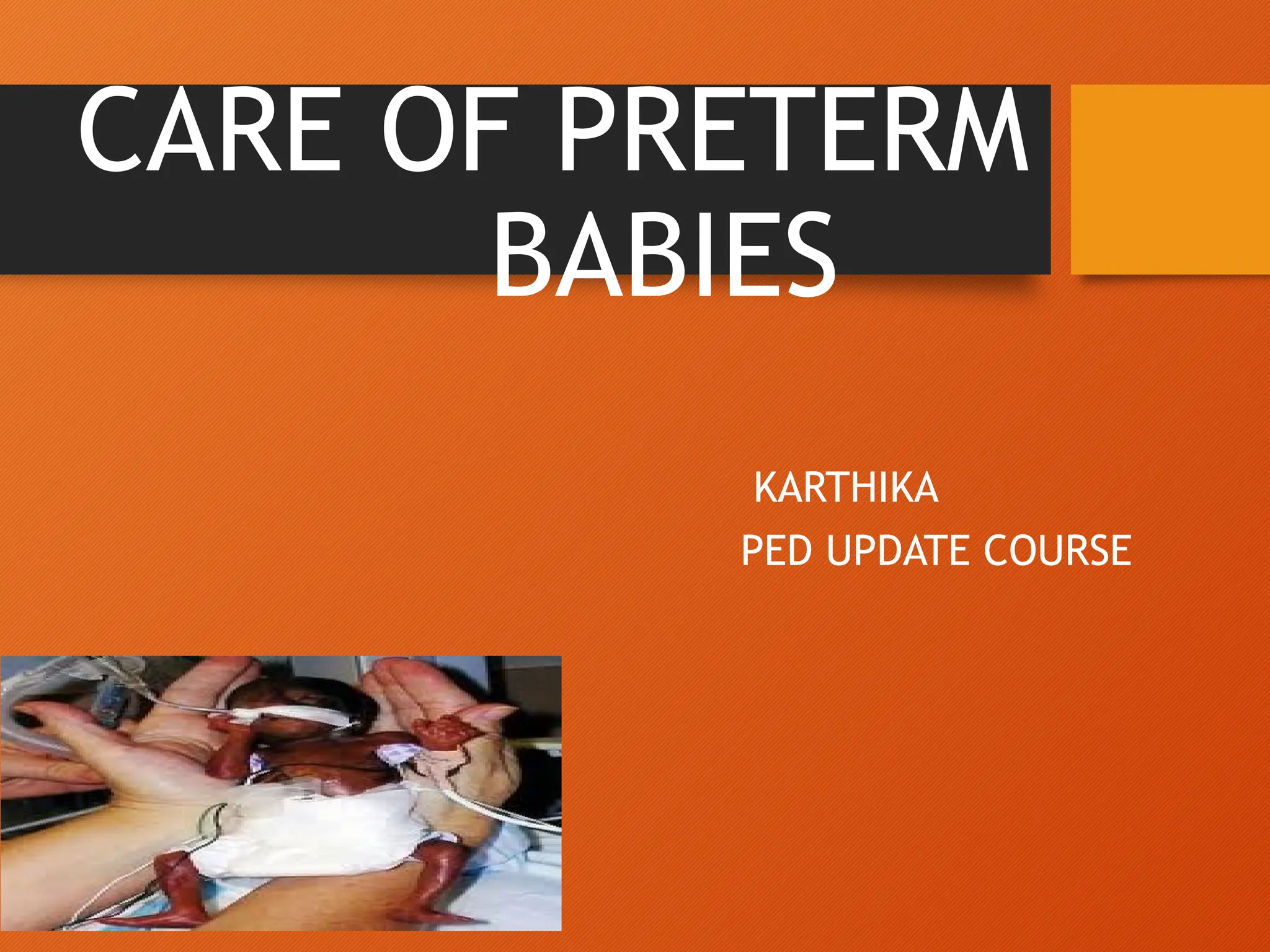
CARE OF PRETERM
BABIES
KARTHIKA
PED UPDATE COURSE
PRETERM BABIES
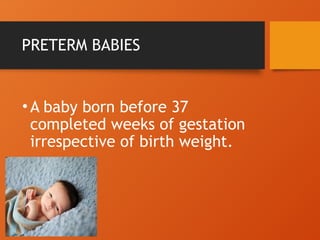
•A baby born before 37
completed weeks of gestation
irrespective of birth weight.
Categories of preterm
• Late preterm-34 to 36 weeks
• Moderately preterm-32 to 34 weeks
• Very preterm-before 32 weeks
• Extremely preterm-before 28 weeks
ETIOLOGY
• Maternal factors
• socio economic factors
• Pregnancy related factors
• Medical conditions
• Anatomic issues
• Infections
CHARACTERISTICS OF PRETERMS
• Small and scrawny
• Proportionally large head to body
• Translucent skin
• Visible blood vessels
CHARACTERISTICS OF PRETERMS
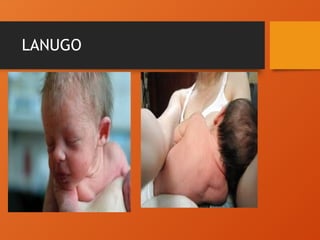
• Fine lanugo hair
• Soft pliable ear cartilage
• Soft bones
• Closed eyes
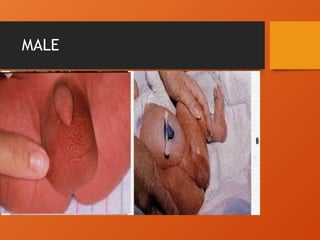
• Few scrotal rugae and undecended
testis
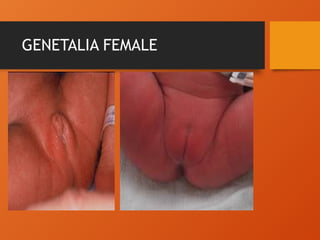
• Prominent labia and clitoris
• Inactive
• Extended extremities
• Partially developed reflux activities
• Absent ,weak or ineffective sucking
• Inability to maintain body temperature
• Limited ability to excrete solutes in
urine
• Increased susceptibility to infection
• Pliable thorax immature lung tissue
CHARACTERISTICS OF PRETERMS
•More susceptible to
hypoglycemia and hyper
bilirubinemia
PHYSIOLOGIC HANDICAPS
• Poor control of body temperature
• Respiratory difficulty
• Susceptibility to infection
• Difficulties with nutrition
• Immaturity in renal function
COMPARISON OF PRETERM
AND TERM
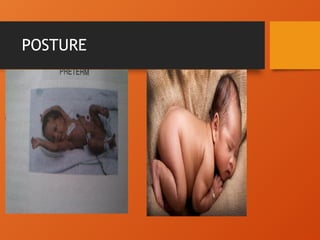
POSTURE
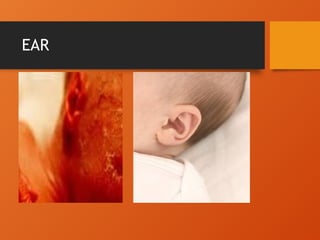
EAR
LANUGO
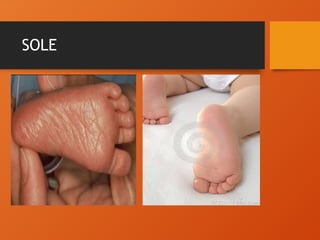
SOLE
GENETALIA FEMALE
MALE
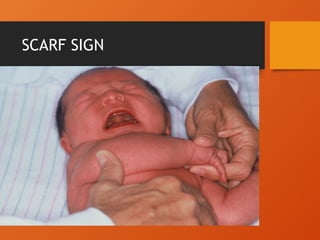
SCARF SIGN
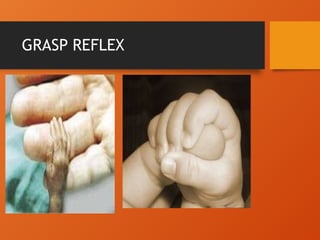
GRASP REFLEX
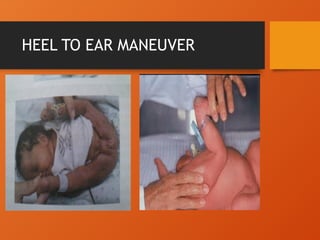
HEEL TO EAR MANEUVER
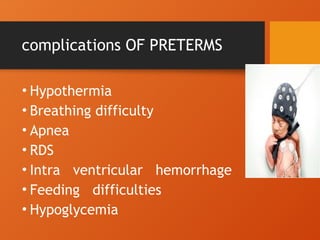
complications OF PRETERMS
• Hypothermia
• Breathing difficulty
• Apnea
• RDS
• Intra ventricular hemorrhage
• Feeding difficulties
• Hypoglycemia
• Metabolic acidosis
• Hyperbilirubinemia
• ROP
• Fluid and electrolyte imbalances
• Necrotizing enterocolitis
• Anemia
• BPD
• Infections
• Patent ductus
LONG TERM PROBLEMS
• Intellectual disabilities
• Cerebral palsy
• Vision and hearing loss
NEW RECOMMENDATIONS ON THE CARE
OF THE PRETERM INFANT BY WHO 2022
• KMC
• EARLY INITIATION OF BREAST
FEEDING
• USE OF CONTINYOUS POSITIVE
AIRWAY PRESSURE
• CAFFEINE
• Fluids and feeds
• Monitoring and early detection
of complications
• Appropriate management
CARE AT BIRTH
• Support breathing by different modes
available.
• Prophylactic administration of
exogenous surfactant.
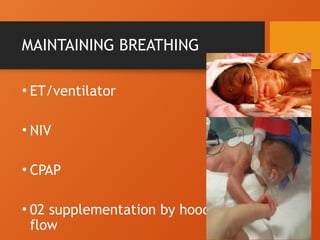
MAINTAINING BREATHING
• ET/ventilator
• NIV
• CPAP
• 02 supplementation by hood/free
flow
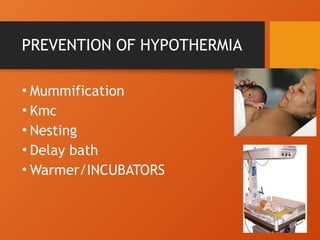
PREVENTION OF HYPOTHERMIA
• Mummification
• Kmc
• Nesting
• Delay bath
• Warmer/INCUBATORS
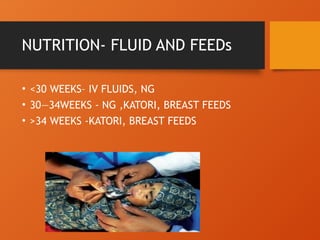
NUTRITION- FLUID AND FEEDs
• <30 WEEKS– IV FLUIDS, NG
• 30—34WEEKS - NG ,KATORI, BREAST FEEDS
• >34 WEEKS -KATORI, BREAST FEEDS
NUTRITION
• PROTEIN
• 10% of daily calories should be derived from proteins.
• Recommended allowance for LBW neonates is 3-4
gms/kg/day
Carbohydrates
• Should provide 40% energy.
• Recommended allowance is 10-15 gms/kg/day.
Fats
• Should provide 50% of total energy.
• Recommended allowance is 5.4- 7.2 gms/kg/day
Electrolytes and vitamins
• Sodium- Recommendations are 2.5 to 3.5 meq/ kg/ day
each.
• Mature Human milk contains 1.1 meq/100 kcal of
sodium and premature milk contains 1.9 meq /100 kcal
which is often insufficient for VLBW infants.
• Vitamin A- An intake of 1500 IU/kg/day is recommended
for preterms.
• It may promote epithelial repair and minimize fibrosis
in preterm babies with CLD.
• Vitamin D- Vit. D at 400 IU/day maintains adequate Vit
D status and prevents Rickets
• Vitamin K- Vit K is required for hepatic synthesis of
coagulation factors II, VII, IX, & X. Administration at
birth of 0.5 to 1.0 mg.
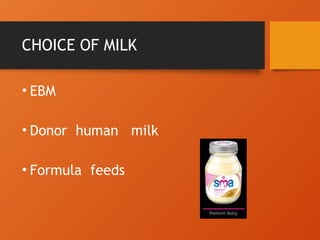
CHOICE OF MILK
• EBM
• Donor human milk
• Formula feeds
FEEDING GUIDELINES
• Ng/ogt
• Frequency
• Positioning
SUPPLEMENTS
• VITAMIN D
• Ca and Ph
• ZINC
• IRON
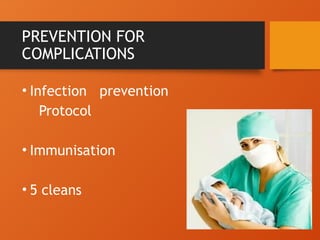
PREVENTION FOR
COMPLICATIONS
• Infection prevention
Protocol
• Immunisation
• 5 cleans
5 CLEANS
• CLEAN HAND
• CLEAN CORD
• CLEAN CORD CLAMP
• CLEAN SURFACE
• CLEAN PROCEDURES
USE OF DRUGS
• Corticosteroids
• Synthetic surfactant
• Vit k
• Antibiotics
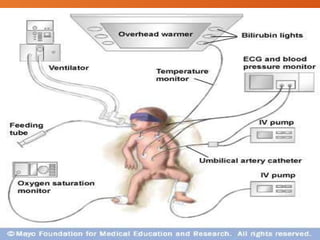
Monitoring
• Vital signs
• Activity and behavior
• Color; Pink, pale, grey, blue, yellow.
• Tissue perfusion
• Fluids, electrolytes and ABG
MONITORING
• Tolerance of feeds; Vomiting, gastric
residuals, abdominal girth.
• Look for development of RDS, Apneic
attacks, sepsis, PDA, NEC, IVH
• Weight gain
FAMILY EDUCATION
TAKE HOME MSG TO PARENTS
• FEEDING PRACTISES
• HAND HYGEINE
• KMC
• INFECTION CTRL
• IMMUNISATION
• DANGER SIGNS
THANK YOU
Developmentally supportive care
Definition : Developmentally supportive
care is defined as care of an infant to
support positive growth and
development, while allowing stabilization
of physiologic and behavioral functioning
(National Association of Neonatal Nurses,
2000)
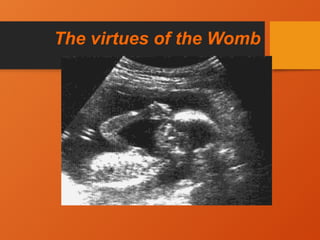
The virtues of the Womb
• Cushioned and comfortable aquatic abode
• Thermal comfort
• Zero insensible water losses
• Shielded from light
• Protected form sound
• Effective and safe ECMO-like oxygenation
• Optimal excretion of waste products
• Isolation and asepsis
• Parenteral nutrition
( Singh M, 2003 )
Dev Supp Care - Principles
• NICU design and environment
• Nursing care routines & plans
• Use of positioning aids
• Use of self regulation aids
• Feeding methods
• Management of pain
• Parental participation & support
• Neonatologist’ attitude
NICU Environment
Infant states
1. Quiet sleep - regular breathing, no REM, no
spontaneous movements.
2. Light sleep - irregular breathing, REM, spontaneous
movements.
3. Transition / drowsy - variable activity, dull look
4. Awake - alert - minimal activity, bright look.
5. Awake - hyperactive - very reactive, fussy, increased
motor activity.
6. Crying
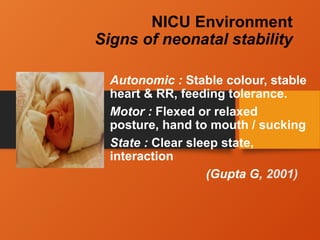
NICU Environment
Signs of neonatal stability
Autonomic : Stable colour, stable
heart & RR, feeding tolerance.
Motor : Flexed or relaxed
posture, hand to mouth / sucking
State : Clear sleep state,
interaction
(Gupta G, 2001)
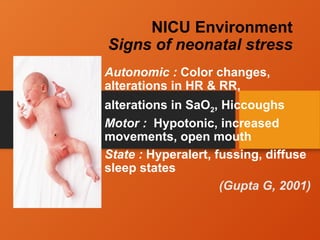
NICU Environment
Signs of neonatal stress
Autonomic : Color changes,
alterations in HR & RR,
alterations in SaO2, Hiccoughs
Motor : Hypotonic, increased
movements, open mouth
State : Hyperalert, fussing, diffuse
sleep states
(Gupta G, 2001)
NICU Environment – Sound
Adverse effects of loud sound
(>60 db)
Interferes with sleep
• Increase in Heart Rate
• Peripheral vasoconstriction
• Sudden loud noise may  TcPo2, ICP, ? IVH
• Hearing loss
( Lefrak L, 2001)
NICU Environment - Sound
• In-utero, 40-60 db
• Usual noise levels in NICU, 50-80 db
• Levels > 90 db for long times, hearing loss
• In PT on aminoglycosides, at lower db levels
NICU Environment – Sound
Sources of Noise
• Inside incubater, 55-88 db (Peak 117)
• Additional 10-40 db with surrounding
equipments
• Routine care activities, 58-76 db.
• Loud, sharp sound - 100-200 db.
• 4994 peak noises - 90% due to human related
factors
(Chang et al, 2001)
NICU Environment – Sound
Interventions to reduce noise
•Decrease noise in NICU
•Decrease monitor noise
•Respond quickly to alarms
•Rounds & reports away from bedside
•Speak softly
•Decrease telephone & intercom noise
( Ctd--)
NICU Environment – Sound
Interventions to reduce noise
( Ctd--)
•Move equipments quietly, repair noisy ones
•Decrease staff generated noises
•Prepare medications & feedings away from
bedside
•Gently open doors and drawers
•Follow the sound limit recommendations
NICU Environment - Sound
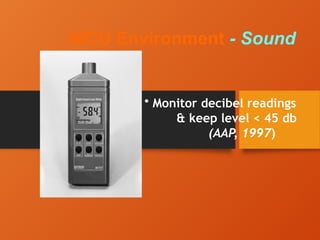
• Monitor decibel readings
& keep level < 45 db
(AAP, 1997)
NICU Environment – Sound
Helpful Effects
•Sound of mother’ voice (calming effect)
•Music may be beneficial
•Lullabies, womb sound, heart beat music.
- Better weight gain
- Decreased hospital stay,
- Better behavioral organization
(Chapman JS,1998)
NICU Environment – Light
Present scenario
•Fetal life - near darkness (ND)
•NICU- Usually very bright light
•Continuous light exposure
•Usual range - 50-150 foot candles
•Procedure & PT lights - 200-400
foot candle
NICU Environment – Light
Light effects:
•Effect on central visual system
•“Shutting out” behavior
• Quiet sleep & physiological instability
•Effect on circadian rhythms
•Effect on G & D
•?  risk of ROP
( Slevin M, 2000 )
NICU Environment – Light
Light Reduction
Safe level not established
• Shade head of crib / incubator
• when required , use spot light /
procedure light
•Eye covers must with PT
• use available natural light
NICU Environment – Light
Light Reduction
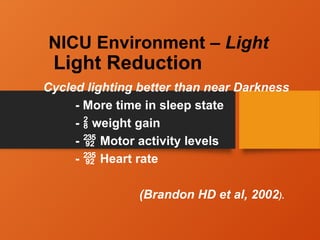
Cycled lighting better than near Darkness
- More time in sleep state
-  weight gain
-  Motor activity levels
-  Heart rate
(Brandon HD et al, 2002).
NICU Environment - Light
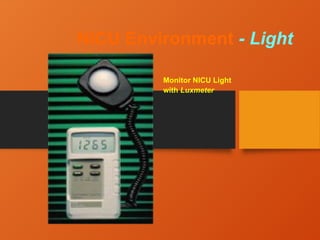
Monitor NICU Light
with Luxmeter
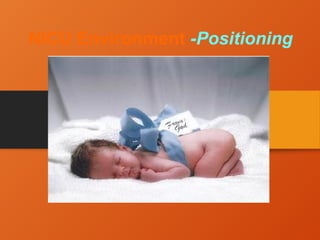
NICU Environment -Positioning
• Effect on respiratory physiology
• Body alignment important
• Prevent postural deformities
• Promote self-soothing activities
• Decided by GA, degree of illness,
paralytic agents.
NICU Environment –Positioning
Guidelines
Preferred, Prone / side lying
• Swaddle / cover to keep in flexed position
• Attempt to “nest” the infant
• Promote midline alignment
• Head support
• Avoid :
- Hyperextension of neck
- Frequent head turning to side
- Lower extremity frogging
- Bigger diaper
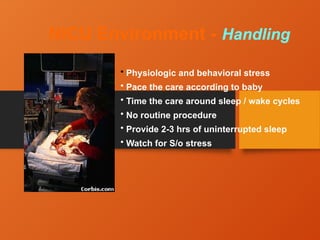
NICU Environment - Handling
• Physiologic and behavioral stress
• Pace the care according to baby
• Time the care around sleep / wake cycles
• No routine procedure
• Provide 2-3 hrs of uninterrupted sleep
• Watch for S/o stress
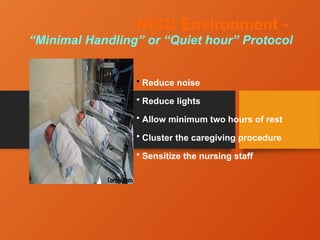
NICU Environment -
“Minimal Handling” or “Quiet hour” Protocol
• Reduce noise
• Reduce lights
• Allow minimum two hours of rest
• Cluster the caregiving procedure
• Sensitize the nursing staff
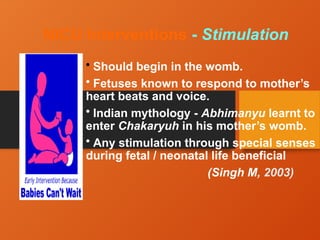
NICU Interventions - Stimulation
• Should begin in the womb.
• Fetuses known to respond to mother’s
heart beats and voice.
• Indian mythology - Abhimanyu learnt to
enter Chakaryuh in his mother’s womb.
• Any stimulation through special senses
during fetal / neonatal life beneficial
(Singh M, 2003)
NICU Interventions
Supplemental stimulation
• Kangaroo Mother Care ( KMC )
• Non-nutritive sucking ( NNS )
• Massage therapy
• Multimodal stimulation
• Breast feeding
• Pain management
• NIDCAP
• Wee care
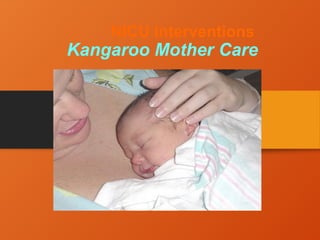
NICU Interventions
Kangaroo Mother Care
NICU Interventions
Kangaroo Mother Care
• Skin to skin contact
• Practiced in many cultures
Components :
• Kangaroo positioning
• Kangaroo feeding
• Kangaroo discharge
Forms :
• Hospitals with no / poor facilities
• Insufficient technical & human resources
• In tertiary level NICUs
(Kirsten G.F., PCNA, 2001)
NICU Interventions
Kangaroo Mother Care
Likely Benefits :
Successful breast feeding
•Better physiologic stability
•Increased maternal confidence & bonding
•Reduced infection rates
•Cost savings
(Kirsten G.F., PCNA, 2001)
NICU Interventions
Non-nutritive Sucking
• Different from nutritive sucking
• On empty breast / pacifier
• Provides comfort
• Promotes physiological organization
• Pain-reducing effect
• Promotes suck- swallow co-ordination
• Facilitates transition to breast feeding
• Better weight gain & shorter hospital stay.
(Field TM, 2003)
NICU Interventions
Massage Therapy
•Tactile / Kinesthetic stimulation
•Tactile stimulation only, may be aversive.
•Massage therapy with moderate pressure may be
useful.
•Stimulation of tactile and pressure receptors
important.
•Hypothetical mechanisms of benefit
- Touch - Growth gene interaction
- Increased vagal tone
- Increased insulin levels
- Increased growth hormone secretion
(Field TM, 2003)
NICU Interventions
Massage Therapy
Proposed benefits :
Better weight gain
• More time in active, alert state
• More quiet sleep
• Better motor maturity scores
• ? Better long-term outcome
(Mathai S. et al, 2001)
NICU Interventions
Massage Therapy
Unresolved Issues :
•Collapse / disorganization due to over-
stimulation
•Response of full term Vs preterm infants
•Response of SGA Vs AGA babies
•Maternal Vs nurse’ touch
(Feldman R et al, 1998)
NICU Interventions
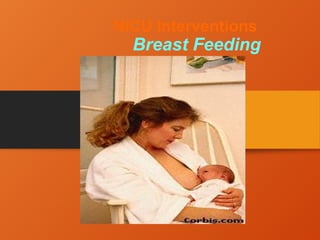
Breast Feeding
NICU Interventions
Breast Feeding
• Humanized and natural
• Species specific & baby specific
• Minimal enteral feeds (Trophic feeds)
• Multiple benefits of MEN
• Early contact and bonding
Support and encourage breast
feeding
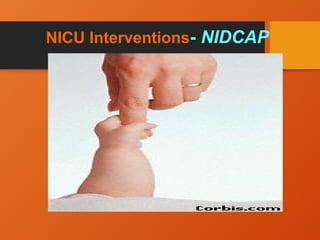
NICU Interventions- NIDCAP
•Neonatal individualized developmental and assessment program
(NIDCAP)
•Developed by Als et al
•Four standards of care
- Structuring the environment
- Timing, organizing & giving direct care
- Working collaboratively
- Supporting & strengthening family relationships.
•Individualized plan for each baby
•Meta-analysis : Significant decrease in O2 requirement
: Improved outcome at 12 mths.
(Jacobs SE et al, J Ped, 2002).
NICU Interventions -
Multimodal Stimulation
• ATVV - Auditory, tactile, visual & vestibular
• Soft & soothing music
• Gentle touch
• Use of pictures (human face), bright toys
• Olfactory stimulation, use of “breast milk” (avoid
cologne / spray).
• Better weight gain and early discharge
(Standly JM, 1998)
NICU Interventions -
Multimodal Stimulation
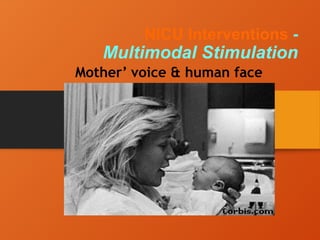
Mother’ voice & human face
NICU Interventions
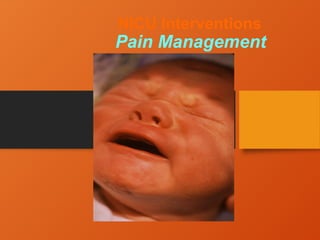
Pain Management
NICU Interventions
Pain Management
Neonatal Pain - Misconceptions
• Newborns lack anatomical &
physiological structures to transmit pain
sensation.
• Can not express pain sensation
• Have no memory of pain
• Would not tolerate analgesia /
anesthesia
NICU Interventions
Pain Management
Neonatal Pain - Facts :
Nociceptive mechanisms well developed
even in preterm.
• Pain expression and assessment possible
• Various consequences of pain & stress
• Various nonpharmacologic &
pharmacologic strategies useful for
treatment
NICU Interventions
Pain Management
Non-pharmacologic Interventions
• Positioning & containment
• Swaddling
• Non-nutritive sucking / pacifiers
• Skin to skin contact
• Rocking
• Music
• Breast milk
• Oral glucose / sucrose
NICU Interventions
Pain Management
Pharmacologic interventions
• Local anaesthetics (EMLA)
• Regional anaesthesia
• Systemic analgesia
(Gilbert R, 2001)
NICU Interventions -
Family Involvement
• NICU - a barrier
• Provision of privacy (for bonding)
• Social interaction & support
• Parental education & counselling
• Involvement of mother in care
• Mother - based NICU, need of hour
(Cisler - Cahill et al 2002)
NICU Interventions - future issues
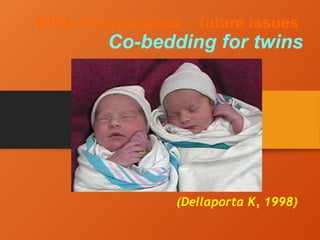
Co-bedding for twins
(Dellaporta K, 1998)
NICU Interventions - future issues
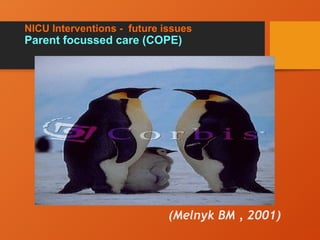
Parent focussed care (COPE)
(Melnyk BM , 2001)
NICU Interventions - future issues
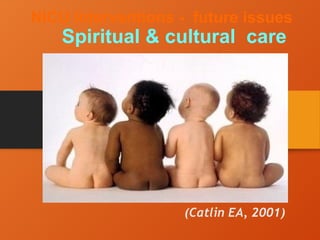
Spiritual & cultural care
(Catlin EA, 2001)
NICU Interventions - future issues
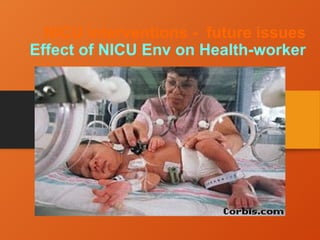
Effect of NICU Env on Health-worker
NICU Interventions - future issues
Quality Assessment & Improvement
NICU Interventions - future issues
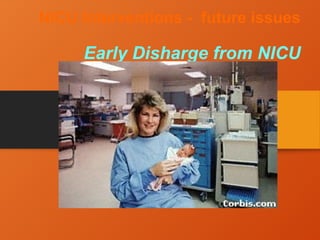
Early Disharge from NICU

careofpretermbabies-130920132634-phpapp01.pptx

  • 1.
  • 2.
    PRETERM BABIES •A babyborn before 37 completed weeks of gestation irrespective of birth weight.
  • 3.
    Categories of preterm •Late preterm-34 to 36 weeks • Moderately preterm-32 to 34 weeks • Very preterm-before 32 weeks • Extremely preterm-before 28 weeks
  • 4.
    ETIOLOGY • Maternal factors •socio economic factors • Pregnancy related factors • Medical conditions • Anatomic issues • Infections
  • 5.
    CHARACTERISTICS OF PRETERMS •Small and scrawny • Proportionally large head to body • Translucent skin • Visible blood vessels
  • 6.
    CHARACTERISTICS OF PRETERMS •Fine lanugo hair • Soft pliable ear cartilage • Soft bones • Closed eyes
  • 7.
    • Few scrotalrugae and undecended testis • Prominent labia and clitoris • Inactive • Extended extremities • Partially developed reflux activities
  • 8.
    • Absent ,weakor ineffective sucking • Inability to maintain body temperature • Limited ability to excrete solutes in urine • Increased susceptibility to infection • Pliable thorax immature lung tissue
  • 9.
    CHARACTERISTICS OF PRETERMS •Moresusceptible to hypoglycemia and hyper bilirubinemia
  • 10.
    PHYSIOLOGIC HANDICAPS • Poorcontrol of body temperature • Respiratory difficulty • Susceptibility to infection • Difficulties with nutrition • Immaturity in renal function
  • 11.
  • 12.
  • 13.
  • 14.
  • 15.
  • 16.
  • 17.
  • 18.
  • 19.
  • 20.
    HEEL TO EARMANEUVER
  • 21.
    complications OF PRETERMS •Hypothermia • Breathing difficulty • Apnea • RDS • Intra ventricular hemorrhage • Feeding difficulties • Hypoglycemia
  • 22.
    • Metabolic acidosis •Hyperbilirubinemia • ROP • Fluid and electrolyte imbalances • Necrotizing enterocolitis • Anemia • BPD • Infections • Patent ductus
  • 23.
    LONG TERM PROBLEMS •Intellectual disabilities • Cerebral palsy • Vision and hearing loss
  • 24.
    NEW RECOMMENDATIONS ONTHE CARE OF THE PRETERM INFANT BY WHO 2022 • KMC • EARLY INITIATION OF BREAST FEEDING • USE OF CONTINYOUS POSITIVE AIRWAY PRESSURE • CAFFEINE
  • 25.
    • Fluids andfeeds • Monitoring and early detection of complications • Appropriate management
  • 26.
    CARE AT BIRTH •Support breathing by different modes available. • Prophylactic administration of exogenous surfactant.
  • 27.
    MAINTAINING BREATHING • ET/ventilator •NIV • CPAP • 02 supplementation by hood/free flow
  • 28.
    PREVENTION OF HYPOTHERMIA •Mummification • Kmc • Nesting • Delay bath • Warmer/INCUBATORS
  • 29.
    NUTRITION- FLUID ANDFEEDs • <30 WEEKS– IV FLUIDS, NG • 30—34WEEKS - NG ,KATORI, BREAST FEEDS • >34 WEEKS -KATORI, BREAST FEEDS
  • 30.
    NUTRITION • PROTEIN • 10%of daily calories should be derived from proteins. • Recommended allowance for LBW neonates is 3-4 gms/kg/day Carbohydrates • Should provide 40% energy. • Recommended allowance is 10-15 gms/kg/day. Fats • Should provide 50% of total energy. • Recommended allowance is 5.4- 7.2 gms/kg/day
  • 31.
    Electrolytes and vitamins •Sodium- Recommendations are 2.5 to 3.5 meq/ kg/ day each. • Mature Human milk contains 1.1 meq/100 kcal of sodium and premature milk contains 1.9 meq /100 kcal which is often insufficient for VLBW infants. • Vitamin A- An intake of 1500 IU/kg/day is recommended for preterms. • It may promote epithelial repair and minimize fibrosis in preterm babies with CLD. • Vitamin D- Vit. D at 400 IU/day maintains adequate Vit D status and prevents Rickets • Vitamin K- Vit K is required for hepatic synthesis of coagulation factors II, VII, IX, & X. Administration at birth of 0.5 to 1.0 mg.
  • 32.
    CHOICE OF MILK •EBM • Donor human milk • Formula feeds
  • 34.
    FEEDING GUIDELINES • Ng/ogt •Frequency • Positioning
  • 35.
    SUPPLEMENTS • VITAMIN D •Ca and Ph • ZINC • IRON
  • 36.
    PREVENTION FOR COMPLICATIONS • Infectionprevention Protocol • Immunisation • 5 cleans
  • 37.
    5 CLEANS • CLEANHAND • CLEAN CORD • CLEAN CORD CLAMP • CLEAN SURFACE • CLEAN PROCEDURES
  • 38.
    USE OF DRUGS •Corticosteroids • Synthetic surfactant • Vit k • Antibiotics
  • 39.
    Monitoring • Vital signs •Activity and behavior • Color; Pink, pale, grey, blue, yellow. • Tissue perfusion • Fluids, electrolytes and ABG
  • 40.
    MONITORING • Tolerance offeeds; Vomiting, gastric residuals, abdominal girth. • Look for development of RDS, Apneic attacks, sepsis, PDA, NEC, IVH • Weight gain
  • 42.
  • 43.
    TAKE HOME MSGTO PARENTS • FEEDING PRACTISES • HAND HYGEINE • KMC • INFECTION CTRL • IMMUNISATION • DANGER SIGNS
  • 44.
  • 45.
    Developmentally supportive care Definition: Developmentally supportive care is defined as care of an infant to support positive growth and development, while allowing stabilization of physiologic and behavioral functioning (National Association of Neonatal Nurses, 2000)
  • 46.
  • 47.
    The virtues ofthe Womb • Cushioned and comfortable aquatic abode • Thermal comfort • Zero insensible water losses • Shielded from light • Protected form sound • Effective and safe ECMO-like oxygenation • Optimal excretion of waste products • Isolation and asepsis • Parenteral nutrition ( Singh M, 2003 )
  • 48.
    Dev Supp Care- Principles • NICU design and environment • Nursing care routines & plans • Use of positioning aids • Use of self regulation aids • Feeding methods • Management of pain • Parental participation & support • Neonatologist’ attitude
  • 49.
    NICU Environment Infant states 1.Quiet sleep - regular breathing, no REM, no spontaneous movements. 2. Light sleep - irregular breathing, REM, spontaneous movements. 3. Transition / drowsy - variable activity, dull look 4. Awake - alert - minimal activity, bright look. 5. Awake - hyperactive - very reactive, fussy, increased motor activity. 6. Crying
  • 50.
    NICU Environment Signs ofneonatal stability Autonomic : Stable colour, stable heart & RR, feeding tolerance. Motor : Flexed or relaxed posture, hand to mouth / sucking State : Clear sleep state, interaction (Gupta G, 2001)
  • 51.
    NICU Environment Signs ofneonatal stress Autonomic : Color changes, alterations in HR & RR, alterations in SaO2, Hiccoughs Motor : Hypotonic, increased movements, open mouth State : Hyperalert, fussing, diffuse sleep states (Gupta G, 2001)
  • 52.
    NICU Environment –Sound Adverse effects of loud sound (>60 db) Interferes with sleep • Increase in Heart Rate • Peripheral vasoconstriction • Sudden loud noise may  TcPo2, ICP, ? IVH • Hearing loss ( Lefrak L, 2001)
  • 53.
    NICU Environment -Sound • In-utero, 40-60 db • Usual noise levels in NICU, 50-80 db • Levels > 90 db for long times, hearing loss • In PT on aminoglycosides, at lower db levels
  • 54.
    NICU Environment –Sound Sources of Noise • Inside incubater, 55-88 db (Peak 117) • Additional 10-40 db with surrounding equipments • Routine care activities, 58-76 db. • Loud, sharp sound - 100-200 db. • 4994 peak noises - 90% due to human related factors (Chang et al, 2001)
  • 55.
    NICU Environment –Sound Interventions to reduce noise •Decrease noise in NICU •Decrease monitor noise •Respond quickly to alarms •Rounds & reports away from bedside •Speak softly •Decrease telephone & intercom noise ( Ctd--)
  • 56.
    NICU Environment –Sound Interventions to reduce noise ( Ctd--) •Move equipments quietly, repair noisy ones •Decrease staff generated noises •Prepare medications & feedings away from bedside •Gently open doors and drawers •Follow the sound limit recommendations
  • 57.
    NICU Environment -Sound • Monitor decibel readings & keep level < 45 db (AAP, 1997)
  • 58.
    NICU Environment –Sound Helpful Effects •Sound of mother’ voice (calming effect) •Music may be beneficial •Lullabies, womb sound, heart beat music. - Better weight gain - Decreased hospital stay, - Better behavioral organization (Chapman JS,1998)
  • 59.
    NICU Environment –Light Present scenario •Fetal life - near darkness (ND) •NICU- Usually very bright light •Continuous light exposure •Usual range - 50-150 foot candles •Procedure & PT lights - 200-400 foot candle
  • 60.
    NICU Environment –Light Light effects: •Effect on central visual system •“Shutting out” behavior • Quiet sleep & physiological instability •Effect on circadian rhythms •Effect on G & D •?  risk of ROP ( Slevin M, 2000 )
  • 61.
    NICU Environment –Light Light Reduction Safe level not established • Shade head of crib / incubator • when required , use spot light / procedure light •Eye covers must with PT • use available natural light
  • 62.
    NICU Environment –Light Light Reduction Cycled lighting better than near Darkness - More time in sleep state -  weight gain -  Motor activity levels -  Heart rate (Brandon HD et al, 2002).
  • 63.
    NICU Environment -Light Monitor NICU Light with Luxmeter
  • 64.
  • 65.
    NICU Environment -Positioning •Effect on respiratory physiology • Body alignment important • Prevent postural deformities • Promote self-soothing activities • Decided by GA, degree of illness, paralytic agents.
  • 66.
    NICU Environment –Positioning Guidelines Preferred,Prone / side lying • Swaddle / cover to keep in flexed position • Attempt to “nest” the infant • Promote midline alignment • Head support • Avoid : - Hyperextension of neck - Frequent head turning to side - Lower extremity frogging - Bigger diaper
  • 67.
    NICU Environment -Handling • Physiologic and behavioral stress • Pace the care according to baby • Time the care around sleep / wake cycles • No routine procedure • Provide 2-3 hrs of uninterrupted sleep • Watch for S/o stress
  • 68.
    NICU Environment - “MinimalHandling” or “Quiet hour” Protocol • Reduce noise • Reduce lights • Allow minimum two hours of rest • Cluster the caregiving procedure • Sensitize the nursing staff
  • 69.
    NICU Interventions -Stimulation • Should begin in the womb. • Fetuses known to respond to mother’s heart beats and voice. • Indian mythology - Abhimanyu learnt to enter Chakaryuh in his mother’s womb. • Any stimulation through special senses during fetal / neonatal life beneficial (Singh M, 2003)
  • 70.
    NICU Interventions Supplemental stimulation •Kangaroo Mother Care ( KMC ) • Non-nutritive sucking ( NNS ) • Massage therapy • Multimodal stimulation • Breast feeding • Pain management • NIDCAP • Wee care
  • 71.
  • 72.
    NICU Interventions Kangaroo MotherCare • Skin to skin contact • Practiced in many cultures Components : • Kangaroo positioning • Kangaroo feeding • Kangaroo discharge Forms : • Hospitals with no / poor facilities • Insufficient technical & human resources • In tertiary level NICUs (Kirsten G.F., PCNA, 2001)
  • 73.
    NICU Interventions Kangaroo MotherCare Likely Benefits : Successful breast feeding •Better physiologic stability •Increased maternal confidence & bonding •Reduced infection rates •Cost savings (Kirsten G.F., PCNA, 2001)
  • 74.
    NICU Interventions Non-nutritive Sucking •Different from nutritive sucking • On empty breast / pacifier • Provides comfort • Promotes physiological organization • Pain-reducing effect • Promotes suck- swallow co-ordination • Facilitates transition to breast feeding • Better weight gain & shorter hospital stay. (Field TM, 2003)
  • 75.
    NICU Interventions Massage Therapy •Tactile/ Kinesthetic stimulation •Tactile stimulation only, may be aversive. •Massage therapy with moderate pressure may be useful. •Stimulation of tactile and pressure receptors important. •Hypothetical mechanisms of benefit - Touch - Growth gene interaction - Increased vagal tone - Increased insulin levels - Increased growth hormone secretion (Field TM, 2003)
  • 76.
    NICU Interventions Massage Therapy Proposedbenefits : Better weight gain • More time in active, alert state • More quiet sleep • Better motor maturity scores • ? Better long-term outcome (Mathai S. et al, 2001)
  • 77.
    NICU Interventions Massage Therapy UnresolvedIssues : •Collapse / disorganization due to over- stimulation •Response of full term Vs preterm infants •Response of SGA Vs AGA babies •Maternal Vs nurse’ touch (Feldman R et al, 1998)
  • 78.
  • 79.
    NICU Interventions Breast Feeding •Humanized and natural • Species specific & baby specific • Minimal enteral feeds (Trophic feeds) • Multiple benefits of MEN • Early contact and bonding Support and encourage breast feeding
  • 80.
  • 81.
    NICU Interventions- NIDCAP •Neonatalindividualized developmental and assessment program (NIDCAP) •Developed by Als et al •Four standards of care - Structuring the environment - Timing, organizing & giving direct care - Working collaboratively - Supporting & strengthening family relationships. •Individualized plan for each baby •Meta-analysis : Significant decrease in O2 requirement : Improved outcome at 12 mths. (Jacobs SE et al, J Ped, 2002).
  • 82.
    NICU Interventions - MultimodalStimulation • ATVV - Auditory, tactile, visual & vestibular • Soft & soothing music • Gentle touch • Use of pictures (human face), bright toys • Olfactory stimulation, use of “breast milk” (avoid cologne / spray). • Better weight gain and early discharge (Standly JM, 1998)
  • 83.
    NICU Interventions - MultimodalStimulation Mother’ voice & human face
  • 84.
  • 85.
    NICU Interventions Pain Management NeonatalPain - Misconceptions • Newborns lack anatomical & physiological structures to transmit pain sensation. • Can not express pain sensation • Have no memory of pain • Would not tolerate analgesia / anesthesia
  • 86.
    NICU Interventions Pain Management NeonatalPain - Facts : Nociceptive mechanisms well developed even in preterm. • Pain expression and assessment possible • Various consequences of pain & stress • Various nonpharmacologic & pharmacologic strategies useful for treatment
  • 87.
    NICU Interventions Pain Management Non-pharmacologicInterventions • Positioning & containment • Swaddling • Non-nutritive sucking / pacifiers • Skin to skin contact • Rocking • Music • Breast milk • Oral glucose / sucrose
  • 88.
    NICU Interventions Pain Management Pharmacologicinterventions • Local anaesthetics (EMLA) • Regional anaesthesia • Systemic analgesia (Gilbert R, 2001)
  • 89.
    NICU Interventions - FamilyInvolvement • NICU - a barrier • Provision of privacy (for bonding) • Social interaction & support • Parental education & counselling • Involvement of mother in care • Mother - based NICU, need of hour (Cisler - Cahill et al 2002)
  • 90.
    NICU Interventions -future issues Co-bedding for twins (Dellaporta K, 1998)
  • 91.
    NICU Interventions -future issues Parent focussed care (COPE) (Melnyk BM , 2001)
  • 92.
    NICU Interventions -future issues Spiritual & cultural care (Catlin EA, 2001)
  • 93.
    NICU Interventions -future issues Effect of NICU Env on Health-worker
  • 94.
    NICU Interventions -future issues Quality Assessment & Improvement
  • 95.
    NICU Interventions -future issues Early Disharge from NICU