Objectives
Identify Typical Developmental Stages Including:
• Gross and Fine Motor Development
• Languages Skills
• Cognitive Development
• Social – Emotional
For youth ages 4 to 12 years old
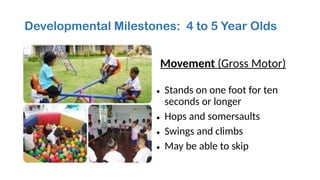
Developmental Milestones: 4 to 5 Year Olds
Movement (Gross Motor)
• Stands on one foot for ten
seconds or longer
• Hops and somersaults
• Swings and climbs
• May be able to skip
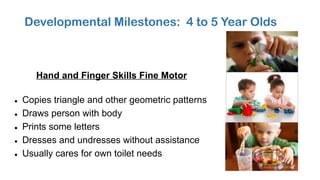
Developmental Milestones: 4 to 5 Year Olds
Hand and Finger Skills Fine Motor
• Copies triangle and other geometric patterns
• Draws person with body
• Prints some letters
• Dresses and undresses without assistance
• Usually cares for own toilet needs
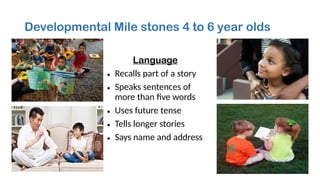
Developmental Mile stones 4 to 6 year olds
Language
• Recalls part of a story
• Speaks sentences of
more than five words
• Uses future tense
• Tells longer stories
• Says name and address
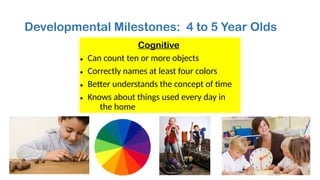
Developmental Milestones: 4 to 5 Year Olds
Cognitive
• Can count ten or more objects
• Correctly names at least four colors
• Better understands the concept of time
• Knows about things used every day in
the home
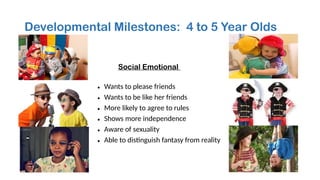
Developmental Milestones: 4 to 5 Year Olds
Social Emotional
• Wants to please friends
• Wants to be like her friends
• More likely to agree to rules
• Shows more independence
• Aware of sexuality
• Able to distinguish fantasy from reality
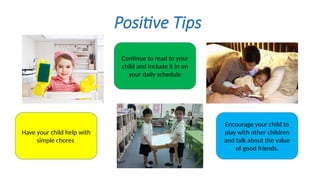
Positive Tips
Have your child help with
simple chores
Continue to read to your
child and include it in on
your daily schedule
Encourage your child to
play with other children
and talk about the value
of good friends.
Developmental Milestones: 6 to 7 Years
Motor Skills
• Use one hand consistently for fine motor tasks
• Interested in games with rules and but lacks skill
• Use a fork and knife together to cut soft foods
• Get dressed by themselves including fasteners
• Enjoys roughhousing, but does not know when to stop; may end up hurt, upset, or exhausted
Developmental Milestones: 6 to 7 Years
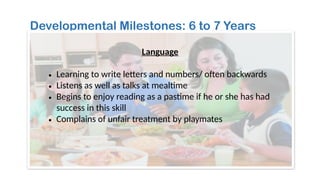
Language
• Learning to write letters and numbers/ often backwards
• Listens as well as talks at mealtime
• Begins to enjoy reading as a pastime if he or she has had
success in this skill
• Complains of unfair treatment by playmates
Developmental Milestones: 6 to 7 Years
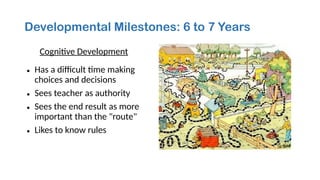
Cognitive Development
• Has a difficult time making
choices and decisions
• Sees teacher as authority
• Sees the end result as more
important than the "route"
• Likes to know rules
Developmental Milestones: 6 to 7 Years
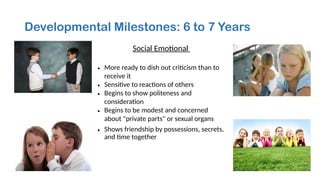
Social Emotional
• More ready to dish out criticism than to
receive it
• Sensitive to reactions of others
• Begins to show politeness and
consideration
• Begins to be modest and concerned
about "private parts" or sexual organs
• Shows friendship by possessions, secrets,
and time together
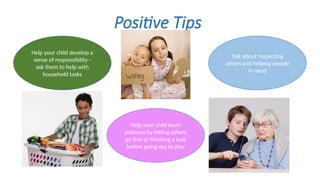
Positive Tips
Help your child learn
patience by letting others
go first or finishing a task
before going out to play
Talk about respecting
others and helping people
in need
Help your child develop a
sense of responsibility -
ask them to help with
household tasks
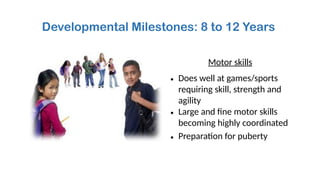
Developmental Milestones: 8 to 12 Years
Motor skills
• Does well at games/sports
requiring skill, strength and
agility
• Large and fine motor skills
becoming highly coordinated
• Preparation for puberty
Developmental Milestones: 8 to 12 Years
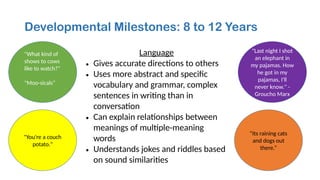
Language
• Gives accurate directions to others
• Uses more abstract and specific
vocabulary and grammar, complex
sentences in writing than in
conversation
• Can explain relationships between
meanings of multiple-meaning
words
• Understands jokes and riddles based
on sound similarities
"What kind of
shows to cows
like to watch?"
"Moo-sicals”
"Last night I shot
an elephant in
my pajamas. How
he got in my
pajamas, I'll
never know." -
Groucho Marx
"You're a couch
potato."
“Its raining cats
and dogs out
there.”
Developmental Milestones: 8 to 12 Years
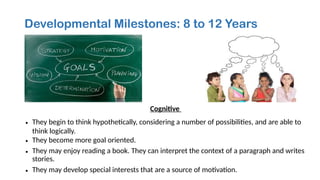
Cognitive
• They begin to think hypothetically, considering a number of possibilities, and are able to
think logically.
• They become more goal oriented.
• They may enjoy reading a book. They can interpret the context of a paragraph and writes
stories.
• They may develop special interests that are a source of motivation.
Developmental Milestones: 8 to 12 Years
Social/ Emotional
• Most early adolescents are fully capable of perspective taking and
understand and consider other's perspectives.
• They begin to understand facets of the adult world like money and
telling time.
• may resent being told what to do, yet needs constant reminders
regarding routine responsibilities
• shows a change of interest in the opposite sex
Positive Tips
Help your child develop a
personal sense of right and
wrong. Talk specifically
about peer pressure and
plans to deal with it.
Use phases like “You must be
proud of yourself” rather than
”I’m proud of you” and
encourage positive choices
when no one is there to praise
their efforts.
Help your child set
individual goals and to think
about how to develop skills
to accomplish them
Questions
CONTACT INFORMATION:
Sue Ownby
Parent Liaison
Knox County Schools
Sue.ownby@knoxschools.org
865-594-8889
References
• American Academy of Pediatrics - Healthychildren.org Caring for Your Baby and Young Child: Birth to Age 5
(Copyright
©
2009 American Academy of Pediatrics)
• References & Resources: Benson, P. L. (2006). All kids are our kids: What communities must do to raise
caring and responsible children and adolescents (2nd ed.). San Francisco: Jossey-Bass.Center for Disease
Control and Prevention (2014, June 23). Middle childhood (6-8 years ofage).Retrievedfrom http://
www.cdc.gov/ncbddd/childdevelopment/positiveparenting/middle.htmlCenter for Disease Control and
Prevention (2014, June 23). Middle childhood (9-11 years of age). Retrieved from http://
www.cdc.gov/ncbddd/childdevelopment/positiveparenting/middle2.htmlCenter for Disease Control and
Prevention (2014, June 23). Young teens (12 -14 years of age).Retrieved fromhttp://
www.cdc.gov/ncbddd/childdevelopment/positiveparenting/adolescence.htmlInstitute for Human Services
for the Ohio Child Welfare Training Program (2007). Developmental milestones chart. Retrieved fromhttp://
www.rsd.k12.pa.us/Downloads/Development_Chart_for_Booklet.pdfLeffert, N., Benson, P., &
Roehlkepartain, J. (1997). Starting out right: Developmental assets for children. Minneapolis, MN: The
Search Institute.
• Adapted by Anne L. Heinsohn, former associate professor of extension education, from Children-How They Grow:
Elementary School Children Ages 6 to 8 and 9 to 12, Bulletins GH 6230 and GH 6231, by Mary McPhail Gray and
Terry Foltz, University of Missouri, Columbia

Developmental_Mile_Stones.pptxnsjjjsjsjshjsj

  • 2.
    Objectives Identify Typical DevelopmentalStages Including: • Gross and Fine Motor Development • Languages Skills • Cognitive Development • Social – Emotional For youth ages 4 to 12 years old
  • 3.
    Developmental Milestones: 4to 5 Year Olds Movement (Gross Motor) • Stands on one foot for ten seconds or longer • Hops and somersaults • Swings and climbs • May be able to skip
  • 4.
    Developmental Milestones: 4to 5 Year Olds Hand and Finger Skills Fine Motor • Copies triangle and other geometric patterns • Draws person with body • Prints some letters • Dresses and undresses without assistance • Usually cares for own toilet needs
  • 5.
    Developmental Mile stones4 to 6 year olds Language • Recalls part of a story • Speaks sentences of more than five words • Uses future tense • Tells longer stories • Says name and address
  • 6.
    Developmental Milestones: 4to 5 Year Olds Cognitive • Can count ten or more objects • Correctly names at least four colors • Better understands the concept of time • Knows about things used every day in the home
  • 7.
    Developmental Milestones: 4to 5 Year Olds Social Emotional • Wants to please friends • Wants to be like her friends • More likely to agree to rules • Shows more independence • Aware of sexuality • Able to distinguish fantasy from reality
  • 8.
    Positive Tips Have yourchild help with simple chores Continue to read to your child and include it in on your daily schedule Encourage your child to play with other children and talk about the value of good friends.
  • 9.
    Developmental Milestones: 6to 7 Years Motor Skills • Use one hand consistently for fine motor tasks • Interested in games with rules and but lacks skill • Use a fork and knife together to cut soft foods • Get dressed by themselves including fasteners • Enjoys roughhousing, but does not know when to stop; may end up hurt, upset, or exhausted
  • 10.
    Developmental Milestones: 6to 7 Years Language • Learning to write letters and numbers/ often backwards • Listens as well as talks at mealtime • Begins to enjoy reading as a pastime if he or she has had success in this skill • Complains of unfair treatment by playmates
  • 11.
    Developmental Milestones: 6to 7 Years Cognitive Development • Has a difficult time making choices and decisions • Sees teacher as authority • Sees the end result as more important than the "route" • Likes to know rules
  • 12.
    Developmental Milestones: 6to 7 Years Social Emotional • More ready to dish out criticism than to receive it • Sensitive to reactions of others • Begins to show politeness and consideration • Begins to be modest and concerned about "private parts" or sexual organs • Shows friendship by possessions, secrets, and time together
  • 13.
    Positive Tips Help yourchild learn patience by letting others go first or finishing a task before going out to play Talk about respecting others and helping people in need Help your child develop a sense of responsibility - ask them to help with household tasks
  • 14.
    Developmental Milestones: 8to 12 Years Motor skills • Does well at games/sports requiring skill, strength and agility • Large and fine motor skills becoming highly coordinated • Preparation for puberty
  • 15.
    Developmental Milestones: 8to 12 Years Language • Gives accurate directions to others • Uses more abstract and specific vocabulary and grammar, complex sentences in writing than in conversation • Can explain relationships between meanings of multiple-meaning words • Understands jokes and riddles based on sound similarities "What kind of shows to cows like to watch?" "Moo-sicals” "Last night I shot an elephant in my pajamas. How he got in my pajamas, I'll never know." - Groucho Marx "You're a couch potato." “Its raining cats and dogs out there.”
  • 16.
    Developmental Milestones: 8to 12 Years Cognitive • They begin to think hypothetically, considering a number of possibilities, and are able to think logically. • They become more goal oriented. • They may enjoy reading a book. They can interpret the context of a paragraph and writes stories. • They may develop special interests that are a source of motivation.
  • 17.
    Developmental Milestones: 8to 12 Years Social/ Emotional • Most early adolescents are fully capable of perspective taking and understand and consider other's perspectives. • They begin to understand facets of the adult world like money and telling time. • may resent being told what to do, yet needs constant reminders regarding routine responsibilities • shows a change of interest in the opposite sex
  • 18.
    Positive Tips Help yourchild develop a personal sense of right and wrong. Talk specifically about peer pressure and plans to deal with it. Use phases like “You must be proud of yourself” rather than ”I’m proud of you” and encourage positive choices when no one is there to praise their efforts. Help your child set individual goals and to think about how to develop skills to accomplish them
  • 19.
    Questions CONTACT INFORMATION: Sue Ownby ParentLiaison Knox County Schools Sue.ownby@knoxschools.org 865-594-8889
  • 20.
    References • American Academyof Pediatrics - Healthychildren.org Caring for Your Baby and Young Child: Birth to Age 5 (Copyright © 2009 American Academy of Pediatrics) • References & Resources: Benson, P. L. (2006). All kids are our kids: What communities must do to raise caring and responsible children and adolescents (2nd ed.). San Francisco: Jossey-Bass.Center for Disease Control and Prevention (2014, June 23). Middle childhood (6-8 years ofage).Retrievedfrom http:// www.cdc.gov/ncbddd/childdevelopment/positiveparenting/middle.htmlCenter for Disease Control and Prevention (2014, June 23). Middle childhood (9-11 years of age). Retrieved from http:// www.cdc.gov/ncbddd/childdevelopment/positiveparenting/middle2.htmlCenter for Disease Control and Prevention (2014, June 23). Young teens (12 -14 years of age).Retrieved fromhttp:// www.cdc.gov/ncbddd/childdevelopment/positiveparenting/adolescence.htmlInstitute for Human Services for the Ohio Child Welfare Training Program (2007). Developmental milestones chart. Retrieved fromhttp:// www.rsd.k12.pa.us/Downloads/Development_Chart_for_Booklet.pdfLeffert, N., Benson, P., & Roehlkepartain, J. (1997). Starting out right: Developmental assets for children. Minneapolis, MN: The Search Institute. • Adapted by Anne L. Heinsohn, former associate professor of extension education, from Children-How They Grow: Elementary School Children Ages 6 to 8 and 9 to 12, Bulletins GH 6230 and GH 6231, by Mary McPhail Gray and Terry Foltz, University of Missouri, Columbia