World Academy of Science, Engineering and Technology
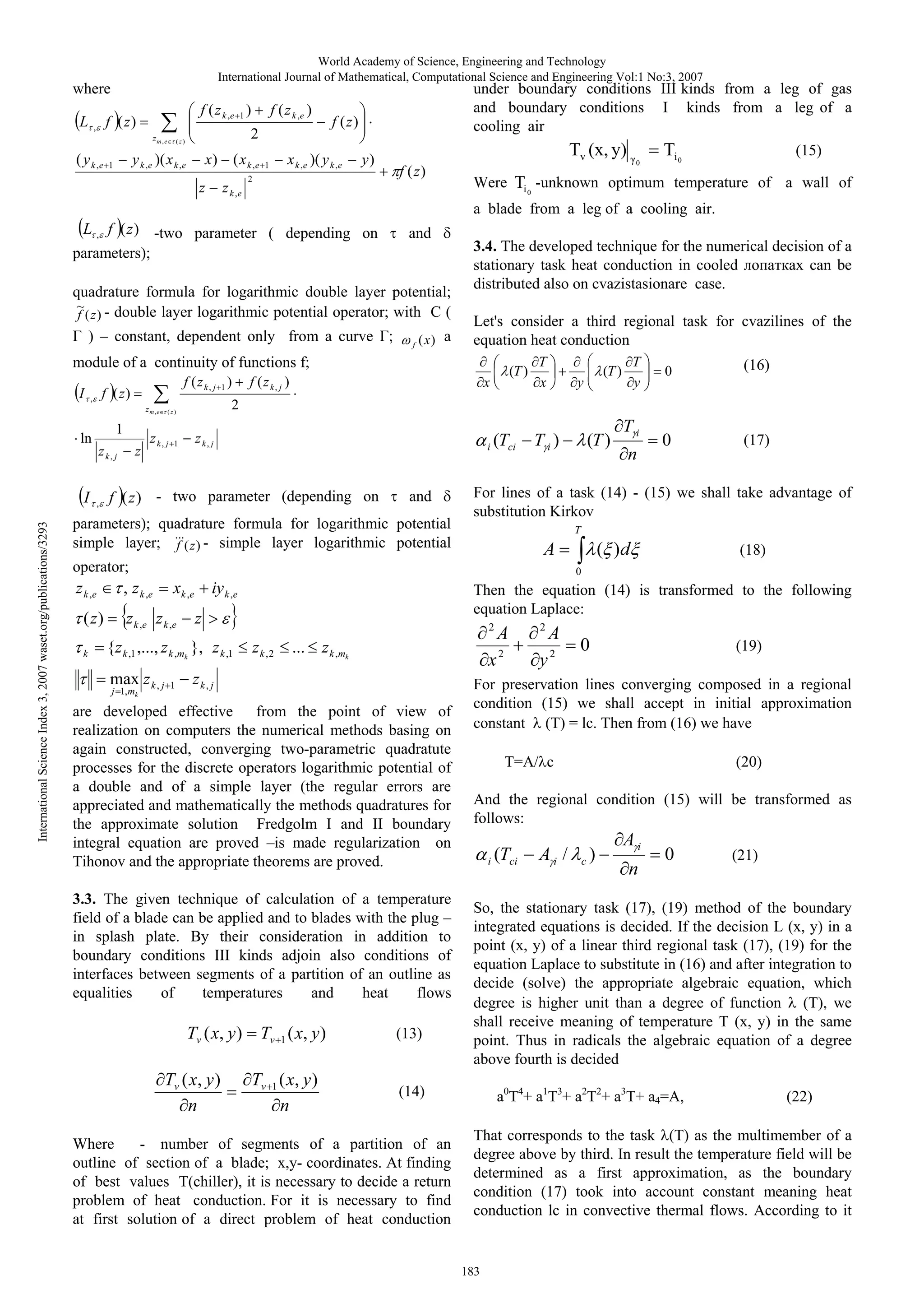
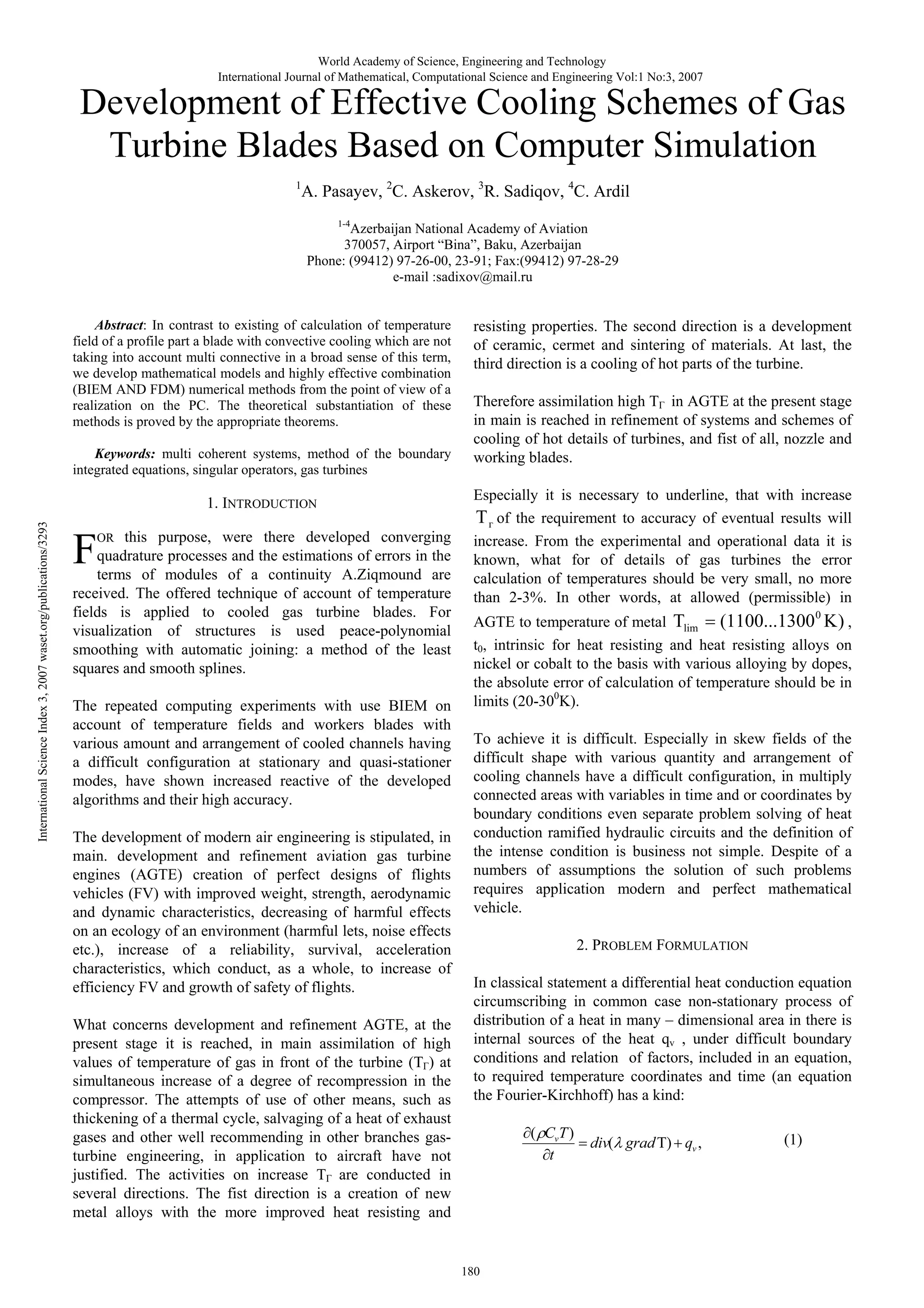
International Journal of Mathematical, Computational Science and Engineering Vol:1 No:3, 2007

Development of Effective Cooling Schemes of Gas
Turbine Blades Based on Computer Simulation
1

. Pasayev, 2C. Askerov, 3R. Sadiqov, 4C. Ardil
1-4

Azerbaijan National Academy of Aviation
370057, Airport “Bina”, Baku, Azerbaijan
Phone: (99412) 97-26-00, 23-91; Fax:(99412) 97-28-29
e-mail :sadixov@mail.ru

Abstract: In contrast to existing of calculation of temperature
field of a profile part a blade with convective cooling which are not
taking into account multi connective in a broad sense of this term,
we develop mathematical models and highly effective combination
(BIEM AND FDM) numerical methods from the point of view of a
realization on the PC. The theoretical substantiation of these
methods is proved by the appropriate theorems.
Keywords: multi coherent systems, method of the boundary
integrated equations, singular operators, gas turbines

International Science Index 3, 2007 waset.org/publications/3293

1. INTRODUCTION
OR this purpose, were there developed converging
quadrature processes and the estimations of errors in the
terms of modules of a continuity .Ziqmound are
received. The offered technique of account of temperature
fields is applied to cooled gas turbine blades. For
visualization of structures is used peace-polynomial
smoothing with automatic joining: a method of the least
squares and smooth splines.

F

The repeated computing experiments with use BIEM on
account of temperature fields and workers blades with
various amount and arrangement of cooled channels having
a difficult configuration at stationary and quasi-stationer
modes, have shown increased reactive of the developed
algorithms and their high accuracy.
The development of modern air engineering is stipulated, in
main. development and refinement aviation gas turbine
engines (AGTE) creation of perfect designs of flights
vehicles (FV) with improved weight, strength, aerodynamic
and dynamic characteristics, decreasing of harmful effects
on an ecology of an environment (harmful lets, noise effects
etc.), increase of a reliability, survival, acceleration
characteristics, which conduct, as a whole, to increase of
efficiency FV and growth of safety of flights.
What concerns development and refinement AGTE, at the
present stage it is reached, in main assimilation of high
values of temperature of gas in front of the turbine (T ) at
simultaneous increase of a degree of recompression in the
compressor. The attempts of use of other means, such as
thickening of a thermal cycle, salvaging of a heat of exhaust
gases and other well recommending in other branches gasturbine engineering, in application to aircraft have not
justified. The activities on increase T are conducted in
several directions. The fist direction is a creation of new
metal alloys with the more improved heat resisting and

resisting properties. The second direction is a development
of ceramic, cermet and sintering of materials. At last, the
third direction is a cooling of hot parts of the turbine.
Therefore assimilation high T in AGTE at the present stage
in main is reached in refinement of systems and schemes of
cooling of hot details of turbines, and fist of all, nozzle and
working blades.
Especially it is necessary to underline, that with increase
of the requirement to accuracy of eventual results will
increase. From the experimental and operational data it is
known, what for of details of gas turbines the error
calculation of temperatures should be very small, no more
than 2-3%. In other words, at allowed (permissible) in
0

AGTE to temperature of metal Tlim (1100...1300 K ) ,
t0, intrinsic for heat resisting and heat resisting alloys on
nickel or cobalt to the basis with various alloying by dopes,
the absolute error of calculation of temperature should be in
limits (20-300K).
To achieve it is difficult. Especially in skew fields of the
difficult shape with various quantity and arrangement of
cooling channels have a difficult configuration, in multiply
connected areas with variables in time and or coordinates by
boundary conditions even separate problem solving of heat
conduction ramified hydraulic circuits and the definition of
the intense condition is business not simple. Despite of a
numbers of assumptions the solution of such problems
requires application modern and perfect mathematical
vehicle.
2. PROBLEM FORMULATION
In classical statement a differential heat conduction equation
circumscribing in common case non-stationary process of
distribution of a heat in many – dimensional area in there is
internal sources of the heat qv , under difficult boundary
conditions and relation of factors, included in an equation,
to required temperature coordinates and time (an equation
the Fourier-Kirchhoff) has a kind:
( CvT )
t

180

div( grad T) qv ,

(1)
where , C v and

-

World Academy of Science, Engineering and Technology
International Journal of Mathematical, Computational Science and Engineering Vol:1 No:3, 2007
3. PROBLEM SOLUTION
accordingly material’s density, thermal

capacity heat conduction, q v - internal source or drain of
heat, and T- required temperature.
By results of researches is established [2], that the
temperature condition of a profile part of a blade with radial
cooling channels can with a sufficient degree of accuracy
determined, as two-dimensional. Besides if to suppose a
constancy of physical properties, absence of internal sources
(drains) heat the temperature field under fixed conditions
will depend only on the shape of a skew field and from
distribution of temperature on a boundaries skew field. In
this case equation (1) will look like:

As of today for the solution of this boundary value problem
(2)-(4) most broad distributions have received four
numerical methods – methods of final differences (MFD),
finite element method (FEM) , probabilistic method ( or
method Monte-Carlo) and method of boundary integral
equations (BIEM) (or it discrete analog a method of
boundary element (BEM). Let’s consider application BIEM
for the solution of a problem (2)-(4).
3.1. The function T=T(x,y) , continuous with the derivatives
up to the second order satisfying to an equation of the
Laplace in considered area , including it an outline
M

2

International Science Index 3, 2007 waset.org/publications/3293

T

2

T
x2

T
y2

i

0

(2)

Grin for a researched potential function T=T(x,y) is the
ratio;

For allocation from a set of the possible solutions it is
necessary to supplement one, circumscribing a particular
temperature field given a differential equation by conditions
of uniqueness. In practice of problem solving temperature
fields, connected to determination in elements of gas
turbines washed by a flow of high – enthalpy gas more often
set boundary conditions of the third kind describing heat
exchange between a skew field and an environment because
of a hypothesis of a Newton- of the Riemann. In that case
these boundary conditions will be recorded as follows:
0

(T0

T

T 0)

0

n

i

n

(T i

Ti )

(x, y)

k

1, M (temperature of the chiller),
where M- quantity of outlines; T 0 -- temperature on an
i

at i

temperature on an
channels);
a blade (at i

0

0 , (outside outline of blade); T i -i

at

i 1, M (outline of cooling

- heat transfer factor from gas to a surface of

0)

i-

heat transfer factor of environment

from a blade to a cooling air at ( i 1, M ); -- thermal
conductivity of a material of a blade; n-external normally
on an outline of researched area.

( nR k )
ds
n

1
2

T 01

k1

k

nR

n

]ds

(5)

n

nR k ds

(6)

0

k2

T0

T 02

k

i

Ti

...
2 Tk

kn

T 0m

(7)

0

where n-quantity of sites of a partition of an outside outline
of a blade
( i on i 0) on small sections
0

S0 ( Si at i

environment at i

outline

( nR)
n

[

With allowance for of entered boundary conditions (2)-(3),
after a collecting terms of terms and input of new factors the
ratio (6) can be presented as a linear algebraic equation,
computed for the point R:

(4)

Characterizes quantity of a heats assigned by a convection
of the chiller, which is transmitted by heat conduction of a
material of a blade to a surface of cooling channels; where
T0 – temperature of environment at i=0; Ti – temperature of

1
2

Where R – variable at an integration of a distance between a
point K(x,y) and “running” on an outline k- point; T temperature on an outline . The value of temperature in
some k t0 a point lying on the boundary, is received as
limiting at approach of a point K(x,y) to the boundary

(3)

Characterizes quantity of heat transmitted convection from
gas to unit of a surface of a blade and assigned by heat
conduction in a skew field of a blade:

Ti

is harmonic. A corollary of the integral formula

i 0

0) , m-quantity of sites of a partition of

outside outlines of all cooling channels
small sections

i

(i 1, M ) on

Si .

Shall remark, that by unknowns in an equation (7) except a
unknown quantity of a true value Tk in a point to are also
mean on sections of a partition of outlines S 0 and S i of
temperature T 01 , T

02

,..., T 0 m and T i1 , T i 2 ,..., T im (total

number n+ ).
From a ratio (7) we shall receive required temperature for
any point, using the formula (5)

181
World Academy of Science, Engineering and Technology
International Journal of Mathematical, Computational Science and Engineering Vol:1 No:3, 2007

T(x, y)
...

1
[ k1T 01
2
T
km im
k 0T 0
cp

k 2T 02 ...
k

i

(8)
i

Tcpi ]

2

( nR k )
ds
n

k1
S01

.

.

( ))

nR( s, )d

n

(12)

( s) nR 1ds)

(T

01

1

For an evaluation of the singular integral operators
which are included in the discrete operators of a
logarithmic potential simple and double layer (10) are
investigated, their connection is shown and the
evaluations in term of modules of a continuity
(evaluation such as assessments are obtained A.
Zigmound).Theorem (main).
Let
( x)

.
0m

nR k ds

m

S0m
0n

nR k ds

n

S01

01

k ii

S01

.

nR k ds ...

1

R(s, ) ((x(s) x( ))2 ( y(s) y( ))2)1/ 2

nR k ds

1

( nR k )
ds
n

S0m
k 0

01

.

kn

nR k ds ...

Sn

im

nR k ds

m

Si1

Sim
M
i

by a

i 0

great many of a discrete point and integrals which are
included in an equations as logarithmic potentials,
calculated approximately was made, being substituted the
following ratios:
( nR k )
S
n

( nR k )
ds
n

And let the equation (10) have the solution f* C (the set of
continuous functions on ).Then
={1,2…} such that
0
N>N0 the discrete system, obtained by using the discrete
double layer potential operator (its properties has been
(N)

studied), has unique solution {f jk }, k
*
| f jk

(N)
f jk |

( )(

(9)

L/2

(x)

i

dx
L/2

dx

f

*

(

f*

)

N

(x)

L

li ; li
i 0

(x)

dx ),

ds)

; {

sequence of partitions of

N

1

T(x, y)

nR ds

(11)

-smooth closed Jordan curve; M-quantity of
i
i 0

cooled channels;
i

Let

0, d

-density of a logarithmic potential uniformly

N

,,

N

)

p.

where d-diameter , and the splitting

2

2
C

Then for all
continuous on )
and z

,(z

(C

- space of all functions

x iy )

i 0

distributed on

M

i

si .

S

I

i 0

f ( z)

,

M

Thus curve

i

is

those, that is satisfied condition

p

M

1

satisfies the condition 2

N N 1 --the

}N 1 -- the sequence of

positive numbers such that the pair (

M

dx

x

i

3.2. In difference from [4] we offer to decide the given
boundary value problem (2)-(4) as follows. We suppose that
distribution of temperature T(x,y) we locate as follows:

where

1, m j ; j 1, n;

where C( ) is constant, depending only on

M

S

(x)

0

x

N

S i
(where

f*
N

i

(x)

x
L/2

(10)

f*

f*

x

0

i

nR k S

(x)

N

N

nR k ds

x

0

In activities [2] the discretization of an antline Ã
International Science Index 3, 2007 waset.org/publications/3293

( (s)

where

where

S i

1
2

( s)

knT 0n

positively are oriented and are given

f

C

i 0

in a parametric kind:
x=x(s), y=y(s), s [0, L]
Using BIEM and expression (9) problem (2)-(4) we shall put
to the following system of boundary integral equations:

L

,

ln

f ( z)

( )

2d

ln

f

~
f ( z)

f ( z)

2d

f
f

( )

x

0
d
l
f

182

( x)
dx
x

d
f

( x)

( x)

x2

dx

2

C

l

( x)

;

Z

dx
World Academy of Science, Engineering and Technology
International Journal of Mathematical, Computational Science and Engineering Vol:1 No:3, 2007

where
L

f ( z k ,e 1 )

f ( z)

,

zm,e

( y k ,e

x)
z

( x k ,e
z k ,e

1

under boundary conditions III kinds from a leg of gas
and boundary conditions I kinds from a leg of a
cooling air

f ( z)

2

(z)

y k ,e )( x k ,e

1

f ( z k ,e )

x k ,e )( y k ,e

y)

2

Tv (x, y)
f ( z)

0

Ti 0

(15)

Were Ti 0 -unknown optimum temperature of a wall of
a blade from a leg of a cooling air.

L , f ( z ) -two parameter ( depending on
parameters)

and

quadrature formula for logarithmic double layer potential
~ - double layer logarithmic potential operator with C (
f ( z)
) – constant, dependent only from a curve

f

(x ) a

3.4. The developed technique for the numerical decision of a
stationary task heat conduction in cooled
can be
distributed also on cvazistasionare case.
Let's consider a third regional task for cvazilines of the
equation heat conduction

module of a continuity of functions f;
I

f (zk, j 1 )

f ( z)

,

zm ,e

ln

International Science Index 3, 2007 waset.org/publications/3293

I

1
zk, j

,

z

x

T
x

zk, j

1

i

f ( z ) - two parameter (depending on

and

parameters) quadrature formula for logarithmic potential
simple layer; f (z ) - simple layer logarithmic potential

y

(Tci

Ti)

( z)
k

0

(16)

(T )

Ti
n

0

(17)

For lines of a task (14) - (15) we shall take advantage of
substitution Kirkov
T

A

operator

z k ,e

T
y

(T )

2

(z)

zk, j

f (zk, j )

(T )

( )d

(18)

0

, z k ,e

x k ,e

z k ,e z k ,e

iy k ,e
z

{z k ,1 ,..., z k ,mk }, z k ,1
max z k , j
j 1, mk

1

Then the equation (14) is transformed to the following
equation Laplace:
2

zk ,2

...

zk , j

are developed effective from the point of view of
realization on computers the numerical methods basing on
again constructed, converging two-parametric quadratute
processes for the discrete operators logarithmic potential of
a double and of a simple layer (the regular errors are
appreciated and mathematically the methods quadratures for
the approximate solution Fredgolm I and II boundary
integral equation are proved –is made regularization on
Tihonov and the appropriate theorems are proved.
3.3. The given technique of calculation of a temperature
field of a blade can be applied and to blades with the plug –
in splash plate. By their consideration in addition to
boundary conditions III kinds adjoin also conditions of
interfaces between segments of a partition of an outline as
equalities
of
temperatures
and
heat
flows

Tv ( x, y )
Tv ( x, y )
n

Tv 1 ( x, y )
Tv 1 ( x, y )
n

(13)

2

y2

A

0

(19)

For preservation lines converging composed in a regional
condition (15) we shall accept in initial approximation
constant (T) = lc. Then from (16) we have
T=A/ c

(20)

And the regional condition (15) will be transformed as
follows:
i

(Tci

Ai /

c

)

Ai
n

0

(21)

So, the stationary task (17), (19) method of the boundary
integrated equations is decided. If the decision L (x, y) in a
point (x, y) of a linear third regional task (17), (19) for the
equation Laplace to substitute in (16) and after integration to
decide (solve) the appropriate algebraic equation, which
degree is higher unit than a degree of function (T), we
shall receive meaning of temperature T (x, y) in the same
point. Thus in radicals the algebraic equation of a degree
above fourth is decided

(14)

Where
- number of segments of a partition of an
outline of section of a blade; x,y- coordinates. At finding
of best values T(chiller), it is necessary to decide a return
problem of heat conduction. For it is necessary to find
at first solution of a direct problem of heat conduction

2

x

z k , mk

A

a0T4+ a1T3+ a2T2+ a3T+ a4=A,

(22)

That corresponds to the task (T) as the multimember of a
degree above by third. In result the temperature field will be
determined as a first approximation, as the boundary
condition (17) took into account constant meaning heat
conduction lc in convective thermal flows. According to it

183
World Academy of Science, Engineering and Technology
International Journal of Mathematical, Computational Science and Engineering Vol:1 No:3, 2007
(1)
(1)

we shall designate this decision T (accordingly A ). For
definition subsequent and (2) (accordingly T(2)) the function
and A( ) is displayed in a number Taylor a vicinity T(1)
and the linear members are left in it only. In result is
received a third regional task for the equation Laplace
is
concerning function And A(2). Temperature T(2)
determined by the decision of the equation (18).

International Science Index 3, 2007 waset.org/publications/3293

3.5. The repeated computing experiments with use
BIEM on calculation of temperature fields nozzle and
working blades with various quantity and arrangement
of cooling channels have a difficult configuration have
shown, that for practical calculations in the approach,
offered us, the discretization of areas of an integration
can be conducted with rather smaller quantity of
discrete points. Thus the reactivity of the developed
algorithms and accuracy of evaluations is increased. The
accuracy of calculation of
temperatures, required
consumption of a cooling air, heat flows, losses from
cooling margins of safety etc. essentially depends on
reliability
of
boundary
conditions, included
in
calculation, of heat exchange.
3.6. It is considered piece-polynomial smoothing of
structures cooled gas-turbine blades with automatic
conjecture: the method of the least squares, device spline
and smooth is used.
3.6.1. Let equation of sites of a structure cooled blades is
polynomial of the third order.
y(x)=a0+a1x+a2x2+a3x3

(23)

The equation of measurements of target coordinate has a
kind:
Zy=a0+a1x+a2x2+a3x3+

y

(24)

where Zy= z1y, z2y, …, zny T– Vector of measurements of
target coordinate, n-quantity(n-amount) of points in a
examined interval. For an estimation polynomial factors
(23) the method of the least squares of the following kind is
used
=(XTX)-1(XTZy)

D =(XTX)-1

(25)

2

(26)

where
1 x1 x12 x13

X=

2
3
1 x2 x2 x2
2
3
1 x3 x3 x3

- Structural matrix;

............
2
3
1 xn xn xn

Estimations of factors for the first site is received under the
formula (25). Beginning with second, the components of a
vector pay off on experimental data from this site, but in
view of parameters found on the previous site. Thus, each
subsequent site of a structure we shall choose with blocking.
Thus it is expedient to use the following linear connections
between the appreciated parameters of the previous site
N 1

and required

N

N-

of a site:

A N=V,

(27)

3
1 xe xe2 x e
2

A= 0 1 2 x e 3 x e

,

(28)

0 0 2 6 xe
a0 N

1

a1N 1 xe

a 2 N 1 xe2

V= a1N

1

a 2 N 1 xe

3a 3 N 1 xe2

2a 2 N

1

3
a3 N 1 xe

,

(29)

6a 3 N 1 x e

e=(N-1)(n-L); L- Number points of blocking.
The expressions (27)-(29) describe communications, which
provide joining of sites of interpolation on function, first and
second with derivative.
Taking into account accuracy of measurements, the task of
definition of unknown factors of model in this case can be
formulated as a task on conditional: minimization of the
square-law form (Zy-X )T 2I(Zy- )under a limiting
condition (27). Here I - individual matrix. For the decision
of such tasks usually use a method of uncertain multipliers
Lagrange. In result we shall write down the following
expressions for estimation a vector of factors at presence of
linear connections (27):

~T
D~

=

T

D

+(VT-

T

AT)[A(XTX)-1AT]-1A(XTX)-1

(XTX)-1AT[A(XTX)-1AT]-1A(XTX)-1

(30)
2

(31)

Substituting matrixes A,
and vectors Zy and V in
expressions (25), (26), (30) and (31), we receive an
estimation of a vector of factors for a site of a structure
cooled
with number N, and also
a
matrix of mistakes of estimations.
As a result of consecutive application of the described
procedure and use of experimental data we shall receive
peace-polynomial interpolation of a researched site with
automatic
.On the basis of the carried out
experimental researches is shown, that optimum overlapping
in most cases is the 50%-s' overlapping.

D -dispersion a matrix of mistakes;
= a0, a1, a2, a3

T

- Vector of estimated factors.

3.6.2. Besides peace-polynomial regression exist which
represent polynomial (low odd degrees - third, fifth),
continuity, subordinated to a condition, of function and
derivative (first and second in case of cubic spinal in

184
World Academy of Science, Engineering and Technology
International Journal of Mathematical, Computational Science and Engineering Vol:1 No:3, 2007

general(common) points of the next sites. If the equation of
a structure cooled gas-turbine blades is described cubic
spinal submitted in obvious polynomial a kind (23), the
factors 0, 1, 2, 3 determining j- spinal, i.e. line
connecting the points Zj=(xj, yj) and Zj+1=(xj+1, yj+1),
calculate as follows:
a0

zj;

a1

z 'j ;

a2

''
j

z /2

3( z j

a3

z 'j'' / 6

2( z j

(32)
z j )h

1

International Science Index 3, 2007 waset.org/publications/3293

2
j 1

z j 1 )h j 31

hj+1= zj+1-zj , j= 1, N

'
j

2z h

1
j 1

z 'j h j 21

z

'
j 1

a2
a3

(z j

h ;

z 'j 1 h j 21 ;

1

z j )h j 11 ;

1

(( z j
(( z j

2

2

[1] Pashaev A.M., Sadykhov R.A., Iskenderov M.G., Samedov A.S.,
Sadykhov A.H. (1997). The effeciency of potential theory method for
solving of the tasks of aircraft and rocket design. 10-th National Mechanic
Conference. Istanbul Technical University, Aeronautics and astronautics
faculty, Istanbul, Turkey, July, p.61-62. 1997.
[2] R.A. Sadigov, A.S. Samedov, (1998). Modelling of temperature fields
of elements of base turbines, scientists of a slip zTU, Baku, Vol.VI,
5,
p.234-239.
[3] Pashaev A.M., Sadykhov R.A., Samedov A.S. (1999). Highly effective
methods of calculation temperature fields of blades of gas turbines. V
International Symposium an Aeronautical Sciences “New Aviation
Technologies of the XXI century”, A collection of technical papers, section
N3, Zhukovsky, Russia, August 1999.
[4] L.N. Zisina-Mologen and etc., (1974). Heat Exchange in turbineengines. M.,
[5] G. Galicheiskiy, (1996). A thermal guard of blades, .:
I, 1996.
[6] A.M.Pashaev, R.A.Sadiqov, C.M.Hajiev, (2002). The BEM Application
in development of Effective Cooling Schemes of Gas Turbine Blades. 6th
Bienial Conference on Engineering Systems Design and Analysis, Istanbul,
Turkey, July, 8-11.

(33)

z j 1 )h j
z j 1 )h j

REFERENCES

1
j 1

3.6.3. Let's consider other way smooth
of a
structure cooled gas-turbine blades on the precisely
measured meaning of coordinates in final system of discrete
points distinct from method of spinal-function and also
effective from the point of view of realization on computers.
Let equation of sites of a structure cooled blades is
described by the multimember of the third order of a type
(23), then by taking advantage a method smooth supply (the
conditions smooth of function are carried out and first by
derivative) we shall define its factors
a0 z j ;

a1

calculated in tens interest. Therefore, the application of
perfect methods of calculation of temperature fields of
elements of gas turbines is one from actual problems of an
air engine building. The efficiency of these methods in the
total rends directs influence to operational manufacturability
and reliability of elements of designs, and also on
acceleration characteristics of the engine.

1
2

1
2

(z j
(z j

1

1

z j )h
z j )h

1
j 1

1
j 1

1
j 1

)h ;

)h j 21 ;

j= 1, N 1 S , S=1.
If it’s required to perform a condition of function smooth
first and second derivative, i.e. appropriate smooth of cubic
splines, we shall deal with the multimember of the fifth
degree (degree of the multimember is equal 2S + 1, i.e. S =
2).
The advantage of such approach (smooth supply) consists
that it is not necessary to decide system of the linear
algebraic equations, as in case of application spinal, though
the degree of the multimember is higher on 2.
4. CONCLUSIONS
In view of extreme complexity of appearances determining
regularities of heat exchange, value

0

with an adequate

accuracy purely theoretically to calcite usually it fails.
Therefore practically they prefer to determine from an
experimental data generalized because of the theory of a
similarity. As per the last years there were activities,
permitting to take into account influence to heat exchange of
an initial degree of a turbulence, angle of attack, mass forces
and radiation of gas, compressibility and acceleration of a
flow, temperature non-stationary at increase and drop of a
load etc.[5]. Between that, the recommendations, being
available in the literature, at the best allow to determine
cooling of an air i
factors
0 with accuracy +15%
with accuracy + 10%. The latter does not mean, certainly,
that the errors in definition of temperature of details also are

185

Development of-effective-cooling-schemes-of-gas-turbine-blades-based-on-computer-simulation

  • 1.
    World Academy ofScience, Engineering and Technology International Journal of Mathematical, Computational Science and Engineering Vol:1 No:3, 2007 Development of Effective Cooling Schemes of Gas Turbine Blades Based on Computer Simulation 1 . Pasayev, 2C. Askerov, 3R. Sadiqov, 4C. Ardil 1-4 Azerbaijan National Academy of Aviation 370057, Airport “Bina”, Baku, Azerbaijan Phone: (99412) 97-26-00, 23-91; Fax:(99412) 97-28-29 e-mail :sadixov@mail.ru Abstract: In contrast to existing of calculation of temperature field of a profile part a blade with convective cooling which are not taking into account multi connective in a broad sense of this term, we develop mathematical models and highly effective combination (BIEM AND FDM) numerical methods from the point of view of a realization on the PC. The theoretical substantiation of these methods is proved by the appropriate theorems. Keywords: multi coherent systems, method of the boundary integrated equations, singular operators, gas turbines International Science Index 3, 2007 waset.org/publications/3293 1. INTRODUCTION OR this purpose, were there developed converging quadrature processes and the estimations of errors in the terms of modules of a continuity .Ziqmound are received. The offered technique of account of temperature fields is applied to cooled gas turbine blades. For visualization of structures is used peace-polynomial smoothing with automatic joining: a method of the least squares and smooth splines. F The repeated computing experiments with use BIEM on account of temperature fields and workers blades with various amount and arrangement of cooled channels having a difficult configuration at stationary and quasi-stationer modes, have shown increased reactive of the developed algorithms and their high accuracy. The development of modern air engineering is stipulated, in main. development and refinement aviation gas turbine engines (AGTE) creation of perfect designs of flights vehicles (FV) with improved weight, strength, aerodynamic and dynamic characteristics, decreasing of harmful effects on an ecology of an environment (harmful lets, noise effects etc.), increase of a reliability, survival, acceleration characteristics, which conduct, as a whole, to increase of efficiency FV and growth of safety of flights. What concerns development and refinement AGTE, at the present stage it is reached, in main assimilation of high values of temperature of gas in front of the turbine (T ) at simultaneous increase of a degree of recompression in the compressor. The attempts of use of other means, such as thickening of a thermal cycle, salvaging of a heat of exhaust gases and other well recommending in other branches gasturbine engineering, in application to aircraft have not justified. The activities on increase T are conducted in several directions. The fist direction is a creation of new metal alloys with the more improved heat resisting and resisting properties. The second direction is a development of ceramic, cermet and sintering of materials. At last, the third direction is a cooling of hot parts of the turbine. Therefore assimilation high T in AGTE at the present stage in main is reached in refinement of systems and schemes of cooling of hot details of turbines, and fist of all, nozzle and working blades. Especially it is necessary to underline, that with increase of the requirement to accuracy of eventual results will increase. From the experimental and operational data it is known, what for of details of gas turbines the error calculation of temperatures should be very small, no more than 2-3%. In other words, at allowed (permissible) in 0 AGTE to temperature of metal Tlim (1100...1300 K ) , t0, intrinsic for heat resisting and heat resisting alloys on nickel or cobalt to the basis with various alloying by dopes, the absolute error of calculation of temperature should be in limits (20-300K). To achieve it is difficult. Especially in skew fields of the difficult shape with various quantity and arrangement of cooling channels have a difficult configuration, in multiply connected areas with variables in time and or coordinates by boundary conditions even separate problem solving of heat conduction ramified hydraulic circuits and the definition of the intense condition is business not simple. Despite of a numbers of assumptions the solution of such problems requires application modern and perfect mathematical vehicle. 2. PROBLEM FORMULATION In classical statement a differential heat conduction equation circumscribing in common case non-stationary process of distribution of a heat in many – dimensional area in there is internal sources of the heat qv , under difficult boundary conditions and relation of factors, included in an equation, to required temperature coordinates and time (an equation the Fourier-Kirchhoff) has a kind: ( CvT ) t 180 div( grad T) qv , (1)
  • 2.
    where , Cv and - World Academy of Science, Engineering and Technology International Journal of Mathematical, Computational Science and Engineering Vol:1 No:3, 2007 3. PROBLEM SOLUTION accordingly material’s density, thermal capacity heat conduction, q v - internal source or drain of heat, and T- required temperature. By results of researches is established [2], that the temperature condition of a profile part of a blade with radial cooling channels can with a sufficient degree of accuracy determined, as two-dimensional. Besides if to suppose a constancy of physical properties, absence of internal sources (drains) heat the temperature field under fixed conditions will depend only on the shape of a skew field and from distribution of temperature on a boundaries skew field. In this case equation (1) will look like: As of today for the solution of this boundary value problem (2)-(4) most broad distributions have received four numerical methods – methods of final differences (MFD), finite element method (FEM) , probabilistic method ( or method Monte-Carlo) and method of boundary integral equations (BIEM) (or it discrete analog a method of boundary element (BEM). Let’s consider application BIEM for the solution of a problem (2)-(4). 3.1. The function T=T(x,y) , continuous with the derivatives up to the second order satisfying to an equation of the Laplace in considered area , including it an outline M 2 International Science Index 3, 2007 waset.org/publications/3293 T 2 T x2 T y2 i 0 (2) Grin for a researched potential function T=T(x,y) is the ratio; For allocation from a set of the possible solutions it is necessary to supplement one, circumscribing a particular temperature field given a differential equation by conditions of uniqueness. In practice of problem solving temperature fields, connected to determination in elements of gas turbines washed by a flow of high – enthalpy gas more often set boundary conditions of the third kind describing heat exchange between a skew field and an environment because of a hypothesis of a Newton- of the Riemann. In that case these boundary conditions will be recorded as follows: 0 (T0 T T 0) 0 n i n (T i Ti ) (x, y) k 1, M (temperature of the chiller), where M- quantity of outlines; T 0 -- temperature on an i at i temperature on an channels); a blade (at i 0 0 , (outside outline of blade); T i -i at i 1, M (outline of cooling - heat transfer factor from gas to a surface of 0) i- heat transfer factor of environment from a blade to a cooling air at ( i 1, M ); -- thermal conductivity of a material of a blade; n-external normally on an outline of researched area. ( nR k ) ds n 1 2 T 01 k1 k nR n ]ds (5) n nR k ds (6) 0 k2 T0 T 02 k i Ti ... 2 Tk kn T 0m (7) 0 where n-quantity of sites of a partition of an outside outline of a blade ( i on i 0) on small sections 0 S0 ( Si at i environment at i outline ( nR) n [ With allowance for of entered boundary conditions (2)-(3), after a collecting terms of terms and input of new factors the ratio (6) can be presented as a linear algebraic equation, computed for the point R: (4) Characterizes quantity of a heats assigned by a convection of the chiller, which is transmitted by heat conduction of a material of a blade to a surface of cooling channels; where T0 – temperature of environment at i=0; Ti – temperature of 1 2 Where R – variable at an integration of a distance between a point K(x,y) and “running” on an outline k- point; T temperature on an outline . The value of temperature in some k t0 a point lying on the boundary, is received as limiting at approach of a point K(x,y) to the boundary (3) Characterizes quantity of heat transmitted convection from gas to unit of a surface of a blade and assigned by heat conduction in a skew field of a blade: Ti is harmonic. A corollary of the integral formula i 0 0) , m-quantity of sites of a partition of outside outlines of all cooling channels small sections i (i 1, M ) on Si . Shall remark, that by unknowns in an equation (7) except a unknown quantity of a true value Tk in a point to are also mean on sections of a partition of outlines S 0 and S i of temperature T 01 , T 02 ,..., T 0 m and T i1 , T i 2 ,..., T im (total number n+ ). From a ratio (7) we shall receive required temperature for any point, using the formula (5) 181
  • 3.
    World Academy ofScience, Engineering and Technology International Journal of Mathematical, Computational Science and Engineering Vol:1 No:3, 2007 T(x, y) ... 1 [ k1T 01 2 T km im k 0T 0 cp k 2T 02 ... k i (8) i Tcpi ] 2 ( nR k ) ds n k1 S01 . . ( )) nR( s, )d n (12) ( s) nR 1ds) (T 01 1 For an evaluation of the singular integral operators which are included in the discrete operators of a logarithmic potential simple and double layer (10) are investigated, their connection is shown and the evaluations in term of modules of a continuity (evaluation such as assessments are obtained A. Zigmound).Theorem (main). Let ( x) . 0m nR k ds m S0m 0n nR k ds n S01 01 k ii S01 . nR k ds ... 1 R(s, ) ((x(s) x( ))2 ( y(s) y( ))2)1/ 2 nR k ds 1 ( nR k ) ds n S0m k 0 01 . kn nR k ds ... Sn im nR k ds m Si1 Sim M i by a i 0 great many of a discrete point and integrals which are included in an equations as logarithmic potentials, calculated approximately was made, being substituted the following ratios: ( nR k ) S n ( nR k ) ds n And let the equation (10) have the solution f* C (the set of continuous functions on ).Then ={1,2…} such that 0 N>N0 the discrete system, obtained by using the discrete double layer potential operator (its properties has been (N) studied), has unique solution {f jk }, k * | f jk (N) f jk | ( )( (9) L/2 (x) i dx L/2 dx f * ( f* ) N (x) L li ; li i 0 (x) dx ), ds) ; { sequence of partitions of N 1 T(x, y) nR ds (11) -smooth closed Jordan curve; M-quantity of i i 0 cooled channels; i Let 0, d -density of a logarithmic potential uniformly N ,, N ) p. where d-diameter , and the splitting 2 2 C Then for all continuous on ) and z ,(z (C - space of all functions x iy ) i 0 distributed on M i si . S I i 0 f ( z) , M Thus curve i is those, that is satisfied condition p M 1 satisfies the condition 2 N N 1 --the }N 1 -- the sequence of positive numbers such that the pair ( M dx x i 3.2. In difference from [4] we offer to decide the given boundary value problem (2)-(4) as follows. We suppose that distribution of temperature T(x,y) we locate as follows: where 1, m j ; j 1, n; where C( ) is constant, depending only on M S (x) 0 x N S i (where f* N i (x) x L/2 (10) f* f* x 0 i nR k S (x) N N nR k ds x 0 In activities [2] the discretization of an antline à International Science Index 3, 2007 waset.org/publications/3293 ( (s) where where S i 1 2 ( s) knT 0n positively are oriented and are given f C i 0 in a parametric kind: x=x(s), y=y(s), s [0, L] Using BIEM and expression (9) problem (2)-(4) we shall put to the following system of boundary integral equations: L , ln f ( z) ( ) 2d ln f ~ f ( z) f ( z) 2d f f ( ) x 0 d l f 182 ( x) dx x d f ( x) ( x) x2 dx 2 C l ( x) ; Z dx
  • 4.
    World Academy ofScience, Engineering and Technology International Journal of Mathematical, Computational Science and Engineering Vol:1 No:3, 2007 where L f ( z k ,e 1 ) f ( z) , zm,e ( y k ,e x) z ( x k ,e z k ,e 1 under boundary conditions III kinds from a leg of gas and boundary conditions I kinds from a leg of a cooling air f ( z) 2 (z) y k ,e )( x k ,e 1 f ( z k ,e ) x k ,e )( y k ,e y) 2 Tv (x, y) f ( z) 0 Ti 0 (15) Were Ti 0 -unknown optimum temperature of a wall of a blade from a leg of a cooling air. L , f ( z ) -two parameter ( depending on parameters) and quadrature formula for logarithmic double layer potential ~ - double layer logarithmic potential operator with C ( f ( z) ) – constant, dependent only from a curve f (x ) a 3.4. The developed technique for the numerical decision of a stationary task heat conduction in cooled can be distributed also on cvazistasionare case. Let's consider a third regional task for cvazilines of the equation heat conduction module of a continuity of functions f; I f (zk, j 1 ) f ( z) , zm ,e ln International Science Index 3, 2007 waset.org/publications/3293 I 1 zk, j , z x T x zk, j 1 i f ( z ) - two parameter (depending on and parameters) quadrature formula for logarithmic potential simple layer; f (z ) - simple layer logarithmic potential y (Tci Ti) ( z) k 0 (16) (T ) Ti n 0 (17) For lines of a task (14) - (15) we shall take advantage of substitution Kirkov T A operator z k ,e T y (T ) 2 (z) zk, j f (zk, j ) (T ) ( )d (18) 0 , z k ,e x k ,e z k ,e z k ,e iy k ,e z {z k ,1 ,..., z k ,mk }, z k ,1 max z k , j j 1, mk 1 Then the equation (14) is transformed to the following equation Laplace: 2 zk ,2 ... zk , j are developed effective from the point of view of realization on computers the numerical methods basing on again constructed, converging two-parametric quadratute processes for the discrete operators logarithmic potential of a double and of a simple layer (the regular errors are appreciated and mathematically the methods quadratures for the approximate solution Fredgolm I and II boundary integral equation are proved –is made regularization on Tihonov and the appropriate theorems are proved. 3.3. The given technique of calculation of a temperature field of a blade can be applied and to blades with the plug – in splash plate. By their consideration in addition to boundary conditions III kinds adjoin also conditions of interfaces between segments of a partition of an outline as equalities of temperatures and heat flows Tv ( x, y ) Tv ( x, y ) n Tv 1 ( x, y ) Tv 1 ( x, y ) n (13) 2 y2 A 0 (19) For preservation lines converging composed in a regional condition (15) we shall accept in initial approximation constant (T) = lc. Then from (16) we have T=A/ c (20) And the regional condition (15) will be transformed as follows: i (Tci Ai / c ) Ai n 0 (21) So, the stationary task (17), (19) method of the boundary integrated equations is decided. If the decision L (x, y) in a point (x, y) of a linear third regional task (17), (19) for the equation Laplace to substitute in (16) and after integration to decide (solve) the appropriate algebraic equation, which degree is higher unit than a degree of function (T), we shall receive meaning of temperature T (x, y) in the same point. Thus in radicals the algebraic equation of a degree above fourth is decided (14) Where - number of segments of a partition of an outline of section of a blade; x,y- coordinates. At finding of best values T(chiller), it is necessary to decide a return problem of heat conduction. For it is necessary to find at first solution of a direct problem of heat conduction 2 x z k , mk A a0T4+ a1T3+ a2T2+ a3T+ a4=A, (22) That corresponds to the task (T) as the multimember of a degree above by third. In result the temperature field will be determined as a first approximation, as the boundary condition (17) took into account constant meaning heat conduction lc in convective thermal flows. According to it 183
  • 5.
    World Academy ofScience, Engineering and Technology International Journal of Mathematical, Computational Science and Engineering Vol:1 No:3, 2007 (1) (1) we shall designate this decision T (accordingly A ). For definition subsequent and (2) (accordingly T(2)) the function and A( ) is displayed in a number Taylor a vicinity T(1) and the linear members are left in it only. In result is received a third regional task for the equation Laplace is concerning function And A(2). Temperature T(2) determined by the decision of the equation (18). International Science Index 3, 2007 waset.org/publications/3293 3.5. The repeated computing experiments with use BIEM on calculation of temperature fields nozzle and working blades with various quantity and arrangement of cooling channels have a difficult configuration have shown, that for practical calculations in the approach, offered us, the discretization of areas of an integration can be conducted with rather smaller quantity of discrete points. Thus the reactivity of the developed algorithms and accuracy of evaluations is increased. The accuracy of calculation of temperatures, required consumption of a cooling air, heat flows, losses from cooling margins of safety etc. essentially depends on reliability of boundary conditions, included in calculation, of heat exchange. 3.6. It is considered piece-polynomial smoothing of structures cooled gas-turbine blades with automatic conjecture: the method of the least squares, device spline and smooth is used. 3.6.1. Let equation of sites of a structure cooled blades is polynomial of the third order. y(x)=a0+a1x+a2x2+a3x3 (23) The equation of measurements of target coordinate has a kind: Zy=a0+a1x+a2x2+a3x3+ y (24) where Zy= z1y, z2y, …, zny T– Vector of measurements of target coordinate, n-quantity(n-amount) of points in a examined interval. For an estimation polynomial factors (23) the method of the least squares of the following kind is used =(XTX)-1(XTZy) D =(XTX)-1 (25) 2 (26) where 1 x1 x12 x13 X= 2 3 1 x2 x2 x2 2 3 1 x3 x3 x3 - Structural matrix; ............ 2 3 1 xn xn xn Estimations of factors for the first site is received under the formula (25). Beginning with second, the components of a vector pay off on experimental data from this site, but in view of parameters found on the previous site. Thus, each subsequent site of a structure we shall choose with blocking. Thus it is expedient to use the following linear connections between the appreciated parameters of the previous site N 1 and required N N- of a site: A N=V, (27) 3 1 xe xe2 x e 2 A= 0 1 2 x e 3 x e , (28) 0 0 2 6 xe a0 N 1 a1N 1 xe a 2 N 1 xe2 V= a1N 1 a 2 N 1 xe 3a 3 N 1 xe2 2a 2 N 1 3 a3 N 1 xe , (29) 6a 3 N 1 x e e=(N-1)(n-L); L- Number points of blocking. The expressions (27)-(29) describe communications, which provide joining of sites of interpolation on function, first and second with derivative. Taking into account accuracy of measurements, the task of definition of unknown factors of model in this case can be formulated as a task on conditional: minimization of the square-law form (Zy-X )T 2I(Zy- )under a limiting condition (27). Here I - individual matrix. For the decision of such tasks usually use a method of uncertain multipliers Lagrange. In result we shall write down the following expressions for estimation a vector of factors at presence of linear connections (27): ~T D~ = T D +(VT- T AT)[A(XTX)-1AT]-1A(XTX)-1 (XTX)-1AT[A(XTX)-1AT]-1A(XTX)-1 (30) 2 (31) Substituting matrixes A, and vectors Zy and V in expressions (25), (26), (30) and (31), we receive an estimation of a vector of factors for a site of a structure cooled with number N, and also a matrix of mistakes of estimations. As a result of consecutive application of the described procedure and use of experimental data we shall receive peace-polynomial interpolation of a researched site with automatic .On the basis of the carried out experimental researches is shown, that optimum overlapping in most cases is the 50%-s' overlapping. D -dispersion a matrix of mistakes; = a0, a1, a2, a3 T - Vector of estimated factors. 3.6.2. Besides peace-polynomial regression exist which represent polynomial (low odd degrees - third, fifth), continuity, subordinated to a condition, of function and derivative (first and second in case of cubic spinal in 184
  • 6.
    World Academy ofScience, Engineering and Technology International Journal of Mathematical, Computational Science and Engineering Vol:1 No:3, 2007 general(common) points of the next sites. If the equation of a structure cooled gas-turbine blades is described cubic spinal submitted in obvious polynomial a kind (23), the factors 0, 1, 2, 3 determining j- spinal, i.e. line connecting the points Zj=(xj, yj) and Zj+1=(xj+1, yj+1), calculate as follows: a0 zj; a1 z 'j ; a2 '' j z /2 3( z j a3 z 'j'' / 6 2( z j (32) z j )h 1 International Science Index 3, 2007 waset.org/publications/3293 2 j 1 z j 1 )h j 31 hj+1= zj+1-zj , j= 1, N ' j 2z h 1 j 1 z 'j h j 21 z ' j 1 a2 a3 (z j h ; z 'j 1 h j 21 ; 1 z j )h j 11 ; 1 (( z j (( z j 2 2 [1] Pashaev A.M., Sadykhov R.A., Iskenderov M.G., Samedov A.S., Sadykhov A.H. (1997). The effeciency of potential theory method for solving of the tasks of aircraft and rocket design. 10-th National Mechanic Conference. Istanbul Technical University, Aeronautics and astronautics faculty, Istanbul, Turkey, July, p.61-62. 1997. [2] R.A. Sadigov, A.S. Samedov, (1998). Modelling of temperature fields of elements of base turbines, scientists of a slip zTU, Baku, Vol.VI, 5, p.234-239. [3] Pashaev A.M., Sadykhov R.A., Samedov A.S. (1999). Highly effective methods of calculation temperature fields of blades of gas turbines. V International Symposium an Aeronautical Sciences “New Aviation Technologies of the XXI century”, A collection of technical papers, section N3, Zhukovsky, Russia, August 1999. [4] L.N. Zisina-Mologen and etc., (1974). Heat Exchange in turbineengines. M., [5] G. Galicheiskiy, (1996). A thermal guard of blades, .: I, 1996. [6] A.M.Pashaev, R.A.Sadiqov, C.M.Hajiev, (2002). The BEM Application in development of Effective Cooling Schemes of Gas Turbine Blades. 6th Bienial Conference on Engineering Systems Design and Analysis, Istanbul, Turkey, July, 8-11. (33) z j 1 )h j z j 1 )h j REFERENCES 1 j 1 3.6.3. Let's consider other way smooth of a structure cooled gas-turbine blades on the precisely measured meaning of coordinates in final system of discrete points distinct from method of spinal-function and also effective from the point of view of realization on computers. Let equation of sites of a structure cooled blades is described by the multimember of the third order of a type (23), then by taking advantage a method smooth supply (the conditions smooth of function are carried out and first by derivative) we shall define its factors a0 z j ; a1 calculated in tens interest. Therefore, the application of perfect methods of calculation of temperature fields of elements of gas turbines is one from actual problems of an air engine building. The efficiency of these methods in the total rends directs influence to operational manufacturability and reliability of elements of designs, and also on acceleration characteristics of the engine. 1 2 1 2 (z j (z j 1 1 z j )h z j )h 1 j 1 1 j 1 1 j 1 )h ; )h j 21 ; j= 1, N 1 S , S=1. If it’s required to perform a condition of function smooth first and second derivative, i.e. appropriate smooth of cubic splines, we shall deal with the multimember of the fifth degree (degree of the multimember is equal 2S + 1, i.e. S = 2). The advantage of such approach (smooth supply) consists that it is not necessary to decide system of the linear algebraic equations, as in case of application spinal, though the degree of the multimember is higher on 2. 4. CONCLUSIONS In view of extreme complexity of appearances determining regularities of heat exchange, value 0 with an adequate accuracy purely theoretically to calcite usually it fails. Therefore practically they prefer to determine from an experimental data generalized because of the theory of a similarity. As per the last years there were activities, permitting to take into account influence to heat exchange of an initial degree of a turbulence, angle of attack, mass forces and radiation of gas, compressibility and acceleration of a flow, temperature non-stationary at increase and drop of a load etc.[5]. Between that, the recommendations, being available in the literature, at the best allow to determine cooling of an air i factors 0 with accuracy +15% with accuracy + 10%. The latter does not mean, certainly, that the errors in definition of temperature of details also are 185