Self-Development
- is a process of discovering
oneself by realizing one's
potentials and capabilities that are
shaped over time either by
studying in a formal school or
through environmental factors.
““Knowing yourself is
the beginning of all
wisdom.” —
Aristotle
Here’s how this applies to us and self-
improvement:
We all think we know ourselves. But in
reality, we are different in front of
people. We wear a mask depending on
who we are interacting with and based
on how we want to be perceived in that
situation.
But if you want to truly live the life of
your dreams, it starts knowing yourself.
So, let’s put this into action:
Start by looking in the mirror and asking
yourself who you really are. If you cannot
be true to yourself you cannot be true to
anyone else.
Start being more authentic. This will take
time. It’s like building a muscle, the more
you practice the better you get.
Self-concept
- refers to your awareness of
yourself.
-is ones abstract and general idea
about him/herself particularly
toward his/her unique personality
and his/her own perception about
his/her set of values, point of views
and behavior.
Person’s existence depends on
his/her perception- Rene
Descartes, the Father of Modern
Philosophy
This means that it is in the mind
that we know everything about
ourselves like our identity, passion,
interest, feelings, and/or intellect,
thus everything that we are comes
from the mind.
THREE ASPECTS IN SELF-
CONCEPT THEORY- Sincero
Self-concept is learned.
. A person will soon develop this as
he/she grows old. This means that self-
concept can only be acquired as soon as
the person learns how to mingle with
others and so this indicates that self-
concept is influenced by the person’s
environment and can be a product of the
person’s socialization.
Self-concept is organized. This
stresses out that one’s perception
towards himself/herself is firm. This
means that a person may hear other
people’s point of view regarding
himself/herself but will keep on
believing that what he/she thinks of
himself/herself is always the right one.
Change on one’s perceptions towards
himself/herself, however, may also be
possible but it takes time.
Self-concept is dynamic.
As an individual grows older, he/she
continues to encounter problems or
challenges that may reveal his/her self-
concept in that particular time or
situation. A person will respond to the
scenario based on his/her own insights
and how he/she perceives
himself/herself in the situation. Thus,
self-concept undergoes development as
the person goes through different
experiences.
Psychology
Sigmund Freud
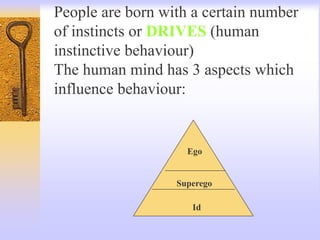
People are born with a certain number
of instincts or DRIVES (human
instinctive behaviour)
The human mind has 3 aspects which
influence behaviour:
Ego
Superego
Id
ID- unconconscious part of the mind
(this part of the mind seeks to bring us pleasure)
-primitive parts of our personality including
aggression and sexual drives
EGO-conscious part of the mind (Rational Self). Decides
what action to take for positive means and what to do based on
what is believed is the right thing to do. Aware of reality.
SUPEREGO- unconscious part of the mind that
acts as our conscience. Reminds us of what we should do.
The ID and the SUPEREGO are in constant conflict. Your
DRIVE tells you to do one thing , while SOCIETY tells you
to do something else.
Self-concept is our individual perceptions
of our behavior, abilities, and unique
characteristics—a mental picture of who
you are as a person. Self-concept
(1) is unique to the individual;
(2) can be positive or negative;
(3) has emotional, Intellectual, and
functional dimensions;
(4) changes with the environmental
context;
(5) changes over time; and
(6) has a powerful influence on one’s life
Two broad categories of self concept
Actual self- is the one that you
actually see. It is the self that has
characteristics that you were nurtured
or, in some cases, born to have.
- how you see yourself. Each
individual’s self-image is a mixture
of different attributes including our
physical
- characteristics, personality traits, and
social roles. Self-image doesn't
necessarily coincide with reality
- The actual self is built on self-
knowledge.
- Self-knowledge is derived from social
interactions that provide insight into
how others react to you. The actual
self is who we actually are. It is how
we think, how we feel, look, and act.
IDEAL SELF
is the self that you aspire to be. It is
the one that you hope will possess
characteristics similar to that of a mentor
or some other worldly figure
According to Carl Rogers, the degree
to which a person's self-concept
matches up to reality is known as
congruence and incongruence. A
person’s ideal self may not be
consistent with what actually happens
in the life and experiences of the
person. Hence, a difference may exist
between a person’s ideal self and actual
experience. This is called
incongruence.
Self-esteem, or how much you value
yourself. A number of factors can
impact self-esteem, including how
we compare ourselves to others and
how others respond to us. When
people respond positively to our
behavior, we are more likely to
develop positive self-esteem. When
we compare ourselves to others and
find ourselves lacking, it can have a
negative impact on our self-esteem.
Why is self-concept important?
Knowing who you are will help you
feel that you have worth and value in
this world. When you can accept
yourself for who you are, it will be
easier for others to accept you, too.
Learning about yourself can help you
develop lasting relationships with others
as well as help you make choices that
will direct your life in the path you want
The Benefits of Self-Concept
Happiness. You will be happier
when you can express who you are.
Expressing your desires will make it
more likely that you get what you
want.
Less inner conflict.
When your outside actions
are in accordance with
your inside feelings and
values, you will
experience less inner
conflict. .
Better decision-making. When you
know yourself, you are able to make
better choices about everything, from
small decisions like which sweater
you’ll buy to big decisions like
which partner you’ll spend your life
with. You'll have guidelines you can
apply to solve life’s varied problems.
Self-control. When you
know yourself, you
understand what motivates
you to resist bad habits and
develop good ones. You'll
have the insight to know
which values and goals
activate your willpower.
Resistance to social
pressure. When you are
grounded in your values
and preferences, you are
less likely to say “yes”
when you want to say
“no.”
Tolerance and understanding
of others. Your awareness of

your own foibles and struggles
can help you empathize with
others. Vitality and pleasure.
Being who you truly are helps
you feel more alive and makes
your experience of life richer,
larger, and more exciting

self concept.ppt

  • 1.
    Self-Development - is aprocess of discovering oneself by realizing one's potentials and capabilities that are shaped over time either by studying in a formal school or through environmental factors.
  • 2.
    ““Knowing yourself is thebeginning of all wisdom.” — Aristotle
  • 3.
    Here’s how thisapplies to us and self- improvement: We all think we know ourselves. But in reality, we are different in front of people. We wear a mask depending on who we are interacting with and based on how we want to be perceived in that situation.
  • 4.
    But if youwant to truly live the life of your dreams, it starts knowing yourself. So, let’s put this into action: Start by looking in the mirror and asking yourself who you really are. If you cannot be true to yourself you cannot be true to anyone else. Start being more authentic. This will take time. It’s like building a muscle, the more you practice the better you get.
  • 5.
    Self-concept - refers toyour awareness of yourself. -is ones abstract and general idea about him/herself particularly toward his/her unique personality and his/her own perception about his/her set of values, point of views and behavior.
  • 6.
    Person’s existence dependson his/her perception- Rene Descartes, the Father of Modern Philosophy This means that it is in the mind that we know everything about ourselves like our identity, passion, interest, feelings, and/or intellect, thus everything that we are comes from the mind.
  • 7.
    THREE ASPECTS INSELF- CONCEPT THEORY- Sincero Self-concept is learned. . A person will soon develop this as he/she grows old. This means that self- concept can only be acquired as soon as the person learns how to mingle with others and so this indicates that self- concept is influenced by the person’s environment and can be a product of the person’s socialization.
  • 8.
    Self-concept is organized.This stresses out that one’s perception towards himself/herself is firm. This means that a person may hear other people’s point of view regarding himself/herself but will keep on believing that what he/she thinks of himself/herself is always the right one. Change on one’s perceptions towards himself/herself, however, may also be possible but it takes time.
  • 9.
    Self-concept is dynamic. Asan individual grows older, he/she continues to encounter problems or challenges that may reveal his/her self- concept in that particular time or situation. A person will respond to the scenario based on his/her own insights and how he/she perceives himself/herself in the situation. Thus, self-concept undergoes development as the person goes through different experiences.
  • 10.
  • 11.
    People are bornwith a certain number of instincts or DRIVES (human instinctive behaviour) The human mind has 3 aspects which influence behaviour: Ego Superego Id
  • 12.
    ID- unconconscious partof the mind (this part of the mind seeks to bring us pleasure) -primitive parts of our personality including aggression and sexual drives EGO-conscious part of the mind (Rational Self). Decides what action to take for positive means and what to do based on what is believed is the right thing to do. Aware of reality. SUPEREGO- unconscious part of the mind that acts as our conscience. Reminds us of what we should do. The ID and the SUPEREGO are in constant conflict. Your DRIVE tells you to do one thing , while SOCIETY tells you to do something else.
  • 13.
    Self-concept is ourindividual perceptions of our behavior, abilities, and unique characteristics—a mental picture of who you are as a person. Self-concept (1) is unique to the individual; (2) can be positive or negative; (3) has emotional, Intellectual, and functional dimensions; (4) changes with the environmental context; (5) changes over time; and (6) has a powerful influence on one’s life
  • 14.
    Two broad categoriesof self concept Actual self- is the one that you actually see. It is the self that has characteristics that you were nurtured or, in some cases, born to have. - how you see yourself. Each individual’s self-image is a mixture of different attributes including our physical
  • 15.
    - characteristics, personalitytraits, and social roles. Self-image doesn't necessarily coincide with reality - The actual self is built on self- knowledge. - Self-knowledge is derived from social interactions that provide insight into how others react to you. The actual self is who we actually are. It is how we think, how we feel, look, and act.
  • 16.
    IDEAL SELF is theself that you aspire to be. It is the one that you hope will possess characteristics similar to that of a mentor or some other worldly figure
  • 17.
    According to CarlRogers, the degree to which a person's self-concept matches up to reality is known as congruence and incongruence. A person’s ideal self may not be consistent with what actually happens in the life and experiences of the person. Hence, a difference may exist between a person’s ideal self and actual experience. This is called incongruence.
  • 18.
    Self-esteem, or howmuch you value yourself. A number of factors can impact self-esteem, including how we compare ourselves to others and how others respond to us. When people respond positively to our behavior, we are more likely to develop positive self-esteem. When we compare ourselves to others and find ourselves lacking, it can have a negative impact on our self-esteem.
  • 19.
    Why is self-conceptimportant? Knowing who you are will help you feel that you have worth and value in this world. When you can accept yourself for who you are, it will be easier for others to accept you, too. Learning about yourself can help you develop lasting relationships with others as well as help you make choices that will direct your life in the path you want
  • 20.
    The Benefits ofSelf-Concept Happiness. You will be happier when you can express who you are. Expressing your desires will make it more likely that you get what you want.
  • 21.
    Less inner conflict. Whenyour outside actions are in accordance with your inside feelings and values, you will experience less inner conflict. .
  • 22.
    Better decision-making. Whenyou know yourself, you are able to make better choices about everything, from small decisions like which sweater you’ll buy to big decisions like which partner you’ll spend your life with. You'll have guidelines you can apply to solve life’s varied problems.
  • 23.
    Self-control. When you knowyourself, you understand what motivates you to resist bad habits and develop good ones. You'll have the insight to know which values and goals activate your willpower.
  • 24.
    Resistance to social pressure.When you are grounded in your values and preferences, you are less likely to say “yes” when you want to say “no.”
  • 25.
    Tolerance and understanding ofothers. Your awareness of your own foibles and struggles can help you empathize with others. Vitality and pleasure. Being who you truly are helps you feel more alive and makes your experience of life richer, larger, and more exciting