
DEVELOPING RESPECT &
RESPONSIBILITY on
HUMANITY BASED ON
HUMAN RIGHTS
THE PHILOSOPHY OF
HUMANISM• Humanism defined
• When did Humanism
begin?
• What are the objectives
of Humanism?
• How has today’s thinking
been influenced by
Humanism?
• Are Humanism and the
Bible compatible?
• What does the Bible say
will happen with
Humanism?
THE ISSUE
• Humanism is a religion – a philosophy that is
rapidly spreading across western society
• It can at times imitate Christian values and fool
some into thinking it is just a modern approach to
the Christian faith
• However, Humanists believe that Christianity is an
old paradigm – that the progressive man is one
who sees the God of the Bible and His moral code
as irrelevant
• Humanism is influencing, even dominating, the
messages we are exposed to in the media,
schools, politics and entertainment
• The Bible teaches that Humanist thought is
incompatible with requirements of God – your
salvation is at risk!
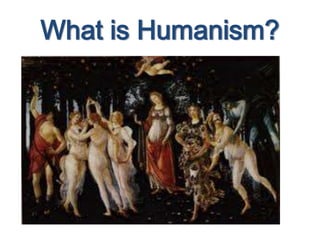
What is Humanism?
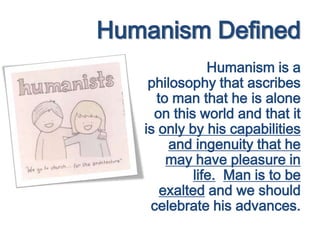
Humanism Defined
Humanism is a
philosophy that ascribes
to man that he is alone
on this world and that it
is only by his capabilities
and ingenuity that he
may have pleasure in
life. Man is to be
exalted and we should
celebrate his advances.
Humanism's Threat to the Mind of
Believers
• It fundamentally asserts that man can
manage his world and self
appropriately
• It denies that our Creator is in charge
of the world and its events
• It rejects His requirements and
commandments and declares them
“not relevant”
• It picks and chooses what is
comfortable and convenient from
God’s Word
• It denies that there is a reward for
Biblical Roots of
Humanism
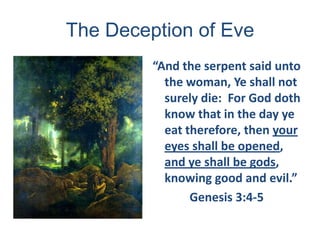
The Deception of Eve
“And the serpent said unto
the woman, Ye shall not
surely die: For God doth
know that in the day ye
eat therefore, then your
eyes shall be opened,
and ye shall be gods,
knowing good and evil.”
Genesis 3:4-5
Genesis 6:5-8
“The LORD saw how great man's wickedness
on the earth had become, and that every
inclination of the thoughts of his heart was only
evil all the time. The LORD was grieved that he
had made man on the earth, and his heart was
filled with pain. So the LORD said, "I will wipe
mankind, whom I have created, from the face of
the earth-men and animals, and creatures that
move along the ground, and birds of the air-for I
am grieved that I have made them." But Noah
found favor in the eyes of the LORD .”
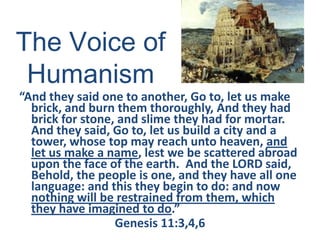
The Voice of
Humanism
“And they said one to another, Go to, let us make
brick, and burn them thoroughly, And they had
brick for stone, and slime they had for mortar.
And they said, Go to, let us build a city and a
tower, whose top may reach unto heaven, and
let us make a name, lest we be scattered abroad
upon the face of the earth. And the LORD said,
Behold, the people is one, and they have all one
language: and this they begin to do: and now
nothing will be restrained from them, which
they have imagined to do.”
Genesis 11:3,4,6
Historical Roots and
Modern Development
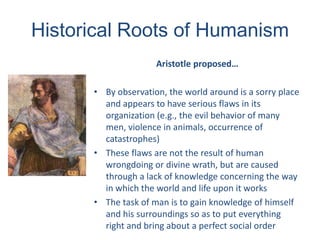
Historical Roots of Humanism
Aristotle proposed…
• By observation, the world around is a sorry place
and appears to have serious flaws in its
organization (e.g., the evil behavior of many
men, violence in animals, occurrence of
catastrophes)
• These flaws are not the result of human
wrongdoing or divine wrath, but are caused
through a lack of knowledge concerning the way
in which the world and life upon it works
• The task of man is to gain knowledge of himself
and his surroundings so as to put everything
right and bring about a perfect social order
Further Roots from Aristotle
• Rejected that there are any “divine”
standards in which behavior was to be
judged
• The pursuit of knowledge had at its aim
happiness in this life, since there was not
believed to be another
• Right and wrong was to be determined by
seeing how things actually worked out in
the end
The Affirmations of Humanism:
Statement of Principles
We are committed to the application of reason and science to the
understanding of the universe and to the solving of human
problems.
We deplore efforts to denigrate human intelligence, to seek to
explain the world in supernatural terms, and to look outside nature
for salvation.
We are committed to the principle of the separation of church and
state.
We attempt to transcend divisive parochial loyalties based on race,
religion, gender, nationality, creed, class, sexual orientation, or
ethnicity, and strive to work together for the common good of
humanity.
We believe in enjoying life here and now and in developing our
creative talents to their fullest.
We respect the right to privacy. Mature adults should
be allowed to fulfill their aspirations, to express their
sexual preferences,…
We believe in the common moral decencies: altruism,
integrity, honesty, truthfulness, responsibility.
Humanist ethics is amenable to critical, rational
guidance. There are normative standards that we
discover together. Moral principles are tested by their
consequences.
We are deeply concerned with the moral education of
our children. We want to nourish reason and
compassion.
We affirm humanism as a realistic alternative to
theologies of despair
Beatitudes vs. Humanism
• Poor in spirit
• They that mourn
• The meek
• Hunger/thirst after
righteousness
• Merciful
• Pure in heart
• Peacemakers
• Persecuted for
righteousness’ sake
• Exaltation of self
• Celebration of human
capability
• Hold fast to “human
rights”
• Rejection of righteous
requirements of God
• Behavior evaluated by
consequences
• There is no Divine moral
code, no need to suffer
for one
Humanists
• Think for themselves about what is right and
wrong, based on reason and respect for
others.
• Find meaning, beauty and joy in the one life
we have, without the need for an afterlife.
• Look to science instead of religion as the best
way to discover and understand the world.
• Believe people can use empathy and
compassion to make the world a better place
for everyone
• trusts to the scientific method when it comes
to understanding how the universe works and
rejects the idea of the supernatural (and is
therefore an atheist or agnostic)
• makes their ethical decisions based on
reason, empathy, and a concern for human
beings and other sentient animals
• believes that, in the absence of an afterlife
and any discernible purpose to the universe,
human beings can act to give their own lives
meaning by seeking happiness in this life and
helping others to do the same.
What is a humanist?
• “Humanist” is used today to mean those who
seek to live good lives without religious or
superstitious beliefs. Humanists believe that
moral values follow on from human nature
and experience in some way.
• Humanists base their moral principles on
reason (which leads them to reject the idea of
any supernatural agency), on shared human
values and respect for others. They believe
that people should work together to improve
the quality of life for all and make it more
equitable.
Humanism is a full philosophy, “life stance” or
worldview, rather than being about one aspect
of religion, knowledge, or politics.

DEVELOPING RESPECT & RESPONSIBILITY on HUMANITY BASED ON HUMAN RIGHTS

  • 1.
    DEVELOPING RESPECT & RESPONSIBILITYon HUMANITY BASED ON HUMAN RIGHTS
  • 2.
    THE PHILOSOPHY OF HUMANISM•Humanism defined • When did Humanism begin? • What are the objectives of Humanism? • How has today’s thinking been influenced by Humanism? • Are Humanism and the Bible compatible? • What does the Bible say will happen with Humanism?
  • 3.
    THE ISSUE • Humanismis a religion – a philosophy that is rapidly spreading across western society • It can at times imitate Christian values and fool some into thinking it is just a modern approach to the Christian faith • However, Humanists believe that Christianity is an old paradigm – that the progressive man is one who sees the God of the Bible and His moral code as irrelevant • Humanism is influencing, even dominating, the messages we are exposed to in the media, schools, politics and entertainment • The Bible teaches that Humanist thought is incompatible with requirements of God – your salvation is at risk!
  • 4.
  • 5.
    Humanism Defined Humanism isa philosophy that ascribes to man that he is alone on this world and that it is only by his capabilities and ingenuity that he may have pleasure in life. Man is to be exalted and we should celebrate his advances.
  • 6.
    Humanism's Threat tothe Mind of Believers • It fundamentally asserts that man can manage his world and self appropriately • It denies that our Creator is in charge of the world and its events • It rejects His requirements and commandments and declares them “not relevant” • It picks and chooses what is comfortable and convenient from God’s Word • It denies that there is a reward for
  • 7.
  • 8.
    The Deception ofEve “And the serpent said unto the woman, Ye shall not surely die: For God doth know that in the day ye eat therefore, then your eyes shall be opened, and ye shall be gods, knowing good and evil.” Genesis 3:4-5
  • 9.
    Genesis 6:5-8 “The LORDsaw how great man's wickedness on the earth had become, and that every inclination of the thoughts of his heart was only evil all the time. The LORD was grieved that he had made man on the earth, and his heart was filled with pain. So the LORD said, "I will wipe mankind, whom I have created, from the face of the earth-men and animals, and creatures that move along the ground, and birds of the air-for I am grieved that I have made them." But Noah found favor in the eyes of the LORD .”
  • 10.
    The Voice of Humanism “Andthey said one to another, Go to, let us make brick, and burn them thoroughly, And they had brick for stone, and slime they had for mortar. And they said, Go to, let us build a city and a tower, whose top may reach unto heaven, and let us make a name, lest we be scattered abroad upon the face of the earth. And the LORD said, Behold, the people is one, and they have all one language: and this they begin to do: and now nothing will be restrained from them, which they have imagined to do.” Genesis 11:3,4,6
  • 11.
  • 12.
    Historical Roots ofHumanism Aristotle proposed… • By observation, the world around is a sorry place and appears to have serious flaws in its organization (e.g., the evil behavior of many men, violence in animals, occurrence of catastrophes) • These flaws are not the result of human wrongdoing or divine wrath, but are caused through a lack of knowledge concerning the way in which the world and life upon it works • The task of man is to gain knowledge of himself and his surroundings so as to put everything right and bring about a perfect social order
  • 13.
    Further Roots fromAristotle • Rejected that there are any “divine” standards in which behavior was to be judged • The pursuit of knowledge had at its aim happiness in this life, since there was not believed to be another • Right and wrong was to be determined by seeing how things actually worked out in the end
  • 14.
    The Affirmations ofHumanism: Statement of Principles We are committed to the application of reason and science to the understanding of the universe and to the solving of human problems. We deplore efforts to denigrate human intelligence, to seek to explain the world in supernatural terms, and to look outside nature for salvation. We are committed to the principle of the separation of church and state. We attempt to transcend divisive parochial loyalties based on race, religion, gender, nationality, creed, class, sexual orientation, or ethnicity, and strive to work together for the common good of humanity. We believe in enjoying life here and now and in developing our creative talents to their fullest.
  • 15.
    We respect theright to privacy. Mature adults should be allowed to fulfill their aspirations, to express their sexual preferences,… We believe in the common moral decencies: altruism, integrity, honesty, truthfulness, responsibility. Humanist ethics is amenable to critical, rational guidance. There are normative standards that we discover together. Moral principles are tested by their consequences. We are deeply concerned with the moral education of our children. We want to nourish reason and compassion. We affirm humanism as a realistic alternative to theologies of despair
  • 16.
    Beatitudes vs. Humanism •Poor in spirit • They that mourn • The meek • Hunger/thirst after righteousness • Merciful • Pure in heart • Peacemakers • Persecuted for righteousness’ sake • Exaltation of self • Celebration of human capability • Hold fast to “human rights” • Rejection of righteous requirements of God • Behavior evaluated by consequences • There is no Divine moral code, no need to suffer for one
  • 17.
  • 18.
    • Think forthemselves about what is right and wrong, based on reason and respect for others. • Find meaning, beauty and joy in the one life we have, without the need for an afterlife. • Look to science instead of religion as the best way to discover and understand the world. • Believe people can use empathy and compassion to make the world a better place for everyone
  • 19.
    • trusts tothe scientific method when it comes to understanding how the universe works and rejects the idea of the supernatural (and is therefore an atheist or agnostic) • makes their ethical decisions based on reason, empathy, and a concern for human beings and other sentient animals • believes that, in the absence of an afterlife and any discernible purpose to the universe, human beings can act to give their own lives meaning by seeking happiness in this life and helping others to do the same.
  • 20.
    What is ahumanist? • “Humanist” is used today to mean those who seek to live good lives without religious or superstitious beliefs. Humanists believe that moral values follow on from human nature and experience in some way. • Humanists base their moral principles on reason (which leads them to reject the idea of any supernatural agency), on shared human values and respect for others. They believe that people should work together to improve the quality of life for all and make it more equitable.
  • 21.
    Humanism is afull philosophy, “life stance” or worldview, rather than being about one aspect of religion, knowledge, or politics.