UNIT 3 REVISION
(MR PLATTS’ UNIT)
THE PROBLEM OF EVIL
Types of evil
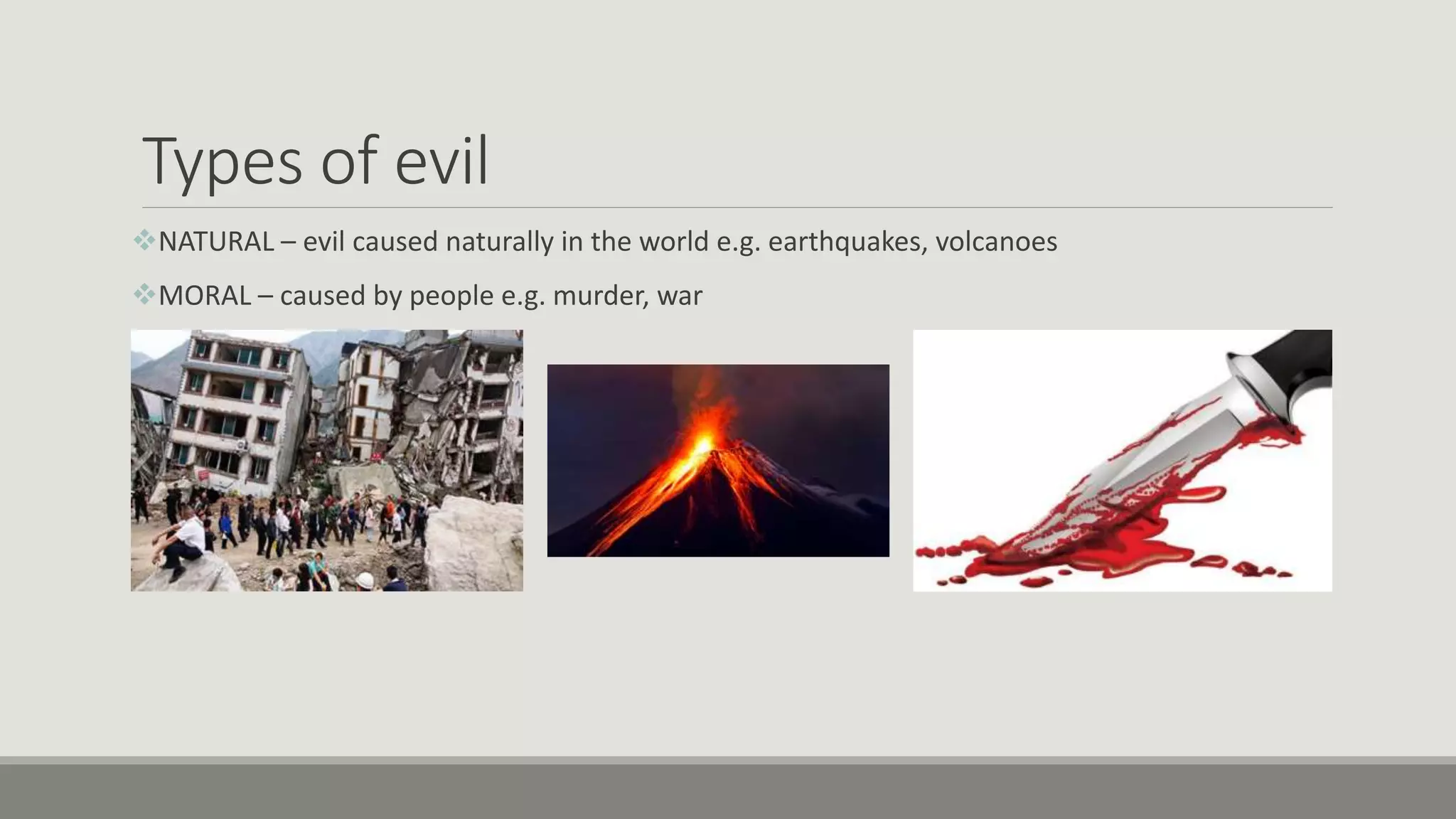
NATURAL – evil caused naturally in the world e.g. earthquakes, volcanoes
MORAL – caused by people e.g. murder, war
The logical problem of evil
A God who’s omnibenevolent will have a motive to get rid of evil
A God who’s omnipotent will have the ability
Evil exists in the world
Therefore God doesn’t exist, or he is not
omnibenevolent/omnipotent
The evidential problem of evil – Rowe
If evil resulted in a greater good then suffering might be justified
but the act is still considered evil
God could prevent suffering without removing a greater good
Unnecessary evil points to the non-existence of the God of classical
theism
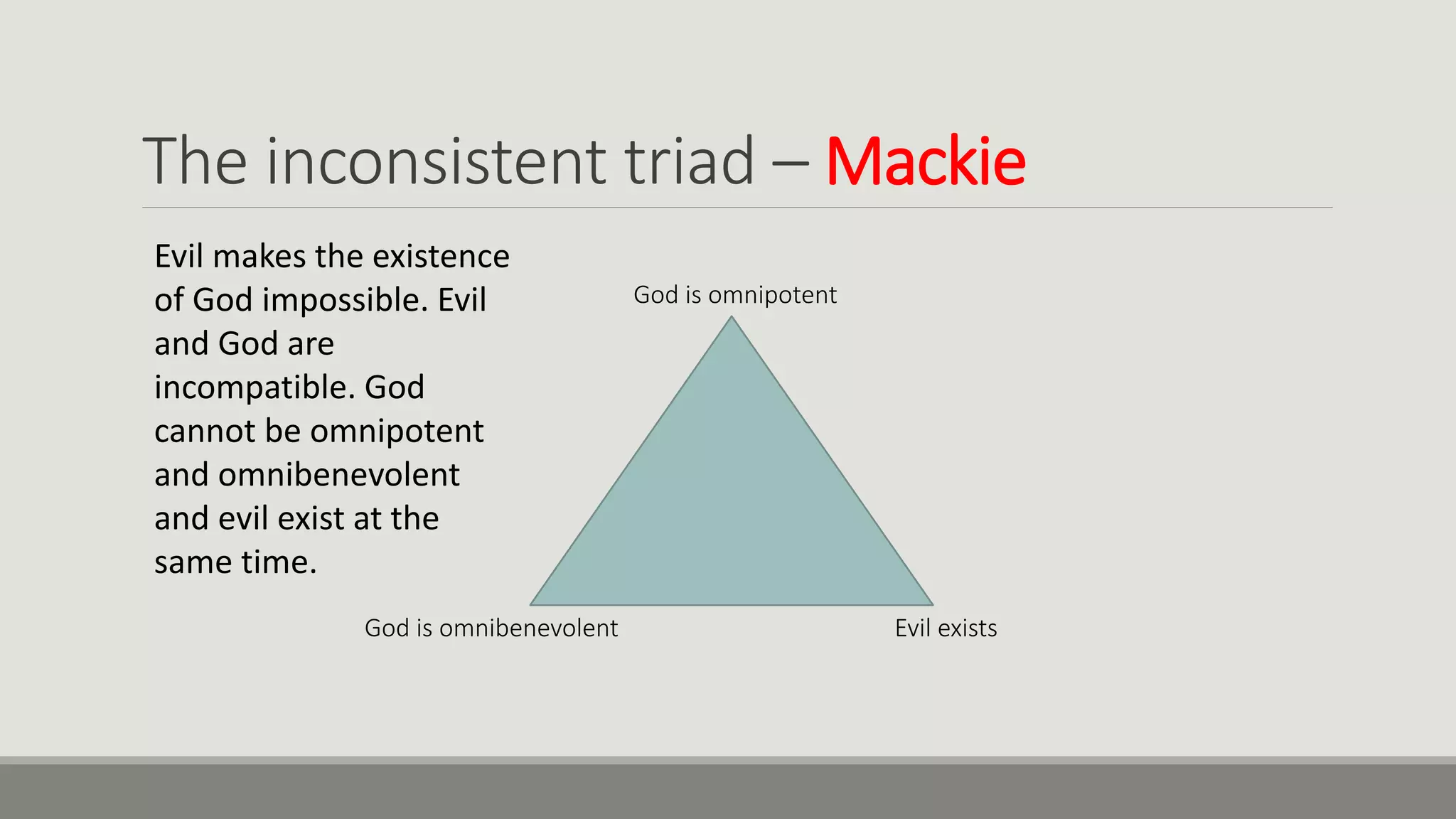
The inconsistent triad – Mackie
God is omnipotent
God is omnibenevolent Evil exists
Evil makes the existence
of God impossible. Evil
and God are
incompatible. God
cannot be omnipotent
and omnibenevolent
and evil exist at the
same time.
The inconsistent triad – Hume
Only two of the three can exist alongside each other
Either God isn’t either omnipotent or omnibenevolent, or evil
doesn’t exist
The consequences of evil are too prominent to deny so it does exist
Therefore God must not be omnipotent or omnibenevolent, or he
doesn’t exist
Augustine
The bible shows God is wholly good
He created a perfect world and created all things good
Evil isn’t good therefore God cannot have created evil
Evil doesn’t exist, it is simply the privation of good
Evil comes from humans and fallen angels who have free will but have chosen to turn away
from God
Perfection was ruined by human sin
It wouldn’t be right for God to intervene with suffering so God is justified in allowing us to
suffer
He sent Jesus to earth to take the punishment for sin so that all believers can be saved
Criticism – Schleiermacher
It’s a logical contradiction to say a perfectly created world went
wrong
Either the world wasn’t perfect to start with or God made it so that
there was the possibility the world could go wrong
It’s God who’s to blame
The free will defence
Free will is essential to humanity
We need evil to have free will
We need evil and free will to be able to make our own choices about believing in God
STRENTHS WEAKNESSES
Swinburne – if God intervened it would
jeopardise freedom, God can’t act like an
overprotective parent
Vardy – natural evil doesn’t always bring
about good
Plantinga – can’t always choose God or
wouldn’t be free, enables humans to get
into heaven
Mackie – God has the capability of
creating free will where all people choose
good and don’t want to sin
Blames humans not God
Logical
Irenaeus
Evil traced back to free will
God didn’t make a perfect world
Evil plays a valuable plan in God’s plan
Goodness and perfection had to be developed by humans
Evil allows us to develop virtues
Evil and suffering will be overcome and humanity will live in heaven
Criticisms of Irenaeus
Suggests everyone goes to heaven
Challenges don’t always result in positive human development
Love can’t be expressed by allowing suffering
Hick
If God made humans perfectly we’d all be robots
Humans need free will
God had to create humans at an epistemic distance
In this way, God isn’t so close to humans that we have no choice
but to believe in him
Process thought – Griffin
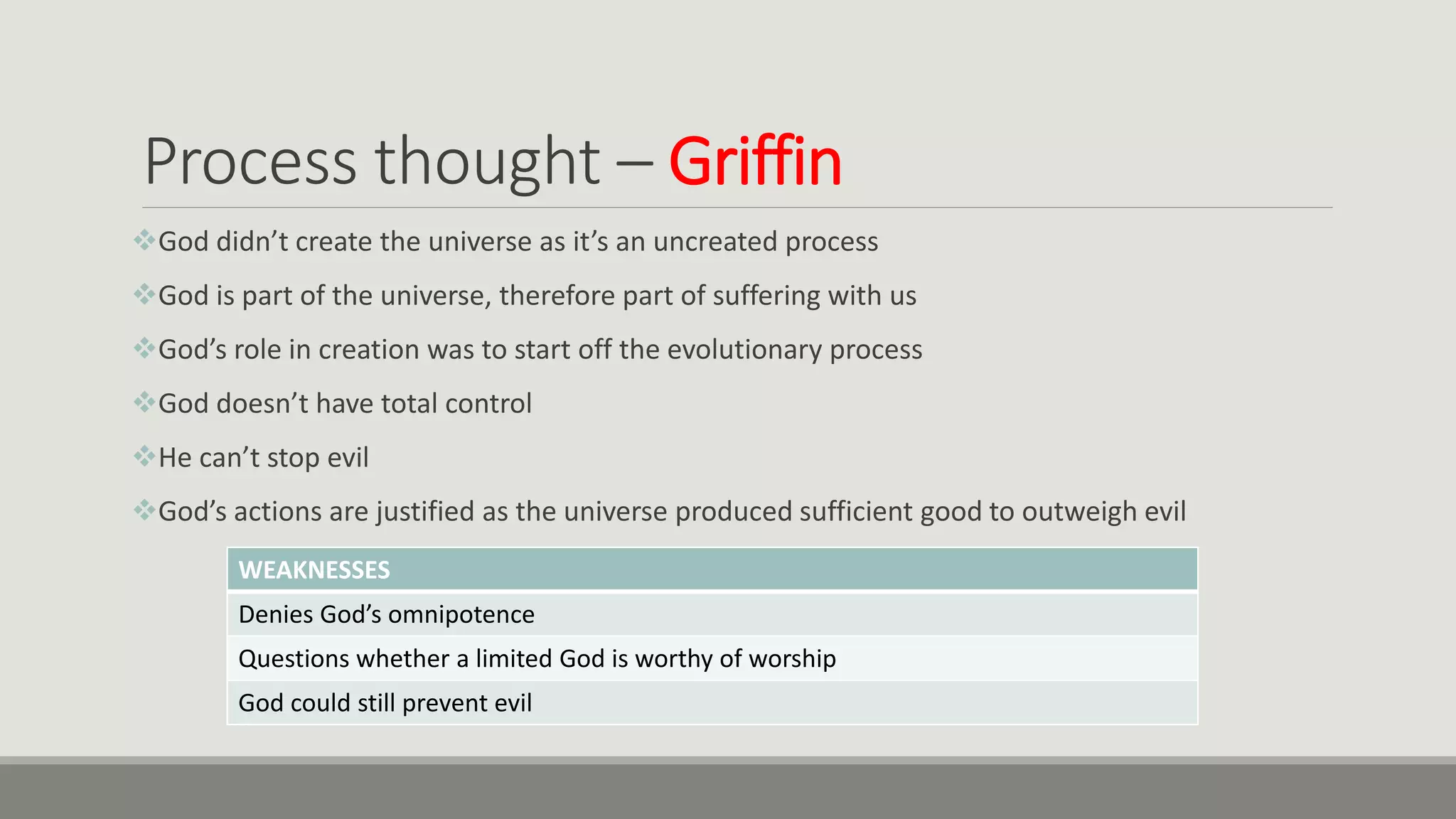
God didn’t create the universe as it’s an uncreated process
God is part of the universe, therefore part of suffering with us
God’s role in creation was to start off the evolutionary process
God doesn’t have total control
He can’t stop evil
God’s actions are justified as the universe produced sufficient good to outweigh evil
WEAKNESSES
Denies God’s omnipotence
Questions whether a limited God is worthy of worship
God could still prevent evil
RELIGIOUS LANGUAGE
The problem of religious language
Some say religious language is cognitive (communicates
knowledge, information and facts about God)
Something about God can be known
However, religious statements aren’t facts
Therefore religious language is meaningless
Via negative – Aquinas
Negative way
We can’t talk about God in positive terms as it’s misleading and
confusing
We must only talk of God in negative terms such as what he’s not
CRITICISM
Davies – describing something as what it’s not gives no clue to what he is
Verification principle – Ayer
If we verify a statement we check its truth against a body of evidence or facts
A statement which can’t be conclusively verified can’t be verified at all
It’s simply devoid of any meaning
Denys the possibility of God’s existence altogether
No way of empirically verifying his existence
Analytic propositions: statements that contain all the information within the statement that we need to verify it
Synthetic propositions: statements that can be confirmed through the use of the senses
Strong verification: an assertion only has meaning if it can be verified according to empirical information
Weak verification: for an assertion to be true one simply has to state what kind of evidence would verify its’
contents
Falsification principle – Flew
Any statement that can’t be falsified is empty of meaning
Religious language is meaningless
Nothing can count against religious statements
They can’t be verified or falsified because believers won’t accept ay
evidence to count against their beliefs
Criticism – Hare
Flew didn’t understand the nature of religious beliefs
“Bliks” = basic beliefs about the world
Basic beliefs are “bliks” as they’re neither verifiable nor falsifiable
We all have a blik
Aquinas
Analogy of attribution: qualities we ascribe to each other are a reflection of
the qualities of God
When we see these attributes in others we’re able to make analogies with the
attributes of God
Analogy of proportion: these properties depend on the nature of the being
that possesses them
When we use words to describe God we’re describing an infinite being
When we use words to describe each other we’re describing finite beings
Therefore the meaning of these words can’t be the same
Tillich
Religious language ought to be understood in a different way
Religious language is cognitive
We’re able to learn something about God from religious language,
but our words become more symbolic
Symbolic: point us towards something else
Criticism – Randall
Religious language is symbolic but non-cognitive
It doesn’t tell us anything about the external reality, only human
experiences
Bultman
A myth is the use of imagery to express the other-worldly
Myth: ancient stories unlikely to be true, but they convey the
values and beliefs of a community
It draws the readers in and requires a response
They’re not the literal truth, but a deep truth
Language games – Wittgenstein
Language is like playing a game with rules
There are agreed rules within the group on how words are used
Those outside of the game cannot understand the true meaning of
the words
Therefore those outside the game believe that religious language is
meaningless
Only those inside the game who understand the context of the
word can know its’ true meaning
Supporter – Phillips
He suggests that no one outside of the game can criticise the belief
Some problems caused by religious language exist because we take
the language literally
THE ONTOLOGICAL ARGUMENT
The ontological argument
A priori argument
God’s existence is different to that of humans
Humans are contingent whereas God is necessary
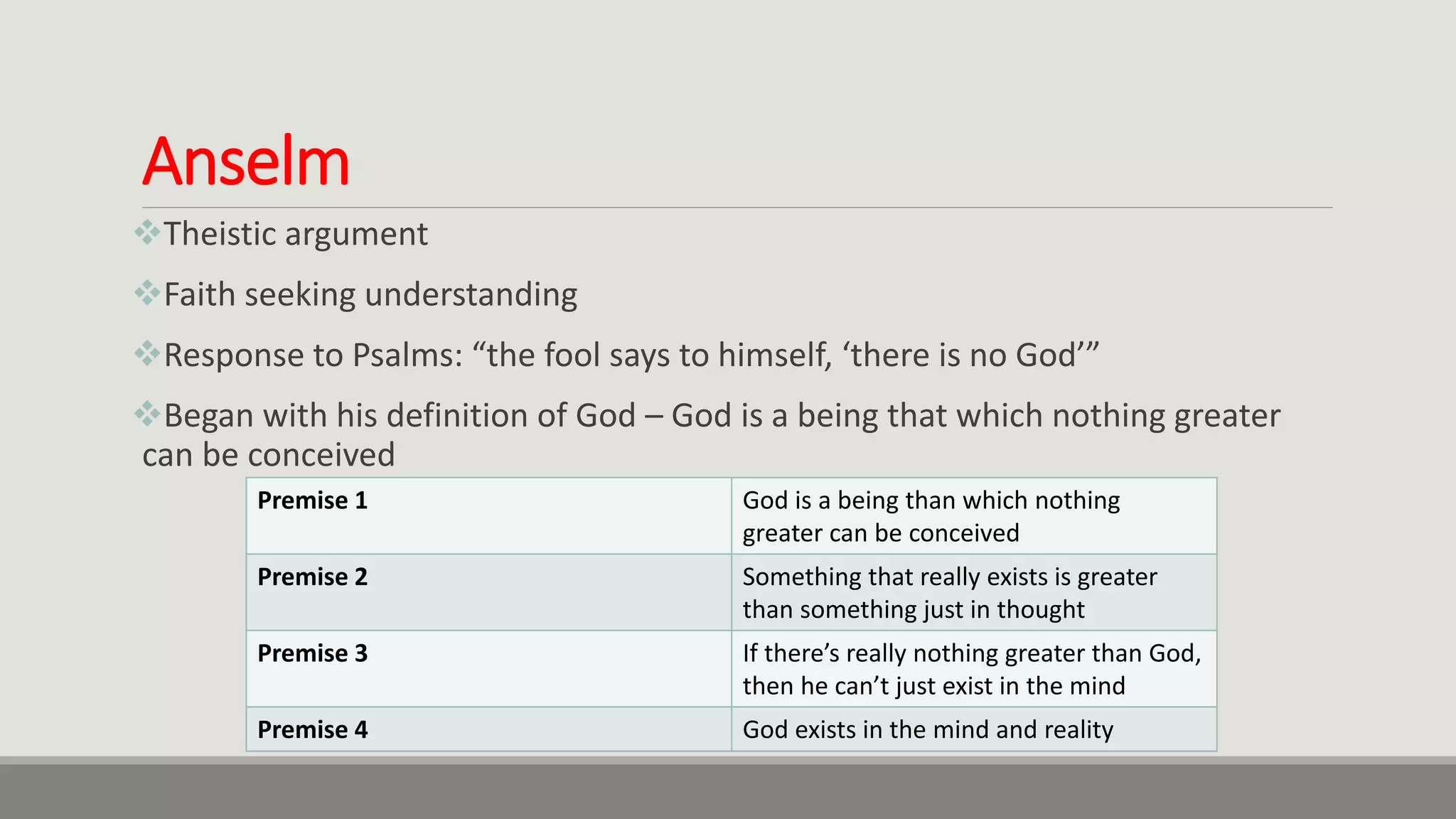
Anselm
Theistic argument
Faith seeking understanding
Response to Psalms: “the fool says to himself, ‘there is no God’”
Began with his definition of God – God is a being that which nothing greater
can be conceived
Premise 1 God is a being than which nothing
greater can be conceived
Premise 2 Something that really exists is greater
than something just in thought
Premise 3 If there’s really nothing greater than God,
then he can’t just exist in the mind
Premise 4 God exists in the mind and reality
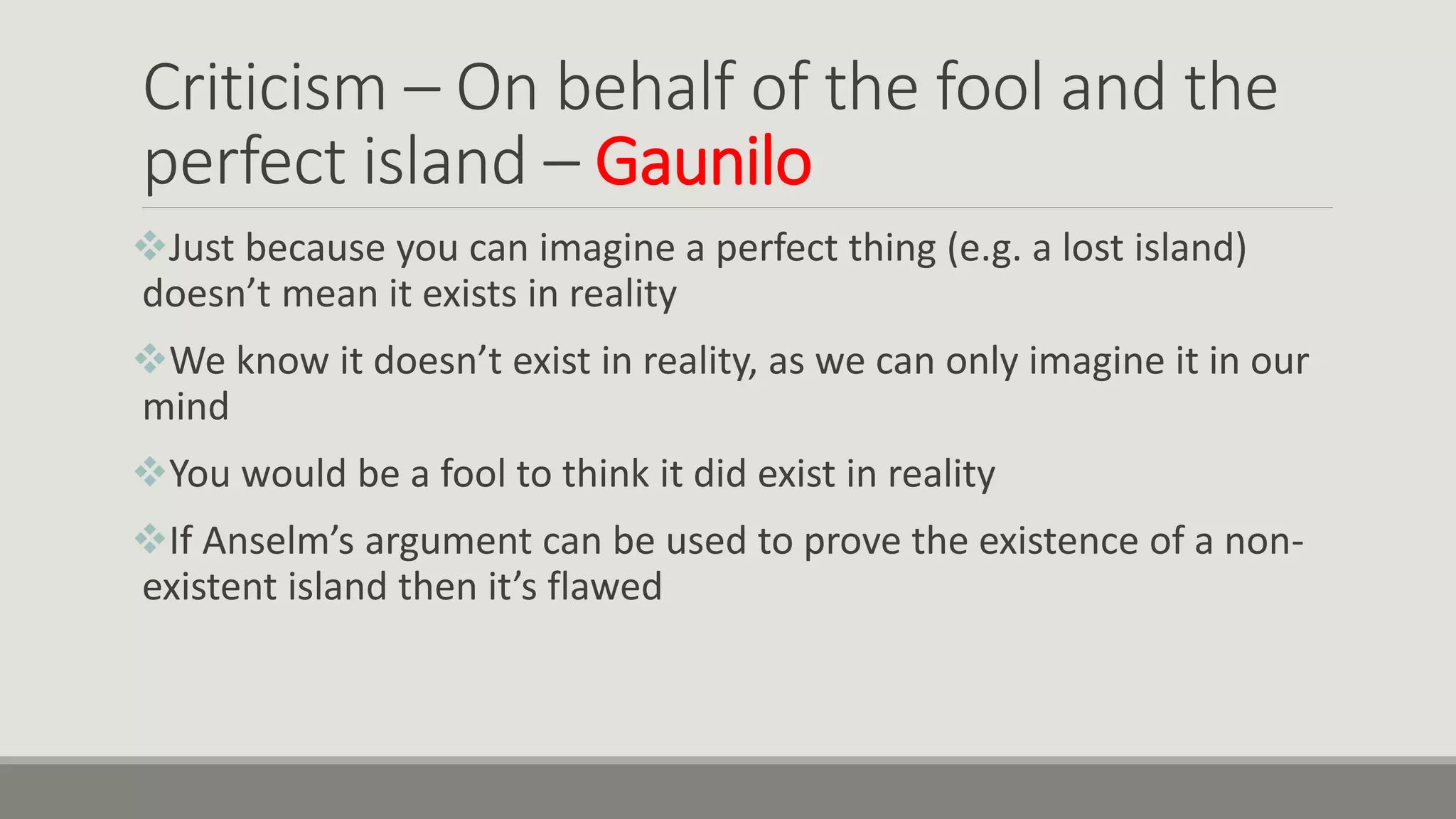
Criticism – On behalf of the fool and the
perfect island – Gaunilo
Just because you can imagine a perfect thing (e.g. a lost island)
doesn’t mean it exists in reality
We know it doesn’t exist in reality, as we can only imagine it in our
mind
You would be a fool to think it did exist in reality
If Anselm’s argument can be used to prove the existence of a non-
existent island then it’s flawed
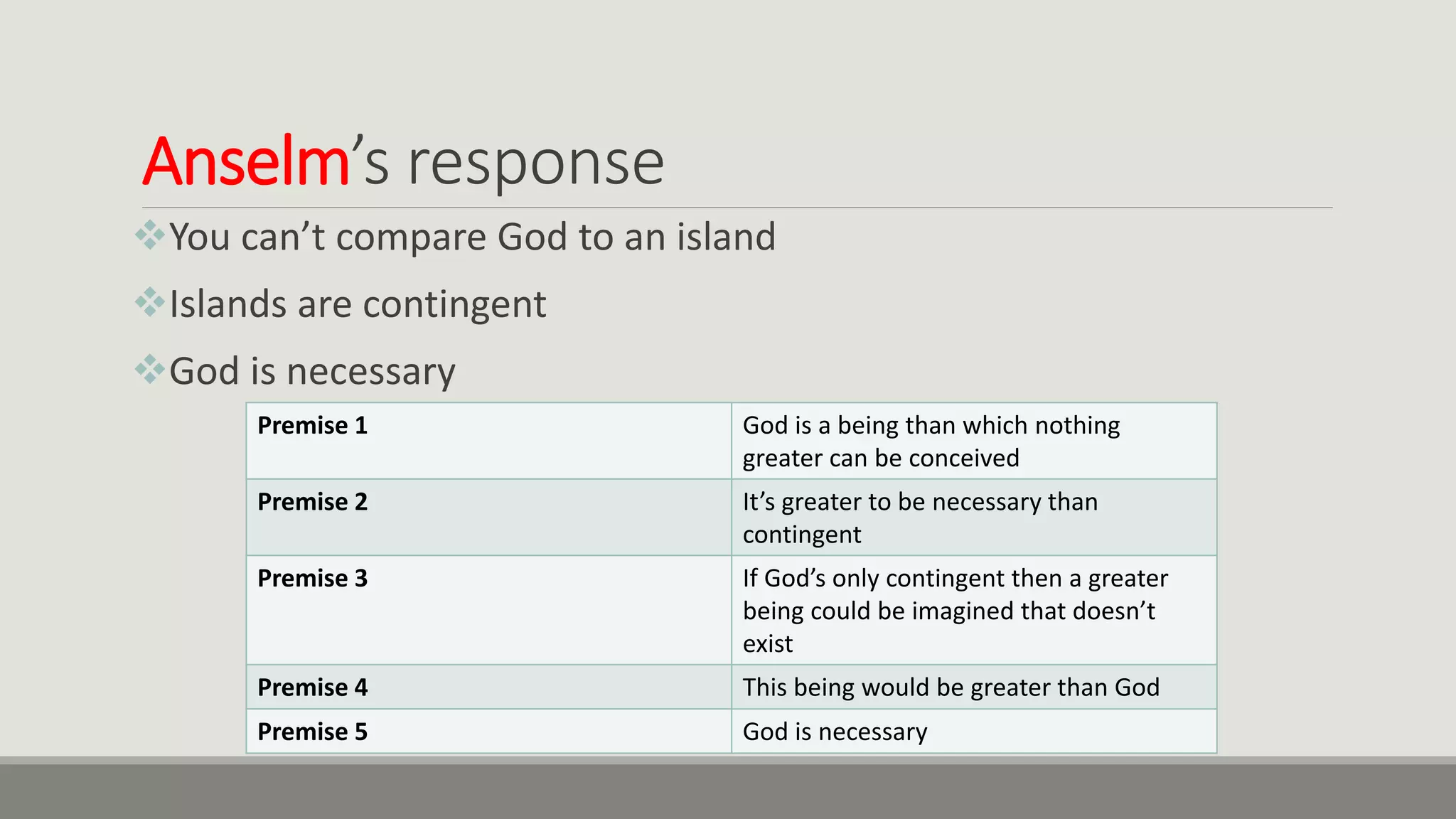
Anselm’s response
You can’t compare God to an island
Islands are contingent
God is necessary
Premise 1 God is a being than which nothing
greater can be conceived
Premise 2 It’s greater to be necessary than
contingent
Premise 3 If God’s only contingent then a greater
being could be imagined that doesn’t
exist
Premise 4 This being would be greater than God
Premise 5 God is necessary
Criticism – Kant
Rejects Anselm’s definition of God
A necessary existence is something that the non-existence of is
impossible
Defence – Malcolm
God can’t come into existence by cause or chance
If he doesn’t already exist then his existence would be impossible
If he does exist he can’t stop existing
God’s existence is necessary
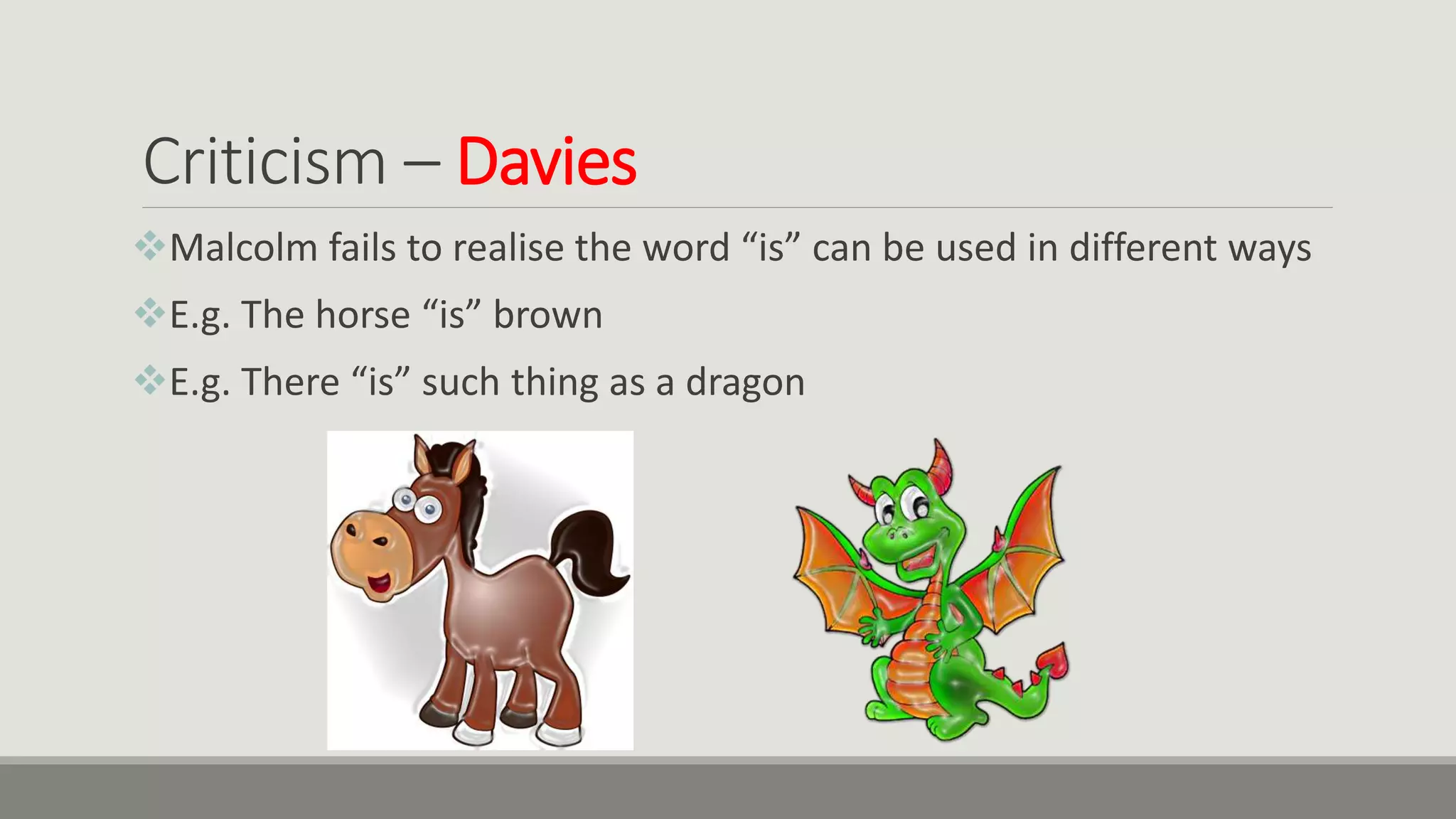
Criticism – Davies
Malcolm fails to realise the word “is” can be used in different ways
E.g. The horse “is” brown
E.g. There “is” such thing as a dragon
Descartes
Even if a triangle had never existed, they’d still have distinct characteristics (e.g. 3 sides, 3
angles)
God exists as an idea in the mind
God is a supremely perfect being
God necessarily exists because that’s where our idea of God came from
As imperfect beings we can’t develop that idea ourselves, it was put there by God
Existence is a predicate of God
He must possess existence otherwise he wouldn’t be perfect
God must exist in reality
God without existence is like a triangle without 3 sides – it’s not possible
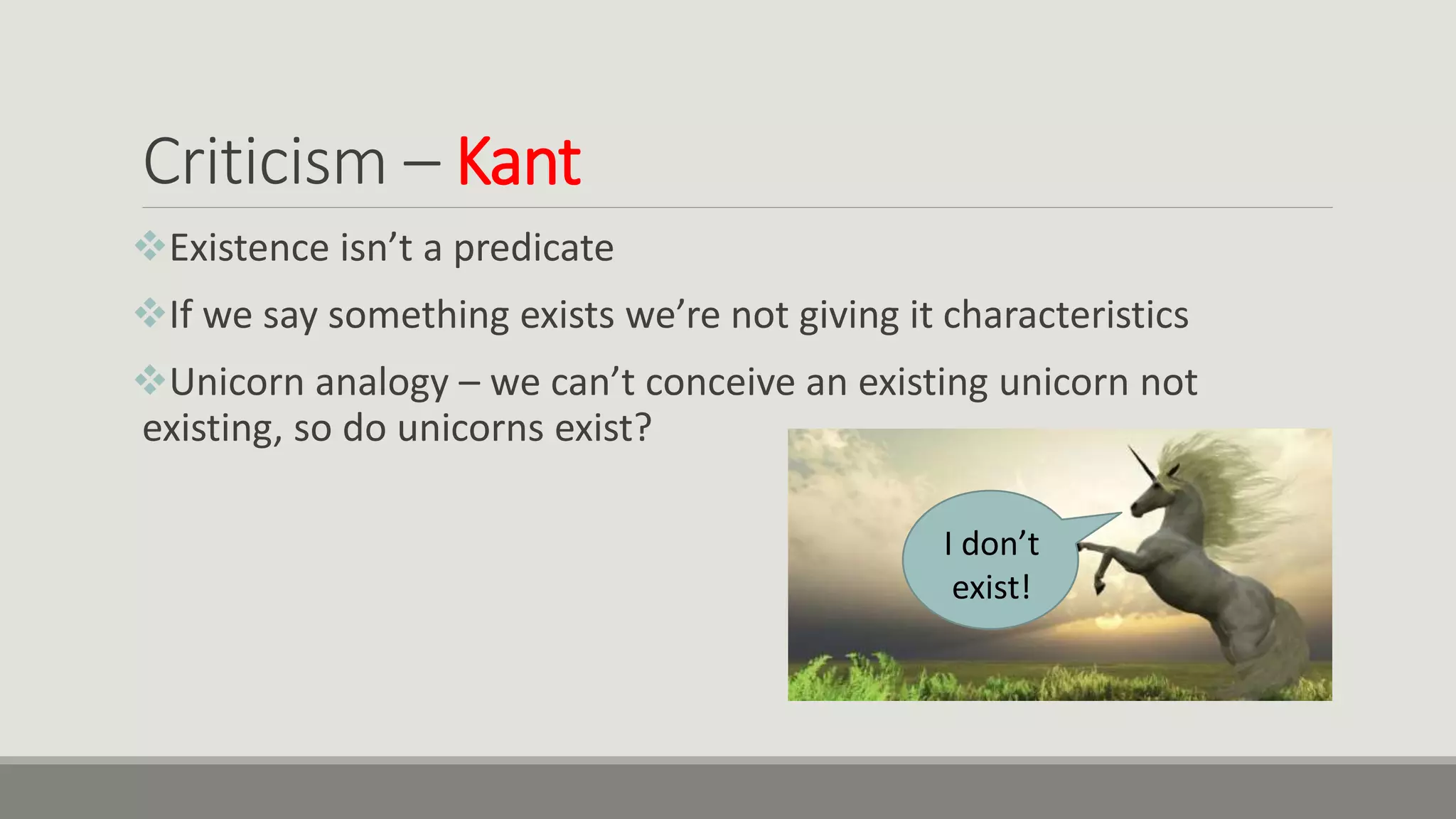
Criticism – Kant
Existence isn’t a predicate
If we say something exists we’re not giving it characteristics
Unicorn analogy – we can’t conceive an existing unicorn not
existing, so do unicorns exist?
I don’t
exist!
Possible worlds – Plantinga
God is a being of maximal greatness
Such a being would exist necessarily
To exist contingently means to depend on other factors
However, this would mean God isn’t maximally great
This being’s existence isn’t impossible in an infinite number of
possible worlds
Therefore, this being has to exist necessarily in all worlds

AQA Religious Studies Unit 3 complete revision

  • 1.
    UNIT 3 REVISION (MRPLATTS’ UNIT)
  • 2.
  • 3.
    Types of evil NATURAL– evil caused naturally in the world e.g. earthquakes, volcanoes MORAL – caused by people e.g. murder, war
  • 4.
    The logical problemof evil A God who’s omnibenevolent will have a motive to get rid of evil A God who’s omnipotent will have the ability Evil exists in the world Therefore God doesn’t exist, or he is not omnibenevolent/omnipotent
  • 5.
    The evidential problemof evil – Rowe If evil resulted in a greater good then suffering might be justified but the act is still considered evil God could prevent suffering without removing a greater good Unnecessary evil points to the non-existence of the God of classical theism
  • 6.
    The inconsistent triad– Mackie God is omnipotent God is omnibenevolent Evil exists Evil makes the existence of God impossible. Evil and God are incompatible. God cannot be omnipotent and omnibenevolent and evil exist at the same time.
  • 7.
    The inconsistent triad– Hume Only two of the three can exist alongside each other Either God isn’t either omnipotent or omnibenevolent, or evil doesn’t exist The consequences of evil are too prominent to deny so it does exist Therefore God must not be omnipotent or omnibenevolent, or he doesn’t exist
  • 8.
    Augustine The bible showsGod is wholly good He created a perfect world and created all things good Evil isn’t good therefore God cannot have created evil Evil doesn’t exist, it is simply the privation of good Evil comes from humans and fallen angels who have free will but have chosen to turn away from God Perfection was ruined by human sin It wouldn’t be right for God to intervene with suffering so God is justified in allowing us to suffer He sent Jesus to earth to take the punishment for sin so that all believers can be saved
  • 9.
    Criticism – Schleiermacher It’sa logical contradiction to say a perfectly created world went wrong Either the world wasn’t perfect to start with or God made it so that there was the possibility the world could go wrong It’s God who’s to blame
  • 10.
    The free willdefence Free will is essential to humanity We need evil to have free will We need evil and free will to be able to make our own choices about believing in God STRENTHS WEAKNESSES Swinburne – if God intervened it would jeopardise freedom, God can’t act like an overprotective parent Vardy – natural evil doesn’t always bring about good Plantinga – can’t always choose God or wouldn’t be free, enables humans to get into heaven Mackie – God has the capability of creating free will where all people choose good and don’t want to sin Blames humans not God Logical
  • 11.
    Irenaeus Evil traced backto free will God didn’t make a perfect world Evil plays a valuable plan in God’s plan Goodness and perfection had to be developed by humans Evil allows us to develop virtues Evil and suffering will be overcome and humanity will live in heaven
  • 12.
    Criticisms of Irenaeus Suggestseveryone goes to heaven Challenges don’t always result in positive human development Love can’t be expressed by allowing suffering
  • 13.
    Hick If God madehumans perfectly we’d all be robots Humans need free will God had to create humans at an epistemic distance In this way, God isn’t so close to humans that we have no choice but to believe in him
  • 14.
    Process thought –Griffin God didn’t create the universe as it’s an uncreated process God is part of the universe, therefore part of suffering with us God’s role in creation was to start off the evolutionary process God doesn’t have total control He can’t stop evil God’s actions are justified as the universe produced sufficient good to outweigh evil WEAKNESSES Denies God’s omnipotence Questions whether a limited God is worthy of worship God could still prevent evil
  • 15.
  • 16.
    The problem ofreligious language Some say religious language is cognitive (communicates knowledge, information and facts about God) Something about God can be known However, religious statements aren’t facts Therefore religious language is meaningless
  • 17.
    Via negative –Aquinas Negative way We can’t talk about God in positive terms as it’s misleading and confusing We must only talk of God in negative terms such as what he’s not CRITICISM Davies – describing something as what it’s not gives no clue to what he is
  • 18.
    Verification principle –Ayer If we verify a statement we check its truth against a body of evidence or facts A statement which can’t be conclusively verified can’t be verified at all It’s simply devoid of any meaning Denys the possibility of God’s existence altogether No way of empirically verifying his existence Analytic propositions: statements that contain all the information within the statement that we need to verify it Synthetic propositions: statements that can be confirmed through the use of the senses Strong verification: an assertion only has meaning if it can be verified according to empirical information Weak verification: for an assertion to be true one simply has to state what kind of evidence would verify its’ contents
  • 19.
    Falsification principle –Flew Any statement that can’t be falsified is empty of meaning Religious language is meaningless Nothing can count against religious statements They can’t be verified or falsified because believers won’t accept ay evidence to count against their beliefs
  • 20.
    Criticism – Hare Flewdidn’t understand the nature of religious beliefs “Bliks” = basic beliefs about the world Basic beliefs are “bliks” as they’re neither verifiable nor falsifiable We all have a blik
  • 21.
    Aquinas Analogy of attribution:qualities we ascribe to each other are a reflection of the qualities of God When we see these attributes in others we’re able to make analogies with the attributes of God Analogy of proportion: these properties depend on the nature of the being that possesses them When we use words to describe God we’re describing an infinite being When we use words to describe each other we’re describing finite beings Therefore the meaning of these words can’t be the same
  • 22.
    Tillich Religious language oughtto be understood in a different way Religious language is cognitive We’re able to learn something about God from religious language, but our words become more symbolic Symbolic: point us towards something else
  • 23.
    Criticism – Randall Religiouslanguage is symbolic but non-cognitive It doesn’t tell us anything about the external reality, only human experiences
  • 24.
    Bultman A myth isthe use of imagery to express the other-worldly Myth: ancient stories unlikely to be true, but they convey the values and beliefs of a community It draws the readers in and requires a response They’re not the literal truth, but a deep truth
  • 25.
    Language games –Wittgenstein Language is like playing a game with rules There are agreed rules within the group on how words are used Those outside of the game cannot understand the true meaning of the words Therefore those outside the game believe that religious language is meaningless Only those inside the game who understand the context of the word can know its’ true meaning
  • 26.
    Supporter – Phillips Hesuggests that no one outside of the game can criticise the belief Some problems caused by religious language exist because we take the language literally
  • 27.
  • 28.
    The ontological argument Apriori argument God’s existence is different to that of humans Humans are contingent whereas God is necessary
  • 29.
    Anselm Theistic argument Faith seekingunderstanding Response to Psalms: “the fool says to himself, ‘there is no God’” Began with his definition of God – God is a being that which nothing greater can be conceived Premise 1 God is a being than which nothing greater can be conceived Premise 2 Something that really exists is greater than something just in thought Premise 3 If there’s really nothing greater than God, then he can’t just exist in the mind Premise 4 God exists in the mind and reality
  • 30.
    Criticism – Onbehalf of the fool and the perfect island – Gaunilo Just because you can imagine a perfect thing (e.g. a lost island) doesn’t mean it exists in reality We know it doesn’t exist in reality, as we can only imagine it in our mind You would be a fool to think it did exist in reality If Anselm’s argument can be used to prove the existence of a non- existent island then it’s flawed
  • 31.
    Anselm’s response You can’tcompare God to an island Islands are contingent God is necessary Premise 1 God is a being than which nothing greater can be conceived Premise 2 It’s greater to be necessary than contingent Premise 3 If God’s only contingent then a greater being could be imagined that doesn’t exist Premise 4 This being would be greater than God Premise 5 God is necessary
  • 32.
    Criticism – Kant RejectsAnselm’s definition of God A necessary existence is something that the non-existence of is impossible
  • 33.
    Defence – Malcolm Godcan’t come into existence by cause or chance If he doesn’t already exist then his existence would be impossible If he does exist he can’t stop existing God’s existence is necessary
  • 34.
    Criticism – Davies Malcolmfails to realise the word “is” can be used in different ways E.g. The horse “is” brown E.g. There “is” such thing as a dragon
  • 35.
    Descartes Even if atriangle had never existed, they’d still have distinct characteristics (e.g. 3 sides, 3 angles) God exists as an idea in the mind God is a supremely perfect being God necessarily exists because that’s where our idea of God came from As imperfect beings we can’t develop that idea ourselves, it was put there by God Existence is a predicate of God He must possess existence otherwise he wouldn’t be perfect God must exist in reality God without existence is like a triangle without 3 sides – it’s not possible
  • 36.
    Criticism – Kant Existenceisn’t a predicate If we say something exists we’re not giving it characteristics Unicorn analogy – we can’t conceive an existing unicorn not existing, so do unicorns exist? I don’t exist!
  • 37.
    Possible worlds –Plantinga God is a being of maximal greatness Such a being would exist necessarily To exist contingently means to depend on other factors However, this would mean God isn’t maximally great This being’s existence isn’t impossible in an infinite number of possible worlds Therefore, this being has to exist necessarily in all worlds