World Religion
Braxton Hunter, PhD
WHAT TO EXPECT
An Introduction to the Study of World Religions
An Exploration of Hinduism
An Exploration of Buddhism
An Exploration of Judaism
An Exploration of Christianity
An Exploration of Islam
Tools for Worldview Evaluation
Introduction
The Significance of the Study
Reasons for the Study
Healthy Citizen Relations
Political Insight
Healthy Interpersonal Relations
Evangelism
Apologetics
Discipleship
What is Religion
A Proper Definition
What is Religion
The English noun is derived from the Latin verb
“Religio” – to bind or tie back.
So one’s religion answers the question of how
one is bound to the nature of reality or how one
ties himself to matters of ultimate importance.
Regardless of whether one considers himself
“religious” in the common use of the phrase,
everyone holds beliefs about matters of great
importance.
Types of Beliefs
Definitions paraphrased from Rick Rogers, Prof. World Religions (Eastern Michigan University)
with the exception of atheism.
Animism – All natural phenomenon are
permeated by impersonal supernatural realities
or qualities which are separate from matter, but
still exist in the natural world. This idea maintains
that these two entities (matter and spirit) are
always interacting with each other in nature.
Atheism – The belief that God does not exist
(sometimes defined as the belief that there is a
supernatural reality, but that no personal God
exists).
Types of Beliefs (Cont.)
Atheism (cont.) - According to Pew Research data, "2.4%
of American adults say they are atheists when asked about
their religious identity." Although the literal definition of
"atheist" is “a person who believes that God does not
exist,”, 14% of those who call themselves atheists also say
they believe in God or a universal spirit. That includes 5%
who say they are “absolutely certain” about the existence
of God or a universal spirit. (emphasis mine). Some
eastern religions would be defined by some as atheistic
even though they believe in some spiritual realities
because they reject the idea of a personal god or gods.
Theism – the belief that there are personal divine entities.
Types of Beliefs (Cont. 2)
Subcategories of Theism
Pantheism – Similar to animism it holds that the
spiritual permeates matter, and there are as many
spirits as there are material things. It is different from
animism in that these spirits are personal and man
must have a personal relationship with some of
these.
Polytheism – The belief that there are only a few
personal spirits (gods) but all of them must be
worshipped and live together in a pantheon outside
of the physical world.
Monotheism – is the belief that there is only one God
and this God lives outside of the physical world.
Types of Beliefs (Cont. 3)
Agnosticism – The admission of a lack of
knowledge about God, gods or the supernatural
(strong and soft).
Monism – The idea that there is only one ultimate
principle or impersonal force behind the natural
and/or spiritual world. (Star Wars)
Major Religions
5 Major World Religions
Christianity
Islam
Judaism
Buddhism
Hinduism
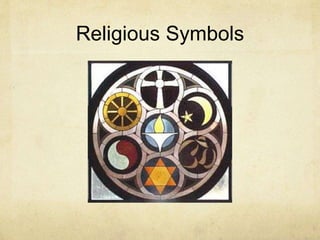
Religious Symbols
Rough Sketch of Major
Religions
Christianity, Islam, Buddhism and Hinduism represent
todays largest religions. Judaism is significant
because it informs and underlies the first two and is
therefore significant.
Buddhism and Hinduism are considered mystical or
esoteric (inward orientation) while Christianity, Islam
and Judaism (prophetic or scriptural) are exoteric
(outward orientation).
Judaism and Hinduism are ethnic without much of a
missionary emphasis.
Buddhism, Christianity and Islam are universal and
broadly focused with a genuine interest in missionary
work.
What is it All About
The student of Religion is actually a social
scientist.
The student of religion collects compelling
evidence to form a compelling argument about
what probably happened in history.
For the Christian student, the implications of this
study will help him to develop apologetic
responses to these religions and wisely decide
upon evangelistic approaches to reaching those
of non-Christian religions for the Christian faith.
Hinduism
Much of the material from this section onward was gleaned from the work of
Rick Rogers of Eastern Michigan University and John Bowker, author of the
text book assigned for this course.
Hinduism Today
Over 900 million members. Within the next 50
years that number may climb to over 1 billion.
Most Hindus live in modern India, but they are
represented throughout the world with more than
a million in Bangladesh, Pakistan, Sri Lanka,
Indonesia, South Africa, Kenya, The United
States and England.
Origin of the Terms
Neither the term Hindu nor Indian is indigenous. These terms were
used to talk about a people living around a river in northern India
which ancient scriptures called the Sindhu. The river flows out of the
Himalayan mountains into the Arabian sea and then into the Indian
Ocean through Pakistan. In the 5th century BC, Persians came into
modern Pakistan and thought the natives were calling the inhabitants
“Hindu.” In the 4th century BC Alexander came and thought that the
inhabitants were calling the river the indos and called the natives
“indoi” (Indian in english).
In 1000 AD Muslim missionaries arrived and (because of their
knowledge of the Greeks and Persians) called these people Indians
and first referred to their religion as Hindu. British in the 1800s added
“ism” to Hindu. Thus, Hinduism.
Thus we use the term Indian to refer to their race and ethnicity and
Hindu to refer to their religion.
Dravidian Beliefs
Hinduism appears to have birthed from the merging of two
peoples (Dravidians and Aryans). The Aryans (from
Russia) around 1500 BC came into northern India and
began conquering the Dravidians. Ultimately these two
groups intermarried and produced a new cultural and
ethnic group we call Indians. The religious blend of these
two peoples, we now call Hinduism.
The indigenous Dravidians had not broken society into
classes. They were pantheistic (revering their rivers as
goddesses and daughters of the sky father god and earth
mother god).
This was a fertility religion. The father was symbolized by
male genitalia and the mother was symbolized by female
genitalia as the sky produced rain and the earth received it
and brought life.
Aryan Beliefs
The Aryans had an extensive class system.
They also had an extensive religious mythology.
They were herdsman and so they thought of their
cattle and livestock as gifts from their gods.
They were polytheistic and called their gods
“Divas.” They needed to keep these divas happy
with sacrifices.
The blending of these two peoples resulted in
what is now called Hinduism or “Sanatana
Dharma.”
Caste System
The system is often called “Varna” (color) by Hindus. People fall into
different varnas that determine what their duties are. The color of
one’s skin can help determine which varna he should be.
Brahmins: priests, teachers and preachers.
Kshatriyas: kings, governors, warriors and soldiers.
Vaishyas: cattle herders, agriculturalists, businessmen, artisans and
merchants.
Shudras: laborers and service providers.
In modern times a new category of lower level Shudras was added
called “Pariah.” It is made up of very dark skinned people. The term
means “untouchables.” They called themselves “Dalits” (suppressed
ones) and today they make up the fishing industry and some have
come to be very successful and wealthy.
Hindu Scripture
Vedas and Upanishads – Written in Sanskrit (the
language of ancient Aryans). Vedas are mythologies
and ritual guides. Upanishads (teachings) wisdom
sayings. The Upanishads are much more used and
appreciated not only among Indians, but the world at
large.
Brahman – Mystical and universal (impersonal)
reality. Little can be known about it. Brahman is the
monist force (like in Star Wars).
Atman – The individual and personal reality about
which much can be known. Atman is thought of as
the soul of all beings.
Hindu Scripture (Cont.)
Samsara – Reincarnation (transmigration of the
atman). Samsara is an educational progression
for the soul as the atman is realized and known
better.
Karma – Law of cause and effect. Good actions
and good thoughts which will lead to a better life
after death in the atman’s next life. The reverse is
also true.
Moksha – Escape or graduation from Samsara.
It is when the true nature of the atman is
understood or realized. Moksha is very similar to
the idea of salvation.
2 Great Epics of India
Mahabharata – means “great Bharata nation.” A
story of civil war and unity which contains many
smaller stories. It is so loved that in India today
there is a soap opera based on these stories.
Ramayana – means “The Adventures of Rama.”
Rama is the central character. An evil demon has
abducted a princes’ wife. He must rescue her,
but on his journey he has many adventures. Also
a soap opera and graphic novel series.
Bhagavad Gita
Bhagavad Gita – means “Song of God.” Sometimes just called “The
Gita.” It is from the Mahabharata and is considered the popular bible
of Hinduism.
It is a discussion between a general known as Arjuna and his
servant, Krishna. The context is a decision of Arjuna’s given his
hatred of the current civil war. The general has killed so many former
friends and family members that he is ready to give up and resign.
This, however, involves giving up his Dharma. Arjuna would be
sinning against God and country.
Krishna (who is known to the reader as the voice of god) gives
arguments for Arjuna to continue. Arjuna will not listen and Krishna
must reveal his true identity and Arjuna regains his faith, recommits to
his Dharma and brings the war to resolution.
The application is that all people have a responsibility to act toward
others as we would have them act toward us. Otherwise imbalance
will result.
Kama Sutra
Sexual intercourse is a metaphor for the extreme
intimacy that can result between man and god.
Companionship, safety, pleasure and happiness
can happen with god as well.
Man and woman can get lost in the act and so
mankind can also get lost in the bliss of god’s
presence as we commune with him.
Yoga
Yogas – The means by which one may achieve enlightenment in Hinduism.
There are four major types of yogas despite there being as many yoga types as one can
imagine.
These first two are the esoteric yogas practiced by the societal elites.
Raja yoga – The royal way of graduating from Samsara. It is practiced by young men who
have devoted their whole lives to religion. Seeks to separate mind and body for the
purpose of helping the atman to be known.
Yana yoga – Seeks the same goal, with a sped up process. Yana means knowledge. It is
the deep meditative practice of older men who renounce their family lives for a hermitic
way of living to seek for the final truth – the identity of the atman.
Hindu philosopher, Shankara, introduced a form of this practice. He believed and taught
that while ritualistic practices were good enough for the majority of less enlightened Hindus
the ultimate knowledge of the atman was simple yet profound. Namely, the individual is the
atman. Once this is realized, personal god’s can be done away with and one may realize
that he himself is the infinite – is god. The atman is Brahman. Realizing this, will result in
graduation from Samsara.
Bhakti Yoga and
Henotheism
These are exoteric yogas and are practiced more by
the common Hindu. They are more accessible. The
exoteric yogas seek only a better rebirth rather than
moksha.
Bhakti yoga – Similar to western religions focusing
on worshipping a personal god. Every Bhakti cult
focuses on worshipping a specific god. Thus, every
Bhakti cult is monotheistic in a practical sense. Yet,
they would all admit that the specific god they
worship is not the only one, but would maintain that it
is the best one. This blending of polytheism and
monotheism has been termed “henotheism.”
Bhakti Cults and
Henotheism (Cont.)
Henotheism among Hindus emerges because one cannot
faithfully worship in a robust way all of the gods and so one
must worship one of the gods. Hindu henotheism is
inclusive (non-exclusive). This is in part because of the
Hindu commitment to relativity with respect to viewpoints
on life and truth.
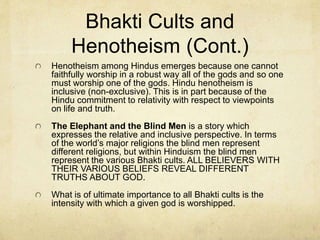
The Elephant and the Blind Men is a story which
expresses the relative and inclusive perspective. In terms
of the world’s major religions the blind men represent
different religions, but within Hinduism the blind men
represent the various Bhakti cults. ALL BELIEVERS WITH
THEIR VARIOUS BELIEFS REVEAL DIFFERENT
TRUTHS ABOUT GOD.
What is of ultimate importance to all Bhakti cults is the
intensity with which a given god is worshipped.
Bhakti Cults
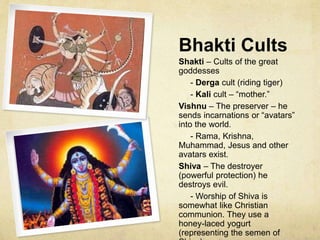
Shakti – Cults of the great
goddesses
- Derga cult (riding tiger)
- Kali cult – “mother.”
Vishnu – The preserver – he
sends incarnations or “avatars”
into the world.
- Rama, Krishna,
Muhammad, Jesus and other
avatars exist.
Shiva – The destroyer
(powerful protection) he
destroys evil.
- Worship of Shiva is
somewhat like Christian
communion. They use a
honey-laced yogurt
(representing the semen of
Karma Yoga
- Jainism
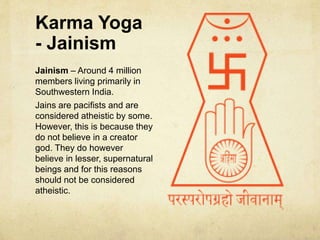
Jainism – Around 4 million
members living primarily in
Southwestern India.
Jains are pacifists and are
considered atheistic by some.
However, this is because they
do not believe in a creator
god. They do however
believe in lesser, supernatural
beings and for this reasons
should not be considered
atheistic.
Karma Yoga
- Sikhism
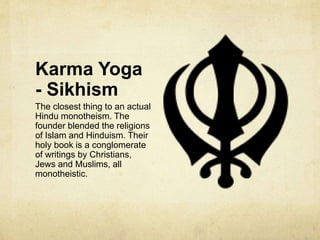
The closest thing to an actual
Hindu monotheism. The
founder blended the religions
of Islam and Hinduism. Their
holy book is a conglomerate
of writings by Christians,
Jews and Muslims, all
monotheistic.
Famous Modern Indian
Figures
Ramakrishna – died in 1886 and was a holy man in
southeast India who was a priest in the Kali cult who
claimed to have visions of Jesus, Moses, Muhammad and
others. They told him that all religions teach the same truth,
“to love our neighbors as ourselves.” He then engaged in
Karmic social justice for women and Dalits. This laid the
foundations for Indian religious pluralism.
Mohandas Karamchand Gandhi – Was a British trained
lawyer who returned to India and fought the apartheid
system. He taught that the caste system was a poison. He
was a part of the new independence movement that sought
to remove the British. In order to do this he used the Hindu
belief in non-violence to bolster the movement. They were
successful. India became an independent country in 1947.
He was assassinated by a Hindu nationalist.
Buddhism
Introduction
Buddhism is based on the thought of Siddhartha
Gautama who has come to be known as “the
Buddha” meaning “the enlightened one.” Buddha
lived in the Indian subcontinent from the 6th to 4th
century BC.
Buddhism is less like the Bhakti religions, and did
not accept the caste system or the belief in
personal gods. However, the story of Siddhartha
Gautama is extremely important and meaningful
to Buddhists. A grove of trees where Buddha is
supposed to have been born, still exists and is a
regular site for visiting pilgrims in Nepal.
Siddhartha’s Life
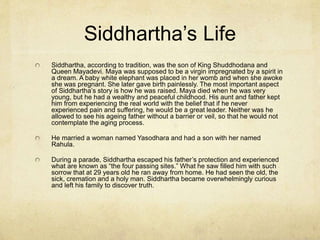
Siddhartha, according to tradition, was the son of King Shuddhodana and
Queen Mayadevi. Maya was supposed to be a virgin impregnated by a spirit in
a dream. A baby white elephant was placed in her womb and when she awoke
she was pregnant. She later gave birth painlessly. The most important aspect
of Siddhartha’s story is how he was raised. Maya died when he was very
young, but he had a wealthy and peaceful childhood. His aunt and father kept
him from experiencing the real world with the belief that if he never
experienced pain and suffering, he would be a great leader. Neither was he
allowed to see his ageing father without a barrier or veil, so that he would not
contemplate the aging process.
He married a woman named Yasodhara and had a son with her named
Rahula.
During a parade, Siddhartha escaped his father’s protection and experienced
what are known as “the four passing sites.” What he saw filled him with such
sorrow that at 29 years old he ran away from home. He had seen the old, the
sick, cremation and a holy man. Siddhartha became overwhelmingly curious
and left his family to discover truth.
Siddhartha’s
Experiences
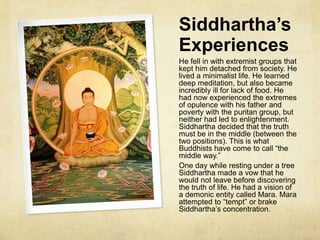
He fell in with extremist groups that
kept him detached from society. He
lived a minimalist life. He learned
deep meditation, but also became
incredibly ill for lack of food. He
had now experienced the extremes
of opulence with his father and
poverty with the puritan group, but
neither had led to enlightenment.
Siddhartha decided that the truth
must be in the middle (between the
two positions). This is what
Buddhists have come to call “the
middle way.”
One day while resting under a tree
Siddhartha made a vow that he
would not leave before discovering
the truth of life. He had a vision of
a demonic entity called Mara. Mara
attempted to “tempt” or brake
Siddhartha’s concentration.
Mara
Siddhartha succeeded in holding his concentration and keeping his
vow against Mara’s temptation. There were visions of wicked entities
attacking Siddhartha that are called “the five daughters of Mara.”
They are:
Pride
Greed
Fear
Ignorance
Desire
He overcame these carnal desires and became enlightened, or
achieved “Nirvana.” The attacks of Mara became nothing more than
flowers.
Reunion and
Establishment
On his journey to share what he had discovered he first
encountered some of his old friends from the extremist
group who had also abandoned the old way of life and as
Siddhartha explained his experience they made him their
new guru.
In Sarnath the first Buddhist school (or sangha) was
established. Here Siddhartha became known as (and was
first called) “The Buddha.” His father, wife and son all came
to Sarnath and became a part of his movement.
He taught his “middle way” for 45 years and established
many Sanghas before dying of food poisoning.
Siddhartha was cremated and his ashes were formed into
relics. There were thousands of these and they were
housed in what look like bells.
Scripture
Dhammapada – means path of truth. It is supposed to be the actual
teachings of Siddartha as recorded by his contemporary followers.
Buddha rejected the belief in personal gods and did not claim to be a
priest. He saw himself as a therapist or counselor.
The Buddha’s Dharma is recorded as a sermon that his followers
titled “The Four Noble Truths.” The four truth are:
Life is suffering – All temporary things and states are unsatisfying
Suffering is caused by desire – We are addicted to things and
status.
Desire can be annihilated – We have to want to beat desire.
Liberation from suffering and desire is found by following and
eight-fold path – it is not complicated.
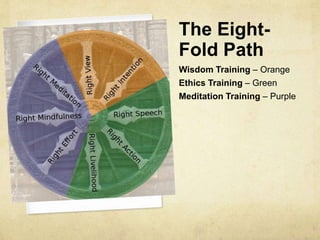
The Eight-
Fold Path
Wisdom Training – Orange
Ethics Training – Green
Meditation Training – Purple
Wisdom
The ability to see things as they are. Here are
two illusions:
The belief in permanence - The doctrine of
“anicca” is the teaching of impermanence. There
is an ongoing process of change. The pleasure
we experience is fleeting.
The belief in self – The doctrine of “anatta”
teaches that we are dependent on others for
meaning and there is no self that does not
change.
Ethics
Morality– The doctrine of “sila” means living a
moral life. This will result in good karma and love.
The precepts of sila are: do not kill, do not steal,
do not slander, do not misbehave sexually and
do not use mind-altering drugs. Sila will result in
virtues.
Meditation
Learning to focus on the moment rather than on
time. When this is accomplished all future
moments evaporate into eternity (not in time, but
in the moment). “Be in the moment.”
In the moment man will free himself from
suffering and achieve Nirvana.
The Monk and the Thugs – illustrates the
moment and nirvana.
Nirvana is not found in thinking, but in doing.
Two Great Branches:
Theravada
Dominant in Cambodia, Sri Lanka, Laos, Thailand and Burma.
Ashoka was an Indian leader who converted to Buddhism and built many
hospitals and monuments (some of which still exist) with portions of the
Dhammapada. He also sent missionaries north (to china) and south (to the
islands). This was the foundation for the two divisions of Theravada and
Mahayana. Theravada is claimed to be the authentic teaching of Siddhartha
and his disciples.
It has 100 million members (or 30% of Buddhism).
It is typically atheistic in that they do not believe in a personal creator. They
venerate specific figures in history who have achieved Nirvana. Siddhartha is
one of those venerated.
Their Scriptures are called the “Tripitaka” meaning “three baskets.” These
three baskets represent three collections of writings: wisdom material, ethical
materials and ritual materials.
There is a hierarchy of interpreters not entirely different from the Catholic
structure.
Two Great Branches:
Mahayana
Mahayana Buddhists resulted from the missionaries sent to China
who then sent missions to Japan and Korea. Those sent missionaries
to Russian, Europe and North America.
There are over 200 million Mahayanas dispersed in every country. It
consists of many schools and denominations. This has led to the
phrase “protestant Buddhism” by westerners.
It is somewhat theistic. Bodhisattvas are those who have achieved
the enlightened state for the purpose of helping others who are
bound in samsara. They gain omniscience and transcendence for the
benefit of others. They are saviors. “The Bodhisattva Vow” is a
commitment that the Bodhisattva will never leave samasara until
every blade of grass has achieved Nirvana.
Mahayana groups have varying scriptures but the “lotus sutra” is
one of the most popular.
Tibetan Buddhism
A Mahayana denomination, Tibetan Buddhism
is focused on colorful images and loud bells and
drums. It has 10 million followers and has many
bodhisattvas. They do not view them as saviors.
But, one of their bodhisattvas, Avalokiteshvara
(of greatest compassion) achieved Nirvana and
is regularly reincarnated into a supreme teaching
monk. He has reincarnated 13 times and is the
14th Dalai Lama.
Zen Buddhism
A Mahayana denomination, Zen Buddhism is focused on softness and quiet.
“Zen” means meditation in Japanese. The denomination is from a Chinese
Buddhism called “Chan.” It began in the 200s BC. Early Buddhist missionaries
were met with the indigenous Chinese religions of Confucianism and Taoism.
Taoists accepted it, but Confucians rejected it. Taoists were opposed to the
legalism of Confucianism. They saw Buddhism as similar in philosophy to their
own views.
One of there stories is of Buddha’s last sermon in which he had nothing else to
say and picked up a flower. The crowd was disappointed that Buddha realized
he had nothing else to say, but one man smiled at Buddha as an indication that
he “got it.” The ultimate truth was ineffable.
The central idea is that if one wishes to be enlightened he must realize that
teachers, preachers and scripture are useless. All doctrines should be
abandoned. Like the flower story, the ultimate truth cannot be taught, but
merely, realized.
Meditation in Zen Buddhism is focused on remaining as quiet as possible for
as long as possible in an attempt to rid thoughts of self and quiet the mind.
There are techniques for doing this like asking the question, “what is the sound
of one hand clapping?”
Judaism
Introduction
Judaism is the first of the Abrahamic religions.
There are 14 million Jews.
There are fewer members of the Jewish religion than
there are Jews.
The Jewish Bible is the TANAKH. Yohanan ben
Zakkai and his colleagues were permitted to remain
in Palestine after the 70 AD diaspora. He brought
together three sections of documents. The Torah, The
Prophets and The Writings. They are often in a
different order, but are the same books that are in the
Christian Old Testament. Observant Jews, would
never refer to the Tanakh as the Old Testament.
Abraham
The first of the patriarchs was Abraham. He live in Ur of the
Chaldees (ancient Iraq). They collected their property and
moved to Canaan.
Isaac and Ishmael
God promised that a great nation would come from Isaac,
but Muslims focus on the promise of Ishmael.
God promised that a great nation would also come from
Ishmael.
The Muslim tradition adds stories about Hagar and Ishmael
living in Mecca in Arabia and that Abraham occasionally
visited with them, treating them as a second family.
Isaac
Isaac is the second great patriarch and the
Jewish teaching about him is called the
“Akedah” or “the binding of Isaac.” It is the
story of Abraham’s almost sacrifice of Isaac as a
burnt offering, or “holocaust.”
The spot is supposed to be where the Ark of the
Covenant came to sit in the holy of holies.
In Muslim thought, this took place in Mecca
where the Kaaba stands. Rather than Isaac, it
was Ishmael who was almost sacrificed.
Jacob
Isaac later marries Rebekah and has two boys,
the youngest of which (Jacob) becomes the third
great patriarch. His name was changed to
“Israel” after wrestling with the angel.
Jacob has many children resulting in the 12
tribes. The Israelites move to Egypt and thrive
until the Royal relationship is forgotten and the
Israelites are enslaved.
Moses
Because of God’s displeasure at the Egyptians God raised
up the first and greatest of prophets according to both the
Islamic and Jewish traditions, namely, Moses.
He encountered God’s voice in the “burning bush” which
led him to confront Pharaoh. Ever after, Moses became the
dominant figure in the Jewish religion.
Moses is so important to Islam that after Allah, no one is
more spoken about.
Through ten plagues Moses was used by Yahweh to lead
the exodus of the Israelites out of Egypt. The last was the
Passover of the angel of death, that became the term used
for the Jewish holy day.
The Exodus
The Hebrews arrived at Mount Sinai where
Moses received the Torah. The Torah was
merely a nucleus of the law, but medieval
Talmudic traditions says there were 613
commandments. These are the moral directives
for Jews even until today.
After 40 years they entered Canaan as an army,
and there is archaeological evidence of this
invasion.
A flourishing Hebrew civilization developed called
Israel.
Three Kings
Saul was the first of the Israelite kings. He was a
warrior who battled the longest with the
Philistines.
During this struggle the story of David and
Goliath takes place.
David later becomes King, authors the Psalms
and is the model for a savior that will one day
come.
Solomon was the third great king and built the
first temple in Jerusalem. In 922 BC he died,
after which the kingdom was divided.
Kings
The nation was divided by civil war into Judah (in the south) and
Israel in the (north).
The Northern Kingdom lasted two centuries until the Assyrians
invaded and exiled the Israelites to Ashur and Nineveh filling Israel
with Assyrian families. The exile resulted in the belief in “The Ten
Lost Tribes.” They merely assimilated with the Assyrians.
Judah survived three centuries until the Babylonians invaded
destroying Judah and filling it with Babylonians families. They
destroyed the Temple and exiled the Jews to Babylon. The lack of a
temple led to the development of synagogues. Sacrifice was
replaced with the study of scripture and priests were replaced by
teachers. This new religion that could be practiced or taught in any
place at any time is what we call Judaism.
From the east, Persians dominated Babylonia and ultimately allowed
for exiles to return to their homelands. Those who went back, rebuilt
the temple.
The Jews
In the 400s Ezra helped to establish a theocratic
leadership with the Torah as the authoritative
document. Those living in Judea became known as
Jews.
In the 160s BC A Judean revolt forced the hand of
Antiochus Epiphanes (God Manifest) to release the
Jews from Syrian control. He had tried to force his
religion on the Jews by erecting a statue of Zeus in
the temple, and sacrificed a pig in the holy of holies.
This enraged the Jews and Judas Maccabeus led a
revolt that established their control of the land. This is
celebrated as Hanukkah.
A century later they were occupied by the romans in
the 60s BC. This control lasted until the 600s AD.
Under the Romans
The Romans allowed the Jews to freely practice their
religion. The main concern was the prevention of a revolt.
The entire area was known by the Romans as Palestine.
Two major parties emerged. The Sadducees were
associated with the temple priestly and sacrificial system.
They were close with the Romans. They were to collect the
Roman taxes.
The Pharisees represented the new, academic religion.
They were more interested in making the public at large
knowledgeable of the Torah. They believed that God also
gave Moses additional laws and a more robust moral code
for a future Israel that the Pharisees believed they were
experiencing.
Sub-groups
The Essenes – decided to separate themselves
from the Sadducees because they disagreed
with the association with the Romans. They led a
communal life in a place they called Qumran
near the Dead Sea. They were collectors of
documents in the form of scrolls including copies
of most books of the Bible (Old Testament). They
also had documents outlining their eschatological
beliefs.
The Nazarenes – Were followers of Jesus. They
group rapidly after the Crucifixion of Jesus. This
group ultimately became the world’s largest
religion.
The Roman Invasion
In 70 AD the Romans invaded Palestine bringing an
end to the 2nd temple period. They burnt the temple to
the ground and the temple has never been rebuilt.
Zealous Jews escaped intending to wear out the
Romans in the chase. They Essenes, seeing all of
this, hid their scrolls in caves and abandoned the site.
In 1947 the scrolls were discovered in 11 caves. The
Dead Sea Scrolls are housed in a museum to today.
The zealots hid atop a mountain called Masada. But
ultimately committed mass suicide as the relentless
Romans built a ramp of dirt and rock to reach them.
Diaspora
Romans then expelled Jews into the surrounding
countries to make the country a Roman state.
This was called the “Diaspora” or “dispersion.”
The religion of the Sadducees was snuffed out
and the practices of the Pharisees (stretching
back to the synagogue practices in Babylon)
became the standard Jewish practice.
Thus, today, synagogue worship and the study of
the Torah in an academic way is the modern
Judaism.
The Mishnah and Talmud
In addition to the Torah, the Pharisees had claimed
that God had given an oral law to Moses that had
survived orally and was intended for the Roman
period. It contained updated versions of the law that
would be more palatable under Roman rule. This oral
tradition was published in the 200s AD as “The
Mishnah.”
The Mishnah was expounded upon, however, and
many commentaries were written by rabbis on it.
Thus, in the 500s AD it was published as “The
Talmud.”
The Tanak (written) and the Talmud (oral) are
considered the “Dual Torah.”
Hasidic Judaism
Hasidic Judaism was led by Baal Shem Tov (1700-
1760) – His teaching was one of service to others
and God with enthusiastic prayer and dance.
They are in some ways the spiritual ancestors of the
Essenes.
These mystics wanted to move beyond the law and
focused on a personal relationship and experience of
God.
Like Hindus and Buddhists, these Jews believe that
in ecstatic moments they lose all ego and become
one without a self in the presence of God.
Zionism
Zionism, reinvigorated by Theodore Herzl in the
1890s, is based upon the promise of God to
Abraham that Israel would have the land and be
numerous.
They believe they have a right to geographic
Palestine in a way that supersedes laws and
legislation.
There are many forms of Zionism such as:
Liberal, Nationalist, Religious, Green, Neo, Post,
etc.
Modern Denominations:
Hasidic Judaism
Hasidic Jews have already been discussed, but
are very conservative. They were a reaction to
legalism.
They believe that God continues to reveal
Himself today in nature and the heart of man.
This can be accessed through meditation and
trance.
Modern Denominations:
Reformed Judaism
A progressive movement that is less observant of
holy days and is in favor of historical and literary
criticism of the Jewish Bible.
They first ordained female rabbis. Are in favor of
assimilation with other cultures and were the first
to have men, women and children to sit together
in services.
Modern Denominations:
Orthodox Judaism
Orthodox Judaism began as a reaction to
Reformed Judaism. Gender segregation
reserved the academic study of the Torah for
men.
Women and children were kept either in another
part of the building or seated behind the men in
services so as not to interrupt the serious and
academic study of the Torah.
They rarely question the miraculous stories of the
Bible.
Modern Denominations:
Conservative Judaism
Conservative Judaism is a more moderate sect
that stands between the two previously
mentioned groups. They practice some of the
more liberal ideas of the reformed group, but are
committed to maintaining there religious identity.
They constitute about half of American religious
Jews.
Reformed and Conservative Jews are dominant
among Judaism in America, but Orthodox
Judaism is the more influential in Israel.
However, secular Judaism is on the rise.
Modern Denominations:
Reconstructionism
Primarily an American Jewish sect which has not
substantially grown, Reconstructionist
Judaism maintains that all major religions are
equal in providing spiritual truth.
They, however, do attempt to maintain a religious
identity and avoid assimilation.
On doctrinal and social issues Reconstructionists
are very similar to Reformed Jews.
The Western Wall
The Western Wall (or wailing wall) – is the remnants of
the second temple which is revered and protected, is made
up of a medieval overlay atop the original ancient structure.
The Western Wall is a common site for pilgrims and
tourists and is also a location regularly used for the study
of the Torah. Prayers are written on paper and placed into
cracks and between rocks in the wall.
The Western Wall sits below the temple mount. Here there
are two Islamic sites. The most prominent of these is the
Dome of the Rock which sits around the rock that is
supposedly where Abraham was to sacrifice Isaac.
Muslims believe that the rock was a spot from which
Muhammad traveled to heaven. It is also where the Ark of
the Covenant was supposed to have rested.
Holy Days
The Sabbath – The moment God finished
creation
Rosh Hashanah – Jewish New Year celebration
Yom Kippur – Day of Atonement
The Passover – God’s salvation of Israel from
Egypt
Hanukkah – more of a non-biblical memorial.
Rituals
Circumcision – 8 days after birth (including naming)
Bar Mitzvah – Religious adulthood for boy
Bat Mitzvah – Religious adulthood for girl
(conservative and reformed)
Sitting Shiva – Grieving over a death of a family
member for seven days
Kosher – The observance of Jewish dietary concerns
Shema Prayer - Prayer three times a day beginning
with the affirmation that there is only one God.
Christianity
Introduction
Christianity has over 2 billion adherents.
Some have speculated that by 2050 only 1 in 5
Christians will be white. The claim is that the center of
Christianity will have moved to the southern
hemisphere.
African Christianity is growing rapidly in a
phenomenal way. In 1900 there were 10 million
Christians on the continent and by 2000 there were
360 million. David Barrett in the “World Christian
Encyclopedia,” hypothesizes that by 2025 there will
be 633 million.
Major Branches
Catholic
Independents
Protestants
Eastern Orthodox
Anglicans
There are over 33,000 denominations and over
300 traditions.
Scriptures
Catholic, Orthodox and Anglican Bibles have
three sections: The Old Testament, The New
Testament and the Inter-Testament.
Protestant Bibles do not include the apocryphal
intertestimental books.
Independent Bibles may have even more extra
books.
The Christian Old Testament has the same
books as the Jewish Bible.
The Gospels
Mike Licona has suggested (along with many others)
that the Gospels are works of Greco-Roman
biography. In this style, organizing historically true
material around a theme or purpose is permissible.
Thus, differences in chronology would not be
considered errors in the text, but permissible
historically accurate styles that exist for the purpose
of conveying a truth. For example, John explains that
his Gospel is written that readers might believe. Luke
explains that his is written so that you might know
what happened.
There are several general principles for determining
the historical reliability of a text. The principle of
embarrassment, enemy attestation, etc. The Gospels
pass these tests.
Inerrancy
In their book The Five Gospels, the Jesus Seminar names
several pillars for discovering the real teachings of Jesus.
Three of them are:
Naturalism - Anything that is supernatural in nature is
omitted.
Primacy of apocryphal gospels
Politically correct - If it isn't it will be omitted.
Because of this, they concluded that 82 percent of the red
letters are not reliable. Another 16 percent are in doubt.
Thus, 98 percent of what the Bible says Jesus said is
considered wrong.
Inerrancy (Cont.)
Another criticism is that man cannot produce a
book without errors. This objection makes two
mistakes:
Man can produce a book without errors - As
Norman Geisler points out, man is perfectly
capable of producing a book without errors.
Some phone and math books contain no errors.
Christians do not claim the Bible is written
merely by man – Christians claim that men
moved by the Spirit wrote an inerrant book.
The Trinity
Muslim apologists attack the idea of the Trinity by
demanding that it is a contradictory belief. However, it
is not a contradiction, but a mystery. If the trinity
doctrine taught, “One God and three Gods,” that
would be a contradiction. If it taught, “One person and
three persons,” that would likewise be a contradiction.
It, however, teaches, “One God who exists as three
persons.” This is mysterious, but not contradictory.
The Trinity has become more reasonable with the rise
of scientific cosmology. God the Father exists outside
of the created universe. God the Son became a part
of the physical universe as man. God the Holy Spirit
unites those in the physical universe with the Father.
The Resurrection
The following are common criticisms of the resurrection of
Jesus.
The swoon theory - This is the claim that Jesus
appearances are explained by the fact that he never died on
the cross.
Mass delusion - This is the claim that the followers of Jesus
thought he appeared to them because they were deluded.
Fabricated by the apostles - They made it all up.
Development of myth over time - The further away from the
event one gets the more legendary the details get.
Gutthold Lessing's "ugly broad ditch" - it is just too far in the
past to be believed.
The Expansion of the Early
Church
After the persecution of the church described at
the end of Acts 7, Christians began to spread
throughout the Mediterranean world. Acts 8:4
explains, “Those that were scattered abroad
went everywhere preaching the gospel.” By AD
70 Christianity was a very visible movement.
Comparisons in modern times: Elvis
impersonators or Apple Computers
Martyrdom
Early on, Christians experienced great
persecution. The book of 1 Peter for example
warns of (depending on the dating of the book)
the coming or already come persecution of
Christians in Asia, Bithynia, Cappadocia, etc.
There are many great stories of Brave Christian
martyrs that are often not heard among lay
believers.
Perpetua and Felicitous, Origen, etc.
Islam
Introduction
Islam – means “submission to God.”
Though Islam began for the promotion of Arabic people it
has become universal in presence.
It is the second largest religion in the world. There are 1.57
billion Muslims in the world.
It has the highest population (per capita) in the middle east
and northern Africa. 88.1% of Indonesia is Muslim.
Turkey, Iran and Egypt are rich with Muslims.
Only 18% of Muslims in the world speak Arabic.
It is growing in the U.S., Russia, and Europe.
Misunderstandings
Muhammad is not supposed to be the object of
Muslim worship.
The terms Islamic and Arabic are adjectives
and can not be pluralized.
Christianity, Islam and Judaism all point to the
God of Abraham as the one true God.
Muslims affirm the prophets of the Jews and
Christians including Jesus.
Muhammad: Early Life
Islam began when the Christian Byzantine and the
Persian Empires were in power.
In 570 AD Muhammad was born in Mecca. It was a
trading city between the heart of Byzantium (north)
and its kingdom (south).
His father and mother died very young. His uncle who
was the political head of his clan adopted him and
they traveled together around the area.
He saw the superiority of the monotheistic beliefs of
Christianity and Judaism.
Muhammad: And the Origin
of Islam
When he was in his mid 20s he was the head of a caravan group for
Khadijah, a widow who later became his wife (though she was 15
years older).
At 40 years old, he had a vision that he later identified as the angel
Gabriel. Muslims call this “the night of power.”
In 610 he received the beginning of his revelation that became the
Quran.
They were monotheistic verses and so Muhammad thought he was
losing his mind and wondered if he was being drawn to either
Judaism or Christianity. He shared this with his wife who then took
him to talk with her Christian cousin, Waraka ibn Nawfal.
She said that the whole thing sounded like the way God dealt with
other great prophets. It was her belief that Muhammad was receiving
his calling.
His closest friends also agreed that he was receiving a calling from
God. Nevertheless, those in Mecca were not sympathetic.
Backlash
If the people of Mecca were to embrace Muhammad’s
monotheistic beliefs they would not only be rejecting their own
religion, but destroying their own livelihood which was based
on the holy site of Kaaba being a tourist and pilgrim attraction.
It was supposed to house many gods.
In 619 Muhammad’s wife and uncle died. This meant that
those who wanted Muhammad dead felt free to accomplish
that task.
During Muhammad’s hiding he experienced another vision
referred to as, “the night journey” while he was praying at the
Kaaba. A winged horse with the head of a human took
Muhammad to the temple mount in Jerusalem. From there he
ascended a stair to heaven having conversations with
prophets and finally God.
Daily, Muhammad began to receive revelations of the Quran.
The Torah and The New
Testament
Clearly there are things in both the Old and New Testament
that conflict with the teachings of Muhammad. Thus,
Muslims believe that this is either the result of poor
transmission, or intentional deception. However, they
believe that the original text was the divine word of God in
pure form.
They saw many problems with allowing the transmission by
scribes and into various languages.
Muslims believe that the Quran was given for the purpose
of correcting the discrepancies that resulted from copyist
errors in the Bible.
Thus, Quran is only considered to be the true word of God
in Arabic.
The Quran & The Hadith
The writing of the Quran by an illiterate man in what is supposed to
be a beautiful way, is considered by Muslims to be a miracle.
It is also considered by Muslim apologists to be one of the great
evidences of the truth of the Muslim faith.
Muslims claim that God reveals himself to peoples miraculously in
ways that conform to what the people of the day appreciated. The
Egyptians liked the forms of illusion and what we might call magic
and so God worked through Moses thusly. The Jews appreciated
miraculous healings and so Jesus performed those kinds of miracles.
The supposed beauty of the Quran was supposed to conform to the
appreciation the world had for language and writings.
In an effort to ensure that the words of Muhammad were never
confused with the word of god, Muslims placed Muhammad’s own
words in the Hadith.
Jesus (Isa)
Jesus was a miracle worker who ascended to
heaven at the end of his life. Jesus was never
crucified.
Islam teaches that Jesus is not the incarnate
God.
He is not a savior.
These were mistakes or additions by later
scribes, according to Islam.
Muslims claim that when Jesus speaks of the
coming comforter, he is referring to Muhammad.
Medina
In 622 AD Muhammad and his followers traveled
to Yathrib in the north to escape persecution.
There were monotheists (both Christian and Jew)
in Yathrib and Muhammad organized what is
known as the Muslim Ummah (or Muslim nation).
This year became central to the Muslim faith and
calendar. The city became Medina. It is the
second most sacred city in Islam after Mecca.
Jerusalem is considered the 3rd.
The next year he married Aisha who was only 6
or 7 at the time.
The Return to Mecca and
Death of Muhammad
By 630 AD the Ummah had grown numerous
enough that Muhammad invaded Mecca and
they converted to Islam.
He cleansed the Kaaba of its idols.
In 632 AD he died in Medina.
His tomb/shrine became extremely revered.
Imams
An Imam is a Muslim leader, usually in terms of
the leading of worship in a Mosque. But early
Imams were also political leaders.
The communities of Islam became divided early
on as followers of these various Imams. They
were in conflict with each other for leadership
and power.
Originally they were divided between Shia and
those who came to be known as Sunni Muslims.
Sunni and Shia Muslims
Sunna – called themselves traditional Muslims.
Sunnism is often referred to as orthodox Islam.
They make up 85% of Muslims. Sunnis are not
divided into lower sects. There beliefs and rituals
are the same universally.
Shia – Often divide and protest each other. They
are made up of many different denominations.
They make up about 15% of Muslims.
The 12th Imam
Shia Muslims do not accept the first three Imams after
Muhammad to be legitimate. This is because they believe
that, Ali (Muhammad’s cousin and son-in-law), was the
only legitimate Imam to immediately follow Muhammad
since he had familial ties.
The twelve Imam was called Muhammad ibn al-Hasan, and
went missing in 874, but Shias believe he is in a sort of
hibernation and will reappear at the end of time with Jesus.
He will rule for a millennium.
At the time after his disappearance, Shia Muslims began to
follow a group of Muslim scribes and scholars as a
governing body. From among these leaders there emerged
a leader who was known as the “Ayatollah,” meaning, “sign
of god.” They were to continue in power until the return of
the 12th Imam.
Sufism
Sufism is a form of Islam that focused on the mystical
experience of love and knowledge that comes by having a
personal experience of God.
It was a response to the legalism of other forms.
Sufis believe that one should focus on the heart of Islam
that teaches the love and provision for others. This focus
on love for others and compassion was considered more
important than even the study of the Quran or adherents to
the leadership.
These teachings were very dangerous for Muslims. They
could be shunned or executed for these beliefs.
They even repeat the names of god until they speak in
tongues.
The Five Pillars of Islam
The Five Pillars are the most important practices
in Islam They are:
Shahadah – Reciting, “There is no god except
God, and Muhammad is his prophet.”
Salat – Praying five times every day
Zakat – Giving 2.5% to the poor
Sawm - Fasting during Ramadan
Hajj – Performing a one time pilgrimage to
Mecca
Jihad
Often thought of as the 6th pillar of Islam.
In theological terms it is thought of as an internal
spiritual battle.
They struggle not to commit sin, but sin is a bit
different in Islam.
Shirk is the worst kind of sin. It is the treatment of
anything other than Allah as a god or the belief in
atheism.
Any righteous struggle is a Jihad, but this includes
political and religious warfare.
Sharia
Sharia is the moral code for Muslims. It is
divided into the sections:
Compulsory – Such as some of the five pillars
Recommended – Such as procreation
Neutral – Such as fluency
Disapproved – Such as divorce
Forbidden – Such as alcohol
Responses: The Person of
Muhammad
The Nature of a Prophet - Impeccable Character
and Basically Sinless.
The Satanic Verses (53:19-23)
Inconsistency in Polygamy laws
Retaliation
Responses: The Quran
Divinely Unique Literary Style
Scientific Accuracy (errors: 23:14,18:86)
Changed lives
Responses: Allah
Voluntarism - God does not do what is right, what
God does is right (6:12)
Extreme Determinism - God is the one who leads
astray and the one who guides. He is the
"compeller," and "tyrant" and "haughty."
"Hence, Muslim scholars cannot avoid the
contradiction that God has logically opposed
characteristics by placing them outside his
essence within the mystery of his will." - Abdule
Saleeb, Answering Islam, p. 147.
Tools for Analysis
How to Evaluate World Views and
Religions
The Web of Belief
In his book by this title, W.V.O. Quine describes
one's worldview as a interconnected web of
beliefs with the most deeply held at the center.
Individual beliefs can be revised, but will influence
others.
Central beliefs would be things like belief in one's
own existence, the existence of others, and the
trustworthiness of the laws of logic.
Terms
Theoretical accommodation
Explanatory scope
Explanatory power
Plausibility
Livability
Coherence
Terms (Cont.)
Correspondence
Self-referential incoherence
Lack of livability
Falsification
The existential test
Radical ad hoc readjustment
Competitive competence test
Logical Fallacies
Wishful thinking - It's true because I hope so!
Confirmation bias - Cherry-picking evidence
Middle ground - If there are extremes be moderate
Design fallacy -If it is beautiful then it's true
Anecdotal evidence - Favoring first hand stories over
good evidence
Circular logic - A premise is based on the conclusion
Appeal to tradition - Believing only because of
tradition
Logical Fallacies (Cont.)
Appeal to popular belief - It's true because lots of
people believe it
Appeal to novelty - It's true because it's new/unusual
Appeal to authority - It's true because someone
respected says so
Appeal to Fear - It's true because if I'm wrong I might
be in danger
Burden of proof - It's true because no one can prove
it's not
Faulty dilemma - Incorrectly only seeing two options.

Major World Religions

  • 2.
  • 3.
    WHAT TO EXPECT AnIntroduction to the Study of World Religions An Exploration of Hinduism An Exploration of Buddhism An Exploration of Judaism An Exploration of Christianity An Exploration of Islam Tools for Worldview Evaluation
  • 4.
  • 5.
    Reasons for theStudy Healthy Citizen Relations Political Insight Healthy Interpersonal Relations Evangelism Apologetics Discipleship
  • 6.
    What is Religion AProper Definition
  • 7.
    What is Religion TheEnglish noun is derived from the Latin verb “Religio” – to bind or tie back. So one’s religion answers the question of how one is bound to the nature of reality or how one ties himself to matters of ultimate importance. Regardless of whether one considers himself “religious” in the common use of the phrase, everyone holds beliefs about matters of great importance.
  • 8.
    Types of Beliefs Definitionsparaphrased from Rick Rogers, Prof. World Religions (Eastern Michigan University) with the exception of atheism. Animism – All natural phenomenon are permeated by impersonal supernatural realities or qualities which are separate from matter, but still exist in the natural world. This idea maintains that these two entities (matter and spirit) are always interacting with each other in nature. Atheism – The belief that God does not exist (sometimes defined as the belief that there is a supernatural reality, but that no personal God exists).
  • 9.
    Types of Beliefs(Cont.) Atheism (cont.) - According to Pew Research data, "2.4% of American adults say they are atheists when asked about their religious identity." Although the literal definition of "atheist" is “a person who believes that God does not exist,”, 14% of those who call themselves atheists also say they believe in God or a universal spirit. That includes 5% who say they are “absolutely certain” about the existence of God or a universal spirit. (emphasis mine). Some eastern religions would be defined by some as atheistic even though they believe in some spiritual realities because they reject the idea of a personal god or gods. Theism – the belief that there are personal divine entities.
  • 10.
    Types of Beliefs(Cont. 2) Subcategories of Theism Pantheism – Similar to animism it holds that the spiritual permeates matter, and there are as many spirits as there are material things. It is different from animism in that these spirits are personal and man must have a personal relationship with some of these. Polytheism – The belief that there are only a few personal spirits (gods) but all of them must be worshipped and live together in a pantheon outside of the physical world. Monotheism – is the belief that there is only one God and this God lives outside of the physical world.
  • 11.
    Types of Beliefs(Cont. 3) Agnosticism – The admission of a lack of knowledge about God, gods or the supernatural (strong and soft). Monism – The idea that there is only one ultimate principle or impersonal force behind the natural and/or spiritual world. (Star Wars)
  • 12.
  • 13.
    5 Major WorldReligions Christianity Islam Judaism Buddhism Hinduism
  • 14.
  • 15.
    Rough Sketch ofMajor Religions Christianity, Islam, Buddhism and Hinduism represent todays largest religions. Judaism is significant because it informs and underlies the first two and is therefore significant. Buddhism and Hinduism are considered mystical or esoteric (inward orientation) while Christianity, Islam and Judaism (prophetic or scriptural) are exoteric (outward orientation). Judaism and Hinduism are ethnic without much of a missionary emphasis. Buddhism, Christianity and Islam are universal and broadly focused with a genuine interest in missionary work.
  • 16.
    What is itAll About The student of Religion is actually a social scientist. The student of religion collects compelling evidence to form a compelling argument about what probably happened in history. For the Christian student, the implications of this study will help him to develop apologetic responses to these religions and wisely decide upon evangelistic approaches to reaching those of non-Christian religions for the Christian faith.
  • 17.
    Hinduism Much of thematerial from this section onward was gleaned from the work of Rick Rogers of Eastern Michigan University and John Bowker, author of the text book assigned for this course.
  • 18.
    Hinduism Today Over 900million members. Within the next 50 years that number may climb to over 1 billion. Most Hindus live in modern India, but they are represented throughout the world with more than a million in Bangladesh, Pakistan, Sri Lanka, Indonesia, South Africa, Kenya, The United States and England.
  • 19.
    Origin of theTerms Neither the term Hindu nor Indian is indigenous. These terms were used to talk about a people living around a river in northern India which ancient scriptures called the Sindhu. The river flows out of the Himalayan mountains into the Arabian sea and then into the Indian Ocean through Pakistan. In the 5th century BC, Persians came into modern Pakistan and thought the natives were calling the inhabitants “Hindu.” In the 4th century BC Alexander came and thought that the inhabitants were calling the river the indos and called the natives “indoi” (Indian in english). In 1000 AD Muslim missionaries arrived and (because of their knowledge of the Greeks and Persians) called these people Indians and first referred to their religion as Hindu. British in the 1800s added “ism” to Hindu. Thus, Hinduism. Thus we use the term Indian to refer to their race and ethnicity and Hindu to refer to their religion.
  • 20.
    Dravidian Beliefs Hinduism appearsto have birthed from the merging of two peoples (Dravidians and Aryans). The Aryans (from Russia) around 1500 BC came into northern India and began conquering the Dravidians. Ultimately these two groups intermarried and produced a new cultural and ethnic group we call Indians. The religious blend of these two peoples, we now call Hinduism. The indigenous Dravidians had not broken society into classes. They were pantheistic (revering their rivers as goddesses and daughters of the sky father god and earth mother god). This was a fertility religion. The father was symbolized by male genitalia and the mother was symbolized by female genitalia as the sky produced rain and the earth received it and brought life.
  • 21.
    Aryan Beliefs The Aryanshad an extensive class system. They also had an extensive religious mythology. They were herdsman and so they thought of their cattle and livestock as gifts from their gods. They were polytheistic and called their gods “Divas.” They needed to keep these divas happy with sacrifices. The blending of these two peoples resulted in what is now called Hinduism or “Sanatana Dharma.”
  • 22.
    Caste System The systemis often called “Varna” (color) by Hindus. People fall into different varnas that determine what their duties are. The color of one’s skin can help determine which varna he should be. Brahmins: priests, teachers and preachers. Kshatriyas: kings, governors, warriors and soldiers. Vaishyas: cattle herders, agriculturalists, businessmen, artisans and merchants. Shudras: laborers and service providers. In modern times a new category of lower level Shudras was added called “Pariah.” It is made up of very dark skinned people. The term means “untouchables.” They called themselves “Dalits” (suppressed ones) and today they make up the fishing industry and some have come to be very successful and wealthy.
  • 23.
    Hindu Scripture Vedas andUpanishads – Written in Sanskrit (the language of ancient Aryans). Vedas are mythologies and ritual guides. Upanishads (teachings) wisdom sayings. The Upanishads are much more used and appreciated not only among Indians, but the world at large. Brahman – Mystical and universal (impersonal) reality. Little can be known about it. Brahman is the monist force (like in Star Wars). Atman – The individual and personal reality about which much can be known. Atman is thought of as the soul of all beings.
  • 24.
    Hindu Scripture (Cont.) Samsara– Reincarnation (transmigration of the atman). Samsara is an educational progression for the soul as the atman is realized and known better. Karma – Law of cause and effect. Good actions and good thoughts which will lead to a better life after death in the atman’s next life. The reverse is also true. Moksha – Escape or graduation from Samsara. It is when the true nature of the atman is understood or realized. Moksha is very similar to the idea of salvation.
  • 25.
    2 Great Epicsof India Mahabharata – means “great Bharata nation.” A story of civil war and unity which contains many smaller stories. It is so loved that in India today there is a soap opera based on these stories. Ramayana – means “The Adventures of Rama.” Rama is the central character. An evil demon has abducted a princes’ wife. He must rescue her, but on his journey he has many adventures. Also a soap opera and graphic novel series.
  • 26.
    Bhagavad Gita Bhagavad Gita– means “Song of God.” Sometimes just called “The Gita.” It is from the Mahabharata and is considered the popular bible of Hinduism. It is a discussion between a general known as Arjuna and his servant, Krishna. The context is a decision of Arjuna’s given his hatred of the current civil war. The general has killed so many former friends and family members that he is ready to give up and resign. This, however, involves giving up his Dharma. Arjuna would be sinning against God and country. Krishna (who is known to the reader as the voice of god) gives arguments for Arjuna to continue. Arjuna will not listen and Krishna must reveal his true identity and Arjuna regains his faith, recommits to his Dharma and brings the war to resolution. The application is that all people have a responsibility to act toward others as we would have them act toward us. Otherwise imbalance will result.
  • 27.
    Kama Sutra Sexual intercourseis a metaphor for the extreme intimacy that can result between man and god. Companionship, safety, pleasure and happiness can happen with god as well. Man and woman can get lost in the act and so mankind can also get lost in the bliss of god’s presence as we commune with him.
  • 28.
    Yoga Yogas – Themeans by which one may achieve enlightenment in Hinduism. There are four major types of yogas despite there being as many yoga types as one can imagine. These first two are the esoteric yogas practiced by the societal elites. Raja yoga – The royal way of graduating from Samsara. It is practiced by young men who have devoted their whole lives to religion. Seeks to separate mind and body for the purpose of helping the atman to be known. Yana yoga – Seeks the same goal, with a sped up process. Yana means knowledge. It is the deep meditative practice of older men who renounce their family lives for a hermitic way of living to seek for the final truth – the identity of the atman. Hindu philosopher, Shankara, introduced a form of this practice. He believed and taught that while ritualistic practices were good enough for the majority of less enlightened Hindus the ultimate knowledge of the atman was simple yet profound. Namely, the individual is the atman. Once this is realized, personal god’s can be done away with and one may realize that he himself is the infinite – is god. The atman is Brahman. Realizing this, will result in graduation from Samsara.
  • 29.
    Bhakti Yoga and Henotheism Theseare exoteric yogas and are practiced more by the common Hindu. They are more accessible. The exoteric yogas seek only a better rebirth rather than moksha. Bhakti yoga – Similar to western religions focusing on worshipping a personal god. Every Bhakti cult focuses on worshipping a specific god. Thus, every Bhakti cult is monotheistic in a practical sense. Yet, they would all admit that the specific god they worship is not the only one, but would maintain that it is the best one. This blending of polytheism and monotheism has been termed “henotheism.”
  • 30.
    Bhakti Cults and Henotheism(Cont.) Henotheism among Hindus emerges because one cannot faithfully worship in a robust way all of the gods and so one must worship one of the gods. Hindu henotheism is inclusive (non-exclusive). This is in part because of the Hindu commitment to relativity with respect to viewpoints on life and truth. The Elephant and the Blind Men is a story which expresses the relative and inclusive perspective. In terms of the world’s major religions the blind men represent different religions, but within Hinduism the blind men represent the various Bhakti cults. ALL BELIEVERS WITH THEIR VARIOUS BELIEFS REVEAL DIFFERENT TRUTHS ABOUT GOD. What is of ultimate importance to all Bhakti cults is the intensity with which a given god is worshipped.
  • 31.
    Bhakti Cults Shakti –Cults of the great goddesses - Derga cult (riding tiger) - Kali cult – “mother.” Vishnu – The preserver – he sends incarnations or “avatars” into the world. - Rama, Krishna, Muhammad, Jesus and other avatars exist. Shiva – The destroyer (powerful protection) he destroys evil. - Worship of Shiva is somewhat like Christian communion. They use a honey-laced yogurt (representing the semen of
  • 32.
    Karma Yoga - Jainism Jainism– Around 4 million members living primarily in Southwestern India. Jains are pacifists and are considered atheistic by some. However, this is because they do not believe in a creator god. They do however believe in lesser, supernatural beings and for this reasons should not be considered atheistic.
  • 33.
    Karma Yoga - Sikhism Theclosest thing to an actual Hindu monotheism. The founder blended the religions of Islam and Hinduism. Their holy book is a conglomerate of writings by Christians, Jews and Muslims, all monotheistic.
  • 34.
    Famous Modern Indian Figures Ramakrishna– died in 1886 and was a holy man in southeast India who was a priest in the Kali cult who claimed to have visions of Jesus, Moses, Muhammad and others. They told him that all religions teach the same truth, “to love our neighbors as ourselves.” He then engaged in Karmic social justice for women and Dalits. This laid the foundations for Indian religious pluralism. Mohandas Karamchand Gandhi – Was a British trained lawyer who returned to India and fought the apartheid system. He taught that the caste system was a poison. He was a part of the new independence movement that sought to remove the British. In order to do this he used the Hindu belief in non-violence to bolster the movement. They were successful. India became an independent country in 1947. He was assassinated by a Hindu nationalist.
  • 35.
  • 36.
    Introduction Buddhism is basedon the thought of Siddhartha Gautama who has come to be known as “the Buddha” meaning “the enlightened one.” Buddha lived in the Indian subcontinent from the 6th to 4th century BC. Buddhism is less like the Bhakti religions, and did not accept the caste system or the belief in personal gods. However, the story of Siddhartha Gautama is extremely important and meaningful to Buddhists. A grove of trees where Buddha is supposed to have been born, still exists and is a regular site for visiting pilgrims in Nepal.
  • 37.
    Siddhartha’s Life Siddhartha, accordingto tradition, was the son of King Shuddhodana and Queen Mayadevi. Maya was supposed to be a virgin impregnated by a spirit in a dream. A baby white elephant was placed in her womb and when she awoke she was pregnant. She later gave birth painlessly. The most important aspect of Siddhartha’s story is how he was raised. Maya died when he was very young, but he had a wealthy and peaceful childhood. His aunt and father kept him from experiencing the real world with the belief that if he never experienced pain and suffering, he would be a great leader. Neither was he allowed to see his ageing father without a barrier or veil, so that he would not contemplate the aging process. He married a woman named Yasodhara and had a son with her named Rahula. During a parade, Siddhartha escaped his father’s protection and experienced what are known as “the four passing sites.” What he saw filled him with such sorrow that at 29 years old he ran away from home. He had seen the old, the sick, cremation and a holy man. Siddhartha became overwhelmingly curious and left his family to discover truth.
  • 38.
    Siddhartha’s Experiences He fell inwith extremist groups that kept him detached from society. He lived a minimalist life. He learned deep meditation, but also became incredibly ill for lack of food. He had now experienced the extremes of opulence with his father and poverty with the puritan group, but neither had led to enlightenment. Siddhartha decided that the truth must be in the middle (between the two positions). This is what Buddhists have come to call “the middle way.” One day while resting under a tree Siddhartha made a vow that he would not leave before discovering the truth of life. He had a vision of a demonic entity called Mara. Mara attempted to “tempt” or brake Siddhartha’s concentration.
  • 39.
    Mara Siddhartha succeeded inholding his concentration and keeping his vow against Mara’s temptation. There were visions of wicked entities attacking Siddhartha that are called “the five daughters of Mara.” They are: Pride Greed Fear Ignorance Desire He overcame these carnal desires and became enlightened, or achieved “Nirvana.” The attacks of Mara became nothing more than flowers.
  • 40.
    Reunion and Establishment On hisjourney to share what he had discovered he first encountered some of his old friends from the extremist group who had also abandoned the old way of life and as Siddhartha explained his experience they made him their new guru. In Sarnath the first Buddhist school (or sangha) was established. Here Siddhartha became known as (and was first called) “The Buddha.” His father, wife and son all came to Sarnath and became a part of his movement. He taught his “middle way” for 45 years and established many Sanghas before dying of food poisoning. Siddhartha was cremated and his ashes were formed into relics. There were thousands of these and they were housed in what look like bells.
  • 41.
    Scripture Dhammapada – meanspath of truth. It is supposed to be the actual teachings of Siddartha as recorded by his contemporary followers. Buddha rejected the belief in personal gods and did not claim to be a priest. He saw himself as a therapist or counselor. The Buddha’s Dharma is recorded as a sermon that his followers titled “The Four Noble Truths.” The four truth are: Life is suffering – All temporary things and states are unsatisfying Suffering is caused by desire – We are addicted to things and status. Desire can be annihilated – We have to want to beat desire. Liberation from suffering and desire is found by following and eight-fold path – it is not complicated.
  • 42.
    The Eight- Fold Path WisdomTraining – Orange Ethics Training – Green Meditation Training – Purple
  • 43.
    Wisdom The ability tosee things as they are. Here are two illusions: The belief in permanence - The doctrine of “anicca” is the teaching of impermanence. There is an ongoing process of change. The pleasure we experience is fleeting. The belief in self – The doctrine of “anatta” teaches that we are dependent on others for meaning and there is no self that does not change.
  • 44.
    Ethics Morality– The doctrineof “sila” means living a moral life. This will result in good karma and love. The precepts of sila are: do not kill, do not steal, do not slander, do not misbehave sexually and do not use mind-altering drugs. Sila will result in virtues.
  • 45.
    Meditation Learning to focuson the moment rather than on time. When this is accomplished all future moments evaporate into eternity (not in time, but in the moment). “Be in the moment.” In the moment man will free himself from suffering and achieve Nirvana. The Monk and the Thugs – illustrates the moment and nirvana. Nirvana is not found in thinking, but in doing.
  • 46.
    Two Great Branches: Theravada Dominantin Cambodia, Sri Lanka, Laos, Thailand and Burma. Ashoka was an Indian leader who converted to Buddhism and built many hospitals and monuments (some of which still exist) with portions of the Dhammapada. He also sent missionaries north (to china) and south (to the islands). This was the foundation for the two divisions of Theravada and Mahayana. Theravada is claimed to be the authentic teaching of Siddhartha and his disciples. It has 100 million members (or 30% of Buddhism). It is typically atheistic in that they do not believe in a personal creator. They venerate specific figures in history who have achieved Nirvana. Siddhartha is one of those venerated. Their Scriptures are called the “Tripitaka” meaning “three baskets.” These three baskets represent three collections of writings: wisdom material, ethical materials and ritual materials. There is a hierarchy of interpreters not entirely different from the Catholic structure.
  • 47.
    Two Great Branches: Mahayana MahayanaBuddhists resulted from the missionaries sent to China who then sent missions to Japan and Korea. Those sent missionaries to Russian, Europe and North America. There are over 200 million Mahayanas dispersed in every country. It consists of many schools and denominations. This has led to the phrase “protestant Buddhism” by westerners. It is somewhat theistic. Bodhisattvas are those who have achieved the enlightened state for the purpose of helping others who are bound in samsara. They gain omniscience and transcendence for the benefit of others. They are saviors. “The Bodhisattva Vow” is a commitment that the Bodhisattva will never leave samasara until every blade of grass has achieved Nirvana. Mahayana groups have varying scriptures but the “lotus sutra” is one of the most popular.
  • 48.
    Tibetan Buddhism A Mahayanadenomination, Tibetan Buddhism is focused on colorful images and loud bells and drums. It has 10 million followers and has many bodhisattvas. They do not view them as saviors. But, one of their bodhisattvas, Avalokiteshvara (of greatest compassion) achieved Nirvana and is regularly reincarnated into a supreme teaching monk. He has reincarnated 13 times and is the 14th Dalai Lama.
  • 49.
    Zen Buddhism A Mahayanadenomination, Zen Buddhism is focused on softness and quiet. “Zen” means meditation in Japanese. The denomination is from a Chinese Buddhism called “Chan.” It began in the 200s BC. Early Buddhist missionaries were met with the indigenous Chinese religions of Confucianism and Taoism. Taoists accepted it, but Confucians rejected it. Taoists were opposed to the legalism of Confucianism. They saw Buddhism as similar in philosophy to their own views. One of there stories is of Buddha’s last sermon in which he had nothing else to say and picked up a flower. The crowd was disappointed that Buddha realized he had nothing else to say, but one man smiled at Buddha as an indication that he “got it.” The ultimate truth was ineffable. The central idea is that if one wishes to be enlightened he must realize that teachers, preachers and scripture are useless. All doctrines should be abandoned. Like the flower story, the ultimate truth cannot be taught, but merely, realized. Meditation in Zen Buddhism is focused on remaining as quiet as possible for as long as possible in an attempt to rid thoughts of self and quiet the mind. There are techniques for doing this like asking the question, “what is the sound of one hand clapping?”
  • 50.
  • 51.
    Introduction Judaism is thefirst of the Abrahamic religions. There are 14 million Jews. There are fewer members of the Jewish religion than there are Jews. The Jewish Bible is the TANAKH. Yohanan ben Zakkai and his colleagues were permitted to remain in Palestine after the 70 AD diaspora. He brought together three sections of documents. The Torah, The Prophets and The Writings. They are often in a different order, but are the same books that are in the Christian Old Testament. Observant Jews, would never refer to the Tanakh as the Old Testament.
  • 52.
    Abraham The first ofthe patriarchs was Abraham. He live in Ur of the Chaldees (ancient Iraq). They collected their property and moved to Canaan. Isaac and Ishmael God promised that a great nation would come from Isaac, but Muslims focus on the promise of Ishmael. God promised that a great nation would also come from Ishmael. The Muslim tradition adds stories about Hagar and Ishmael living in Mecca in Arabia and that Abraham occasionally visited with them, treating them as a second family.
  • 53.
    Isaac Isaac is thesecond great patriarch and the Jewish teaching about him is called the “Akedah” or “the binding of Isaac.” It is the story of Abraham’s almost sacrifice of Isaac as a burnt offering, or “holocaust.” The spot is supposed to be where the Ark of the Covenant came to sit in the holy of holies. In Muslim thought, this took place in Mecca where the Kaaba stands. Rather than Isaac, it was Ishmael who was almost sacrificed.
  • 54.
    Jacob Isaac later marriesRebekah and has two boys, the youngest of which (Jacob) becomes the third great patriarch. His name was changed to “Israel” after wrestling with the angel. Jacob has many children resulting in the 12 tribes. The Israelites move to Egypt and thrive until the Royal relationship is forgotten and the Israelites are enslaved.
  • 55.
    Moses Because of God’sdispleasure at the Egyptians God raised up the first and greatest of prophets according to both the Islamic and Jewish traditions, namely, Moses. He encountered God’s voice in the “burning bush” which led him to confront Pharaoh. Ever after, Moses became the dominant figure in the Jewish religion. Moses is so important to Islam that after Allah, no one is more spoken about. Through ten plagues Moses was used by Yahweh to lead the exodus of the Israelites out of Egypt. The last was the Passover of the angel of death, that became the term used for the Jewish holy day.
  • 56.
    The Exodus The Hebrewsarrived at Mount Sinai where Moses received the Torah. The Torah was merely a nucleus of the law, but medieval Talmudic traditions says there were 613 commandments. These are the moral directives for Jews even until today. After 40 years they entered Canaan as an army, and there is archaeological evidence of this invasion. A flourishing Hebrew civilization developed called Israel.
  • 57.
    Three Kings Saul wasthe first of the Israelite kings. He was a warrior who battled the longest with the Philistines. During this struggle the story of David and Goliath takes place. David later becomes King, authors the Psalms and is the model for a savior that will one day come. Solomon was the third great king and built the first temple in Jerusalem. In 922 BC he died, after which the kingdom was divided.
  • 58.
    Kings The nation wasdivided by civil war into Judah (in the south) and Israel in the (north). The Northern Kingdom lasted two centuries until the Assyrians invaded and exiled the Israelites to Ashur and Nineveh filling Israel with Assyrian families. The exile resulted in the belief in “The Ten Lost Tribes.” They merely assimilated with the Assyrians. Judah survived three centuries until the Babylonians invaded destroying Judah and filling it with Babylonians families. They destroyed the Temple and exiled the Jews to Babylon. The lack of a temple led to the development of synagogues. Sacrifice was replaced with the study of scripture and priests were replaced by teachers. This new religion that could be practiced or taught in any place at any time is what we call Judaism. From the east, Persians dominated Babylonia and ultimately allowed for exiles to return to their homelands. Those who went back, rebuilt the temple.
  • 59.
    The Jews In the400s Ezra helped to establish a theocratic leadership with the Torah as the authoritative document. Those living in Judea became known as Jews. In the 160s BC A Judean revolt forced the hand of Antiochus Epiphanes (God Manifest) to release the Jews from Syrian control. He had tried to force his religion on the Jews by erecting a statue of Zeus in the temple, and sacrificed a pig in the holy of holies. This enraged the Jews and Judas Maccabeus led a revolt that established their control of the land. This is celebrated as Hanukkah. A century later they were occupied by the romans in the 60s BC. This control lasted until the 600s AD.
  • 60.
    Under the Romans TheRomans allowed the Jews to freely practice their religion. The main concern was the prevention of a revolt. The entire area was known by the Romans as Palestine. Two major parties emerged. The Sadducees were associated with the temple priestly and sacrificial system. They were close with the Romans. They were to collect the Roman taxes. The Pharisees represented the new, academic religion. They were more interested in making the public at large knowledgeable of the Torah. They believed that God also gave Moses additional laws and a more robust moral code for a future Israel that the Pharisees believed they were experiencing.
  • 61.
    Sub-groups The Essenes –decided to separate themselves from the Sadducees because they disagreed with the association with the Romans. They led a communal life in a place they called Qumran near the Dead Sea. They were collectors of documents in the form of scrolls including copies of most books of the Bible (Old Testament). They also had documents outlining their eschatological beliefs. The Nazarenes – Were followers of Jesus. They group rapidly after the Crucifixion of Jesus. This group ultimately became the world’s largest religion.
  • 62.
    The Roman Invasion In70 AD the Romans invaded Palestine bringing an end to the 2nd temple period. They burnt the temple to the ground and the temple has never been rebuilt. Zealous Jews escaped intending to wear out the Romans in the chase. They Essenes, seeing all of this, hid their scrolls in caves and abandoned the site. In 1947 the scrolls were discovered in 11 caves. The Dead Sea Scrolls are housed in a museum to today. The zealots hid atop a mountain called Masada. But ultimately committed mass suicide as the relentless Romans built a ramp of dirt and rock to reach them.
  • 63.
    Diaspora Romans then expelledJews into the surrounding countries to make the country a Roman state. This was called the “Diaspora” or “dispersion.” The religion of the Sadducees was snuffed out and the practices of the Pharisees (stretching back to the synagogue practices in Babylon) became the standard Jewish practice. Thus, today, synagogue worship and the study of the Torah in an academic way is the modern Judaism.
  • 64.
    The Mishnah andTalmud In addition to the Torah, the Pharisees had claimed that God had given an oral law to Moses that had survived orally and was intended for the Roman period. It contained updated versions of the law that would be more palatable under Roman rule. This oral tradition was published in the 200s AD as “The Mishnah.” The Mishnah was expounded upon, however, and many commentaries were written by rabbis on it. Thus, in the 500s AD it was published as “The Talmud.” The Tanak (written) and the Talmud (oral) are considered the “Dual Torah.”
  • 65.
    Hasidic Judaism Hasidic Judaismwas led by Baal Shem Tov (1700- 1760) – His teaching was one of service to others and God with enthusiastic prayer and dance. They are in some ways the spiritual ancestors of the Essenes. These mystics wanted to move beyond the law and focused on a personal relationship and experience of God. Like Hindus and Buddhists, these Jews believe that in ecstatic moments they lose all ego and become one without a self in the presence of God.
  • 66.
    Zionism Zionism, reinvigorated byTheodore Herzl in the 1890s, is based upon the promise of God to Abraham that Israel would have the land and be numerous. They believe they have a right to geographic Palestine in a way that supersedes laws and legislation. There are many forms of Zionism such as: Liberal, Nationalist, Religious, Green, Neo, Post, etc.
  • 67.
    Modern Denominations: Hasidic Judaism HasidicJews have already been discussed, but are very conservative. They were a reaction to legalism. They believe that God continues to reveal Himself today in nature and the heart of man. This can be accessed through meditation and trance.
  • 68.
    Modern Denominations: Reformed Judaism Aprogressive movement that is less observant of holy days and is in favor of historical and literary criticism of the Jewish Bible. They first ordained female rabbis. Are in favor of assimilation with other cultures and were the first to have men, women and children to sit together in services.
  • 69.
    Modern Denominations: Orthodox Judaism OrthodoxJudaism began as a reaction to Reformed Judaism. Gender segregation reserved the academic study of the Torah for men. Women and children were kept either in another part of the building or seated behind the men in services so as not to interrupt the serious and academic study of the Torah. They rarely question the miraculous stories of the Bible.
  • 70.
    Modern Denominations: Conservative Judaism ConservativeJudaism is a more moderate sect that stands between the two previously mentioned groups. They practice some of the more liberal ideas of the reformed group, but are committed to maintaining there religious identity. They constitute about half of American religious Jews. Reformed and Conservative Jews are dominant among Judaism in America, but Orthodox Judaism is the more influential in Israel. However, secular Judaism is on the rise.
  • 71.
    Modern Denominations: Reconstructionism Primarily anAmerican Jewish sect which has not substantially grown, Reconstructionist Judaism maintains that all major religions are equal in providing spiritual truth. They, however, do attempt to maintain a religious identity and avoid assimilation. On doctrinal and social issues Reconstructionists are very similar to Reformed Jews.
  • 72.
    The Western Wall TheWestern Wall (or wailing wall) – is the remnants of the second temple which is revered and protected, is made up of a medieval overlay atop the original ancient structure. The Western Wall is a common site for pilgrims and tourists and is also a location regularly used for the study of the Torah. Prayers are written on paper and placed into cracks and between rocks in the wall. The Western Wall sits below the temple mount. Here there are two Islamic sites. The most prominent of these is the Dome of the Rock which sits around the rock that is supposedly where Abraham was to sacrifice Isaac. Muslims believe that the rock was a spot from which Muhammad traveled to heaven. It is also where the Ark of the Covenant was supposed to have rested.
  • 73.
    Holy Days The Sabbath– The moment God finished creation Rosh Hashanah – Jewish New Year celebration Yom Kippur – Day of Atonement The Passover – God’s salvation of Israel from Egypt Hanukkah – more of a non-biblical memorial.
  • 74.
    Rituals Circumcision – 8days after birth (including naming) Bar Mitzvah – Religious adulthood for boy Bat Mitzvah – Religious adulthood for girl (conservative and reformed) Sitting Shiva – Grieving over a death of a family member for seven days Kosher – The observance of Jewish dietary concerns Shema Prayer - Prayer three times a day beginning with the affirmation that there is only one God.
  • 75.
  • 76.
    Introduction Christianity has over2 billion adherents. Some have speculated that by 2050 only 1 in 5 Christians will be white. The claim is that the center of Christianity will have moved to the southern hemisphere. African Christianity is growing rapidly in a phenomenal way. In 1900 there were 10 million Christians on the continent and by 2000 there were 360 million. David Barrett in the “World Christian Encyclopedia,” hypothesizes that by 2025 there will be 633 million.
  • 77.
    Major Branches Catholic Independents Protestants Eastern Orthodox Anglicans Thereare over 33,000 denominations and over 300 traditions.
  • 78.
    Scriptures Catholic, Orthodox andAnglican Bibles have three sections: The Old Testament, The New Testament and the Inter-Testament. Protestant Bibles do not include the apocryphal intertestimental books. Independent Bibles may have even more extra books. The Christian Old Testament has the same books as the Jewish Bible.
  • 79.
    The Gospels Mike Liconahas suggested (along with many others) that the Gospels are works of Greco-Roman biography. In this style, organizing historically true material around a theme or purpose is permissible. Thus, differences in chronology would not be considered errors in the text, but permissible historically accurate styles that exist for the purpose of conveying a truth. For example, John explains that his Gospel is written that readers might believe. Luke explains that his is written so that you might know what happened. There are several general principles for determining the historical reliability of a text. The principle of embarrassment, enemy attestation, etc. The Gospels pass these tests.
  • 80.
    Inerrancy In their bookThe Five Gospels, the Jesus Seminar names several pillars for discovering the real teachings of Jesus. Three of them are: Naturalism - Anything that is supernatural in nature is omitted. Primacy of apocryphal gospels Politically correct - If it isn't it will be omitted. Because of this, they concluded that 82 percent of the red letters are not reliable. Another 16 percent are in doubt. Thus, 98 percent of what the Bible says Jesus said is considered wrong.
  • 81.
    Inerrancy (Cont.) Another criticismis that man cannot produce a book without errors. This objection makes two mistakes: Man can produce a book without errors - As Norman Geisler points out, man is perfectly capable of producing a book without errors. Some phone and math books contain no errors. Christians do not claim the Bible is written merely by man – Christians claim that men moved by the Spirit wrote an inerrant book.
  • 82.
    The Trinity Muslim apologistsattack the idea of the Trinity by demanding that it is a contradictory belief. However, it is not a contradiction, but a mystery. If the trinity doctrine taught, “One God and three Gods,” that would be a contradiction. If it taught, “One person and three persons,” that would likewise be a contradiction. It, however, teaches, “One God who exists as three persons.” This is mysterious, but not contradictory. The Trinity has become more reasonable with the rise of scientific cosmology. God the Father exists outside of the created universe. God the Son became a part of the physical universe as man. God the Holy Spirit unites those in the physical universe with the Father.
  • 83.
    The Resurrection The followingare common criticisms of the resurrection of Jesus. The swoon theory - This is the claim that Jesus appearances are explained by the fact that he never died on the cross. Mass delusion - This is the claim that the followers of Jesus thought he appeared to them because they were deluded. Fabricated by the apostles - They made it all up. Development of myth over time - The further away from the event one gets the more legendary the details get. Gutthold Lessing's "ugly broad ditch" - it is just too far in the past to be believed.
  • 84.
    The Expansion ofthe Early Church After the persecution of the church described at the end of Acts 7, Christians began to spread throughout the Mediterranean world. Acts 8:4 explains, “Those that were scattered abroad went everywhere preaching the gospel.” By AD 70 Christianity was a very visible movement. Comparisons in modern times: Elvis impersonators or Apple Computers
  • 85.
    Martyrdom Early on, Christiansexperienced great persecution. The book of 1 Peter for example warns of (depending on the dating of the book) the coming or already come persecution of Christians in Asia, Bithynia, Cappadocia, etc. There are many great stories of Brave Christian martyrs that are often not heard among lay believers. Perpetua and Felicitous, Origen, etc.
  • 86.
  • 87.
    Introduction Islam – means“submission to God.” Though Islam began for the promotion of Arabic people it has become universal in presence. It is the second largest religion in the world. There are 1.57 billion Muslims in the world. It has the highest population (per capita) in the middle east and northern Africa. 88.1% of Indonesia is Muslim. Turkey, Iran and Egypt are rich with Muslims. Only 18% of Muslims in the world speak Arabic. It is growing in the U.S., Russia, and Europe.
  • 88.
    Misunderstandings Muhammad is notsupposed to be the object of Muslim worship. The terms Islamic and Arabic are adjectives and can not be pluralized. Christianity, Islam and Judaism all point to the God of Abraham as the one true God. Muslims affirm the prophets of the Jews and Christians including Jesus.
  • 89.
    Muhammad: Early Life Islambegan when the Christian Byzantine and the Persian Empires were in power. In 570 AD Muhammad was born in Mecca. It was a trading city between the heart of Byzantium (north) and its kingdom (south). His father and mother died very young. His uncle who was the political head of his clan adopted him and they traveled together around the area. He saw the superiority of the monotheistic beliefs of Christianity and Judaism.
  • 90.
    Muhammad: And theOrigin of Islam When he was in his mid 20s he was the head of a caravan group for Khadijah, a widow who later became his wife (though she was 15 years older). At 40 years old, he had a vision that he later identified as the angel Gabriel. Muslims call this “the night of power.” In 610 he received the beginning of his revelation that became the Quran. They were monotheistic verses and so Muhammad thought he was losing his mind and wondered if he was being drawn to either Judaism or Christianity. He shared this with his wife who then took him to talk with her Christian cousin, Waraka ibn Nawfal. She said that the whole thing sounded like the way God dealt with other great prophets. It was her belief that Muhammad was receiving his calling. His closest friends also agreed that he was receiving a calling from God. Nevertheless, those in Mecca were not sympathetic.
  • 91.
    Backlash If the peopleof Mecca were to embrace Muhammad’s monotheistic beliefs they would not only be rejecting their own religion, but destroying their own livelihood which was based on the holy site of Kaaba being a tourist and pilgrim attraction. It was supposed to house many gods. In 619 Muhammad’s wife and uncle died. This meant that those who wanted Muhammad dead felt free to accomplish that task. During Muhammad’s hiding he experienced another vision referred to as, “the night journey” while he was praying at the Kaaba. A winged horse with the head of a human took Muhammad to the temple mount in Jerusalem. From there he ascended a stair to heaven having conversations with prophets and finally God. Daily, Muhammad began to receive revelations of the Quran.
  • 92.
    The Torah andThe New Testament Clearly there are things in both the Old and New Testament that conflict with the teachings of Muhammad. Thus, Muslims believe that this is either the result of poor transmission, or intentional deception. However, they believe that the original text was the divine word of God in pure form. They saw many problems with allowing the transmission by scribes and into various languages. Muslims believe that the Quran was given for the purpose of correcting the discrepancies that resulted from copyist errors in the Bible. Thus, Quran is only considered to be the true word of God in Arabic.
  • 93.
    The Quran &The Hadith The writing of the Quran by an illiterate man in what is supposed to be a beautiful way, is considered by Muslims to be a miracle. It is also considered by Muslim apologists to be one of the great evidences of the truth of the Muslim faith. Muslims claim that God reveals himself to peoples miraculously in ways that conform to what the people of the day appreciated. The Egyptians liked the forms of illusion and what we might call magic and so God worked through Moses thusly. The Jews appreciated miraculous healings and so Jesus performed those kinds of miracles. The supposed beauty of the Quran was supposed to conform to the appreciation the world had for language and writings. In an effort to ensure that the words of Muhammad were never confused with the word of god, Muslims placed Muhammad’s own words in the Hadith.
  • 94.
    Jesus (Isa) Jesus wasa miracle worker who ascended to heaven at the end of his life. Jesus was never crucified. Islam teaches that Jesus is not the incarnate God. He is not a savior. These were mistakes or additions by later scribes, according to Islam. Muslims claim that when Jesus speaks of the coming comforter, he is referring to Muhammad.
  • 95.
    Medina In 622 ADMuhammad and his followers traveled to Yathrib in the north to escape persecution. There were monotheists (both Christian and Jew) in Yathrib and Muhammad organized what is known as the Muslim Ummah (or Muslim nation). This year became central to the Muslim faith and calendar. The city became Medina. It is the second most sacred city in Islam after Mecca. Jerusalem is considered the 3rd. The next year he married Aisha who was only 6 or 7 at the time.
  • 96.
    The Return toMecca and Death of Muhammad By 630 AD the Ummah had grown numerous enough that Muhammad invaded Mecca and they converted to Islam. He cleansed the Kaaba of its idols. In 632 AD he died in Medina. His tomb/shrine became extremely revered.
  • 97.
    Imams An Imam isa Muslim leader, usually in terms of the leading of worship in a Mosque. But early Imams were also political leaders. The communities of Islam became divided early on as followers of these various Imams. They were in conflict with each other for leadership and power. Originally they were divided between Shia and those who came to be known as Sunni Muslims.
  • 98.
    Sunni and ShiaMuslims Sunna – called themselves traditional Muslims. Sunnism is often referred to as orthodox Islam. They make up 85% of Muslims. Sunnis are not divided into lower sects. There beliefs and rituals are the same universally. Shia – Often divide and protest each other. They are made up of many different denominations. They make up about 15% of Muslims.
  • 99.
    The 12th Imam ShiaMuslims do not accept the first three Imams after Muhammad to be legitimate. This is because they believe that, Ali (Muhammad’s cousin and son-in-law), was the only legitimate Imam to immediately follow Muhammad since he had familial ties. The twelve Imam was called Muhammad ibn al-Hasan, and went missing in 874, but Shias believe he is in a sort of hibernation and will reappear at the end of time with Jesus. He will rule for a millennium. At the time after his disappearance, Shia Muslims began to follow a group of Muslim scribes and scholars as a governing body. From among these leaders there emerged a leader who was known as the “Ayatollah,” meaning, “sign of god.” They were to continue in power until the return of the 12th Imam.
  • 100.
    Sufism Sufism is aform of Islam that focused on the mystical experience of love and knowledge that comes by having a personal experience of God. It was a response to the legalism of other forms. Sufis believe that one should focus on the heart of Islam that teaches the love and provision for others. This focus on love for others and compassion was considered more important than even the study of the Quran or adherents to the leadership. These teachings were very dangerous for Muslims. They could be shunned or executed for these beliefs. They even repeat the names of god until they speak in tongues.
  • 101.
    The Five Pillarsof Islam The Five Pillars are the most important practices in Islam They are: Shahadah – Reciting, “There is no god except God, and Muhammad is his prophet.” Salat – Praying five times every day Zakat – Giving 2.5% to the poor Sawm - Fasting during Ramadan Hajj – Performing a one time pilgrimage to Mecca
  • 102.
    Jihad Often thought ofas the 6th pillar of Islam. In theological terms it is thought of as an internal spiritual battle. They struggle not to commit sin, but sin is a bit different in Islam. Shirk is the worst kind of sin. It is the treatment of anything other than Allah as a god or the belief in atheism. Any righteous struggle is a Jihad, but this includes political and religious warfare.
  • 103.
    Sharia Sharia is themoral code for Muslims. It is divided into the sections: Compulsory – Such as some of the five pillars Recommended – Such as procreation Neutral – Such as fluency Disapproved – Such as divorce Forbidden – Such as alcohol
  • 104.
    Responses: The Personof Muhammad The Nature of a Prophet - Impeccable Character and Basically Sinless. The Satanic Verses (53:19-23) Inconsistency in Polygamy laws Retaliation
  • 105.
    Responses: The Quran DivinelyUnique Literary Style Scientific Accuracy (errors: 23:14,18:86) Changed lives
  • 106.
    Responses: Allah Voluntarism -God does not do what is right, what God does is right (6:12) Extreme Determinism - God is the one who leads astray and the one who guides. He is the "compeller," and "tyrant" and "haughty." "Hence, Muslim scholars cannot avoid the contradiction that God has logically opposed characteristics by placing them outside his essence within the mystery of his will." - Abdule Saleeb, Answering Islam, p. 147.
  • 107.
    Tools for Analysis Howto Evaluate World Views and Religions
  • 108.
    The Web ofBelief In his book by this title, W.V.O. Quine describes one's worldview as a interconnected web of beliefs with the most deeply held at the center. Individual beliefs can be revised, but will influence others. Central beliefs would be things like belief in one's own existence, the existence of others, and the trustworthiness of the laws of logic.
  • 109.
  • 110.
    Terms (Cont.) Correspondence Self-referential incoherence Lackof livability Falsification The existential test Radical ad hoc readjustment Competitive competence test
  • 111.
    Logical Fallacies Wishful thinking- It's true because I hope so! Confirmation bias - Cherry-picking evidence Middle ground - If there are extremes be moderate Design fallacy -If it is beautiful then it's true Anecdotal evidence - Favoring first hand stories over good evidence Circular logic - A premise is based on the conclusion Appeal to tradition - Believing only because of tradition
  • 112.
    Logical Fallacies (Cont.) Appealto popular belief - It's true because lots of people believe it Appeal to novelty - It's true because it's new/unusual Appeal to authority - It's true because someone respected says so Appeal to Fear - It's true because if I'm wrong I might be in danger Burden of proof - It's true because no one can prove it's not Faulty dilemma - Incorrectly only seeing two options.

Editor's Notes

  • #30 Henotheism is inclusive.