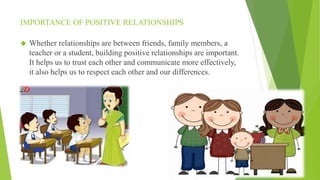
IMPORTANCE OF POSITIVE RELATIONSHIPS 
 Whether relationships are between friends, family members, a 
teacher or a student, building positive relationships are important. 
It helps us to trust each other and communicate more effectively, 
it also helps us to respect each other and our differences.
DEVELOPING POSITIVE RELATIONSHIPS WITH PARENTS 
SOME WAYS IN WHICH TEACHERS CAN DEVELOP A 
POSITIVE RELATIONSHIP WITH PARENTS ARE: 
• Most parents usually interact with teachers, so the encounter with 
parents should be warm and friendly. 
• Regular communication is also good. Providing information on 
what’s going on in class; what students are learning, what they have 
accomplished, the improvements that are needed and growth that 
you're seeing. 
• Declaration of your intention; telling them that you want to work 
together with them and the support is appreciated.
DEVELOPING POSITIVE RELATIONSHIPS WITH STUDENTS 
SOME WAYS IN WHICH TEACHERS CAN DEVELOP A 
POSITIVE RELATIONSHIP WITH STUDENTS ARE: 
1. Communicating positive expectations has a massive impact on 
students academic performance also on their behavioral performance 
(Kerman, Kimball, & Martin, 1980). 
2.Giving hints and clues to help students answer questions. 
3. Motivating and encouraging students; telling them they have the 
ability to do it. (Thompson 1988) 
4. Correcting students in a constructive way.
DEVELOPING POSTIVES RELATIONS BETWEEN TEACHER 
AND TEACHER 
Effective teacher to teacher communication is vitally essential to anyone's success in 
becoming a teacher. Some ways in which teachers can develop positive relations with 
other teachers are: 
• Encourage and show kindness and humility. Praise exemplary work, regardless of 
the person that did it. Sometimes the most hardened of fellow workers can be 
turned into “softies” once they realize that you are not afraid to compliment them or 
give them encouraging words, despite of how they perceive you ordinarily. 
• Be happy. Making a choice to be happy on a day to day basis will make people 
around you more comfortable on a day to day basis. (Zehm and Kottler 1993) 
• Be open-minded. Do not get into arguments. Discuss things with people rather than 
argue. Being combative or disagreeable is likely to put others off. 
• Understanding that some peoples feelings hurt easier than others. Humor can bring 
people together, but it can also tear people apart. Before making a joke with 
someone know how they would take it. Everyone is different in this aspect.
REFERENCES 
• www.abouteducation.com 
• Battistich, Schaps, & Wilson, 2004; Birch & Ladd, 1997; Hamre & Pianta, 2001 
• Daniels & Perry, 2003; Perry & Weinstein, 1998 
• Murray, Christopher. “Supportive teacher-student relationships: Promoting the 
Social and Emotional Health of Early Adolescents with High Incidence 
Disabilities.” 
• Pianta, Robert C., Enhancing Relationships Between Children and Teachers. 
Washington, D.C.American Psychological Assn., 1999.

Redone wiki 1 assignment

  • 2.
    IMPORTANCE OF POSITIVERELATIONSHIPS  Whether relationships are between friends, family members, a teacher or a student, building positive relationships are important. It helps us to trust each other and communicate more effectively, it also helps us to respect each other and our differences.
  • 3.
    DEVELOPING POSITIVE RELATIONSHIPSWITH PARENTS SOME WAYS IN WHICH TEACHERS CAN DEVELOP A POSITIVE RELATIONSHIP WITH PARENTS ARE: • Most parents usually interact with teachers, so the encounter with parents should be warm and friendly. • Regular communication is also good. Providing information on what’s going on in class; what students are learning, what they have accomplished, the improvements that are needed and growth that you're seeing. • Declaration of your intention; telling them that you want to work together with them and the support is appreciated.
  • 4.
    DEVELOPING POSITIVE RELATIONSHIPSWITH STUDENTS SOME WAYS IN WHICH TEACHERS CAN DEVELOP A POSITIVE RELATIONSHIP WITH STUDENTS ARE: 1. Communicating positive expectations has a massive impact on students academic performance also on their behavioral performance (Kerman, Kimball, & Martin, 1980). 2.Giving hints and clues to help students answer questions. 3. Motivating and encouraging students; telling them they have the ability to do it. (Thompson 1988) 4. Correcting students in a constructive way.
  • 5.
    DEVELOPING POSTIVES RELATIONSBETWEEN TEACHER AND TEACHER Effective teacher to teacher communication is vitally essential to anyone's success in becoming a teacher. Some ways in which teachers can develop positive relations with other teachers are: • Encourage and show kindness and humility. Praise exemplary work, regardless of the person that did it. Sometimes the most hardened of fellow workers can be turned into “softies” once they realize that you are not afraid to compliment them or give them encouraging words, despite of how they perceive you ordinarily. • Be happy. Making a choice to be happy on a day to day basis will make people around you more comfortable on a day to day basis. (Zehm and Kottler 1993) • Be open-minded. Do not get into arguments. Discuss things with people rather than argue. Being combative or disagreeable is likely to put others off. • Understanding that some peoples feelings hurt easier than others. Humor can bring people together, but it can also tear people apart. Before making a joke with someone know how they would take it. Everyone is different in this aspect.
  • 6.
    REFERENCES • www.abouteducation.com • Battistich, Schaps, & Wilson, 2004; Birch & Ladd, 1997; Hamre & Pianta, 2001 • Daniels & Perry, 2003; Perry & Weinstein, 1998 • Murray, Christopher. “Supportive teacher-student relationships: Promoting the Social and Emotional Health of Early Adolescents with High Incidence Disabilities.” • Pianta, Robert C., Enhancing Relationships Between Children and Teachers. Washington, D.C.American Psychological Assn., 1999.