MARIAVICTORIA PINEDA
SEAMEO RETRAC, Ho Chi Minh City, Viet Nam
Email address: victoria.pineda@vnseameo.org
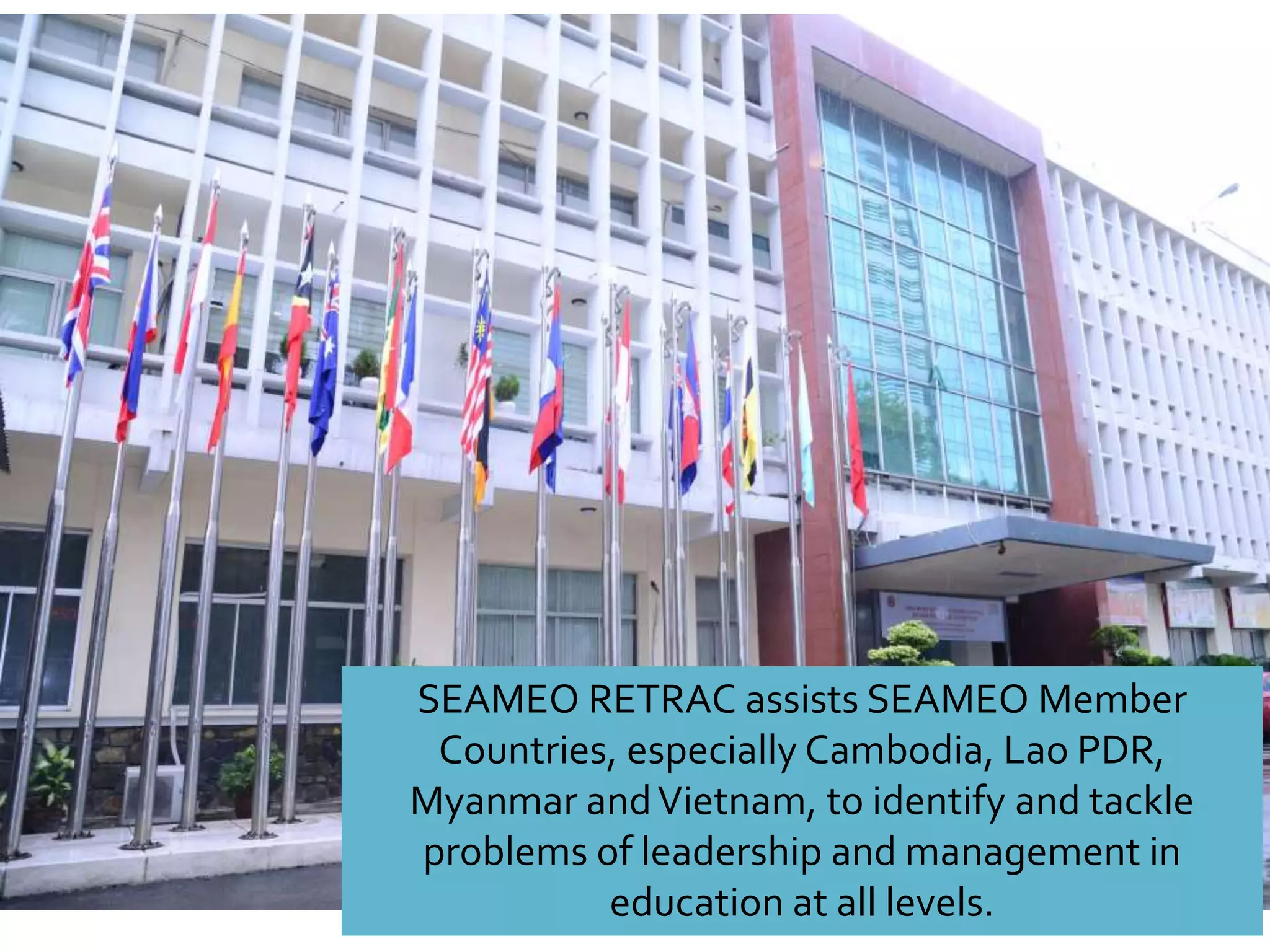
SEAMEO RETRAC assists SEAMEO Member
Countries, especially Cambodia, Lao PDR,
Myanmar andVietnam, to identify and tackle
problems of leadership and management in
education at all levels.
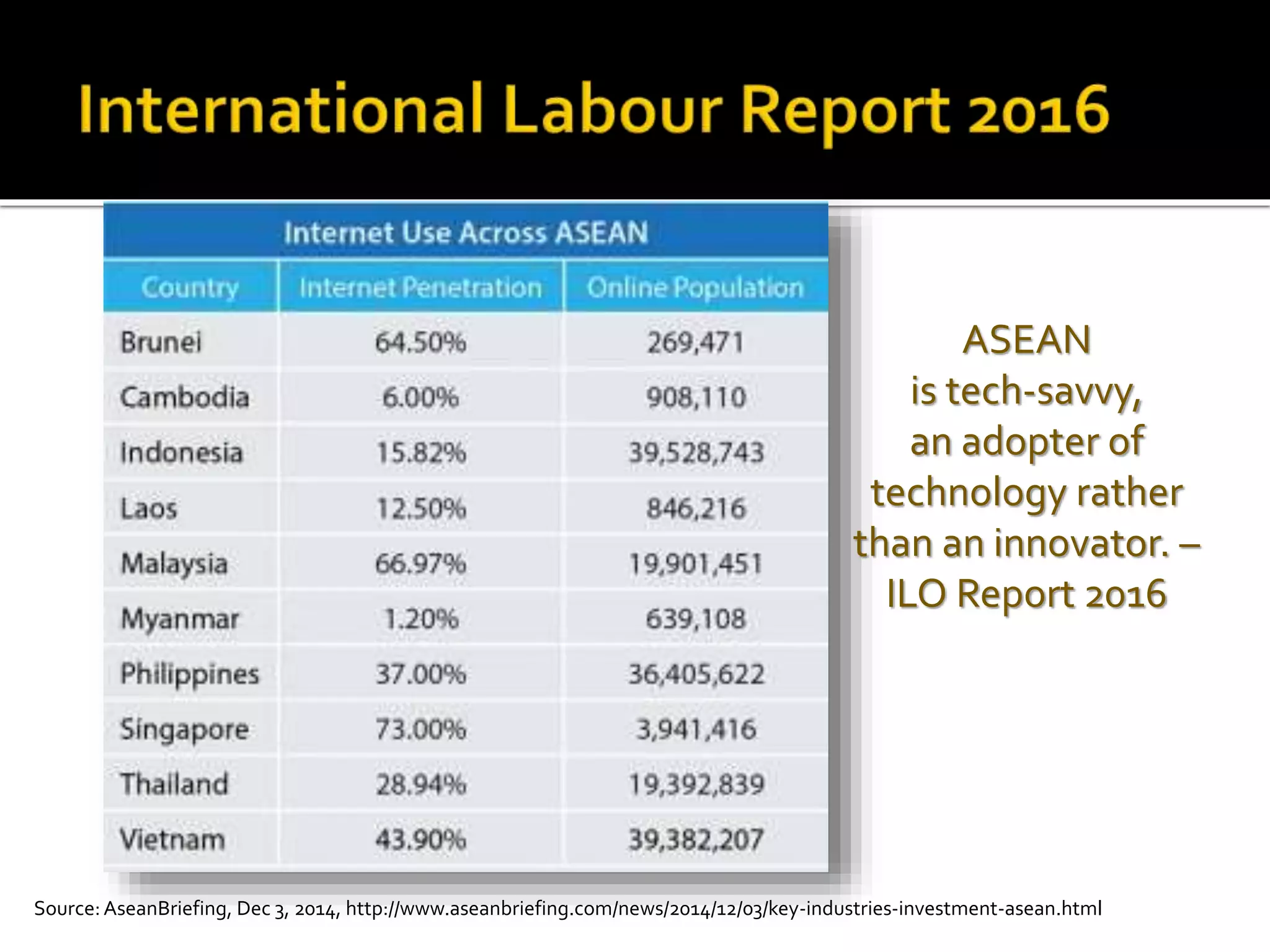
Source:AseanBriefing, Dec 3, 2014, http://www.aseanbriefing.com/news/2014/12/03/key-industries-investment-asean.html
ASEAN
is tech-savvy,
an adopter of
technology rather
than an innovator. –
ILO Report 2016
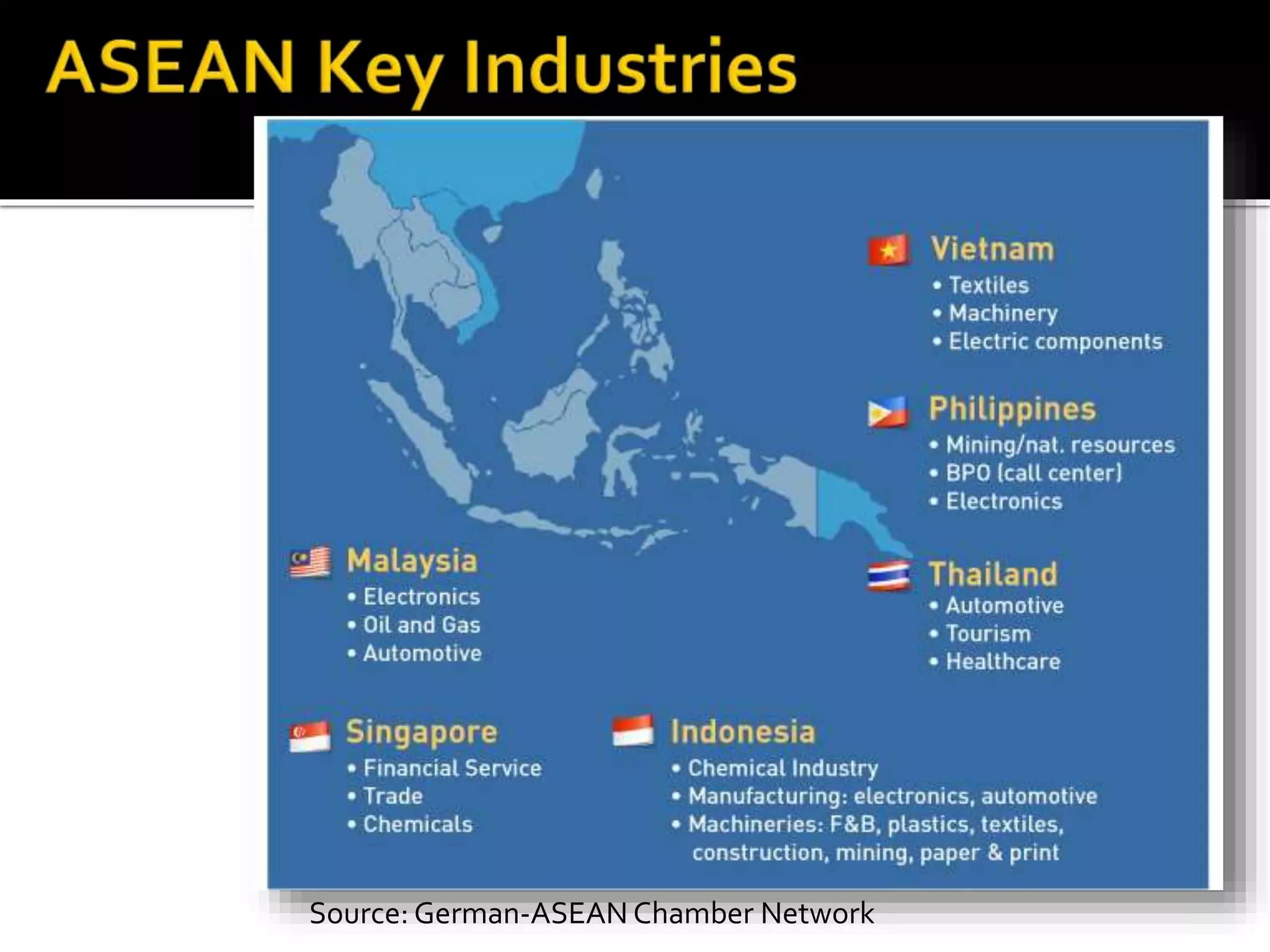
Source: German-ASEAN Chamber Network
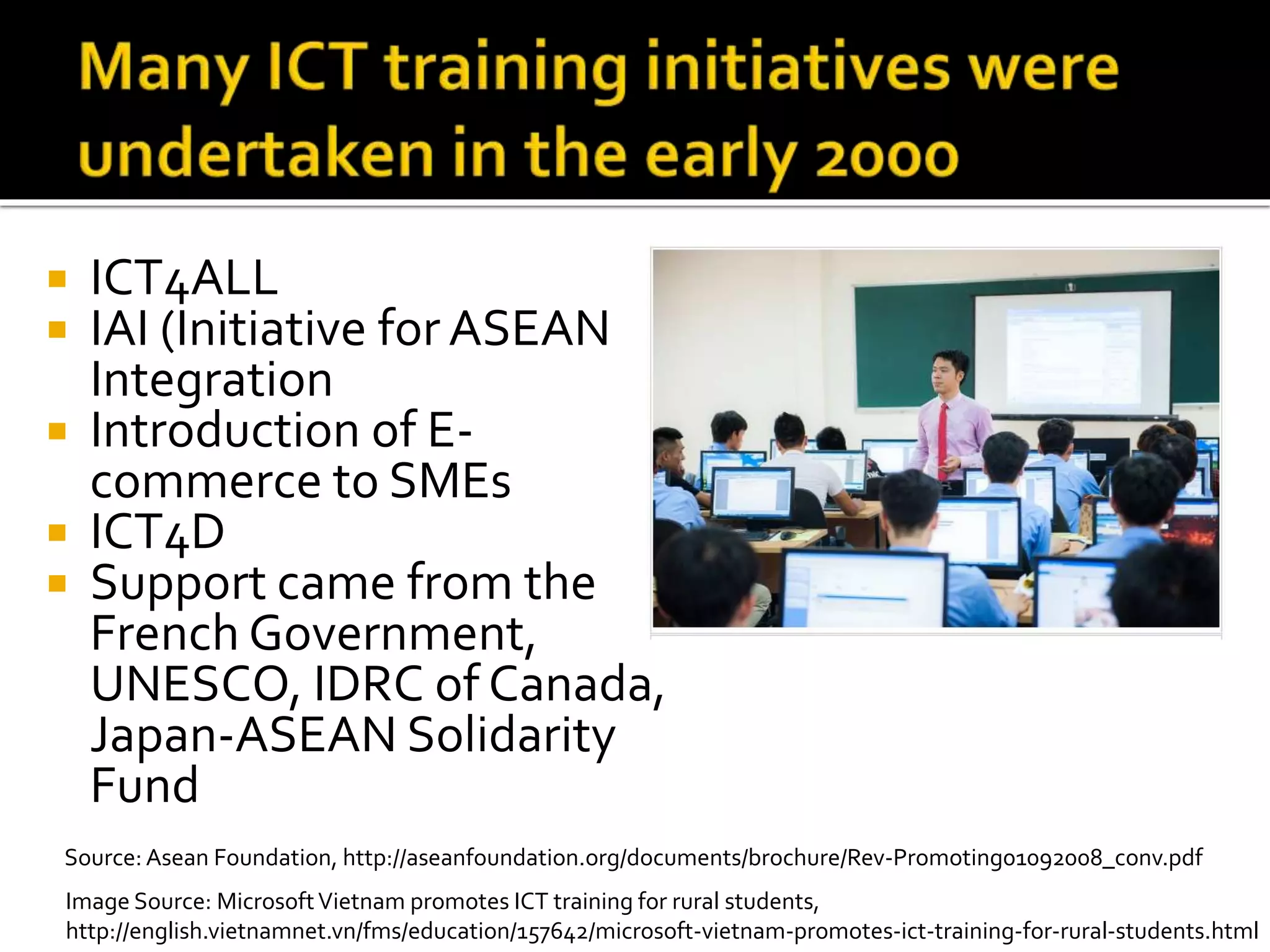
 ICT4ALL
 IAI (Initiative for ASEAN
Integration
 Introduction of E-
commerce to SMEs
 ICT4D
 Support came from the
French Government,
UNESCO, IDRC of Canada,
Japan-ASEAN Solidarity
Fund
Source: Asean Foundation, http://aseanfoundation.org/documents/brochure/Rev-Promoting01092008_conv.pdf
Image Source: MicrosoftVietnam promotes ICT training for rural students,
http://english.vietnamnet.vn/fms/education/157642/microsoft-vietnam-promotes-ict-training-for-rural-students.html
TeachingTechnology
1990s to the present
Teaching withTechnology
2000 to the present
Teaching in the context ofTechnology
2000 to the present
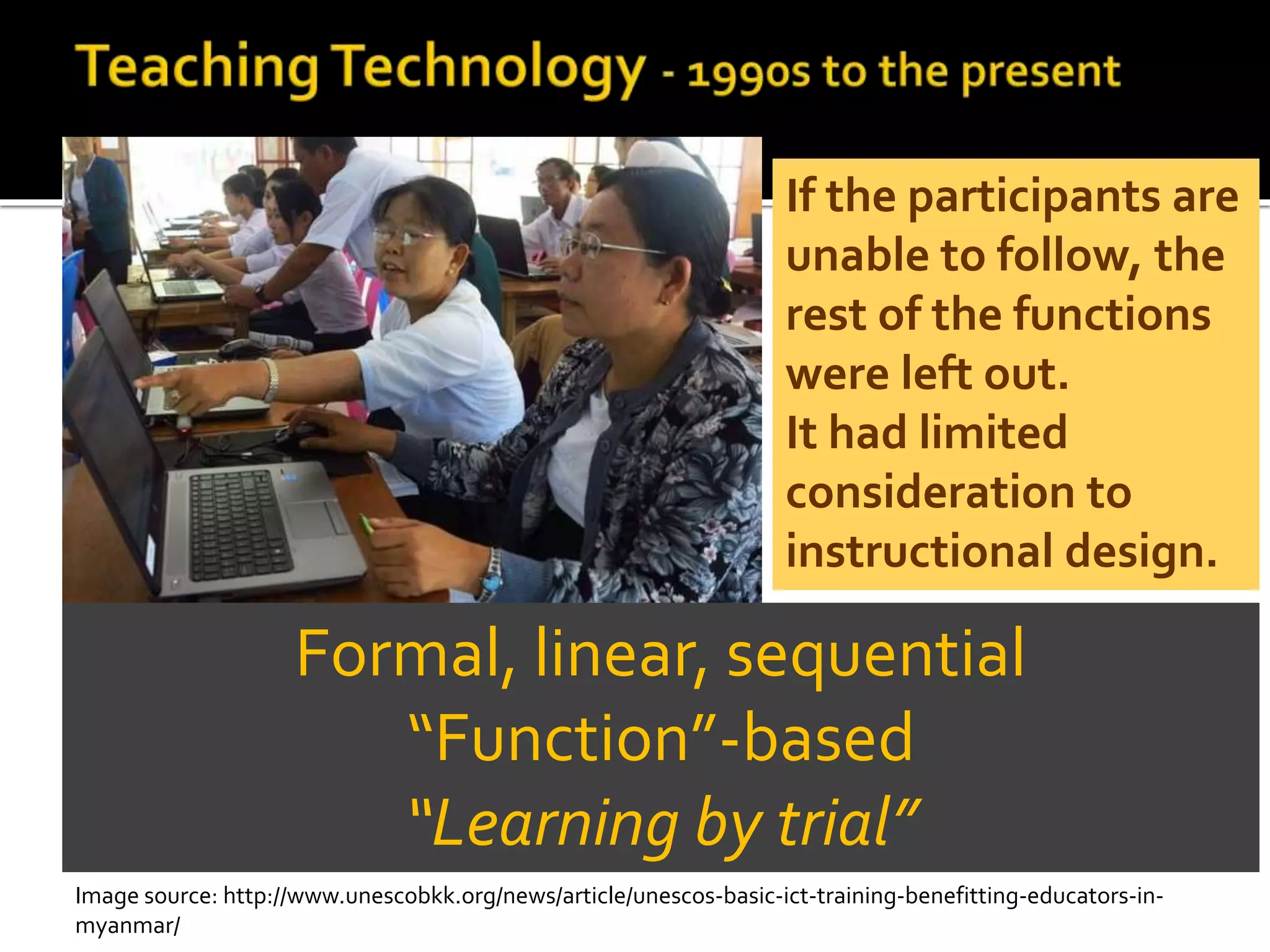
Formal, linear, sequential
“Function”-based
“Learning by trial”
If the participants are
unable to follow, the
rest of the functions
were left out.
It had limited
consideration to
instructional design.
Image source: http://www.unescobkk.org/news/article/unescos-basic-ict-training-benefitting-educators-in-
myanmar/
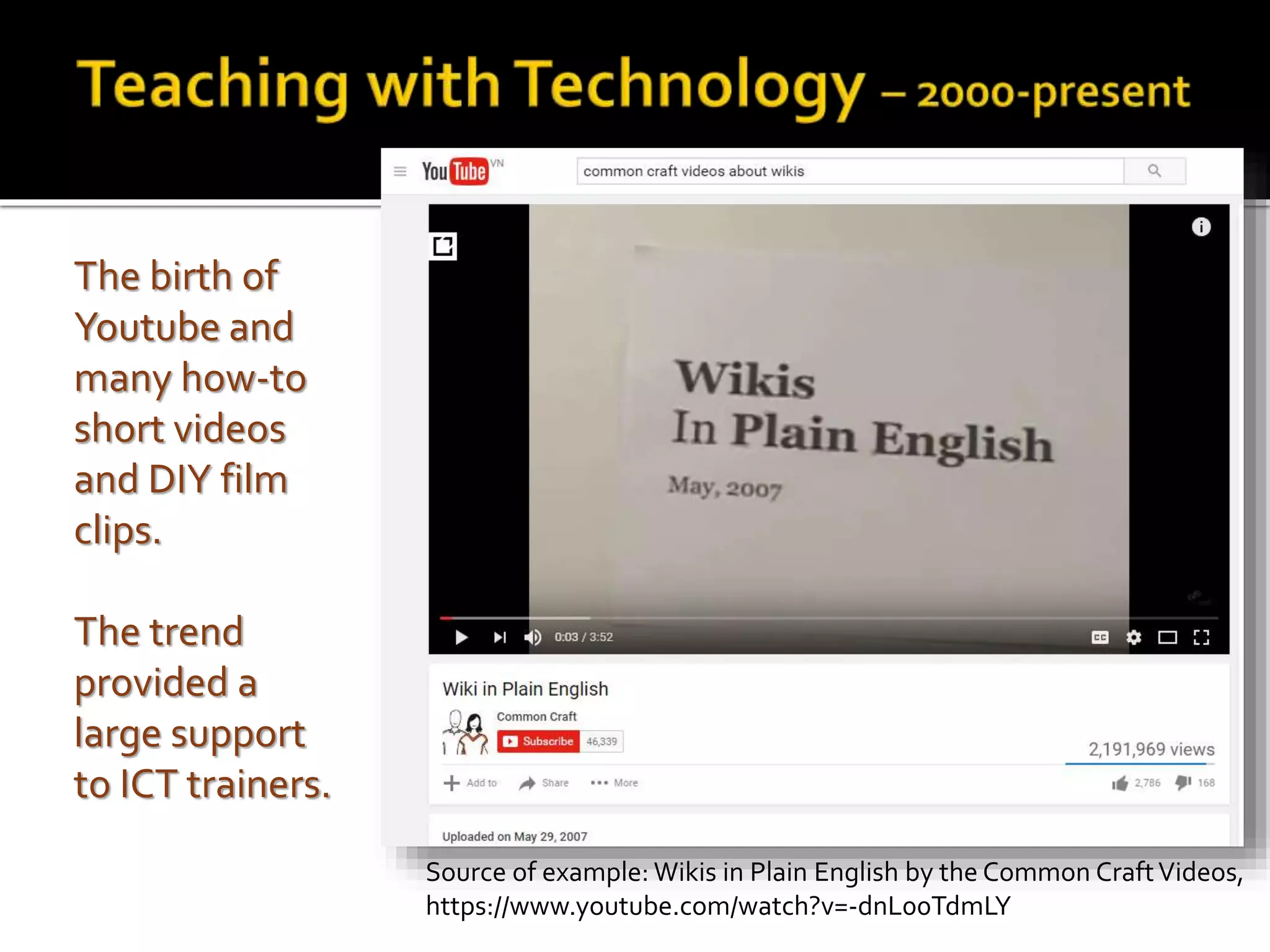
The birth of
Youtube and
many how-to
short videos
and DIY film
clips.
The trend
provided a
large support
to ICT trainers.
Source of example: Wikis in Plain English by the Common CraftVideos,
https://www.youtube.com/watch?v=-dnL00TdmLY
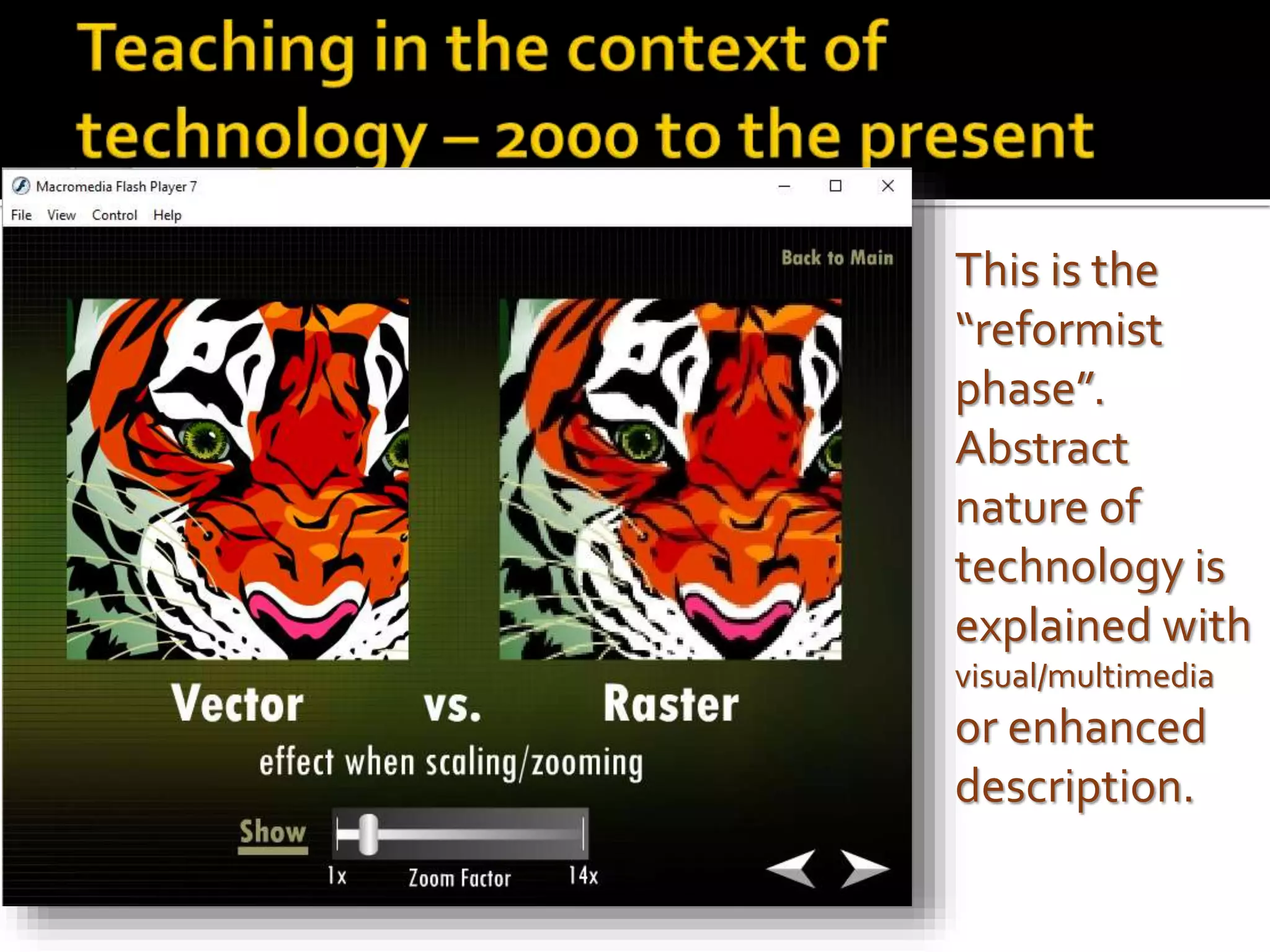
This is the
“reformist
phase”.
Abstract
nature of
technology is
explained with
visual/multimedia
or enhanced
description.
#TIME4CHANGE
#WeNeedAlternative
#21stCentury
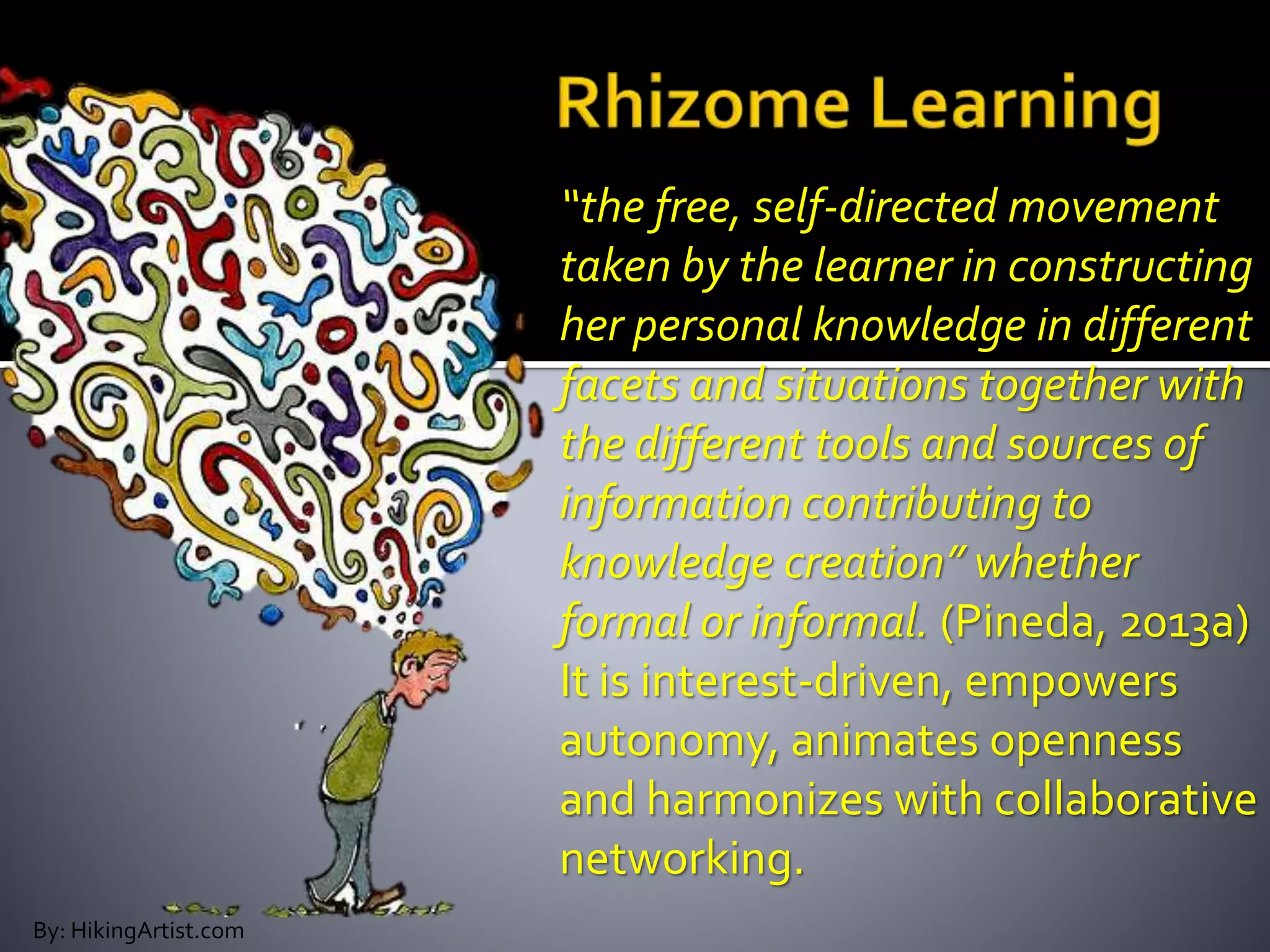
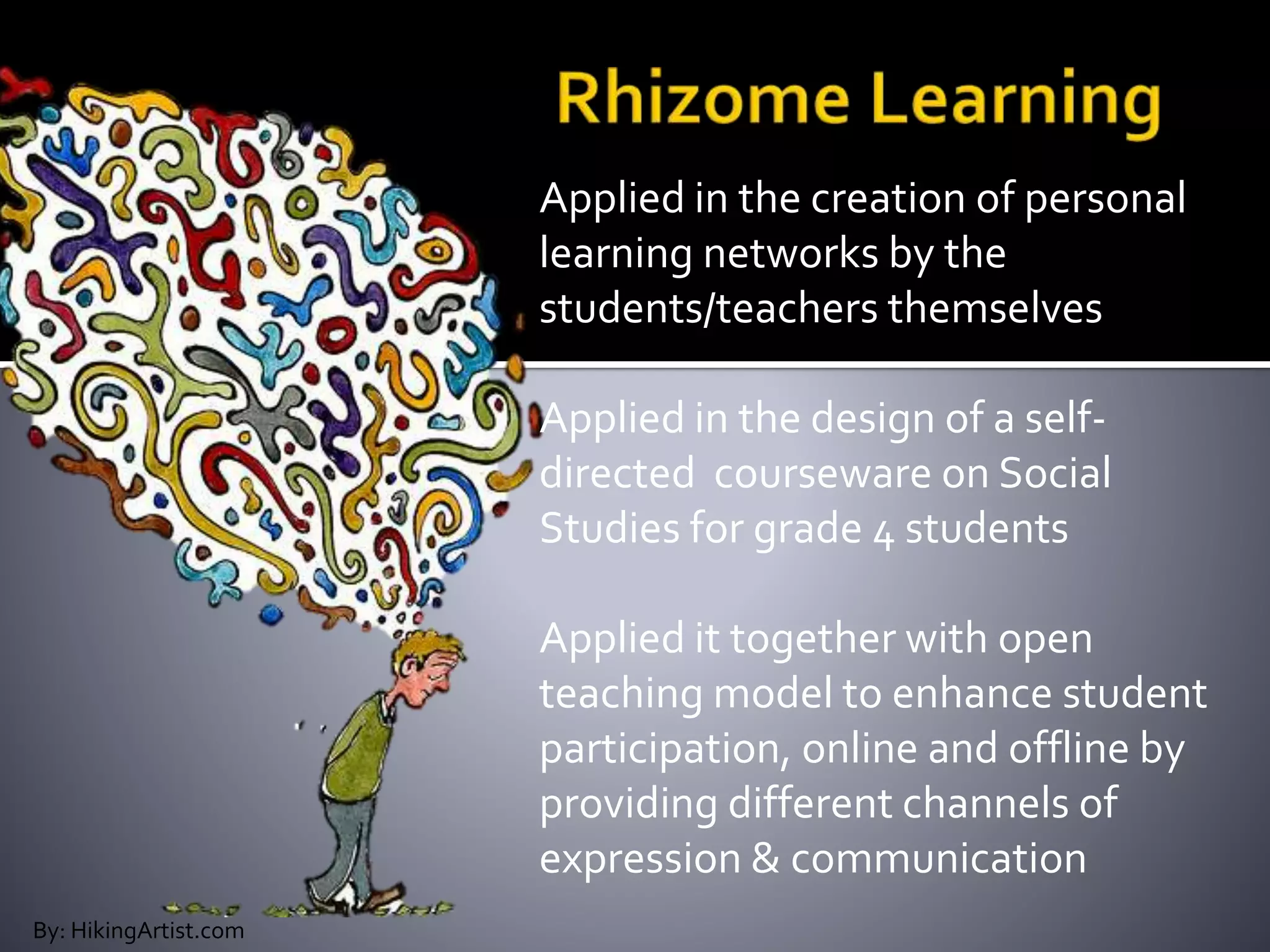
By: HikingArtist.com
“the free, self-directed movement
taken by the learner in constructing
her personal knowledge in different
facets and situations together with
the different tools and sources of
information contributing to
knowledge creation” whether
formal or informal. (Pineda, 2013a)
It is interest-driven, empowers
autonomy, animates openness
and harmonizes with collaborative
networking.
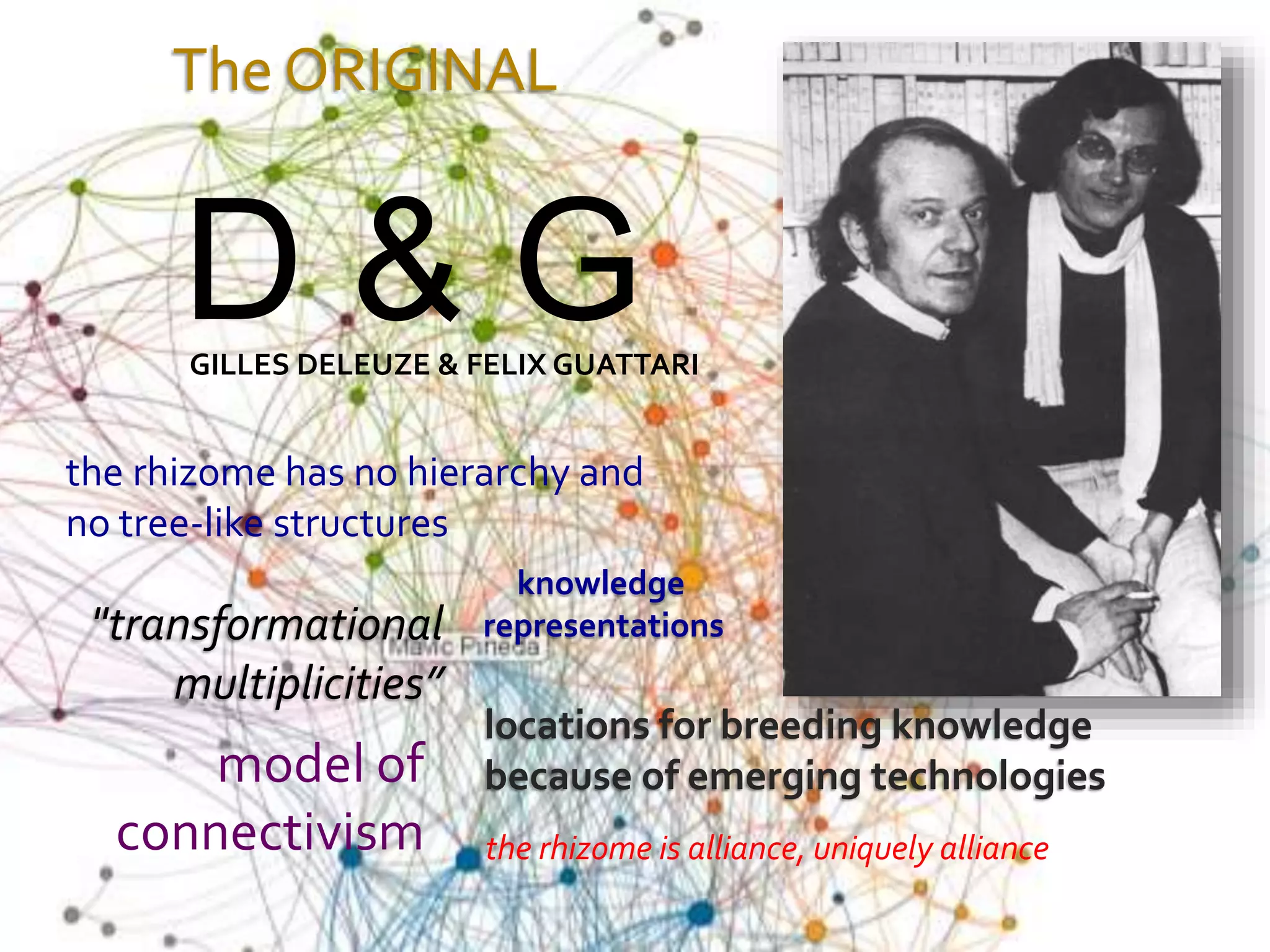
The ORIGINAL
the rhizome has no hierarchy and
no tree-like structures
knowledge
representations
model of
connectivism
locations for breeding knowledge
because of emerging technologies
the rhizome is alliance, uniquely alliance
"transformational
multiplicities”
D & GGILLES DELEUZE & FELIX GUATTARI
By: HikingArtist.com
Applied in the creation of personal
learning networks by the
students/teachers themselves
Applied in the design of a self-
directed courseware on Social
Studies for grade 4 students
Applied it together with open
teaching model to enhance student
participation, online and offline by
providing different channels of
expression & communication
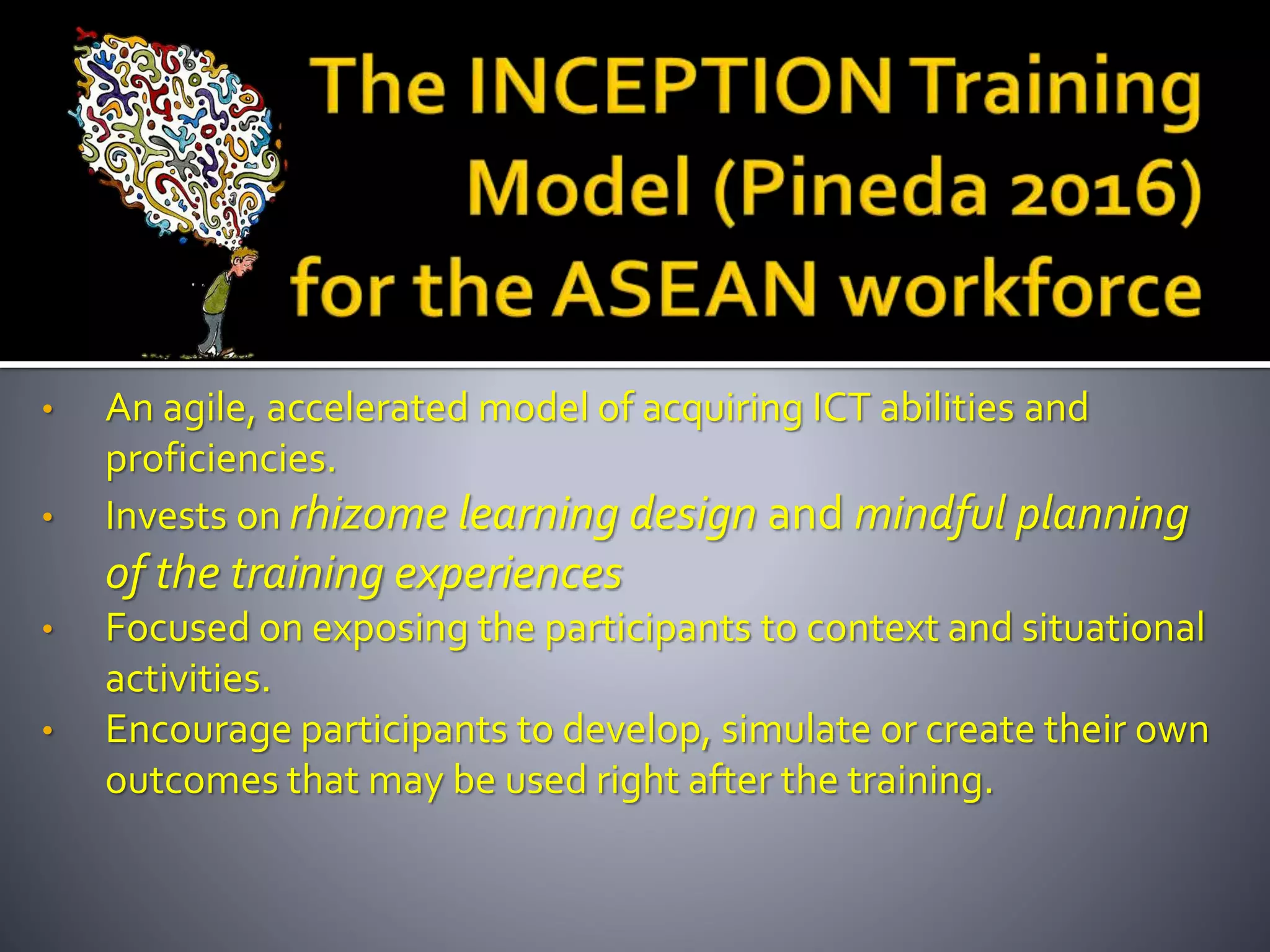
• An agile, accelerated model of acquiring ICT abilities and
proficiencies.
• Invests on rhizome learning design and mindful planning
of the training experiences
• Focused on exposing the participants to context and situational
activities.
• Encourage participants to develop, simulate or create their own
outcomes that may be used right after the training.
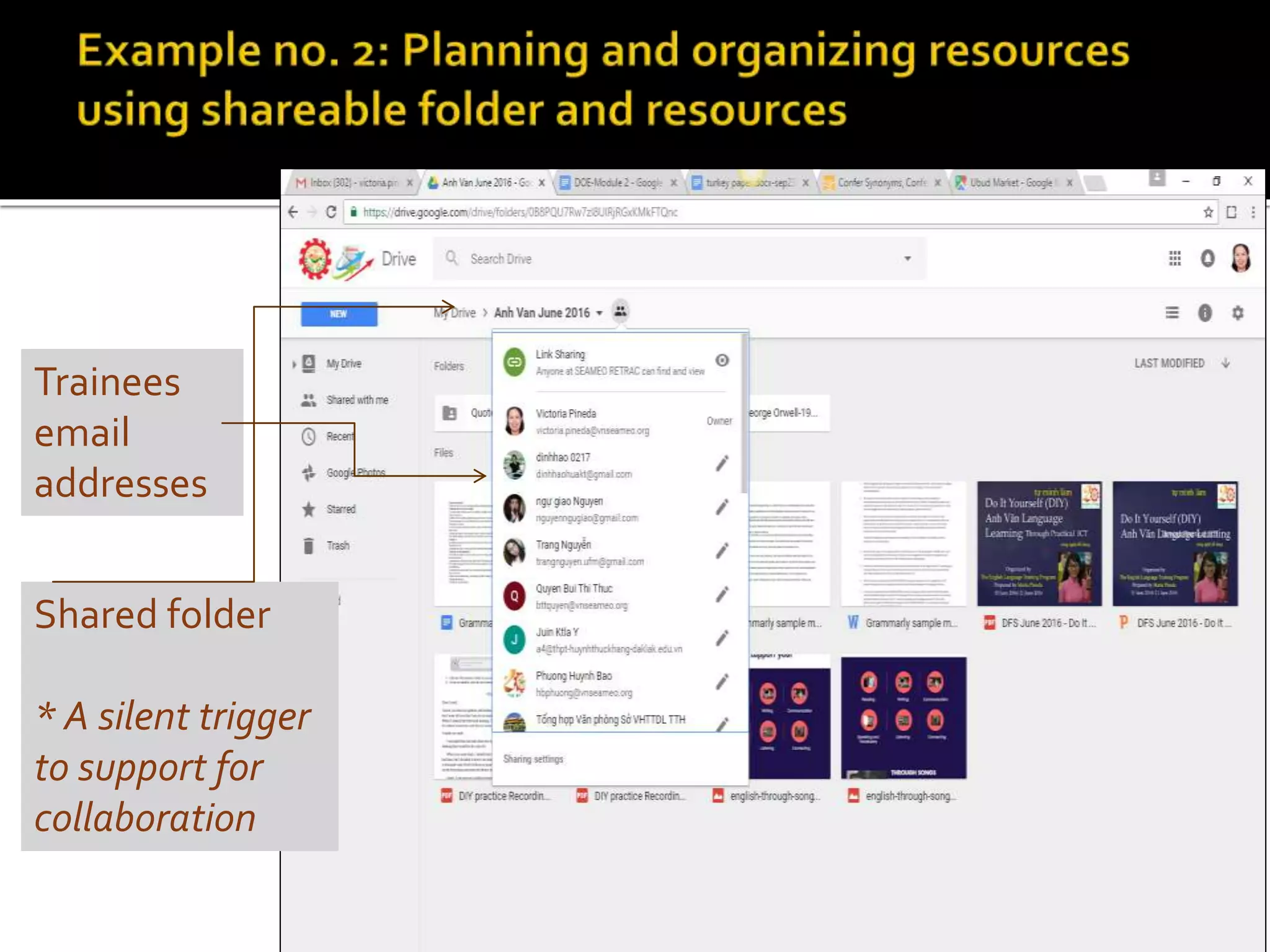
Trainees
email
addresses
Shared folder
* A silent trigger
to support for
collaboration
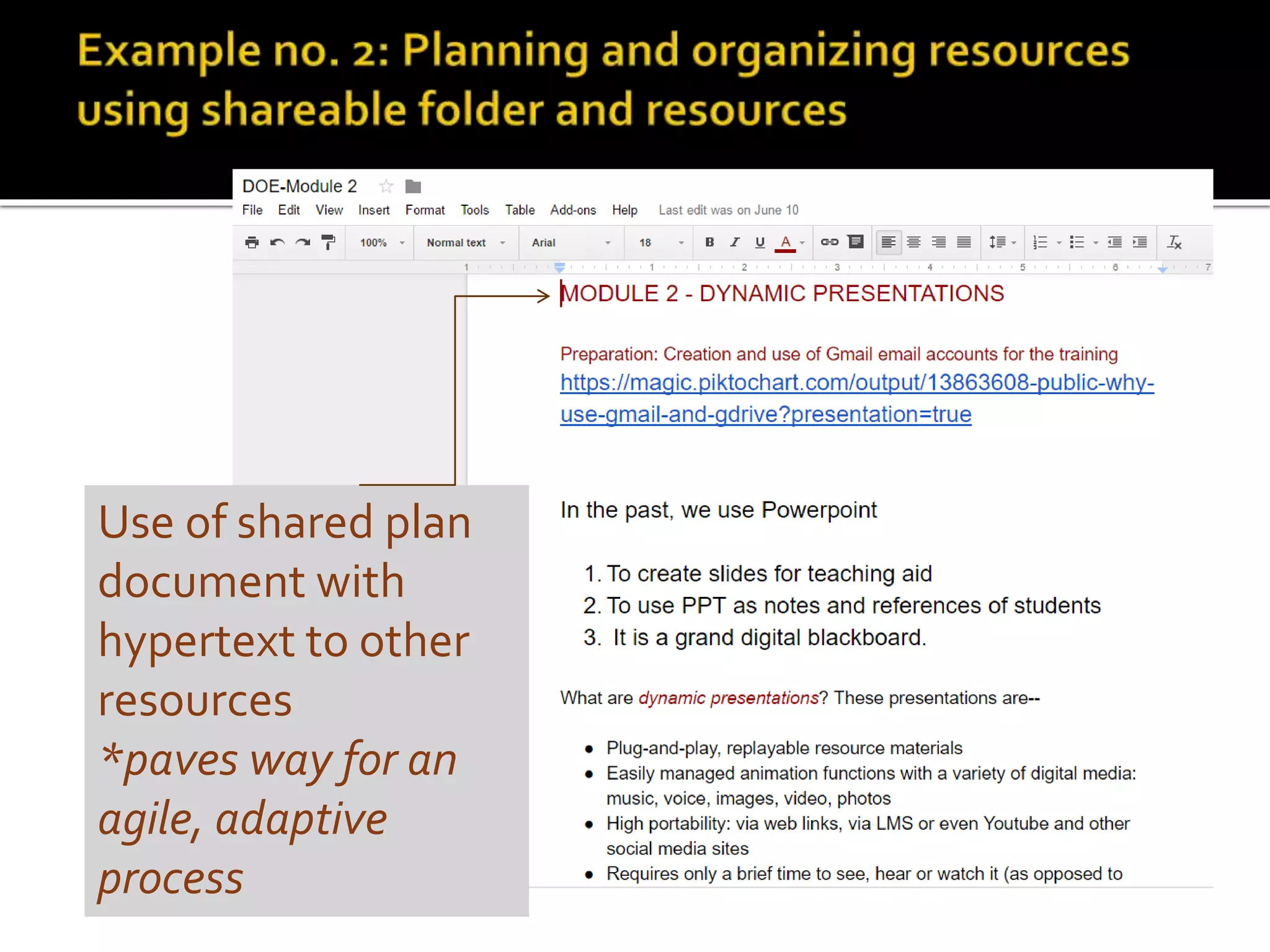
Use of shared plan
document with
hypertext to other
resources
*paves way for an
agile, adaptive
process
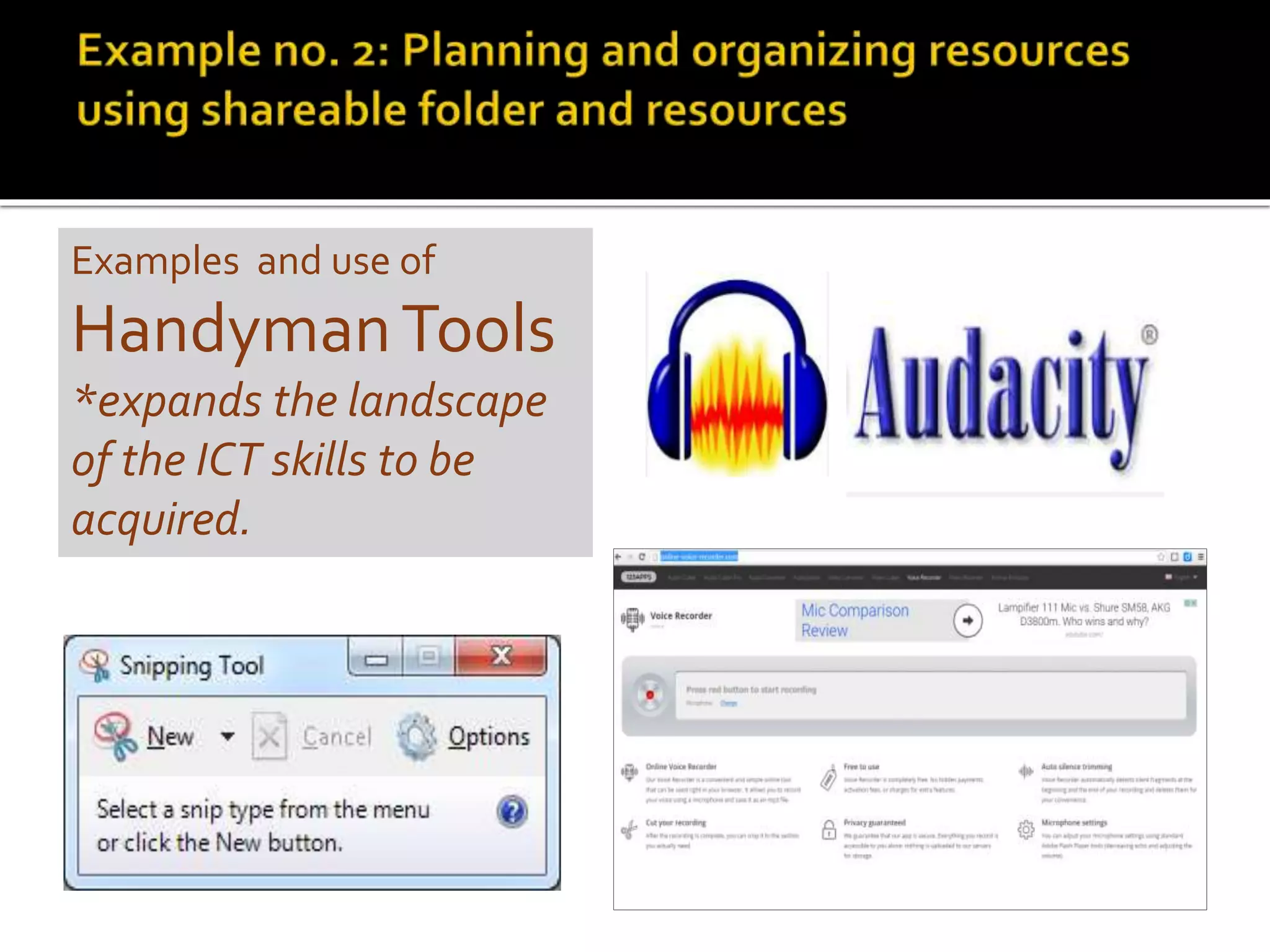
Examples and use of
HandymanTools
*expands the landscape
of the ICT skills to be
acquired.
 The learning landscape expands, so does ICT
training and learning.
 The present 21st-century situation demands
development of capabilities, mindset, and
aptitude towards new technologies, changing
technologies and technology adaptation.
 Trainers must advance their methods &
techniques.
 ITM is an agile training model and a mindset
developed for acquiring ICT skills and
competencies.
MariaVictoria Pineda
Email: victoria.pineda@vnseameo.org
Publications: https://vnseameo.academia.edu/VictoriaPineda
Sample works: http://www.slideshare.net/mobilemartha
Teaching blog: https://teachingictblog.wordpress.com/

Developing an Agile ICT Training Model for 21st Century Requirements in the ASEAN Region

  • 1.
    MARIAVICTORIA PINEDA SEAMEO RETRAC,Ho Chi Minh City, Viet Nam Email address: victoria.pineda@vnseameo.org
  • 4.
    SEAMEO RETRAC assistsSEAMEO Member Countries, especially Cambodia, Lao PDR, Myanmar andVietnam, to identify and tackle problems of leadership and management in education at all levels.
  • 6.
    Source:AseanBriefing, Dec 3,2014, http://www.aseanbriefing.com/news/2014/12/03/key-industries-investment-asean.html ASEAN is tech-savvy, an adopter of technology rather than an innovator. – ILO Report 2016
  • 7.
  • 8.
     ICT4ALL  IAI(Initiative for ASEAN Integration  Introduction of E- commerce to SMEs  ICT4D  Support came from the French Government, UNESCO, IDRC of Canada, Japan-ASEAN Solidarity Fund Source: Asean Foundation, http://aseanfoundation.org/documents/brochure/Rev-Promoting01092008_conv.pdf Image Source: MicrosoftVietnam promotes ICT training for rural students, http://english.vietnamnet.vn/fms/education/157642/microsoft-vietnam-promotes-ict-training-for-rural-students.html
  • 9.
    TeachingTechnology 1990s to thepresent Teaching withTechnology 2000 to the present Teaching in the context ofTechnology 2000 to the present
  • 10.
    Formal, linear, sequential “Function”-based “Learningby trial” If the participants are unable to follow, the rest of the functions were left out. It had limited consideration to instructional design. Image source: http://www.unescobkk.org/news/article/unescos-basic-ict-training-benefitting-educators-in- myanmar/
  • 11.
    The birth of Youtubeand many how-to short videos and DIY film clips. The trend provided a large support to ICT trainers. Source of example: Wikis in Plain English by the Common CraftVideos, https://www.youtube.com/watch?v=-dnL00TdmLY
  • 12.
    This is the “reformist phase”. Abstract natureof technology is explained with visual/multimedia or enhanced description.
  • 14.
  • 15.
    By: HikingArtist.com “the free,self-directed movement taken by the learner in constructing her personal knowledge in different facets and situations together with the different tools and sources of information contributing to knowledge creation” whether formal or informal. (Pineda, 2013a) It is interest-driven, empowers autonomy, animates openness and harmonizes with collaborative networking.
  • 16.
    The ORIGINAL the rhizomehas no hierarchy and no tree-like structures knowledge representations model of connectivism locations for breeding knowledge because of emerging technologies the rhizome is alliance, uniquely alliance "transformational multiplicities” D & GGILLES DELEUZE & FELIX GUATTARI
  • 17.
    By: HikingArtist.com Applied inthe creation of personal learning networks by the students/teachers themselves Applied in the design of a self- directed courseware on Social Studies for grade 4 students Applied it together with open teaching model to enhance student participation, online and offline by providing different channels of expression & communication
  • 18.
    • An agile,accelerated model of acquiring ICT abilities and proficiencies. • Invests on rhizome learning design and mindful planning of the training experiences • Focused on exposing the participants to context and situational activities. • Encourage participants to develop, simulate or create their own outcomes that may be used right after the training.
  • 24.
    Trainees email addresses Shared folder * Asilent trigger to support for collaboration
  • 25.
    Use of sharedplan document with hypertext to other resources *paves way for an agile, adaptive process
  • 26.
    Examples and useof HandymanTools *expands the landscape of the ICT skills to be acquired.
  • 27.
     The learninglandscape expands, so does ICT training and learning.  The present 21st-century situation demands development of capabilities, mindset, and aptitude towards new technologies, changing technologies and technology adaptation.  Trainers must advance their methods & techniques.  ITM is an agile training model and a mindset developed for acquiring ICT skills and competencies.
  • 28.
    MariaVictoria Pineda Email: victoria.pineda@vnseameo.org Publications:https://vnseameo.academia.edu/VictoriaPineda Sample works: http://www.slideshare.net/mobilemartha Teaching blog: https://teachingictblog.wordpress.com/

Editor's Notes

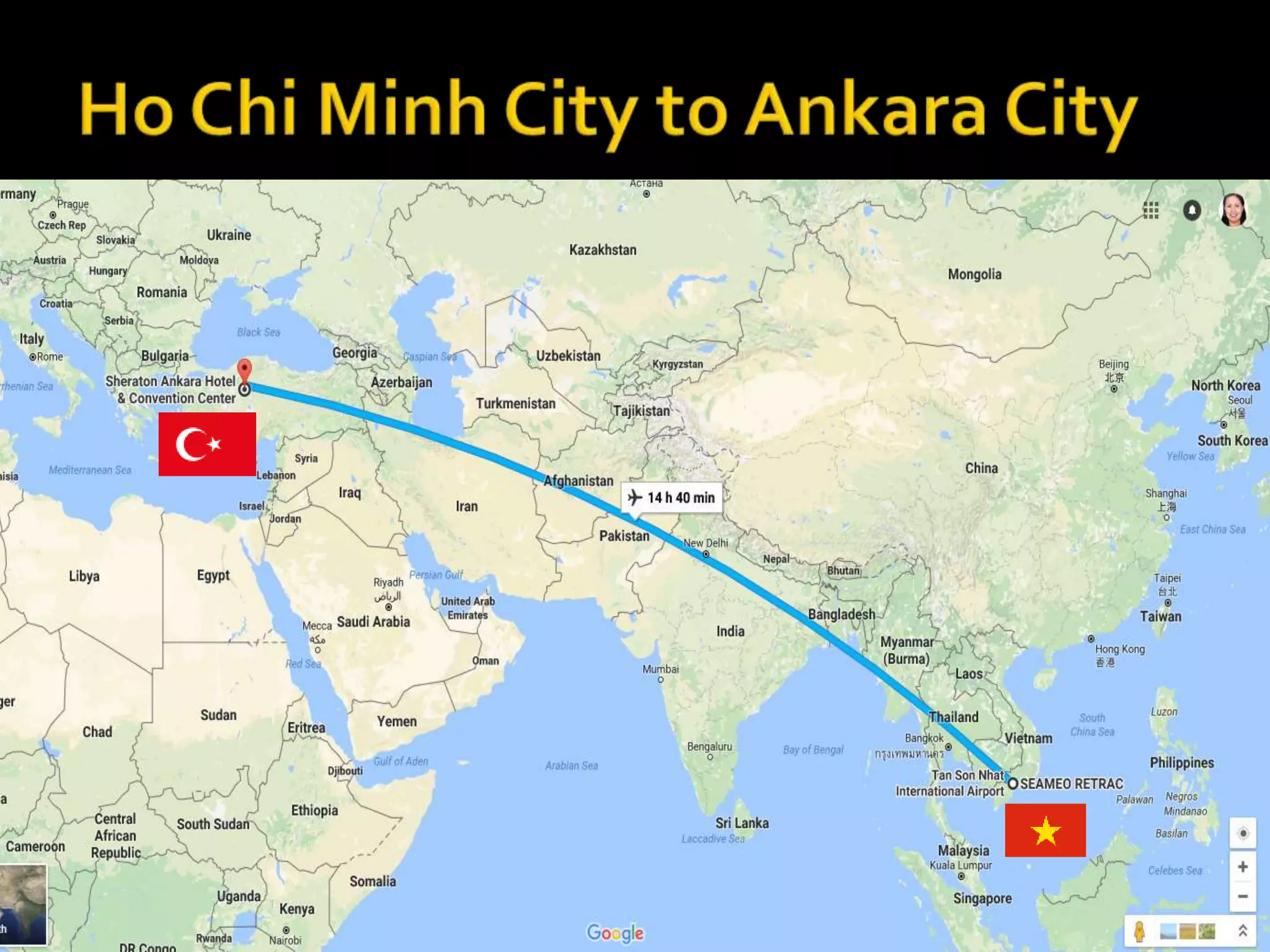
  • #3 I travelled 7,852 km from HCMC to Sheraton, Ankara in 14 hours and 40minutes
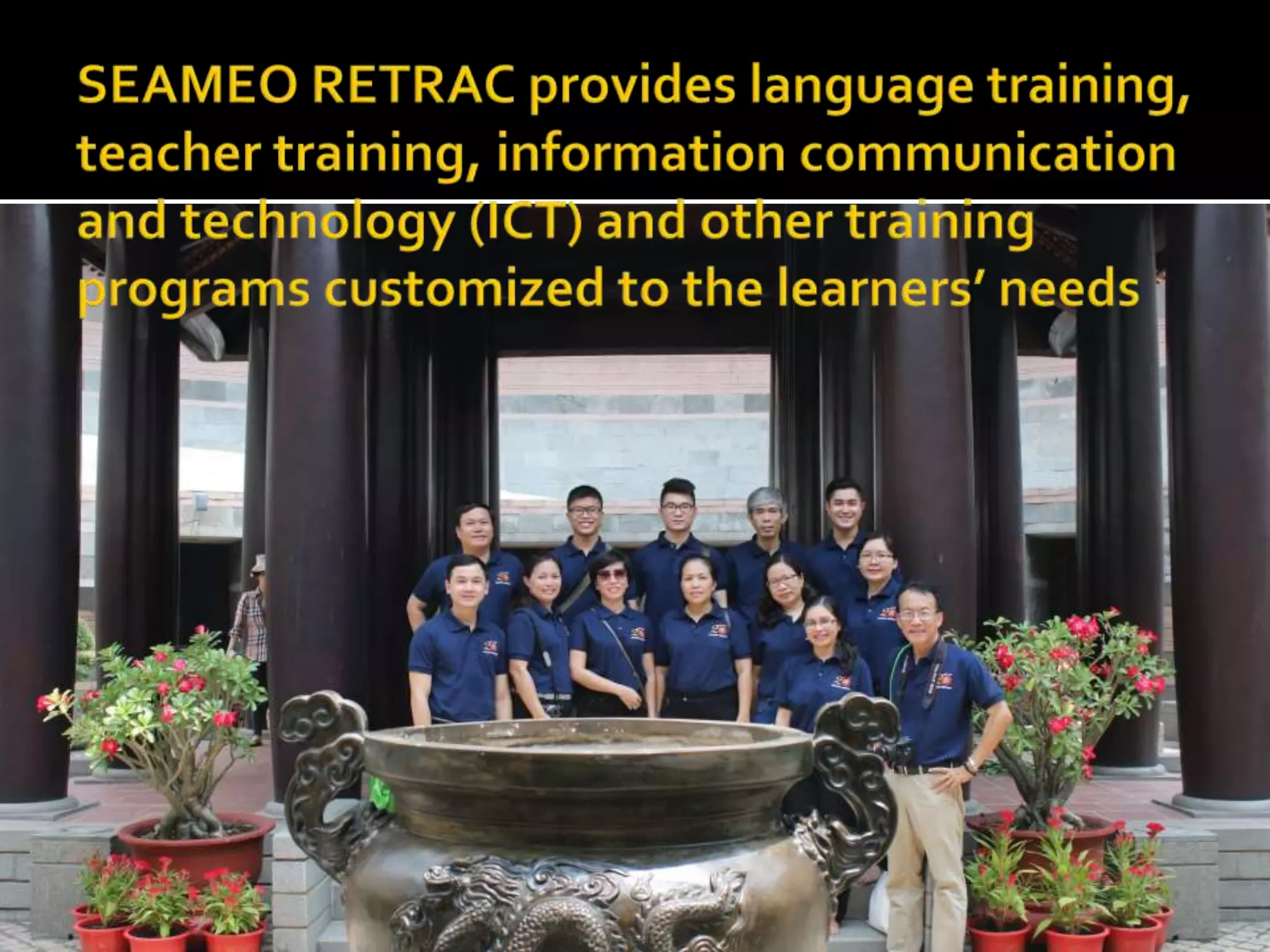
  • #4 I work for the Southeast Asian Ministers of Education Organization. There is a SEAMEO in every ASEAN member country. In Vietnam we have the Regional Training Center. Our specialty is on workshops, trainings, seminar of education managers, teachers and trainers on education management and leadership. We also provide ELT, ToT and ICT for instruction.
  • #5 RETRAC in Vietnam assists SEAMEO Member Countries, especially Cambodia, Lao PDR, Myanmar and Vietnam,
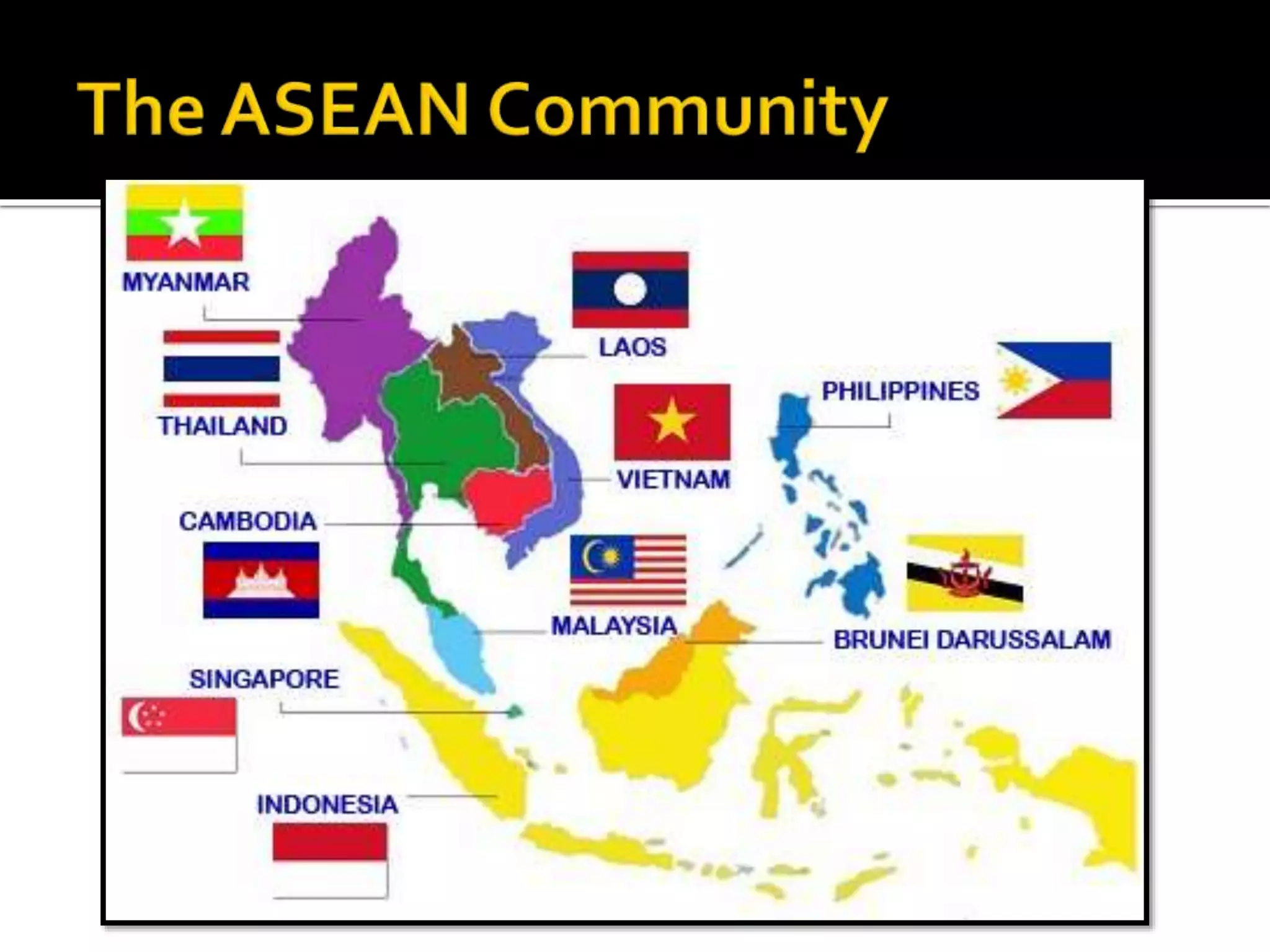
  • #6 It was in 1967 when five countries in Southeast Asia, namely, Malaysia, Indonesia, the Philippines, Singapore, and Thailand, forged the first Association of Southeast Asian Nations (ASEAN) cooperation. By 2003, Brunei, Cambodia, Laos, Myanmar and Vietnam joined ASEAN. The goal was “to build continuing cooperation in economic, social, cultural, technical, educational and other fields” and to maintain stability in the region. Please allow me to say this– many are saying now that ASEAN or Southeast Asia is the center of gravity in the world right now. We are always at the center of the global supply chain.
  • #7 The International Labour Organization report noted the growth of investments in the region with its attractiveness attributed to “better, educated workforce, emerging consumer markets, expanding infrastructure and growing logistics networks.” (Chang and Huynh 2016) In addition, ASEAN workforce are cooperative, respectful and hard-working. In ASEAN we are tech-savvy characterized by a high use of mobile telecommunications and the internet, the region is an adopter of technology rather than an innovator.
  • #8 ASEAN industries will be threatened when disruptive technologies (such as advanced automation, nanotechnologies, predictive analytics) roll in the picture. Many of the presentations here talked about automation since the first day. Automotive, manufacturing especially garments, wholesale and retail trade, construction and manufacturing are the industries that are highly influenced by automation. (Ibid. p.4) So we need retooling for our workforce.
  • #9 Various ICT training initiatives were done since early 2000. Support came from the French Government, UNESCO, IDRC of Canada, Japan-ASEAN Solidarity Fund
  • #10 But how was ICT training delivered in the region? There were three common methods Teaching Technology Teaching with Technology Teaching in the context of Technology
  • #11 Teaching Technology – such as software, tools, applications or even programming was conducted in a formal, linear, Instructor-dependent approach. The focus was on content and “functionalities”. It is learning by trial so If the participants are unable to follow, the rest of the functions were left out. It had limited consideration to instructional design.
  • #12 In mid-2000 to 2010, the period gave birth to Web 2.0 that included google, social networks, wikis and Youtube (Wikipedia 2016) which became if not the best, one of the most sought hubs for how-to tutorial videos. There are over 20k how-to videos in Youtube. The trend provided a large support to ICT trainers Trainers show the concept of the new technology thru a video and then teach how to create a wiki thru a wiki application.
  • #13 Technologies evolved quickly. So there is also the method of teaching in the context of technology. For example. before introducing the functions of a photo or imaging software, the basic concepts and processes of images and drawings must be explained. So discussions were made in the context of technology, conventionally coupled by multimedia for enhanced description. Teaching in the context of technology expanded the vocabulary of technology among trainers and participants. This became the strategy in teaching programming courses.
  • #14 The rapid development of the web and many new applications is evidently making a continuous impact on ICT training and learning.
  • #16 I want to introduce the model of rhizome learning. It is an interest-driven, free, self-directed movement taken by the learner in constructing her personal knowledge while using the different tools and sources of information she is comfortable with .. To create knowledge.
  • #17 The rhizome concept was inspired from the writings of two French philosophers, Gilles Deleuze & Felix Guattari. who wrote A Thousand Plateaus. It talked about many things, citing how we traditionally build structures to frame our thoughts. These two gentlemen argued a rhizomatic map of perceiving things. They wrote about the creation of a map to create the unconscious. the rhizome is the production of the unconscious   Given now that our environment is surrounded by emerging technologies, the more it is convenient for us to become aware on how we learn and how we learn effectively.
  • #18 I have applied this rhizome learning in the creation of personal learning networks by the students/teachers themselves in the design of a self-directed courseware on Social Studies for grade 4 students I also applied it together with open teaching model to enhance student participation, online and offline by providing different channels of expression & communication And now I have applied this in 8 batches of different ICT training for the past year I have been in SEAMEO.
  • #19 So the proposed ICT training model for the ASEAN workforce An agile, accelerated model of acquiring ICT abilities and proficiencies that is very much needed now. Invests on rhizome learning design and mindful planning of the training experiences Focused on exposing the participants to context and situational activities.
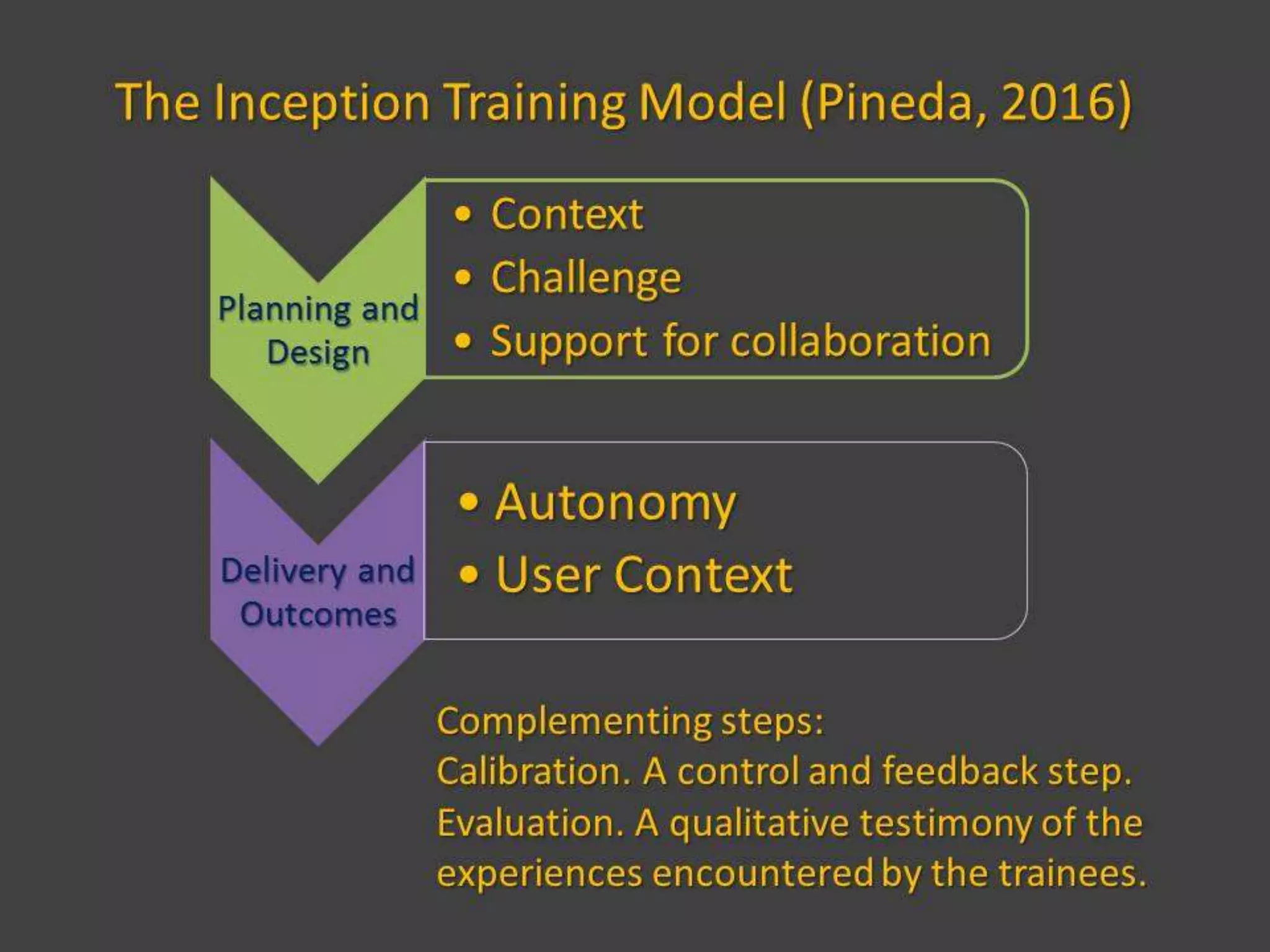
  • #20 In the past and even now, most training would perform needs analysis or demographics survey. But it is not critical in an ICT training. The Inception training model is more focused on the intended skills outcomes of the training as the basis for the design and planning. It makes use of a set of criteria to guide trainers in designing profound activities, examples, and flow of the training. The content and functions are still there but the priority is on the intended skills outcomes. There are two stages: the planning and design and the delivery and outcomes Planning and design is - Focused on exposing the participants to context and situational activities, challenges and support for collaboration Delivery and outcomes stage -- Encourages participants to develop, simulate or create their own outcomes that may be used right after the training.
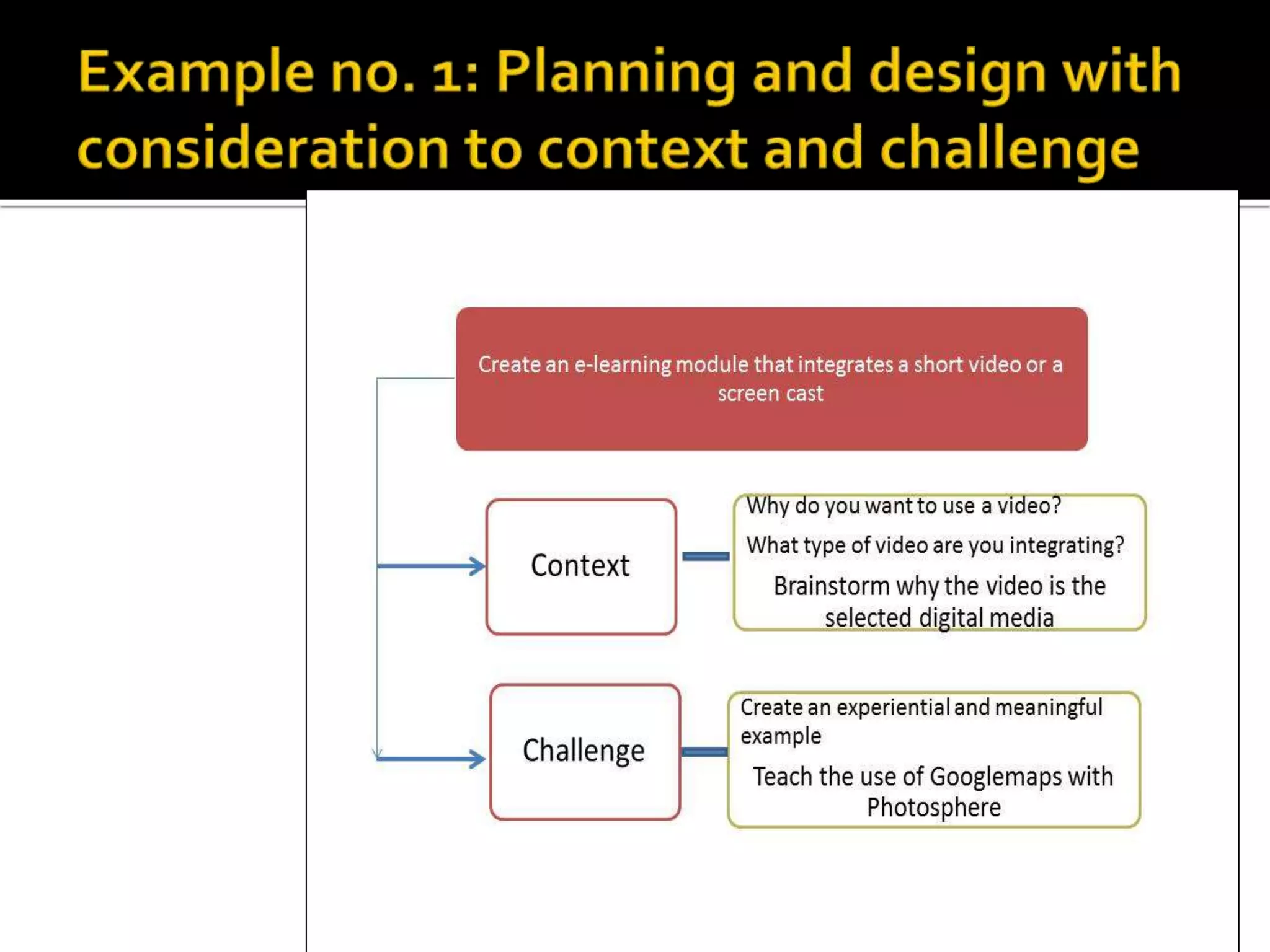
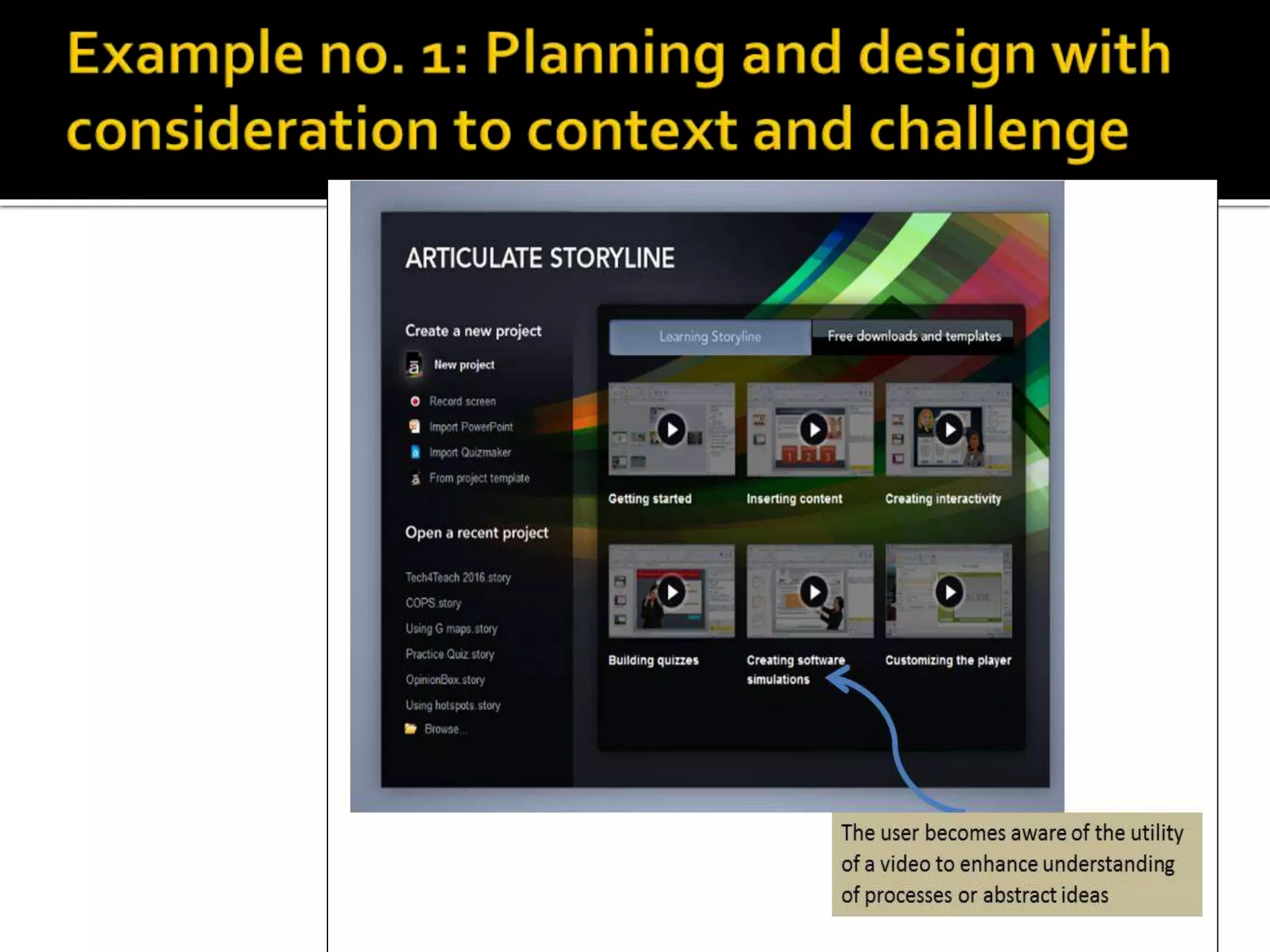
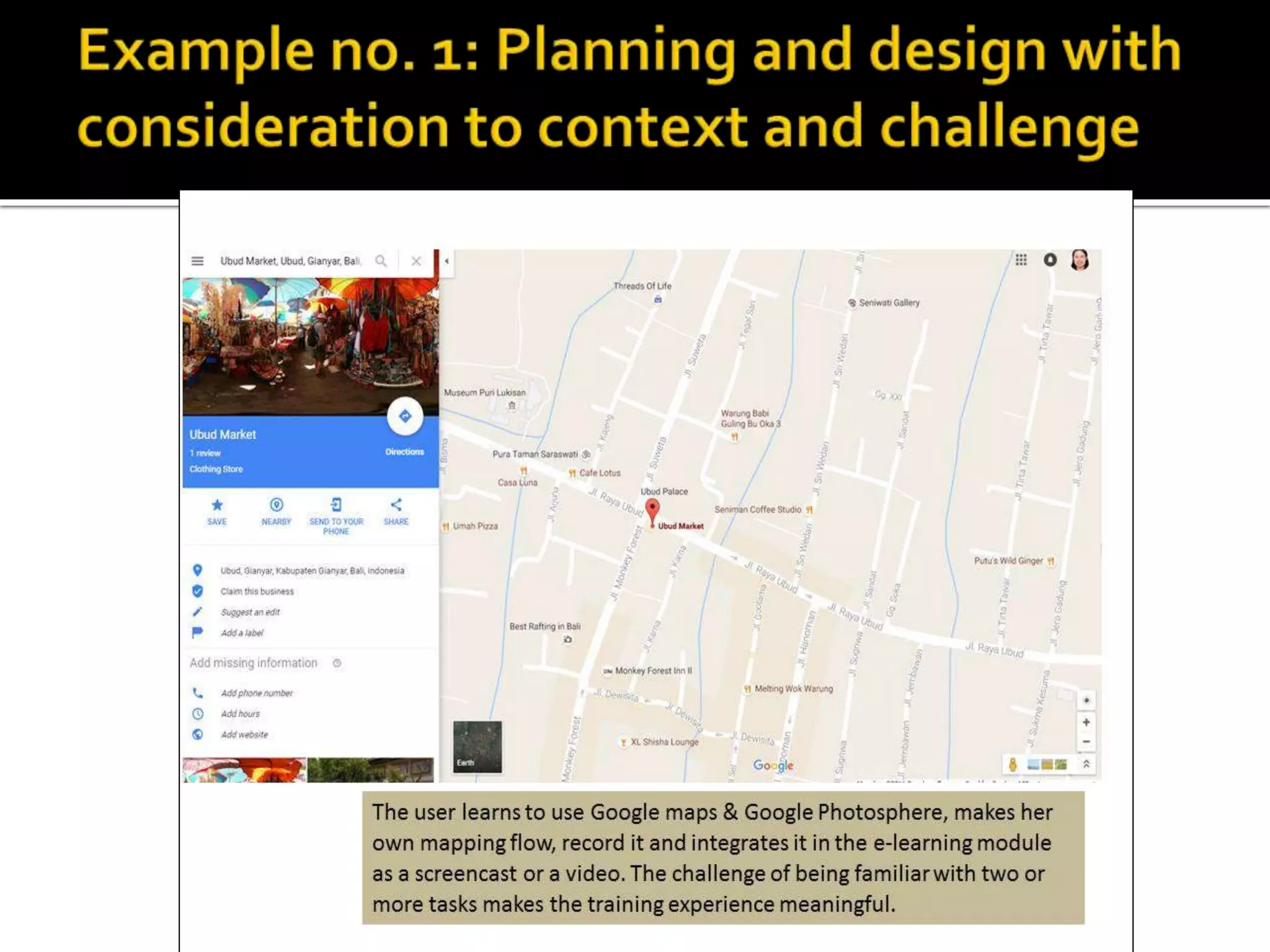
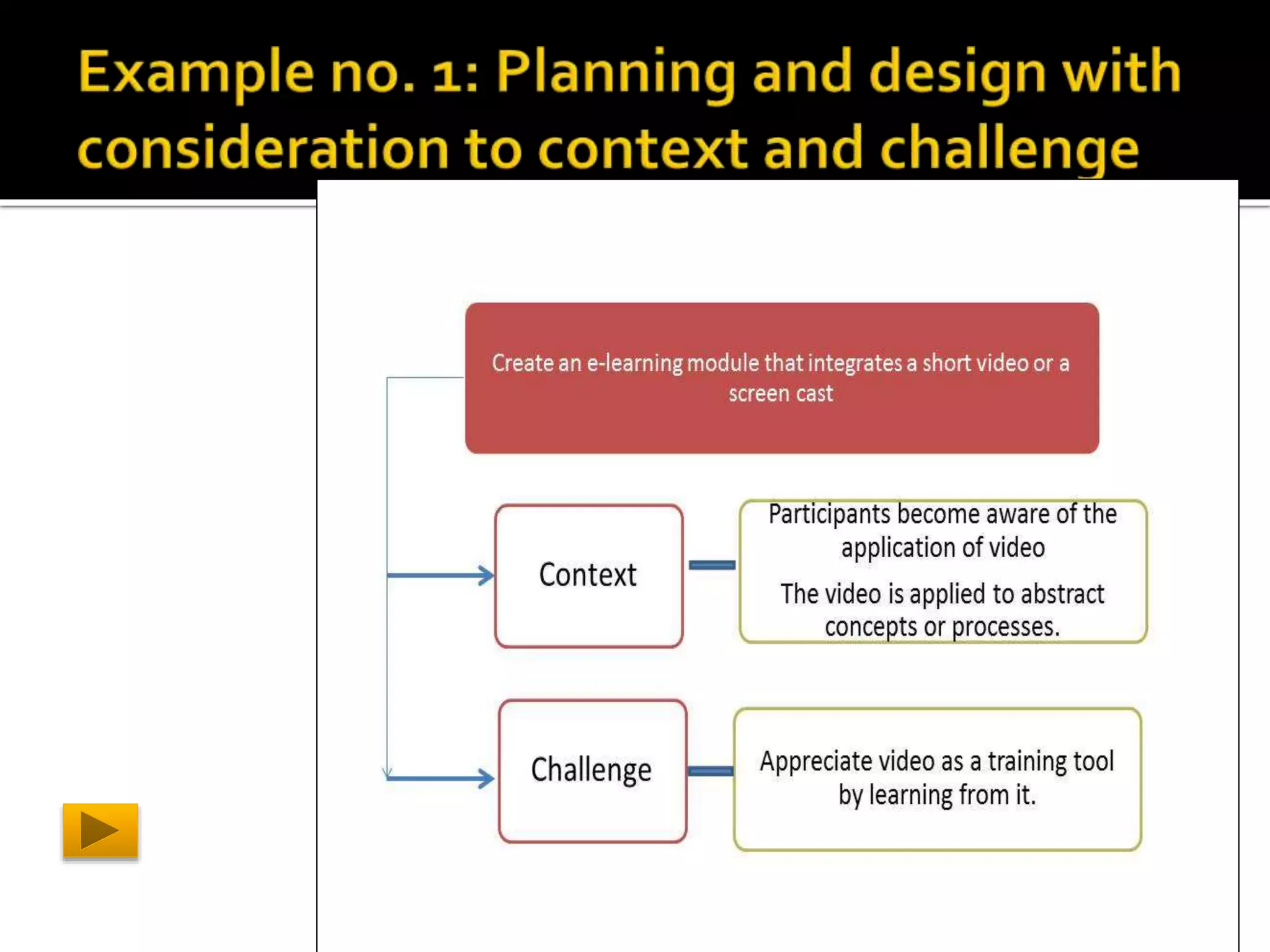
  • #21 So for example, the intended skill outcome is the ability to create useful elearning modules. Context – throw the questions: why do you want to use a video? What type of video are you integrating The context provides an opportunity for users to think critically and rationalize the support provided by the application towards a given task. Challenge – create an experiential and meaningful example. There has to be room for analyzing outcomes as this will pave the way to experimentation and reflective mindset.
  • #28 ICT training is a significant investment in the region and in other parts of the world. It must be attended with a watchful judgment and not waste capacity building investments. ICT trainers need to advance their methods and expand their training and learning landscape. The old strategy of linear, step-by-step “teaching technology” is ineffective and not suitable anymore. A new way of building ICT capacities in the region entails solid instructional design combined with proven training methods. Integrating the rhizome learning principles with carefully thought of accelerated stages of planning and design, and delivery and outcomes is the response to the retooling and relearning essential for the ASEAN citizens.