ITSM Specialization Sourcing
2012-2013
Prof. Frank Willems
Lecture 5: Crowdsourcing and Social Media
2
Agenda
1. Change management and leadership
2. Social Networks as background or playground?
3. What is Crowdsourcing, Tribes and Co-creation?
4. Social Media as trigger for change
3
Fasttrack on change management and
leadership
4
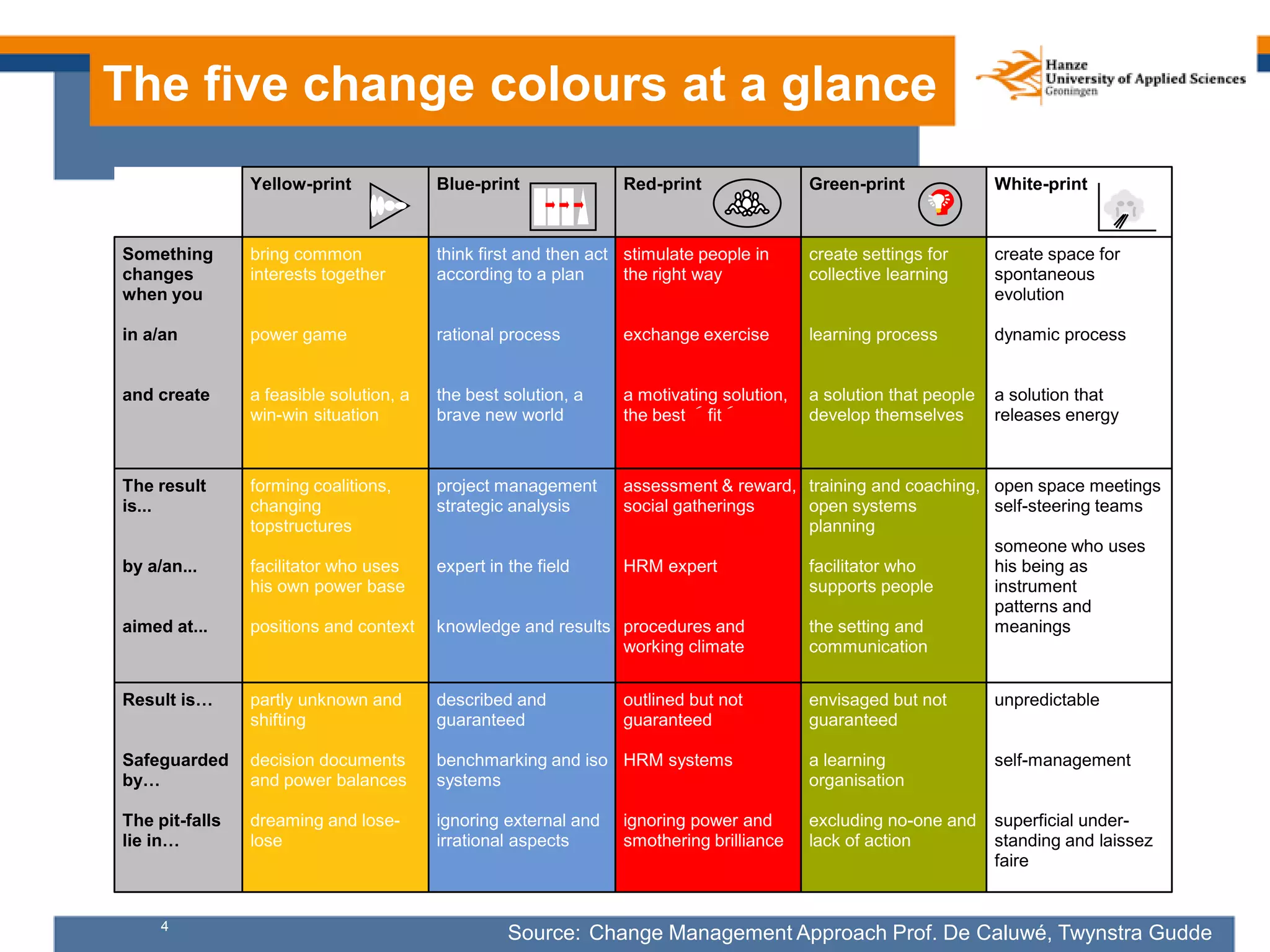
The five change colours at a glance
Yellow-print Blue-print Red-print Green-print White-print
Something
changes
when you
in a/an
and create
bring common
interests together
power game
a feasible solution, a
win-win situation
think first and then act
according to a plan
rational process
the best solution, a
brave new world
stimulate people in
the right way
exchange exercise
a motivating solution,
the best ´fit´
create settings for
collective learning
learning process
a solution that people
develop themselves
create space for
spontaneous
evolution
dynamic process
a solution that
releases energy
The result
is...
by a/an...
aimed at...
forming coalitions,
changing
topstructures
facilitator who uses
his own power base
positions and context
project management
strategic analysis
expert in the field
knowledge and results
assessment & reward,
social gatherings
HRM expert
procedures and
working climate
training and coaching,
open systems
planning
facilitator who
supports people
the setting and
communication
open space meetings
self-steering teams
someone who uses
his being as
instrument
patterns and
meanings
Result is…
Safeguarded
by…
The pit-falls
lie in…
partly unknown and
shifting
decision documents
and power balances
dreaming and lose-
lose
described and
guaranteed
benchmarking and iso
systems
ignoring external and
irrational aspects
outlined but not
guaranteed
HRM systems
ignoring power and
smothering brilliance
envisaged but not
guaranteed
a learning
organisation
excluding no-one and
lack of action
unpredictable
self-management
superficial under-
standing and laissez
faire
Source: Change Management Approach Prof. De Caluwé, Twynstra Gudde
5
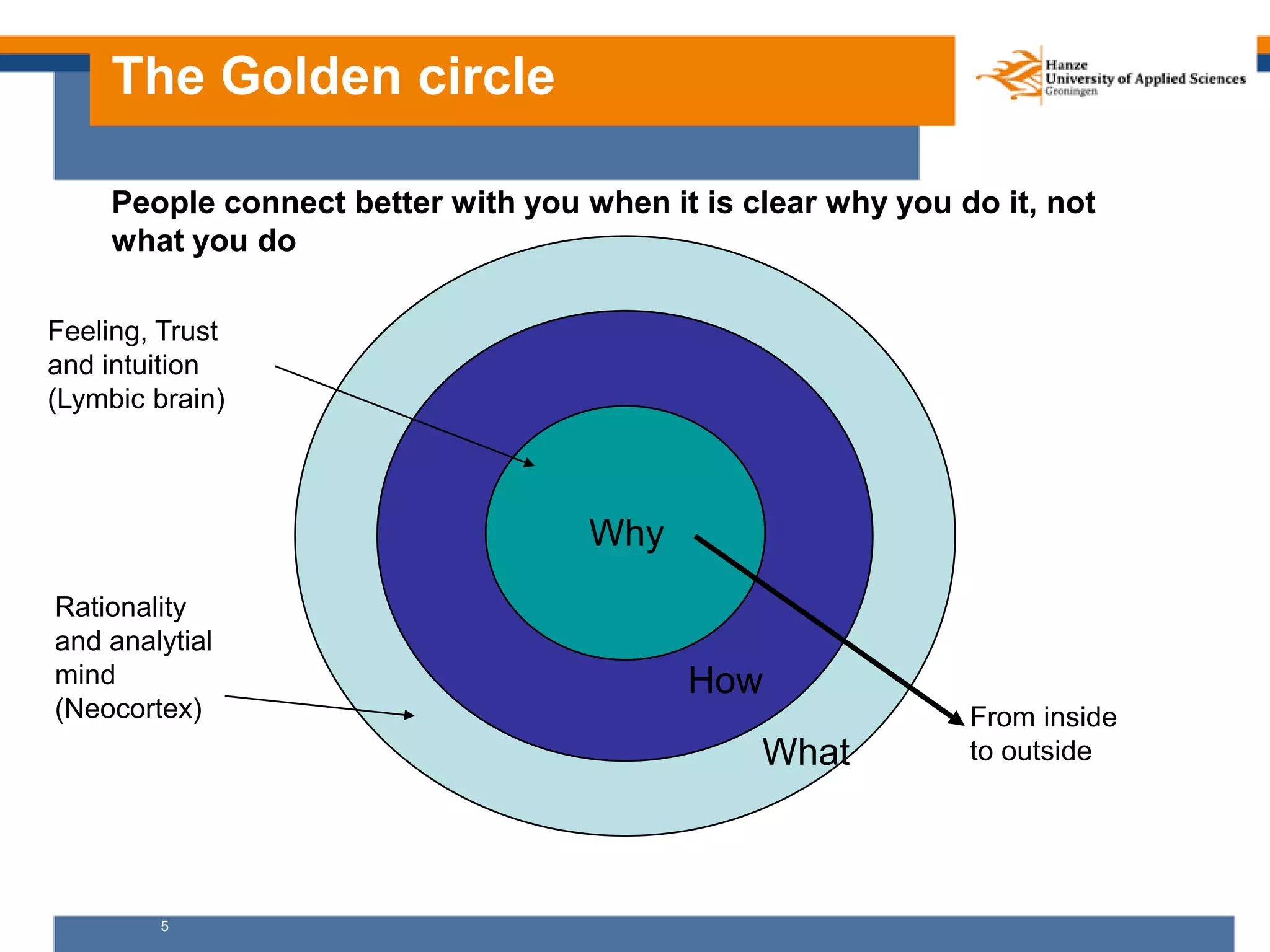
The Golden circle
People connect better with you when it is clear why you do it, not
what you do
What
How
Why
Rationality
and analytial
mind
(Neocortex)
Feeling, Trust
and intuition
(Lymbic brain)
From inside
to outside
6
Open
Will
Open
Heart
Open
Mind
LISTENING 2:
from outside
disconfirming
[new] data
Downloading
habits of judgment
reconfirming old
opinions & judgments
Factual listening
noticing differences
LISTENING 3:
from within
seeing through
another person‘s eyes
emotional connection
Empathic listening
LISTENING 1:
from habits
LISTENING 4:
from Source
connecting to an
emerging future whole;
shift in identity and self
Generative listening
(from the future wanting to
emerge)
Theory U as ‘toolkit’ for leaders
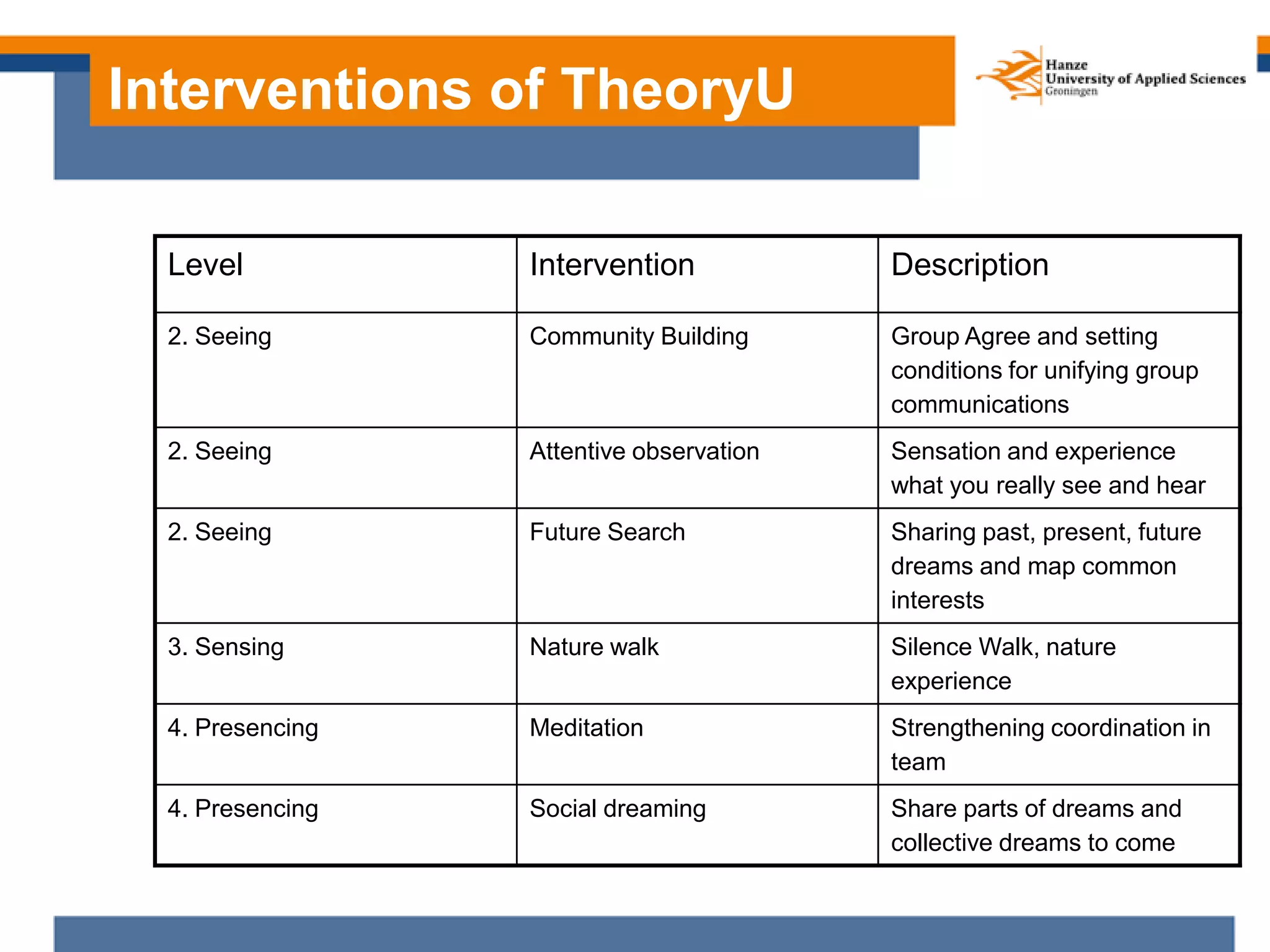
Interventions of TheoryU
Level Intervention Description
2. Seeing Community Building Group Agree and setting
conditions for unifying group
communications
2. Seeing Attentive observation Sensation and experience
what you really see and hear
2. Seeing Future Search Sharing past, present, future
dreams and map common
interests
3. Sensing Nature walk Silence Walk, nature
experience
4. Presencing Meditation Strengthening coordination in
team
4. Presencing Social dreaming Share parts of dreams and
collective dreams to come
8
Social Networks
9
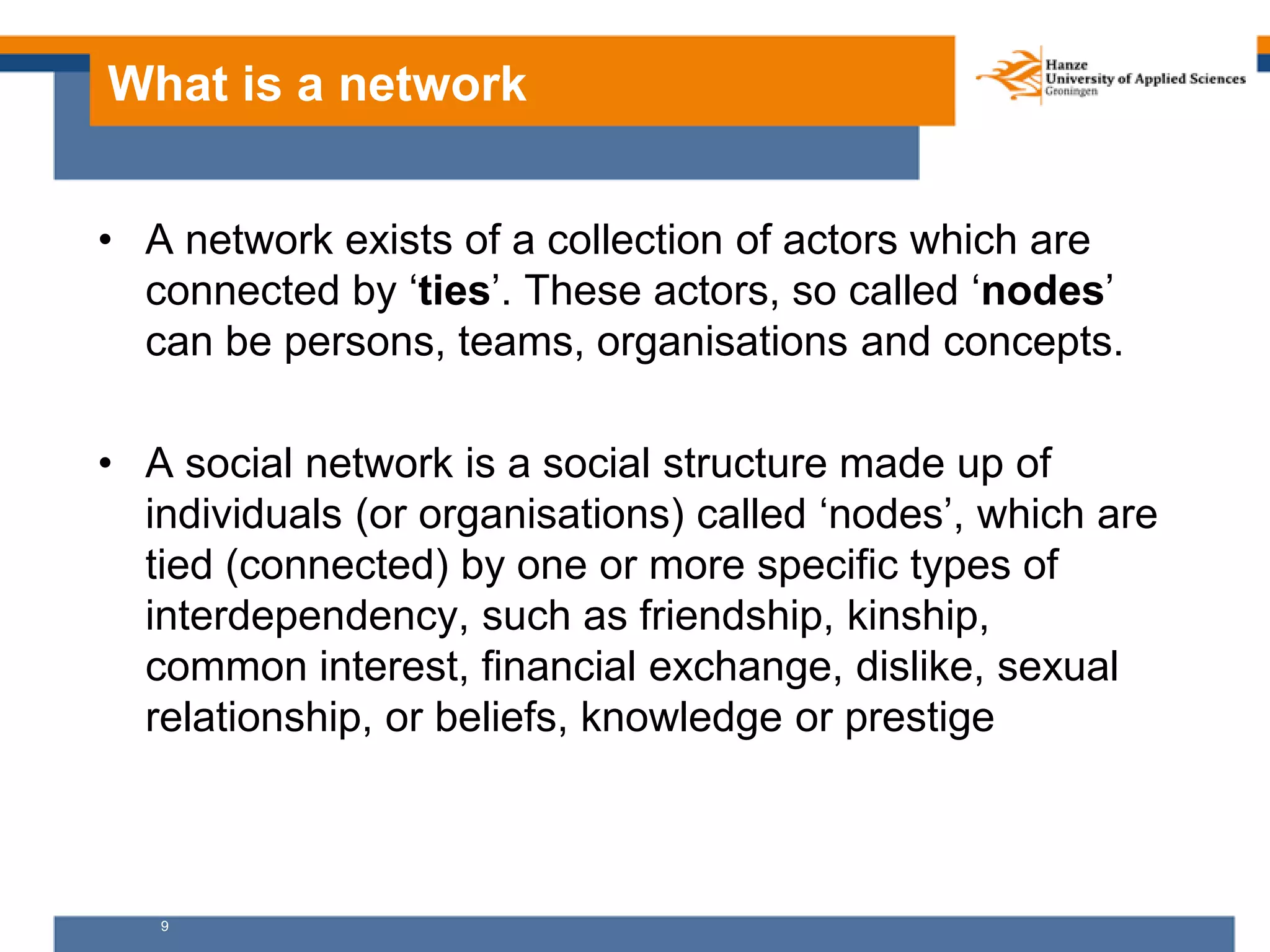
What is a network
• A network exists of a collection of actors which are
connected by ‘ties’. These actors, so called ‘nodes’
can be persons, teams, organisations and concepts.
• A social network is a social structure made up of
individuals (or organisations) called ‘nodes’, which are
tied (connected) by one or more specific types of
interdependency, such as friendship, kinship,
common interest, financial exchange, dislike, sexual
relationship, or beliefs, knowledge or prestige
10
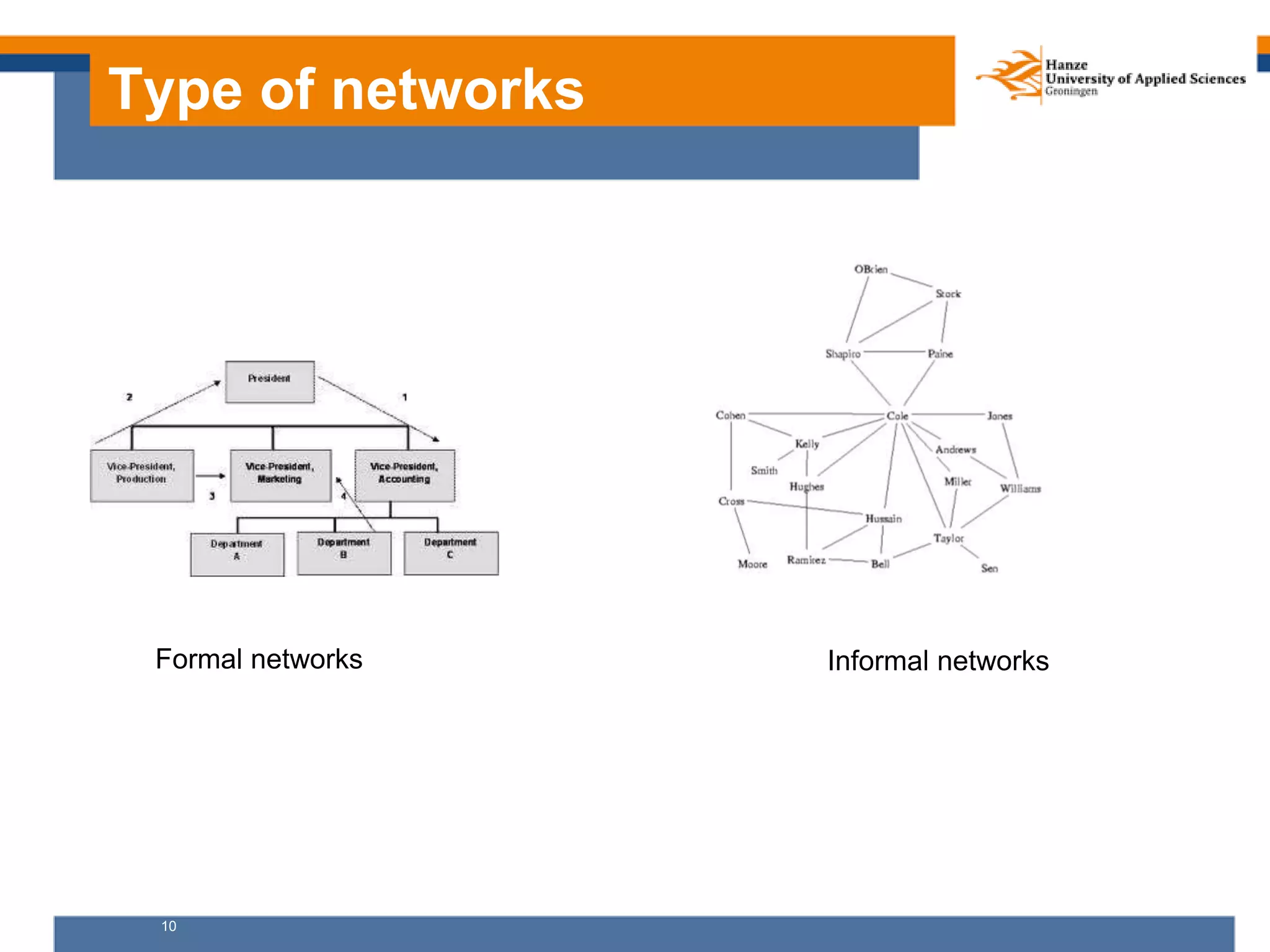
Type of networks
Formal networks Informal networks
1
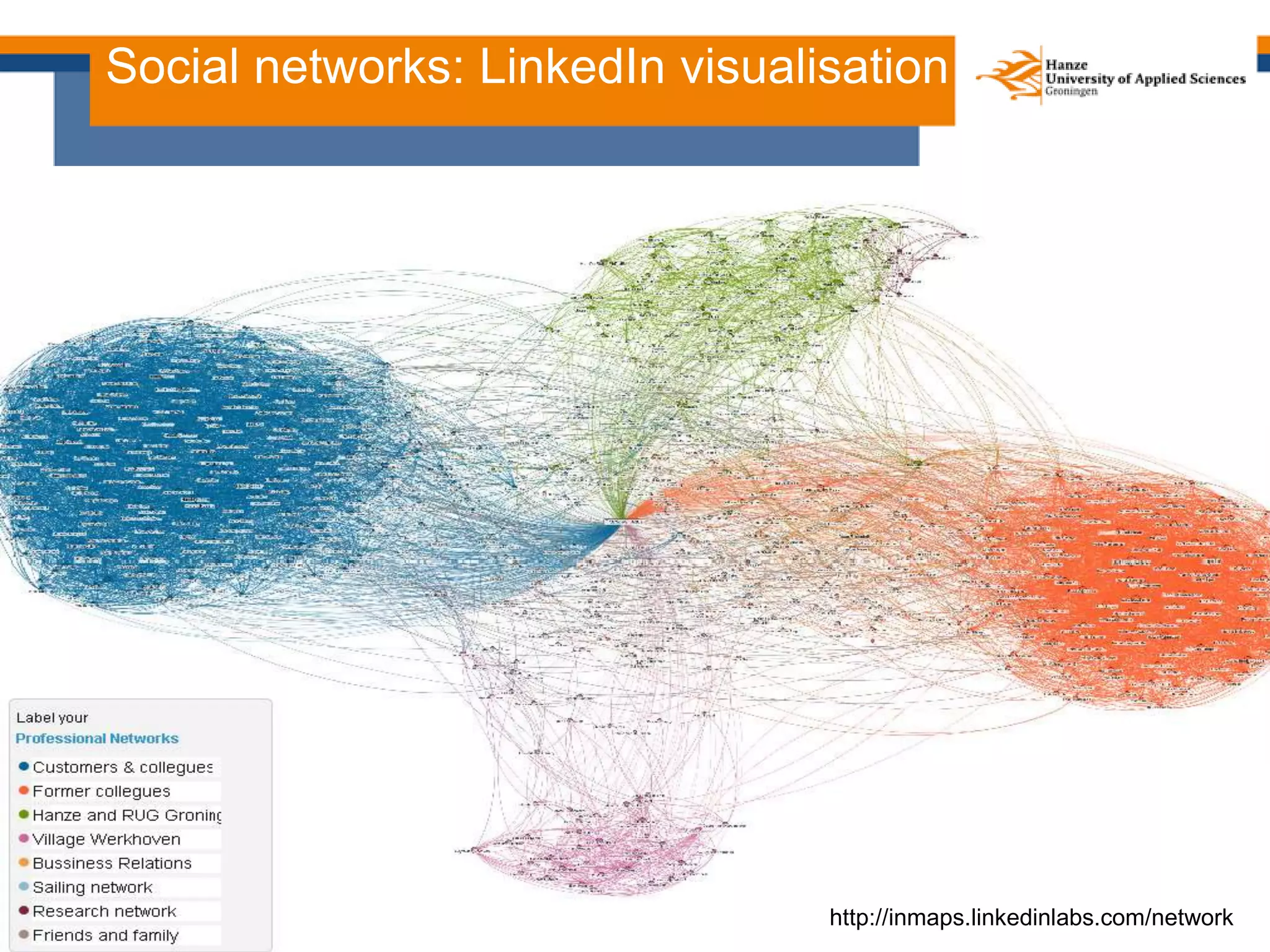
Social networks: LinkedIn visualisation
http://inmaps.linkedinlabs.com/network
12
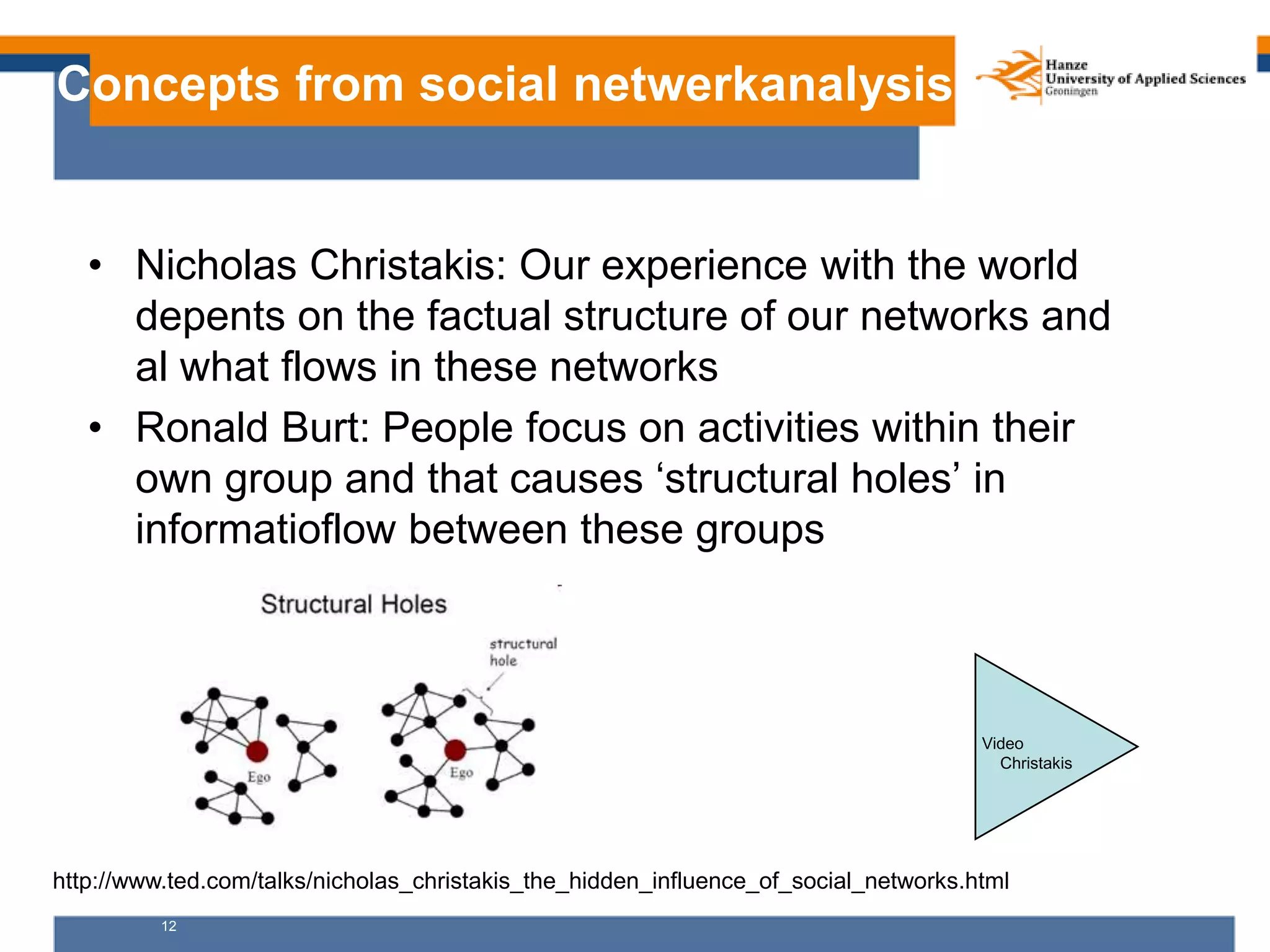
Concepts from social netwerkanalysis
• Nicholas Christakis: Our experience with the world
depents on the factual structure of our networks and
al what flows in these networks
• Ronald Burt: People focus on activities within their
own group and that causes ‘structural holes’ in
informatioflow between these groups
Video
Christakis
http://www.ted.com/talks/nicholas_christakis_the_hidden_influence_of_social_networks.html
13
Bridging the structural holes
• Will lead to new ideas, innovations and borderless
opportunities
• How to bridge the structural holes?
• How can change management and leadership support
this?
14
Social Capital
• Social Capital is a sociological concept, which refers to
connections within and between social networks
• The concept of Social Capital highlights the value of social
relations and the role of cooperation and confidence to get
collective or economic results
• The modern emergence of Social Capital concept renewed
the academic interest for an old debate in social science:
the relationship between trust, social networks and the
development of modern industrial society.
• Social Capital is the strategy of getting relations
• Great thinkers are Robert Putnam, Pierre Bourdieu and
James Coleman
15
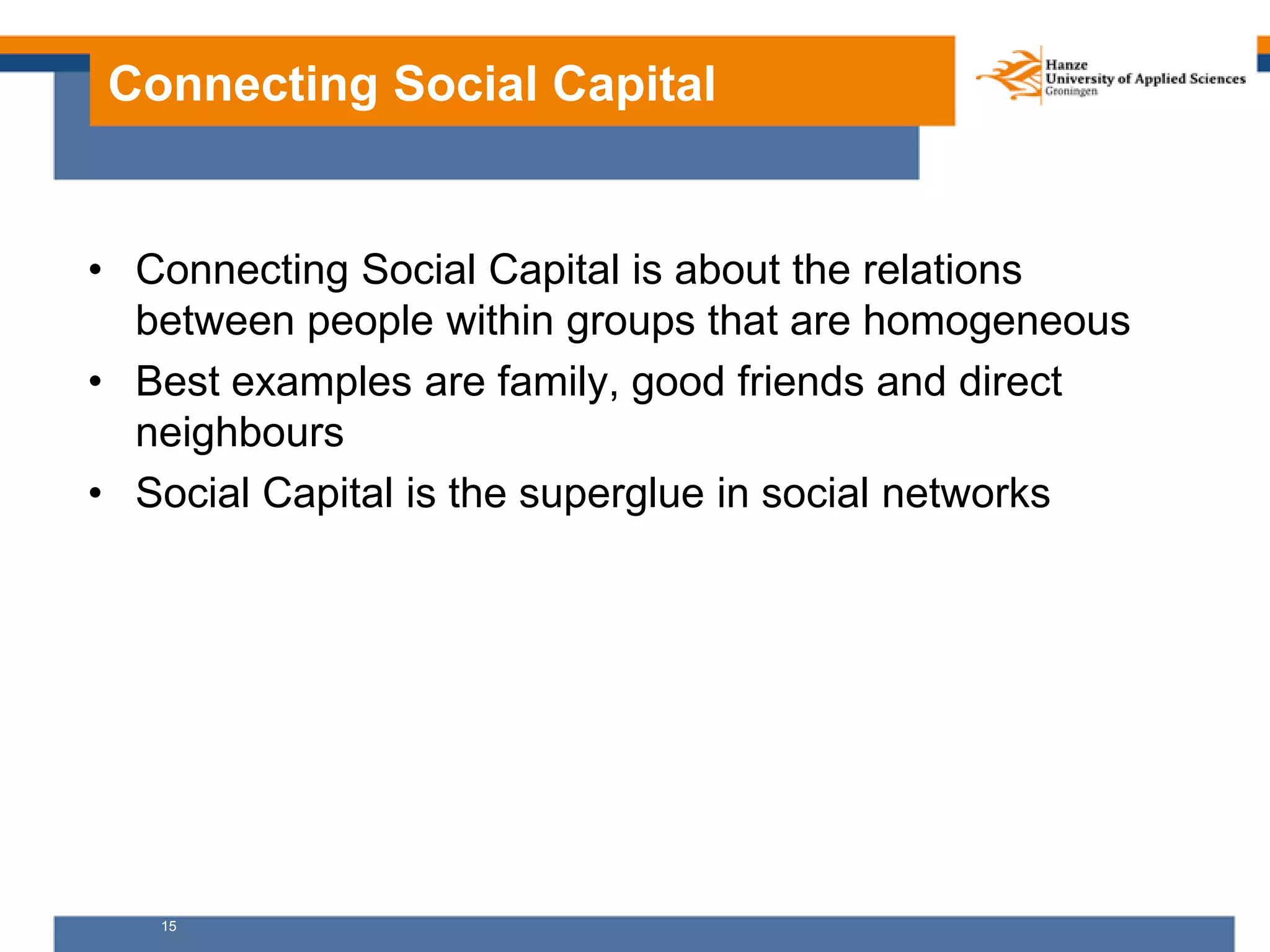
Connecting Social Capital
• Connecting Social Capital is about the relations
between people within groups that are homogeneous
• Best examples are family, good friends and direct
neighbours
• Social Capital is the superglue in social networks
16
Crowdsourcing
17
Crowdsourcing, Tribes and
Co-creation
• Crowdsourcing is the act of outsourcing tasks,
traditionally performed by an employee or contractor,
to an undefined, large group of people or community
(a crowd), through an open call.
• A tribe is a group of people connected to one another,
connected to a leader and connected to an idea
• Co-creation is a form of market or business strategy
that emphasizes the development and ongoing
realization of mutual firm-customer value
18
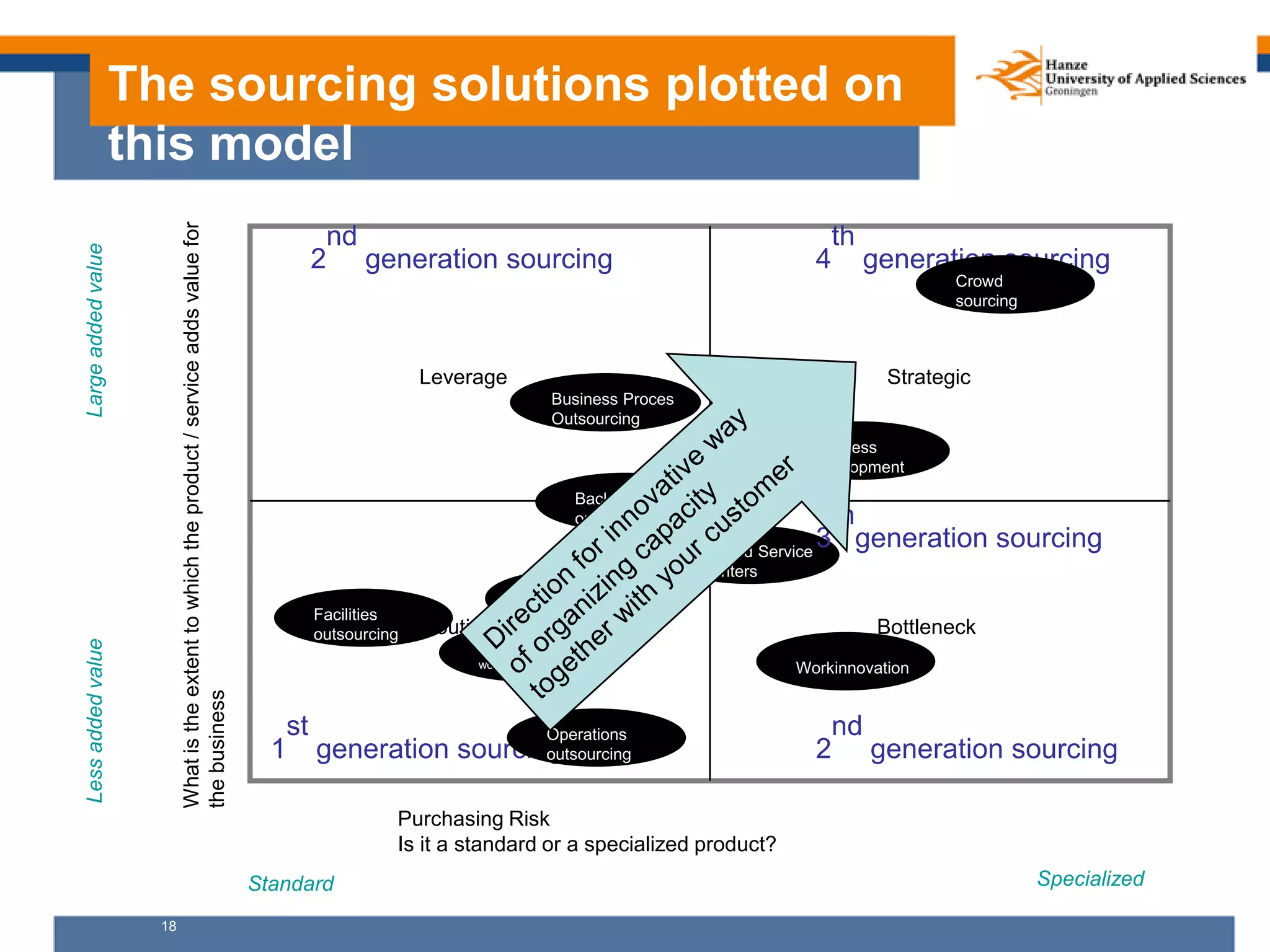
The sourcing solutions plotted on
this model
Purchasing Risk
Is it a standard or a specialized product?
Whatistheextenttowhichtheproduct/serviceaddsvaluefor
thebusiness
LessaddedvalueLargeaddedvalue
Standard Specialized
StrategicLeverage
BottleneckRoutine
Business Proces
Outsourcing
Backoffice
outsourcing
Outsourcing
workplace mgt
Business
development
Shared Service
Centers
DataCenter
outsourcingFacilities
outsourcing
Workinnovation
1
st
generation sourcing 2
nd
generation sourcing
4
th
generation sourcing
3
th
generation sourcing
2
nd
generation sourcing
Crowd
sourcing
Operations
outsourcing
19
Crowdsourcing
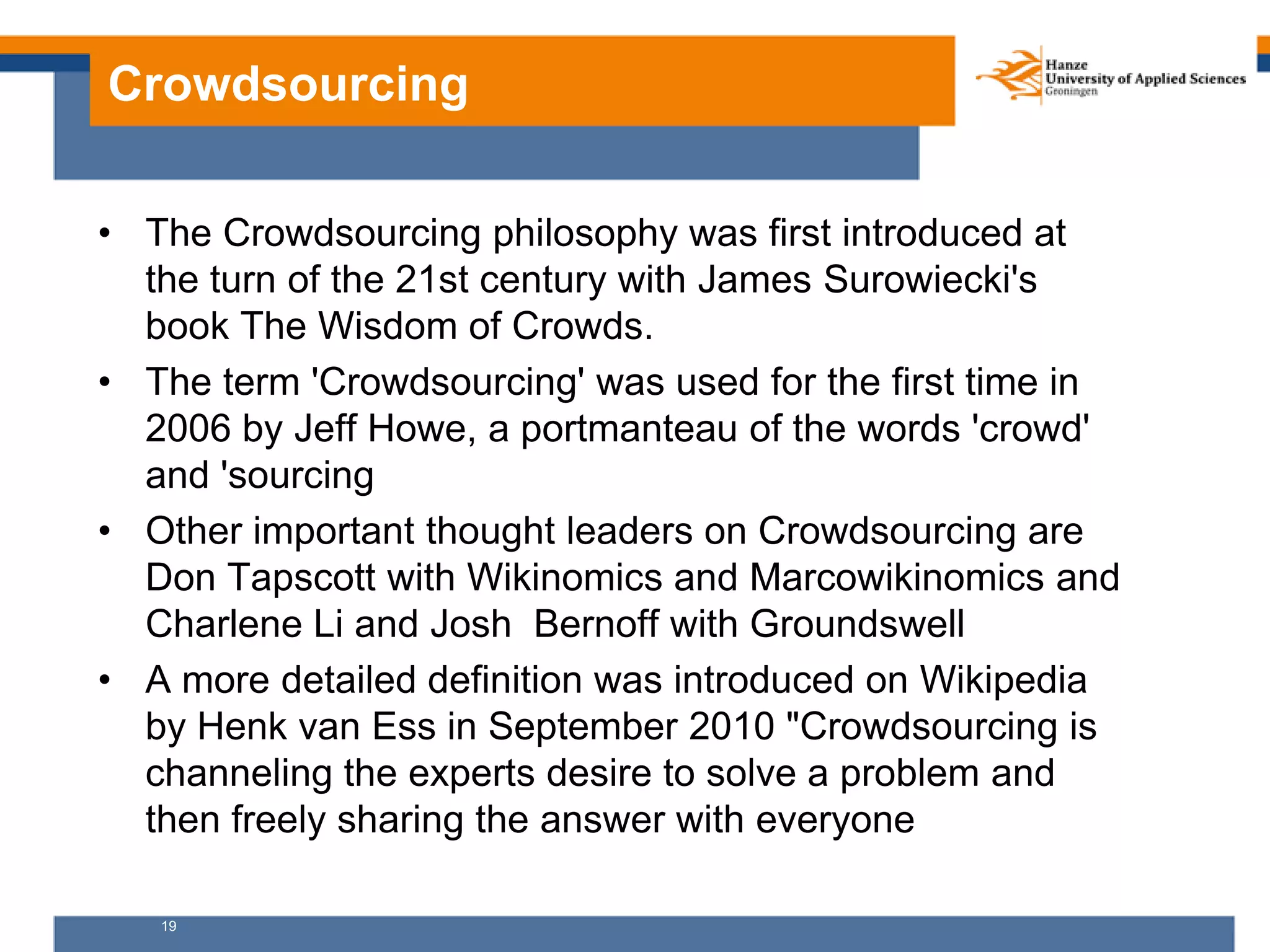
• The Crowdsourcing philosophy was first introduced at
the turn of the 21st century with James Surowiecki's
book The Wisdom of Crowds.
• The term 'Crowdsourcing' was used for the first time in
2006 by Jeff Howe, a portmanteau of the words 'crowd'
and 'sourcing
• Other important thought leaders on Crowdsourcing are
Don Tapscott with Wikinomics and Marcowikinomics and
Charlene Li and Josh Bernoff with Groundswell
• A more detailed definition was introduced on Wikipedia
by Henk van Ess in September 2010 "Crowdsourcing is
channeling the experts desire to solve a problem and
then freely sharing the answer with everyone
20
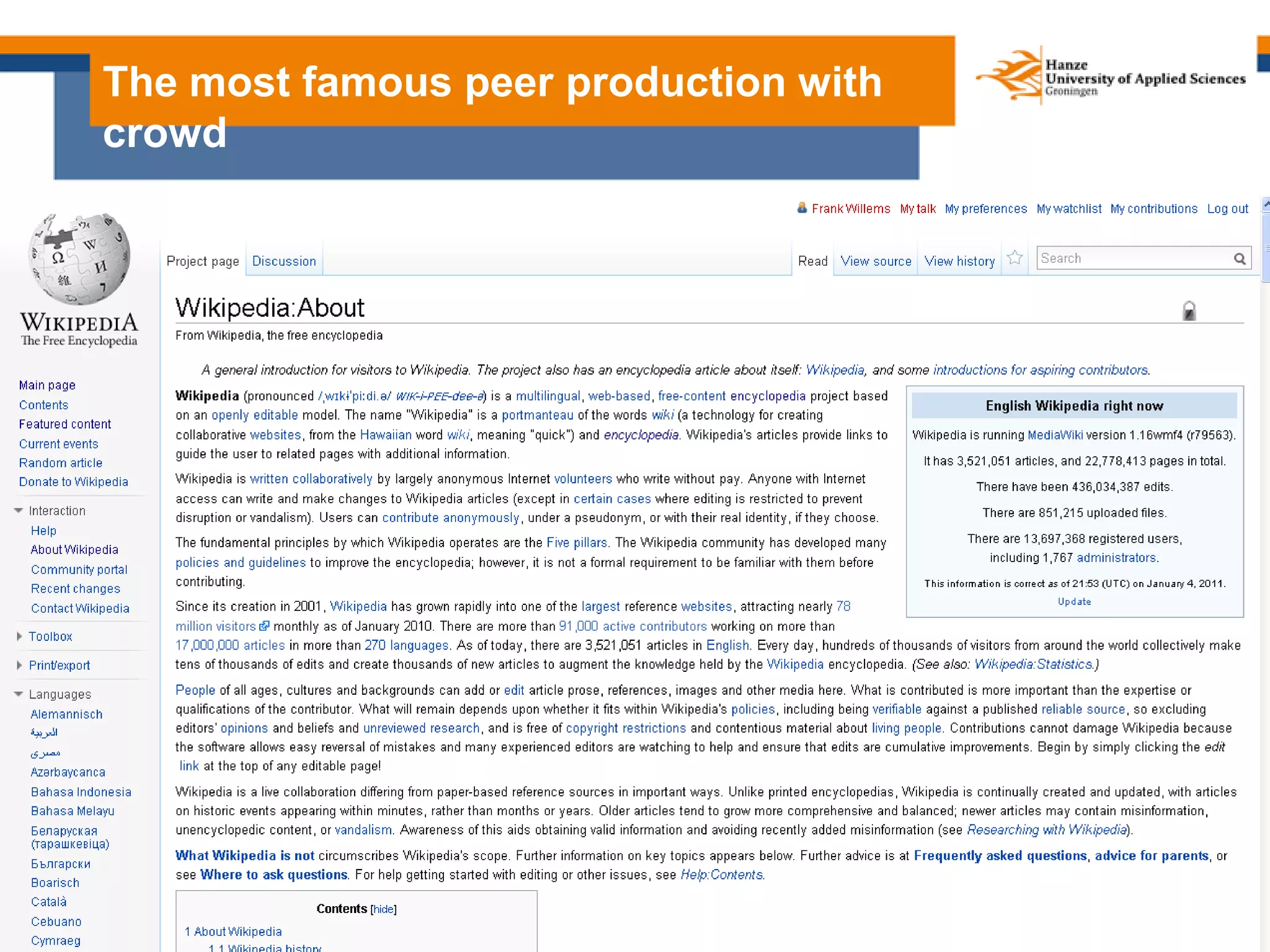
The most famous peer production with
crowd
21
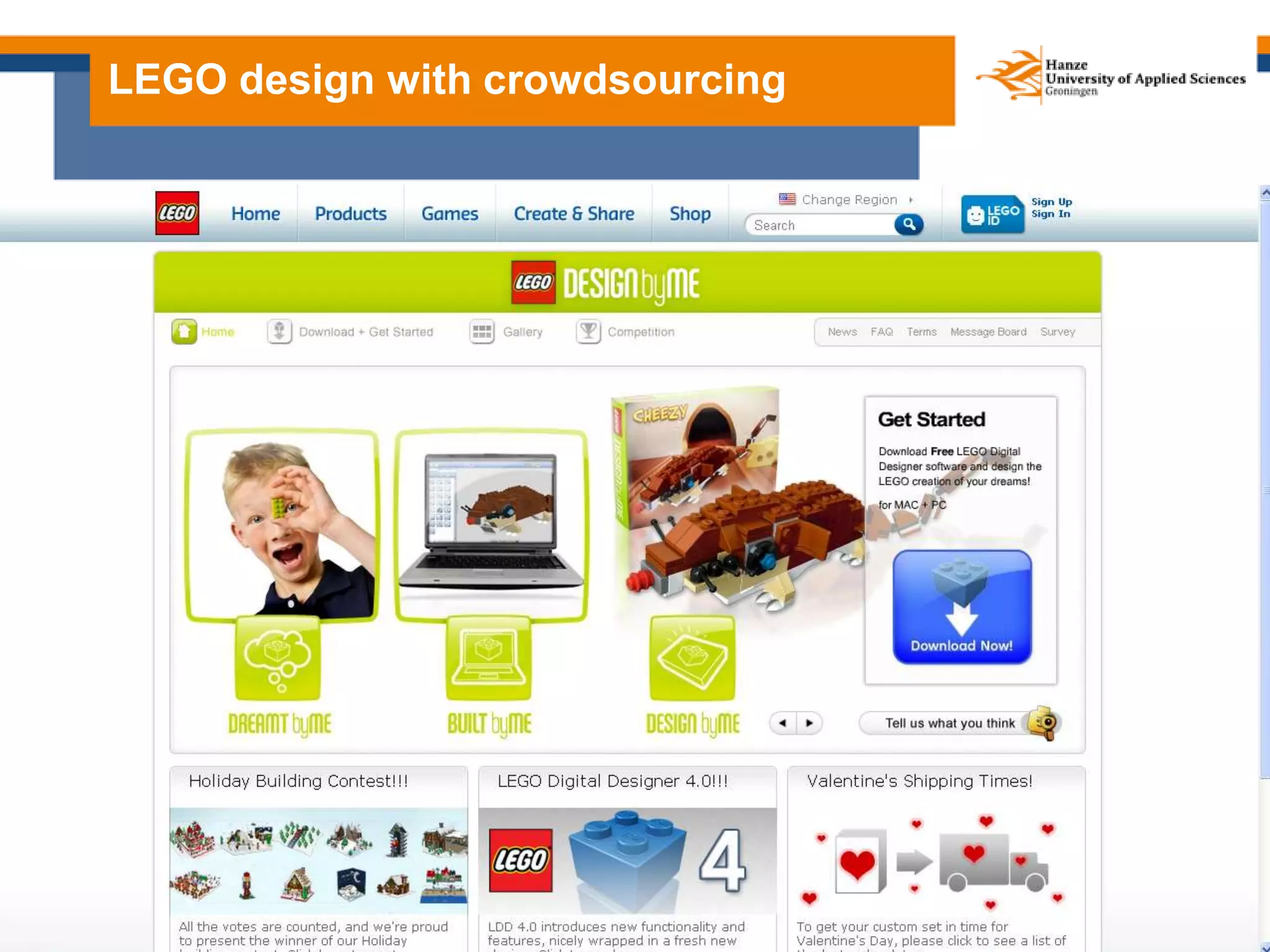
LEGO design with crowdsourcing
22
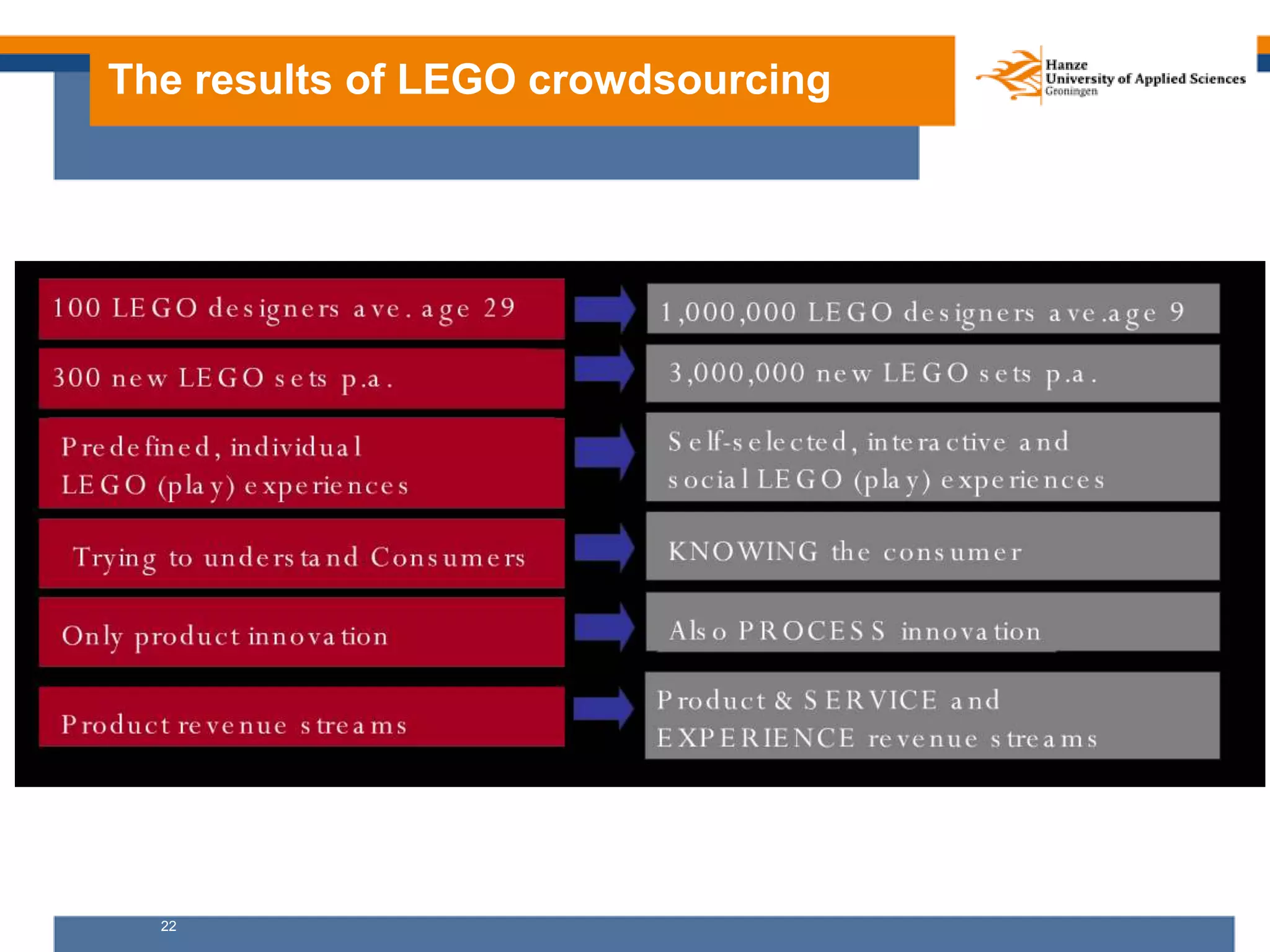
The results of LEGO crowdsourcing
23
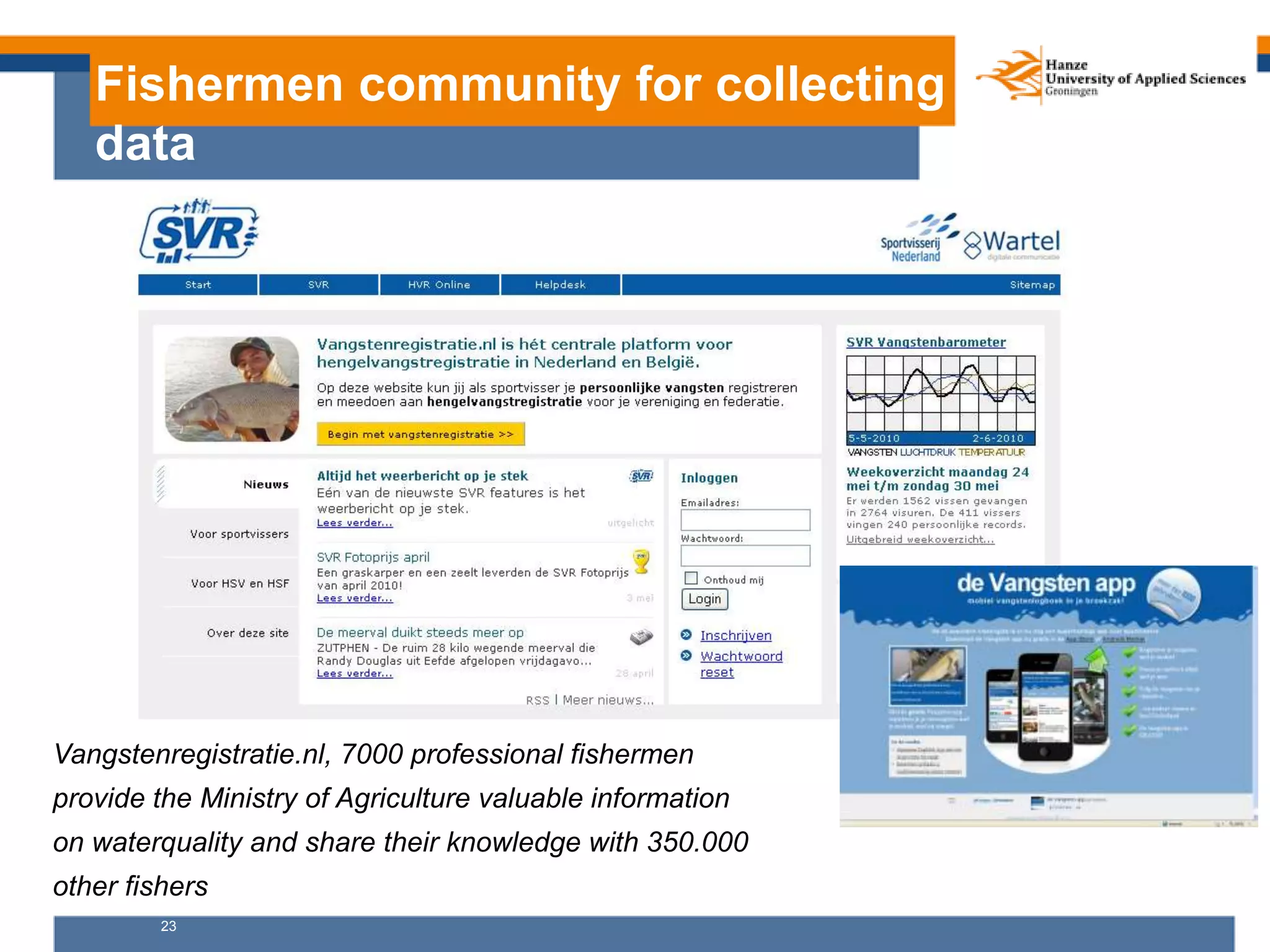
Fishermen community for collecting
data
Vangstenregistratie.nl, 7000 professional fishermen
provide the Ministry of Agriculture valuable information
on waterquality and share their knowledge with 350.000
other fishers
24
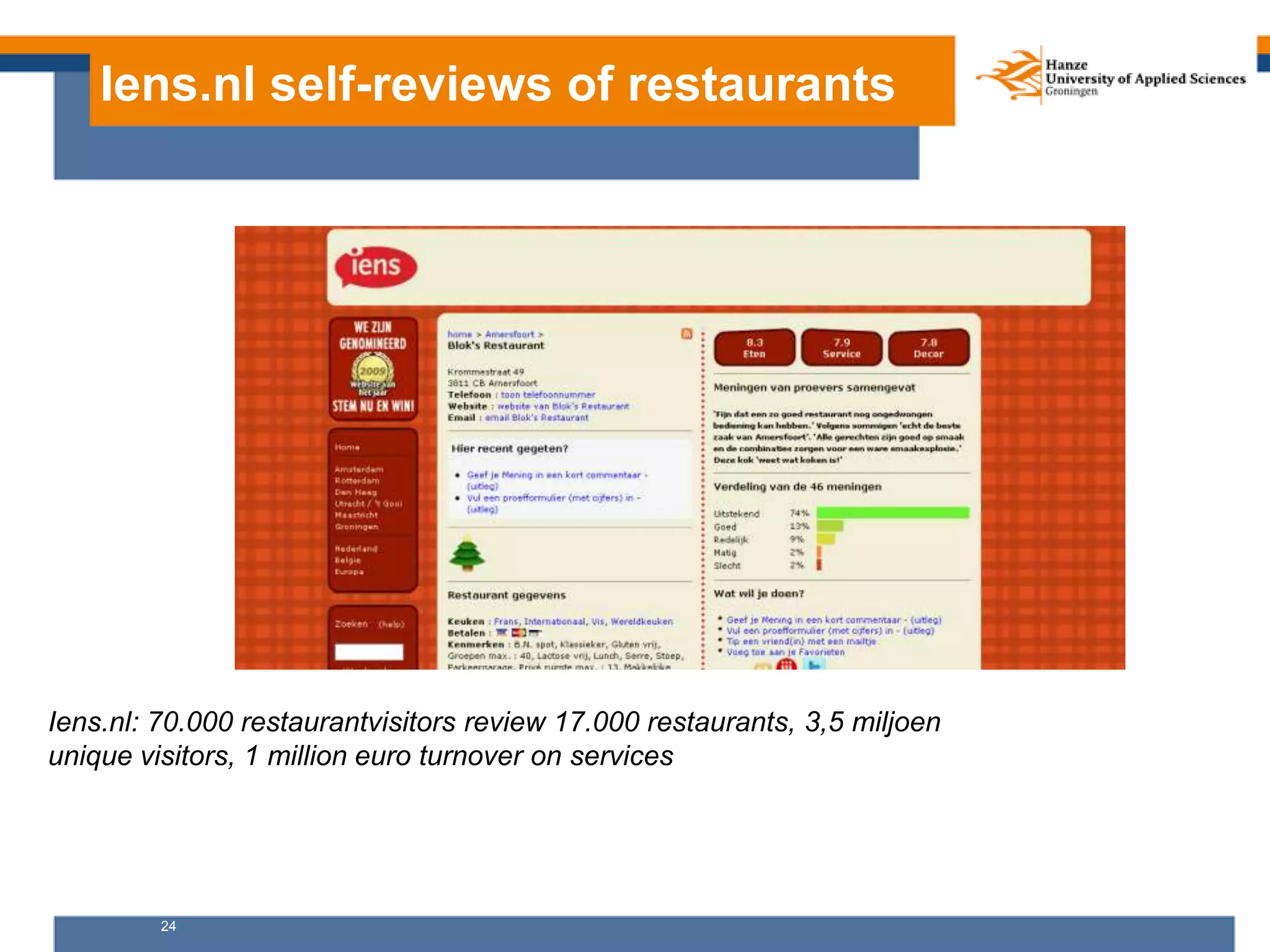
Iens.nl self-reviews of restaurants
Iens.nl: 70.000 restaurantvisitors review 17.000 restaurants, 3,5 miljoen
unique visitors, 1 million euro turnover on services
25
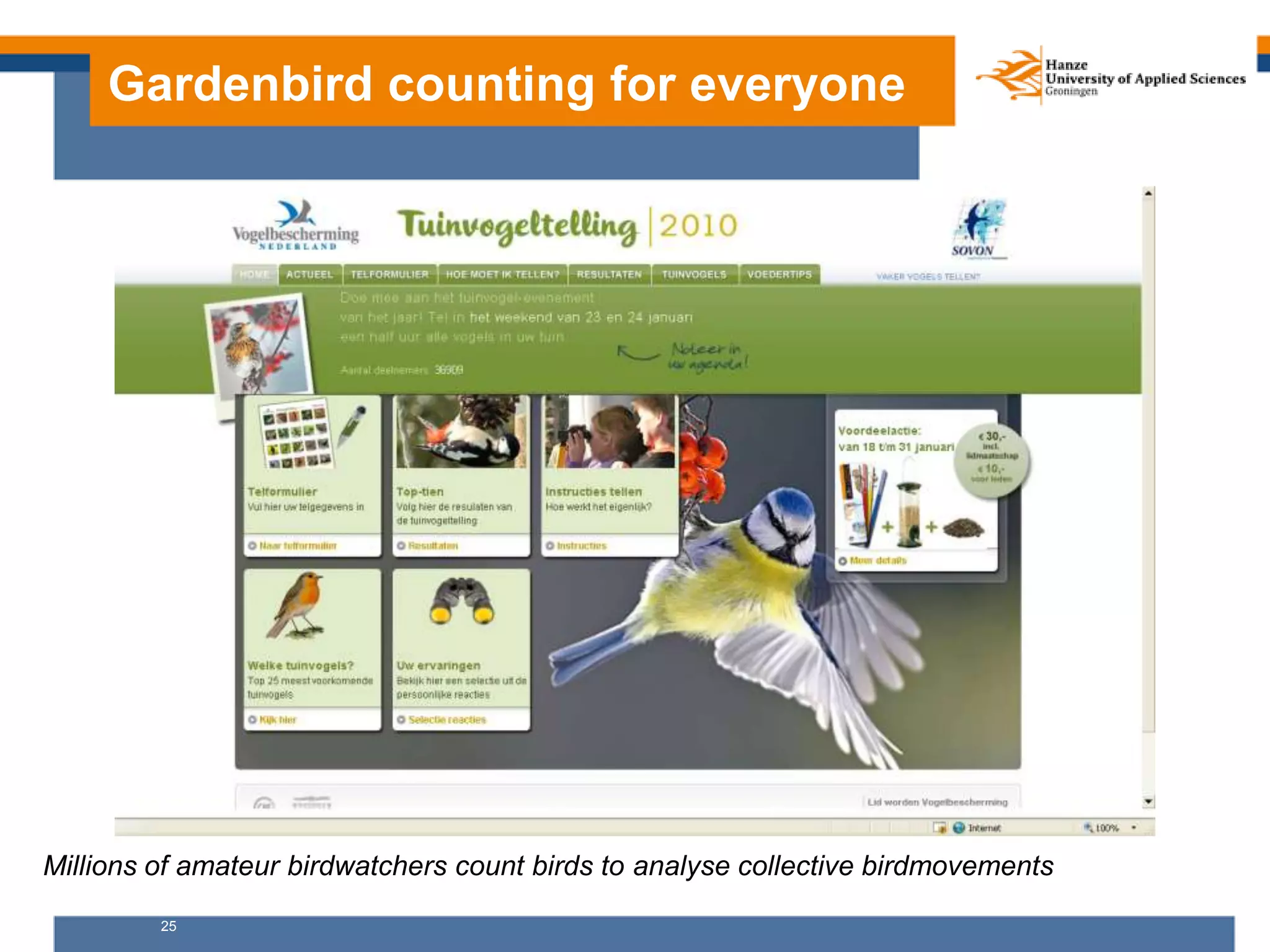
Gardenbird counting for everyone
Millions of amateur birdwatchers count birds to analyse collective birdmovements
26
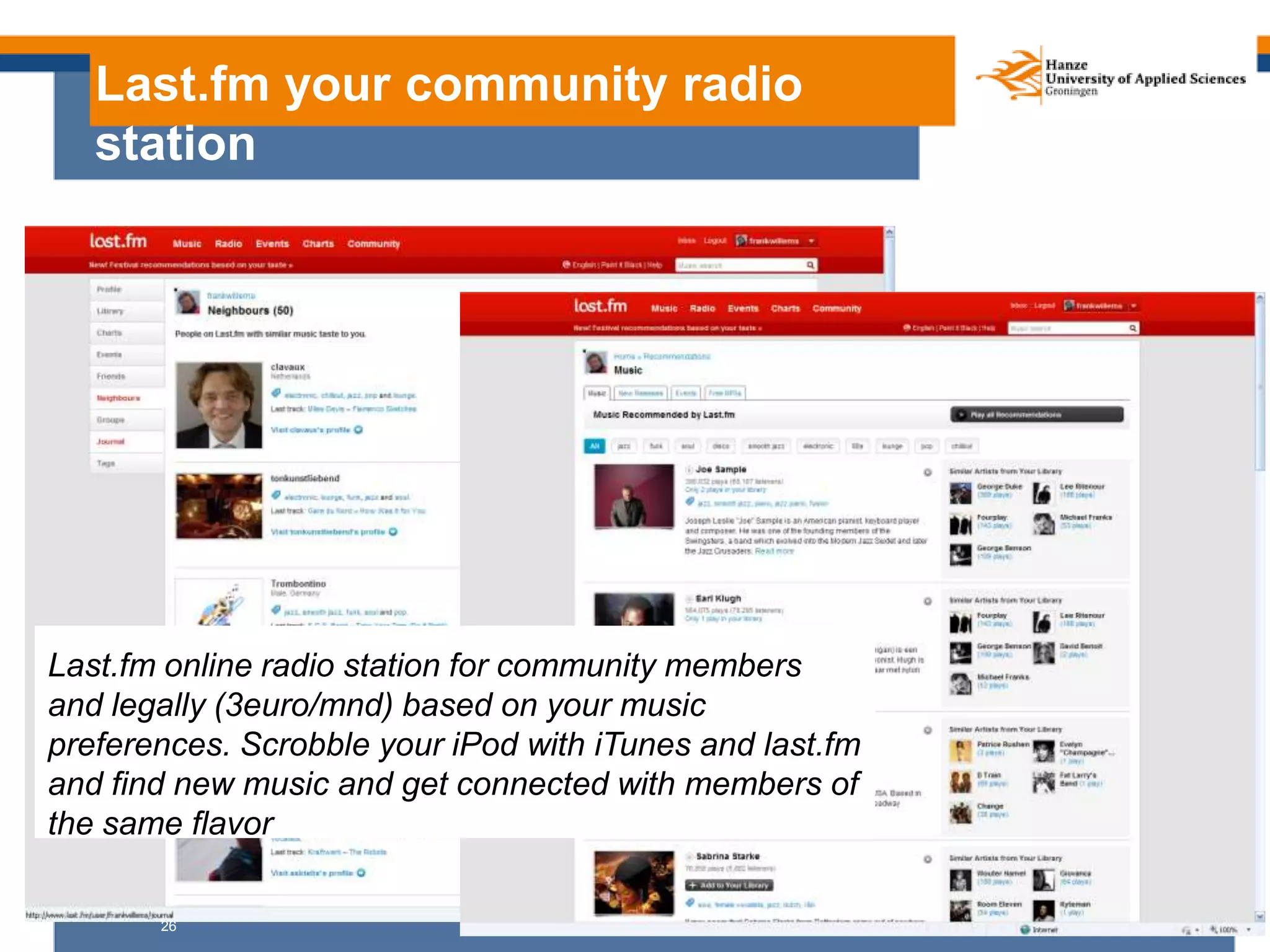
Last.fm your community radio
station
Last.fm online radio station for community members
and legally (3euro/mnd) based on your music
preferences. Scrobble your iPod with iTunes and last.fm
and find new music and get connected with members of
the same flavor
27
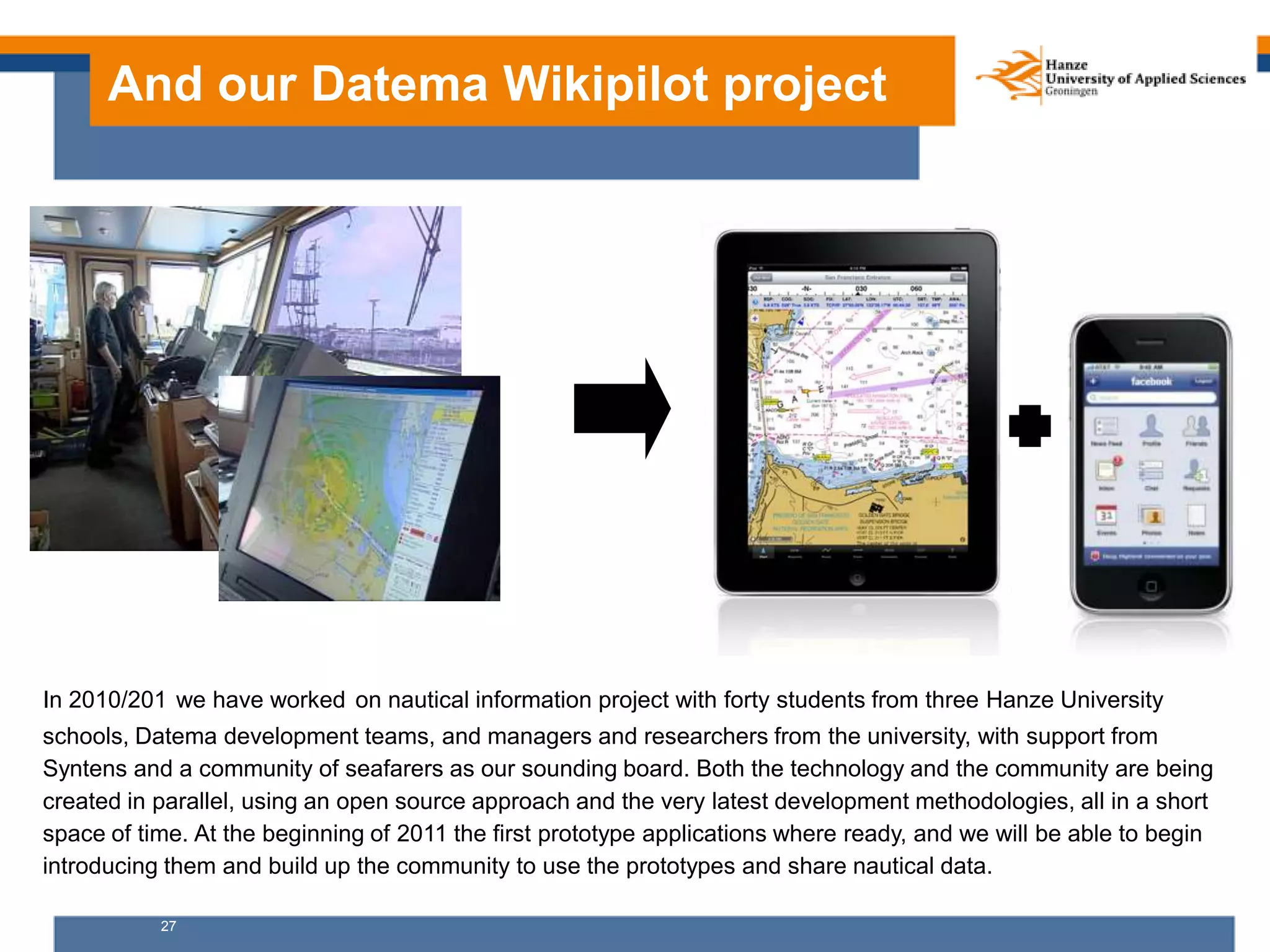
And our Datema Wikipilot project
In 2010/201 we have worked on nautical information project with forty students from three Hanze University
schools, Datema development teams, and managers and researchers from the university, with support from
Syntens and a community of seafarers as our sounding board. Both the technology and the community are being
created in parallel, using an open source approach and the very latest development methodologies, all in a short
space of time. At the beginning of 2011 the first prototype applications where ready, and we will be able to begin
introducing them and build up the community to use the prototypes and share nautical data.
28
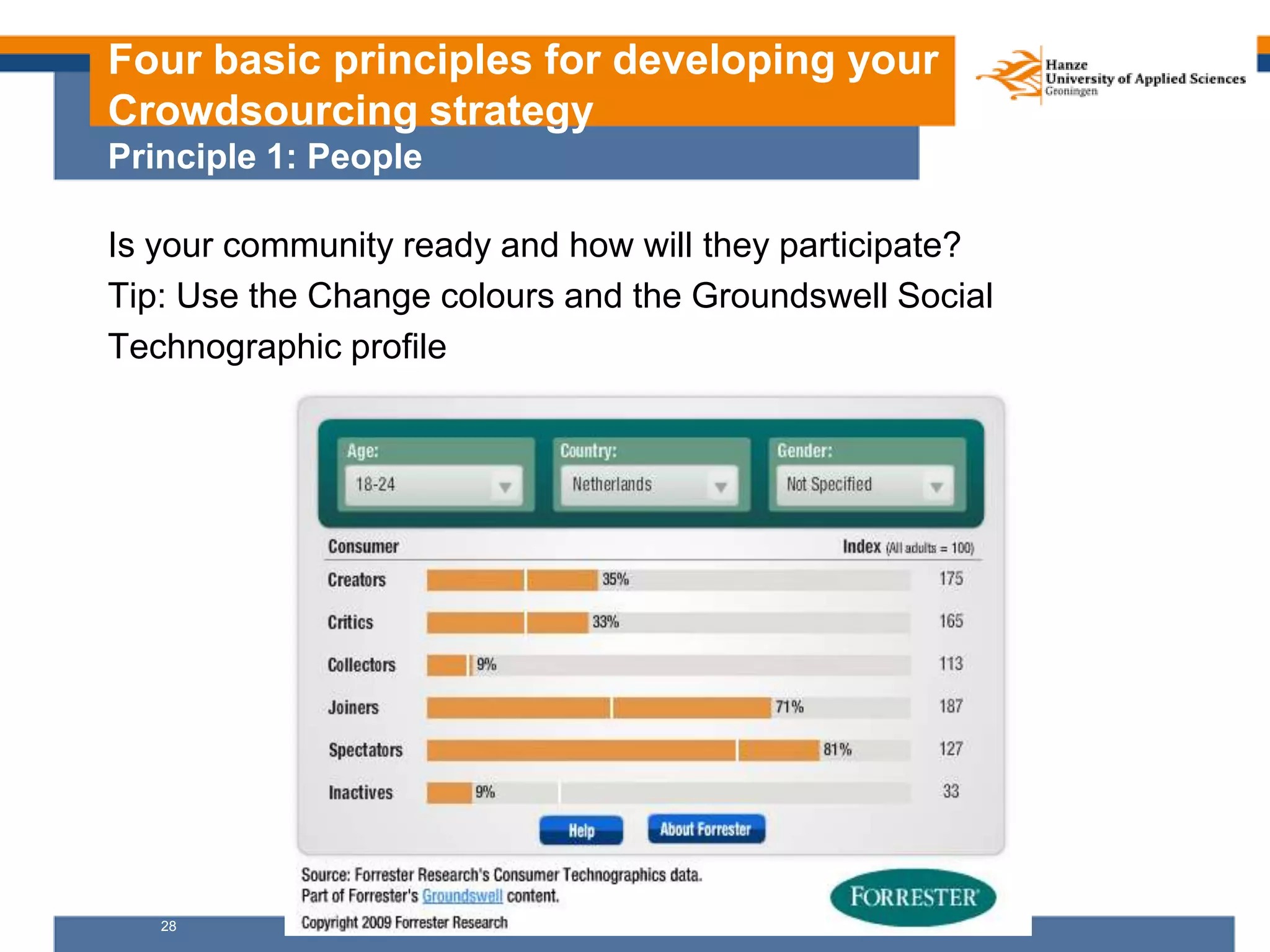
Four basic principles for developing your
Crowdsourcing strategy
Principle 1: People
Is your community ready and how will they participate?
Tip: Use the Change colours and the Groundswell Social
Technographic profile
29
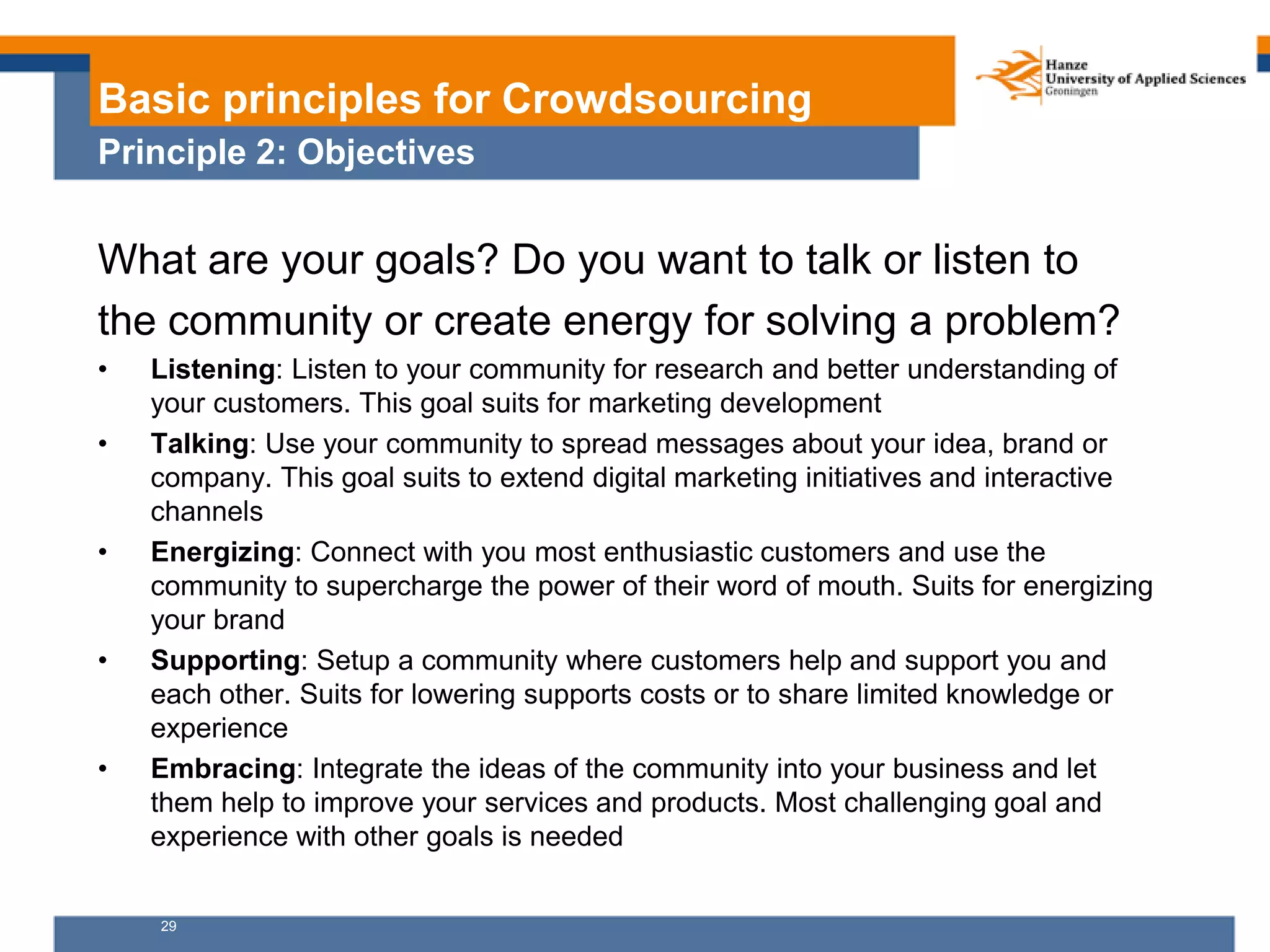
Basic principles for Crowdsourcing
Principle 2: Objectives
What are your goals? Do you want to talk or listen to
the community or create energy for solving a problem?
• Listening: Listen to your community for research and better understanding of
your customers. This goal suits for marketing development
• Talking: Use your community to spread messages about your idea, brand or
company. This goal suits to extend digital marketing initiatives and interactive
channels
• Energizing: Connect with you most enthusiastic customers and use the
community to supercharge the power of their word of mouth. Suits for energizing
your brand
• Supporting: Setup a community where customers help and support you and
each other. Suits for lowering supports costs or to share limited knowledge or
experience
• Embracing: Integrate the ideas of the community into your business and let
them help to improve your services and products. Most challenging goal and
experience with other goals is needed
30
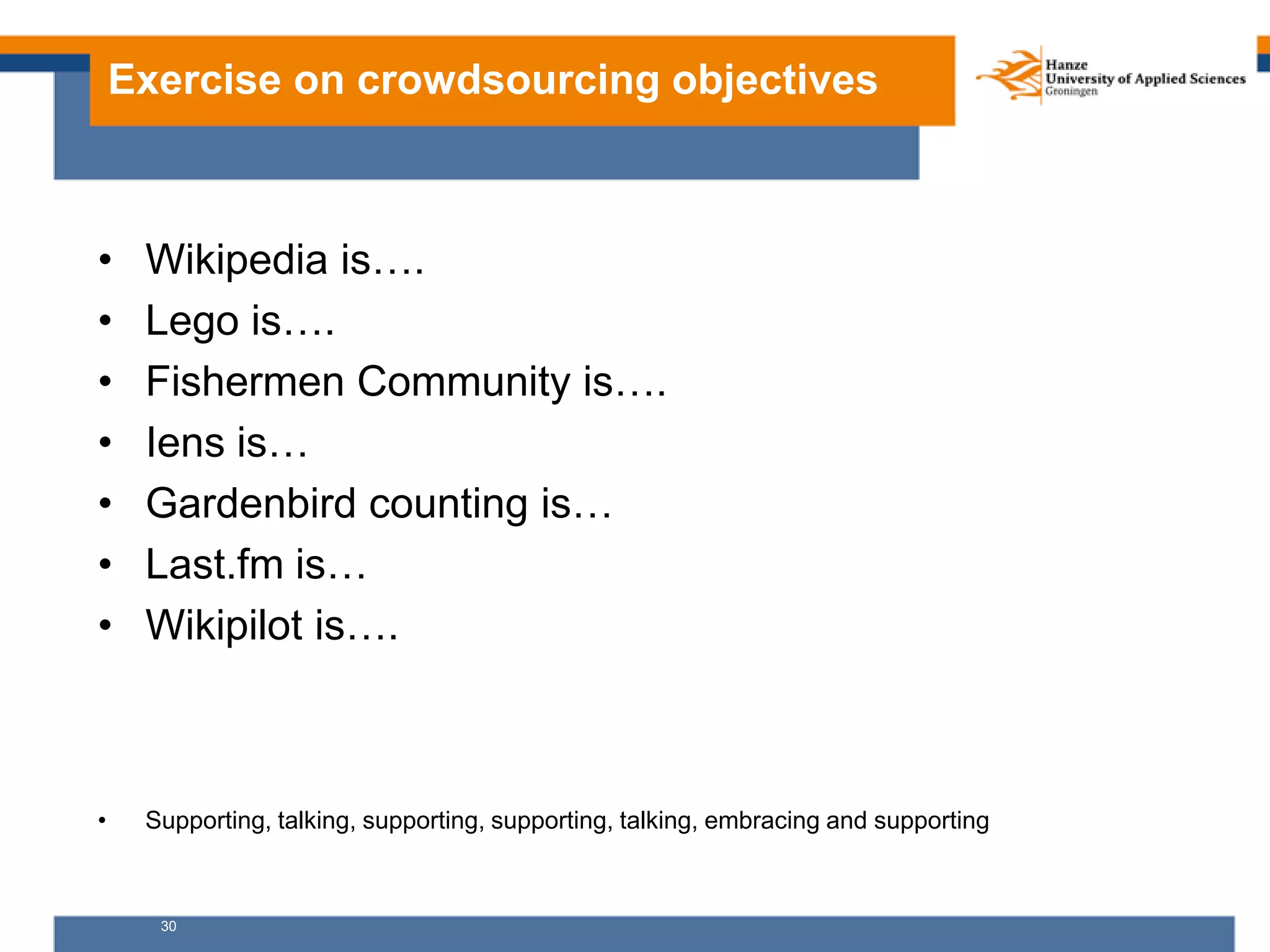
Exercise on crowdsourcing objectives
• Wikipedia is….
• Lego is….
• Fishermen Community is….
• Iens is…
• Gardenbird counting is…
• Last.fm is…
• Wikipilot is….
• Supporting, talking, supporting, supporting, talking, embracing and supporting
31
Basic principles for Crowdsourcing
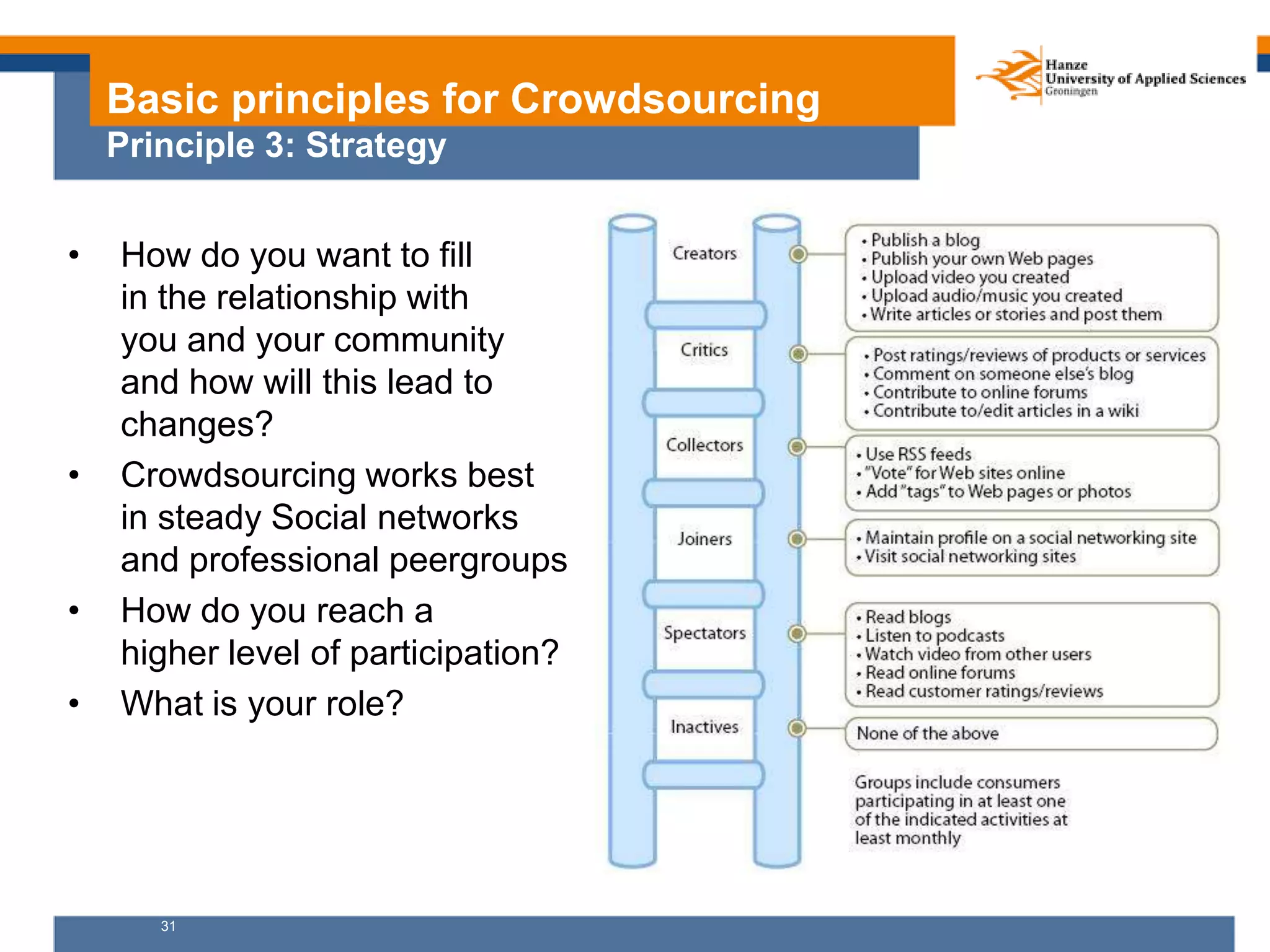
Principle 3: Strategy
• How do you want to fill
in the relationship with
you and your community
and how will this lead to
changes?
• Crowdsourcing works best
in steady Social networks
and professional peergroups
• How do you reach a
higher level of participation?
• What is your role?
32
Basic principles for Crowdsourcing
Principle 4: Technology
What applications are useful and effective?
• Built yourself
– Socialtext….praktical and fast to use
– Wordpress….you need patience and to do a lot yourself, but
it is nice
– Sharepoint 2010….is coming, but expensive
– …
• Ready to use
– Ning…Easy to step in, but commercial
– Google…Low entrance and common in use but….where is
my data?
– Winkwaves Kenniscafé..smart in usage but not free. Several
pilots at Hanze University at this moment
– …
33
How do you direct crowdsourcing?
In crowdsourcing you can not
manage all and get full grip:
the community
is leading
34
Seth Godin’s Tribes principles
Basic information for creating communities and tribes
• A group needs only two things to be a tribe: a shared
interest and a way to communicate
• There’s an explosion of tools to help lead the tribes
we’re forming. All of it is worthless if you don’t decide
to lead.
• Everyone is a leader. Without leaders, there are no
followers. You’re a leader. We need you!
• Managers make widgets, leaders make change
• Leaders use passion and ideas to lead people. They
don’t care much for organizational structure
http://www.ted.com/talks/seth_godin_on_the_tribes_we_lead.html
35
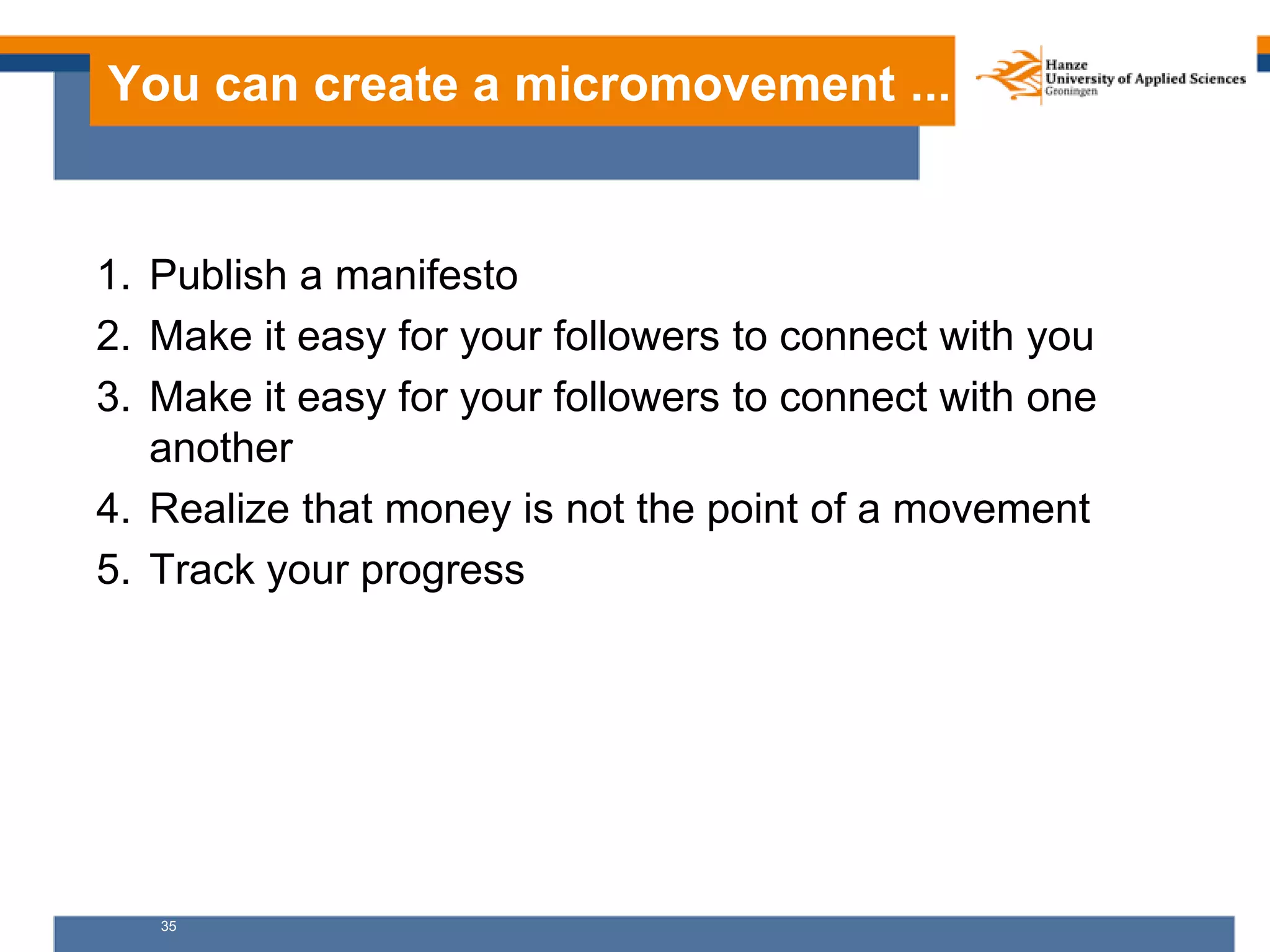
You can create a micromovement ...
1. Publish a manifesto
2. Make it easy for your followers to connect with you
3. Make it easy for your followers to connect with one
another
4. Realize that money is not the point of a movement
5. Track your progress
36
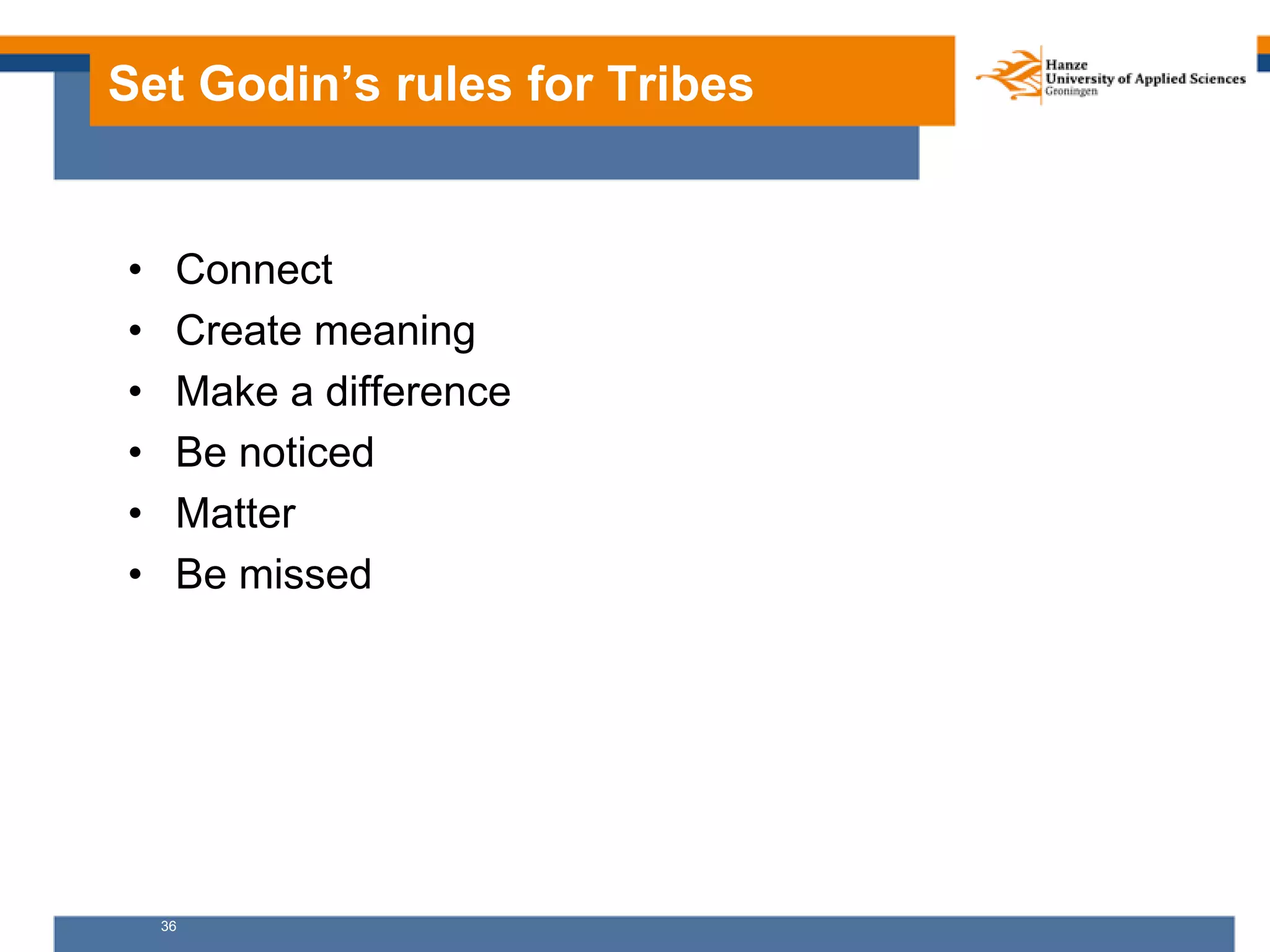
Set Godin’s rules for Tribes
• Connect
• Create meaning
• Make a difference
• Be noticed
• Matter
• Be missed
37
Video on Leadership and creating
a Tribe
http://www.youtube.com/watch?v=fW8amMCVAJQ
Video
Dancing
Guy
38
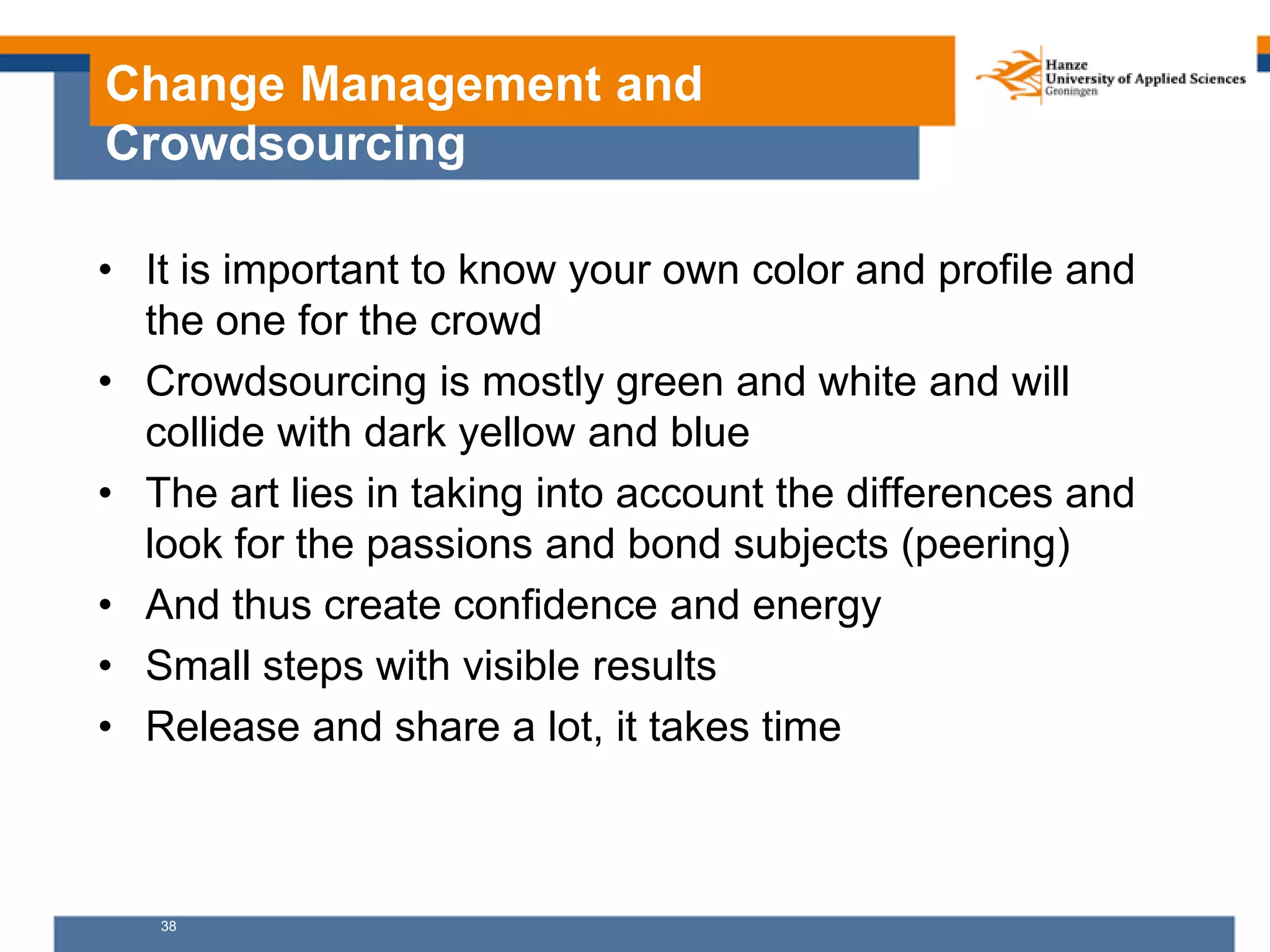
Change Management and
Crowdsourcing
• It is important to know your own color and profile and
the one for the crowd
• Crowdsourcing is mostly green and white and will
collide with dark yellow and blue
• The art lies in taking into account the differences and
look for the passions and bond subjects (peering)
• And thus create confidence and energy
• Small steps with visible results
• Release and share a lot, it takes time
39
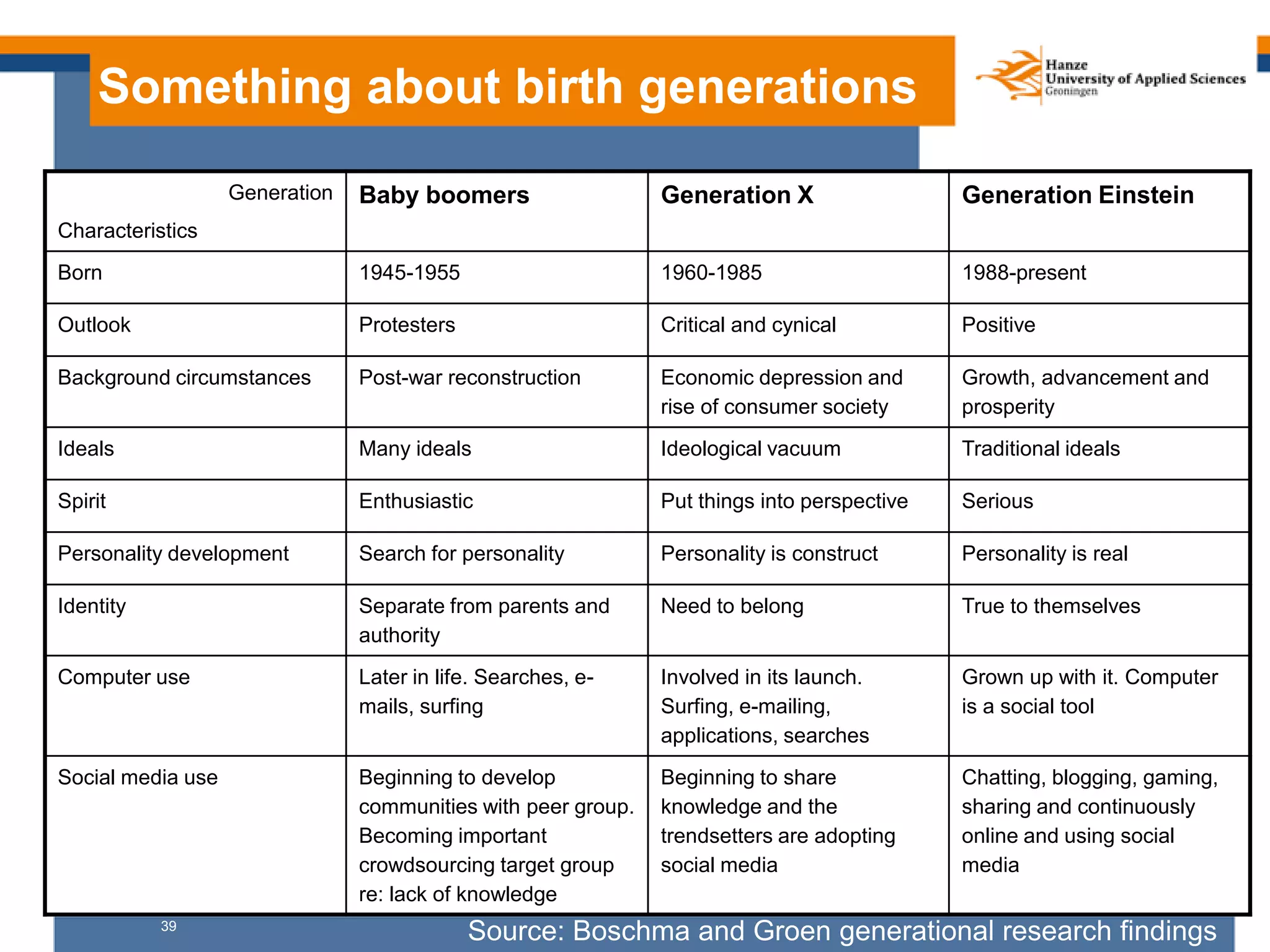
Something about birth generations
Source: Boschma and Groen generational research findings
Generation
Characteristics
Baby boomers Generation X Generation Einstein
Born 1945-1955 1960-1985 1988-present
Outlook Protesters Critical and cynical Positive
Background circumstances Post-war reconstruction Economic depression and
rise of consumer society
Growth, advancement and
prosperity
Ideals Many ideals Ideological vacuum Traditional ideals
Spirit Enthusiastic Put things into perspective Serious
Personality development Search for personality Personality is construct Personality is real
Identity Separate from parents and
authority
Need to belong True to themselves
Computer use Later in life. Searches, e-
mails, surfing
Involved in its launch.
Surfing, e-mailing,
applications, searches
Grown up with it. Computer
is a social tool
Social media use Beginning to develop
communities with peer group.
Becoming important
crowdsourcing target group
re: lack of knowledge
Beginning to share
knowledge and the
trendsetters are adopting
social media
Chatting, blogging, gaming,
sharing and continuously
online and using social
media
40
Some conclusions on the birth
generation
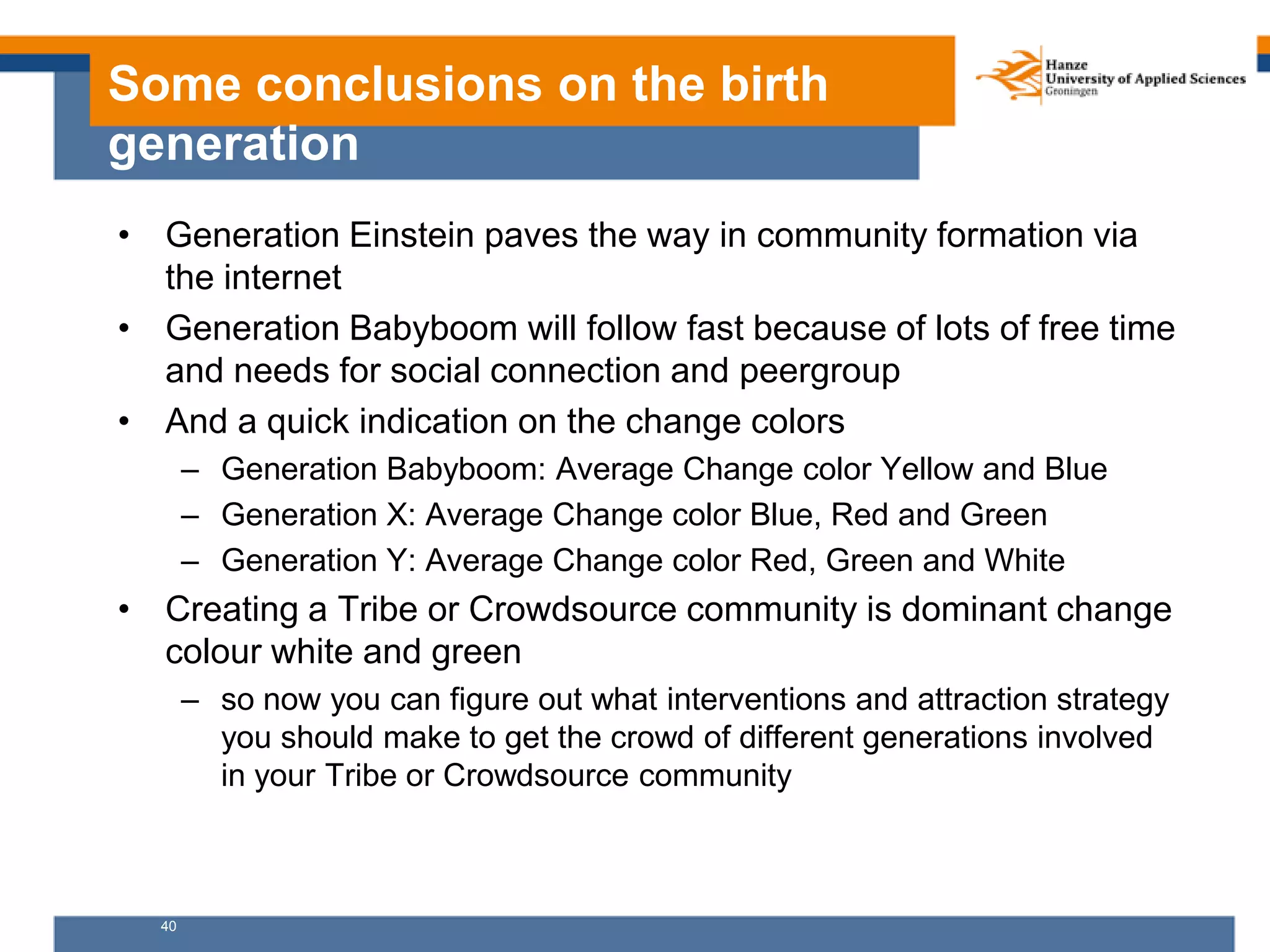
• Generation Einstein paves the way in community formation via
the internet
• Generation Babyboom will follow fast because of lots of free time
and needs for social connection and peergroup
• And a quick indication on the change colors
– Generation Babyboom: Average Change color Yellow and Blue
– Generation X: Average Change color Blue, Red and Green
– Generation Y: Average Change color Red, Green and White
• Creating a Tribe or Crowdsource community is dominant change
colour white and green
– so now you can figure out what interventions and attraction strategy
you should make to get the crowd of different generations involved
in your Tribe or Crowdsource community
41
Social Media
42
Social Media is supportive to
Crowdsourcing
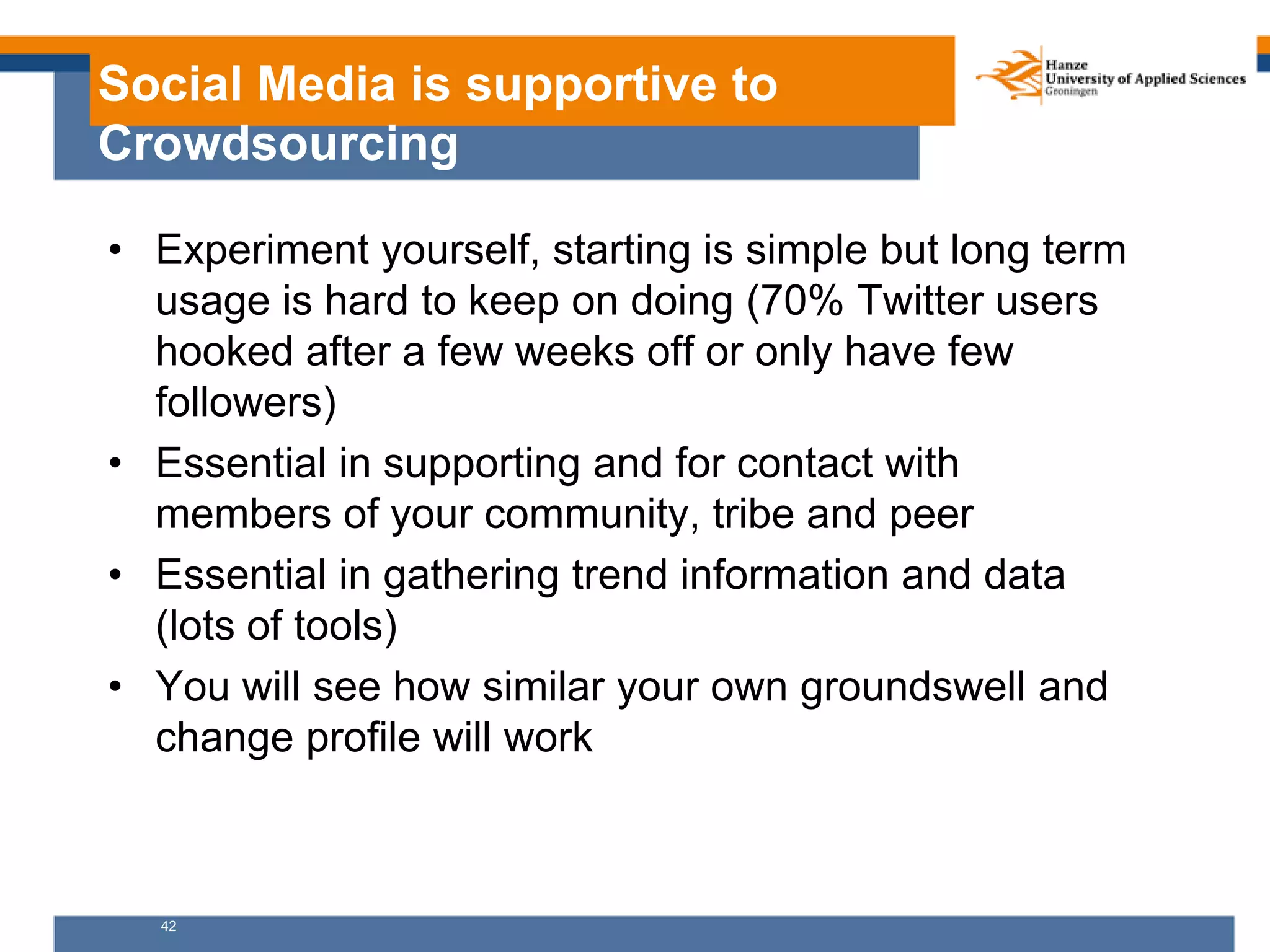
• Experiment yourself, starting is simple but long term
usage is hard to keep on doing (70% Twitter users
hooked after a few weeks off or only have few
followers)
• Essential in supporting and for contact with
members of your community, tribe and peer
• Essential in gathering trend information and data
(lots of tools)
• You will see how similar your own groundswell and
change profile will work
43
What is Social Media
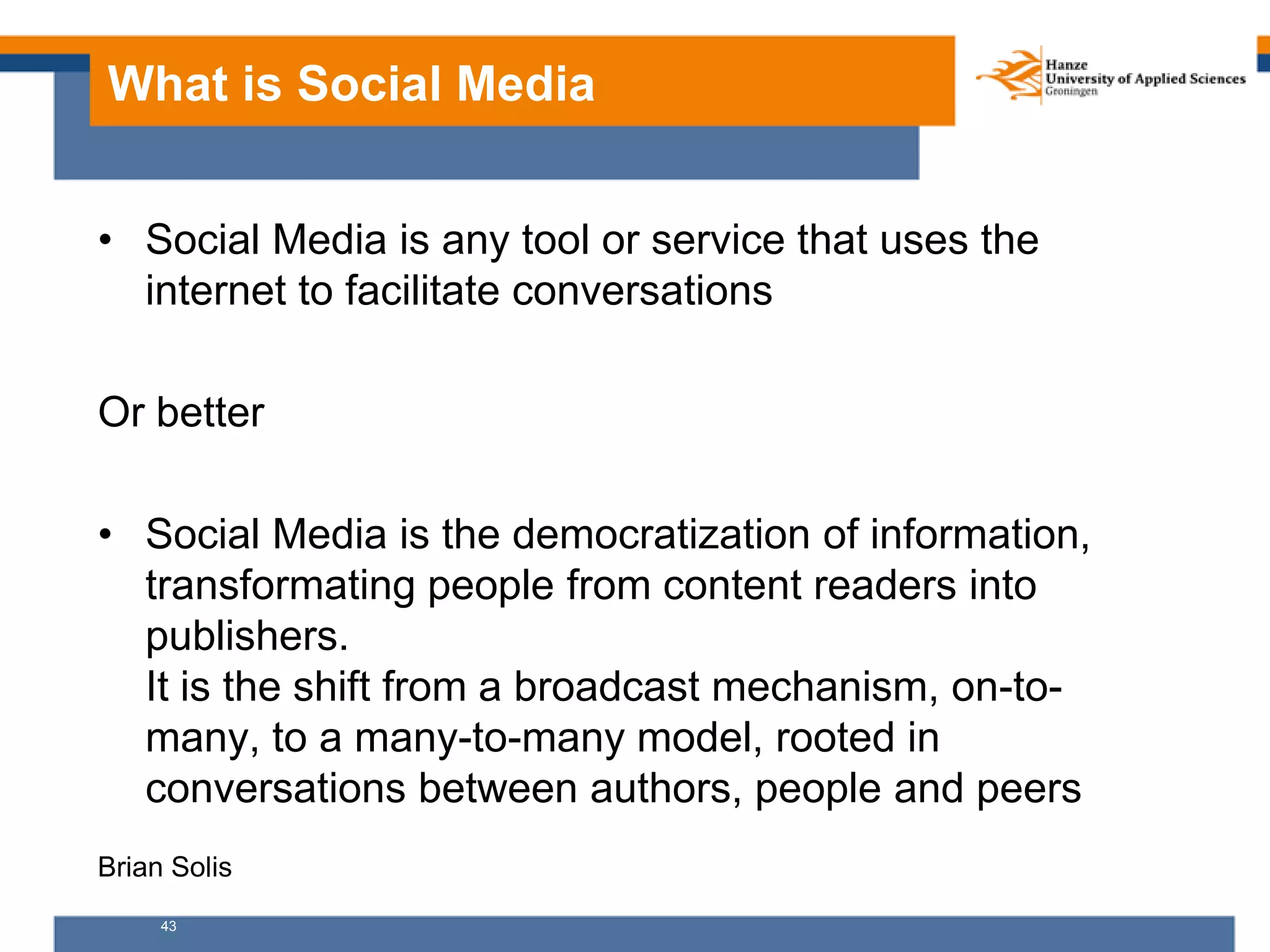
• Social Media is any tool or service that uses the
internet to facilitate conversations
Or better
• Social Media is the democratization of information,
transformating people from content readers into
publishers.
It is the shift from a broadcast mechanism, on-to-
many, to a many-to-many model, rooted in
conversations between authors, people and peers
Brian Solis
44
So
Social Media is all about change!
45
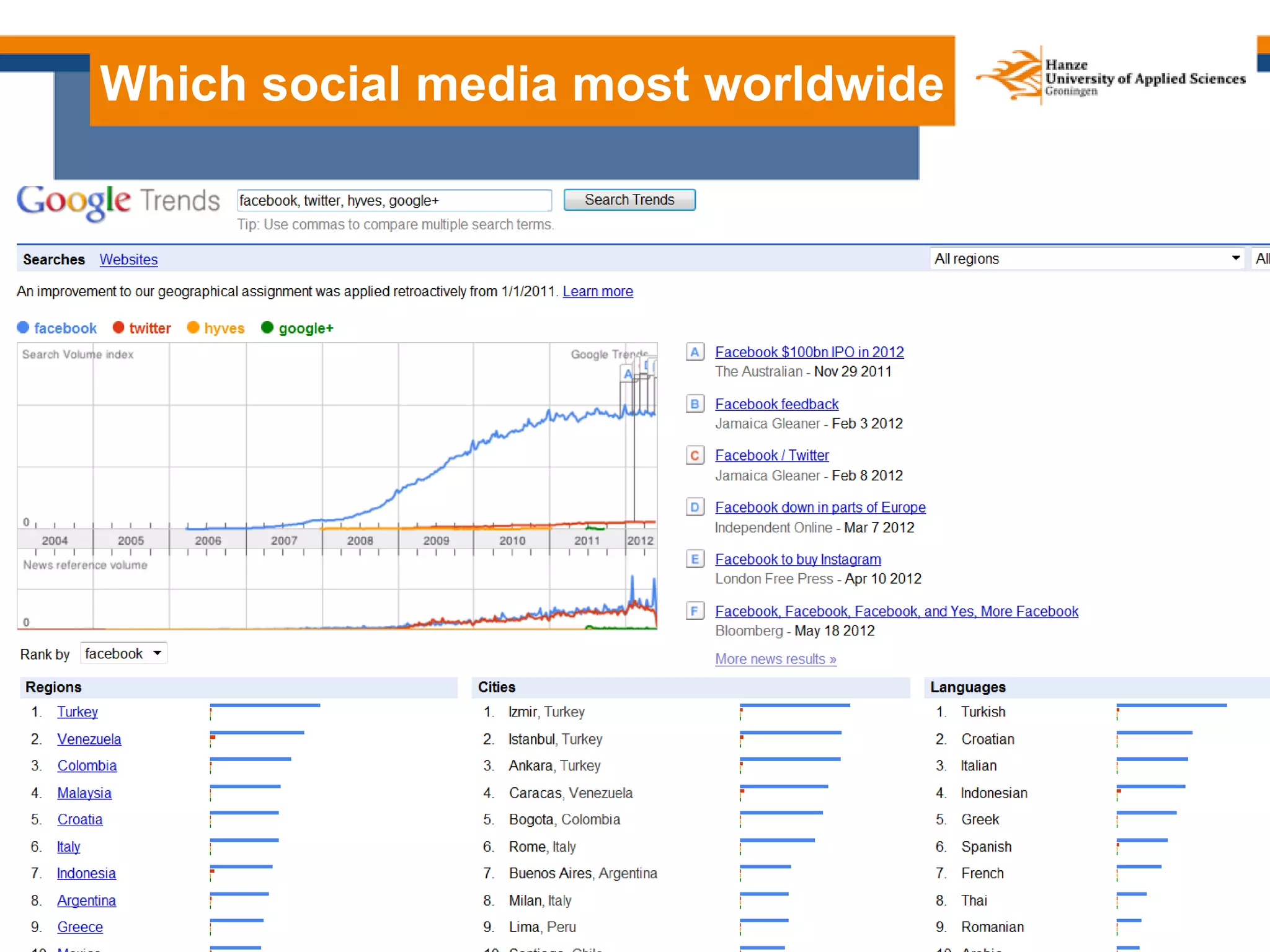
Which social media most worldwide
46
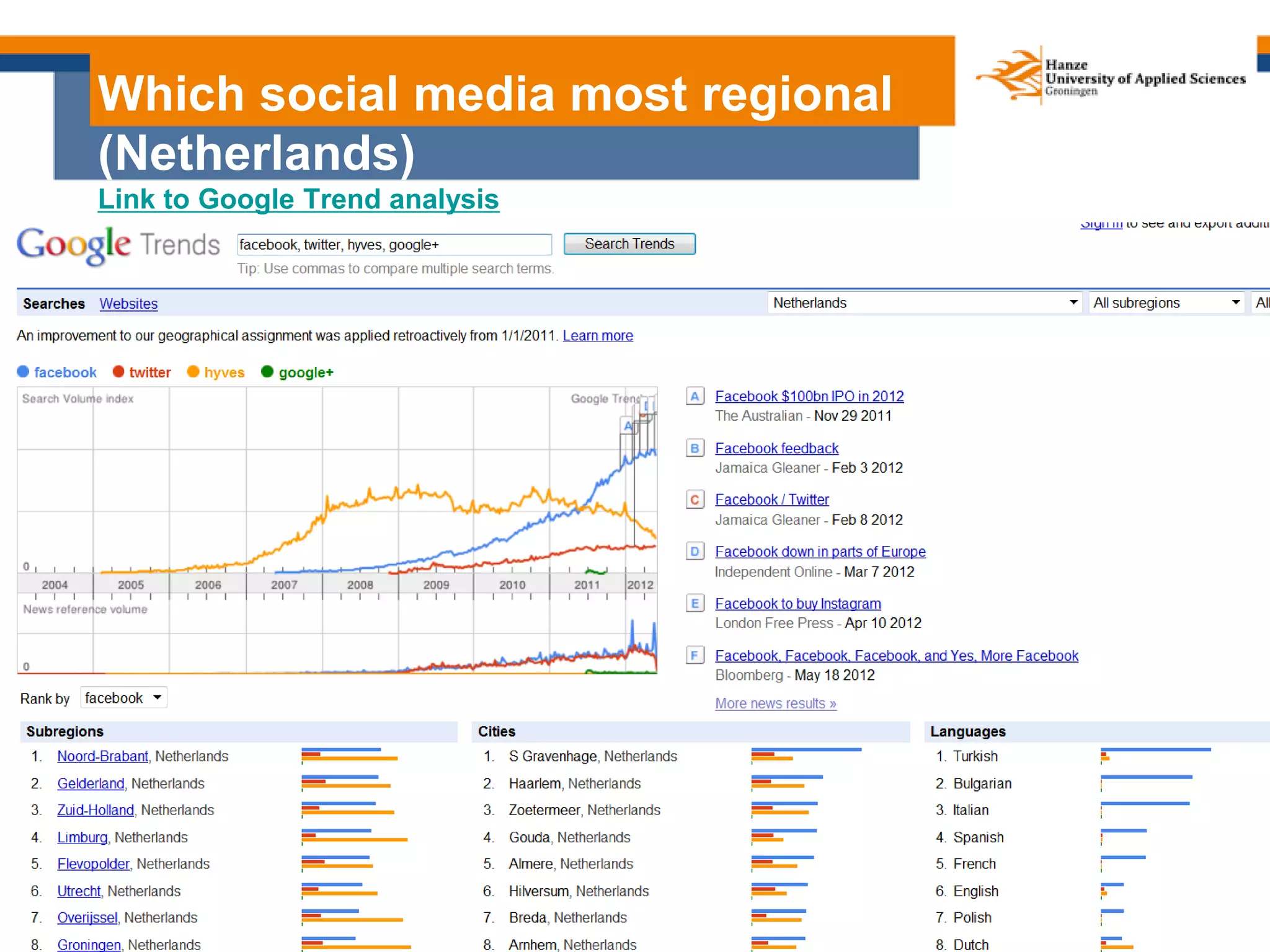
Which social media most regional
(Netherlands)
Link to Google Trend analysis
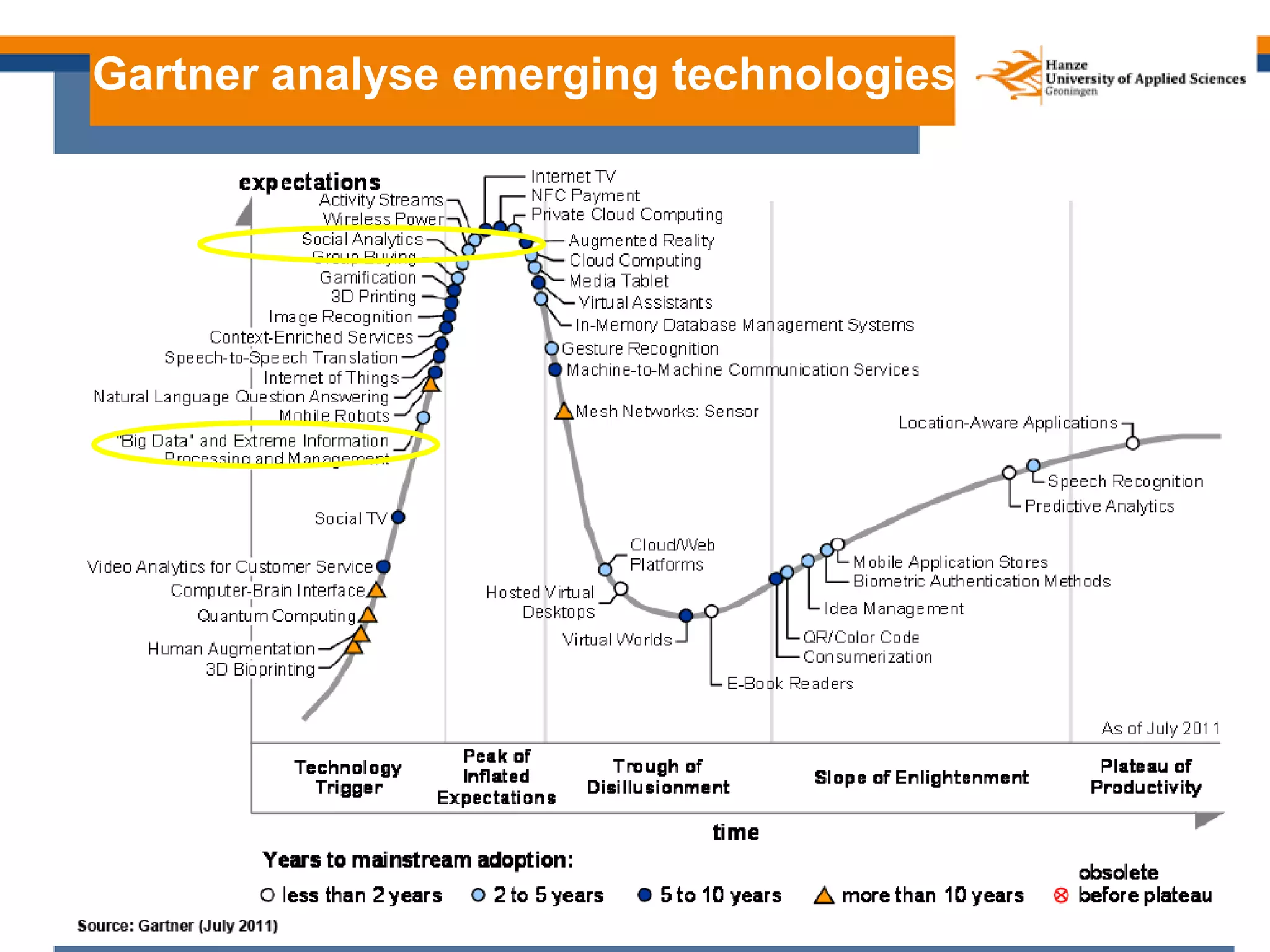
Gartner analyse emerging technologies
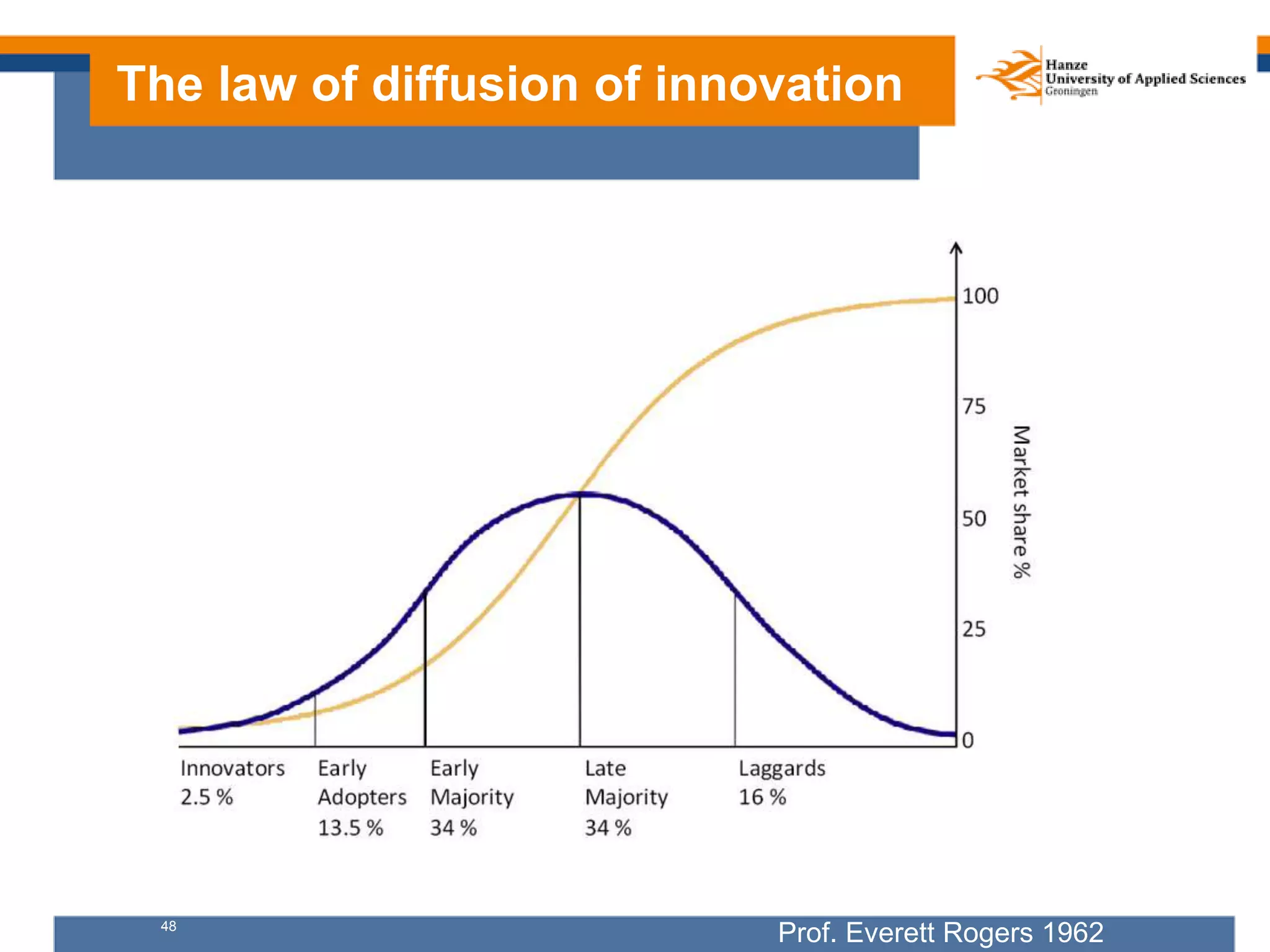
48
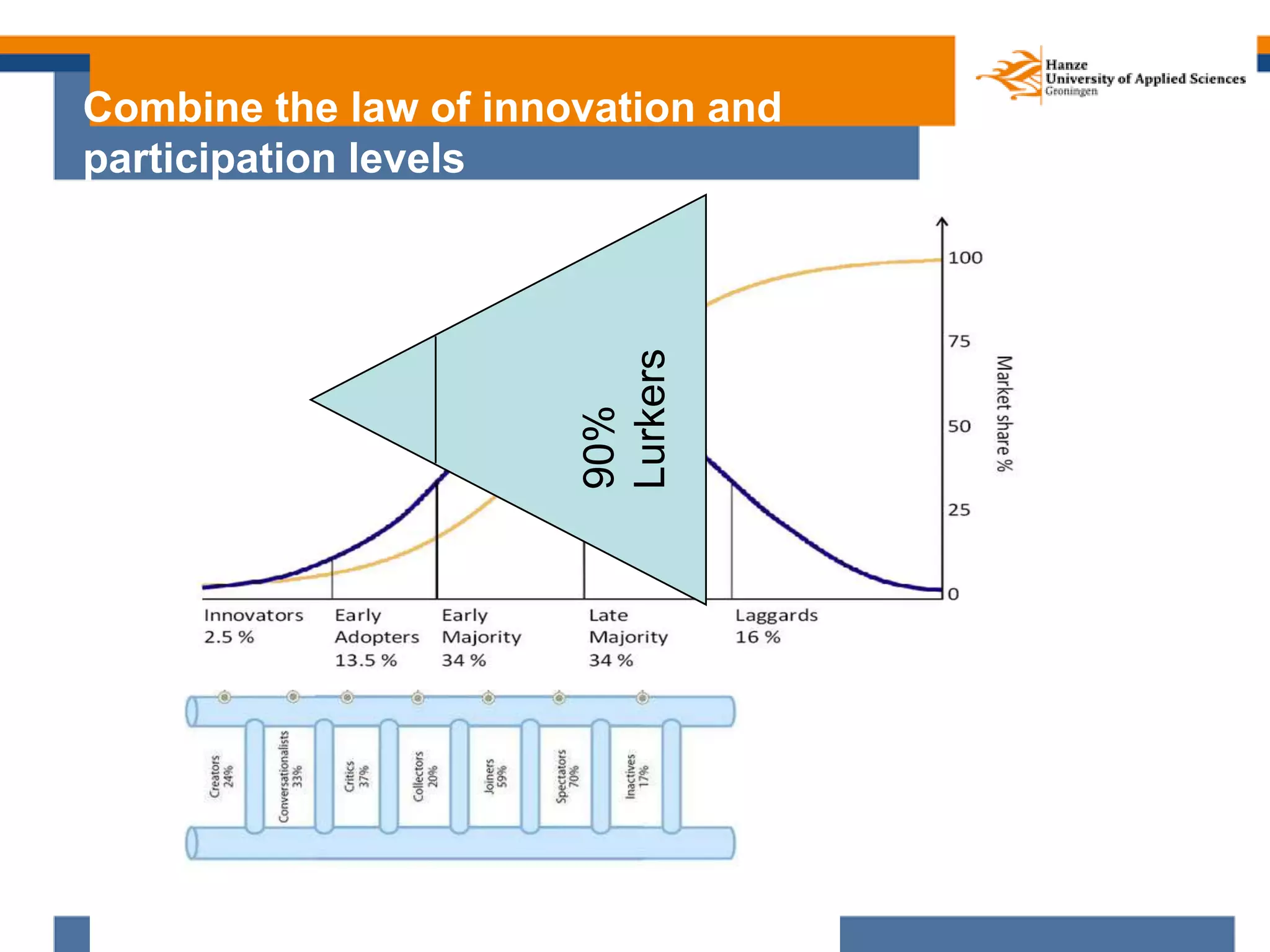
The law of diffusion of innovation
Prof. Everett Rogers 1962
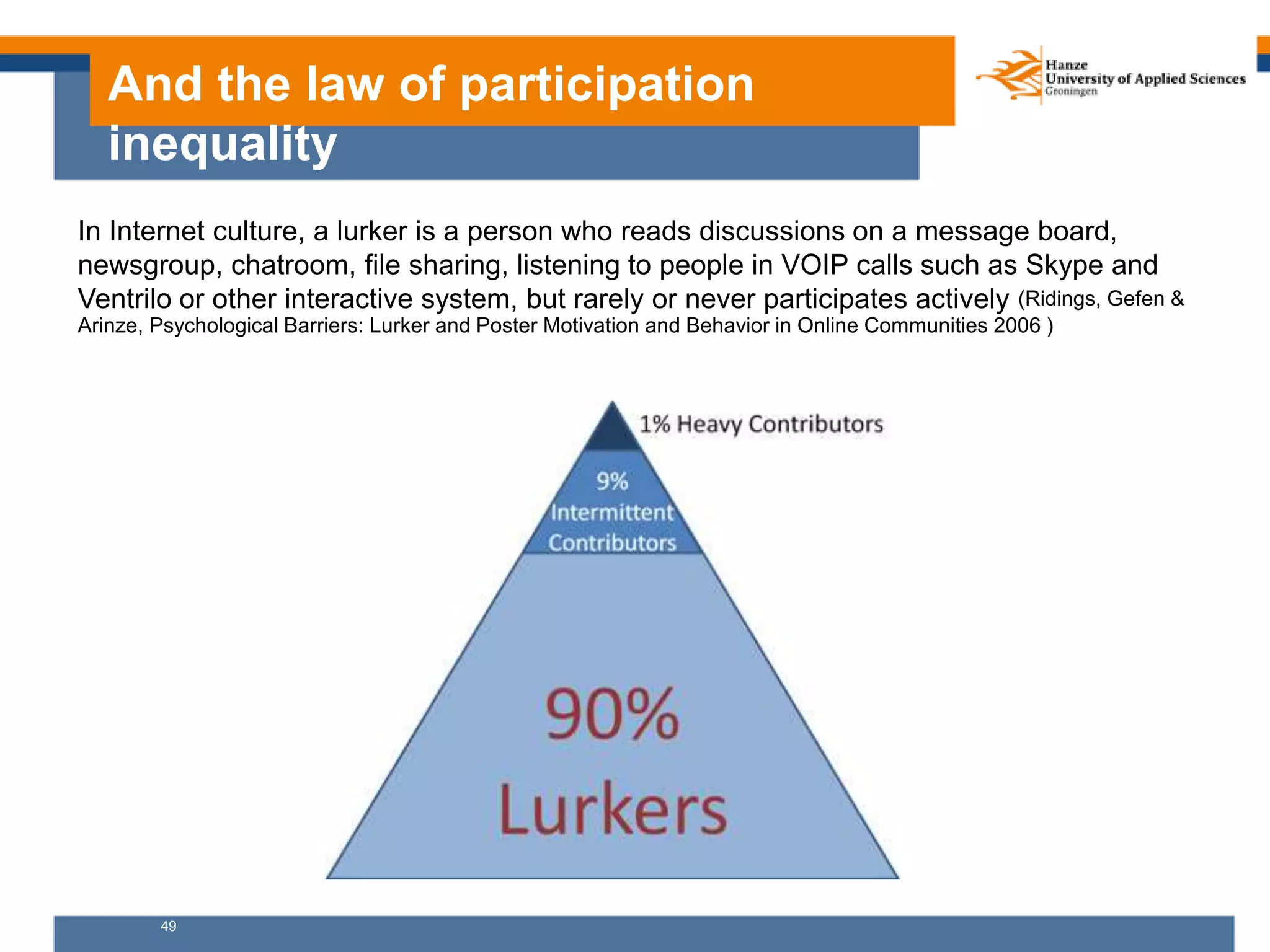
49
And the law of participation
inequality
In Internet culture, a lurker is a person who reads discussions on a message board,
newsgroup, chatroom, file sharing, listening to people in VOIP calls such as Skype and
Ventrilo or other interactive system, but rarely or never participates actively (Ridings, Gefen &
Arinze, Psychological Barriers: Lurker and Poster Motivation and Behavior in Online Communities 2006 )
Combine the law of innovation and
participation levels
50
90%
Lurkers
51
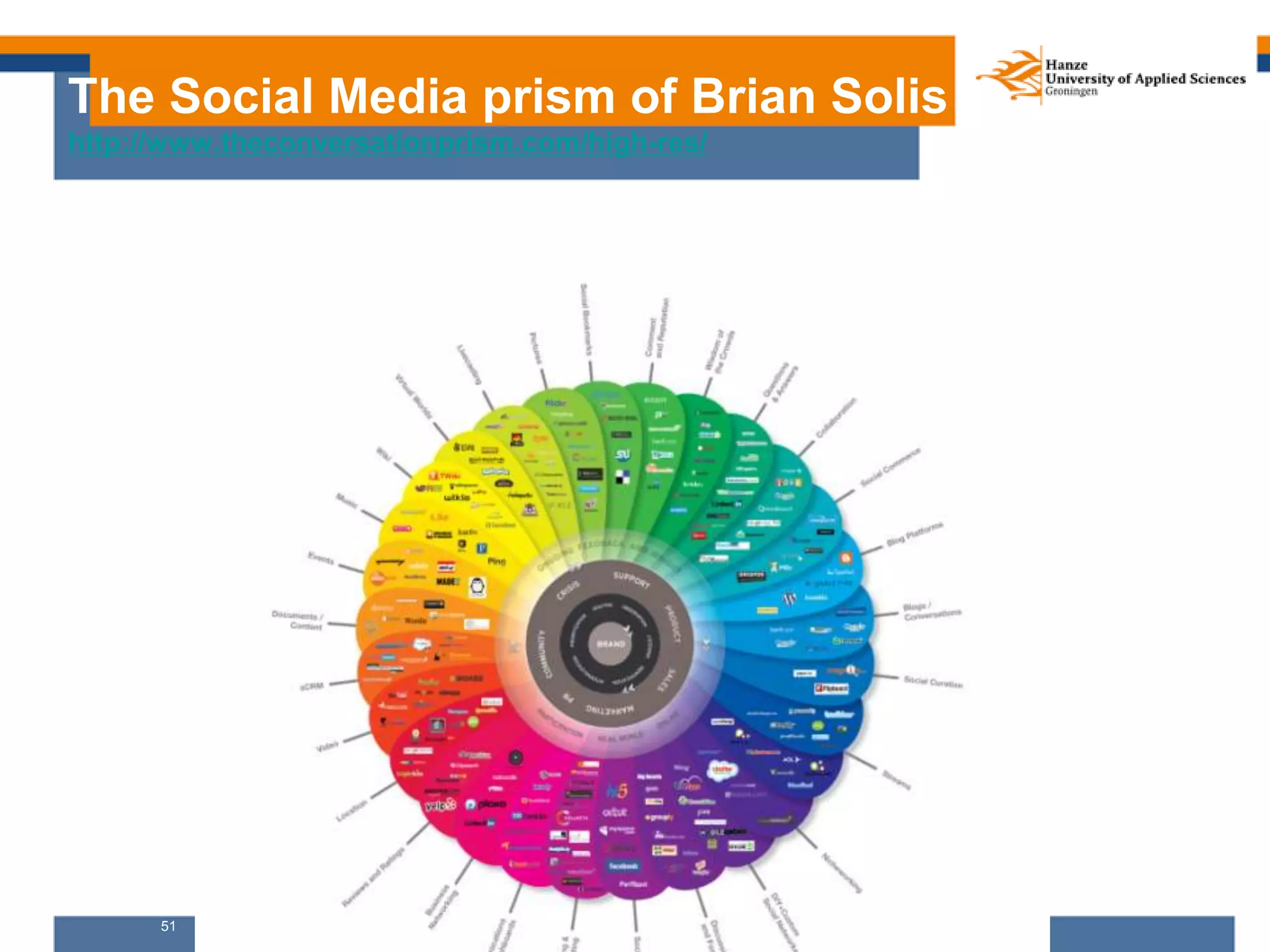
The Social Media prism of Brian Solis
http://www.theconversationprism.com/high-res/
52
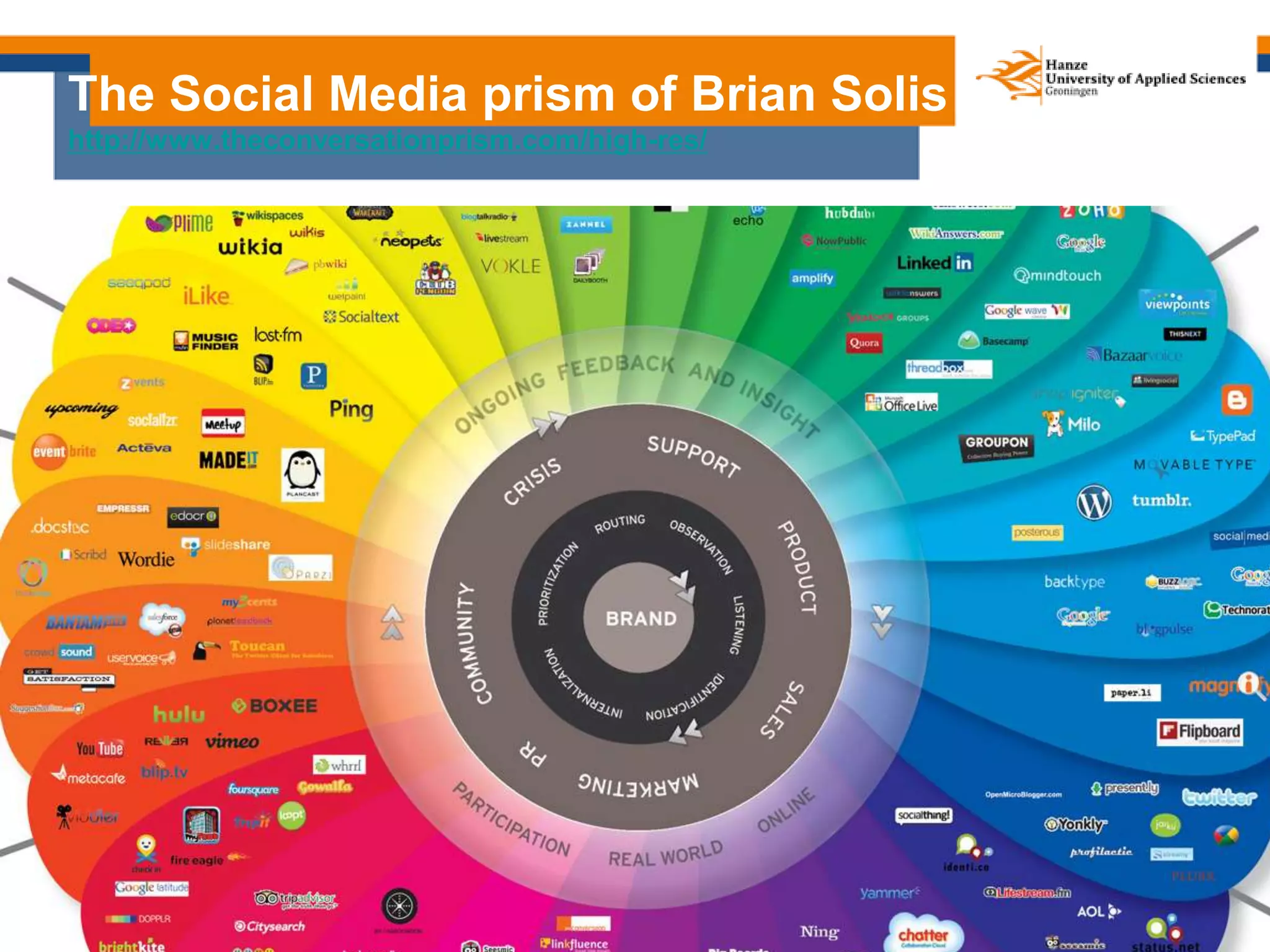
The Social Media prism of Brian Solis
http://www.theconversationprism.com/high-res/
53
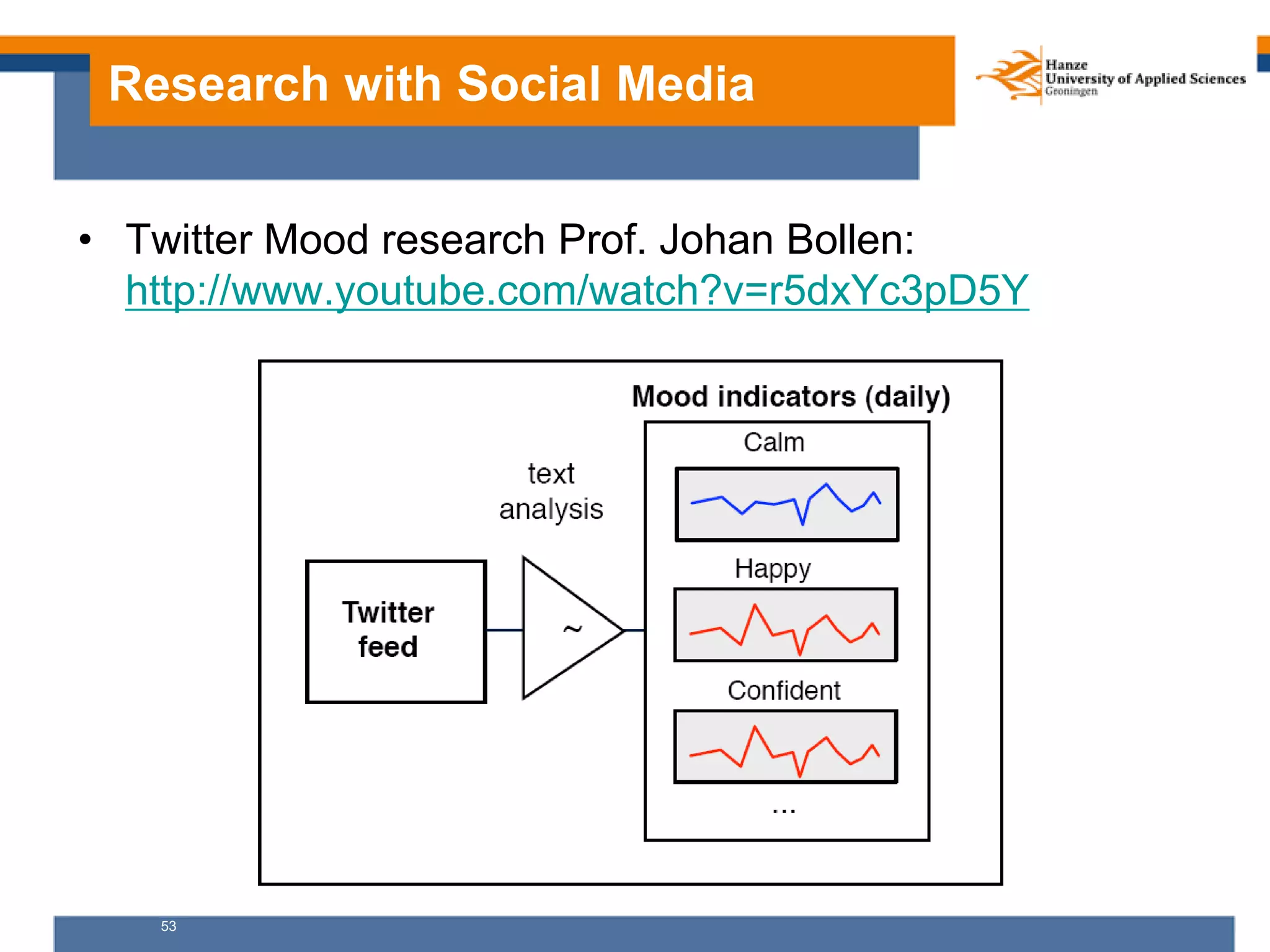
Research with Social Media
• Twitter Mood research Prof. Johan Bollen:
http://www.youtube.com/watch?v=r5dxYc3pD5Y
54
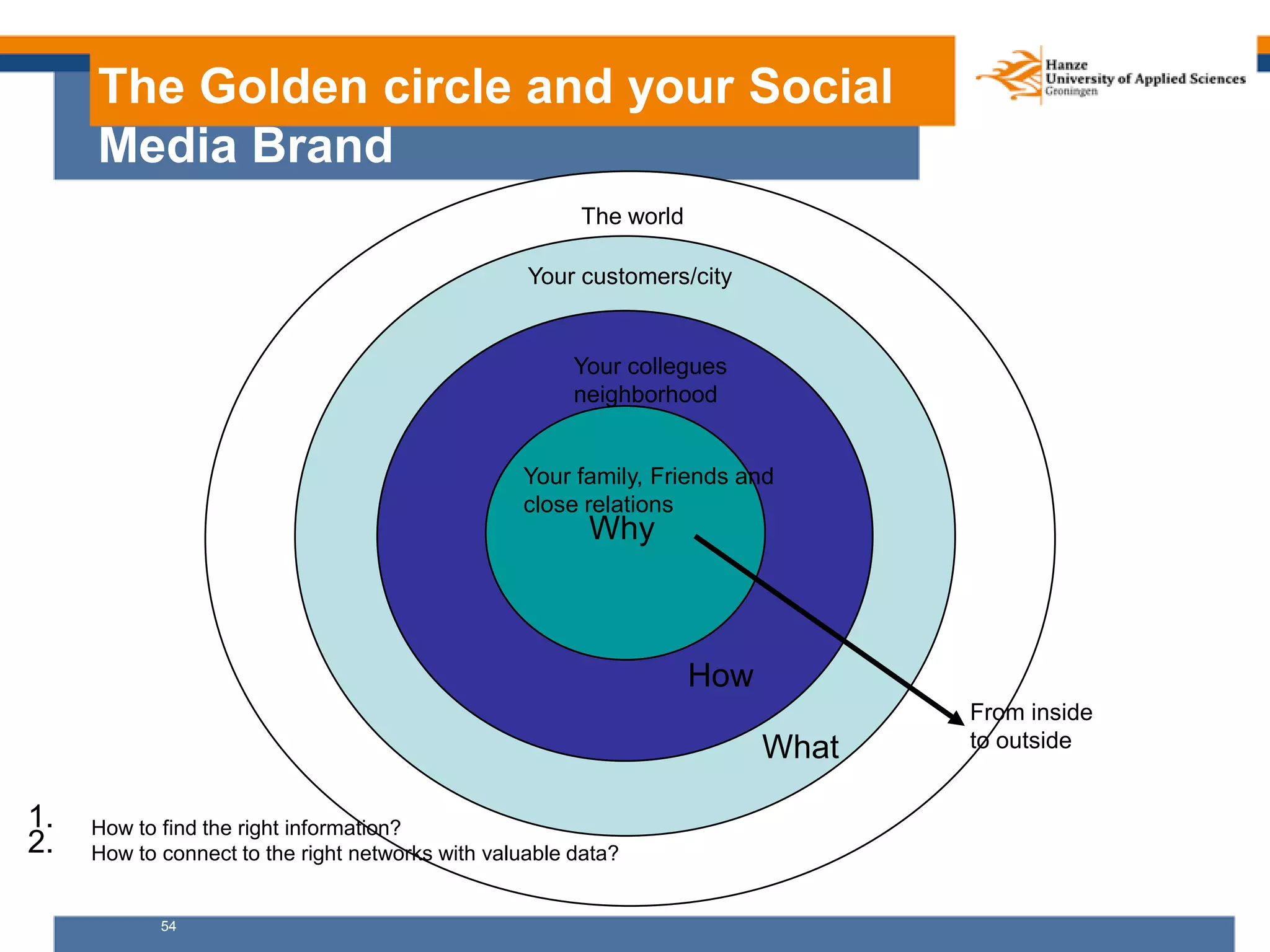
The Golden circle and your Social
Media Brand
What
How
Why
From inside
to outside
Your family, Friends and
close relations
Your collegues
neighborhood
Your customers/city
The world
1. How to find the right information?
2. How to connect to the right networks with valuable data?
55
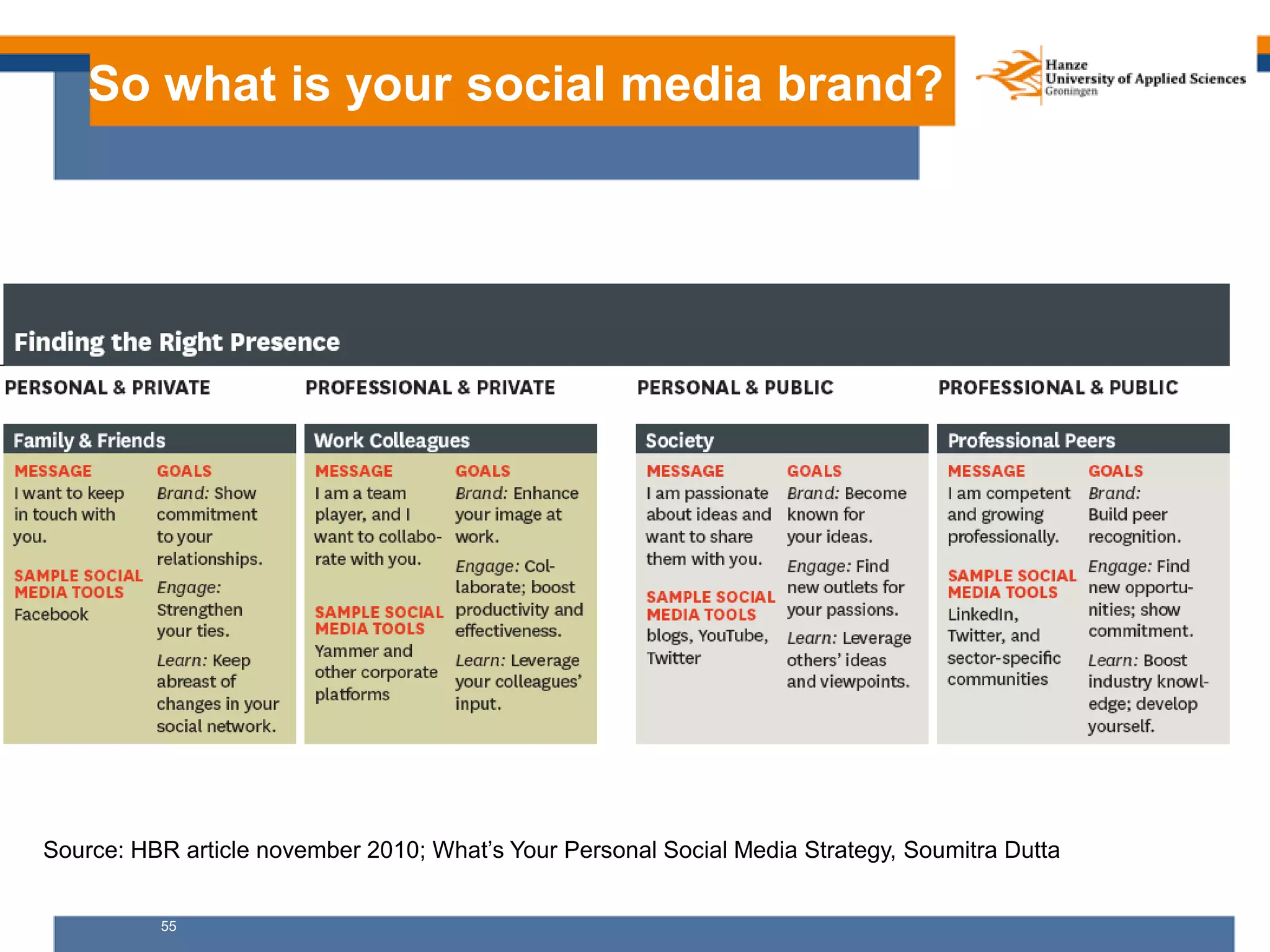
So what is your social media brand?
Source: HBR article november 2010; What’s Your Personal Social Media Strategy, Soumitra Dutta
56
Change Management is essential in
Crowdsourcing
The illiterate of the 21st century are not
those who can not read and write,
but those who can not unlearn,
share and collaborate
Alvin Toffler
57
Chaos is needed for brakethrough!
If a cluttered desk says something about a
messy mind what does a blank
desk say then?
Einstein
58
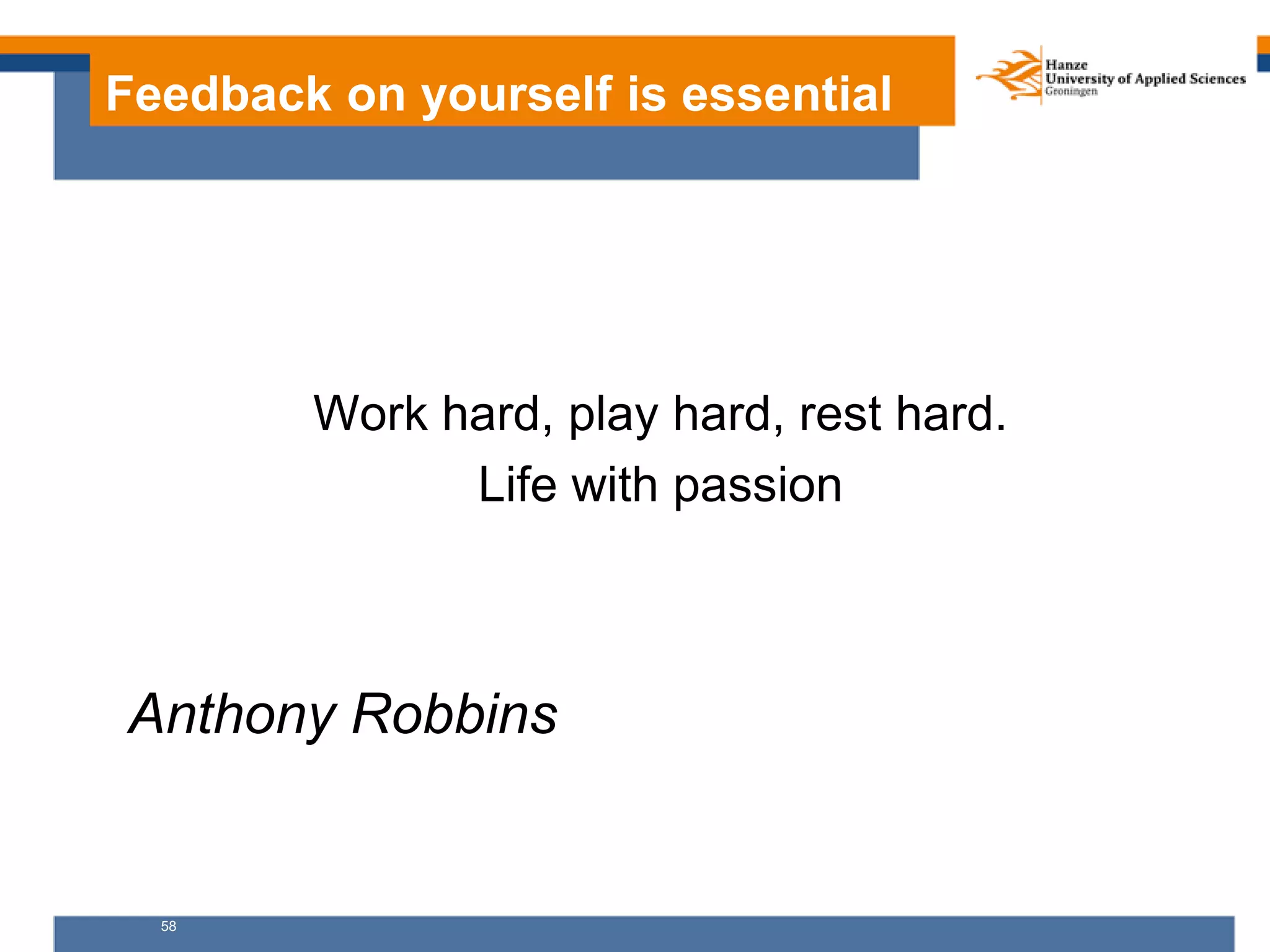
Feedback on yourself is essential
Work hard, play hard, rest hard.
Life with passion
Anthony Robbins
30-1-2015

Lecture 5 2011 2012 crowdsourcing and social media

  • 1.
    ITSM Specialization Sourcing 2012-2013 Prof.Frank Willems Lecture 5: Crowdsourcing and Social Media
  • 2.
    2 Agenda 1. Change managementand leadership 2. Social Networks as background or playground? 3. What is Crowdsourcing, Tribes and Co-creation? 4. Social Media as trigger for change
  • 3.
    3 Fasttrack on changemanagement and leadership
  • 4.
    4 The five changecolours at a glance Yellow-print Blue-print Red-print Green-print White-print Something changes when you in a/an and create bring common interests together power game a feasible solution, a win-win situation think first and then act according to a plan rational process the best solution, a brave new world stimulate people in the right way exchange exercise a motivating solution, the best ´fit´ create settings for collective learning learning process a solution that people develop themselves create space for spontaneous evolution dynamic process a solution that releases energy The result is... by a/an... aimed at... forming coalitions, changing topstructures facilitator who uses his own power base positions and context project management strategic analysis expert in the field knowledge and results assessment & reward, social gatherings HRM expert procedures and working climate training and coaching, open systems planning facilitator who supports people the setting and communication open space meetings self-steering teams someone who uses his being as instrument patterns and meanings Result is… Safeguarded by… The pit-falls lie in… partly unknown and shifting decision documents and power balances dreaming and lose- lose described and guaranteed benchmarking and iso systems ignoring external and irrational aspects outlined but not guaranteed HRM systems ignoring power and smothering brilliance envisaged but not guaranteed a learning organisation excluding no-one and lack of action unpredictable self-management superficial under- standing and laissez faire Source: Change Management Approach Prof. De Caluwé, Twynstra Gudde
  • 5.
    5 The Golden circle Peopleconnect better with you when it is clear why you do it, not what you do What How Why Rationality and analytial mind (Neocortex) Feeling, Trust and intuition (Lymbic brain) From inside to outside
  • 6.
    6 Open Will Open Heart Open Mind LISTENING 2: from outside disconfirming [new]data Downloading habits of judgment reconfirming old opinions & judgments Factual listening noticing differences LISTENING 3: from within seeing through another person‘s eyes emotional connection Empathic listening LISTENING 1: from habits LISTENING 4: from Source connecting to an emerging future whole; shift in identity and self Generative listening (from the future wanting to emerge) Theory U as ‘toolkit’ for leaders
  • 7.
    Interventions of TheoryU LevelIntervention Description 2. Seeing Community Building Group Agree and setting conditions for unifying group communications 2. Seeing Attentive observation Sensation and experience what you really see and hear 2. Seeing Future Search Sharing past, present, future dreams and map common interests 3. Sensing Nature walk Silence Walk, nature experience 4. Presencing Meditation Strengthening coordination in team 4. Presencing Social dreaming Share parts of dreams and collective dreams to come
  • 8.
  • 9.
    9 What is anetwork • A network exists of a collection of actors which are connected by ‘ties’. These actors, so called ‘nodes’ can be persons, teams, organisations and concepts. • A social network is a social structure made up of individuals (or organisations) called ‘nodes’, which are tied (connected) by one or more specific types of interdependency, such as friendship, kinship, common interest, financial exchange, dislike, sexual relationship, or beliefs, knowledge or prestige
  • 10.
    10 Type of networks Formalnetworks Informal networks
  • 11.
    1 Social networks: LinkedInvisualisation http://inmaps.linkedinlabs.com/network
  • 12.
    12 Concepts from socialnetwerkanalysis • Nicholas Christakis: Our experience with the world depents on the factual structure of our networks and al what flows in these networks • Ronald Burt: People focus on activities within their own group and that causes ‘structural holes’ in informatioflow between these groups Video Christakis http://www.ted.com/talks/nicholas_christakis_the_hidden_influence_of_social_networks.html
  • 13.
    13 Bridging the structuralholes • Will lead to new ideas, innovations and borderless opportunities • How to bridge the structural holes? • How can change management and leadership support this?
  • 14.
    14 Social Capital • SocialCapital is a sociological concept, which refers to connections within and between social networks • The concept of Social Capital highlights the value of social relations and the role of cooperation and confidence to get collective or economic results • The modern emergence of Social Capital concept renewed the academic interest for an old debate in social science: the relationship between trust, social networks and the development of modern industrial society. • Social Capital is the strategy of getting relations • Great thinkers are Robert Putnam, Pierre Bourdieu and James Coleman
  • 15.
    15 Connecting Social Capital •Connecting Social Capital is about the relations between people within groups that are homogeneous • Best examples are family, good friends and direct neighbours • Social Capital is the superglue in social networks
  • 16.
  • 17.
    17 Crowdsourcing, Tribes and Co-creation •Crowdsourcing is the act of outsourcing tasks, traditionally performed by an employee or contractor, to an undefined, large group of people or community (a crowd), through an open call. • A tribe is a group of people connected to one another, connected to a leader and connected to an idea • Co-creation is a form of market or business strategy that emphasizes the development and ongoing realization of mutual firm-customer value
  • 18.
    18 The sourcing solutionsplotted on this model Purchasing Risk Is it a standard or a specialized product? Whatistheextenttowhichtheproduct/serviceaddsvaluefor thebusiness LessaddedvalueLargeaddedvalue Standard Specialized StrategicLeverage BottleneckRoutine Business Proces Outsourcing Backoffice outsourcing Outsourcing workplace mgt Business development Shared Service Centers DataCenter outsourcingFacilities outsourcing Workinnovation 1 st generation sourcing 2 nd generation sourcing 4 th generation sourcing 3 th generation sourcing 2 nd generation sourcing Crowd sourcing Operations outsourcing
  • 19.
    19 Crowdsourcing • The Crowdsourcingphilosophy was first introduced at the turn of the 21st century with James Surowiecki's book The Wisdom of Crowds. • The term 'Crowdsourcing' was used for the first time in 2006 by Jeff Howe, a portmanteau of the words 'crowd' and 'sourcing • Other important thought leaders on Crowdsourcing are Don Tapscott with Wikinomics and Marcowikinomics and Charlene Li and Josh Bernoff with Groundswell • A more detailed definition was introduced on Wikipedia by Henk van Ess in September 2010 "Crowdsourcing is channeling the experts desire to solve a problem and then freely sharing the answer with everyone
  • 20.
    20 The most famouspeer production with crowd
  • 21.
    21 LEGO design withcrowdsourcing
  • 22.
    22 The results ofLEGO crowdsourcing
  • 23.
    23 Fishermen community forcollecting data Vangstenregistratie.nl, 7000 professional fishermen provide the Ministry of Agriculture valuable information on waterquality and share their knowledge with 350.000 other fishers
  • 24.
    24 Iens.nl self-reviews ofrestaurants Iens.nl: 70.000 restaurantvisitors review 17.000 restaurants, 3,5 miljoen unique visitors, 1 million euro turnover on services
  • 25.
    25 Gardenbird counting foreveryone Millions of amateur birdwatchers count birds to analyse collective birdmovements
  • 26.
    26 Last.fm your communityradio station Last.fm online radio station for community members and legally (3euro/mnd) based on your music preferences. Scrobble your iPod with iTunes and last.fm and find new music and get connected with members of the same flavor
  • 27.
    27 And our DatemaWikipilot project In 2010/201 we have worked on nautical information project with forty students from three Hanze University schools, Datema development teams, and managers and researchers from the university, with support from Syntens and a community of seafarers as our sounding board. Both the technology and the community are being created in parallel, using an open source approach and the very latest development methodologies, all in a short space of time. At the beginning of 2011 the first prototype applications where ready, and we will be able to begin introducing them and build up the community to use the prototypes and share nautical data.
  • 28.
    28 Four basic principlesfor developing your Crowdsourcing strategy Principle 1: People Is your community ready and how will they participate? Tip: Use the Change colours and the Groundswell Social Technographic profile
  • 29.
    29 Basic principles forCrowdsourcing Principle 2: Objectives What are your goals? Do you want to talk or listen to the community or create energy for solving a problem? • Listening: Listen to your community for research and better understanding of your customers. This goal suits for marketing development • Talking: Use your community to spread messages about your idea, brand or company. This goal suits to extend digital marketing initiatives and interactive channels • Energizing: Connect with you most enthusiastic customers and use the community to supercharge the power of their word of mouth. Suits for energizing your brand • Supporting: Setup a community where customers help and support you and each other. Suits for lowering supports costs or to share limited knowledge or experience • Embracing: Integrate the ideas of the community into your business and let them help to improve your services and products. Most challenging goal and experience with other goals is needed
  • 30.
    30 Exercise on crowdsourcingobjectives • Wikipedia is…. • Lego is…. • Fishermen Community is…. • Iens is… • Gardenbird counting is… • Last.fm is… • Wikipilot is…. • Supporting, talking, supporting, supporting, talking, embracing and supporting
  • 31.
    31 Basic principles forCrowdsourcing Principle 3: Strategy • How do you want to fill in the relationship with you and your community and how will this lead to changes? • Crowdsourcing works best in steady Social networks and professional peergroups • How do you reach a higher level of participation? • What is your role?
  • 32.
    32 Basic principles forCrowdsourcing Principle 4: Technology What applications are useful and effective? • Built yourself – Socialtext….praktical and fast to use – Wordpress….you need patience and to do a lot yourself, but it is nice – Sharepoint 2010….is coming, but expensive – … • Ready to use – Ning…Easy to step in, but commercial – Google…Low entrance and common in use but….where is my data? – Winkwaves Kenniscafé..smart in usage but not free. Several pilots at Hanze University at this moment – …
  • 33.
    33 How do youdirect crowdsourcing? In crowdsourcing you can not manage all and get full grip: the community is leading
  • 34.
    34 Seth Godin’s Tribesprinciples Basic information for creating communities and tribes • A group needs only two things to be a tribe: a shared interest and a way to communicate • There’s an explosion of tools to help lead the tribes we’re forming. All of it is worthless if you don’t decide to lead. • Everyone is a leader. Without leaders, there are no followers. You’re a leader. We need you! • Managers make widgets, leaders make change • Leaders use passion and ideas to lead people. They don’t care much for organizational structure http://www.ted.com/talks/seth_godin_on_the_tribes_we_lead.html
  • 35.
    35 You can createa micromovement ... 1. Publish a manifesto 2. Make it easy for your followers to connect with you 3. Make it easy for your followers to connect with one another 4. Realize that money is not the point of a movement 5. Track your progress
  • 36.
    36 Set Godin’s rulesfor Tribes • Connect • Create meaning • Make a difference • Be noticed • Matter • Be missed
  • 37.
    37 Video on Leadershipand creating a Tribe http://www.youtube.com/watch?v=fW8amMCVAJQ Video Dancing Guy
  • 38.
    38 Change Management and Crowdsourcing •It is important to know your own color and profile and the one for the crowd • Crowdsourcing is mostly green and white and will collide with dark yellow and blue • The art lies in taking into account the differences and look for the passions and bond subjects (peering) • And thus create confidence and energy • Small steps with visible results • Release and share a lot, it takes time
  • 39.
    39 Something about birthgenerations Source: Boschma and Groen generational research findings Generation Characteristics Baby boomers Generation X Generation Einstein Born 1945-1955 1960-1985 1988-present Outlook Protesters Critical and cynical Positive Background circumstances Post-war reconstruction Economic depression and rise of consumer society Growth, advancement and prosperity Ideals Many ideals Ideological vacuum Traditional ideals Spirit Enthusiastic Put things into perspective Serious Personality development Search for personality Personality is construct Personality is real Identity Separate from parents and authority Need to belong True to themselves Computer use Later in life. Searches, e- mails, surfing Involved in its launch. Surfing, e-mailing, applications, searches Grown up with it. Computer is a social tool Social media use Beginning to develop communities with peer group. Becoming important crowdsourcing target group re: lack of knowledge Beginning to share knowledge and the trendsetters are adopting social media Chatting, blogging, gaming, sharing and continuously online and using social media
  • 40.
    40 Some conclusions onthe birth generation • Generation Einstein paves the way in community formation via the internet • Generation Babyboom will follow fast because of lots of free time and needs for social connection and peergroup • And a quick indication on the change colors – Generation Babyboom: Average Change color Yellow and Blue – Generation X: Average Change color Blue, Red and Green – Generation Y: Average Change color Red, Green and White • Creating a Tribe or Crowdsource community is dominant change colour white and green – so now you can figure out what interventions and attraction strategy you should make to get the crowd of different generations involved in your Tribe or Crowdsource community
  • 41.
  • 42.
    42 Social Media issupportive to Crowdsourcing • Experiment yourself, starting is simple but long term usage is hard to keep on doing (70% Twitter users hooked after a few weeks off or only have few followers) • Essential in supporting and for contact with members of your community, tribe and peer • Essential in gathering trend information and data (lots of tools) • You will see how similar your own groundswell and change profile will work
  • 43.
    43 What is SocialMedia • Social Media is any tool or service that uses the internet to facilitate conversations Or better • Social Media is the democratization of information, transformating people from content readers into publishers. It is the shift from a broadcast mechanism, on-to- many, to a many-to-many model, rooted in conversations between authors, people and peers Brian Solis
  • 44.
    44 So Social Media isall about change!
  • 45.
    45 Which social mediamost worldwide
  • 46.
    46 Which social mediamost regional (Netherlands) Link to Google Trend analysis
  • 47.
  • 48.
    48 The law ofdiffusion of innovation Prof. Everett Rogers 1962
  • 49.
    49 And the lawof participation inequality In Internet culture, a lurker is a person who reads discussions on a message board, newsgroup, chatroom, file sharing, listening to people in VOIP calls such as Skype and Ventrilo or other interactive system, but rarely or never participates actively (Ridings, Gefen & Arinze, Psychological Barriers: Lurker and Poster Motivation and Behavior in Online Communities 2006 )
  • 50.
    Combine the lawof innovation and participation levels 50 90% Lurkers
  • 51.
    51 The Social Mediaprism of Brian Solis http://www.theconversationprism.com/high-res/
  • 52.
    52 The Social Mediaprism of Brian Solis http://www.theconversationprism.com/high-res/
  • 53.
    53 Research with SocialMedia • Twitter Mood research Prof. Johan Bollen: http://www.youtube.com/watch?v=r5dxYc3pD5Y
  • 54.
    54 The Golden circleand your Social Media Brand What How Why From inside to outside Your family, Friends and close relations Your collegues neighborhood Your customers/city The world 1. How to find the right information? 2. How to connect to the right networks with valuable data?
  • 55.
    55 So what isyour social media brand? Source: HBR article november 2010; What’s Your Personal Social Media Strategy, Soumitra Dutta
  • 56.
    56 Change Management isessential in Crowdsourcing The illiterate of the 21st century are not those who can not read and write, but those who can not unlearn, share and collaborate Alvin Toffler
  • 57.
    57 Chaos is neededfor brakethrough! If a cluttered desk says something about a messy mind what does a blank desk say then? Einstein
  • 58.
    58 Feedback on yourselfis essential Work hard, play hard, rest hard. Life with passion Anthony Robbins
  • 59.