Virtual Exchange for Internationalising
the Curriculum
OEB Global Virtual Experience 2020
Panel Presentation, 3 December 3-4 PM CET
Sake Jager, University of Groningen
EVOLVE Project Coordinator
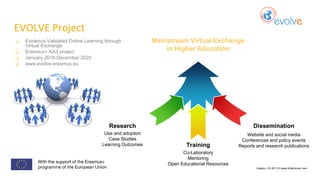
EVOLVE Project
Research
Use and adoption
Case Studies
Learning Outcomes
Dissemination
Website and social media
Conferences and policy events
Reports and research publicationsTraining
Co-Laboratory
Mentoring
Open Educational Resources
Mainstream Virtual Exchange
in Higher Education
❑ Evidence-Validated Online Learning through
Virtual Exchange
❑ Erasmus+ KA3 project
❑ January 2018-December 2020
❑ www.evolve-erasmus.eu
With the support of the Erasmus+
programme of the European Union Graphic: CC-BY 2.0 www.SlideHunter.com
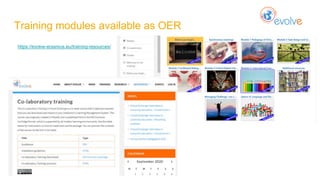
Training modules available as OER
https://evolve-erasmus.eu/training-resources/
What is Virtual Exchange?
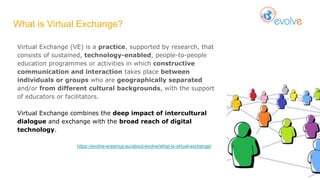
Virtual Exchange (VE) is a practice, supported by research, that
consists of sustained, technology-enabled, people-to-people
education programmes or activities in which constructive
communication and interaction takes place between
individuals or groups who are geographically separated
and/or from different cultural backgrounds, with the support
of educators or facilitators.
Virtual Exchange combines the deep impact of intercultural
dialogue and exchange with the broad reach of digital
technology.
https://evolve-erasmus.eu/about-evolve/what-is-virtual-exchange/
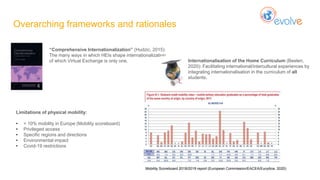
Overarching frameworks and rationales
“Comprehensive Internationalization” (Hudzic, 2015):
The many ways in which HEIs shape internationalization,
of which Virtual Exchange is only one. Internationalisation of the Home Curriculum (Beelen,
2020): Facilitating international/intercultural experiences by
integrating internationalisation in the curriculum of all
students.
Limitations of physical mobility:
• < 10% mobility in Europe (Mobility scoreboard)
• Privileged access
• Specific regions and directions
• Environmental impact
• Covid-19 restrictions
Mobility Scoreboard 2018/2019 report (European Commission/EACEA/Eurydice, 2020)
Integration into curriculum
COIL (Virtual Exchange) “combines the four essential
dimensions of real virtual mobility; it is a collaborative exercise of
teachers and students; it makes use of online technology and
interaction; it has potential international dimensions; and it is
integrated into the learning process”
(De Wit, 2013)
Typical VE competences:
● Intercultural competence
● Digital skills
● Language skills
● Collaboration skills / 21st c.skills
Combines disciplinary skills with transversal/soft
skills
Alignment with HEIs topics:
● International experience for all students
● Ecological footprint of mobility
● Equity, diversity and inclusiveness
● Sustainable Development Goals
● (Social) Entrepreneurship
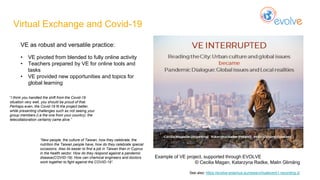
Virtual Exchange and Covid-19
Example of VE project, supported through EVOLVE
© Cecilia Magan, Katarzyna Radke, Malin Glimäng
See also: https://evolve-erasmus.eu/news/virtualevent1-recording-2/
VE as robust and versatile practice:
• VE pivoted from blended to fully online activity
• Teachers prepared by VE for online tools and
tasks
• VE provided new opportunities and topics for
global learning
“New people, the culture of Taiwan, how they celebrate, the
nutrition the Taiwan people have, how do they celebrate special
occasions. Also its easier to find a job in Taiwan than in Cyprus
in the health sector. Ηοw do they respond against a pandemic
disease(COVID-19). How can chemical engineers and doctors
work together to fight against the COVID-19”.
“I think you handled the shift from the Covid-19
situation very well, you should be proud of that.
Perhaps even, the Covid-19 fit the project better,
while presenting challenges such as not seeing your
group members (i.e the one from your country), the
telecollaboration certainly came alive.”
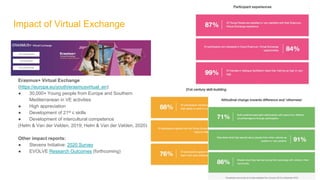
Impact of Virtual Exchange
Erasmus+ Virtual Exchange
(https://europa.eu/youth/erasmusvirtual_en):
● 30.000+ Young people from Europe and Southern
Mediterranean in VE activities
● High appreciation
● Development of 21st c skills
● Development of intercultural competence
(Helm & Van der Velden, 2019; Helm & Van der Velden, 2020)
Other impact reports:
● Stevens Initiative: 2020 Survey
● EVOLVE Research Outcomes (forthcoming)
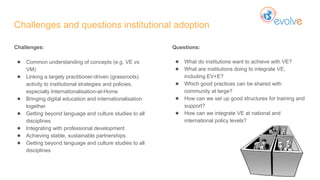
Challenges and questions institutional adoption
Challenges:
● Common understanding of concepts (e.g. VE vs
VM)
● Linking a largely practitioner-driven (grassroots)
activity to institutional strategies and policies,
especially Internationalisation-at-Home
● Bringing digital education and internationalisation
together
● Getting beyond language and culture studies to all
disciplines
● Integrating with professional development
● Achieving stable, sustainable partnerships
● Getting beyond language and culture studies to all
disciplines
Questions:
● What do institutions want to achieve with VE?
● What are institutions doing to integrate VE,
including EV+E?
● Which good practices can be shared with
community at large?
● How can we set up good structures for training and
support?
● How can we integrate VE at national and
international policy levels?
EVOLVE partnership composed of: Coimbra Group, SGroup, Jan Dlugosz University,
University of Leon, University of Groningen, Sharing Perspectives Foundation, The Open
University, Université Grenoble Alpes, University of Padua, University of Warwick, Malmö
University, Search for Common Ground:
With the support of the Erasmus+ programme of the
European Union
Connect with us:
www.evolve-erasmus.eu
Email: evolve@rug.nl
Twitter @evolve_erasmus
Thank you for your attention!
Sake Jager
s.jager@rug.nl
www.rug.nl/staff/s.jager
References
Beelen, J. (2020). Deploying virtual exchange in your institution. Presentation at EAIE 2020 Community
Exchange, together with R. O’Dowd.
Beelen J. & Jones E. (2015) Redefining internationalization at home. In A. Curaj, L. Matei, R. Pricopie, J.
Salmi, & P. Scott (Eds.), The European higher education area: The impact of past and future policies
(pp 59-72). Springer.
de Wit, H. (2013, June 1). COIL - Virtual mobility without commercialisation. University World News.
https://www.universityworldnews.com/post.php?story=20130528175741647
European Commission/EACEA/Eurydice, 2020. Mobility Scoreboard: Higher Education Background. Report
2018/19. Eurydice Report. Luxembourg: Publications Office of the European Union.
Helm, F. & Van der Velden, B. (2019). Erasmus+ Virtual Exchange Impact Report 2018. Publications Office
of the EU. doi: 0.2797/668291
Helm, F. & Van der Velden, B. (2020). Erasmus+ Virtual Exchange Impact Report 2019. Publications Office
of the EU. doi: 10.2797/513584
Hudzik, J. K. (2015) Comprehensive internationalization: institutional pathways to success. Routledge
Resources on Virtual Exchange and Internationalisation
Organisations supporting VE:
● SUNY COIL Center: coil.suny.edu
● Stevens Initiative: www.stevensinitiative.org
● UNICollaboration: www.unicollaboration.org
● Soliya: www.soliya.net
● Sharing Perspectives:
sharingperspectivesfoundation.com
Resources for International Relations Officers:
● Stevens Initiative:
https://www.stevensinitiative.org/resource/guide-for-
sios/
● Erasmus+ Virtual Exchange:
europa.eu/youth/sites/default/files/eyp/eve/attachments/
eve_-_handbook_for_iros_1.pdf
● Forum Education Abroad:
forumea.org/resources/guidelines/virtual-exchanges-
and-global-learning-online
● COIL VE Directory: https://coilconnect.org/

Virtual Exchange for Internationalising the Curriculum

  • 1.
    Virtual Exchange forInternationalising the Curriculum OEB Global Virtual Experience 2020 Panel Presentation, 3 December 3-4 PM CET Sake Jager, University of Groningen EVOLVE Project Coordinator
  • 2.
    EVOLVE Project Research Use andadoption Case Studies Learning Outcomes Dissemination Website and social media Conferences and policy events Reports and research publicationsTraining Co-Laboratory Mentoring Open Educational Resources Mainstream Virtual Exchange in Higher Education ❑ Evidence-Validated Online Learning through Virtual Exchange ❑ Erasmus+ KA3 project ❑ January 2018-December 2020 ❑ www.evolve-erasmus.eu With the support of the Erasmus+ programme of the European Union Graphic: CC-BY 2.0 www.SlideHunter.com
  • 3.
    Training modules availableas OER https://evolve-erasmus.eu/training-resources/
  • 4.
    What is VirtualExchange? Virtual Exchange (VE) is a practice, supported by research, that consists of sustained, technology-enabled, people-to-people education programmes or activities in which constructive communication and interaction takes place between individuals or groups who are geographically separated and/or from different cultural backgrounds, with the support of educators or facilitators. Virtual Exchange combines the deep impact of intercultural dialogue and exchange with the broad reach of digital technology. https://evolve-erasmus.eu/about-evolve/what-is-virtual-exchange/
  • 5.
    Overarching frameworks andrationales “Comprehensive Internationalization” (Hudzic, 2015): The many ways in which HEIs shape internationalization, of which Virtual Exchange is only one. Internationalisation of the Home Curriculum (Beelen, 2020): Facilitating international/intercultural experiences by integrating internationalisation in the curriculum of all students. Limitations of physical mobility: • < 10% mobility in Europe (Mobility scoreboard) • Privileged access • Specific regions and directions • Environmental impact • Covid-19 restrictions Mobility Scoreboard 2018/2019 report (European Commission/EACEA/Eurydice, 2020)
  • 6.
    Integration into curriculum COIL(Virtual Exchange) “combines the four essential dimensions of real virtual mobility; it is a collaborative exercise of teachers and students; it makes use of online technology and interaction; it has potential international dimensions; and it is integrated into the learning process” (De Wit, 2013) Typical VE competences: ● Intercultural competence ● Digital skills ● Language skills ● Collaboration skills / 21st c.skills Combines disciplinary skills with transversal/soft skills Alignment with HEIs topics: ● International experience for all students ● Ecological footprint of mobility ● Equity, diversity and inclusiveness ● Sustainable Development Goals ● (Social) Entrepreneurship
  • 7.
    Virtual Exchange andCovid-19 Example of VE project, supported through EVOLVE © Cecilia Magan, Katarzyna Radke, Malin Glimäng See also: https://evolve-erasmus.eu/news/virtualevent1-recording-2/ VE as robust and versatile practice: • VE pivoted from blended to fully online activity • Teachers prepared by VE for online tools and tasks • VE provided new opportunities and topics for global learning “New people, the culture of Taiwan, how they celebrate, the nutrition the Taiwan people have, how do they celebrate special occasions. Also its easier to find a job in Taiwan than in Cyprus in the health sector. Ηοw do they respond against a pandemic disease(COVID-19). How can chemical engineers and doctors work together to fight against the COVID-19”. “I think you handled the shift from the Covid-19 situation very well, you should be proud of that. Perhaps even, the Covid-19 fit the project better, while presenting challenges such as not seeing your group members (i.e the one from your country), the telecollaboration certainly came alive.”
  • 8.
    Impact of VirtualExchange Erasmus+ Virtual Exchange (https://europa.eu/youth/erasmusvirtual_en): ● 30.000+ Young people from Europe and Southern Mediterranean in VE activities ● High appreciation ● Development of 21st c skills ● Development of intercultural competence (Helm & Van der Velden, 2019; Helm & Van der Velden, 2020) Other impact reports: ● Stevens Initiative: 2020 Survey ● EVOLVE Research Outcomes (forthcoming)
  • 9.
    Challenges and questionsinstitutional adoption Challenges: ● Common understanding of concepts (e.g. VE vs VM) ● Linking a largely practitioner-driven (grassroots) activity to institutional strategies and policies, especially Internationalisation-at-Home ● Bringing digital education and internationalisation together ● Getting beyond language and culture studies to all disciplines ● Integrating with professional development ● Achieving stable, sustainable partnerships ● Getting beyond language and culture studies to all disciplines Questions: ● What do institutions want to achieve with VE? ● What are institutions doing to integrate VE, including EV+E? ● Which good practices can be shared with community at large? ● How can we set up good structures for training and support? ● How can we integrate VE at national and international policy levels?
  • 10.
    EVOLVE partnership composedof: Coimbra Group, SGroup, Jan Dlugosz University, University of Leon, University of Groningen, Sharing Perspectives Foundation, The Open University, Université Grenoble Alpes, University of Padua, University of Warwick, Malmö University, Search for Common Ground: With the support of the Erasmus+ programme of the European Union Connect with us: www.evolve-erasmus.eu Email: evolve@rug.nl Twitter @evolve_erasmus Thank you for your attention! Sake Jager s.jager@rug.nl www.rug.nl/staff/s.jager
  • 11.
    References Beelen, J. (2020).Deploying virtual exchange in your institution. Presentation at EAIE 2020 Community Exchange, together with R. O’Dowd. Beelen J. & Jones E. (2015) Redefining internationalization at home. In A. Curaj, L. Matei, R. Pricopie, J. Salmi, & P. Scott (Eds.), The European higher education area: The impact of past and future policies (pp 59-72). Springer. de Wit, H. (2013, June 1). COIL - Virtual mobility without commercialisation. University World News. https://www.universityworldnews.com/post.php?story=20130528175741647 European Commission/EACEA/Eurydice, 2020. Mobility Scoreboard: Higher Education Background. Report 2018/19. Eurydice Report. Luxembourg: Publications Office of the European Union. Helm, F. & Van der Velden, B. (2019). Erasmus+ Virtual Exchange Impact Report 2018. Publications Office of the EU. doi: 0.2797/668291 Helm, F. & Van der Velden, B. (2020). Erasmus+ Virtual Exchange Impact Report 2019. Publications Office of the EU. doi: 10.2797/513584 Hudzik, J. K. (2015) Comprehensive internationalization: institutional pathways to success. Routledge
  • 12.
    Resources on VirtualExchange and Internationalisation Organisations supporting VE: ● SUNY COIL Center: coil.suny.edu ● Stevens Initiative: www.stevensinitiative.org ● UNICollaboration: www.unicollaboration.org ● Soliya: www.soliya.net ● Sharing Perspectives: sharingperspectivesfoundation.com Resources for International Relations Officers: ● Stevens Initiative: https://www.stevensinitiative.org/resource/guide-for- sios/ ● Erasmus+ Virtual Exchange: europa.eu/youth/sites/default/files/eyp/eve/attachments/ eve_-_handbook_for_iros_1.pdf ● Forum Education Abroad: forumea.org/resources/guidelines/virtual-exchanges- and-global-learning-online ● COIL VE Directory: https://coilconnect.org/