Developing
a Vibrant Research Culture
Prof. Dr. R.Badlishah Ahmad
Jun 2014
RC refers to an environment in which new supervisees (your
student) learn the rule of the game.

includes understanding the research orientation of the
discipline.
RC that a supervisee is exposed to during the postgraduate
studies is important -> prepared for a future career. (in the
future they need to produce more research works/ideas)
Avoid the “Lone Ranger” attitude/environment → get
engage.... !! How?
l Talk! Regular meeting with supervisors, colleagues formal→
or informal, discussions etc...
Research Culture (RC)
VIBRANT?

Moving/Nonstatic

Need platforms
Research Culture (RC)
Very IMPORTANT!!
Several platforms are needed such as:

Short courses

Workshops

Conferences

Seminars

Talks/Lectures (any kind)

VIVA presentation etc
Both supervisors and students (senior and
junior) ought to attend these workshops.
RC Platforms
Some workshop examples:
 Managing postgraduate studies
 Academic writing
 Practical strategies for editing and proof reading
 Effective reading and note taking
 Critical thinking and problem solving in research
 Avoiding plagiarism
 Sustaining motivation at the postgraduate level
 Writing for publication in research/scientific journals
 Reviewing journal articles
Workshop and training courses
Encourage postgraduate students to attend at
least one conference a year with possible
funding from the respective learning institution.
Inform financial support provided by the
university for those who wish to present papers
and participate in conference and seminars
At these conferences, postgraduate students will:
l meet people and establish contacts
l extra support when they encounter problems or
difficulties in their study
Conferences and Seminars
Seminar, talks, conferences
l get together with senior postgraduate students
allows sharing similar research interests.
l provide opportunities for academic discussions
among students where they can exchange ideas,
experiences, problems, and challenges on matters
related to their studies
l Not only with peers/colleague and expert
Benefit of Platforms (formal)
Organizing social events will help students get
acquainted including festive gatherings.
To encourage positive and a vibrant atmosphere,
departments can show their appreciation of
postgraduate students’ success through
departmental celebration, often to acknowledge
students who have articles published in journals,
passed their viva voce, and upon completion of a
post graduate degree.
Social Events (Group or Dept. Level)
Peers play a crucial role in the development of
postgraduate students.
Research on peer support groups clearly indicate
that support groups play a valuable role in the
completions rates of doctoral thesis.
The supervisor can start a peer support group by
inviting all the students (s)he supervises.
Monthly meetings can be initiated and once this
has been done, the students can organise events on
their own.
During these meetings, postgraduates can organize
both academic and social events.
Peer support group (Within Group)
The academic events could include reading drafts
of each other, doing trial runs of oral presentations,
reporting progress to get feedback, group reading of
relevant articles, and sharing experiences.
Social events could include having meals together
with the supervisor, visiting members’ homes,
outings, etc.
Supervisors and institutions can provide token
financial support for coffee/meals and a place to
meet.
Peer support group
Feature postgraduates in the faculty web-site giving
information about their areas of research. This can
be done to show that it is a student centred
faculty/university.
Introduce postgraduate students to other
academic/non-academic staff.
Encourage students to attend research seminars.
Organise an annual writing retreat and ask
students to present their work in progress to get
feedback from colleagues/peers.
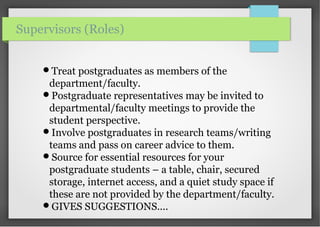
Supervisors (Roles)
Treat postgraduates as members of the
department/faculty.
Postgraduate representatives may be invited to
departmental/faculty meetings to provide the
student perspective.
Involve postgraduates in research teams/writing
teams and pass on career advice to them.
Source for essential resources for your
postgraduate students – a table, chair, secured
storage, internet access, and a quiet study space if
these are not provided by the department/faculty.
GIVES SUGGESTIONS....
Supervisors (Roles)
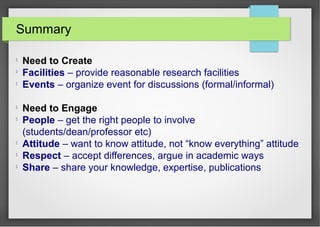
Summary

Need to Create

Facilities – provide reasonable research facilities

Events – organize event for discussions (formal/informal)

Need to Engage

People – get the right people to involve
(students/dean/professor etc)

Attitude – want to know attitude, not “know everything” attitude

Respect – accept differences, argue in academic ways

Share – share your knowledge, expertise, publications
CREATE & ENGAGE
In
THE ENVIRONMENTS

Developing a Vibrant Research Culture v2

  • 1.
    Developing a Vibrant ResearchCulture Prof. Dr. R.Badlishah Ahmad Jun 2014
  • 2.
    RC refers toan environment in which new supervisees (your student) learn the rule of the game.  includes understanding the research orientation of the discipline. RC that a supervisee is exposed to during the postgraduate studies is important -> prepared for a future career. (in the future they need to produce more research works/ideas) Avoid the “Lone Ranger” attitude/environment → get engage.... !! How? l Talk! Regular meeting with supervisors, colleagues formal→ or informal, discussions etc... Research Culture (RC)
  • 3.
  • 4.
    Very IMPORTANT!! Several platformsare needed such as:  Short courses  Workshops  Conferences  Seminars  Talks/Lectures (any kind)  VIVA presentation etc Both supervisors and students (senior and junior) ought to attend these workshops. RC Platforms
  • 5.
    Some workshop examples: Managing postgraduate studies  Academic writing  Practical strategies for editing and proof reading  Effective reading and note taking  Critical thinking and problem solving in research  Avoiding plagiarism  Sustaining motivation at the postgraduate level  Writing for publication in research/scientific journals  Reviewing journal articles Workshop and training courses
  • 6.
    Encourage postgraduate studentsto attend at least one conference a year with possible funding from the respective learning institution. Inform financial support provided by the university for those who wish to present papers and participate in conference and seminars At these conferences, postgraduate students will: l meet people and establish contacts l extra support when they encounter problems or difficulties in their study Conferences and Seminars
  • 7.
    Seminar, talks, conferences lget together with senior postgraduate students allows sharing similar research interests. l provide opportunities for academic discussions among students where they can exchange ideas, experiences, problems, and challenges on matters related to their studies l Not only with peers/colleague and expert Benefit of Platforms (formal)
  • 8.
    Organizing social eventswill help students get acquainted including festive gatherings. To encourage positive and a vibrant atmosphere, departments can show their appreciation of postgraduate students’ success through departmental celebration, often to acknowledge students who have articles published in journals, passed their viva voce, and upon completion of a post graduate degree. Social Events (Group or Dept. Level)
  • 9.
    Peers play acrucial role in the development of postgraduate students. Research on peer support groups clearly indicate that support groups play a valuable role in the completions rates of doctoral thesis. The supervisor can start a peer support group by inviting all the students (s)he supervises. Monthly meetings can be initiated and once this has been done, the students can organise events on their own. During these meetings, postgraduates can organize both academic and social events. Peer support group (Within Group)
  • 10.
    The academic eventscould include reading drafts of each other, doing trial runs of oral presentations, reporting progress to get feedback, group reading of relevant articles, and sharing experiences. Social events could include having meals together with the supervisor, visiting members’ homes, outings, etc. Supervisors and institutions can provide token financial support for coffee/meals and a place to meet. Peer support group
  • 11.
    Feature postgraduates inthe faculty web-site giving information about their areas of research. This can be done to show that it is a student centred faculty/university. Introduce postgraduate students to other academic/non-academic staff. Encourage students to attend research seminars. Organise an annual writing retreat and ask students to present their work in progress to get feedback from colleagues/peers. Supervisors (Roles)
  • 12.
    Treat postgraduates asmembers of the department/faculty. Postgraduate representatives may be invited to departmental/faculty meetings to provide the student perspective. Involve postgraduates in research teams/writing teams and pass on career advice to them. Source for essential resources for your postgraduate students – a table, chair, secured storage, internet access, and a quiet study space if these are not provided by the department/faculty. GIVES SUGGESTIONS.... Supervisors (Roles)
  • 13.
    Summary  Need to Create  Facilities– provide reasonable research facilities  Events – organize event for discussions (formal/informal)  Need to Engage  People – get the right people to involve (students/dean/professor etc)  Attitude – want to know attitude, not “know everything” attitude  Respect – accept differences, argue in academic ways  Share – share your knowledge, expertise, publications
  • 14.