Policy into Practice:
EURAXESS Researcher Career Skills for Career Development
PIPERS
This project has received funding from the European Union’s Seventh Framework Programme
for research, technological development and demonstration under grant agreement No 643330
Helping researchers to pursue their professional ambitions:
A workshop for staff assisting researchers’ development
23 OCTOBER 2015
SOFIA, BULGARIAResearcher Development
The UK Experience
Dr Lowry McComb
Formerly Director of Researcher Development
Durham University
What is Researcher Development?
• Knowledge and Intellectual Abilities
• e.g. Discipline-Specific Knowledge, Problem Solving, Critical Thinking
• Personal Effectiveness
• e.g. Career Development, Time Management
• Research Governance and Organisation
• e.g. Project Planning, Research Grant Development, Research
Integrity
• Engagement, Influence and Impact
• e.g. Teaching, Publication, Impact Awareness, Outreach, Enterprise
The Importance of Research Development
•Should improve student’s ability to successfully complete
research programme
•Preparation for future employment either in academia or
other employment
National Policy
• “…major funders of PhD students should
make all funding related to PhD students
conditional on students’ training meeting
stringent minimum standards”
• Training “…should include the provision of
at least two weeks’ dedicated training a
year, principally in transferable skills…”
• Roberts Review, 2002
Professor Sir Gareth Roberts
Aims of the AHRC’s Postgraduate
Programme
• The AHRC’s postgraduate programme aims to improve the support,
training and development opportunities offered to postgraduates,
helping them to:
• Make significant contributions to the advancement of knowledge and
understanding
• Develop highly-skilled researchers ready for careers in HE and other
sectors
• Develop the skills required by the knowledge-driven economy, and
demonstrate the arts and humanities’ contribution to the UK’s cultural,
social and economic well-being.
Global Context
• Trends that will shape the economy over the next decade
include:
• growing rewards from innovation, as the pace of technological
change increases and countries move into higher-value activities;
• the importance of higher skill levels
• Need to improve the UK’s capacity for science and
innovation
• Investment in the science base
• Improving links with business
• Attract foreign direct investment
• Build high value-added firms that will raise private investment
• Research Councils UK
QAA UK Quality Code Chapter B12
Indicator 14
• Research students have appropriate opportunities for
developing research, personal and professional skills. Each
research student's development needs are identified and
agreed jointly by the student and appropriate staff at the
start of the degree; these are regularly reviewed and
updated as appropriate.
Arts and Humanities Research Council
• AHRC – Delivery Plan 2011-15
• We remain committed to the development of early career
researchers, to develop their skills, benefit the wider
economy, and to ensure the continuing pipeline of excellent
researchers.
• It is often said that the primary resource for research impact
is the researchers we train and develop. For instance, it is
emblematic that an estimated 1 in 3 of all those working in
the UK’s creative industries hold a postgraduate qualification.
Engineering and Physical Sciences
Research Council
•EPSRC – Delivery Plan 2011-15
• Highly-skilled people are the most important output from our
research investments, and with industry warning of STEM
skill shortages, it has never been more important to ensure
our people have the skills most valuable to industry.
• We will act to further improve the quality of PhDs by
increasing the proportion of students funded via cohort
approaches.
Economics and Social Research Council
• ESRC – Delivery Plan 2011-15
• As the main UK provider of PhD funding across all areas of social science
we develop skilled social scientists to contribute to a competitive,
knowledge-based UK economy, and help create the next generation of
world-leading academic social scientists.
• We achieve this by providing the highest quality postgraduate training
across the UK social science community, and ensuring postgraduates and
postdoctorates develop the skills that employers need. We also provide
opportunities for researchers at all stages of their career to work with
government, business and civil society organisations.
EU Funding
• The Commission identifies the need to increase the number of
researchers, stating that the EU will need at least one million new
research jobs if it is to reach the R&D target of 3%, and that the number
of actual researchers required is significantly higher as many researchers
will retire over the next decade. As a result, the European Commission
calls on EU Member States to strengthen their capacity to attract and
train young people to become researchers, so as to offer internationally
competitive research careers to keep them in Europe as well as to attract
high quality researchers from abroad.
UKRO Europe Unit, Briefing Note E-2010-12
The Key Features of a
Researcher Development
Programme for
Doctoral Students
Doctoral Training Programme
Handbook available at
http://www.dur.ac.uk/resourc
es/graduate.school/Handboo
k2011.pdf
Current Approaches: Course Titles
The Key Features of a
Researcher Development
Programme for
Doctoral Students
Key Features
1. Streamlined Framework
2. Phased Approach
3. Enhances Engagement &
Employability
4. Supports All
5. Measurable Outcomes
Sam Nolan
Vitae Framework
Good as a starting point, key
elements can be retained to develop
a more streamlined approach
1) Streamlined Framework
•Knowledge and Intellectual Abilities
e.g. Discipline-Specific Knowledge, Problem
Solving, Critical Thinking
•Personal Effectiveness
e.g. Career Development, Time Management
•Research Governance and Organisation
e.g. Project Planning, Research Grant
Development, Research Integrity
•Engagement, Influence and Impact
e.g. Teaching, Publication, Impact Awareness,
Outreach, Enterprise
2) Phased Approach
The Underpinning phase refers to the first nine months of a PhD. It
begins with a needs analysis and focuses on:
Example Course Themes:
• Team Work
• Career Options
• Information Management
• Personal Effectiveness
• Presenting & Teaching
• Professional Conduct
• Project Management
• Statistics
• Writing
• Academic Writing Skills
• Tackling a Literature Review
• Writing for Publication
• Systematic Reviews
2) Phased Approach
The Consolidating phase refers to the 9-20 month period of a PhD
and focuses on:
Example Course Themes:
• Career Planning
• Presenting (Advanced)
• Progressing
2) Phased Approach
The Completing phase refers to 20+ months of a PhD and focuses
on:
Example Course Themes:
• Advanced Writing
• Career Action
• Completing
2) Phased Approach
Enriching courses can be taken at any point during the PhD.
Example Course Themes:
• Business and Enterprise
• Resilience
• Professional Conduct
• Mini MBA Programme
• Public Engagement
• Working with Others
3) Enhances Engagement & Employability
Engagement
• Academic Led
Employability
• Inside Academia
• Outside Academia
3.5% of UK PGRs end up in permanent
academic posts in the UK
• Work in co-operation with the
careers services
• Embed Employer Participation
Careers in and outside science, taken from
Royal Society Report: A Century of Science
3) Enhances Engagement & Employability
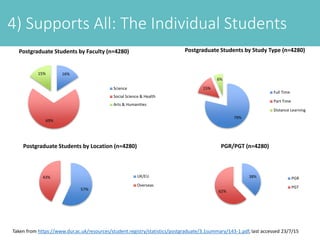
4) Supports All: The Individual Students
16%
69%
15%
Postgraduate Students by Faculty (n=4280)
Science
Social Science & Health
Arts & Humanities
79%
15%
6%
Postgraduate Students by Study Type (n=4280)
Full Time
Part Time
Distance Learning
57%
43%
Postgraduate Students by Location (n=4280)
UK/EU
Overseas
38%
62%
PGR/PGT (n=4280)
PGR
PGT
Taken from https://www.dur.ac.uk/resources/student.registry/statistics/postgraduate/3.1summary/143-1.pdf, last accessed 23/7/15
4) Supports All: The Individual Students
Core Groups:
• Three Faculties
• PGR, PGT
• F/T, P/T, DL
• UK & OS
Every student is an individual so
training needs should be identified
and reviewed
4) Supports All: The Doctoral Training Centres
4) Supports All: The Innovative Training
Networks
PGR Training Programme
should also support
development of
partnerships which take
the form of collaborative…
• European Training
Networks (ETN)
• European Industrial
Doctorates (EID)
• European Joint
Doctorates (EJD)
5) Measurable Outcomes
Engagement with
RCUK and
Employers
Engagement with
Faculty and
Departmental PG
Leaders
Focus Groups with
Students
Training Course
Feedback
• Training Course Feedback
• Focus Groups with Students
• Engagement with Faculty
and Departmental PG
Leaders
• Engagement with RCUK and
Employers
The EU Framework
The European Charter for Researchers
• The European Charter for Researchers is a set of general
principles and requirements which specifies the roles,
responsibilities and entitlements of researchers as well
as of employers and/or funders of researchers6. The aim
of the Charter is to ensure that the nature of the
relationship between researchers and employers or
funders is conducive to successful performance in
generating, transferring, sharing and disseminating
knowledge and technological development, and to the
career development of researchers. The Charter also
recognizes the value of all forms of mobility as a means
for enhancing the professional development of
researchers.
The Code of Conduct for the Recruitment of
Researchers
The Code of Conduct for the recruitment of researchers
consists of a set of general principles and requirements that
should be followed by employers and/or funders when
appointing or recruiting researchers. These principles and
requirements should ensure observance of values such as
transparency of the recruitment process and equal treatment
of all applicants, in particular with regard to the development
of an attractive, open and sustainable European labour market
for researchers, and are complementary to those outlined in
the European Charter for Researchers.
Access to research training and continuous
development
Employers and/or funders should ensure that all researchers at
any stage of their career, regardless of their contractual
situation, are given the opportunity for professional
development and for improving their employability through
access to measures for the continuing development of skills
and competencies.
Such measures should be regularly assessed for their
accessibility, takeup and effectiveness in improving
competencies, skills and employability.
Career development
Employers and/or funders of researchers should draw up,
preferably within the framework of their human resources
management, a specific career development strategy for
researchers at all stages of their career, regardless of their
contractual situation, including for researchers on fixed-term
contracts. It should include the availability of mentors involved
in providing support and guidance for the personal and
professional development of researchers, thus motivating
them and contributing to reducing any insecurity in their
professional future. All researchers should be made familiar
with such provisions and arrangements.
Access to career advice
Employers and/or funders should ensure that
career advice and job placement assistance,
either in the institutions concerned, or through
collaboration with other structures, is offered
to researchers at all stages of their careers,
regardless of their contractual situation.
The Human Resources Strategy for Researchers
( HRS4R )
The "HR Strategy for Researchers" supports research
institutions and funding organisations in the
implementation of the Charter & Code in their
policies and practices. The concrete implementation
of the Charter & Code by research institutions will
render them more attractive to researchers looking
for a new employer or for a host for their research
project. Funding organisations implementing the
Charter & Code principles will contribute to the
attractiveness of their national research systems and
to the attractiveness of the European Research Area
more generally.
HR Excellence in Research
The "HR Excellence in Research" award gives public recognition
to research institutions that have made progress in aligning
their human resource policies with the principles set out in the
"Charter & Code". Institutions that have been awarded the
right to use the icon can use it to highlight their commitment
to implement fair and transparent recruitment and appraisal
procedures for researchers.
Any Questions?

The uk experience final

  • 1.
    Policy into Practice: EURAXESSResearcher Career Skills for Career Development PIPERS This project has received funding from the European Union’s Seventh Framework Programme for research, technological development and demonstration under grant agreement No 643330 Helping researchers to pursue their professional ambitions: A workshop for staff assisting researchers’ development 23 OCTOBER 2015 SOFIA, BULGARIAResearcher Development The UK Experience Dr Lowry McComb Formerly Director of Researcher Development Durham University
  • 2.
    What is ResearcherDevelopment? • Knowledge and Intellectual Abilities • e.g. Discipline-Specific Knowledge, Problem Solving, Critical Thinking • Personal Effectiveness • e.g. Career Development, Time Management • Research Governance and Organisation • e.g. Project Planning, Research Grant Development, Research Integrity • Engagement, Influence and Impact • e.g. Teaching, Publication, Impact Awareness, Outreach, Enterprise
  • 3.
    The Importance ofResearch Development •Should improve student’s ability to successfully complete research programme •Preparation for future employment either in academia or other employment
  • 5.
    National Policy • “…majorfunders of PhD students should make all funding related to PhD students conditional on students’ training meeting stringent minimum standards” • Training “…should include the provision of at least two weeks’ dedicated training a year, principally in transferable skills…” • Roberts Review, 2002 Professor Sir Gareth Roberts
  • 6.
    Aims of theAHRC’s Postgraduate Programme • The AHRC’s postgraduate programme aims to improve the support, training and development opportunities offered to postgraduates, helping them to: • Make significant contributions to the advancement of knowledge and understanding • Develop highly-skilled researchers ready for careers in HE and other sectors • Develop the skills required by the knowledge-driven economy, and demonstrate the arts and humanities’ contribution to the UK’s cultural, social and economic well-being.
  • 7.
    Global Context • Trendsthat will shape the economy over the next decade include: • growing rewards from innovation, as the pace of technological change increases and countries move into higher-value activities; • the importance of higher skill levels • Need to improve the UK’s capacity for science and innovation • Investment in the science base • Improving links with business • Attract foreign direct investment • Build high value-added firms that will raise private investment • Research Councils UK
  • 8.
    QAA UK QualityCode Chapter B12 Indicator 14 • Research students have appropriate opportunities for developing research, personal and professional skills. Each research student's development needs are identified and agreed jointly by the student and appropriate staff at the start of the degree; these are regularly reviewed and updated as appropriate.
  • 9.
    Arts and HumanitiesResearch Council • AHRC – Delivery Plan 2011-15 • We remain committed to the development of early career researchers, to develop their skills, benefit the wider economy, and to ensure the continuing pipeline of excellent researchers. • It is often said that the primary resource for research impact is the researchers we train and develop. For instance, it is emblematic that an estimated 1 in 3 of all those working in the UK’s creative industries hold a postgraduate qualification.
  • 10.
    Engineering and PhysicalSciences Research Council •EPSRC – Delivery Plan 2011-15 • Highly-skilled people are the most important output from our research investments, and with industry warning of STEM skill shortages, it has never been more important to ensure our people have the skills most valuable to industry. • We will act to further improve the quality of PhDs by increasing the proportion of students funded via cohort approaches.
  • 11.
    Economics and SocialResearch Council • ESRC – Delivery Plan 2011-15 • As the main UK provider of PhD funding across all areas of social science we develop skilled social scientists to contribute to a competitive, knowledge-based UK economy, and help create the next generation of world-leading academic social scientists. • We achieve this by providing the highest quality postgraduate training across the UK social science community, and ensuring postgraduates and postdoctorates develop the skills that employers need. We also provide opportunities for researchers at all stages of their career to work with government, business and civil society organisations.
  • 12.
    EU Funding • TheCommission identifies the need to increase the number of researchers, stating that the EU will need at least one million new research jobs if it is to reach the R&D target of 3%, and that the number of actual researchers required is significantly higher as many researchers will retire over the next decade. As a result, the European Commission calls on EU Member States to strengthen their capacity to attract and train young people to become researchers, so as to offer internationally competitive research careers to keep them in Europe as well as to attract high quality researchers from abroad. UKRO Europe Unit, Briefing Note E-2010-12
  • 13.
    The Key Featuresof a Researcher Development Programme for Doctoral Students
  • 14.
    Doctoral Training Programme Handbookavailable at http://www.dur.ac.uk/resourc es/graduate.school/Handboo k2011.pdf
  • 15.
  • 16.
    The Key Featuresof a Researcher Development Programme for Doctoral Students Key Features 1. Streamlined Framework 2. Phased Approach 3. Enhances Engagement & Employability 4. Supports All 5. Measurable Outcomes Sam Nolan
  • 17.
    Vitae Framework Good asa starting point, key elements can be retained to develop a more streamlined approach
  • 18.
    1) Streamlined Framework •Knowledgeand Intellectual Abilities e.g. Discipline-Specific Knowledge, Problem Solving, Critical Thinking •Personal Effectiveness e.g. Career Development, Time Management •Research Governance and Organisation e.g. Project Planning, Research Grant Development, Research Integrity •Engagement, Influence and Impact e.g. Teaching, Publication, Impact Awareness, Outreach, Enterprise
  • 19.
    2) Phased Approach TheUnderpinning phase refers to the first nine months of a PhD. It begins with a needs analysis and focuses on: Example Course Themes: • Team Work • Career Options • Information Management • Personal Effectiveness • Presenting & Teaching • Professional Conduct • Project Management • Statistics • Writing • Academic Writing Skills • Tackling a Literature Review • Writing for Publication • Systematic Reviews
  • 20.
    2) Phased Approach TheConsolidating phase refers to the 9-20 month period of a PhD and focuses on: Example Course Themes: • Career Planning • Presenting (Advanced) • Progressing
  • 21.
    2) Phased Approach TheCompleting phase refers to 20+ months of a PhD and focuses on: Example Course Themes: • Advanced Writing • Career Action • Completing
  • 22.
    2) Phased Approach Enrichingcourses can be taken at any point during the PhD. Example Course Themes: • Business and Enterprise • Resilience • Professional Conduct • Mini MBA Programme • Public Engagement • Working with Others
  • 23.
    3) Enhances Engagement& Employability Engagement • Academic Led
  • 24.
    Employability • Inside Academia •Outside Academia 3.5% of UK PGRs end up in permanent academic posts in the UK • Work in co-operation with the careers services • Embed Employer Participation Careers in and outside science, taken from Royal Society Report: A Century of Science 3) Enhances Engagement & Employability
  • 25.
    4) Supports All:The Individual Students 16% 69% 15% Postgraduate Students by Faculty (n=4280) Science Social Science & Health Arts & Humanities 79% 15% 6% Postgraduate Students by Study Type (n=4280) Full Time Part Time Distance Learning 57% 43% Postgraduate Students by Location (n=4280) UK/EU Overseas 38% 62% PGR/PGT (n=4280) PGR PGT Taken from https://www.dur.ac.uk/resources/student.registry/statistics/postgraduate/3.1summary/143-1.pdf, last accessed 23/7/15
  • 26.
    4) Supports All:The Individual Students Core Groups: • Three Faculties • PGR, PGT • F/T, P/T, DL • UK & OS Every student is an individual so training needs should be identified and reviewed
  • 27.
    4) Supports All:The Doctoral Training Centres
  • 28.
    4) Supports All:The Innovative Training Networks PGR Training Programme should also support development of partnerships which take the form of collaborative… • European Training Networks (ETN) • European Industrial Doctorates (EID) • European Joint Doctorates (EJD)
  • 29.
    5) Measurable Outcomes Engagementwith RCUK and Employers Engagement with Faculty and Departmental PG Leaders Focus Groups with Students Training Course Feedback • Training Course Feedback • Focus Groups with Students • Engagement with Faculty and Departmental PG Leaders • Engagement with RCUK and Employers
  • 30.
  • 31.
    The European Charterfor Researchers • The European Charter for Researchers is a set of general principles and requirements which specifies the roles, responsibilities and entitlements of researchers as well as of employers and/or funders of researchers6. The aim of the Charter is to ensure that the nature of the relationship between researchers and employers or funders is conducive to successful performance in generating, transferring, sharing and disseminating knowledge and technological development, and to the career development of researchers. The Charter also recognizes the value of all forms of mobility as a means for enhancing the professional development of researchers.
  • 32.
    The Code ofConduct for the Recruitment of Researchers The Code of Conduct for the recruitment of researchers consists of a set of general principles and requirements that should be followed by employers and/or funders when appointing or recruiting researchers. These principles and requirements should ensure observance of values such as transparency of the recruitment process and equal treatment of all applicants, in particular with regard to the development of an attractive, open and sustainable European labour market for researchers, and are complementary to those outlined in the European Charter for Researchers.
  • 33.
    Access to researchtraining and continuous development Employers and/or funders should ensure that all researchers at any stage of their career, regardless of their contractual situation, are given the opportunity for professional development and for improving their employability through access to measures for the continuing development of skills and competencies. Such measures should be regularly assessed for their accessibility, takeup and effectiveness in improving competencies, skills and employability.
  • 34.
    Career development Employers and/orfunders of researchers should draw up, preferably within the framework of their human resources management, a specific career development strategy for researchers at all stages of their career, regardless of their contractual situation, including for researchers on fixed-term contracts. It should include the availability of mentors involved in providing support and guidance for the personal and professional development of researchers, thus motivating them and contributing to reducing any insecurity in their professional future. All researchers should be made familiar with such provisions and arrangements.
  • 35.
    Access to careeradvice Employers and/or funders should ensure that career advice and job placement assistance, either in the institutions concerned, or through collaboration with other structures, is offered to researchers at all stages of their careers, regardless of their contractual situation.
  • 36.
    The Human ResourcesStrategy for Researchers ( HRS4R ) The "HR Strategy for Researchers" supports research institutions and funding organisations in the implementation of the Charter & Code in their policies and practices. The concrete implementation of the Charter & Code by research institutions will render them more attractive to researchers looking for a new employer or for a host for their research project. Funding organisations implementing the Charter & Code principles will contribute to the attractiveness of their national research systems and to the attractiveness of the European Research Area more generally.
  • 37.
    HR Excellence inResearch The "HR Excellence in Research" award gives public recognition to research institutions that have made progress in aligning their human resource policies with the principles set out in the "Charter & Code". Institutions that have been awarded the right to use the icon can use it to highlight their commitment to implement fair and transparent recruitment and appraisal procedures for researchers.
  • 38.