IT-infused Curriculum to Empower the Digital Generation of
Marine Engineers.
By Kalyan Chatterjea & Daniel Lim1
Abstract
Present generation of learners, growing up in a digital age, expect a fully IT-infused curriculum
as a minimum. So, the majority of non-digital-age maritime instructors have to strive hard to
keep pace with these new-age students’ expectations. In this paper, we will share our experience
at the Wavelink Maritime Institute (WMI), where we are busy in developing and delivering a 3-
year pre-sea training programme for marine engineers. Integrating technology in curriculum led
to seamless accessibility, reduction of drudgery of calculations in engineering problems,
increase in conceptual understandings. This also enables trials of various what-if scenarios and
simulations of more authentic engineering cases, which were sometimes arranged as team
assignments to add teamwork and cooperation in learning. Starting with the description of the
steps taken to develop a knowledge-based infrastructure for learning, the paper will share some
specific applications of technology usage in many of the course subjects and also include our
student feed back, which refects some degree of success of our eforts.
Introduction
“We live in a digital and mobile world where Google, the Internet and mobile technologies
have disrupted traditional classroom learning...Internet-accessible resources are extensions
of our memory. There are over 30 trillion links and 2 billion plus users. Our students are using
these resources from all around the world to learn. Tomorrow, there will be more and more
technologies that thrust information at students, stimulating curiosity and thinking.” ...Prof.
K. Ranga Krishnan, Dean of Duke-NUS Medical School, Singapore.” (Krishnan, Kamei and
Cook, 2013)
Learning environment for our learners is undergoing major transformations on a continuous
basis as stated above by Krishnan et al. but we are doubtful that the teaching institutions and
faculties are moving at the same pace. As further stated in the above reference, teaching today
goes much beyond filling students’ heads with content knowledge and only teachers’ insights.
We need our learners to be able to critique, synthesise and process the given information and
apply these to real life problems. Yet in the curricula, the content to be covered is always packed
and usually there is little time to do justice in a given semester.
Our learners, mostly from generation Y (born 1977-1994) and generation Z (born 1995 – 2012 –
frequently referred to as digital natives) are born in the digital era and exhibit digital behaviours
(e.g. continuous photo sharing, whatsapping, Facebooking, continuous multitasking & showing
incessant attention to their mobiles etc.), which are usually not encouraged in maritime
academies. Yet the complete ease with which they embrace digital artefacts, could perhaps be
harnessed for learning at a much higher rate than usually possible by earlier generations. As
Darla Rothman summarized (Rothman, 2016) in her article “A Tsunami of Learners Called
Generation Z”:
“How is Generation Z diferent from previous generations?
• They have never known a world without Internet, cell phones, or iPods.
• They are tech savvy and in constant contact with people 24/7 using Facebook
1 Kalyan Chatterjea & Daniel Lim are both instructors at the Wavelink Maritime Institute,
Singapore. Both did their Extra Chief Certificates from South Tyneside College, England
and had many years of practical experience in the maritime industry.
Presented at Martech 2017, Singapore/ K.Chatterjea & Daniel Lim/WMI, Singapore
or Twitter.
• They want technology that is easy to use and will solve their problems, help
coordinate their activities, or provide them with relevant people or information.
• Their brains are afected by Internet use. They fnd answers to questions in
Google and YouTube, but they lack the critical thinking skills to evaluate
sources.
• They have low/no tolerance for being without digital resources.
• They have never had to use a library card catalogue or rummage through shelves
to fnd a specifc book.
• They don’t use a wristwatches or alarm clocks because they use their
smartphones for that.
• Instead of reading an article, they want to watch a video (YouTube) that
summarizes it.
• They may never send an email: [that is “so yesterday”]. Why email when you
can text, instant message, tweet or FaceBook?
• They use a texting “slanguage.” Examples: Cray Cray (when life is too crazy
for one word), Probs (other generations say probably), Totes (used to show
agreement—totally), XOXOX (used to end any text. For Baby Boomers it
means sincerely yours), V (very) and I (because I am the center of everything).”
We realised at Wavelink Maritime Institute (WMI) that the challenge was to develop a 3-year
pre-sea engineering course on a suitable digital infrastructure, which will be able to keep the
participants belonging to Gen Y/Z fully engaged during the time they would be with us.
(Hartman, Moskal and Dziuban, 2005)
In this paper, we describe the digital infrastructure developed at WMI and some aspects of the
course, which were modified to suit these new generation of learners. We also provide some of
the feedback received from the cohorts, which refects some level of success achieved using
these approaches.
Digital Infrastructure
A unique digital environment was created at WMI which is shown in Figure 1. The three
components of the digital infrastructure, illustrated in the figure, are described below.
Fig. 1 Wavelink Digital Learning Environment (LMS + a Core KBS)
Presented at Martech 2017, Singapore/ K.Chatterjea & Daniel Lim/WMI, Singapore
A. Knowledge-base system (KBS) was developed using CmapServer (Cañas, Hill and Lott,
1993). The CmapTools software suite allows users to construct concept maps
representing their understanding of a domain of knowledge. In the case of a large
domain, or of a detailed representation of a domain, many concept maps are developed
and linked. Concept maps are concepts with resources like, document files, slide
presentations, video clips etc. Hence, the KBS becomes a repository of domain
knowledge with its own ontology. This is a development area and its accessibility is
restricted to teachers/facilitators. Some examples will follow in a following sub-section.
B. Concept maps that are saved on CmapServers, are automatically saved with a version that
can be viewed as a web page on any web browser. The web-version of the knowledge-
maps are not editable. The learners access these knowledge-maps and their associated
resources via Moodle learning-management server. Hence, the domain knowledge, which
is developed by the facilitators remain secure in the KBS (Item – A).
C. The virtual learning environment chosen is the Moodle. Moodle (Modular Object-
Oriented Dynamic Learning Environment) is a course management system used
extensively world-wide for developing and managing e-learning platforms. Moodle is
“open source” and it allows developers to tailor the system to individual needs. It
supports third-party resources (Facebook, YouTube, Wikipedia, JClik, Hot Potatoes,
GeoGebra, etc.), providing fexibility in design . Moodle is based on socio-constructivist
pedagogy supporting an inquiry- and discovery-based approach to online learning.
Furthermore, it is truly useful for collaborative interaction among students as a
standalone, or in addition to, conventional classroom instruction.(Kotzer and Elran, 2012).
Some examples will follow in a following sub-section.
Digital Infrastructure – CmapServer
CmapServer works as a repository for users’ Cmaps and resources, with a folder-based interface
familiar to all users. It fully supports the construction of Knowledge Models, including large
models with thousands of resources. Cmaps can have links to resources on any reachable
CmapServer — links can be across CmapServers. Resources can be moved around within a
CmapServer without having to update links in the Cmaps. CmapServers register as Places with
the CmapTools network’s Directory of Places, and thereby appear under the All Places entry in
the CmapTools views, making it easy to locate the CmapServer you want to use anywhere in the
world. All resources (Cmaps, videos, images, etc.) in the CmapServer are indexed and can be
searched via the CmapTools search feature. Indexes from CmapServers are shared with the
CmapTools Network’s Index-Server, allowing searches across CmapServers from CmapTools.
Cmaps stored on a CmapServer can also be viewed and navigated through using a Web browser.
Synchronous, real time collaboration during the construction of Cmaps, allowing two or users to
simultaneously edit the same Cmap. Powerful permissions scheme allows for determining
permissions at the folder level to View, Annotate or Edit resources, plus additional specific
permissions. Annotation allows users to annotate Cmaps but prevents the editing of the Cmap.
Administration permission can be assigned dynamically when a folder is created, allowing e.g.
teachers to give students administrative permissions on their folders. Discussion threads allow
threaded discussion on a particular concept of a Cmap.(Florida Institute for Human & Machine
Cognition (IHMC), 2014)
Knowledge is seen as consisting of conceptual and procedural components. Educational
technology has mostly focused on supporting either one or the other type of learning activity.
Camps are combination of concepts and their relationships (Figure. 2, 3). So, they are able to
create Exploratory Learning Environments (ELEs), allowing students the choice of exploratory
learning. This reduces control over the learners' learning styles and behaviour. While the
Presented at Martech 2017, Singapore/ K.Chatterjea & Daniel Lim/WMI, Singapore
procedural components, also supported by CmapTools, guides students in problem solving
based on standard industry practices (Figure. 4). Both of these approaches are supported by
CmapTools architecture. (Rummel et al., 2016)
Figure 2. Exploratory Learning Environment (ELE) – allowing more student-control
Figure 3. Another example of ELE – allowing more student-control
Presented at Martech 2017, Singapore/ K.Chatterjea & Daniel Lim/WMI, Singapore
Figure 4. Procedural problem-solving diagram using CmapTools
Digital Infrastructure – Moodle CMS
Moodle Course Management System is being used for the WMI Engineering courses. We have
used the various types of quizzes extensively and find the calculation-based quizzes in Moodle to
be extremely powerful. Each numerical question is unique as the numbers change for each
leaner and a long numerical problem could be broken down into sub-sections (Formulas Type
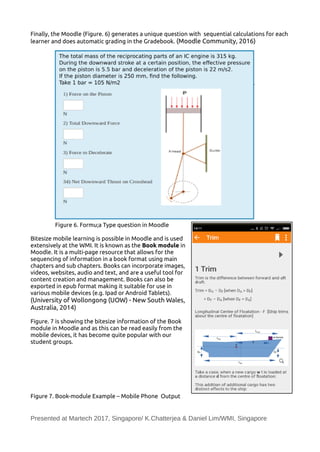
Question), when the results from one section feeds to the next sub-section. Formulas type
questions have local random variables called ‘sets’ as given below in an example, where M, P, A
are random variables defined in the set and global variables (a, b, c, d & e) are used for the
calculations (Figure. 5).
Figure 5. Random and Global variables in Formula Type Questions in Moodle
Presented at Martech 2017, Singapore/ K.Chatterjea & Daniel Lim/WMI, Singapore
Finally, the Moodle (Figure. 6) generates a unique question with sequential calculations for each
learner and does automatic grading in the Gradebook. (Moodle Community, 2016)
Figure 6. Formu;a Type question in Moodle
Bitesize mobile learning is possible in Moodle and is used
extensively at the WMI. It is known as the Book module in
Moodle. It is a multi-page resource that allows for the
sequencing of information in a book format using main
chapters and sub chapters. Books can incorporate images,
videos, websites, audio and text, and are a useful tool for
content creation and management. Books can also be
exported in epub format making it suitable for use in
various mobile devices (e.g. Ipad or Android Tablets).
(University of Wollongong (UOW) - New South Wales,
Australia, 2014)
Figure. 7 is showing the bitesize information of the Book
module in Moodle and as this can be read easily from the
mobile devices, it has become quite popular with our
student groups.
Figure 7. Book-module Example – Mobile Phone Output
Presented at Martech 2017, Singapore/ K.Chatterjea & Daniel Lim/WMI, Singapore
Digital Interactive Learning – CyclePad & GeoGebra
A number of programs are used to make the learning of engineering more interactive. We will
describe two of those, which are being used extensively:
1. CyclePad, which is being used for the learning of Thermodynamics and
2. GeoGebra, which is used to teach Engineering Mathematics, Ship Stability, Thermodynamics
and Engineering Mechanics.
CyclePad has been built to help engineering undergraduates appreciate and therefore learn
important principles of thermodynamics. CyclePad provides a conceptual CAD environment
where students can design and analyse power plants, refrigerators, and other thermodynamic
cycles. It relies on a synergistic combination of existing AI techniques: compositional modelling
to represent and reason with modelling assumptions, qualitative representations to express the
intuitive knowledge of physics needed to detect impossible designs, truth-maintenance to
provide the basis for explanations, and constraint reasoning and propagation to provide efcient
mathematical reasoning. We have implemented CyclePad for about 90% of the Engineering
Thermodynamics syllabus and we are still developing further exercises to produce more what-if
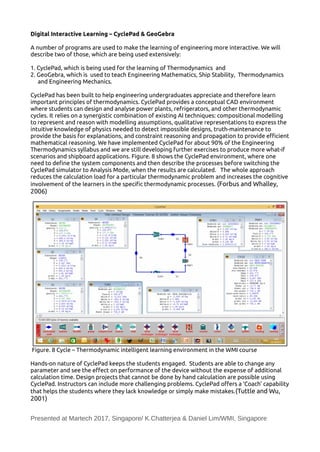
scenarios and shipboard applications. Figure. 8 shows the CyclePad environment, where one
need to define the system components and then describe the processes before switching the
CyclePad simulator to Analysis Mode, when the results are calculated. The whole approach
reduces the calculation load for a particular thermodynamic problem and increases the cognitive
involvement of the learners in the specific thermodynamic processes. (Forbus and Whalley,
2006)
Figure. 8 Cycle – Thermodynamic intelligent learning environment in the WMI course
Hands-on nature of CyclePad keeps the students engaged. Students are able to change any
parameter and see the efect on performance of the device without the expense of additional
calculation time. Design projects that cannot be done by hand calculation are possible using
CyclePad. Instructors can include more challenging problems. CyclePad ofers a ‘Coach’ capability
that helps the students where they lack knowledge or simply make mistakes.(Tuttle and Wu,
2001)
Presented at Martech 2017, Singapore/ K.Chatterjea & Daniel Lim/WMI, Singapore
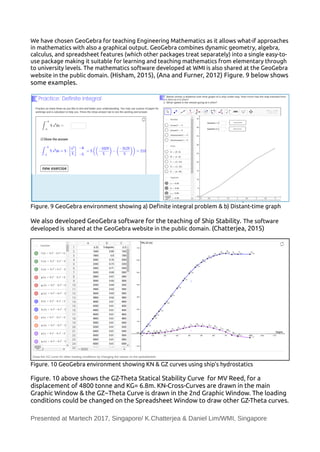
We have chosen GeoGebra for teaching Engineering Mathematics as it allows what-if approaches
in mathematics with also a graphical output. GeoGebra combines dynamic geometry, algebra,
calculus, and spreadsheet features (which other packages treat separately) into a single easy-to-
use package making it suitable for learning and teaching mathematics from elementary through
to university levels. The mathematics software developed at WMI is also shared at the GeoGebra
website in the public domain. (Hisham, 2015), (Ana and Furner, 2012) Figure. 9 below shows
some examples.
Figure. 9 GeoGebra environment showing a) Definite integral problem & b) Distant-time graph
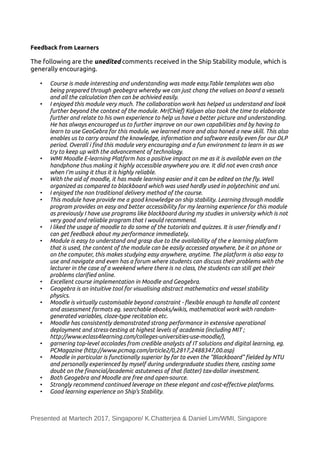
We also developed GeoGebra software for the teaching of Ship Stability. The software
developed is shared at the GeoGebra website in the public domain. (Chatterjea, 2015)
Figure. 10 GeoGebra environment showing KN & GZ curves using ship’s hydrostatics
Figure. 10 above shows the GZ-Theta Statical Stability Curve for MV Reed, for a
displacement of 4800 tonne and KG= 6.8m. KN-Cross-Curves are drawn in the main
Graphic Window & the GZ~Theta Curve is drawn in the 2nd Graphic Window. The loading
conditions could be changed on the Spreadsheet Window to draw other GZ-Theta curves.
Presented at Martech 2017, Singapore/ K.Chatterjea & Daniel Lim/WMI, Singapore
Feedback from Learners
The following are the unedited comments received in the Ship Stability module, which is
generally encouraging.
• Course is made interesting and understanding was made easy.Table templates was also
being prepared through geobegra whereby we can just chang the values on board a vessels
and all the calculation then can be achivied easily.
• I enjoyed this module very much. The collaboration work has helped us understand and look
further beyond the context of the module. Mr(Chief) Kalyan also took the time to elaborate
further and relate to his own experience to help us have a better picture and understanding.
He has always encouraged us to further improve on our own capabilities and by having to
learn to use GeoGebra for this module, we learned more and also honed a new skill. This also
enables us to carry around the knowledge, information and software easily even for our DLP
period. Overall i fnd this module very encouraging and a fun environment to learn in as we
try to keep up with the advancement of technology.
• WMI Moodle E-learning Platform has a positive impact on me as it is available even on the
handphone thus making it highly accessible anywhere you are. It did not even crash once
when I'm using it thus it is highly reliable.
• With the aid of moodle, it has made learning easier and it can be edited on the fy. Well
organized as compared to blackboard which was used hardly used in polytechinic and uni.
• I enjoyed the non traditional delivery method of the course.
• This module have provide me a good knowledge on ship stability. Learning through moddle
program provides an easy and better accessibility for my learning experience for this module
as previously I have use programs like blackboard during my studies in university which is not
very good and reliable program that I would recommend.
• I liked the usage of moodle to do some of the tutorials and quizzes. It is user friendly and I
can get feedback about my performance immediately.
• Module is easy to understand and grasp due to the availability of the e learning platform
that is used, the content of the module can be easily accessed anywhere, be it on phone or
on the computer, this makes studying easy anywhere, anytime. The platform is also easy to
use and navigate and even has a forum where students can discuss their problems with the
lecturer in the case of a weekend where there is no class, the students can still get their
problems clarifed online.
• Excellent course implementation in Moodle and Geogebra.
• Geogebra is an intuitive tool for visualising abstract mathematics and vessel stability
physics.
• Moodle is virtually customisable beyond constraint - fexible enough to handle all content
and assessment formats eg. searchable ebooks/wikis, mathematical work with random-
generated variables, cloze-type recitation etc.
• Moodle has consistently demonstrated strong performance in extensive operational
deployment and stress-testing at highest levels of academia (including MIT ;
http://www.eclass4learning.com/colleges-universities-use-moodle/),
• garnering top-level accolades from credible analysts of IT solutions and digital learning, eg.
PCMagazine (http://www.pcmag.com/article2/0,2817,2488347,00.asp)
• Moodle in particular is functionally superior by far to even the "Blackboard" felded by NTU
and personally experienced by myself during undergraduate studies there, casting some
doubt on the fnancial/academic astuteness of that (latter) tax-dollar investment.
• Both Geogebra and Moodle are free and open-source.
• Strongly recommend continued leverage on these elegant and cost-efective platforms.
• Good learning experience on Ship's Stability.
Presented at Martech 2017, Singapore/ K.Chatterjea & Daniel Lim/WMI, Singapore
• I pretty much sumed up everything that i need to know for ship stability module. I believe the
theory learnt will be benefcial to be put into practical real-life usage. With the ease of
GeoGebra, calculations will be made slightly easy.
• Learning over the internet has improve drastically my study methods, i could study
anywhere.
Conclusions
With pervasive digital technologies all around us, generation Z is even more demanding than
generation Y with respect to information technology usage in educational artefacts. The
instructors/facilitators need to bare this in mind and try to engage the learners through various
interactivity developed innovatively in the online/mobile platforms. We have shared some of the
steps which were taken at the Wavelink Maritime Institute to produce interactive content for our
engineering modules. The results shown in the feedback are mostly positive. However, the
present educational IT scene is extremely dynamic and the instructors should have their
antennas out to detect digital-behaviour changes in generation Z. Perhaps it is time to use a
gamification strategy to stay relevant in the next phase of the volatile Learning World.
(Moonami, 2017)
References
Ana, E. and Furner, J. M. (2012) ‘The Impact of GeoGebra in Math Teachers’ Professional
Development’, in. International Conference on Technologies in Collegiate Mathematics edited by P.
Bogacki et al.(Department of Mathematics and Statistics Old Dominion University, Norfolk, USA,
2011), pp. 76–84. Available at: http://archives.math.utk.edu/ICTCM/VOL23/S113/paper.pdf
(Accessed: 2 July 2017).
Cañas, A. J., Hill, G. and Lott, J. (1993) Support for constructing knowledge models in CmapTools.
Technical Report IHMC CmapTools 93–2. 40 South Alcaniz St. Pensacola Fl 32501, USA: Institute
for Human and Machine Cognition.
Available at: http://cmap.ihmc.us/Publications/WhitePapers/Support%20for%20Constructing
%20Knowledge%20Models%20in%20CmapTools.pdf (Accessed: 29 June 2017).
Chatterjea, K. (2015) ‘Ship-Calculations Ver 0.98’, GeoGebra, 14 September. Available at:
https://www.geogebra.org/m/MnwTXV42 (Accessed: 2 July 2017).
Florida Institute for Human & Machine Cognition (IHMC) (2014) CmapServer, Cmap.
Available at: http://cmap.ihmc.us/cmapserver/ (Accessed: 29 June 2017).
Forbus, K. D. and Whalley, P. B. (2006) ‘Using Qualitative Physics to Build Articulate Software for
Thermodynamics Education’, Interactive Learning Environments, 5, pp. 19–32. Available at:
http://www.qrg.northwestern.edu/papers/Files/QRG_Dist_Files/QRG_1998/Forbus-Whalley-
1998.pdf (Accessed: 2 July 2017).
Hartman, J., Moskal, P. and Dziuban, C. (2005) ‘Preparing the Academy of Today for the Learner
of Tomorrow’, in Educating the Net Generation. (Educase), p. 264.
Available at: https://www.educause.edu/research-and-publications/books/educating-net-
generation/preparing-academy-today-learner-tomorrow (Accessed: 27 June 2017).
Hisham, A. (2015) ‘Engineering Mathematics’, GeoGebra, 13 October. Available at:
https://www.geogebra.org/m/TXytYmMU# (Accessed: 2 July 2017).
Presented at Martech 2017, Singapore/ K.Chatterjea & Daniel Lim/WMI, Singapore
Kotzer, S. and Elran, Y. (2012) ‘Learning and teaching with Moodle-based E-learning
environments, combining learning skills and content in the fields of Math and Science &
Technology’, in. 1st Moodle Research Conference, Heraklion, Crete-Greece, pp. 122–131.
Available at: http://research.moodle.net/55/1/16%20-%20Kotzer%20-%20Learning%20and
%20teaching%20with%20Moodle-based%20E-learning.pdf (Accessed: 29 June 2017).
Moodle Community (2016) ‘Formulas Question Type’, Moodle Docs, 17 April.
Available at: https://docs.moodle.org/30/en/Formulas_question_type#Examples (Accessed: 2
July 2017).
Moonami (2017) ‘Check Out Mootivated, A New Concept In Moodle Gamification’, Moodle News,
13 June. Available at: https://www.moodlenews.com/2017/check-out-mootivated-a-new-
concept-in-moodle-gamification/ (Accessed: 3 July 2017).
Rothman, D. (2016) ‘A Tsunami of learners called Generation Z’, Journal of MDLE (Maryland Police
and Correctional Training Commissions).
Available at: http://mdle.net/Journal/A_Tsunami_of_Learners_Called_Generation_Z.pdf
(Accessed: 28 June 2017).
Rummel, N. et al. (2016) ‘Combining Exploratory Learning With Structured Practice to Foster
Conceptual and Procedural Fractions Knowledge’, in Transforming Learning, Empowering
Learners: The International Conference of the Learning Sciences (ICLS) 2016. Singapore: National
Institute of Education, Nanyang Technological University, Singapore, pp. 58–65.
Available at: https://www.isls.org/icls/2016/docs/ICLS2016_Volume_1.pdf (Accessed: 27 June
2017).
Tuttle, K. L. and Wu, C. (2001) ‘Intelligent computer assisted instruction in thermodynamics at
the US Naval Academy’, in Proceedings of the 15th Annual Workshop on Qualitative Reasoning.
15th Annual Workshop on Qualitative Reasoning, San Antonio. Available at:
http://wavelinklms.edu.sg/moodle/pluginfile.php/179/mod_resource/content/2/paper12.pdf
(Accessed: 2 July 2017).
University of Wollongong (UOW) - New South Wales, Australia (2014) ‘Why Use Moodle Books?’,
Learning, Teaching & Curriculum, November. Available at:
http://www.uow.edu.au/content/groups/public/@web/@dvce/@tel/documents/doc/uow183582
.pdf (Accessed: 2 July 2017).
Presented at Martech 2017, Singapore/ K.Chatterjea & Daniel Lim/WMI, Singapore

Developing a Pre-Sea Curriculum for the Digital Generation of Marine Engineers

  • 1.
    IT-infused Curriculum toEmpower the Digital Generation of Marine Engineers. By Kalyan Chatterjea & Daniel Lim1 Abstract Present generation of learners, growing up in a digital age, expect a fully IT-infused curriculum as a minimum. So, the majority of non-digital-age maritime instructors have to strive hard to keep pace with these new-age students’ expectations. In this paper, we will share our experience at the Wavelink Maritime Institute (WMI), where we are busy in developing and delivering a 3- year pre-sea training programme for marine engineers. Integrating technology in curriculum led to seamless accessibility, reduction of drudgery of calculations in engineering problems, increase in conceptual understandings. This also enables trials of various what-if scenarios and simulations of more authentic engineering cases, which were sometimes arranged as team assignments to add teamwork and cooperation in learning. Starting with the description of the steps taken to develop a knowledge-based infrastructure for learning, the paper will share some specific applications of technology usage in many of the course subjects and also include our student feed back, which refects some degree of success of our eforts. Introduction “We live in a digital and mobile world where Google, the Internet and mobile technologies have disrupted traditional classroom learning...Internet-accessible resources are extensions of our memory. There are over 30 trillion links and 2 billion plus users. Our students are using these resources from all around the world to learn. Tomorrow, there will be more and more technologies that thrust information at students, stimulating curiosity and thinking.” ...Prof. K. Ranga Krishnan, Dean of Duke-NUS Medical School, Singapore.” (Krishnan, Kamei and Cook, 2013) Learning environment for our learners is undergoing major transformations on a continuous basis as stated above by Krishnan et al. but we are doubtful that the teaching institutions and faculties are moving at the same pace. As further stated in the above reference, teaching today goes much beyond filling students’ heads with content knowledge and only teachers’ insights. We need our learners to be able to critique, synthesise and process the given information and apply these to real life problems. Yet in the curricula, the content to be covered is always packed and usually there is little time to do justice in a given semester. Our learners, mostly from generation Y (born 1977-1994) and generation Z (born 1995 – 2012 – frequently referred to as digital natives) are born in the digital era and exhibit digital behaviours (e.g. continuous photo sharing, whatsapping, Facebooking, continuous multitasking & showing incessant attention to their mobiles etc.), which are usually not encouraged in maritime academies. Yet the complete ease with which they embrace digital artefacts, could perhaps be harnessed for learning at a much higher rate than usually possible by earlier generations. As Darla Rothman summarized (Rothman, 2016) in her article “A Tsunami of Learners Called Generation Z”: “How is Generation Z diferent from previous generations? • They have never known a world without Internet, cell phones, or iPods. • They are tech savvy and in constant contact with people 24/7 using Facebook 1 Kalyan Chatterjea & Daniel Lim are both instructors at the Wavelink Maritime Institute, Singapore. Both did their Extra Chief Certificates from South Tyneside College, England and had many years of practical experience in the maritime industry. Presented at Martech 2017, Singapore/ K.Chatterjea & Daniel Lim/WMI, Singapore
  • 2.
    or Twitter. • Theywant technology that is easy to use and will solve their problems, help coordinate their activities, or provide them with relevant people or information. • Their brains are afected by Internet use. They fnd answers to questions in Google and YouTube, but they lack the critical thinking skills to evaluate sources. • They have low/no tolerance for being without digital resources. • They have never had to use a library card catalogue or rummage through shelves to fnd a specifc book. • They don’t use a wristwatches or alarm clocks because they use their smartphones for that. • Instead of reading an article, they want to watch a video (YouTube) that summarizes it. • They may never send an email: [that is “so yesterday”]. Why email when you can text, instant message, tweet or FaceBook? • They use a texting “slanguage.” Examples: Cray Cray (when life is too crazy for one word), Probs (other generations say probably), Totes (used to show agreement—totally), XOXOX (used to end any text. For Baby Boomers it means sincerely yours), V (very) and I (because I am the center of everything).” We realised at Wavelink Maritime Institute (WMI) that the challenge was to develop a 3-year pre-sea engineering course on a suitable digital infrastructure, which will be able to keep the participants belonging to Gen Y/Z fully engaged during the time they would be with us. (Hartman, Moskal and Dziuban, 2005) In this paper, we describe the digital infrastructure developed at WMI and some aspects of the course, which were modified to suit these new generation of learners. We also provide some of the feedback received from the cohorts, which refects some level of success achieved using these approaches. Digital Infrastructure A unique digital environment was created at WMI which is shown in Figure 1. The three components of the digital infrastructure, illustrated in the figure, are described below. Fig. 1 Wavelink Digital Learning Environment (LMS + a Core KBS) Presented at Martech 2017, Singapore/ K.Chatterjea & Daniel Lim/WMI, Singapore
  • 3.
    A. Knowledge-base system(KBS) was developed using CmapServer (Cañas, Hill and Lott, 1993). The CmapTools software suite allows users to construct concept maps representing their understanding of a domain of knowledge. In the case of a large domain, or of a detailed representation of a domain, many concept maps are developed and linked. Concept maps are concepts with resources like, document files, slide presentations, video clips etc. Hence, the KBS becomes a repository of domain knowledge with its own ontology. This is a development area and its accessibility is restricted to teachers/facilitators. Some examples will follow in a following sub-section. B. Concept maps that are saved on CmapServers, are automatically saved with a version that can be viewed as a web page on any web browser. The web-version of the knowledge- maps are not editable. The learners access these knowledge-maps and their associated resources via Moodle learning-management server. Hence, the domain knowledge, which is developed by the facilitators remain secure in the KBS (Item – A). C. The virtual learning environment chosen is the Moodle. Moodle (Modular Object- Oriented Dynamic Learning Environment) is a course management system used extensively world-wide for developing and managing e-learning platforms. Moodle is “open source” and it allows developers to tailor the system to individual needs. It supports third-party resources (Facebook, YouTube, Wikipedia, JClik, Hot Potatoes, GeoGebra, etc.), providing fexibility in design . Moodle is based on socio-constructivist pedagogy supporting an inquiry- and discovery-based approach to online learning. Furthermore, it is truly useful for collaborative interaction among students as a standalone, or in addition to, conventional classroom instruction.(Kotzer and Elran, 2012). Some examples will follow in a following sub-section. Digital Infrastructure – CmapServer CmapServer works as a repository for users’ Cmaps and resources, with a folder-based interface familiar to all users. It fully supports the construction of Knowledge Models, including large models with thousands of resources. Cmaps can have links to resources on any reachable CmapServer — links can be across CmapServers. Resources can be moved around within a CmapServer without having to update links in the Cmaps. CmapServers register as Places with the CmapTools network’s Directory of Places, and thereby appear under the All Places entry in the CmapTools views, making it easy to locate the CmapServer you want to use anywhere in the world. All resources (Cmaps, videos, images, etc.) in the CmapServer are indexed and can be searched via the CmapTools search feature. Indexes from CmapServers are shared with the CmapTools Network’s Index-Server, allowing searches across CmapServers from CmapTools. Cmaps stored on a CmapServer can also be viewed and navigated through using a Web browser. Synchronous, real time collaboration during the construction of Cmaps, allowing two or users to simultaneously edit the same Cmap. Powerful permissions scheme allows for determining permissions at the folder level to View, Annotate or Edit resources, plus additional specific permissions. Annotation allows users to annotate Cmaps but prevents the editing of the Cmap. Administration permission can be assigned dynamically when a folder is created, allowing e.g. teachers to give students administrative permissions on their folders. Discussion threads allow threaded discussion on a particular concept of a Cmap.(Florida Institute for Human & Machine Cognition (IHMC), 2014) Knowledge is seen as consisting of conceptual and procedural components. Educational technology has mostly focused on supporting either one or the other type of learning activity. Camps are combination of concepts and their relationships (Figure. 2, 3). So, they are able to create Exploratory Learning Environments (ELEs), allowing students the choice of exploratory learning. This reduces control over the learners' learning styles and behaviour. While the Presented at Martech 2017, Singapore/ K.Chatterjea & Daniel Lim/WMI, Singapore
  • 4.
    procedural components, alsosupported by CmapTools, guides students in problem solving based on standard industry practices (Figure. 4). Both of these approaches are supported by CmapTools architecture. (Rummel et al., 2016) Figure 2. Exploratory Learning Environment (ELE) – allowing more student-control Figure 3. Another example of ELE – allowing more student-control Presented at Martech 2017, Singapore/ K.Chatterjea & Daniel Lim/WMI, Singapore
  • 5.
    Figure 4. Proceduralproblem-solving diagram using CmapTools Digital Infrastructure – Moodle CMS Moodle Course Management System is being used for the WMI Engineering courses. We have used the various types of quizzes extensively and find the calculation-based quizzes in Moodle to be extremely powerful. Each numerical question is unique as the numbers change for each leaner and a long numerical problem could be broken down into sub-sections (Formulas Type Question), when the results from one section feeds to the next sub-section. Formulas type questions have local random variables called ‘sets’ as given below in an example, where M, P, A are random variables defined in the set and global variables (a, b, c, d & e) are used for the calculations (Figure. 5). Figure 5. Random and Global variables in Formula Type Questions in Moodle Presented at Martech 2017, Singapore/ K.Chatterjea & Daniel Lim/WMI, Singapore
  • 6.
    Finally, the Moodle(Figure. 6) generates a unique question with sequential calculations for each learner and does automatic grading in the Gradebook. (Moodle Community, 2016) Figure 6. Formu;a Type question in Moodle Bitesize mobile learning is possible in Moodle and is used extensively at the WMI. It is known as the Book module in Moodle. It is a multi-page resource that allows for the sequencing of information in a book format using main chapters and sub chapters. Books can incorporate images, videos, websites, audio and text, and are a useful tool for content creation and management. Books can also be exported in epub format making it suitable for use in various mobile devices (e.g. Ipad or Android Tablets). (University of Wollongong (UOW) - New South Wales, Australia, 2014) Figure. 7 is showing the bitesize information of the Book module in Moodle and as this can be read easily from the mobile devices, it has become quite popular with our student groups. Figure 7. Book-module Example – Mobile Phone Output Presented at Martech 2017, Singapore/ K.Chatterjea & Daniel Lim/WMI, Singapore
  • 7.
    Digital Interactive Learning– CyclePad & GeoGebra A number of programs are used to make the learning of engineering more interactive. We will describe two of those, which are being used extensively: 1. CyclePad, which is being used for the learning of Thermodynamics and 2. GeoGebra, which is used to teach Engineering Mathematics, Ship Stability, Thermodynamics and Engineering Mechanics. CyclePad has been built to help engineering undergraduates appreciate and therefore learn important principles of thermodynamics. CyclePad provides a conceptual CAD environment where students can design and analyse power plants, refrigerators, and other thermodynamic cycles. It relies on a synergistic combination of existing AI techniques: compositional modelling to represent and reason with modelling assumptions, qualitative representations to express the intuitive knowledge of physics needed to detect impossible designs, truth-maintenance to provide the basis for explanations, and constraint reasoning and propagation to provide efcient mathematical reasoning. We have implemented CyclePad for about 90% of the Engineering Thermodynamics syllabus and we are still developing further exercises to produce more what-if scenarios and shipboard applications. Figure. 8 shows the CyclePad environment, where one need to define the system components and then describe the processes before switching the CyclePad simulator to Analysis Mode, when the results are calculated. The whole approach reduces the calculation load for a particular thermodynamic problem and increases the cognitive involvement of the learners in the specific thermodynamic processes. (Forbus and Whalley, 2006) Figure. 8 Cycle – Thermodynamic intelligent learning environment in the WMI course Hands-on nature of CyclePad keeps the students engaged. Students are able to change any parameter and see the efect on performance of the device without the expense of additional calculation time. Design projects that cannot be done by hand calculation are possible using CyclePad. Instructors can include more challenging problems. CyclePad ofers a ‘Coach’ capability that helps the students where they lack knowledge or simply make mistakes.(Tuttle and Wu, 2001) Presented at Martech 2017, Singapore/ K.Chatterjea & Daniel Lim/WMI, Singapore
  • 8.
    We have chosenGeoGebra for teaching Engineering Mathematics as it allows what-if approaches in mathematics with also a graphical output. GeoGebra combines dynamic geometry, algebra, calculus, and spreadsheet features (which other packages treat separately) into a single easy-to- use package making it suitable for learning and teaching mathematics from elementary through to university levels. The mathematics software developed at WMI is also shared at the GeoGebra website in the public domain. (Hisham, 2015), (Ana and Furner, 2012) Figure. 9 below shows some examples. Figure. 9 GeoGebra environment showing a) Definite integral problem & b) Distant-time graph We also developed GeoGebra software for the teaching of Ship Stability. The software developed is shared at the GeoGebra website in the public domain. (Chatterjea, 2015) Figure. 10 GeoGebra environment showing KN & GZ curves using ship’s hydrostatics Figure. 10 above shows the GZ-Theta Statical Stability Curve for MV Reed, for a displacement of 4800 tonne and KG= 6.8m. KN-Cross-Curves are drawn in the main Graphic Window & the GZ~Theta Curve is drawn in the 2nd Graphic Window. The loading conditions could be changed on the Spreadsheet Window to draw other GZ-Theta curves. Presented at Martech 2017, Singapore/ K.Chatterjea & Daniel Lim/WMI, Singapore
  • 9.
    Feedback from Learners Thefollowing are the unedited comments received in the Ship Stability module, which is generally encouraging. • Course is made interesting and understanding was made easy.Table templates was also being prepared through geobegra whereby we can just chang the values on board a vessels and all the calculation then can be achivied easily. • I enjoyed this module very much. The collaboration work has helped us understand and look further beyond the context of the module. Mr(Chief) Kalyan also took the time to elaborate further and relate to his own experience to help us have a better picture and understanding. He has always encouraged us to further improve on our own capabilities and by having to learn to use GeoGebra for this module, we learned more and also honed a new skill. This also enables us to carry around the knowledge, information and software easily even for our DLP period. Overall i fnd this module very encouraging and a fun environment to learn in as we try to keep up with the advancement of technology. • WMI Moodle E-learning Platform has a positive impact on me as it is available even on the handphone thus making it highly accessible anywhere you are. It did not even crash once when I'm using it thus it is highly reliable. • With the aid of moodle, it has made learning easier and it can be edited on the fy. Well organized as compared to blackboard which was used hardly used in polytechinic and uni. • I enjoyed the non traditional delivery method of the course. • This module have provide me a good knowledge on ship stability. Learning through moddle program provides an easy and better accessibility for my learning experience for this module as previously I have use programs like blackboard during my studies in university which is not very good and reliable program that I would recommend. • I liked the usage of moodle to do some of the tutorials and quizzes. It is user friendly and I can get feedback about my performance immediately. • Module is easy to understand and grasp due to the availability of the e learning platform that is used, the content of the module can be easily accessed anywhere, be it on phone or on the computer, this makes studying easy anywhere, anytime. The platform is also easy to use and navigate and even has a forum where students can discuss their problems with the lecturer in the case of a weekend where there is no class, the students can still get their problems clarifed online. • Excellent course implementation in Moodle and Geogebra. • Geogebra is an intuitive tool for visualising abstract mathematics and vessel stability physics. • Moodle is virtually customisable beyond constraint - fexible enough to handle all content and assessment formats eg. searchable ebooks/wikis, mathematical work with random- generated variables, cloze-type recitation etc. • Moodle has consistently demonstrated strong performance in extensive operational deployment and stress-testing at highest levels of academia (including MIT ; http://www.eclass4learning.com/colleges-universities-use-moodle/), • garnering top-level accolades from credible analysts of IT solutions and digital learning, eg. PCMagazine (http://www.pcmag.com/article2/0,2817,2488347,00.asp) • Moodle in particular is functionally superior by far to even the "Blackboard" felded by NTU and personally experienced by myself during undergraduate studies there, casting some doubt on the fnancial/academic astuteness of that (latter) tax-dollar investment. • Both Geogebra and Moodle are free and open-source. • Strongly recommend continued leverage on these elegant and cost-efective platforms. • Good learning experience on Ship's Stability. Presented at Martech 2017, Singapore/ K.Chatterjea & Daniel Lim/WMI, Singapore
  • 10.
    • I prettymuch sumed up everything that i need to know for ship stability module. I believe the theory learnt will be benefcial to be put into practical real-life usage. With the ease of GeoGebra, calculations will be made slightly easy. • Learning over the internet has improve drastically my study methods, i could study anywhere. Conclusions With pervasive digital technologies all around us, generation Z is even more demanding than generation Y with respect to information technology usage in educational artefacts. The instructors/facilitators need to bare this in mind and try to engage the learners through various interactivity developed innovatively in the online/mobile platforms. We have shared some of the steps which were taken at the Wavelink Maritime Institute to produce interactive content for our engineering modules. The results shown in the feedback are mostly positive. However, the present educational IT scene is extremely dynamic and the instructors should have their antennas out to detect digital-behaviour changes in generation Z. Perhaps it is time to use a gamification strategy to stay relevant in the next phase of the volatile Learning World. (Moonami, 2017) References Ana, E. and Furner, J. M. (2012) ‘The Impact of GeoGebra in Math Teachers’ Professional Development’, in. International Conference on Technologies in Collegiate Mathematics edited by P. Bogacki et al.(Department of Mathematics and Statistics Old Dominion University, Norfolk, USA, 2011), pp. 76–84. Available at: http://archives.math.utk.edu/ICTCM/VOL23/S113/paper.pdf (Accessed: 2 July 2017). Cañas, A. J., Hill, G. and Lott, J. (1993) Support for constructing knowledge models in CmapTools. Technical Report IHMC CmapTools 93–2. 40 South Alcaniz St. Pensacola Fl 32501, USA: Institute for Human and Machine Cognition. Available at: http://cmap.ihmc.us/Publications/WhitePapers/Support%20for%20Constructing %20Knowledge%20Models%20in%20CmapTools.pdf (Accessed: 29 June 2017). Chatterjea, K. (2015) ‘Ship-Calculations Ver 0.98’, GeoGebra, 14 September. Available at: https://www.geogebra.org/m/MnwTXV42 (Accessed: 2 July 2017). Florida Institute for Human & Machine Cognition (IHMC) (2014) CmapServer, Cmap. Available at: http://cmap.ihmc.us/cmapserver/ (Accessed: 29 June 2017). Forbus, K. D. and Whalley, P. B. (2006) ‘Using Qualitative Physics to Build Articulate Software for Thermodynamics Education’, Interactive Learning Environments, 5, pp. 19–32. Available at: http://www.qrg.northwestern.edu/papers/Files/QRG_Dist_Files/QRG_1998/Forbus-Whalley- 1998.pdf (Accessed: 2 July 2017). Hartman, J., Moskal, P. and Dziuban, C. (2005) ‘Preparing the Academy of Today for the Learner of Tomorrow’, in Educating the Net Generation. (Educase), p. 264. Available at: https://www.educause.edu/research-and-publications/books/educating-net- generation/preparing-academy-today-learner-tomorrow (Accessed: 27 June 2017). Hisham, A. (2015) ‘Engineering Mathematics’, GeoGebra, 13 October. Available at: https://www.geogebra.org/m/TXytYmMU# (Accessed: 2 July 2017). Presented at Martech 2017, Singapore/ K.Chatterjea & Daniel Lim/WMI, Singapore
  • 11.
    Kotzer, S. andElran, Y. (2012) ‘Learning and teaching with Moodle-based E-learning environments, combining learning skills and content in the fields of Math and Science & Technology’, in. 1st Moodle Research Conference, Heraklion, Crete-Greece, pp. 122–131. Available at: http://research.moodle.net/55/1/16%20-%20Kotzer%20-%20Learning%20and %20teaching%20with%20Moodle-based%20E-learning.pdf (Accessed: 29 June 2017). Moodle Community (2016) ‘Formulas Question Type’, Moodle Docs, 17 April. Available at: https://docs.moodle.org/30/en/Formulas_question_type#Examples (Accessed: 2 July 2017). Moonami (2017) ‘Check Out Mootivated, A New Concept In Moodle Gamification’, Moodle News, 13 June. Available at: https://www.moodlenews.com/2017/check-out-mootivated-a-new- concept-in-moodle-gamification/ (Accessed: 3 July 2017). Rothman, D. (2016) ‘A Tsunami of learners called Generation Z’, Journal of MDLE (Maryland Police and Correctional Training Commissions). Available at: http://mdle.net/Journal/A_Tsunami_of_Learners_Called_Generation_Z.pdf (Accessed: 28 June 2017). Rummel, N. et al. (2016) ‘Combining Exploratory Learning With Structured Practice to Foster Conceptual and Procedural Fractions Knowledge’, in Transforming Learning, Empowering Learners: The International Conference of the Learning Sciences (ICLS) 2016. Singapore: National Institute of Education, Nanyang Technological University, Singapore, pp. 58–65. Available at: https://www.isls.org/icls/2016/docs/ICLS2016_Volume_1.pdf (Accessed: 27 June 2017). Tuttle, K. L. and Wu, C. (2001) ‘Intelligent computer assisted instruction in thermodynamics at the US Naval Academy’, in Proceedings of the 15th Annual Workshop on Qualitative Reasoning. 15th Annual Workshop on Qualitative Reasoning, San Antonio. Available at: http://wavelinklms.edu.sg/moodle/pluginfile.php/179/mod_resource/content/2/paper12.pdf (Accessed: 2 July 2017). University of Wollongong (UOW) - New South Wales, Australia (2014) ‘Why Use Moodle Books?’, Learning, Teaching & Curriculum, November. Available at: http://www.uow.edu.au/content/groups/public/@web/@dvce/@tel/documents/doc/uow183582 .pdf (Accessed: 2 July 2017). Presented at Martech 2017, Singapore/ K.Chatterjea & Daniel Lim/WMI, Singapore