DEVELOPING A LESSON PLAN
Module 2.8: Developing a Lesson Plan
TRAINING OBJECTIVES
After the lesson, the participants will be able to:
1. Describe a lesson plan.
2. Express the purposes of a well-written lesson plan.
3. Explain the four (4) main requirements in the
preparation of a lesson plan.
4. Elaborate on each of the three (3) main parts of a
lesson plan.
5. Employ the ROPES Model in developing a lesson
plan for the chosen topic.
Module 2.8: Developing a Lesson Plan
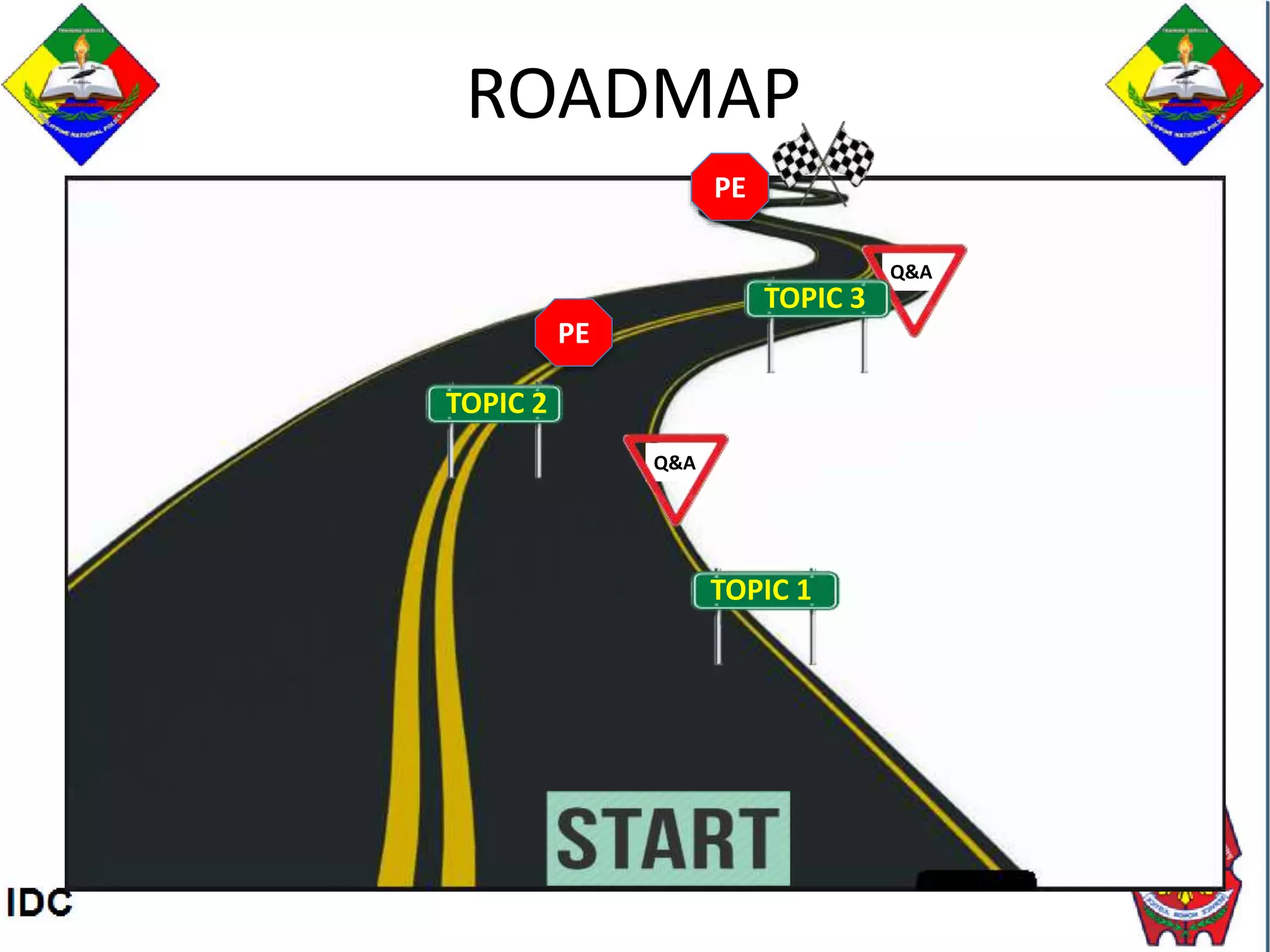
ROADMAP
TOPIC 2
PE
Q&A
Q&A
TOPIC 1
TOPIC 3
PE
Why is there a need for a
lesson plan?
Module 2.8: Developing a Lesson Plan
LESSON PLAN
A document that sets forth...
1. the objectives to be attained in a single
lesson
2. the content to be learned, &
3. the means by which the objectives are to
be achieved.
It must also include how the facts, principles,
concepts & skills are to be taught.
Module 2.8: Developing a Lesson Plan
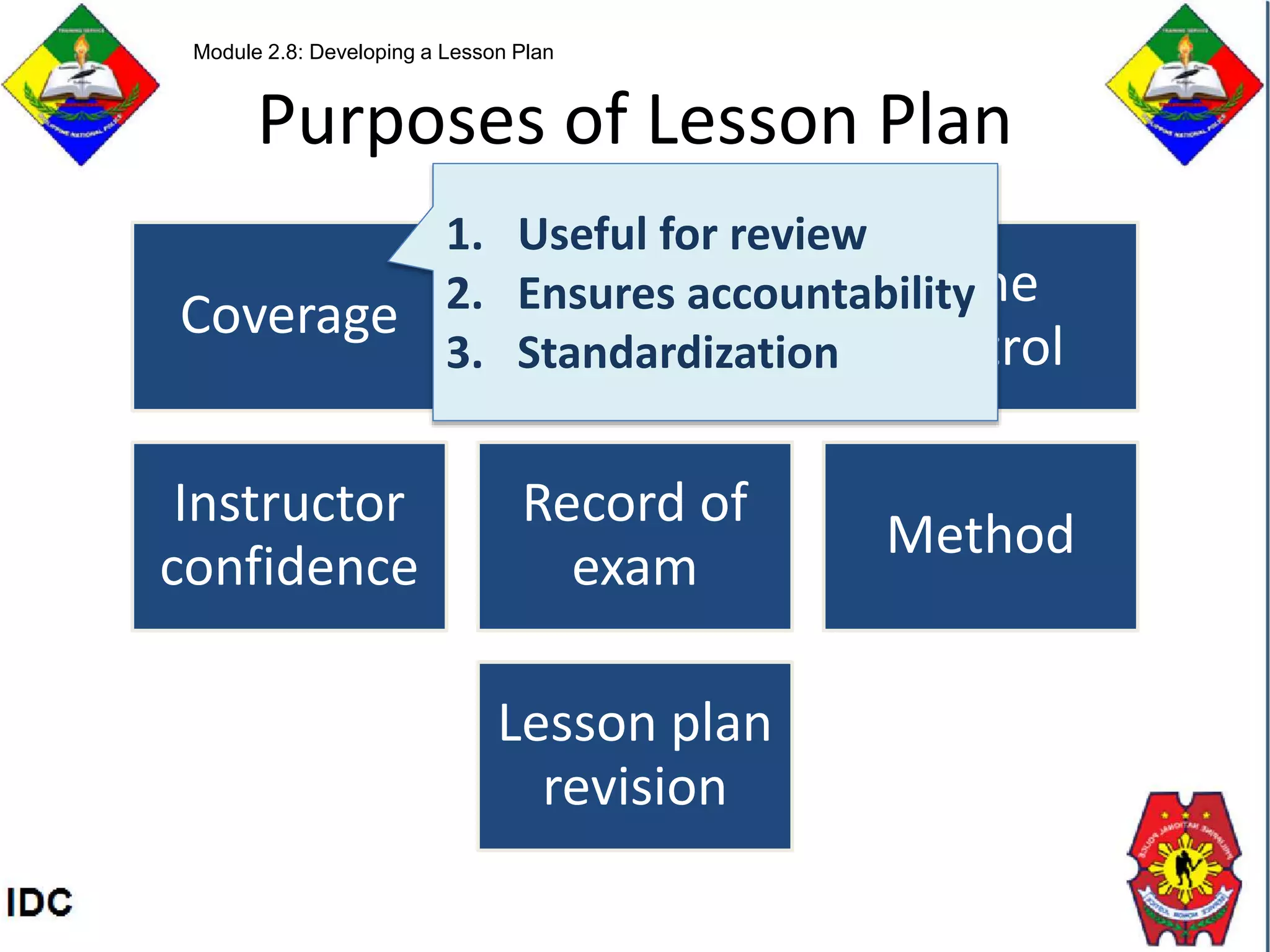
Purposes of Lesson Plan
Coverage Sequence
Time
control
Instructor
confidence
Record of
exam
Method
Lesson plan
revision
1. Useful for review
2. Ensures accountability
3. Standardization
Module 2.8: Developing a Lesson Plan
Preparation of a Lesson Plan
Requires organizational ability
Basic requirements
Experience
Developing expertise
Lesson Plan Format
INTRODUCTION BODY CONCLUSION
Module 2.8: Developing a Lesson Plan
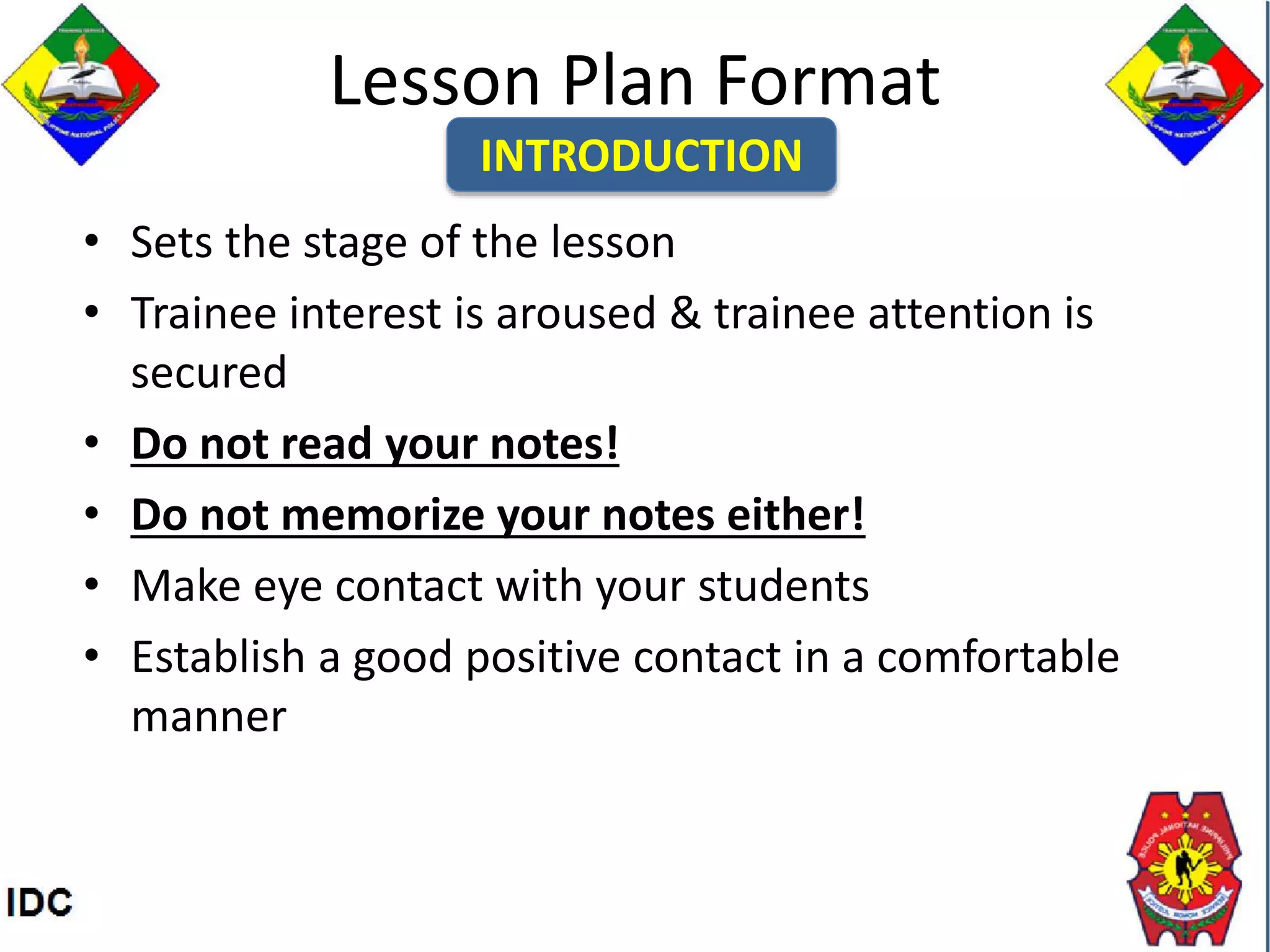
Lesson Plan Format
• Sets the stage of the lesson
• Trainee interest is aroused & trainee attention is
secured
• Do not read your notes!
• Do not memorize your notes either!
• Make eye contact with your students
• Establish a good positive contact in a comfortable
manner
INTRODUCTION
Lesson Plan Format
• Introduction of the instructor - name, rank/title &
some background information
• State “attention getter” or a “hook”
– Involve the audience
– Relate your subject to personal experience
– Ask a rhetorical or thought-provoking question
– Create suspense
– Use a quotation or an anecdote
– Quote a startling statistic
– Use a cartoon or other gentle humor related to the topic
INTRODUCTION
Opening Statement
Credibility
Lesson Plan Format
• State the reason/s (need) for learning the content of
the lesson
• Importance of the material to the individual & its
relationship to a particular job duty, task or element
INTRODUCTION
Training Objectives
• Should be seen by the students & the instructor
should briefly discuss each of them
Purpose / Motivation
Lesson Plan Format
• Content materials & teaching points that support
lesson objectives
• Subject matter is explained
• Performance is developed
• Understanding is affirmed
• Skills are acquired
BODY
Lesson Plan Format
1. Topics are designated as correctly as possible
2. Selection of main topic
3. Information order
4. Teaching procedures
5. Demonstrations & practical exercises
6. Procedural notes for videos/DVDs
BODY
Lesson Plan Format
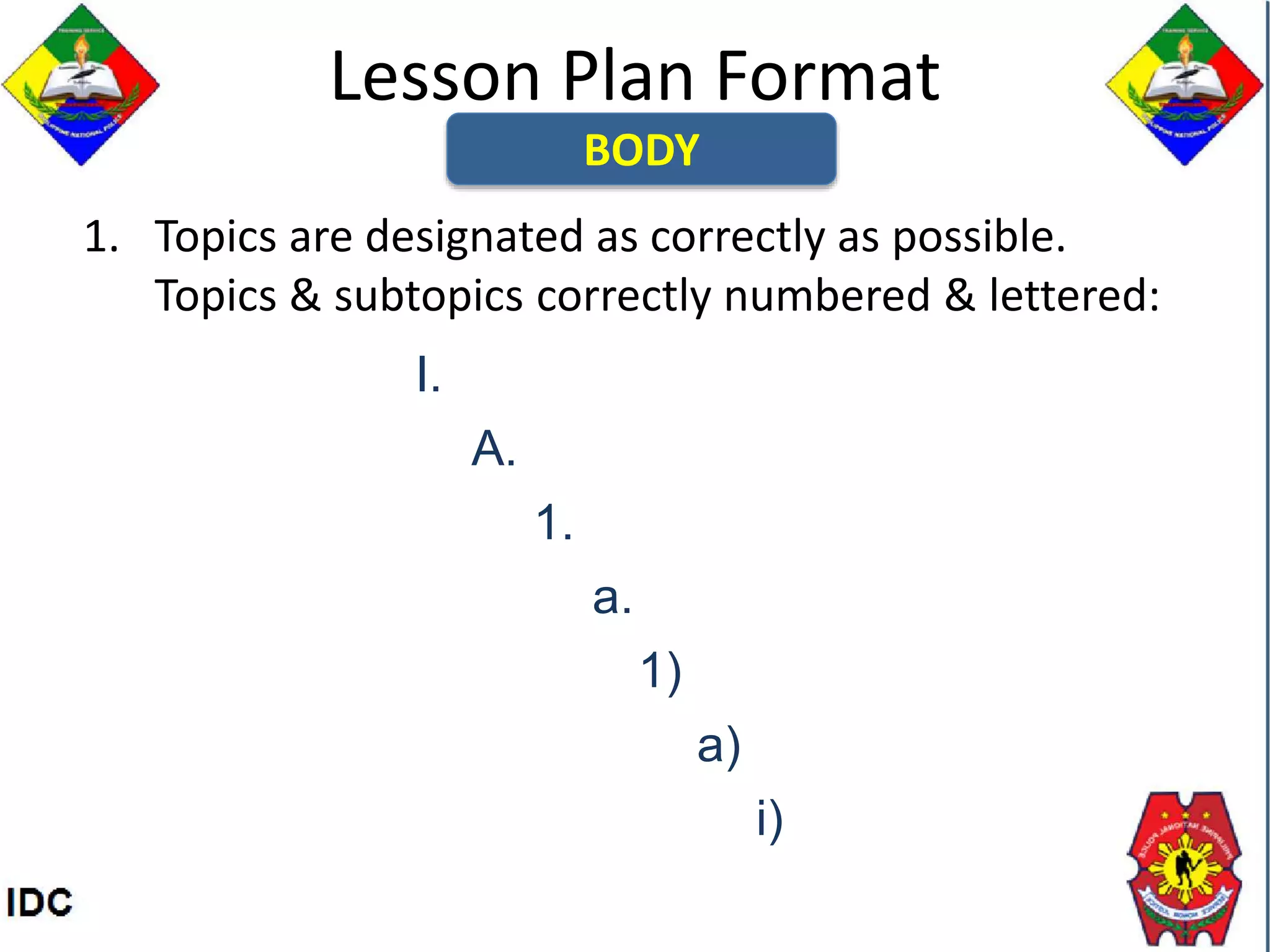
1. Topics are designated as correctly as possible.
Topics & subtopics correctly numbered & lettered:
BODY
I.
A.
1.
a.
1)
a)
i)
Lesson Plan Format
2. Selection of main topic
– Main topics should have been thought out prior to
writing the objectives
– Each main topic should support the lesson topic & should
also support the course
– If you have three objectives, then you should have at
least three topic areas
BODY
Lesson Plan Format
3. Information order
– follow the order of the objectives
4. Teaching procedures
– should show when training aids, summaries, questions &
other instructional procedures are to be used = Instructor
Notes
5. Demonstrations & practical exercises
– demonstration should be completely described including
type of equipment, when & how it will be used
6. Procedural notes for videos/DVDs
BODY
Lesson Plan Format
CONCLUSION
Summary
• Objectives
reviewed &
students
demonstrate
learning
Questions from
class
• To clarify
confusions
• To get
answers to
questions
from the
presentation
Closing
Statement
• “call to
action”
• Rhetorical
question
• Quotation
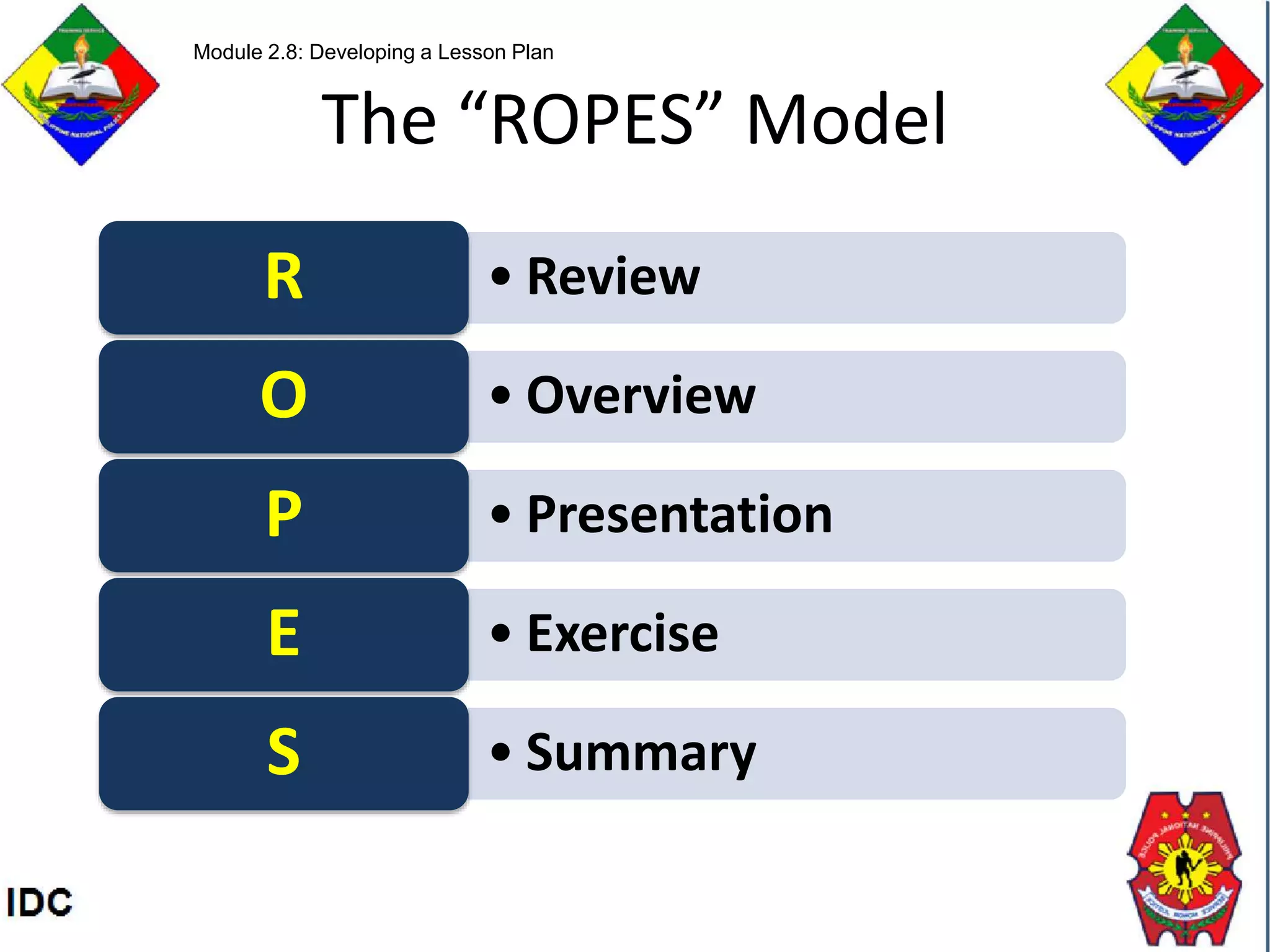
The “ROPES” Model
• Review
R
• Overview
O
• Presentation
P
• Exercise
E
• Summary
S
Module 2.8: Developing a Lesson Plan
Review
To conduct a review of the learners general knowledge
of and experience with the topic.
1. Explore/Activate prior knowledge
2. Check misconceptions
3. Recognize potential resources from the group
4. Activities (Bell Ringer) can be performed
Module 2.8: Developing a Lesson Plan
Overview
To establish a connection between the learners & the
training content that engages the learners & motivates
them to want to learn.
1. Focus the students to the lesson
2. State the importance of the lesson and its
application to their career
3. State the training objectives
Module 2.8: Developing a Lesson Plan
Presentation
To present the content of the lesson to the learners in
ways that help them to understand & retain the
information.
1. Choose appropriate method/s of instruction
2. Engage the learners
3. Scaffolding – for teaching skills
Module 2.8: Developing a Lesson Plan
Exercise
To allow the learners to practice using the training
content so as to build their skills.
1. Guided Practice - supervised
2. Independent Practice - unsupervised
3. Feedback
Module 2.8: Developing a Lesson Plan
Summary
To summarize and clarify what was learned and, if
needed, to transition to the next lesson.
1. Check objectives. Let students verbalize learning
2. Re-emphasize key points
3. Assessment
4. Reteach if necessary
Module 2.8: Developing a Lesson Plan
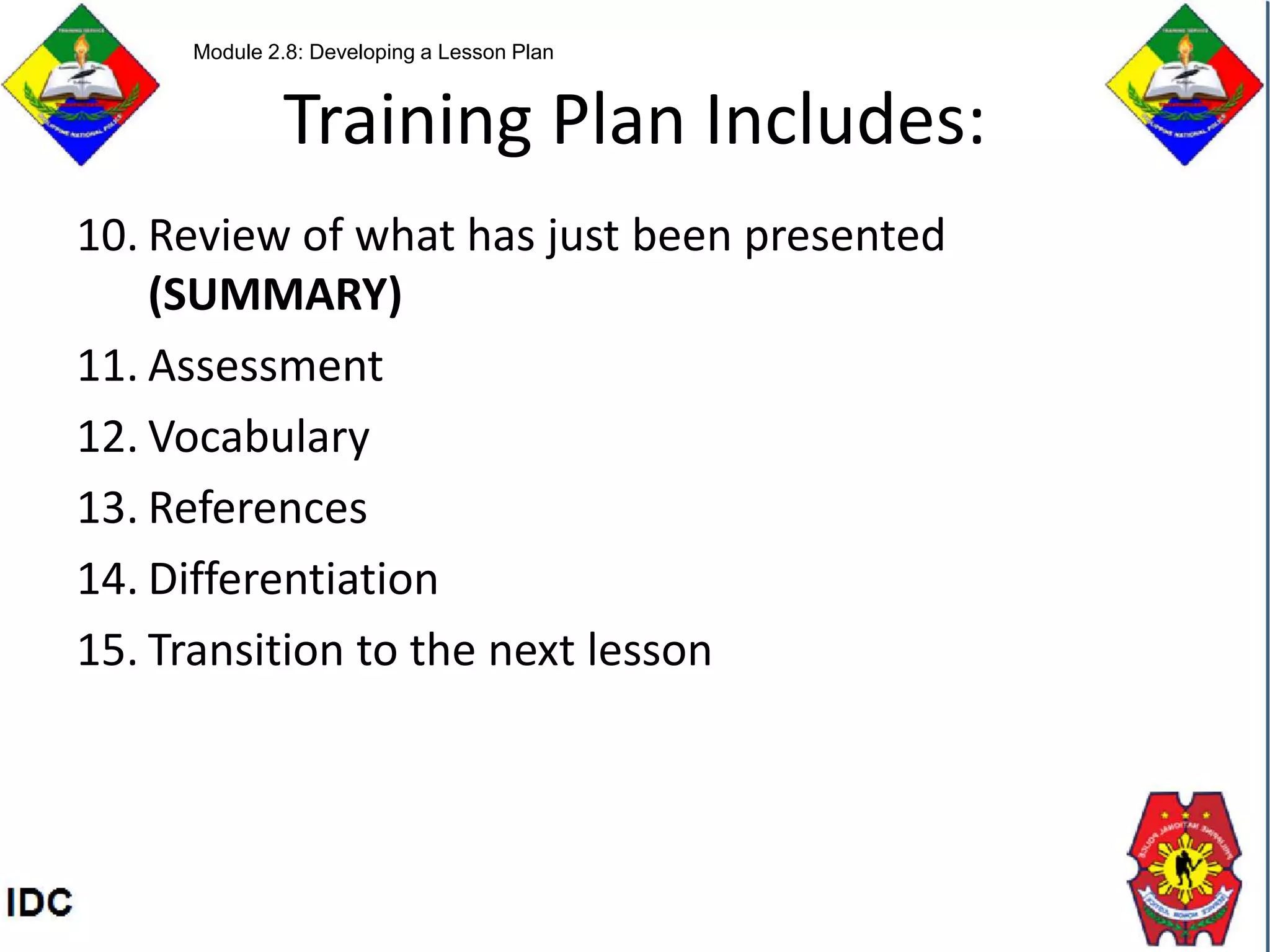
Training Plan Includes:
1. Lesson Title
2. Learning Goal
3. Instructor/s, Course title, audience, time frame
4. Materials needed
5. Hazard & safety warnings
6. Review of previous lesson (REVIEW)
7. Training Objectives & purpose (OVERVIEW)
8. Model of instruction & lesson (PRESENTATION)
9. Student activities (EXERCISE)
Module 2.8: Developing a Lesson Plan
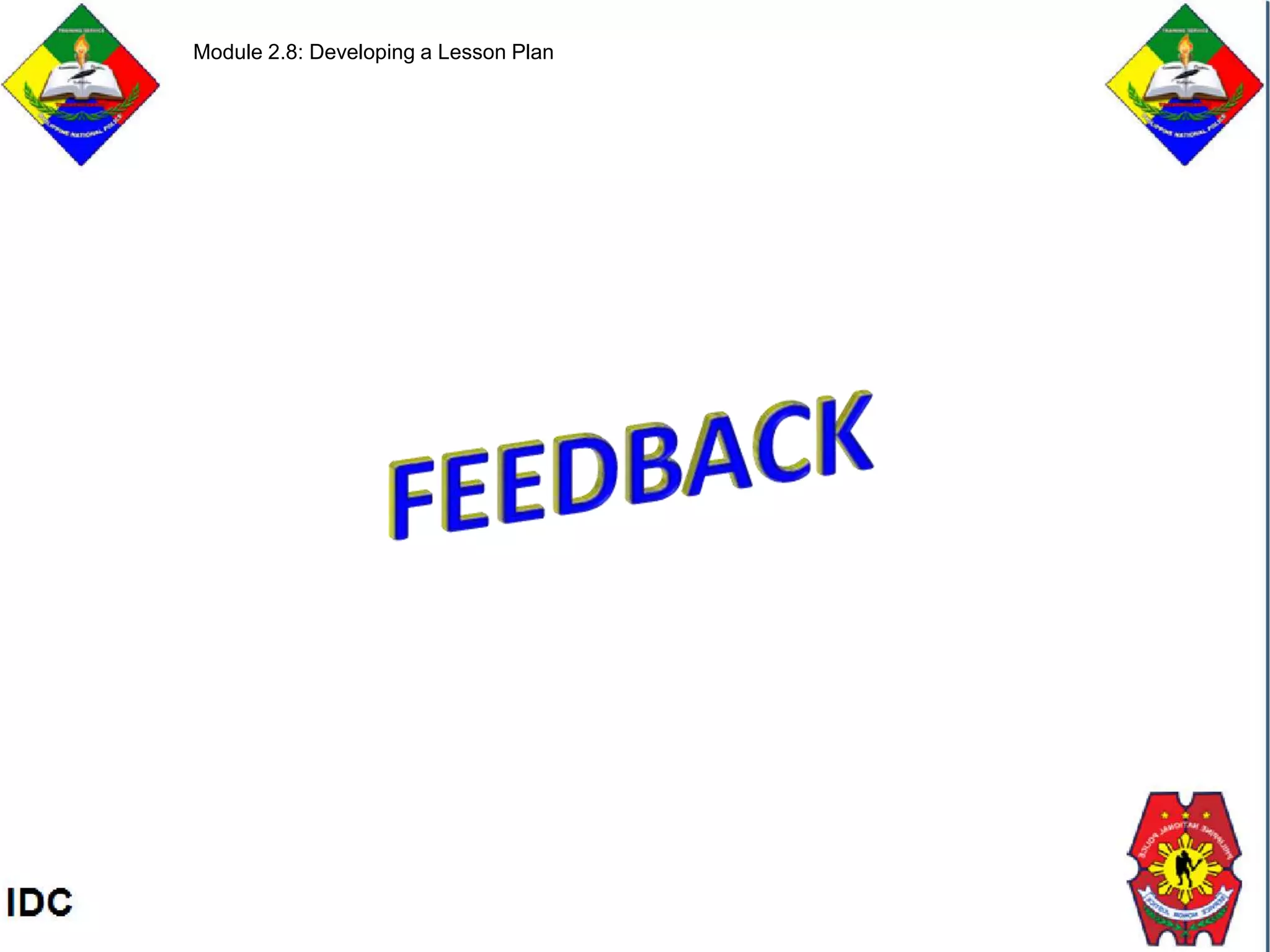
Training Plan Includes:
10. Review of what has just been presented
(SUMMARY)
11. Assessment
12. Vocabulary
13. References
14. Differentiation
15. Transition to the next lesson
Module 2.8: Developing a Lesson Plan
PRACTICAL EXERCISE
1. You & your partner will now be given time to
develop the lesson plan for your presentation
following the ROPES Model & using the
lesson format discussed in the lesson as your
guide.
2. Use the content of this lesson to guide you.
3. Brainstorm with your partner on how you will
present your topic: introduction, body, &
conclusion.
Module 2.8: Developing a Lesson Plan
SUMMARY
1. Describe a lesson plan.
2. Express the purposes of a well-written lesson
plan.
3. Explain the four (4) main requirements in the
preparation of a lesson plan.
4. Elaborate on each of the three (3) main parts of a
lesson plan.
5. Employ the ROPES Model in developing a lesson
plan for the chosen topic.
Module 2.8: Developing a Lesson Plan

Developing a lesson plan

  • 1.
    DEVELOPING A LESSONPLAN Module 2.8: Developing a Lesson Plan
  • 2.
    TRAINING OBJECTIVES After thelesson, the participants will be able to: 1. Describe a lesson plan. 2. Express the purposes of a well-written lesson plan. 3. Explain the four (4) main requirements in the preparation of a lesson plan. 4. Elaborate on each of the three (3) main parts of a lesson plan. 5. Employ the ROPES Model in developing a lesson plan for the chosen topic. Module 2.8: Developing a Lesson Plan
  • 3.
  • 4.
    Why is therea need for a lesson plan? Module 2.8: Developing a Lesson Plan
  • 5.
    LESSON PLAN A documentthat sets forth... 1. the objectives to be attained in a single lesson 2. the content to be learned, & 3. the means by which the objectives are to be achieved. It must also include how the facts, principles, concepts & skills are to be taught. Module 2.8: Developing a Lesson Plan
  • 6.
    Purposes of LessonPlan Coverage Sequence Time control Instructor confidence Record of exam Method Lesson plan revision 1. Useful for review 2. Ensures accountability 3. Standardization Module 2.8: Developing a Lesson Plan
  • 7.
    Preparation of aLesson Plan Requires organizational ability Basic requirements Experience Developing expertise
  • 8.
    Lesson Plan Format INTRODUCTIONBODY CONCLUSION Module 2.8: Developing a Lesson Plan
  • 9.
    Lesson Plan Format •Sets the stage of the lesson • Trainee interest is aroused & trainee attention is secured • Do not read your notes! • Do not memorize your notes either! • Make eye contact with your students • Establish a good positive contact in a comfortable manner INTRODUCTION
  • 10.
    Lesson Plan Format •Introduction of the instructor - name, rank/title & some background information • State “attention getter” or a “hook” – Involve the audience – Relate your subject to personal experience – Ask a rhetorical or thought-provoking question – Create suspense – Use a quotation or an anecdote – Quote a startling statistic – Use a cartoon or other gentle humor related to the topic INTRODUCTION Opening Statement Credibility
  • 11.
    Lesson Plan Format •State the reason/s (need) for learning the content of the lesson • Importance of the material to the individual & its relationship to a particular job duty, task or element INTRODUCTION Training Objectives • Should be seen by the students & the instructor should briefly discuss each of them Purpose / Motivation
  • 12.
    Lesson Plan Format •Content materials & teaching points that support lesson objectives • Subject matter is explained • Performance is developed • Understanding is affirmed • Skills are acquired BODY
  • 13.
    Lesson Plan Format 1.Topics are designated as correctly as possible 2. Selection of main topic 3. Information order 4. Teaching procedures 5. Demonstrations & practical exercises 6. Procedural notes for videos/DVDs BODY
  • 14.
    Lesson Plan Format 1.Topics are designated as correctly as possible. Topics & subtopics correctly numbered & lettered: BODY I. A. 1. a. 1) a) i)
  • 15.
    Lesson Plan Format 2.Selection of main topic – Main topics should have been thought out prior to writing the objectives – Each main topic should support the lesson topic & should also support the course – If you have three objectives, then you should have at least three topic areas BODY
  • 16.
    Lesson Plan Format 3.Information order – follow the order of the objectives 4. Teaching procedures – should show when training aids, summaries, questions & other instructional procedures are to be used = Instructor Notes 5. Demonstrations & practical exercises – demonstration should be completely described including type of equipment, when & how it will be used 6. Procedural notes for videos/DVDs BODY
  • 17.
    Lesson Plan Format CONCLUSION Summary •Objectives reviewed & students demonstrate learning Questions from class • To clarify confusions • To get answers to questions from the presentation Closing Statement • “call to action” • Rhetorical question • Quotation
  • 18.
    The “ROPES” Model •Review R • Overview O • Presentation P • Exercise E • Summary S Module 2.8: Developing a Lesson Plan
  • 19.
    Review To conduct areview of the learners general knowledge of and experience with the topic. 1. Explore/Activate prior knowledge 2. Check misconceptions 3. Recognize potential resources from the group 4. Activities (Bell Ringer) can be performed Module 2.8: Developing a Lesson Plan
  • 20.
    Overview To establish aconnection between the learners & the training content that engages the learners & motivates them to want to learn. 1. Focus the students to the lesson 2. State the importance of the lesson and its application to their career 3. State the training objectives Module 2.8: Developing a Lesson Plan
  • 21.
    Presentation To present thecontent of the lesson to the learners in ways that help them to understand & retain the information. 1. Choose appropriate method/s of instruction 2. Engage the learners 3. Scaffolding – for teaching skills Module 2.8: Developing a Lesson Plan
  • 22.
    Exercise To allow thelearners to practice using the training content so as to build their skills. 1. Guided Practice - supervised 2. Independent Practice - unsupervised 3. Feedback Module 2.8: Developing a Lesson Plan
  • 23.
    Summary To summarize andclarify what was learned and, if needed, to transition to the next lesson. 1. Check objectives. Let students verbalize learning 2. Re-emphasize key points 3. Assessment 4. Reteach if necessary Module 2.8: Developing a Lesson Plan
  • 24.
    Training Plan Includes: 1.Lesson Title 2. Learning Goal 3. Instructor/s, Course title, audience, time frame 4. Materials needed 5. Hazard & safety warnings 6. Review of previous lesson (REVIEW) 7. Training Objectives & purpose (OVERVIEW) 8. Model of instruction & lesson (PRESENTATION) 9. Student activities (EXERCISE) Module 2.8: Developing a Lesson Plan
  • 25.
    Training Plan Includes: 10.Review of what has just been presented (SUMMARY) 11. Assessment 12. Vocabulary 13. References 14. Differentiation 15. Transition to the next lesson Module 2.8: Developing a Lesson Plan
  • 26.
    PRACTICAL EXERCISE 1. You& your partner will now be given time to develop the lesson plan for your presentation following the ROPES Model & using the lesson format discussed in the lesson as your guide. 2. Use the content of this lesson to guide you. 3. Brainstorm with your partner on how you will present your topic: introduction, body, & conclusion. Module 2.8: Developing a Lesson Plan
  • 27.
    SUMMARY 1. Describe alesson plan. 2. Express the purposes of a well-written lesson plan. 3. Explain the four (4) main requirements in the preparation of a lesson plan. 4. Elaborate on each of the three (3) main parts of a lesson plan. 5. Employ the ROPES Model in developing a lesson plan for the chosen topic. Module 2.8: Developing a Lesson Plan
  • 28.