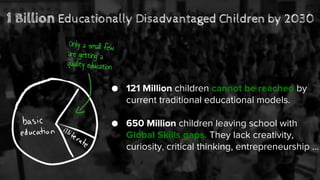
1 Billion Educationally Disadvantaged Children by 2030
● 121 Million children cannot be reached by
current traditional educational models.
● 650 Million children leaving school with
Global Skills gaps. They lack creativity,
curiosity, critical thinking, entrepreneurship ...
Only a small few
are getting a
quality education
Leaving no one
behind - how
long will it take?
Image by: Brad Ruggles
Until 2086
(UNESCO)
Challenges with current solutions
● Top down linear curriculums
limited learning and impact
● High cost and slow to deploy
100 M+ Children left behind
● Cannot build enough schools
cannot train enough teachers
We think there is
another approach
Instead of forcing children
through a one-size-fits-all
education, is there a way to:
Empower them, foster their creativity
leverage their curiosity and passion ?
Image by: Global Literacy Project
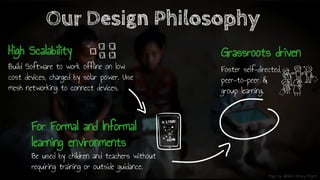
Build Software to work offline on low
cost devices, charged by solar power. Use
mesh networking to connect devices.
Our Design Philosophy
Be used by children and teachers without
requiring training or outside guidance.
Foster self-directed,
peer-to-peer &
group learning.
High Scalability
For Formal and Informal
learning environments
Grassroots driven
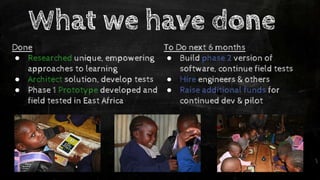
What we have done
Done
● Researched unique, empowering
approaches to learning
● Architect solution, develop tests
● Phase 1 Prototype developed and
field tested in East Africa
To Do next 6 months
● Build phase 2 version of
software, continue field tests
● Hire engineers & others
● Raise additional funds for
continued dev & pilot
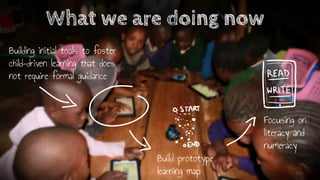
Building initial tools to foster
child-driven learning that does
not require formal guidance
What we are doing now
Build prototype
learning map
Focusing on
literacy and
numeracy
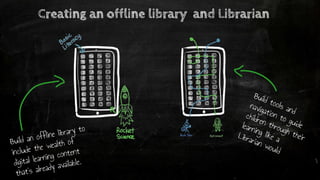
Creating an offline library and Librarian
Build an offline library to
include the wealth of
digital learning content
that’s already available.
Build tools and
navigation to guide
children through their
learning like aLibrarian would
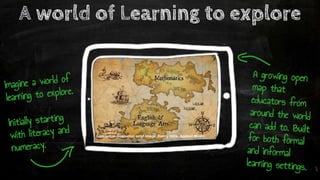
Conceptual illustration only! Image: Danny Hillis, Applied Minds
A growing open
map that
educators from
around the world
can add to. Built
for both formal
and informal
learning settings.
A world of Learning to explore
Imagine a world of
learning to explore.
Initially starting
with literacy and
numeracy.
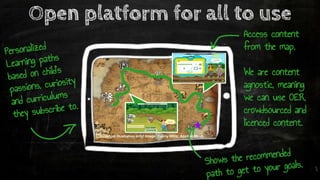
Personalized
Learning paths
based on child’s
passions, curiosity
and curriculums
they subscribe to.
Shows the recommended
path to get to your goals.
Open platform for all to use
Access content
from the map.
We are content
agnostic, meaning
we can use OER,
crowdsourced and
licenced content.
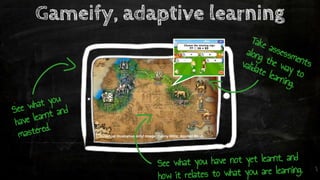
Conceptual illustration only! Image: Danny Hillis, Applied Minds
See what you
have learnt and
mastered.
Take assessments
along the way to
validate learning.
Gameify, adaptive learning
See what you have not yet learnt, and
how it relates to what you are learning.
Conceptual illustration only! Image: Danny Hillis, Applied Minds
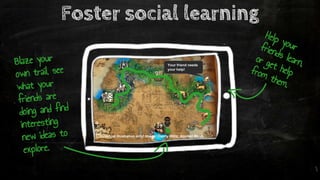
Blaze your
own trail, see
what your
friends are
doing and find
interesting
new ideas to
explore.
Help yourfriends learn,or get helpfrom them.
Your friend needs
your help!
Foster social learning
Conceptual illustration only! Image: Danny Hillis, Applied Minds
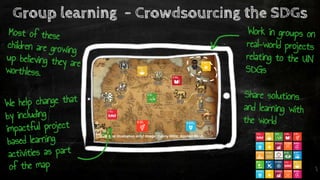
Group learning - Crowdsourcing the SDGs
Most of these
children are growing
up believing they are
worthless.
We help change that
by including
impactful project
based learning
activities as part
of the map
Work in groups on
real-world projects
relating to the UN
SDGs
Share solutions
and learning with
the world
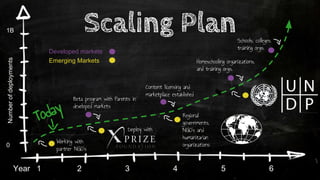
Scaling Plan
Developed markets
Emerging Markets
Numberofdeployments
Year 1 2 3 4 5 6
1B
0
Working with
partner NGO’s
Regional
governments,
NGO’s and
humanitarian
organizations
Deploy with
Content licensing and
marketplace established
Beta program with Parents in
developed markets
Homeschooling organizations,
and training orgs.
Schools, colleges,
training orgs.
Today
RevenueModels
Year 1 2 3 4 5 6
$
0
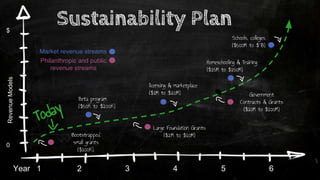
Sustainability Plan
Bootstrapped,
small grants
($100K).
Large Foundation Grants
($2M to $10M)
Government
Contracts & Grants
($10M to $100M)
Market revenue streams
Philanthropic and public
revenue streams
licensing & marketplace
($1M to $20M)
Beta program
($50K to $200K)
Homeschooling & Training
($15M to $150M)
Schools, colleges,
($500M to $~B)
Today
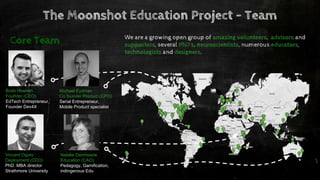
The Moonshot Education Project - Team
Bodo Hoenen
Founder (CEO)
EdTech Entrepreneur,
Founder Dev4X
Michael Eydman
Co founder Product (CPO)
Serial Entrepreneur,
Mobile Product specialist
Vincent Ogutu
Deployment (CDO)
PhD. MBA director
Strathmore University
Natalie Denmeade
Education (CAO)
Pedagogy, Gamification,
indingenous Edu
We are a growing open group of amazing volunteers, advisors and
supporters, several PhD’s, neuroscientists, numerous educators,
technologists and designers.
Core Team
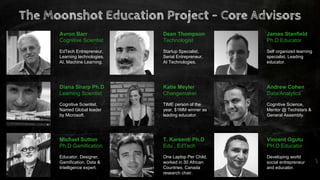
Avron Barr
Cognitive Scientist
EdTech Entrepreneur,
Learning technologies,
AI, Machine Learning.
Dean Thompson
Technologist
Startup Specialist,
Serial Entrepreneur,
AI Technologies.
James Stanfield
Ph.D Educator
Self organized learning
specialist, Leading
educator.
Diana Sharp Ph.D
Learning Scientist
Cognitive Scientist,
Named Global leader
by Microsoft.
Katie Meyler
Changemaker
TIME person of the
year, $1MM winner as
leading educator.
Andrew Cohen
Data/Analytics
Cognitive Science,
Mentor @ Techstars &
General Assembly.
Michael Sutton
Ph.D Gamification
Educator, Designer,
Gamification, Data &
Intelligence expert.
T. Karsenti Ph.D
Edu , EdTech
One Laptop Per Child,
worked in 30 African
Countries, Canada
research chair.
Vincent Ogutu
PH.D Educator
Developing world
social entrepreneur
and educator.
The Moonshot Education Project - Core Advisors
We need your help!
Find out more about us here: — dev4x.com
Join the growing community: — dev4x.com/#joinus
Connect with us on social: — Facebook | Twitter | Google+
Appendix
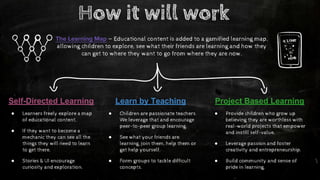
Learn by Teaching
● Children are passionate teachers.
We leverage that and encourage
peer-to-peer group learning.
● See what your friends are
learning, join them, help them or
get help yourself.
● Form groups to tackle difficult
concepts.
Self-Directed Learning
● Learners freely explore a map
of educational content.
● If they want to become a
mechanic they can see all the
things they will need to learn
to get there.
● Stories & UI encourage
curiosity and exploration.
The Learning Map — Educational content is added to a gamified learning map,
allowing children to explore, see what their friends are learning and how they
can get to where they want to go from where they are now.
Project Based Learning
● Provide children who grow up
believing they are worthless with
real-world projects that empower
and instill self-value.
● Leverage passion and foster
creativity and entrepreneurship.
● Build community and sense of
pride in learning.
How it will work
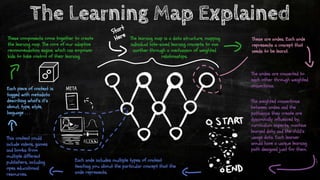
The Learning Map Explained
The learning map is a data structure, mapping
individual bite-sized learning concepts to one
another through a mechanism of weighted
relationships.
These are nodes. Each node
represents a concept that
needs to be learnt.
The nodes are connected to
each other through weighted
connections.
The weighted connections
between nodes and the
pathways they create are
dynamically influenced by,
curriculum experts, machine
learned data and the child’s
usage data. Each learner
would have a unique learning
path designed just for them.
This content could
include videos, games
and books from
multiple different
publishers, including
open educational
resources.
Each node includes multiple types of content
teaching you about the particular concept that the
node represents.
Start
Here
Each piece of content is
tagged with metadata
describing what's it’s
about, type, style,
language . . .
These components come together to create
the learning map. The core of our adaptive
recommendation engine, which can empower
kids to take control of their learning.
META
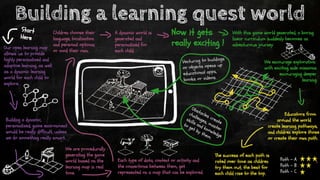
Our open learning map
allows us to provide
highly personalized and
adaptive learning, as well
as a dynamic learning
world for each child to
explore.
Building a learning quest world
Start
Here
Building a dynamic,
personalized, game environment
would be really difficult, unless
we do something really smart.
We are procedurally
generating the game
world based on the
learning map in real
time.
Children choose their
language, localization
and personal options,
or mod their own.
Now it gets
really exciting !
With this game world generated, a boring
linear curriculum suddenly becomes an
adventurous journey
Educators from
around the world
create learning pathways,
and children explore those
or create their own path.
The success of each path is
rated over time as children
try them out, the best for
each child rise to the top.
We encourage exploration
with exciting side missions
encouraging deeper
learning
Path - A
Path - B
Path - C
Venturing to buildings
or objects opens up
educational apps,
books or videos.
Obstacles create
challenges, master
skills and knowledge
to get by them.
A dynamic world is
generated and
personalized for
each child.
Each type of data, content or activity and
the connections between them, get
represented on a map that can be explored.
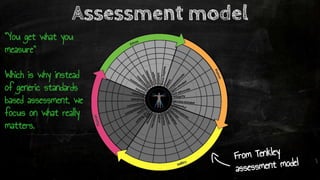
Assessment model
From Tenkley
assessment model
“You get what you
measure”
Which is why instead
of generic standards
based assessment, we
focus on what really
matters.
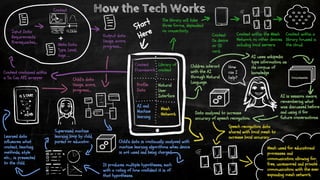
Input Data:
Requirements
Prerequisites….
Content
Framework
Library of
content
Mesh
Network
AI and
Machine
learning
Profile
Data
Natural
User
Interface
Content contained within
a Tin Can API wrapper
Output data:
Usage, score,
progress….
Content
+Meta Data:
Type, Level,
tags ….
The library will take
three forms, dependent
on connectivity.
Content
On device
or SD
card.
Content within the Mesh
Network on other devices
including local servers
Content within a
library housed in
the cloud.
Child’s data:
Usage, score,
progress….
Child's data is continually analyzed with
machine learning algorithms when device
is not used and being charged
It produces multiple hypotheses, each
with a rating of how confident it is of
that hypotheses
Supervised machine
learning loop by child,
parent or educator.
Learned data
influences what
content, teaching
methods, style
etc…. is presented
to the child.
How
can I
help? Encyclopedia
Children interact
with the AI
through Natural
Language.
AI uses wikipedia
type information as
its corpus of
knowledge
AI is session aware,
remembering what
was discussed before
and using it for
future conversations
Data analyzed to increase
accuracy of speech recognition.
Speech recognition data
shared with local mesh to
increase local accuracy
Mesh used for educational
processes and
communication allowing for
free, uncensored and private
communication with the ever
expanding mesh network.
Start
Here
How
can I
help? Encyclopedia
Children interact
with the AI
through Natural
Language.
AI uses wikipedia
type information as
its corpus of
knowledge
AI is session aware,
remembering what
was discussed before
and using it for
future conversations
Data analyzed to increase
accuracy of speech recognition.
How the Tech Works
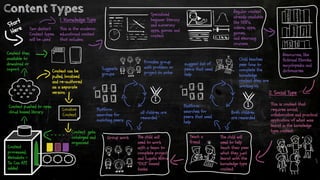
Content Types
1. Knowledge Type
Content pushed to open
cloud based library
Two distinct
Content types
will be used
Start
Here This is the academic
educational content
that includes:
Specialized
beginner literacy
and numeracy
apps, games and
content
Regular content
already available
like OER’s,
videos, apps,
games,
and elearning
courses
Resources, like
fictional Ebooks
encyclopedia and
dictionaries
2. Social Type
This is content that
requires social,
collaborative and practical
application of what was
learnt in the knowledge
type content.
Teach a
friend
The child will
need to help
teach their peer
what they just
learnt with the
knowledge type
content.
The child will
need to work
with a team to
complete project
and Sugata Mitra
‘SOLE’ based
tasks
Group work
Platform
searches for
peers that need
help
suggest list of
peers that need
help
Child teaches
peer how to
complete the
knowledge
content they are
working on
Both children
are rewarded
Platform
searches for
matching peers
Suggests
groups
Provides group
with problem or
project to solve
all children are
rewarded
Content
processed,
Metadata +
Tin Can API
added
Content then
available to
download or
import.
Localize
Content
Content can be
pulled, localized
and re-authored
as a separate
version
Content gets
cataloged and
organized
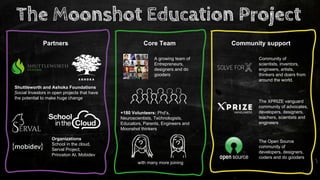
Core TeamPartners Community support
Community of
scientists, inventors,
engineers, artists,
thinkers and doers from
around the world.
The XPRIZE vanguard
community of advocates,
developers, designers,
teachers, scientists and
engineers
The Open Source
community of
developers, designers,
coders and do gooders
Shuttleworth and Ashoka Foundations
Social Investors in open projects that have
the potential to make huge change
+180 Volunteers: Phd’s,
Neuroscientists, Technologists,
Educators, Parents, Engineers and
Moonshot thinkers
with many more joining
The Moonshot Education Project
A growing team of
Entrepreneurs,
designers and do
gooders
Organizations
School in the cloud,
Serval Project,
Princeton AI, Mobidev
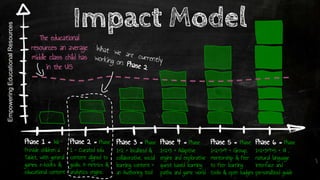
Impact Model
Phase 1 = We
Provide children a
Tablet, with general
games, e-books &
educational content
Phase 2 = Phase
1 + Curated edu
content aligned to
goals. A metrics &
analytics engine.
Phase 4 = Phase
1+2+3 + Adaptive
engine and explorative
quest based learning
paths and game world
Phase 5 = Phase
1+2+3+4 + Group,
mentorship & Peer
to Peer learning
tools & open badges
Phase 6 = Phase
1+2+3+4+5 + AI ,
natural language
interface and
personalized guide
EmpoweringEducationalResources
The educational
resources an average
middle class child has
in the US
What we are currentlyworking on: Phase 2
Phase 3 = Phase
1+2 + localized &
collaborative, social
learning content +
an Authoring tool
Dev4X  project overview

Dev4X project overview

  • 2.
    1 Billion EducationallyDisadvantaged Children by 2030 ● 121 Million children cannot be reached by current traditional educational models. ● 650 Million children leaving school with Global Skills gaps. They lack creativity, curiosity, critical thinking, entrepreneurship ... Only a small few are getting a quality education
  • 3.
    Leaving no one behind- how long will it take? Image by: Brad Ruggles Until 2086 (UNESCO)
  • 4.
    Challenges with currentsolutions ● Top down linear curriculums limited learning and impact ● High cost and slow to deploy 100 M+ Children left behind ● Cannot build enough schools cannot train enough teachers
  • 5.
    We think thereis another approach
  • 6.
    Instead of forcingchildren through a one-size-fits-all education, is there a way to: Empower them, foster their creativity leverage their curiosity and passion ?
  • 7.
    Image by: GlobalLiteracy Project Build Software to work offline on low cost devices, charged by solar power. Use mesh networking to connect devices. Our Design Philosophy Be used by children and teachers without requiring training or outside guidance. Foster self-directed, peer-to-peer & group learning. High Scalability For Formal and Informal learning environments Grassroots driven
  • 8.
    What we havedone Done ● Researched unique, empowering approaches to learning ● Architect solution, develop tests ● Phase 1 Prototype developed and field tested in East Africa To Do next 6 months ● Build phase 2 version of software, continue field tests ● Hire engineers & others ● Raise additional funds for continued dev & pilot
  • 9.
    Building initial toolsto foster child-driven learning that does not require formal guidance What we are doing now Build prototype learning map Focusing on literacy and numeracy
  • 10.
    Creating an offlinelibrary and Librarian Build an offline library to include the wealth of digital learning content that’s already available. Build tools and navigation to guide children through their learning like aLibrarian would
  • 11.
    Conceptual illustration only!Image: Danny Hillis, Applied Minds A growing open map that educators from around the world can add to. Built for both formal and informal learning settings. A world of Learning to explore Imagine a world of learning to explore. Initially starting with literacy and numeracy.
  • 12.
    Personalized Learning paths based onchild’s passions, curiosity and curriculums they subscribe to. Shows the recommended path to get to your goals. Open platform for all to use Access content from the map. We are content agnostic, meaning we can use OER, crowdsourced and licenced content. Conceptual illustration only! Image: Danny Hillis, Applied Minds
  • 13.
    See what you havelearnt and mastered. Take assessments along the way to validate learning. Gameify, adaptive learning See what you have not yet learnt, and how it relates to what you are learning. Conceptual illustration only! Image: Danny Hillis, Applied Minds
  • 14.
    Blaze your own trail,see what your friends are doing and find interesting new ideas to explore. Help yourfriends learn,or get helpfrom them. Your friend needs your help! Foster social learning Conceptual illustration only! Image: Danny Hillis, Applied Minds
  • 15.
    Conceptual illustration only!Image: Danny Hillis, Applied Minds Group learning - Crowdsourcing the SDGs Most of these children are growing up believing they are worthless. We help change that by including impactful project based learning activities as part of the map Work in groups on real-world projects relating to the UN SDGs Share solutions and learning with the world
  • 16.
    Scaling Plan Developed markets EmergingMarkets Numberofdeployments Year 1 2 3 4 5 6 1B 0 Working with partner NGO’s Regional governments, NGO’s and humanitarian organizations Deploy with Content licensing and marketplace established Beta program with Parents in developed markets Homeschooling organizations, and training orgs. Schools, colleges, training orgs. Today
  • 17.
    RevenueModels Year 1 23 4 5 6 $ 0 Sustainability Plan Bootstrapped, small grants ($100K). Large Foundation Grants ($2M to $10M) Government Contracts & Grants ($10M to $100M) Market revenue streams Philanthropic and public revenue streams licensing & marketplace ($1M to $20M) Beta program ($50K to $200K) Homeschooling & Training ($15M to $150M) Schools, colleges, ($500M to $~B) Today
  • 18.
    The Moonshot EducationProject - Team Bodo Hoenen Founder (CEO) EdTech Entrepreneur, Founder Dev4X Michael Eydman Co founder Product (CPO) Serial Entrepreneur, Mobile Product specialist Vincent Ogutu Deployment (CDO) PhD. MBA director Strathmore University Natalie Denmeade Education (CAO) Pedagogy, Gamification, indingenous Edu We are a growing open group of amazing volunteers, advisors and supporters, several PhD’s, neuroscientists, numerous educators, technologists and designers. Core Team
  • 19.
    Avron Barr Cognitive Scientist EdTechEntrepreneur, Learning technologies, AI, Machine Learning. Dean Thompson Technologist Startup Specialist, Serial Entrepreneur, AI Technologies. James Stanfield Ph.D Educator Self organized learning specialist, Leading educator. Diana Sharp Ph.D Learning Scientist Cognitive Scientist, Named Global leader by Microsoft. Katie Meyler Changemaker TIME person of the year, $1MM winner as leading educator. Andrew Cohen Data/Analytics Cognitive Science, Mentor @ Techstars & General Assembly. Michael Sutton Ph.D Gamification Educator, Designer, Gamification, Data & Intelligence expert. T. Karsenti Ph.D Edu , EdTech One Laptop Per Child, worked in 30 African Countries, Canada research chair. Vincent Ogutu PH.D Educator Developing world social entrepreneur and educator. The Moonshot Education Project - Core Advisors
  • 20.
    We need yourhelp! Find out more about us here: — dev4x.com Join the growing community: — dev4x.com/#joinus Connect with us on social: — Facebook | Twitter | Google+
  • 21.
  • 22.
    Learn by Teaching ●Children are passionate teachers. We leverage that and encourage peer-to-peer group learning. ● See what your friends are learning, join them, help them or get help yourself. ● Form groups to tackle difficult concepts. Self-Directed Learning ● Learners freely explore a map of educational content. ● If they want to become a mechanic they can see all the things they will need to learn to get there. ● Stories & UI encourage curiosity and exploration. The Learning Map — Educational content is added to a gamified learning map, allowing children to explore, see what their friends are learning and how they can get to where they want to go from where they are now. Project Based Learning ● Provide children who grow up believing they are worthless with real-world projects that empower and instill self-value. ● Leverage passion and foster creativity and entrepreneurship. ● Build community and sense of pride in learning. How it will work
  • 23.
    The Learning MapExplained The learning map is a data structure, mapping individual bite-sized learning concepts to one another through a mechanism of weighted relationships. These are nodes. Each node represents a concept that needs to be learnt. The nodes are connected to each other through weighted connections. The weighted connections between nodes and the pathways they create are dynamically influenced by, curriculum experts, machine learned data and the child’s usage data. Each learner would have a unique learning path designed just for them. This content could include videos, games and books from multiple different publishers, including open educational resources. Each node includes multiple types of content teaching you about the particular concept that the node represents. Start Here Each piece of content is tagged with metadata describing what's it’s about, type, style, language . . . These components come together to create the learning map. The core of our adaptive recommendation engine, which can empower kids to take control of their learning. META
  • 24.
    Our open learningmap allows us to provide highly personalized and adaptive learning, as well as a dynamic learning world for each child to explore. Building a learning quest world Start Here Building a dynamic, personalized, game environment would be really difficult, unless we do something really smart. We are procedurally generating the game world based on the learning map in real time. Children choose their language, localization and personal options, or mod their own. Now it gets really exciting ! With this game world generated, a boring linear curriculum suddenly becomes an adventurous journey Educators from around the world create learning pathways, and children explore those or create their own path. The success of each path is rated over time as children try them out, the best for each child rise to the top. We encourage exploration with exciting side missions encouraging deeper learning Path - A Path - B Path - C Venturing to buildings or objects opens up educational apps, books or videos. Obstacles create challenges, master skills and knowledge to get by them. A dynamic world is generated and personalized for each child. Each type of data, content or activity and the connections between them, get represented on a map that can be explored.
  • 25.
    Assessment model From Tenkley assessmentmodel “You get what you measure” Which is why instead of generic standards based assessment, we focus on what really matters.
  • 26.
    Input Data: Requirements Prerequisites…. Content Framework Library of content Mesh Network AIand Machine learning Profile Data Natural User Interface Content contained within a Tin Can API wrapper Output data: Usage, score, progress…. Content +Meta Data: Type, Level, tags …. The library will take three forms, dependent on connectivity. Content On device or SD card. Content within the Mesh Network on other devices including local servers Content within a library housed in the cloud. Child’s data: Usage, score, progress…. Child's data is continually analyzed with machine learning algorithms when device is not used and being charged It produces multiple hypotheses, each with a rating of how confident it is of that hypotheses Supervised machine learning loop by child, parent or educator. Learned data influences what content, teaching methods, style etc…. is presented to the child. How can I help? Encyclopedia Children interact with the AI through Natural Language. AI uses wikipedia type information as its corpus of knowledge AI is session aware, remembering what was discussed before and using it for future conversations Data analyzed to increase accuracy of speech recognition. Speech recognition data shared with local mesh to increase local accuracy Mesh used for educational processes and communication allowing for free, uncensored and private communication with the ever expanding mesh network. Start Here How can I help? Encyclopedia Children interact with the AI through Natural Language. AI uses wikipedia type information as its corpus of knowledge AI is session aware, remembering what was discussed before and using it for future conversations Data analyzed to increase accuracy of speech recognition. How the Tech Works
  • 27.
    Content Types 1. KnowledgeType Content pushed to open cloud based library Two distinct Content types will be used Start Here This is the academic educational content that includes: Specialized beginner literacy and numeracy apps, games and content Regular content already available like OER’s, videos, apps, games, and elearning courses Resources, like fictional Ebooks encyclopedia and dictionaries 2. Social Type This is content that requires social, collaborative and practical application of what was learnt in the knowledge type content. Teach a friend The child will need to help teach their peer what they just learnt with the knowledge type content. The child will need to work with a team to complete project and Sugata Mitra ‘SOLE’ based tasks Group work Platform searches for peers that need help suggest list of peers that need help Child teaches peer how to complete the knowledge content they are working on Both children are rewarded Platform searches for matching peers Suggests groups Provides group with problem or project to solve all children are rewarded Content processed, Metadata + Tin Can API added Content then available to download or import. Localize Content Content can be pulled, localized and re-authored as a separate version Content gets cataloged and organized
  • 28.
    Core TeamPartners Communitysupport Community of scientists, inventors, engineers, artists, thinkers and doers from around the world. The XPRIZE vanguard community of advocates, developers, designers, teachers, scientists and engineers The Open Source community of developers, designers, coders and do gooders Shuttleworth and Ashoka Foundations Social Investors in open projects that have the potential to make huge change +180 Volunteers: Phd’s, Neuroscientists, Technologists, Educators, Parents, Engineers and Moonshot thinkers with many more joining The Moonshot Education Project A growing team of Entrepreneurs, designers and do gooders Organizations School in the cloud, Serval Project, Princeton AI, Mobidev
  • 29.
    Impact Model Phase 1= We Provide children a Tablet, with general games, e-books & educational content Phase 2 = Phase 1 + Curated edu content aligned to goals. A metrics & analytics engine. Phase 4 = Phase 1+2+3 + Adaptive engine and explorative quest based learning paths and game world Phase 5 = Phase 1+2+3+4 + Group, mentorship & Peer to Peer learning tools & open badges Phase 6 = Phase 1+2+3+4+5 + AI , natural language interface and personalized guide EmpoweringEducationalResources The educational resources an average middle class child has in the US What we are currentlyworking on: Phase 2 Phase 3 = Phase 1+2 + localized & collaborative, social learning content + an Authoring tool