MECHANICAL
ANALYSIS OF SOIL
Presentation on
“TEAM SEEKERS”
SESSION: 2017-18
2ND
YEAR, 1ST
SEMESTER
DEPARTMENT OF ENVIRONMENTAL
SCIENCE AND ENGINEERING
2
Presentation Outline
Mechanical analysis
Soil particle size
Soil gradation
Soil texture
Sieve analysis
Sedimentation
Hydrometer analysis
Pipette method
Hydro photometer
analysis
Gamma ray analysis
Particle size distribution
curve parameters
Environmental
interpretation
Practical implications
3
Let’s Figure out something….
Before
After
4
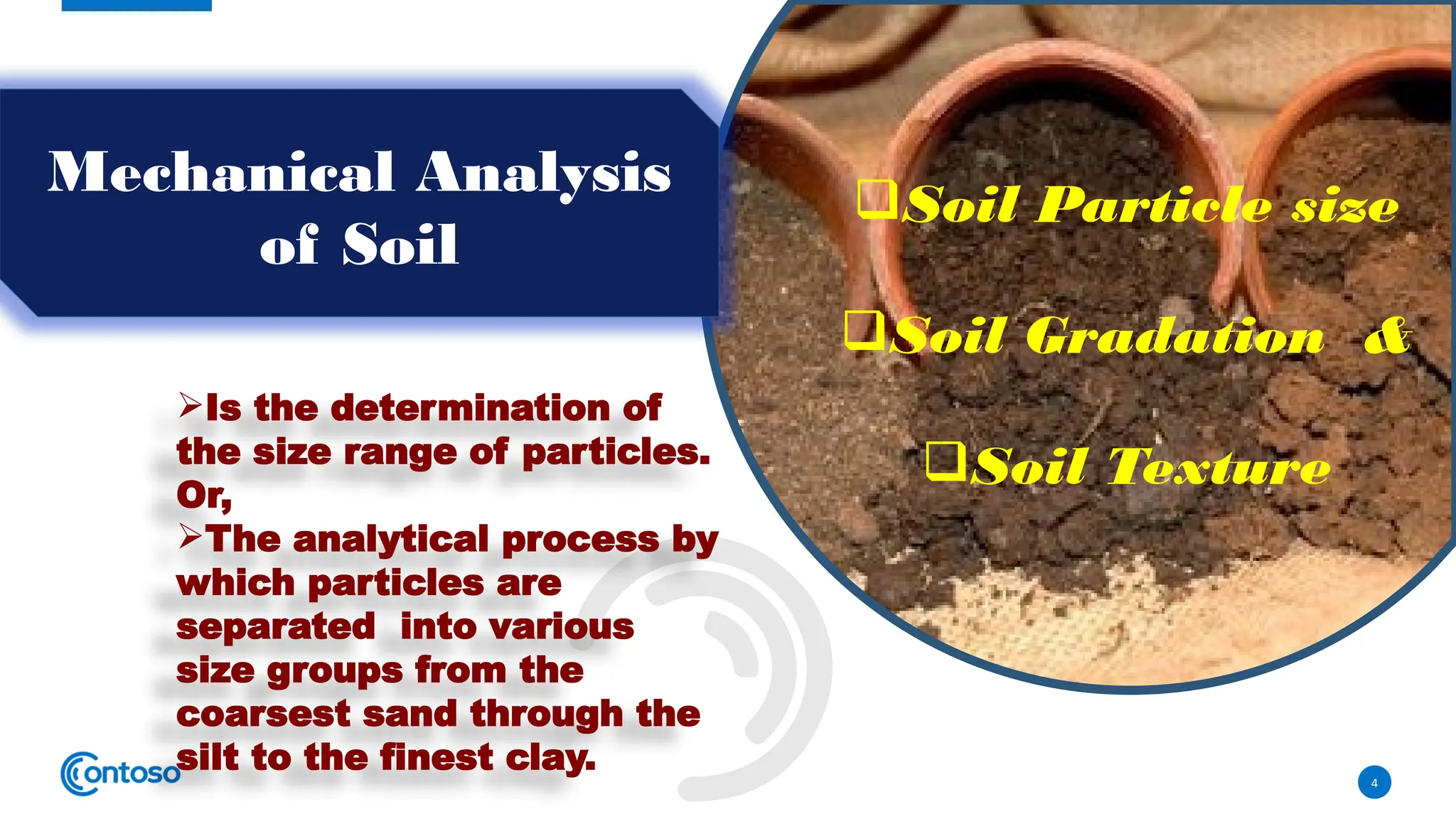
Mechanical Analysis
of Soil
Is the determination of
the size range of particles.
Or,
The analytical process by
which particles are
separated into various
size groups from the
coarsest sand through the
silt to the finest clay.
Soil Particle size
Soil Gradation &
Soil Texture
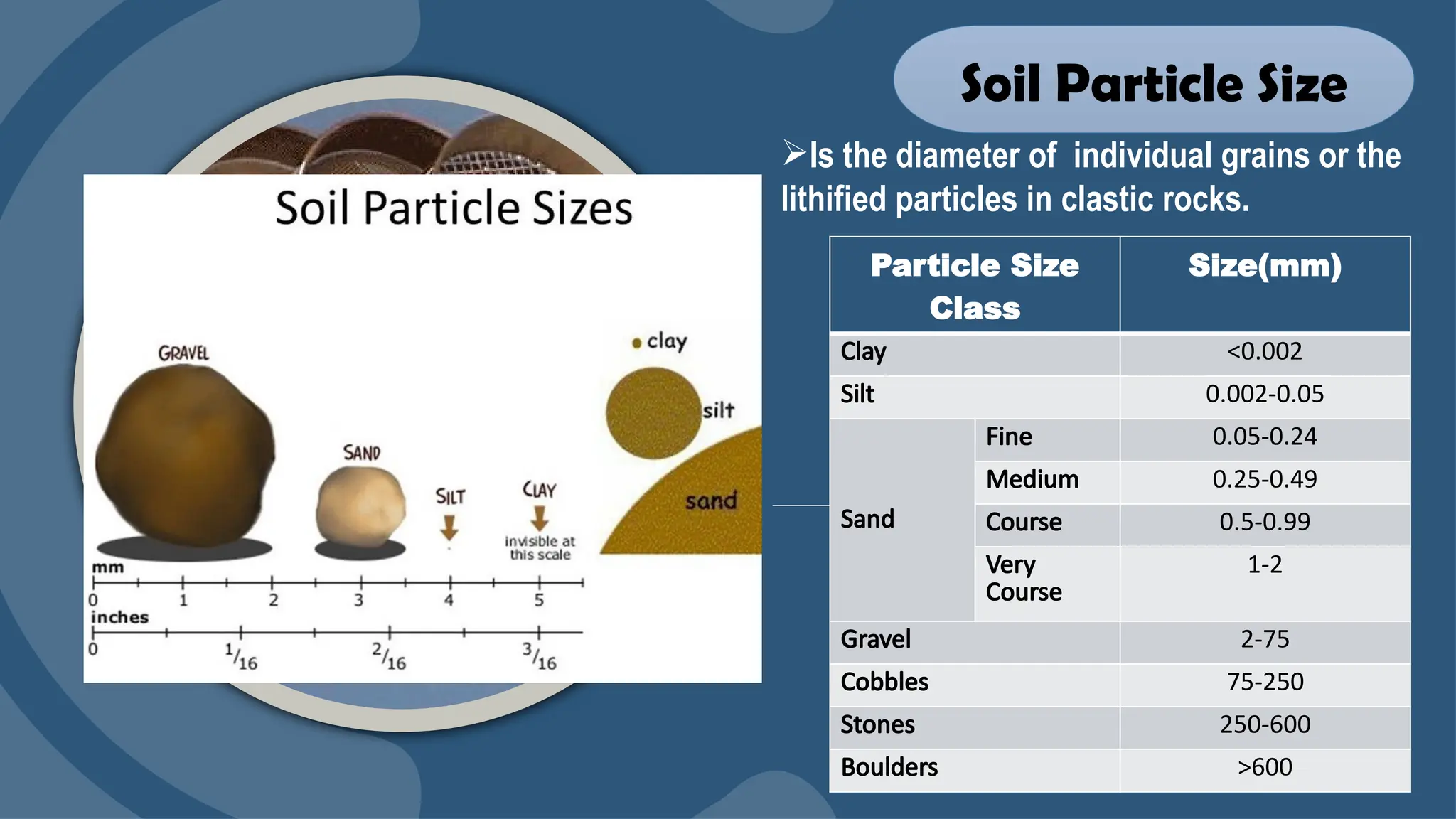
Particle Size
Class
Size(mm)
Clay <0.002
Silt 0.002-0.05
Sand
Fine 0.05-0.24
Medium 0.25-0.49
Course 0.5-0.99
Very
Course
1-2
Gravel 2-75
Cobbles 75-250
Stones 250-600
Boulders >600
Soil Particle Size
Is the diameter of individual grains or the
lithified particles in clastic rocks.
6
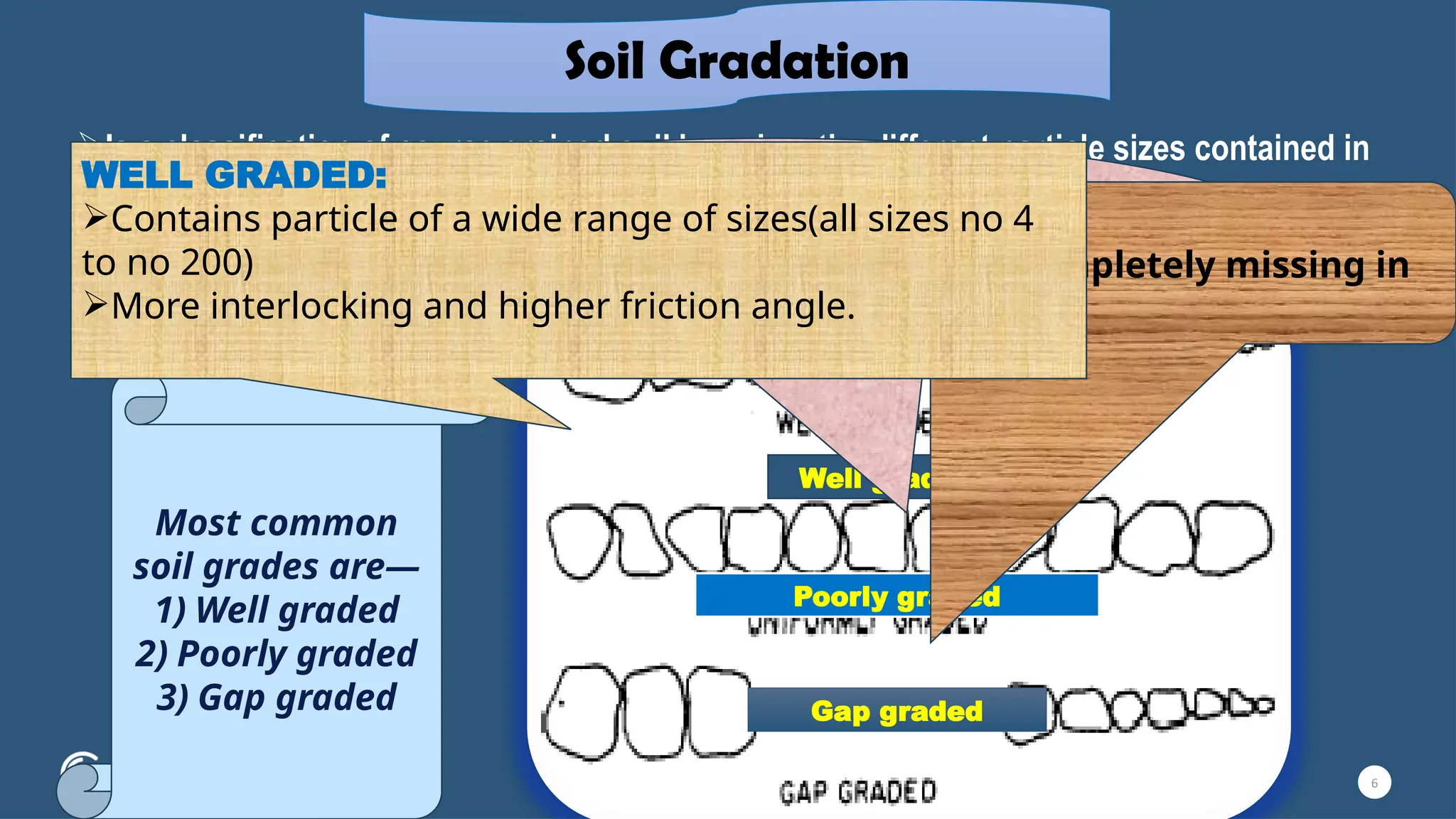
Is a classification of course grained soil based on the different particle sizes contained in
the soil
Is a indicator of engineering properties such as—compressibility, shear strength and
hydraulic conductivity.
Most common
soil grades are—
1) Well graded
2) Poorly graded
3) Gap graded
Soil Gradation
Well graded
Poorly graded
Gap graded
POORLY GRADED:
Most of the particles are approximately
of the same size.
Permeability is more than well graded
soil.
GAP GRADED:
Not all particle size is present as some are completely missing in
them.
WELL GRADED:
Contains particle of a wide range of sizes(all sizes no 4
to no 200)
More interlocking and higher friction angle.
7
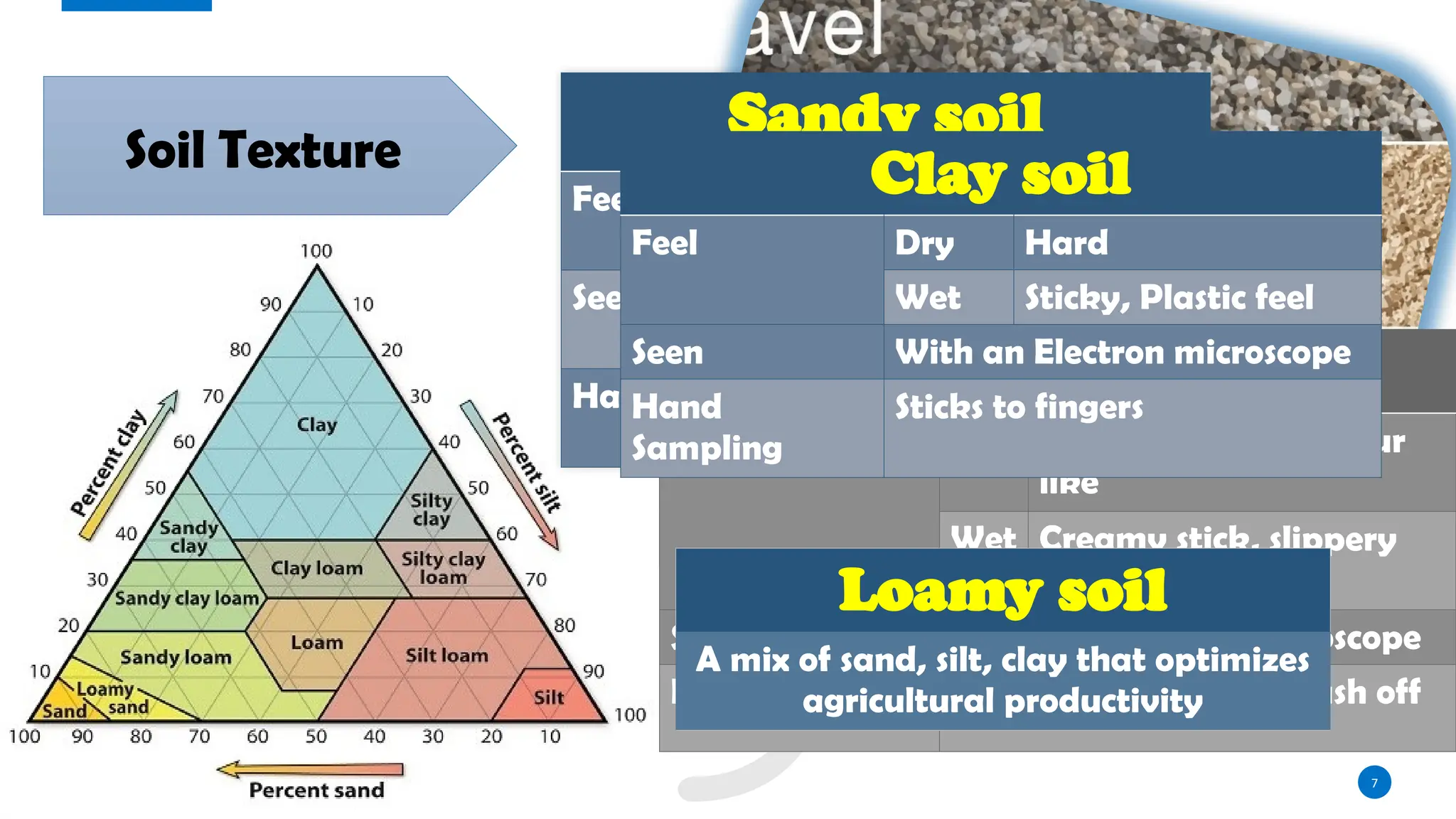
Soil Texture
refers to the composition of
the soil in terms of the amounts
of small (clays), medium (silts),
and large (sands) size particles.
According to USDA, there are 12
textural classes of soil; but the
most common are—
I. Sandy soil,
II. Silty soil,
III.Clay soil &
IV. Loamy soil.
Sandy soil
Feel Gritty
Seen Can be seen with
naked eye
Hand Sampling No residue rest on
hand
Silty soil
Feel Dry Powdery smooth, flour
like
Wet Creamy stick, slippery
feel
Seen With hand lens or microscope
Hand Sampling Coats hand, able to Brush off
Clay soil
Feel Dry Hard
Wet Sticky, Plastic feel
Seen With an Electron microscope
Hand
Sampling
Sticks to fingers
Loamy soil
A mix of sand, silt, clay that optimizes
agricultural productivity
8
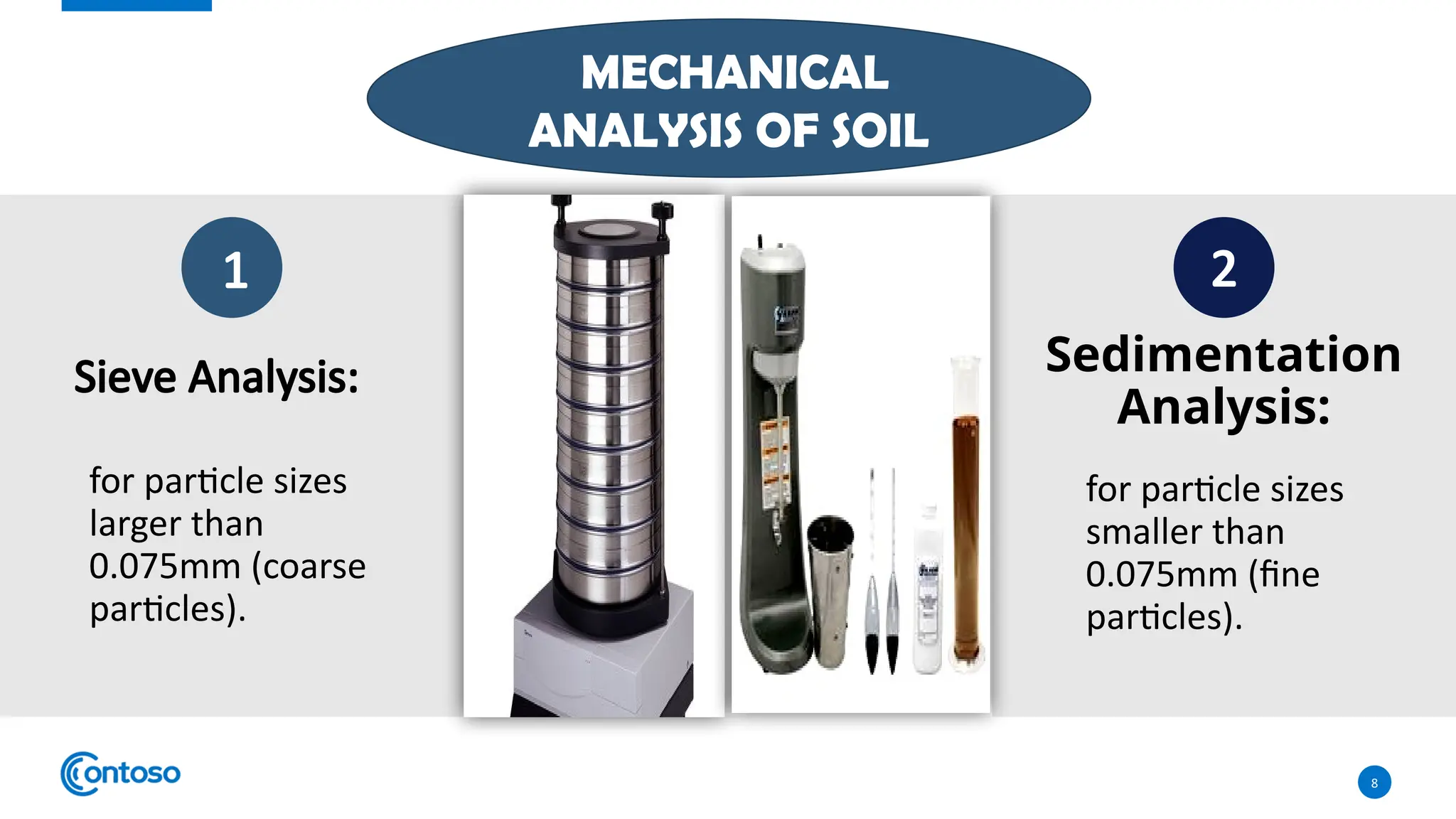
for particle sizes
larger than
0.075mm (coarse
particles).
Sedimentation
Analysis:
for particle sizes
smaller than
0.075mm (fine
particles).
MECHANICAL
ANALYSIS OF SOIL
Sieve Analysis:
1 2
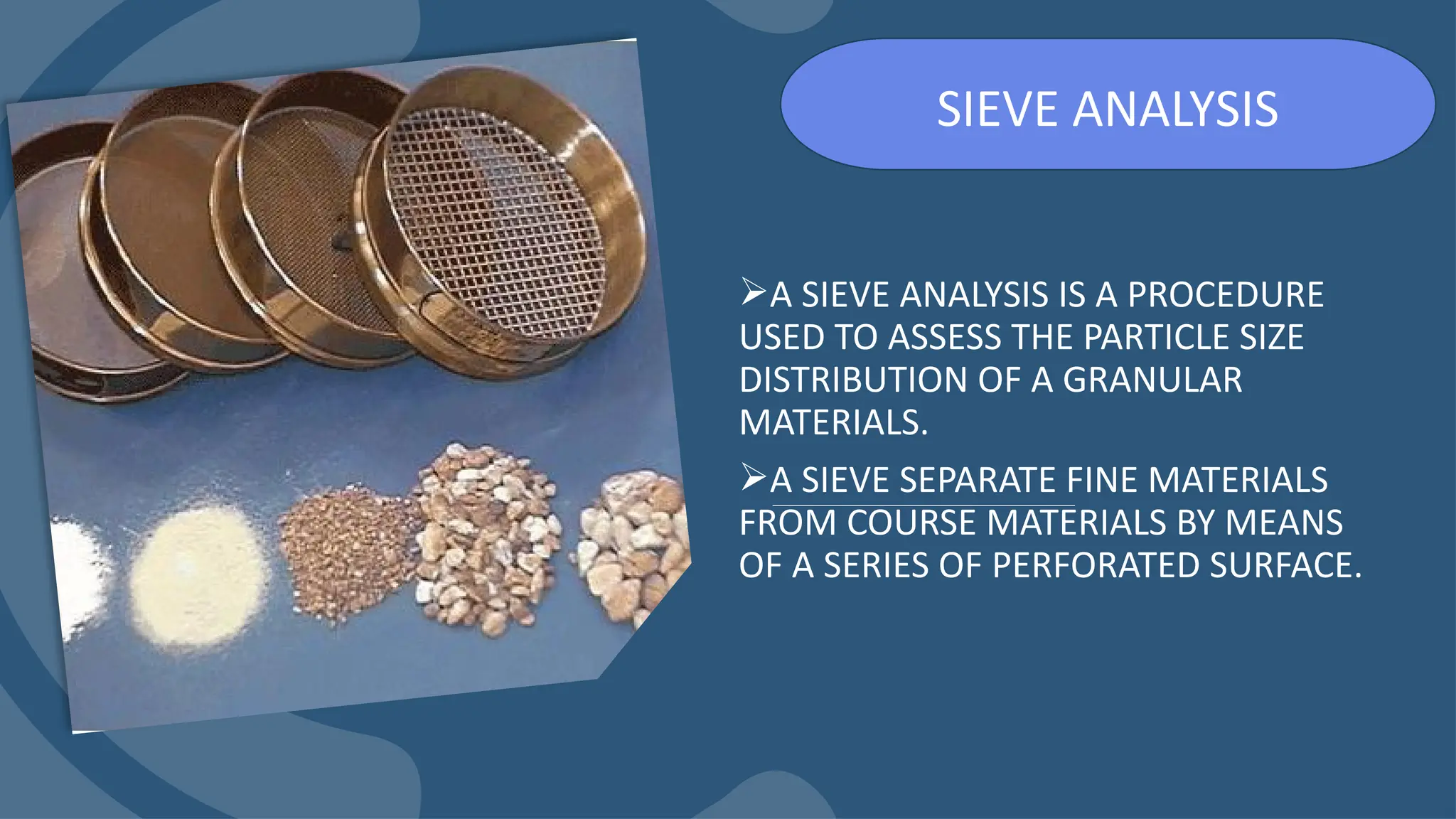
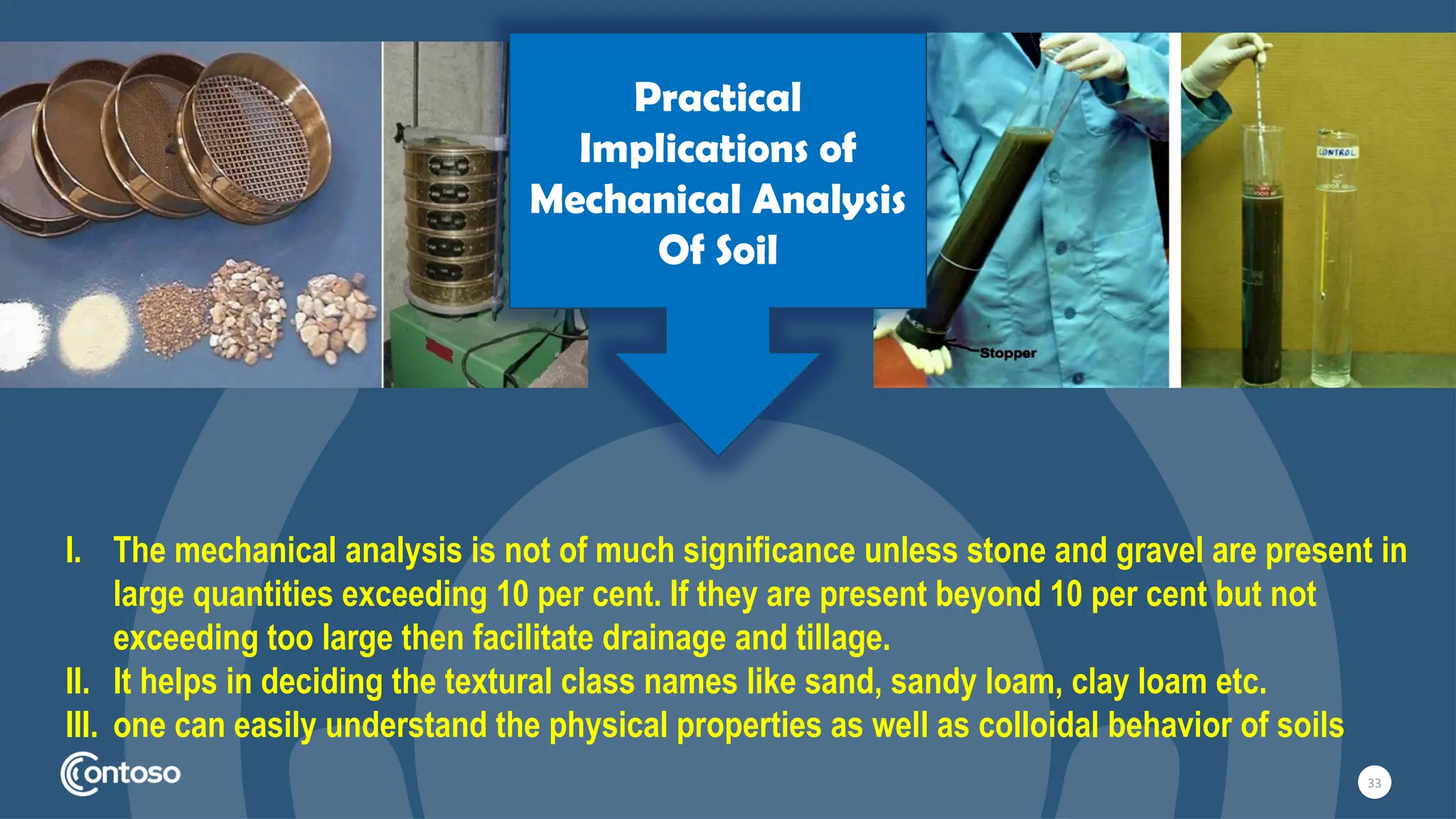
A SIEVE ANALYSIS IS A PROCEDURE
USED TO ASSESS THE PARTICLE SIZE
DISTRIBUTION OF A GRANULAR
MATERIALS.
A SIEVE SEPARATE FINE MATERIALS
FROM COURSE MATERIALS BY MEANS
OF A SERIES OF PERFORATED SURFACE.
SIEVE ANALYSIS
10
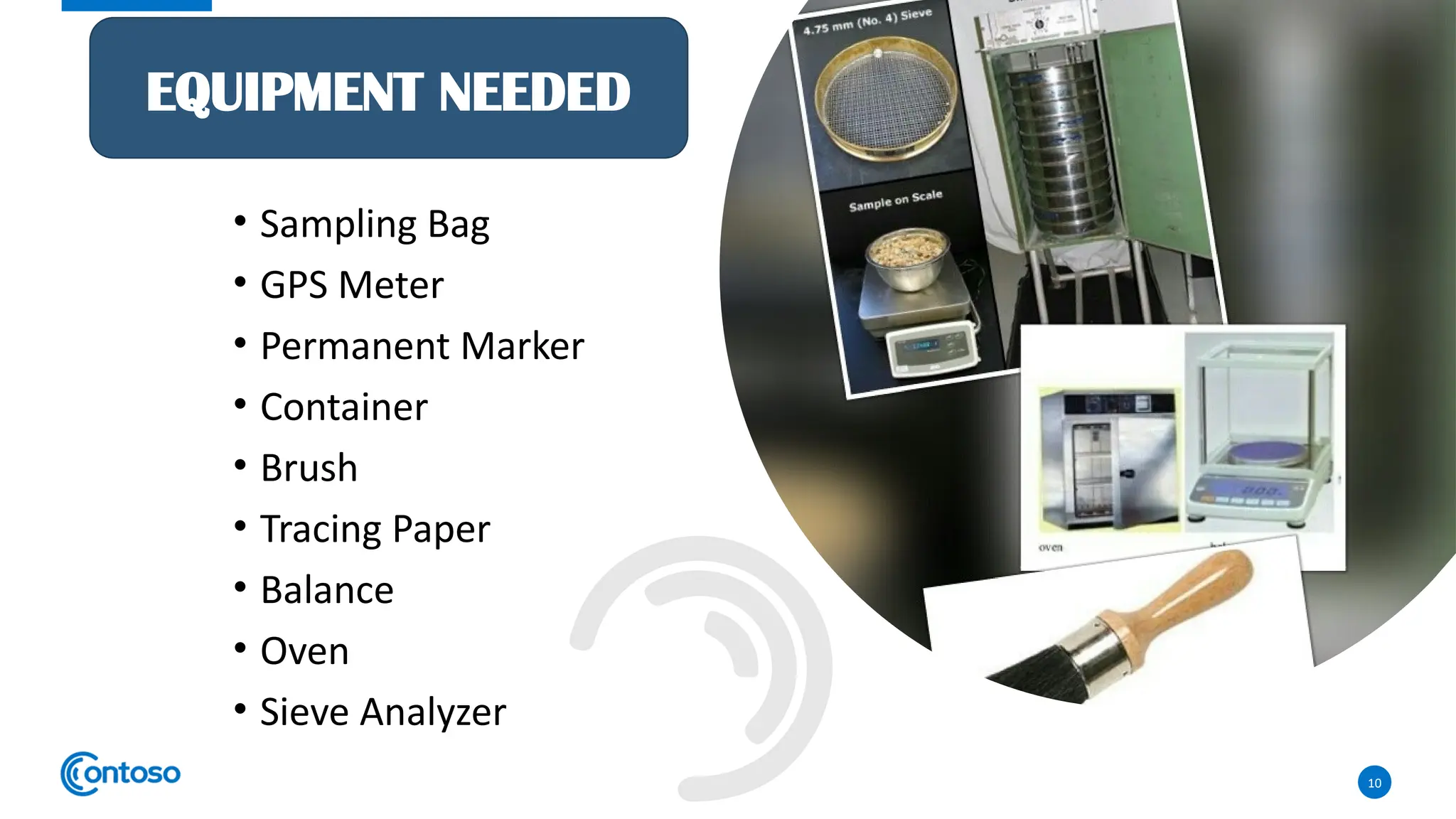
• Sampling Bag
• GPS Meter
• Permanent Marker
• Container
• Brush
• Tracing Paper
• Balance
• Oven
• Sieve Analyzer
EQUIPMENT NEEDED
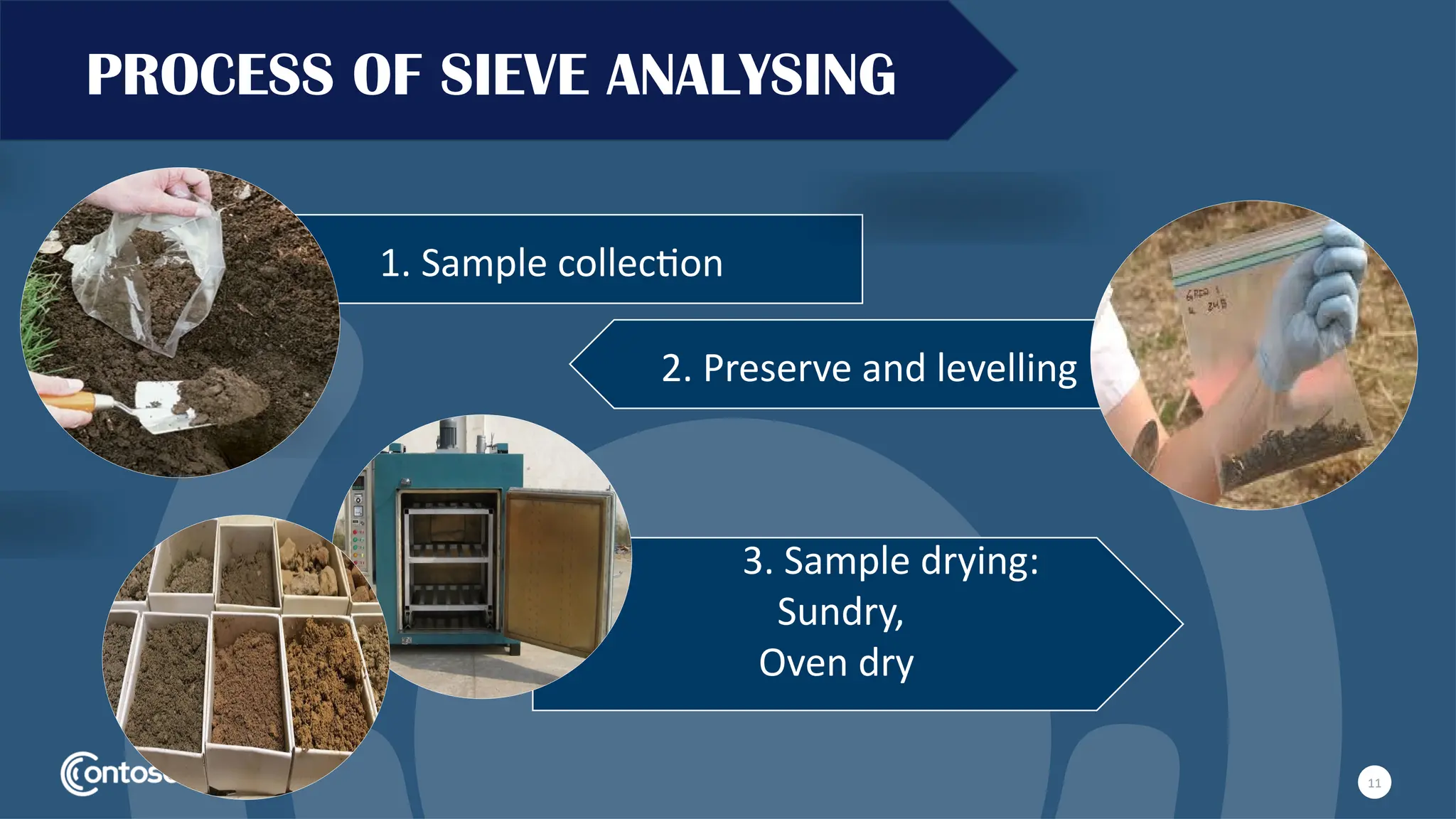
1. Sample collection
2. Preserve and levelling
3. Sample drying:
Sundry,
Oven dry
11
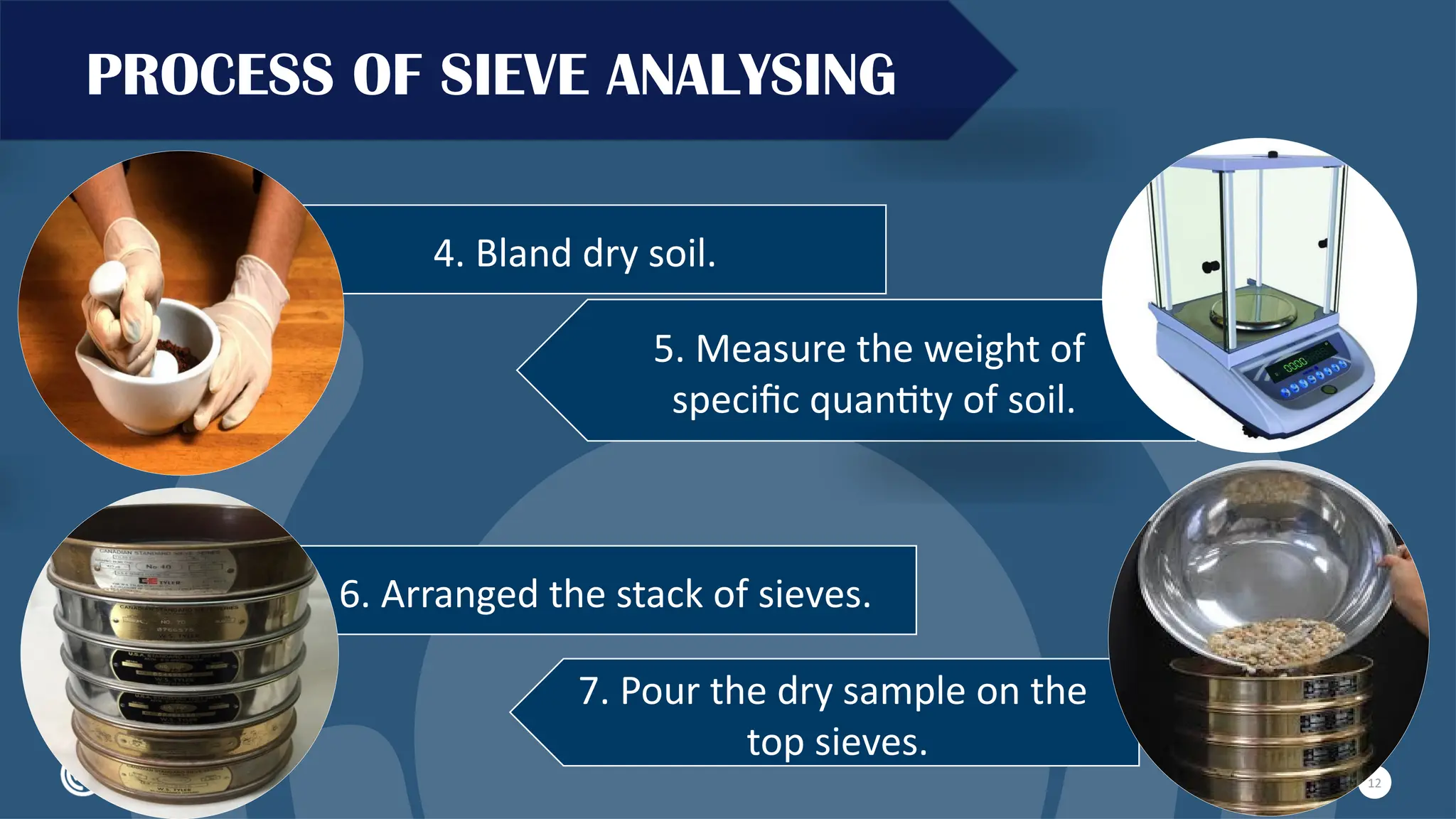
PROCESS OF SIEVE ANALYSING
4. Bland dry soil.
7. Pour the dry sample on the
top sieves.
5. Measure the weight of
specific quantity of soil.
6. Arranged the stack of sieves.
12
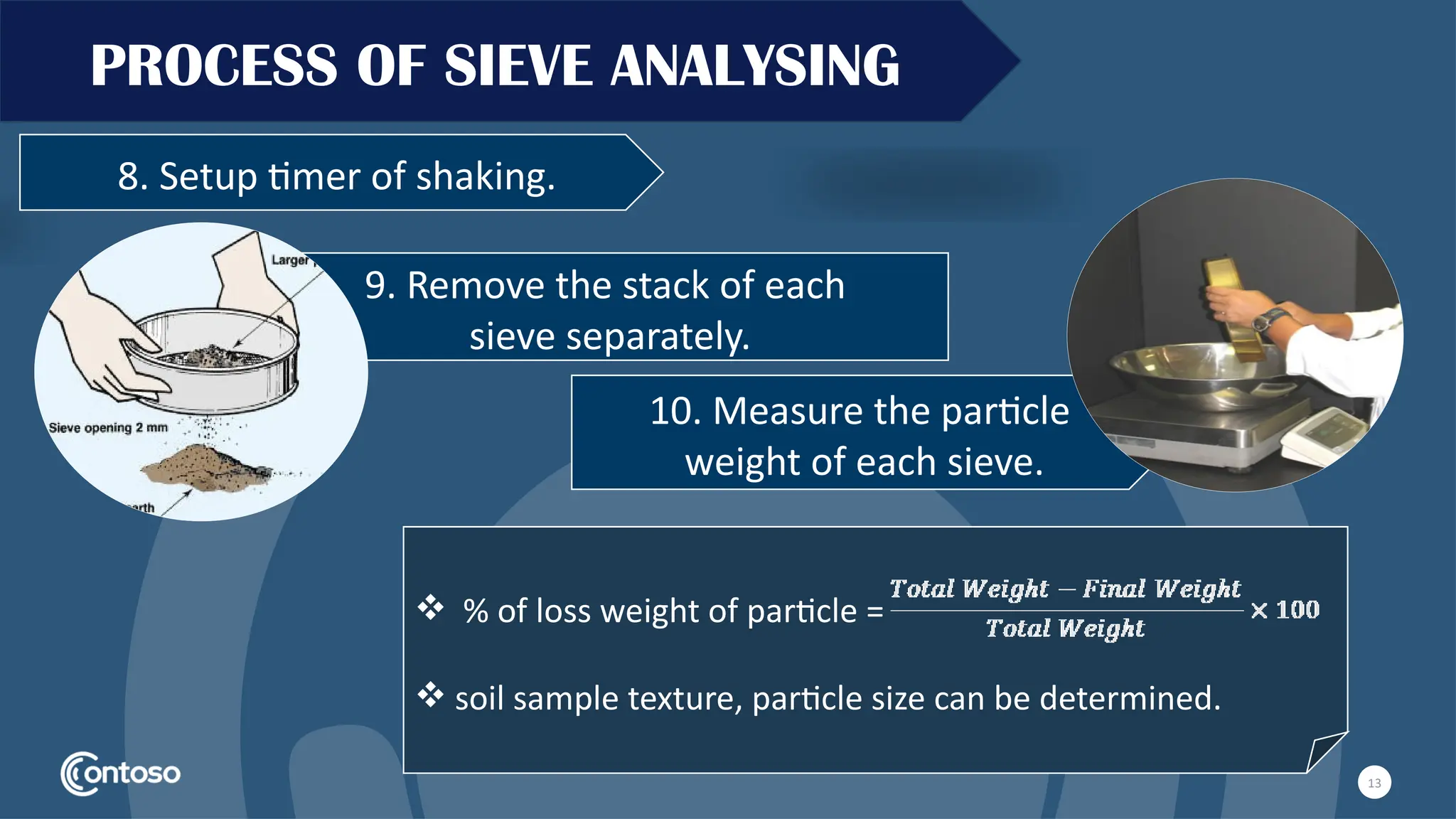
PROCESS OF SIEVE ANALYSING
9. Remove the stack of each
sieve separately.
10. Measure the particle
weight of each sieve.
13
PROCESS OF SIEVE ANALYSING
8. Setup timer of shaking.
 % of loss weight of particle =
 soil sample texture, particle size can be determined.
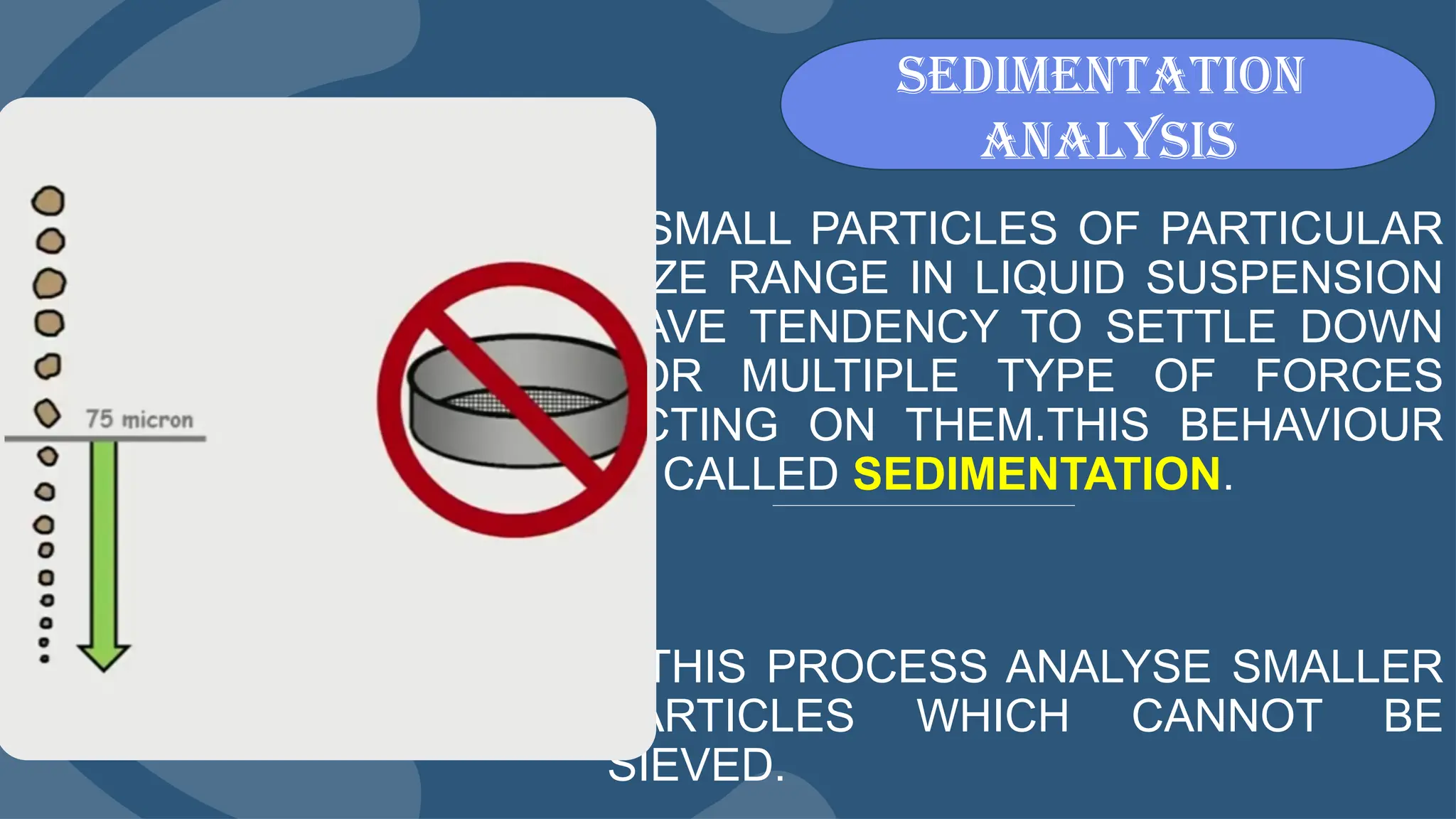
SMALL PARTICLES OF PARTICULAR
SIZE RANGE IN LIQUID SUSPENSION
HAVE TENDENCY TO SETTLE DOWN
FOR MULTIPLE TYPE OF FORCES
ACTING ON THEM.THIS BEHAVIOUR
IS CALLED SEDIMENTATION.
THIS PROCESS ANALYSE SMALLER
PARTICLES WHICH CANNOT BE
SIEVED.
sedimentation
analysis
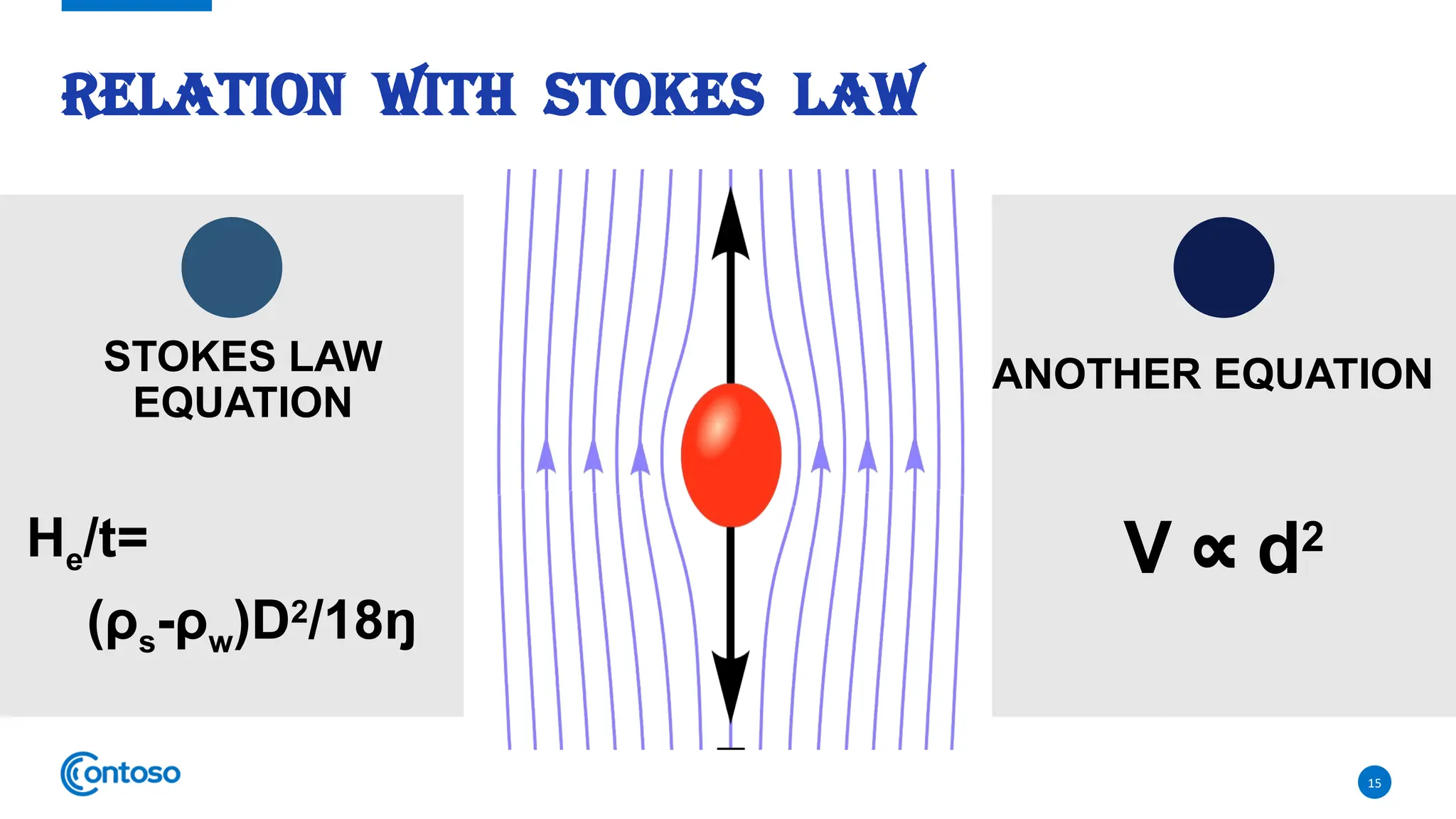
RELATION WITH STOKES LAW
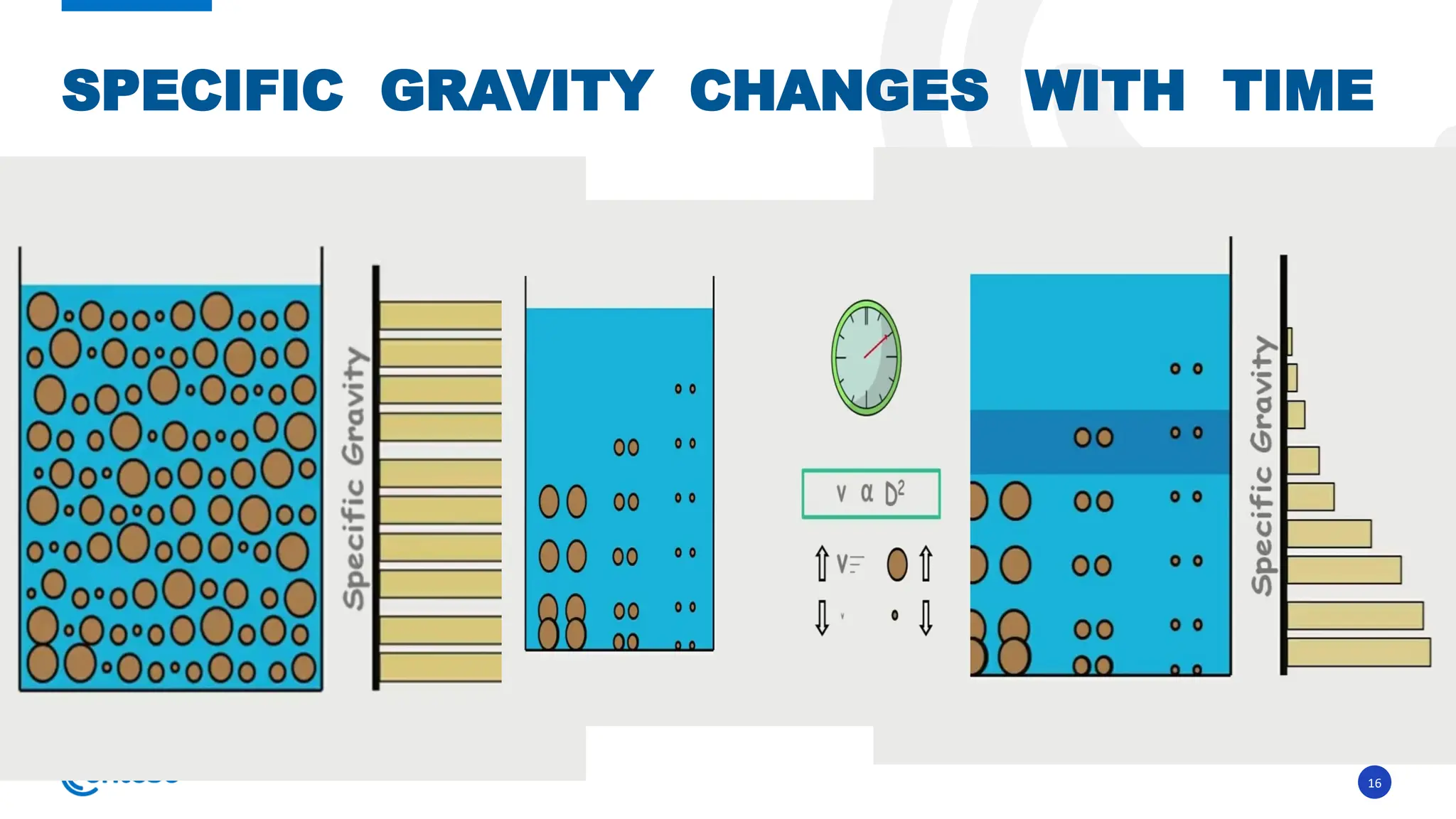
He/t=
(ρs-ρw)D2
/18ŋ
15
V ∝ d2
STOKES LAW
EQUATION
ANOTHER EQUATION
16
SPECIFIC GRAVITY CHANGES WITH TIME
17
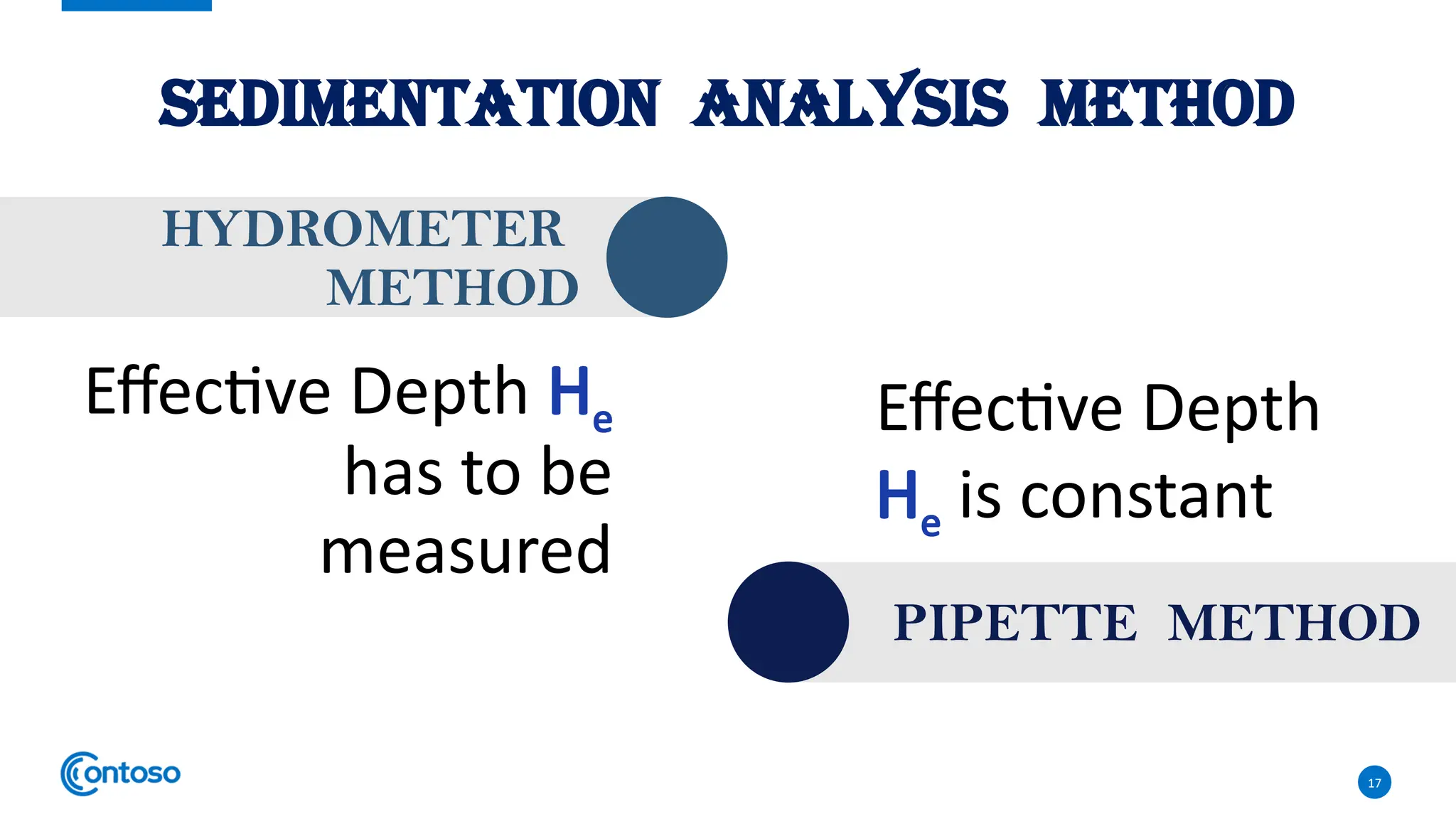
SEDIMENTATION ANALYSIS METHOD
HYDROMETER
METHOD
Effective Depth He
has to be
measured
Effective Depth
He is constant
PIPETTE METHOD
18
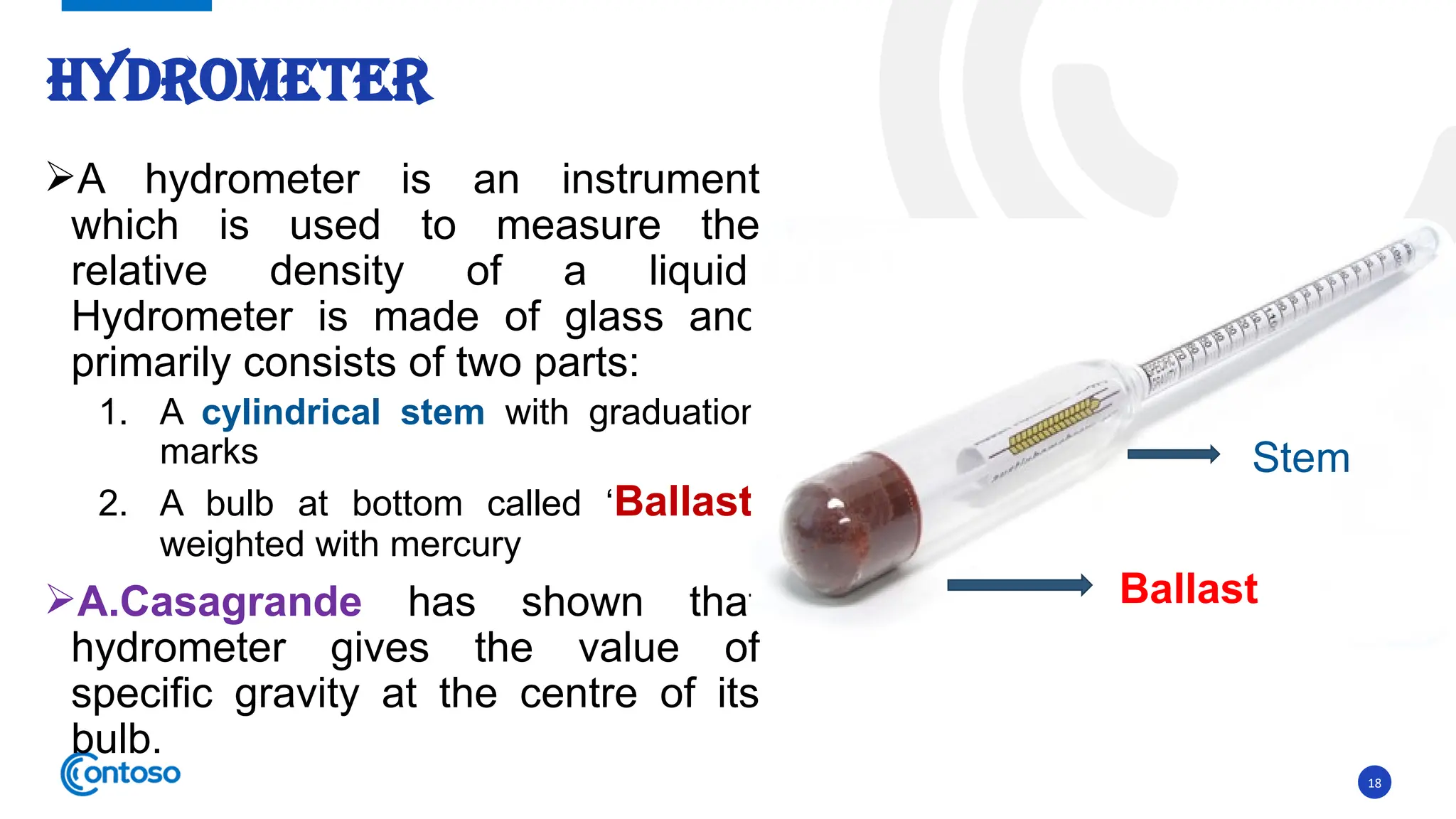
A hydrometer is an instrument
which is used to measure the
relative density of a liquid.
Hydrometer is made of glass and
primarily consists of two parts:
1. A cylindrical stem with graduation
marks
2. A bulb at bottom called ‘Ballast’
weighted with mercury
A.Casagrande has shown that
hydrometer gives the value of
specific gravity at the centre of its
bulb.
HYDROMETER
Ballast
Stem
19
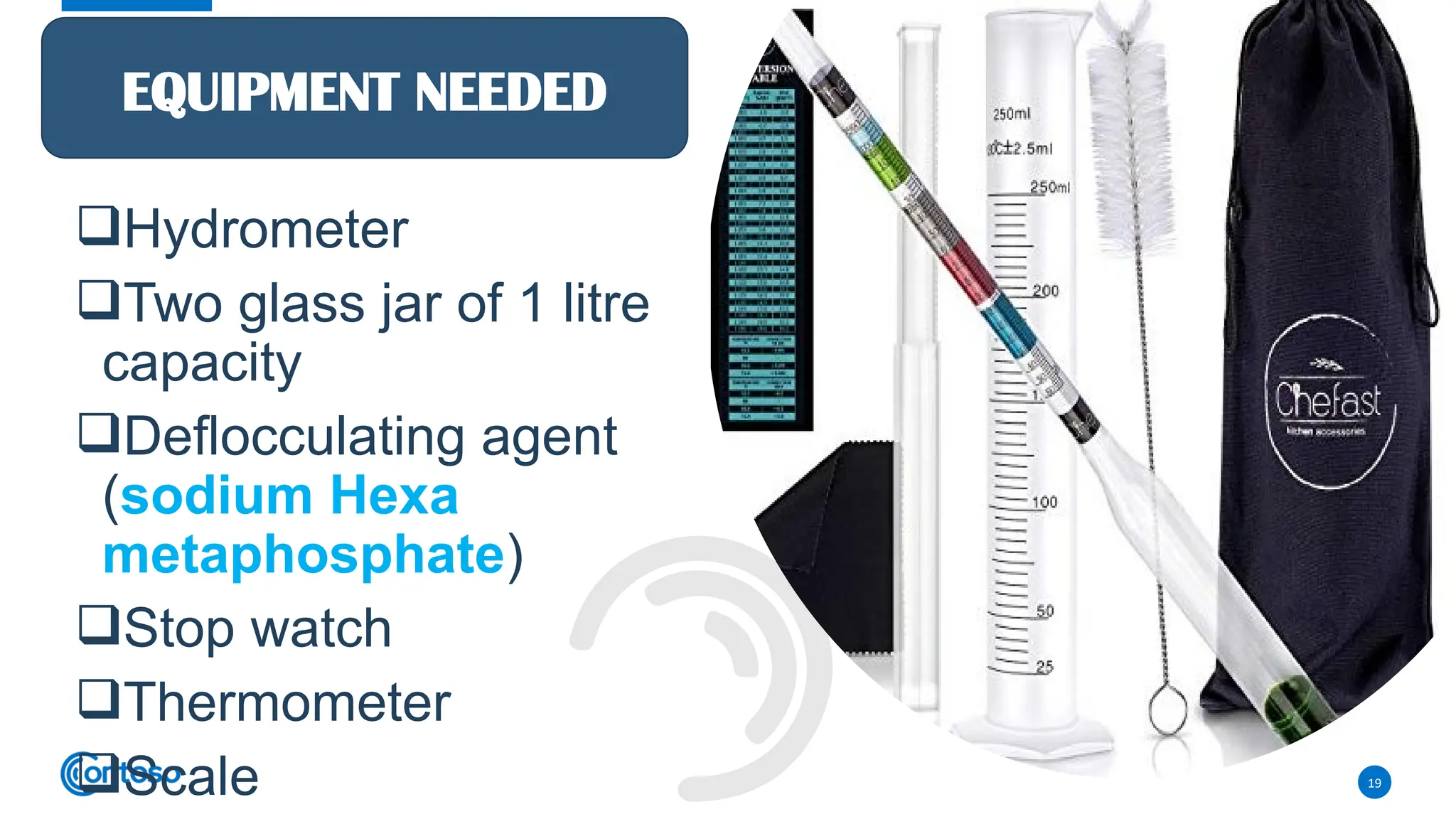
Hydrometer
Two glass jar of 1 litre
capacity
Deflocculating agent
(sodium Hexa
metaphosphate)
Stop watch
Thermometer
Scale
EQUIPMENT NEEDED
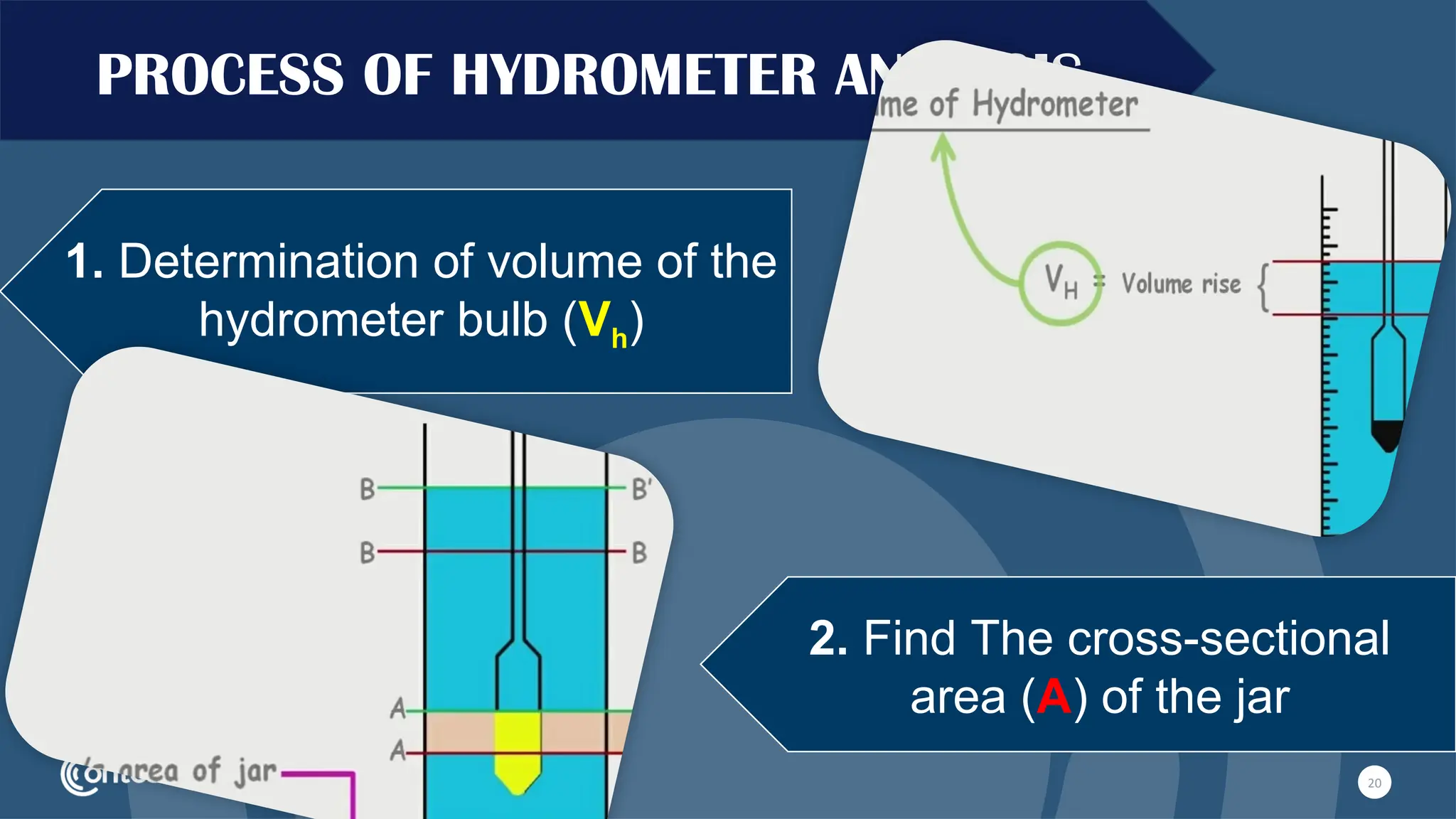
1. Determination of volume of the
hydrometer bulb (Vh)
2. Find The cross-sectional
area (A) of the jar
20
PROCESS OF HYDROMETER ANALYSIS
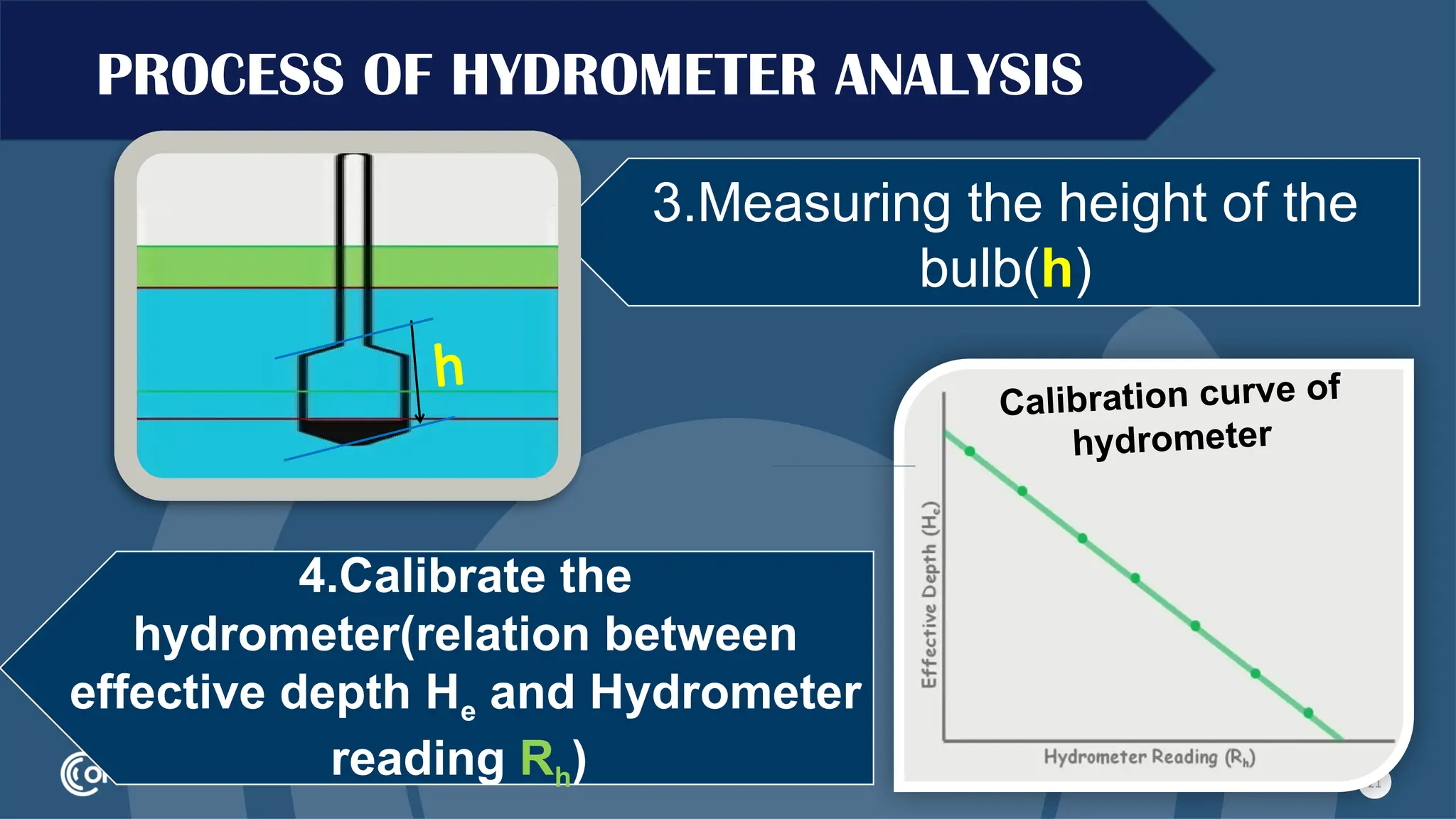
3.Measuring the height of the
bulb(h)
4.Calibrate the
hydrometer(relation between
effective depth He and Hydrometer
reading Rh) 21
PROCESS OF HYDROMETER ANALYSIS
h Calibration curve of
hydrometer
EFFECTIVE DEPTH
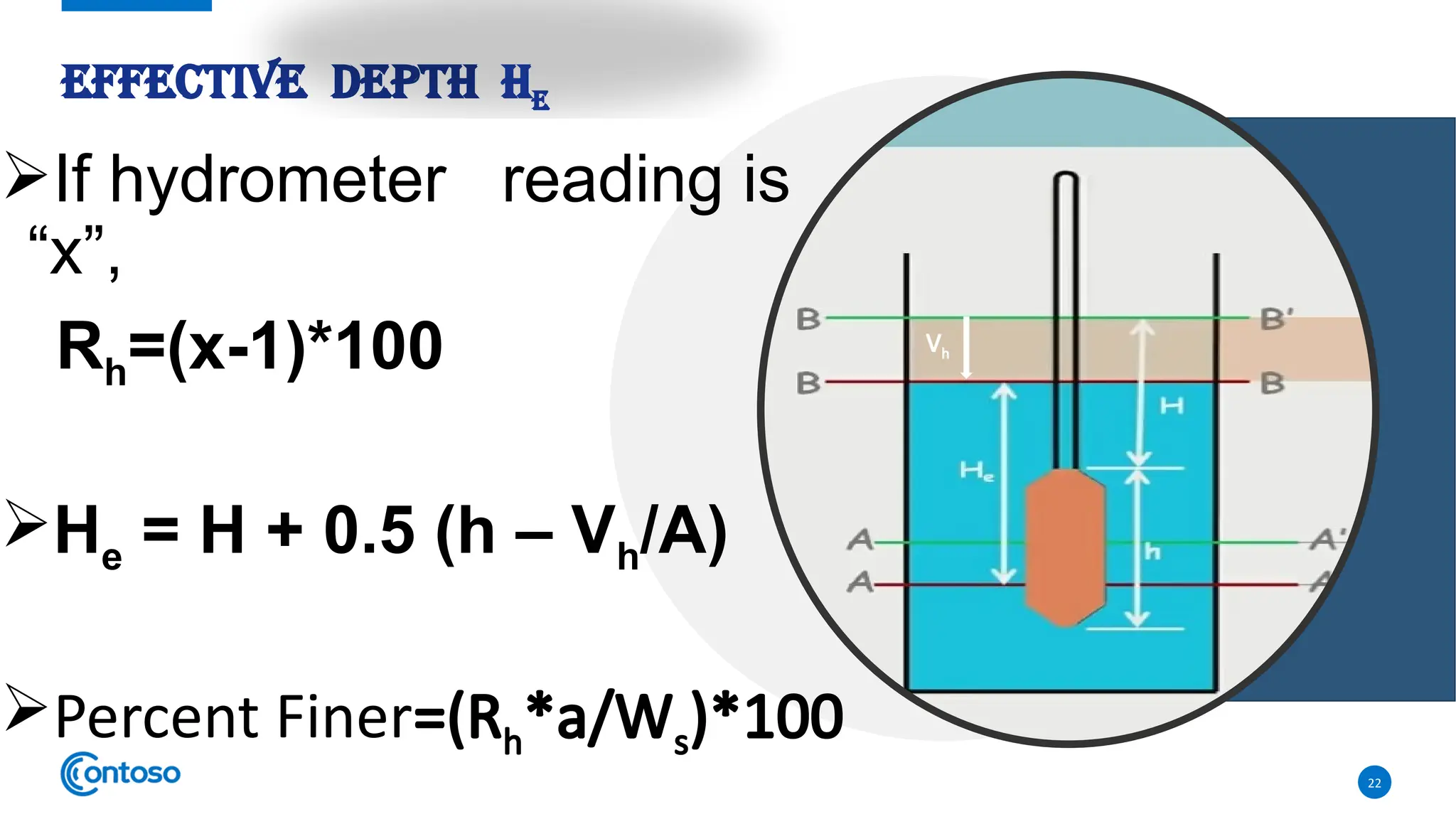
If hydrometer reading is
“x”,
Rh=(x-1)*100
He = H + 0.5 (h – Vh/A)
Percent Finer=(Rh*a/Ws)*100
22
He
Vh
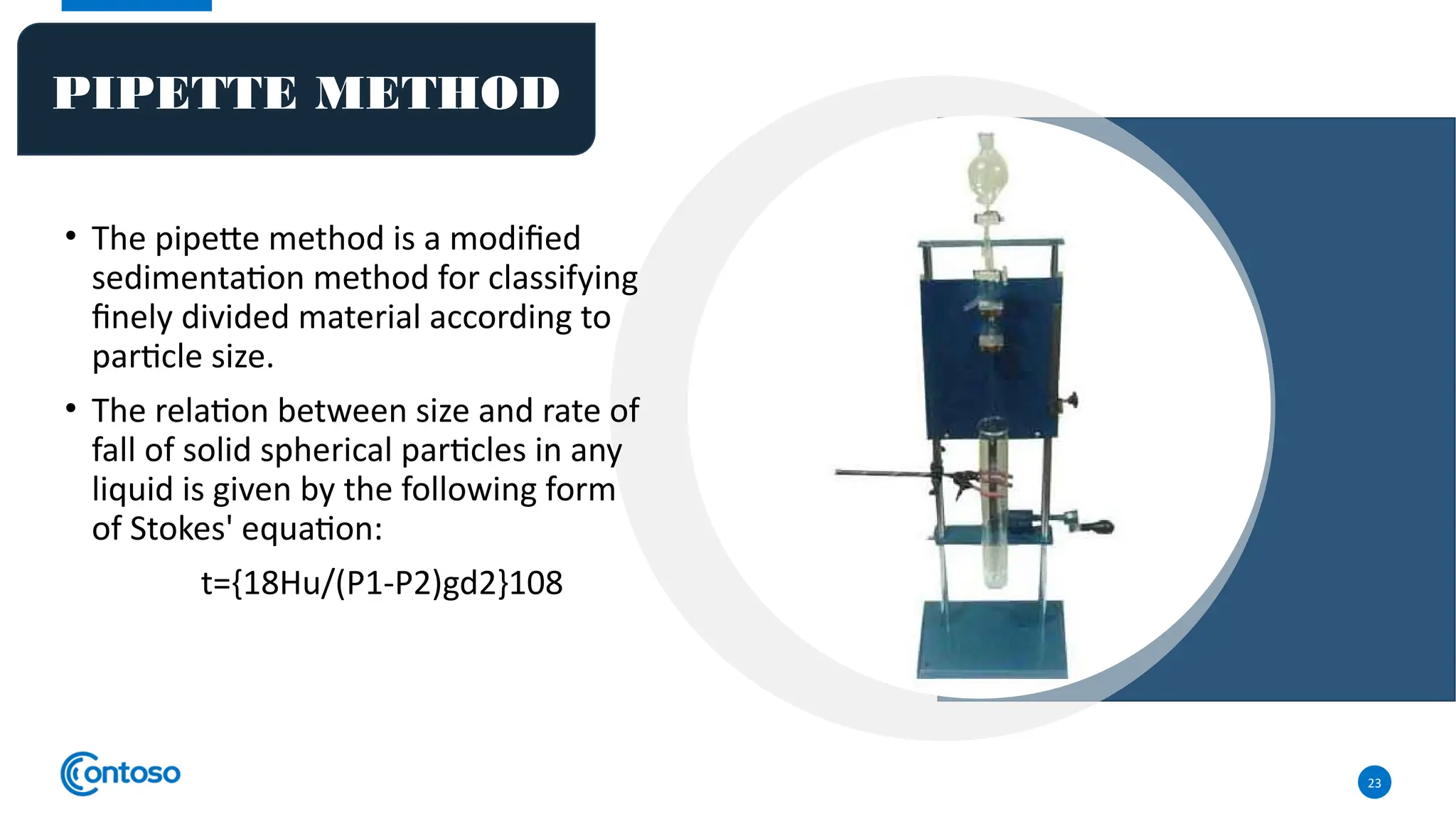
• The pipette method is a modified
sedimentation method for classifying
finely divided material according to
particle size.
• The relation between size and rate of
fall of solid spherical particles in any
liquid is given by the following form
of Stokes' equation:
t={18Hu/(P1-P2)gd2}108
23
PIPETTE METHOD
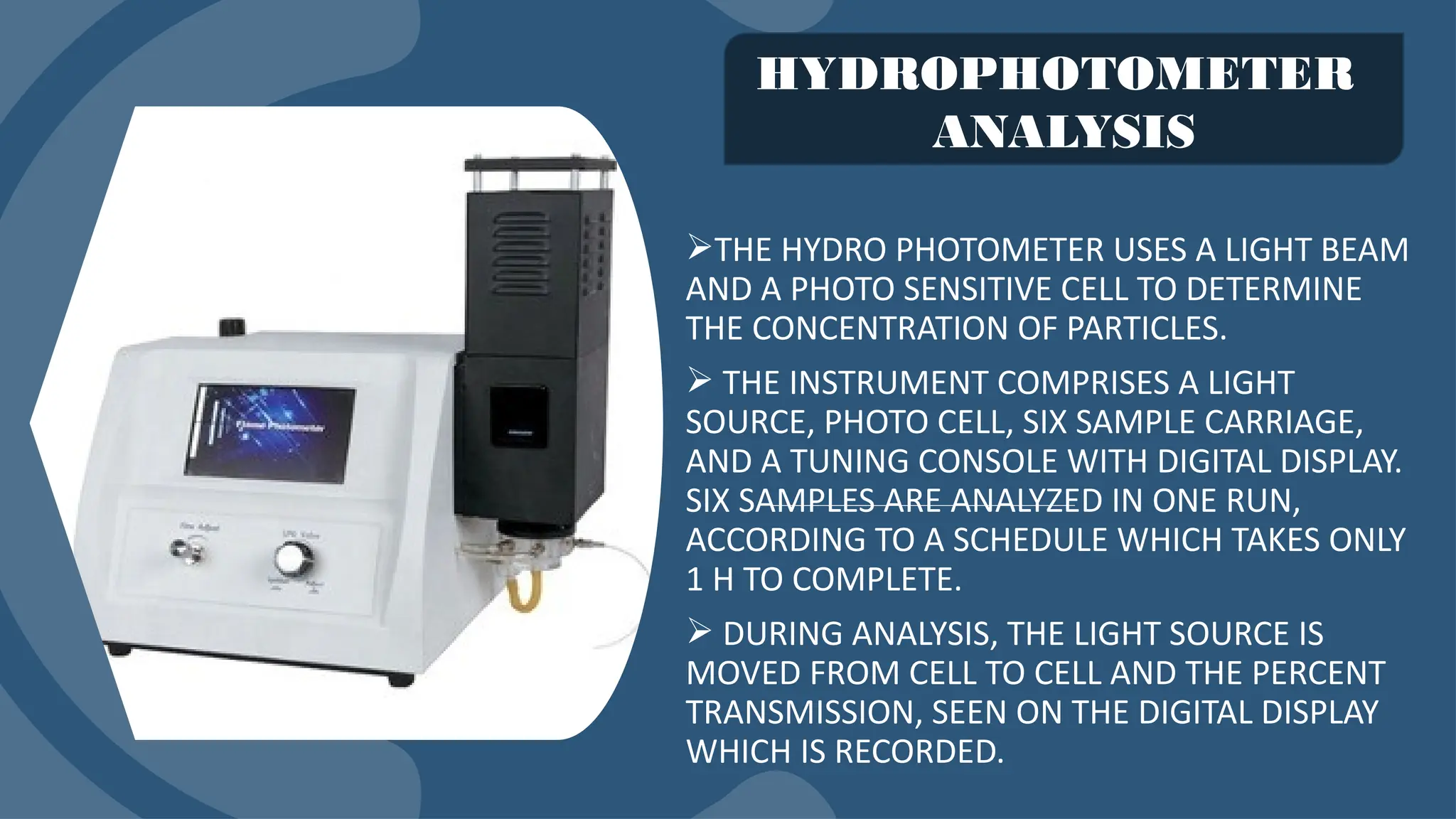
THE HYDRO PHOTOMETER USES A LIGHT BEAM
AND A PHOTO SENSITIVE CELL TO DETERMINE
THE CONCENTRATION OF PARTICLES.
 THE INSTRUMENT COMPRISES A LIGHT
SOURCE, PHOTO CELL, SIX SAMPLE CARRIAGE,
AND A TUNING CONSOLE WITH DIGITAL DISPLAY.
SIX SAMPLES ARE ANALYZED IN ONE RUN,
ACCORDING TO A SCHEDULE WHICH TAKES ONLY
1 H TO COMPLETE.
 DURING ANALYSIS, THE LIGHT SOURCE IS
MOVED FROM CELL TO CELL AND THE PERCENT
TRANSMISSION, SEEN ON THE DIGITAL DISPLAY
WHICH IS RECORDED.
HYDROPHOTOMETER
ANALYSIS
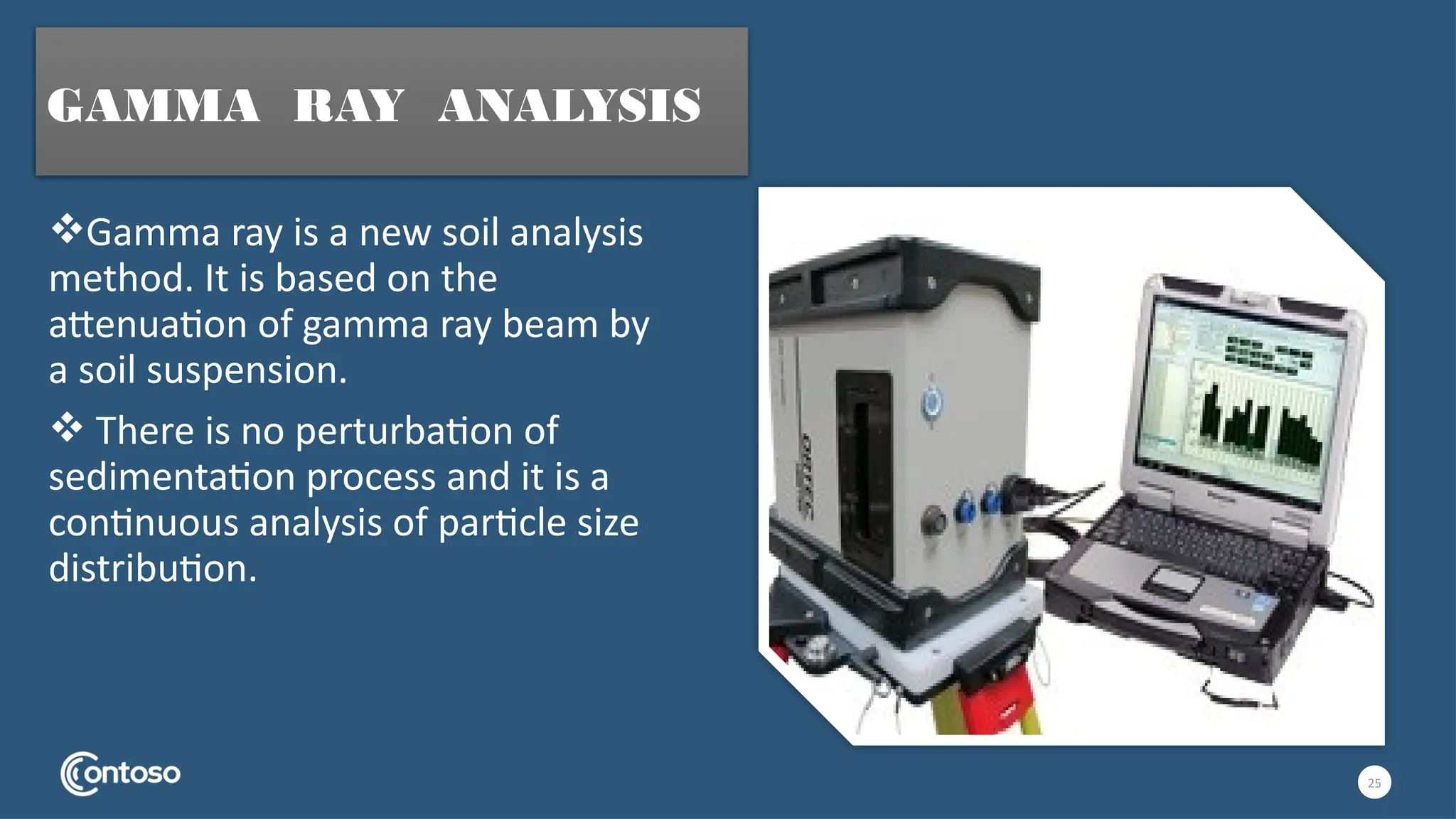
Gamma ray is a new soil analysis
method. It is based on the
attenuation of gamma ray beam by
a soil suspension.
 There is no perturbation of
sedimentation process and it is a
continuous analysis of particle size
distribution.
25
GAMMA RAY ANALYSIS
9
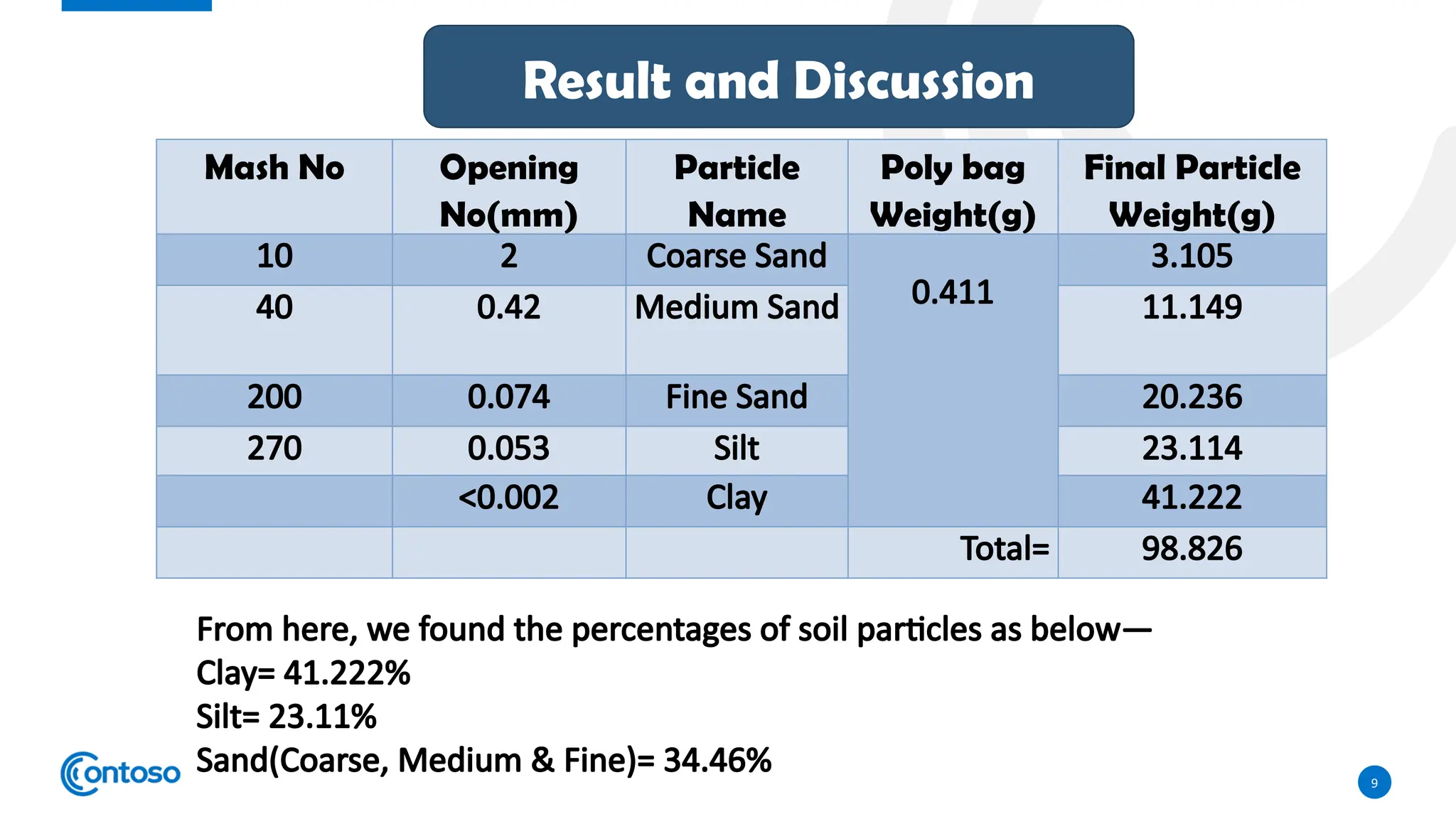
Mash No Opening
No(mm)
Particle
Name
Poly bag
Weight(g)
Final Particle
Weight(g)
10 2 Coarse Sand
0.411
3.105
40 0.42 Medium Sand 11.149
200 0.074 Fine Sand 20.236
270 0.053 Silt 23.114
<0.002 Clay 41.222
Total= 98.826
From here, we found the percentages of soil particles as below—
Clay= 41.222%
Silt= 23.11%
Sand(Coarse, Medium & Fine)= 34.46%
Result and Discussion
27
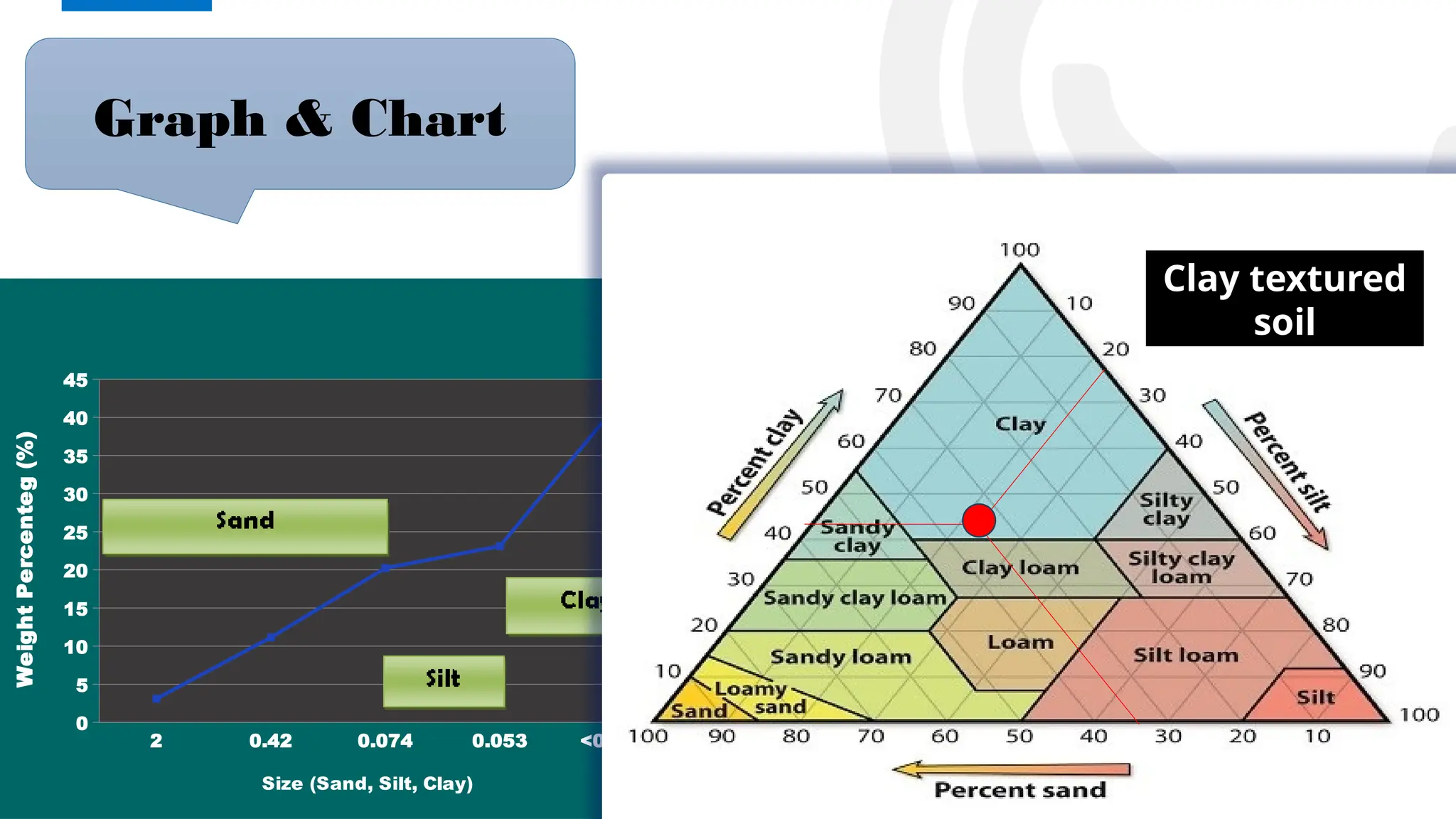
Graph & Chart
2 0.42 0.074 0.053 <0.002
0
5
10
15
20
25
30
35
40
45
Particle
Weight(g)
Size (Sand, Silt, Clay)
Weight
Percenteg
(%)
Clay textured
soil
28
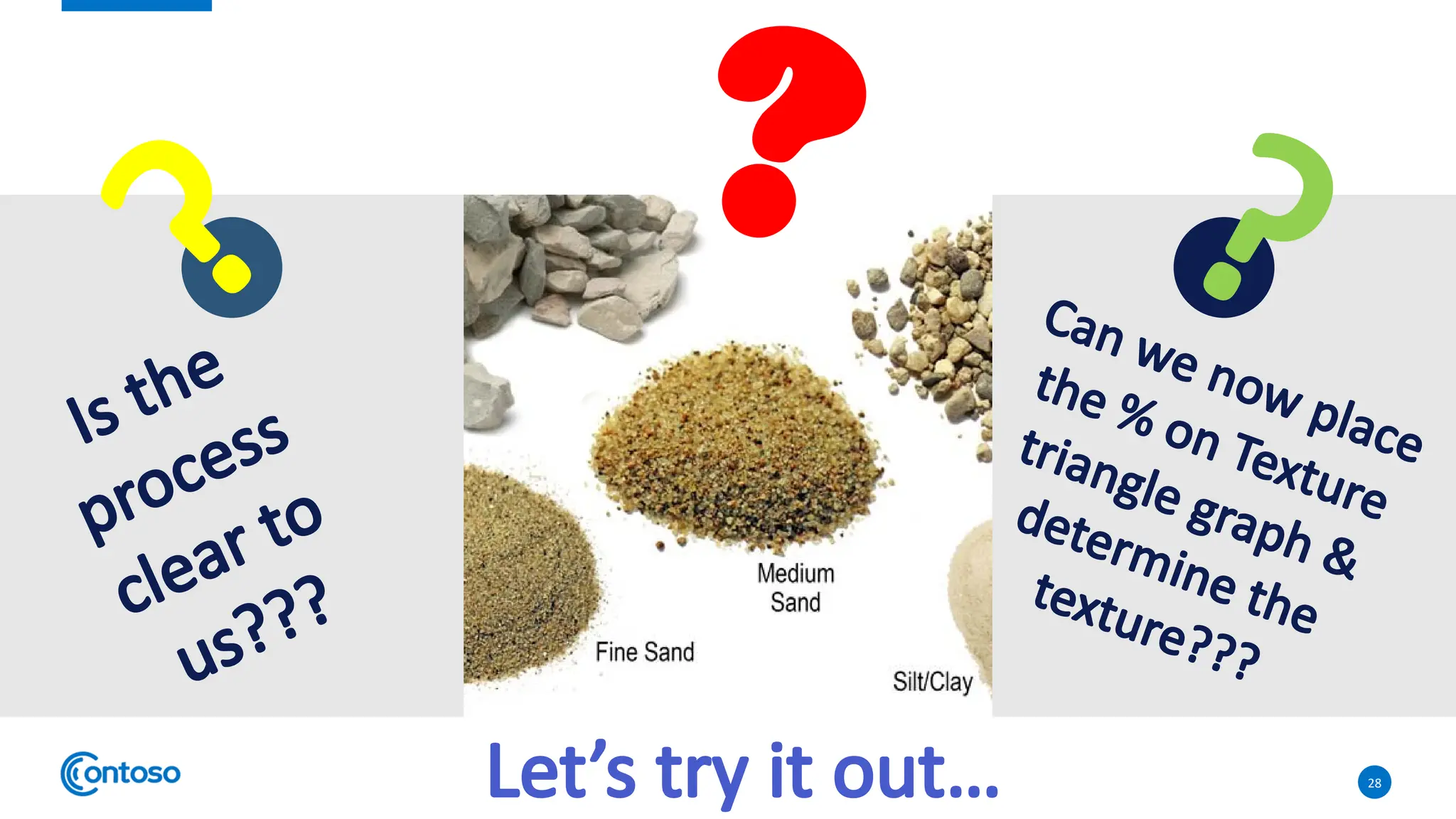
Is the
process
clear to
us???
Can we now place
the % on Texture
triangle graph &
determine the
texture???
?
? ?
Let’s try it out…
29
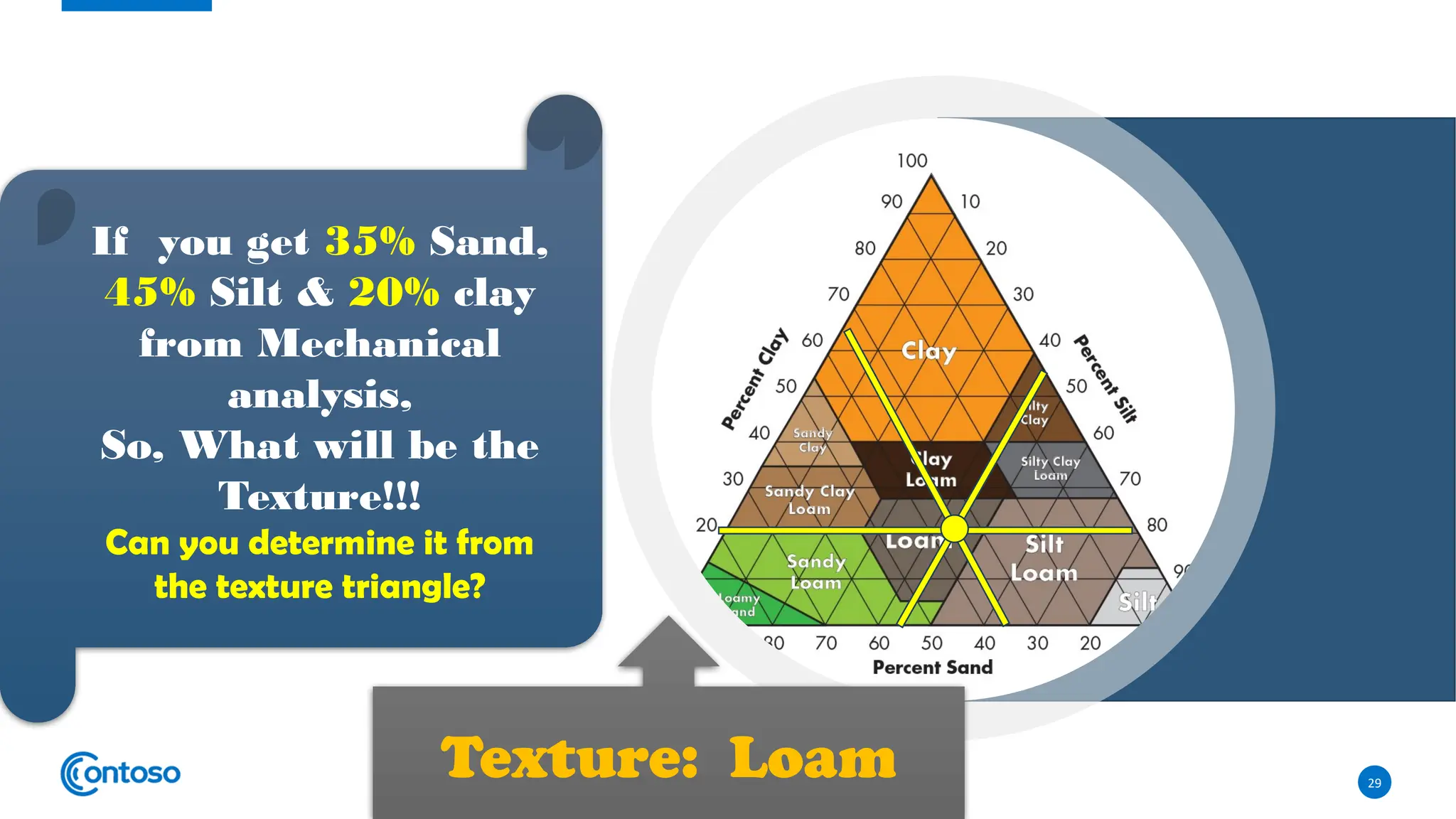
If you get 35% Sand,
45% Silt & 20% clay
from Mechanical
analysis,
So, What will be the
Texture!!!
Can you determine it from
the texture triangle?
Texture: Loam
30
PARAMETERS OF PARTICLE SIZE
DISTRIBUTION CURVE
1.EFFECTIVE SIZE
D10
2.UNIFORMITY
COEFFICIENT
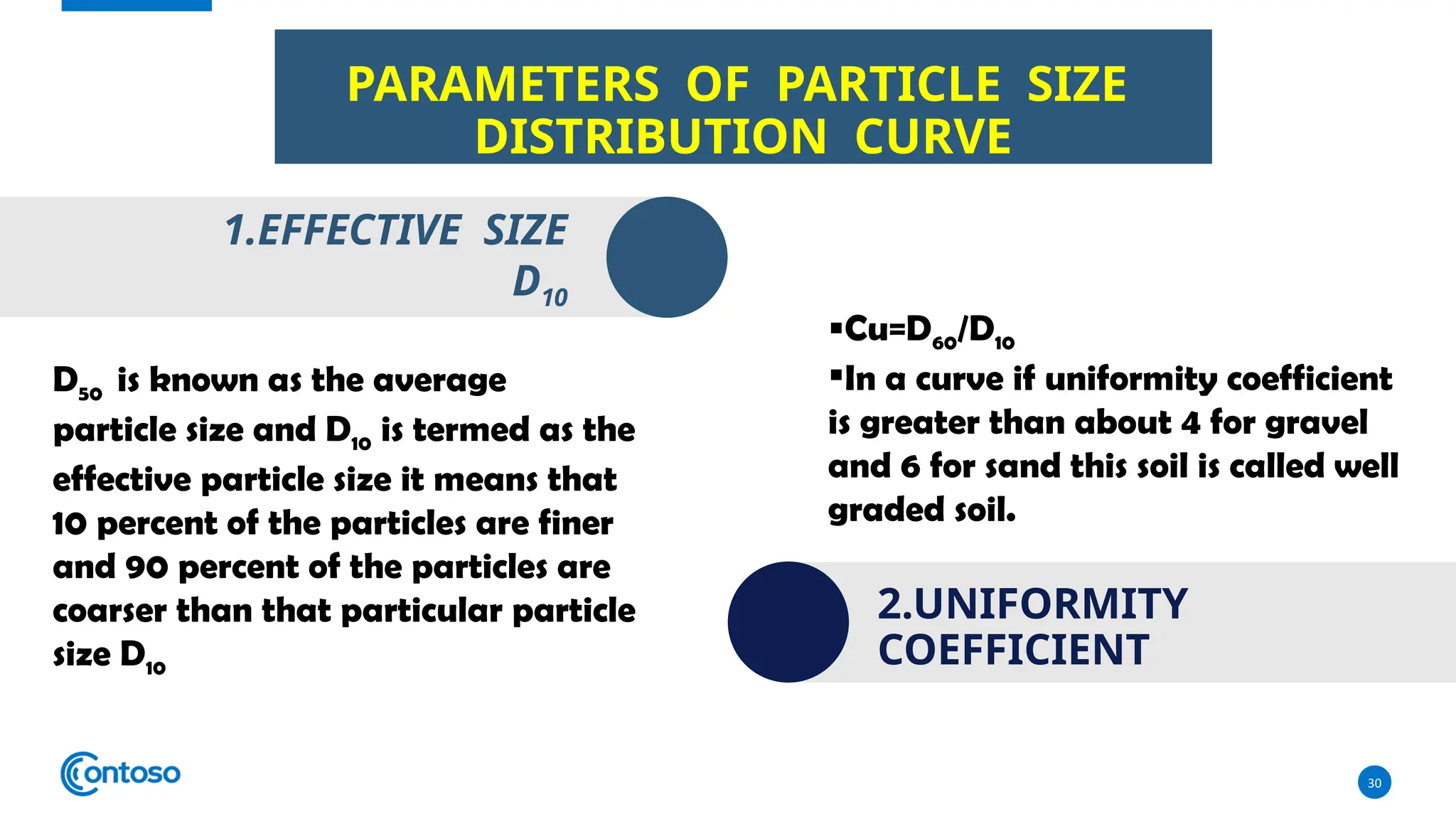
D50 is known as the average
particle size and D10 is termed as the
effective particle size it means that
10 percent of the particles are finer
and 90 percent of the particles are
coarser than that particular particle
size D10
Cu=D60/D10
In a curve if uniformity coefficient
is greater than about 4 for gravel
and 6 for sand this soil is called well
graded soil.
31
3. COEFFICIENT OF GRADATION
4. SORTING COEFFICIENT( SO)
The equation for this coefficient is,
Cc =[D30]2
/[(D60)(D10)]
If it ranges between 1 to 3( for
gravel and sands) in a curve so this
kind of soil is also called well
graded soil.
So=(D75/D25 )1/2
It is also a determinate for sorting
condition of soil.
PARAMETERS OF PARTICLE SIZE
DISTRIBUTION CURVE
32
ENVIRONMENTAL INTERPRETATION
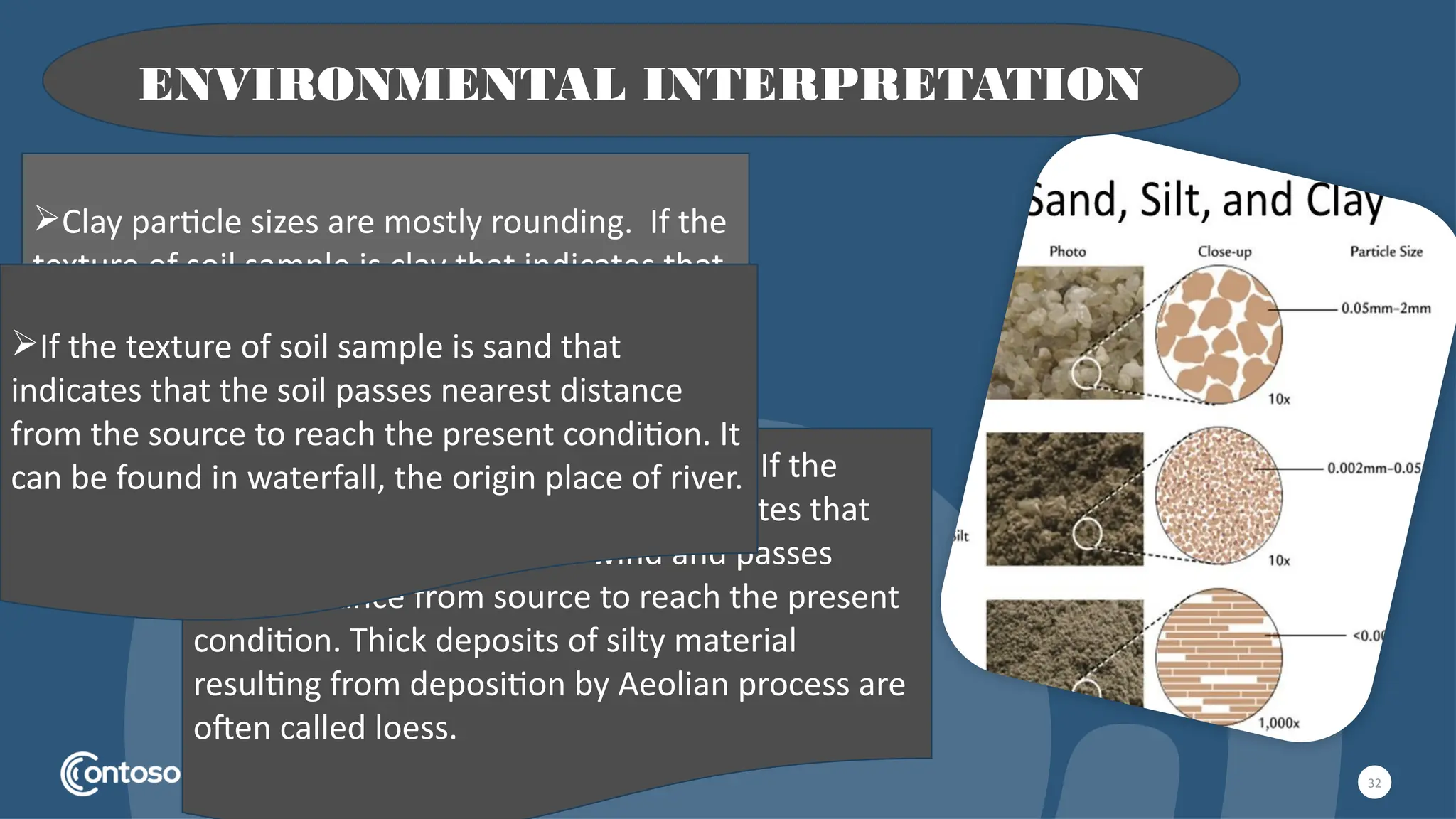
Clay particle sizes are mostly rounding. If the
texture of soil sample is clay that indicates that
the soil took so much time and long distance to
reach the present condition. It can be found in
river bank, beneath of inland water bodies.
Silt particles have a spherical shape. If the
texture of soil sample is silt that indicates that
the soils flow by stream or wind and passes
some distance from source to reach the present
condition. Thick deposits of silty material
resulting from deposition by Aeolian process are
often called loess.
If the texture of soil sample is sand that
indicates that the soil passes nearest distance
from the source to reach the present condition. It
can be found in waterfall, the origin place of river.
33
Practical
Implications of
Mechanical Analysis
Of Soil
I. The mechanical analysis is not of much significance unless stone and gravel are present in
large quantities exceeding 10 per cent. If they are present beyond 10 per cent but not
exceeding too large then facilitate drainage and tillage.
II. It helps in deciding the textural class names like sand, sandy loam, clay loam etc.
III. one can easily understand the physical properties as well as colloidal behavior of soils
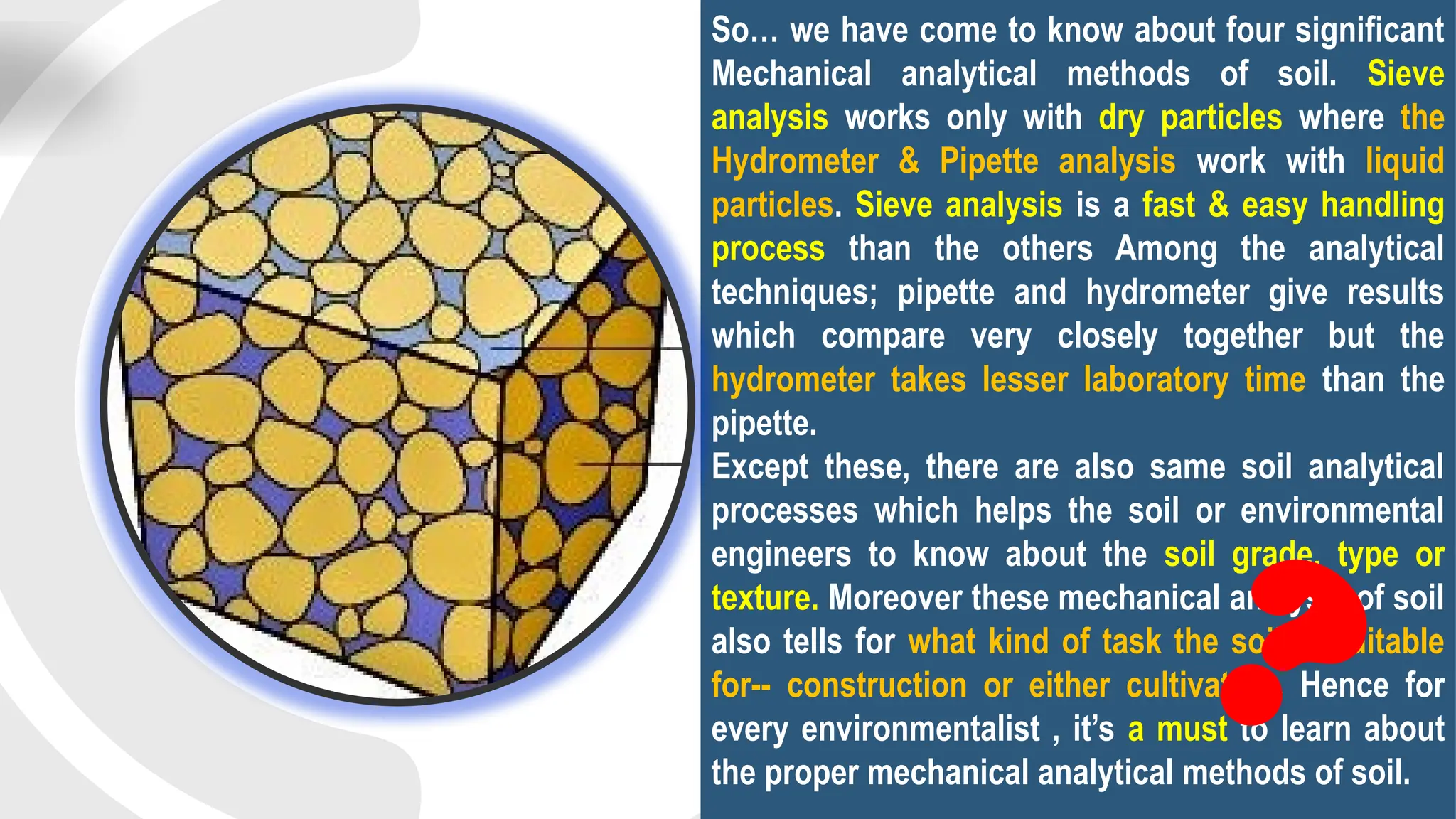
So… we have come to know about four significant
Mechanical analytical methods of soil. Sieve
analysis works only with dry particles where the
Hydrometer & Pipette analysis work with liquid
particles. Sieve analysis is a fast & easy handling
process than the others Among the analytical
techniques; pipette and hydrometer give results
which compare very closely together but the
hydrometer takes lesser laboratory time than the
pipette.
Except these, there are also same soil analytical
processes which helps the soil or environmental
engineers to know about the soil grade, type or
texture. Moreover these mechanical analysis of soil
also tells for what kind of task the soil is suitable
for-- construction or either cultivation. Hence for
every environmentalist , it’s a must to learn about
the proper mechanical analytical methods of soil.
?
35
SAIDA ISLAM SEJUTI
18103432
AMINA BEGUM
18103431
RIFAT ARA SHUCHE
18103403
FATEMA KHAN TAMANNA
18103404
HAMIDA JANNAT
17103420
SABINA YASMIN ETI
18103440
Team Seekers

Thank
You
All…!!!

Group ppt on Mechanical Analysis of Soil

  • 1.
    MECHANICAL ANALYSIS OF SOIL Presentationon “TEAM SEEKERS” SESSION: 2017-18 2ND YEAR, 1ST SEMESTER DEPARTMENT OF ENVIRONMENTAL SCIENCE AND ENGINEERING
  • 2.
    2 Presentation Outline Mechanical analysis Soilparticle size Soil gradation Soil texture Sieve analysis Sedimentation Hydrometer analysis Pipette method Hydro photometer analysis Gamma ray analysis Particle size distribution curve parameters Environmental interpretation Practical implications
  • 3.
    3 Let’s Figure outsomething…. Before After
  • 4.
    4 Mechanical Analysis of Soil Isthe determination of the size range of particles. Or, The analytical process by which particles are separated into various size groups from the coarsest sand through the silt to the finest clay. Soil Particle size Soil Gradation & Soil Texture
  • 5.
    Particle Size Class Size(mm) Clay <0.002 Silt0.002-0.05 Sand Fine 0.05-0.24 Medium 0.25-0.49 Course 0.5-0.99 Very Course 1-2 Gravel 2-75 Cobbles 75-250 Stones 250-600 Boulders >600 Soil Particle Size Is the diameter of individual grains or the lithified particles in clastic rocks.
  • 6.
    6 Is a classificationof course grained soil based on the different particle sizes contained in the soil Is a indicator of engineering properties such as—compressibility, shear strength and hydraulic conductivity. Most common soil grades are— 1) Well graded 2) Poorly graded 3) Gap graded Soil Gradation Well graded Poorly graded Gap graded POORLY GRADED: Most of the particles are approximately of the same size. Permeability is more than well graded soil. GAP GRADED: Not all particle size is present as some are completely missing in them. WELL GRADED: Contains particle of a wide range of sizes(all sizes no 4 to no 200) More interlocking and higher friction angle.
  • 7.
    7 Soil Texture refers tothe composition of the soil in terms of the amounts of small (clays), medium (silts), and large (sands) size particles. According to USDA, there are 12 textural classes of soil; but the most common are— I. Sandy soil, II. Silty soil, III.Clay soil & IV. Loamy soil. Sandy soil Feel Gritty Seen Can be seen with naked eye Hand Sampling No residue rest on hand Silty soil Feel Dry Powdery smooth, flour like Wet Creamy stick, slippery feel Seen With hand lens or microscope Hand Sampling Coats hand, able to Brush off Clay soil Feel Dry Hard Wet Sticky, Plastic feel Seen With an Electron microscope Hand Sampling Sticks to fingers Loamy soil A mix of sand, silt, clay that optimizes agricultural productivity
  • 8.
    8 for particle sizes largerthan 0.075mm (coarse particles). Sedimentation Analysis: for particle sizes smaller than 0.075mm (fine particles). MECHANICAL ANALYSIS OF SOIL Sieve Analysis: 1 2
  • 9.
    A SIEVE ANALYSISIS A PROCEDURE USED TO ASSESS THE PARTICLE SIZE DISTRIBUTION OF A GRANULAR MATERIALS. A SIEVE SEPARATE FINE MATERIALS FROM COURSE MATERIALS BY MEANS OF A SERIES OF PERFORATED SURFACE. SIEVE ANALYSIS
  • 10.
    10 • Sampling Bag •GPS Meter • Permanent Marker • Container • Brush • Tracing Paper • Balance • Oven • Sieve Analyzer EQUIPMENT NEEDED
  • 11.
    1. Sample collection 2.Preserve and levelling 3. Sample drying: Sundry, Oven dry 11 PROCESS OF SIEVE ANALYSING
  • 12.
    4. Bland drysoil. 7. Pour the dry sample on the top sieves. 5. Measure the weight of specific quantity of soil. 6. Arranged the stack of sieves. 12 PROCESS OF SIEVE ANALYSING
  • 13.
    9. Remove thestack of each sieve separately. 10. Measure the particle weight of each sieve. 13 PROCESS OF SIEVE ANALYSING 8. Setup timer of shaking.  % of loss weight of particle =  soil sample texture, particle size can be determined.
  • 14.
    SMALL PARTICLES OFPARTICULAR SIZE RANGE IN LIQUID SUSPENSION HAVE TENDENCY TO SETTLE DOWN FOR MULTIPLE TYPE OF FORCES ACTING ON THEM.THIS BEHAVIOUR IS CALLED SEDIMENTATION. THIS PROCESS ANALYSE SMALLER PARTICLES WHICH CANNOT BE SIEVED. sedimentation analysis
  • 15.
    RELATION WITH STOKESLAW He/t= (ρs-ρw)D2 /18ŋ 15 V ∝ d2 STOKES LAW EQUATION ANOTHER EQUATION
  • 16.
  • 17.
    17 SEDIMENTATION ANALYSIS METHOD HYDROMETER METHOD EffectiveDepth He has to be measured Effective Depth He is constant PIPETTE METHOD
  • 18.
    18 A hydrometer isan instrument which is used to measure the relative density of a liquid. Hydrometer is made of glass and primarily consists of two parts: 1. A cylindrical stem with graduation marks 2. A bulb at bottom called ‘Ballast’ weighted with mercury A.Casagrande has shown that hydrometer gives the value of specific gravity at the centre of its bulb. HYDROMETER Ballast Stem
  • 19.
    19 Hydrometer Two glass jarof 1 litre capacity Deflocculating agent (sodium Hexa metaphosphate) Stop watch Thermometer Scale EQUIPMENT NEEDED
  • 20.
    1. Determination ofvolume of the hydrometer bulb (Vh) 2. Find The cross-sectional area (A) of the jar 20 PROCESS OF HYDROMETER ANALYSIS
  • 21.
    3.Measuring the heightof the bulb(h) 4.Calibrate the hydrometer(relation between effective depth He and Hydrometer reading Rh) 21 PROCESS OF HYDROMETER ANALYSIS h Calibration curve of hydrometer
  • 22.
    EFFECTIVE DEPTH If hydrometerreading is “x”, Rh=(x-1)*100 He = H + 0.5 (h – Vh/A) Percent Finer=(Rh*a/Ws)*100 22 He Vh
  • 23.
    • The pipettemethod is a modified sedimentation method for classifying finely divided material according to particle size. • The relation between size and rate of fall of solid spherical particles in any liquid is given by the following form of Stokes' equation: t={18Hu/(P1-P2)gd2}108 23 PIPETTE METHOD
  • 24.
    THE HYDRO PHOTOMETERUSES A LIGHT BEAM AND A PHOTO SENSITIVE CELL TO DETERMINE THE CONCENTRATION OF PARTICLES.  THE INSTRUMENT COMPRISES A LIGHT SOURCE, PHOTO CELL, SIX SAMPLE CARRIAGE, AND A TUNING CONSOLE WITH DIGITAL DISPLAY. SIX SAMPLES ARE ANALYZED IN ONE RUN, ACCORDING TO A SCHEDULE WHICH TAKES ONLY 1 H TO COMPLETE.  DURING ANALYSIS, THE LIGHT SOURCE IS MOVED FROM CELL TO CELL AND THE PERCENT TRANSMISSION, SEEN ON THE DIGITAL DISPLAY WHICH IS RECORDED. HYDROPHOTOMETER ANALYSIS
  • 25.
    Gamma ray isa new soil analysis method. It is based on the attenuation of gamma ray beam by a soil suspension.  There is no perturbation of sedimentation process and it is a continuous analysis of particle size distribution. 25 GAMMA RAY ANALYSIS
  • 26.
    9 Mash No Opening No(mm) Particle Name Polybag Weight(g) Final Particle Weight(g) 10 2 Coarse Sand 0.411 3.105 40 0.42 Medium Sand 11.149 200 0.074 Fine Sand 20.236 270 0.053 Silt 23.114 <0.002 Clay 41.222 Total= 98.826 From here, we found the percentages of soil particles as below— Clay= 41.222% Silt= 23.11% Sand(Coarse, Medium & Fine)= 34.46% Result and Discussion
  • 27.
    27 Graph & Chart 20.42 0.074 0.053 <0.002 0 5 10 15 20 25 30 35 40 45 Particle Weight(g) Size (Sand, Silt, Clay) Weight Percenteg (%) Clay textured soil
  • 28.
    28 Is the process clear to us??? Canwe now place the % on Texture triangle graph & determine the texture??? ? ? ? Let’s try it out…
  • 29.
    29 If you get35% Sand, 45% Silt & 20% clay from Mechanical analysis, So, What will be the Texture!!! Can you determine it from the texture triangle? Texture: Loam
  • 30.
    30 PARAMETERS OF PARTICLESIZE DISTRIBUTION CURVE 1.EFFECTIVE SIZE D10 2.UNIFORMITY COEFFICIENT D50 is known as the average particle size and D10 is termed as the effective particle size it means that 10 percent of the particles are finer and 90 percent of the particles are coarser than that particular particle size D10 Cu=D60/D10 In a curve if uniformity coefficient is greater than about 4 for gravel and 6 for sand this soil is called well graded soil.
  • 31.
    31 3. COEFFICIENT OFGRADATION 4. SORTING COEFFICIENT( SO) The equation for this coefficient is, Cc =[D30]2 /[(D60)(D10)] If it ranges between 1 to 3( for gravel and sands) in a curve so this kind of soil is also called well graded soil. So=(D75/D25 )1/2 It is also a determinate for sorting condition of soil. PARAMETERS OF PARTICLE SIZE DISTRIBUTION CURVE
  • 32.
    32 ENVIRONMENTAL INTERPRETATION Clay particlesizes are mostly rounding. If the texture of soil sample is clay that indicates that the soil took so much time and long distance to reach the present condition. It can be found in river bank, beneath of inland water bodies. Silt particles have a spherical shape. If the texture of soil sample is silt that indicates that the soils flow by stream or wind and passes some distance from source to reach the present condition. Thick deposits of silty material resulting from deposition by Aeolian process are often called loess. If the texture of soil sample is sand that indicates that the soil passes nearest distance from the source to reach the present condition. It can be found in waterfall, the origin place of river.
  • 33.
    33 Practical Implications of Mechanical Analysis OfSoil I. The mechanical analysis is not of much significance unless stone and gravel are present in large quantities exceeding 10 per cent. If they are present beyond 10 per cent but not exceeding too large then facilitate drainage and tillage. II. It helps in deciding the textural class names like sand, sandy loam, clay loam etc. III. one can easily understand the physical properties as well as colloidal behavior of soils
  • 34.
    So… we havecome to know about four significant Mechanical analytical methods of soil. Sieve analysis works only with dry particles where the Hydrometer & Pipette analysis work with liquid particles. Sieve analysis is a fast & easy handling process than the others Among the analytical techniques; pipette and hydrometer give results which compare very closely together but the hydrometer takes lesser laboratory time than the pipette. Except these, there are also same soil analytical processes which helps the soil or environmental engineers to know about the soil grade, type or texture. Moreover these mechanical analysis of soil also tells for what kind of task the soil is suitable for-- construction or either cultivation. Hence for every environmentalist , it’s a must to learn about the proper mechanical analytical methods of soil. ?
  • 35.
    35 SAIDA ISLAM SEJUTI 18103432 AMINABEGUM 18103431 RIFAT ARA SHUCHE 18103403 FATEMA KHAN TAMANNA 18103404 HAMIDA JANNAT 17103420 SABINA YASMIN ETI 18103440 Team Seekers
  • 36.