Detecting Neutralization
Antibodies to COVID-19
Group 2
Agenda
• Virus Structure
• Mechanism of infection
• Tests and timing
• Neutralization antibodies and associated tests
• C-Pass SARS Cov-2 Neutralization antibody
kit (sVNT)
• Pros and Comparison
Introduction
A robust serological test to detect neutralizing
antibodies to SARS Cov-2 is needed to
determine not only the infection rate, herd
immunity and predicted humoral protection, but
also vaccine efficacy during clinical trials after
large scale vaccination.
Transmission
mechanism of
Covid-19
Binding of coronavirus spike protein
(red) to an ACE2 receptor (blue) on
a human cell leads to the
penetration of the virus in the cell.
Spike protein (red) contains 2
subunits: S1 (yellow) and S2. S1
yellow contains receptor binding
domain.
Timing for Molecular Tests Post
Infection
Viral RNA/
Antigen/
Antibody levels
in blood
To Time
Nucleic acid and Antibody- Based Tests
to Reduce Disease Period
Nucleic Acid Test
• Highly sensitive test to detect the
presence of the virus itself very early
after infection.
• Dependent on sampling the
appropriate tissue or fluids to avoid
false negatives.
• Reduced disease period by revealing
very early infected who can
immediately self-quarantine.
Serological Test (Antibody-Based)
• Detects antibodies generated by
infected people during their natural
immune response.
• Antibody test result could be positive
when the nucleic acid result is
negative.
• Permits asymptomatic individuals to
confirm past infection from which they
recovered.
Complementary tests to confirm Infection
Protein Based capture tests for IgG and IgM
Receptor Binding Domain
(RBD) of SARS-Cov-2
Nucleocapsid Protein
(NP) of SARS-Cov-2
Immune response
antibodies (IgM & IgG) to
NP from patient sample
Immune response
antibodies (IgM & IgG) to
RBD from patient sample
RBD of the spike
protein binds to
ACE2 receptor
Protein Based capture tests for IgG and IgM
Mouse anti-human IgG or IgM
detection antibodies
Protein Based capture tests for IgG and IgM
Detects only anti-
Spike S1- RBD
protein antibodies.
IgG and IgM can be
detected together or
in separate wells.
Quantitative assay.
Useful for diagnostic,
vaccine and drug
development.
Detects only anti-
Spike S1- RBD and
anti nucleocapsid
protein antibodies.
IgG and IgM can be
detected together in
each wells.
Qualitative assay.
Useful for diagnostic,
vaccine and drug
development.
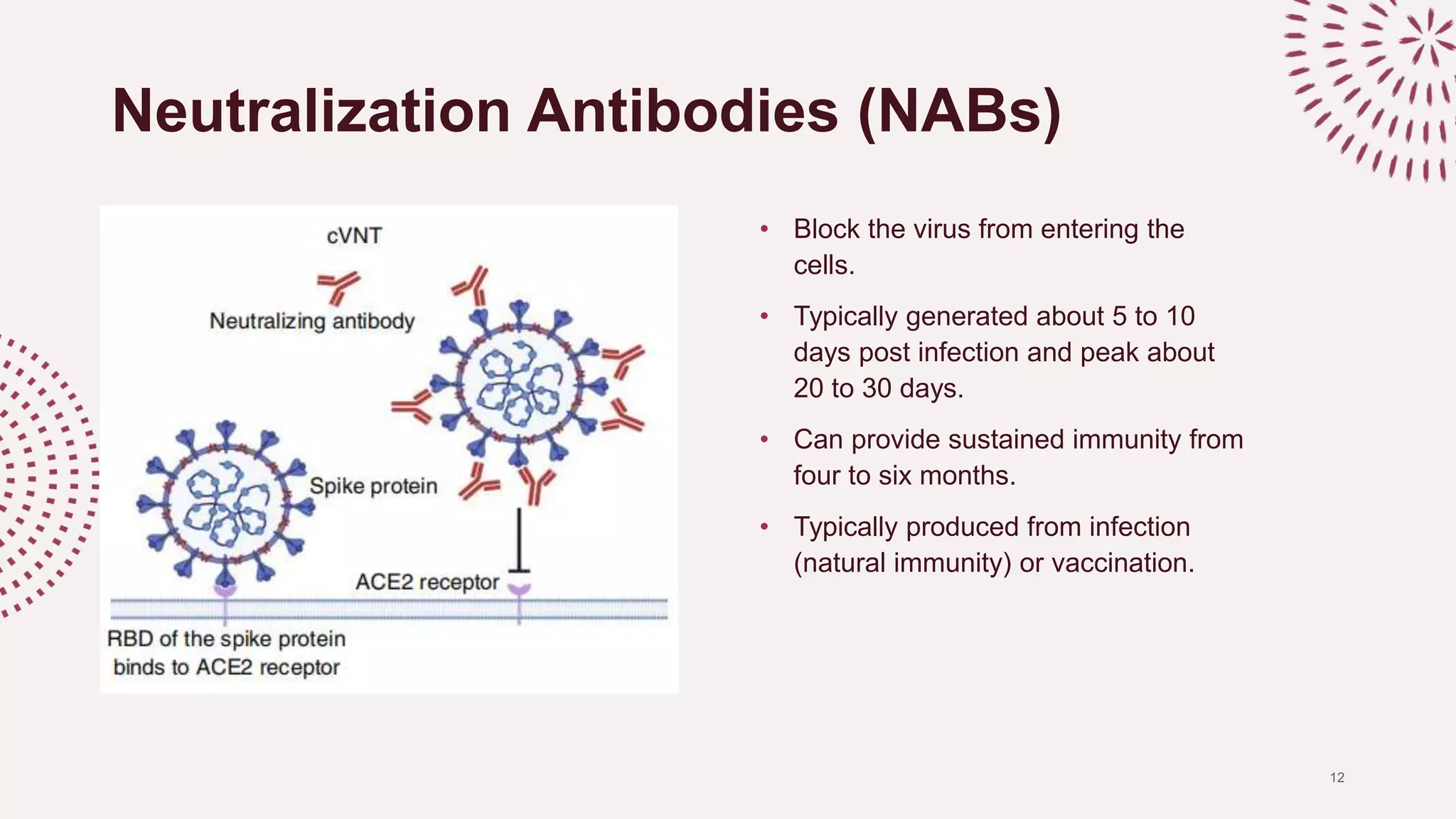
Neutralization Antibodies (NABs)
• Block the virus from entering the
cells.
• Typically generated about 5 to 10
days post infection and peak about
20 to 30 days.
• Can provide sustained immunity from
four to six months.
• Typically produced from infection
(natural immunity) or vaccination.
Pre-Existing Neutralization Ab Tests
Virus Neutralization Test
• Live cells and live SARS
Cov-2 virus
(DANGEROUS) required.
• Specialized biosafety level
3 (BSLV3) containment
facility.
• Requires 2-4 days with
complex equipment and
reagents.
Pseudo virus based VNT
• Live cells and live pseudo-
virus (SAFER) required.
• (BSL2) Lab.
• Requires 2-4 days with
complex equipment and
reagents.
SARS Cov-2 surrogate VNT
(CPASS Genscript)
• No cells or live virus
required (Basic ELISA Kit).
• BSL2 Lab.
• Requires 1 to 2 hours with
basic equipment and
reagents.
• Species independent (can
be used with any organism
infected and recovered
from SARS Cov-2 virus.
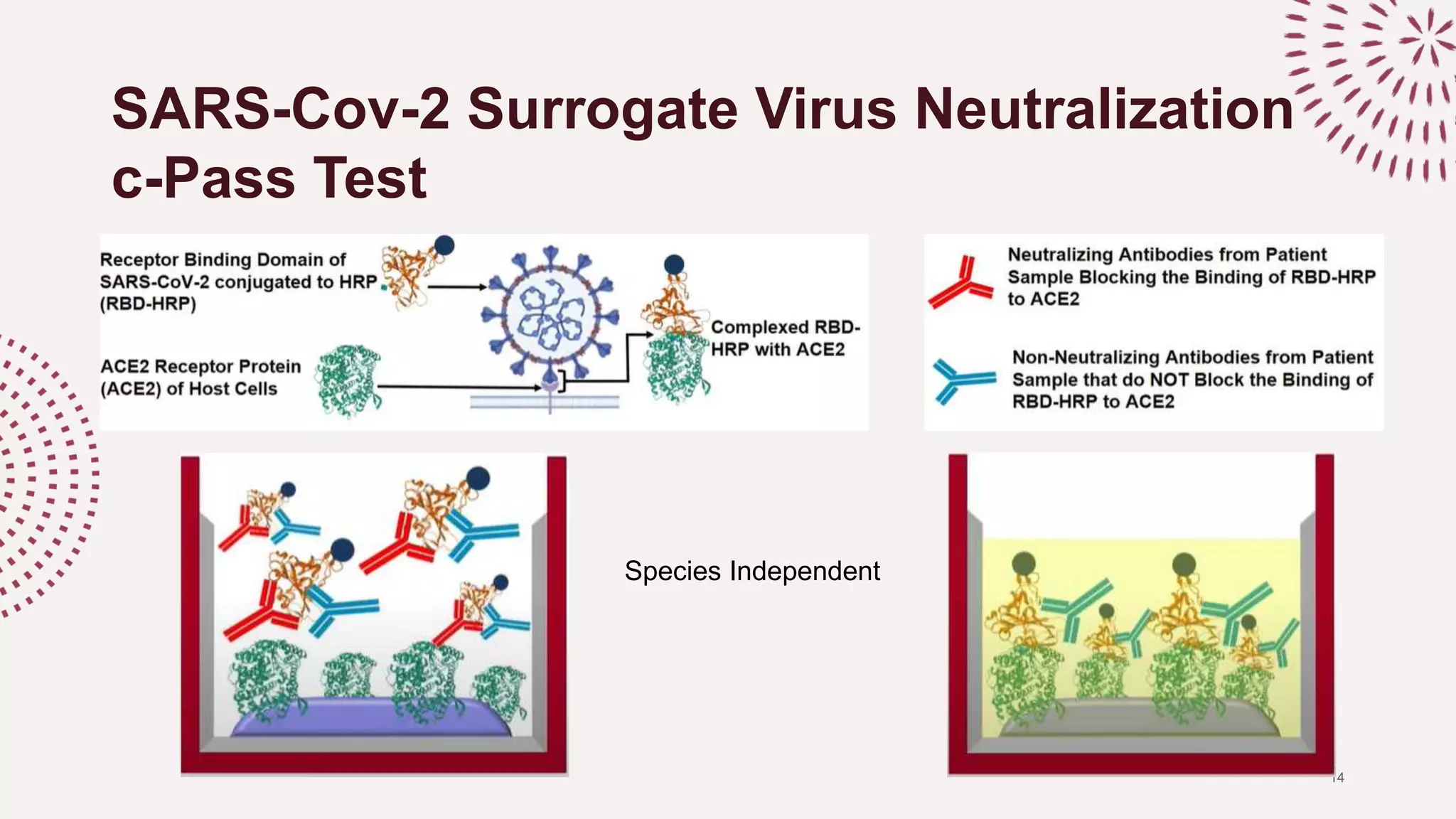
SARS-Cov-2 Surrogate Virus Neutralization
c-Pass Test
Species Independent
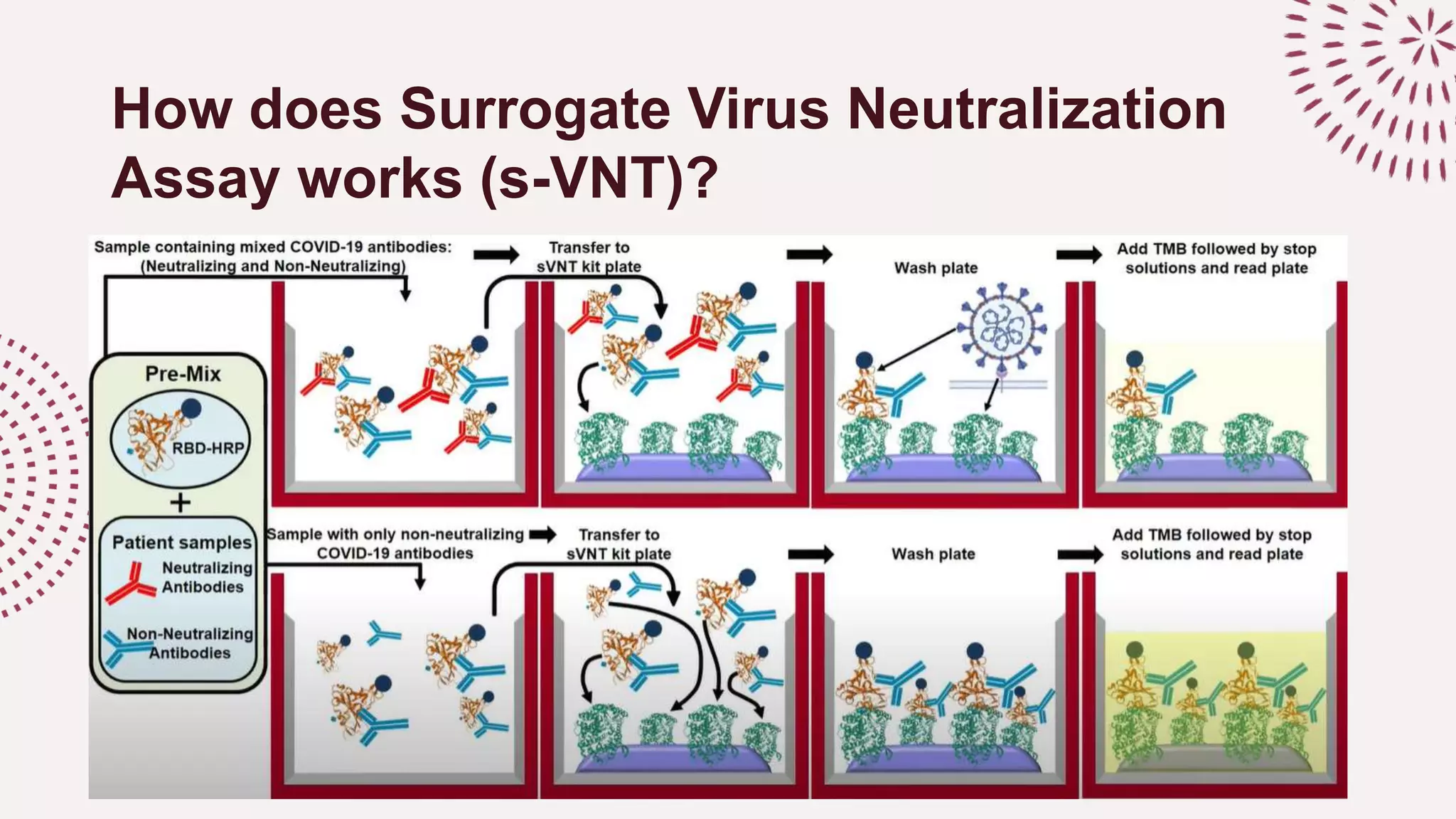
How does Surrogate Virus Neutralization
Assay works (s-VNT)?
Advantages of cPass s-VNT assay for
detecting immunoglobins
Immunoglobin Agnostic
• Permits the detection of
any immune response
antibody that binds to RBD
and blocks its interaction
with ACE2.
• Not limited to IgG and IgM
(higher sensitivity).
• Species independent.
RBD is in solution
• RBD is not coated on plate.
• Much lower probability of
confirmational differences
for RBD in the solution vs
coated to a plate surface.
• Immunoglobins react with a
more native conformation
of RBD and its associated
antigenic sites (higher
specificity).
Dual Detection and functional
assay
• RBD must bind to ACE2
coated plate (neutralizing
antibody dependent).
• Detects the presence of
neutralizing antibodies with
sensitivity and specificity
that rivals traditional IgG
and IgM ELISA tests.
• Requires 1 hour with basic
equipment and reagents.
Comparison of SVNT with RBD coated
ELISA (IgG & IgM)
Grouped Clinical Data (GenScript SVNT Results)
Performance cross species c-pass SVNT
• Tested Rabbit and Ferret.
• In principle as the blocking is on the
virus protein, this methodology should
work for all species.
Summary
In summary, we have addressed the challenge
of COVID-19 serology with an approach that
enables the detection of NAbs in an easy, safe
and rapid manner with enhanced specificity and
sensitivity. Although the sVNT assay may never
be able to completely replace cVNT, data
indicate that the performance of sVNT is well
correlated with that of both cVNT and pVNT. Its
application can cover many aspects of COVID-
19 investigation from contact tracing,
seroprevalence surveying and
reservoir/intermediate animal tracking to the
assessment of herd immunity and longevity of
protective immunity. It can also be used to
assess vaccine efficacy during preclinical and
clinical trials of different vaccine candidates and
to monitor neutralizing titers in vaccinees after
mass vaccination in human populations.
REFERENCES
• A SARS-CoV-2 surrogate virus neutralization test based on antibody-mediated blockage of
ACE2–spike protein–protein interaction (nature article).
• https://doi.org/10.1038/s41587-020-0631-z
• COVID-19 Detection | cPass™ Kit Technology (genscript.com)
Thank you
Group 2

Detecting neutralization antibodies to covid 19

  • 1.
  • 2.
    Agenda • Virus Structure •Mechanism of infection • Tests and timing • Neutralization antibodies and associated tests • C-Pass SARS Cov-2 Neutralization antibody kit (sVNT) • Pros and Comparison
  • 3.
    Introduction A robust serologicaltest to detect neutralizing antibodies to SARS Cov-2 is needed to determine not only the infection rate, herd immunity and predicted humoral protection, but also vaccine efficacy during clinical trials after large scale vaccination.
  • 4.
    Transmission mechanism of Covid-19 Binding ofcoronavirus spike protein (red) to an ACE2 receptor (blue) on a human cell leads to the penetration of the virus in the cell. Spike protein (red) contains 2 subunits: S1 (yellow) and S2. S1 yellow contains receptor binding domain.
  • 5.
    Timing for MolecularTests Post Infection Viral RNA/ Antigen/ Antibody levels in blood To Time
  • 6.
    Nucleic acid andAntibody- Based Tests to Reduce Disease Period Nucleic Acid Test • Highly sensitive test to detect the presence of the virus itself very early after infection. • Dependent on sampling the appropriate tissue or fluids to avoid false negatives. • Reduced disease period by revealing very early infected who can immediately self-quarantine. Serological Test (Antibody-Based) • Detects antibodies generated by infected people during their natural immune response. • Antibody test result could be positive when the nucleic acid result is negative. • Permits asymptomatic individuals to confirm past infection from which they recovered. Complementary tests to confirm Infection
  • 7.
    Protein Based capturetests for IgG and IgM Receptor Binding Domain (RBD) of SARS-Cov-2 Nucleocapsid Protein (NP) of SARS-Cov-2 Immune response antibodies (IgM & IgG) to NP from patient sample Immune response antibodies (IgM & IgG) to RBD from patient sample RBD of the spike protein binds to ACE2 receptor
  • 8.
    Protein Based capturetests for IgG and IgM
  • 9.
    Protein Based capturetests for IgG and IgM
  • 10.
    Protein Based capturetests for IgG and IgM Mouse anti-human IgG or IgM detection antibodies
  • 11.
    Protein Based capturetests for IgG and IgM Detects only anti- Spike S1- RBD protein antibodies. IgG and IgM can be detected together or in separate wells. Quantitative assay. Useful for diagnostic, vaccine and drug development. Detects only anti- Spike S1- RBD and anti nucleocapsid protein antibodies. IgG and IgM can be detected together in each wells. Qualitative assay. Useful for diagnostic, vaccine and drug development.
  • 12.
    Neutralization Antibodies (NABs) •Block the virus from entering the cells. • Typically generated about 5 to 10 days post infection and peak about 20 to 30 days. • Can provide sustained immunity from four to six months. • Typically produced from infection (natural immunity) or vaccination.
  • 13.
    Pre-Existing Neutralization AbTests Virus Neutralization Test • Live cells and live SARS Cov-2 virus (DANGEROUS) required. • Specialized biosafety level 3 (BSLV3) containment facility. • Requires 2-4 days with complex equipment and reagents. Pseudo virus based VNT • Live cells and live pseudo- virus (SAFER) required. • (BSL2) Lab. • Requires 2-4 days with complex equipment and reagents. SARS Cov-2 surrogate VNT (CPASS Genscript) • No cells or live virus required (Basic ELISA Kit). • BSL2 Lab. • Requires 1 to 2 hours with basic equipment and reagents. • Species independent (can be used with any organism infected and recovered from SARS Cov-2 virus.
  • 14.
    SARS-Cov-2 Surrogate VirusNeutralization c-Pass Test Species Independent
  • 15.
    How does SurrogateVirus Neutralization Assay works (s-VNT)?
  • 16.
    Advantages of cPasss-VNT assay for detecting immunoglobins Immunoglobin Agnostic • Permits the detection of any immune response antibody that binds to RBD and blocks its interaction with ACE2. • Not limited to IgG and IgM (higher sensitivity). • Species independent. RBD is in solution • RBD is not coated on plate. • Much lower probability of confirmational differences for RBD in the solution vs coated to a plate surface. • Immunoglobins react with a more native conformation of RBD and its associated antigenic sites (higher specificity). Dual Detection and functional assay • RBD must bind to ACE2 coated plate (neutralizing antibody dependent). • Detects the presence of neutralizing antibodies with sensitivity and specificity that rivals traditional IgG and IgM ELISA tests. • Requires 1 hour with basic equipment and reagents.
  • 17.
    Comparison of SVNTwith RBD coated ELISA (IgG & IgM)
  • 18.
    Grouped Clinical Data(GenScript SVNT Results)
  • 19.
    Performance cross speciesc-pass SVNT • Tested Rabbit and Ferret. • In principle as the blocking is on the virus protein, this methodology should work for all species.
  • 20.
    Summary In summary, wehave addressed the challenge of COVID-19 serology with an approach that enables the detection of NAbs in an easy, safe and rapid manner with enhanced specificity and sensitivity. Although the sVNT assay may never be able to completely replace cVNT, data indicate that the performance of sVNT is well correlated with that of both cVNT and pVNT. Its application can cover many aspects of COVID- 19 investigation from contact tracing, seroprevalence surveying and reservoir/intermediate animal tracking to the assessment of herd immunity and longevity of protective immunity. It can also be used to assess vaccine efficacy during preclinical and clinical trials of different vaccine candidates and to monitor neutralizing titers in vaccinees after mass vaccination in human populations.
  • 21.
    REFERENCES • A SARS-CoV-2surrogate virus neutralization test based on antibody-mediated blockage of ACE2–spike protein–protein interaction (nature article). • https://doi.org/10.1038/s41587-020-0631-z • COVID-19 Detection | cPass™ Kit Technology (genscript.com)
  • 22.