ELECTROMECHANICAL SELF
REPRODUCTION
By, Melvin Alex
Why self replication machines?
• Robots that could replicate or at least repair themselves while
working in space or in hazardous environments.
• Robots sent to explore Mars could carry a supply of spare modules to
use for repairing or rebuilding as needed, allowing for more flexible,
versatile and robust missions.
• solar satellites in space.
John Von Neumann
Reproduction
vs
Replication
Capability Requirements
• Mobility
• Communication
• Processing
• Sensors
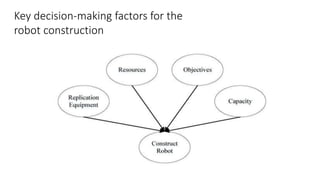
Key decision-making factors for the
robot construction
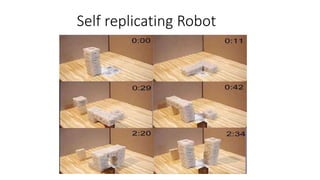
Self replicating Robot
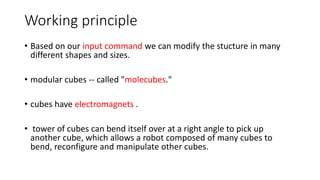
Working principle
• Based on our input command we can modify the stucture in many
different shapes and sizes.
• modular cubes -- called "molecubes."
• cubes have electromagnets .
• tower of cubes can bend itself over at a right angle to pick up
another cube, which allows a robot composed of many cubes to
bend, reconfigure and manipulate other cubes.
Diagonal Cut
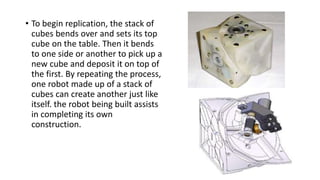
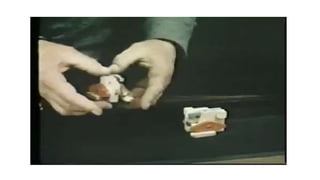
• To begin replication, the stack of
cubes bends over and sets its top
cube on the table. Then it bends
to one side or another to pick up a
new cube and deposit it on top of
the first. By repeating the process,
one robot made up of a stack of
cubes can create another just like
itself. the robot being built assists
in completing its own
construction.
Inspiration from DNA replication
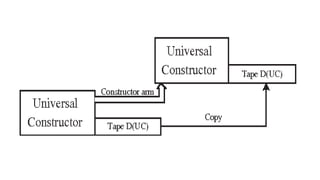
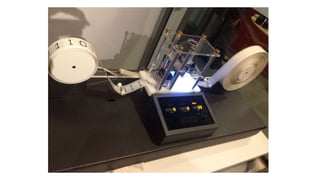
Turing machine
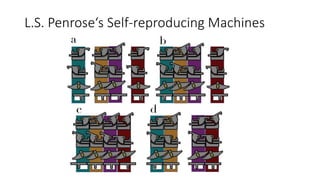
L.S. Penrose‘s Self-reproducing Machines
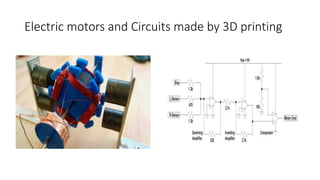
3D PRINTING
Electric motors and Circuits made by 3D printing
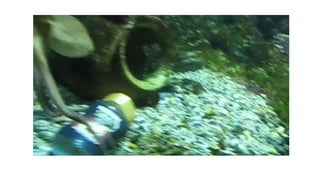
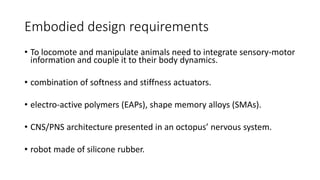
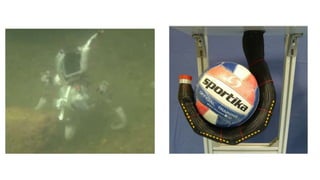
Bioinspired Octopus robot arm
Embodied design requirements
• To locomote and manipulate animals need to integrate sensory-motor
information and couple it to their body dynamics.
• combination of softness and stiffness actuators.
• electro-active polymers (EAPs), shape memory alloys (SMAs).
• CNS/PNS architecture presented in an octopus’ nervous system.
• robot made of silicone rubber.
CONCEPT
• If the diameter of the muscular-hydrostats decreases, then their
length increases, and vice versa.
• the arm is soft, including only springs, which are aligned to mimic the
muscular structure of the octopus.
• Robotic arm can be regenerated by electro-polymerization.
• virtually unlimited degrees of freedom.
References
• https://www.mdpi.com/2075-1702/5/2/12/htm
• https://arc.aiaa.org/doi/abs/10.2514/1.A33409
• https://www.creativemachineslab.com/self-replication.html
• https://scihub.se/https://www.researchgate.net/publication/324022524
_Bioinspiration_lessons_from_a_self-
replicating_machine_concept_in_a_constrained_environment

Electromechanical Self Reproduction

Editor's Notes

  • #4 Von Neumann
  • #10  self replicating machine video.
  • #12 DIAGONAL CUT
  • #13 (Cornell University researchers)
  • #17 model of turing machine , stored data on computer and can be reproduced.
  • #19 DEMONSTRATION VIDEO
  • #20 DEMONSTRATION VIDEO 2