The choice of a footwear release agent
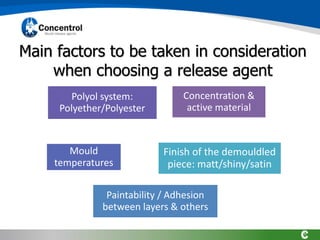
Main factors to be taken in consideration
when choosing a release agent
Concentration &
active material
Polyol system:
Polyether/Polyester
Mould
temperatures
Paintability / Adhesion
between layers & others
Finish of the demouldled
piece: matt/shiny/satin
3
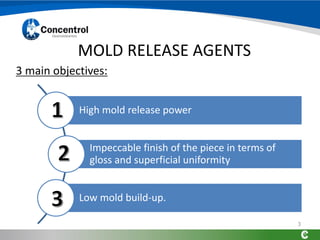
MOLD RELEASE AGENTS
3 main objectives:
High mold release power
Impeccable finish of the piece in terms of
gloss and superficial uniformity
Low mold build-up.
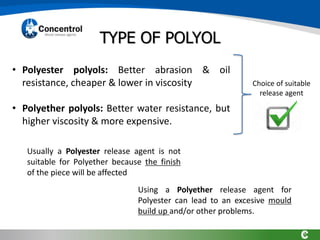
TYPE OF POLYOL
• Polyester polyols: Better abrasion & oil
resistance, cheaper & lower in viscosity
• Polyether polyols: Better water resistance, but
higher viscosity & more expensive.
Choice of suitable
release agent
Usually a Polyester release agent is not
suitable for Polyether because the finish
of the piece will be affected
Using a Polyether release agent for
Polyester can lead to an excesive mould
build up and/or other problems.
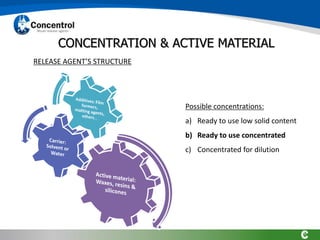
CONCENTRATION & ACTIVE MATERIAL
RELEASE AGENT’S STRUCTURE
Possible concentrations:
a) Ready to use low solid content
b) Ready to use concentrated
c) Concentrated for dilution
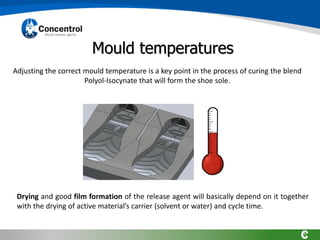
Mould temperatures
Adjusting the correct mould temperature is a key point in the process of curing the blend
Polyol-Isocynate that will form the shoe sole.
Drying and good film formation of the release agent will basically depend on it together
with the drying of active material’s carrier (solvent or water) and cycle time.
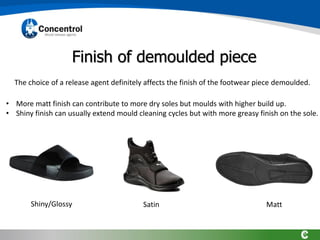
Finish of demoulded piece
The choice of a release agent definitely affects the finish of the footwear piece demoulded.
Shiny/Glossy Satin Matt
• More matt finish can contribute to more dry soles but moulds with higher build up.
• Shiny finish can usually extend mould cleaning cycles but with more greasy finish on the sole.
Secondary processes: Painting, gluing &
adhesion
After demolding → Painting, gluing or textile/leather adhesion.
Release agent can affect this process, so it is important to choice them accordingly.
Normally all demoulded soles are de-greased phisically or chemically to make easier the
following posterior treatments.
Specific release agents to make this process easier
9
RELEASE AGENTS FOR DUAL
DENSITY SOLES
During the same molding process the outsole has to bond with the midsole, but the
release agent can be transferred to the outsole during the process.
The mold release agent must not interfere at all with adhesion between
outsole and midsole.
*** Special release agents designed for this process ***
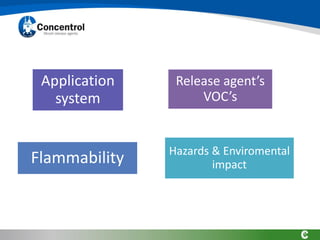
But there are other factors, usually
underrated, equally important to consider
Release agent’s
VOC’s
Application
system
Flammability Hazards & Enviromental
impact
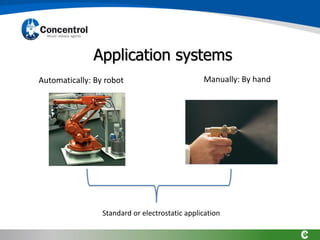
Application systems
Automatically: By robot Manually: By hand
Standard or electrostatic application
Robot application benefits
Always the same
application
Optimization of the
release agent
consumption
Easy to work with
electrostatic system
The application speed
can be
increased/adjusted
without risk of fatigue.
Cost reduction
More homogeneous
production
Robot application disadvantages
Robots cannot handle
unexpected situations
Higher investment at
beginning
Robots installed in
workplaces still
require manual labour
attached to them
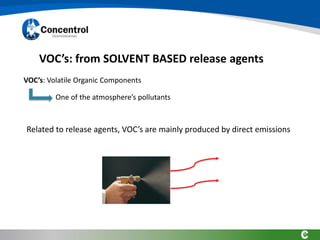
VOC’s: from SOLVENT BASED release agents
Related to release agents, VOC’s are mainly produced by direct emissions
VOC’s: Volatile Organic Components
One of the atmosphere’s pollutants
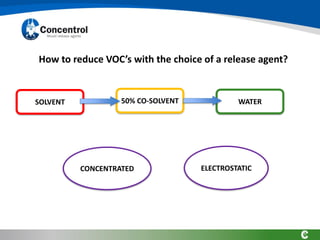
How to reduce VOC’s with the choice of a release agent?
SOLVENT 50% CO-SOLVENT WATER
CONCENTRATED ELECTROSTATIC
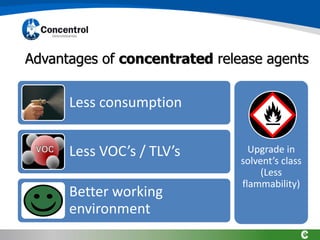
Advantages of concentrated release agents
Less consumption
Less VOC’s / TLV’s
Better working
environment
Upgrade in
solvent’s class
(Less
flammability)
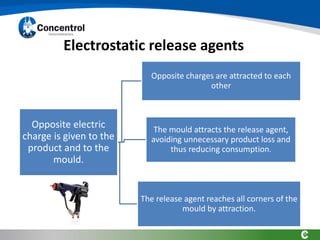
Electrostatic release agents
Opposite electric
charge is given to the
product and to the
mould.
Opposite charges are attracted to each
other
The mould attracts the release agent,
avoiding unnecessary product loss and
thus reducing consumption.
The release agent reaches all corners of the
mould by attraction.
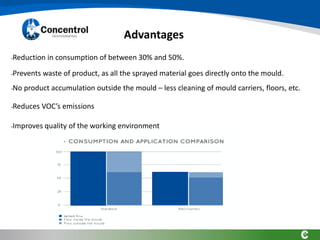
Advantages
•Reduction in consumption of between 30% and 50%.
•Prevents waste of product, as all the sprayed material goes directly onto the mould.
•No product accumulation outside the mould – less cleaning of mould carriers, floors, etc.
•Reduces VOC’s emissions
•Improves quality of the working environment
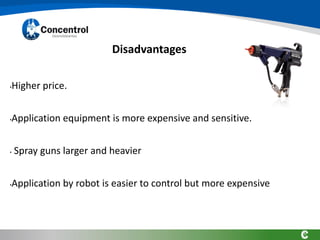
Disadvantages
•Higher price.
•Application equipment is more expensive and sensitive.
• Spray guns larger and heavier
•Application by robot is easier to control but more expensive
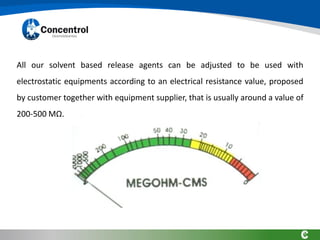
All our solvent based release agents can be adjusted to be used with
electrostatic equipments according to an electrical resistance value, proposed
by customer together with equipment supplier, that is usually around a value of
200-500 MΩ.
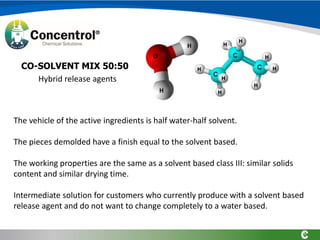
CO-SOLVENT MIX 50:50
Hybrid release agents
The vehicle of the active ingredients is half water-half solvent.
The pieces demolded have a finish equal to the solvent based.
The working properties are the same as a solvent based class III: similar solids
content and similar drying time.
Intermediate solution for customers who currently produce with a solvent based
release agent and do not want to change completely to a water based.
Main advantages in comparision with solvent-based release agent:
• Half reduction of VOC's emitted into the atmosphere
• Better work environment in the productive line
• Lower flammability
Main advantages in comparision with water-based release agents:
• More dry finish of the demoulded piece
• Cleaner than a classic water based release agent
• Similar working method as a solvent based release agent
CO-SOLVENT MIX 50:50
Hybrid release agents
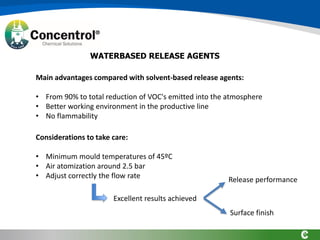
Main advantages compared with solvent-based release agents:
• From 90% to total reduction of VOC's emitted into the atmosphere
• Better working environment in the productive line
• No flammability
WATERBASED RELEASE AGENTS
Considerations to take care:
• Minimum mould temperatures of 45ºC
• Air atomization around 2.5 bar
• Adjust correctly the flow rate
Excellent results achieved
Release performance
Surface finish
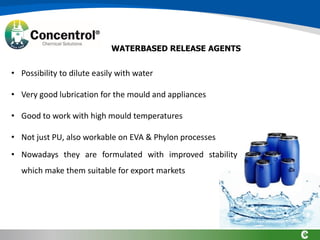
• Possibility to dilute easily with water
• Very good lubrication for the mould and appliances
• Good to work with high mould temperatures
• Not just PU, also workable on EVA & Phylon processes
• Nowadays they are formulated with improved stability
which make them suitable for export markets
WATERBASED RELEASE AGENTS
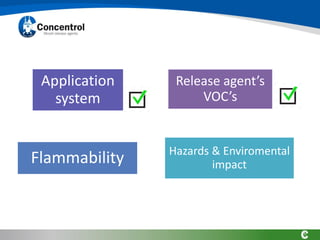
Release agent’s
VOC’s
Application
system
Flammability Hazards & Enviromental
impact
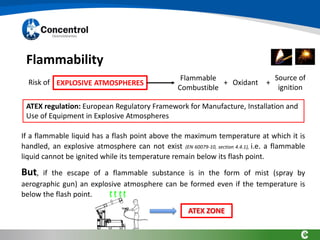
Flammability
Risk of EXPLOSIVE ATMOSPHERES
ATEX regulation: European Regulatory Framework for Manufacture, Installation and
Use of Equipment in Explosive Atmospheres
Flammable
Combustible
Oxidant+ +
Source of
ignition
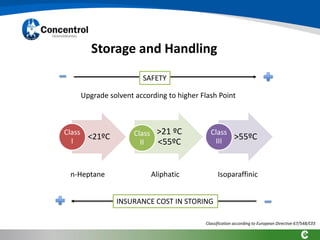
If a flammable liquid has a flash point above the maximum temperature at which it is
handled, an explosive atmosphere can not exist (EN 60079-10, section 4.4.1), i.e. a flammable
liquid cannot be ignited while its temperature remain below its flash point.
But, if the escape of a flammable substance is in the form of mist (spray by
aerographic gun) an explosive atmosphere can be formed even if the temperature is
below the flash point.
ATEX ZONE
<21ºC
Class
I
>21 ºC
<55ºC
Class
II
>55ºC
Class
III
n-Heptane Aliphatic Isoparaffinic

SAFETY
Upgrade solvent according to higher Flash Point

Storage and Handling
Classification according to European Directive 67/548/CEE
INSURANCE COST IN STORING
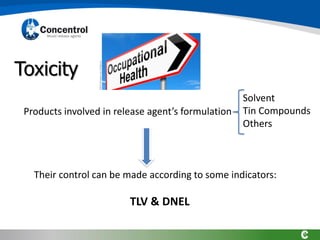
Toxicity
Products involved in release agent’s formulation
Solvent
Tin Compounds
Others
Their control can be made according to some indicators:
TLV & DNEL
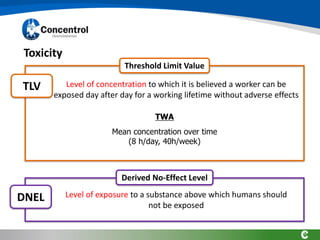
Toxicity
TLV
DNEL
Level of concentration to which it is believed a worker can be
exposed day after day for a working lifetime without adverse effects
TWA
Mean concentration over time
(8 h/day, 40h/week)
Level of exposure to a substance above which humans should
not be exposed
Threshold Limit Value
Derived No-Effect Level
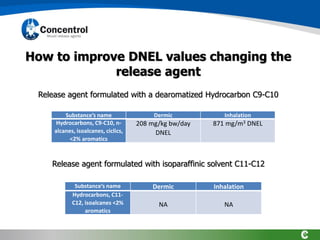
How to improve DNEL values changing the
release agent
Release agent formulated with a dearomatized Hydrocarbon C9-C10
Substance’s name Dermic Inhalation
Hydrocarbons, C9-C10, n-
alcanes, isoalcanes, ciclics,
<2% aromatics
208 mg/kg bw/day
DNEL
871 mg/m3 DNEL
Release agent formulated with isoparaffinic solvent C11-C12
Substance’s name Dermic Inhalation
Hydrocarbons, C11-
C12, isoalcanes <2%
aromatics
NA NA
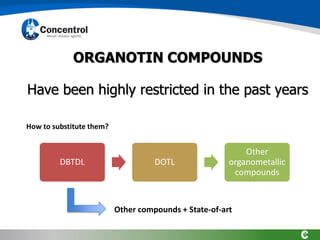
ORGANOTIN COMPOUNDS
Have been highly restricted in the past years
DBTDL DOTL
Other
organometallic
compounds
Other compounds + State-of-art
How to substitute them?
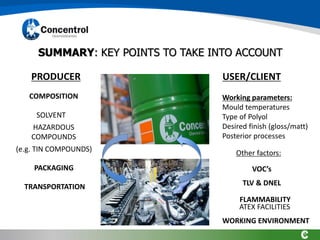
SOLVENT
PACKAGING
(e.g. TIN COMPOUNDS)
HAZARDOUS
COMPOUNDS
COMPOSITION
VOC’s
TLV & DNEL
FLAMMABILITY
TRANSPORTATION
WORKING ENVIRONMENT
SUMMARY: KEY POINTS TO TAKE INTO ACCOUNT
PRODUCER USER/CLIENT
ATEX FACILITIES
Working parameters:
Mould temperatures
Type of Polyol
Desired finish (gloss/matt)
Posterior processes
Other factors:
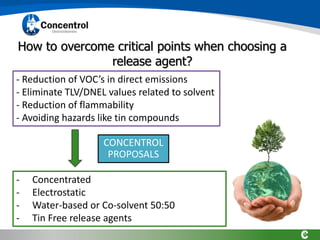
- Reduction of VOC’s in direct emissions
- Eliminate TLV/DNEL values related to solvent
- Reduction of flammability
- Avoiding hazards like tin compounds
- Concentrated
- Electrostatic
- Water-based or Co-solvent 50:50
- Tin Free release agents
CONCENTROL
PROPOSALS
How to overcome critical points when choosing a
release agent?
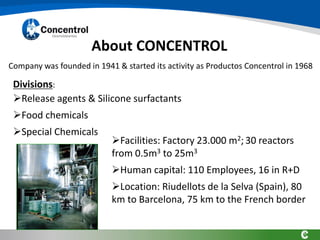
About CONCENTROL
➢Facilities: Factory 23.000 m2; 30 reactors
from 0.5m3 to 25m3
➢Human capital: 110 Employees, 16 in R+D
➢Location: Riudellots de la Selva (Spain), 80
km to Barcelona, 75 km to the French border
Divisions:
➢Release agents & Silicone surfactants
➢Food chemicals
➢Special Chemicals
Company was founded in 1941 & started its activity as Productos Concentrol in 1968
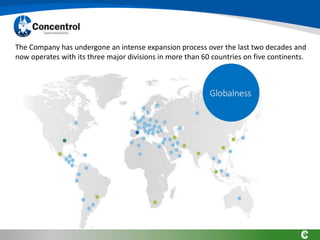
The Company has undergone an intense expansion process over the last two decades and
now operates with its three major divisions in more than 60 countries on five continents.
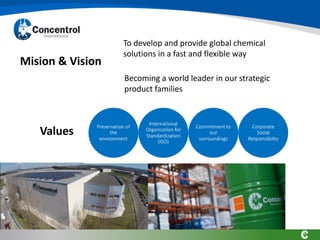
Mision & Vision
To develop and provide global chemical
solutions in a fast and flexible way
Becoming a world leader in our strategic
product families
Values
Pol. Ind. Girona
17457 Riudellots de la Selva (GIRONA) · Spain
T. +34 972 478 091 · F. +34 972 477 115
marketing@concentrol.com ·
www.concentrol.com

DESMA Fair presentation by Concentrol

  • 1.
    The choice ofa footwear release agent
  • 2.
    Main factors tobe taken in consideration when choosing a release agent Concentration & active material Polyol system: Polyether/Polyester Mould temperatures Paintability / Adhesion between layers & others Finish of the demouldled piece: matt/shiny/satin
  • 3.
    3 MOLD RELEASE AGENTS 3main objectives: High mold release power Impeccable finish of the piece in terms of gloss and superficial uniformity Low mold build-up.
  • 4.
    TYPE OF POLYOL •Polyester polyols: Better abrasion & oil resistance, cheaper & lower in viscosity • Polyether polyols: Better water resistance, but higher viscosity & more expensive. Choice of suitable release agent Usually a Polyester release agent is not suitable for Polyether because the finish of the piece will be affected Using a Polyether release agent for Polyester can lead to an excesive mould build up and/or other problems.
  • 5.
    CONCENTRATION & ACTIVEMATERIAL RELEASE AGENT’S STRUCTURE Possible concentrations: a) Ready to use low solid content b) Ready to use concentrated c) Concentrated for dilution
  • 6.
    Mould temperatures Adjusting thecorrect mould temperature is a key point in the process of curing the blend Polyol-Isocynate that will form the shoe sole. Drying and good film formation of the release agent will basically depend on it together with the drying of active material’s carrier (solvent or water) and cycle time.
  • 7.
    Finish of demouldedpiece The choice of a release agent definitely affects the finish of the footwear piece demoulded. Shiny/Glossy Satin Matt • More matt finish can contribute to more dry soles but moulds with higher build up. • Shiny finish can usually extend mould cleaning cycles but with more greasy finish on the sole.
  • 8.
    Secondary processes: Painting,gluing & adhesion After demolding → Painting, gluing or textile/leather adhesion. Release agent can affect this process, so it is important to choice them accordingly. Normally all demoulded soles are de-greased phisically or chemically to make easier the following posterior treatments. Specific release agents to make this process easier
  • 9.
    9 RELEASE AGENTS FORDUAL DENSITY SOLES During the same molding process the outsole has to bond with the midsole, but the release agent can be transferred to the outsole during the process. The mold release agent must not interfere at all with adhesion between outsole and midsole. *** Special release agents designed for this process ***
  • 10.
    But there areother factors, usually underrated, equally important to consider
  • 11.
  • 12.
    Application systems Automatically: Byrobot Manually: By hand Standard or electrostatic application
  • 13.
    Robot application benefits Alwaysthe same application Optimization of the release agent consumption Easy to work with electrostatic system The application speed can be increased/adjusted without risk of fatigue. Cost reduction More homogeneous production
  • 14.
    Robot application disadvantages Robotscannot handle unexpected situations Higher investment at beginning Robots installed in workplaces still require manual labour attached to them
  • 15.
    VOC’s: from SOLVENTBASED release agents Related to release agents, VOC’s are mainly produced by direct emissions VOC’s: Volatile Organic Components One of the atmosphere’s pollutants
  • 16.
    How to reduceVOC’s with the choice of a release agent? SOLVENT 50% CO-SOLVENT WATER CONCENTRATED ELECTROSTATIC
  • 17.
    Advantages of concentratedrelease agents Less consumption Less VOC’s / TLV’s Better working environment Upgrade in solvent’s class (Less flammability)
  • 18.
    Electrostatic release agents Oppositeelectric charge is given to the product and to the mould. Opposite charges are attracted to each other The mould attracts the release agent, avoiding unnecessary product loss and thus reducing consumption. The release agent reaches all corners of the mould by attraction.
  • 19.
    Advantages •Reduction in consumptionof between 30% and 50%. •Prevents waste of product, as all the sprayed material goes directly onto the mould. •No product accumulation outside the mould – less cleaning of mould carriers, floors, etc. •Reduces VOC’s emissions •Improves quality of the working environment
  • 20.
    Disadvantages •Higher price. •Application equipmentis more expensive and sensitive. • Spray guns larger and heavier •Application by robot is easier to control but more expensive
  • 21.
    All our solventbased release agents can be adjusted to be used with electrostatic equipments according to an electrical resistance value, proposed by customer together with equipment supplier, that is usually around a value of 200-500 MΩ.
  • 22.
    CO-SOLVENT MIX 50:50 Hybridrelease agents The vehicle of the active ingredients is half water-half solvent. The pieces demolded have a finish equal to the solvent based. The working properties are the same as a solvent based class III: similar solids content and similar drying time. Intermediate solution for customers who currently produce with a solvent based release agent and do not want to change completely to a water based.
  • 23.
    Main advantages incomparision with solvent-based release agent: • Half reduction of VOC's emitted into the atmosphere • Better work environment in the productive line • Lower flammability Main advantages in comparision with water-based release agents: • More dry finish of the demoulded piece • Cleaner than a classic water based release agent • Similar working method as a solvent based release agent CO-SOLVENT MIX 50:50 Hybrid release agents
  • 24.
    Main advantages comparedwith solvent-based release agents: • From 90% to total reduction of VOC's emitted into the atmosphere • Better working environment in the productive line • No flammability WATERBASED RELEASE AGENTS Considerations to take care: • Minimum mould temperatures of 45ºC • Air atomization around 2.5 bar • Adjust correctly the flow rate Excellent results achieved Release performance Surface finish
  • 25.
    • Possibility todilute easily with water • Very good lubrication for the mould and appliances • Good to work with high mould temperatures • Not just PU, also workable on EVA & Phylon processes • Nowadays they are formulated with improved stability which make them suitable for export markets WATERBASED RELEASE AGENTS
  • 26.
  • 27.
    Flammability Risk of EXPLOSIVEATMOSPHERES ATEX regulation: European Regulatory Framework for Manufacture, Installation and Use of Equipment in Explosive Atmospheres Flammable Combustible Oxidant+ + Source of ignition If a flammable liquid has a flash point above the maximum temperature at which it is handled, an explosive atmosphere can not exist (EN 60079-10, section 4.4.1), i.e. a flammable liquid cannot be ignited while its temperature remain below its flash point. But, if the escape of a flammable substance is in the form of mist (spray by aerographic gun) an explosive atmosphere can be formed even if the temperature is below the flash point. ATEX ZONE
  • 28.
    <21ºC Class I >21 ºC <55ºC Class II >55ºC Class III n-Heptane AliphaticIsoparaffinic SAFETY Upgrade solvent according to higher Flash Point Storage and Handling Classification according to European Directive 67/548/CEE INSURANCE COST IN STORING
  • 29.
    Toxicity Products involved inrelease agent’s formulation Solvent Tin Compounds Others Their control can be made according to some indicators: TLV & DNEL
  • 30.
    Toxicity TLV DNEL Level of concentrationto which it is believed a worker can be exposed day after day for a working lifetime without adverse effects TWA Mean concentration over time (8 h/day, 40h/week) Level of exposure to a substance above which humans should not be exposed Threshold Limit Value Derived No-Effect Level
  • 31.
    How to improveDNEL values changing the release agent Release agent formulated with a dearomatized Hydrocarbon C9-C10 Substance’s name Dermic Inhalation Hydrocarbons, C9-C10, n- alcanes, isoalcanes, ciclics, <2% aromatics 208 mg/kg bw/day DNEL 871 mg/m3 DNEL Release agent formulated with isoparaffinic solvent C11-C12 Substance’s name Dermic Inhalation Hydrocarbons, C11- C12, isoalcanes <2% aromatics NA NA
  • 32.
    ORGANOTIN COMPOUNDS Have beenhighly restricted in the past years DBTDL DOTL Other organometallic compounds Other compounds + State-of-art How to substitute them?
  • 33.
    SOLVENT PACKAGING (e.g. TIN COMPOUNDS) HAZARDOUS COMPOUNDS COMPOSITION VOC’s TLV& DNEL FLAMMABILITY TRANSPORTATION WORKING ENVIRONMENT SUMMARY: KEY POINTS TO TAKE INTO ACCOUNT PRODUCER USER/CLIENT ATEX FACILITIES Working parameters: Mould temperatures Type of Polyol Desired finish (gloss/matt) Posterior processes Other factors:
  • 34.
    - Reduction ofVOC’s in direct emissions - Eliminate TLV/DNEL values related to solvent - Reduction of flammability - Avoiding hazards like tin compounds - Concentrated - Electrostatic - Water-based or Co-solvent 50:50 - Tin Free release agents CONCENTROL PROPOSALS How to overcome critical points when choosing a release agent?
  • 35.
    About CONCENTROL ➢Facilities: Factory23.000 m2; 30 reactors from 0.5m3 to 25m3 ➢Human capital: 110 Employees, 16 in R+D ➢Location: Riudellots de la Selva (Spain), 80 km to Barcelona, 75 km to the French border Divisions: ➢Release agents & Silicone surfactants ➢Food chemicals ➢Special Chemicals Company was founded in 1941 & started its activity as Productos Concentrol in 1968
  • 36.
    The Company hasundergone an intense expansion process over the last two decades and now operates with its three major divisions in more than 60 countries on five continents.
  • 37.
    Mision & Vision Todevelop and provide global chemical solutions in a fast and flexible way Becoming a world leader in our strategic product families Values
  • 39.
    Pol. Ind. Girona 17457Riudellots de la Selva (GIRONA) · Spain T. +34 972 478 091 · F. +34 972 477 115 marketing@concentrol.com · www.concentrol.com