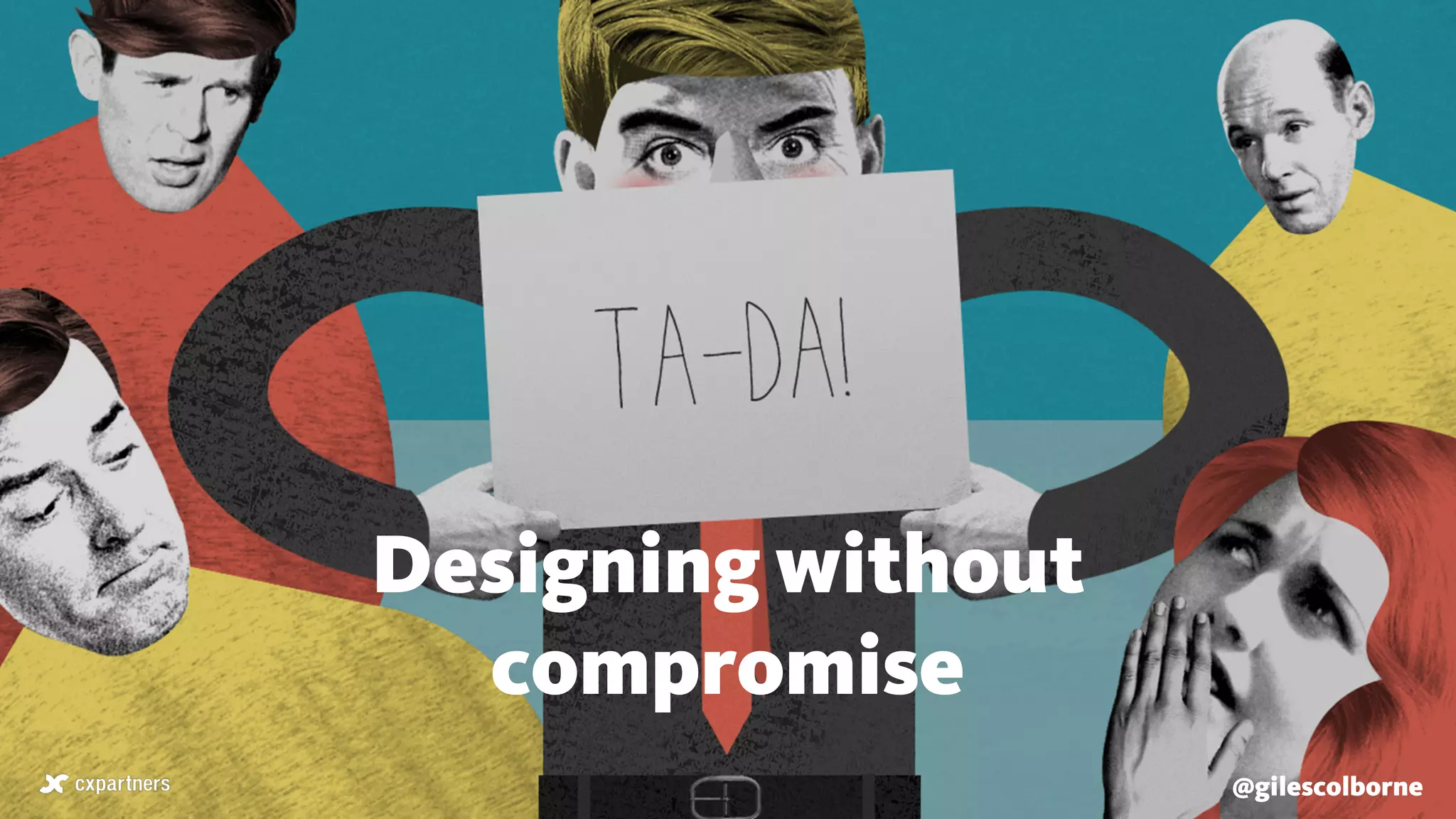
Designing without
compromise
@gilescolborne
@gilescolborne@gilescolborne
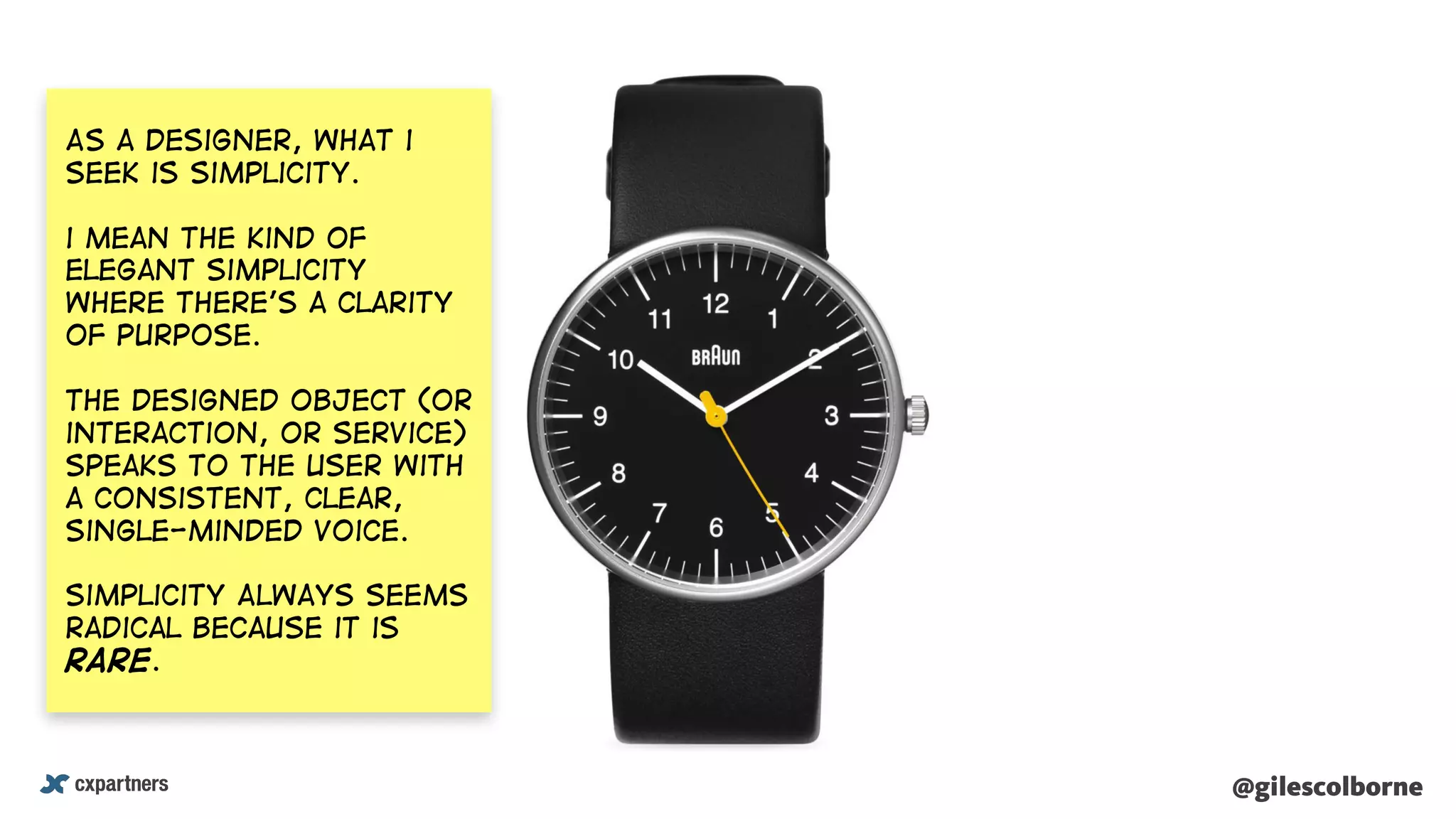
As a designer, what i
seek is simplicity.
i mean the kind of
elegant simplicity
where there’s a clarity
of purpose.
The designed object (or
interaction, or service)
speaks to the user with
a consistent, clear,
single-minded voice.
Simplicity Always seems
radical because it is
rare.
@gilescolborne@gilescolborne
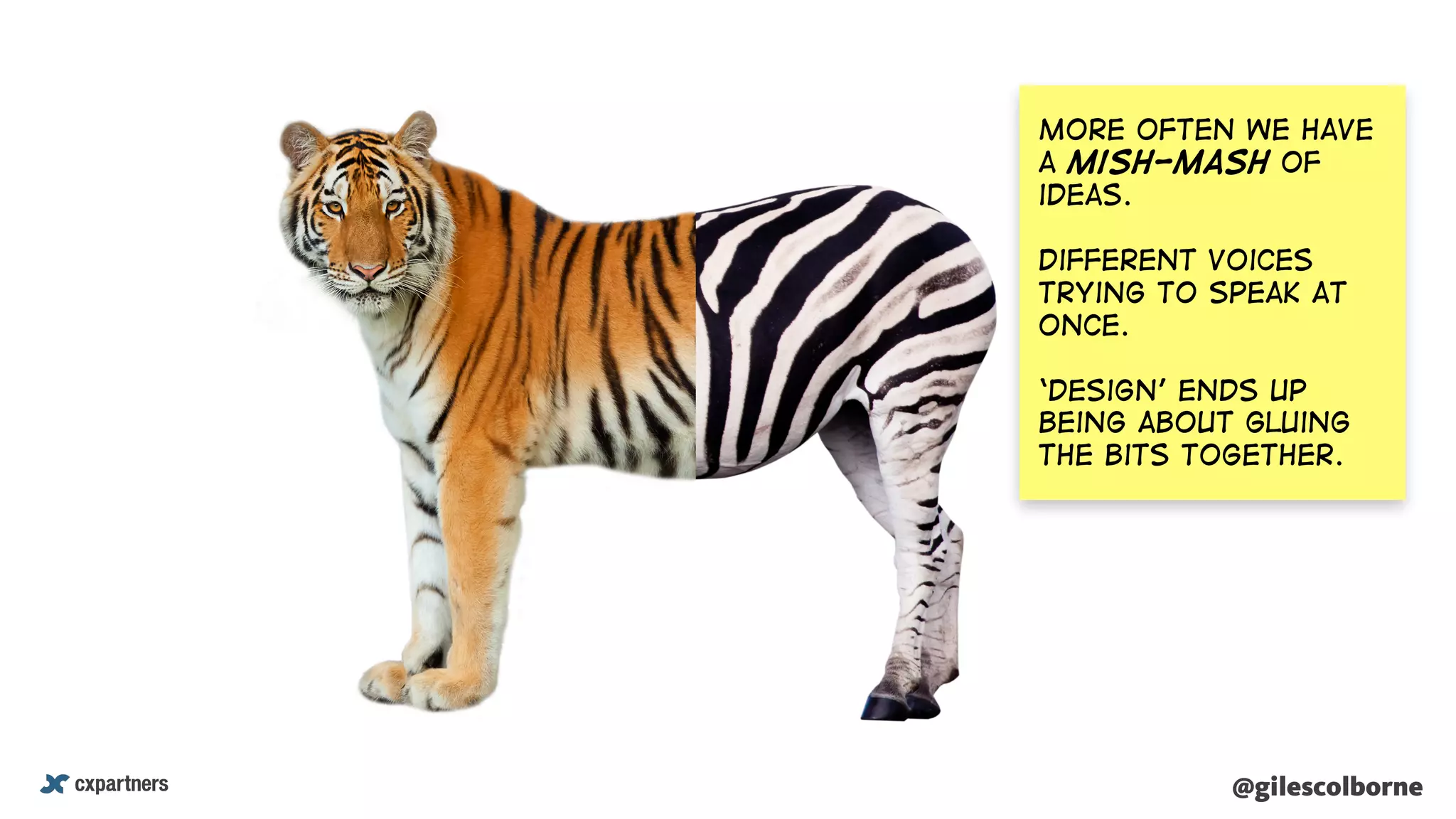
More often we have
a mish-mash of
ideas.
Different voices
trying to speak at
once.
‘design’ ends up
being about gluing
the bits together.
@gilescolborne@gilescolborne
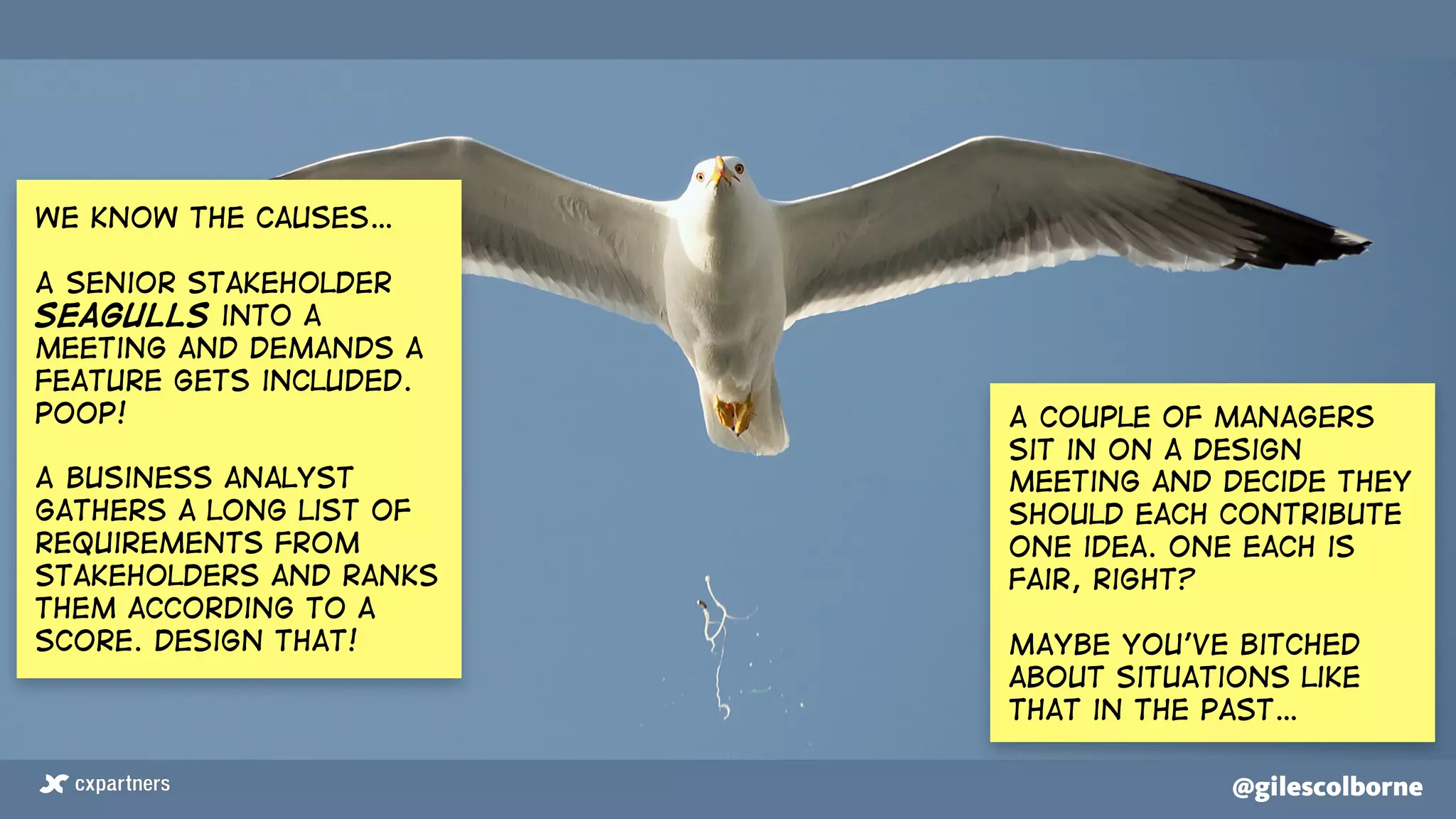
We know the causes…
A senior stakeholder
seagulls into a
meeting and demands a
feature gets included.
Poop!
A business analyst
gathers a long list of
requirements from
stakeholders and ranks
them according to a
score. Design that!
A couple of managers
sit in on a design
meeting and decide they
should each contribute
one idea. One each is
fair, right?
Maybe you’ve bitched
about situations like
that in the past…
@gilescolborne@gilescolborne
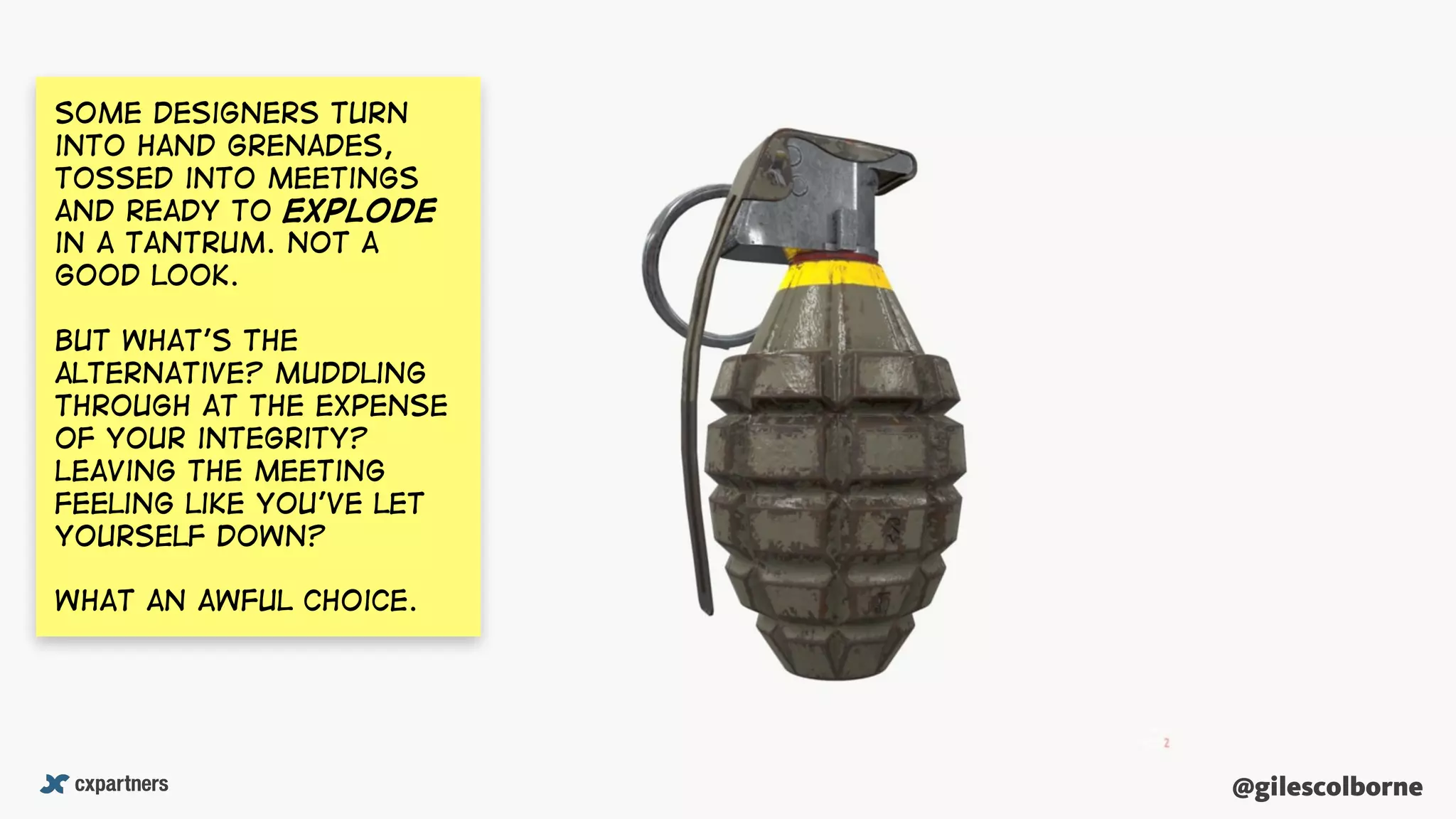
Some designers turn
into hand grenades,
tossed into meetings
and ready to explode
in a tantrum. Not a
good look.
But What’s the
alternative? Muddling
through at the expense
of your integrity?
Leaving the meeting
feeling like you’ve let
yourself down?
What an awful choice.
@gilescolborne@gilescolborne
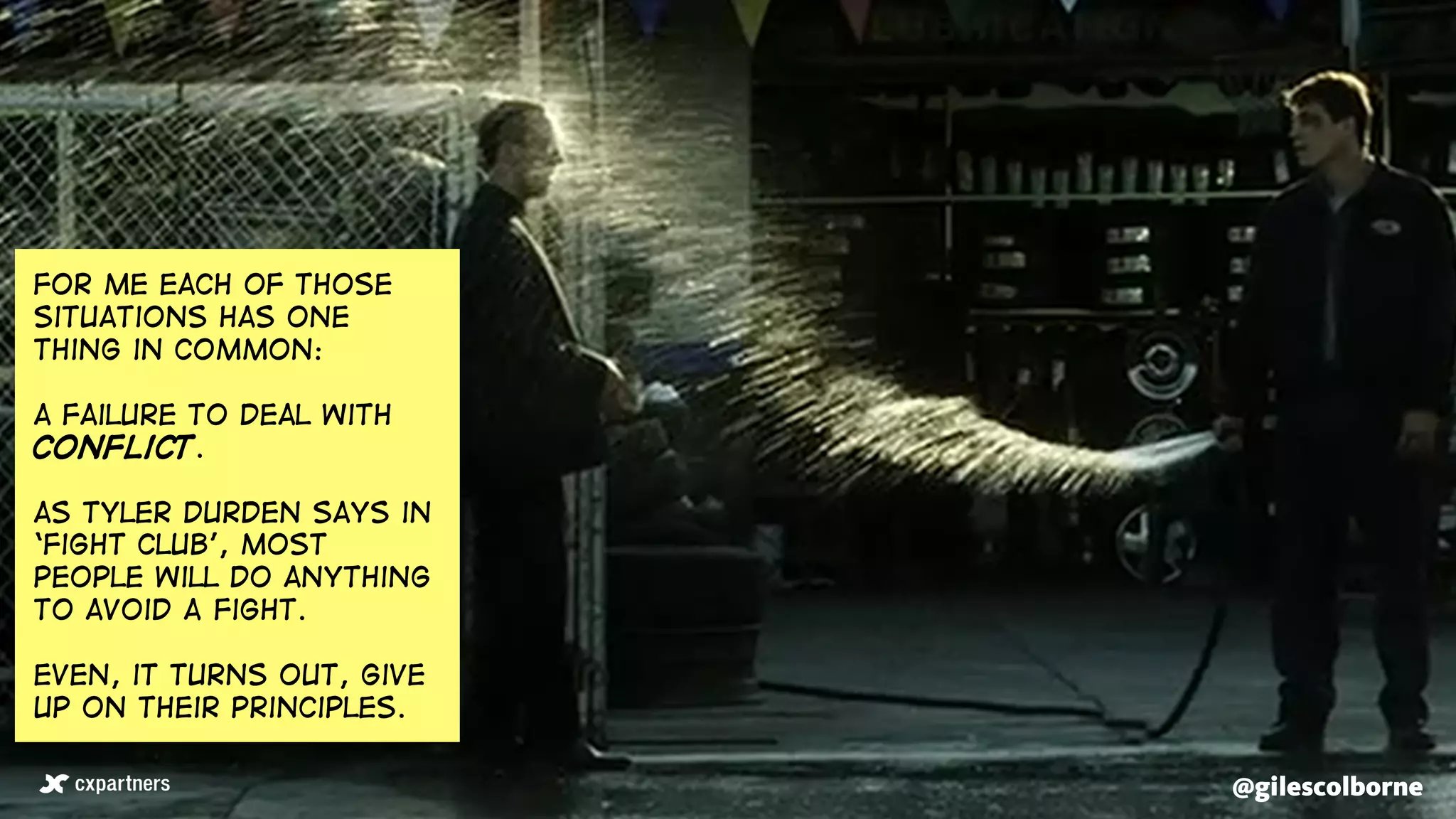
For me each of those
situations has one
thing in common:
a failure to deal with
conflict.
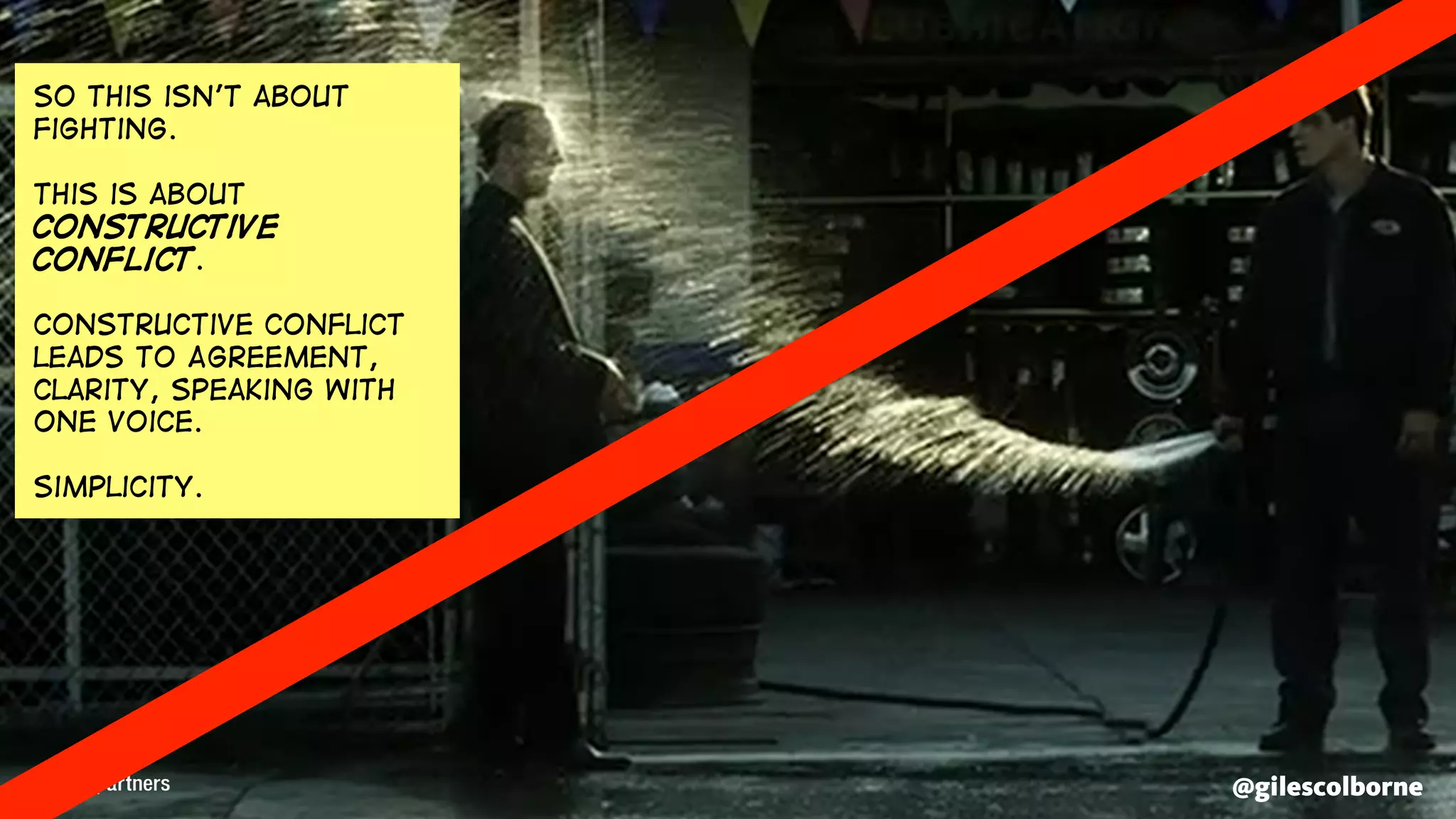
as Tyler Durden says in
‘Fight Club’, most
people will do anything
to avoid A fight.
Even, it turns out, give
up on their principles.
@gilescolborne
Some people see
conflict differently.
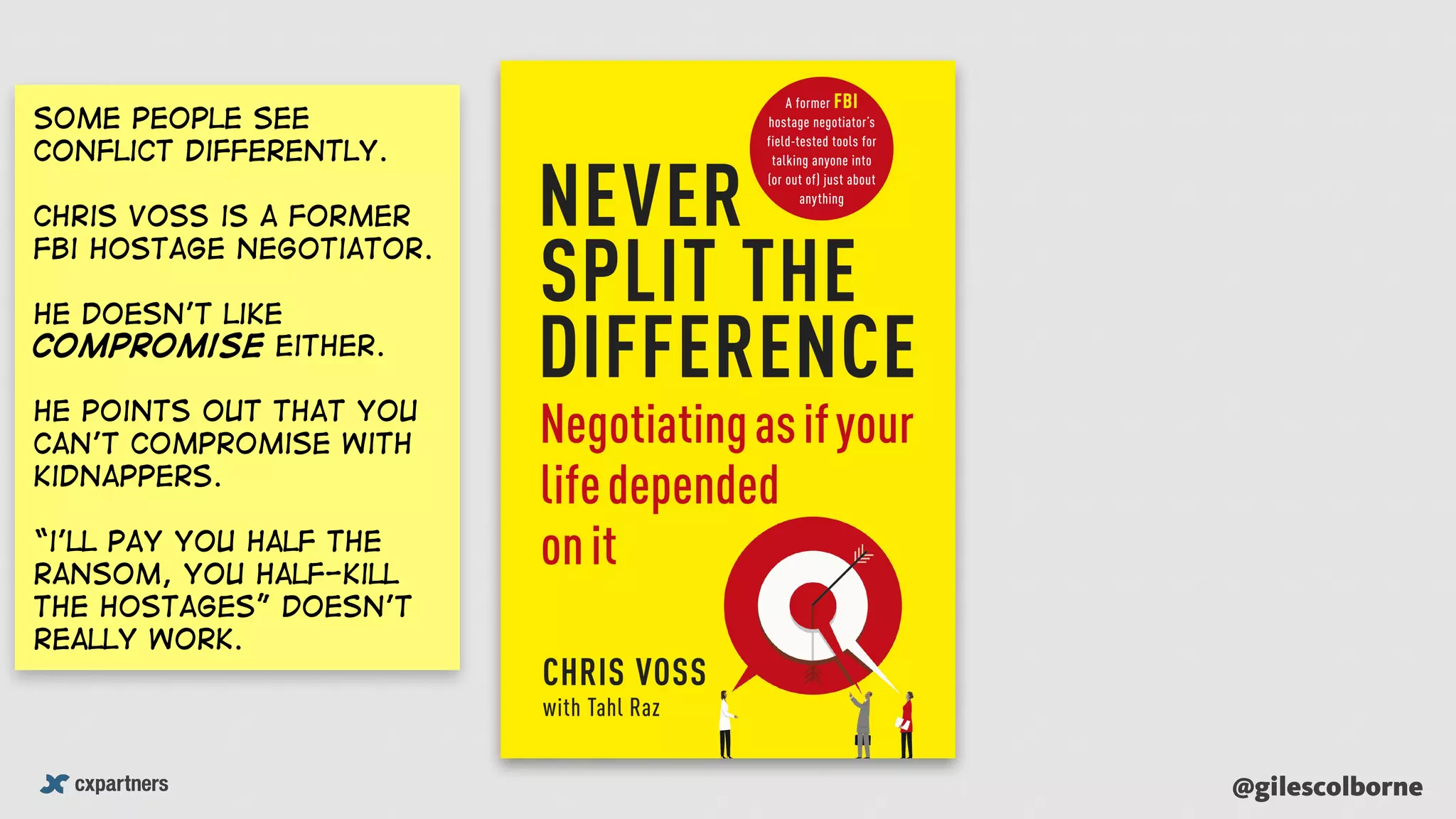
Chris Voss is a former
Fbi hostage negotiator.
He doesn’t like
compromise either.
He points out that you
can’t compromise with
kidnappers.
“i’ll pay you half the
ransom, you half-kill
the hostages” doesn’t
really work.
@gilescolborne
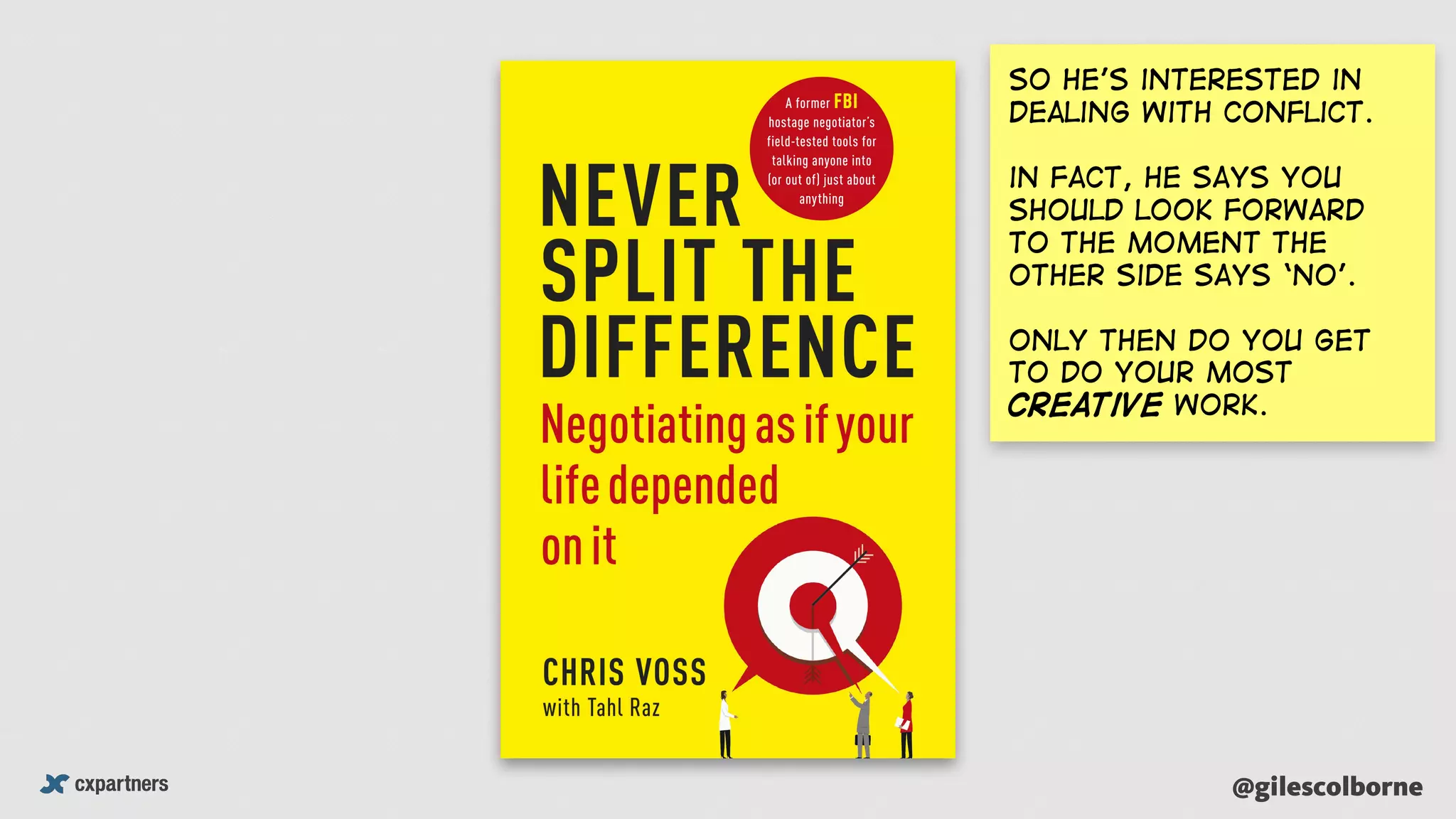
So he’s interested in
dealing with conflict.
in fact, He says you
should look forward
to the moment the
other side says ‘no’.
Only then do you get
to do your most
creative work.
@gilescolborne@gilescolborne
So this isn’t about
fighting.
This is about
Constructive
conflict.
Constructive conflict
leads to Agreement,
clarity, speaking with
one voice.
simplicity.
@gilescolborne
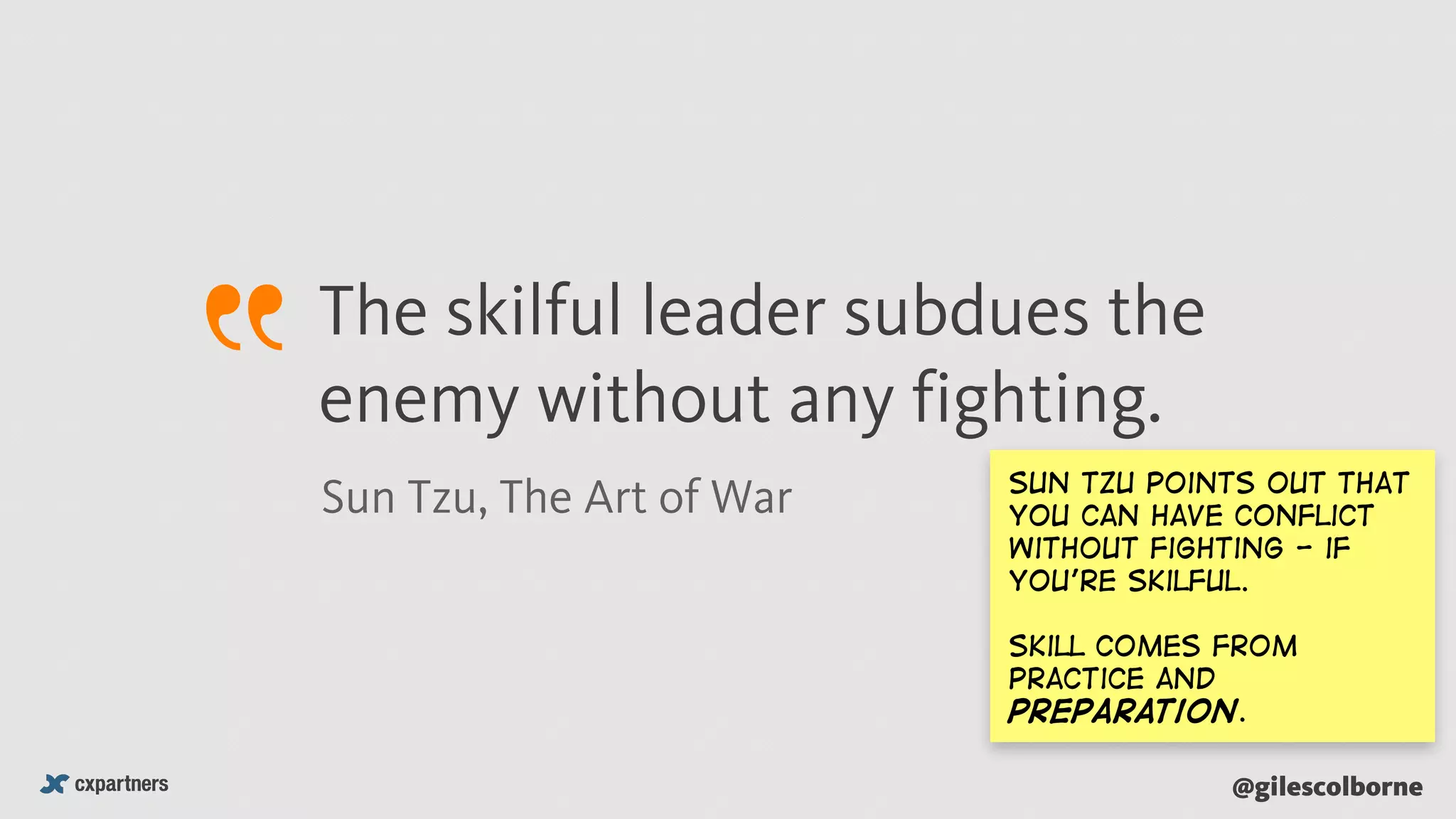
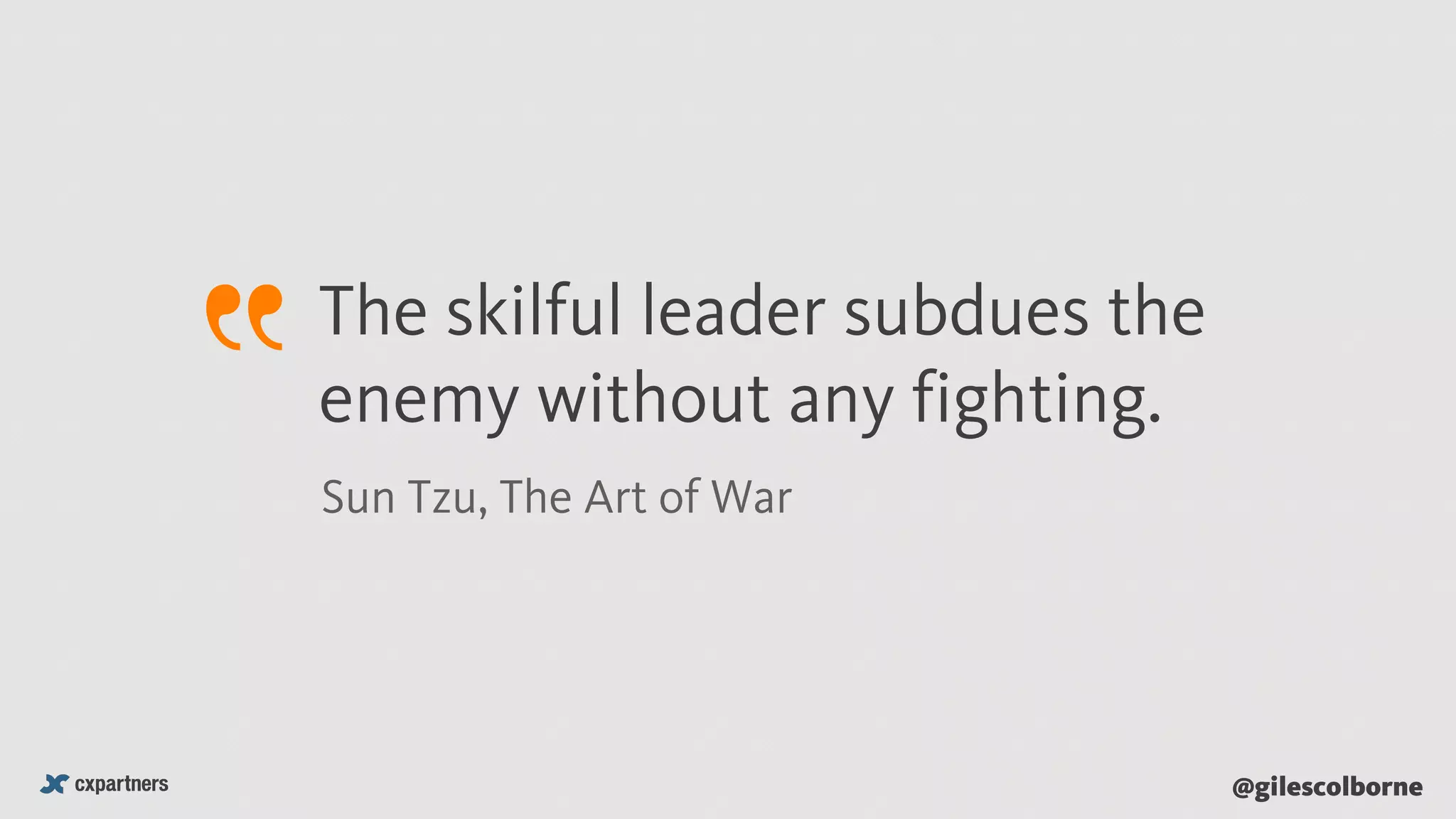
The skilful leader subdues the
enemy without any fighting.
Sun Tzu, The Art of War Sun tzu points out that
you can have conflict
without fighting - if
you’re skilful.
Skill comes from
practice and
preparation.
@gilescolborne
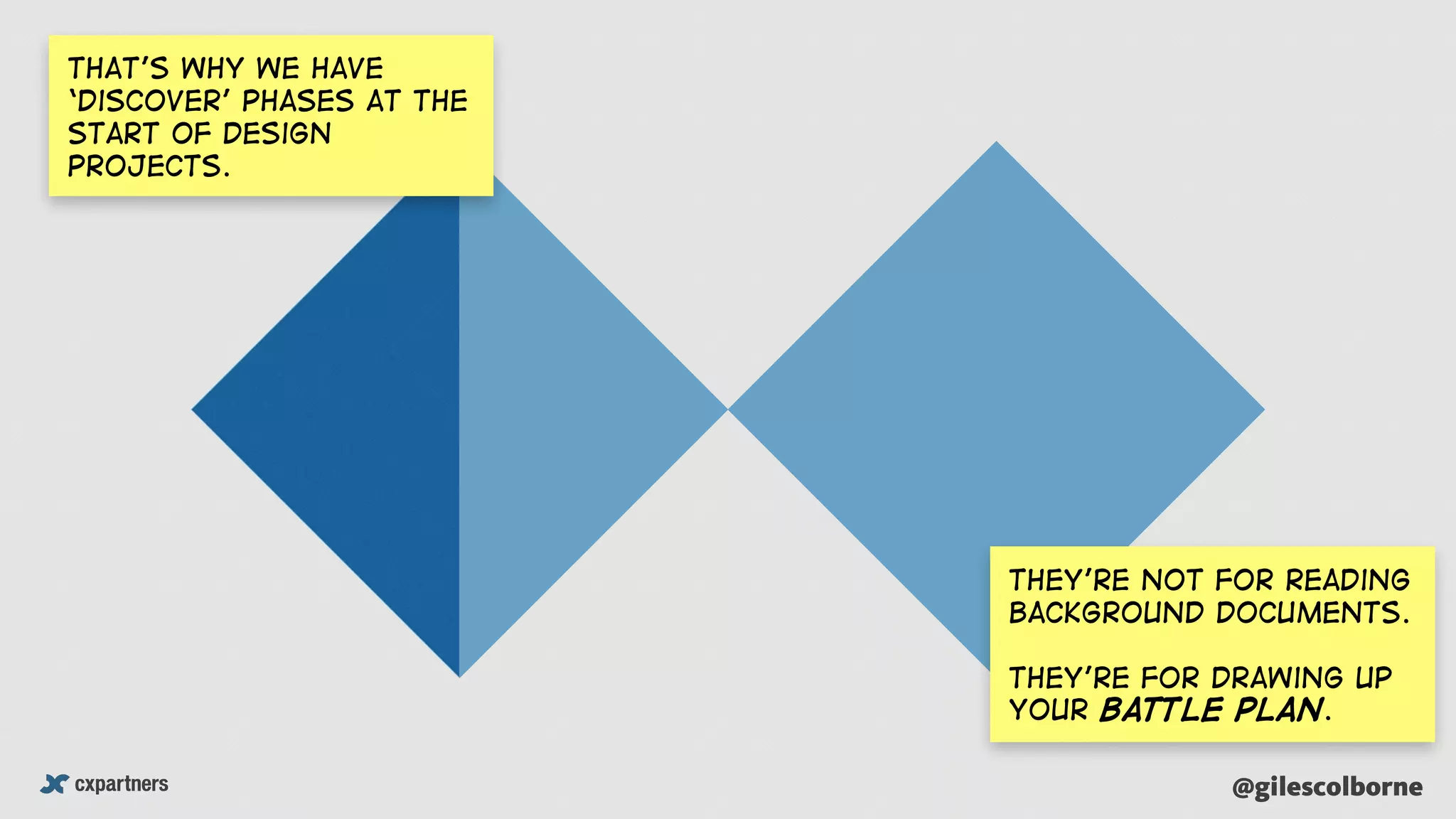
That’s why we have
‘discover’ phases at the
start of design
projects.
They’re not for reading
background documents.
They’re for drawing up
your battle plan.
@gilescolborne
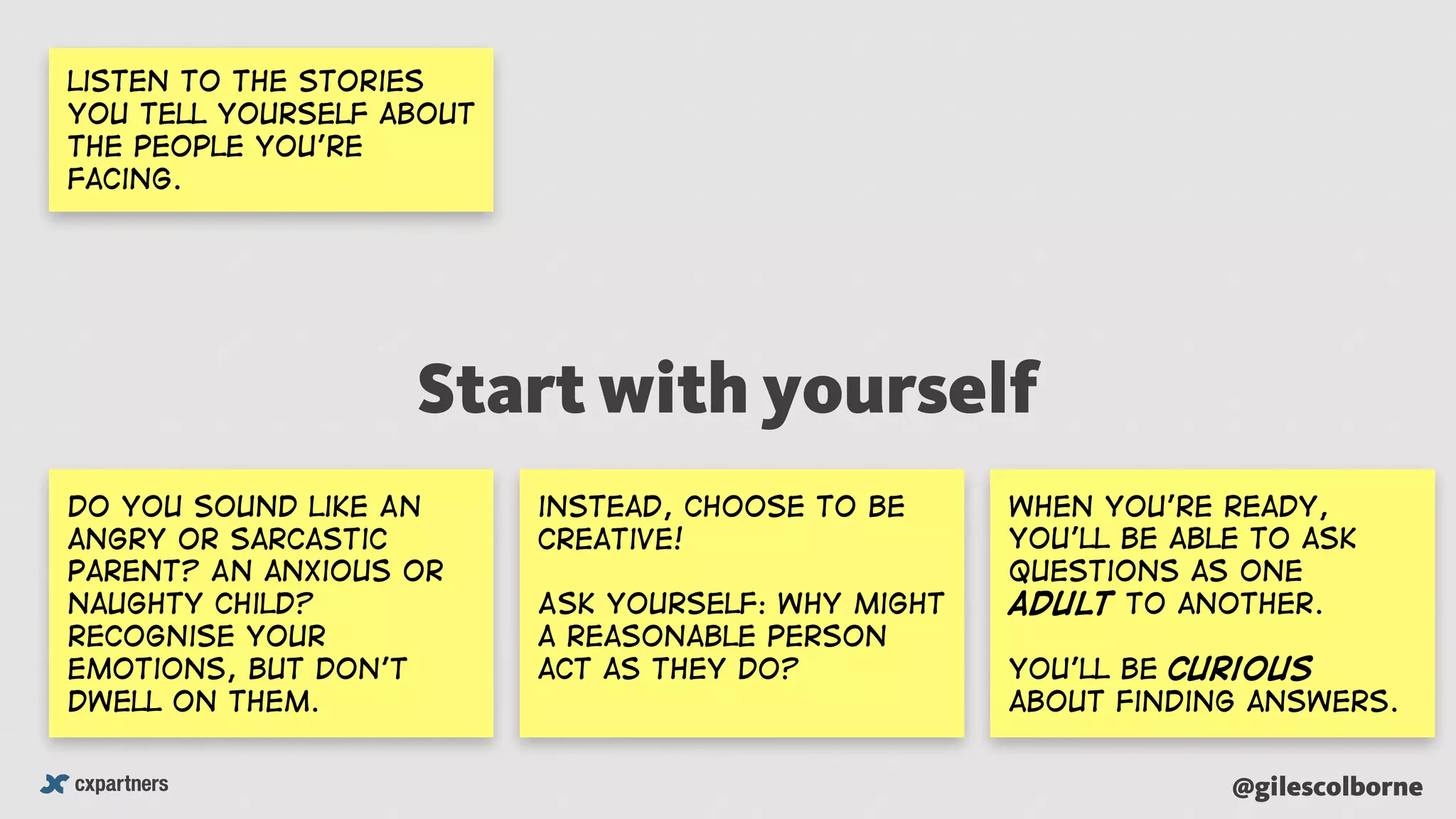
Start with yourself
But preparation should
start closer to home.
We all carry some
personal baggage into
conflict. Past
experiences.
we walk into the room
feeling angry, or
anxious, or intimidated.
The most important
preparation is
mastering those
feelings.
@gilescolborne
Do you sound like An
angry or sarcastic
parent? An anxious or
naughty child?
recognise your
emotions, but don’t
dwell on them.
instead, choose to be
creative!
Ask yourself: Why might
a reasonable person
acT as they do?
when you’re ready,
You’ll be able to ask
questions as one
adult to another.
you’ll be curious
about finding answers.
listen to the stories
you tell yourself about
the people you’re
facing.
Start with yourself
@gilescolborne
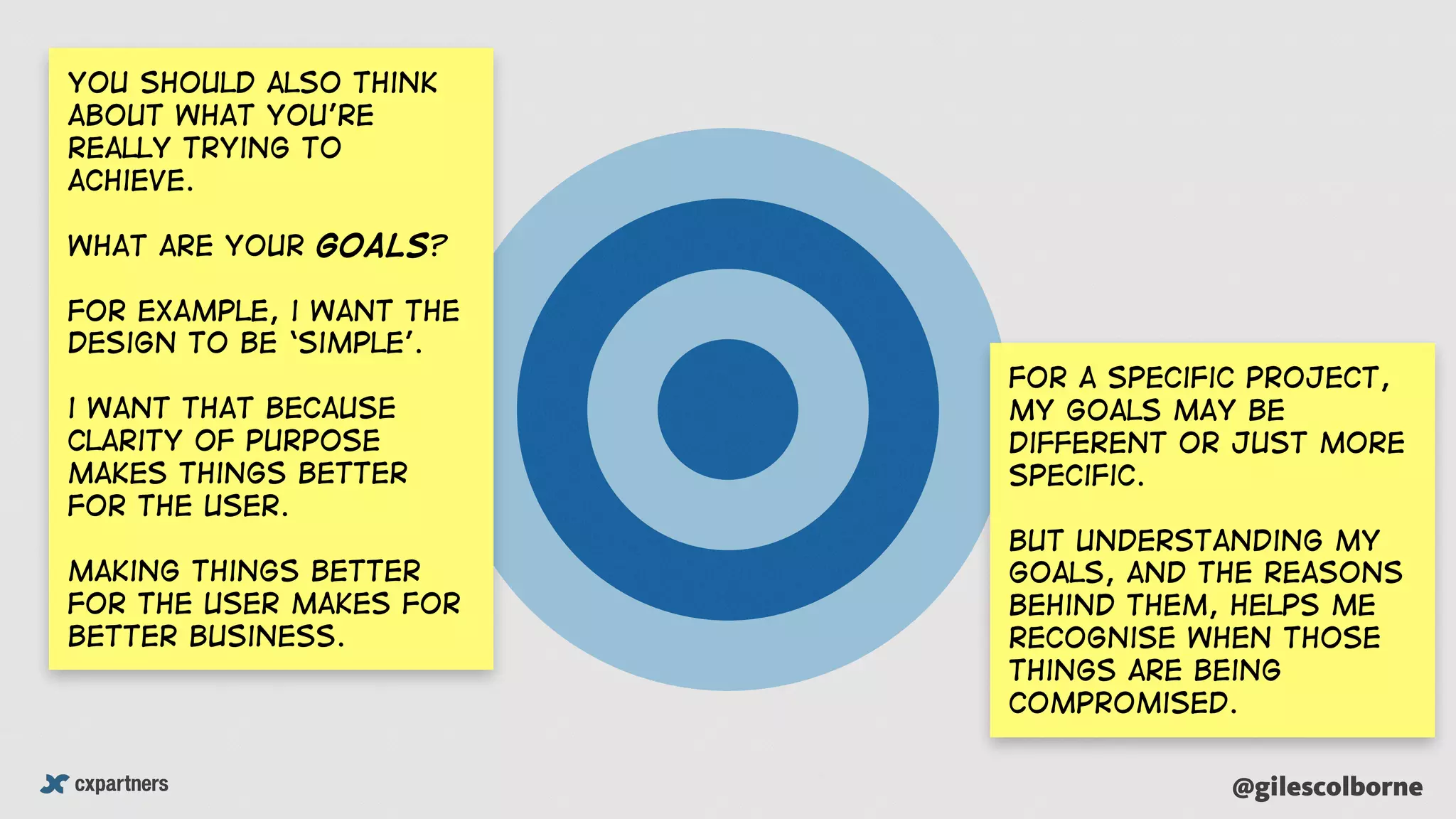
For a specific project,
my goals may be
different or just more
specific.
But understanding my
goals, and the reasons
behind them, helps me
recognise when those
things are being
compromised.
You should also think
about what you’re
really trying to
achieve.
what are your goals?
For example, i want the
design to be ‘Simple’.
i want that because
clarity of purpose
makes things better
for the user.
making things better
for the user makes for
better business.
@gilescolborne@gilescolborne
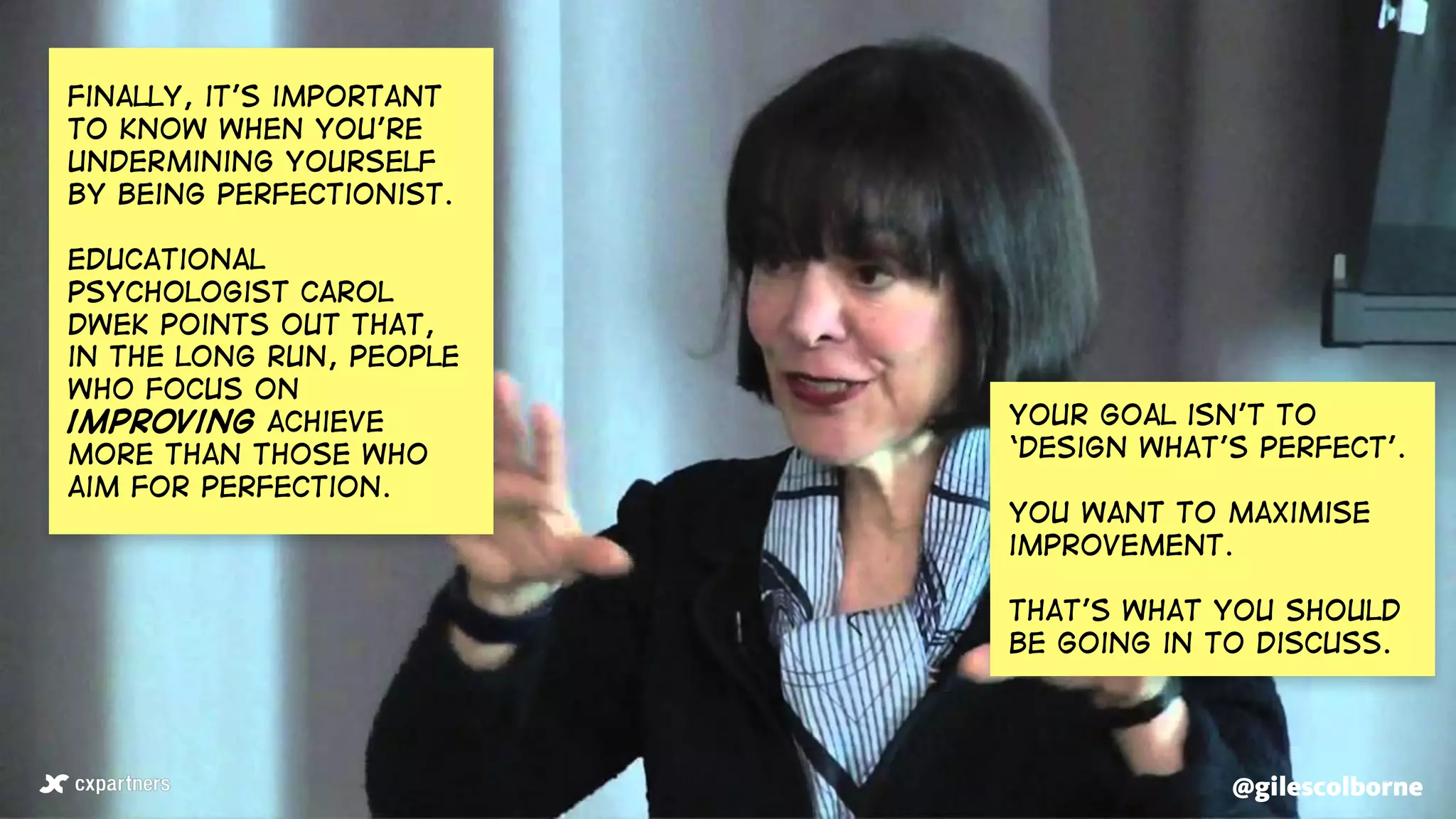
Finally, it’s important
to know when you’re
undermining yourself
by being perfectionist.
educational
psychologist Carol
dwek points out that,
in the long run, people
who focus on
improving achieve
more than those who
aim for perfection.
Your goal isn’t to
‘design what’s perfect’.
You want to maximise
improvement.
that’s what you should
be going in to discuss.
@gilescolborne@gilescolborne
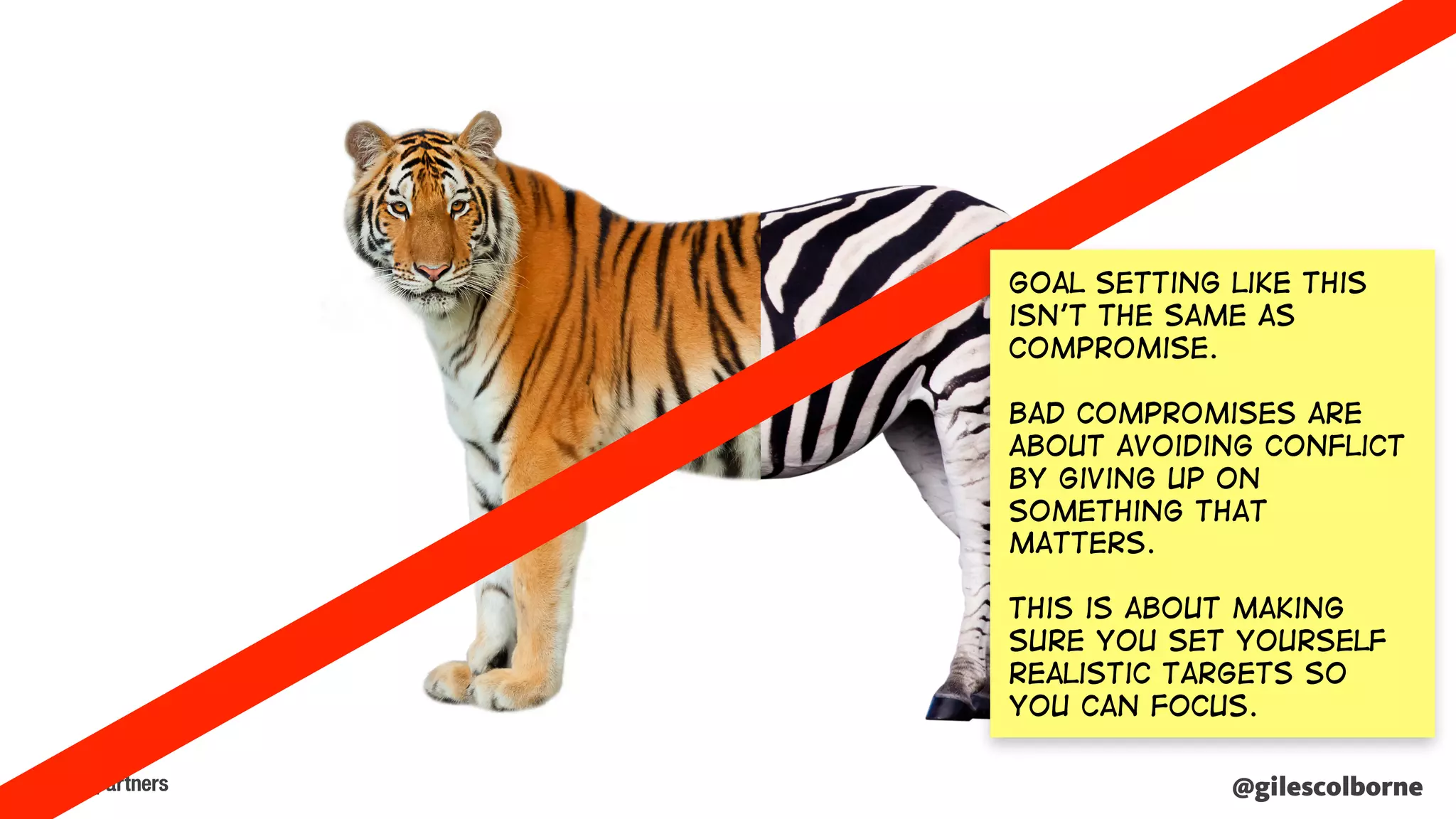
Goal setting like This
isn’t the same as
compromise.
Bad compromises are
about avoiding conflict
by giving up on
something that
matters.
this is about making
sure you set yourself
realistic targets so
you can focus.
@gilescolborne
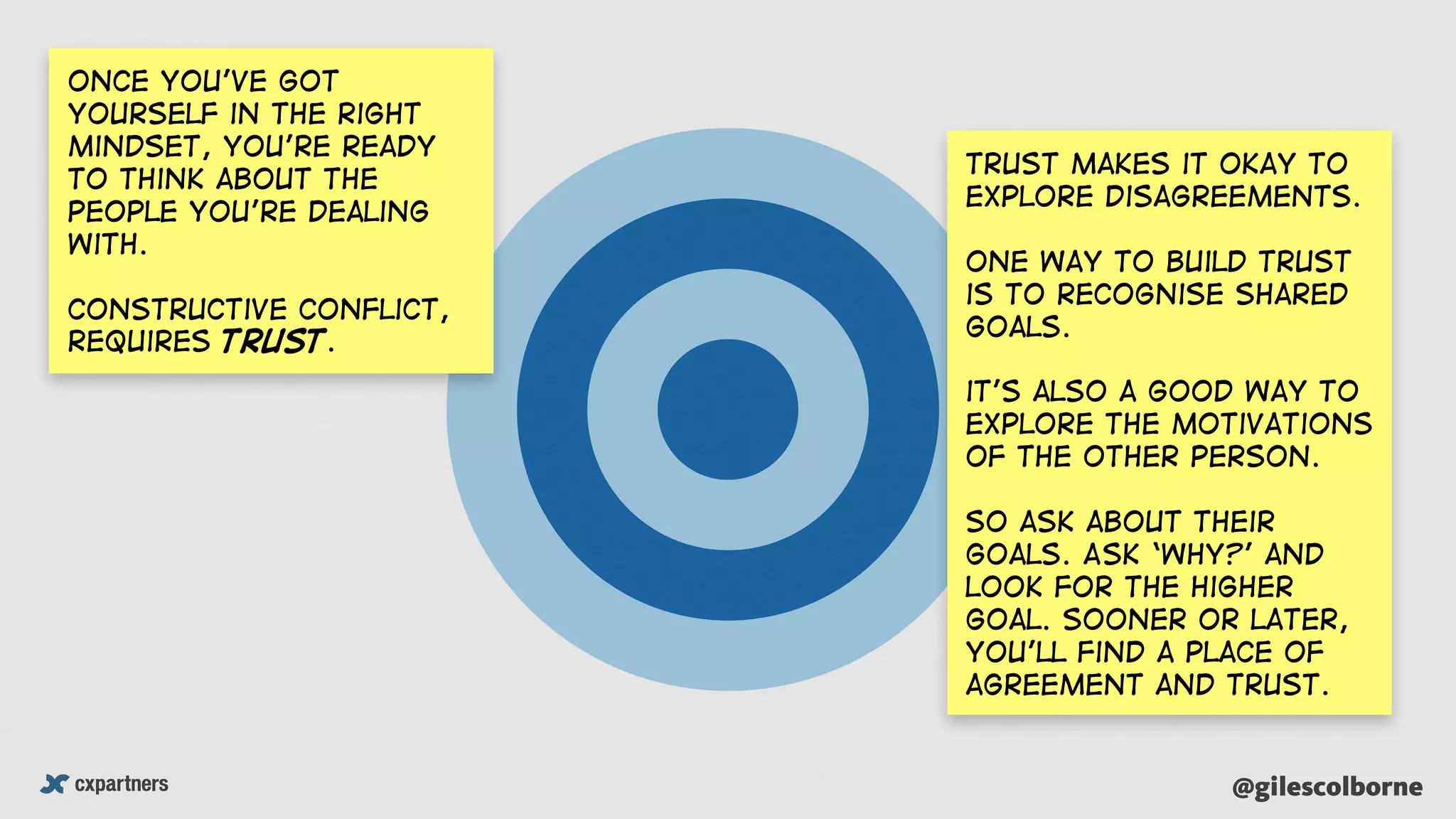
Once you’ve got
yourself in the right
mindset, you’re ready
to think about the
people you’re dealing
with.
constructive conflict,
requires trust.
Trust makes it okay to
explore disagreements.
One way to build trust
is to recognise shared
goals.
it’s also a good way to
explore the motivations
of the other person.
So ask about their
goals. Ask ‘why?’ and
look for the higher
goal. Sooner or later,
you’ll find a place of
agreement and trust.
@gilescolborne@gilescolborne
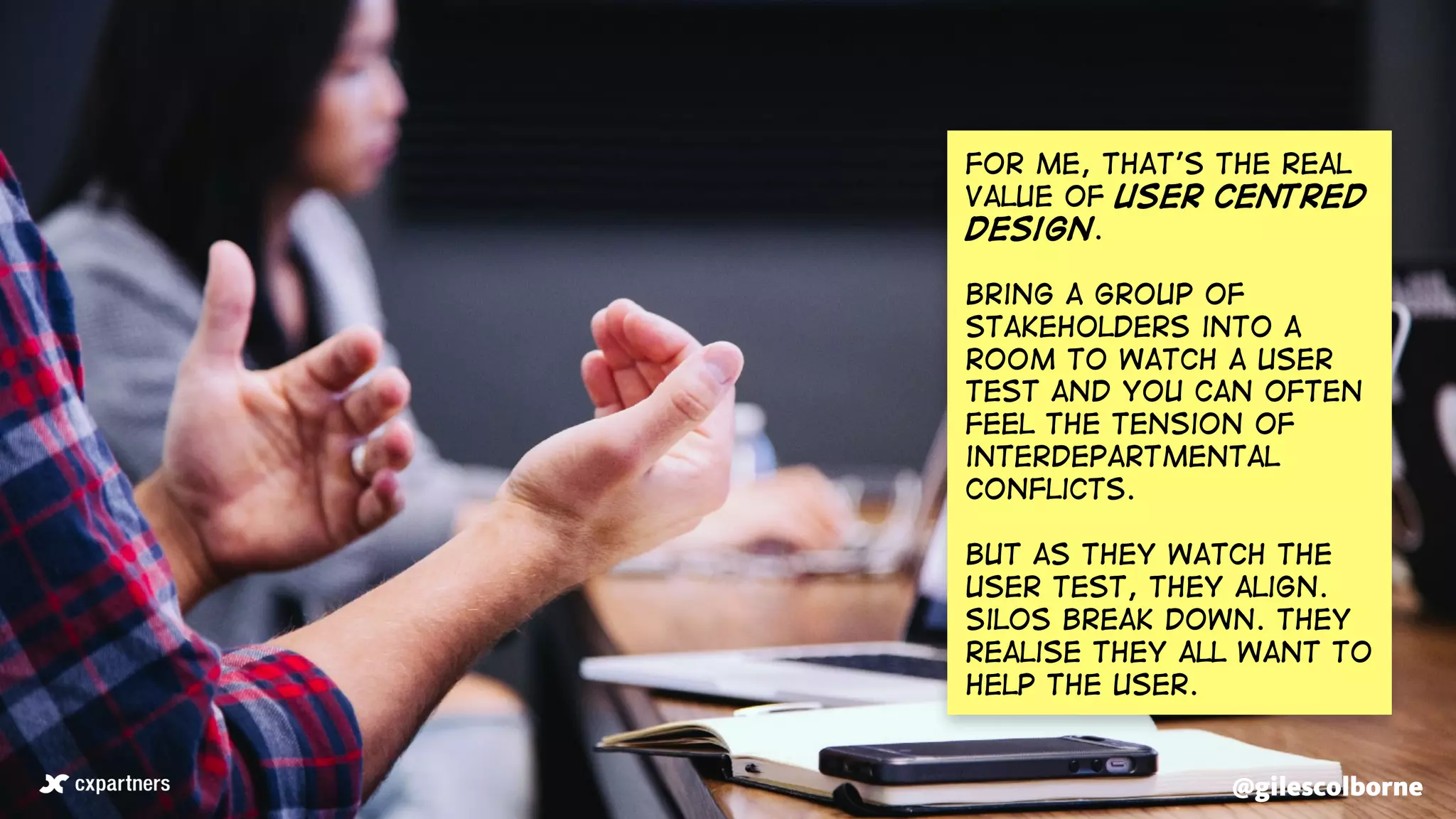
For me, that’s the real
value of user centred
design.
Bring a group of
stakeholders into a
room to watch a user
test and you can often
feel the tension of
interdepartmental
conflicts.
But as they watch the
user test, they align.
Silos break down. They
realise they all want to
help the user.
@gilescolborne
Exploring goals also
builds trust because it
encourages you to
listen deeply to the
other person.
Listening is respectful.
it builds trust by
showing you care.
Summarising what
you’ve heard also helps
in two ways.
it reinforces that you
want to listen, and it
gives the other person
a chance to clarify any
complex points.
Now you can explore
points of
disagreement. ‘We both
want X, so i’m curious
about y.’ remember,
bring curiosity, not
opposition.
@gilescolborne
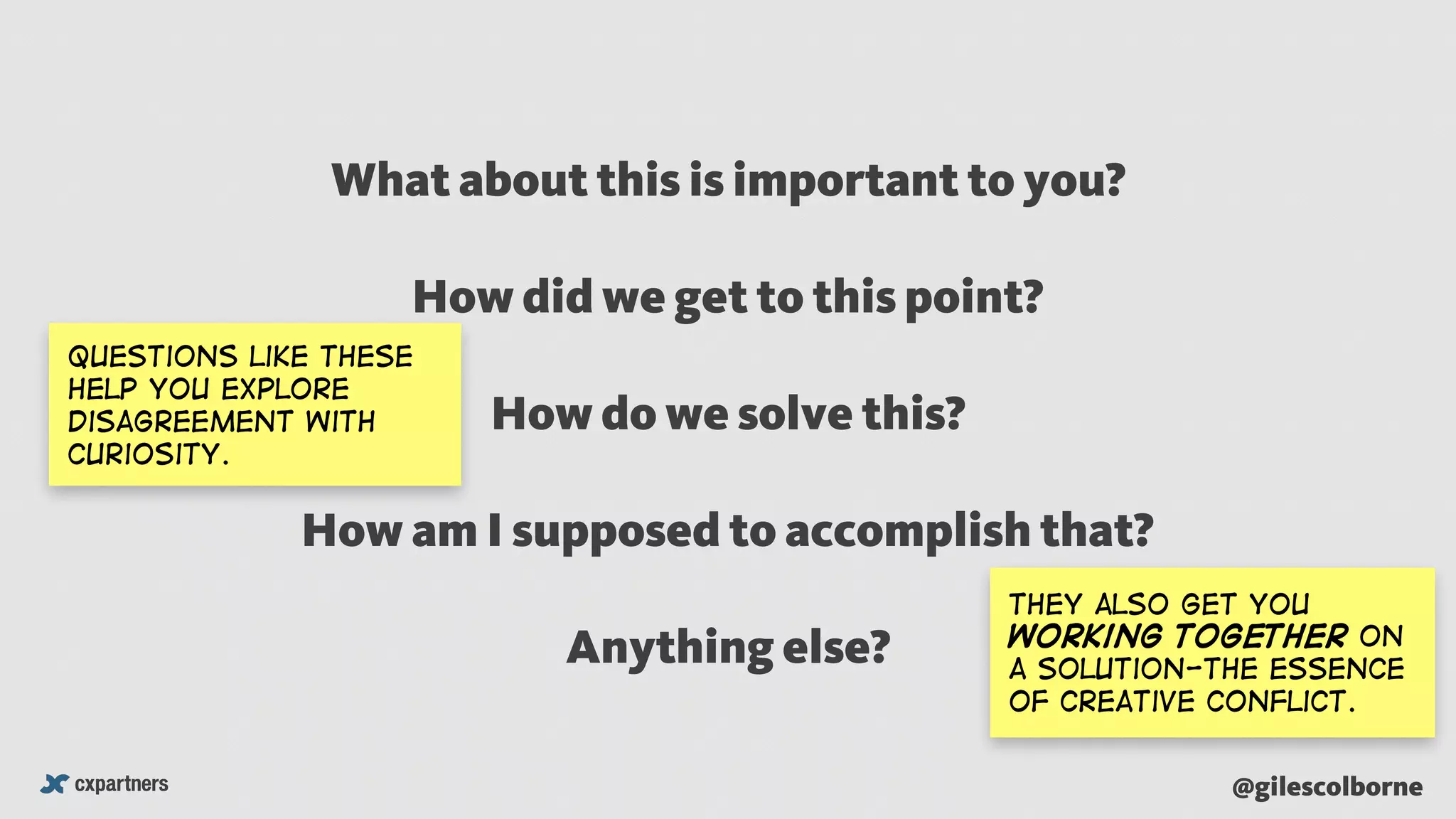
What about this is important to you?
How did we get to this point?
How do we solve this?
How am I supposed to accomplish that?
Anything else?
questions like these
help you explore
disagreement with
curiosity.
They also get you
working together on
a solution-The essence
of creative conflict.
@gilescolborne
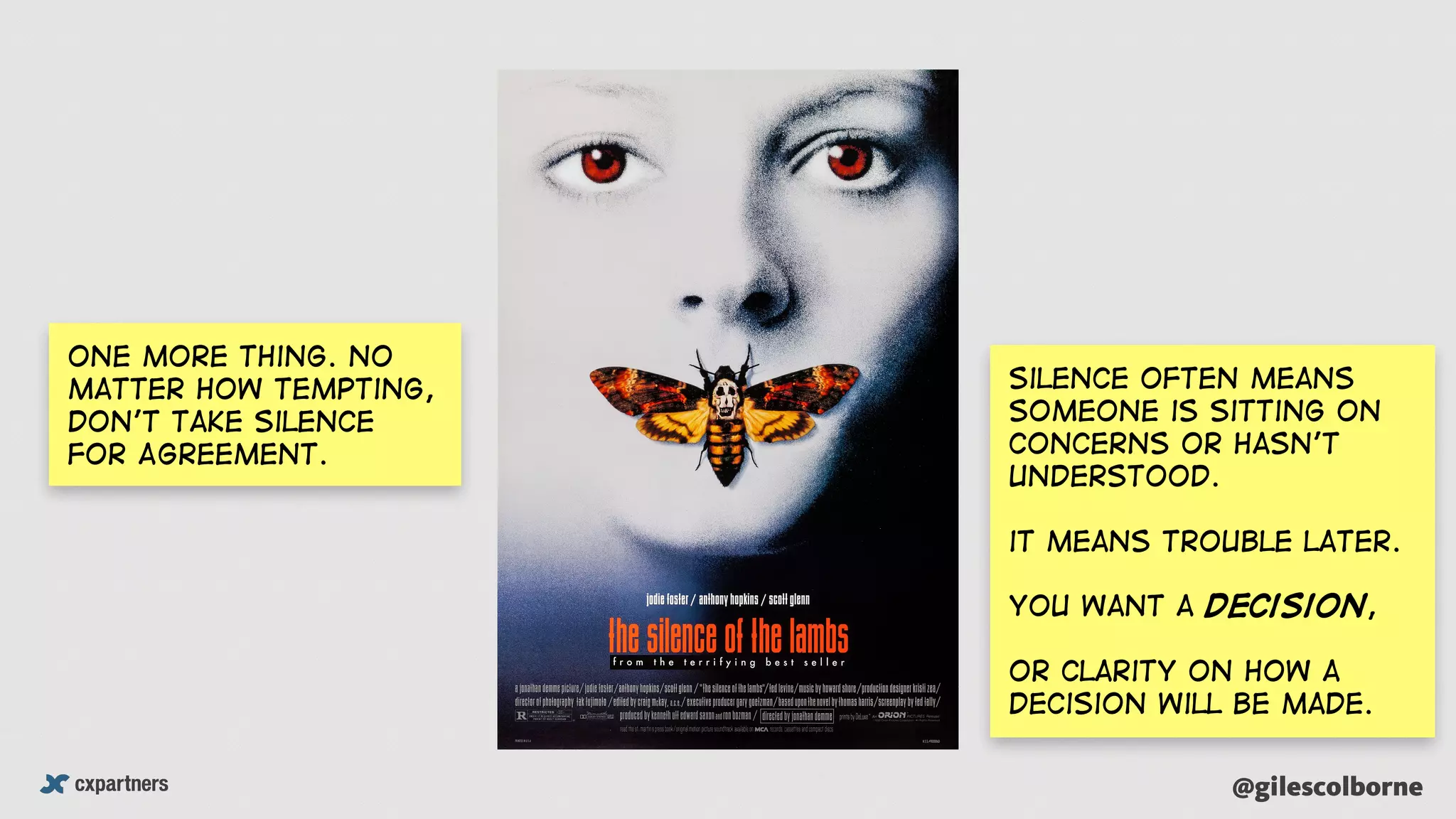
One more thing. No
matter how tempting,
Don’t take silence
for Agreement.
Silence often means
someone is sitting on
concerns or hasn’t
understood.
it means trouble later.
You want a decision,
or clarity on how a
decision will be made.
@gilescolborne
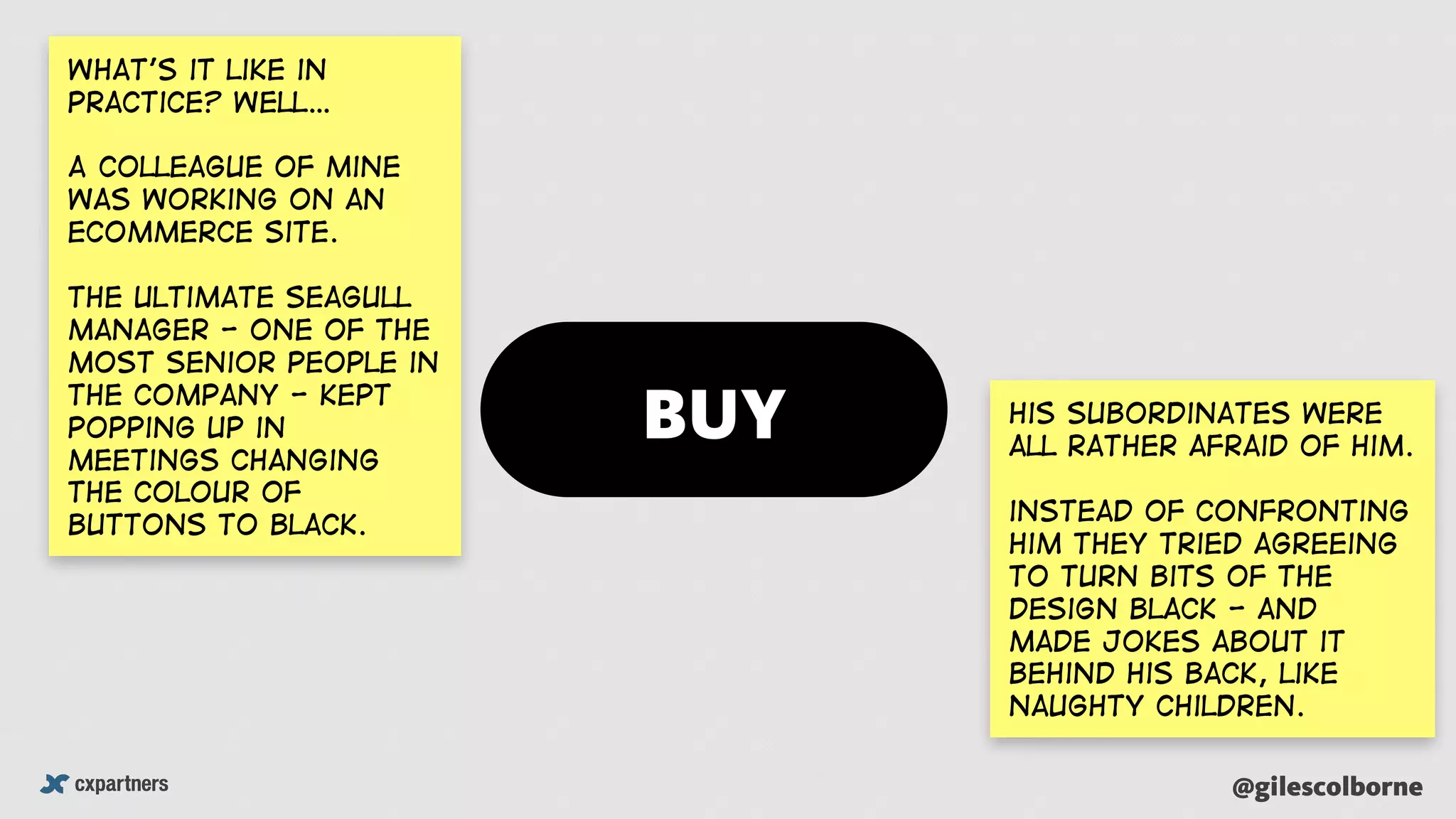
What’s it like in
practice? WEll…
A colleague of mine
was working on an
ecommerce site.
the ultimate seagull
manager - one of the
most senior people in
the company - kept
popping up in
meetings changing
the colour of
buttons to black.
His subordinates were
all rather afraid of him.
instead of confronting
him they tried agreeing
to turn bits of the
design black - and
made jokes about it
behind his back, like
naughty children.
BUY
@gilescolborne
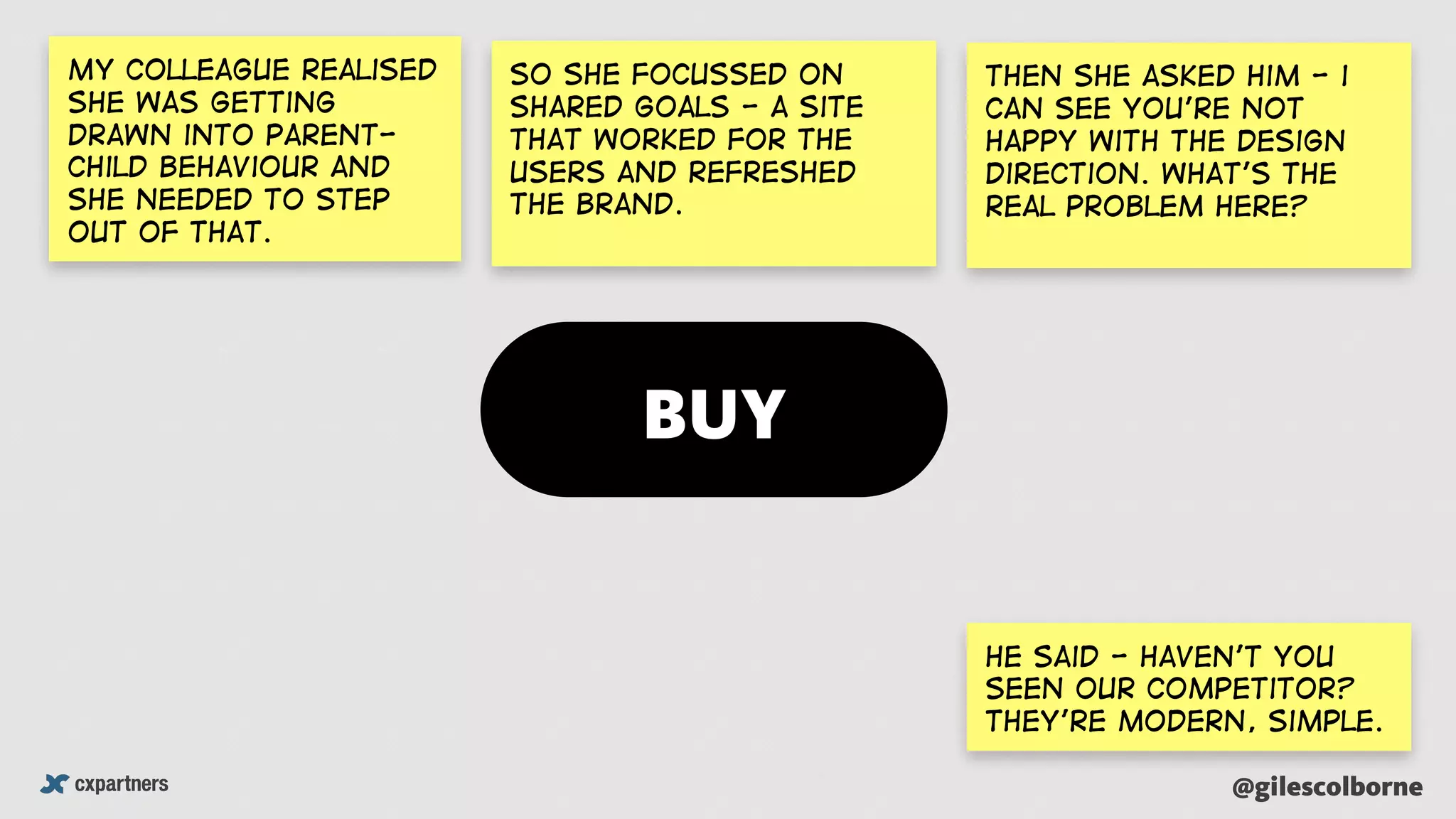
My colleague realised
she was getting
drawn into Parent-
child behaviour and
she needed to step
out of that.
So she focussed on
shared goals - a site
that worked for the
users and refreshed
the brand.
Then she asked him - i
can see you’re not
happy with the design
direction. what’s the
real problem here?
BUY
He said - haven’t you
seen our competitor?
They’re modern, simple.
@gilescolborne
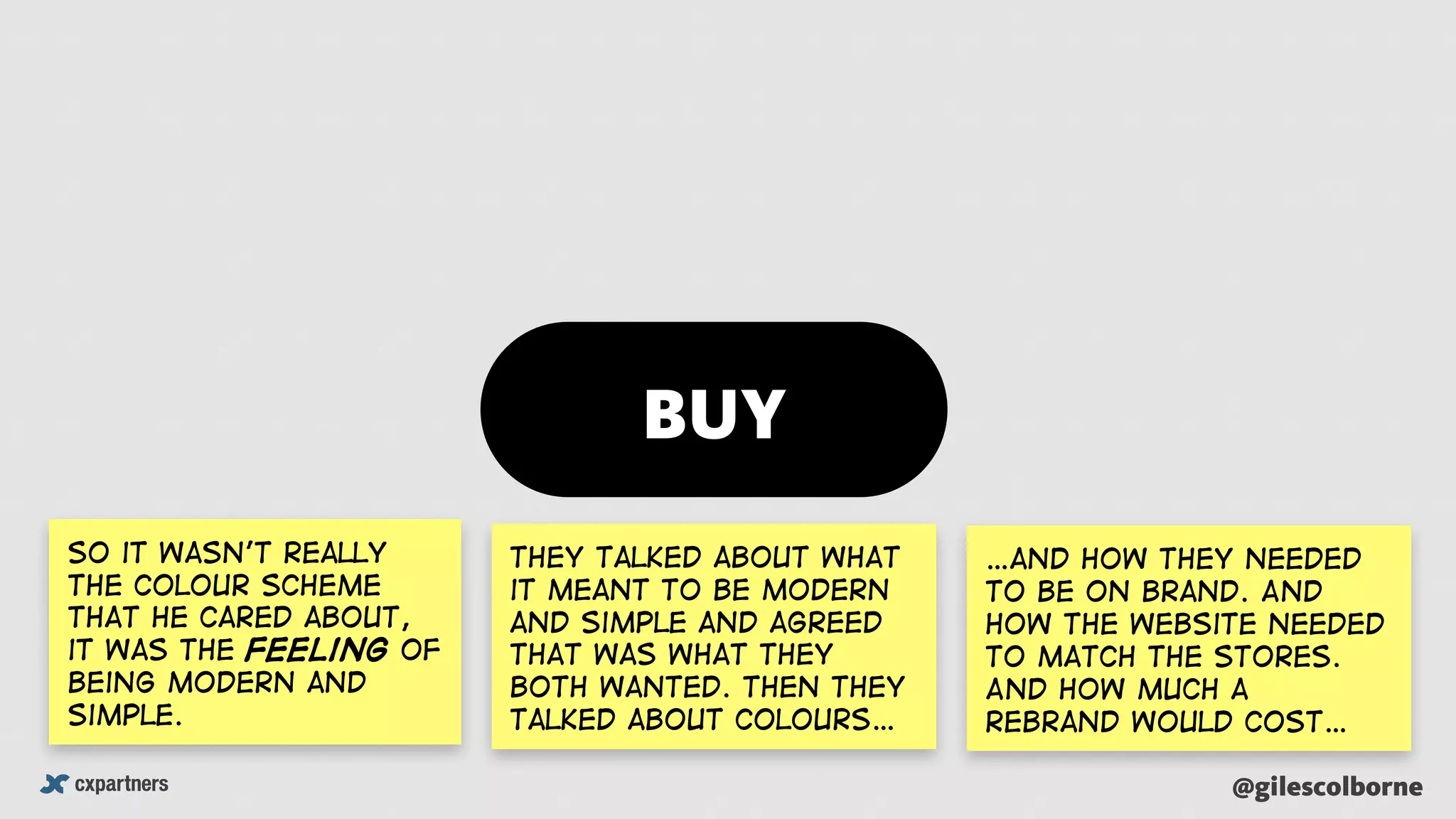
So it wasn’t really
the colour scheme
that he cared about,
it was the feeling of
being modern and
simple.
They talked about what
it meant to be modern
and simple and agreed
that was what they
both wanted. Then they
talked about colours…
…and how they needed
to be on brand. And
how the website needed
to match the stores.
And how much a
rebrand would cost…
BUY
@gilescolborne
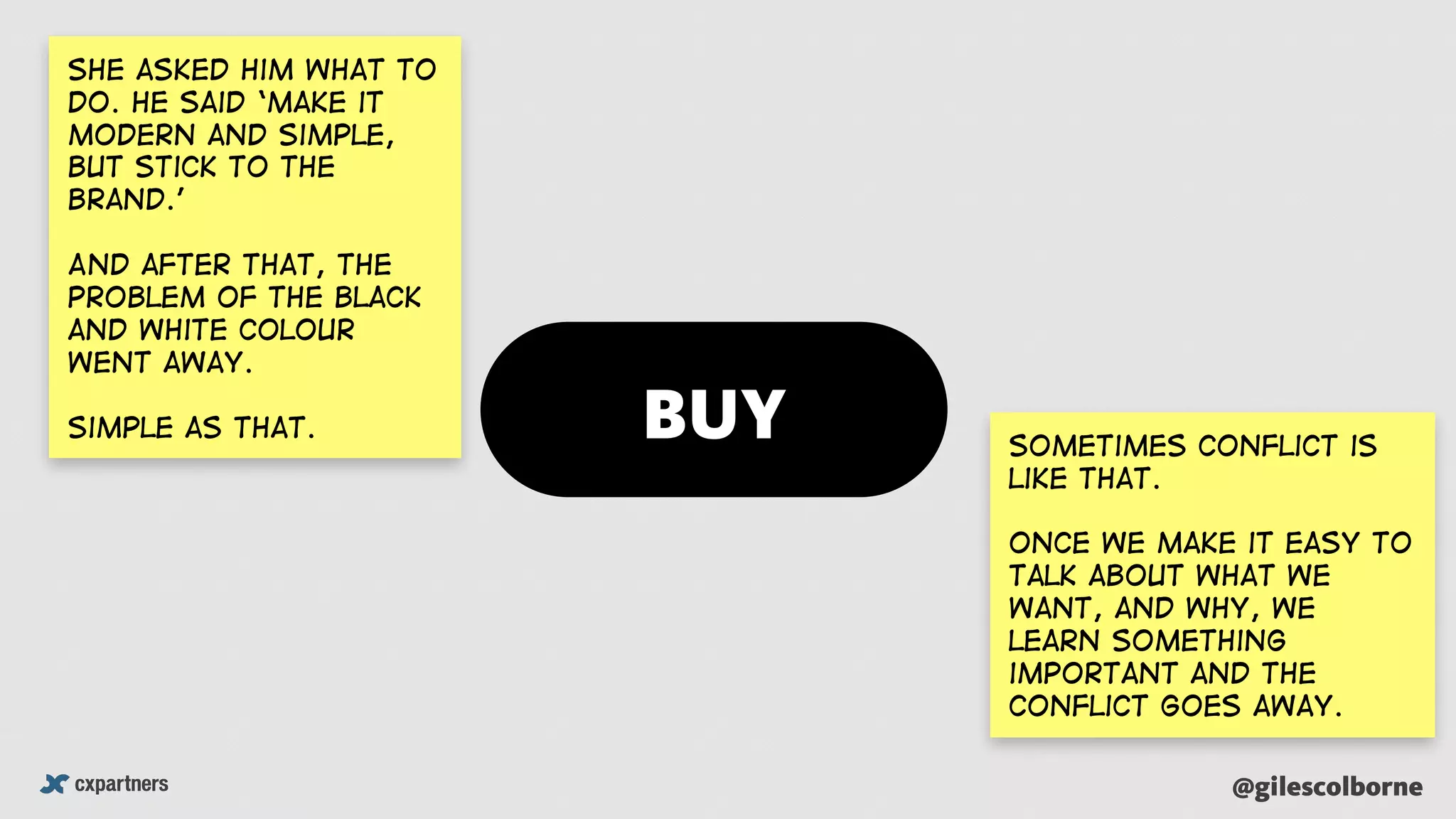
She asked him what to
do. He said ‘make it
modern and simple,
but stick to the
brand.’
And after that, the
problem of the black
and white colour
went away.
simple as that.
Sometimes conflict is
like that.
Once we make it easy to
talk about what we
want, and why, we
learn something
important and the
conflict goes away.
BUY
@gilescolborne
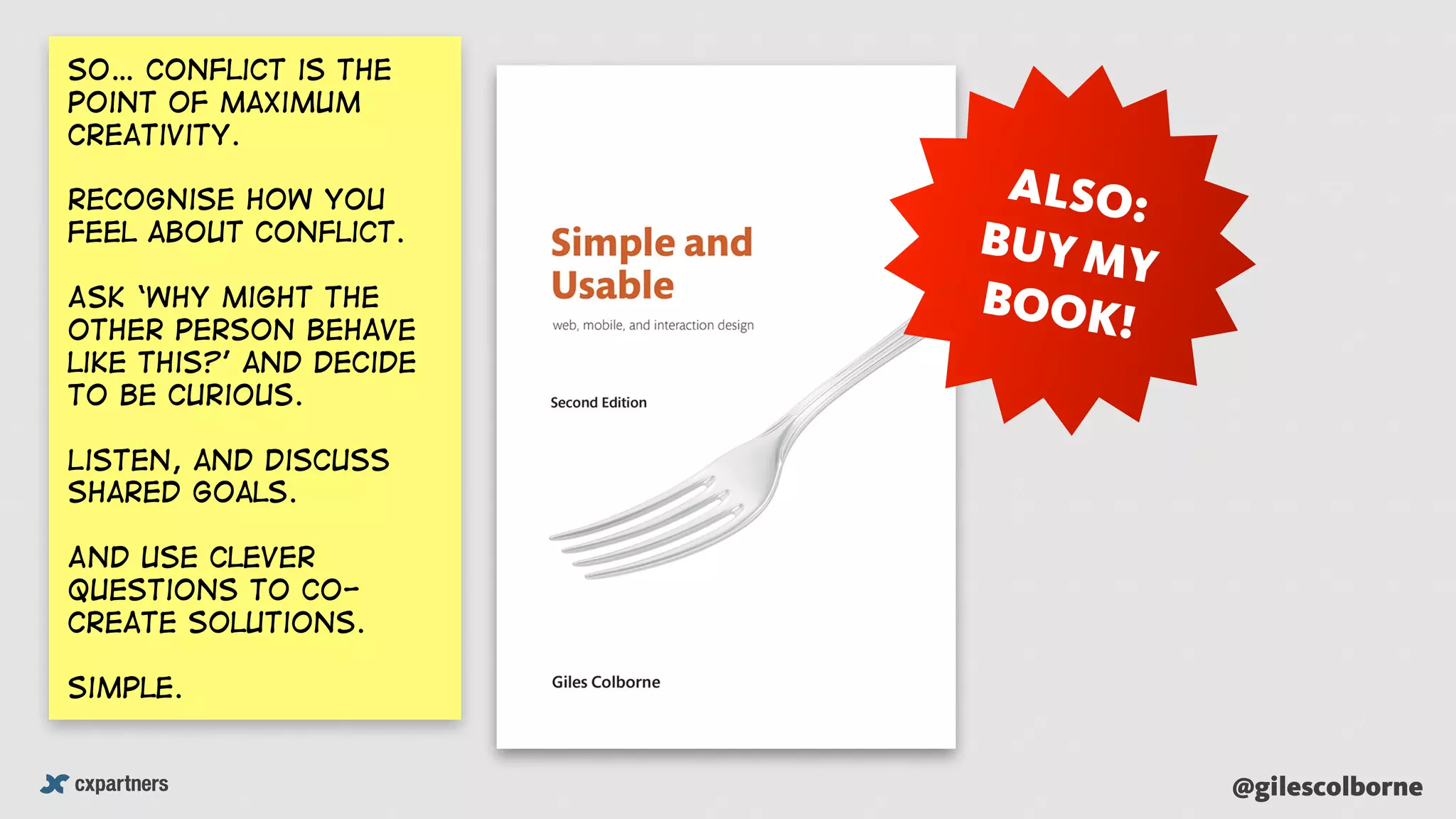
ALSO:
BUY MY
BOOK!
So… Conflict is the
point of maximum
creativity.
recognise how you
feel about conflict.
Ask ‘why might the
other person behave
like this?’ and Decide
to be curious.
Listen, and discuss
shared goals.
And use clever
questions to co-
create solutions.
Simple.
@gilescolborne
The skilful leader subdues the
enemy without any fighting.
Sun Tzu, The Art of War
Thank you!
@gilescolborne

Designing Without Compromise

  • 1.
  • 2.
    @gilescolborne@gilescolborne As a designer,what i seek is simplicity. i mean the kind of elegant simplicity where there’s a clarity of purpose. The designed object (or interaction, or service) speaks to the user with a consistent, clear, single-minded voice. Simplicity Always seems radical because it is rare.
  • 3.
    @gilescolborne@gilescolborne More often wehave a mish-mash of ideas. Different voices trying to speak at once. ‘design’ ends up being about gluing the bits together.
  • 4.
    @gilescolborne@gilescolborne We know thecauses… A senior stakeholder seagulls into a meeting and demands a feature gets included. Poop! A business analyst gathers a long list of requirements from stakeholders and ranks them according to a score. Design that! A couple of managers sit in on a design meeting and decide they should each contribute one idea. One each is fair, right? Maybe you’ve bitched about situations like that in the past…
  • 5.
    @gilescolborne@gilescolborne Some designers turn intohand grenades, tossed into meetings and ready to explode in a tantrum. Not a good look. But What’s the alternative? Muddling through at the expense of your integrity? Leaving the meeting feeling like you’ve let yourself down? What an awful choice.
  • 6.
    @gilescolborne@gilescolborne For me eachof those situations has one thing in common: a failure to deal with conflict. as Tyler Durden says in ‘Fight Club’, most people will do anything to avoid A fight. Even, it turns out, give up on their principles.
  • 7.
    @gilescolborne Some people see conflictdifferently. Chris Voss is a former Fbi hostage negotiator. He doesn’t like compromise either. He points out that you can’t compromise with kidnappers. “i’ll pay you half the ransom, you half-kill the hostages” doesn’t really work.
  • 8.
    @gilescolborne So he’s interestedin dealing with conflict. in fact, He says you should look forward to the moment the other side says ‘no’. Only then do you get to do your most creative work.
  • 9.
    @gilescolborne@gilescolborne So this isn’tabout fighting. This is about Constructive conflict. Constructive conflict leads to Agreement, clarity, speaking with one voice. simplicity.
  • 10.
    @gilescolborne The skilful leadersubdues the enemy without any fighting. Sun Tzu, The Art of War Sun tzu points out that you can have conflict without fighting - if you’re skilful. Skill comes from practice and preparation.
  • 11.
    @gilescolborne That’s why wehave ‘discover’ phases at the start of design projects. They’re not for reading background documents. They’re for drawing up your battle plan.
  • 12.
    @gilescolborne Start with yourself Butpreparation should start closer to home. We all carry some personal baggage into conflict. Past experiences. we walk into the room feeling angry, or anxious, or intimidated. The most important preparation is mastering those feelings.
  • 13.
    @gilescolborne Do you soundlike An angry or sarcastic parent? An anxious or naughty child? recognise your emotions, but don’t dwell on them. instead, choose to be creative! Ask yourself: Why might a reasonable person acT as they do? when you’re ready, You’ll be able to ask questions as one adult to another. you’ll be curious about finding answers. listen to the stories you tell yourself about the people you’re facing. Start with yourself
  • 14.
    @gilescolborne For a specificproject, my goals may be different or just more specific. But understanding my goals, and the reasons behind them, helps me recognise when those things are being compromised. You should also think about what you’re really trying to achieve. what are your goals? For example, i want the design to be ‘Simple’. i want that because clarity of purpose makes things better for the user. making things better for the user makes for better business.
  • 15.
    @gilescolborne@gilescolborne Finally, it’s important toknow when you’re undermining yourself by being perfectionist. educational psychologist Carol dwek points out that, in the long run, people who focus on improving achieve more than those who aim for perfection. Your goal isn’t to ‘design what’s perfect’. You want to maximise improvement. that’s what you should be going in to discuss.
  • 16.
    @gilescolborne@gilescolborne Goal setting likeThis isn’t the same as compromise. Bad compromises are about avoiding conflict by giving up on something that matters. this is about making sure you set yourself realistic targets so you can focus.
  • 17.
    @gilescolborne Once you’ve got yourselfin the right mindset, you’re ready to think about the people you’re dealing with. constructive conflict, requires trust. Trust makes it okay to explore disagreements. One way to build trust is to recognise shared goals. it’s also a good way to explore the motivations of the other person. So ask about their goals. Ask ‘why?’ and look for the higher goal. Sooner or later, you’ll find a place of agreement and trust.
  • 18.
    @gilescolborne@gilescolborne For me, that’sthe real value of user centred design. Bring a group of stakeholders into a room to watch a user test and you can often feel the tension of interdepartmental conflicts. But as they watch the user test, they align. Silos break down. They realise they all want to help the user.
  • 19.
    @gilescolborne Exploring goals also buildstrust because it encourages you to listen deeply to the other person. Listening is respectful. it builds trust by showing you care. Summarising what you’ve heard also helps in two ways. it reinforces that you want to listen, and it gives the other person a chance to clarify any complex points. Now you can explore points of disagreement. ‘We both want X, so i’m curious about y.’ remember, bring curiosity, not opposition.
  • 20.
    @gilescolborne What about thisis important to you? How did we get to this point? How do we solve this? How am I supposed to accomplish that? Anything else? questions like these help you explore disagreement with curiosity. They also get you working together on a solution-The essence of creative conflict.
  • 21.
    @gilescolborne One more thing.No matter how tempting, Don’t take silence for Agreement. Silence often means someone is sitting on concerns or hasn’t understood. it means trouble later. You want a decision, or clarity on how a decision will be made.
  • 22.
    @gilescolborne What’s it likein practice? WEll… A colleague of mine was working on an ecommerce site. the ultimate seagull manager - one of the most senior people in the company - kept popping up in meetings changing the colour of buttons to black. His subordinates were all rather afraid of him. instead of confronting him they tried agreeing to turn bits of the design black - and made jokes about it behind his back, like naughty children. BUY
  • 23.
    @gilescolborne My colleague realised shewas getting drawn into Parent- child behaviour and she needed to step out of that. So she focussed on shared goals - a site that worked for the users and refreshed the brand. Then she asked him - i can see you’re not happy with the design direction. what’s the real problem here? BUY He said - haven’t you seen our competitor? They’re modern, simple.
  • 24.
    @gilescolborne So it wasn’treally the colour scheme that he cared about, it was the feeling of being modern and simple. They talked about what it meant to be modern and simple and agreed that was what they both wanted. Then they talked about colours… …and how they needed to be on brand. And how the website needed to match the stores. And how much a rebrand would cost… BUY
  • 25.
    @gilescolborne She asked himwhat to do. He said ‘make it modern and simple, but stick to the brand.’ And after that, the problem of the black and white colour went away. simple as that. Sometimes conflict is like that. Once we make it easy to talk about what we want, and why, we learn something important and the conflict goes away. BUY
  • 26.
    @gilescolborne ALSO: BUY MY BOOK! So… Conflictis the point of maximum creativity. recognise how you feel about conflict. Ask ‘why might the other person behave like this?’ and Decide to be curious. Listen, and discuss shared goals. And use clever questions to co- create solutions. Simple.
  • 27.
    @gilescolborne The skilful leadersubdues the enemy without any fighting. Sun Tzu, The Art of War
  • 28.