GAME MECHANICS
*SUCK* WITHOUT
NARRATIVE
Melinda Jacobs, Subatomic
Gamification Europe
@melindajacobs
WHAT IS
GAMIFICATION?
* r e a l l y *
@melindajacobs
GAMIFICATION IS …
an observation that games are extraordinarily
successful at creating engagement and triggering
states of flow ...
as well as a decision to design experiences based
on a narrative(s), in a similar manner as we would
design a game, with the goal of achieving similar
levels of interactivity and engagement.
GAMIFICATION IS NOT A
PRACTICE.
WHAT ABOUT
ENGAGEMENT?
h o w d o e s t h i s p l a y i n ?
@melindajacobs
ENGAGEMENT HAS A CONTEXT
We have to stop thinking of engagement as a
stand alone target. It is not a target in and of itself.
It’s a target in combination with (a goal of) a
narrative.
You must design for engagement in line with your
goal, otherwise you might create something
engaging, but damaging to your narrative.
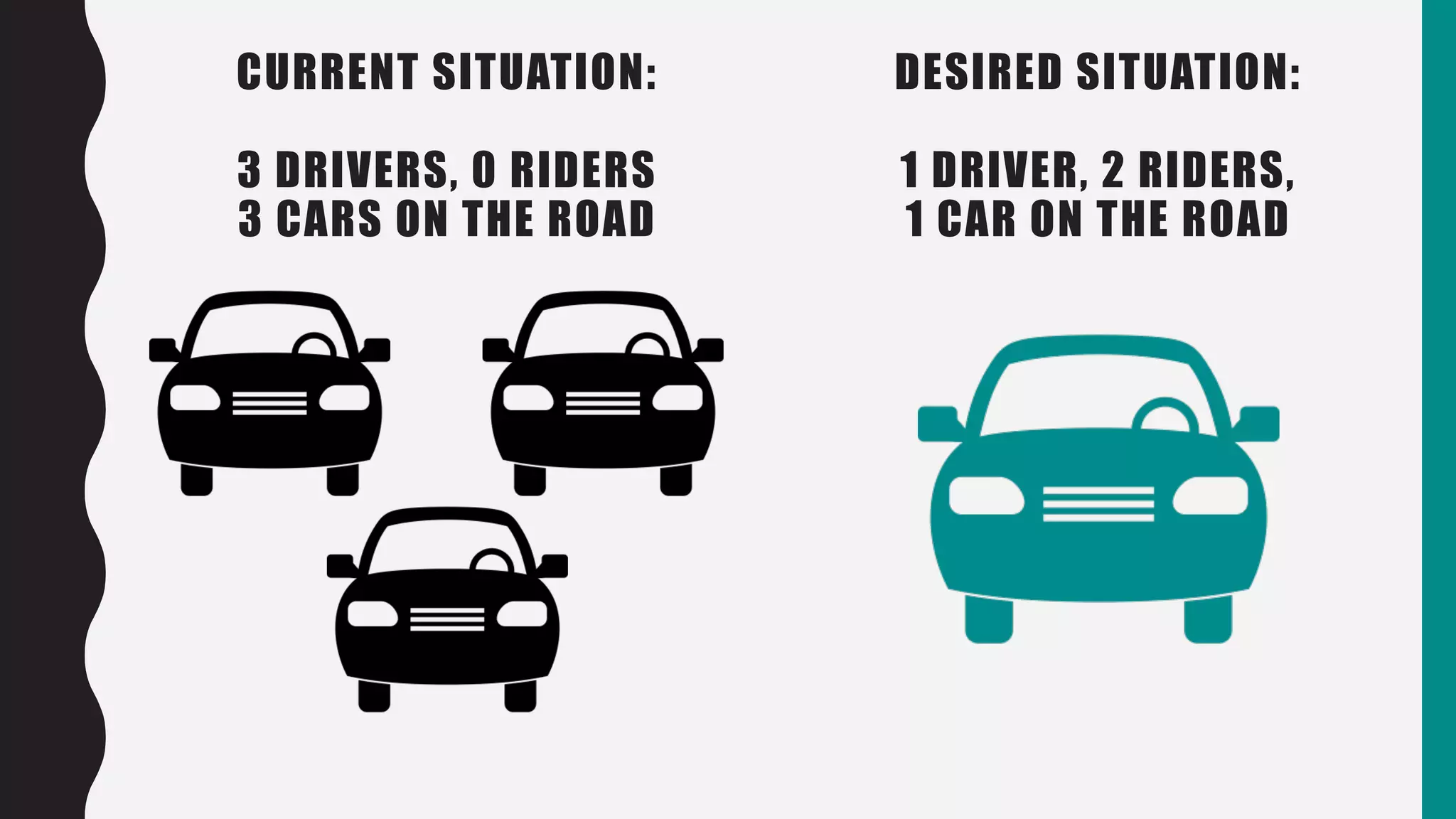
CURRENT SITUATION:
3 DRIVERS, 0 RIDERS
3 CARS ON THE ROAD
DESIRED SITUATION:
1 DRIVER, 2 RIDERS,
1 CAR ON THE ROAD
CARPOOL EXAMPLE
Gamification: ”We need to encourage drivers to
share riders, so let’s reward drivers who share
drives with a leaderboard, point system, reward
system.”
But what does this create? “Game mechanics” got
drivers get engaged and active – success! - but is
it? We’ve now put a value so high on driving
everyone still wants to be a driver …
ENGAGEMENT IS ONLY A WIN
WHEN IT’S IN LINE WITH THE
NARRATIVE.
THE
EXPERIENCE
t h e b i g p i c t u r e
@melindajacobs
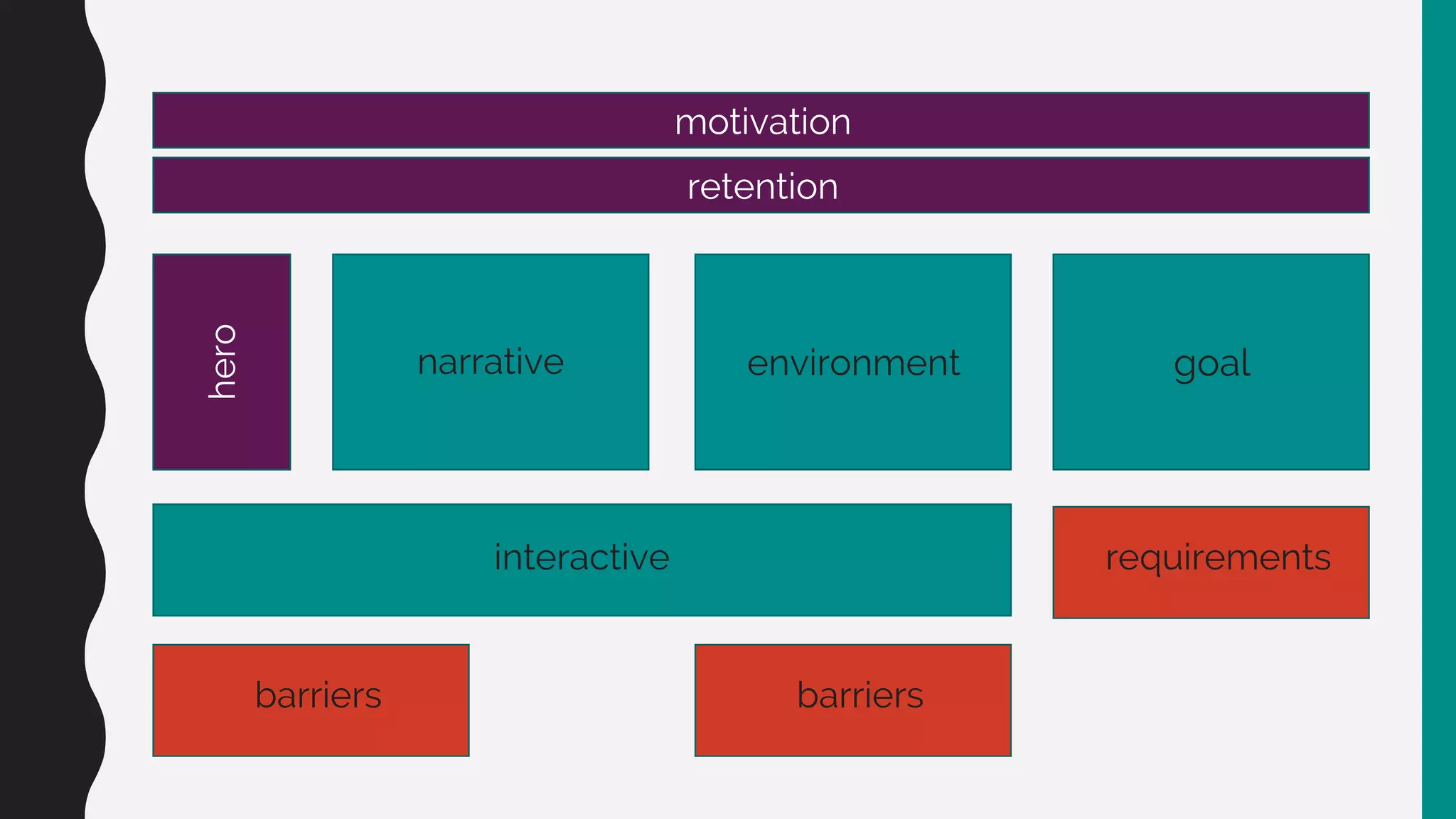
narrative environment goal
interactive
retention
requirements
hero
barriers
motivation
barriers
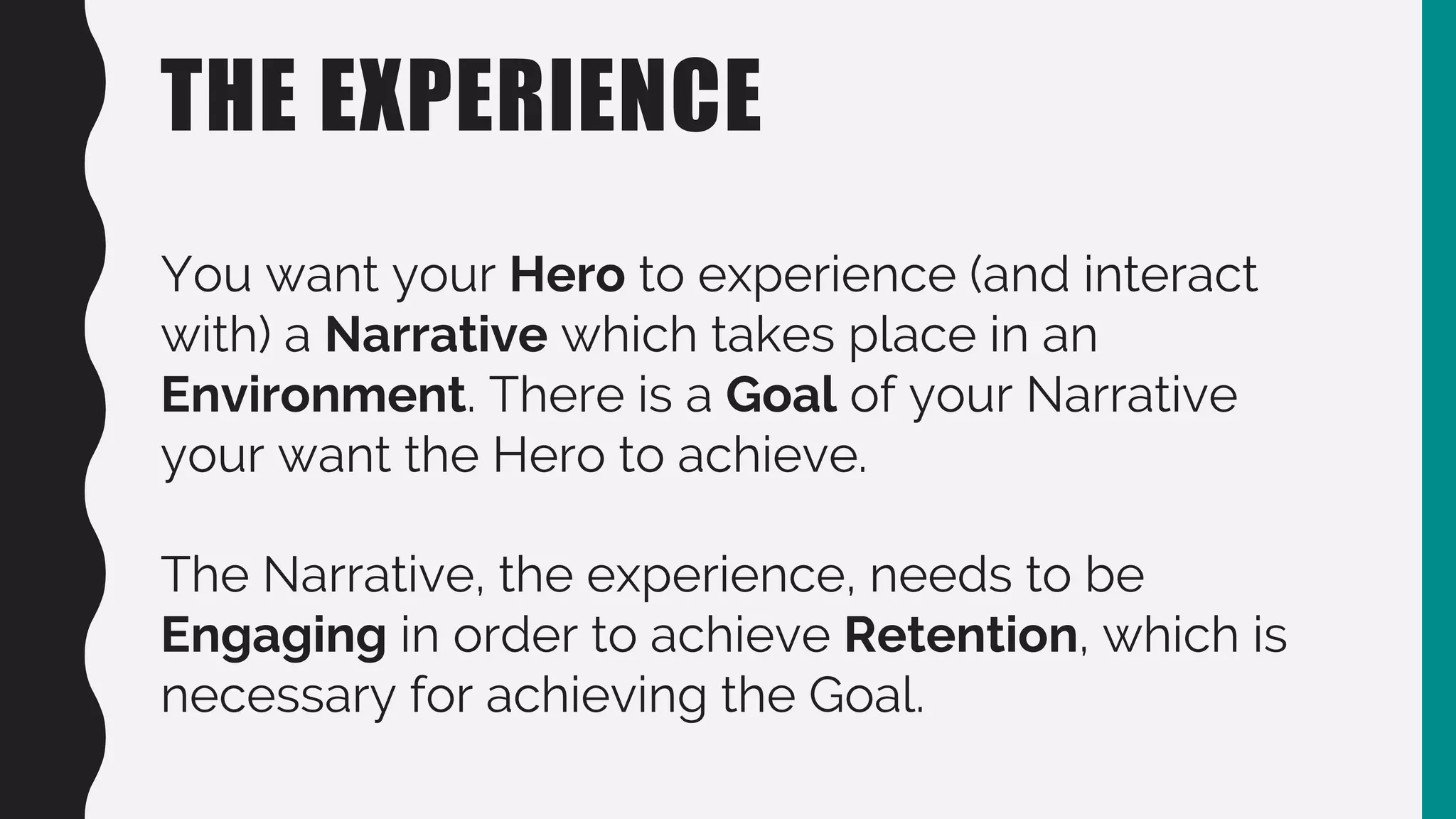
THE EXPERIENCE
You want your Hero to experience (and interact
with) a Narrative which takes place in an
Environment. There is a Goal of your Narrative
your want the Hero to achieve.
The Narrative, the experience, needs to be
Engaging in order to achieve Retention, which is
necessary for achieving the Goal.
THE EXPERIENCE
We want to Engage the user with the Narrative. We
want this engagement to create Value and we
believe Interactivity is key in achieving this.
Interactivity is one of the core things we take from
games. We want to bring the Hero as close to the
Narrative as possible.
THE EXPERIENCE
There are, usually, Requirements for the User to
achieve the Goal. (e.g. registration, need FB
connect), and Challenges to completing those
Requirements.
We need to anticipate those Challenges, and help
the Hero move past them. This is where
’gamification’ helps.
INTERACTING
W/ NARRATIVE
t h e h e a r t o f y o u r e x p e r i e n c e
@melindajacobs
NARRATIVE
What is the main story you are telling? What’s the
reason for this experience?
Look at how you communicate your narrative.
Sometimes you may need to adjust how you
introduce or talk about your narrative, to find
success. Make it relatable.
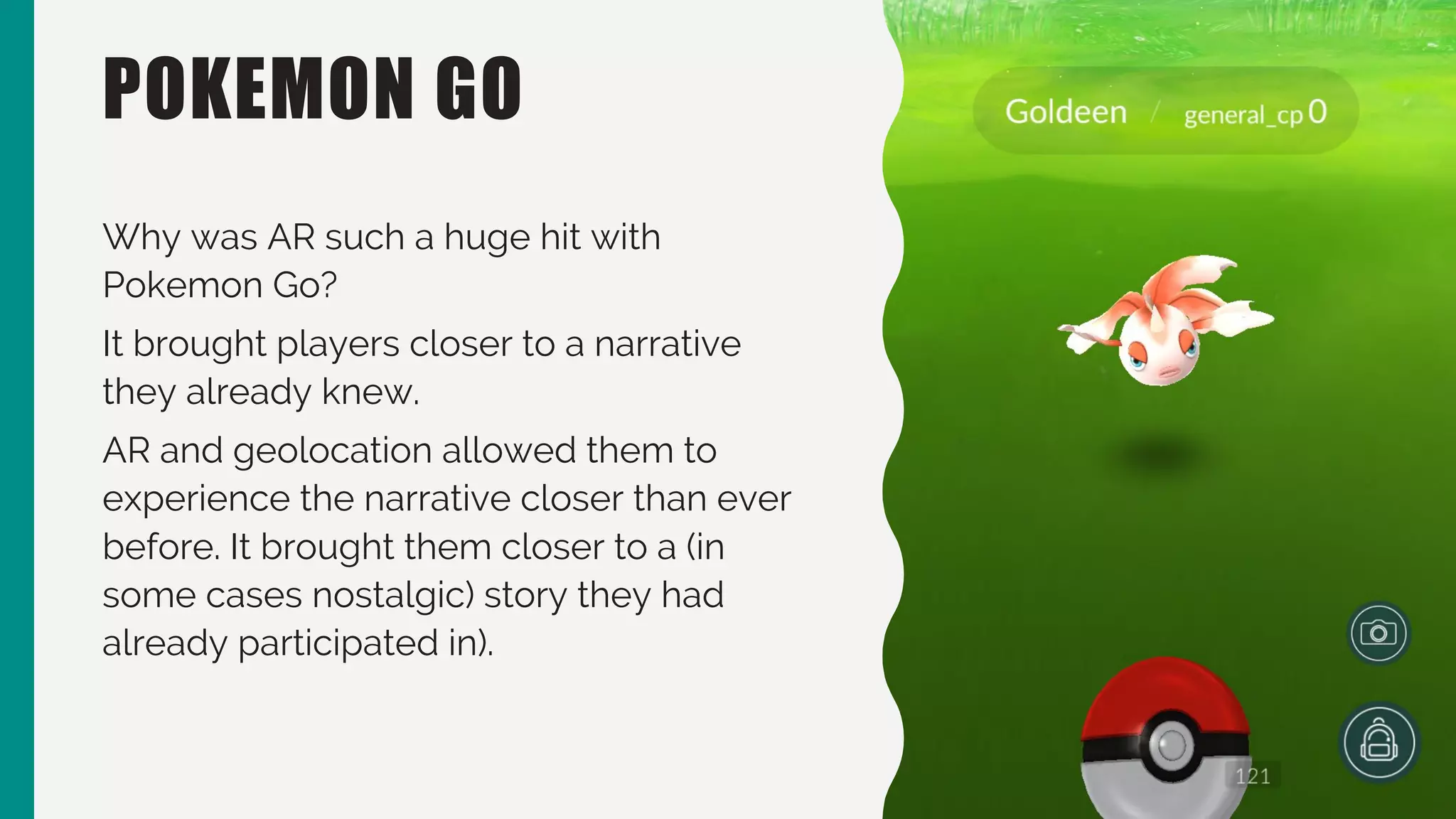
POKEMON GO
Why was AR such a huge hit with
Pokemon Go?
It brought players closer to a narrative
they already knew.
AR and geolocation allowed them to
experience the narrative closer than ever
before. It brought them closer to a (in
some cases nostalgic) story they had
already participated in).
GOAL & ROLES
What is the reason you are telling this story? What
do you want your Hero to do, or to get out of it?
Who is your Hero in this experience with?
Themselves? Others? What about the role of the
system?
MOTIVATION
Why would your hero do this in the first place?
Where are the motivation? Where is the value?
Again, is it individual? Or is it group?
INTERACTIVITY
& PLAY
c o r e m e c h a n i c s o f g a m e s
@melindajacobs
INTERACTIVITY
Games are narratives, stories, with interactive
environments. An interactive environment is
different than one-way participation. Think of it as a
spectrum, but remember interactivity is not parallel
to engagement level.
Use interactivity as a dialogue with your narrative
and your user. Remember it’s always a negotiation.
INFLUENCE
How much can your Hero affect the outcome? How
much can your Hero influence the rules of the
system or environment they are in? How much can
they influence each other.
We often want to be useful contributors to a
pursuit, be able to influence the direction of what
we’re doing.
PLAY
A narrative in an interactive environment, where the
Hero can explore, gain experience, and grow an
understanding through trial and error.
We learn best when we actually can implement
what we’ve learned and practice … or learn the hard
way.
PLAY IS AN ABILITY TO FAIL, AND
FAIL IS AN ABILITY TO LEARN.
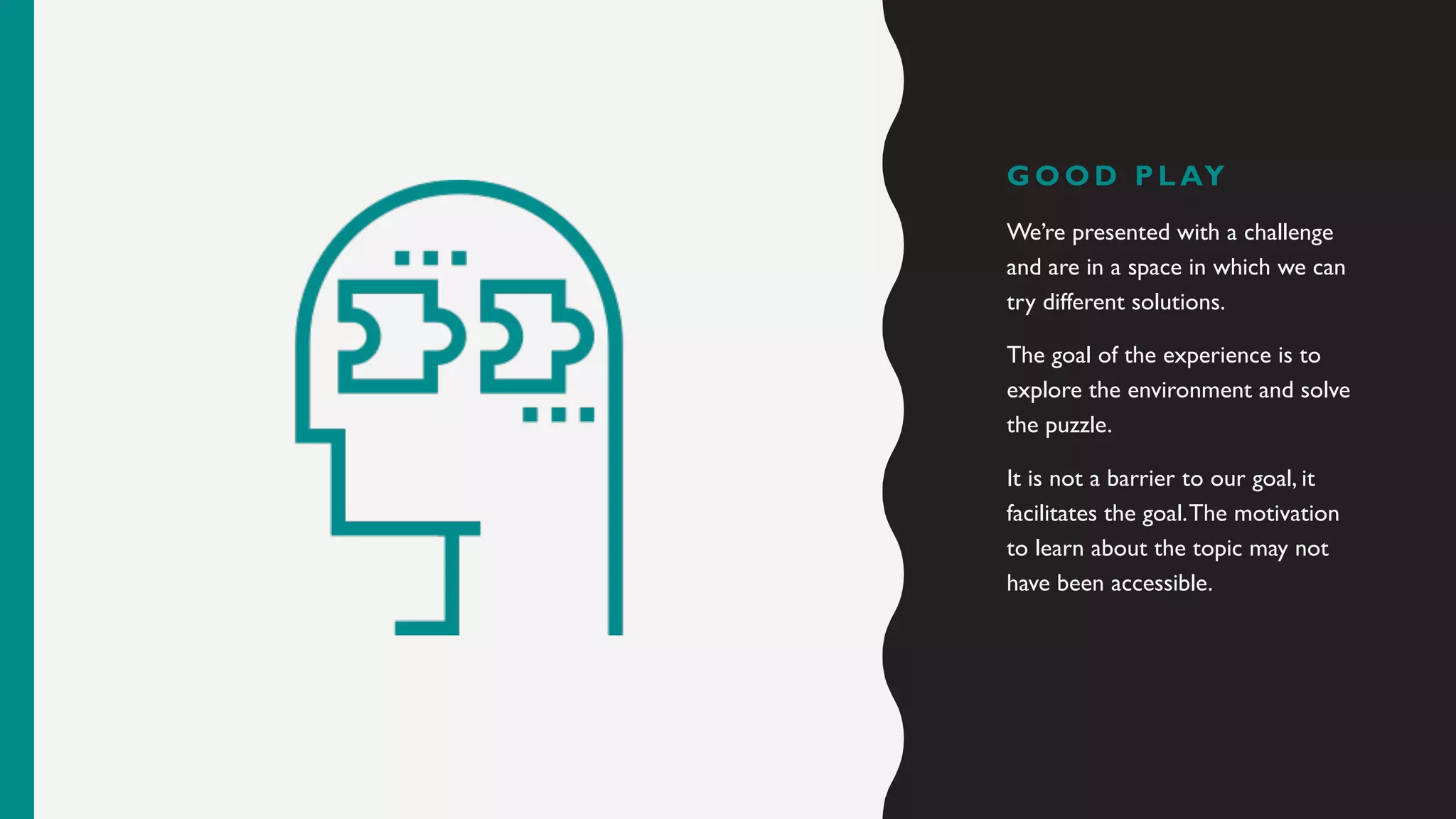
G O O D P L AY
We’re presented with a challenge
and are in a space in which we can
try different solutions.
The goal of the experience is to
explore the environment and solve
the puzzle.
It is not a barrier to our goal, it
facilitates the goal.The motivation
to learn about the topic may not
have been accessible.
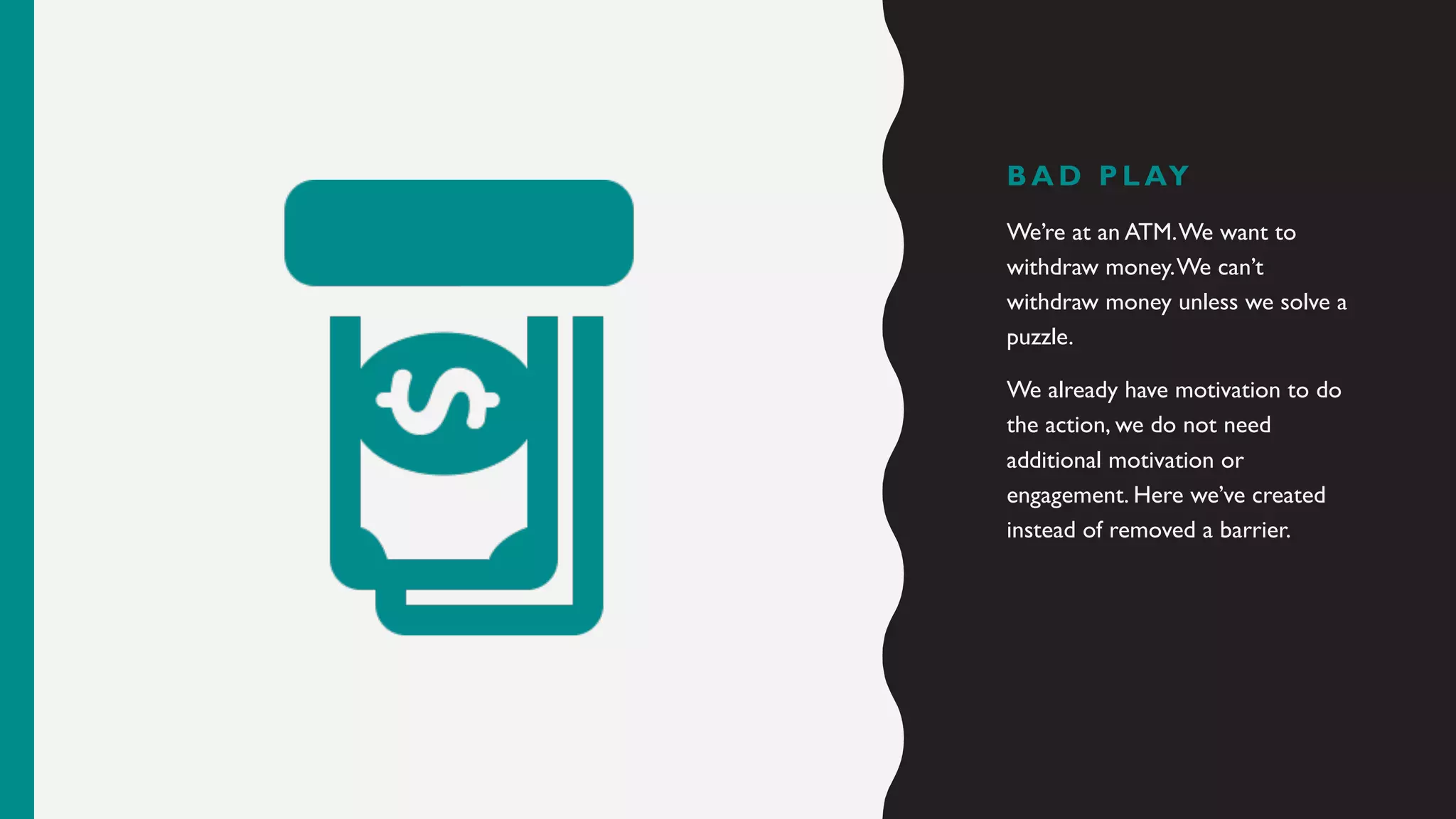
B A D P L AY
We’re at an ATM.We want to
withdraw money.We can’t
withdraw money unless we solve a
puzzle.
We already have motivation to do
the action, we do not need
additional motivation or
engagement. Here we’ve created
instead of removed a barrier.
FEEDBACK
Feedback is an essential part of understanding an
environment, and how it behaves. It’s allows us to
learn through experience.
• This can be a system logic: If A then B.
• It can also be a system awareness: You are now here.
• It can also manage expectations. It will take you 10
minutes to read this article.
• Etc.
OVERCOMING
OBSTACLES
p r o b l e m s o l v i n g
@melindajacobs
What does the
user need to do
to complete the
goal?
Where are the
problems?
What is the goal?
There’s a difference between flow and free play.
The user needs to understand, why don’t they want to do this, or why an
issue, event, narrative, is not currently expected or predicted to creating
engagement.
This test should be a framework for determining how relevant a feature is, an
approach is, and how well it helps a user in a given customer segment
accomplish the goal of your product vision, your narrative.
BEFORE YOU START ADDING,
KNOW YOUR HERO’S
CHALLENGES AND PAINS.
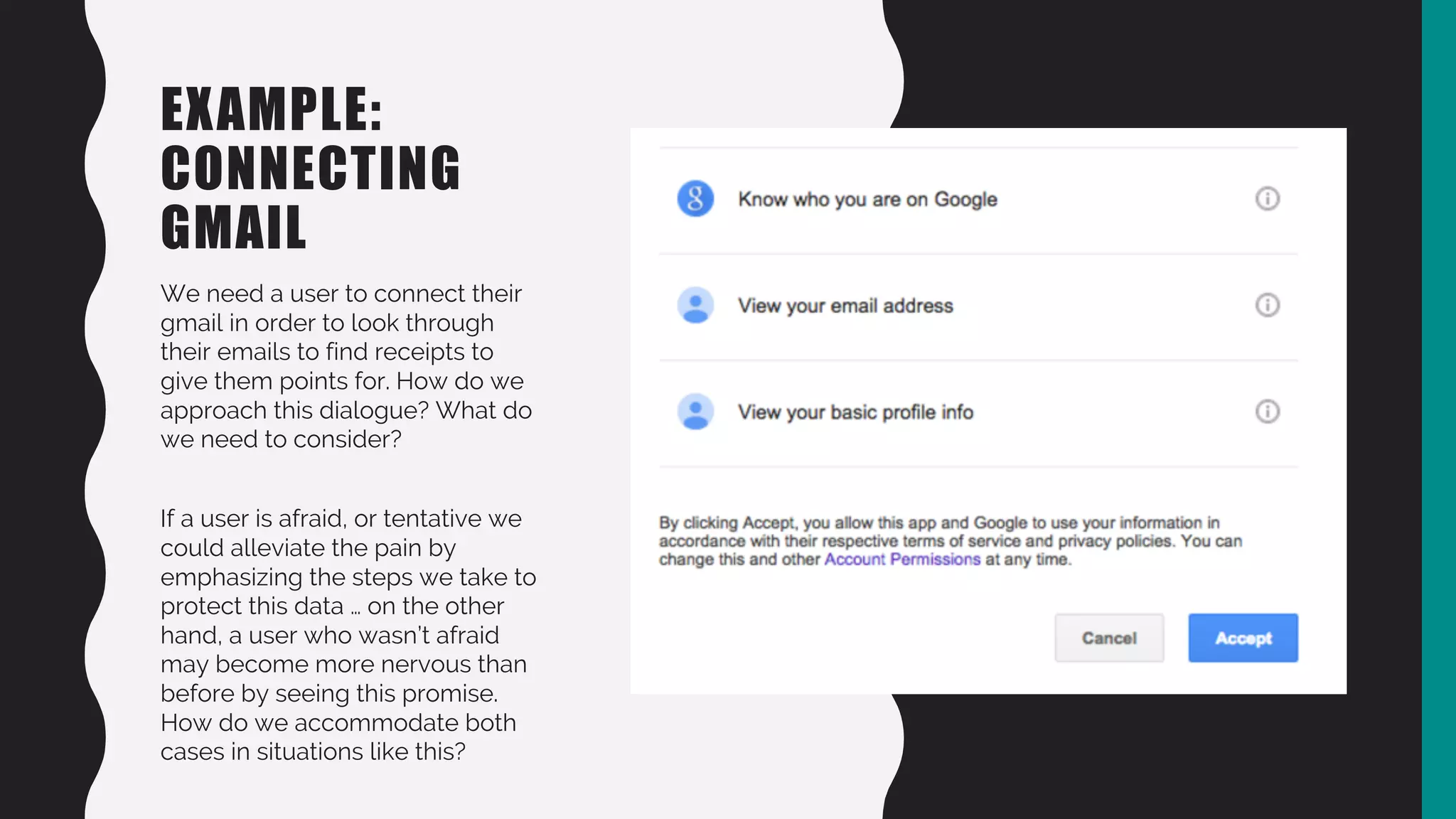
EXAMPLE:
CONNECTING
GMAIL
We need a user to connect their
gmail in order to look through
their emails to find receipts to
give them points for. How do we
approach this dialogue? What do
we need to consider?
If a user is afraid, or tentative we
could alleviate the pain by
emphasizing the steps we take to
protect this data … on the other
hand, a user who wasn’t afraid
may become more nervous than
before by seeing this promise.
How do we accommodate both
cases in situations like this?
HUMOR
Humor, helps soften delivery. Humanizes the
dialogue that is going on. Softens, while
acknowledging the situation.
WHAT’S THE
MOTIVATION
d r i v e r s
@melindajacobs
MOTIVATION
Always ask yourself, every step of the way, ”Why
would they do this?” Where is the motivation? Is it
there? Or do I need to create it.
REWARDS ARE TEMPTING, BUT …
Research shows those who are directly rewarded
for behavior are actually less likely to perform the
behavior
What work’s better? No rewards or Surprise
rewards
WHY IS THIS THE CASE?
With only predicted external motivation, the task
loses meaning – “Why am I doing this?” They don’t
develop value on their own.
CURIOSITY
Curiosity works. People are more likely to
remember something if they are curious about it in
the first place. Generating that curiosity is part of
your system design.
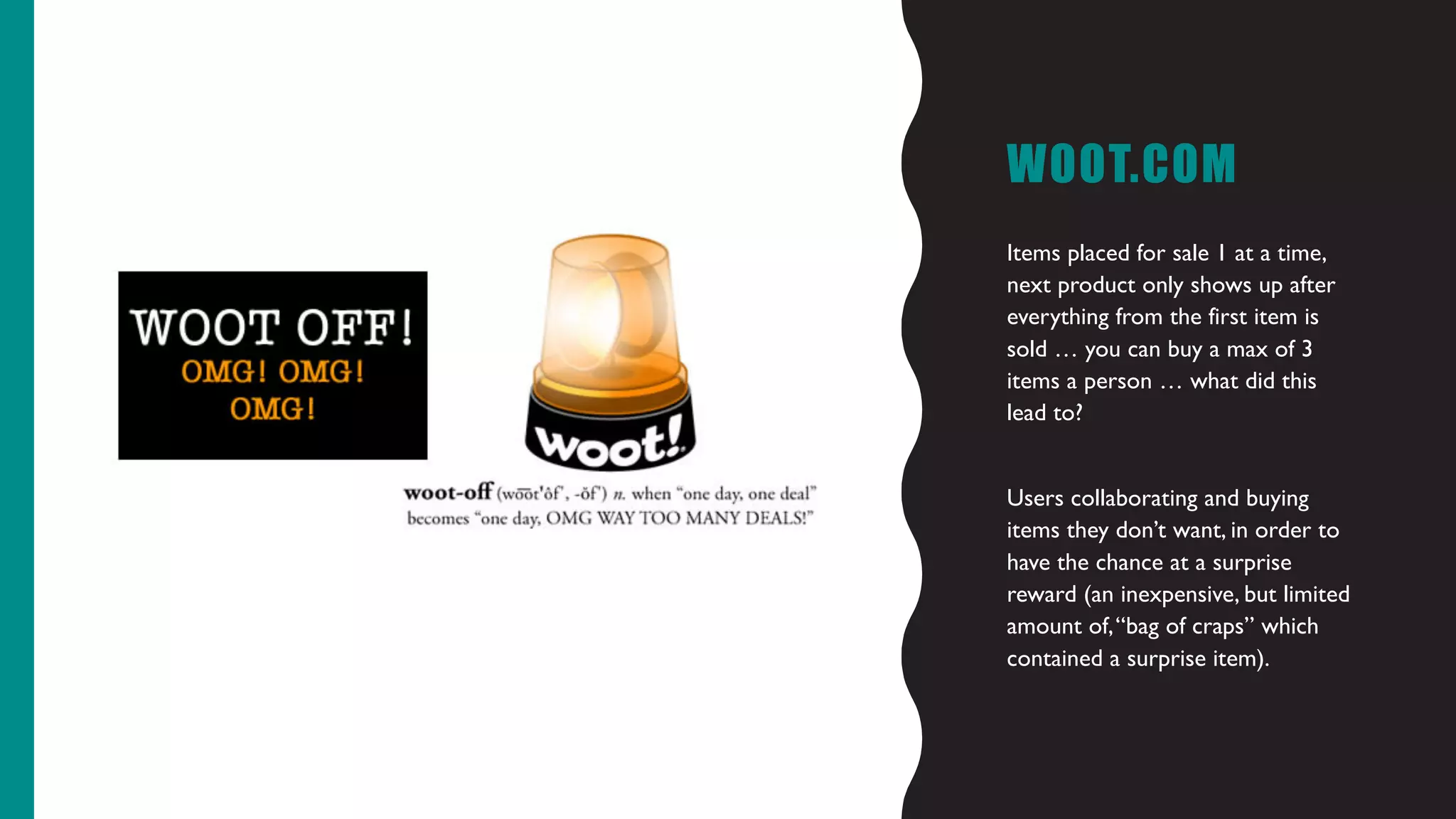
WOOT.COM
Items placed for sale 1 at a time,
next product only shows up after
everything from the first item is
sold … you can buy a max of 3
items a person … what did this
lead to?
Users collaborating and buying
items they don’t want, in order to
have the chance at a surprise
reward (an inexpensive, but limited
amount of,“bag of craps” which
contained a surprise item).
BADGES
Badges, leaderboards, are only rewarding if they
have value. Badges do not motivate people in and
of itself, especially when they are predictable.
They have to have a value and it can be very
difficult not to inflate that value.
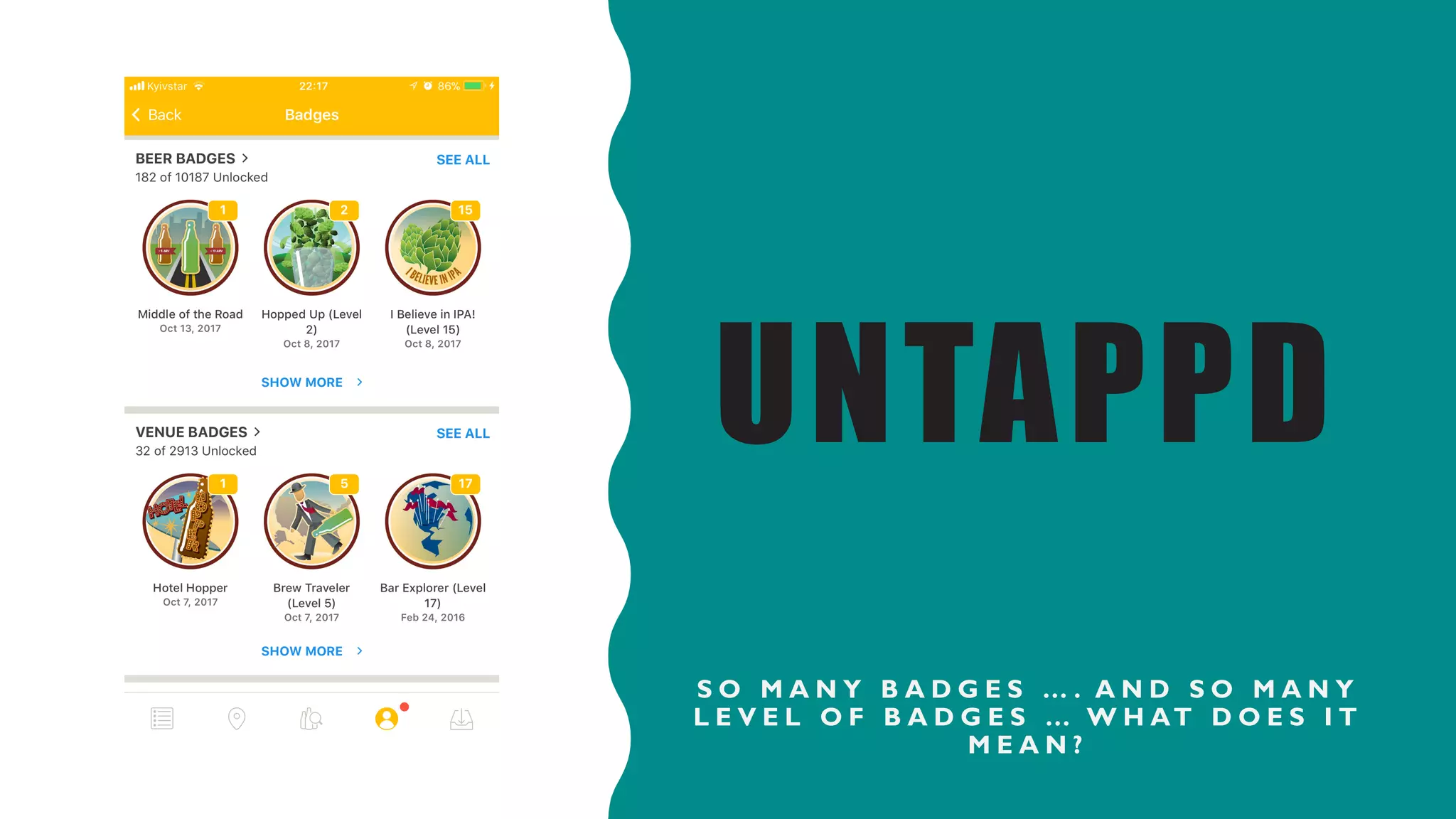
UNTAPPD
S O M A N Y B A D G E S … . A N D S O M A N Y
L E V E L O F B A D G E S … W H AT D O E S I T
M E A N ?
CREATING VALUE AND MEANING
CREATES MOTIVATION.
WAIT, WHERE IS
FUN?
w h y i s n ’ t i t i n h e r e ?
@melindajacobs
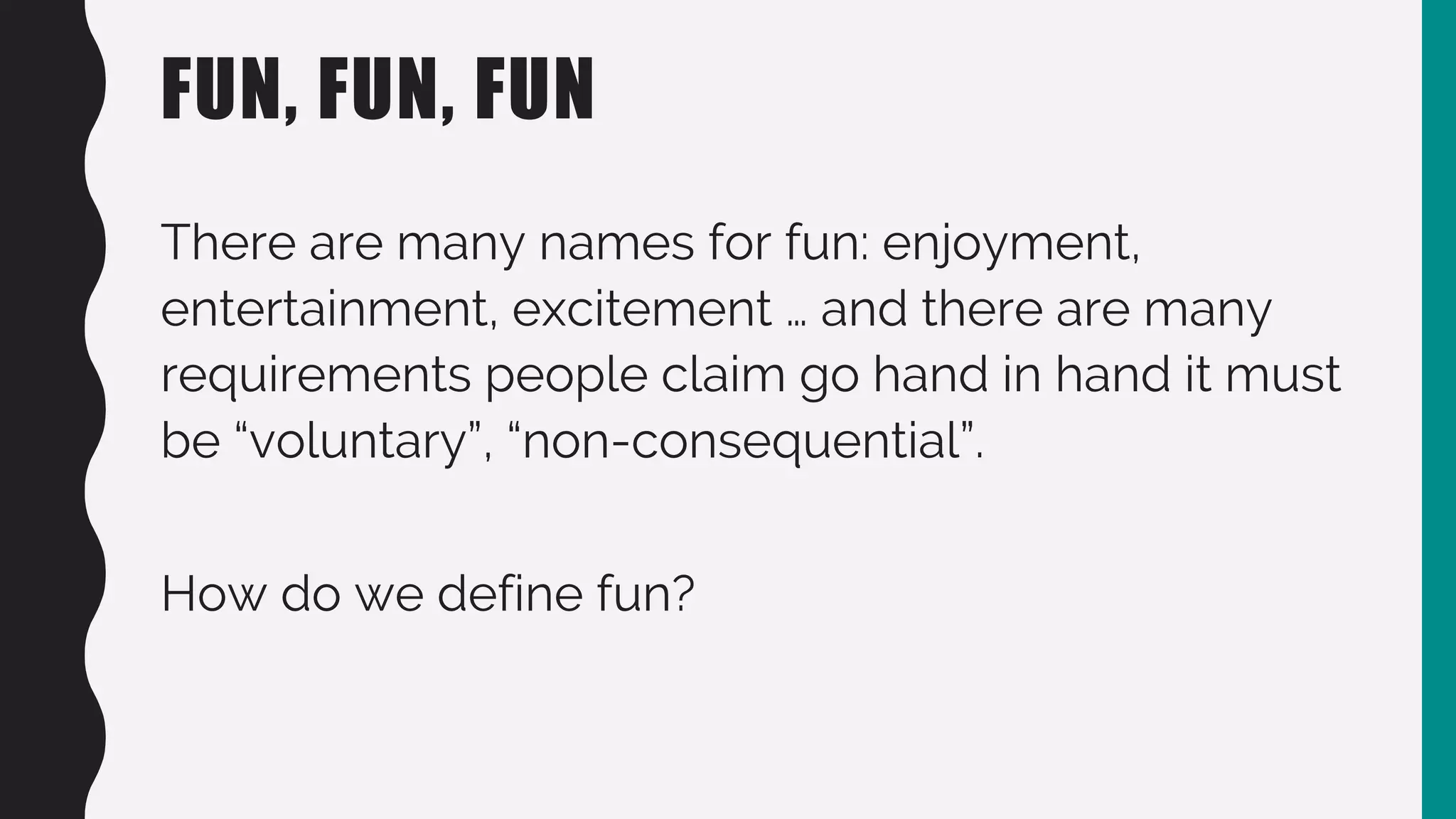
FUN, FUN, FUN
There are many names for fun: enjoyment,
entertainment, excitement … and there are many
requirements people claim go hand in hand it must
be “voluntary”, “non-consequential”.
How do we define fun?
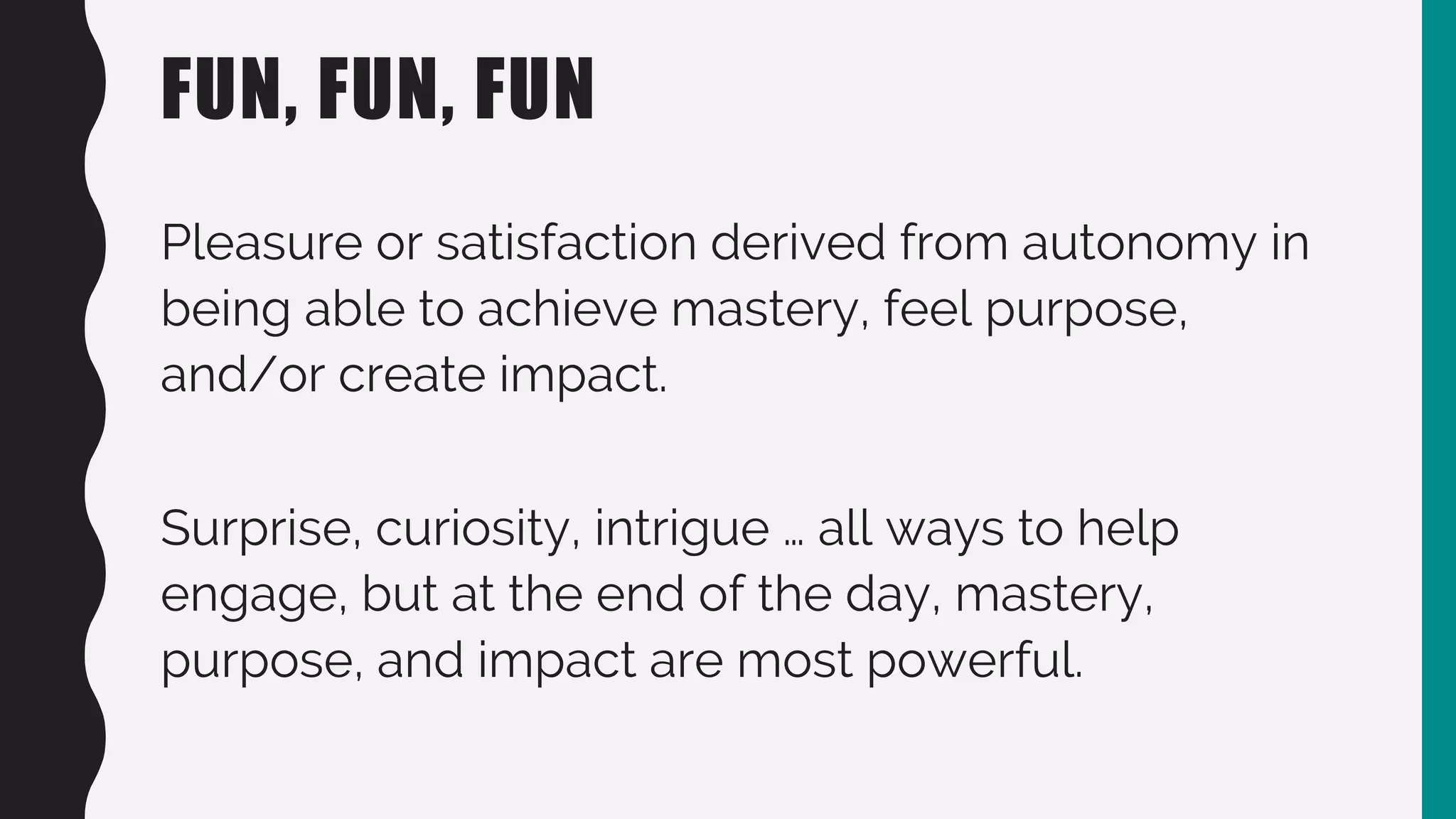
FUN, FUN, FUN
Pleasure or satisfaction derived from autonomy in
being able to achieve mastery, feel purpose,
and/or create impact.
Surprise, curiosity, intrigue … all ways to help
engage, but at the end of the day, mastery,
purpose, and impact are most powerful.
TAKING ACTION
NOW
4 t a k e a w a y s
@melindajacobs
IDENTIFY &
UNDERSTAND
YOUR NARRATIVE.
PUT YOUR GOALS AT
THE CENTER OF
YOUR DESIGN.
BE CONCIOUS OF
CHALLENGES &
NEGOTIATIONS.
CHALLENGE YOUR
EXPECTATIONS.
THANK YOU.
Melinda Jacobs
melinda@subatomic.nl
@melindajacobs

Game Mechanics Suck without Narrative - Jacobs

  • 1.
    GAME MECHANICS *SUCK* WITHOUT NARRATIVE MelindaJacobs, Subatomic Gamification Europe @melindajacobs
  • 2.
    WHAT IS GAMIFICATION? * re a l l y * @melindajacobs
  • 3.
    GAMIFICATION IS … anobservation that games are extraordinarily successful at creating engagement and triggering states of flow ... as well as a decision to design experiences based on a narrative(s), in a similar manner as we would design a game, with the goal of achieving similar levels of interactivity and engagement.
  • 4.
  • 5.
    WHAT ABOUT ENGAGEMENT? h ow d o e s t h i s p l a y i n ? @melindajacobs
  • 6.
    ENGAGEMENT HAS ACONTEXT We have to stop thinking of engagement as a stand alone target. It is not a target in and of itself. It’s a target in combination with (a goal of) a narrative. You must design for engagement in line with your goal, otherwise you might create something engaging, but damaging to your narrative.
  • 7.
    CURRENT SITUATION: 3 DRIVERS,0 RIDERS 3 CARS ON THE ROAD DESIRED SITUATION: 1 DRIVER, 2 RIDERS, 1 CAR ON THE ROAD
  • 8.
    CARPOOL EXAMPLE Gamification: ”Weneed to encourage drivers to share riders, so let’s reward drivers who share drives with a leaderboard, point system, reward system.” But what does this create? “Game mechanics” got drivers get engaged and active – success! - but is it? We’ve now put a value so high on driving everyone still wants to be a driver …
  • 9.
    ENGAGEMENT IS ONLYA WIN WHEN IT’S IN LINE WITH THE NARRATIVE.
  • 10.
    THE EXPERIENCE t h eb i g p i c t u r e @melindajacobs
  • 11.
  • 12.
    THE EXPERIENCE You wantyour Hero to experience (and interact with) a Narrative which takes place in an Environment. There is a Goal of your Narrative your want the Hero to achieve. The Narrative, the experience, needs to be Engaging in order to achieve Retention, which is necessary for achieving the Goal.
  • 13.
    THE EXPERIENCE We wantto Engage the user with the Narrative. We want this engagement to create Value and we believe Interactivity is key in achieving this. Interactivity is one of the core things we take from games. We want to bring the Hero as close to the Narrative as possible.
  • 14.
    THE EXPERIENCE There are,usually, Requirements for the User to achieve the Goal. (e.g. registration, need FB connect), and Challenges to completing those Requirements. We need to anticipate those Challenges, and help the Hero move past them. This is where ’gamification’ helps.
  • 15.
    INTERACTING W/ NARRATIVE t he h e a r t o f y o u r e x p e r i e n c e @melindajacobs
  • 16.
    NARRATIVE What is themain story you are telling? What’s the reason for this experience? Look at how you communicate your narrative. Sometimes you may need to adjust how you introduce or talk about your narrative, to find success. Make it relatable.
  • 17.
    POKEMON GO Why wasAR such a huge hit with Pokemon Go? It brought players closer to a narrative they already knew. AR and geolocation allowed them to experience the narrative closer than ever before. It brought them closer to a (in some cases nostalgic) story they had already participated in).
  • 18.
    GOAL & ROLES Whatis the reason you are telling this story? What do you want your Hero to do, or to get out of it? Who is your Hero in this experience with? Themselves? Others? What about the role of the system?
  • 19.
    MOTIVATION Why would yourhero do this in the first place? Where are the motivation? Where is the value? Again, is it individual? Or is it group?
  • 20.
    INTERACTIVITY & PLAY c or e m e c h a n i c s o f g a m e s @melindajacobs
  • 21.
    INTERACTIVITY Games are narratives,stories, with interactive environments. An interactive environment is different than one-way participation. Think of it as a spectrum, but remember interactivity is not parallel to engagement level. Use interactivity as a dialogue with your narrative and your user. Remember it’s always a negotiation.
  • 22.
    INFLUENCE How much canyour Hero affect the outcome? How much can your Hero influence the rules of the system or environment they are in? How much can they influence each other. We often want to be useful contributors to a pursuit, be able to influence the direction of what we’re doing.
  • 23.
    PLAY A narrative inan interactive environment, where the Hero can explore, gain experience, and grow an understanding through trial and error. We learn best when we actually can implement what we’ve learned and practice … or learn the hard way.
  • 24.
    PLAY IS ANABILITY TO FAIL, AND FAIL IS AN ABILITY TO LEARN.
  • 25.
    G O OD P L AY We’re presented with a challenge and are in a space in which we can try different solutions. The goal of the experience is to explore the environment and solve the puzzle. It is not a barrier to our goal, it facilitates the goal.The motivation to learn about the topic may not have been accessible.
  • 26.
    B A DP L AY We’re at an ATM.We want to withdraw money.We can’t withdraw money unless we solve a puzzle. We already have motivation to do the action, we do not need additional motivation or engagement. Here we’ve created instead of removed a barrier.
  • 27.
    FEEDBACK Feedback is anessential part of understanding an environment, and how it behaves. It’s allows us to learn through experience. • This can be a system logic: If A then B. • It can also be a system awareness: You are now here. • It can also manage expectations. It will take you 10 minutes to read this article. • Etc.
  • 28.
    OVERCOMING OBSTACLES p r ob l e m s o l v i n g @melindajacobs
  • 29.
    What does the userneed to do to complete the goal? Where are the problems? What is the goal? There’s a difference between flow and free play. The user needs to understand, why don’t they want to do this, or why an issue, event, narrative, is not currently expected or predicted to creating engagement. This test should be a framework for determining how relevant a feature is, an approach is, and how well it helps a user in a given customer segment accomplish the goal of your product vision, your narrative.
  • 30.
    BEFORE YOU STARTADDING, KNOW YOUR HERO’S CHALLENGES AND PAINS.
  • 31.
    EXAMPLE: CONNECTING GMAIL We need auser to connect their gmail in order to look through their emails to find receipts to give them points for. How do we approach this dialogue? What do we need to consider? If a user is afraid, or tentative we could alleviate the pain by emphasizing the steps we take to protect this data … on the other hand, a user who wasn’t afraid may become more nervous than before by seeing this promise. How do we accommodate both cases in situations like this?
  • 32.
    HUMOR Humor, helps softendelivery. Humanizes the dialogue that is going on. Softens, while acknowledging the situation.
  • 33.
    WHAT’S THE MOTIVATION d ri v e r s @melindajacobs
  • 34.
    MOTIVATION Always ask yourself,every step of the way, ”Why would they do this?” Where is the motivation? Is it there? Or do I need to create it.
  • 35.
    REWARDS ARE TEMPTING,BUT … Research shows those who are directly rewarded for behavior are actually less likely to perform the behavior What work’s better? No rewards or Surprise rewards
  • 36.
    WHY IS THISTHE CASE? With only predicted external motivation, the task loses meaning – “Why am I doing this?” They don’t develop value on their own.
  • 37.
    CURIOSITY Curiosity works. Peopleare more likely to remember something if they are curious about it in the first place. Generating that curiosity is part of your system design.
  • 38.
    WOOT.COM Items placed forsale 1 at a time, next product only shows up after everything from the first item is sold … you can buy a max of 3 items a person … what did this lead to? Users collaborating and buying items they don’t want, in order to have the chance at a surprise reward (an inexpensive, but limited amount of,“bag of craps” which contained a surprise item).
  • 39.
    BADGES Badges, leaderboards, areonly rewarding if they have value. Badges do not motivate people in and of itself, especially when they are predictable. They have to have a value and it can be very difficult not to inflate that value.
  • 40.
    UNTAPPD S O MA N Y B A D G E S … . A N D S O M A N Y L E V E L O F B A D G E S … W H AT D O E S I T M E A N ?
  • 41.
    CREATING VALUE ANDMEANING CREATES MOTIVATION.
  • 42.
    WAIT, WHERE IS FUN? wh y i s n ’ t i t i n h e r e ? @melindajacobs
  • 43.
    FUN, FUN, FUN Thereare many names for fun: enjoyment, entertainment, excitement … and there are many requirements people claim go hand in hand it must be “voluntary”, “non-consequential”. How do we define fun?
  • 44.
    FUN, FUN, FUN Pleasureor satisfaction derived from autonomy in being able to achieve mastery, feel purpose, and/or create impact. Surprise, curiosity, intrigue … all ways to help engage, but at the end of the day, mastery, purpose, and impact are most powerful.
  • 45.
    TAKING ACTION NOW 4 ta k e a w a y s @melindajacobs
  • 46.
  • 47.
    PUT YOUR GOALSAT THE CENTER OF YOUR DESIGN.
  • 48.
  • 49.
  • 50.