PRESENTED BY
Daniel Fisher
CONTACT US
daniel.fisher@devcoach.com
dc
EFFECTIVE, LOOSLY COUPLED
Writing better code with C#
LENNYBACON.COM
Daniel Fisher | CTO & Software Architect
CCD mit MCP, MCTS, MCPD…
daniel.fisher@devcoach.com
Mit-Gründer und Geschäftsführer von devcoach.com
www.devcoach.com
Mit-Gründer und Vorstand der
gemeinnützigen www.just community.de e.V.
Veranstalter des größten Entwickler & IT-Pro
Community Events in Deutschland: www.nrwconf.de
Mit-Gründer und Leiter der
INETA Usergroup Düsseldorf
www.NetUG-NiederRhein.de
Mitglied im Microsoft
Community Leader & Insider Program (CLIP)
Connected Systems Advisory Board
Expertengruppe für WCF, WF & BizTalk
DEVCOACH.COM
• Leistungen
– Architektur-Beratung
• Strukturierter und effizienter zu einer wartbaren Anwendung.
– Prozessoptimierung
• BPM
• FDD, TDD, MSF Agile & SCRUM
– Software-Entwicklung
• Team-out-of-the-box (Near-shoring)
• Objektmodelle und Datenzugriff
• Kommunikations-Infrastrukturen
• Identitäts- und Berechtigungsmodelle
• Web 2.0 und Rich Internet Applikation
– Coaching & Training
• Technologien schneller verstehen und richtig einsetzen.
• Technologien
– Microsoft Windows & .NET Framework
• ASP.NET, WCF, WF, WPF, Silverlight & Geneva
• Kunden
– Versicherung, Finanzindustrie, Mittelstand, Handel, Kommunikation,
Softwarehersteller u.v.a.
• Bundesamt für Sicherheit in der Informationstechnologie, Microsoft,
Dresdner Bank…
Project
Experience
Technology
Know-how
devcoach®
AGENDA
• Loose Koppelung
• Konzepte
• Code
LOOSE KOPPELUNG
WHAT IS BAD DESIGN?
"That's not the way I would have done it..."
Well, that is not a valid measure for the
quality of the design!
This statement is purely based on personal
preferences.
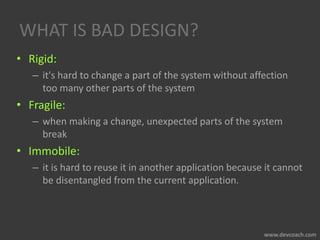
WHAT IS BAD DESIGN?
• Rigid:
– it's hard to change a part of the system without affection
too many other parts of the system
• Fragile:
– when making a change, unexpected parts of the system
break
• Immobile:
– it is hard to reuse it in another application because it cannot
be disentangled from the current application.
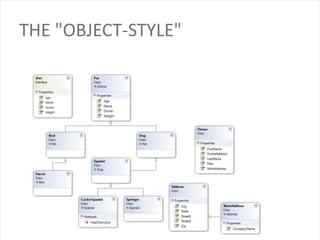
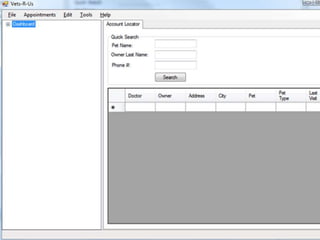
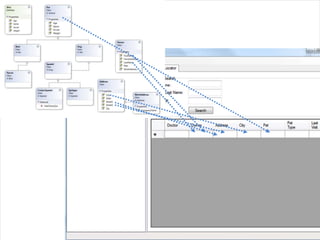
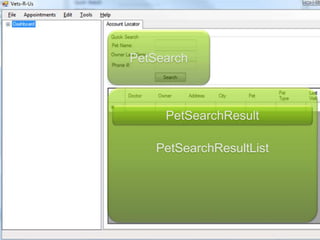
THE "OBJECT-STYLE"
PetSearch
PetSearchResultList
PetSearchResult
QUESTION?
• Are you telling me that every screen the app
has, there is a different object?
• No, but …
– Define your objects like they are "viewed" in the
application.
KONZEPTE
DESIGN GOALS
• There are several design goals
– Reusability
– Maintainability
– Performance
– Scalability
– …
• Make decisions on the goals of you application!
WHY MAINTAINABILITY?
• The most expensive and time-consuming work of software
development is the work of finding bugs and fixing them.
– In the U.S. the number of bugs … averages five per function point.
– The cost of finding and repairing these defects averages about 35
percent of the total development cost of building the application.
– The schedule time required is about 30 percent of project development
schedules.
• Defect repair costs and schedules are often larger than
coding costs and schedules.
Capers Jones, Estimating Software Costs
http://www.amazon.com/Estimating-Software-Costs-Capers-Jones/dp/0071483004/
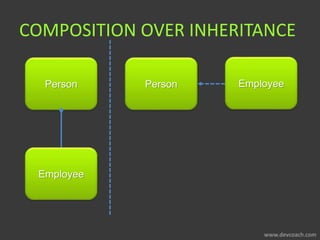
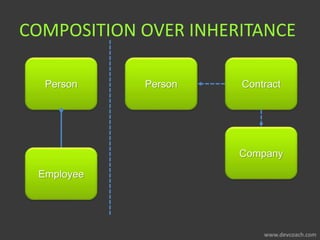
COMPOSITION OVER INHERITANCE
Person
Employee
Person Employee
COMPOSITION OVER INHERITANCE
Person
Employee
Person Contract
Company
FRAGILE BASE CLASS
• A fundamental architectural problem problem
of OOP
• Base classes (superclasses) are considered
"fragile"
– Modifications to a base class may cause derived
classes to malfunction.
– The programmer cannot determine whether a base
class change is safe simply by examining in isolation
the methods of the base class.
• Solutions: "sealed" and "non-virtual"
http://en.wikipedia.org/wiki/Fragile_base_class
COMPOSITION ADVANTAGES
• More flexibility
• Much more resilient to change
– When used properly :-)
• Where inheritance represents the relationship
with the most coupling between two classes,
composition allows us to freely decouple two
(or more) classes.
INHERITANCE SAMPLE
public class SqlRoleProvider
{
…
}
public class CachedSqlRoleProvider
: SqlRoleProvider
{
public override string[] GetAllRoles()
{
//TODO: Get from Cache and return
var roles = base.GetAllRoles()
//TODO: Fill Cache
return roles;
}
}
SOLID DESING…
• Single Responsibility Principle
• Open Closed Principle
• Liskov Substitution Principle
• Interface Segregation Principle
• Dependency Inversion Principle
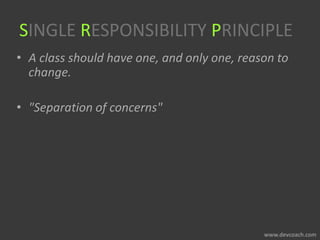
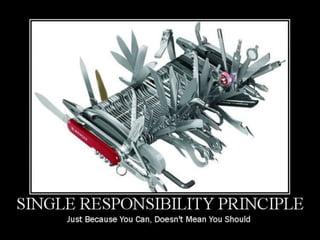
SINGLE RESPONSIBILITY PRINCIPLE
• A class should have one, and only one, reason to
change.
• "Separation of concerns"
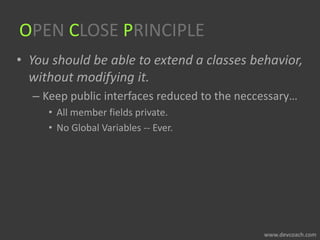
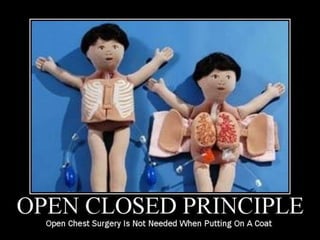
OPEN CLOSE PRINCIPLE
• You should be able to extend a classes behavior,
without modifying it.
– Keep public interfaces reduced to the neccessary…
• All member fields private.
• No Global Variables -- Ever.
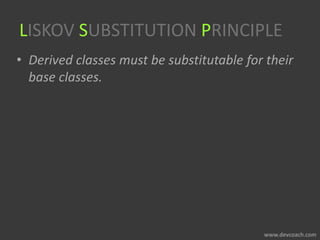
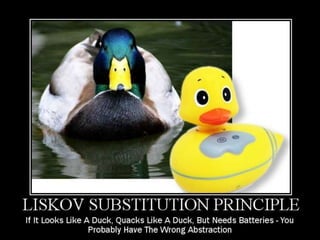
LISKOV SUBSTITUTION PRINCIPLE
• Derived classes must be substitutable for their
base classes.
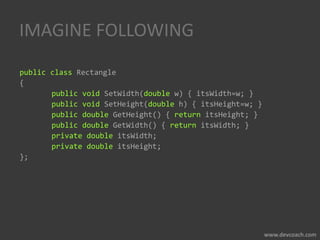
IMAGINE FOLLOWING
public class Rectangle
{
public void SetWidth(double w) { itsWidth=w; }
public void SetHeight(double h) { itsHeight=w; }
public double GetHeight() { return itsHeight; }
public double GetWidth() { return itsWidth; }
private double itsWidth;
private double itsHeight;
};
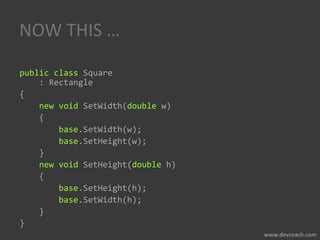
NOW THIS …
public class Square
: Rectangle
{
new void SetWidth(double w)
{
base.SetWidth(w);
base.SetHeight(w);
}
new void SetHeight(double h)
{
base.SetHeight(h);
base.SetWidth(h);
}
}
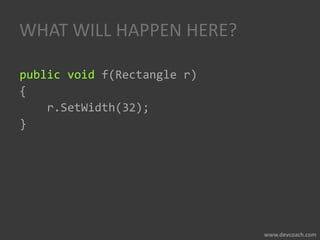
WHAT WILL HAPPEN HERE?
public void f(Rectangle r)
{
r.SetWidth(32);
}
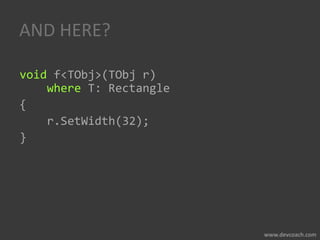
AND HERE?
void f<TObj>(TObj r)
where T: Rectangle
{
r.SetWidth(32);
}
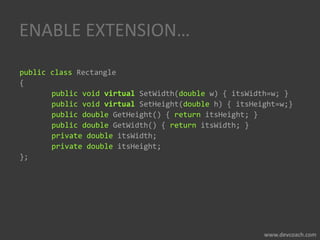
ENABLE EXTENSION…
public class Rectangle
{
public void virtual SetWidth(double w) { itsWidth=w; }
public void virtual SetHeight(double h) { itsHeight=w;}
public double GetHeight() { return itsHeight; }
public double GetWidth() { return itsWidth; }
private double itsWidth;
private double itsHeight;
};
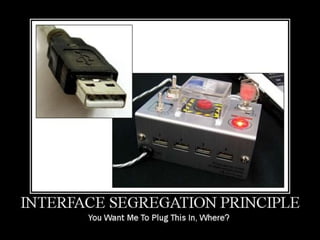
INTERFACE SEGREGATION PRINCIPLE
• Make fine grained interfaces that are client
specific.
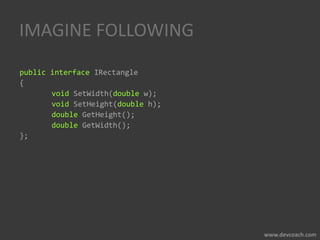
IMAGINE FOLLOWING
public interface IRectangle
{
void SetWidth(double w);
void SetHeight(double h);
double GetHeight();
double GetWidth();
};
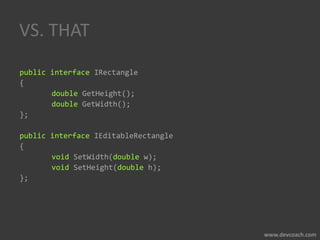
VS. THAT
public interface IRectangle
{
double GetHeight();
double GetWidth();
};
public interface IEditableRectangle
{
void SetWidth(double w);
void SetHeight(double h);
};
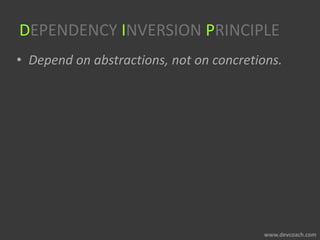
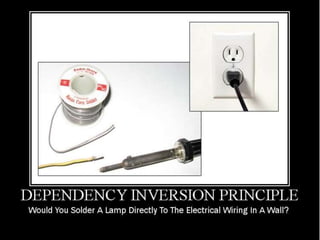
DEPENDENCY INVERSION PRINCIPLE
• Depend on abstractions, not on concretions.
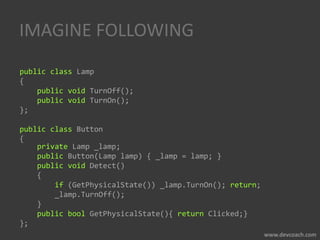
IMAGINE FOLLOWING
public class Lamp
{
public void TurnOff();
public void TurnOn();
};
public class Button
{
private Lamp _lamp;
public Button(Lamp lamp) { _lamp = lamp; }
public void Detect()
{
if (GetPhysicalState()) _lamp.TurnOn(); return;
_lamp.TurnOff();
}
public bool GetPhysicalState(){ return Clicked;}
};
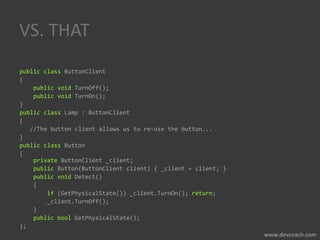
VS. THAT
public class ButtonClient
{
public void TurnOff();
public void TurnOn();
}
public class Lamp : ButtonClient
{
//The button client allows us to re-use the button...
}
public class Button
{
private ButtonClient _client;
public Button(ButtonClient client) { _client = client; }
public void Detect()
{
if (GetPhysicalState()) _client.TurnOn(); return;
_client.TurnOff();
}
public bool GetPhysicalState();
};
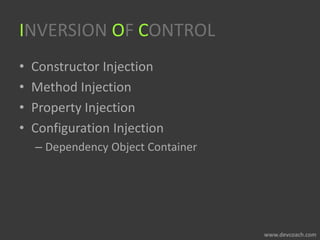
INVERSION OF CONTROL
• Constructor Injection
• Method Injection
• Property Injection
• Configuration Injection
– Dependency Object Container
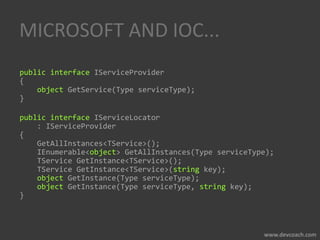
MICROSOFT AND IOC...
public interface IServiceProvider
{
object GetService(Type serviceType);
}
public interface IServiceLocator
: IServiceProvider
{
GetAllInstances<TService>();
IEnumerable<object> GetAllInstances(Type serviceType);
TService GetInstance<TService>();
TService GetInstance<TService>(string key);
object GetInstance(Type serviceType);
object GetInstance(Type serviceType, string key);
}
SIMPLE DESIGN
“Simplicity is more complicated than you think.
But it’s well worth it.”
• Satisfy requirements
– No Less
– No more
• Shape units
DIVIDE AND CONQUER
„recursively breaking down a problem into two
or more sub-problems of the same (or related)
type, until these become simple enough to be
solved directly. “
„ The solutions to the sub-problems are then
combined to give a solution to the original
problem. “
CREATE ASSEMBLIES WISELY
• More assemblies = more physical stuff
– Build, configuration, Deployment, File IO…
• Who will pay that?
• But necessary for:
– Product Separation?
– Different Liceses models?
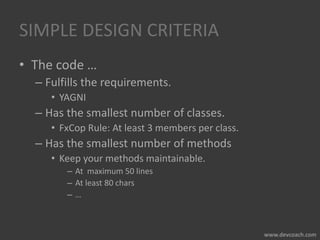
SIMPLE DESIGN CRITERIA
• The code …
– Fulfills the requirements.
• YAGNI
– Has the smallest number of classes.
• FxCop Rule: At least 3 members per class.
– Has the smallest number of methods
• Keep your methods maintainable.
– At maximum 50 lines
– At least 80 chars
– …
SOLID References
• http://www.objectmentor.com/resources/articles
/srp.pdf
• http://www.objectmentor.com/resources/articles
/ocp.pdf
• http://www.objectmentor.com/resources/articles
/lsp.pdf
• http://www.objectmentor.com/resources/articles
/isp.pdf
• http://www.objectmentor.com/resources/articles
/dip.pdf

2009 Dotnet Information Day: More effective c#

  • 1.
    PRESENTED BY Daniel Fisher CONTACTUS daniel.fisher@devcoach.com dc EFFECTIVE, LOOSLY COUPLED Writing better code with C#
  • 3.
    LENNYBACON.COM Daniel Fisher |CTO & Software Architect CCD mit MCP, MCTS, MCPD… daniel.fisher@devcoach.com Mit-Gründer und Geschäftsführer von devcoach.com www.devcoach.com Mit-Gründer und Vorstand der gemeinnützigen www.just community.de e.V. Veranstalter des größten Entwickler & IT-Pro Community Events in Deutschland: www.nrwconf.de Mit-Gründer und Leiter der INETA Usergroup Düsseldorf www.NetUG-NiederRhein.de Mitglied im Microsoft Community Leader & Insider Program (CLIP) Connected Systems Advisory Board Expertengruppe für WCF, WF & BizTalk
  • 4.
    DEVCOACH.COM • Leistungen – Architektur-Beratung •Strukturierter und effizienter zu einer wartbaren Anwendung. – Prozessoptimierung • BPM • FDD, TDD, MSF Agile & SCRUM – Software-Entwicklung • Team-out-of-the-box (Near-shoring) • Objektmodelle und Datenzugriff • Kommunikations-Infrastrukturen • Identitäts- und Berechtigungsmodelle • Web 2.0 und Rich Internet Applikation – Coaching & Training • Technologien schneller verstehen und richtig einsetzen. • Technologien – Microsoft Windows & .NET Framework • ASP.NET, WCF, WF, WPF, Silverlight & Geneva • Kunden – Versicherung, Finanzindustrie, Mittelstand, Handel, Kommunikation, Softwarehersteller u.v.a. • Bundesamt für Sicherheit in der Informationstechnologie, Microsoft, Dresdner Bank… Project Experience Technology Know-how devcoach®
  • 5.
  • 6.
  • 11.
    WHAT IS BADDESIGN? "That's not the way I would have done it..." Well, that is not a valid measure for the quality of the design! This statement is purely based on personal preferences.
  • 12.
    WHAT IS BADDESIGN? • Rigid: – it's hard to change a part of the system without affection too many other parts of the system • Fragile: – when making a change, unexpected parts of the system break • Immobile: – it is hard to reuse it in another application because it cannot be disentangled from the current application.
  • 13.
  • 16.
  • 17.
    QUESTION? • Are youtelling me that every screen the app has, there is a different object? • No, but … – Define your objects like they are "viewed" in the application.
  • 18.
  • 19.
    DESIGN GOALS • Thereare several design goals – Reusability – Maintainability – Performance – Scalability – … • Make decisions on the goals of you application!
  • 20.
    WHY MAINTAINABILITY? • Themost expensive and time-consuming work of software development is the work of finding bugs and fixing them. – In the U.S. the number of bugs … averages five per function point. – The cost of finding and repairing these defects averages about 35 percent of the total development cost of building the application. – The schedule time required is about 30 percent of project development schedules. • Defect repair costs and schedules are often larger than coding costs and schedules. Capers Jones, Estimating Software Costs http://www.amazon.com/Estimating-Software-Costs-Capers-Jones/dp/0071483004/
  • 21.
  • 22.
  • 23.
    FRAGILE BASE CLASS •A fundamental architectural problem problem of OOP • Base classes (superclasses) are considered "fragile" – Modifications to a base class may cause derived classes to malfunction. – The programmer cannot determine whether a base class change is safe simply by examining in isolation the methods of the base class. • Solutions: "sealed" and "non-virtual" http://en.wikipedia.org/wiki/Fragile_base_class
  • 24.
    COMPOSITION ADVANTAGES • Moreflexibility • Much more resilient to change – When used properly :-) • Where inheritance represents the relationship with the most coupling between two classes, composition allows us to freely decouple two (or more) classes.
  • 25.
    INHERITANCE SAMPLE public classSqlRoleProvider { … } public class CachedSqlRoleProvider : SqlRoleProvider { public override string[] GetAllRoles() { //TODO: Get from Cache and return var roles = base.GetAllRoles() //TODO: Fill Cache return roles; } }
  • 26.
    SOLID DESING… • SingleResponsibility Principle • Open Closed Principle • Liskov Substitution Principle • Interface Segregation Principle • Dependency Inversion Principle
  • 27.
    SINGLE RESPONSIBILITY PRINCIPLE •A class should have one, and only one, reason to change. • "Separation of concerns"
  • 29.
    OPEN CLOSE PRINCIPLE •You should be able to extend a classes behavior, without modifying it. – Keep public interfaces reduced to the neccessary… • All member fields private. • No Global Variables -- Ever.
  • 31.
    LISKOV SUBSTITUTION PRINCIPLE •Derived classes must be substitutable for their base classes.
  • 32.
    IMAGINE FOLLOWING public classRectangle { public void SetWidth(double w) { itsWidth=w; } public void SetHeight(double h) { itsHeight=w; } public double GetHeight() { return itsHeight; } public double GetWidth() { return itsWidth; } private double itsWidth; private double itsHeight; };
  • 33.
    NOW THIS … publicclass Square : Rectangle { new void SetWidth(double w) { base.SetWidth(w); base.SetHeight(w); } new void SetHeight(double h) { base.SetHeight(h); base.SetWidth(h); } }
  • 34.
    WHAT WILL HAPPENHERE? public void f(Rectangle r) { r.SetWidth(32); }
  • 35.
    AND HERE? void f<TObj>(TObjr) where T: Rectangle { r.SetWidth(32); }
  • 36.
    ENABLE EXTENSION… public classRectangle { public void virtual SetWidth(double w) { itsWidth=w; } public void virtual SetHeight(double h) { itsHeight=w;} public double GetHeight() { return itsHeight; } public double GetWidth() { return itsWidth; } private double itsWidth; private double itsHeight; };
  • 38.
    INTERFACE SEGREGATION PRINCIPLE •Make fine grained interfaces that are client specific.
  • 39.
    IMAGINE FOLLOWING public interfaceIRectangle { void SetWidth(double w); void SetHeight(double h); double GetHeight(); double GetWidth(); };
  • 40.
    VS. THAT public interfaceIRectangle { double GetHeight(); double GetWidth(); }; public interface IEditableRectangle { void SetWidth(double w); void SetHeight(double h); };
  • 42.
    DEPENDENCY INVERSION PRINCIPLE •Depend on abstractions, not on concretions.
  • 43.
    IMAGINE FOLLOWING public classLamp { public void TurnOff(); public void TurnOn(); }; public class Button { private Lamp _lamp; public Button(Lamp lamp) { _lamp = lamp; } public void Detect() { if (GetPhysicalState()) _lamp.TurnOn(); return; _lamp.TurnOff(); } public bool GetPhysicalState(){ return Clicked;} };
  • 44.
    VS. THAT public classButtonClient { public void TurnOff(); public void TurnOn(); } public class Lamp : ButtonClient { //The button client allows us to re-use the button... } public class Button { private ButtonClient _client; public Button(ButtonClient client) { _client = client; } public void Detect() { if (GetPhysicalState()) _client.TurnOn(); return; _client.TurnOff(); } public bool GetPhysicalState(); };
  • 46.
    INVERSION OF CONTROL •Constructor Injection • Method Injection • Property Injection • Configuration Injection – Dependency Object Container
  • 47.
    MICROSOFT AND IOC... publicinterface IServiceProvider { object GetService(Type serviceType); } public interface IServiceLocator : IServiceProvider { GetAllInstances<TService>(); IEnumerable<object> GetAllInstances(Type serviceType); TService GetInstance<TService>(); TService GetInstance<TService>(string key); object GetInstance(Type serviceType); object GetInstance(Type serviceType, string key); }
  • 48.
    SIMPLE DESIGN “Simplicity ismore complicated than you think. But it’s well worth it.” • Satisfy requirements – No Less – No more • Shape units
  • 49.
    DIVIDE AND CONQUER „recursivelybreaking down a problem into two or more sub-problems of the same (or related) type, until these become simple enough to be solved directly. “ „ The solutions to the sub-problems are then combined to give a solution to the original problem. “
  • 50.
    CREATE ASSEMBLIES WISELY •More assemblies = more physical stuff – Build, configuration, Deployment, File IO… • Who will pay that? • But necessary for: – Product Separation? – Different Liceses models?
  • 51.
    SIMPLE DESIGN CRITERIA •The code … – Fulfills the requirements. • YAGNI – Has the smallest number of classes. • FxCop Rule: At least 3 members per class. – Has the smallest number of methods • Keep your methods maintainable. – At maximum 50 lines – At least 80 chars – …
  • 55.
    SOLID References • http://www.objectmentor.com/resources/articles /srp.pdf •http://www.objectmentor.com/resources/articles /ocp.pdf • http://www.objectmentor.com/resources/articles /lsp.pdf • http://www.objectmentor.com/resources/articles /isp.pdf • http://www.objectmentor.com/resources/articles /dip.pdf