Metrics-Driven  Marketing Strategy (+ a little Product Strategy too) Dave McClure Visiting Lecturer Stanford Facebook Class (CS377W) 11/15/07
Summary Marketing Plan / Strategy = Target Customer Acquisition Channels 3 Important Factors = Volume, Cost, Conversion Focus on conversion to target customer lifecycle actions Measure as deep down the conversion funnel as possible Estimate Customer Lifecycle, Conversion, Revenue Potential  Hypothesize Customer Lifecycle & Critical Conversion Points Estimate Conversion , Revenue Potential when designing marketing plan Understand “Annual Rev. Per User” (ARPU) & “Customer Lifetime Value” (CLV) Match Marketing Channel Costs to Customer Revenue Potential Design channels that costs <20-50% of target ARPU / CLV *NOTE: “Cost” has multiple meanings actual dollars marketing costs product development time & resources time profit vs cashflow
Agenda Quick Review of Pirate Metrics Example Mktg Channels Brainstorm 3 Scenarios
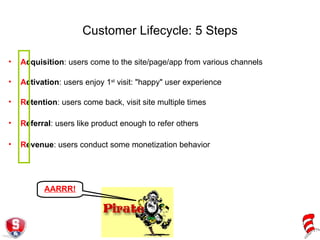
Customer Lifecycle: 5 Steps A cquisition : users come to the site/page/app from various channels A ctivation : users enjoy 1 st  visit: &quot;happy&quot; user experience R etention : users come back, visit site multiple times R eferral : users like product enough to refer others R evenue : users conduct some monetization behavior AARRR!
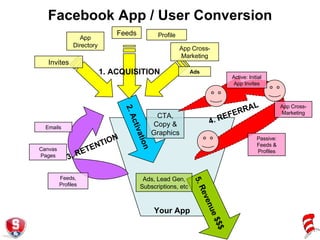
Facebook App / User Conversion Your App 3. RETENTION Emails Feeds, Profiles 4. REFERRAL Passive: Feeds & Profiles Active: Initial App Invites Invites App Directory Feeds App Cross-Marketing Profile Ads 5. Revenue $$$ Ads, Lead Gen, Subscriptions, etc Canvas Pages App Cross-Marketing 2. Activation CTA, Copy & Graphics 1. ACQUISITION
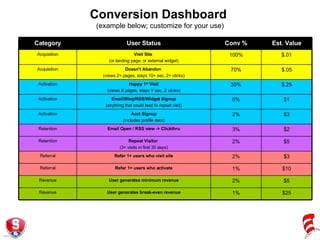
Conversion Dashboard  (example below; customize for your use) $2 3% Email Open / RSS view -> Clickthru Retention $10 1% Refer 1+ users who activate Referral $3 2% Refer 1+ users who visit site Referral $5 2% Repeat Visitor  (3+ visits in first 30 days) Retention $25 1% User generates break-even revenue Revenue $3 2% Acct Signup (includes profile data) Activation $1 5% Email/Blog/RSS/Widget Signup (anything that could lead to repeat visit) Activation User generates minimum revenue Happy 1 st  Visit (views X pages, stays Y sec, Z clicks) Doesn't Abandon  (views 2+ pages, stays 10+ sec, 2+ clicks) Visit Site   (or landing page, or external widget) User Status $5 2% Revenue $.25 30% Activation $.05 70% Acquisition $.01 100% Acquisition Est. Value Conv % Category
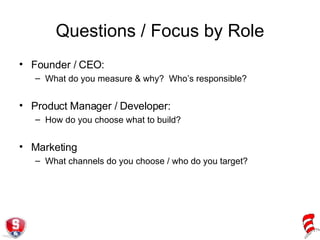
Questions / Focus by Role Founder / CEO:  What do you measure & why?  Who’s responsible? Product Manager / Developer:  How do you choose what to build? Marketing What channels do you choose / who do you target?
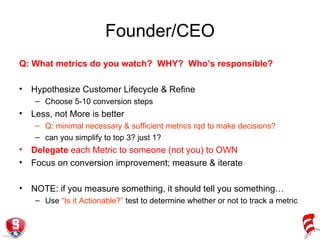
Founder/CEO Q: What metrics do you watch?  WHY?  Who’s responsible? Hypothesize Customer Lifecycle & Refine Choose 5-10 conversion steps Less, not More is better Q: minimal necessary & sufficient metrics rqd to make decisions? can you simplify to top 3? just 1? Delegate  each Metric to someone (not you) to OWN  Focus on conversion improvement; measure & iterate NOTE: if you measure something, it should tell you something… Use  “Is it Actionable?”  test to determine whether or not to track a metric
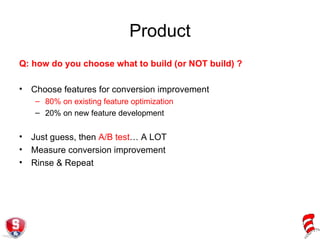
Product Q: how do you choose what to build (or NOT build) ? Choose features for conversion improvement 80% on existing feature optimization 20% on new feature development Just guess, then  A/B test … A LOT Measure conversion improvement Rinse & Repeat
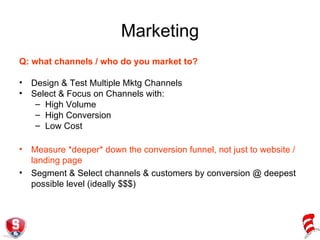
Marketing Q: what channels / who do you market to? Design & Test Multiple Mktg Channels Select & Focus on Channels with: High Volume High Conversion Low Cost Measure *deeper* down the conversion funnel, not just to website / landing page Segment & Select channels & customers by conversion @ deepest possible level (ideally $$$)
Agenda Quick Review of Pirate Metrics Example Mktg Channels Brainstorm 3 Scenarios
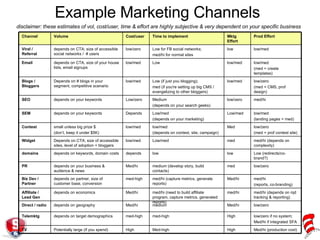
Example Marketing Channels disclaimer: these estimates of vol, cost/user, time & effort are highly subjective & very dependent on your specific business med/hi  (reports, co-branding) Med/hi med/hi (capture metrics, generate reports) med-high depends on partner, size of customer base, conversion Biz Dev / Partner low/zero (med = prof contest site) Med low/med (depends on contest, site, campaign) low/med small unless big prize $  (don’t, keep it under $5K) Contest low/zero if no system; Med/hi if integrated SFA High med-high med-high depends on target demographics Telemktg low/zero Med/hi medium Med/hi depends on geography Direct / radio Med/hi (production cost) High Med-high High Potentially large (if you spend) TV low/med low Low for FB social networks; med/hi for normal sites low/zero depends on CTA; size of accessible social networks /  # users Viral / Referral low/med  (landing pages = med) Low/med Low/med (depends on your marketing) Depends depends on your keywords SEM med/hi (depends on complexity) med Low/med low/med Depends on CTA; size of accessible sites, level of adoption + bloggers Widget med/hi (depends on rqd tracking & reporting) med/hi med/hi (need to build affiliate program, capture metrics, generated reports) Med/hi depends on economics Affiliate / Lead Gen low/zero med medium (develop story, build contacts) Med/hi depends on your business & audience & news PR Low (redirects/co-brand?) low low depends depends on keywords, domain costs domains med/hi low/zero Medium (depends on your search geeks) Low/zero depends on your keywords SEO low/zero (med = CMS, prof design) low/med Low (if just you blogging);  med (if you're setting up big CMS / evangelizing to other bloggers) low/med Depends on # blogs in your segment, competitive scenario Blogs / Bloggers low/med  (med = create templates) low/med Low low/med depends on CTA, size of your house lists, email signups Email Prod Effort Mktg Effort Time to implement Cost/user Volume Channel
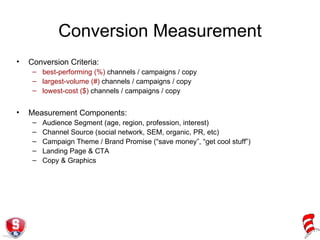
Conversion Measurement Conversion Criteria: best-performing (%)  channels / campaigns / copy largest-volume (#)  channels / campaigns / copy lowest-cost ($)  channels / campaigns / copy Measurement Components: Audience Segment (age, region, profession, interest) Channel Source (social network, SEM, organic, PR, etc) Campaign Theme / Brand Promise (“save money”, “get cool stuff”) Landing Page & CTA Copy & Graphics
Agenda Quick Review of Pirate Metrics Example Mktg Channels Brainstorm 3 Scenarios
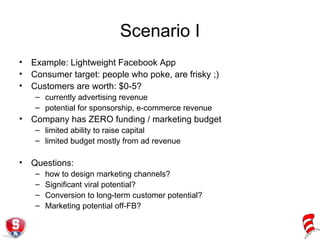
Scenario I Example: Lightweight Facebook App Consumer target: people who poke, are frisky ;) Customers are worth: $0-5? currently advertising revenue potential for sponsorship, e-commerce revenue Company has ZERO funding / marketing budget limited ability to raise capital limited budget mostly from ad revenue Questions: how to design marketing channels? Significant viral potential? Conversion to long-term customer potential? Marketing potential off-FB?
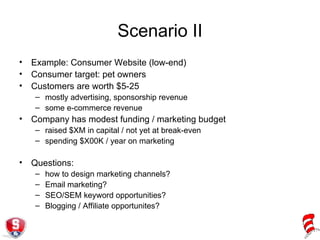
Scenario II Example: Consumer Website (low-end) Consumer target: pet owners Customers are worth $5-25 mostly advertising, sponsorship revenue some e-commerce revenue Company has modest funding / marketing budget raised $XM in capital / not yet at break-even spending $X00K / year on marketing Questions: how to design marketing channels? Email marketing? SEO/SEM keyword opportunities? Blogging / Affiliate opportunites?
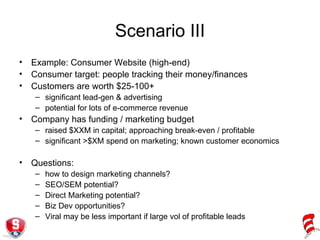
Scenario III Example: Consumer Website (high-end) Consumer target: people tracking their money/finances Customers are worth $25-100+ significant lead-gen & advertising potential for lots of e-commerce revenue Company has funding / marketing budget raised $XXM in capital; approaching break-even / profitable significant >$XM spend on marketing; known customer economics Questions: how to design marketing channels? SEO/SEM potential? Direct Marketing potential? Biz Dev opportunities? Viral may be less important if large vol of profitable leads

Metrics-Driven Marketing Strategy

  • 1.
    Metrics-Driven MarketingStrategy (+ a little Product Strategy too) Dave McClure Visiting Lecturer Stanford Facebook Class (CS377W) 11/15/07
  • 2.
    Summary Marketing Plan/ Strategy = Target Customer Acquisition Channels 3 Important Factors = Volume, Cost, Conversion Focus on conversion to target customer lifecycle actions Measure as deep down the conversion funnel as possible Estimate Customer Lifecycle, Conversion, Revenue Potential Hypothesize Customer Lifecycle & Critical Conversion Points Estimate Conversion , Revenue Potential when designing marketing plan Understand “Annual Rev. Per User” (ARPU) & “Customer Lifetime Value” (CLV) Match Marketing Channel Costs to Customer Revenue Potential Design channels that costs <20-50% of target ARPU / CLV *NOTE: “Cost” has multiple meanings actual dollars marketing costs product development time & resources time profit vs cashflow
  • 3.
    Agenda Quick Reviewof Pirate Metrics Example Mktg Channels Brainstorm 3 Scenarios
  • 4.
    Customer Lifecycle: 5Steps A cquisition : users come to the site/page/app from various channels A ctivation : users enjoy 1 st visit: &quot;happy&quot; user experience R etention : users come back, visit site multiple times R eferral : users like product enough to refer others R evenue : users conduct some monetization behavior AARRR!
  • 5.
    Facebook App /User Conversion Your App 3. RETENTION Emails Feeds, Profiles 4. REFERRAL Passive: Feeds & Profiles Active: Initial App Invites Invites App Directory Feeds App Cross-Marketing Profile Ads 5. Revenue $$$ Ads, Lead Gen, Subscriptions, etc Canvas Pages App Cross-Marketing 2. Activation CTA, Copy & Graphics 1. ACQUISITION
  • 6.
    Conversion Dashboard (example below; customize for your use) $2 3% Email Open / RSS view -> Clickthru Retention $10 1% Refer 1+ users who activate Referral $3 2% Refer 1+ users who visit site Referral $5 2% Repeat Visitor (3+ visits in first 30 days) Retention $25 1% User generates break-even revenue Revenue $3 2% Acct Signup (includes profile data) Activation $1 5% Email/Blog/RSS/Widget Signup (anything that could lead to repeat visit) Activation User generates minimum revenue Happy 1 st Visit (views X pages, stays Y sec, Z clicks) Doesn't Abandon (views 2+ pages, stays 10+ sec, 2+ clicks) Visit Site (or landing page, or external widget) User Status $5 2% Revenue $.25 30% Activation $.05 70% Acquisition $.01 100% Acquisition Est. Value Conv % Category
  • 7.
    Questions / Focusby Role Founder / CEO: What do you measure & why? Who’s responsible? Product Manager / Developer: How do you choose what to build? Marketing What channels do you choose / who do you target?
  • 8.
    Founder/CEO Q: Whatmetrics do you watch? WHY? Who’s responsible? Hypothesize Customer Lifecycle & Refine Choose 5-10 conversion steps Less, not More is better Q: minimal necessary & sufficient metrics rqd to make decisions? can you simplify to top 3? just 1? Delegate each Metric to someone (not you) to OWN Focus on conversion improvement; measure & iterate NOTE: if you measure something, it should tell you something… Use “Is it Actionable?” test to determine whether or not to track a metric
  • 9.
    Product Q: howdo you choose what to build (or NOT build) ? Choose features for conversion improvement 80% on existing feature optimization 20% on new feature development Just guess, then A/B test … A LOT Measure conversion improvement Rinse & Repeat
  • 10.
    Marketing Q: whatchannels / who do you market to? Design & Test Multiple Mktg Channels Select & Focus on Channels with: High Volume High Conversion Low Cost Measure *deeper* down the conversion funnel, not just to website / landing page Segment & Select channels & customers by conversion @ deepest possible level (ideally $$$)
  • 11.
    Agenda Quick Reviewof Pirate Metrics Example Mktg Channels Brainstorm 3 Scenarios
  • 12.
    Example Marketing Channelsdisclaimer: these estimates of vol, cost/user, time & effort are highly subjective & very dependent on your specific business med/hi (reports, co-branding) Med/hi med/hi (capture metrics, generate reports) med-high depends on partner, size of customer base, conversion Biz Dev / Partner low/zero (med = prof contest site) Med low/med (depends on contest, site, campaign) low/med small unless big prize $ (don’t, keep it under $5K) Contest low/zero if no system; Med/hi if integrated SFA High med-high med-high depends on target demographics Telemktg low/zero Med/hi medium Med/hi depends on geography Direct / radio Med/hi (production cost) High Med-high High Potentially large (if you spend) TV low/med low Low for FB social networks; med/hi for normal sites low/zero depends on CTA; size of accessible social networks / # users Viral / Referral low/med (landing pages = med) Low/med Low/med (depends on your marketing) Depends depends on your keywords SEM med/hi (depends on complexity) med Low/med low/med Depends on CTA; size of accessible sites, level of adoption + bloggers Widget med/hi (depends on rqd tracking & reporting) med/hi med/hi (need to build affiliate program, capture metrics, generated reports) Med/hi depends on economics Affiliate / Lead Gen low/zero med medium (develop story, build contacts) Med/hi depends on your business & audience & news PR Low (redirects/co-brand?) low low depends depends on keywords, domain costs domains med/hi low/zero Medium (depends on your search geeks) Low/zero depends on your keywords SEO low/zero (med = CMS, prof design) low/med Low (if just you blogging); med (if you're setting up big CMS / evangelizing to other bloggers) low/med Depends on # blogs in your segment, competitive scenario Blogs / Bloggers low/med (med = create templates) low/med Low low/med depends on CTA, size of your house lists, email signups Email Prod Effort Mktg Effort Time to implement Cost/user Volume Channel
  • 13.
    Conversion Measurement ConversionCriteria: best-performing (%) channels / campaigns / copy largest-volume (#) channels / campaigns / copy lowest-cost ($) channels / campaigns / copy Measurement Components: Audience Segment (age, region, profession, interest) Channel Source (social network, SEM, organic, PR, etc) Campaign Theme / Brand Promise (“save money”, “get cool stuff”) Landing Page & CTA Copy & Graphics
  • 14.
    Agenda Quick Reviewof Pirate Metrics Example Mktg Channels Brainstorm 3 Scenarios
  • 15.
    Scenario I Example:Lightweight Facebook App Consumer target: people who poke, are frisky ;) Customers are worth: $0-5? currently advertising revenue potential for sponsorship, e-commerce revenue Company has ZERO funding / marketing budget limited ability to raise capital limited budget mostly from ad revenue Questions: how to design marketing channels? Significant viral potential? Conversion to long-term customer potential? Marketing potential off-FB?
  • 16.
    Scenario II Example:Consumer Website (low-end) Consumer target: pet owners Customers are worth $5-25 mostly advertising, sponsorship revenue some e-commerce revenue Company has modest funding / marketing budget raised $XM in capital / not yet at break-even spending $X00K / year on marketing Questions: how to design marketing channels? Email marketing? SEO/SEM keyword opportunities? Blogging / Affiliate opportunites?
  • 17.
    Scenario III Example:Consumer Website (high-end) Consumer target: people tracking their money/finances Customers are worth $25-100+ significant lead-gen & advertising potential for lots of e-commerce revenue Company has funding / marketing budget raised $XXM in capital; approaching break-even / profitable significant >$XM spend on marketing; known customer economics Questions: how to design marketing channels? SEO/SEM potential? Direct Marketing potential? Biz Dev opportunities? Viral may be less important if large vol of profitable leads