Startup Metrics for Pirates
@DaveMcClure
Founding Partner, 500 Startups
http://500.co
http://500hats.com
http://slideshare.net/dmc500hats
AARRR!
Dave McClure

Founding Partner & Troublemaker, 500 Startups
00’s & 10’s:
• VC: Founders Fund, Facebook fbFund, 500 Startups
• Angel: Mashery, Mint.com, SlideShare, Twilio
• Marketing: PayPal, Simply Hired, Mint.com, O’Reilly
80’s & 90’s:
• Entrepreneur: Aslan Computing (acq’d by Servinet/Panurgy)
• Developer: Windows / SQL DB consultant (Intel, MSFT)
• Engineer: Johns Hopkins‘88, BS Eng / Applied Math
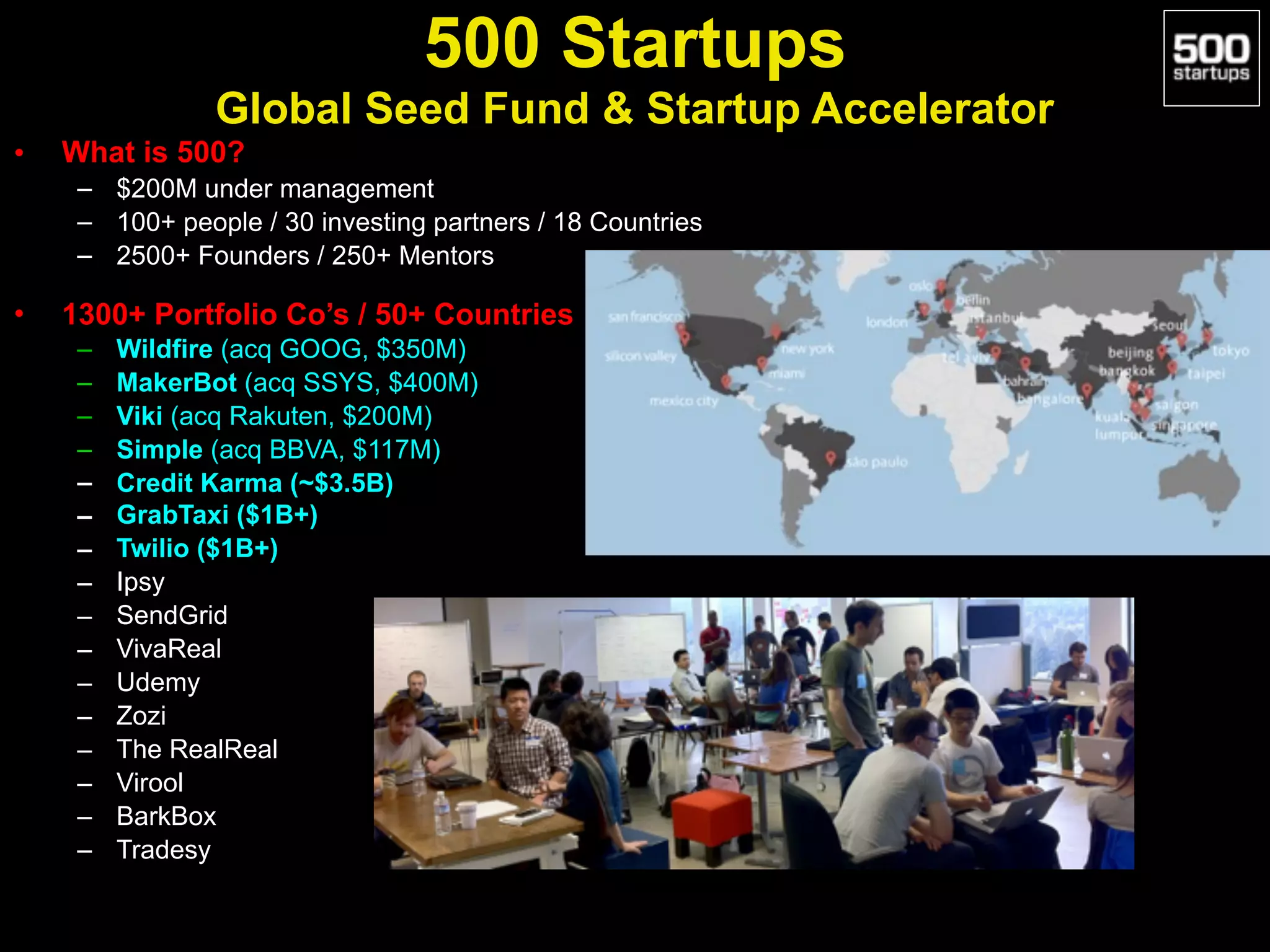
• What is 500?
– $200M under management
– 100+ people / 30 investing partners / 18 Countries
– 2500+ Founders / 250+ Mentors
• 1300+ Portfolio Co’s / 50+ Countries
– Wildfire (acq GOOG, $350M)
– MakerBot (acq SSYS, $400M)
– Viki (acq Rakuten, $200M)
– Simple (acq BBVA, $117M)
– Credit Karma (~$3.5B)
– GrabTaxi ($1B+)
– Twilio ($1B+)
– Ipsy
– SendGrid
– VivaReal
– Udemy
– Zozi
– The RealReal
– Virool
– BarkBox
– Tradesy
500 Startups

Global Seed Fund & Startup Accelerator
[ This Talk ]
Topics
• Basic Concepts of “Startup Metrics 4 Pirates”
• 3 Steps to AARRR: Product, Market, Revenue
• Constructing MVP: Just ONE Feature?
• Design (UX) & Distribution (MKTG)
• Winning = Users, Revenue, Profit?
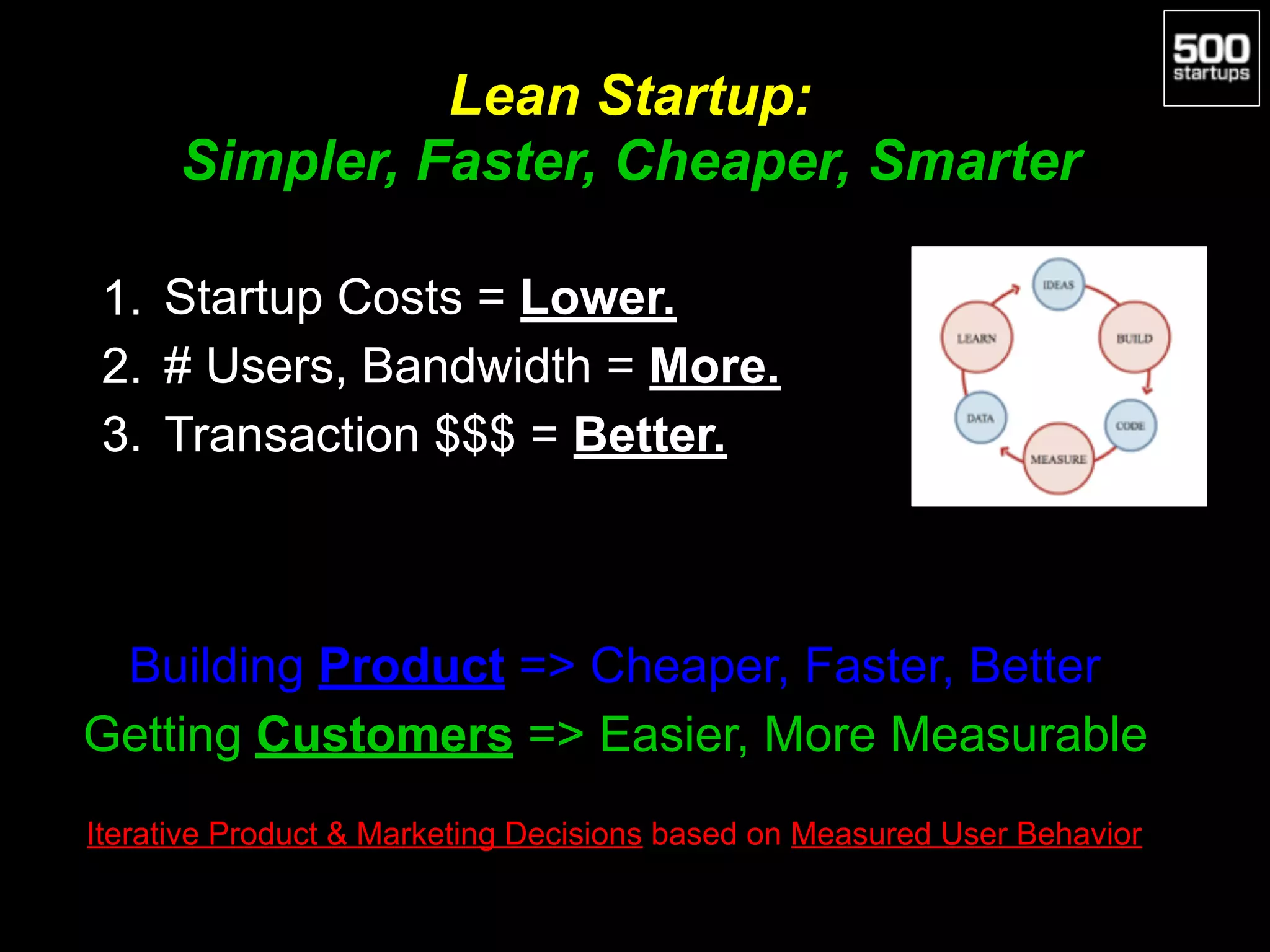
Lean Startup:

Simpler, Faster, Cheaper, Smarter
1. Startup Costs = Lower.
2. # Users, Bandwidth = More.
3. Transaction $$$ = Better.
Building Product => Cheaper, Faster, Better
Getting Customers => Easier, More Measurable
Iterative Product & Marketing Decisions based on Measured User Behavior
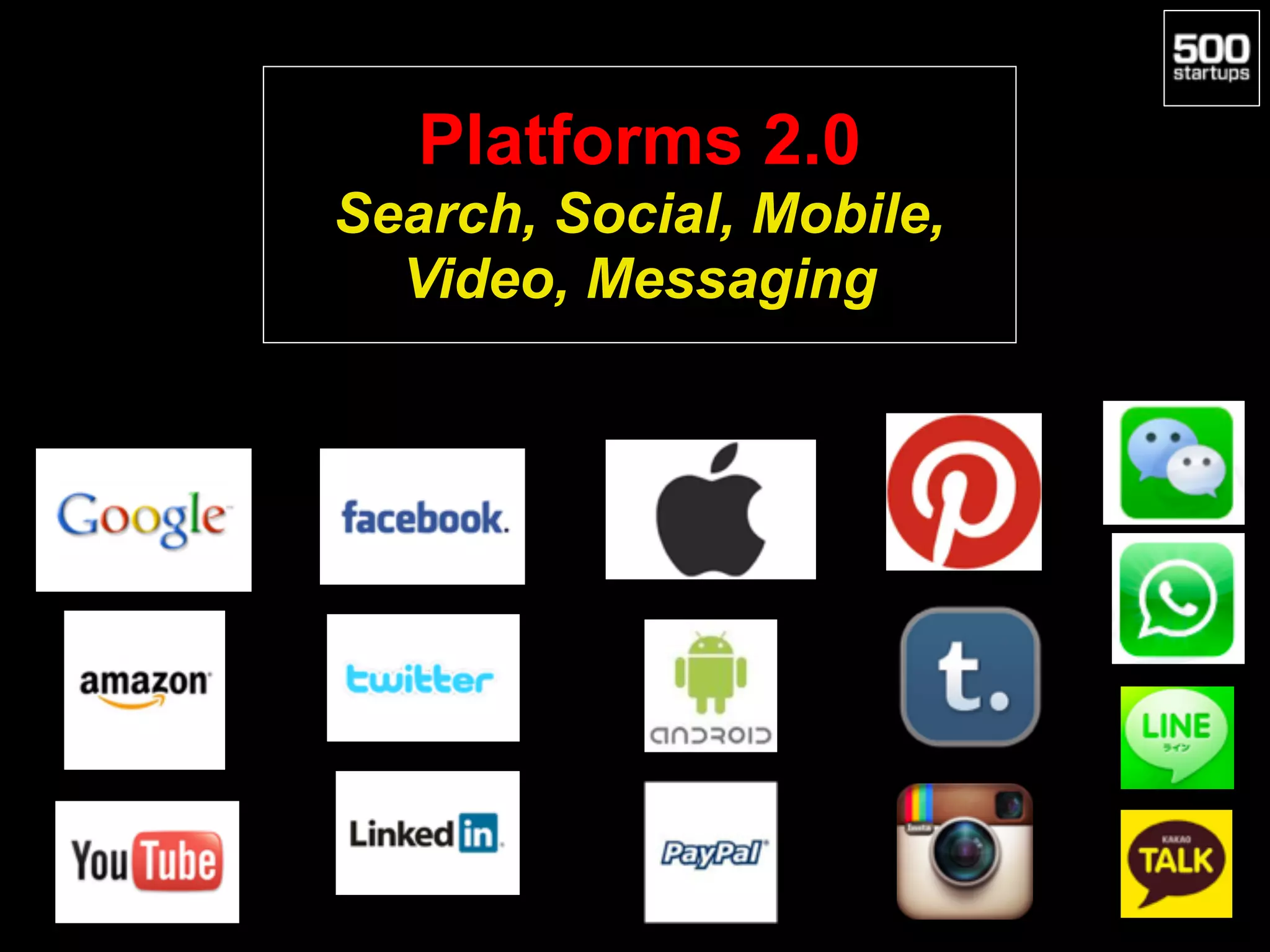
Platforms 2.0

Search, Social, Mobile,
Video, Messaging
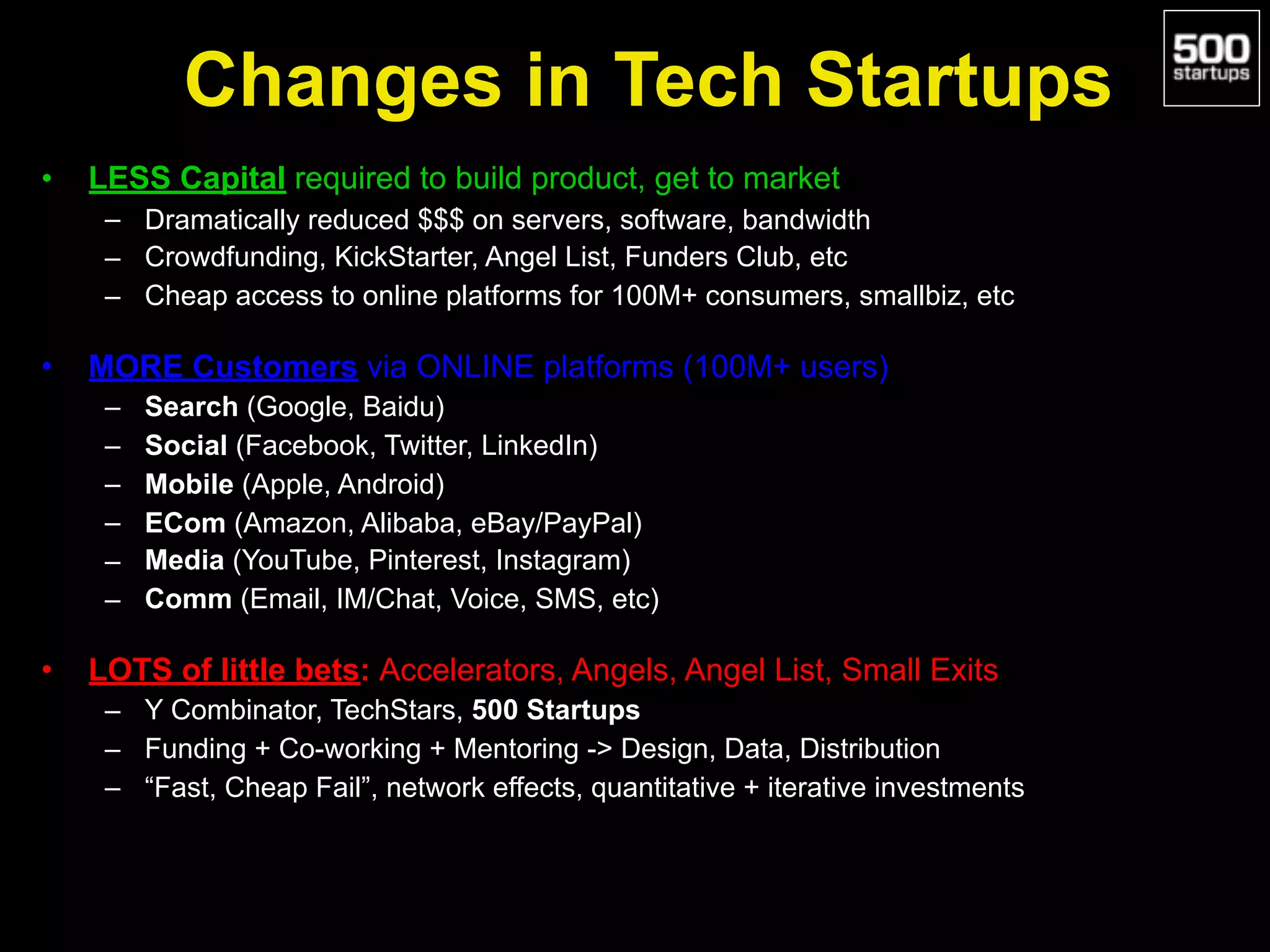
Changes in Tech Startups
• LESS Capital required to build product, get to market
– Dramatically reduced $$$ on servers, software, bandwidth
– Crowdfunding, KickStarter, Angel List, Funders Club, etc
– Cheap access to online platforms for 100M+ consumers, smallbiz, etc
• MORE Customers via ONLINE platforms (100M+ users)
– Search (Google, Baidu)
– Social (Facebook, Twitter, LinkedIn)
– Mobile (Apple, Android)
– ECom (Amazon, Alibaba, eBay/PayPal)
– Media (YouTube, Pinterest, Instagram)
– Comm (Email, IM/Chat, Voice, SMS, etc)
• LOTS of little bets: Accelerators, Angels, Angel List, Small Exits
– Y Combinator, TechStars, 500 Startups
– Funding + Co-working + Mentoring -> Design, Data, Distribution
– “Fast, Cheap Fail”, network effects, quantitative + iterative investments
DO Marketing! 

(It’s Not Evil)
• Marketing is Both Qualitative + Quantitative
• Qualitative: Create Emotion, Drive Action
• Quantitative: Measure Results of Action
• Design (UX) & Distribution (MKTG) Matter
• Volume (#), Cost ($), Conversion (%)
[Startup Metrics 4 Pirates]
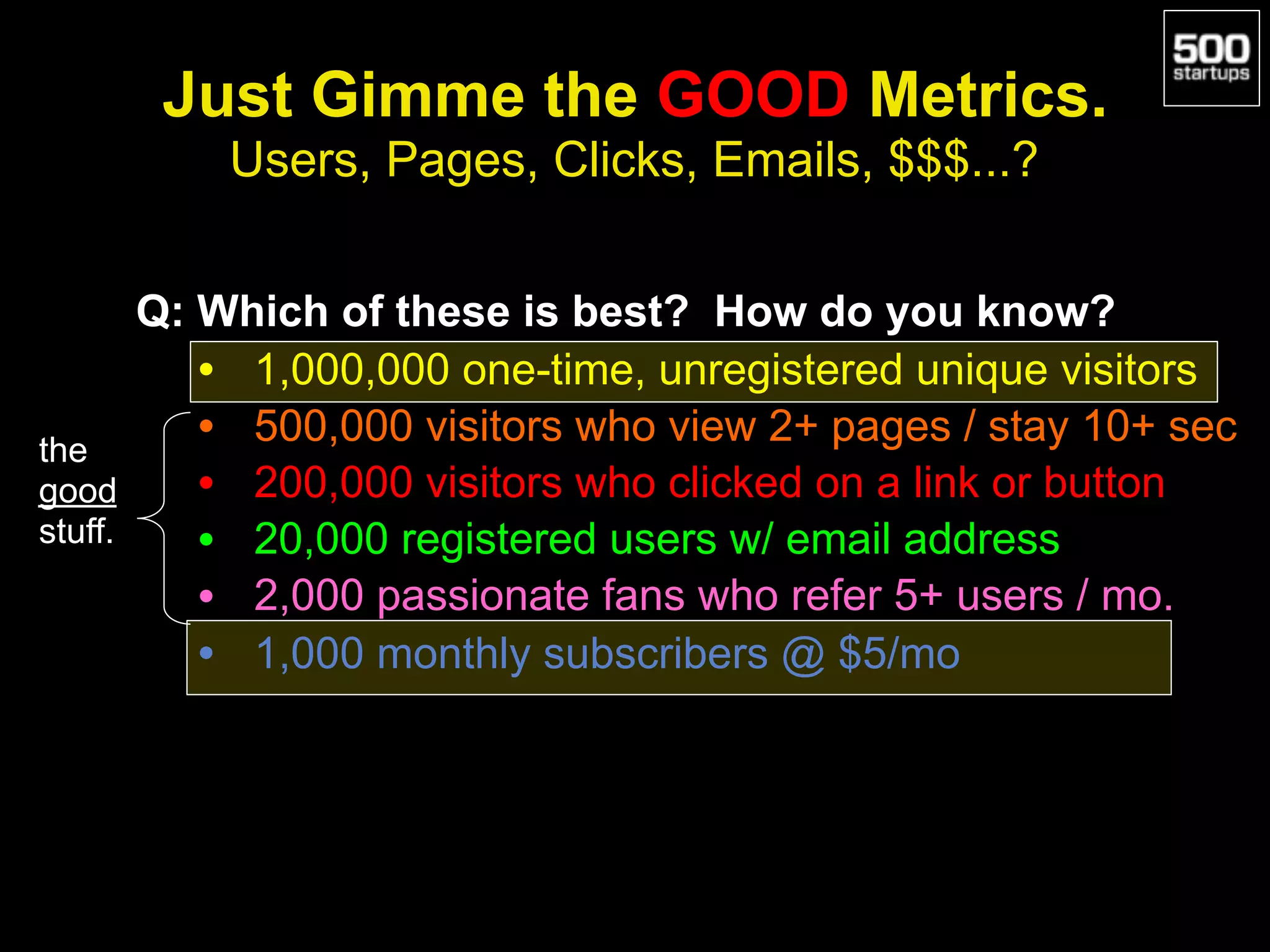
Just Gimme the GOOD Metrics.
Users, Pages, Clicks, Emails, $$$...?
Q: Which of these is best? How do you know?
• 1,000,000 one-time, unregistered unique visitors
• 500,000 visitors who view 2+ pages / stay 10+ sec
• 200,000 visitors who clicked on a link or button
• 20,000 registered users w/ email address
• 2,000 passionate fans who refer 5+ users / mo.
• 1,000 monthly subscribers @ $5/mo
the
good
stuff.
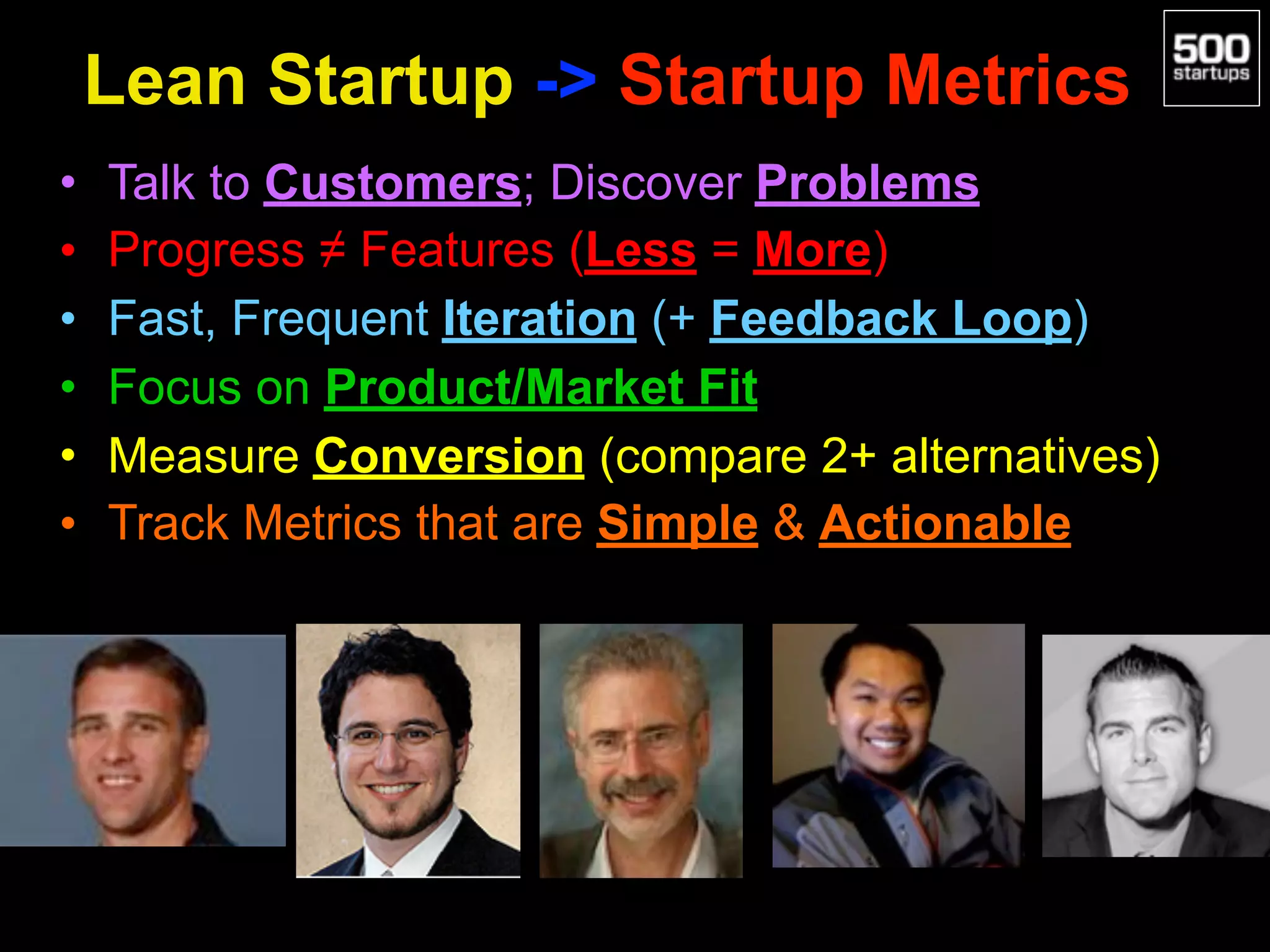
Lean Startup -> Startup Metrics
• Talk to Customers; Discover Problems
• Progress ≠ Features (Less = More)
• Fast, Frequent Iteration (+ Feedback Loop)
• Focus on Product/Market Fit
• Measure Conversion (compare 2+ alternatives)
• Track Metrics that are Simple & Actionable
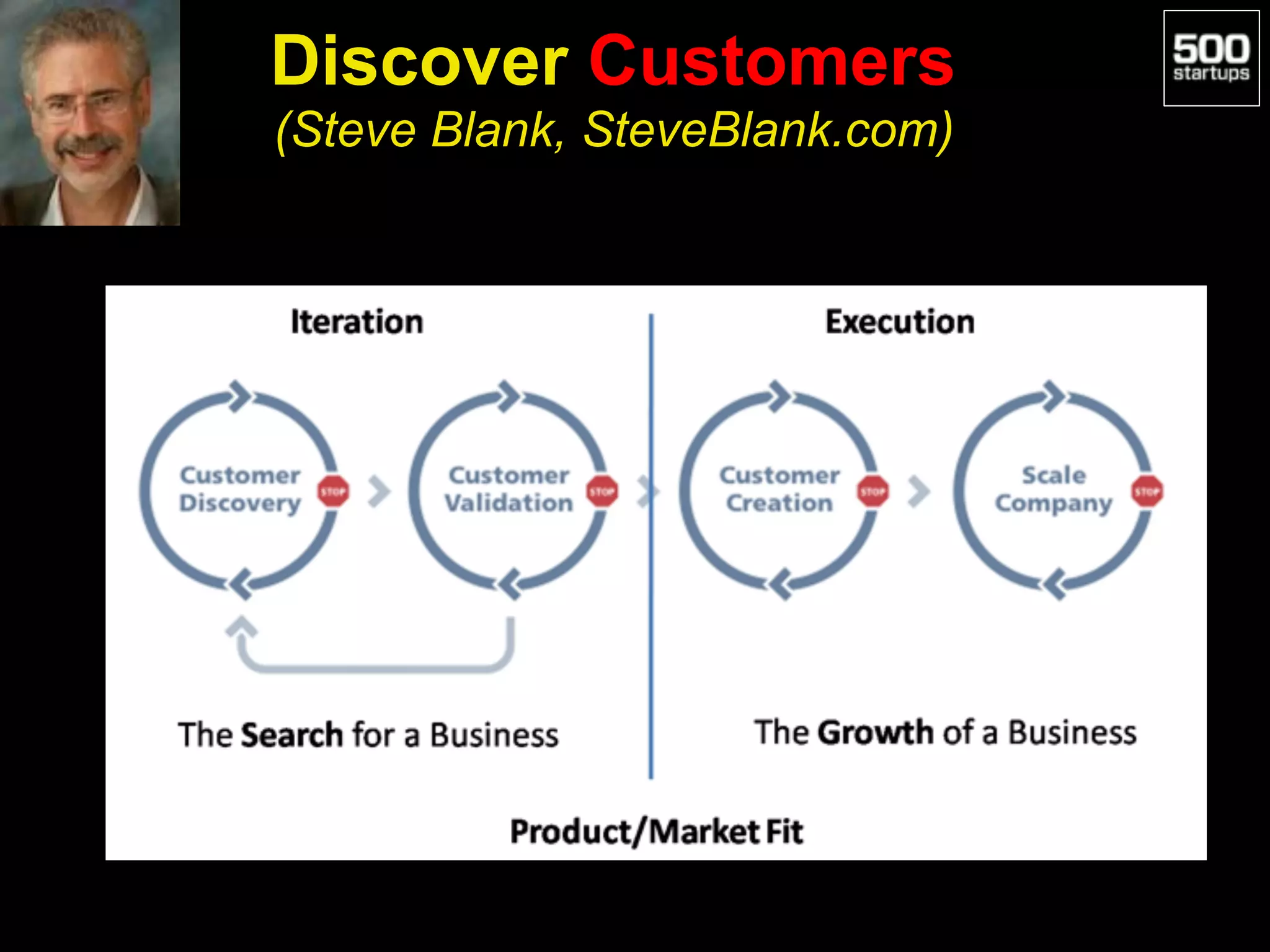
Discover Customers

(Steve Blank, SteveBlank.com)
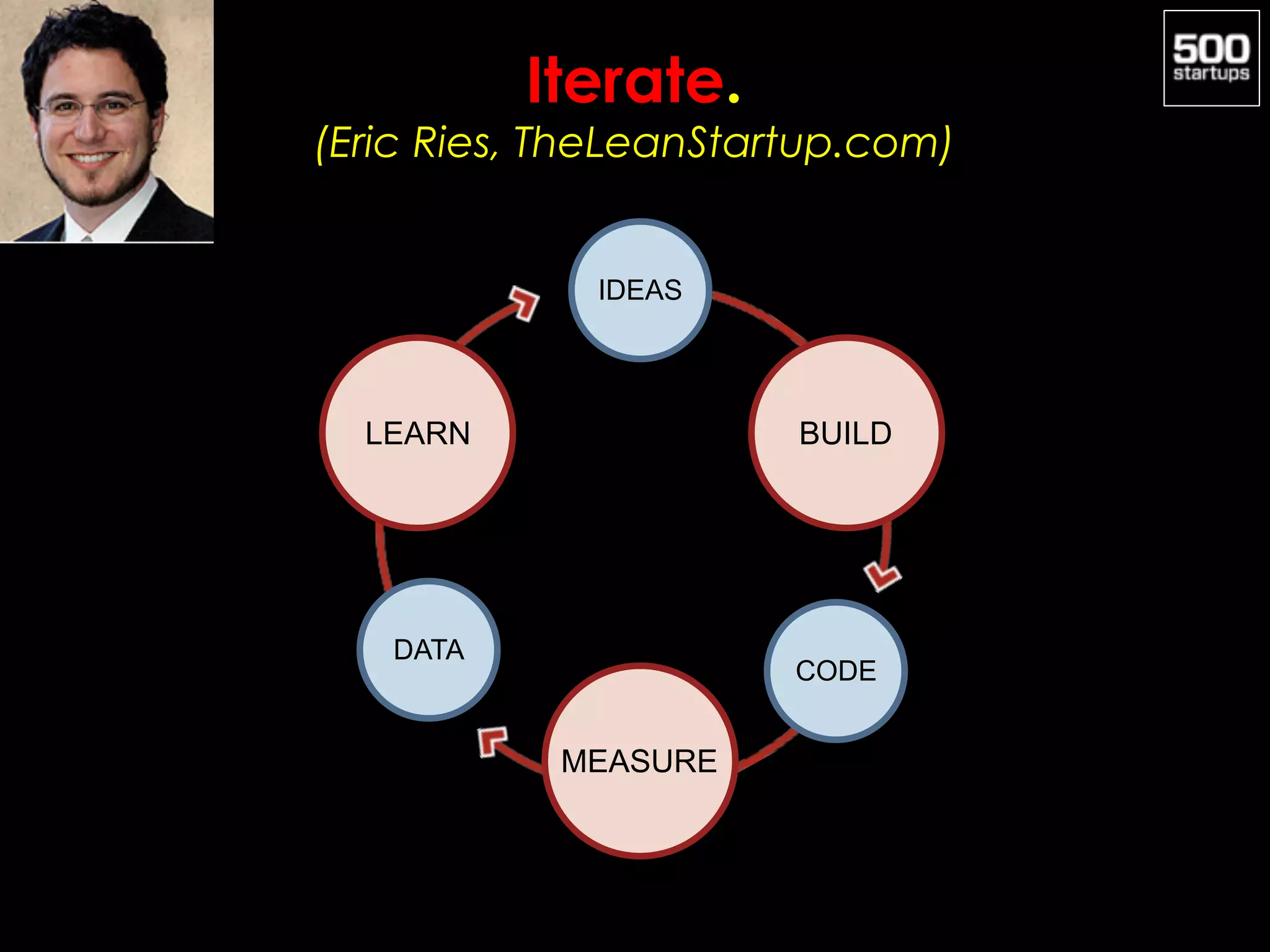
LEARN BUILD
MEASURE
IDEAS
CODE
DATA
Iterate.

(Eric Ries, TheLeanStartup.com)
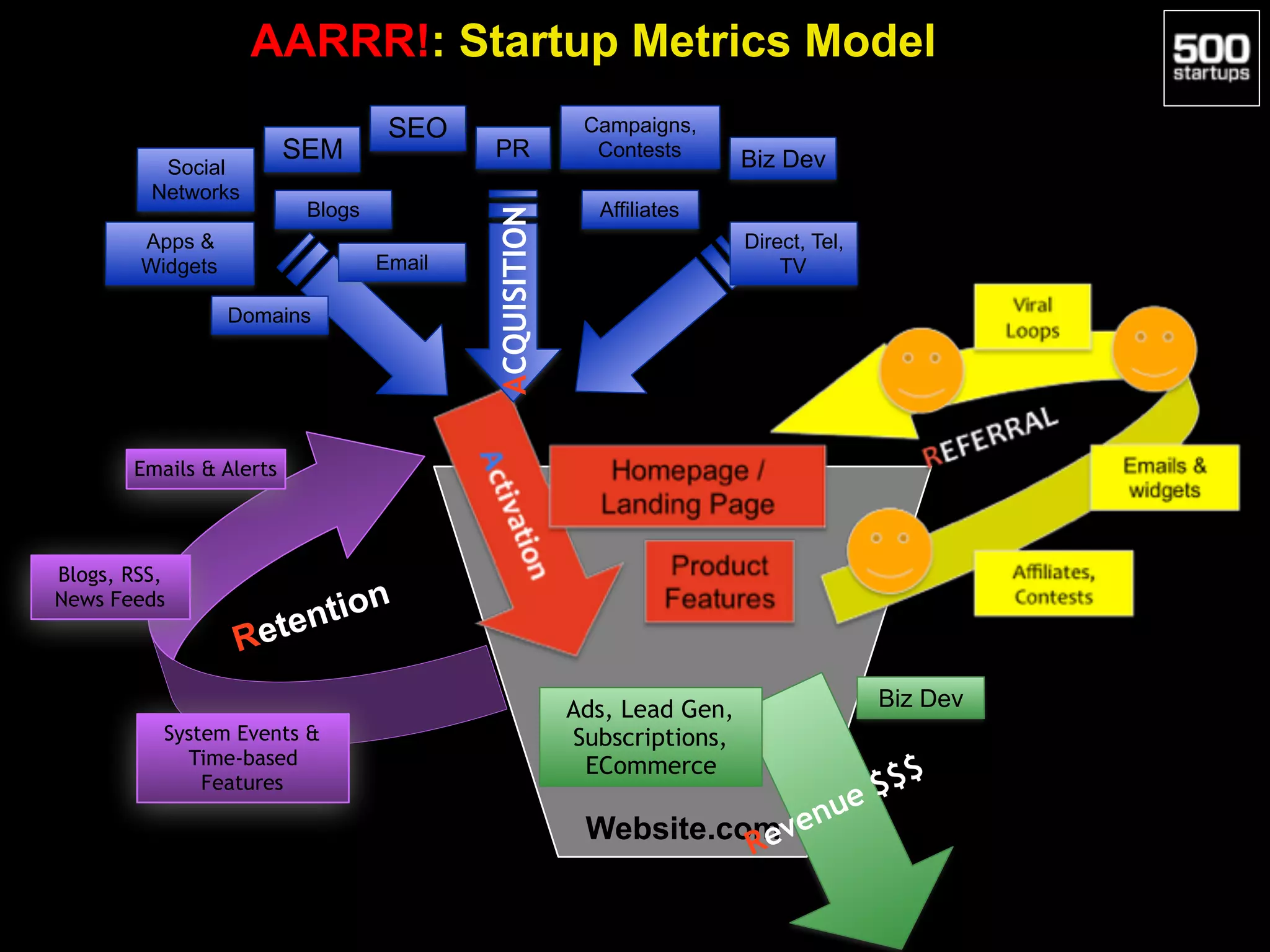
AARRR!: Startup Metrics Model
Website.com
Revenue $$$
Biz DevAds, Lead Gen,
Subscriptions,
ECommerce
ACQUISITION
SEO
SEM
Apps &
Widgets
Affiliates
Email
PR Biz Dev
Campaigns,
Contests
Direct, Tel,
TV
Social
Networks
Blogs
Domains
Retention
Emails & Alerts
System Events &
Time-based
Features
Blogs, RSS,
News Feeds
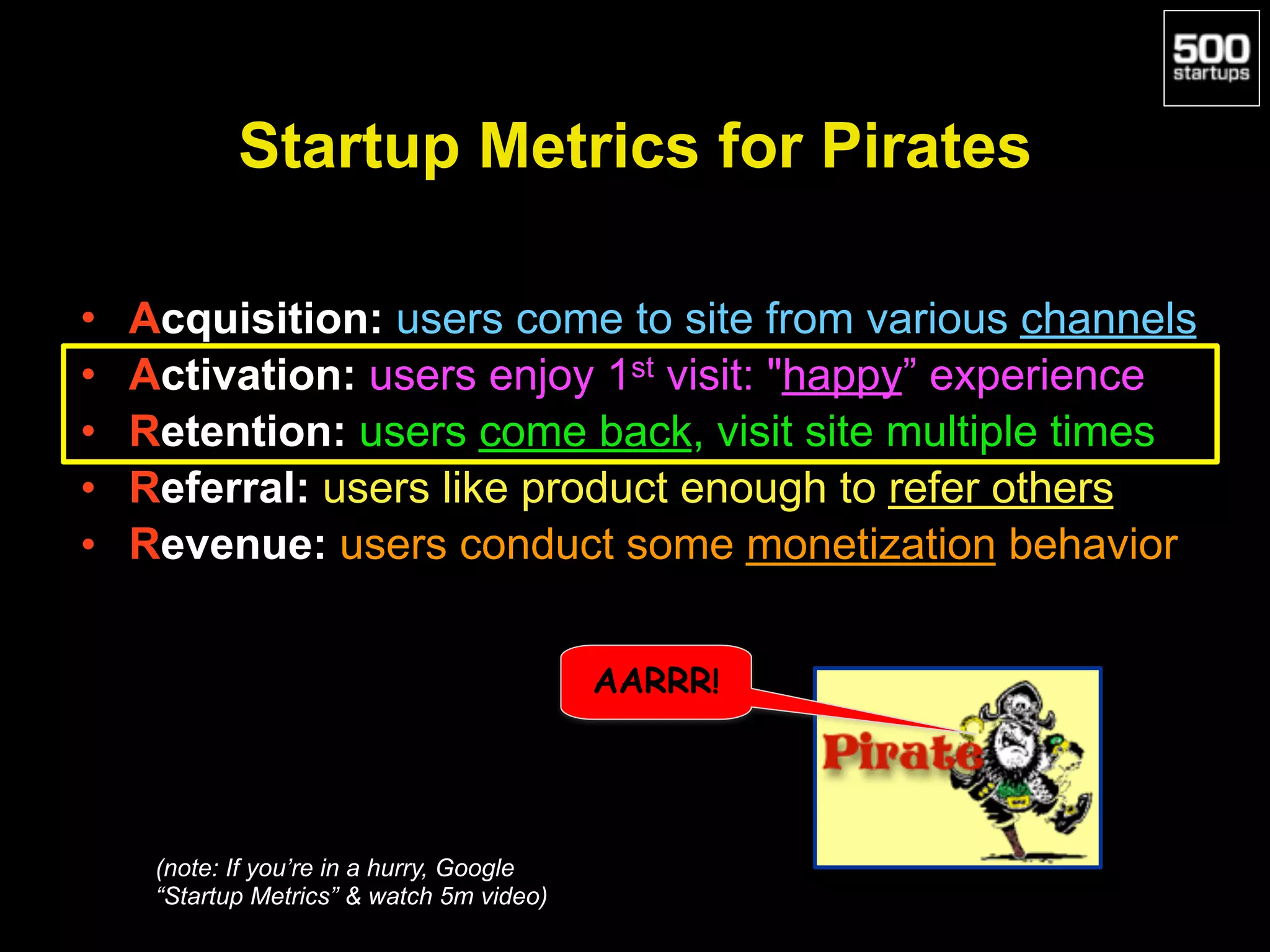
Startup Metrics for Pirates
• Acquisition: users come to site from various channels
• Activation: users enjoy 1st visit: "happy” experience
• Retention: users come back, visit site multiple times
• Referral: users like product enough to refer others
• Revenue: users conduct some monetization behavior
AARRR!
(note: If you’re in a hurry, Google
“Startup Metrics” & watch 5m video)
One Step at a Time.
1. Make a Good Product: Activation & Retention
2. Market the Product: Acquisition & Referral
3. Make Money: Revenue & Profitability
Startup Challenges
Startups have problems in 3 key areas:
• Management: Set Priorities, Define Key Metrics
• Product: Build “Right” Features. Measure, Iterate.
• Marketing: Distribution, Distribution, Distribution.
(Search, Social, Mobile)
[ Constructing MVP ]
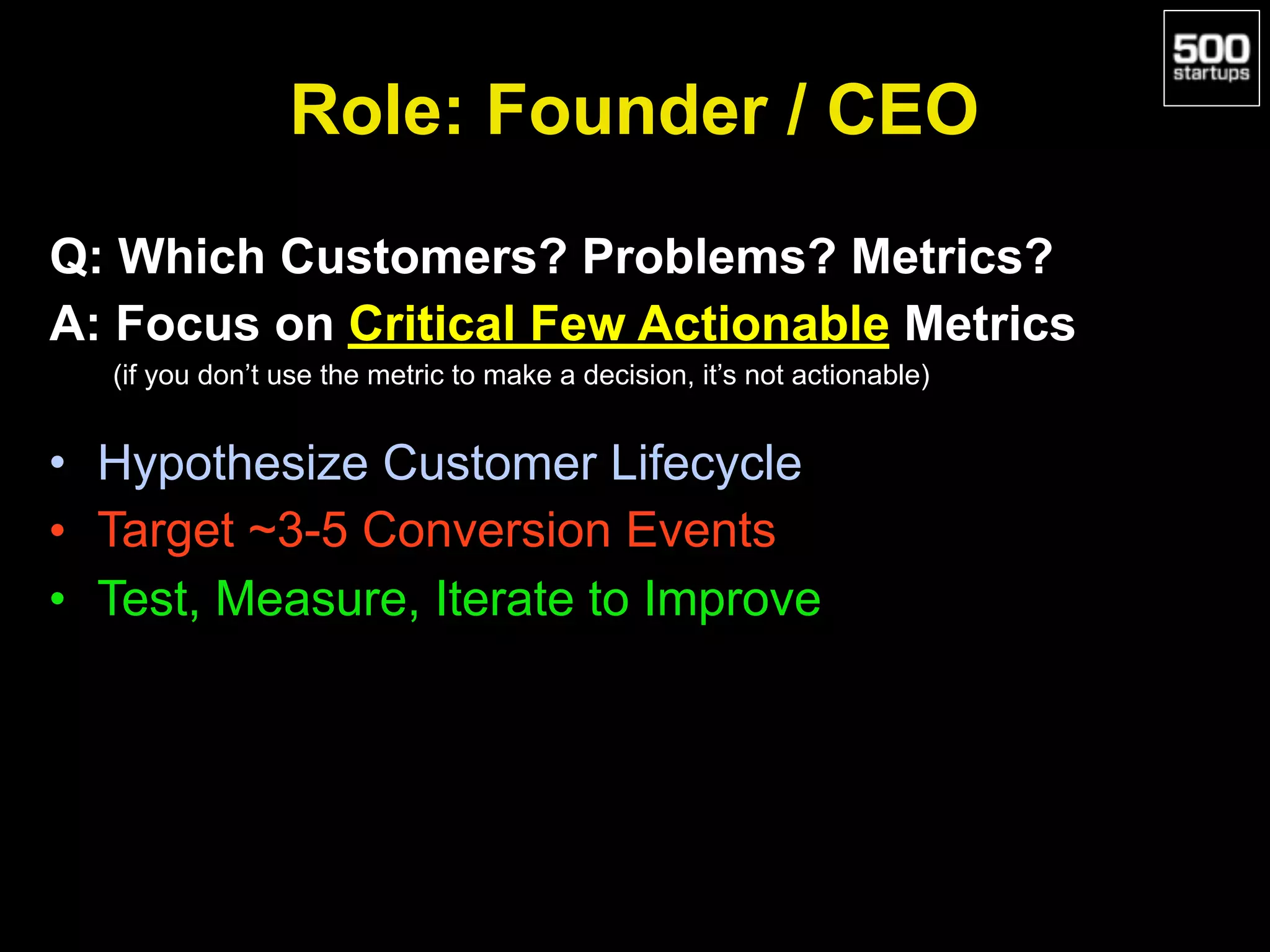
Role: Founder / CEO
Q: Which Customers? Problems? Metrics?
A: Focus on Critical Few Actionable Metrics
(if you don’t use the metric to make a decision, it’s not actionable)
• Hypothesize Customer Lifecycle
• Target ~3-5 Conversion Events
• Test, Measure, Iterate to Improve
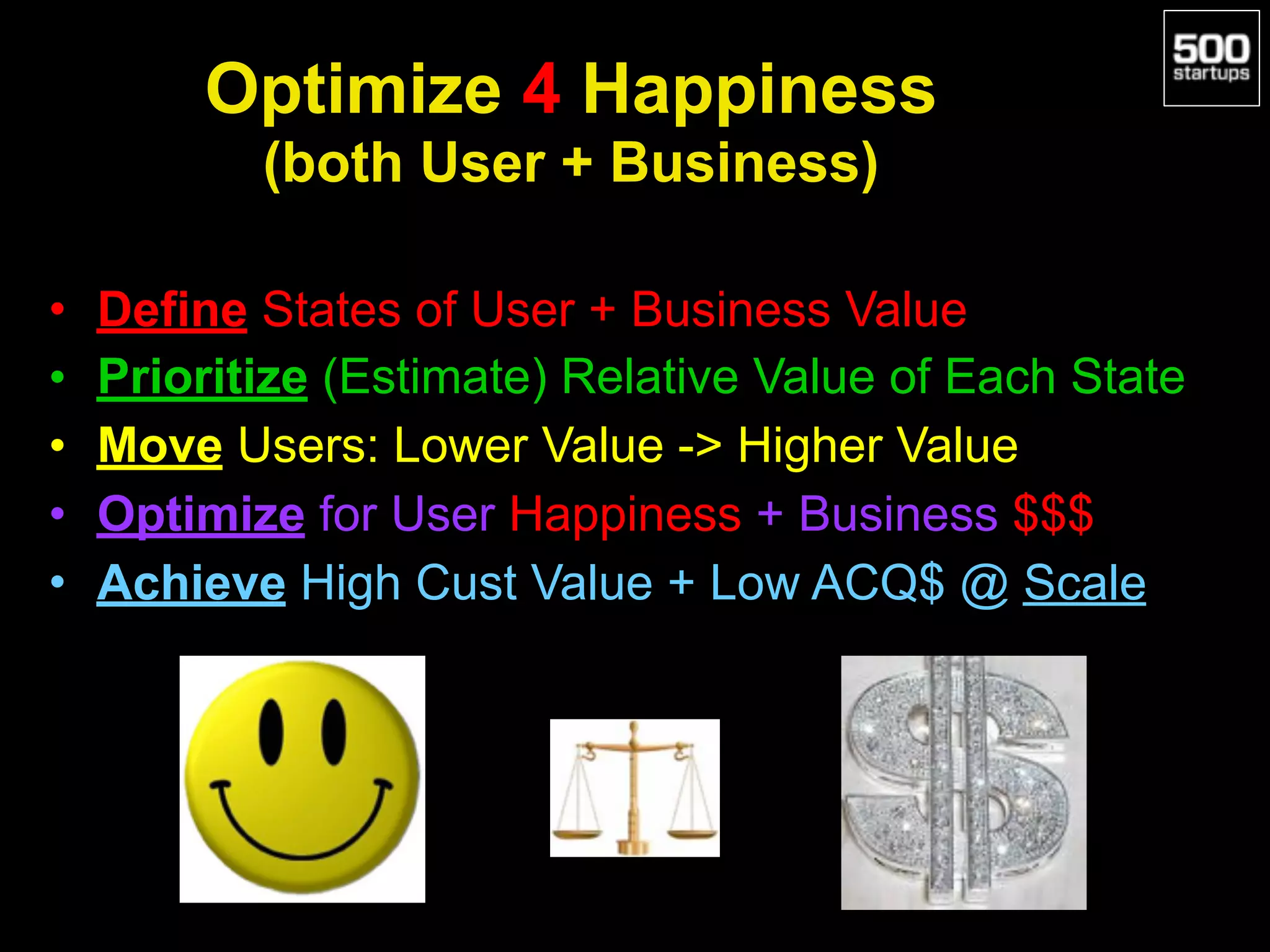
Optimize 4 Happiness 

(both User + Business)
• Define States of User + Business Value
• Prioritize (Estimate) Relative Value of Each State
• Move Users: Lower Value -> Higher Value
• Optimize for User Happiness + Business $$$
• Achieve High Cust Value + Low ACQ$ @ Scale
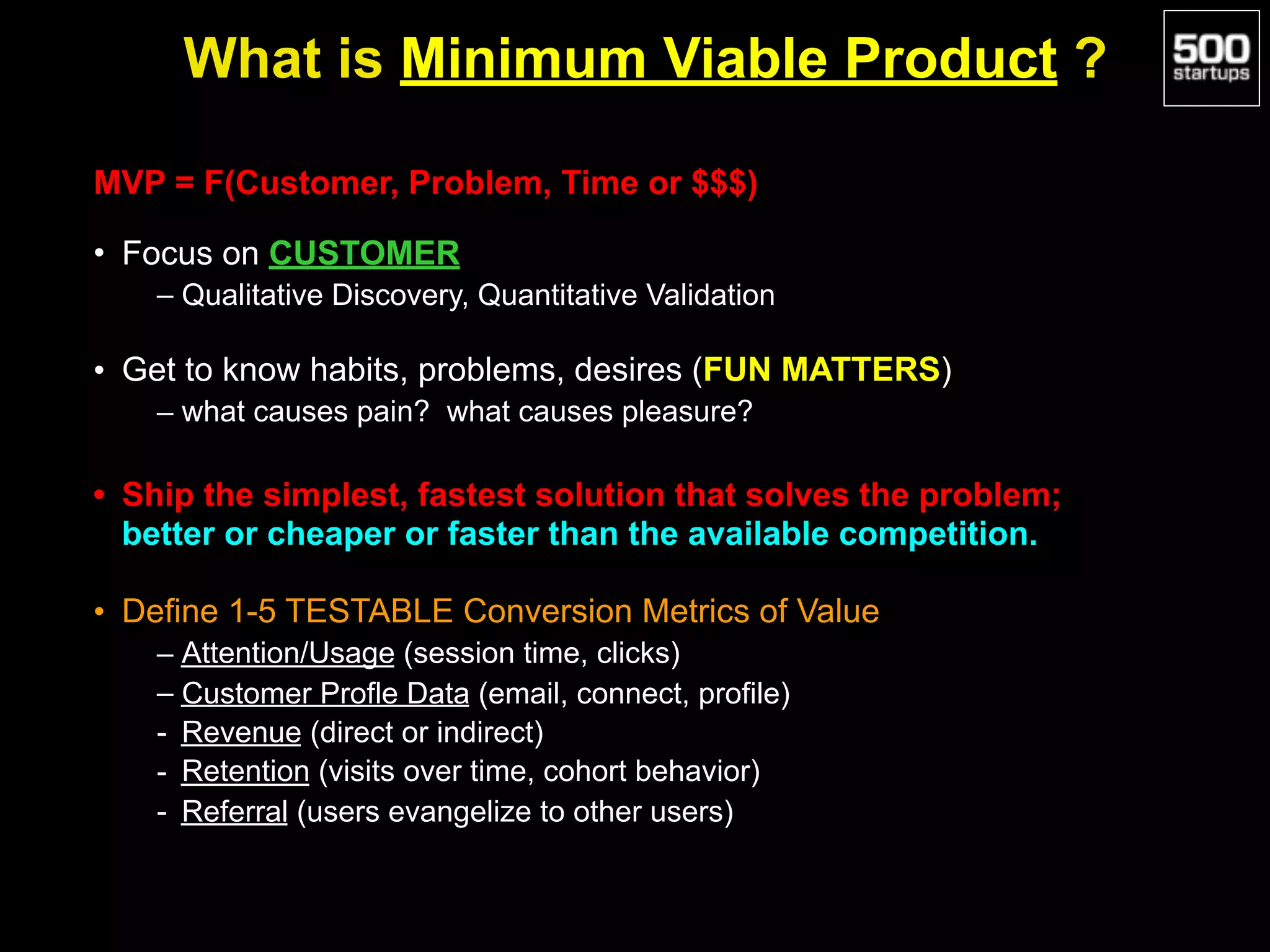
What is Minimum Viable Product ?
MVP = F(Customer, Problem, Time or $$$)
• Focus on CUSTOMER
– Qualitative Discovery, Quantitative Validation
• Get to know habits, problems, desires (FUN MATTERS)
– what causes pain? what causes pleasure?
• Ship the simplest, fastest solution that solves the problem;
better or cheaper or faster than the available competition.
• Define 1-5 TESTABLE Conversion Metrics of Value
– Attention/Usage (session time, clicks)
– Customer Profle Data (email, connect, profile)
- Revenue (direct or indirect)
- Retention (visits over time, cohort behavior)
- Referral (users evangelize to other users)
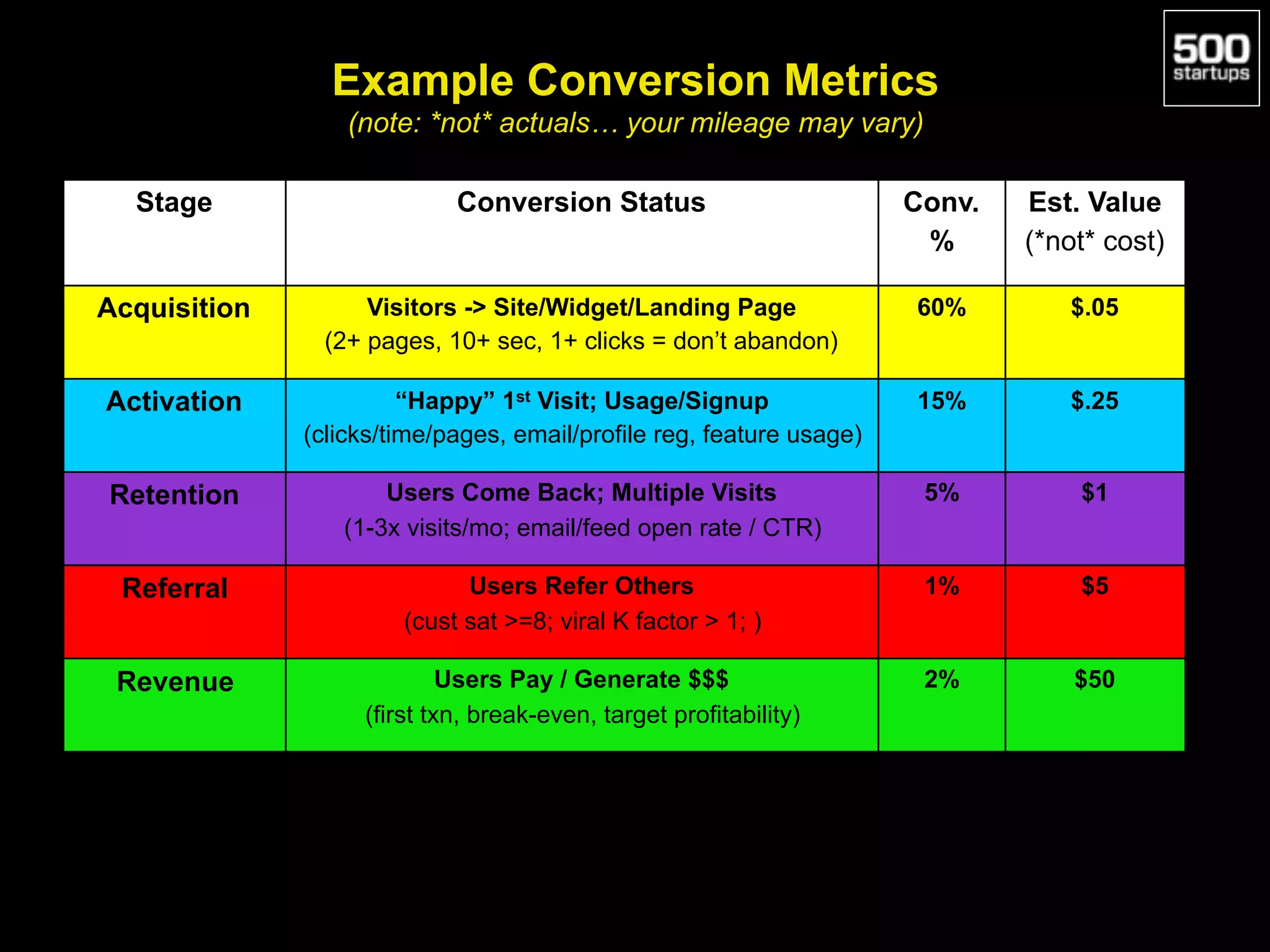
Example Conversion Metrics

(note: *not* actuals… your mileage may vary)
Stage Conversion Status Conv.
%
Est. Value
(*not* cost)
Acquisition Visitors -> Site/Widget/Landing Page
(2+ pages, 10+ sec, 1+ clicks = don’t abandon)
60% $.05
Activation “Happy” 1st Visit; Usage/Signup
(clicks/time/pages, email/profile reg, feature usage)
15% $.25
Retention Users Come Back; Multiple Visits
(1-3x visits/mo; email/feed open rate / CTR)
5% $1
Referral Users Refer Others
(cust sat >=8; viral K factor > 1; )
1% $5
Revenue Users Pay / Generate $$$
(first txn, break-even, target profitability)
2% $50
[ Getting 2 PMF ]
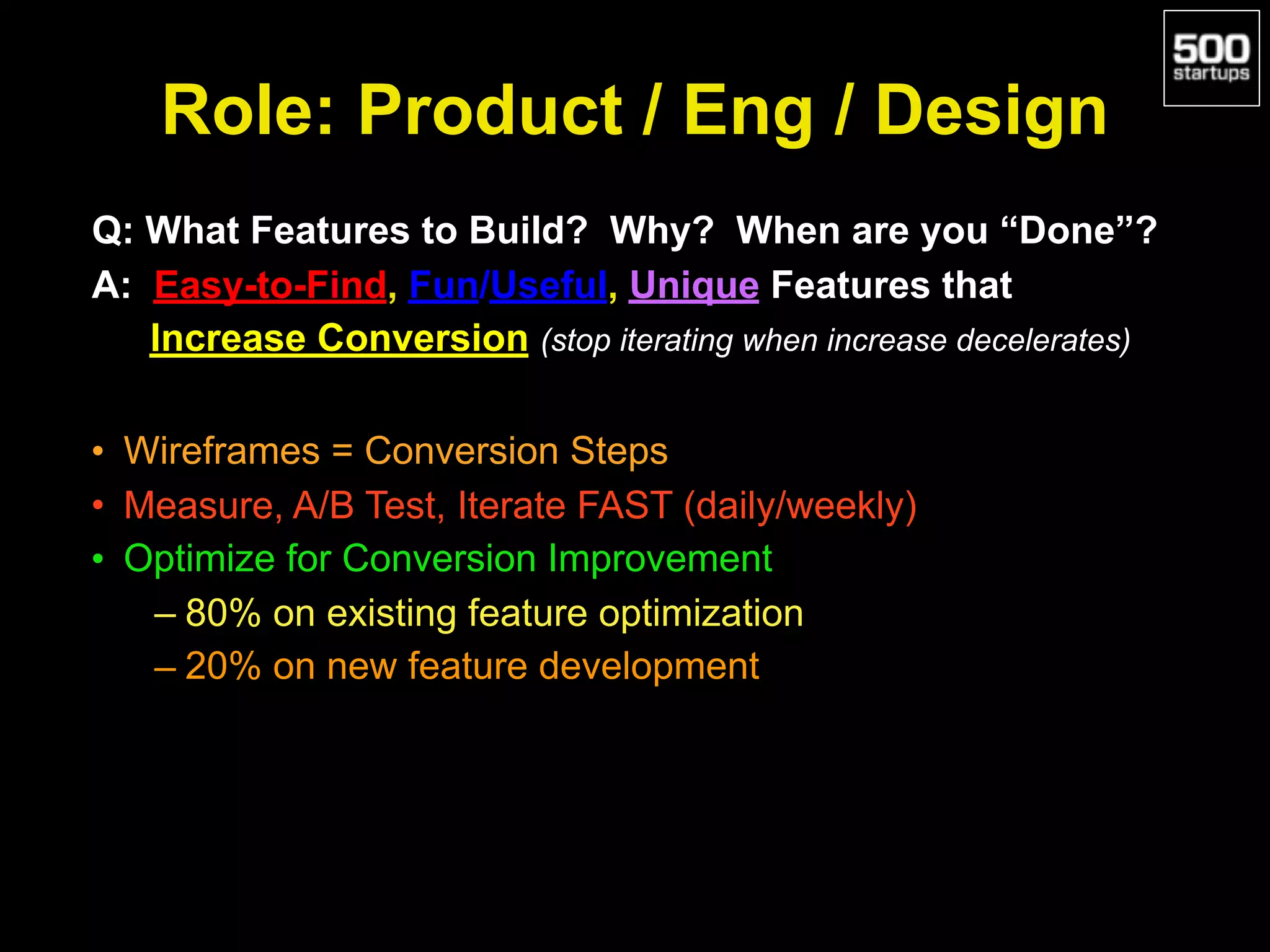
Role: Product / Eng / Design
Q: What Features to Build? Why? When are you “Done”?
A: Easy-to-Find, Fun/Useful, Unique Features that
Increase Conversion (stop iterating when increase decelerates)
• Wireframes = Conversion Steps
• Measure, A/B Test, Iterate FAST (daily/weekly)
• Optimize for Conversion Improvement
– 80% on existing feature optimization
– 20% on new feature development
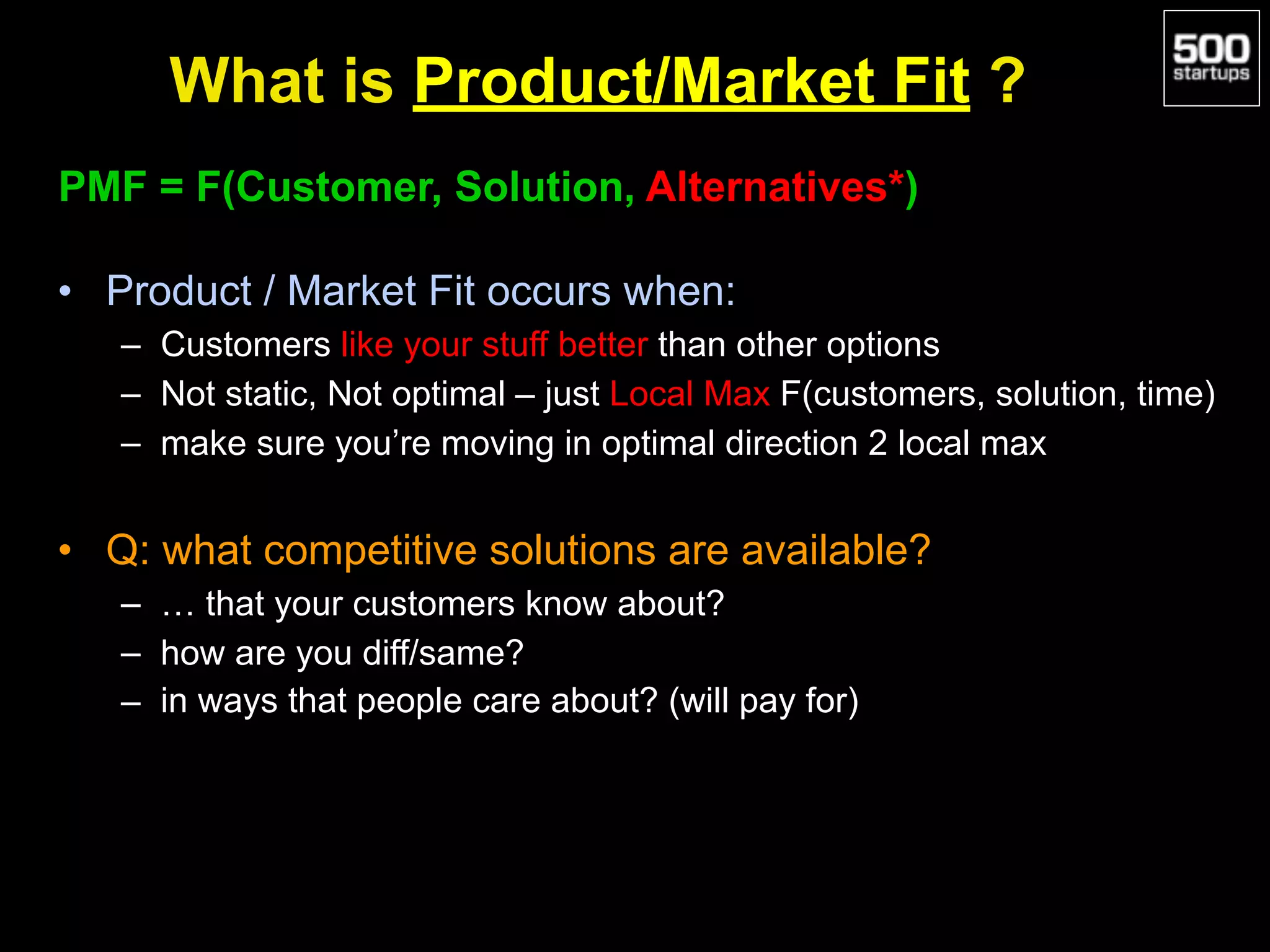
What is Product/Market Fit ?
PMF = F(Customer, Solution, Alternatives*)
• Product / Market Fit occurs when:
– Customers like your stuff better than other options
– Not static, Not optimal – just Local Max F(customers, solution, time)
– make sure you’re moving in optimal direction 2 local max
• Q: what competitive solutions are available?
– … that your customers know about?
– how are you diff/same?
– in ways that people care about? (will pay for)
[ Testing 4 AUX ]
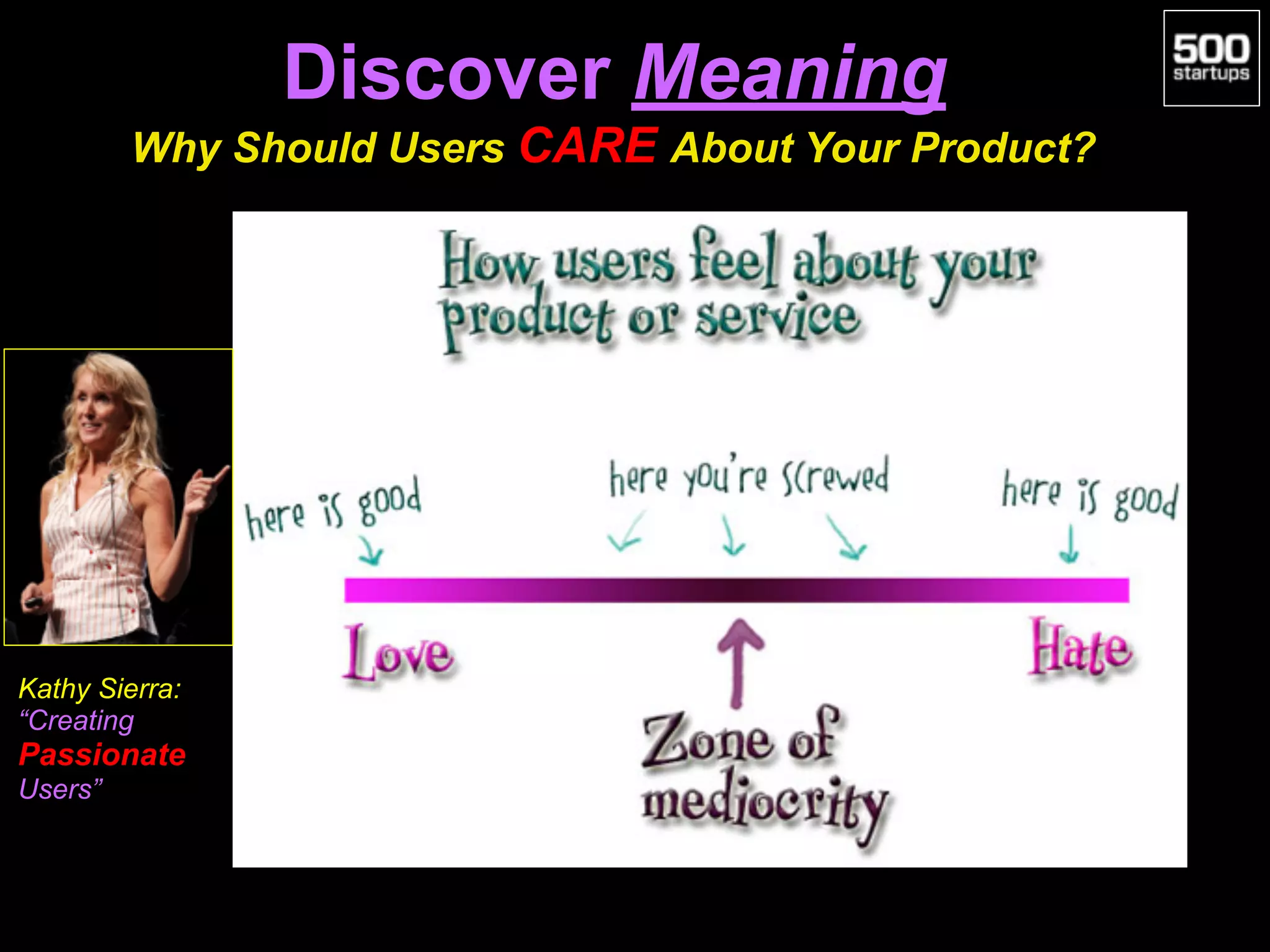
Discover Meaning

Why Should Users CARE About Your Product?
Kathy Sierra:
“Creating
Passionate
Users”
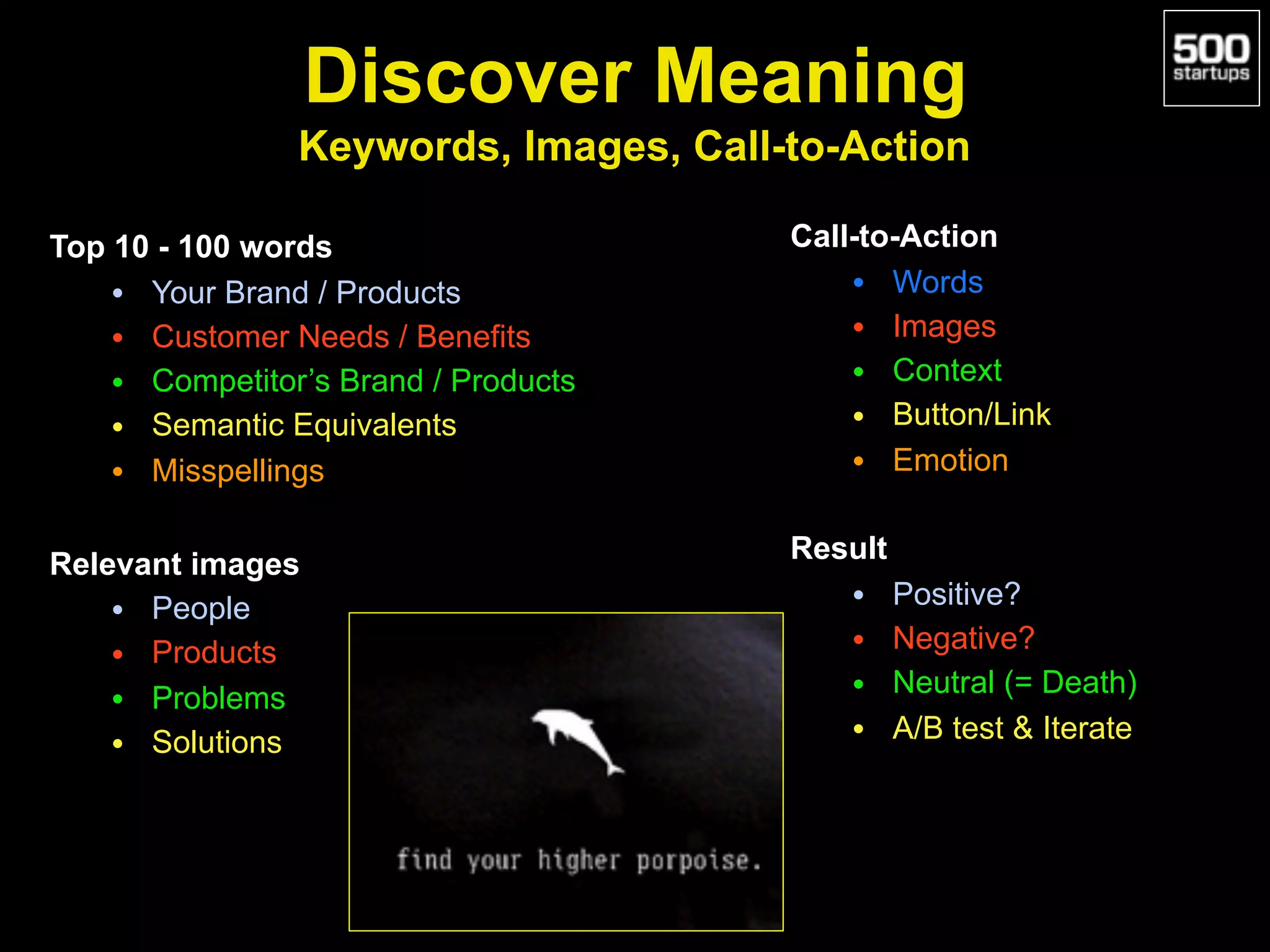
Discover Meaning

Keywords, Images, Call-to-Action
Top 10 - 100 words
• Your Brand / Products
• Customer Needs / Benefits
• Competitor’s Brand / Products
• Semantic Equivalents
• Misspellings
Relevant images
• People
• Products
• Problems
• Solutions
Call-to-Action
• Words
• Images
• Context
• Button/Link
• Emotion
Result
• Positive?
• Negative?
• Neutral (= Death)
• A/B test & Iterate
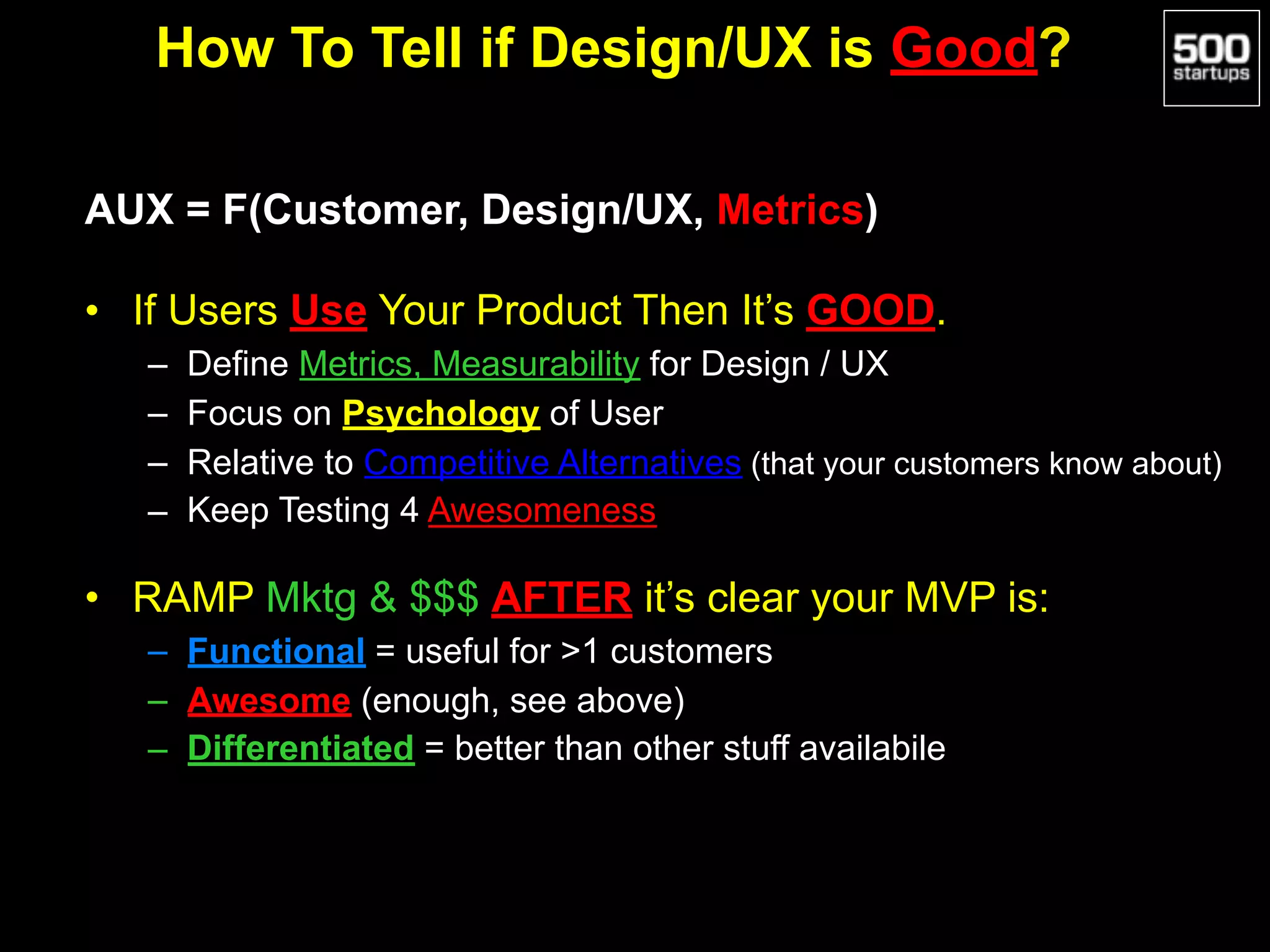
How To Tell if Design/UX is Good?
AUX = F(Customer, Design/UX, Metrics)
• If Users Use Your Product Then It’s GOOD.
– Define Metrics, Measurability for Design / UX
– Focus on Psychology of User
– Relative to Competitive Alternatives (that your customers know about)
– Keep Testing 4 Awesomeness
• RAMP Mktg & $$$ AFTER it’s clear your MVP is:
– Functional = useful for >1 customers
– Awesome (enough, see above)
– Differentiated = better than other stuff availabile
[ Metrics 4 ACQ ]
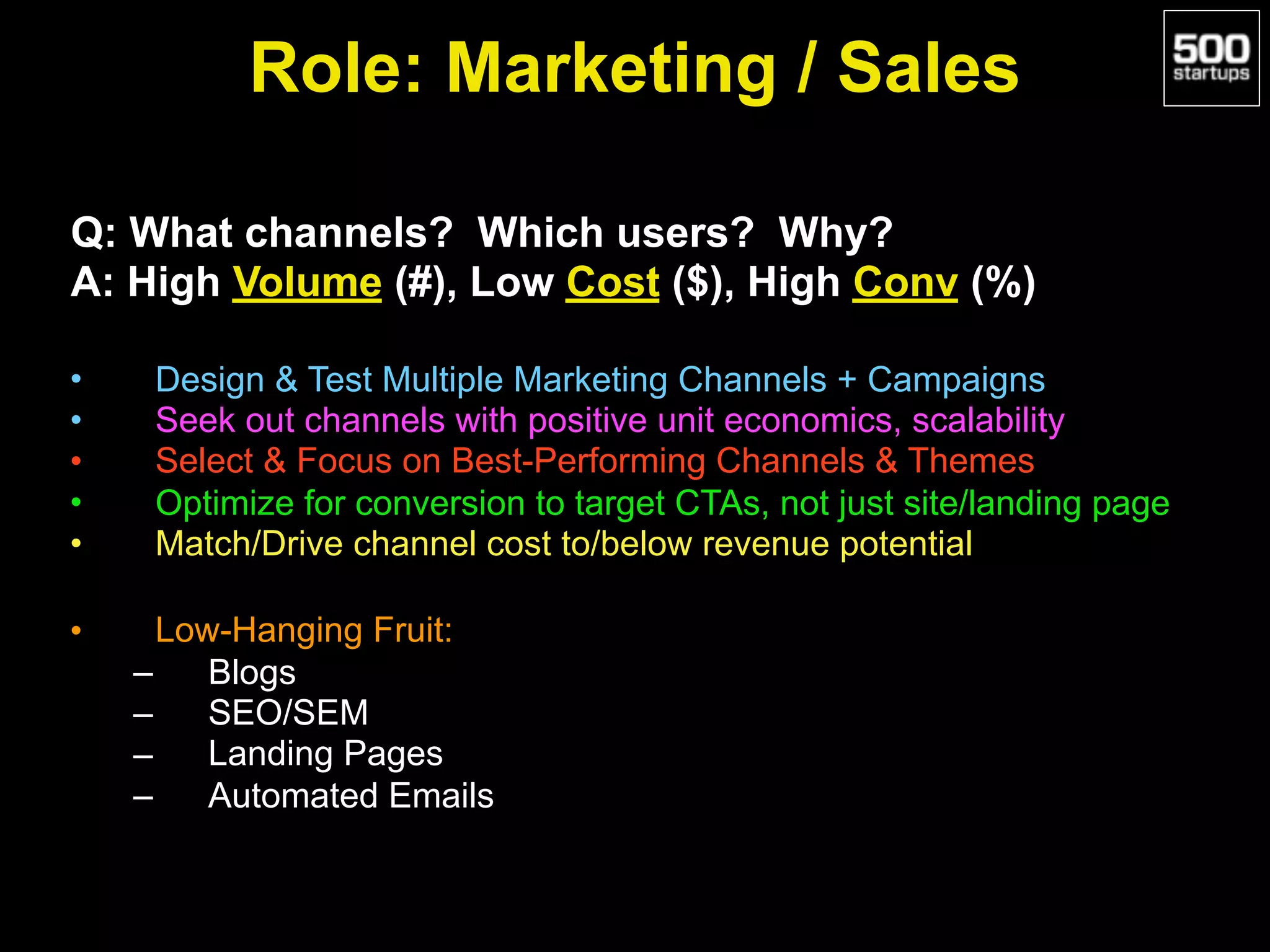
Role: Marketing / Sales
Q: What channels? Which users? Why?
A: High Volume (#), Low Cost ($), High Conv (%)
• Design & Test Multiple Marketing Channels + Campaigns
• Seek out channels with positive unit economics, scalability
• Select & Focus on Best-Performing Channels & Themes
• Optimize for conversion to target CTAs, not just site/landing page
• Match/Drive channel cost to/below revenue potential
• Low-Hanging Fruit:
– Blogs
– SEO/SEM
– Landing Pages
– Automated Emails
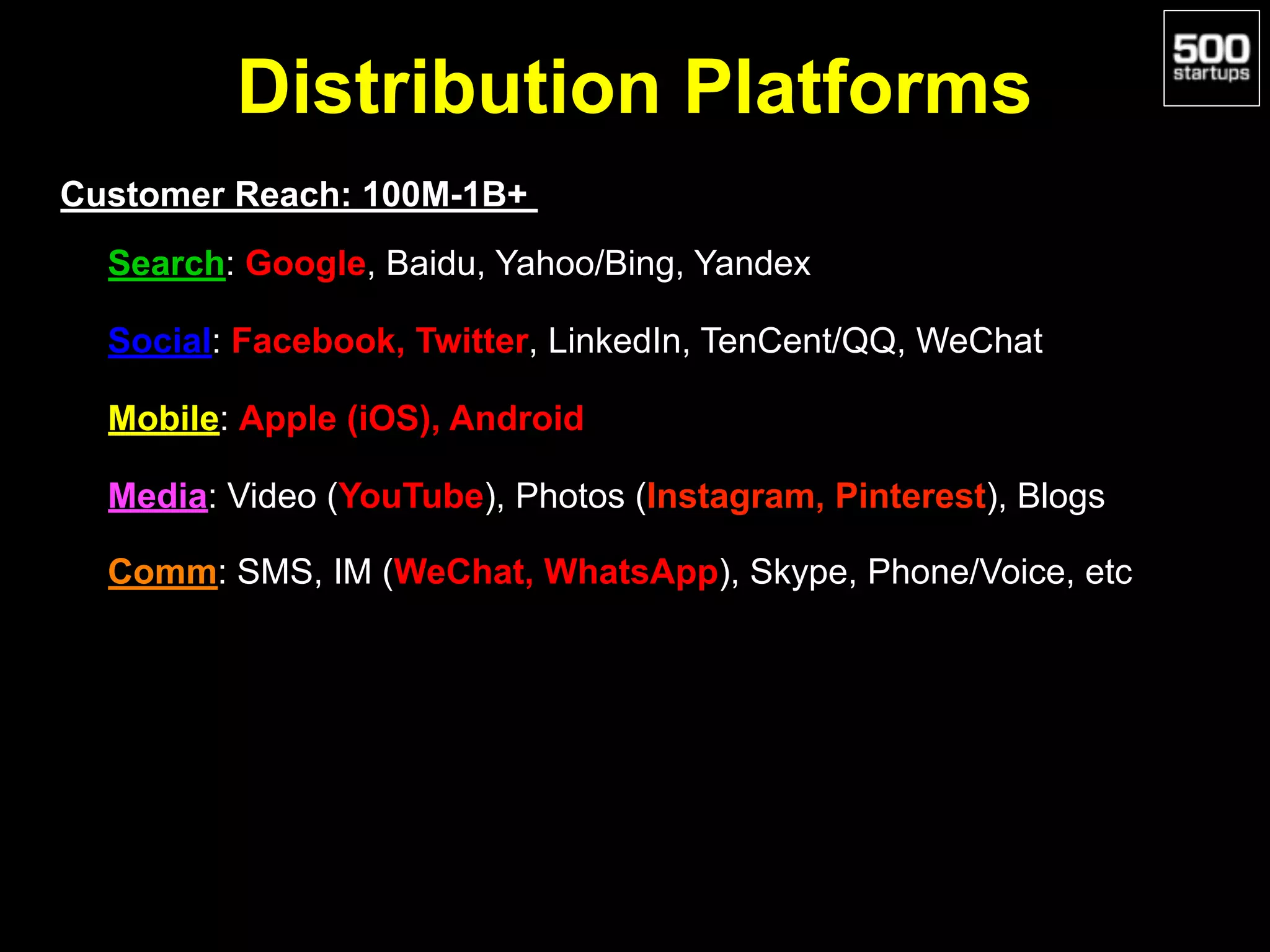
Distribution Platforms
Customer Reach: 100M-1B+
• Search: Google, Baidu, Yahoo/Bing, Yandex
• Social: Facebook, Twitter, LinkedIn, TenCent/QQ, WeChat
• Mobile: Apple (iOS), Android
• Media: Video (YouTube), Photos (Instagram, Pinterest), Blogs
• Comm: SMS, IM (WeChat, WhatsApp), Skype, Phone/Voice, etc
MAARRRketing Plan
Marketing Plan = Target Customer Acquisition Channels
• 3 Important Factors = Volume (#), Cost ($), Conversion (%)
• Measure conversion to target customer actions
• Test audience segments, campaign themes, Call-To-Action (CTAs)
[Gradually] Match Channel Costs => Revenue Potential
• Increase Vol. & Conversion, Decrease Cost, Optimize for Revenue Potential
• Avg Txn Value (ATV), Ann Rev Per User (ARPU), Cust Lifetime Value (CLV)
• Design channels that (eventually) cost <20-50% of target ATV, ARPU, CLV
Consider Costs, Scarce Resource Tradeoffs
• Actual $ expenses
• Marketing time & resources
• Product/Engineering time & resources
• Cashflow timing of expense vs. revenue, profit
ACQ = F(Customer, Campaign, Vol, Cost, Conv)
[ What is WINNING? ]
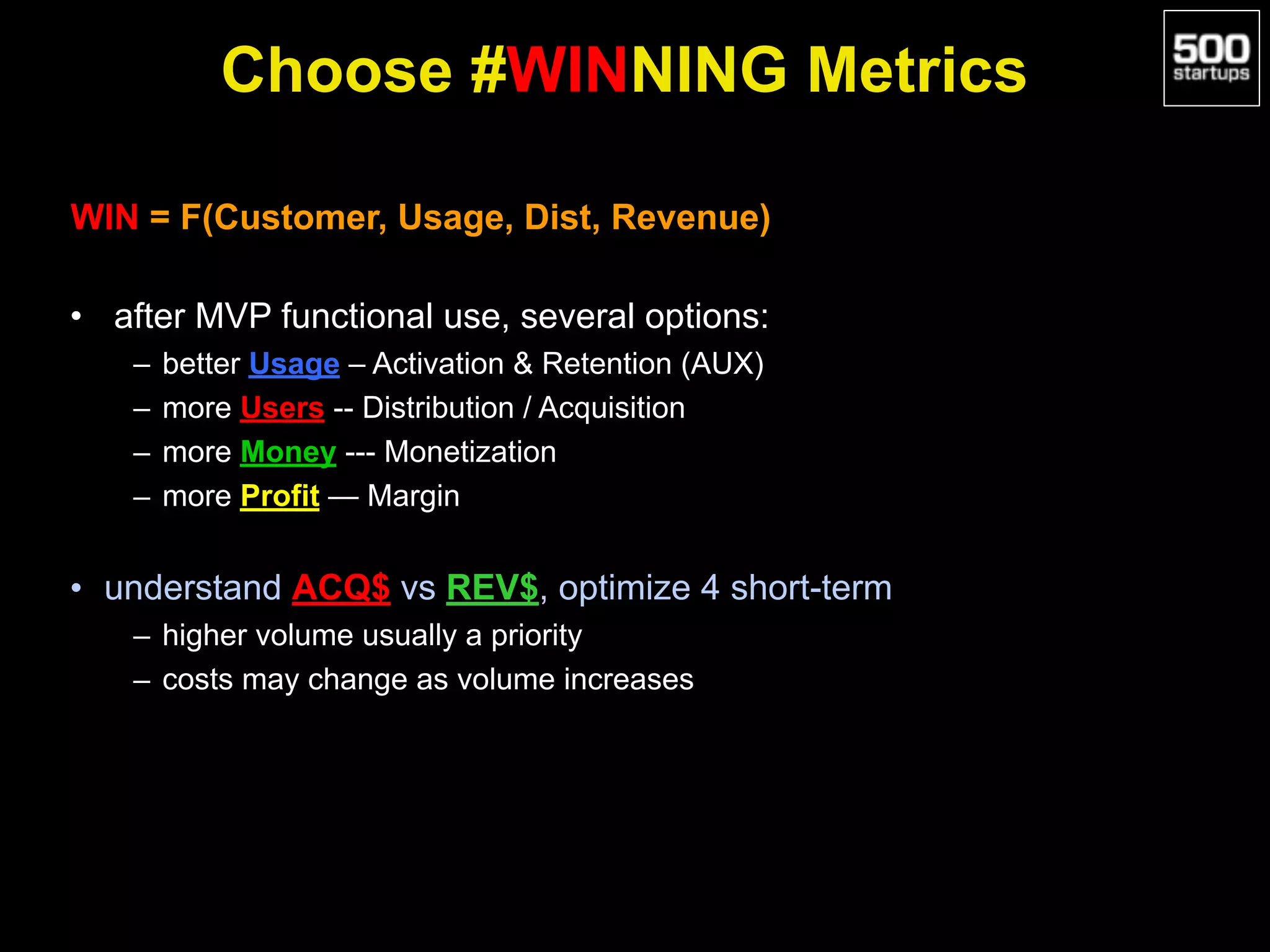
Choose #WINNING Metrics
WIN = F(Customer, Usage, Dist, Revenue)
• after MVP functional use, several options:
– better Usage – Activation & Retention (AUX)
– more Users -- Distribution / Acquisition
– more Money --- Monetization
– more Profit — Margin
• understand ACQ$ vs REV$, optimize 4 short-term
– higher volume usually a priority
– costs may change as volume increases
[ The Lean Investor ]
Startup 2.0: 

“Lean Investor” Model
Method: Invest in startups using incremental
investment, iterative development. Start with
lots of small experiments, filter out failure, and
expand investment upon success.
• Incubator: $0-100K (“Product Viability”)
• Seed: $100K-$2M (“Expand Distribution”)
• Venture: $1M-$10M (“Maximize Revenue”)
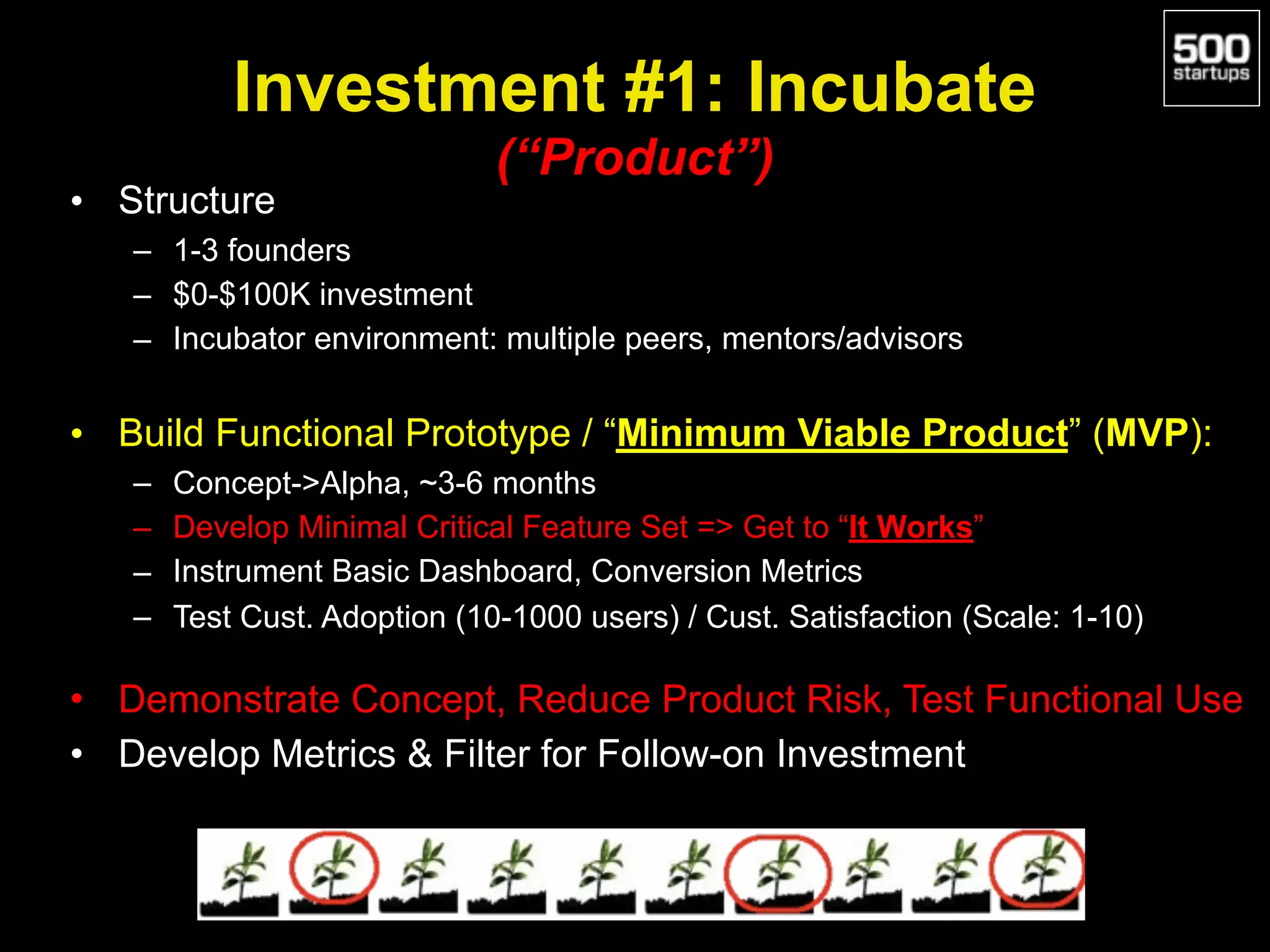
Investment #1: Incubate

(“Product”)
• Structure
– 1-3 founders
– $0-$100K investment
– Incubator environment: multiple peers, mentors/advisors
• Build Functional Prototype / “Minimum Viable Product” (MVP):
– Concept->Alpha, ~3-6 months
– Develop Minimal Critical Feature Set => Get to “It Works”
– Instrument Basic Dashboard, Conversion Metrics
– Test Cust. Adoption (10-1000 users) / Cust. Satisfaction (Scale: 1-10)
• Demonstrate Concept, Reduce Product Risk, Test Functional Use
• Develop Metrics & Filter for Follow-on Investment
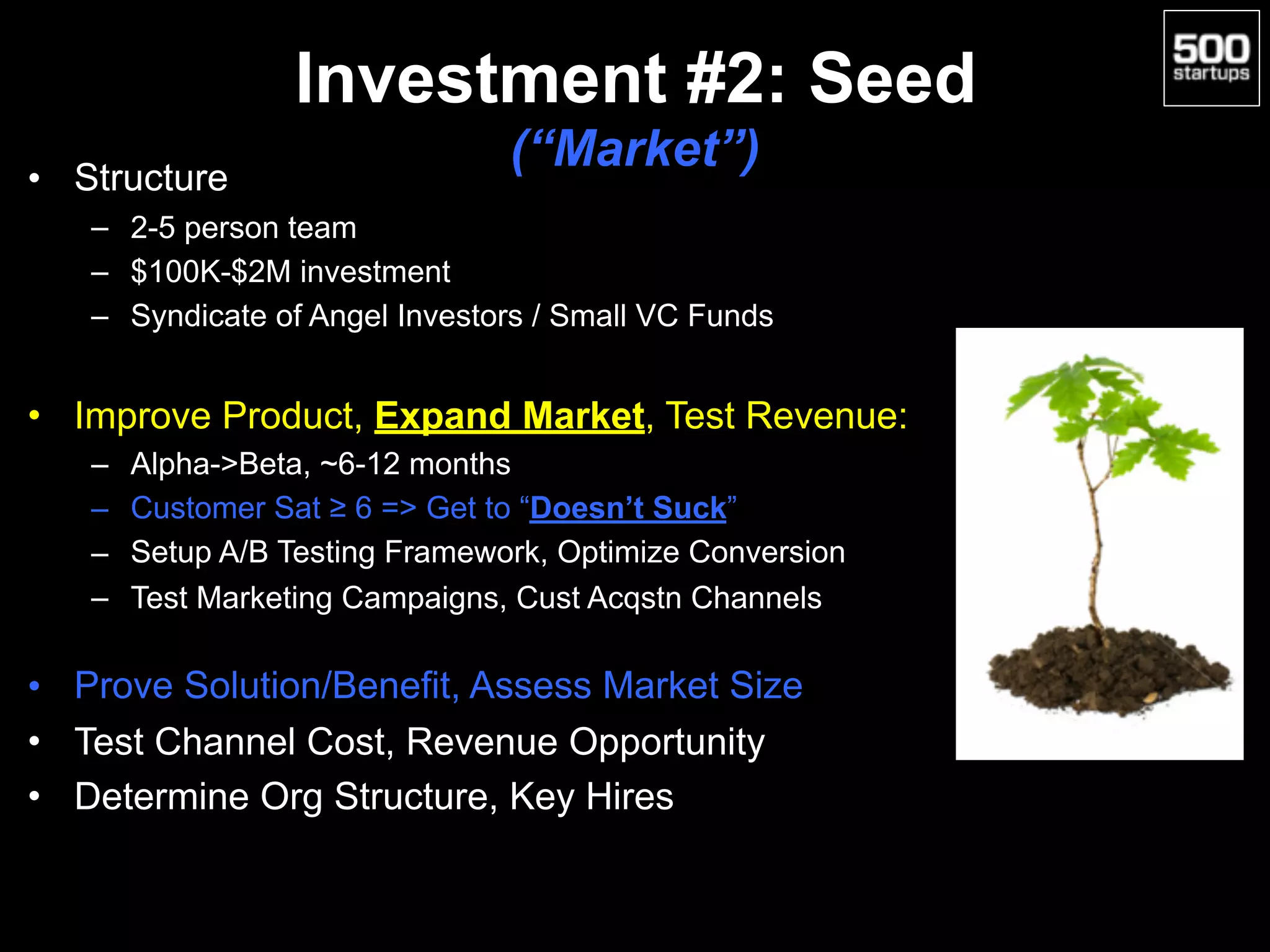
Investment #2: Seed

(“Market”)• Structure
– 2-5 person team
– $100K-$2M investment
– Syndicate of Angel Investors / Small VC Funds
• Improve Product, Expand Market, Test Revenue:
– Alpha->Beta, ~6-12 months
– Customer Sat ≥ 6 => Get to “Doesn’t Suck”
– Setup A/B Testing Framework, Optimize Conversion
– Test Marketing Campaigns, Cust Acqstn Channels
• Prove Solution/Benefit, Assess Market Size
• Test Channel Cost, Revenue Opportunity
• Determine Org Structure, Key Hires
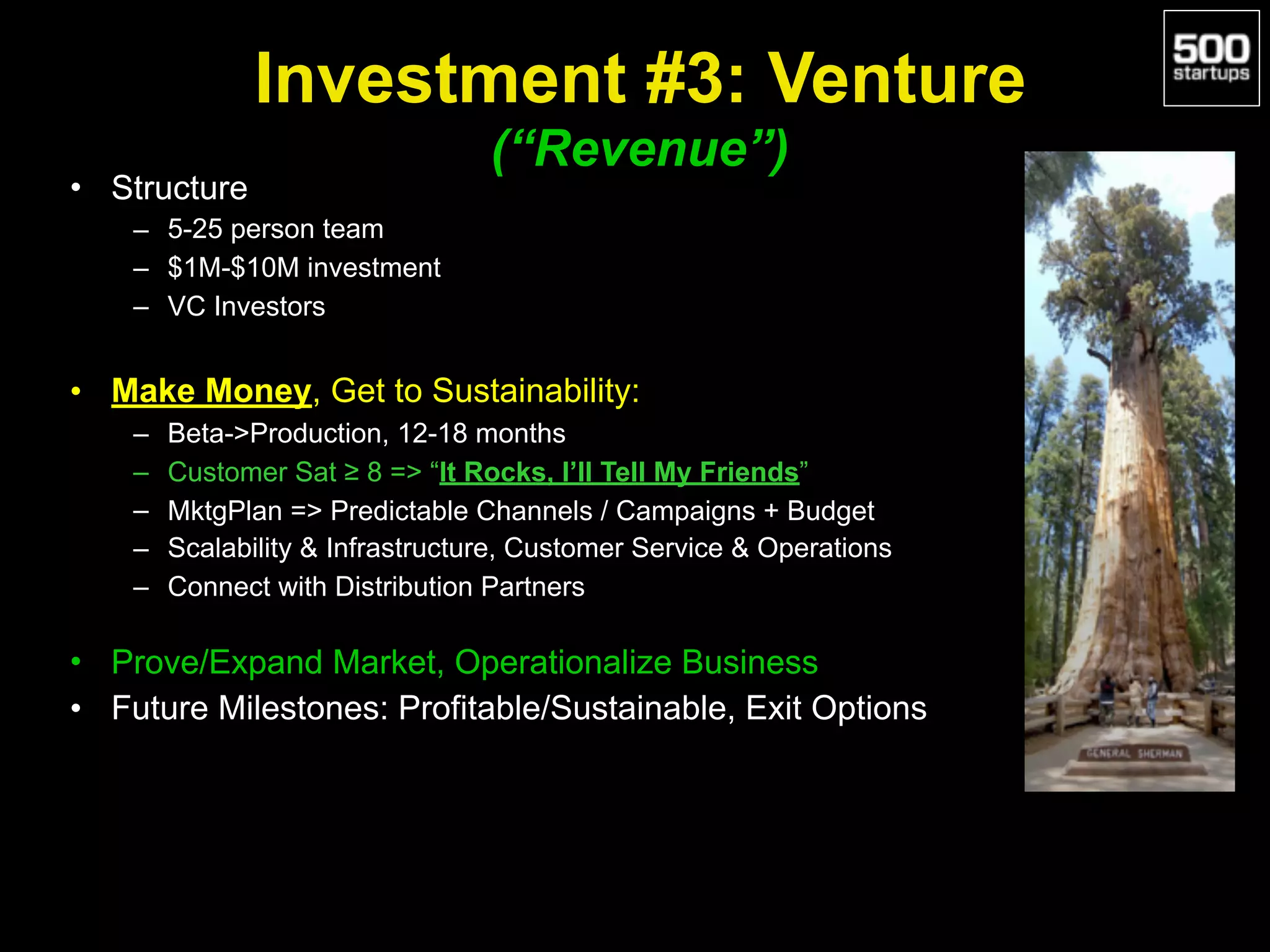
Investment #3: Venture

(“Revenue”)
• Structure
– 5-25 person team
– $1M-$10M investment
– VC Investors
• Make Money, Get to Sustainability:
– Beta->Production, 12-18 months
– Customer Sat ≥ 8 => “It Rocks, I’ll Tell My Friends”
– MktgPlan => Predictable Channels / Campaigns + Budget
– Scalability & Infrastructure, Customer Service & Operations
– Connect with Distribution Partners
• Prove/Expand Market, Operationalize Business
• Future Milestones: Profitable/Sustainable, Exit Options
Q&A?
Âť Questions?
Âť Answers: $1
Âť Correct Answers: $10
Âť Stupid Look on my face: FREE!
Appendix
(note the following slides are a bit
old and i haven’t updated them in
quite a while… sorry ;)
Startup Metrics
Activation
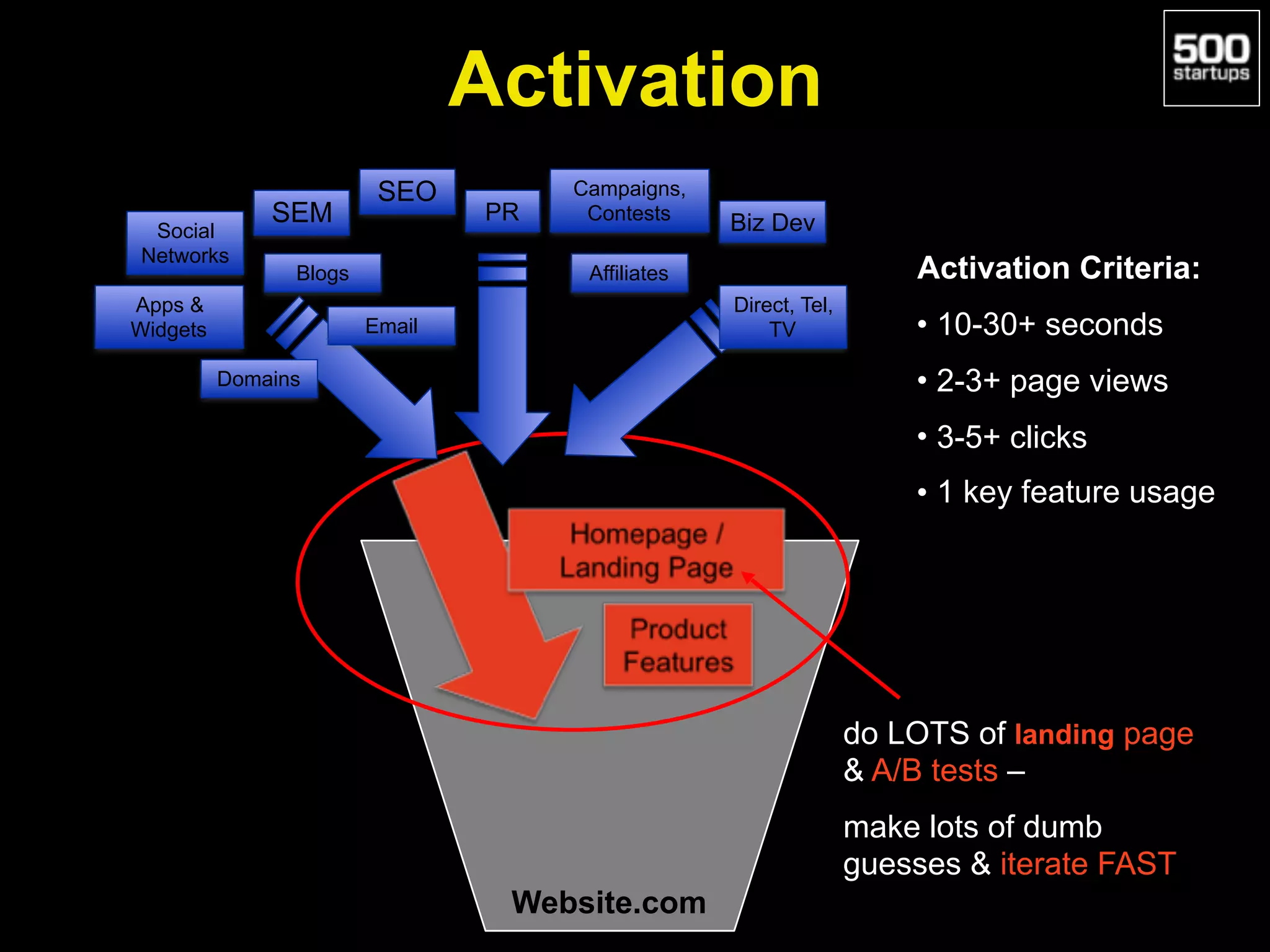
Website.com
Activation Criteria:
• 10-30+ seconds
• 2-3+ page views
• 3-5+ clicks
• 1 key feature usage
do LOTS of landing page
& A/B tests –
make lots of dumb
guesses & iterate FAST
SEO
SEM
Apps &
Widgets
Affiliates
Email
PR Biz Dev
Campaigns,
Contests
Direct, Tel,
TV
Social
Networks
Blogs
Domains
Activation
Activation

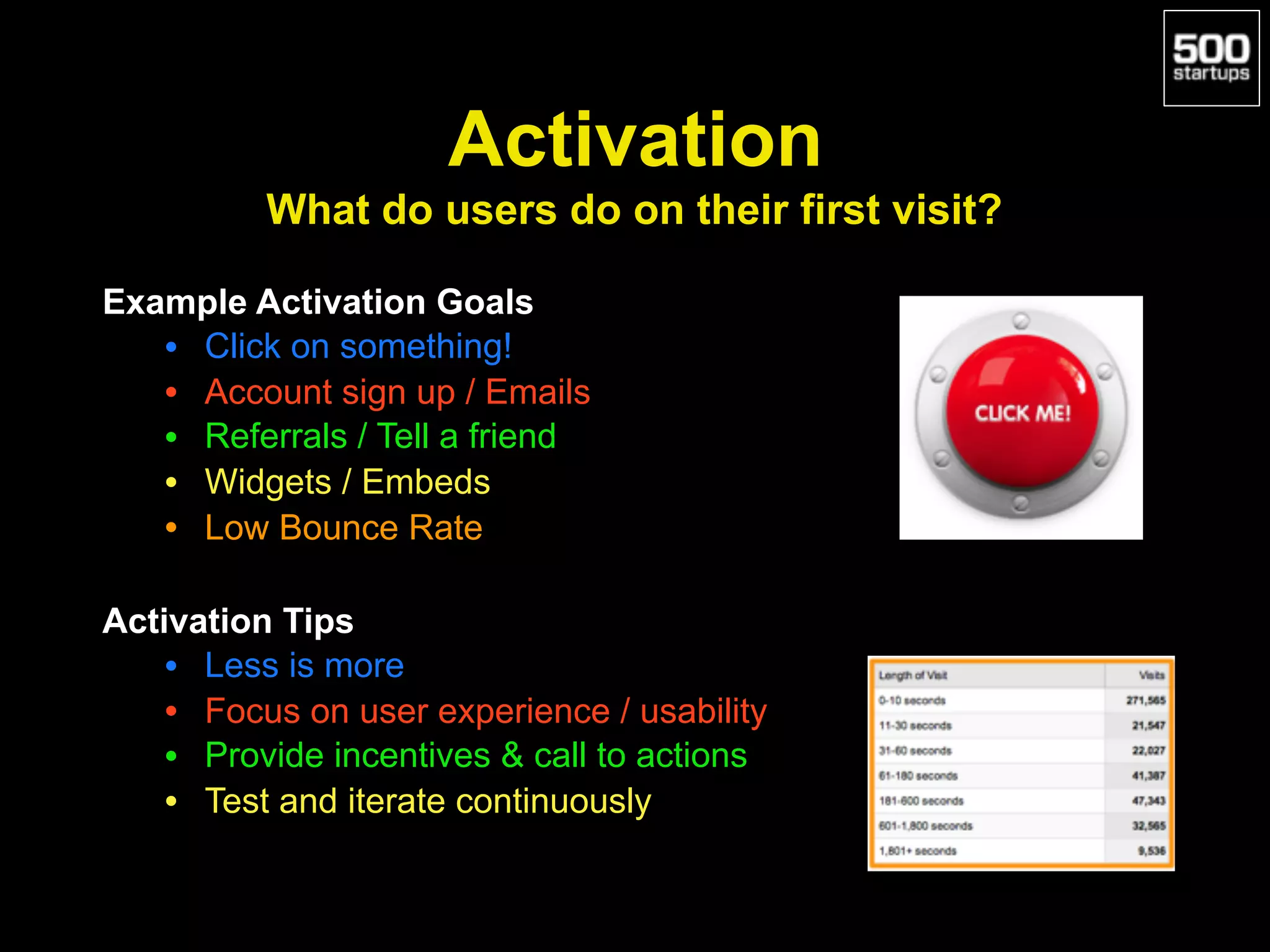
What do users do on their first visit?
Example Activation Goals
• Click on something!
• Account sign up / Emails
• Referrals / Tell a friend
• Widgets / Embeds
• Low Bounce Rate
Activation Tips
• Less is more
• Focus on user experience / usability
• Provide incentives & call to actions
• Test and iterate continuously
Activation

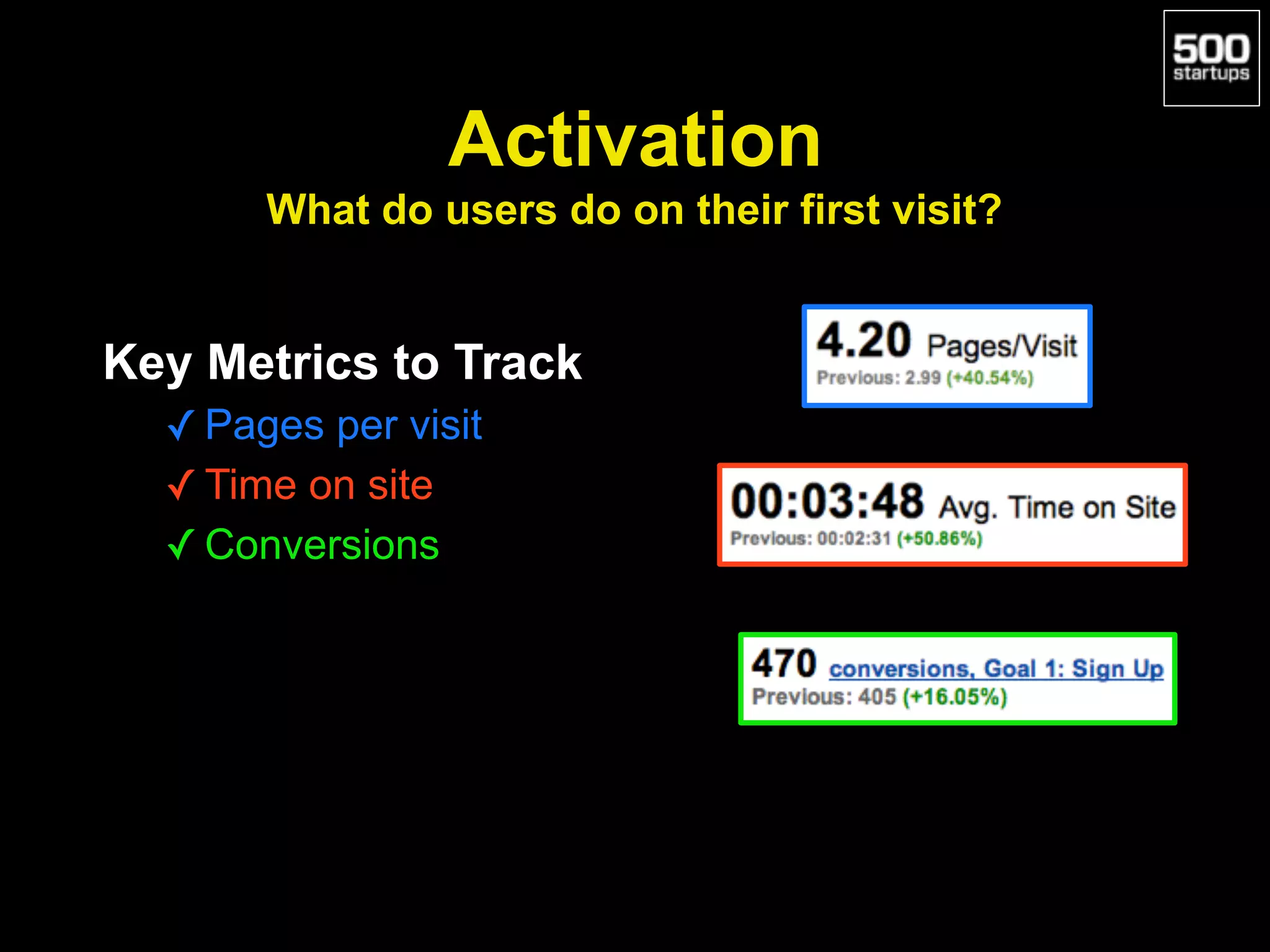
What do users do on their first visit?
Key Metrics to Track
✓ Pages per visit
✓ Time on site
✓ Conversions
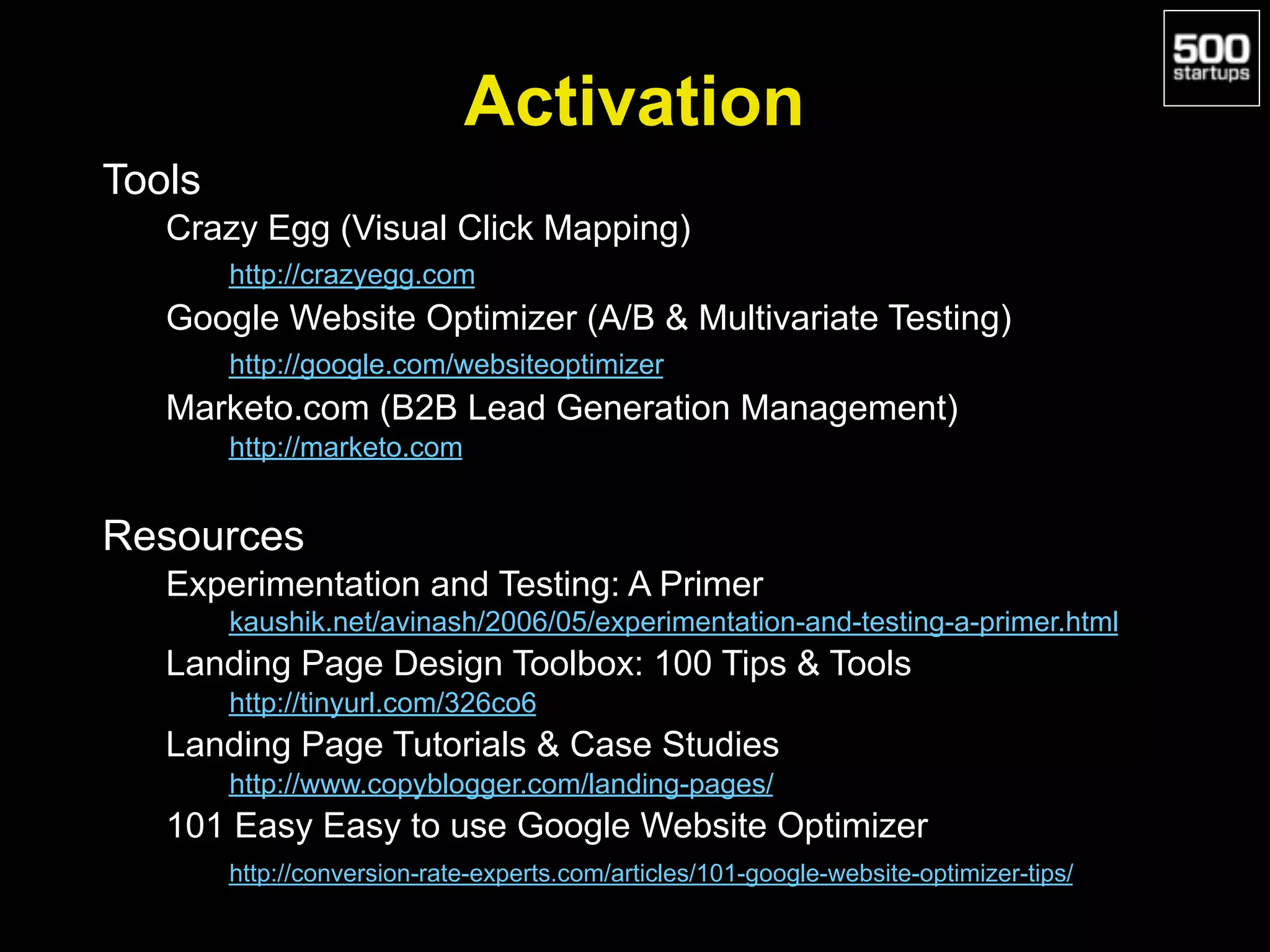
Activation
Tools
Crazy Egg (Visual Click Mapping)
http://crazyegg.com
Google Website Optimizer (A/B & Multivariate Testing)
http://google.com/websiteoptimizer
Marketo.com (B2B Lead Generation Management)
http://marketo.com
Resources
Experimentation and Testing: A Primer
kaushik.net/avinash/2006/05/experimentation-and-testing-a-primer.html
Landing Page Design Toolbox: 100 Tips & Tools
http://tinyurl.com/326co6
Landing Page Tutorials & Case Studies
http://www.copyblogger.com/landing-pages/
101 Easy Easy to use Google Website Optimizer
http://conversion-rate-experts.com/articles/101-google-website-optimizer-tips/
Startup Metrics
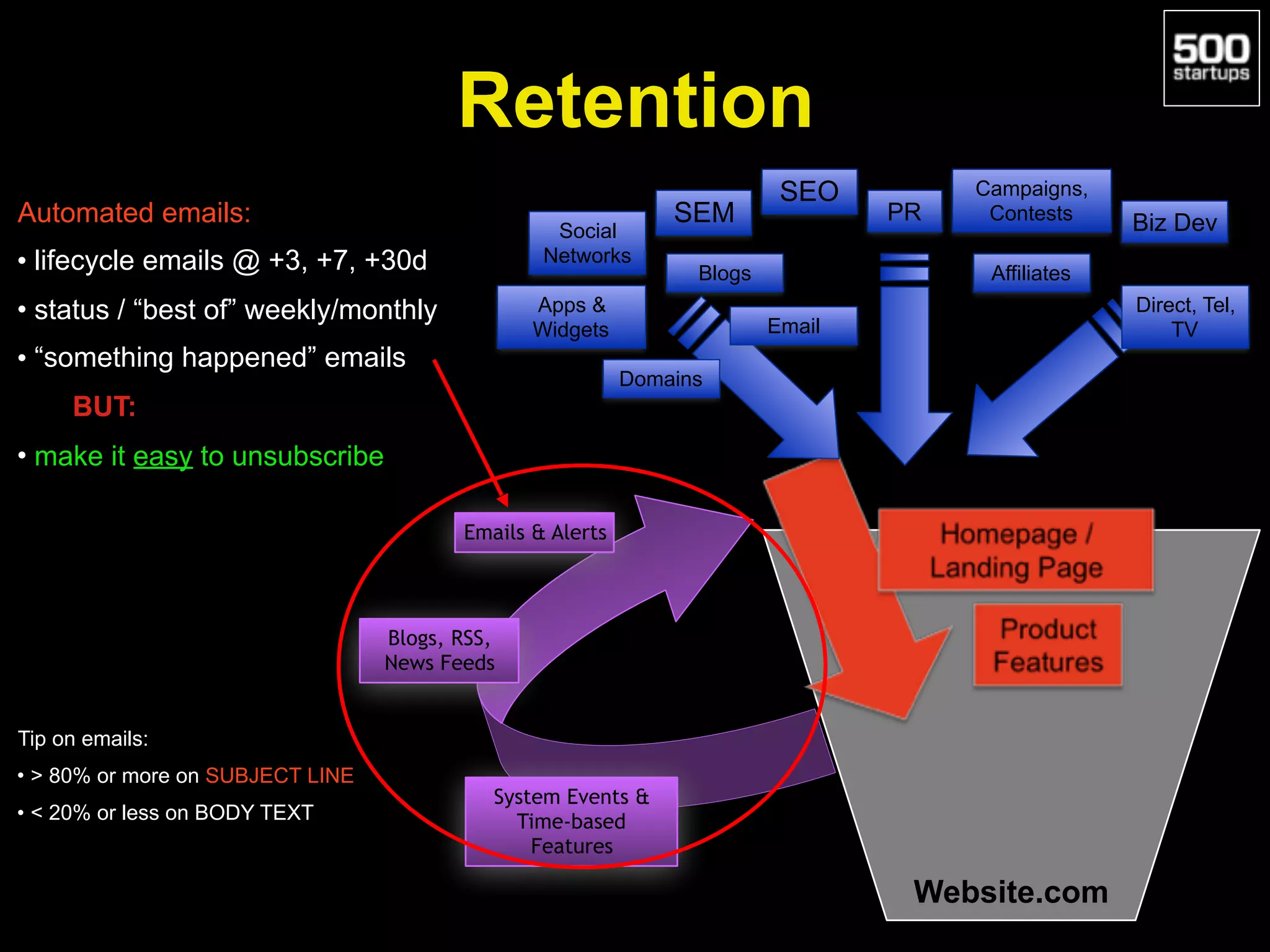
Retention
Website.com
SEO
SEM
Apps &
Widgets
Affiliates
Email
PR Biz Dev
Campaigns,
Contests
Direct, Tel,
TV
Social
Networks
Blogs
Domains
Emails & Alerts
System Events &
Time-based
Features
Blogs, RSS,
News Feeds
Automated emails:
• lifecycle emails @ +3, +7, +30d
• status / “best of” weekly/monthly
• “something happened” emails
BUT:
• make it easy to unsubscribe
Tip on emails:
• > 80% or more on SUBJECT LINE
• < 20% or less on BODY TEXT
Retention
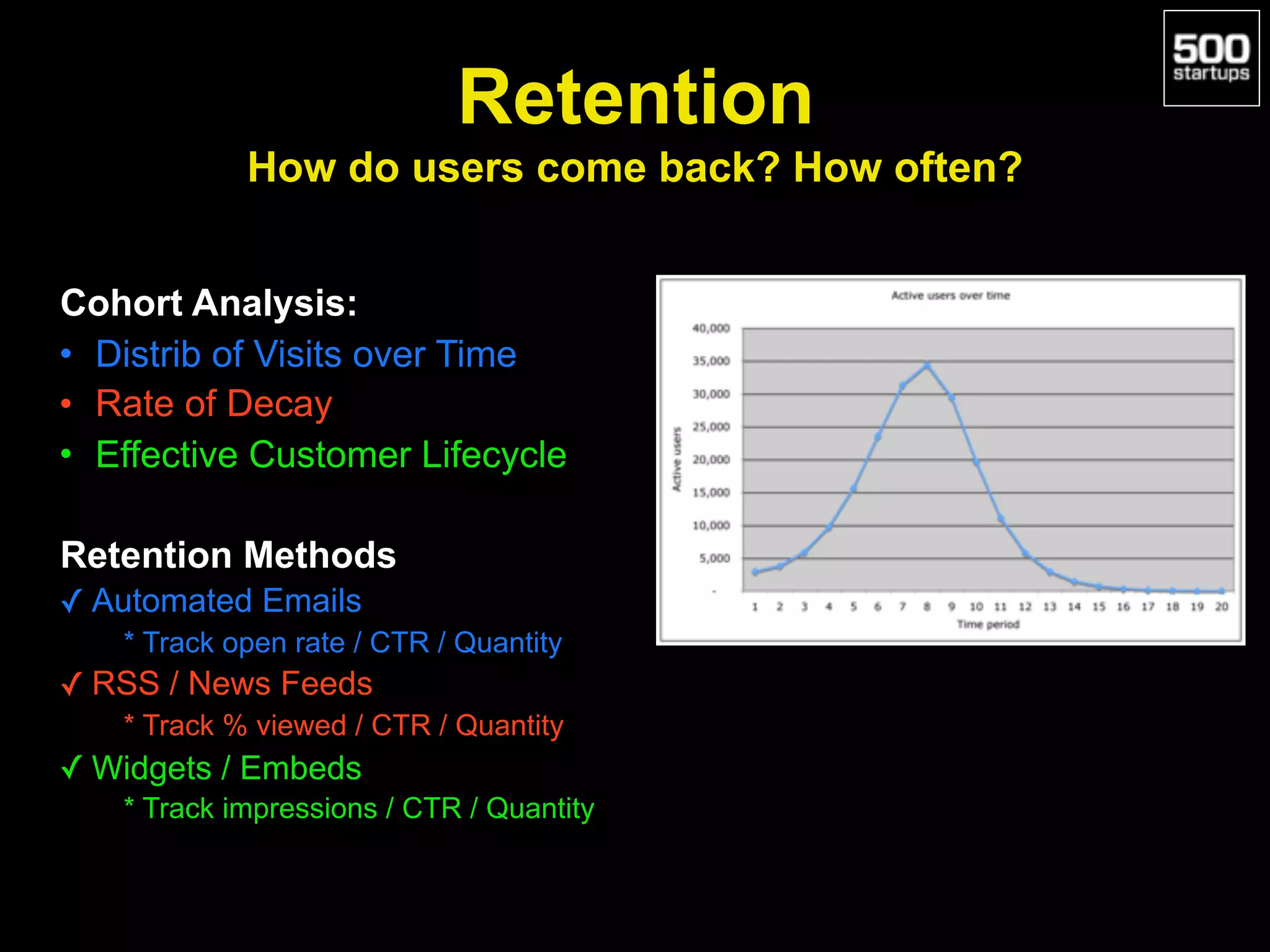
Cohort Analysis:
• Distrib of Visits over Time
• Rate of Decay
• Effective Customer Lifecycle
Retention Methods
✓ Automated Emails
* Track open rate / CTR / Quantity
✓ RSS / News Feeds
* Track % viewed / CTR / Quantity
✓ Widgets / Embeds
* Track impressions / CTR / Quantity
Retention

How do users come back? How often?
Example Retention Goals
• 1 - 3+ visits per month
• 20% open rate / 2% CTR
• High deliverability / Low spam rating
• Long customer life cycle / Low decay
• Identify fanatics and cheerleaders
Retention Tips
• Email is simple and it works
• BUT make unsubscribe easy
• 80% subject line / 20% body text
• ACTUALLY 99% subject line / 1% body text
• Fanatics = virality + affiliate channel (bloggers?)
Retention

How do users come back? How often?
Retention

How do users come back? How often?
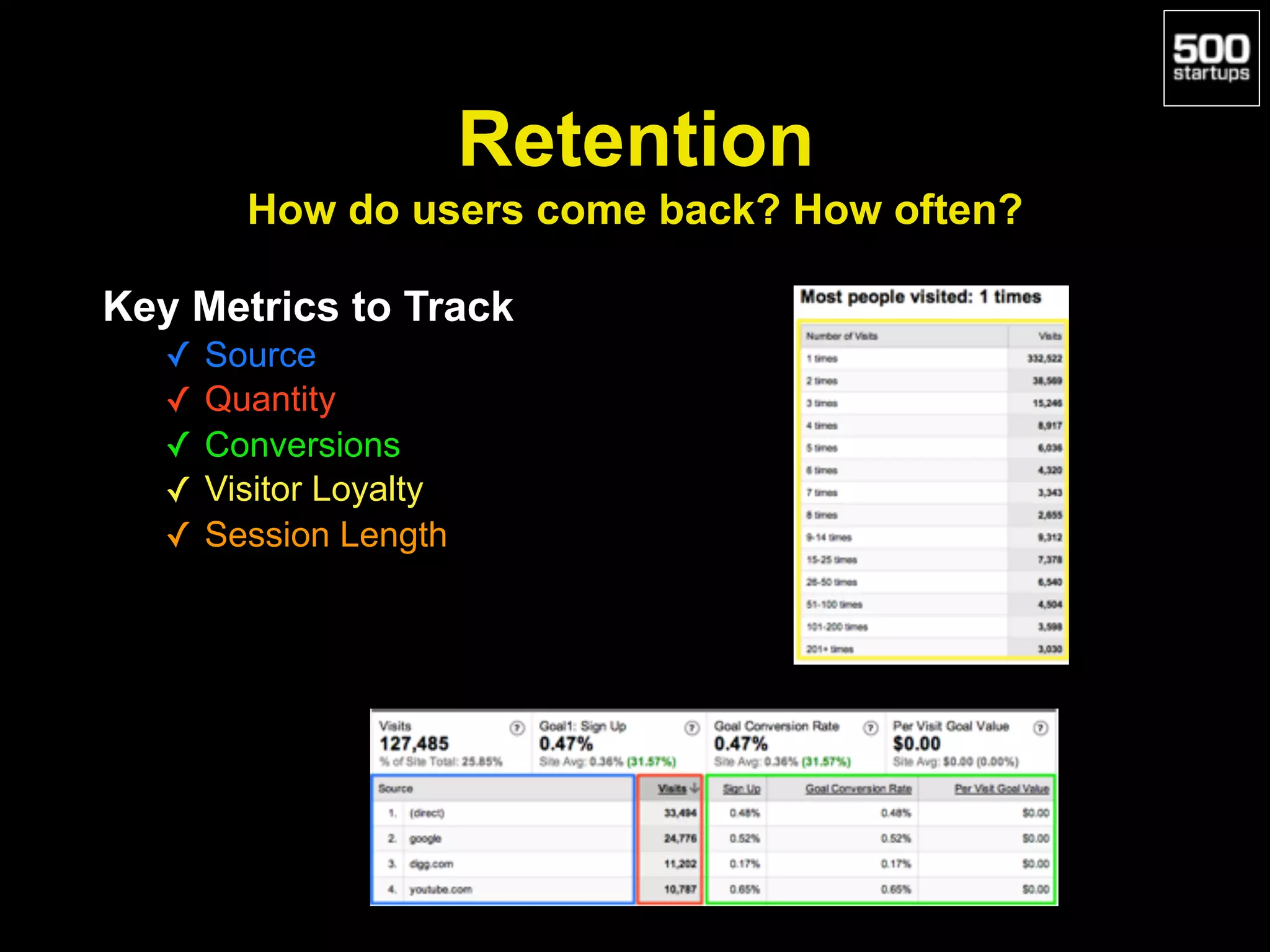
Key Metrics to Track
✓ Source
✓ Quantity
✓ Conversions
✓ Visitor Loyalty
✓ Session Length
Retention
Tools
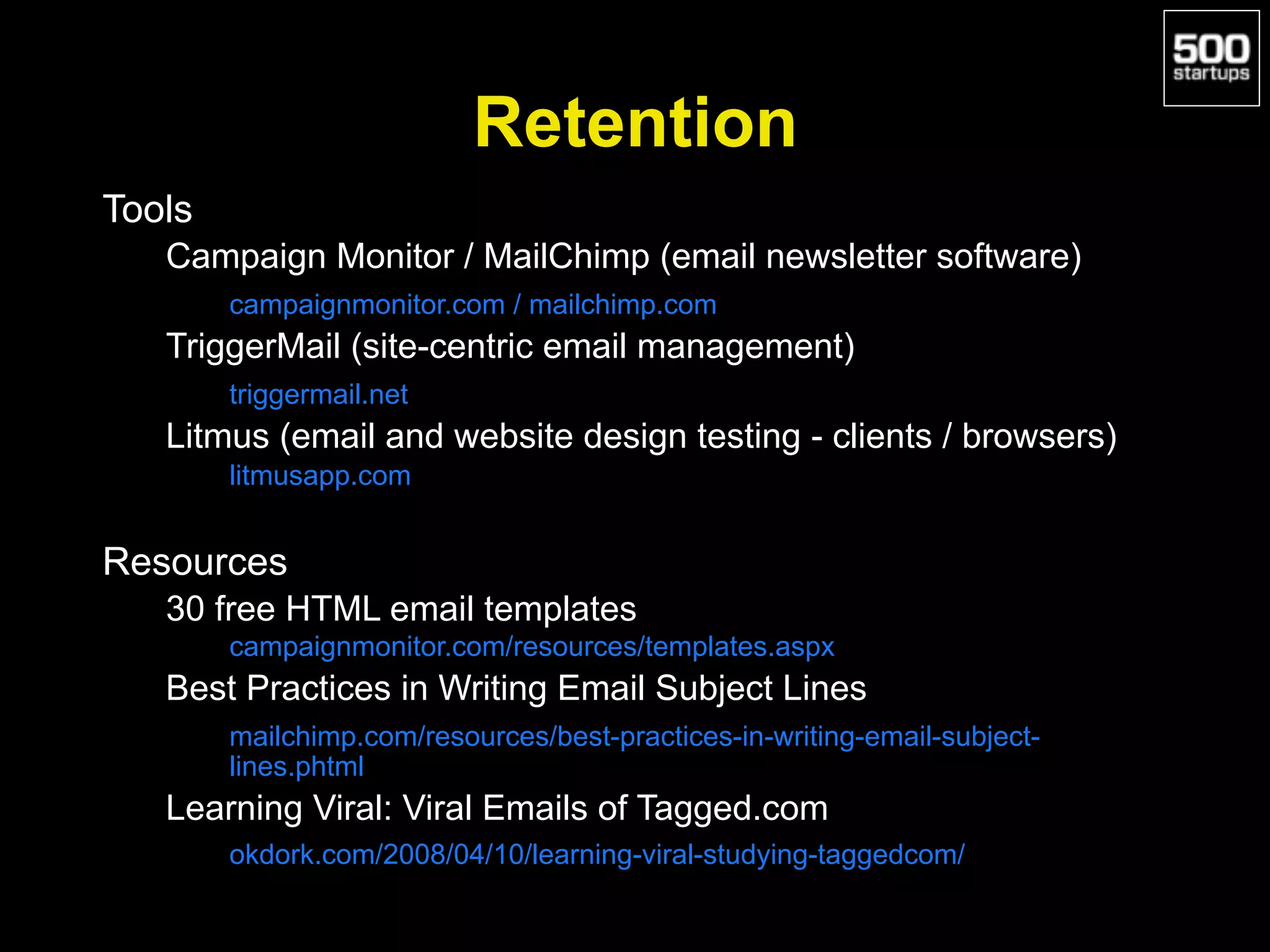
Campaign Monitor / MailChimp (email newsletter software)
campaignmonitor.com / mailchimp.com
TriggerMail (site-centric email management)
triggermail.net
Litmus (email and website design testing - clients / browsers)
litmusapp.com
Resources
30 free HTML email templates
campaignmonitor.com/resources/templates.aspx
Best Practices in Writing Email Subject Lines
mailchimp.com/resources/best-practices-in-writing-email-subject-
lines.phtml
Learning Viral: Viral Emails of Tagged.com
okdork.com/2008/04/10/learning-viral-studying-taggedcom/
Startup Metrics
Acquisition
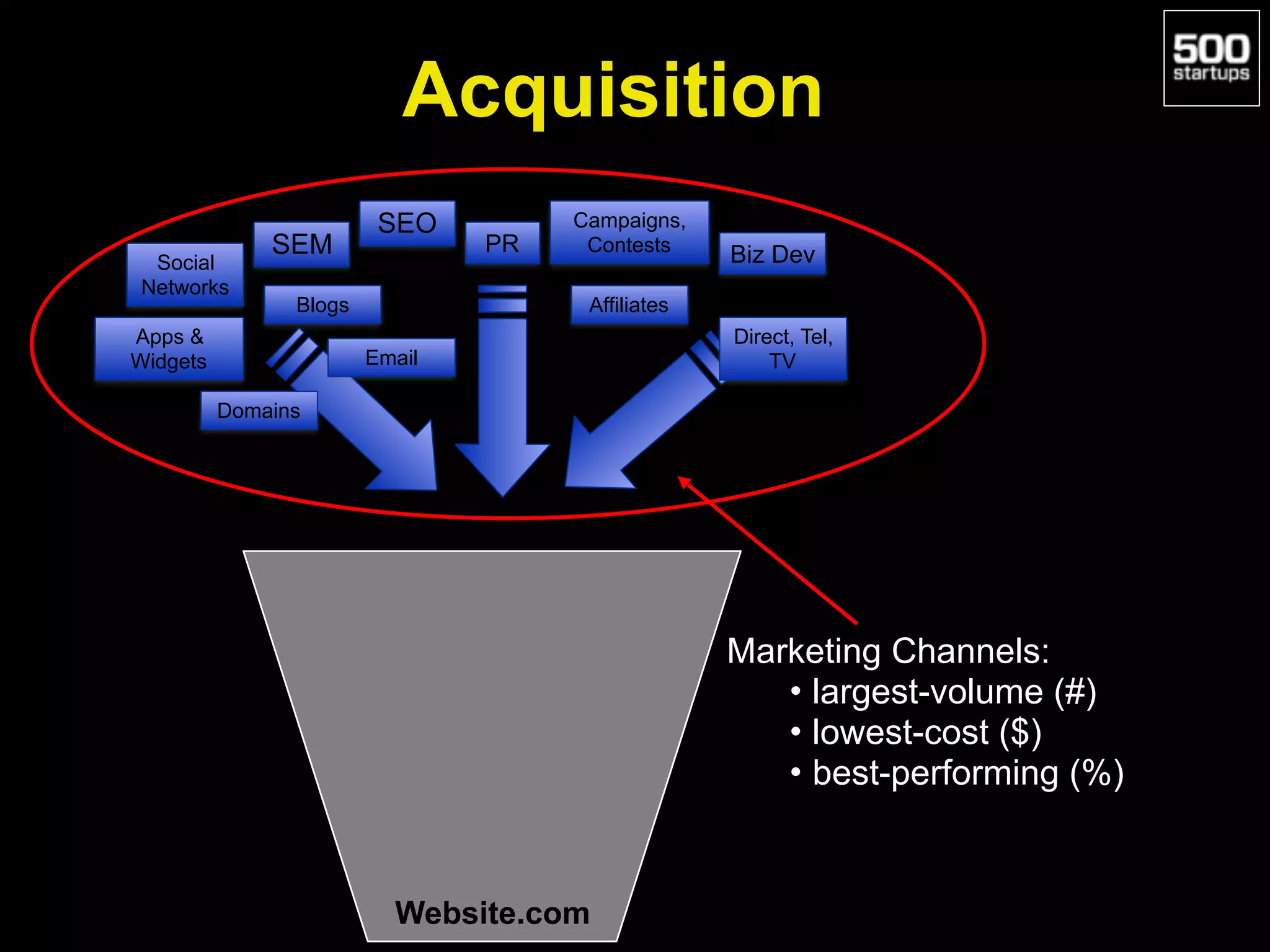
Website.com
Marketing Channels:
• largest-volume (#)
• lowest-cost ($)
• best-performing (%)
Acquisition
SEO
SEM
Apps &
Widgets
Affiliates
Email
PR Biz Dev
Campaigns,
Contests
Direct, Tel,
TV
Social
Networks
Blogs
Domains
Acquisition

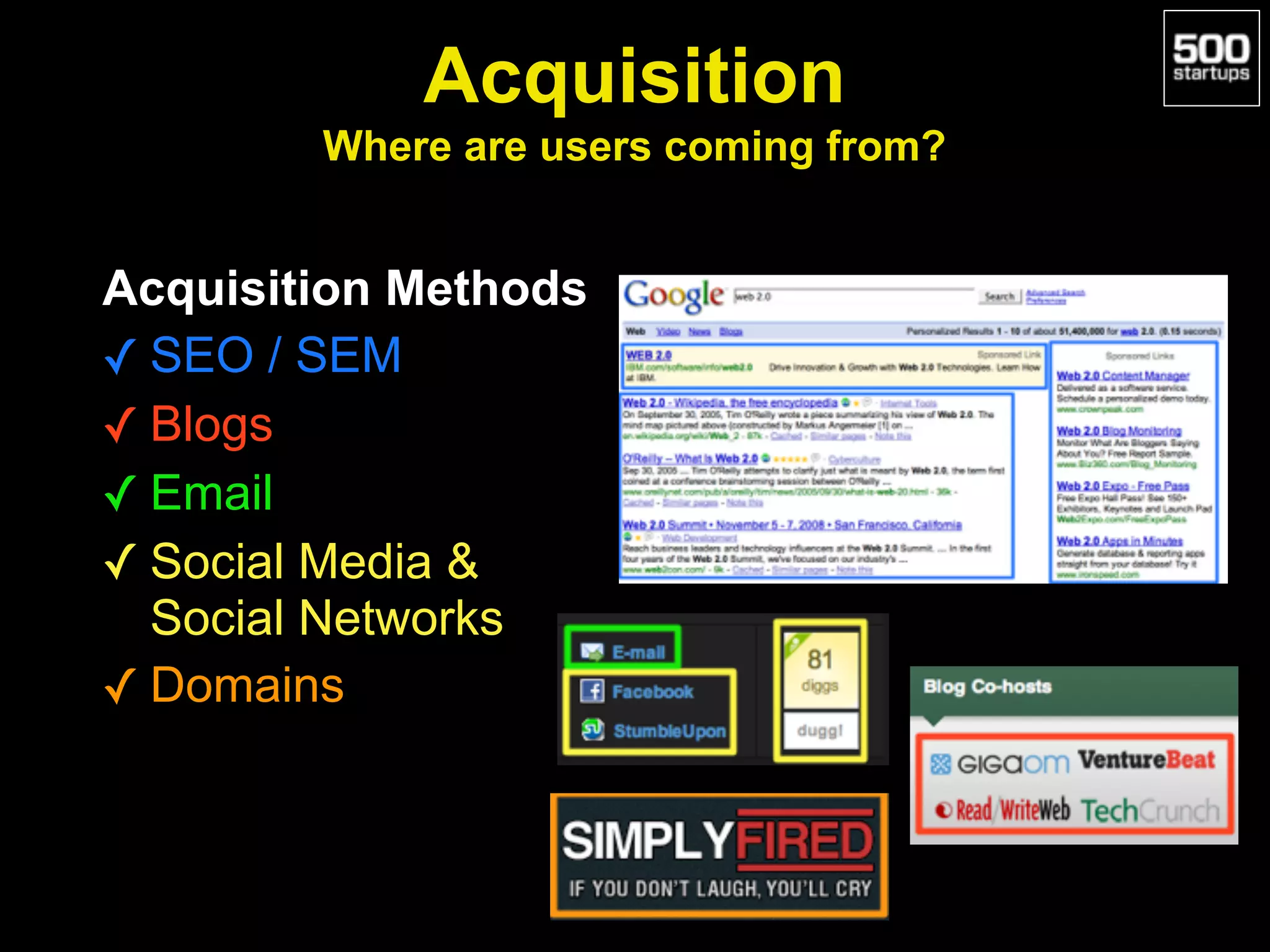
Where are users coming from?
Acquisition Methods
✓ SEO / SEM
✓ Blogs
✓ Email
✓ Social Media &
Social Networks
✓ Domains
Acquisition

Keyword Vocabulary
Top 10 - 100 words
• Your Brand / Products
• Customer Needs / Benefits
• Competitor’s Brand / Products
• Semantic Equivalents
• Misspellings
Things to analyze
• Sources
• Volume
• Cost
• Conversion
Acquisition

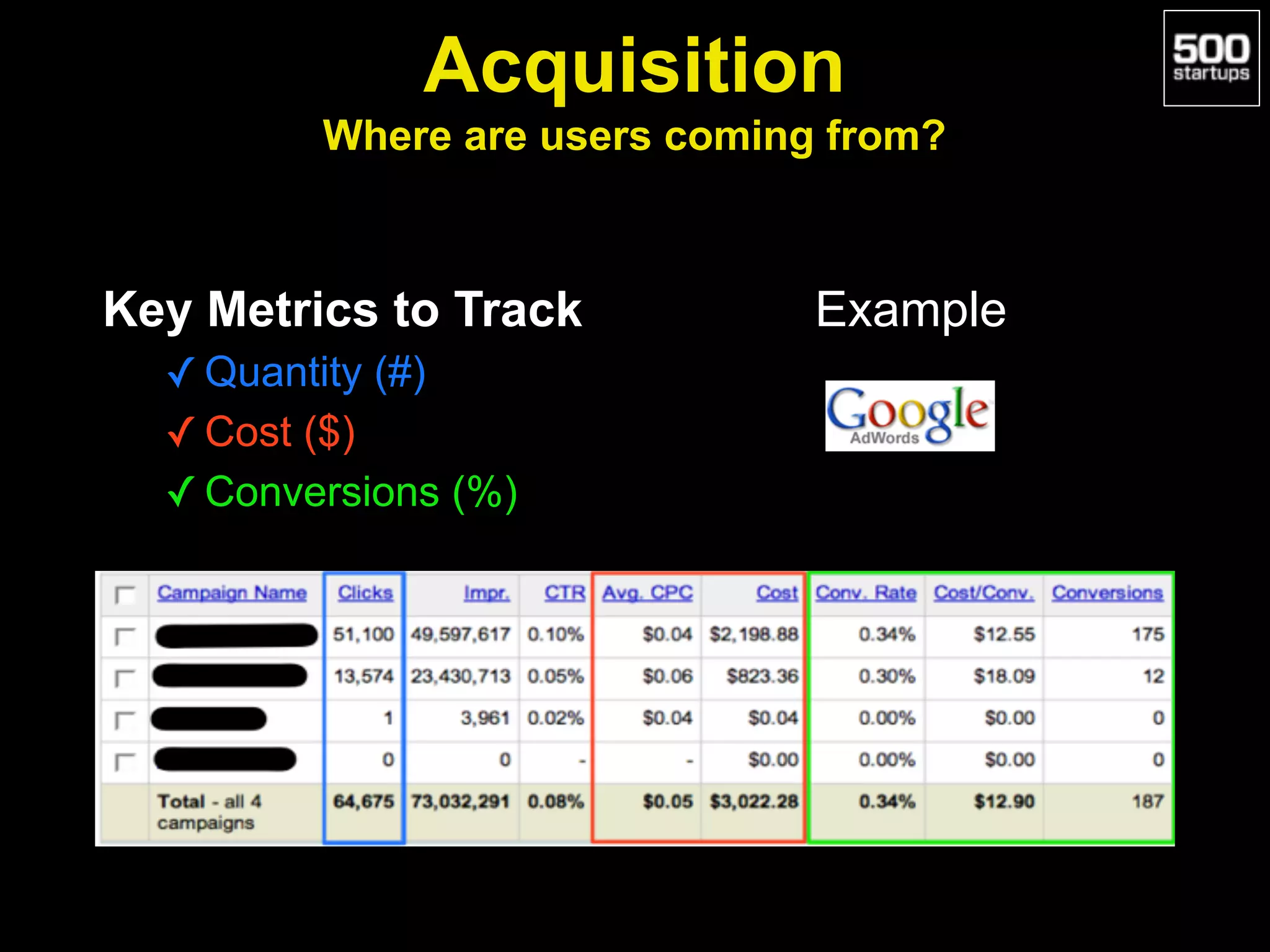
Where are users coming from?
Key Metrics to Track
✓ Quantity (#)
✓ Cost ($)
✓ Conversions (%)
Example
Acquisition
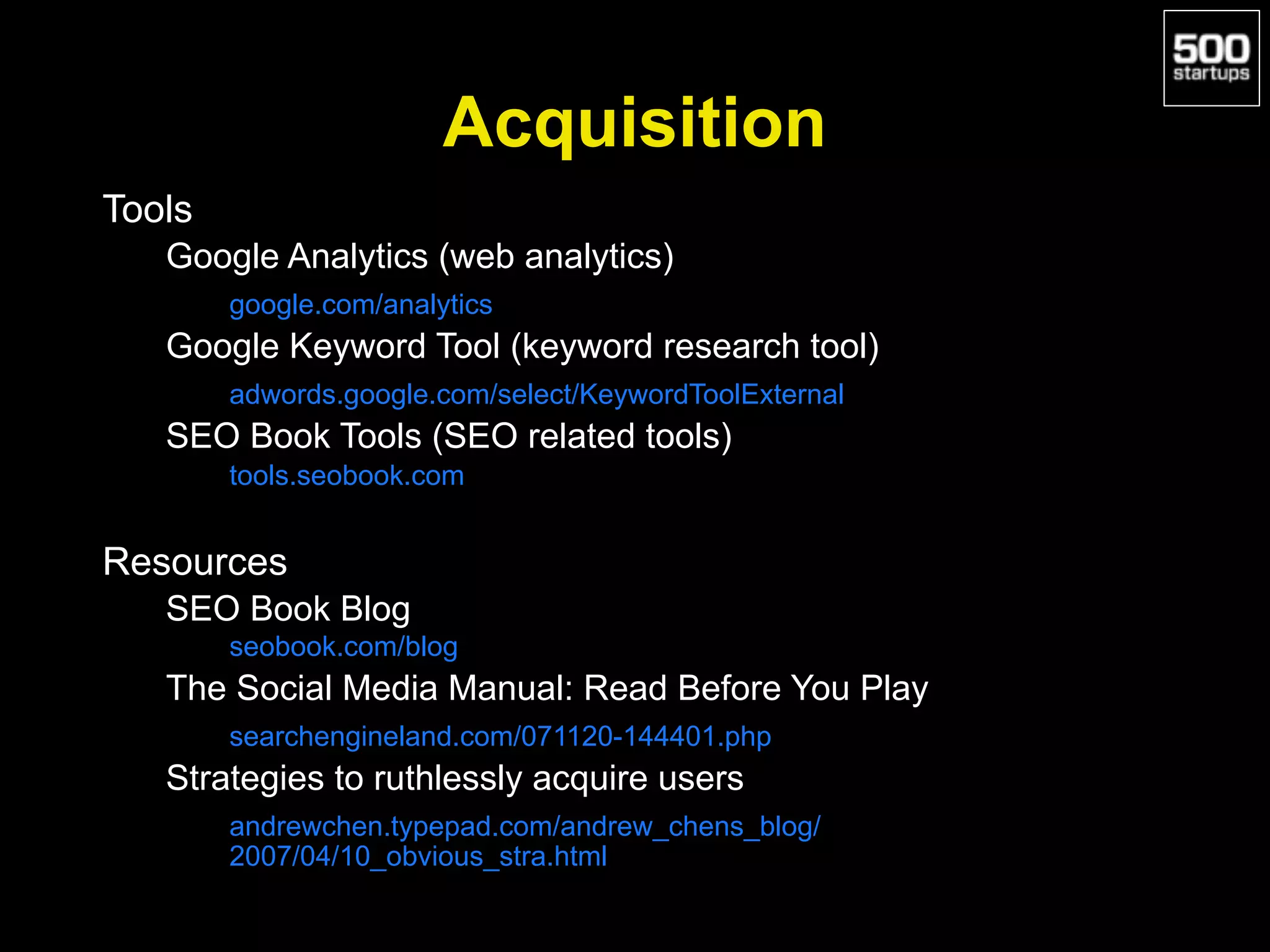
Tools
Google Analytics (web analytics)
google.com/analytics
Google Keyword Tool (keyword research tool)
adwords.google.com/select/KeywordToolExternal
SEO Book Tools (SEO related tools)
tools.seobook.com
Resources
SEO Book Blog
seobook.com/blog
The Social Media Manual: Read Before You Play
searchengineland.com/071120-144401.php
Strategies to ruthlessly acquire users
andrewchen.typepad.com/andrew_chens_blog/
2007/04/10_obvious_stra.html
Startup Metrics
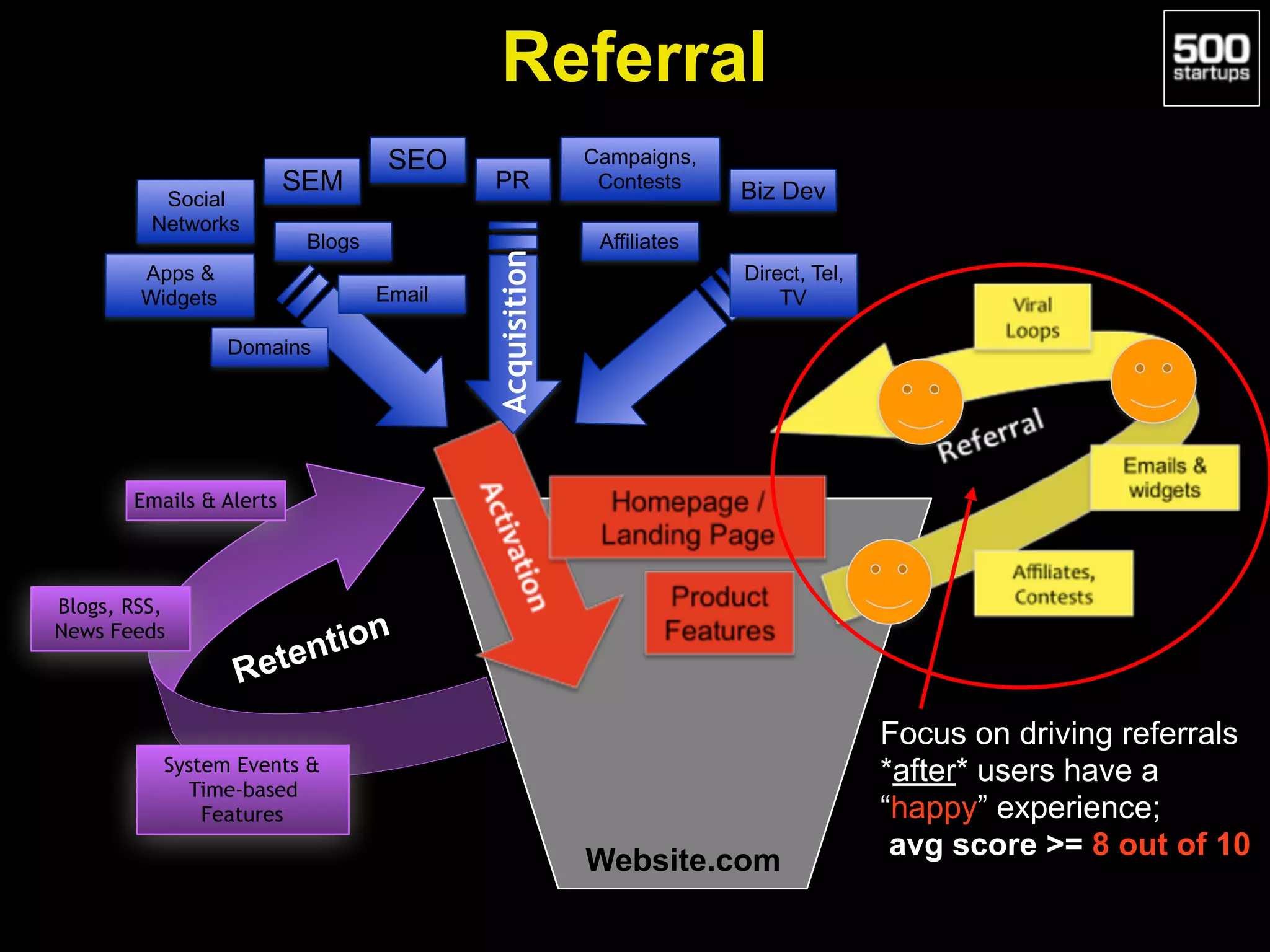
Referral
Website.com
Acquisition
SEO
SEM
Apps &
Widgets
Affiliates
Email
PR Biz Dev
Campaigns,
Contests
Direct, Tel,
TV
Social
Networks
Blogs
Domains
Retention
Emails & Alerts
System Events &
Time-based
Features
Blogs, RSS,
News Feeds
Focus on driving referrals
*after* users have a
“happy” experience;
avg score >= 8 out of 10
Referral
Referral

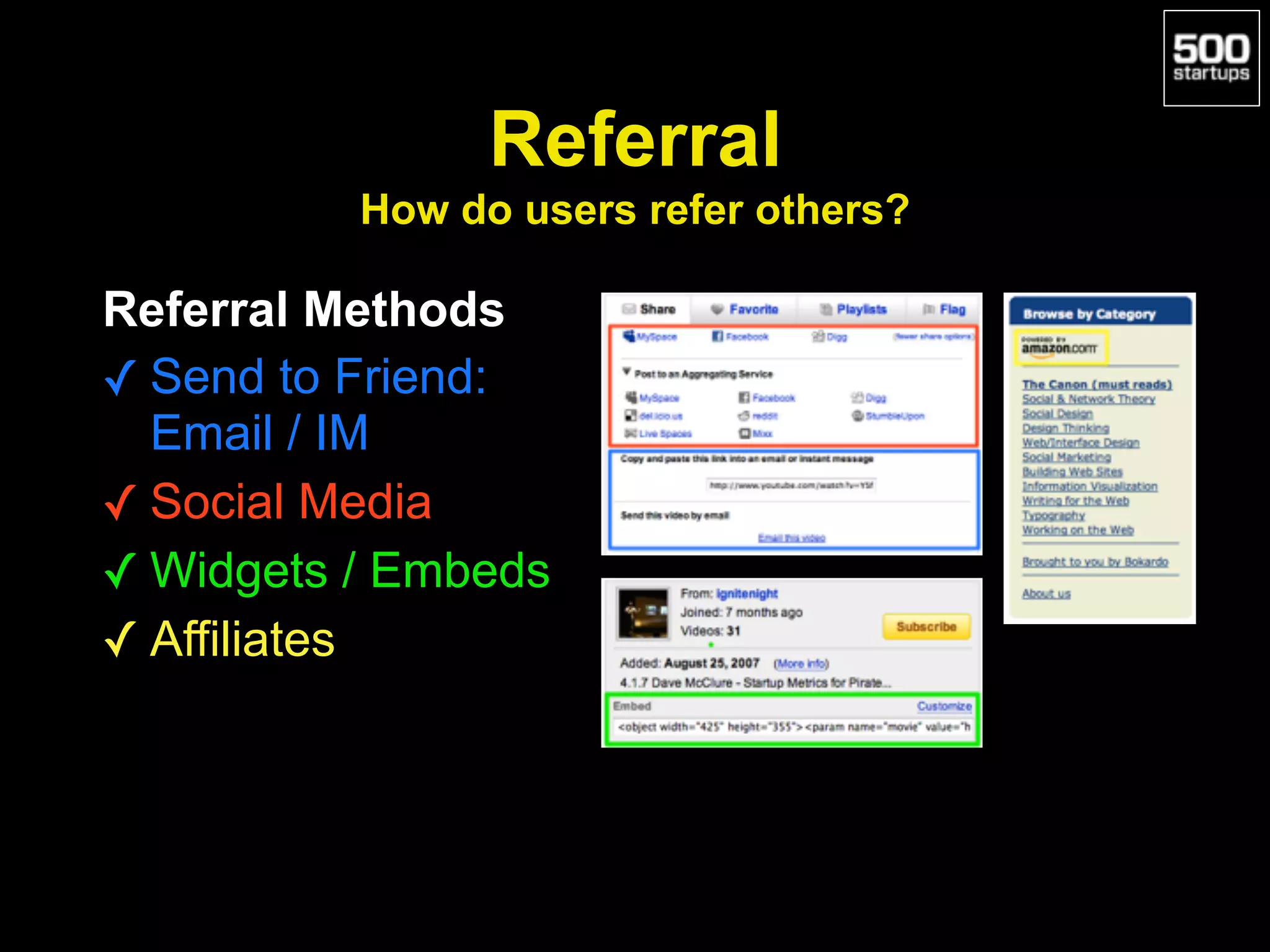
How do users refer others?
Referral Methods
✓ Send to Friend:
Email / IM
✓ Social Media
✓ Widgets / Embeds
✓ Affiliates
Referral

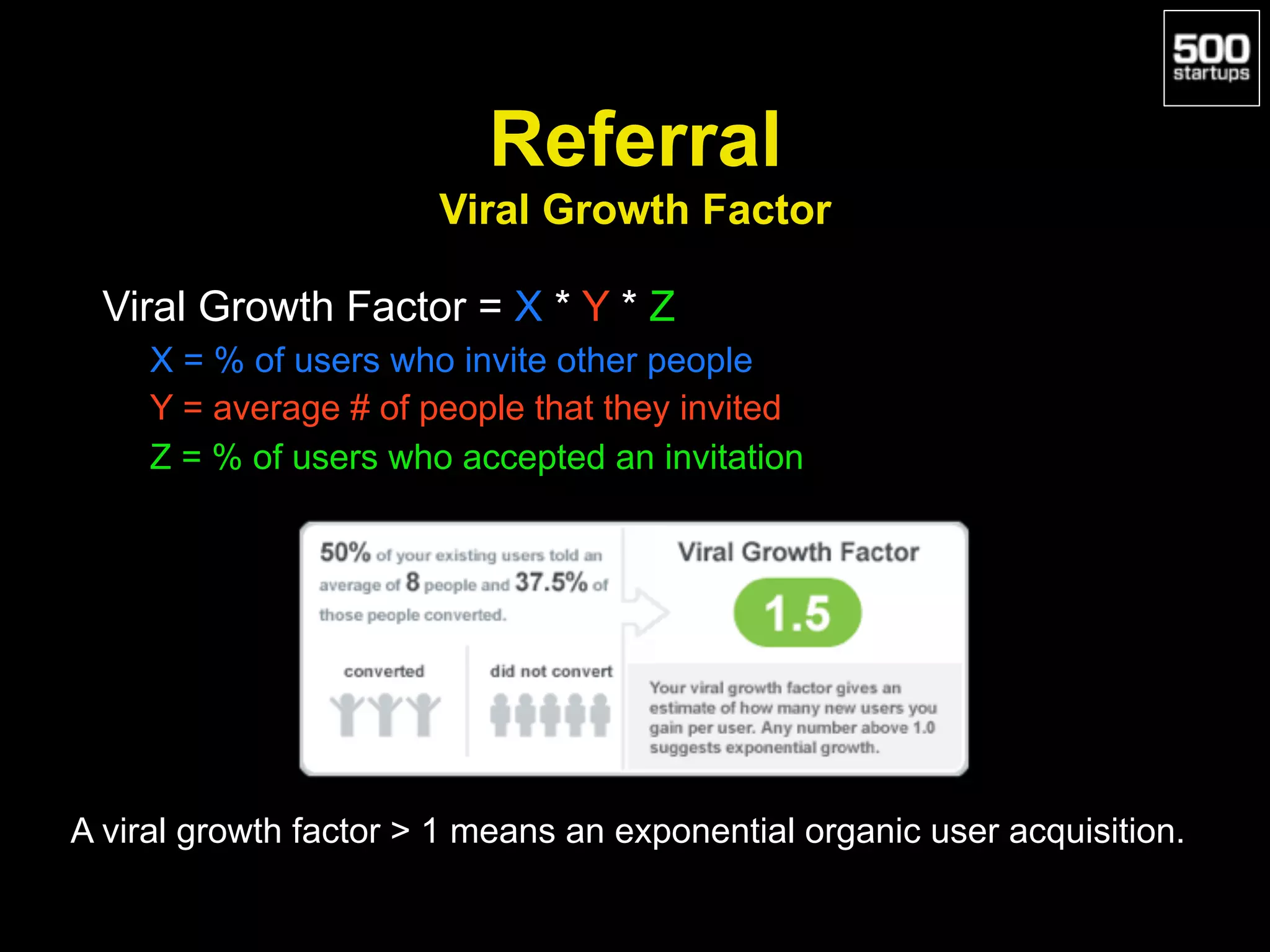
Viral Growth Factor
Viral Growth Factor = X * Y * Z
X = % of users who invite other people
Y = average # of people that they invited
Z = % of users who accepted an invitation
A viral growth factor > 1 means an exponential organic user acquisition.
Referral
Tools
Gigya (social media distribution & tracking tool)
gigya.com
ShareThis / AddThis (sharing buttons)
sharethis.com / addthis.com
GetMyContacts (PHP contacts importing & invitation software)
getmycontacts.com
Resources
Seven Ways to GO VIRAL
lsvp.wordpress.com/2007/03/02/seven-ways-to-go-viral/
What’s your viral loop? Understanding the engine of adoption
andrewchen.typepad.com/andrew_chens_blog/2007/07/whats-your-
vira.html
Metrics: Where Users Come From
slideshare.net/guest2968b8/rockyou-snap-summit-32508
Startup Metrics
Revenue
Website.com
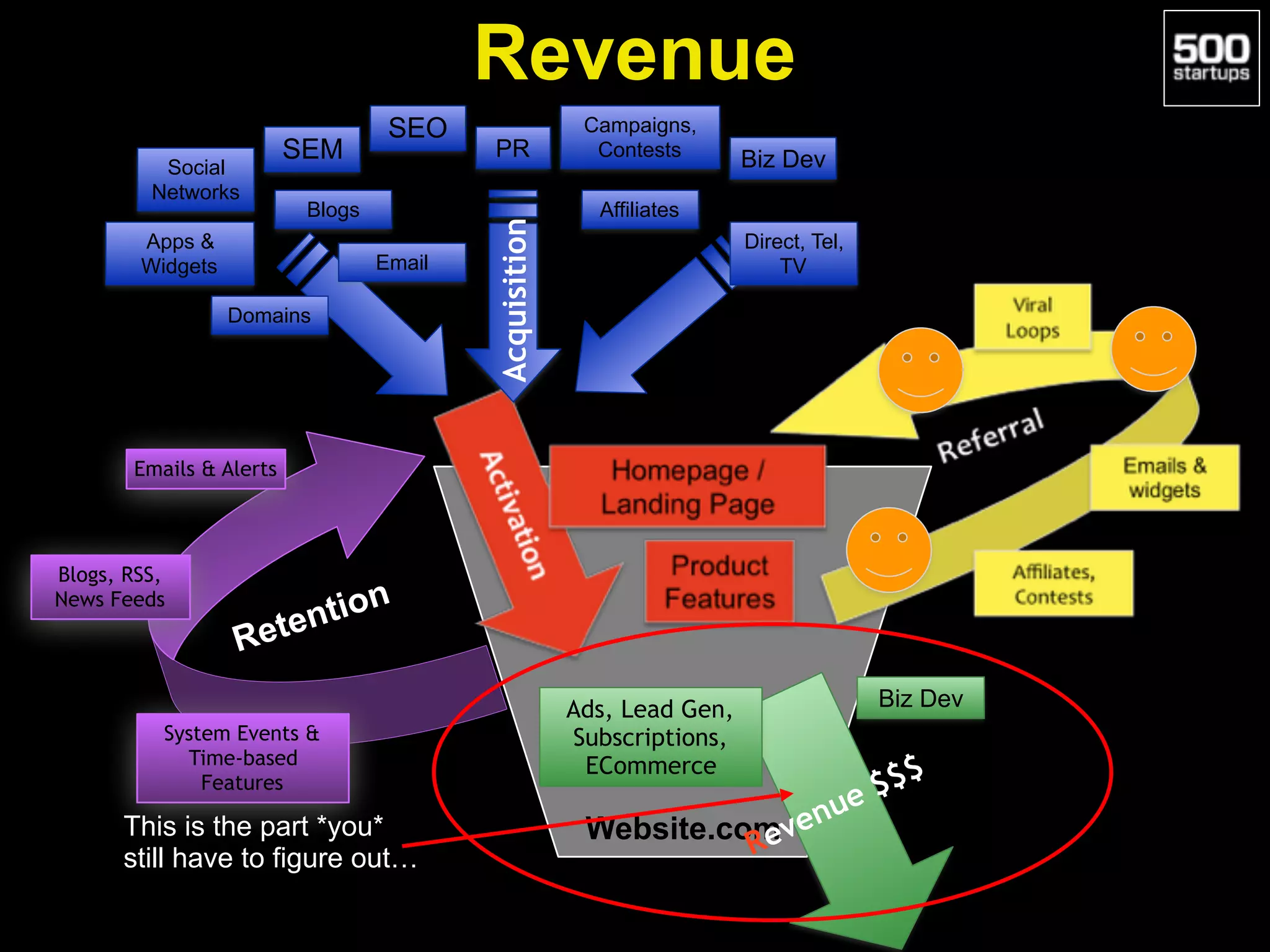
Revenue $$$
Biz DevAds, Lead Gen,
Subscriptions,
ECommerce
Acquisition
SEO
SEM
Apps &
Widgets
Affiliates
Email
PR Biz Dev
Campaigns,
Contests
Direct, Tel,
TV
Social
Networks
Blogs
Domains
Retention
Emails & Alerts
System Events &
Time-based
Features
Blogs, RSS,
News Feeds
Revenue
This is the part *you*
still have to figure out…
Revenue

How do you make money?
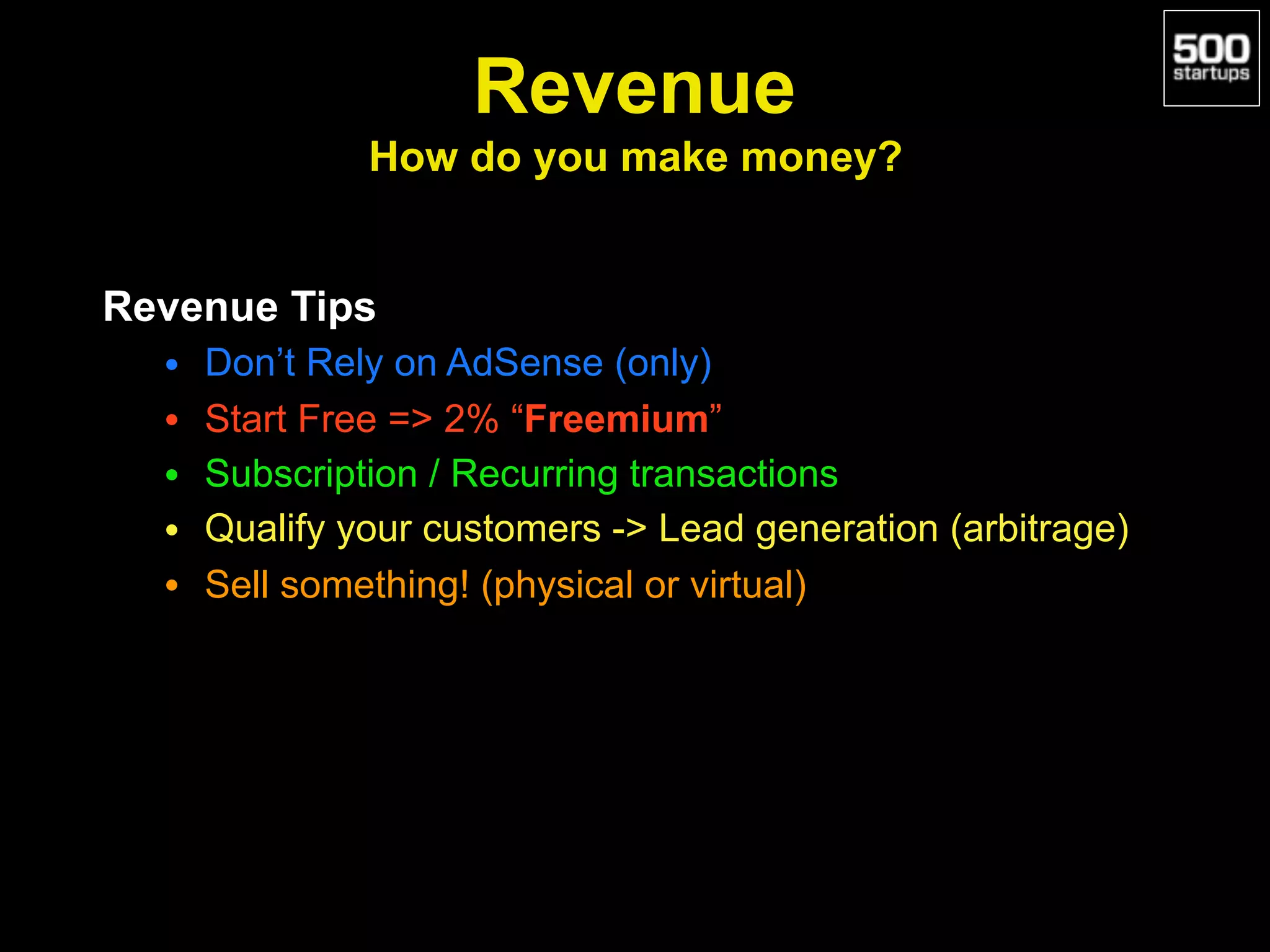
Revenue Tips
• Don’t Rely on AdSense (only)
• Start Free => 2% “Freemium”
• Subscription / Recurring transactions
• Qualify your customers -> Lead generation (arbitrage)
• Sell something! (physical or virtual)
Revenue
Resources & Tools
Revenue Metrics (Andrew Chen)
http://tinyurl.com/47r63a
How to Create a Profitable “Freemium” Startup (Andrew Chen)
http://tinyurl.com/8z9ygk
2008 Affiliate Marketing Review (Scott Jangro)
http://tinyurl.com/86wak4


Links & Resources
Additional References:
• Influence: The Psychology of Persuasion Robert Cialdini (book)
• The Mating Mind Geoffrey Miller (book)
• Putting the Fun in Functional Amy Jo Kim (etech 2006 preso)
• Futuristic Play Andrew Chen (blog)
• Don’t Make Me Think Steve Krug (book)
• Designing for the Social Web Joshua Porter (book, website)
• Startup Lessons Learned Eric Ries (blog)
• Customer Development Methodology Steve Blank (presentation, blog)
• Startup-Marketing.com Sean Ellis (blog)
• Understanding Comics Scott McCloud (book)

Startup Metrics for Pirates (Nov 2015, Platzi)

  • 1.
    Startup Metrics forPirates @DaveMcClure Founding Partner, 500 Startups http://500.co http://500hats.com http://slideshare.net/dmc500hats AARRR!
  • 2.
    Dave McClure
 Founding Partner& Troublemaker, 500 Startups 00’s & 10’s: • VC: Founders Fund, Facebook fbFund, 500 Startups • Angel: Mashery, Mint.com, SlideShare, Twilio • Marketing: PayPal, Simply Hired, Mint.com, O’Reilly 80’s & 90’s: • Entrepreneur: Aslan Computing (acq’d by Servinet/Panurgy) • Developer: Windows / SQL DB consultant (Intel, MSFT) • Engineer: Johns Hopkins‘88, BS Eng / Applied Math
  • 3.
    • What is500? – $200M under management – 100+ people / 30 investing partners / 18 Countries – 2500+ Founders / 250+ Mentors • 1300+ Portfolio Co’s / 50+ Countries – Wildfire (acq GOOG, $350M) – MakerBot (acq SSYS, $400M) – Viki (acq Rakuten, $200M) – Simple (acq BBVA, $117M) – Credit Karma (~$3.5B) – GrabTaxi ($1B+) – Twilio ($1B+) – Ipsy – SendGrid – VivaReal – Udemy – Zozi – The RealReal – Virool – BarkBox – Tradesy 500 Startups
 Global Seed Fund & Startup Accelerator
  • 4.
  • 5.
    Topics • Basic Conceptsof “Startup Metrics 4 Pirates” • 3 Steps to AARRR: Product, Market, Revenue • Constructing MVP: Just ONE Feature? • Design (UX) & Distribution (MKTG) • Winning = Users, Revenue, Profit?
  • 6.
    Lean Startup:
 Simpler, Faster,Cheaper, Smarter 1. Startup Costs = Lower. 2. # Users, Bandwidth = More. 3. Transaction $$$ = Better. Building Product => Cheaper, Faster, Better Getting Customers => Easier, More Measurable Iterative Product & Marketing Decisions based on Measured User Behavior
  • 7.
    Platforms 2.0
 Search, Social,Mobile, Video, Messaging
  • 8.
    Changes in TechStartups • LESS Capital required to build product, get to market – Dramatically reduced $$$ on servers, software, bandwidth – Crowdfunding, KickStarter, Angel List, Funders Club, etc – Cheap access to online platforms for 100M+ consumers, smallbiz, etc • MORE Customers via ONLINE platforms (100M+ users) – Search (Google, Baidu) – Social (Facebook, Twitter, LinkedIn) – Mobile (Apple, Android) – ECom (Amazon, Alibaba, eBay/PayPal) – Media (YouTube, Pinterest, Instagram) – Comm (Email, IM/Chat, Voice, SMS, etc) • LOTS of little bets: Accelerators, Angels, Angel List, Small Exits – Y Combinator, TechStars, 500 Startups – Funding + Co-working + Mentoring -> Design, Data, Distribution – “Fast, Cheap Fail”, network effects, quantitative + iterative investments
  • 9.
    DO Marketing! 
 (It’sNot Evil) • Marketing is Both Qualitative + Quantitative • Qualitative: Create Emotion, Drive Action • Quantitative: Measure Results of Action • Design (UX) & Distribution (MKTG) Matter • Volume (#), Cost ($), Conversion (%)
  • 10.
  • 11.
    Just Gimme theGOOD Metrics. Users, Pages, Clicks, Emails, $$$...? Q: Which of these is best? How do you know? • 1,000,000 one-time, unregistered unique visitors • 500,000 visitors who view 2+ pages / stay 10+ sec • 200,000 visitors who clicked on a link or button • 20,000 registered users w/ email address • 2,000 passionate fans who refer 5+ users / mo. • 1,000 monthly subscribers @ $5/mo the good stuff.
  • 12.
    Lean Startup ->Startup Metrics • Talk to Customers; Discover Problems • Progress ≠ Features (Less = More) • Fast, Frequent Iteration (+ Feedback Loop) • Focus on Product/Market Fit • Measure Conversion (compare 2+ alternatives) • Track Metrics that are Simple & Actionable
  • 13.
  • 14.
  • 15.
    AARRR!: Startup MetricsModel Website.com Revenue $$$ Biz DevAds, Lead Gen, Subscriptions, ECommerce ACQUISITION SEO SEM Apps & Widgets Affiliates Email PR Biz Dev Campaigns, Contests Direct, Tel, TV Social Networks Blogs Domains Retention Emails & Alerts System Events & Time-based Features Blogs, RSS, News Feeds
  • 16.
    Startup Metrics forPirates • Acquisition: users come to site from various channels • Activation: users enjoy 1st visit: "happy” experience • Retention: users come back, visit site multiple times • Referral: users like product enough to refer others • Revenue: users conduct some monetization behavior AARRR! (note: If you’re in a hurry, Google “Startup Metrics” & watch 5m video)
  • 17.
    One Step ata Time. 1. Make a Good Product: Activation & Retention 2. Market the Product: Acquisition & Referral 3. Make Money: Revenue & Profitability
  • 18.
    Startup Challenges Startups haveproblems in 3 key areas: • Management: Set Priorities, Define Key Metrics • Product: Build “Right” Features. Measure, Iterate. • Marketing: Distribution, Distribution, Distribution. (Search, Social, Mobile)
  • 19.
  • 20.
    Role: Founder /CEO Q: Which Customers? Problems? Metrics? A: Focus on Critical Few Actionable Metrics (if you don’t use the metric to make a decision, it’s not actionable) • Hypothesize Customer Lifecycle • Target ~3-5 Conversion Events • Test, Measure, Iterate to Improve
  • 21.
    Optimize 4 Happiness
 (both User + Business) • Define States of User + Business Value • Prioritize (Estimate) Relative Value of Each State • Move Users: Lower Value -> Higher Value • Optimize for User Happiness + Business $$$ • Achieve High Cust Value + Low ACQ$ @ Scale
  • 22.
    What is MinimumViable Product ? MVP = F(Customer, Problem, Time or $$$) • Focus on CUSTOMER – Qualitative Discovery, Quantitative Validation • Get to know habits, problems, desires (FUN MATTERS) – what causes pain? what causes pleasure? • Ship the simplest, fastest solution that solves the problem; better or cheaper or faster than the available competition. • Define 1-5 TESTABLE Conversion Metrics of Value – Attention/Usage (session time, clicks) – Customer Profle Data (email, connect, profile) - Revenue (direct or indirect) - Retention (visits over time, cohort behavior) - Referral (users evangelize to other users)
  • 23.
    Example Conversion Metrics
 (note:*not* actuals… your mileage may vary) Stage Conversion Status Conv. % Est. Value (*not* cost) Acquisition Visitors -> Site/Widget/Landing Page (2+ pages, 10+ sec, 1+ clicks = don’t abandon) 60% $.05 Activation “Happy” 1st Visit; Usage/Signup (clicks/time/pages, email/profile reg, feature usage) 15% $.25 Retention Users Come Back; Multiple Visits (1-3x visits/mo; email/feed open rate / CTR) 5% $1 Referral Users Refer Others (cust sat >=8; viral K factor > 1; ) 1% $5 Revenue Users Pay / Generate $$$ (first txn, break-even, target profitability) 2% $50
  • 24.
  • 25.
    Role: Product /Eng / Design Q: What Features to Build? Why? When are you “Done”? A: Easy-to-Find, Fun/Useful, Unique Features that Increase Conversion (stop iterating when increase decelerates) • Wireframes = Conversion Steps • Measure, A/B Test, Iterate FAST (daily/weekly) • Optimize for Conversion Improvement – 80% on existing feature optimization – 20% on new feature development
  • 26.
    What is Product/MarketFit ? PMF = F(Customer, Solution, Alternatives*) • Product / Market Fit occurs when: – Customers like your stuff better than other options – Not static, Not optimal – just Local Max F(customers, solution, time) – make sure you’re moving in optimal direction 2 local max • Q: what competitive solutions are available? – … that your customers know about? – how are you diff/same? – in ways that people care about? (will pay for)
  • 27.
  • 28.
    Discover Meaning
 Why ShouldUsers CARE About Your Product? Kathy Sierra: “Creating Passionate Users”
  • 29.
    Discover Meaning
 Keywords, Images,Call-to-Action Top 10 - 100 words • Your Brand / Products • Customer Needs / Benefits • Competitor’s Brand / Products • Semantic Equivalents • Misspellings Relevant images • People • Products • Problems • Solutions Call-to-Action • Words • Images • Context • Button/Link • Emotion Result • Positive? • Negative? • Neutral (= Death) • A/B test & Iterate
  • 30.
    How To Tellif Design/UX is Good? AUX = F(Customer, Design/UX, Metrics) • If Users Use Your Product Then It’s GOOD. – Define Metrics, Measurability for Design / UX – Focus on Psychology of User – Relative to Competitive Alternatives (that your customers know about) – Keep Testing 4 Awesomeness • RAMP Mktg & $$$ AFTER it’s clear your MVP is: – Functional = useful for >1 customers – Awesome (enough, see above) – Differentiated = better than other stuff availabile
  • 31.
  • 32.
    Role: Marketing /Sales Q: What channels? Which users? Why? A: High Volume (#), Low Cost ($), High Conv (%) • Design & Test Multiple Marketing Channels + Campaigns • Seek out channels with positive unit economics, scalability • Select & Focus on Best-Performing Channels & Themes • Optimize for conversion to target CTAs, not just site/landing page • Match/Drive channel cost to/below revenue potential • Low-Hanging Fruit: – Blogs – SEO/SEM – Landing Pages – Automated Emails
  • 33.
    Distribution Platforms Customer Reach:100M-1B+ • Search: Google, Baidu, Yahoo/Bing, Yandex • Social: Facebook, Twitter, LinkedIn, TenCent/QQ, WeChat • Mobile: Apple (iOS), Android • Media: Video (YouTube), Photos (Instagram, Pinterest), Blogs • Comm: SMS, IM (WeChat, WhatsApp), Skype, Phone/Voice, etc
  • 34.
    MAARRRketing Plan Marketing Plan= Target Customer Acquisition Channels • 3 Important Factors = Volume (#), Cost ($), Conversion (%) • Measure conversion to target customer actions • Test audience segments, campaign themes, Call-To-Action (CTAs) [Gradually] Match Channel Costs => Revenue Potential • Increase Vol. & Conversion, Decrease Cost, Optimize for Revenue Potential • Avg Txn Value (ATV), Ann Rev Per User (ARPU), Cust Lifetime Value (CLV) • Design channels that (eventually) cost <20-50% of target ATV, ARPU, CLV Consider Costs, Scarce Resource Tradeoffs • Actual $ expenses • Marketing time & resources • Product/Engineering time & resources • Cashflow timing of expense vs. revenue, profit ACQ = F(Customer, Campaign, Vol, Cost, Conv)
  • 35.
    [ What isWINNING? ]
  • 36.
    Choose #WINNING Metrics WIN= F(Customer, Usage, Dist, Revenue) • after MVP functional use, several options: – better Usage – Activation & Retention (AUX) – more Users -- Distribution / Acquisition – more Money --- Monetization – more Profit — Margin • understand ACQ$ vs REV$, optimize 4 short-term – higher volume usually a priority – costs may change as volume increases
  • 37.
    [ The LeanInvestor ]
  • 38.
    Startup 2.0: 
 “LeanInvestor” Model Method: Invest in startups using incremental investment, iterative development. Start with lots of small experiments, filter out failure, and expand investment upon success. • Incubator: $0-100K (“Product Viability”) • Seed: $100K-$2M (“Expand Distribution”) • Venture: $1M-$10M (“Maximize Revenue”)
  • 39.
    Investment #1: Incubate
 (“Product”) •Structure – 1-3 founders – $0-$100K investment – Incubator environment: multiple peers, mentors/advisors • Build Functional Prototype / “Minimum Viable Product” (MVP): – Concept->Alpha, ~3-6 months – Develop Minimal Critical Feature Set => Get to “It Works” – Instrument Basic Dashboard, Conversion Metrics – Test Cust. Adoption (10-1000 users) / Cust. Satisfaction (Scale: 1-10) • Demonstrate Concept, Reduce Product Risk, Test Functional Use • Develop Metrics & Filter for Follow-on Investment
  • 40.
    Investment #2: Seed
 (“Market”)•Structure – 2-5 person team – $100K-$2M investment – Syndicate of Angel Investors / Small VC Funds • Improve Product, Expand Market, Test Revenue: – Alpha->Beta, ~6-12 months – Customer Sat ≥ 6 => Get to “Doesn’t Suck” – Setup A/B Testing Framework, Optimize Conversion – Test Marketing Campaigns, Cust Acqstn Channels • Prove Solution/Benefit, Assess Market Size • Test Channel Cost, Revenue Opportunity • Determine Org Structure, Key Hires
  • 41.
    Investment #3: Venture
 (“Revenue”) •Structure – 5-25 person team – $1M-$10M investment – VC Investors • Make Money, Get to Sustainability: – Beta->Production, 12-18 months – Customer Sat ≥ 8 => “It Rocks, I’ll Tell My Friends” – MktgPlan => Predictable Channels / Campaigns + Budget – Scalability & Infrastructure, Customer Service & Operations – Connect with Distribution Partners • Prove/Expand Market, Operationalize Business • Future Milestones: Profitable/Sustainable, Exit Options
  • 42.
    Q&A? Âť Questions? Âť Answers:$1 Âť Correct Answers: $10 Âť Stupid Look on my face: FREE!
  • 43.
    Appendix (note the followingslides are a bit old and i haven’t updated them in quite a while… sorry ;)
  • 44.
  • 45.
    Website.com Activation Criteria: • 10-30+seconds • 2-3+ page views • 3-5+ clicks • 1 key feature usage do LOTS of landing page & A/B tests – make lots of dumb guesses & iterate FAST SEO SEM Apps & Widgets Affiliates Email PR Biz Dev Campaigns, Contests Direct, Tel, TV Social Networks Blogs Domains Activation
  • 46.
    Activation
 What do usersdo on their first visit? Example Activation Goals • Click on something! • Account sign up / Emails • Referrals / Tell a friend • Widgets / Embeds • Low Bounce Rate Activation Tips • Less is more • Focus on user experience / usability • Provide incentives & call to actions • Test and iterate continuously
  • 47.
    Activation
 What do usersdo on their first visit? Key Metrics to Track ✓ Pages per visit ✓ Time on site ✓ Conversions
  • 48.
    Activation Tools Crazy Egg (VisualClick Mapping) http://crazyegg.com Google Website Optimizer (A/B & Multivariate Testing) http://google.com/websiteoptimizer Marketo.com (B2B Lead Generation Management) http://marketo.com Resources Experimentation and Testing: A Primer kaushik.net/avinash/2006/05/experimentation-and-testing-a-primer.html Landing Page Design Toolbox: 100 Tips & Tools http://tinyurl.com/326co6 Landing Page Tutorials & Case Studies http://www.copyblogger.com/landing-pages/ 101 Easy Easy to use Google Website Optimizer http://conversion-rate-experts.com/articles/101-google-website-optimizer-tips/
  • 49.
  • 50.
    Website.com SEO SEM Apps & Widgets Affiliates Email PR BizDev Campaigns, Contests Direct, Tel, TV Social Networks Blogs Domains Emails & Alerts System Events & Time-based Features Blogs, RSS, News Feeds Automated emails: • lifecycle emails @ +3, +7, +30d • status / “best of” weekly/monthly • “something happened” emails BUT: • make it easy to unsubscribe Tip on emails: • > 80% or more on SUBJECT LINE • < 20% or less on BODY TEXT Retention
  • 51.
    Cohort Analysis: • Distribof Visits over Time • Rate of Decay • Effective Customer Lifecycle Retention Methods ✓ Automated Emails * Track open rate / CTR / Quantity ✓ RSS / News Feeds * Track % viewed / CTR / Quantity ✓ Widgets / Embeds * Track impressions / CTR / Quantity Retention
 How do users come back? How often?
  • 52.
    Example Retention Goals •1 - 3+ visits per month • 20% open rate / 2% CTR • High deliverability / Low spam rating • Long customer life cycle / Low decay • Identify fanatics and cheerleaders Retention Tips • Email is simple and it works • BUT make unsubscribe easy • 80% subject line / 20% body text • ACTUALLY 99% subject line / 1% body text • Fanatics = virality + affiliate channel (bloggers?) Retention
 How do users come back? How often?
  • 53.
    Retention
 How do userscome back? How often? Key Metrics to Track ✓ Source ✓ Quantity ✓ Conversions ✓ Visitor Loyalty ✓ Session Length
  • 54.
    Retention Tools Campaign Monitor /MailChimp (email newsletter software) campaignmonitor.com / mailchimp.com TriggerMail (site-centric email management) triggermail.net Litmus (email and website design testing - clients / browsers) litmusapp.com Resources 30 free HTML email templates campaignmonitor.com/resources/templates.aspx Best Practices in Writing Email Subject Lines mailchimp.com/resources/best-practices-in-writing-email-subject- lines.phtml Learning Viral: Viral Emails of Tagged.com okdork.com/2008/04/10/learning-viral-studying-taggedcom/
  • 55.
  • 56.
    Website.com Marketing Channels: • largest-volume(#) • lowest-cost ($) • best-performing (%) Acquisition SEO SEM Apps & Widgets Affiliates Email PR Biz Dev Campaigns, Contests Direct, Tel, TV Social Networks Blogs Domains
  • 57.
    Acquisition
 Where are userscoming from? Acquisition Methods ✓ SEO / SEM ✓ Blogs ✓ Email ✓ Social Media & Social Networks ✓ Domains
  • 58.
    Acquisition
 Keyword Vocabulary Top 10- 100 words • Your Brand / Products • Customer Needs / Benefits • Competitor’s Brand / Products • Semantic Equivalents • Misspellings Things to analyze • Sources • Volume • Cost • Conversion
  • 59.
    Acquisition
 Where are userscoming from? Key Metrics to Track ✓ Quantity (#) ✓ Cost ($) ✓ Conversions (%) Example
  • 60.
    Acquisition Tools Google Analytics (webanalytics) google.com/analytics Google Keyword Tool (keyword research tool) adwords.google.com/select/KeywordToolExternal SEO Book Tools (SEO related tools) tools.seobook.com Resources SEO Book Blog seobook.com/blog The Social Media Manual: Read Before You Play searchengineland.com/071120-144401.php Strategies to ruthlessly acquire users andrewchen.typepad.com/andrew_chens_blog/ 2007/04/10_obvious_stra.html
  • 61.
  • 62.
    Website.com Acquisition SEO SEM Apps & Widgets Affiliates Email PR BizDev Campaigns, Contests Direct, Tel, TV Social Networks Blogs Domains Retention Emails & Alerts System Events & Time-based Features Blogs, RSS, News Feeds Focus on driving referrals *after* users have a “happy” experience; avg score >= 8 out of 10 Referral
  • 63.
    Referral
 How do usersrefer others? Referral Methods ✓ Send to Friend: Email / IM ✓ Social Media ✓ Widgets / Embeds ✓ Affiliates
  • 64.
    Referral
 Viral Growth Factor ViralGrowth Factor = X * Y * Z X = % of users who invite other people Y = average # of people that they invited Z = % of users who accepted an invitation A viral growth factor > 1 means an exponential organic user acquisition.
  • 65.
    Referral Tools Gigya (social mediadistribution & tracking tool) gigya.com ShareThis / AddThis (sharing buttons) sharethis.com / addthis.com GetMyContacts (PHP contacts importing & invitation software) getmycontacts.com Resources Seven Ways to GO VIRAL lsvp.wordpress.com/2007/03/02/seven-ways-to-go-viral/ What’s your viral loop? Understanding the engine of adoption andrewchen.typepad.com/andrew_chens_blog/2007/07/whats-your- vira.html Metrics: Where Users Come From slideshare.net/guest2968b8/rockyou-snap-summit-32508
  • 66.
  • 67.
    Website.com Revenue $$$ Biz DevAds,Lead Gen, Subscriptions, ECommerce Acquisition SEO SEM Apps & Widgets Affiliates Email PR Biz Dev Campaigns, Contests Direct, Tel, TV Social Networks Blogs Domains Retention Emails & Alerts System Events & Time-based Features Blogs, RSS, News Feeds Revenue This is the part *you* still have to figure out…
  • 68.
    Revenue
 How do youmake money? Revenue Tips • Don’t Rely on AdSense (only) • Start Free => 2% “Freemium” • Subscription / Recurring transactions • Qualify your customers -> Lead generation (arbitrage) • Sell something! (physical or virtual)
  • 69.
    Revenue Resources & Tools RevenueMetrics (Andrew Chen) http://tinyurl.com/47r63a How to Create a Profitable “Freemium” Startup (Andrew Chen) http://tinyurl.com/8z9ygk 2008 Affiliate Marketing Review (Scott Jangro) http://tinyurl.com/86wak4
  • 70.
    
 Links & Resources AdditionalReferences: • Influence: The Psychology of Persuasion Robert Cialdini (book) • The Mating Mind Geoffrey Miller (book) • Putting the Fun in Functional Amy Jo Kim (etech 2006 preso) • Futuristic Play Andrew Chen (blog) • Don’t Make Me Think Steve Krug (book) • Designing for the Social Web Joshua Porter (book, website) • Startup Lessons Learned Eric Ries (blog) • Customer Development Methodology Steve Blank (presentation, blog) • Startup-Marketing.com Sean Ellis (blog) • Understanding Comics Scott McCloud (book)